I Asked My 7-Year-Old Why He Waved at the Scary Biker Outside School Every Morning—Then He Said, “Because Nobody Else Kept Me Safe.” What I Learned About That Broken-Hearted Marine Destroyed Me.
PART2:
“You know him?”
Caleb kept looking out the window.
“Yeah.”
“Who is he?”
“My friend.”
That was all.
If you knew Caleb then, you would understand why those two words should have gotten my attention.
Caleb was not a child who made friends casually.
He had always been sensitive.
Even as a toddler, he watched a room before entering it.
At birthday parties, he stayed beside me for the first twenty minutes.
At playgrounds, he waited until he understood the other children before joining.
He loved space books.
Dinosaurs.
Drawing elaborate cities with roads that connected everything perfectly.
He hated shouting.
He hated rough games.
He cried when another child squashed a bug.
His father, Luis, used to call him an old soul.
“He feels everything before the rest of us even know something happened,” Luis would say.
There were times I worried the world would be too loud for him.
PART3:
But Caleb had friends.
He laughed.
He played.
He talked endlessly at home.
Nothing about him seemed alarming.
So when he said the biker was his friend, I assumed there was some ordinary explanation.
Maybe the man was somebody’s grandfather.
Maybe he lived nearby.
Maybe Caleb had waved once and turned it into friendship because seven-year-olds can do that.
I let it go.
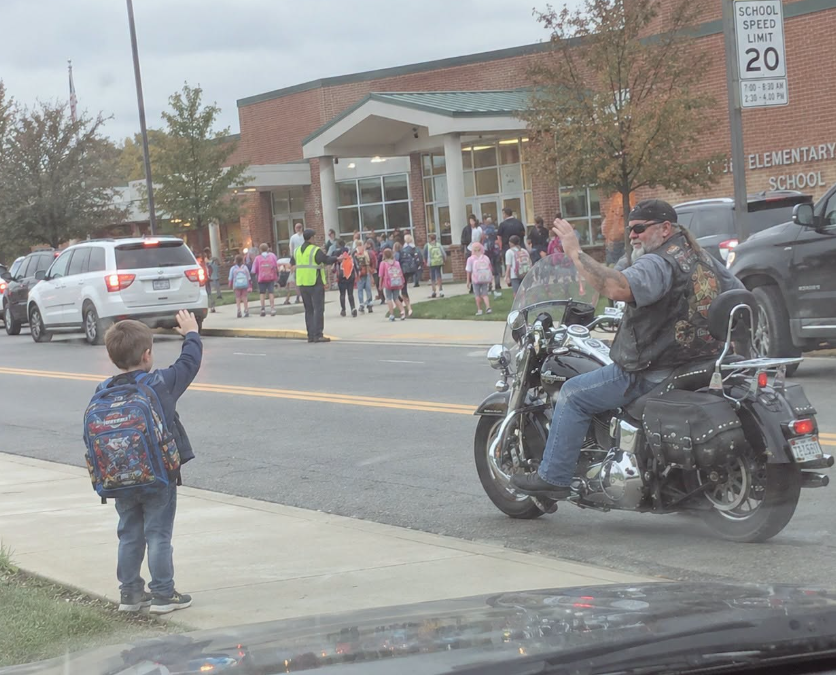
The next morning, the biker was there again.
Same motorcycle.
Same spot.
Caleb waved.
He waved back.
Wednesday.
Again.
Thursday.
Again.
Friday.
Again.
The following Monday it rained.
Not mist.
Real rain.
Cold sheets of it blowing sideways across the intersection.
The biker was there.
Rain jacket beneath his vest.
Helmet sitting on the seat.
Caleb nearly bounced in his booster.
“He came!”
I looked at him.
“Does he always come?”
Caleb shrugged.
“Most days.”
“How long have you known him?”
Another shrug.
“Long time.”
“What’s his name?”
He hesitated.
“I dunno.”
“You said he’s your friend.”
“He is.”
“But you don’t know his name?”
“He knows mine.”
That bothered me.
“How?”
Caleb looked out the window.
“I told him.”
Something tightened inside me.
“When?”
No answer.
“Caleb.”
“We’re late.”
“We are not late.”
He stared at his shoes.
I pulled into the drop-off lane.
A teacher opened the door.
“Morning, Caleb.”
“Morning.”
He jumped out.
Before walking toward the entrance, he turned.
Not toward me.
Toward the biker.
Wave.
Wave back.
Then Caleb disappeared into school.
I sat there long enough for the teacher directing traffic to motion impatiently at me.
That morning, I called my sister.
“There’s this man outside Caleb’s school.”
“What man?”
“A biker.”
“A biker?”
“Yes.”
“As in motorcycle?”
“No, as in Tour de France. Yes, motorcycle.”
“Okay.”
“He sits across the street every morning.”
“Doing what?”
“Watching.”
“Watching what?”
“The school.”
There was a pause.
“That sounds creepy.”
“Thank you.”
“Have you asked anybody?”
“Caleb says they’re friends.”
Longer pause.
“What?”
“Apparently my seven-year-old has a fifty-something-year-old biker friend.”
“Maria.”
“I know.”
“You need to talk to the school.”
“I probably will.”
“Probably?”
“I don’t want to accuse somebody of something because he owns a motorcycle.”
“You’re not accusing him. You’re asking.”
I knew she was right.
But there was another truth I didn’t say.
The biker scared me.
And I was embarrassed by that.
Nothing he had actually done was threatening.
He never approached the school.
Never crossed the street.
Never tried to speak to children.
Never photographed anyone.
Never followed us.
He simply sat there.
Morning and afternoon.
And waved to my son.
Still, by the end of October, I had memorized his routine.
7:35 a.m., he arrived.
Usually from the west.
Parked beneath the sycamore tree opposite the main gates.
Helmet off.
Motorcycle angled toward traffic.
At 8:05, after the bell, he left.
At 2:40, he returned.
At 3:15, once most children were gone, he left again.
Every school day.
Rain or shine.
For almost two months.
One afternoon I deliberately parked farther down the street to watch him.
I felt ridiculous.
Like some suburban private investigator.
The biker never left his motorcycle.
Children exited.
Parents arrived.
Crossing guard blew her whistle.
Caleb came through the gate.
He immediately searched across the street.
Saw the man.
His whole face changed.
Relief.
That was the word.
Not excitement.
Relief.
Caleb waved.
The biker waved.
Then my son climbed into our van.
“Good day?”
“Yeah.”
“What did you do?”
“Math.”
“Anything else?”
“Stuff.”
That had become his standard answer.
At home he was quieter lately.
Not dramatically.
Enough that I noticed, not enough that I acted.
He sometimes said his stomach hurt before school.
Children get stomachaches.
He had stopped asking for extra snacks after school.
I assumed he was eating more lunch.
He had lost two pencils, an eraser shaped like a shark, and a Spider-Man lunch bag in six weeks.
Kids lose things.
He stopped talking about recess.
I assumed second grade was becoming more academic.
That is how adults miss things.
Not because the signs are invisible.
Because each sign arrives with an innocent explanation.
You accept them one by one.
Then one day somebody puts them together for you.
Mine happened over cereal.
It was a Thursday morning.
Caleb sat at the kitchen table eating Cinnamon Toast Crunch.
I was packing my lunch.
He had barely touched his bowl.
“Eat.”
“I’m not hungry.”
“You’ll be hungry before lunch.”
“I’m okay.”
“You said your stomach hurt yesterday.”
“It doesn’t now.”
“Then eat.”
He pushed one square around with his spoon.
I looked at him.
Really looked.
Dark circles under his eyes.
His shoulders rounded.
Nails chewed.
Caleb had never chewed his nails before.
I sat across from him.
“Who is the motorcycle man?”
His spoon stopped.
“Mom.”
“No.”
He looked up.
“I’ve asked you nicely for almost two months.”
“He’s just my friend.”
“How did you meet him?”
Silence.
“Did he talk to you first?”
“No.”
“Did you?”
“No.”
“Then how are you friends?”
Caleb stared at the cereal.
“Because.”
“Because what?”
His mouth tightened.
I softened my voice.
“You’re not in trouble.”
That sentence did something.
His eyes immediately filled.
My heart dropped.
“Caleb?”
He rubbed one eye angrily.
“What happened?”
“Nothing.”
“Something happened.”
“No.”
“Look at me.”
He wouldn’t.
I moved around the table and knelt beside him.
“Baby, whatever it is, you can tell me.”
His bottom lip began trembling.
Then he said something I will hear for the rest of my life.
“He keeps me safe.”
I stared.
“Who?”
“The motorcycle man.”
“Safe from what?”
Caleb’s face folded.
“The boys.”
Every muscle in my body locked.
“What boys?”
He started crying silently.
“Caleb.”
“Don’t be mad.”
“I’m not mad at you.”
“Promise?”
“I promise.”
“Brandon and Devon and A.J.”
I knew one name.
Brandon Miller.
Third grader, I thought.
Maybe fourth.
“What do they do?”
Caleb wiped his nose with his sleeve.
“They take my lunch.”
I stared.
“What do you mean?”
“They take it.”
“Every day?”
He nodded.
“How long?”
Another shrug.
“How long, Caleb?”
“Since school started.”
September.
We were almost in November.
My mouth went dry.
“What else?”
He looked terrified.
“What else?”
“They push me.”
“Where?”
“Sometimes the swings.”
“What do you mean push you?”
“When I’m on them.”
My stomach turned.
“Do you fall?”
“Sometimes.”
“Have you been hurt?”
“No.”
That answer came too quickly.
“What else?”
Caleb started picking at the skin beside his thumbnail.
“They call me stuff.”
“What stuff?”
“Stupid.”
His voice barely existed.
“And fat.”
Caleb was not fat.
Not that it would have mattered.
“And crybaby.”
I closed my eyes for half a second.
“What else?”
He whispered, “Baby.”
“Baby?”
“They call me baby Caleb because I don’t fight.”
I swallowed.
“Do they hit you?”
“No.”
Then his eyes moved away.
I saw it.
“Caleb.”
“No.”
“Tell me the truth.”
“Not really.”
“What does not really mean?”
“They kick my backpack.”
“While you’re holding it?”
Silence.
“Caleb.”
“Sometimes.”
“Do they kick you?”
He pressed both lips together.
I felt cold despite the warm kitchen.
“Baby.”
“Only sometimes.”
I sat on the floor.
Literally.
My knees gave out.
“How did the motorcycle man get involved?”
Caleb sniffed.
“One day after school.”
“What happened?”
“They were by the fence.”
“Who?”
“The boys.”
“And?”
“They took my backpack.”
My hands began shaking.
“What did they do?”
“Threw my stuff.”
“What stuff?”
“My homework.”
“Your shark eraser?”
He nodded.
“That’s how it disappeared?”
Another nod.
“And your pencils?”
“Yes.”
“Your lunch bag?”
“They put it in the trash.”
I had to look away.
There are things that sound small when you say them about children.
An eraser.
A lunch bag.
Pencils.
But when you imagine a seven-year-old watching older children take his things, each object becomes evidence.
“Where was the biker?”
“At the light.”
“What happened?”
“He saw.”
I looked at him.
“Saw what?”
“I was sitting down.”
“Why?”
Caleb wouldn’t answer.
“Did they push you?”
He nodded.
“Then what?”
“The motorcycle got loud.”
I frowned.
“What?”
“He made it go really loud.”
“He revved the engine?”
Caleb nodded.
“The boys looked.”
“And?”
“The motorcycle man stared at them.”
“Did he come over?”
“No.”
“Did he threaten them?”
“No.”
“Did he say anything?”
“No.”
“They just ran?”
Caleb nodded.
“Because they thought he was scary.”
I sat silently.
“Then what happened?”
“He asked if I was okay.”
I felt something twist inside me.
“What did you say?”
“I said yes.”
Of course he did.
“He asked my name.”
“And you told him?”
“Yes.”
“Did he touch you?”
“No.”
“Did he offer you anything?”
“No.”
“Ask you to go anywhere?”
“No.”
“Take pictures?”
“No.”
“What did he say?”
Caleb thought.
“He said, ‘You got somebody coming?’”
My throat tightened.
“What did you say?”
“That you were coming.”
“Then?”
“He waited until your car came.”
I remembered that day.
At least, I thought I did.
I had been late.
Ten minutes.
Maybe fifteen.
A client call ran over.
Traffic was bad.
I had pulled up irritated and found Caleb standing near the gate.
He had climbed into the car quietly.
I asked why his backpack was dirty.
He said he dropped it.
I believed him.
I looked at my son.
“What happened after that day?”
“The motorcycle man came back.”
“The next day?”
“Yes.”
“And the next?”
“Yes.”
“For you?”
Caleb shrugged.
“I think.”
“And the boys?”
“They stopped.”
“Completely?”
“They don’t take my lunch when he’s there.”
“When he’s there?”
My voice sharpened.
Caleb flinched.
I immediately softened.
“Sorry.”
“They still say stuff sometimes.”
“Inside school?”
He nodded.
“Why haven’t you told anyone?”
“I did.”
I stared.
“Who?”
“Mrs. Hall.”
His recess aide.
“What did she say?”
“She said ignore them.”
My blood pressure rose.
“Did you tell your teacher?”
“No.”
“Why?”
“Mr. Brennan is busy.”
“He is your teacher.”
“He has all the kids.”
“What about the counselor?”
Caleb shook his head.
“What about me?”
That was the question.
The painful one.
His eyes lowered.
“Why didn’t you tell me?”
He whispered, “Because I thought you’d make it worse.”
It hurt.
I deserved it.
“Why?”
“You’d come to school.”
“Yes.”
“And talk to everybody.”
“Yes.”
“And then the boys would know.”
“Yes.”
“And they said if I told, they’d get me when motorcycle man wasn’t there.”
I couldn’t breathe properly.
Then Caleb looked at me and said:
“But he keeps me safe, Mom.”
His voice was so sincere.
“So I wave.”
I stared at him.
“He keeps me safe because nobody else did.”
Something broke inside me.
Not dramatically.
Not loudly.
Just one clean fracture.
Because my son wasn’t accusing me.
That was what made it worse.
He was explaining.
As if it were perfectly reasonable that a stranger on a motorcycle had become his security system.
As if adults failed children sometimes and kids simply adapted.
I pulled him into my arms.
He stiffened for a second.
Then clung to me.
“I’m sorry.”
He started crying harder.
“You’re not in trouble.”
“I know.”
“No, listen.”
I pulled back.
“You did nothing wrong.”
“They said I’m a tattletale.”
“You are not.”
“They said nobody likes tattletales.”
“I like tattletales.”
He almost laughed.
“I love tattletales.”
“That’s weird.”
“Then I’m weird.”
I kissed his forehead.
“You tell me when somebody hurts you.”
“But—”
“Every time.”
“What if it makes you sad?”
My heart stopped.
“What?”
He shrugged.
“You get sad when stuff happens.”
“What stuff?”
He wouldn’t answer.
I knew.
His father.
My divorce.
The year after Luis left.
Not died.
Not disappeared.
Left.
That was another thing I had not yet told the biker.
Luis had moved to Texas eighteen months earlier after years of instability between us.
He called Caleb sometimes.
Not enough.
He promised weekends he canceled.
Birthday trips that never happened.
Caleb loved him anyway.
Children are loyal to hope long after adults have accepted evidence.
Maybe that was part of why he stayed silent.
I had been struggling.
Bills.
Work.
Single motherhood.
Anger I tried not to show.
Caleb had been watching.
He thought protecting me meant carrying his own problems alone.
I held his face.
“You are not responsible for keeping me happy.”
“But—”
“No.”
I said it firmly.
“That is my job.”
I tapped his chest.
“Your job is to be seven.”
He sniffed.
“What do seven-year-olds do?”
“Lose pencils.”
Despite everything, I laughed.
“Yes.”
“Eat cereal.”
“Yes.”
“Play Minecraft.”
“Too much.”
He smiled slightly.
“And tell their moms when somebody is hurting them.”
His smile disappeared.
“Okay.”
I drove him to school that morning.
The biker was there.
Caleb waved.
The man waved back.
Then I parked.
“Mom?”
“I’m not going inside yet.”
Caleb looked nervous.
“I’m going to talk to him.”
His eyes widened.
“No.”
“Why?”
“He’ll leave.”
The terror in those words stunned me.
“He won’t.”
“You don’t know.”
“You’re right.”
I took a breath.
“So I’m going to ask.”
I walked Caleb to the gate first.
Watched him enter.
Waited until he was inside.
Then crossed the street.
Up close, the biker was less frightening.
Still large.
Still rough.
But older than I had thought.
Maybe fifty-five.
Maybe closer to sixty.
Gray threaded through his beard.
Fine wrinkles around his eyes.
His left hand had a tremor.
The tattoo on his forearm was clearer.
NATHAN MICHAEL DALTON
1998–2011
My eyes stopped there.
Thirteen.
The biker saw me looking.
His face closed slightly.
“I’m Caleb’s mother.”
He nodded.
“Figured.”
“You know who I am?”
“Blue minivan.”
That should have bothered me.
Instead, I felt embarrassed.
“Maria Torres.”
“Ray Dalton.”
He held out a hand.
I hesitated only a second before taking it.
His grip was careful.
Not crushing.
“What did Caleb tell you?”
I asked.
Ray leaned against his motorcycle.
“Enough.”
“Why didn’t you come to me?”
“Didn’t know you.”
“You knew my car.”
“Knowing your minivan ain’t knowing you.”
Fair.
“Why didn’t you tell the school?”
“I did.”
My anger shifted instantly.
“What?”
“Called the day after I saw it.”
“Who did you speak with?”
“Woman in the office.”
“Name?”
“Didn’t write it down.”
“What did she say?”
“They’d look into it.”
“And?”
“And I came by the next week.”
His eyes moved toward the gate.
“Same kids.”
“What were they doing?”
“Cornered your boy near the fence.”
I closed my eyes.
“Did you call again?”
“No.”
“Why?”
“Because I’d already learned what ‘we’ll look into it’ meant.”
“That doesn’t mean you get to—”
I stopped.
Get to what?
Park legally across the street?
Wave?
Exist?
Ray waited.
I started again.
“Why did you keep coming?”
He looked at me.
“Your boy tell you what happened the first day?”
“Yes.”
“All of it?”
“I think so.”
Ray rubbed his beard.
“I was stopped at the light.”
His voice changed.
Less defensive.
More distant.
“Three bigger kids had him down.”
My stomach clenched.
“Down?”
“On the ground.”
Caleb had said sitting.
Not why.
Ray continued.
“They were kicking his backpack back and forth.”
My eyes burned.
“Your boy was sitting there.”
He looked at me directly.
“Wasn’t crying.”
Somehow that was worse.
“Wasn’t yelling.”
His jaw tightened.
“Wasn’t fighting.”
I swallowed.
“He just watched them.”
Ray glanced toward the school.
“Like it happened all the time.”
I covered my mouth.
“I revved the bike.”
“The boys ran.”
“Yeah.”
“What did you say to Caleb?”
“Asked if he was hurt.”
“He said no.”
“Of course he did.”
Ray almost smiled sadly.
“Asked if somebody was coming.”
“He said me.”
“Yeah.”
“I was late.”
“He said traffic.”
“He defended me?”
Ray looked at me.
“That kid defends everybody.”
I had to turn away.
When I faced him again, I asked the question that changed both our lives.
“Why three months?”
Ray stared at the handlebars.
“What?”
“You saw him once.”
“Yes.”
“You reported it.”
“Yes.”
“You saw it again.”
“Yes.”
“You could have left.”
“Yes.”
“You could have decided it wasn’t your problem.”
“Yes.”
“But you’ve been here every school day.”
He didn’t answer.
“Why?”
His hand moved.
For the first time, I noticed he was rubbing the tattoo.
Nathan’s name.
Slowly.
Over and over.
“Because I didn’t do it for mine.”
My anger disappeared.
“What?”
Ray’s shoulders dropped.
“I had a boy.”
I looked at the tattoo.
“Nathan?”
He nodded.
“Born June 17, 1998.”
He smiled faintly.
“Skinny little thing.”
His eyes softened.
“Big ears.”
The smile disappeared.
“Loved drawing.”
“What happened?”
Ray stared across the street.
At the elementary school.
“He was like Caleb.”
Quiet.
Sensitive.
Not interested in sports.
Didn’t want to wrestle.
Didn’t care about football.
Loved comic books.
Could spend six hours drawing superheroes.
“Third grade,” Ray said, “kids started calling him names.”
He had told his father.
Ray responded the way his father had responded to him.
Ignore it.
Toughen up.
Hit back.
“Thought I was teaching him how to be a man.”
His voice filled with disgust.
“When you were raised by a man who thought feelings were infections, you repeat some stupid things.”
“What happened?”
“Names became shoving.”
“Did the school know?”
“Sometimes.”
“And?”
“Same stuff schools always said back then.”
He counted on his fingers.
“Conflict.”
“Social difficulties.”
“Boys testing boundaries.”
He laughed bitterly.
“Nathan told me.”
I waited.
“And I told him to fight back.”
Ray looked down.
“He said he couldn’t.”
I could hear the shame in every word.
“I told him that was the problem.”
My heart hurt.
“I said bullies can smell weakness.”
His voice cracked slightly.
“Those exact words.”
I said nothing.
“What happened after?”
“Nathan stopped telling me.”
Ray took a slow breath.
“I thought that meant he’d handled it.”
He looked at me.
“You know how good silence feels when you’re a parent?”
I understood too well.
“You ask if everything’s okay.”
He continued.
“They say yeah.”
“And you’re relieved.”
“Yes.”
“So relieved you don’t ask why they answered too fast.”
I thought of Caleb.
Yeah.
Stuff.
Fine.
Ray’s voice lowered.
“Seventh grade.”
He swallowed.
“October 14, 2011.”
My skin chilled.
“I worked maintenance at the county hospital.”
He was scheduled until four.
Traffic made him late.
He got home at 4:38.
Nathan’s bedroom door was locked.
“I knocked.”
No answer.
“Called him.”
Nothing.
“I got mad.”
Ray closed his eyes.
“Actually got mad because the door was locked.”
I couldn’t breathe.
“I told him if he didn’t open it, I was taking the hinges off.”
His fingers tightened around the handlebars.
“No answer.”
Then Ray knew.
Not why.
Just wrong.
“I broke the door.”
He stopped.
I waited.
He didn’t describe what he saw.
He didn’t need to.
“He was twelve.”
His voice barely carried.
“Left a note.”
My eyes filled.
“Three sentences.”
Ray stared through me.
“‘I’m tired of being scared.’”
He swallowed.
“‘I’m tired of being alone.’”
His mouth trembled.
“‘Nobody’s coming to help.’”
I started crying.
Not politely.
Not quietly.
Ray looked away to give me privacy.
That made me cry harder.
“I was ten miles away,” he continued.
“Working.”
He rubbed Nathan’s tattoo.
“Thinking everything was fine.”
His voice turned rough.
“I told my boy to toughen up instead of showing up.”
“Ray…”
“No.”
He shook his head.
“I know people mean well when they say don’t blame yourself.”
He looked at me.
“I don’t need you to say it.”
So I didn’t.
Some grief is too complicated for strangers to forgive.
He continued.
“When I saw Caleb sitting against that fence…”
His voice broke completely.
Same quiet boy.
Same expression.
Same surrender.
“I couldn’t ride past.”
His eyes filled.
“I just couldn’t.”
We stood there while traffic moved around us.
Parents drove away.
School settled into its morning rhythm.
The bell rang.
Ray wiped his face.
“Didn’t plan on three months.”
“What was the plan?”
“Come back the next day.”
“And then?”
“Next day after that.”
“That’s three months.”
“Yeah.”
“Do you have somewhere else to be?”
He almost smiled.
“Retired.”
“From?”
“Utilities.”
He tapped one of the military patches.
“Marines before that.”
“Desert Storm?”
“Yeah.”
“Combat?”
He shrugged.
“That’s usually what they send Marines places for.”
Despite myself, I laughed.
Then stopped.
“Ray.”
“Yeah?”
“Thank you.”
His face hardened almost immediately.
“Don’t.”
“For my son.”
“I’m not doing anything.”
“You’re here.”
He looked toward the school.
“Sometimes that’s something.”
I sat in my car after he rode away and cried for forty minutes.
Not only because of Nathan.
Not only because of Caleb.
Because I realized how close the two stories were.
Different endings.
That was all.
Different endings because one stranger at a traffic light had looked long enough to notice.
At 9:02, I walked into Willow Creek Elementary.
I asked to see the principal.
The secretary smiled.
“Do you have an appointment?”
“No.”
“Mrs. Whitfield is quite busy.”
“So am I.”
She blinked.
“My son has been physically and verbally bullied for approximately two months. A concerned adult reported it to this office weeks ago, and nothing was done.”
Her smile disappeared.
“One moment.”
Seven minutes later, I sat across from Principal Denise Whitfield.
She was in her late fifties.
Perfectly arranged silver-blonde hair.
Pearl earrings.
Calm voice.
The kind of office full of slogans about kindness.
BE THE REASON SOMEONE SMILES TODAY.
CHOOSE KIND.
EVERY CHILD MATTERS.
I found myself staring at that last one.
“How can I help you, Mrs. Torres?”
“My son is Caleb Torres.”
She typed.
“Second grade.”
“Yes.”
“Mr. Brennan’s class.”
“Yes.”
“What seems to be the concern?”
“Three older boys have been taking his lunch, taking his belongings, pushing him off playground equipment, calling him names, and cornering him near the fence.”
Her fingers stopped.
“How long?”
“Since September.”
“And this is the first report you’ve made?”
That sentence made me understand immediately how these conversations go wrong.
“No.”
She looked up.
“A man named Ray Dalton called your office weeks ago.”
“I don’t recognize the name.”
“He rides a motorcycle.”
A flicker of recognition.
Tiny.
There.
“You know.”
“I may recall a call involving someone observing students from off campus.”
“Observing?”
“I don’t have the documentation in front of me.”
“Find it.”
Her expression changed.
“Mrs. Torres—”
“Find it.”
She typed again.
Clicked.
Frowned.
“I don’t see a formal report.”
“Was there a call?”
“I would need to check.”
“So a grown adult told your office my son was being bullied, nobody documented it, and nobody followed up.”
“That isn’t what I said.”
“It’s exactly what you said.”
She folded her hands.
“We take bullying very seriously.”
“My son says the only reason he feels safe here is because a stranger parks across the street on a Harley every day.”
She blinked.
Not the polished administrator blink.
A real one.
I continued.
“He does not feel protected by you.”
Silence.
“He does not feel protected by his teacher.”
Silence.
“He did not feel protected by me because he never told me.”
My voice shook.
“But that man saw him once.”
I pointed toward the window.
“And has shown up for almost three months.”
Mrs. Whitfield looked toward the street.
Ray had already left.
I leaned forward.
“Do you understand how unacceptable that is?”
“Yes.”
The answer surprised me.
Good.
“I want his teacher here today.”
“I can arrange—”
“Today.”
“Yes.”
“And I want to know what happens with those boys.”
“We have procedures.”
“Use them.”
She scheduled a meeting for two.
Caleb’s teacher, Mr. Brennan, arrived looking terrified.
He was young.
Twenty-five at most.
Second year, I later learned.
He sat with his knees pressed together and his hands clasped.
“I’m so sorry.”
“Did you know?”
“No.”
I believed him.
That made me angrier in a different way.
“How?”
His face reddened.
“Caleb is quiet.”
“I know.”
“He finishes his work.”
“I know.”
“He doesn’t cause problems.”
“That should not make him invisible.”
“No.”
“He stopped eating lunch.”
“I’m not in the cafeteria with them.”
“He stopped talking about recess.”
“There are recess aides.”
“One told him to ignore it.”
Mr. Brennan looked stunned.
“Who?”
“Mrs. Hall.”
Principal Whitfield wrote something.
I continued.
“His lunch was stolen.”
Mr. Brennan looked horrified.
“He told me he didn’t like turkey sandwiches.”
I stared.
“What?”
“Two weeks ago.”
His face changed as he understood.
“He asked if he could skip lunch because he didn’t like what was packed.”
I closed my eyes.
He had been covering for them.
Again.
Protecting adults from information.
Mr. Brennan looked sick.
“I should have—”
“Yes.”
I opened my eyes.
“You should have.”
I gave them the names.
Brandon Miller.
Devon Hayes.
A.J. Russo.
Principal Whitfield knew them.
I saw it.
“Have there been issues before?”
She hesitated.
“Behavior concerns.”
“What does that mean?”
“Nothing involving Caleb that has been documented.”
“Stop saying documented like paper is the difference between whether something happened.”
That hit.
She looked ashamed.
Good.
The boys were called in separately.
By four o’clock, the school had enough.
Lunch theft.
Name-calling.
Pushing.
Taking school supplies.
Blocking Caleb near the fence.
Brandon was the leader.
Devon and A.J. followed.
Two other children confirmed it.
One girl said she had seen Caleb crying behind the swings.
She thought “the teacher knew.”
Nobody had told the teacher.
Everyone assumed somebody else knew.
That sentence became the theme of the investigation.
Everyone thought somebody else knew.
The school called parents.
Devon’s mother cried and apologized.
A.J.’s father drove directly from work and made his son return two missing pencils and a water bottle that evening.
Brandon’s mother was different.
I heard her before I saw her.
“This is ridiculous.”
She stood in the hallway wearing expensive workout clothes.
Phone in one hand.
Car keys in the other.
“They’re children.”
Principal Whitfield tried to lower her voice.
“Mrs. Miller—”
“Boys roughhouse.”
“My son wasn’t roughhousing,” I said.
She turned.
“You’re the mother?”
“Yes.”
“Brandon says your son is sensitive.”
I stared at her.
“My son being sensitive does not make him public property.”
“I didn’t say that.”
“You implied it.”
“Brandon said they were joking.”
“Did Caleb laugh?”
She opened her mouth.
Nothing.
“Did he give them his lunch willingly?”
Silence.
“Did he choose to be pushed off a swing?”
Her face hardened.
“You don’t need to attack me.”
“No.”
I stepped closer.
“But your son has been attacking mine.”
Principal Whitfield intervened.
“Mrs. Torres.”
I stopped.
Brandon’s mother shook her head.
“This generation is helpless. When we were kids, we handled things ourselves.”
A voice behind us said, “That’s how kids learn nobody’s coming.”
We all turned.
Ray.
I had not known he was there.
Leather vest.
Helmet under one arm.
He stood at the end of the hall.
Brandon’s mother looked at him.
“Who are you?”
“Concerned citizen.”
“Ray,” I said.
He looked at me.
“I’m not doing anything.”
I almost smiled.
Principal Whitfield looked nervous.
“Mr. Dalton, visitors need to sign in.”
He lifted a bright yellow visitor sticker.
Already there.
Of course.
Brandon’s mother stared.
“You’re that man.”
Ray said nothing.
“The biker.”
Nothing.
“You’ve been intimidating my son.”
Ray’s face remained blank.
“Have I spoken to your son?”
“No.”
“Touched him?”
“No.”
“Threatened him?”
“No.”
“Then I reckon your son’s intimidated by his own imagination.”
She turned to the principal.
“This is insane.”
Ray looked at her.
“Ma’am.”
She glared.
He spoke quietly.
“Your boy’s got time to learn better.”
That softened something in me.
He didn’t call Brandon bad.
Didn’t threaten him.
Didn’t humiliate his mother.
He simply said:
“He’s got time.”
Brandon shoved Caleb one final time three days later.
Near the drinking fountain.
A teacher saw it.
Brandon received a two-day suspension.
He never touched Caleb again.
The verbal bullying took longer to stop.
Kids adapt.
When adults watch hallways, cruelty moves to whispers.
So Caleb began counseling on Wednesdays.
He got a buddy system.
Mr. Brennan rearranged lunch seating.
Recess supervisors rotated zones.
Principal Whitfield established a check-in each Friday.
Not perfect.
Better.
And every morning Ray was across the street.
At first I brought him coffee because I did not know how else to repay presence.
“What do you drink?”
“Coffee.”
“I know. How?”
“Black.”
“Of course.”
“Two sugars.”
I stared.
He frowned.
“What?”
“That somehow makes you less intimidating.”
“Don’t spread it around.”
So every morning:
One coffee for me.
Black, two sugars for Ray.
Caleb waved.
Ray waved back.
Then we talked for five minutes.
I learned his life slowly.
He joined the Marines at eighteen.
Went to Saudi Arabia.
Then Kuwait.
Came home at twenty-two convinced surviving war meant he understood hardship.
“It did not.”
He married Nathan’s mother, Elise, at twenty-four.
Nathan came later.
Only child.
Their entire world.
After Nathan died, the marriage collapsed.
“Did she blame you?”
Ray stared into his coffee.
“Sometimes.”
“Did you blame her?”
“No.”
“Did you blame yourself?”
“Every day.”
“What happened?”
“We stopped being married.”
Not dramatic.
No cheating.
No screaming final scene.
Just two people unable to look at each other without seeing the worst day of their lives.
“We lasted eleven months.”
Then Ray started riding.
Long distances.
No plan.
Colorado.
Arizona.
Texas.
Montana.
“I thought if I moved far enough, grief would lose the address.”
“Did it?”
He looked at me.
“No.”
“You can’t outrun it?”
“It rides pillion.”
I smiled.
“Pillion?”
“Passenger seat.”
“Biker vocabulary.”
“You suburban people got minivan vocabulary?”
“Yes.”
“What?”
“Cup holder.”
He laughed.
That was the first time I heard it.
Big.
Unexpected.
After a few years, Ray joined a veterans’ motorcycle club.
Not an outlaw club.
Charity rides.
Hospital visits.
Toy drives.
Funeral escorts.
Veterans helping veterans.
“Why children’s charities?”
I already knew.
He answered anyway.
“Can’t help Nathan.”
A pause.
“Can help somebody.”
One morning in January, Caleb came running toward us.
He had started talking more.
Not just to me.
To everyone.
“Ray!”
Ray turned.
“What’s up, partner?”
“I got something.”
Caleb pulled a folded piece of construction paper from his backpack.
“Mom said I could give you.”
I had not seen the finished version.
He handed it over.
Ray opened it.
A motorcycle drawn in black crayon.
Flames coming from the back.
A stick figure with an enormous gray beard.
Stars.
Three badly drawn skulls.
At the top:
DEAR MOTORCYCLE MAN.
THANK YOU FOR BEING MY FRIEND.
YOU ARE BRAVE AND COOL.
LOVE CALEB.
Ray stopped moving.
His thumb touched the drawing.
Then the words.
Back to the drawing.
He turned slightly away.
I saw his shoulders rise once.
Caleb looked worried.
“Do you like it?”
Ray put one hand over his face.
No sound.
Just tears moving into his beard.
This man had survived war.
Buried a child.
Lost a marriage.
Spent years carrying grief across highways.
And one seven-year-old’s crayon motorcycle broke him completely.
Caleb stepped closer.
“Ray?”
Ray lowered his hand.
“Yeah.”
“You okay?”
“Yeah.”
His voice failed.
He cleared it.
“Yeah, partner.”
“You can put it somewhere if you want.”
Ray folded the card with almost absurd care.
Opened the inside pocket of his vest.
Placed it there.
Over his heart.
“I know exactly where it goes.”
Then he knelt.
“You know something?”
“What?”
“You are the bravest kid I know.”
Caleb smiled.
“I’m not brave.”
“You wave at ugly bikers.”
“That’s true.”
I burst out laughing.
Ray stared at him.
“Traitor.”
That spring, Caleb’s life began widening again.
A boy named Marcus started sitting with him at lunch.
Marcus had curly hair, asthma, and an obsession with sharks.
A girl named Priya liked drawing comics.
The three of them started spending recess building stories about a superhero named Captain Llama.
Caleb stopped asking to stay home with stomachaches.
His lunch came home empty because he ate it.
His pencils stopped disappearing.
He still checked for Ray every morning.
But the look on his face changed.
Less relief.
More affection.
That difference meant everything.
Ray came fewer days.
Four mornings.
Then three.
Sometimes only Monday and Friday.
The first morning he didn’t appear, Caleb noticed.
“Where’s Ray?”
“I don’t know.”
“Is he okay?”
“I’m sure.”
He looked worried.
Then Marcus ran up.
“Caleb!”
Caleb looked from the empty parking spot to Marcus.
Then ran toward his friend.
I cried in the van.
Not because Ray was gone.
Because Caleb could walk through the gate without him.
That was the point.
Security should become confidence.
Not dependency.
A month later, Caleb’s eighth birthday arrived.
We invited fourteen kids.
Ten came.
That number meant more to me than it should have.
Ray arrived last.
Leather vest.
Wrapped gift beneath one arm.
Caleb saw him through the window.
“RAY!”
He screamed so loudly three parents jumped.
He ran.
Ray braced.
Caleb crashed into him.
Ray hugged him back.
“Happy birthday, partner.”
“You came.”
“Invited, wasn’t I?”
“Yes!”
“Then I came.”
Such a simple statement.
It almost made me cry.
Ray gave Caleb a professional drawing set.
Graphite pencils.
Colored pencils.
Charcoal.
Sharpener.
Sketchbook with thick paper.
Caleb stared.
“This is expensive.”
“That is an adult problem.”
I looked at Ray.
“You spent too much.”
“That is also an adult problem.”
Caleb opened the sketchbook.
On the first page, Ray had written:
DRAW EVERYTHING YOU SEE.
DRAW THE THINGS YOU WISH YOU COULD SEE TOO.
Caleb looked up.
“Did Nathan draw?”
Ray froze.
I had told Caleb carefully about Nathan.
Not how he died.
Only that Ray had a son who died very young and loved drawing.
“Yeah.”
“What did he draw?”
“Superheroes.”
Caleb grinned.
“Me too.”
Ray swallowed.
“I know.”
The following week, Caleb handed Ray a new drawing.
A biker in a cape.
Huge muscles.
Motorcycle with flames.
Across the chest:
RAY THE PROTECTOR.
Ray pretended to hate it.
He had it framed.
By spring, other parents had learned the story.
Not all details.
Enough.
The suspicious looks stopped.
A mom named Jennifer started bringing Ray coffee if I was late.
Another parent gave him Christmas cookies.
The crossing guard knew his name.
Mr. Brennan waved.
Even Principal Whitfield occasionally crossed the street to say hello.
That relationship took time.
Ray had not forgiven the school.
Not completely.
Neither had I.
But Mrs. Whitfield did something important.
She stopped defending.
At a school board meeting, she said publicly:
“We missed repeated signs that a child was being harmed.”
Not:
Communication could have been better.
Not:
Procedures were followed.
She said:
“We failed to connect what students and adults were telling us, and Caleb paid the price.”
Parents were stunned.
Administrators rarely speak that way.
She created a new reporting protocol.
Every bullying concern from any source—student, parent, staff member, neighbor—had to be logged and acknowledged.
No more disappearing phone calls.
No more “we’ll look into it” without ownership.
Mr. Brennan received mentorship.
Additional recess coverage was added.
None of it erased what happened.
But change is one form of apology.
Eight months after my conversation with Caleb over cereal, Willow Creek held a bullying-prevention assembly.
Mrs. Whitfield asked Ray to speak.
He refused immediately.
“No.”
She tried again.
“No.”
I tried.
“No.”
Mr. Brennan tried.
“No.”
Finally Caleb asked.
We were standing outside school.
“Please?”
Ray looked at him.
“No.”
“You’re good at talking.”
“Objectively false.”
“You talk to Mom a lot.”
“Your mom won’t stop.”
“Ray.”
I punched his shoulder.
Caleb continued.
“You’re the bravest person I know.”
Ray’s face changed.
The same expression he had when Caleb handed him the card.
He looked toward the school.
Then sighed.
“Five minutes.”
The gym held nearly three hundred students.
Parents filled bleachers.
Teachers lined walls.
Ray stood behind the curtain like a man waiting for surgery.
“You fought in a war,” I whispered.
“That was easier.”
“Than second graders?”
“Much.”
Mrs. Whitfield introduced him simply.
“Someone who chose not to walk past.”
Ray walked onto the gym floor.
No podium.
Leather vest.
Jeans.
Boots.
Children immediately whispered.
He waited.
The room settled.
“My name is Ray Dalton.”
He cleared his throat.
“I ride the motorcycle some of you see outside.”
A few kids smiled.
“I’m not a teacher.”
Pause.
“Not a counselor.”
Pause.
“Definitely not a principal.”
Laughter.
Mrs. Whitfield smiled.
“I had a son.”
The room changed.
Ray looked toward Caleb.
His voice steadied.
“His name was Nathan.”
He told them Nathan liked comics.
Drawing.
Quiet places.
He told them kids bullied him.
He did not describe Nathan’s death explicitly.
He simply said:
“They hurt him so badly for so long that eventually he decided he did not want to be here anymore.”
Adults went very still.
Kids understood enough.
Ray continued.
“My boy asked for help.”
His jaw tightened.
“And I told him to toughen up.”
I watched parents.
Several lowered their heads.
“I thought brave meant fighting back.”
He looked around.
“I was wrong.”
Silence.
“Brave is telling.”
He pointed toward the children.
“Brave is telling even when somebody calls you a snitch.”
Then toward the teachers.
“Brave is listening when a kid tells you something that makes your day harder.”
Then toward parents.
“Brave is asking twice when your kid says everything is fine too fast.”
I cried.
Ray continued.
“And if you see somebody alone…”
His voice softened.
“You do not have to fight anybody.”
“You do not need muscles.”
“You do not need a motorcycle.”
A few kids laughed.
“Sit with them.”
“Wave.”
“Tell a teacher.”
“Tell your mom.”
“Tell your dad.”
“Tell another teacher if the first one doesn’t listen.”
His eyes found Caleb.
“Keep telling until somebody comes.”
Caleb’s face was wet.
Ray’s voice cracked.
“Because no kid should ever believe nobody is coming.”
The entire gym was silent.
Then Caleb stood.
He started clapping.
Small hands.
Fast.
Marcus stood beside him.
Then Priya.
Mr. Brennan.
Me.
One row.
Another.
Another.
Within seconds, three hundred people were standing.
The sound became enormous.
Ray looked overwhelmed.
He didn’t wave.
Didn’t smile.
He simply nodded.
Slowly.
Once.
Twice.
Like a man acknowledging something far away.
Afterward, he disappeared.
I found him outside behind the gym.
Sitting on the curb.
Helmet between his knees.
“You okay?”
“No.”
I sat beside him.
“Want to leave?”
“In a minute.”
We listened to children inside.
“What are you thinking?”
He looked at the pavement.
“That Nathan would hate this.”
I laughed through tears.
“Why?”
“He hated attention.”
“He might be proud.”
Ray’s face tightened.
“I hope.”
I put a hand on his shoulder.
“For what it’s worth…”
He waited.
“I think you spent years thinking that because you failed once, everything afterward had to be punishment.”
He said nothing.
“But what you’re doing for Caleb isn’t punishment.”
“What is it?”
I looked toward the gym.
“Love with somewhere to go.”
Ray lowered his head.
We sat there a long time.
That should have been the end.
It wasn’t.
Stories like ours rarely finish at the emotional speech.
Real change gets tested.
Two weeks after the assembly, Brandon Miller’s mother filed a complaint against Ray.
I found out from Principal Whitfield.
She called me at work.
“There’s an issue.”
My stomach tightened.
“What happened?”
“Mrs. Miller alleges Mr. Dalton has been surveilling her son.”
“That’s ridiculous.”
“I agree based on what I currently know.”
“Currently?”
“She contacted the district and the police.”
I stood.
“The police?”
“Yes.”
“She’s saying Ray is following Brandon?”
“She says his presence outside the school is intimidation.”
My hands shook.
“He parks on a public street.”
“I know.”
“He has never spoken to Brandon.”
“I know.”
“He helped my son.”
“I know.”
“But?”
Mrs. Whitfield sighed.
“District counsel has asked that we request he not park directly outside the school until the complaint is reviewed.”
I felt betrayed all over again.
“You’re banning him.”
“No.”
“That’s what it sounds like.”
“We’re asking temporarily.”
“Because the mother of the kid who bullied my son is uncomfortable?”
“I understand how this looks.”
“No, you don’t.”
“Maria.”
“If you make Ray leave, you are proving exactly what Caleb believed.”
Silence.
“That the person who showed up gets pushed out while everybody else protects procedure.”
Mrs. Whitfield’s voice softened.
“I’m trying not to do that.”
“Then don’t.”
That afternoon, Ray was already gone when I arrived.
Caleb noticed immediately.
“Where’s Ray?”
“I don’t know.”
He looked at me.
“Is he in trouble?”
Children always know.
“Some adults are sorting something out.”
“Because of Brandon?”
My silence answered.
Caleb’s eyes filled.
“That’s not fair.”
“No.”
“Did Ray do something?”
“No.”
“Then why?”
I had no good answer.
At home, he went to his room.
Didn’t slam the door.
Caleb never slammed doors.
Somehow that made me angrier.
I called Ray.
He answered.
“Hey.”
“Where are you?”
“Shop.”
“You’re not coming tomorrow?”
“Probably shouldn’t.”
“You didn’t do anything.”
“I know.”
“Then why are you accepting this?”
He was quiet.
“Because it’s not worth making the school harder for Caleb.”
“That’s not your decision.”
“It kind of is.”
“Ray.”
“Maria.”
His voice was calm.
“Your boy doesn’t need me across the street anymore.”
“That isn’t the point.”
“No.”
He paused.
“But it matters.”
I drove to his house.
No invitation.
I arrived twenty minutes later.
He lived in a small ranch house outside town.
Motorcycle in the garage.
American flag.
Old pickup.
I knocked.
Ray opened the door.
“You’re a pain in the ass.”
“Move.”
He moved.
The living room stunned me.
Not because it was unusual.
Because of the walls.
Nathan.
Everywhere.
Baby Nathan.
Kindergarten Nathan.
Nathan holding a crayon drawing.
Nathan in a Spider-Man Halloween costume.
Nathan at ten.
Nathan at twelve.
Then one picture near the hallway stopped me.
Nathan sitting on a park bench.
Skinny.
Dark hair.
Huge glasses.
The expression.
I knew it.
Because I had seen it on Caleb.
Quiet resignation.
“You kept everything.”
Ray stood behind me.
“Most.”
On a shelf sat Caleb’s card.
Framed.
Beside Nathan’s drawings.
I looked at Ray.
“You put them together.”
He shrugged.
I picked up the frame.
A child’s motorcycle.
THANK YOU FOR BEING MY FRIEND.
“You know what Brandon’s mom is doing?”
“Trying to protect her kid.”
“From you.”
“Still protecting.”
“She’s protecting him from consequences.”
“Maybe.”
“You’re too forgiving.”
Ray laughed.
“Nobody has ever accused me of that.”
“You should fight this.”
His face changed.
“You know what I learned after Nathan?”
“What?”
“There are fights you win by refusing to leave.”
I waited.
“And fights you win by refusing to make yourself the story.”
That stopped me.
“This isn’t supposed to become about the scary biker.”
He pointed toward Caleb’s framed card.
“It’s about kids being safe.”
“But she’s lying.”
“Then facts will do the work.”
They did.
Police reviewed the complaint.
No threats.
No contact.
No stalking.
Ray had parked legally.
School camera footage confirmed he remained across the street.
Other parents provided statements.
Crossing guard.
Teachers.
Me.
Even Principal Whitfield.
Complaint closed.
The district withdrew its request.
Mrs. Miller did not apologize.
Ray did not ask her to.
He returned the following Monday.
Caleb saw him.
Ran halfway across the drop-off path before remembering traffic.
“RAY!”
Ray raised a hand.
Caleb gave that same huge wave.
I stood beside the minivan crying.
Another mother handed me a tissue.
“You’re Caleb’s mom, right?”
“Yes.”
“I’m Priya’s.”
She nodded toward Ray.
“That him?”
“That’s him.”
She smiled.
“My daughter says he’s the reason Caleb talks at lunch now.”
I looked at her.
“Really?”
“She says Caleb used to sit with his food and not speak.”
I hadn’t known.
“She started drawing with him because she saw him wave to the motorcycle guy.”
My throat tightened.
“She figured if Caleb knew somebody that cool, he couldn’t be that weird.”
I laughed.
“Please tell her I said thank you.”
“She already knows.”
That was when I started understanding Ray’s effect had spread beyond the thing he came to fix.
He had not just frightened off bullies.
He had made Caleb visible.
Visible children are harder to isolate.
By the following school year, Ray no longer came every day.
Sometimes once a week.
Sometimes twice a month.
Caleb had Marcus.
Priya.
Soccer, briefly, which he hated.
Art club, which he loved.
He still waved when Ray came.
Ray always waved back.
Luis visited more consistently for a while.
Then less.
That remained complicated.
Ray never tried to replace him.
Not once.
If Caleb complained about his father, Ray never insulted Luis.
“Your dad’s your dad,” he said.
“Adults can love you and still be bad at showing up.”
That line hit me too.
One afternoon, when Caleb was nine, he asked Ray:
“Do you wish Nathan was me?”
I nearly dropped my coffee.
Ray went completely still.
“Why would you ask that?”
Caleb shrugged.
“Because I remind you of him.”
Ray considered his answer.
Then crouched.
“No.”
“Why not?”
“Because you’re Caleb.”
“But you miss Nathan.”
“Every second.”
“So…”
Ray placed a hand over his own heart.
“Nathan has his place.”
Then gently touched Caleb’s shoulder.
“You got yours.”
Caleb thought.
“Can people have both?”
Ray smiled.
“Heart’s weird that way.”
That night I cried in the kitchen.
Years passed.
The original story became something parents told incoming families.
Not the dramatic details.
Just:
If your child tells you something, listen.
Caleb entered middle school.
Ray grew grayer.
His left knee was replaced.
He sold the black motorcycle for a smaller touring bike, then complained for six months that modern bikes had “too much plastic.”
Principal Whitfield retired.
At her farewell ceremony, she asked Caleb to speak.
He was thirteen.
Tall.
Still gentle.
Still drawing.
He walked to the microphone.
“I used to think adults always knew what was happening.”
Parents laughed.
“Then second grade happened.”
More laughter.
Mrs. Whitfield smiled painfully.
Caleb continued.
“I learned adults miss things.”
Silence.
“But I also learned they can admit it and get better.”
Mrs. Whitfield began crying.
Caleb looked toward Ray.
“And sometimes the adult who sees you first is somebody who doesn’t know you.”
Ray stared at the floor.
“Everybody says Mr. Dalton saved me.”
Caleb paused.
“I don’t think that’s exactly right.”
My heart tightened.
“He didn’t save me.”
Ray looked up.
“He made sure I knew somebody saw me until I could ask for help myself.”
That distinction mattered.
Caleb finished:
“And if you see somebody having a bad day, you don’t have to fix everything.”
He smiled toward Ray.
“Sometimes you can just park nearby.”
The room laughed.
Ray cried.
Industrial dust again, apparently.
Caleb is sixteen now.
He drives.
That feels impossible.
He still draws.
He wants to study animation.
His room contains an embarrassing number of sketchbooks.
One is devoted entirely to motorcycle designs Ray says would be mechanically impossible.
Marcus is still his friend.
Priya too.
Brandon moved away in fifth grade.
A.J. apologized years later.
Devon became a decent kid by high school.
That surprised me.
It shouldn’t have.
Children are unfinished people.
That includes the ones who hurt others.
Especially them.
Ray is sixty-four.
His beard is almost completely white.
The Nathan tattoo has faded.
Caleb’s thank-you card still rides inside his vest when Ray wears it.
Not the original paper.
That became too fragile.
Ray made a copy and laminated it.
The original is framed beside Nathan’s drawings.
Last October 14th, the anniversary of Nathan’s death, Ray did something he had never done before.
He asked Caleb and me to come to the cemetery.
Nathan’s grave was under an oak tree.
Simple marker.
NATHAN MICHAEL DALTON
BELOVED SON
ARTIST
DREAMER
1998–2011
Ray stood there a long time.
Then Caleb placed something at the grave.
A drawing.
Two boys.
One on each side of a motorcycle.
One was Nathan.
I knew from the glasses.
The other was Caleb.
Ray stared.
“What’s this?”
Caleb looked embarrassed.
“I thought maybe he could have a friend too.”
Ray sat down right there in the grass.
Sixty-four-year-old Marine veteran.
Bad knee.
Gray beard.
He covered his face.
I looked away.
Caleb sat beside him.
Neither said anything for several minutes.
Finally Ray whispered:
“I’m sorry, buddy.”
I didn’t know whether he meant Nathan or Caleb.
Maybe both.
Maybe himself.
When we left, Ray touched Nathan’s stone.
“I gotta go.”
Then, after a pause:
“I’m coming back.”
That sentence mattered.
Because the note Ray had carried in his head for all those years ended with the opposite belief.
Nobody’s coming.
Ray had spent more than a decade trying to answer those words.
Not with speeches.
With presence.
He could not travel backward to Nathan’s seventh-grade hallway.
Could not change what he said.
Could not knock differently on that locked door.
Could not reach through time and tell his son:
You do not need to toughen up.
You need help.
I believe you.
I’m coming.
But he could say it somewhere else.
To someone else.
Again and again.
That is not redemption in the simple sense.
Nothing he did for Caleb erased what happened to Nathan.
Ray would be the first person to tell you that.
Love is not accounting.
Save one child, cancel one loss.
Life does not work that way.
What Ray did was harder.
He accepted that the past would remain true.
Then he refused to let it teach him the wrong lesson.
His grief could have made him bitter.
It made him watchful.
His guilt could have made him disappear.
It made him show up.
His son’s final words could have destroyed him completely.
Instead they became a promise.
Nobody should believe nobody is coming.
I still feel guilty.
I probably always will.
Sometimes I remember Caleb sitting at our kitchen table pushing cereal around while I asked him about a biker instead of asking why he had stopped smiling.
I remember telling myself his lost lunch box was carelessness.
His stomachaches were anxiety.
His silence was personality.
I remember all the harmless explanations I used because they were easier.
But Ray once told me something I carry with me.
We were standing beside his motorcycle.
Caleb was inside school.
I said, “I should have known.”
Ray shook his head.
“You should’ve asked more.”
It stung.
Then he added:
“That’s different.”
I looked at him.
“Knowing is magic.”
He tightened his gloves.
“Asking is work.”
That became one of the most important lessons of my life.
Parents are not supposed to magically know everything.
We are supposed to keep asking.
Teachers are not supposed to see through walls.
They are supposed to take concerns seriously.
Schools cannot prevent every cruel word.
They can make sure children know where to go next.
And children should never be required to become brave enough to endure what adults failed to stop.
That is not resilience.
That is abandonment with a compliment attached.
Caleb taught me that.
Ray taught me that.
Nathan did too, though I never met him.
Every year on October 14th, I think about a twelve-year-old boy who wrote three sentences in a bedroom.
I think about how many children feel like him without anyone knowing.
Then I think about the morning my own son waved at a stranger and said:
“That’s my friend.”
I almost saw a threat.
Caleb saw the one person who had proven he would return.
That difference still humbles me.
Ray doesn’t park outside Willow Creek anymore.
He hasn’t for years.
But once every fall, usually around the start of the school year, he rides past.
Just to look.
Sometimes he sees another kid standing alone.
Sometimes not.
He says schools look different now.
Maybe.
Kids probably don’t.
Children still want the same things.
Someone to sit with them.
Someone to believe them.
Someone who notices when their lunch disappears.
Someone who asks why they stopped talking.
Someone who comes back tomorrow.
Last month, Caleb drove me to school because his younger cousin had a music program there.
As we turned onto Maple Avenue, a motorcycle sat across from the entrance.
Not Ray’s.
Different rider.
Caleb looked.
Then laughed.
“What?”
“Nothing.”
He parked.
We started walking.
A little boy near the gate waved at the motorcyclist.
The rider waved back.
Caleb stopped.
For one second he was seven again.
I could see it.
Small backpack.
Skinny arms.
Big wave.
“Mom?”
“Yeah?”
“Do you remember when you thought Ray was a criminal?”
“I never said criminal.”
“You almost called the police.”
“That information was supposed to die with me.”
He grinned.
Then grew quiet.
“I really thought he was my bodyguard.”
“I know.”
“I thought Brandon wouldn’t mess with me because Ray could beat him up.”
“I know.”
“Ray never even talked to him.”
“I know.”
Caleb looked toward the school.
“That was the point, wasn’t it?”
“What?”
“He didn’t have to.”
I smiled.
“No.”
“He was just there.”
“Yes.”
Caleb nodded.
Then we walked inside.
The school gym looked smaller than I remembered.
Maybe because my child was taller.
Maybe because places connected to childhood fear shrink once you survive them.
On the wall near the entrance hung a framed poster from the anti-bullying program the school created years earlier.
I had seen it dozens of times.
That day I stopped.
At the top:
IF YOU SEE SOMETHING, SHOW UP.
Below it were simple suggestions.
Sit beside someone alone.
Tell an adult.
Tell another adult if needed.
Listen without blaming.
Check back tomorrow.
At the bottom was a line I recognized.
No attribution.
Just eight words.
EVERYBODY DESERVES TO KNOW SOMEBODY IS COMING.
I touched the glass.
Caleb stood beside me.
“Ray said that.”
“Basically.”
“You think Nathan would like it?”
I looked at my son.
“I think he should have heard it.”
Caleb nodded.
Then we went inside.
Ray came to dinner that Sunday.
He always claims he comes for my enchiladas.
He comes because Caleb is there.
After dinner, they sat on the porch talking about motorcycles, art school, girls, work, life.
I watched through the kitchen window.
Ray’s beard white.
Caleb almost grown.
At some point Caleb said something that made Ray laugh.
A full laugh.
Head back.
Shoulders shaking.
For years I imagined Ray only through the story of what he lost.
Nathan.
His marriage.
His certainty about who he had been as a father.
But standing there, I realized Ray had also gained something.
Not another son.
Caleb was not Nathan.
Not a replacement family.
That would diminish everyone involved.
What Ray found was proof that one terrible failure does not have to become your final identity.
He was a father who once failed to understand his child’s pain.
He was also a man who learned.
A man who listened.
A man who returned.
A man who sat across from an elementary school every morning asking for nothing.
That matters.
We cannot always fix the past.
Sometimes the only thing left is deciding what kind of person the past creates.
And my son?
He became the child who learned being quiet was not the same thing as being strong.
He learned adults can disappoint you and still become better.
He learned telling is not weakness.
He learned friendship can begin with a wave.
He learned that the scariest-looking man outside the school might be the safest person on the street.
I learned too.
I learned not every warning sign looks dramatic.
Sometimes it is an untouched bowl of cereal.
A missing pencil.
A stomachache on Monday.
A child who suddenly says recess is boring.
A wave through a car window.
I learned that protecting children is not only about teaching them which strangers to fear.
It is about teaching them which adults they can tell.
And then earning the answer.
Most of all, I learned the difference between someone who says they care and someone who shows up.
Ray never promised Caleb anything.
Not once.
Never said:
I’ll always protect you.
Never told him:
Nobody will hurt you again.
Those are impossible promises.
He simply returned.
Monday.
Tuesday.
Wednesday.
Rain.
Cold.
Heat.
Morning.
Afternoon.
One day at a time.
Until Caleb believed somebody would.
That was enough.
Sometimes courage is dramatic.
Running into a burning building.
Going to war.
Standing between danger and someone else.
But there is another kind.
Quieter.
Less celebrated.
The courage to keep returning to the place that reminds you of your greatest failure because maybe somebody else still needs you there.
That was Ray.
A brokenhearted Marine on a motorcycle across from an elementary school.
A man who could not save the boy whose name was tattooed on his arm.
So when he saw another little boy sitting silently on the ground while three children threw his belongings around, he did not tell himself:
Somebody else will handle it.
He did not ride away.
He stopped.
Then he came back.
And back.
And back.
Until a seven-year-old boy started waving every morning.
A wave that said:
I see you.
Ray’s wave said:
I see you too.
Caleb’s said:
Thank you for coming.
Ray’s said:
I’m still here.
Years later, that is what remains with me.
Not the motorcycle.
Not the leather vest.
Not even the bullies.
The wave.
Two people separated by a street.
One child who had begun believing nobody would protect him.
One father who had spent years wishing he had protected his own child differently.
Neither knew they were saving the other.
They simply kept showing up.
And sometimes that is how people survive.
Not because someone arrives with every answer.
Because someone arrives tomorrow.








