I Adopted the Quiet Gray Cat—Then She Threw Herself Against the Kennel Door for the Sick Orange Cat I Was Leaving Behind
PART3:
Silence eventually felt like proof that nobody was there.
I worked remotely as an insurance claims analyst.
Which meant I could go astonishingly long stretches without speaking to another person face-to-face.
Monday:
Work.
Grocery delivery.
Dinner.
Tuesday:
Work.
Laundry.
Wednesday:
Work.
Walk around the neighborhood after dark because I did not want neighbors asking whether I was okay.
Thursday evening I once realized the last person I had spoken to in the same physical room was the pharmacist on Saturday.
That frightened me.
Not enough to change anything immediately.
Just enough to notice.
I began leaving the television on.
Morning news while I worked.
Sitcoms while I cooked.
Documentaries while I cleaned.
Anything with voices.
I did not care what people were saying.
I cared that somebody was saying something.
Dinner was the worst.
I stopped sitting at the dining table.
Too formal for one.
Too much empty space.
Instead I ate standing at the kitchen counter or over the sink.
Television talking behind me.
Fork in one hand.
Phone in the other.
Pretending I preferred efficiency.
One night I caught my reflection in the dark kitchen window.
Plate balanced in one hand.
Television flashing across the glass.
And I thought:
This cannot be what the rest of my life becomes.
The next morning I searched:
CAT SHELTERS NEAR ME.
I had grown up with cats.
My mother always had one.
Sometimes two.
Ryan had been allergic, so during our marriage we never adopted.
After he left, I thought about it.
Then my mother got sick.
Then everything else.
Months passed.
That Thursday, I closed my laptop at three.
Put on jeans.
Drove to Franklin County Animal Shelter.
I told myself:
I am only looking.
Everyone who works at shelters knows this is usually a lie.
A volunteer named Denise greeted me.
Early sixties.
Silver hair.
Purple reading glasses hanging around her neck.
“Looking for anything specific?”
“No kittens.”
She smiled.
“You’re the first person today to say that.”
“I work from home.”
“Okay.”
“I’d like someone fairly calm.”
“Okay.”
“I don’t care about color.”
“Male or female?”
“Either.”
“Longhair?”
“Doesn’t matter.”
“Any other animals?”
“No.”
“Children?”
“No.”
Denise looked at me for a moment.
Then:
“Come meet some grown-ups.”
She led me through the cat room.
I met Percy.
Orange.
Four years old.
Extremely friendly.
He climbed halfway onto my shoulder before anyone had approved the relationship.
Then Nina.
Black-and-white.
Seven.
She ignored me completely but adored Denise.
Then Oliver.
White.
Deaf.
Beautiful.
A little too energetic for my house.
I liked all of them.
None felt wrong.
None felt like mine.
Then we reached Ivy.
She sat there.
Watching.
Denise stopped.
“This one has been here a little while.”
“How long?”
“Almost three months.”
“Why?”
“Nothing wrong.”
She lowered her voice.
“Ivy doesn’t market herself.”
I smiled.
“Market herself?”
“Shelter cats have about thirty seconds to convince people.”
She gestured toward the tuxedo cat two cages over, who was performing what appeared to be a prison escape.
“That guy understands sales.”
I laughed.
Ivy blinked slowly.
Denise opened the small access panel.
“You can offer her your fingers.”
I did.
Ivy stayed where she was.
I waited.
Denise said nothing.
That helped.
After maybe twenty seconds, Ivy stood.
Stretched.
Walked forward.
Sniffed my fingertips.
Then very slowly pressed her forehead against them.
That was it.
No purring I could hear.
No dramatic climb into my arms.
Forehead.
Fingers.
Metal bars between us.
Something inside me loosened.
I did not cry.
Not then.
I just whispered:
“Hi.”
Ivy pushed a little harder.
Denise smiled.
“That’s a lot from her.”
“Really?”
“She takes her time.”
I scratched gently between Ivy’s ears.
She closed her eyes.
And for reasons I still cannot perfectly explain, I knew.
Not:
This cat will heal me.
Not:
Fate.
Nothing that dramatic.
Just:
I want to take care of you.
Maybe that was enough.
“I think I’d like to adopt her.”
Denise nodded as if she had already known.
“Let’s get paperwork.”
The adoption took about forty minutes.
Application.
Identification.
Lease confirmation.
Veterinary contact information.
Discussion of food.
Litter.
Adjustment period.
Microchip.
Medical history.
I paid the fee.
Bought a cardboard carrier because the hard plastic one I ordered online had not arrived yet.
Denise gave me a starter bag of the food Ivy had been eating.
I texted my best friend, Sarah:
I think I just adopted a cat.
She replied instantly:
FINALLY.
Then:
PHOTO.
I sent one of Ivy through the kennel.
Sarah responded:
She looks like she knows your secrets.
Probably.
I signed the final page.
Denise said:
“I’ll get her ready.”
That should have been the entire story.
Ivy comes home.
I stop eating dinner alone.
Nice.
Simple.
Instead, while Denise went to collect a small blanket, I noticed the cat beside Ivy.
Bean.
His information card was partly hidden beneath a clipboard.
BEAN
MALE
EST. 2 YEARS
NEUTERED
UNDERWEIGHT
MEDICAL MONITORING
SHY
He did not look two.
Tiny.
Orange fur.
Patchy around his shoulders.
Thin legs.
Narrow face.
His body was curled beneath a faded blue towel.
Only his eyes showed.
I had probably walked past him three times.
Every few seconds, Ivy looked toward him.
I noticed that now.
Her eyes moved from me.
To Bean.
Back to me.
I assumed curiosity.
Cats notice cats.
Denise returned.
“All right.”
She opened Ivy’s kennel.
I crouched.
Placed the cardboard carrier on the floor.
“Come on, girl.”
Ivy stepped out.
Slowly.
Looked around.
Then walked two steps toward me.
Bean made a sound.
Not a proper meow.
More like a tiny squeak that broke halfway through.
Ivy froze.
Her ears went forward.
Bean made it again.
Ivy spun around.
Ran past me.
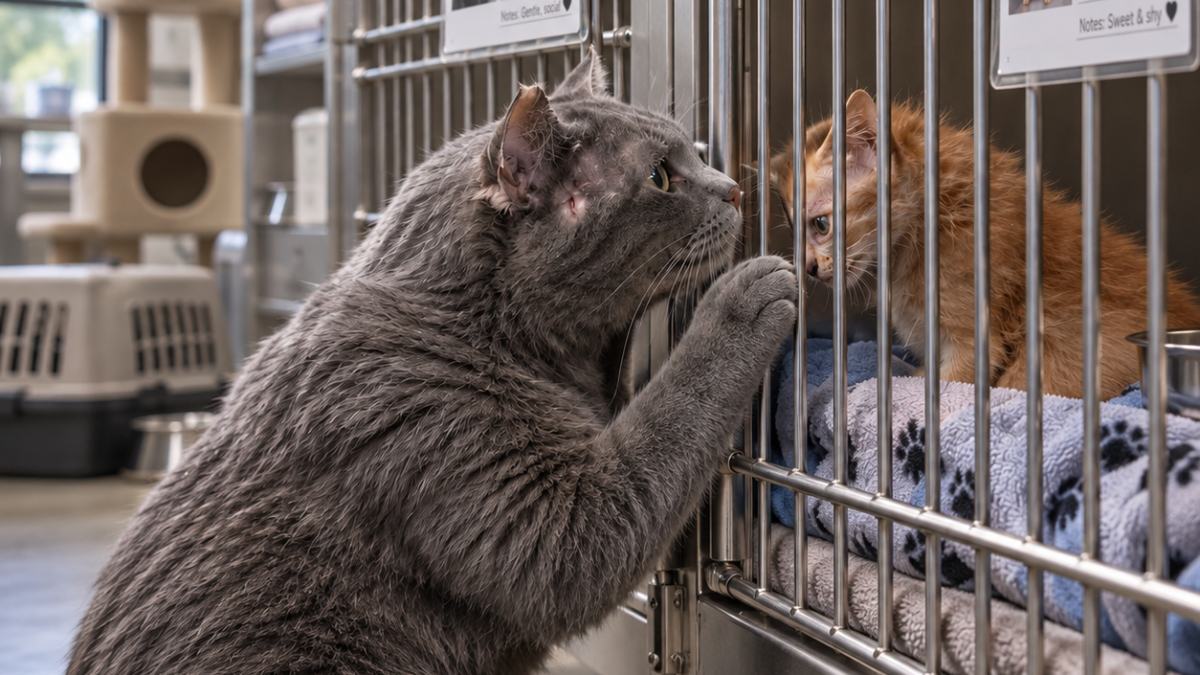
Straight toward his kennel.
She rose onto her hind legs.
Both front paws hit the metal door.
Then she started crying.
I had not heard Ivy make a single sound until then.
Now:
“MRRRAOW.”
Loud.
Urgent.
Again.
“MRRRAOW.”
Bean’s towel moved.
His head appeared.
He crawled forward.
Very slowly.
Ivy pressed her nose between the bars.
Bean reached her.
Their faces met through the metal.
His eyes closed.
Ivy began making a low, trembling sound.
Half meow.
Half chirp.
I looked at Denise.
“What is happening?”
Denise’s face changed.
“Oh.”
“What?”
She crouched.
“I was worried about this.”
“About what?”
“Ivy and Bean.”
I looked between them.
“They’re bonded?”
“Not officially.”
“What does that mean?”
“It means they didn’t arrive together.”
“Okay.”
“They don’t have documented history together.”
“Okay.”
“But…”
She hesitated.
“They’ve become very attached.”
Bean pushed his face harder against Ivy’s.
She licked what little she could reach through the bars.
I said:
“How attached?”
Denise stood.
“Bean came in about six weeks ago.”
“What happened to him?”
“Found behind an apartment complex.”
“Stray?”
“We think so.”
“Medical problems?”
“Mostly neglect.”
She looked at him.
“He was severely underweight.”
“Parasites.”
“Some skin issues.”
“Nothing we think is permanently serious.”
“But?”
“He shut down here.”
“What do you mean?”
“Wouldn’t eat reliably.”
“Stayed under blankets.”
“Hissed if anyone reached in.”
“Not aggressive exactly.”
“Terrified.”
Ivy cried again.
Denise continued.
“We moved his kennel here because another room needed space.”
“Beside Ivy?”
“Yes.”
“What happened?”
“At first, nothing.”
“Then Ivy started sleeping against that side.”
She pointed to the divider.
“The wall between them.”
“Bean started doing the same.”
“Then?”
“We allowed supervised time.”
“When?”
“About three weeks ago.”
Denise smiled.
“Bean ate an entire bowl afterward.”
I looked at them.
“Ivy grooms him.”
“Yes.”
“He follows her.”
“Yes.”
“When strangers come into the social room, she sits between him and them.”
My stomach sank.
“Why wasn’t this on her adoption card?”
“We were still evaluating whether they truly needed placement together.”
“Needed?”
“There’s a difference between two cats liking each other and a bonded pair that experiences significant distress if separated.”
I looked at Ivy.
Still at Bean’s door.
“But she’s distressed now.”
“Yes.”
I reached toward her.
“Ivy.”
She looked at me.
I tried to lift her gently.
She allowed my hands beneath her chest.
Then twisted.
Not scratching.
Not biting.
Just determined.
She slipped down.
Landed.
Immediately moved directly in front of Bean’s kennel.
Sat.
Her body physically between me and him.
I laughed once.
Nervously.
“She’s not going.”
Denise exhaled.
“No.”
Bean retreated half a step.
Ivy turned.
Reached through the bars.
One gray paw.
She stretched as far as she could.
Touched his cheek.
Bean leaned into it.
Completely.
Eyes closed.
Something inside me cracked.
Not dramatically.
Quietly.
The same way grief had cracked me.
I sat on the floor.
“What happens to him?”
Denise knew what I meant.
“If you adopt Ivy alone?”
“Yes.”
“He stays available.”
“Someone else adopts him?”
“Hopefully.”
“Hopefully.”
“He’s harder to place.”
“Because he’s sick?”
“Because he hides.”
She looked at Bean.
“People have to believe there’s a cat under the towel before they fall in love with him.”
I almost smiled.
Then:
“Will Ivy adjust without him?”
Denise was careful.
“She may.”
“May?”
“I don’t want to manipulate you.”
“Okay.”
“Ivy deserves a home.”
“You already committed to her.”
“If one cat is what you can responsibly manage, take one cat.”
That mattered.
No pressure.
No:
You’ll destroy them.
No guilt.
Denise continued.
“We would monitor Bean.”
“We’d work with him.”
“He would not simply be abandoned.”
I nodded.
That should have made leaving easier.
It didn’t.
I had planned for one cat.
One adoption fee.
One set of vaccines.
One litter box.
One food budget.
One emergency fund.
My house was small.
My finances were stable but not luxurious.
Divorce had done expensive things to both of us.
The mortgage was entirely mine now.
My mother’s final medical expenses were still being sorted out.
Bean might need veterinary care.
Dermatology.
Dental work.
Nutritional support.
Who knew?
Someone else could take him.
Someone with more money.
Someone whose life had not been turned inside out over the previous year.
Someone more prepared.
I stood.
“I need a minute.”
“Take one.”
I walked toward the lobby.
Then stopped.
Behind me, Ivy cried.
Once.
I did not turn.
Then twice.
I looked.
She was facing Bean.
Paw through bars.
Touching his face.
Bean pressed himself against her.
I thought about my mother.
Not because Bean reminded me of her.
That would be ridiculous.
I thought about the day after she died.
Sarah came to my house.
She sat with me on the bedroom floor while I sorted hospital paperwork.
At some point I told her:
“I just want everybody to leave me alone.”
Sarah said:
“Okay.”
But she did not leave.
She sat quietly three feet away.
I hated her for maybe ten minutes.
Then I crawled across the floor and put my head in her lap.
Sometimes wanting to be alone and needing to be alone are not the same thing.
I had spent nearly a year convincing myself loneliness was easier because loneliness could not leave.
If you do not need anyone, nobody can disappear.
Ivy knew nothing about any of that.
She was a cat.
Bean was a cat.
I did not need to turn them into symbols.
But the fact remained:
Ivy had something she cared about.
Someone she had chosen.
And I was about to improve her life by taking it away.
Could she adjust?
Probably.
Would Bean?
Maybe.
Could I afford two?
That was the real question.
I went to the lobby.
Denise followed after a minute.
I asked:
“How much more expensive is two?”
She smiled slightly.
“That’s difficult to answer.”
“Ballpark.”
“Food is obviously higher.”
“Litter.”
“Routine vet.”
“Emergencies can happen.”
“What medical care does Bean need now?”
“Follow-up bloodwork.”
“Weight monitoring.”
“Skin treatment.”
“His rescue fund already covered the initial work.”
“Anything chronic?”
“Not that we know.”
I sat.
“Is his adoption fee separate?”
“Yes.”
Then she added:
“But bonded or companion placements are discounted.”
“Why?”
“We want people choosing the right home rather than calculating two full fees.”
I looked through the doorway.
Ivy had not moved.
“Could I foster Bean?”
Denise brightened slightly.
“That’s an option.”
“How would that work?”
“You adopt Ivy.”
“Bean comes home as foster-to-adopt.”
“The rescue covers approved medical treatment during the foster period.”
“You see how your household manages two cats.”
“If it doesn’t work, we reassess.”
“Would he come back here?”
“If necessary.”
That hurt anyway.
But it was responsible.
“How long?”
“Usually two to four weeks.”
I nodded slowly.
“Okay.”
Then stood.
“Actually…”
Denise waited.
I looked at Ivy.
Bean.
Then her.
“Can I just adopt both?”
Her smile softened.
“Yes.”
“Even knowing Bean might need extra care?”
“Yes.”
I swallowed.
“Then I’ll take care of it.”
Denise did not clap.
Did not congratulate me for saving anyone.
She simply said:
“Okay.”
That was what I needed.
More paperwork.
Second microchip.
Second medical packet.
Second carrier.
The shelter had a used hard plastic one they loaned me.
When Bean’s kennel opened, he disappeared deeper beneath the towel.
Denise did not grab him immediately.
She moved Ivy’s carrier beside his.
Ivy stepped inside hers.
Sat.
Bean heard her.
His head emerged.
Denise opened his door.
Waited.
Bean stayed.
I crouched about six feet away.
“Hey.”
His eyes found me.
I put one hand on the floor.
Palm down.
Did not reach.
Did not call again.
A minute passed.
Then two.
Bean stepped forward.
One paw.
Pause.
Another.
He approached my fingers.
Sniffed.
Then backed up.
I stayed.
Ivy chirped from inside the carrier.
Bean turned toward her.
Walked closer.
Then stepped into his own carrier.
Denise quietly closed it.
Ivy immediately lay down.
Completely calm.
That was when I knew I had made the right decision.
Not because two cats were magically meant to live with me.
Because the moment Bean was included, Ivy stopped fighting.
Her problem had never been the carrier.
It had never been me.
She had simply been refusing to leave without him.
The drive home took twenty-three minutes.
Bean cried for the first five.
Ivy answered.
A soft chirp every time.
Then silence.
At a red light, I looked into the rearview mirror.
Two carriers.
One gray face.
One orange.
My house had been designed around one cat for approximately four hours.
Now I was bringing home two.
I laughed.
“What have I done?”
Ivy blinked.
Bean hid.
At home, I placed both carriers inside the spare bedroom.
Denise advised starting small.
One room.
Litter boxes.
Water.
Food.
Hiding places.
No forcing interaction.
I opened Ivy’s carrier first.
She came out within ten seconds.
Inspected the room.
Sniffed the bed.
Walked to the window.
Then returned to Bean’s carrier.
Sat beside it.
I opened his door.
Bean did not move.
Twenty minutes.
Nothing.
I sat on the floor.
Read emails on my phone.
Pretended not to care.
Ivy eventually walked into his carrier.
There was barely enough room for both.
She squeezed in anyway.
A minute later she backed out.
Bean followed.
He stayed low.
Belly close to the floor.
Looked everywhere.
I held out my hand.
He approached.
Sniffed.
Then stepped over my wrist.
That was our first interaction.
Not:
He chose me.
He wanted past me.
Fine.
Ivy led him to the water bowl.
I am aware how human that sounds.
Maybe she was simply thirsty and he followed.
Either way, she drank.
He watched.
Then drank.
Food next.
She ate.
Bean hesitated.
Then ate.
I sat on the floor watching two cats consume wet food and felt absurdly emotional.
That evening, I opened the spare-bedroom door.
Ivy walked into the hallway.
Bean followed so closely his nose nearly touched her tail.
Living room.
Kitchen.
Dining room.
They explored as a unit.
When Bean became nervous, Ivy stopped.
Waited.
When she continued, he continued.
I had placed a soft blanket beside the radiator.
Ivy found it.
Circled.
Lay down.
Bean curled beside her.
Twenty minutes later, Ivy jumped onto the couch.
Bean looked up.
He tried.
His weak back legs did not give him enough lift.
He slid down.
I stood.
Almost helped.
Then stopped.
Ivy looked over the edge.
Bean tried again.
Failed.
Third attempt.
His front paws caught the cushion.
He pulled.
Climbed.
Made it.
I laughed.
A real laugh.
Not polite.
Not something I produced because another person expected a reaction.
It surprised me.
I actually put my hand over my mouth.
“Look at you.”
Bean stared like I had embarrassed him.
Ivy curled around him.
Both slept.
The television remained off.
I noticed that around nine.
I had not turned it on.
First night:
Bean hid beneath the bed.
Ivy slept underneath with him.
Second:
Bean came out at three in the morning.
Knocked over the water.
I woke to splashing.
Found Ivy sitting in the middle of the mess looking deeply disappointed in him.
Third night:
Bean climbed onto my bed.
I woke because something touched my ankle.
He froze when I moved.
I stayed still.
After maybe a minute, he curled beside my foot.
Ivy arrived later.
Slept by my hip.
I lay awake.
Two cats breathing.
Rain against the window.
House quiet.
And for the first time, quiet did not hurt.
The first veterinary visit came five days later.
Bean hated the carrier.
Ivy walked into hers willingly.
Bean began panicking as soon as the car moved.
I put their carriers side by side.
Ivy reached through the small ventilation opening.
One paw.
Bean pressed against it.
Exactly like the shelter.
His breathing slowed.
Dr. Kapoor examined both.
Ivy:
Healthy.
Mild old scar near the ear.
Maybe previous injury.
Nothing concerning.
Bean:
Still underweight.
Skin improving.
Significant muscle loss.
Dental disease mild.
Bloodwork better than expected.
“Good news.”
I exhaled.
“Meaning?”
“He needs calories.”
“Time.”
“Routine.”
“Parasite follow-up.”
“Nothing here screams chronic illness.”
I almost cried.
Dr. Kapoor looked between them.
“They came together?”
“Not originally.”
I told her the shelter story.
She watched Ivy grooming Bean.
“I’d keep them together.”
“That’s the plan.”
“Good.”
Bean gained weight.
Slowly.
First week:
Half a pound.
Then more.
His coat started changing.
At the shelter, his orange fur looked thin and rough.
Two months later it became soft.
Bright.
He developed a ridiculous cream-colored belly.
His personality emerged even faster.
Bean was not naturally timid.
Bean was a criminal who had temporarily lost confidence.
He learned cabinet doors.
Bread bags.
Laundry baskets.
Toilet-paper rolls.
At 2:00 one morning, I heard a crash.
Found him inside the kitchen sink.
One paw in a dirty saucepan.
Ivy sat on the floor watching.
“You’re supposed to supervise him.”
She blinked.
Bean licked butter from the pan.
I picked him up.
He purred.
First time.
Small vibration against my chest.
I froze.
“Oh.”
Bean stopped.
Then resumed.
I carried him into the living room.
Sat on the couch.
He stayed in my lap for eleven minutes.
I know because I looked at the clock afterward.
Ivy arrived at minute six.
Jumped up.
Sat beside us.
Then put one paw on my thigh as though confirming she still had access.
“All right.”
I scratched both.
“Apparently this is my life now.”
Sarah visited in December.
She entered carrying wine and two absurdly expensive cat toys.
“I have nieces now.”
“They’re male and female.”
“Niblings.”
“No.”
Ivy greeted her after twenty minutes.
Bean hid for forty.
Then emerged because Sarah opened cheese.
She watched him approach.
“Oh my God.”
“What?”
“He’s so small.”
“He’s gained three pounds.”
“What did he look like before?”
I showed her shelter photos.
Sarah stopped smiling.
“Oh.”
“Yeah.”
Then the photo of Ivy against Bean’s kennel.
Sarah looked at me.
“You really couldn’t leave him.”
“No.”
“You went for one.”
“I know.”
“You always do this.”
“Do what?”
“Act like you have no room for anything and then make room.”
I rolled my eyes.
“I don’t.”
“You took care of your mom almost every day.”
“That’s different.”
“You drove forty minutes each way.”
“She was my mother.”
“You kept checking on Ryan’s dad after the divorce because he was lonely.”
“Frank did nothing wrong.”
“Exactly.”
“What’s your point?”
Sarah smiled.
“You aren’t nearly as detached as you think you are.”
I said nothing.
Ivy jumped onto the couch.
Bean followed.
Sarah pointed.
“Exhibit A and B.”
Christmas came.
My first without my mother.
I dreaded it.
I had planned to ignore the holiday.
No tree.
No decorations.
Then I remembered my mother would have hated that.
So I bought a small tree.
Ivy inspected it responsibly.
Bean climbed it in under six minutes.
I found him three feet from the top.
“Absolutely not.”
He stared down.
Ivy sat beneath him.
Probably encouraging.
I laughed.
Then cried.
Same moment.
I sat on the floor with Bean in my arms and suddenly missed my mother so hard I could barely breathe.
Grief does that.
It waits.
Then enters through whatever door is open.
Bean wriggled.
I held him closer than he wanted.
He tolerated maybe five seconds.
Then escaped.
Ivy walked over.
Pressed her forehead against my knee.
Same gesture from the shelter.
I cried harder.
Not because she understood death.
Because she stayed.
There is comfort in presence even when the one present cannot understand your story.
January was hard.
Cold.
Gray.
Anniversary of my mother’s diagnosis.
Anniversary of Ryan moving out.
I worked too much.
Some days I did not shower until afternoon.
But the cats created structure.
Breakfast.
Litter.
Medication.
Play.
Dinner.
Routine.
Bean screamed every morning at 6:17.
Not 6:15.
Not 6:20.
6:17.
I do not know why.
Ivy sat silently beside him, pretending she had no involvement.
If I stayed in bed:
Bean escalated.
If I ignored him:
He climbed onto my chest.
One morning I said:
“You understand I adopted you out of pity?”
Bean bit my pajama sleeve.
Fair.
By spring, he could jump onto everything.
Couch.
Desk.
Windowsill.
Kitchen counter when he thought I wasn’t looking.
Ivy never stopped watching him.
The dynamic changed, though.
At first:
Protector.
Protected.
Later:
Partners in crime.
Bean initiated wrestling matches.
Ivy ended them.
Bean stole toys.
Ivy stole them back.
Bean learned to open the hallway closet.
Ivy took advantage of the open door.
One afternoon I entered the bedroom and found shredded tissue paper everywhere.
Both cats sat in the center.
“Who did this?”
Bean began washing his foot.
Ivy looked away.
Solidarity.
The house changed too.
Not physically at first.
Emotionally.
I began sitting at the dining table again.
Why?
Because Bean would climb onto an empty chair.
Ivy sat beneath.
Eating standing up became inconvenient.
So I sat.
Television stayed off more often.
I listened to paws on hardwood.
Food bowls.
Purring.
The strange chirping noise Ivy made when she saw birds.
Bean screaming at absolutely nothing.
I started opening curtains.
Then windows.
Then inviting Sarah over.
My neighbor, Mrs. Feldman, came one afternoon because a package had been delivered to her house accidentally.
She saw Bean.
Stayed forty-five minutes.
Next week she brought him a toy mouse.
Human life re-entered through the side door.
Not because cats replaced people.
They did not.
That matters.
Ivy did not become my therapist.
Bean did not cure grief.
But caring for them interrupted the loop I had built.
Wake.
Work.
Eat.
Avoid.
Sleep.
Repeat.
They created reasons to move.
Then reasons to laugh.
Then reasons to talk.
Eventually, reasons to invite people inside.
In April, Ryan called.
We had not spoken in three months.
Civil divorce.
No hatred.
Still awkward.
He needed an old tax document.
I found it.
He came by.
The moment he entered, Ivy disappeared.
Bean walked toward him.
Ryan froze.
“You got cats.”
“Two.”
“Two?”
“I planned one.”
He looked at Bean.
“What happened?”
“Ivy unionized.”
Ryan laughed.
First time we had laughed together since the divorce.
Bean sniffed his shoe.
Ryan crouched.
“Hey.”
Then sneezed violently.
I laughed harder.
He looked around the house.
Cat tree.
Toys.
Blankets.
Two food bowls.
“You seem…”
He stopped.
“What?”
“Better.”
That word irritated me at first.
Better.
As if grief had been an infection.
“I’m okay.”
He nodded.
“I didn’t mean—”
“I know.”
Silence.
Then I admitted:
“I am better.”
He smiled.
“Good.”
There was no romantic reunion.
No suggestion.
We had ended for reasons cats could not fix.
But something inside me released another layer.
I could look at the man I had lost and not feel like I had lost my entire future with him.
He left.
Ivy emerged ten minutes later.
Bean sneezed once.
Probably sympathy.
Summer marked almost a year since my mother’s death.
I took Ivy and Bean to their annual exams.
Bean now weighed eleven pounds.
Eleven.
The shelter paperwork listed him at six-point-two.
Dr. Kapoor lifted him.
“You have become substantial.”
Bean purred.
Ivy weighed nine.
Healthy.
“You two are boring.”
Dr. Kapoor told them.
“Excellent.”
At home, I found the original adoption paperwork.
I had kept it inside a kitchen drawer.
Two forms.
Ivy Bennett.
Bean Bennett.
I laughed at the surname.
Never thought about it.
They had become family on paper before I understood it emotionally.
The one-year anniversary of the adoption arrived on a Thursday.
I remembered because my phone photo app showed:
ONE YEAR AGO.
There was Ivy behind shelter bars.
Then Bean under the towel.
Then their carriers in my car.
Then first night.
I spent too long looking.
That evening, I ordered takeout.
Not celebratory.
I told myself.
Then bought them expensive salmon treats.
Definitely celebratory.
I sat on the kitchen floor.
Why floor?
Bean liked lying beside my feet while I ate.
Ivy liked leaning against my leg.
The television was off.
I realized halfway through dinner.
Quiet house.
No voices.
No background noise.
I put down my fork.
Listened.
Refrigerator hum.
Rain outside.
Bean breathing.
Ivy purring.
That was all.
And I was okay.
More than okay.
I thought about the woman I had been one year earlier.
Standing at this same sink with dinner on a plate.
Television playing to an empty room.
Convincing herself she preferred peace.
She had gone to the shelter because she wanted something alive to notice when she came home.
That was literally how I had phrased it to Sarah.
“I just want something to notice whether I’m here.”
I thought I was looking for witness.
Something that would make my presence matter inside the walls.
I found Ivy.
Then Ivy refused to leave Bean.
And somewhere in that ridiculous shelter room, the shape of my life changed.
Not because I saved two cats.
Bean would probably have been adopted eventually.
Ivy certainly would.
The shelter staff cared.
They had options.
I did not pull them from certain death.
That is not what happened.
What happened was quieter.
Ivy showed me that companionship sometimes comes with attachments.
You do not always get to choose the simplest version of love.
Sometimes the person—or animal—you open the door for arrives carrying someone else in their heart.
If you want them, you may have to make room for what they love too.
I thought about Bean pressing his face into Ivy’s paw.
How easy it would have been to walk away.
How rational.
One cat.
Smaller budget.
Simpler.
Perfectly defensible.
Nobody would have called me cruel.
Denise explicitly told me taking Ivy alone was acceptable.
But I knew myself.
If I had carried Ivy out while Bean cried behind those bars, I would have heard that sound for years.
Maybe Ivy would have adjusted.
Maybe Bean would have too.
But I had the choice.
And I chose two carriers.
Bean woke.
Looked at me.
Then put one paw on my ankle.
Ivy shifted closer.
I laughed.
“What?”
Neither answered.
Months turned into years.
I returned to the office part-time.
Made friends again.
Joined a weekend walking group.
I started seeing a therapist after resisting the idea for an embarrassingly long time.
Sarah said:
“I have been telling you this for eighteen months.”
“I know.”
“Do I get credit?”
“No.”
“Rude.”
Therapy helped.
So did time.
So did finally talking about my mother instead of protecting everyone else from my grief.
So did admitting my marriage had ended without requiring either Ryan or me to become the villain.
Ivy and Bean simply existed alongside all of that.
They were not solutions.
They were participants.
Ivy became bolder with age.
The cat who once sat silently behind shelter bars eventually developed opinions about visitors.
Sarah:
Approved.
Mrs. Feldman:
Approved because treats.
Delivery people:
Suspicious.
Vacuum:
Mortal enemy.
Bean became fearless.
Too fearless.
He fell into an empty bathtub.
Got stuck behind the refrigerator once.
Escaped onto the porch and immediately panicked because outside contained wind.
Ivy followed him to the open door but did not leave.
She sat there making the same cry I had heard at the shelter.
I grabbed Bean in under thirty seconds.
The moment he came back inside, Ivy smacked him across the head.
Then groomed him.
I laughed until I cried.
“Apparently motherhood is complicated.”
They still were not mother and son.
Not siblings.
Not biologically related at all.
But language needs something.
Friends seemed too small.
Bonded pair sounded clinical.
Family was closest.
Bean’s health remained mostly good.
At five, he developed dental problems.
Needed two extractions.
The night before surgery, I barely slept.
Ivy knew something was different when I removed his food.
Bean screamed because starvation apparently begins six hours before anesthesia.
At the clinic, they took Bean through the treatment door.
Ivy was at home.
For the first time in years, she could not find him.
When I returned without Bean, she searched the carrier.
Then looked at me.
Then searched every room.
I sat on the floor.
“He’s coming back.”
I knew she did not understand the words.
I said them anyway.
“He’s coming back.”
She stayed near the front door most of the afternoon.
When I brought Bean home groggy, shaved patch on his leg, Ivy ran to the carrier.
Same urgency.
Same sound.
I opened it.
Bean stumbled out.
Ivy sniffed him from nose to tail.
Then slapped him once.
Apparently hospital smell was offensive.
An hour later, they slept together.
I took a photograph.
Compared it with the shelter image.
Gray face.
Orange face.
Touching.
Same.
That night I understood the shelter moment differently.
I had always told the story as:
Ivy refused to leave Bean.
True.
But there was more.
Bean had changed Ivy too.
At the shelter, everyone focused on his recovery.
Bean began eating after meeting Ivy.
Bean became braver.
Bean followed her.
But Ivy had arrived withdrawn.
Quiet.
Watching.
Nobody knew much about her life before intake.
She had been surrendered after her owner entered assisted living.
Sudden loss.
New environment.
Kennel.
Then Bean appeared.
Maybe protecting him gave her something to organize herself around.
Maybe companionship worked both directions.
It usually does.
Years later, Ivy began slowing first.
She was older than Bean, probably more than the shelter estimate.
Arthritis.
Nothing dramatic.
Then kidney disease.
Early.
Manageable.
Special food.
More water.
Medication.
Bean hated her prescription food and tried stealing it anyway.
Ivy remained in charge.
At night, they slept beside each other.
By then I was forty-five.
The house had changed.
New paint.
Different couch.
My mother’s old bookshelf in the living room.
Photos on walls.
Friends around my dining table occasionally.
There were human voices again.
But I no longer needed them constantly.
Silence stopped meaning abandonment.
That may have been the greatest change.
I could sit alone.
Read.
Drink coffee.
Hear nothing but rain.
And not feel forgotten.
Because being alone for an evening is very different from believing you belong to nobody.
One autumn night, Ivy stopped eating.
Kidney values had worsened.
We adjusted medications.
Fluids.
She improved.
Then declined again.
Bean stayed beside her.
Constantly.
If Ivy slept, Bean slept touching her.
If she moved rooms, he followed.
I recognized the pattern.
Shelter.
Years before.
Only roles had changed.
One morning Ivy could not comfortably stand.
I took her to Dr. Kapoor.
Tests.
Exam.
Long conversation.
Not emergency.
Not yet.
But approaching.
I asked the question everyone with an old animal eventually asks.
“How do I know?”
Dr. Kapoor knew what I meant.
“When the things that make her Ivy become harder to find than the things making her uncomfortable.”
I cried in the exam room.
Ivy sat in my lap.
She pushed her forehead against my hand.
Same gesture.
All those years later.
Forehead.
Fingers.
I took her home.
We got another good week.
Then a second.
She ate tuna.
Sat in sunlight.
Groomed Bean badly.
Yelled once at Sarah.
Excellent.
Then one morning she refused water.
Would not move from the blanket.
Bean lay beside her.
I knew.
The veterinarian came to our house.
That was important to me.
No last carrier.
No separation.
Ivy on her blanket.
Bean beside her.
I sat on the floor.
One hand beneath her head.
The veterinarian gave the sedative.
Ivy relaxed.
Bean sniffed her face.
Pressed his forehead against hers.
I broke.
Completely.
“I’m sorry.”
I whispered.
Not because I was making the decision.
Because every ending awakens all the others.
Ryan.
Mom.
Years of people leaving.
Ivy’s breathing slowed.
Her head became heavy in my palm.
The vet listened.
Then looked at me.
“She’s gone.”
Bean stayed touching her.
I did not move him.
Nobody hurried us.
After a while, he began grooming Ivy’s forehead.
Then stopped.
Sat.
Waited.
I remembered that first shelter day so vividly it hurt.
Ivy at Bean’s kennel.
Paws on bars.
Crying.
Refusing to leave.
Now Bean was the one left behind.
That terrified me.
For days he searched.
Bedroom.
Hallway.
Closet.
Ivy’s favorite windowsill.
He cried at night.
I cried too.
I could have adopted another cat immediately.
I did not.
Not because replacement would be wrong.
Because Bean needed time.
So did I.
We became strangely close.
He started sleeping against my chest instead of my feet.
Followed me from room to room.
Sat outside the bathroom.
Waited beside my laptop.
The cat who had once needed Ivy to show him everything eventually learned to move through the house without her.
So did I.
Six months later, I visited Franklin County Shelter again.
Not to adopt.
I brought donations.
Food.
Blankets.
A check.
Denise still volunteered.
Older.
Same purple glasses.
She recognized me immediately.
“Claire.”
We hugged.
“How’s Ivy?”
That was the question.
I told her.
Her face fell.
“Oh.”
“And Bean?”
“Still committing crimes.”
She laughed.
“Good.”
We talked about Ivy.
Then Denise disappeared into the office.
Returned with a folder.
“I probably shouldn’t show you this without warning.”
“What?”
“Old shelter notes.”
I opened them.
Handwritten observations.
Bean:
Still hiding.
Poor appetite.
Then:
Moved beside Ivy.
Then:
Ivy sleeping against divider.
Bean ate half can.
Next day:
Full meal.
Supervised social:
Ivy groomed Bean.
Bean followed Ivy.
Then one line:
Ivy more interactive since introduction to Bean.
I read it again.
Denise pointed.
“See?”
I looked up.
“She needed him too.”
“We think so.”
That did something to me.
For years I had told the story as Ivy saving Bean.
Then me saving both.
Then maybe them saving me.
But relationships are rarely that clean.
Bean gave Ivy purpose.
Ivy gave Bean courage.
They gave me companionship.
I gave them home.
Then Ivy died.
Bean helped me survive losing her.
Nobody permanently occupies one role.
Rescuer.
Rescued.
Strong.
Weak.
We trade places.
That may be the closest thing to family I know.
Before leaving, I walked through the cat room.
I stopped at the kennel where Ivy had been.
Different cat now.
White and brown.
Very loud.
I smiled.
Then looked one cage over.
Bean’s old kennel.
Empty.
For a second I saw:
Gray paw.
Orange cheek.
Metal bars.
I closed my eyes.
“Thank you.”
I am not sure who I meant.
Ivy.
Bean.
Denise.
My mother.
Maybe the version of me who walked back to the front desk and asked:
“Can I adopt two?”
Years later, Bean became old too.
His orange coat lightened around the face.
He developed diabetes.
Then arthritis.
I complained about insulin schedules.
He complained louder.
Every morning and night:
Injection.
Treat.
Insulting me.
Routine.
He lived to fifteen.
Maybe sixteen.
Shelter ages are guesses.
His final year was quiet.
No major drama.
He still slept on my bed.
Still screamed for breakfast.
Still sat in Ivy’s old spot by the radiator sometimes.
Whether he remembered her the way I did, I cannot know.
I stopped pretending animals tell the same stories humans do.
But sometimes I would find him grooming the empty side of the blanket before settling.
Maybe habit.
Maybe memory.
Maybe nothing.
It mattered to me anyway.
When Bean’s end came, it was gentler than Ivy’s.
Old body.
Tired.
The vet came home again.
I held him.
He purred almost until the sedative took over.
I whispered:
“She’s waiting.”
Then immediately laughed through my tears.
Because I do not actually know whether anyone waits anywhere.
But grief is allowed poetry.
Bean died in my arms.
The house became quiet again.
Completely.
No paws.
No bowls.
No morning screams.
No gray cat staring.
No orange cat stealing bread.
I stood in the kitchen the first night.
The television was off.
For a moment I was thirty-eight again.
Plate in hand.
Empty house.
Terrified of silence.
I waited for that old feeling.
It did not come.
Sadness came.
Huge.
Real.
But not emptiness.
Those are different.
My house was quiet because two lives had ended after years of filling it.
Not because nothing had ever been there.
I sat at the dining table.
Ate dinner.
No television.
I cried.
Then smiled.
Both were allowed.
On the shelf above my desk sat a photograph from the first week.
Ivy and Bean curled together.
Another from the day Bean finally reached a healthy weight.
Another of Ivy glaring from the Christmas tree while Bean climbed behind her.
One photograph from that shelter.
Denise had sent it later.
Ivy standing against Bean’s kennel.
Front paws on metal.
Bean pressing his face toward hers.
That was the beginning.
Or one beginning.
I used to think I had gone to the shelter because I wanted a cat to notice when I came home.
That was true.
But too small.
I wanted evidence that my presence mattered.
I wanted someone waiting.
Someone alive inside the silence.
I chose Ivy because she touched her forehead to my fingers.
Then she showed me something I had forgotten.
Love almost never arrives alone.
It brings obligations.
History.
Fear.
Someone else’s needs.
Risk.
Eventually grief.
If you let someone matter, losing them becomes possible.
That was exactly what I had spent a year trying to avoid.
Ivy did not have that strategy.
She stood in front of Bean’s kennel and refused to participate in a life that required leaving him behind.
No spreadsheet.
No five-year plan.
No guarantee Bean would become healthy.
No guarantee two cats would be affordable.
No guarantee any of us would get enough time.
She simply knew:
Not without him.
I could have learned the wrong lesson.
That love means never separating.
Life disproved that.
Ivy died.
Bean stayed.
Bean died.
I stayed.
People leave.
Animals leave.
Marriages end.
Parents die.
Nothing we love becomes safe from loss simply because we love it well.
The lesson was not:
Never leave.
It was:
Do not let the certainty of an ending prevent the beginning.
That first Thursday, I was afraid of taking on two cats because my life already felt unstable.
Money.
Space.
Grief.
Future.
All reasonable concerns.
But I had enough.
Enough room.
Enough money.
Enough patience.
Enough love, although I would never have used that word then.
So I made room.
One food bowl became two.
One litter box became three because every cat expert apparently enjoys telling you the formula is number of cats plus one.
One carrier became two.
One veterinary bill became many.
One quiet house became chaos.
Then home.
I never regretted it.
Not even at the end.
Especially not at the end.
Because the pain of losing Ivy and Bean was not evidence that adopting them had been a mistake.
It was evidence that they had become part of me.
A few months after Bean died, Sarah came for dinner.
We sat at the table.
No television.
She looked around.
“Thinking about another cat?”
“Eventually.”
“One?”
I smiled.
“Absolutely one.”
Sarah stared.
I started laughing.
“So two.”
“I did not say that.”
“You did with your face.”
“No.”
“Claire.”
“Fine.”
“Maybe.”
She raised her glass.
“To maybe.”
Months later, I returned to the shelter.
That is another story.
But before I went, I opened Ivy and Bean’s old adoption file.
At the very bottom was the original receipt.
Two adoption fees.
Two microchip numbers.
Two names.
And one handwritten note Denise must have added after I left:
IVY WOULD NOT LEAVE WITHOUT BEAN.
ADOPTED TOGETHER.
I sat with that sentence for a long time.
Then folded the paper.
Put it back.
Because if anyone ever asks me what happened that Thursday, that is still the simplest answer.
I went to adopt a quiet gray cat.
She chose me.
Then she showed me the orange cat she had already chosen.
And somewhere between the shelter and my front door, without realizing it, I chose both of them.
Ivy had been waiting for a person willing to see her.
Bean had been waiting for Ivy to stay.
And I had been waiting for something to teach me that being alone was not safer simply because nobody could leave.
Three lonely lives.
One small house.
Two carriers in the back seat.
That was all.
No miracle.
No grand rescue.
Just three beings who had all learned different versions of loneliness and happened to find one another before any of us decided it was too late.
For years afterward, when I came home, Bean would run toward the kitchen.
Ivy would walk more slowly behind him.
She would look up at me with those serious green eyes.
Then press her forehead against my hand.
Exactly like the first day.
And every time she did, some part of me remembered the metal bars between us.
The shelter noise.
The paperwork.
The carrier waiting on the floor.
Bean’s tiny broken squeak.
Ivy turning around.
Running back.
Two paws against the kennel.
One gray paw reaching through.
One orange face leaning into it.
And me standing there thinking I had arrived to rescue one cat.
I had no idea.
Ivy was about to bring the rest of my family with her.








