Hotel Manager Charges Old Woman $8,000 a Night to Get Rid of Her, Not Knowing She Owns the Hotel
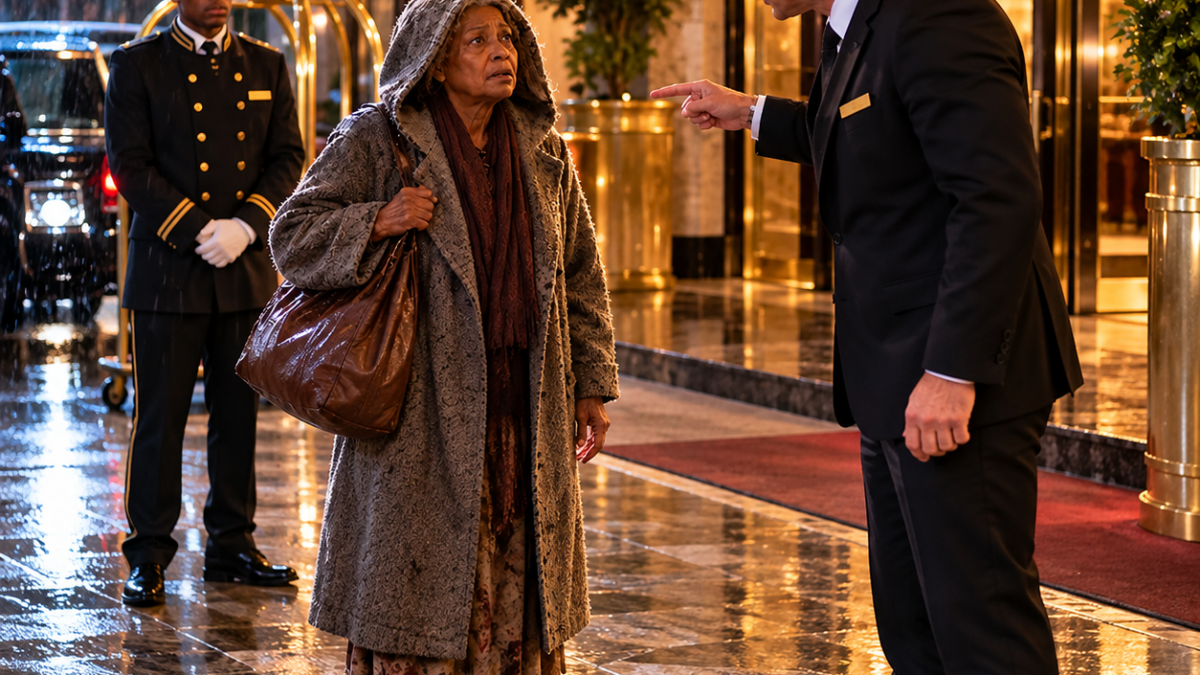
Hotel Manager Charges Old Woman $8,000 a Night to Get Rid of Her, Not Knowing She Owns the Hotel.
The hotel manager saw an old woman soaked from the rain and decided she was worth less than the marble floor beneath her shoes.
He raised the price of a $300 room to $8,000 just to humiliate me in front of his staff.
What he did not know was that every chandelier, every polished elevator door, and every room key in that building belonged to me.
My name is Margaret Whitfield, and for nearly forty years, the Aurelia Grand Hotel had been my life’s work.
I did not inherit it.
I did not marry into it.
I built it slowly, painfully, one terrified decision at a time.
When I bought the building in my thirties, it was not called the Aurelia. It was a failing old downtown hotel with leaking pipes, cracked plaster, faded carpets, and a lobby that smelled like cigarette smoke, wet wool, and broken promises. The previous owners had given up on it. Guests complained. Staff came and went. Investors laughed when I said I wanted to turn it into a place known not only for beauty, but for dignity.
I was not rich then.
I was not powerful.
I was a widow with two suitcases, a small inheritance from my father, and a stubborn belief that hospitality was supposed to mean something.
My father had run a modest boarding house when I was a girl. Nothing grand. Nothing polished. But he had one rule carved deeper into him than any business lesson.
Every person who walks through the door is carrying something you cannot see.
He said it when a tired truck driver arrived with mud on his boots.
He said it when a young mother paid in coins.
He said it when a man in a tailored suit complained about a room that was already better than he deserved.
“Never greet the wallet first, Maggie,” he used to tell me. “Greet the person.”
I built the Aurelia around that sentence.
For decades, it worked.
The hotel became known for its marble lobby, yes.
Its brass elevators.
Its chandeliers.
Its suites overlooking the city.
Its grand staircase and flower arrangements and restaurant critics who wrote glowing things about the breakfast service.
But those were not the reasons I was proud of it.
I was proud because our doormen learned guests’ names.
Because housekeepers were treated as professionals, not ghosts.
Because a tired traveler could arrive late and still be offered tea.
Because no one who entered my building was supposed to feel invisible.
That was the Aurelia I built.
But buildings change when the wrong people are allowed to manage them.
I had stepped back from daily operations after my husband died and my health began arguing with me more loudly than my ambition. I still owned the hotel, but I trusted executives, managers, department heads, and reports printed in neat columns. I thought I could watch from a distance.
For a while, maybe I could.
Then the numbers changed.
Sales dipped first.
Not dramatically.
Enough for my CFO, Daniel Reeves, to place a folder on my desk one Tuesday morning and say, “Margaret, we need to talk about the Aurelia.”
I was sitting near the window in my private office, a cup of tea cooling beside my hand.
Daniel had worked with me for fifteen years. He knew better than to soften bad news until it became useless.
“Occupancy?” I asked.
“Down.”
“Restaurant?”
“Down.”
“Events?”
“Down, but not as badly.”
“Reviews?”
He hesitated.
That bothered me more than the numbers.
“Daniel.”
He opened the folder.
“They’re getting worse.”
I put on my glasses.
At first, the reviews looked ordinary.
Slow room service.
Front desk confusion.
Breakfast delays.
Overpriced parking.
Things hotels always struggle with when management gets sloppy.
Then I read deeper.
The staff treated my mother like she didn’t belong.
PART2:
The front desk lied and said no rooms were available, then checked in a wealthy couple right behind us.
The manager was rude when my husband asked for a wheelchair-accessible table.
Beautiful building, ugly attitude.
They act like you are an inconvenience unless you look rich.
I stopped reading.
A strange coldness moved through me.
“How long?” I asked.
Daniel did not pretend to misunderstand.
“Three months.”
“And Derek?”
“His reports blame staffing issues, rising guest expectations, and online exaggeration.”
“Of course they do.”
Derek Langford had been the general manager for eight months.
On paper, he was perfect.
Luxury hospitality background.
Expensive suits.
Confident voice.
The kind of résumé that made board members nod before he finished speaking.
I had met him twice.
Both times, he had been charming.
Too charming, maybe.
But charm is a dangerous thing to judge from the owner’s chair. People are always kind when they know power is watching.
That was the problem.
I did not want to know how Derek treated me.
I wanted to know how he treated someone he thought did not matter.
I closed the folder.
PART3:
“I think it’s time I paid them a visit.”
Daniel nodded.
“I’ll let Derek know.”
“No.”
He looked up.
“No?”
“Not if he knows it’s me.”
Daniel stared at me for a moment.
Then his eyes narrowed with understanding.
“Margaret.”
“What?”
“You are eighty-two years old.”
“Thank you. I had forgotten.”
“You have a bad hip.”
“I have two hips. One is simply more dramatic.”
“This is not safe.”
“What isn’t safe is letting a hotel rot from the inside because people are too polished to be decent.”
He sighed.
“You’re serious.”
“I usually am.”
“Do you want security nearby?”
“No.”
“Margaret.”
“Daniel, I am going to walk into my own hotel wearing an old coat and carrying an old handbag. If that is dangerous, then we have a much larger problem than revenue.”
He did not like it.
But he knew me well enough to stop wasting breath.
Two days later, rain covered the city.
Not a soft rain.
A hard, cold, slanting rain that turned sidewalks glossy and made taxis hiss at curbs. It was the kind of evening when hotels should become sanctuaries. Warm light. Dry towels. Someone at the door saying, “Welcome in.”
Instead, I stood half a block from the Aurelia wearing an old brown coat, scuffed shoes, a plain gray dress, and a knitted hat pulled low over my white hair.
No pearls.
No driver.
No credit card with my name showing.
No makeup beyond what age had left me.
My handbag was old but clean. Inside, I carried identification, one black credit card, a phone, and a small recording device Daniel insisted I take.
I let the rain soak my shoulders before I entered.
Not for drama.
For truth.
Guests do not always arrive looking ready for photographs.
Sometimes they arrive wet, frightened, tired, sick, grieving, lost, or ashamed.
The doors opened, and warm air rolled over me.
For one second, my heart tightened.
The Aurelia lobby was still beautiful.
Marble floors.
Gold light.
Tall arrangements of white lilies.
The grand staircase curving to the mezzanine.
The chandelier I had once spent six months saving for.
But beauty felt different when no one looked up.
The doorman was gone from his post.
Two bellmen whispered near the luggage stand.
At the front desk, a young woman with sleek dark hair and red nails glanced at me, then looked back at her screen.
Her name tag read Chloe.
I approached slowly, leaning on my cane.
“Excuse me,” I said. “Do you have a room available for tonight?”
Chloe did not smile.
“We’re fully booked.”
She said it too quickly.
No checking.
No typing.
No apology.
“Anything at all?” I asked. “The next hotel is several blocks away, and I can barely walk in this rain.”
“We’re fully booked.”
“I understand. Could I at least sit somewhere until the rain slows?”
She looked me over.
Not subtly.
My wet coat.
My old handbag.
My shoes dripping rainwater onto the marble.
Finally, she pointed toward a small chair near a side table.
“You can sit there.”
“Thank you.”
“And please don’t touch anything else.”
The words were quiet.
Not quiet enough.
I sat.
Water dripped from the hem of my coat onto the polished floor.
No one brought a towel.
No one asked if I needed help.
No one asked my name.
A few minutes later, the doors opened again.
A man in a navy overcoat stepped inside with a leather suitcase and a woman on his arm. He was handsome in the way wealthy men can afford to be. Clean haircut. Expensive watch. Shoes that had never met a puddle without assistance.
Chloe’s entire face changed.
She straightened.
“Good evening, Mr. Ellison.”
The man smiled.
“Hello, Chloe.”
“Your usual suite is ready.”
“Wonderful.”
“Would you like someone to take your bags up?”
“That would be excellent.”
A bellman appeared as if summoned by money.
I stood slowly and returned to the desk.
“You just told me there were no rooms.”
Chloe’s smile remained fixed, but her eyes sharpened.
“Something opened up.”
“Just now?”
“Yes.”
“That seems unlikely.”
Her voice lowered.
“Ma’am, please don’t cause a scene.”
“I asked politely for a room.”
“And I answered.”
“I’d like to speak to the manager.”
That annoyed her.
Not because she was afraid.
Because she thought I was beneath escalation.
She picked up the phone.
“Derek, we have a problem at the front desk.”
A few minutes later, Derek Langford appeared.
He was exactly as polished as I remembered.
Tall.
Dark suit.
Silver tie.
Perfect hair.
A smile designed for donors, celebrities, and inspection days.
But that smile never reached me.
It landed on my wet coat, my old shoes, my cane, my handbag, and died there.
“What is this?” he asked Chloe.
“She refuses to leave,” Chloe said. “She’s upsetting the guests.”
I looked around.
The guests were not upset.
Curious, maybe.
A little uncomfortable.
But not because of me.
Derek turned to me.
“Ma’am, this is a private hotel.”
“That is usually how hotels work.”
His eyes narrowed.
“You’re dripping water all over the marble.”
“I was outside in the rain.”
“Then perhaps you should have planned better.”
I let the insult sit between us.
“I can pay for a room.”
Derek gave a small laugh.
Not loud.
Not kind.
“People like you don’t belong here.”
The lobby changed.
Not visibly.
But I felt it.
A bellman looked down.
Chloe smirked.
A couple near the elevators pretended not to listen.
“People like me,” I repeated.
Derek leaned closer.
“This is a luxury property. We have standards.”
“My money is accepted elsewhere.”
“I’m sure it is.”
“I would like a room.”
He looked toward Chloe.
Then back at me.
A cruel little idea moved across his face.
“Fine.”
Chloe looked surprised.
Derek folded his arms.
“Our standard room is normally three hundred dollars. But due to demand tonight, the rate is eight thousand.”
Someone behind me made a small sound.
A gasp.
Maybe a laugh.
Derek smiled.
“For one night.”
I looked at him.
“Eight thousand dollars.”
“Yes.”
“For a standard room.”
“Take it or leave.”
He expected me to break.
To cry.
To protest.
To admit I could not pay.
He wanted the price to do what his insults had not yet done—push me out while keeping his hands clean.
I opened my handbag slowly and removed my credit card.
“I’ll pay that.”
The lobby became very quiet.
Derek’s smile faltered.
Chloe stared at the card.
For a moment, no one moved.
Then Derek laughed again, but it sounded different now.
“Where does someone like you get eight thousand dollars?”
“From a bank, usually.”
Chloe whispered, “Maybe she stole it.”
Derek did not correct her.
Instead, he snapped his fingers toward security.
Two guards approached.
One was older and visibly uncomfortable.
The other looked like he enjoyed instructions more than judgment.
Derek pointed at my handbag.
“Check it.”
I held it tighter.
“You want security to search an elderly guest’s bag in the lobby?”
“I want to make sure this property is protected.”
“From me?”
“From fraud.”
I could have ended it there.
I could have said my name.
I could have watched the blood drain from Derek’s face before dinner.
But I needed to know how far this sickness had spread.
So I handed over the bag.
The younger guard opened it on the desk.
He removed my wallet.
A packet of tissues.
An old photograph of my father standing in front of his boarding house.
A folded scarf.
My medication.
Guests watched.
Chloe looked bored.
Derek looked satisfied.
The older guard would not meet my eyes.
Finally, Chloe ran the card.
Approved.
One little word on the screen.
Approved.
Derek’s jaw tightened.
Chloe blinked.
I held out my hand for my belongings.
The guard returned them without a word.
Derek took a key card from Chloe and slid it across the counter.
“Room 214.”
I picked it up.
“Thank you.”
“Don’t make a mess.”
That was the sentence that almost broke my composure.
Not the money.
Not the search.
Not even people like you.
Don’t make a mess.
As if I were dirt he had generously allowed indoors.
I nodded once and walked toward the elevators.
No one offered to help with my bag.
No one asked if I needed assistance.
Behind me, I heard Chloe laugh softly.
I spent that night in room 214.
It was not a bad room.
The Aurelia had no bad rooms, at least not structurally.
The bed was made with crisp white linen. The lamps glowed warm. The bathroom smelled faintly of lavender and disinfectant. Outside the window, rain blurred the city lights into gold and red lines.
But I did not sleep well.
Not because of my hip.
Not because of the storm.
Because I kept hearing my father’s voice.
Every person who walks through the door is carrying something you cannot see.
And I wondered how many people had walked through my doors over the past eight months carrying grief, fear, exhaustion, or illness, only to be judged by a front desk clerk’s glance and a manager’s arrogance.
At six in the morning, I called Daniel.
He answered immediately.
“Margaret?”
“It’s worse than the reviews.”
A pause.
“What happened?”
“I’ll tell you later.”
“Should I come now?”
“No. Come at noon.”
“With legal?”
“With HR.”
Another pause.
“That bad?”
“Yes.”
I looked out at the rain.
“And Daniel?”
“Yes?”
“Do not tell Derek.”
By nine, I went downstairs for breakfast.
The restaurant was busy but not full.
A hostess looked at my coat, then my room key, then seated me near a service station beside a pillar where I would be easy to ignore.
I ordered tea and a full breakfast.
The waiter, a young man with tired eyes and a name tag reading Marcus, did not write it down.
“You’ll get it when you get it,” he said.
Then he disappeared.
One hour passed.
Then two.
Guests seated after me received omelets, coffee, fruit, toast, pastries, refills, apologies for minor delays.
I received nothing.
At the two-hour mark, I asked Chloe, who had come through the restaurant carrying a clipboard.
“Excuse me. I ordered breakfast some time ago.”
She barely looked at me.
“Kitchen’s busy.”
“I’ve been waiting nearly three hours.”
“Then I guess they’re very busy.”
“I would like tea at least.”
She leaned closer.
“Lady, you’ll get it when you get it.”
Lady.
Not ma’am.
Not Mrs.
Not guest.
Lady.
A young staff member standing near the coffee station looked over.
He was maybe twenty-five, with a slim build, dark hair, and the exhausted posture of someone working double shifts. His name tag read Sam.
He had been clearing tables quietly all morning.
I had noticed him because he moved differently from the others.
Not polished.
Not careless.
Attentive.
He noticed empty glasses before guests lifted them.
He thanked housekeepers when they passed.
He picked up a dropped napkin for a child before the mother saw it fall.
Now he watched Chloe speak to me, and I saw something in his face harden.
I turned back to Chloe.
“Since I walked through those doors, your staff has lied to me, humiliated me, searched my bag, overcharged me, and ignored me. Is this how guests are treated here?”
Chloe rolled her eyes.
“Oh my gosh. Old lady, who cares?”
The restaurant went quiet enough for silverware to sound loud.
A few guests looked up.
Marcus laughed under his breath.
Chloe looked around as if daring anyone to object.
No one did.
That was when Sam stepped forward.
“Stop.”
Chloe turned.
“Excuse me?”
“She’s a guest.”
Chloe laughed.
“She’s a problem.”
“She paid for a room,” Sam said. “More than anyone else here, from what I heard.”
Her face reddened.
“And even if she hadn’t,” he continued, “you shouldn’t treat anyone like that.”
Marcus scoffed.
“Here we go.”
Sam ignored him.
“She’s somebody’s mother. Somebody’s grandmother. She asked for tea. That’s not a crime.”
Chloe stepped toward him.
“You might want to remember who signs off on schedules.”
Sam’s voice did not rise.
“I remember. I also remember what this job is supposed to be.”
Derek entered halfway through the exchange.
“What is going on?”
Chloe turned immediately.
“She’s causing another scene.”
Sam looked at Derek.
“No, sir. She’s been waiting three hours for breakfast. Staff has been mocking her.”
Derek’s eyes flashed.
“This isn’t a discussion. Return to your duties.”
“She deserves an apology.”
The restaurant froze.
Derek stared at him.
“You are a bus attendant.”
“Yes, sir.”
“Then bus tables.”
Sam swallowed.
I could see fear there.
Real fear.
Not fear of embarrassment.
Fear of rent.
Bills.
Someone at home depending on him.
But he did not step back.
“With respect, sir, if this is how we treat people, the reviews make sense.”
Derek’s face went hard.
“Get back to work, or you won’t have a job.”
Sam held his gaze for one more second.
Then he turned to me.
“I’m sorry, ma’am. I’ll bring your tea myself.”
I looked at him carefully.
“Why did you defend me?”
His expression softened.
“My mom would have done the same.”
“Your mother raised you well.”
“She’s sick,” he said quietly. “She needs treatment. I work double shifts.”
There it was.
The story beneath the uniform.
The invisible weight.
“She taught me that no matter how little you have, you never have too little to be kind.”
I felt my throat tighten.
“She sounds remarkable.”
“She is.”
He gave me a small smile.
“I’ll bring your tea.”
He did.
Not just tea.
Fresh toast.
Eggs.
Fruit.
A small pot of jam.
He set everything down with quiet dignity, as if making one old woman breakfast correctly could repair the entire building.
It could not.
But it mattered.
At eleven-thirty, Derek gathered the staff in the lobby.
I sat in the same chair Chloe had pointed to the night before, wearing the same old coat.
Derek clapped his hands.
“All right, everyone, listen up. The CEO is coming in today for an inspection.”
People straightened.
Chloe fixed her hair.
Marcus tucked in his shirt.
Housekeeping staff exchanged tired looks.
“I want this place spotless,” Derek continued. “Everyone on your best behavior. No complaints. No mistakes. No embarrassment.”
His eyes landed on me.
“And you.”
I looked up.
“Move out of the way.”
I did not move.
“Did you hear me?”
“Yes.”
“Then move.”
I folded my hands over my cane.
“No.”
His face darkened.
Before he could speak again, the front doors opened.
Daniel Reeves stepped inside with two members of HR, the regional operations director, and our corporate counsel.
Derek’s entire body changed.
He smiled so fast it looked painful.
“Daniel. Welcome. It’s good to see you.”
Daniel did not shake his hand.
He walked past him.
Straight to me.
“Mrs. Whitfield,” he said softly, “I’m sorry I’m late.”
The lobby froze.
Derek blinked.
“Why are you talking to her?”
Daniel turned.
“Her?”
Chloe whispered, “The old lady?”
Daniel’s expression sharpened.
“The old lady is Mrs. Margaret Whitfield. Owner of the Aurelia Grand Hotel.”
No one spoke.
For a moment, the entire building seemed to hold its breath.
Derek stared at me.
Then at Daniel.
Then back at me.
“You’re lying.”
I stood slowly.
My hip protested, but pride helped.
“She is just an old lady,” I said. “An old lady who owns this hotel.”
Chloe’s face went white.
Marcus looked as if he might faint.
Sam stood near the restaurant entrance holding a tray, eyes wide.
I looked around the lobby.
At the marble floor Derek had cared about more than my dignity.
At the chandelier my staff had forgotten to deserve.
At the employees who had laughed, watched, ignored, or participated.
“I came here because sales have been falling,” I said. “Reviews have been worsening. Guests have been telling us, in plain language, that something inside this hotel has gone rotten.”
Derek opened his mouth.
I raised one hand.
He closed it.
“I decided to visit without telling anyone who I was. I wanted to see how this hotel treats people when it believes they have no power.”
My voice stayed calm.
That was important.
Rage can be dismissed.
Calm testimony cannot.
“Last night, I was told there were no rooms. Then I watched a wealthy guest receive his usual suite. When I asked for fairness, I was humiliated. A standard room was raised from three hundred dollars to eight thousand dollars because your manager assumed I could not pay. My handbag was searched in the lobby. Staff suggested I had stolen my own money. I was told people like me do not belong here.”
Derek looked at the floor.
Chloe was trembling.
“And this morning,” I continued, “I waited nearly three hours for tea while employees mocked me.”
A staff member near the front desk began crying quietly.
Good.
Shame had finally entered the building.
Derek took one step forward.
“Mrs. Whitfield, I am so sorry. I had no idea—”
“That was the problem.”
He stopped.
“You had no idea who I was, so you showed me who you are.”
The words landed harder than shouting ever could.
He swallowed.
“If I had known—”
“If you had known, you would have performed kindness. That is not the same as having it.”
I turned to the HR director.
“Derek Langford is terminated effective immediately.”
Derek’s head snapped up.
“Mrs. Whitfield, please. Give me another chance. I made a terrible mistake.”
“No,” I said. “You made a choice.”
His face twisted.
“I didn’t know.”
“That is why it matters.”
Chloe began crying.
“Mrs. Whitfield, I’m sorry. Derek told us to be careful with people who looked like they couldn’t afford to stay here. He said we shouldn’t waste time on people who looked poor.”
Derek turned on her.
“Chloe.”
She stepped back.
“It’s true.”
Others began nodding.
One bellman spoke.
“He said guests like that create complaints.”
A housekeeper whispered, “He told us not to let certain people sit in the lobby.”
Marcus looked down.
I faced Chloe.
“You lied to me. You mocked me. You allowed my bag to be searched. You called me an old lady as if age made me less human.”
She sobbed.
“I’m sorry.”
“You are terminated as well.”
Her knees nearly buckled.
Corporate counsel stepped forward, guiding both Derek and Chloe away from the front desk. Security, suddenly very interested in proper procedure, escorted them toward the office.
I turned back to the staff.
“Anyone who laughed, filmed, encouraged, or stood by while a guest was humiliated will be reviewed today. Some of you may lose your jobs. Some of you may keep them under retraining and probation. That decision will depend on what you did when you thought no one important was watching.”
No one moved.
Then my eyes found Sam.
He still held the tray.
Poor boy.
He looked terrified now.
Not for himself, maybe.
For his mother.
“Sam,” I said.
He stepped forward carefully.
“Yes, ma’am.”
“You defended me.”
“I just thought—”
“You risked your job.”
His voice was quiet.
“It didn’t feel right to stay quiet.”
“No. It wasn’t.”
I walked toward him.
“Tell me about your mother.”
His eyes filled instantly.
“She has kidney disease. The treatment costs keep rising. Insurance covers some, but not enough. I’ve been working doubles to help. She doesn’t know how bad the bills are.”
“What is her name?”
“Elena.”
“Elena,” I repeated.
A beautiful name.
I looked at Daniel.
He already knew.
That is why I trusted him.
He opened a leather folder and removed an envelope.
I took it and handed it to Sam.
“This is for you and your mother.”
His hands shook.
“What is it?”
“A medical trust in her name. One million dollars.”
The lobby went silent again.
Sam stared at the envelope.
“I—I can’t accept that.”
“Yes, you can.”
“No, Mrs. Whitfield, I only brought you tea.”
“You did more than that.”
His mouth trembled.
“I don’t know what to say.”
“You do not have to say anything.”
Tears slipped down his face.
“My mom is going to be okay?”
I placed one hand on his arm.
“She will have the chance she deserves.”
He covered his mouth with the envelope, shoulders shaking.
For a moment, no one in the lobby cared about chandeliers, marble, room rates, or titles.
They watched a young man cry because kindness had finally returned to him in a language large enough to change his life.
I turned back to the staff.
“Sam will remain employed here if he wishes. Effective immediately, he is promoted to guest services supervisor. He will receive full benefits, paid family leave, and management training.”
Sam looked up sharply.
“Mrs. Whitfield—”
“You understand hospitality better than the people who were paid to teach it.”
Daniel smiled for the first time that day.
“Congratulations, Sam.”
That afternoon, we closed the lobby for one hour.
Not the hotel.
Just the performance of normalcy.
Guests were informed there would be a management transition. Complimentary meals were sent to rooms. Every complaint from the previous six months was reopened. Every department head was interviewed. Every policy Derek had introduced was frozen pending review.
The phrase guest quality screening disappeared from our internal language by five o’clock.
I had it removed from every memo, training sheet, and staff note.
I hated those words.
Guest quality.
As if the human being entering the building was the product being inspected.
By evening, news of Derek’s firing had spread through the hotel faster than room service ever had under his leadership.
Some staff were frightened.
Some relieved.
Some ashamed.
The best ones were all three.
The next morning, I stood in the grand ballroom with every available employee gathered before me.
Housekeeping.
Kitchen.
Front desk.
Maintenance.
Security.
Bell staff.
Restaurant.
Management.
I wore my own clothes this time.
A dark green suit.
Pearls.
Hair pinned properly.
But I kept the old handbag.
I placed it on the podium where everyone could see it.
“Yesterday,” I began, “many of you learned who I am.”
The room was still.
“But the truth is, who I am should not have mattered.”
I looked across their faces.
“Last night, I walked through those doors in a wet coat, with an old handbag and tired legs. To some of you, that was all I was. You decided I was poor. Inconvenient. Unworthy. Disposable.”
No one spoke.
“Every person who walks through those doors has a story you cannot see. The woman in the old coat might be grieving. The young man carrying bags might be carrying medical bills at home. The quiet guest at breakfast might have just buried her husband. The stranger asking to sit down might have nowhere safe to wait out the rain.”
My voice softened.
“Money can buy a beautiful building. It cannot buy a good heart. And a hotel without heart is just an expensive room with clean towels.”
I saw housekeepers nodding.
A cook wiped his eyes with the back of his hand.
Sam stood near the front, pale but steady.
“This hotel was built on a promise,” I continued. “Not luxury first. Dignity first. Luxury means nothing if dignity is reserved only for people wearing the right coat.”
I picked up the old handbag.
“This bag was searched in our lobby because people assumed age and poverty looked like guilt. That will never happen here again without lawful cause and senior approval.”
I looked toward security.
The older guard from that night lowered his head.
“Guests may be removed if they are dangerous, abusive, or committing a crime. Not because they make someone uncomfortable by looking tired, poor, old, wet, or inconvenient.”
I turned to Daniel.
“Effective immediately, every employee will complete new hospitality and dignity training. Not online. Not a box to check. In person. Department by department. Anyone who believes kindness is beneath their position may resign today.”
No one moved.
Good.
“Promotions will be reviewed. Complaints will be reviewed. Pay will be reviewed. Because I also know cruelty often grows where workers are exhausted, underpaid, and led by cowards. We will fix what management broke.”
That mattered too.
Bad culture does not appear from thin air.
It is taught, tolerated, rewarded, or ignored.
I had ignored too much from a distance.
That failure belonged to me.
“I owe guests an apology,” I said. “I owe many of you an apology too. I trusted reports more than atmosphere. I let polished managers speak over honest reviews. I allowed this building to forget itself.”
My throat tightened, but I continued.
“That ends now.”
The room remained silent for several seconds.
Then Mrs. Alvarez from housekeeping began to clap.
She had worked at the Aurelia for twenty-two years.
One clap.
Then another.
Then the room joined.
I did not need applause.
But I accepted what it meant.
Not celebration.
Relief.
Afterward, Sam approached me near the ballroom doors.
He looked overwhelmed.
“Mrs. Whitfield?”
“Yes?”
“My mother wants to speak to you. She cried when I told her. Then she yelled at me for crying first.”
I smiled.
“She sounds exactly as remarkable as promised.”
“She asked why you would do something like this for strangers.”
“What did you tell her?”
“I said maybe because somebody helped you once.”
That stopped me.
Because he was right.
Many years earlier, when I was twenty-six, before the Aurelia, before ownership, before power, I had arrived at a boarding house after my husband’s funeral with one suitcase and nowhere I wanted to go.
My father had already passed.
The building was not ours anymore.
I had sold nearly everything to pay medical bills.
It had been raining then too.
The woman at the desk took one look at me and knew I could not pay for more than a night.
She gave me a room for a week anyway.
When I told her I had no money, she said, “Then pay me by surviving until Friday.”
Her name was Ruth.
Without her, I do not know what would have happened to me.
I thought about Ruth often.
But not enough.
“Sam,” I said quietly, “your mother raised a man who remembered what too many people forget. That deserves help.”
He nodded, wiping his eyes.
“Thank you.”
“No,” I said. “Thank you.”
The Aurelia changed after that.
Not overnight.
Hotels are like people. They do not become good again just because someone makes a speech.
We worked.
We removed cruel policies.
We raised wages in departments Derek had squeezed.
We replaced supervisors who led with fear.
We gave housekeeping more realistic room quotas.
We created a hardship fund for employees.
We reinstated the old lobby tea service I had foolishly allowed Derek to cut because he called it inefficient.
Imagine that.
Tea.
Inefficient.
Some of the reviews changed within weeks.
Not all.
Trust returns slowly when dignity has been broken.
But guests noticed.
The doorman returned to the entrance.
The front desk began saying, “Welcome in,” before asking for a credit card.
Chairs in the lobby were no longer treated like museum pieces.
Staff were instructed that anyone waiting from the rain could sit without being interrogated by wardrobe.
Sam took to leadership quietly.
He was nervous at first.
Of course he was.
But kindness is not weakness, and he learned quickly that the best kind of authority does not need to humiliate anyone to be obeyed.
His mother, Elena, began treatment through the trust.
A year later, she visited the hotel.
She was small, sharp-eyed, wrapped in a blue scarf, and entirely unimpressed by chandeliers.
When Sam introduced us, she took both my hands.
“You gave me my son back,” she said.
I shook my head.
“No. He gave himself. I only noticed.”
She studied me.
Then smiled.
“You are stubborn.”
“So I’ve been told.”
“Good. Live longer.”
I did my best.
Derek tried to sue.
Of course he did.
Men like Derek mistake consequences for injustice.
His complaint claimed wrongful termination, reputational harm, and emotional distress.
It lasted less than a month.
The recordings, witness statements, payment records, and security footage were enough to make his attorney discover the magic phrase voluntary dismissal.
Chloe sent one letter six months later.
Handwritten.
Short.
She said she had been ashamed.
She said Derek’s culture had not excused her behavior.
She said she had started working at a small inn outside the city and was trying to become someone who did not judge guests by their shoes.
I believed her.
Or perhaps I wanted to.
I wrote back one sentence.
Then keep trying.
That is all any of us can do once we see ourselves clearly.
As for me, I still sometimes walk through the Aurelia in plain clothes.
Not disguised as dramatically as that first night.
But quietly.
I sit in the lobby and watch.
I listen.
Not for perfection.
Perfection is marketing.
I listen for tone.
For warmth.
For whether a tired person is offered help before being assessed.
For whether employees look afraid or respected.
For whether the marble is serving people, or people are serving marble.
Every year, on the anniversary of that night, Sam places a small card in the staff room.
It says:
Greet the person first.
He says he stole the line from me.
I stole it from my father.
That is how decent things survive.
They are passed hand to hand by people who choose not to forget.
I am eighty-five now.
My hip is worse.
My cane is better.
The Aurelia still stands.
Still beautiful.
But beauty no longer impresses me the way it once did.
I have seen a wet coat reveal more truth than a chandelier.
I have seen an old handbag expose a rotten management team.
I have seen a cup of tea mean more than an $8,000 room.
People still ask why I gave Sam and his mother so much money.
They assume it was a reward for defending me.
It was not.
At least not only that.
It was an investment in the kind of world I wanted my hotel to belong to.
A world where a young man working double shifts for his sick mother is not crushed while arrogant men polish marble and call it standards.
A world where old women can walk in from the rain and be treated as human before they are identified as wealthy.
A world where kindness is not surprising enough to become news.
That last one may take longer.
But we begin where we are.
That night, Derek charged me $8,000 because he thought money was the only language I understood.
He was wrong.
I understood humiliation.
I understood grief.
I understood labor.
I understood what it means to be looked through instead of seen.
And I understood something Derek never did.
Hospitality is not how you treat important people.
It is how you treat people before you know whether they are important.
Because they already are.








