HOA Tried to Fine Me $45,820 and Seize My Lakefront Lot—Then My Survey Revealed Their Pool, Marina Power Lines, and Drainage System Were Built on My Land.
PART2:
Harrison never looked up from his coffee.
“Don’t.”
I laughed.
“Why?”
“Because then I’ll have to talk.”
That was our introduction.
He owned twelve acres along the lake.
Had since 1978.
Bought before the shoreline became luxury real estate.
Back then, according to Harrison, it was mostly pine trees, fishing camps, dirt tracks, and “men making things in sheds they didn’t want the sheriff asking about.”
I assumed moonshine.
He neither confirmed nor denied.
The Peninsula was built decades later on land wrapping around his eastern and southern boundaries.
The developers tried repeatedly to buy him out.
Harrison refused.
“Why?”
I asked.
He stirred coffee.
“First offer was insulting.”
“What about later offers?”
“By then I disliked them.”
That was Harrison.
Spite had apparently preserved some of the most valuable undeveloped shoreline in the county.
He had an old fishing shack there once.
Storm took it.
After his wife died, he barely visited.
Taxes and brush maintenance became irritating.
His children lived out west.
None wanted the land.
Over several weeks, I learned he was actually willing to sell.
Just not to the Peninsula.
“Why me?”
I asked.
“You don’t wear loafers without socks.”
That was his answer.
I hired an attorney anyway.
Greg Finch.
Real-estate lawyer.
Fifty-eight.
Hair always looked like he had run his hands through it while reading something irritating.
Greg reviewed title.
Recorded deed.
Plats.
Easements.
Access.
Restrictions.
There were none of the private covenants affecting the adjacent Peninsula parcels.
The lot fronted a county-maintained road through a narrow deeded access section.
It had direct lake frontage.
No HOA declaration appeared in the chain of title.
No annexation agreement signed by Harrison.
No deed to the Peninsula.
No architectural restrictions.
Greg told me:
“This is unusually clean.”
I said:
“Never say that.”
He smiled.
“Fair.”
We closed privately.
Cash.
Not because I was rich.
I had sold a small logistics company four years earlier and done well enough to buy land without financing the dirt itself.
The cabin would be another matter.
Harrison signed.
I signed.
The deed recorded.
I owned twelve acres.
My plan was simple.
Clear perhaps two acres.
Leave most trees.
Build a modest one-and-a-half-story cabin facing water.
Metal roof.
Cedar exterior.
Stone fireplace.
One detached garage.
Small dock, assuming county and lake permits.
I wanted a place where my phone barely worked.
That was the dream.
Two weeks after closing, I rented a commercial brush cutter and started clearing briars near the proposed house pad.
It was a Tuesday morning.
Cool for South Carolina.
Pine needles damp.
Sun coming through trees.
I had headphones on.
Classic rock.
I had been cutting maybe two hours when I felt vibration through the ground and caught movement near the eastern line.
Golf cart.
Not normal golf cart.
Lifted.
Leather seats.
Custom wheels.
A machine that probably cost more than the truck I drove in college.
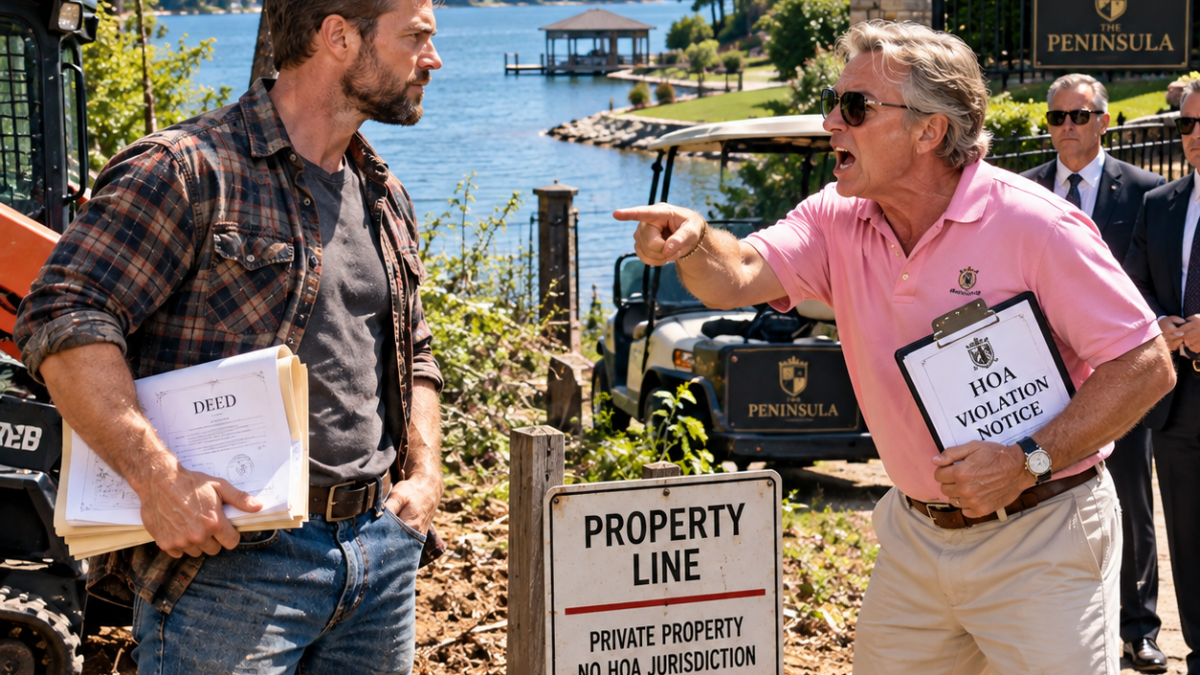
The man behind the wheel wore mirrored aviators, a pale pink polo, khaki shorts, and boat shoes.
Maybe sixty.
Trim.
Silver hair.
The expression of a man who had spent many years mistaking confidence for jurisdiction.
I shut down the cutter.
Pulled headphones.
“Morning.”
He parked precisely on my side of the line.
I did not know that yet.
He climbed out holding clipboard.
“What exactly do you think you’re doing?”
No hello.
No name.
Nothing.
“Clearing brush.”
“I can see that.”
He looked at machine.
“Do you have authorization?”
“From who?”
“The Architectural Review Board.”
I smiled.
“No.”
His expression sharpened.
“Then shut the equipment down immediately.”
“It’s already shut down.”
“You know what I mean.”
I wiped sweat.
“I’m Daniel Higgins.”
I held hand out.
He stared at dirt on it.
Did not shake.
“Richard Garrison.”
Pause.
“President of the Peninsula Property Owners Association.”
That should have been warning.
Richard continued:
“You are in violation of Article Four, Section Twelve governing heavy machinery.”
“Land clearing is prohibited from May through September.”
“No construction may begin before architectural approval.”
“And vegetation removal along the lake buffer requires community environmental review.”
I actually laughed.
Not mockingly at first.
I thought there was misunderstanding.
“Well, good news.”
“What?”
“I’m not in the Peninsula.”
Richard stared.
“This is the Gable lot.”
“Yes.”
“I bought it last week.”
“I know what lot it is.”
“Then you know it’s outside your declarations.”
His smile returned.
Not friendly.
“Harrison Gable told himself that for years.”
“I read the deed.”
“In 2018, Phase Three expansion incorporated the parcel into the Peninsula master plan.”
“No.”
“Yes.”
“Did Harrison sign?”
“The developer recorded an annexation declaration.”
“That isn’t what I asked.”
His mouth tightened.
I said:
“Harrison didn’t sign anything.”
“That is a legal issue above your understanding.”
I almost laughed again.
“Then my lawyer can misunderstand it professionally.”
Richard clicked his pen.
“You’re being assessed five hundred dollars per hour for unauthorized site work.”
Now I did laugh.
“Five hundred an hour?”
“Retroactive from commencement.”
“You’re charging me to use my own brush cutter on my own land?”
“You purchased property with obligations.”
“No.”
“You purchased property without understanding them.”
I stepped closer—not aggressively, just enough that he had to look at me instead of clipboard.
“Richard.”
“This is private property.”
“You’re standing on it.”
“I’m asking you to leave.”
He stared.
Then wrote something.
Very deliberately.
“You’ve been warned.”
He climbed into golf cart.
I restarted cutter.
He shouted something I could not hear.
Probably another fine.
I waved.
That was the end of our first conversation.
I thought he was ridiculous.
I did not understand yet that ridiculous people with lawyers are still people with lawyers.
The next morning, an orange violation sticker was attached to my truck windshield.
OVERNIGHT VEHICLE STORAGE ON UNAPPROVED SURFACE.
FINE: $750.
I peeled it off.
It left glue.
That annoyed me more than amount.
I called Greg.
“HOA says I owe seven-fifty.”
“Pay it?”
“No.”
“Good.”
“Can I invoice them for adhesive removal?”
“You can.”
“Will it help?”
“No.”
“What about their annexation claim?”
“I’m pulling records.”
He called later.
“There is a document.”
My stomach tightened.
“What?”
“2018 Phase Three Master Annexation Declaration.”
“Signed by Harrison?”
“No.”
“Then?”
“Signed by developer and HOA.”
“How do you annex someone else’s parcel?”
“You generally don’t without authority.”
“Generally?”
“Daniel.”
“Yes?”
“Stop asking me for absolute answers before I finish reading.”
“Fine.”
He continued:
“The document identifies the Gable parcel as ‘anticipated buffer acquisition.’”
“Anticipated?”
“Yes.”
“Not acquired?”
“Correct.”
“But one exhibit colors it as part of landscape buffer.”
“So Richard’s lying.”
“Richard may be relying on a bad exhibit.”
“Same result.”
“Legally not same.”
Greg needed boundaries as much as surveyors.
He told me to get professional survey.
I hired Thomas Wright.
Thomas had been surveying mountain and lake property thirty-eight years.
Sun-burned neck.
White mustache.
No patience for decorative boundary opinions.
He spent four hours with robotic total station, old plats, iron pins, deed calls, and county monuments.
He found the original southwest pin under three inches of soil.
Found eastern marker.
Found lakeside references.
Then hammered bright survey stakes.
He stood beside eastern line.
“The Peninsula begins there.”
He pointed.
I followed.
The line ran farther east than I expected.
Meaning my lot was slightly wider along one section.
“What about annexation?”
“Survey doesn’t care about HOA paperwork.”
“I can tell you deed boundary.”
“And?”
“They don’t own one inch west of this stake.”
I paid.
Photographed.
Emailed survey to Greg.
Two days later I returned.
Every stake gone.
Not leaning.
Gone.
Broken pieces stacked into a little pyramid in center of my access drive.
I stood looking.
Something inside me changed.
The fines were annoying.
This felt personal.
Thomas came back.
He was furious.
“Do you know who?”
“No.”
“Official markers or stakes?”
“The actual iron monuments still there?”
“Yes.”
“Good.”
“Wood witness stakes removed.”
“Still not okay.”
I called sheriff.
Deputy took report.
No suspect.
I installed trail cameras.
Three.
High enough not easily spotted.
One on entrance.
Two on eastern line.
Motion activated.
Cell connected.
Then Thomas restaked.
Forty-eight hours later, 6:13 a.m., my phone pinged.
Video.
Richard.
Golf cart.
Two Peninsula landscaping employees.
Richard pointed at stakes.
One worker hesitated.
You could not hear everything, but enough.
Richard gestured sharply.
Worker pulled stake.
Another.
Richard picked one up, snapped it across golf-cart rail.
I watched twice.
Then stopped.
Greg answered on second ring.
“I have him.”
“With what?”
“Video.”
“Send it.”
Before I got chance to call sheriff again, certified letter arrived at my home.
Caldwell, Mercer & Price LLP.
Seven pages.
Heavy paper.
Formal.
The Peninsula demanded:
Immediate cessation of clearing.
Removal of unauthorized equipment.
Submission of architectural plans.
Payment of accumulated dues and assessments dating to 2018.
Late fees.
Violation fines.
Collection costs.
Total:
$45,820.
If unpaid within fourteen days, they threatened lien remedies and foreclosure “as authorized by governing documents and applicable law.”
I sat at kitchen table reading twice.
Then called Greg.
He called back twenty minutes later.
His first words:
“This is aggressive nonsense.”
“Good.”
“Good?”
“I wanted you angry.”
“I’m always angry.”
“Can they lien property?”
“They can try to record something.”
“Can they foreclose?”
“Not legitimately if parcel isn’t subject.”
“But fighting costs.”
“Yes.”
There it was.
That was Richard’s leverage.
Not law.
Cost.
“What about 2018 document?”
“Bad for them.”
“Why?”
“Because the annexation declaration itself says developer intended to acquire Gable tract later.”
“Didn’t.”
“No.”
“It references a proposed easement too.”
“Signed?”
“No.”
“Exactly.”
Greg sent response.
Twenty-three pages.
No shouting.
Just documents.
My deed.
Survey.
Chain of title.
Recorded declarations.
Demand to cease issuing fines.
Demand to withdraw claimed lien rights.
Notice regarding destruction of survey stakes.
Preservation request for security footage, board emails, and Phase Three acquisition files.
Greg ended with:
Any attempt to encumber Mr. Higgins’s title based on covenants to which the property is not subject will be challenged immediately.
I loved lawyer English.
It is “go to hell” wearing tie.
I expected legal pause.
Richard escalated physically.
Friday morning, I was meeting contractor to locate cabin foundation.
I turned off county road.
Stopped.
A massive decorative concrete planter sat across my driveway.
Three tons at least.
Palm tree in it.
On either side, steel chain had been strung between trees and planter.
PRIVATE PROPERTY
THE PENINSULA HOA
NO TRESPASSING
I sat in truck almost a minute.
Then called Greg.
Important difference from original version of me in my imagination.
I did not cut chain.
I wanted to.
I had angle grinder in truck.
I could picture sparks.
Instead Greg said:
“Don’t touch it.”
“It’s on my land.”
“I know.”
“They blocked only access.”
“I know.”
“Can I cut lock?”
“Probably defendable.”
“Probably?”
“Do you want another issue?”
No.
I called sheriff.
Then tow company capable of moving planter.
Deputy Miller arrived first.
Older.
Gray mustache.
Calm.
Richard arrived five minutes later in golf cart.
Of course.
He got there shouting.
“He has no right to remove association infrastructure.”
Deputy Miller held hand.
“Everybody stop.”
I gave folder.
Deed.
Survey.
Greg’s letter.
Trail-camera stills.
Miller looked.
Then walked property line.
The planter sat completely west of surveyed boundary, on my deeded access.
Richard pointed at annexation declaration.
Miller read.
“I’m not deciding HOA membership.”
“Exactly.”
Richard said.
“This is civil.”
Miller looked at him.
“The planter isn’t.”
“What?”
“You blocked recorded access to property owned by another party.”
“Because he’s trespassing on community land.”
Miller pointed.
“County GIS and survey say this driveway is his.”
“That survey is disputed.”
“Then dispute in court.”
Miller handed paper back.
“You can’t blockade it meantime.”
Then I showed video of stake removal.
Richard’s face changed.
Miller watched.
“Those workers yours?”
Richard said:
“They were correcting unauthorized markers.”
Thomas had placed wooden witness stakes, not legal monument pins, but removing someone’s survey stakes can still create issues. Miller did not overstate.
He said:
“Do not touch any more survey markings.”
“We’ll refer this.”
Richard looked at me.
“You’re manufacturing conflict.”
I almost admired sentence.
He placed planter on my driveway.
I was manufacturing conflict.
Tow company arrived.
Richard ordered driver not to touch.
Driver looked at deputy.
Deputy said:
“It’s on Mr. Higgins’s access.”
Richard called his attorney.
Twenty minutes.
Then planter got removed.
No sparks.
No heroic angle grinder.
But watching a three-ton monument to entitlement roll away was satisfying enough.
Foundation excavation started next morning.
Concrete poured Monday.
Three days later, process server found me at work.
Thick packet.
The Peninsula had filed suit.
Declaratory judgment.
Injunctive relief.
Claims that my lot had been annexed.
Claims that construction threatened community stormwater infrastructure and lake protection.
Claims my clearing disturbed a “critical vegetative buffer” servicing Phase Three runoff.
They requested temporary restraining order.
A judge signed narrow TRO stopping further grading within designated disputed strip until hearing.
Not because judge declared HOA owned my lot.
Because environmental/stormwater allegations can justify preserving status quo when presented under oath.
Still, effect was brutal.
My contractor stopped.
Framing materials had been ordered.
Excavator scheduled elsewhere.
Permit clocks kept moving.
Legal meter ran.
At Greg’s office, I said:
“This is how they win.”
“Yes.”
“They don’t have to own land.”
“No.”
“They just make it expensive enough I quit.”
“Yes.”
“Can we get hearing fast?”
“We’ll try.”
“When?”
“Two weeks if emergency slot opens.”
“Not six months?”
“No.”
He looked at me.
“Courts are slow, not geological.”
Good.
But two weeks still hurt.
Then Greg showed affidavit supporting TRO.
Richard swore that:
Gable tract had been incorporated into Phase Three.
HOA managed vegetation there since 2018.
My clearing endangered drainage serving clubhouse and marina.
I stopped.
“Drainage serving clubhouse?”
“Yes.”
“On my property?”
“They say vegetation is part of system.”
“What physical system?”
Greg looked.
“Good question.”
The next morning I called Thomas.
“Bring everything.”
“What?”
“Survey gear.”
“Old plans if you can find.”
“Why?”
“I want to know exactly what is near eastern line.”
Thomas and I walked.
Cabin work area was inland.
HOA’s clubhouse sat southeast, higher ground.
Infinity pool overlooked lake.
Beautiful.
Its back edge appeared maybe twenty or thirty feet east of my line.
Thomas located stakes.
Then followed drainage features.
A concrete headwall.
Storm pipe.
It disappeared underground.
He measured.
Frowned.
Measured again.
“Daniel.”
“What?”
“Come here.”
He pointed to drainage inlet.
“What?”
“It’s west of line.”
“How far?”
“About eleven feet.”
My pulse rose.
We followed.
Buried conduit boxes for marina.
Also west.
Then retaining wall supporting landscaping below infinity pool.
The wall curved.
Thomas shot points.
Looked at data collector.
“Twenty-two feet at widest.”
“You’re telling me their wall is on my land?”
“Part of it.”
“What’s behind wall?”
He looked uphill.
Pool deck.
My stomach flipped.
“If wall moves?”
“I’m surveyor.”
“Not engineer.”
“Don’t make dramatic assumptions.”
Right.
We called Greg.
Then civil engineer.
Then utility locator.
Within four days we had a much clearer picture.
During Phase Three construction, several pieces of Peninsula infrastructure crossed the recorded Gable boundary:
Stormwater pipes draining clubhouse parking.
Electrical conduit servicing portions of marina lighting.
A retaining-wall segment supporting landscaped grade below pool complex.
The wall itself did not mean pool would instantly collapse if removed.
That would be exaggeration.
But relocating it and associated drainage would be expensive, disruptive, and require engineering.
“How did this happen?”
I asked Thomas.
He shrugged.
“Bad construction staking.”
“Old concept plan.”
“Developer assumed acquisition.”
“Somebody cut corner.”
Greg said:
“We need records.”
Discovery request already pending.
We subpoenaed county permit files.
The county had approved plans based on a Phase Three civil drawing.
That drawing showed Gable tract labeled:
FUTURE HOA BUFFER / ACQUISITION PENDING.
Not owned.
There it was.
The developer’s engineer knew.
Even better, a 2017 letter from Harrison’s attorney was in county file.
Re:
PROPOSED DRAINAGE EASEMENT.
Harrison rejected.
Explicitly.
No easement.
No sale.
No annexation.
The developer built anyway.
“Does HOA know?”
I asked.
“Maybe not.”
Greg said.
“Different developer.”
“But Richard said Harrison was old fool who didn’t understand property law.”
“That is not knowledge of infrastructure.”
Then board files came.
One email from 2019.
Property manager to Richard:
We still need resolution of Gable strip. Counsel advises Phase Three declaration does not independently convey title. Please avoid permanent improvements beyond surveyed Peninsula boundary until acquisition or easement is complete.
I read three times.
“Richard knew.”
“He was copied.”
“Did he answer?”
“Yes.”
Two hours later:
Harrison will never cooperate. We have maintained the area and should continue treating it as Peninsula common buffer. We can address title if/when necessary.
If/when necessary.
Greg smiled for first time in days.
“I believe we have reached necessary.”
The TRO hearing became very different.
HOA’s attorney was Patricia Caldwell.
Sharp.
Professional.
Not cartoon villain.
She did what attorney should: argued client’s position based on documents and affidavits provided.
Greg presented:
My deed.
Thomas’s survey.
Original plat.
2018 declaration with “future acquisition” notation.
Harrison’s rejection of drainage easement.
2019 email warning Richard title unresolved.
Engineering overlay showing HOA structures crossing line.
Judge asked Patricia:
“Does the association have a recorded deed or easement over Mr. Higgins’s parcel?”
She paused.
“No deed, Your Honor.”
“Recorded easement?”
“Not located at this time.”
“Signed annexation consent by Mr. Gable?”
“No.”
Then:
“On what basis did the association assess forty-five thousand dollars in dues against this parcel?”
Patricia said:
“Association relied on Phase Three declaration and historic treatment of tract.”
Judge looked at exhibit.
“Declaration says acquisition pending.”
“Yes.”
Richard sat behind counsel.
Very still.
Greg did not grandstand.
He said:
“My client is not asking court today to resolve every encroachment.”
“He asks only that the TRO be dissolved because environmental emergency alleged by plaintiff arises primarily from plaintiff’s own infrastructure placed across a boundary it had been warned it did not own.”
That landed.
Judge dissolved broad stop-work order.
She kept temporary no-disturbance zone around existing drainage and retaining wall until engineering and title claims resolved.
Fine.
My cabin pad was outside that zone.
Construction resumed.
Richard lost first major round.
He responded by sending settlement offer.
$80,000.
For my entire property.
Twelve lakefront acres.
I laughed.
Greg did not.
“They’re testing.”
“They can add zero.”
“Don’t be emotional.”
“I’m not.”
“You’re smiling.”
“I can smile legally.”
Offer letter said HOA would:
Waive all fines.
Dismiss claims.
Pay $80,000.
I would quitclaim parcel.
Why so low?
Because they framed it as compromised property burdened by infrastructure and litigation.
They still believed attrition.
I rejected.
Then sent my own demand.
Not “tear down pool in thirty days.”
That would have been stupid.
We requested:
Permanent recognition that Gable tract was outside HOA covenants.
Withdrawal of all fines and liens.
Reimbursement of certain legal and survey costs.
Negotiation of paid permanent utility/encroachment easement for existing HOA infrastructure.
Engineering safeguards.
Access and maintenance limits.
Indemnification.
No expansion without written consent.
And compensation.
Our opening number for easement and settlement:
$300,000.
Richard called it extortion in board email.
Patricia called Greg.
“They will never pay.”
Greg said:
“Then relocate infrastructure.”
That was the leverage.
Not destroying things.
Choice.
Pay fair value for permanent rights.
Or redesign systems onto land you own.
Engineering estimate came back.
Relocation:
Potentially $600,000 to over $1 million depending drainage modifications, retaining-wall reconstruction, pool-deck stabilization, marina electrical rerouting, permitting, temporary closures.
Suddenly $300,000 looked different.
Then the HOA’s governance problems surfaced.
Not magic corporate dissolution.
The source version of this story later claimed the Peninsula had been “legally dead” for two years and therefore every covenant and dues payment was void.
That was not true.
The association had administrative filing problems.
Its corporate registration had indeed fallen into delinquent status for failure to make required filings.
But Greg was clear:
“They can probably cure that.”
“So no nuclear bomb?”
“No.”
“Internet will be disappointed.”
“What matters is board authority under governing documents, not whether a secretary forgot annual report.”
He was right.
But filing problem opened door to records.
The new discovery revealed:
Richard had continued approving legal expenditures without full board votes in several instances.
Architecture fines had been assessed inconsistently.
The $45,820 supposedly owed by my parcel had been created internally only after I bought land.
There were no prior invoices to Harrison.
No dues ledger from 2018 forward.
They had backfilled account.
That was ugly.
Even worse, Richard had pushed a capital plan for a community boat-launch expansion exactly where my property met lake.
Derek? No need.
Board minutes eight months before I bought:
President Garrison reported renewed effort may be necessary to secure Gable parcel to support future launch, trailer turnaround, and expanded shoreline access.
Another note:
Owner remains unwilling to convey.
There it was.
They knew Harrison owned it.
They wanted it.
After I bought, Richard tried to pretend it already belonged to them.
Greg leaned back.
“This changes intent.”
“How?”
“The fines look less like mistake.”
“More like pressure.”
“Yes.”
Residents learned about litigation when annual budget showed legal spend.
Questions.
One homeowner, Susan Patel, requested records.
The board delayed.
Another, Martin Reece, a retired judge, asked why HOA claimed title to parcel while seeking to purchase same parcel months earlier.
That question spread.
Richard’s grip weakened.
The Peninsula was not full of villains.
That is important.
Most homeowners had no idea.
They paid dues.
Used pool.
Went to work.
Raised kids.
Complained about landscaping.
Some liked Richard because neighborhood looked good.
Some hated him.
Most did not read plats.
Why would they?
Then special board meeting drew over two hundred residents.
I did not attend initially.
Not my HOA.
Susan later told me what happened.
Richard stood at front.
Said lawsuit necessary to “protect community assets from speculative encroachment.”
Martin raised hand.
“Who owns the Higgins parcel?”
Richard answered:
“That is being litigated.”
Martin:
“Did HOA attempt to buy it from Harrison Gable?”
Pause.
“That was exploratory.”
“Why buy land we already owned?”
No good answer.
Then Susan:
“Why were dues never billed to Mr. Gable?”
Richard:
“He refused to participate.”
“Where are invoices?”
Finance chair looked down.
A third homeowner:
“Did we know retaining wall was over line?”
Richard:
“No.”
Then someone produced 2019 email obtained through litigation exhibit.
Chaos.
The board did not collapse that night.
Real organizations move slower.
But three directors demanded independent counsel separate from Patricia, because Patricia represented association while Richard’s conduct might diverge.
Correct move.
They formed special committee.
Hired outside engineer.
Hired independent real-estate counsel.
That lawyer reached same conclusion:
Gable parcel had never been validly annexed.
The HOA likely had potential equitable arguments regarding long-maintained encroachments, but not the sweeping ownership Richard claimed.
Fines unsupported.
Foreclosure threat indefensible.
That was when Patricia called Greg differently.
“Can we mediate?”
Greg smiled at me.
“Now they’re serious.”
Mediation took eleven hours.
Not dramatic mahogany ambush.
Conference center.
Bad coffee.
Separate rooms.
Mediator walking back and forth.
Numbers.
Risks.
I wanted recognition.
They wanted infrastructure certainty.
I did not want their wall torn down.
Despite anger.
Why would I?
It supported beautiful pool used by families who had nothing to do with dispute.
I wanted them off my title and out of my cabin plans.
We negotiated.
Final framework:
The Peninsula formally acknowledged my twelve-acre parcel was not subject to HOA declaration, dues, architectural controls, fines, or future annexation without my written consent.
All $45,820 charges canceled.
Any recorded lien notices withdrawn.
HOA reimbursed $38,000 of my documented legal, survey, and delay costs—not all, but significant.
I granted a permanent limited easement covering existing stormwater, marina electrical conduit, and defined retaining-wall footprint.
No expansion.
No public access.
Maintenance only through designated corridor with notice except emergency.
HOA paid $225,000 for easement and release of encroachment claims.
They also funded independent engineering measures to ensure drainage did not increase runoff onto my build site or shoreline.
The cabin resumed fully.
Richard resigned as HOA president.
That last item was not my contractual demand.
Important.
The board did it.
Technically he resigned before recall vote.
He said he wanted to protect community from distraction.
Residents had gathered enough signatures to remove him.
Either way, he was gone.
He did not go to prison.
The FBI did not storm the clubhouse.
No federal extortion raid.
No gated-community apocalypse.
The HOA continued.
The covenants remained for homes actually subject to them.
People did not suddenly paint houses purple in rebellion.
The gates stayed.
The pool stayed.
The marina stayed.
But governance changed.
The board amended procedures.
Independent review before asserting jurisdiction over neighboring property.
No fines without verified covenant applicability.
Board votes required for major litigation.
Conflict-of-interest disclosures.
Annual legal boundary review for common-area expansion.
Boring.
Useful.
Patricia remained the HOA’s lawyer briefly, then firm relationship ended after retainer review.
I never blamed her personally for initial claim once it became clear she had relied heavily on Richard’s version.
At final mediation she said:
“Mr. Higgins, for what it’s worth, if I had seen the 2019 email before filing, we would not have filed the same complaint.”
I believed her.
“Why didn’t you?”
She looked toward closed conference-room door.
“That is question for former president.”
Exactly.
Harrison Gable heard everything.
I drove to diner after settlement.
He was in same stool.
Coffee.
I placed copy of settlement—not confidential financial pages, just declaration confirming property independent—on counter.
He read.
Slow.
Then laughed.
“What?”
“They finally paid for drainage.”
“You knew?”
He looked at me like I was slow.
“Of course.”
“You knew pipes crossed?”
“Not exact.”
“Why didn’t you tell me?”
“You had survey.”
“Harrison.”
“They asked easement.”
“I said no.”
“You could have mentioned.”
He shrugged.
“You bought land.”
“You didn’t buy my memory.”
Infuriating old man.
Then he smiled.
“Richard still president?”
“No.”
“Good.”
“Did you hate him?”
“I don’t spend enough life on him to hate.”
That sentence stuck.
I had spent months thinking about Richard.
Waking at 3 a.m.
Replaying.
Imagining court speeches.
Imagining bulldozer beside pool.
Harrison had resisted developers for decades and barely gave them mental rent.
That was healthier.
Construction finished the next spring.
My cabin was not huge.
Twenty-two hundred square feet.
Cedar siding.
Dark metal roof.
Stone chimney.
Wraparound deck facing water.
I kept more trees than original plan.
The HOA had no approval authority.
I still complied with county.
Lake management.
Building code.
Septic.
Dock requirements.
Freedom does not mean no rules.
It means correct rules from correct authority.
That distinction became theme.
Richard confused standards with ownership.
Because his community had rules, he began acting as if rulemaking extended across property lines.
It did not.
My first night sleeping cabin, rain hit metal roof.
I sat deck with bourbon.
Not much.
Looked toward Peninsula.
You could see warm clubhouse lights through trees.
Pool edge glowed blue.
The retaining wall somewhere beyond was partly on my land under permanent easement now.
Paid.
Recorded.
Legal.
Exactly how it should have been from beginning.
Greg joined me a week later.
I handed beer.
He looked lake.
“So.”
“What?”
“Worth it?”
“The land?”
“Yes.”
“Absolutely.”
“Fight?”
“No.”
He laughed.
“Good answer.”
“What did I actually make after costs?”
“Don’t ruin view.”
Settlement money exceeded legal and delay costs.
I used part for deck and shoreline stabilization.
Not yacht.
Not revenge monument.
I bought a used fishing boat.
Harrison approved grudgingly.
“Too much motor.”
“It’s 150 horsepower.”
“Exactly.”
The first time I took boat out, I passed Peninsula marina.
Richard’s old house visible uphill.
He had not moved immediately.
Eventually he did.
Not because I forced.
Probably because living among people who voted you out gets uncomfortable.
I saw him once after settlement.
Hardware store.
Aisle seven.
He looked older.
No pink polo.
Just jacket.
We both stopped.
“Daniel.”
“Richard.”
Pause.
He said:
“You cost that neighborhood a lot of money.”
I could have answered sharply.
Instead:
“You cost it more.”
His jaw tightened.
“You bought outside parcel in middle of established community.”
“Next to.”
“Semantics.”
“Property lines are semantics with monuments.”
He almost smiled.
Almost.
Then:
“Harrison should have sold years ago.”
“Maybe.”
“We could’ve avoided this.”
“Yes.”
“If he had sold.”
“No.”
I looked at him.
“If you had asked instead of pretending.”
That landed.
He had nothing.
I added:
“You could’ve called the week I bought.”
“Said we have infrastructure over line.”
“Asked for easement.”
“We’d have worked something out.”
“You chose forty-five thousand dollars in fake fines.”
His face reddened.
“Those assessments were based on counsel—”
“Not your current counsel’s story.”
Silence.
Then he said:
“You don’t understand responsibility of protecting property values.”
I nodded.
“You’re right.”
“I understand protecting property.”
Different.
I walked away.
That was last conversation.
The Peninsula did not collapse.
In some ways it improved.
Susan Patel joined board.
Martin Reece chaired governance committee.
They hired professional manager.
One summer Susan invited me to community barbecue.
I laughed when email arrived.
“Do I need architectural approval for ribs?”
She answered:
Only if sauce color violates palette.
I went.
That mattered.
Not because we became best friends.
Because conflict does not need permanent enemy lines.
Most residents had not attacked me.
Several apologized.
One man said:
“I thought you were trying to exploit loophole.”
“I thought you were all trying to steal my land.”
“Some were.”
“Some.”
Fair.
The HOA installed small fence and signs marking actual boundary.
Not hostile.
Clear.
PRIVATE PROPERTY BEYOND THIS LINE
NO HOA ACCESS EXCEPT RECORDED UTILITY EASEMENT
I approved wording.
Clarity prevents mythology.
Thomas came back one afternoon.
He checked monuments.
Still there.
“Anybody pulling stakes?”
“No.”
“Boring.”
“Beautiful.”
We sat dock.
He said something I remember.
“Most boundary disputes aren’t because lines hard to find.”
“Then what?”
“Because somebody hates where line is.”
Exactly.
The line had existed.
Iron pins.
Deed.
Plat.
Richard simply preferred different reality.
Law does not always fix that quickly.
But eventually documents matter.
The unilateral 2018 “annexation” became favorite example Greg used in seminars.
Not as HOA horror story.
As title lesson.
A master plan is not ownership.
A colored exhibit does not convey land.
Future acquisition is not acquisition.
Maintenance is not automatically title.
Recorded rights matter.
Consent matters.
And if you build infrastructure relying on future deal that never closes, someday somebody will ask.
I was somebody.
There is one thing I changed from Harrison.
He held land partly out of spite.
I refused to.
I told Greg:
“If Peninsula ever wants to buy ten-foot strip later for utility expansion, I’ll listen.”
“Really?”
“Yes.”
“What happened to freedom?”
“Freedom includes selling.”
Important.
I did not win right to become stubborn forever.
I won right to decide.
A year later HOA asked for tiny additional easement—six feet near marina conduit replacement.
They approached correctly.
Survey.
Plan.
Compensation.
Insurance.
Written maintenance terms.
I said yes.
No fight.
Susan joked:
“That was disturbingly easy.”
“Funny what happens when nobody sends $45,000 bill first.”
She laughed.
That was point.
Ask.
Do not manufacture authority.
My cabin became what I wanted.
Weekend place.
Then more than weekends.
Remote work.
Fishing mornings.
Coffee deck.
Harrison visited once.
He walked slowly with cane.
Stood at shoreline.
“You cut too many trees.”
“I knew you’d say.”
“Cabin too big.”
“You said fishing shack was 600 square feet.”
“Plenty.”
“You had outhouse.”
“Efficient.”
I poured coffee.
He sat.
Looked toward Peninsula.
Pool visible faintly.
“They still using your dirt?”
“Yes.”
“They pay?”
“Yes.”
“Good.”
That was his entire approval.
Harrison died two years later.
His daughter called because I had stayed in touch.
At memorial, she handed me envelope.
Inside old photograph.
Harrison and his wife standing near shoreline.
No Peninsula.
No clubhouse.
Just woods and water.
Back read:
Keowee. Before everybody discovered it.
I framed that.
Not settlement check.
Not court order.
Photo.
Because land dispute had almost made me see property only as lines and leverage.
It was still place.
Water.
Trees.
Weather.
Memory.
That is why Harrison refused developers.
Not only spite.
He had buried wife’s ashes? Better avoid inventing too sentimental unless useful. Maybe they had memories there. He never said details. Let’s say decades of weekends.
A deed contains ownership.
Not meaning.
Meaning comes from use.
The Peninsula residents had meaning too.
Their children learned to swim in pool partly supported by retaining wall on my land.
Families launched boats through marina powered across my boundary.
They were not villains for loving those things.
The mistake was assuming their enjoyment entitled them to underlying property.
That distinction made final agreement possible.
I could recognize their dependence without surrendering title.
They could recognize my title without destroying amenities.
That is what good settlements do.
They replace dominance with defined rights.
Richard wanted winner and loser.
Recorded easement created neighbors.
The $225,000 helped, obviously.
Anyone saying money did not matter is lying.
But the real value was sentence in recorded agreement:
The Gable Parcel, now owned by Daniel Higgins, is and shall remain outside the declaration governing The Peninsula unless its owner voluntarily executes a written annexation instrument.
Voluntarily.
Best word.
The HOA could not fine.
Could not review siding.
Could not approve clearing.
Could not assess dues.
Could not claim future board vote annexed me.
Only I could opt in.
I never did.
I also stopped calling them “attack dogs.”
Most lawyers were doing jobs.
Most residents were living lives.
Even some board members had relied on Richard.
The more I learned, the less satisfying cartoon version became.
The true story was more useful.
One man controlled information.
He relied on everyone assuming he had authority because he had exercised authority before.
A developer had left title problem unresolved.
Infrastructure crossed line.
A board failed oversight.
Lawyers received incomplete records.
A homeowner outside association got treated like member because forcing him into system served future expansion.
Then evidence accumulated.
Not one nuclear revelation.
Survey.
Old plat.
Rejected easement.
2019 email.
Board minutes.
Engineer map.
Those pieces changed balance.
That is how real legal fights turn.
Paper.
One document at time.
I still keep original $45,820 demand.
Framed?
No.
In file.
Greg wanted frame.
I refused.
“Why keep?”
He asked.
“Reminder.”
“Of Richard?”
“No.”
“Of opening mail before coffee.”
He laughed.
But real reason:
The letter looked official.
Heavy paper.
Letterhead.
Citations.
Deadlines.
Threats.
If I had been younger.
Poorer.
Without lawyer.
Maybe I panic.
Maybe pay something.
Maybe sign.
Maybe sell.
That bothers me most.
How many people fold because something looks official?
That is why I tell friends:
Do not ignore legal letters.
But do not worship them either.
A demand is a position.
Not judgment.
A lien claim can be challenged.
A board letter is not court order.
A lawsuit is accusation written professionally.
Get advice.
Check documents.
Deadlines matter.
Facts matter.
Power often depends on whether target believes resistance impossible.
I was fortunate.
I could afford Greg.
That mattered.
I had time to research.
Also mattered.
Harrison’s deed was clean.
Huge.
Thomas was excellent.
Critical.
County records survived.
Lucky.
Not every person has those advantages.
So I do not tell story as:
Just stand up to HOA and win.
Sometimes law messy.
Sometimes deed burdened.
Sometimes HOA right.
Sometimes owner wrong.
This case turned because property truly was outside.
And board records showed it.
Five years after purchase, Lake Keowee land worth much more.
People ask if I’ll sell.
Maybe someday.
Not now.
The Peninsula once offered informally—not official board—whether I would sell shoreline corner for additional marina slips.
I said no.
Not because Richard.
Because I like trees.
Simple.
One morning, I watched mist lift.
Fishing line in water.
Truck sound from county road.
No golf cart.
No clipboard.
I thought about first day.
Richard saying:
“What exactly do you think you’re doing?”
At time answer:
Clearing brush.
Now I think better answer:
Owning land.
That sounds obvious.
It was whole dispute.
Ownership is not doing whatever you want.
County still governs.
Environmental rules.
Shoreline protections.
Building code.
Septic.
Lake authority.
Neighbors’ recorded easements.
You follow legitimate constraints.
But private association cannot create jurisdiction because it wants continuity.
A gated community ending at your boundary still ends.
Money does not extend line.
A million-dollar pool does not move iron pin.
A board vote cannot replace signature required for annexation.
A beautifully drafted map labeled FUTURE does not become PRESENT because five years passed.
And somebody maintaining grass does not automatically own everything grass touches.
Richard eventually learned.
The HOA learned.
I learned too.
I learned not to cut lock in anger.
Not to threaten demolition before engineer.
Not to confuse satisfying revenge with durable outcome.
There was moment, early, when I wanted excavator to rip every pipe from ground.
I pictured it.
Greg asked:
“Then what?”
“What?”
“You rip pipe.”
“Flood clubhouse.”
“Damage lake.”
“They sue.”
“County fines.”
“You spend two years proving point.”
“What did you gain?”
I hated him.
Because right.
The strongest move was not destruction.
It was making them choose.
Relocate legally.
Or pay for rights.
They paid.
Infrastructure stayed.
Lake protected.
Cabin built.
Nobody’s pool fell into water.
Less cinematic.
Better.
Online versions that circulated later changed everything.
One claimed I “dismantled entire HOA.”
No.
One claimed their corporation was dissolved and therefore all covenants vanished.
Wrong.
One claimed Richard went to federal prison.
No.
One claimed I personally bulldozed retaining wall until pool cracked.
Definitely not.
One claimed I received $2 million.
No.
Real settlement was $225,000 easement plus partial costs.
Still substantial.
One story said HOA paid because I threatened FBI with $1.4 million wire fraud.
Never happened.
The truth needed less decoration.
They tried claiming land they did not own.
Their own records contradicted them.
Their infrastructure crossed boundary.
Their president knew title unresolved.
Their leverage failed.
Board replaced him.
They paid for easement.
I kept land.
Cabin finished.
That is enough.
Maybe people exaggerate because paperwork feels boring.
But paperwork protects ordinary people from somebody else’s confidence.
I’d rather have survey than dramatic speech.
Greg once said:
“If client starts sentence ‘I’m a man of principle,’ I increase retainer.”
I asked why.
“Because next they want to do something expensive for emotional reasons.”
Fair.
I wanted principle.
He forced strategy.
That saved me.
Thomas supplied geometry.
Harrison supplied stubborn deed history.
Susan and Martin supplied homeowner pressure internally.
Even Patricia, once given complete record, helped move board toward settlement.
No single hero.
No single villain except perhaps Richard at worst moments.
Even him, I try not simplify completely.
He genuinely believed Peninsula needed control.
He thought uniform standards protected values.
He believed Gable tract should have been incorporated.
He crossed line—legally and literally—because he began treating desired outcome as existing authority.
That is dangerous personality trait in any institution.
Not unique to HOA.
The final year before Harrison died, he asked:
“You forgive that fellow?”
“Richard?”
“Yeah.”
“I don’t think about him much.”
Harrison smiled.
“That’s better.”
He was right.
Hatred still grants access.
Boundary disputes taught me boundaries should apply emotionally too.
Richard gets no space in cabin.
The documents do.
Practical.
My eastern boundary markers now protected in visible monuments.
I walk them once year with survey map.
Not because paranoid.
Because maintenance.
The Peninsula maintains easement corridor under agreement.
They notify before work.
Last summer, contractor replaced drain section.
Email:
Mr. Higgins, pursuant to Easement Section 4(b), maintenance crew requests access Tuesday 8 a.m.–3 p.m.
I replied:
Approved.
They came.
Worked.
Left.
No drama.
I almost missed drama.
Almost.
Then went fishing.
The cabin porch faces west.
Sunsets are ridiculous.
In October, water goes copper.
Pines black against sky.
Sometimes you can hear music from Peninsula gala.
Not loud.
Across water.
Once I sat with Susan during neighborhood event and she pointed toward my cabin.
“Funny.”
“What?”
“Everybody thought you were going to ruin view.”
“Did I?”
“No.”
“Your place nicer than half ours.”
“Careful.”
“Don’t tell architecture committee.”
We laughed.
There is irony.
My unrestricted cabin used cedar, stone, dark roof—exactly aesthetic their review board probably would have approved.
Difference:
I chose it.
That is what whole fight was about.
Choice.
Not whether rules were tasteful.
Not whether Richard liked brush cutter.
Whether he had right to dictate.
He did not.
If I had built neon pink shipping containers, county might still have something to say depending code.
But HOA would not.
Property freedom is not absence of consequences.
It is knowing who has legitimate authority and where it stops.
The Peninsula finally knows.
So do I.
If I had to reduce everything to one image, it is not Richard yelling beside planter.
Not court.
Not settlement wire.
Not pool wall.
It is one line Thomas marked through leaves.
Bright pink stake.
My side.
Their side.
For all the legal language, money, egos, engineers, and binders, conflict came down to line.
Richard hated it.
I respected it.
Eventually the paperwork forced everyone else to.
Harrison had understood from beginning.
Developers offered money.
He said no.
They built around.
Then assumed future would eventually deliver what consent withheld.
It didn’t.
When I bought, I inherited more than twelve acres.
I inherited an unfinished argument.
I finished it the only way that lasts.
Survey.
Record.
Agreement.
Signatures.
Money.
Then peace.
Today, if you pull county records, it is clean.
Daniel Higgins owns Gable tract.
The Peninsula owns adjacent common property.
Recorded easement grants specific rights over defined twenty-two-foot corridor.
No HOA authority beyond line.
No ambiguous “anticipated annexation.”
No future acquisition language.
No pretending.
That clarity may outlive all of us.
That is worth something.
Sometimes I think about the first $45,820 demand letter and laugh.
They thought number would scare me into obedience.
It almost did scare me.
That part nobody likes admitting.
When I first read foreclosure threat, my hands shook.
I did not know if Greg had missed something.
I imagined losing land I had just bought.
Imagine legal bills.
Job stress.
Contractor walking.
Everyone telling me:
Why buy beside HOA?
Maybe I had been stupid.
Fear is real even when claim false.
Then facts came.
Slowly.
Not one revelation.
And once facts became organized, fear became strategy.
That is maybe most useful lesson.
When powerful-looking institution says you are wrong, don’t assume arrogance alone will save you.
Check.
Get deed.
Survey.
Title.
Declarations.
Emails.
Permits.
Engineering.
Then decide.
Confidence without evidence is just another Richard.
I never wanted become that.
Harrison’s photograph hangs near back door now.
His old lot.
Before Peninsula.
When people visit, they ask:
“Is that here?”
“Yes.”
“No houses?”
“No.”
“Wow.”
Then I point through trees.
“There’s HOA.”
They laugh.
Some know story.
One friend asked:
“If you could go back, would you still buy?”
I answered immediately.
“Yes.”
“Even fight?”
“Yes.”
“Why?”
I looked water.
Because Richard was temporary.
Court temporary.
Construction delay temporary.
The land remains.
That is the thing about boundaries.
People fight.
Boards change.
Lawyers retire.
Developers disappear.
Documents get scanned.
Trees grow.
Water keeps moving.
Eventually everybody who argued is gone.
The line is still there.
I paid Harrison for land outside HOA.
Richard tried to turn a colored planning exhibit into ownership.
It didn’t work.
The HOA sent lawyers.
I sent records.
They sent injunction.
I sent survey.
They claimed environmental danger.
Their own pipes were over line.
They threatened foreclosure.
Their own minutes proved they knew they had never acquired the property.
And in the end, I did not dismantle their neighborhood.
I did something Richard found worse.
I made them respect exactly where their neighborhood ended.
Twenty-two feet turned out to be very expensive.
But once everyone finally acknowledged the line, the war stopped.
I built my cabin.
The pool stayed.
The marina stayed.
The HOA stayed.
And my land stayed mine.
Which was all I had asked for on the first morning when Richard Garrison stepped off his golf cart with a clipboard and demanded to know what I thought I was doing.
I was clearing brush.
I was building a home.
And whether he liked it or not, I was doing it outside his HOA.








