HOA Sold 63 Marina Passes Through My Private Road—Then the State Inspector Called Me “Judge”
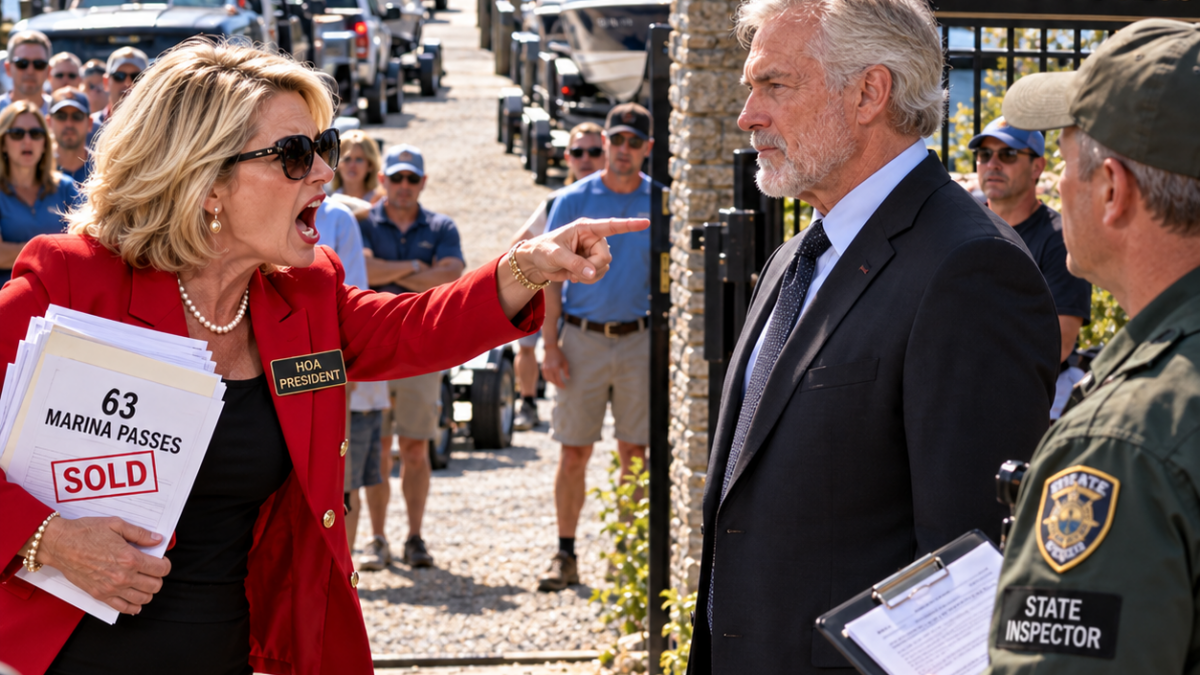
PART2:
My father polished that cap every spring.
Not because brass needed polishing.
Because he was my father.
The golf cart rolled toward me.
The young man driving it lifted one palm.
“Sir, you can’t stop there.”
I looked ahead.
“I’m not stopping.”
“Lake traffic needs to keep moving.”
“I’m trying to reach the house.”
He glanced at my truck.
Faded blue paint.
Tool chest.
Mud on the rocker panel.
Then back at me.
“This road is for Brier Glen residents and registered marina guests.”
“No.”
He smiled politely.
“Yes, sir.”
I pointed down.
“This road ends at my boathouse.”
His smile became the patient version people use when they think they are dealing with somebody confused.
“No, sir. It ends at the community marina.”
That was the first sentence that told me something had gone very wrong while my father was dying.
I looked beyond the trailers.
Fifty yards downhill stood an electronic gate.
Black steel arms.
Keypad pedestal.
Blue Brier Glen crest.
Fresh concrete.
None of that had existed at Christmas.
A wooden sign beside it read:
BRIER GLEN LAKE ACCESS
MEMBERS ONLY
I turned back to the young man.
“What’s your name?”
“Tyler.”
“Tyler, who built that gate?”
“The association.”
“On whose property?”
He hesitated.
“The access corridor.”
“That wasn’t my question.”
Before he could answer, his radio chirped.
He stepped away.
“Dana, I’ve got a gentleman blocking west access. Says road is his.”
A voice came back through static.
“I’m coming.”
Ten minutes later, a black SUV appeared from the subdivision side.
It moved past the parked trailers like a government motorcade.
The driver stopped nose-to-nose with my truck.
A woman got out.
Early fifties.
White pants.
Polished shoes.
Scarlet blazer.
Blue binder tucked against her ribs.
Everything about her suggested preparation.
“Mr. Reic?”
“That’s right.”
“I’m Dana Whitmore, president of the Brier Glen Property Owners Association.”
“I know.”
That surprised her slightly.
Then her face softened.
“I’m very sorry about your father.”
“Thank you.”
“We sent flowers.”
“I saw them.”
She nodded as though we had completed a necessary diplomatic exchange.
Then she gestured toward the trailers.
“This is our spring launch day. If you back down to the county road, Tyler can open the north service lane for you.”
“The north lane reaches the barn.”
“Yes.”
“I need this road to reach the house.”
Dana looked past me at the old brass survey cap.
“This has been the association’s established lake-access corridor for years.”
“How many?”
She blinked.
“Excuse me?”
“How many years?”
“Long enough that ownership is not the simple issue you seem to think it is.”
That sentence told me more than an argument would have.
People who have a deed usually say they have a deed.
People who have an easement usually say they have an easement.
People who say ownership is complicated often want time.
“Move the trailers.”
“Mr. Reic—”
“And open the gate.”
“You’re disrupting a scheduled association event.”
“On my road.”
“On an access route used by this community.”
“Show me the recorded easement.”
Her expression cooled.
“Our counsel handles title questions.”
“Instrument number.”
“I’m not conducting a legal debate on a roadway.”
“I’m not asking for a debate.”
She opened the binder.
Removed a blue paper tag.
“Take a visitor pass for today. We can have a formal discussion Monday.”
I did not take it.
She held it out another second.
Then withdrew it.
“Mr. Reic, I understand emotions are high after a loss.”
That nearly worked.
Not because she was right.
Because it was the first time she tried using my father’s death to explain why I objected to strangers occupying his road.
I kept my voice even.
“I will reach my house today.”
“Not through the launch traffic.”
“Fine.”
I backed into the grass.
Dropped into four-wheel drive.
And drove through an old timber track my father used when hauling firewood.
Branches scraped both sides of my truck.
Tyler stared.
Dana watched without moving.
Twenty minutes later I came out behind the barn.
The house sat where it always had, on an eleven-acre point above Lake Bellweather.
My father built it in 1969.
Not a mansion.
Two stories.
Stone chimney.
Screened porch.
Long western view across the reservoir.
Our property was shaped like a crooked knife.
Narrow at the county road.
Wider near the lake.
Brier Glen subdivision bordered us on the east.
Their cul-de-sac stopped forty-two feet from our western access road.
Or at least it had.
From my father’s porch I could see the new connection.
Fresh gravel crossed the gap from the end of Brier Glen’s cul-de-sac to our road.
Trees had been cut.
Brush cleared.
Electronic gate installed inside our tree line.
The road continued down toward our private ramp.
Except it no longer looked private.
Near the boathouse, workers were attaching railings to a large floating dock.
Blue plastic barrels.
Aluminum frames.
Dock cleats.
New electrical pedestal.
And farther uphill stood the skeleton of a small pavilion.
Roof nearly complete.
Stone piers.
Restroom enclosure.
My father’s fourteen-foot green aluminum fishing boat had been dragged out of its slip and placed on the bank beneath a tarp.
I stood on the porch for a long time.
Then went down.
The lock on the boathouse had been cut.
Not broken.
Cut.
A keypad latch had been screwed into the cedar frame.
Inside, where my father kept tackle boxes, life jackets labeled BRIER GLEN were stacked to the ceiling.
A laminated emergency evacuation map covered the pencil marks where Dad recorded lake levels each October.
1992 drought.
The flood year.
All under a plastic sign telling strangers where to assemble during lightning.
I photographed everything.
Gate.
Dock.
Boathouse.
Keypad.
My father’s boat.
The fresh gravel.
Then I found the first survey monument.
It was four inches below the new road surface.
Red plastic cap barely visible.
I dug with my fingers.
The pin was exactly where I remembered.
Eleven feet west of the new gate.
Someone had driven a steel fence post two feet to the east.
Orange ribbon tied around it.
As though fluorescent plastic could relocate a deed line.
I slept badly.
Monday morning, I found an envelope wedged into the front door.
Brier Glen letterhead.
NOTICE OF INTERFERENCE WITH COMMUNITY AMENITY.
I read it standing in the kitchen.
It demanded that I stop obstructing the association’s established access corridor.
Remove my vehicle from the marina turning circle.
Refrain from interfering with contractors.
Provide Brier Glen with keys to the boathouse.
And avoid conduct that might delay the Memorial Day opening of the new marina pavilion.
The final paragraph warned that the association reserved all rights to seek damages caused by my interference.
Attached was a glossy color brochure.
A computer rendering showed smiling families on a dock beneath string lights.
Children holding fishing poles.
Two pontoon boats.
Blue sunset.
Across the top:
YOUR LAKE. YOUR SUMMER. YOUR BRIER GLEN.
Below:
63 LAKE ACCESS MEMBERSHIPS
$600 PER HOUSEHOLD ANNUALLY
My father’s private road had become a product.
Sixty-three times six hundred.
$37,800 every year.
Then I read the financing sheet.
The pavilion project cost approximately $280,000.
Special assessment funded part.
A bank loan covered the rest.
Future marina-access revenue backed portions of the financing plan.
Final $85,000 construction draw required the marina to receive an operating certification before May 31.
If it missed that deadline, the association might need an additional emergency assessment.
Dana had not merely crossed a boundary.
She had attached sixty-three families, a construction loan, a board budget, a Memorial Day ceremony, and future revenue projections to it.
That changed the problem.
Monday afternoon I drove into Brier Glen.
The clubhouse parking lot was full.
Dana had called an “informational meeting.”
My name was already printed on the agenda.
PROPERTY ACCESS UPDATE — REIC PARCEL.
Approximately seventy residents sat in folding chairs.
The moment I entered, conversations lowered.
I took a chair against the back wall.
Dana stood beside a projected map.
Different red blazer.
Possibly same manufacturer.
“Mr. Reic has recently inherited the parcel adjoining our established lake-access corridor.”
I almost corrected her.
The land had passed through trust arrangements before my father died.
But it didn’t matter.
“Understandably,” Dana continued, “he has questions regarding boundaries and historic use.”
Several people looked back at me.
“Unfortunately, Mr. Reic has also indicated an intention to close the access route before Memorial Day.”
A man near the front turned around.
“We paid for that access.”
I answered from my chair.
“You paid the HOA.”
He frowned.
“So?”
“I didn’t sell it.”
Room shifted.
Not loudly.
A chair scraped.
Someone folded the marina brochure.
Dana stepped in.
“The association’s legal position is that the route has served Brier Glen openly and continuously for decades.”
She pointed at the map.
It showed their cul-de-sac connected directly to the lake road.
No gap.
No parcel boundary.
No forty-two-foot strip.
No ownership break.
At lower corner:
1998 SHORELINE ACCESS CONTROL SURVEY.
I knew that survey.
Not the cropped image.
The complete one.
I had seen it years earlier.
“Dana.”
She stopped.
“What is the recording instrument number for the easement?”
“Our counsel will address legal filings.”
“So none tonight?”
“This meeting is to communicate with residents.”
“Who authorized your electronic gate?”
“The gate is inside the association’s access area.”
“According to what recorded document?”
She tightened her grip on pointer.
“You’re asking the same question repeatedly.”
“Because you keep answering a different one.”
Somebody laughed quietly.
Not at me.
Dana continued.
“This is a technical title matter.”
“Who cut the lock on my father’s boathouse?”
That changed her pace.
“Our contractor opened a facility that the association has historically maintained.”
“Who gave permission?”
Her voice sharpened.
“Mr. Reic, repairing tractors does not make you a surveyor.”
A few people laughed.
Then she added:
“And owning a toolbox does not make someone a lawyer. Brier Glen has counsel.”
More laughter.
The man beside the projector said:
“Maybe he can weld himself an easement.”
That got the biggest laugh.
I let it happen.
There are moments when correcting arrogance only teaches it caution.
I looked at the screen one more time.
Cropped map.
No instrument number.
Then I left.
The next morning I called Laura Chen.
Licensed surveyor.
Two counties away.
I had never hired her.
Never used her firm.
No connection to my father.
No connection to my professional work.
I chose her because independence matters more when you already know what you expect the answer to be.
Laura arrived Thursday with two technicians.
Robotic total station.
GPS receiver.
Data collector.
Tripods.
Dana arrived nine minutes later.
Binder.
Tyler.
Golf cart.
“You do not have permission to survey association property.”
Laura didn’t look up from her tripod.
“My client retained me to survey his parcel.”
“The parcel line is disputed.”
Laura leveled instrument.
“The line is what I’m measuring.”
“You’re crossing association property.”
“No.”
Dana stared.
Laura finally looked at her.
“Mrs. Whitmore, if your concern is where the boundary lies, the least useful thing you can do is argue with the people measuring it.”
Dana filmed us on her phone for an hour.
Laura worked two days.
Recovered original monuments.
Brass cap at county road.
Buried pin near gate.
Iron pipe above ramp.
The deed calls closed almost perfectly.
She showed me preliminary overlay on tablet.
The result was worse than I expected.
The electronic gate stood eleven feet inside my property.
The new gravel connector crossed forty-two feet of my parcel before reaching our road.
Sixteen feet of the marina turnaround occupied our land.
A corner of the pavilion roof extended eighteen inches across the line.
Part of the dock anchoring system was tied into my shoreline.
“No easement shows in title search?”
Laura asked.
“None.”
“Any license?”
“No.”
“Old agreement?”
“Not that I’ve found.”
She zoomed.
“Then this is straightforward geometrically.”
“Legally may not be.”
She studied me.
“You’re comfortable with plats.”
“I’ve read a few.”
She smiled.
“For a tractor mechanic.”
I laughed.
Dana did not wait for final survey.
That evening she emailed the sixty-three marina members.
An outside contractor retained by Mr. Reic has placed unverified boundary markers across an established community access route.
An emergency board session will be held to authorize removal of any obstruction threatening Memorial Day operations.
The next morning, two orange construction barricades blocked the timber path I had been using to reach the house.
CONSTRUCTION AREA — NO ENTRY.
They weren’t on her side.
They were on mine.
That was the moment this stopped being about aggressive interpretation and became something else.
Dana was trying to isolate me on my own parcel until her project crossed the deadline.
I photographed barricades.
Moved them carefully onto shoulder.
Drove through.
That evening, a family waited by my mailbox.
Man.
Woman.
Boy around twelve.
Behind their SUV sat a brand-new fishing boat.
Dealer sticker still in windshield.
The man introduced himself.
Eric Shaw.
His wife Marlene.
Son Ben.
Eric looked toward road.
“Dana says you’re shutting the marina.”
“No.”
“You’re closing access.”
“I’m stopping the HOA from crossing land it doesn’t own.”
Marlene touched the trailer hitch.
“We bought this after announcement.”
“How much?”
Eric hesitated.
“Twenty-seven thousand.”
Ben stared at boat.
Marlene said:
“He’s been counting days.”
That was harder than Dana.
Dana’s pressure was easy to resist.
A twelve-year-old who had nothing to do with any of this?
Different.
I told them:
“I did not sell the association a road.”
Eric’s jaw tightened.
“That may be true.”
“It is.”
“But we’re the ones who lose.”
He was right about that.
Dana had constructed the perfect political position.
Every boundary I defended could be presented as something I was taking from a family.
Not something she had falsely sold them.
They drove away slowly.
Unused boat behind them.
That night I understood documents alone would not solve the social problem.
Residents needed to see who had made the promise.
And who had never made it.
The next day, contractor knocked.
Rick Alvarez.
Owned grading company.
He looked uncomfortable before I opened door.
“Can we talk?”
“Sure.”
He unrolled site plans across kitchen table.
They showed the connector road crossing an area labeled:
HOA ACCESS RESERVE.
Parcel identification number in title block belonged to Brier Glen’s cul-de-sac parcel.
Not mine.
“Who gave you this?”
“Association project manager.”
“Dana?”
“Through project manager.”
“Did they show deed?”
“No.”
“Recorded easement?”
“I asked.”
“And?”
“Said counsel had it.”
“How much work have you done?”
Rick rubbed jaw.
“Concrete, grading, gate base, some turnaround.”
“Approximate?”
“Twelve grand concrete alone.”
“And paving?”
“Crew Monday.”
I handed him Laura’s preliminary overlay.
He stared.
“This pin is where?”
“Under your gravel.”
He closed eyes.
“If this is right…”
“It is preliminary.”
“I’m canceling paving.”
“You should verify independently.”
“I will.”
Before leaving, Rick asked:
“Are you going after me?”
“Did you know?”
“No.”
“Then no.”
His shoulders dropped.
That cancellation was the first deadline Dana lost.
It also gave me first independent witness who could say the HOA supplied a plan falsely labeling my land as association property.
Then I started searching my father’s records.
Dad saved everything.
Not neatly.
He believed filing meant putting something somewhere he would remember later through intuition.
I opened:
Coffee cans.
Tackle boxes.
Desk drawers.
Old tax folders.
Metal cabinets.
A drawer labeled ELECTRICAL containing zero electrical records and three years of boat registrations.
Near sunset Saturday, I found rubber-banded maintenance invoices.
Every November from 1999 through 2023, Dad paid same local company to winterize ramp and chain the road.
Several invoices had handwritten notes:
Turned away Brier Glen vehicle.
Chain replaced after unauthorized removal.
Road closed for winter.
“Open and continuous use” sounds impressive in an HOA meeting.
Twenty-four years of seasonal closures sounds less impressive.
County archives gave another piece.
Aerial photographs.
Four-year intervals.
Tree line between cul-de-sac and our road remained intact.
No connector.
No road.
No corridor.
Then 2023 aerial imagery showed clearing.
The access was new.
Not historic.
Then county clerk found file that changed everything.
2019 Brier Glen marina preliminary application.
Correspondence tab.
Letter from Dana Whitmore to my father.
The HOA offered him $18,000 for a permanent lake-access easement.
His response:
Dana,
The road crosses family land and serves our private boathouse.
I am not interested in selling permanent access.
Regards,
Thomas Reic
Two weeks later, Brier Glen board minutes:
Motion to increase easement offer — FAILED 4-3.
Then:
President Whitmore recommends alternative access strategy.
I read that line three times.
Dana had not misunderstood ownership.
She had tried to buy the right.
My father said no.
Her own board refused to increase price.
Then she built as though she had won.
That distinction mattered more than almost anything else.
Several residents started calling.
First was Nolan Price.
Retired teacher.
Lived near cul-de-sac.
“I paid the six hundred.”
“So did my daughter.”
“Did you receive an easement document?”
“No.”
“What were you told?”
He hesitated.
“Dana said your father eventually donated access corridor.”
“After 2019?”
“That’s what I understood.”
“Any writing?”
“We got stickers.”
Blue windshield stickers.
Ownership by decal.
Nolan sounded embarrassed, not angry.
Then he explained why residents were so invested.
Brier Glen once had its own small ramp.
Silted in over years.
Too shallow for modern boats.
Nearest public launch was fourteen miles.
Filled before sunrise on summer weekends.
HOA marina announcement changed buying decisions.
People bought boats.
Paid special assessment.
Some chose houses because agents mentioned future lake access.
One family financed a pontoon.
Dana had arranged their lives around a promise she did not own.
That made them angry with her.
It also made them terrified of me.
Nolan forwarded an internal board email marked CONFIDENTIAL.
Loan deadline.
Final $85,000 draw conditioned on legal access and operating certification by May 31.
Missing deadline could require additional homeowner assessment estimated around $1,350 per household.
Now I understood urgency.
Dana was not merely protecting ego.
She was trying to force unresolved property access into existence before a financing deadline.
Once project opened, once sixty-three families were using it, once bank funded final draw, once children had boats in water—
Then she could argue reliance.
Custom.
Established use.
Practical impossibility of undoing.
She wanted facts on ground before deeds caught up.
On Monday Laura delivered signed survey.
Sealed.
I created packet.
Survey.
2019 easement offer.
My father’s rejection.
Board minutes.
Aerial imagery.
Winter closure invoices.
Contractor site plan.
Photos.
I sent it to:
Dana.
Brier Glen counsel.
County permitting office.
Bellweather Reservoir Authority.
I requested ordinary compliance review.
Nothing more.
I did not ask for emergency injunction.
Did not call sheriff.
Did not ask anyone in my professional life for favors.
Did not put title before my name.
The reservoir authority scheduled field inspection for Memorial Day morning.
Same morning Dana planned ribbon cutting.
She could have postponed.
Instead, banners went up.
Balloons ordered.
Caterer booked.
Newsletter:
GRAND OPENING
RIBBON CUTTING — 10:00
LIVE MUSIC — NOON
FIRST ANNUAL BRIER GLEN BOAT PARADE — 1:00
Three days before opening, Dana came to my porch.
Alone.
No binder.
No golf cart.
Scarlet blazer.
Two-page agreement.
“We can settle this privately.”
I took paper.
It granted Brier Glen permanent use of:
Road.
Ramp.
Turning circle.
Boathouse.
No payment.
No limit on users.
No insurance requirement.
No seasonal restrictions.
No maintenance standards beyond vague language.
No hours.
No term.
At bottom:
ADJOINING OWNER CONSENT.
I looked up.
“You’re asking me to give you what the board refused to buy.”
“I’m giving you chance to avoid becoming man who ruins summer for sixty-three families.”
“You sold them something my father refused to sell you.”
Her eyes narrowed.
“Your father is not here.”
That was closest she ever came to making me lose composure.
I folded paper.
Handed it back.
“The inspection is Monday.”
“I know.”
“Our maps were approved.”
“Which maps?”
Her patient smile returned.
“The ones professionals understand.”
I watched her leave.
Memorial Day was bright.
Windless.
At nine, marina lawn covered with folding chairs.
Blue balloons tied to railings.
Coffee table.
Pastries.
Small podium with Brier Glen logo.
Trailers filled cul-de-sac.
This time Dana kept them off my road.
Two private security guards stood at electronic gate.
I walked down from house carrying slim document case.
No robe.
No suit.
Work boots.
Dark jacket.
Laura had set total station on shoulder.
Rick Alvarez stood near his truck.
Nolan and daughter waited near back.
Eric Shaw came with Marlene and Ben.
Their boat remained home.
At 9:45, three white state vehicles entered.
Conversation lowered.
Dana stepped toward them before doors opened.
First man out was tall.
Gray hair.
Bellweather Reservoir Authority badge.
Calvin Mercer.
Not related.
He looked at Laura’s tripod.
Then brass cap.
Then at me.
He stopped.
“Mason Reic?”
“Morning, Calvin.”
He crossed road.
Shook my hand.
“Judge Reic. I didn’t know this was your family’s property.”
Behind us, conversations died one by one.
Dana’s smile stayed.
But balance left it.
“You two know each other?”
Calvin looked at her.
“Judge Reic has served on Central Circuit Superior Court for eleven years.”
Someone behind me whispered:
“Judge?”
Calvin continued.
“I’ve testified in his courtroom on two reservoir condemnation matters.”
Then pointed toward enlarged survey map beside podium.
“The complete 1998 shoreline survey was evidence in one.”
Dana recovered faster than most people would.
“Then Judge Reic has an obvious conflict.”
Calvin frowned.
“He is using his judicial office to pressure this agency over a private property dispute.”
I had expected that.
It was exactly why I had not called Calvin.
Not contacted director.
Not used courthouse letterhead.
Not requested colleague.
Nothing.
I said:
“My compliance request came through public portal.”
The permit officer behind Calvin lifted tablet.
“Submitted 8:14 Monday morning. Standard citizen intake.”
Dana looked at him.
“No priority flag.”
He scrolled.
“No internal referral. Applicant disclosed he is record owner and included employment disclosure.”
Calvin looked at me.
“Why didn’t you call my office?”
“Because the public counter was sufficient.”
Nolan spoke from behind chairs.
“So he could have called people and didn’t.”
Nobody answered.
Didn’t need to.
Dana’s prepared accusation turned into proof of restraint.
“I did not prepare the current survey.”
I said.
Laura stepped forward.
“I did.”
She handed over sealed plat.
“My firm has never worked for Mr. Reic before this month.”
The permit officer unfolded it.
Laura continued.
“Recovered monuments match deed calls. Association connector crosses forty-two feet of Reic parcel. Gate stands eleven feet inside. Turnaround encroaches sixteen feet. Pavilion roof extends approximately eighteen inches.”
Calvin asked Dana:
“Approved access plan?”
She opened blue binder.
Her cropped 1998 map.
Enlarged.
Title block gone.
Western margin missing.
Heavy access line continuing toward lake.
But underlying boundary erased.
I opened case.
Certified archive copy.
Full map.
Calvin laid them side by side.
The complete version showed hatched strip between Brier Glen cul-de-sac and my father’s parcel.
Across it:
NO PUBLIC ACCESS ACQUIRED.
Three signatures.
Date.
Long before I became judge.
My title didn’t create note.
Calvin recognizing me didn’t move boundary.
Archive record was archive record.
Permit officer compared maps.
Then opened county parcel data.
“This construction plan identifies the access reserve as HOA property.”
“Yes.”
Rick stepped forward.
“That’s the plan Mrs. Whitmore’s project team gave us.”
Dana turned.
“Your contract required verification of site conditions.”
Rick looked at her.
“Site conditions, yes.”
Then louder:
“Not whether client invented the parcel.”
The crowd reacted.
Not shouting yet.
That sentence traveled faster.
Nolan raised hand.
“What about 2019 vote?”
Dana stared.
I handed Nolan copy.
He read aloud.
Offer for permanent easement.
Failed.
Four to three.
President Whitmore recommends alternative access strategy.
Questions exploded.
“You told us it was donated.”
“Where did our $600 go?”
“Why did we buy stickers?”
“You said title was settled.”
“What did bank see?”
“Did lawyer know?”
Dana raised both hands.
“This association has acquired rights through historic use.”
Laura answered.
“Aerial imagery shows connector constructed last fall.”
Dana:
“Use predates gravel.”
Laura:
“Your claimed route was chained seasonally for twenty-four documented years.”
Dana:
“That doesn’t defeat all legal rights.”
Laura:
“No. But it certainly does not establish what you represented in this permit.”
Calvin turned to permit officer.
They spoke quietly.
Then permit officer closed binder.
“The marina cannot open under current approval.”
Silence.
Dana’s face changed.
“Excuse me?”
“The permit package identifies access property incorrectly.”
“We can supplement.”
“Not today.”
“We have sixty-three households scheduled.”
“That doesn’t change title.”
“Our lender—”
“Also not this agency’s issue.”
He removed red notice from clipboard.
Walked to electronic gate.
Posted:
OPERATING AUTHORIZATION SUSPENDED
NO MEMBER OR VEHICLE ACCESS PENDING CORRECTED SITE PLAN AND DOCUMENTED LEGAL ACCESS.
No handcuffs.
No dramatic sirens.
No one dragged Dana away.
The caterer continued arranging sandwiches because caterers understand sunk costs better than most executives.
Balloons shifted in breeze above a dock nobody could use.
A fishing boat passed across reservoir without slowing.
Dana stood beside podium.
Sixty-three families who had paid for access stood behind her.
And a state official had just told all of them she could not deliver it.
For first time, scarlet blazer looked like clothing instead of uniform.
Three days later, Brier Glen board met without Dana presiding.
Every director received:
My portal submission timestamp.
Disclosure letter.
Laura’s engagement letter.
Authority response.
2019 easement records.
Financing email.
Full 1998 map.
Contractor plan.
Aerial imagery.
Winter road closures.
Nolan called me afterward.
“Six to one.”
“What?”
“They removed her as president.”
I said nothing.
“Two members changed votes after financing email.”
“Okay.”
“You don’t sound happy.”
“This is your association.”
“Our mistake.”
“Not all of you.”
“Still.”
Board hired outside accountant.
Independent counsel.
Insurance advisor.
They did not invite me.
I was grateful.
My problem was road.
Their problem was governance.
Accounting found no stolen fortune.
No offshore account.
No secret embezzlement.
Money had gone where project said it went.
Pavilion.
Dock.
Paving.
Landscaping.
Engineering.
Loan payments.
Dana had not built marina to steal money.
In some ways that made conduct harder to understand.
She believed project itself would justify access.
If enough money was spent, enough families depended on it, enough infrastructure existed, eventually unauthorized route would become too difficult to undo.
She was trying to turn momentum into ownership.
The board refunded current year’s $600 access fees using reserves.
Special assessment money could not simply be unwound because infrastructure existed and contractors had been paid.
That created anger.
Some residents wanted to sue Dana personally.
Others wanted to sue board.
Others wanted me to grant access for free to save them.
One woman wrote a letter calling me “technically correct but morally destructive.”
I understood anger.
I did not answer.
Contractor removed electronic gate.
Jackhammered footings.
Restored eleven-foot strip around monument.
Pavilion roof cut back eighteen inches.
Boathouse emptied.
My lock replaced.
Their keypad removed.
My father’s fishing boat went back inside.
For six weeks, only boat using ramp was his green aluminum fourteen-footer.
I repaired fuel line.
Changed trailer tires.
One Tuesday morning, I launched.
Motored toward center of lake.
Killed engine.
Drifted.
Dad had loved that spot.
He refused easement because he feared road would become permanent highway through last quiet part of land.
But my father was not selfish.
That distinction mattered.
He spent forty years pulling strangers off sandbars.
Loaning jumper cables.
Giving kids worms for fishing.
Letting neighbors walk shoreline when they asked.
He didn’t hate sharing.
He hated having kindness converted into entitlement.
Dana did exactly that.
She took years of occasional tolerance and tried turning it into a product.
By July, Brier Glen had new president.
Priya Wallace.
Retired civil engineer.
The kind of person who reads footnotes before first paragraph.
Their attorney contacted mine.
Not my courthouse.
Not me directly.
Formal proposal.
This time:
Seasonal license.
Not easement.
Not ownership.
Forty household permits, not sixty-three.
Daylight use only.
Five-mile-per-hour road limit.
No gate inside my boundary.
No storage in boathouse.
No commercial events.
No trailers parked overnight.
Liability insurance naming property owner.
Road maintenance paid by HOA.
Dust control.
Shoreline restoration.
Annual license fee deposited into transparent road-maintenance account.
Three-year review.
Suspension rights for safety violations.
And first paragraph:
The road, ramp, turning circle, shoreline, and boathouse remain private property of Mason Reic. Nothing in this agreement creates an easement, ownership interest, or permanent right of access.
I read that sentence twice.
Then signed.
Some people told me I was stupid.
“After what they did?”
Yes.
Because I was not fighting to prove nobody else could ever use lake.
I was fighting to prove nobody else could sell my father’s refusal as consent.
A fair agreement was always possible.
What made Dana dangerous was pretending agreement already existed.
Marina opened in August.
No balloons.
No ribbon.
Nolan was first resident down road.
He stopped beside brass cap.
Got out.
Brushed dust from REIC.
I called:
“Five miles an hour.”
He nodded.
Got back in.
Drove slowly enough I could hear gravel settle instead of scatter.
Ben Shaw launched family’s fishing boat that afternoon.
His father stopped at porch.
“Thank you.”
“You paid HOA.”
“Still.”
He looked embarrassed.
“I was angry at you.”
“I know.”
“I thought you were taking something.”
“I know.”
“Dana sold us anger before she sold us passes.”
That was a good sentence.
I remembered it.
Dana kept her house.
I saw her once that fall at grocery store.
Produce aisle.
I was wearing same work jacket.
She looked at sleeves.
Then my hands.
As though still reconciling tractor mechanic with judge.
“You could have told me.”
“Told you what?”
“Who you were.”
“You knew.”
She frowned.
“I knew your name.”
“You knew I owned property.”
“That isn’t what I mean.”
“I know.”
She looked away.
“You let me embarrass myself.”
“No.”
She looked back.
“You could have said, ‘I’m a judge.’”
“Why?”
“Because maybe this would have been handled differently.”
“That’s exactly why I didn’t.”
She stared.
“I was owner.”
I said.
“That was the only identity that should have mattered.”
Dana said nothing.
Then:
“You knew people would react when Calvin called you Judge.”
“I didn’t know Calvin was assigned.”
“You knew someone would eventually find out.”
“Probably.”
“You enjoyed it.”
I thought.
Did I?
A little.
I’m human.
But not enough to lie.
“The surprise?”
“Yes.”
“Maybe.”
She looked hurt.
“The rest?”
“No.”
I pointed at cart.
“You lost because maps didn’t match deeds.”
Not because of robe.
She walked away.
The old electronic gate is gone.
A plain wooden gate now stands on my side of survey pin.
Open during licensed summer hours.
Closed when road is saturated.
Closed when lake levels fall.
Closed during winter.
The key hangs in kitchen beside my father’s old brass level.
Every spring I still polish boundary cap.
Same rag Dad used.
Brass does not need it.
Boundaries sometimes do.
Not because boundary exists to keep everyone out.
Sometimes a clear boundary makes generosity possible.
Without one, every favor risks becoming precedent.
Every courtesy becomes expectation.
Every expectation becomes claim.
Dana believed sixty-three checks could create right.
They could not.
She believed a cropped map could erase forty-two feet.
It could not.
She believed spending $280,000 made undoing project impossible.
It did not.
She believed a financing deadline would force everyone to accept what had already been built.
It did not.
And when she saw grease on my hands, an old truck, and a work jacket, she believed she knew how much resistance I could offer.
That was her least important mistake.
Because the road would have been mine if I were unemployed.
It would have been mine if I worked at gas station.
It would have been mine if I were plumber, teacher, mechanic, janitor, lawyer, judge, or retired entirely.
Property rights are not stronger because owner has impressive title.
Dana only learned mine because a state employee happened to recognize me.
By then evidence was already complete.
Laura’s survey.
The deed.
The survey monuments.
1998 archive.
2019 purchase offer.
My father’s rejection.
Board vote.
Contractor plan.
Aerial imagery.
Winter chains.
Everything needed existed before Calvin shook my hand.
That is why accusation about judicial influence failed.
I had deliberately used ordinary channels.
Not because I’m noble.
Because I knew exactly how it would look if I didn’t.
Judges spend careers telling people process matters.
It would have been absurd to ignore it when my own land was involved.
I did not call sheriff because I could.
I did not ask colleague for injunction because I knew one.
I did not call reservoir director.
I filled out form.
Paid surveyor.
Collected records.
Waited.
Slow process protected me more than influence could.
Dana had influence too.
Board presidency.
Contractors.
Residents.
Money.
A deadline.
A microphone.
She used every ounce.
Still could not change deed.
That is probably lesson I carried back into courtroom.
Confidence is not evidence.
Repetition is not ownership.
Reliance does not automatically create original right.
And a person who has already spent money can still be wrong.
Maybe especially wrong, because money spent makes admitting error harder.
Brier Glen’s new board eventually sued its former planning consultant over inaccurate parcel design.
Contractor settled part of dispute with insurer.
Bank amended loan.
Residents paid no emergency $1,350 assessment, though dues increased modestly.
The pavilion became useful.
Small restroom.
Picnic tables.
No giant events.
Forty permits are not always used.
Some years only thirty-two households renew.
Road stays quieter than Dad feared.
Louder than he preferred.
I can live with that.
One summer evening, I sat on boathouse roof with Nolan.
He asked:
“Did your father ever consider saying yes?”
“To easement?”
“Yes.”
“He considered everything.”
“What stopped him?”
“Permanent.”
Nolan nodded.
“License different?”
“Yes.”
“You can stop it.”
“If abused.”
“So people behave.”
“Mostly.”
He smiled.
“That’s depressing.”
“Realistic.”
We watched boats.
Then he asked:
“Do you think Dana actually believed she’d win?”
“Yes.”
“Even after 2019?”
“Yes.”
“Why?”
“Because every step after made stopping harder.”
He thought.
“Then she confused hard with impossible.”
Exactly.
Once contractor poured concrete, stopping got harder.
Once families paid, harder.
Once boats purchased, harder.
Once lender tied money, harder.
Once ribbon cutting announced, harder.
But none made unauthorized legal.
People often build pressure around a bad premise then point to pressure as reason premise must be accepted.
That works socially.
Sometimes politically.
It doesn’t move survey monuments.
Years later, I found one of Dad’s notebooks.
Not legal document.
Just farm notes.
Fuel.
Tractor hours.
Lake level.
Weather.
On page from 2019:
Brier Glen wants road.
No.
Underneath:
Mason says maybe license someday if rules clear.
I stared.
I had forgotten that conversation.
Dad called after Dana’s offer.
Asked what I thought.
I told him:
“Don’t sell permanent if you don’t want permanent. You can always license later.”
He had written it down.
Five years before everything.
That made final agreement feel less like compromise and more like completing thought he already had.
I took notebook to lake.
Sat.
Said aloud:
“You were stubborn.”
Wind did not answer.
Dad would have called me same.
The strangest part of whole story is how the word Judge became headline.
Residents still tell it that way.
“Dana sold judge’s road.”
No.
Dana sold my father’s road.
Then mine.
Judge part is theater.
A reveal.
A social correction for people who laughed when she called me tractor mechanic.
I understand why people enjoy it.
But it can obscure what mattered.
Dana should have listened to tractor mechanic.
A mechanic can own land.
A mechanic can read deed.
A mechanic can hire surveyor.
A mechanic can recognize boundary pin.
The robe adds nothing.
If anything, I preferred being underestimated.
Until families started losing money.
Then I wanted clarity, not humiliation.
Dana’s worst consequence was not embarrassment when Calvin said Judge.
It was turning around and seeing sixty-three neighbors realize she had sold them something that did not exist.
That was heavier.
No judge could sentence her more effectively.
She had to live there.
See them.
At mailbox.
Clubhouse.
Grocery store.
People who bought boats.
Paid assessments.
Defended her in meetings.
People who laughed at me because she told them certainty.
Then discovered her certainty was unsupported.
Trust once spent is harder to replace than money.
The board could refund six hundred dollars.
Could not refund trust.
New president made every land-access document public in association portal.
Actual deed references.
Insurance.
Permit.
License.
No more cropped maps.
Every spring residents receive reminder:
Brier Glen access is licensed private access and may be suspended.
Some people complain language is repetitive.
Good.
Important things can survive repetition.
On first anniversary, Ben Shaw brought me fish.
Two bass.
I said:
“You caught these?”
“Yes.”
“On my road?”
He laughed.
“On lake.”
“Better answer.”
His father stood beside him.
“We used public launch once last year.”
“How was it?”
“Forty-minute wait.”
I smiled.
“So you appreciate five miles an hour now?”
“Deeply.”
We grilled fish.
That is what Dana never understood.
I was not opposed to neighbors.
I was opposed to ownership by assertion.
There is difference between:
May we use your road?
And:
We sold your road to sixty-three people.
Difference between:
Can we negotiate?
And:
Sign this so you don’t ruin summer.
Difference between:
We think we have rights.
And:
Here is cropped map where inconvenient boundary disappeared.
Once people understand difference, sharing becomes easier.
The summer license survived three-year review.
Minor changes.
Permit count forty-five now.
Speed limit same.
Insurance increased.
Residents pay annual maintenance.
One year road washout after storm.
HOA paid contractor promptly.
No argument.
Nolan called.
“See? We can behave.”
“Don’t get confident.”
He laughed.
Dana moved two years later.
Sold house.
I heard nothing after.
I hope she learned.
She was not thief.
Not criminal mastermind.
She was something more common.
An effective person who became convinced outcome justified shortcut.
She wanted marina.
Residents wanted marina.
Old access problem inconvenient.
My father refused.
Board failed to secure alternative.
Project momentum grew.
Eventually she started treating obstacle as technicality instead of right.
Once that happened, every document became something to interpret toward desired result.
Survey cropped.
Parcel relabeled.
Contractor reassured.
Residents told access secure.
Bank deadline became moral emergency.
And me?
Obstacle.
Then she met resistance.
Instead of stopping and checking premise, she escalated.
That is how smart people create enormous failures.
Not because they cannot understand facts.
Because they become too invested in preferred story to let facts end it.
I see that in court often.
People don’t always lie first.
Sometimes they rationalize first.
Then statement gets repeated.
Then relied upon.
Then money moves.
Then reputation attaches.
At that point truth becomes expensive.
So they defend story harder.
Dana had every chance to stop.
When my father rejected easement.
When board vote failed.
Before permit.
Before construction.
Before membership sales.
When contractor asked for deed.
When I appeared.
When Laura surveyed.
When Rick canceled paving.
When full 1998 map surfaced.
Before opening ceremony.
Each step gave another exit.
She chose next escalation.
By Memorial Day, state inspector didn’t create failure.
He simply arrived at last available exit with paperwork.
That is why red notice felt inevitable rather than dramatic.
The project had been standing on an answer to one question:
Do you legally control access?
The answer was no.
Everything else was decoration.
Blue balloons.
Scarlet blazer.
Golf cart.
Banners.
Stickers.
Financing.
None changed answer.
I retired from bench several years later.
Still spend part of year at lake.
Still repair things Dad would have told me to replace.
The Ford finally died.
I bought another old truck.
Nolan said:
“Can’t a retired judge buy something nice?”
“I did.”
“It has rust.”
“Cosmetic.”
He shook head.
Gate key still hangs in kitchen.
Sometimes young marina families don’t know story.
Good.
That means arrangement outlived conflict.
They stop at wooden gate.
Read sign.
Drive slowly.
Wave.
That is enough.
Occasionally a visitor asks:
“Is this HOA road?”
Resident will correct:
“No. Private road. We have license.”
Those words make me happier than they probably should.
Because language matters.
Private road.
Licensed use.
Not ours.
Permission.
Not ownership.
Dana’s whole collapse happened because she blurred those distinctions.
The replacement system works because it states them plainly.
One afternoon, I found Tyler again.
The golf-cart kid from first day.
Older.
Working as marina coordinator during summers while finishing college.
He recognized me.
“Mr. Reic.”
“Mason.”
He grinned.
“I’m allowed to call judge?”
“No.”
“Good.”
He looked embarrassed.
“I was kind of a jerk first day.”
“You were doing job.”
“I told you road belonged to us.”
“You believed it.”
“Dana trained us.”
“I know.”
He looked at brass cap.
“I check line now.”
“Good.”
“Every spring.”
“Better.”
Then he said:
“You know what’s weird?”
“What?”
“If you’d told me you were judge, I probably would’ve opened gate.”
I looked at him.
“That’s exactly the problem.”
He understood immediately.
“Because I should’ve opened it for owner.”
“Yes.”
“Not judge.”
“Yes.”
He nodded.
Lesson completed.
That may be best ending.
Not Dana removed.
Not marina shut.
Not headline.
A twenty-year-old understanding authority should respond to right reason.
Status seduces people.
Titles.
Uniforms.
Money.
Boards.
Official binders.
But ownership doesn’t require social rank.
Consent doesn’t become stronger because person saying no is powerful.
My father’s “no” in 2019 was legally just as meaningful as mine.
Maybe more morally.
He was old.
Sick later.
Easy to outwait.
Dana thought time would solve him.
Then he died.
And she treated death as opportunity to complete project.
That is part I never forgave easily.
Not gate.
Not map.
Not laughter.
Timing.
Building while he declined.
Selling access before estate settled.
She saw absence and moved.
Maybe she thought nobody would notice.
Maybe she thought heirs wouldn’t care.
Maybe she assumed an old road used casually wasn’t worth fight.
She was wrong.
But even that didn’t mean I wanted revenge.
I wanted line restored.
Records corrected.
Residents told truth.
Then I wanted possibility of reasonable sharing.
That is what happened.
Dad’s brass cap still marks west line.
Each spring I polish it.
Sometimes marina families pass while I’m there.
Most have no idea why old man kneels by roadside rubbing metal.
That is fine.
Not every boundary needs conflict forever.
A good boundary becomes boring.
People know where it is.
Respect it.
Then life continues.
That road is shared now because terms are clear.
That feels better than permanent war.
If Dana had asked honestly in beginning, maybe sixty-three families could have saved a year of anger and a lot of money.
If board had negotiated a seasonal license after my father’s refusal, maybe he would have agreed.
If not, they could have improved old launch or bought another strip.
What they could not do was create consent through construction.
No amount of gravel can pave over no.
No amount of money can purchase land from someone who never sold it.
No number of users can turn false promise into deed overnight.
And no impressive title is required to defend boundary already written into public record.
People still tell me:
“You should have seen Dana’s face when Calvin called you Judge.”
I did.
It was memorable.
But I remember something else more.
Ten minutes later, after red suspension notice went up, Ben Shaw stood beside his father holding an unused life jacket.
He looked confused.
Not angry.
Just a kid wondering why adults had promised something they could not deliver.
That was real cost.
That is why I eventually signed seasonal license.
Not because Dana deserved rescue.
Because residents deserved honest path forward.
And because my father’s land could be protected without turning his caution into isolation.
He had taught me that too.
Help people.
But know where the line is.
Loan tools.
Tow boats.
Open gate.
But don’t let someone else sell your generosity.
Today the pavilion is smaller than Dana envisioned.
Quieter.
Forty-five permits.
No giant parties.
No overnight trailers.
Road has speed bumps now because apparently five miles an hour was too philosophical for some people.
The boathouse is mine.
Dad’s lake marks visible again.
His boat still there.
My tractor sometimes breaks.
I still fix it.
And every so often someone new to Brier Glen learns story and looks at me oddly.
“You’re the judge?”
Retired.
“But you do all this?”
Meaning grease.
Tools.
Farm work.
Yes.
There is no conflict.
People contain more than one label.
That was Dana’s first mistake when she met me.
She saw old pickup and work jacket and decided exactly how conversation would go.
Then later people saw judge and decided that was why I won.
Both readings are too simple.
I won because map was cropped.
Because easement did not exist.
Because my father had refused sale.
Because survey monuments remained where surveyors put them.
Because contractor kept plan.
Because county archive kept old map.
Because portal kept timestamp.
Because state inspector compared documents.
The robe was incidental.
If anything, title made me more careful.
Dana’s authority encouraged her to be less.
Maybe that’s final lesson.
Power should make you more attentive to limits, not less.
The more authority you have, the more important it becomes to ask what you actually control.
Dana controlled meetings.
Budgets.
Association communication.
Contractors.
Member access stickers.
She did not control my father’s road.
She crossed that line literally before she understood it legally.
And in the end, the sentence that broke her story was not:
Judge Reic.
It was written on a map more than twenty years old.
NO PUBLIC ACCESS ACQUIRED.
Everything after that was simply people finally reading what had been there all along.








