HOA Sent 11 Trucks to Seize My Family Farm—Then Missouri State Police Surrounded the Convoy and Asked for the Court Order They Never Had.
PART3:
Especially once the HOA came after us.
Verene’s real weapon wasn’t a badge anyway.
It was a green spiral notebook.
She had kept one almost every year since 1994.
Seed receipts.
Fence repairs.
Certified mail receipts.
Agricultural permits.
Veterinary paperwork.
Copies of notices.
Names.
Dates.
Phone calls.
When a document came into our house, Verene did not “keep” it.
She filed it.
She would correct you if you used the wrong word.
Keeping meant putting something somewhere.
Filing meant being able to find it ten years later while somebody else was still opening drawers.
Our daughter Selby inherited the same disease.
She was twenty-nine, working as a paralegal for a title firm in Springfield while attending law school at night.
Every time trouble happened, Selby’s first question was never, “What did they say?”
It was, “Daddy, did you sign anything?”
Her second question was usually, “Where’s the paper?”
The first problem came disguised as landscaping.
Wexford Reach had been built in three stages on land north and west of us.
The developer bought old soybean fields in the early 2000s.
At first, the subdivision had been small enough that we barely noticed it.
Thirty houses.
Then sixty.
Then one hundred fourteen.
Then a clubhouse.
Pool.
Walking trails.
A decorative pond that geese apparently considered public housing.
Wexford Reach’s main entrance connected to county road several miles west.
But Sanders Lane ran along its southern boundary.
The subdivision did not own Sanders Lane.
That is important.
Part of the underlying fee title belonged to a narrow tract the developer had purchased.
Part followed an old county road reservation.
But our thirty-foot recorded right-of-way predated every house there by nearly a century.
Nobody cared at first.
Farm trucks came through.
Residents waved.
Kids watched combines.
My father used to let neighborhood children sit in the cab when we were parked.
Then Wexford Reach became expensive.
Homes started selling for seven hundred thousand dollars.
Then a million.
The new board wanted a “premium identity.”
That phrase eventually became the source of half our problems.
They replaced the simple entrance sign with limestone columns.
Installed decorative lighting.
Added cameras.
Hired private security on weekends.
Then came Delphine.
She moved into Wexford Reach five years before our fight.
She was fifty-six.
Former executive vice president for a regional property-management company.
Tall.
Always perfectly dressed.
Always spoke in complete paragraphs.
Her hair never moved, even in Missouri wind.
The first time I met her, she stood beside Sanders Lane in beige slacks and white boots while I was hauling a disc behind the John Deere.
I stopped because she was waving.
She walked up.
“Mr. Thrasher?”
“Yes.”
“I’m Delphine Stackpole Ren, Wexford Reach board president.”
“I’ve seen your signs.”
She smiled.
“I wanted to introduce myself personally.”
“Good to meet you.”
She looked at tractor.
Then lane.
“How frequently do you use this route?”
“Depends.”
“During harvest?”
“Every day.”
“With semis?”
“Yes.”
“Large equipment?”
“Yes.”
She nodded slowly.
“That’s something we’ll have to address.”
I thought I had misheard.
“What?”
“We’re undertaking a comprehensive access and safety redesign.”
I looked behind her.
“You redesigning your entrance?”
“All perimeter access.”
“This isn’t your access.”
Her smile stayed.
“Sanders Lane passes along Wexford Reach.”
“Yes.”
“It functions as part of our internal traffic environment.”
“No.”
She paused.
“You may want to review the subdivision plat.”
“You may want to review Book 12, Page 388.”
Her smile disappeared for half a second.
“What is that?”
“My deed.”
I drove away.
I thought that was amusing.
Verene did not.
When I told her over dinner, she stopped cutting chicken.
“Exactly what did she say?”
I repeated it.
Verene got up.
Walked to filing cabinet.
Pulled a folder.
SANDERS LANE.
That was when I should have understood.
My wife had already created a folder before the conflict existed.
Inside:
1911 deed copy.
1974 survey.
1988 bridge replacement records.
1997 easement confirmation.
2004 letter from Wexford developer acknowledging agricultural access.
2010 county maintenance correspondence.
2018 survey.
“You had all this?”
“You’ve been driving grain trucks over that lane for thirty years.”
“So?”
“So roads become arguments.”
That was Verene.
Never paranoid.
Prepared.
Two weeks later the HOA installed a sign.
WEXFORD REACH RESIDENT ACCESS ONLY
NO COMMERCIAL VEHICLES
NO FARM EQUIPMENT OVER 10,000 LBS
It stood directly beside Sanders Lane.
I took a photograph.
Sent it to county public works.
Their response came three days later.
The sign was privately installed.
It had no legal effect on the Thrasher easement.
County advised HOA to clarify.
The sign stayed.
Then a security guard tried stopping my grain truck.
I was hauling empty at the time.
He stepped into lane wearing yellow vest and held up his hand.
“Sir, commercial vehicles aren’t allowed.”
“You should move.”
“I’m instructed to log violators.”
“Then write fast.”
He looked at the truck.
“I’m going to need your name.”
“You’re standing next to my mailbox.”
He stepped aside.
I drove.
No confrontation.
No threats.
Verene wrote date in notebook.
Delphine sent first certified letter.
Mr. Thrasher,
Wexford Reach has adopted reasonable traffic-management rules governing Sanders Lane due to resident safety concerns.
Effective immediately, heavy agricultural equipment exceeding 10,000 pounds must use an alternate access route.
I replied:
There is no alternate access route suitable for farm equipment.
The Thrasher property holds a recorded thirty-foot ingress and egress easement over Sanders Lane dating to 1911.
Please direct future legal correspondence to counsel.
My attorney was Raymond Cole.
No relation to anybody else in the story.
Seventy-one.
Farm-country lawyer.
He had represented my father.
Raymond’s office smelled like paper and peppermint.
He read Delphine’s letter.
Then looked at me.
“They can’t do that.”
“I know.”
“Then why are you here?”
“Verene told me to come.”
He nodded.
“Smartest decision you’ve made.”
Raymond sent Delphine four pages.
The important sentence was one.
The Association may not obstruct, narrow, condition, toll, suspend, or materially interfere with the Thrasher easement without lawful authority or agreement.
Delphine replied through HOA counsel.
For a while, things quieted.
Then she installed a gate.
Not across full Sanders Lane.
That would have been too obvious.
A decorative steel arm across the section nearest Wexford Reach’s southern service entrance.
Residents got remote openers.
Farm traffic supposedly could call security.
I did not call.
I got out of tractor.
Opened arm manually because latch was not locked yet.
Drove through.
Next week it was padlocked.
That morning, I had a forty-foot header wagon behind me.
No turning room.
No alternate path.
I called number on sign.
Security said:
“HOA president requires twenty-four-hour notice for agricultural passage.”
I said:
“No.”
They said:
“We can’t open without authorization.”
I called county sheriff.
Not emergency.
Deputy came.
Looked at easement copy.
Called Delphine.
Forty minutes later, security opened gate.
I lost almost an hour.
That mattered during harvest.
Verene wrote:
October 3, 7:12 a.m. Gate locked. Access denied 58 minutes. Deputy Samuel Crane responded. Grain moisture 17.2%.
I asked:
“Why grain moisture?”
“Because delay causes damages.”
She was terrifying.
Selby came home that weekend.
Read everything.
“Daddy, don’t talk to Delphine anymore.”
“I barely do.”
“You talk too much.”
“I say hello.”
“Stop.”
“That’s rude.”
“Good.”
Then Selby searched county recorder.
Found something strange.
Wexford Reach HOA had filed a document titled:
NOTICE OF COMMUNITY ACCESS CONTROL.
It claimed association had “primary management authority” over Sanders Lane based on subdivision plat.
It did not extinguish our easement.
Could not.
But it was written to sound bigger than it was.
Raymond challenged.
HOA counsel quietly recorded a clarification.
Another crack.
Then the bridge became an issue.
Sanders Lane crossed Cedar Branch on a two-lane steel-and-concrete bridge installed in 1988.
County maintained it.
Old but decent.
That year inspection showed deterioration at one bearing and scour near east abutment.
County posted temporary gross-weight restriction:
24 tons.
My loaded grain semis could exceed that.
So we adjusted loads.
More trips.
Annoying.
Necessary.
I obeyed.
The HOA hated the weight restriction because their landscaping contractor and pool-service trucks used same bridge.
Delphine complained publicly that county was “overreacting to a rural structure.”
I found that sentence interesting.
Later, it became central.
County inspection report said clearly:
No concentrated convoy loading.
Heavy vehicles should maintain spacing.
Oversize equipment by permit.
Verene filed report.
Of course.
The access fight escalated after I refused another purchase offer.
Wexford Reach had become interested in buying thirty-two acres along our western edge for a “community equestrian and recreation preserve.”
That sounded pleasant.
The actual development concept included:
Additional clubhouse.
Event barn.
Pickleball courts.
Forty-six “estate homes.”
They offered $1.4 million.
No.
$1.8.
No.
$2.2.
No.
Delphine came personally.
“Obie, you’re fifty-eight.”
“That is correct.”
“How long do you expect to farm at this scale?”
“Long enough.”
“Your daughter doesn’t farm.”
“Also correct.”
“You’re holding property that will eventually be sold anyway.”
“Maybe.”
“Why force your family to deal with this later?”
I looked toward 1948 barn.
“My family has been dealing with this later since 1911.”
She did not like that.
“You have a valuable opportunity.”
“I have valuable land.”
“There is a difference.”
“Yes.”
She smiled.
“I think eventually you’ll understand.”
I did.
Just not in the way she meant.
The fines began after that meeting.
Unauthorized commercial use of community road.
$500.
Heavy vehicle violation.
$750.
Repeated safety noncompliance.
$1,500.
Unauthorized livestock-related traffic.
$1,000.
My cattle were apparently violating aesthetic order merely by existing inside trailers.
I disputed everything.
Raymond demanded authority.
HOA counsel gave cautious answers.
The farm was not part of HOA.
The HOA could not assess covenant fines against us.
So Delphine changed labels.
They were no longer fines.
They became:
ROAD IMPACT ASSESSMENTS.
Then:
ACCESS REMEDIATION CHARGES.
Then:
SAFETY COST RECOVERY.
Same numbers.
Different headers.
Selby laughed the first time she saw.
“That’s not how debt works.”
Verene did not laugh.
“File it.”
By spring, HOA claimed I owed $38,750.
By summer:
$71,200.
By harvest:
$113,900.
None had legal basis we could find.
Then Wexford Reach filed a lien.
Against my farm.
That got my attention.
County recorder accepted it for recording because recorders generally do not adjudicate validity at counter.
The document claimed:
$186,430 in unpaid access assessments, abatement expenses, security expenses, attorney fees, roadway damages.
I had never damaged their road.
The 1911 easement did not require HOA dues.
My farm was not in the association.
Raymond filed action to release invalid lien.
Delphine responded with press release to residents.
“Wexford Reach has initiated lawful collection against a noncompliant adjacent commercial agricultural operator whose heavy equipment has damaged shared community infrastructure.”
Commercial agricultural operator.
I had become a corporation with horns.
At board meeting, resident asked if HOA could actually foreclose our farm.
Delphine said:
“All lawful remedies remain available.”
That phrase traveled back to us.
Selby said:
“She doesn’t know what remedy means.”
Verene said:
“She does.”
“That’s worse.”
Yes.
Court case moved slowly.
Motions.
Title history.
Surveys.
Easement interpretation.
Meanwhile, Delphine sent contractors to photograph equipment.
Not from road only.
Twice cameras caught men stepping onto our yard.
I confronted nobody.
Saved footage.
Certified trespass notice.
Photographs.
Dates.
One man later admitted he was inventorying “attachable agricultural assets.”
Attachable.
My father’s tractor.
Combine.
Hay equipment.
Stock trailer.
Workshop tools.
I felt something ugly.
Verene stopped me from doing anything stupid.
“How?”
“I know your face.”
“What face?”
“The one where you turn sixty and get arrested.”
I was fifty-eight.
“Close enough.”
She made tea.
Then put green notebook on table.
“Paper.”
“I’m tired of paper.”
“That’s why paper wins.”
I hated when she was right in sayings.
Then came a letter from Mid-State Asset Recovery.
I still have it.
NOTICE OF SCHEDULED POSSESSION AND ASSET LEVY.
It said they had been retained by Wexford Reach to execute “lawful recovery of identified collateral and property subject to recorded lien rights.”
Scheduled date:
Monday, August 14.
6:30 a.m.
Property:
Thrasher Bottoms.
Assets identified:
John Deere 4440 tractor.
International 1086 tractor.
Case IH combine.
Three trailers.
Portable fuel tank.
Skid loader.
Selected workshop equipment.
Estimated recovery value:
$214,000.
I read it three times.
Then called Raymond.
He swore.
That worried me.
Raymond usually swore only when printers jammed.
“Do they have a judgment?”
“No.”
“Writ?”
“No.”
“Court order?”
“No.”
“Sheriff levy?”
“No.”
“Then they are not seizing anything.”
“They say lien.”
“A lien is not a magic truck key.”
Selby arrived that night with three binders.
Verene already had five.
Kitchen table disappeared.
We reviewed.
There was no court order.
No judgment authorizing possession.
No writ of execution.
No replevin order.
No sheriff levy.
Nothing.
Just HOA’s recorded lien and a private “Board Resolution Authorizing Recovery.”
Delphine had apparently convinced Mid-State that the board resolution plus recorded lien allowed physical repossession.
Raymond called recovery company counsel.
They refused to discuss without client permission.
He sent formal notice.
No authority.
Entry prohibited.
Any removal would be conversion/theft/trespass.
I sent copy certified.
Verene asked:
“How many trucks?”
“We don’t know.”
Selby said:
“Find out.”
“How?”
“Call them.”
I laughed.
“You just told me not to talk.”
“To Delphine.”
“Different.”
I called Mid-State as property owner.
A dispatcher accidentally forwarded manifest before attorney stopped him.
Eleven vehicles.
I stared.
Three heavy lowboy tractor haulers.
Two rollback tow trucks.
One enclosed box truck.
Two pickups.
One service truck.
One skid-steer trailer.
One flatbed.
One escort vehicle.
Eleven.
They planned to strip the farm.
Not house.
Not land physically.
Equipment.
Enough to cripple operation.
The manifest included route.
Sanders Lane.
Across Cedar Branch Bridge.
That was when Verene stopped being wife and became what twenty-nine years of federal law enforcement had trained her to be.
Not by using office.
By asking:
“What is the posted bridge limit?”
“Twenty-four tons.”
“How much do those lowboys weigh with tractors?”
“Too much.”
“Permit?”
“No idea.”
“Convoy spacing?”
I looked at report.
“Inspection says heavy vehicles must cross individually.”
She nodded.
“Who has jurisdiction over commercial vehicles on that route?”
Missouri State Highway Patrol Commercial Vehicle Enforcement.
Selby looked up.
“Daddy.”
“Yes.”
“File a complaint.”
Not:
Call Mom’s friends.
Not:
Flash badge.
Citizen complaint.
So I did.
I contacted Missouri State Highway Patrol.
Explained:
Eleven commercial vehicles planned.
Private asset seizure disputed.
Route includes posted bridge.
Potential overweight equipment.
No known court order.
No consent to enter farm.
I sent documents.
All of them.
Deed.
Easement.
Bridge inspection.
Certified notices.
Photos of trespass.
Lien.
Recovery letter.
Manifest.
Attorney cease-and-desist.
Emails.
Delphine’s threats.
County correspondence.
I expected maybe a phone call.
Instead, Lieutenant Marcus Bell from the Patrol’s commercial-vehicle unit called.
“Mr. Thrasher?”
“Yes.”
“You understand we aren’t your private property lawyer.”
“Yes.”
“We don’t enforce HOA covenants.”
“I understand.”
“We do enforce commercial-vehicle laws and highway safety.”
“Yes.”
“And if someone is claiming court-authorized seizure, that’s something local law enforcement will want verified.”
“Yes.”
“Has county sheriff been notified?”
“Attorney did.”
“Good.”
“Do not confront convoy.”
“I wasn’t planning.”
Verene looked at me.
Lieutenant Bell somehow heard silence.
“Mr. Thrasher?”
“Yes.”
“Don’t confront convoy.”
“Understood.”
He had met farmers before.
Sunday night, the night before seizure, Delphine sent a neighborhood-wide email.
SUBJECT: FARM ACCESS RESOLUTION — FINAL IMPLEMENTATION.
Residents forwarded it to me within seven minutes.
She wrote:
After years of obstruction, Wexford Reach will complete a lawful recovery action Monday morning to enforce recorded lien rights and protect community infrastructure.
A professional recovery company will secure certain agricultural assets pending satisfaction of outstanding obligations.
Residents are asked to avoid Sanders Lane during implementation.
Then:
This action is legally authorized and will finally bring the adjacent Thrasher property into responsible compliance.
I read last sentence aloud.
Verene closed notebook.
“She thinks she’s taking governance over the farm.”
Selby said:
“She thinks possession of equipment creates leverage.”
Raymond, on speakerphone, said:
“She thinks trucks are law.”
I thought of Army convoys.
Manifest.
Route.
Paperwork.
“She’ll learn.”
I barely slept.
At 5:50 a.m. I was already dressed.
Coffee.
Work boots.
No weapons.
That was Verene’s condition.
She did not need to say it twice.
At 6:03, cameras showed vehicles assembling two miles west near state route.
Eleven.
Exactly.
White Mid-State trucks.
Lowboys.
Amber beacons.
Delphine’s black Mercedes SUV at front.
She had magnetic signs on doors:
WEXFORD REACH — AUTHORIZED PROPERTY RECOVERY.
That detail almost made me laugh.
At 6:16, convoy moved.
At 6:21, first patrol cruiser appeared behind.
Not lights.
Just following.
At 6:24, another state trooper positioned near Cedar Branch Bridge.
At 6:27, county deputy appeared from east.
I stood inside our property fence with Verene and Selby.
Raymond had told me:
“Do not go into road.”
So I did not.
Several neighbors stood far back along Wexford sidewalks.
Phones out.
Of course.
Delphine’s convoy reached bridge.
First lowboy started forward.
Trooper stepped into lane and raised hand.
Red lights came on.
Then another cruiser behind convoy lit up.
Then a third.
The sight was not dramatic in Hollywood sense.
No helicopters.
No rifles.
No tires squealing.
Just state vehicles positioned so eleven trucks could not continue until someone answered questions.
The lead Mid-State driver stopped.
Delphine got out of Mercedes.
I could not hear from farm gate at first.
Then she raised voice.
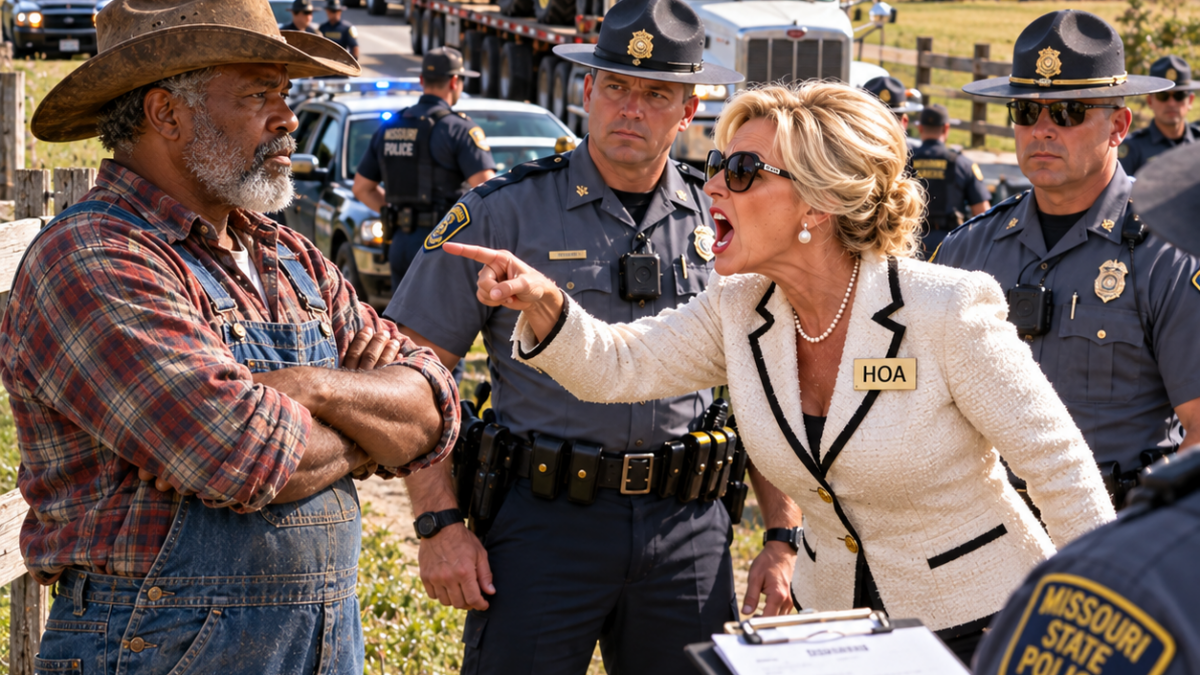
“This is a court-authorized recovery.”
Lieutenant Bell had arrived.
He was tall, broad, gray at temples.
He said something.
Delphine handed him folder.
He opened it.
A county deputy joined.
Drivers began shutting engines off.
Diesel noise faded.
Within minutes, Sanders Lane was full of enormous stationary vehicles.
A convoy designed to make me feel powerless had become parking lot.
Bell read.
Then asked:
“Where is the court order?”
Delphine pointed at page.
“This is the authorization.”
“No.”
He held up document.
“This is an HOA board resolution.”
“It incorporates the recorded lien.”
“Where is the court order authorizing seizure of personal property?”
“The lien is recorded.”
“That is not what I asked.”
“The association is exercising self-help remedies.”
Bell looked at Mid-State supervisor.
“Your company has a writ?”
The supervisor said:
“We were told client had legal authority.”
“Do you have a writ of execution?”
He checked binder.
“No.”
“Replevin order?”
“No.”
“Sheriff’s levy?”
“No.”
“Court judgment awarding possession?”
The supervisor looked at Delphine.
“No.”
Bell turned back.
“Then what exactly are you here to execute?”
Delphine’s voice hardened.
“A recorded property lien.”
County deputy said:
“Ma’am, a lien does not automatically authorize private contractors to enter somebody’s farm and take tractors.”
She pointed toward my property.
“He owes the association nearly two hundred thousand dollars.”
“Has a court adjudicated that debt?”
“The lien has been recorded.”
Again.
Recorded.
As if county recorder were judge.
Bell closed folder.
Then looked at bridge.
“Also, three of these tractor haulers exceed posted bridge restrictions if loaded as listed.”
Mid-State supervisor said:
“We haven’t loaded.”
“Your manifest states intended loads.”
“Yes.”
“Do you have oversize or overweight permits as required for the proposed movements?”
He checked.
“Dispatch said client handled route permits.”
Everyone looked at Delphine.
She said:
“We were told agricultural exemptions apply.”
Bell asked:
“To commercial recovery vehicles hauling seized equipment?”
Silence.
No.
They did not.
The convoy was not moving.
Then the strangest part happened.
One of Mid-State drivers walked over to supervisor and said:
“I was told sheriff would be here to meet us.”
Supervisor nodded.
Delphine interrupted.
“County knows about action.”
The deputy looked at her.
“My office does not have a civil execution order for this property.”
Delphine’s face finally changed.
“What do you mean?”
“I mean nobody from our civil division has a writ to execute.”
“Your clerk acknowledged the lien.”
“Recorder isn’t sheriff.”
“That lien gives us recovery rights.”
“That is between lawyers and courts.”
He gestured toward eleven vehicles.
“You do not get to turn a private debt claim into your own levy because you rented enough trucks.”
That sentence traveled through Wexford Reach before lunch.
Delphine tried another route.
“This farm has repeatedly violated safety rules.”
Bell asked:
“HOA safety rules?”
“Yes.”
“Is the farm a member?”
“It relies on our road.”
I called from inside gate:
“My easement predates the subdivision by ninety-seven years.”
Bell turned.
“Mr. Thrasher, stay where you are.”
“Yes, sir.”
Verene whispered:
“Good boy.”
I ignored.
Bell asked Delphine:
“Do you dispute his recorded easement?”
“We dispute the extent.”
“Has a court extinguished or limited it?”
“No.”
“Has a court ordered his equipment seized?”
“No.”
There.
Finally.
One word.
No.
Everything Delphine had built that morning collapsed inside it.
No.
No court order.
No writ.
No levy.
No permit to take my tractors.
No right to block Sanders Lane.
No magical transformation from HOA resolution to state authority.
Just eleven trucks.
A president.
And paper that said less than she had told everybody it said.
Mid-State’s lawyer joined by phone.
Within fifteen minutes, company withdrew from recovery attempt.
Drivers were instructed not to enter property.
Commercial-vehicle officers inspected paperwork.
Two trucks received citations related to route/registration issues unrelated to seizure.
No big mass arrests.
No tactical takedown.
The trucks turned around one at a time because bridge was narrow.
That took almost an hour.
I watched each leave.
The three lowboys designed for our tractors passed my gate empty.
That image is better than any courtroom speech.
Empty.
Delphine stayed until last.
She was talking on phone.
Angry.
Pointing.
Trying to keep control over a scene that had stopped recognizing her authority.
A county investigator arrived before she left.
He asked for the “recovery authorization” documents.
She handed copies.
Then made mistake that turned civil disaster into something else.
She said:
“Our counsel approved all of it.”
The investigator asked:
“Which counsel?”
She named attorney.
Raymond looked at me.
“That lawyer sent us a letter last month saying physical seizure would require lawful judicial process.”
Indeed.
We had it.
Filed.
Certified.
That afternoon HOA counsel issued statement:
Our firm did not authorize extrajudicial seizure of Thrasher farm equipment and specifically advised the Association that any collection remedy required compliance with applicable judicial procedures.
Delphine was done politically before sunset.
But the story had started much earlier than those trucks.
The board investigation found what Verene’s notebooks had been building toward.
Delphine had wanted Sanders Lane under HOA control for three reasons.
First:
Wexford Reach wanted the southern access aesthetic cleaned up.
Farm traffic made luxury entrance look less luxury.
Second:
The developer considering forty-six additional homes needed broader emergency and construction access.
Our recorded easement complicated redesign.
Third:
A company called Stackpole Community Strategies had received consulting fees tied to “access resolution and southern expansion planning.”
Owner?
Delphine’s adult son, Adrian Ren.
Not illegal automatically.
Disclosed?
Barely.
One line in annual vendor statement:
Affiliate planning support.
Compensation:
$84,000 base.
Plus $225,000 success fee if southern land-access package completed.
Meaning Delphine’s family stood to receive over two hundred thousand dollars if Wexford secured access and expansion advanced.
Suddenly the fake assessments looked different.
Not proof by themselves.
But motive.
Then emails.
Selby obtained through litigation.
Delphine to Adrian:
Thrasher will not sell while farm remains operationally viable.
Adrian:
Then make Sanders Lane expensive.
Delphine:
Working on traffic assessments.
Another:
Equipment is leverage. If lien reaches enough value, collection pressure may force settlement.
Adrian:
Can HOA seize tractors?
Delphine:
Counsel says judicial process is cleaner, but board has broad self-help powers for community damage.
Counsel had not said that.
Another email, two weeks before convoy:
Mid-State wants court paperwork.
Delphine:
Send lien, board resolution, enforcement schedule, and counsel memo.
Adrian:
Memo says we may need court authorization.
Delphine:
Remove preliminary language. It’s legal analysis, not operative limitation.
That sentence hurt her badly.
Remove preliminary language.
They had taken a legal memo warning them and stripped the warning before sending it to contractor.
Mid-State’s contract also contained representation:
Client warrants that all required judicial or governmental authorizations have been obtained.
Signed:
Delphine Stackpole Ren
President, Wexford Reach HOA
They had not.
Mid-State sued HOA for misrepresentation and mobilization costs.
HOA insurer reserved coverage.
Residents furious.
Special meeting happened four days after convoy.
Clubhouse standing room only.
I did not attend initially.
Not my association.
Selby did.
“Why?”
“Research.”
“You’re nosy.”
“I get it from Mom.”
Correct.
Delphine opened meeting.
She claimed state police had “interfered with a lawful civil recovery due to incomplete interagency communication.”
That lasted about ninety seconds.
Then Tom Beckett, a resident and retired judge, stood up.
Yes.
There was a retired judge living in Wexford Reach.
He held board resolution.
“Delphine.”
She looked.
“Judge Beckett, please wait for public comment.”
“No.”
Room quieted.
“I spent thirty-four years in state judiciary.”
He held paper.
“This does not authorize seizure.”
She said:
“Our counsel—”
“It is a board resolution.”
“Correct.”
“It is not a judgment.”
“We had lien.”
“A lien is not a writ of execution.”
“Our governing documents allow self-help.”
“Not farm-equipment repossession from a nonmember.”
Applause started.
Beckett raised hand.
Stopped it.
Good judge.
He continued:
“Did you knowingly represent to Mid-State Asset Recovery that a court order existed?”
Delphine looked around.
“I represented that lawful authority existed.”
“That isn’t my question.”
Silence.
Verene would have loved that.
Specific questions kill vague authority.
Delphine said:
“No court order existed.”
There.
Again.
No.
Meeting unraveled.
Board voted 4–1 to suspend her.
She voted no.
Of course.
Independent counsel appointed.
All collection against farm halted.
Lien withdrawn pending litigation.
Stackpole Community Strategies contract suspended.
Residents began reviewing years of “access assessments.”
They found HOA had collected money from delivery companies and contractors using Sanders Lane even when those vehicles were serving our farm or neighboring agricultural tracts.
Not huge money.
Tolls disguised as administrative fees.
No legal basis under our easement.
Refunds followed.
Then came the bridge.
Remember bridge inspection?
Patrol review found HOA had repeatedly routed heavy landscaping trucks across Cedar Branch Bridge while publicly accusing my farm of creating safety risk.
Their pool renovation contractor had crossed overweight without permits several times.
Traffic camera footage.
Invoices.
Vehicle weights.
Delphine knew about bridge restriction because she had emailed county complaining.
Yet convoy manifest would have put three loaded recovery rigs well over restriction.
If the Patrol had not stopped them before loading and recrossing, they could have endangered bridge.
Would bridge collapse?
Probably not.
No need to exaggerate.
But inspection restrictions exist because probabilities matter.
Public works closed it for reinspection after convoy.
Found no new damage.
Good.
I would rather have anticlimax than dead driver.
The county temporarily required one heavy vehicle at a time with permit.
Farm adjusted.
HOA complained.
I laughed.
Then court hearing on lien.
Judge Evelyn Moore.
No nonsense.
Raymond presented:
1911 deed.
Easement.
Farm not in HOA.
No covenant incorporation.
No agreement to pay Wexford access assessments.
County correspondence.
HOA counsel warning.
The association’s new independent lawyer did not defend everything Delphine had done.
Smart.
He argued maybe certain road-maintenance contributions could be equitably apportioned depending facts.
Fair question.
We had historically contributed to specific maintenance.
We were not freeloaders.
We paid county taxes.
We had paid part of gravel resurfacing under voluntary agreement in 2008.
But that did not create HOA jurisdiction.
Judge distinguished.
She invalidated lien as filed.
HOA could pursue any legitimate contractual claim separately.
It could not convert invented penalties into property encumbrance.
Then she said line I still remember:
“Recorded does not mean adjudicated.”
Selby whispered:
“I want that on a shirt.”
Verene said:
“No.”
I bought shirt later.
Civil settlement took ten months.
HOA agreed:
Recognize thirty-foot Thrasher easement.
No padlocks.
No prior notice requirement for ordinary farm use.
No tolls.
No weight limits beyond lawful public restrictions.
Farm voluntarily coordinates unusual oversize moves for safety.
We already did.
No issue.
HOA withdrew all claimed assessments.
Paid portion of attorney fees.
Reimbursed crop-related delay from prior blocked access.
Mid-State settled separately with HOA.
My equipment never moved.
The three tractors remained.
The John Deere 4440 belonged to my father.
Not technically family-owned “for generations” in a hundred-year sense.
He bought it new in 1981.
But it carried history anyway.
He taught me clutch on it.
Selby drove it at twelve.
Verene hates it because seat suspension never worked right.
When I watched empty lowboy leave, I put hand on hood later.
Metal warm from sun.
I said:
“They almost came for you.”
Verene heard.
“You’re talking to tractor.”
“Yes.”
“You need hobby.”
“I farm.”
“Different hobby.”
Delphine’s consequences were complicated.
Residents recalled her by eighty-three percent.
Adrian’s contract terminated.
HOA sued his company to recover payments tied to undisclosed or inadequately disclosed success fee.
He repaid portion under settlement.
Delphine faced criminal investigation over representations in attempted seizure.
No grand “farm theft” conviction.
Law is narrower.
Prosecutors focused on document alterations and representations to recovery company.
Eventually she entered plea to reduced offenses involving falsified business records and attempted unlawful taking-related conduct, with probation, restitution, and community-service requirements.
No prison.
Some residents wanted handcuffs.
I did not.
I had watched enough systems.
Accountability does not require theater.
The bigger consequence:
She lost thing she valued most.
Credibility.
People stopped assuming her confidence meant she knew.
That is devastating to someone who built authority out of certainty.
She sold house two years later.
Before leaving, she sent me certified letter.
Naturally certified.
Obie,
I owe you an acknowledgment, even if you do not want one.
I convinced myself that your use of Sanders Lane was harmful to Wexford Reach and that your refusal to sell was primarily a negotiating tactic.
From there, I began treating every obstacle as something to overcome rather than a boundary to respect.
The planned recovery was wrong.
I relied on the lien and board authority beyond what they actually permitted.
I am sorry for the fear and disruption caused to you and your family.
Delphine
I read it.
Verene asked:
“You answering?”
“No.”
A week later I did.
Delphine,
Thank you for putting it in writing.
Obie.
Verene smiled.
“What?”
“You filed her apology.”
“Yes.”
“Which folder?”
I had created one:
STACKPOLE REN — FINAL.
My wife laughed for five minutes.
Wexford Reach elected Tom Beckett president temporarily.
Retired judge did not want job.
Residents begged.
He served nine months.
First newsletter was painfully boring.
POOL FILTER REPLACEMENT
TREE TRIMMING SCHEDULE
BUDGET HEARING
PLEASE SLOW DOWN NEAR WALKING TRAIL
I respected it.
Then new president was Miriam Cole, elementary school principal.
She came to farm.
No folder.
No security.
Brought pie.
“What do you want?”
She blinked.
“Pie?”
“I mean from me.”
“Nothing.”
Suspicious.
She laughed.
“I want to introduce myself and confirm access arrangement.”
We sat porch.
She said:
“We’d like Sanders Lane relationship to stop being war.”
“Good.”
“Can we set up annual meeting with county and farm before harvest?”
“Sure.”
“For safety only.”
“Fine.”
“Can we split gravel cost on section our delivery trucks use?”
“Show me numbers.”
She did.
Reasonable.
We paid share.
Amazing what happens when people ask instead of command.
Residents began waving again.
Kids watched combines.
One boy named Henry came with grandfather.
“Mr. Thrasher, is this the tractor they tried stealing?”
I looked at John Deere.
“Sort of.”
Grandfather looked embarrassed.
“I told him not to say stealing.”
“Attempted unauthorized seizure.”
Henry frowned.
“That’s stealing with extra words.”
Selby, standing nearby, laughed.
“Future lawyer.”
“No,” grandfather said quickly.
Good man.
My great-grandfather Amos’s deed became local history story.
County historical society asked if they could copy.
I agreed.
They did exhibit on Black farm ownership in early twentieth-century Missouri.
Amos bought land in 1911 when discrimination in lending, title access, and local power could make ownership fragile even after purchase.
He recorded anyway.
Book 12.
Page 388.
I stood in courthouse one afternoon looking at scan.
His signature.
Uneven.
Strong.
Two dollars.
I thought about him walking into county office where not everybody believed he belonged.
He still paid.
Still recorded.
Did he imagine 114 years later that one paragraph would stop luxury HOA from locking great-grandson out?
Probably not.
People write deeds for future strangers.
Sometimes those strangers are family.
Verene retired the year after dispute.
People expected celebration.
She cleaned office.
Turned in credentials.
Came home.
Placed final green notebook in cabinet.
Then sat at kitchen table and cried.
I had rarely seen her cry.
“What?”
“Nothing.”
“That isn’t nothing.”
“I’ve had job since before Selby was born.”
“Yes.”
“Tomorrow nobody needs me anywhere.”
I sat.
For thirty-one years, she had been structure in our family.
Marshal.
Mother.
Organizer.
Finder of paper.
Now role shifted.
I told:
“I need you to explain crop insurance.”
She laughed through tears.
“Idiot.”
She started volunteering with legal-aid property clinic twice month.
Not as lawyer.
Document organization.
God help opposing parties.
Selby graduated law school.
Passed bar.
Went into title and land-use law.
Of course.
Her first business card sits beside Amos deed copy.
She eventually opened small firm.
THRASHER TITLE & LAND COUNSEL.
I said name sounds expensive.
She said:
“It is.”
Verene proud enough to be unbearable.
I am too.
My farm changed.
We reduced cattle.
More hay.
Leased forty acres to young farmer.
Installed drainage tiles.
Repainted barn.
Not everything preserved exactly.
People confuse heritage with refusing change.
Amos changed crops.
My grandfather bought tractor.
Dad added irrigation.
I use GPS.
The point is not to freeze land in 1911.
Point is family gets to decide when and how it changes.
Not Delphine.
Not developer.
Not HOA.
Us.
That is ownership.
Not maximal control.
Continuity plus choice.
The bridge got replaced three years later.
County secured grant.
New concrete span.
Higher weight.
Better shoulders.
During construction Sanders Lane closed six weeks.
We used temporary farm bypass across neighbor’s field by agreement.
Signed.
Recorded short-term license.
Verene insisted.
Of course.
Miriam from HOA coordinated deliveries.
No conflict.
When new bridge opened, county had little ceremony.
Ribbon.
Commissioner.
Kids.
I drove John Deere across first after county truck.
People clapped.
I hated that.
Selby loved.
Someone shouted:
“Got your court order?”
I laughed.
That phrase became neighborhood joke.
Anytime HOA wanted something:
“Do we need court order?”
Miriam eventually banned joke in meetings because it derailed.
I approved.
Humor can heal.
Can also fossilize conflict.
Better to move.
Missouri State Highway Patrol lieutenant Marcus Bell stopped by farm once years later.
He was nearby inspecting commercial route.
I offered coffee.
He said:
“Your wife still files everything?”
“Retired. Worse now.”
He laughed.
I asked:
“Did you know that morning there was no order?”
“No.”
“Suspected.”
“Why?”
“Recovery company usually coordinates civil levy with sheriff when actual court process exists.”
“Eleven trucks and nobody called sheriff?”
“Exactly.”
He sipped.
“Big convoy doesn’t create legal authority.”
There it was.
Whole story.
I said:
“Army taught me same.”
“How?”
“Wrong manifest stops tank.”
He nodded.
“Paper beats horsepower.”
“Yes.”
Not always.
But often enough.
There is a photograph from convoy morning.
Taken by resident.
Long lens.
Eleven trucks lined Sanders Lane.
Three state patrol cruisers.
County deputy.
Delphine beside Mercedes holding folder.
Me behind my farm gate.
Verene beside me.
Selby with phone.
People online caption:
FARMER’S FEDERAL MARSHAL WIFE CALLS IN STATE POLICE ARMY.
Completely wrong.
Verene made no official call.
State Patrol responded to citizen complaint and commercial vehicle issue.
County sheriff responded to attempted private seizure.
Her title had nothing to do with authority.
I correct every time.
Why?
Because truth matters most in story about fake authority.
It would be ridiculous to criticize Delphine for pretending personal power was law while exaggerating my wife’s position for drama.
Verene would haunt me while alive.
She says:
“You don’t need to win prettier than it happened.”
Correct.
The real version is better.
Farmer read paperwork.
Family documented.
Lawyer objected.
Private recovery convoy arrived.
State troopers checked permits.
Sheriff checked writ.
None existed.
Trucks left.
Then courts sorted rest.
No shootout.
No federal raid.
No dramatic confiscation of HOA clubhouse.
Just institutions working because somebody asked correct questions before tractors disappeared.
That is enough drama for me.
The old padlock from Sanders Lane sits on a nail in barn.
I kept it.
Why?
Not anger.
Reminder.
A locked gate looks final.
It isn’t always.
Metal can say no.
Deed can say otherwise.
That little lock once delayed harvest nearly hour and made me feel powerless.
Now it hangs beside grease gun.
Rusting.
I like that.
The 1911 deed is stored safely.
Certified copies in home fireproof safe.
Bank box.
Selby’s office.
County record.
Scanned cloud.
Verene may have put copy somewhere I do not know just to win argument from grave someday.
Likely.
The green notebooks now fill two shelves.
From 1994 to present.
Selby wants donate someday.
I said no while we’re alive.
Verene says:
“See? He finally understands records have value.”
I always understood.
I just preferred tractors.
Amos’s land remains 214 acres.
Mostly.
We sold eight acres along far north to county for flood-control project.
That was our choice.
Fair price.
Public purpose.
No coercion.
Recorded clean.
Verene joked:
“Family farm shrinking.”
I said:
“River was going to take it free.”
Practical.
Miriam retired from HOA board.
Wexford Reach residents elected young accountant named Jules Parker.
First thing Jules did:
Asked Selby to give board fifteen-minute talk on recorded easements.
She charged them.
I was proud.
At Q&A resident asked:
“Can HOA ever seize personal property for unpaid assessments?”
Selby answered:
“Not by sending eleven trucks because president says so.”
Everyone laughed.
Then she gave actual nuanced answer about judgments, statutory remedies, due process, liens, execution procedures.
I watched.
My daughter.
Lawyer.
Amos would have loved.
Maybe.
Or asked whether she could drive tractor.
She can.
Badly.
Verene says worse than me.
At sixty-three, I slowed farming.
Not quit.
Never say quit to farmer.
I lease more.
Still mow.
Still check cattle.
Still complain about diesel.
Every harvest I drive Sanders Lane.
New bridge.
No gate.
Wexford kids wave.
Sometimes new resident sees combine and posts online:
Why is farm machinery allowed through neighborhood access?
Within minutes, some old resident replies:
Don’t start.
That makes me smile.
One afternoon, a new HOA manager called.
“Mr. Thrasher, we had complaint about mud on Sanders Lane.”
“Probably mine.”
“Would you be willing to sweep?”
“Yes.”
Pause.
“That easy?”
“Yes.”
“We thought—”
“What?”
“Nothing.”
I laughed.
“Ask reasonable thing, get reasonable answer.”
We swept.
Community living should not be war.
Property rights do not require hostility.
They require boundaries.
I have let HOA borrow pasture for Fourth of July overflow parking twice.
Written agreement.
Temporary.
Insurance.
No adverse claims.
Selby drafted.
Ten pages.
For parking.
I complained.
She said:
“Remember eleven trucks?”
I signed.
The farm hosts school tours.
Wexford children come.
Learn corn.
Cattle.
Soil.
One teacher asked about “famous HOA incident.”
I said no.
Kids there for farming.
Not feud.
Good.
I don’t want Delphine owning farm story forever.
She occupied chapter.
Not book.
That is something people miss about conflict.
If you keep retelling enemy, they become permanent tenant in identity.
I do not grant Delphine easement through my life.
Nice line.
Selby says sounds like lawyer.
I deny.
Verene wrote it in notebook.
Of course.
My father’s John Deere still runs.
Barely.
Engine rebuilt.
Cab seals terrible.
Air conditioning philosophical rather than functional.
I could replace.
Won’t.
Not because Delphine.
Because Dad.
But when it finally dies beyond sense, maybe I will.
Her attempt to seize it taught me not that objects must never change.
It taught me choice matters.
If I sell tractor, I decide.
If I retire it, I decide.
If Selby puts it in barn museum, God help us, we decide.
Someone else cannot call my family history collateral because they printed enough letterhead.
That is central.
The morning convoy came, Delphine believed volume created legitimacy.
Eleven trucks.
Amber lights.
Uniformed drivers.
Clipboards.
Magnetic signs.
Recovery manifest.
Board resolution.
Recorded lien.
A president in front.
It looked official.
That is how soft power works.
Most people step aside because scene resembles authority.
But resemblance is not source.
Real authority has origin.
Statute.
Contract.
Court order.
Deed.
Writ.
Consent.
And an edge.
Always an edge.
Delphine hated edges.
Our easement was edge.
Our deed edge.
Court process edge.
Bridge limit edge.
Farm gate edge.
Every time she met one, she treated it as insult.
So she kept pushing until state trooper asked simplest question in world:
“Where is the court order?”
She did not have one.
Everything else was noise.
A year after Verene retired, we sat porch on Amos’s birthday.
No idea exact date.
Family Bible says March 3.
Maybe.
We poured bourbon.
Selby came.
She brought photocopy of 1911 ledger.
Amos paid $2 recording fee.
I said:
“That was probably day’s wages.”
Verene said:
“Maybe more.”
Selby pointed at margin.
Handwritten notation:
R/W 30 ft. to county way.
That little notation had outlived banks.
Developers.
Boards.
Presidents.
Lawsuits.
One hundred plus winters.
Selby said:
“Great-great-grandpa knew what he was doing.”
I thought.
“Maybe clerk told him.”
“Does that matter?”
“No.”
That’s another truth.
History likes lone heroes.
Reality is often somebody saying:
Sir, record the easement too.
Maybe Amos knew.
Maybe lawyer.
Maybe clerk.
Maybe experience.
Doesn’t matter.
He did it.
We inherited.
Good systems let dead people protect descendants through records.
That is civilization.
Not exciting.
Powerful.
I am sixty-four now.
Verene says sixty-five because she rounds up when insulting knees.
Selby is partner at firm.
Wexford Reach has 121 homes now after small northern expansion.
No southern takeover.
Thrasher Bottoms remains.
Morning fog still sits low.
Barn still leans slightly west.
Sanders Lane still gets mud.
New bridge shines too much.
Give it time.
Delphine lives in St. Louis area according to someone who saw.
I do not track.
No need.
Her apology is filed.
Final folder.
Closed.
Sometimes journalists or Facebook pages retell story.
They exaggerate.
“Eleven HOA tow trucks ambushed Black veteran farmer.”
“U.S. Marshal wife orders state police blockade.”
“HOA president arrested at gunpoint.”
No.
No.
No.
I correct.
Why spoil viral story?
Because Amos paid two dollars for truth to stay public.
I owe him at least that.
Eleven commercial vehicles came.
Yes.
Three lowboys meant to remove tractors.
Yes.
Delphine believed HOA lien authorized recovery.
Yes.
State Highway Patrol stopped convoy on route and checked commercial compliance.
Yes.
County law enforcement asked for actual judicial authority.
Yes.
There wasn’t one.
Yes.
The trucks turned around empty.
Yes.
That is enough.
Everything after was paper.
Which is where fight had always been.
The one thing I remember most is not Delphine’s face.
Not troopers.
Not lowboys.
It is sound of engines shutting off.
One by one.
Eleven engines.
A convoy built to look unstoppable.
Then questions began.
Engine one stopped.
Then two.
Three.
Four.
Until Sanders Lane went quiet.
That was moment I understood lesson from Army had followed me home.
A machine can be enormous.
Expensive.
Heavy.
Loud.
It can look like nobody can stand in its way.
But machines move because somebody authorized movement.
And when that authority is false, eventually somebody with real responsibility says:
Stop.
Show me the paper.
That morning, Delphine had trucks.
I had a deed.
She had a board resolution.
I had a recorded easement.
She had a lien.
I had the court docket showing no judgment.
She had a convoy.
I had time stamps, inspection reports, certified mail receipts, photographs, and thirty-one years of marriage to a woman who never threw anything away without scanning it first.
Verene still corrects me.
“Filed.”
Right.
Never threw anything away without filing it first.
The trucks looked stronger.
The paper was.
And every harvest when I cross Sanders Lane in my father’s old John Deere, I pass the place where those lowboys stopped.
There is no plaque.
No sign.
Nothing.
Good.
I do not need monument.
The farm itself is the monument.
Still ours.
Still working.
Still here.








