**HOA Rammed Their 90,000-Pound Yacht Into My Private Bridge—Then I Opened the Dam and Drained the Lake Beneath Their $1.9 Million Resort.**
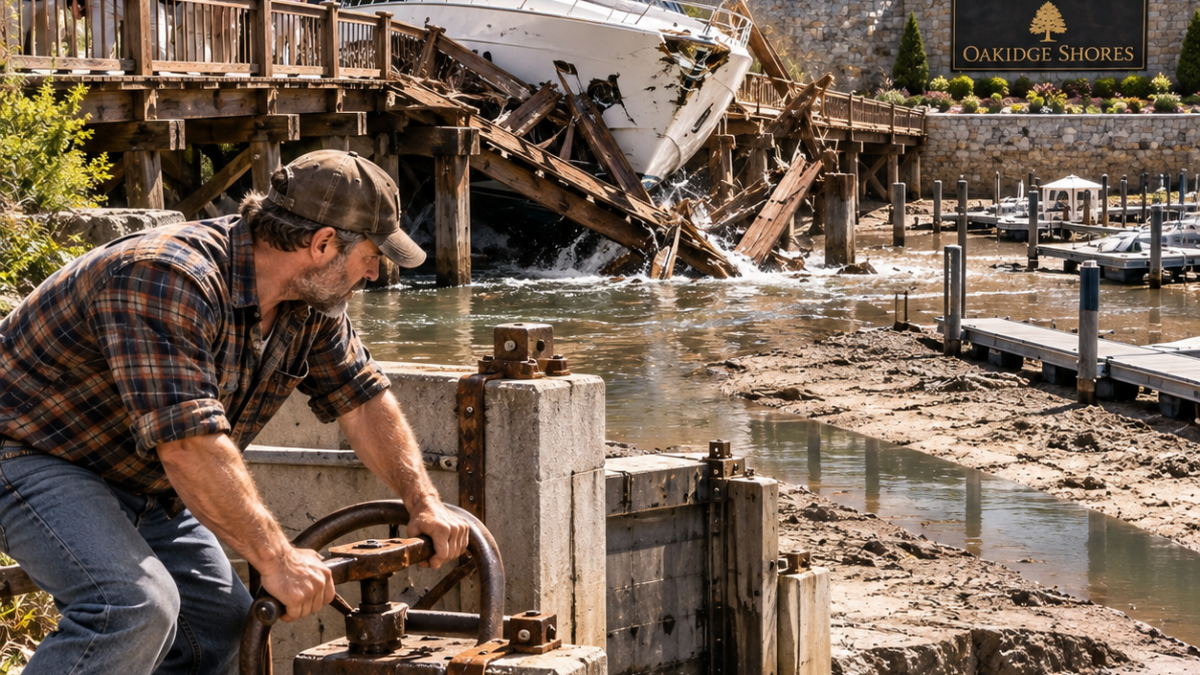
PART3:
So Granddad did what men apparently did in 1948 when they owned enough land and possessed unreasonable confidence.
He built a dam.
Legally.
That detail matters.
Engineering plans.
County approvals.
State authorization.
Water-control rights.
Surveyed flood pool.
Recorded maintenance obligations.
Concrete gravity section tied into an earth embankment.
Not some farmer throwing logs into a creek.
A real dam.
Over the next several years, the valley filled.
Three hundred acres of water.
Deepest near the southern basin.
Narrow at the northern channel.
Locals called it Mitchell Lake.
Nobody objected.
Mostly because there were hardly any neighbors.
Granddad used the water for the mill for a while.
Then the mill closed.
The lake stayed.
Fishing.
Boating.
Wildlife.
My father grew up there.
I grew up there.
By the time I inherited the remaining family property, most of the original five hundred acres had been sold in pieces.
Taxes.
Medical bills.
Retirement.
Life.
What remained to me was roughly forty acres on an eastern peninsula, the dam parcel, several maintenance easements, and a private bridge connecting my peninsula to the county road.
That bridge had been built in 1968.
My father and grandfather designed it together.
Seventy feet long.
Old-growth oak.
Reinforced steel.
Heavy timber deck.
Twelve feet of clearance above normal water level.
Nothing beautiful if your idea of beauty involved brushed aluminum and architectural lighting.
But it worked.
For fifty years it carried pickups.
Equipment.
Delivery trucks.
Ambulances.
Concrete mixers.
My parents’ funeral processions.
My first motorcycle.
My wife’s car the night we came home after getting married.
When my father died, I stood in the middle of that bridge after everybody left and cried where nobody could see me.
So when somebody called it “rotting firewood,” I took it personally.
That somebody was Richard Garrison.
Oakridge Shores came in 2021.
A real-estate consortium purchased nearly all the undeveloped shoreline my family had sold decades earlier.
They cleared pines.
Cut roads.
Installed sewer.
Built gates.
Then came the homes.
Large homes.
Stone facades.
Three-car garages.
Outdoor kitchens.
Infinity pools.
The kind of neighborhood where the marketing photographs contain more wine glasses than children.
They changed the lake’s name in their brochures.
LAKE OAKRIDGE.
That annoyed me more than it should have.
The county maps still said Mitchell Lake.
My grandfather had created the thing.
But apparently a logo could rename water.
The centerpiece was a $1.9 million clubhouse directly across from my peninsula.
Zero-edge pool.
Outdoor fireplaces.
Imported tile.
Fitness center.
Private dining space.
And a long floating mahogany marina extending into the lake.
I will admit:
It looked impressive.
That was never the problem.
The problem was what came with it.
The Oakridge Shores HOA.
Richard Garrison became president during the first permanent board election.
He had retired from a corporate restructuring firm.
That made perfect sense after I knew him.
Richard’s entire career had apparently involved walking into businesses, finding things he considered inefficient, and removing them.
Departments.
Properties.
People.
He approached the neighborhood the same way.
He was not unintelligent.
That matters.
He understood budgets.
Contracts.
Negotiations.
He could speak for twenty minutes without looking at a note.
Residents liked him because dues stayed predictable and projects happened on schedule.
Susan Albright, the vice president, was an interior designer who treated visual inconsistency like a moral failure.
She believed every roofline, flower bed, dock, trash can, and porch light around the lake contributed to something she called “the Oakridge experience.”
My property contributed nothing.
That drove them insane.
I was not in the HOA.
Never had been.
My parcel predated development.
The original developer knew it.
The covenants specifically excluded the Mitchell holdings.
I paid no dues.
Needed no architectural approval.
Did not use clubhouse.
Did not want to.
My house was older.
My dock was practical.
My mailbox leaned slightly because a delivery driver backed into it in 2018 and I had never cared enough to straighten it.
Susan cared.
Very much.
The first violation letter arrived six months after Oakridge opened.
UNAPPROVED MAILBOX DESIGN.
Fine:
$500.
I called their management company.
“I think you mailed this to the wrong address.”
The manager checked.
“You are Mr. Mitchell?”
“Yes.”
She paused.
“Oh.”
“Exactly.”
“We’ll correct.”
Two months later:
FAILURE TO MAINTAIN LAKEFRONT LANDSCAPE TO COMMUNITY STANDARDS.
$1,000.
My attorney, Harrison Cole, sent the response.
Harrison was sixty-four then and had represented my father before me.
He possessed a soft voice, a cluttered office, and the temperament of a man who genuinely enjoyed reading deeds older than the lawyers arguing against him.
His letter said, essentially:
Wyatt Mitchell is not a member of Oakridge Shores HOA.
Stop.
They stopped sending fines.
For six weeks.
Then Richard found the bridge.
Or, more accurately, he discovered the bridge prevented the kind of boats he wanted in the northern cove.
Emerald Cove was the prettiest section of the lake.
Deep.
Protected.
Tree-lined.
My bridge crossed the narrow channel leading to it.
Most fishing boats passed underneath.
Pontoons too.
The problem was the growing number of enormous recreational boats Oakridge residents started bringing in.
Boats designed for coastal water.
Twenty-eight feet.
Thirty-five.
Forty.
Tall radar arches.
Upper decks.
Richard wanted unrestricted access.
One April morning I found him and Susan standing near the county-road entrance to my bridge.
Richard pointed toward the span.
“There he is.”
Not:
Good morning.
Not:
Wyatt.
“There he is.”
I walked down.
“Can I help you?”
Susan looked at the oak railing.
“This structure is worse up close.”
“Good morning to you too.”
Richard ignored that.
“We need to discuss clearance.”
“No, we don’t.”
“We have residents purchasing vessels that cannot access Emerald Cove.”
“Then they purchased wrong vessels.”
His jaw tightened.
“Your bridge creates a navigational obstruction.”
“It predates your neighborhood by more than fifty years.”
“Age does not legalize hazard.”
“It was inspected eighteen months ago.”
“By whom?”
“Licensed structural engineer.”
I gave his name.
Richard did not like that answer.
Susan stepped closer.
“We’re willing to be generous.”
“That sounds dangerous.”
“The HOA will remove this bridge at our cost.”
“No.”
“We’ll replace it with a modern steel arch.”
“No.”
“Higher clearance.”
“No.”
“In return, you grant the association a pedestrian and recreational easement across your peninsula.”
I laughed.
Actually laughed.
Susan looked offended.
“You want me to give you my front yard.”
“We want reasonable community access.”
“To my property.”
“To an amenity that physically divides the lake.”
“My property is not an amenity.”
Richard’s voice hardened.
“You are one owner obstructing an entire lake community.”
“I was here before the lake community.”
“That argument gets old.”
“So does ownership.”
Susan crossed arms.
“What would it take?”
“Nothing.”
“Everybody has a number.”
“No.”
Richard looked at me.
“You’re being irrational.”
That was the moment I stopped finding him merely annoying.
Because people who call your refusal irrational are often preparing to stop asking.
I said:
“Leave.”
“We’re on county shoulder.”
“Then stay there.”
The following year became exhausting.
Private inspectors photographing bridge.
County complaints.
Anonymous reports claiming the structure was unsafe.
An environmental inquiry alleging shadowing beneath the bridge damaged aquatic plants.
A fire-safety complaint saying my gate impaired emergency access despite the fire department already having a key agreement.
Every claim failed.
Not because I had special power.
Because the bridge was lawful.
Inspected.
Maintained.
And private.
Harrison sent cease-and-desist letters.
Richard kept smiling at HOA meetings.
Then somebody inside Oakridge sent me an audio recording.
Richard speaking at the annual summer gala.
His voice carried through clubhouse speakers.
“The Mitchell situation will be resolved.”
Applause.
“We have been patient.”
More applause.
“But one outdated private structure cannot dictate recreational access for an entire community.”
Then:
“One way or another, that bridge will not be blocking Emerald Cove by Labor Day.”
Harrison listened twice.
“That is useful.”
“You think he’ll actually do something?”
“I think people announce intentions when they want applause.”
“That doesn’t answer.”
“No.”
“It doesn’t.”
Labor Day weekend came hot.
Ninety-three degrees.
The HOA had expanded its marina.
Music across lake.
Catering.
Champagne.
About two hundred residents.
I stayed home.
I could see from porch with binoculars if I wanted.
I did not particularly care.
Then I heard new engines.
Deep diesels.
I looked.
Blue Dividend.
Forty-five-foot luxury cruiser.
Owned by Chad Harrington.
Chad was forty-one.
Tech entrepreneur.
New board member.
Recently purchased lake house.
The boat looked ridiculous on Mitchell Lake.
Beautiful.
But ridiculous.
Its radar arch sat more than fourteen feet above waterline.
My bridge gave twelve.
Chad knew.
Everybody knew.
The marina staff had warned owners about clearance.
There were signs.
LOW BRIDGE — 12 FT CLEARANCE AT NORMAL POOL.
Blue Dividend idled from marina.
Richard and Susan stood on bow.
Champagne.
Chad at helm.
They pointed north.
At my bridge.
At first I thought they were showing off.
Then Chad increased throttle.
I grabbed binoculars.
The boat turned toward narrow channel.
“Don’t.”
I said aloud.
It kept coming.
I ran.
By the time I reached bridge, Blue Dividend was maybe two hundred yards away.
“Turn around!”
I shouted.
I waved both arms.
Chad looked directly at me.
Richard did too.
The boat did not slow.
That matters.
It did not drift sideways.
It did not get caught in wind.
It held a straight line.
Engine pitch climbed.
I stepped off bridge onto bank.
“Stop!”
Then impact.
The first piling cracked.
The boat hit slightly starboard of center.
Radar arch caught underside.
The bridge sagged.
Richard disappeared behind rail.
Susan screamed.
Chad reversed.
That caused more damage.
The yacht tore free, pulling deck timber and another support.
Then backed away.
Its own upper structure mangled.
My bridge looked broken in half.
I stood unable to speak.
Richard shouted from boat:
“This is your fault!”
That snapped me awake.
“What?”
“You maintained a dangerous obstruction!”
“You drove into it!”
“The wind pushed us!”
There was almost no wind.
Flags across marina barely moved.
I pulled phone.
Called 911.
Marine Patrol arrived.
So did county deputies.
Chad told Officer Mason Davies that a sudden gust and steering correction had caused accidental impact.
Richard claimed bridge was structurally compromised beforehand.
Susan repeated:
“We warned him.”
Officer Davies looked uncomfortable.
“Do you have video?”
My stomach sank.
My bridge camera had been offline after lightning strike.
I had delayed replacing it.
Stupid.
“I saw it.”
Richard:
“So did we.”
Davies said:
“This will be investigated.”
Chad’s insurance company was notified.
Nobody arrested that afternoon.
That infuriated me.
But Officer Davies was right about one thing:
intent had to be proven.
A collision was not automatically a crime because I believed it deliberate.
Then the next morning, a process server arrived by boat.
The HOA sued me.
Two hundred fifty thousand dollars.
Damage to Blue Dividend.
Loss of marina access.
Negligent maintenance of an alleged navigational hazard.
They also sought an emergency injunction ordering me to remove the collapsed bridge debris from the channel within forty-eight hours.
I sat at my kitchen table reading.
They rammed my bridge.
Then sued me because my bridge damaged the boat that rammed it.
Harrison arrived ninety minutes later.
He read complaint.
Then looked toward lake.
“Where’s your dam binder?”
“My what?”
“Original operating documents.”
“In attic.”
“Get them.”
My grandfather kept everything.
Blueprints.
Inspection reports.
Handwritten flow calculations.
Gate-maintenance logs.
Original water-control agreement.
Recorded deed.
State correspondence.
Harrison spread the documents across dining table.
Dust everywhere.
He worked silently for almost an hour.
Then stopped.
“Wyatt.”
“What?”
“Read this.”
Section on emergency reservoir management.
The wording was old.
Not magical.
Not a blank check.
But clear.
The dam operator retained authority, subject to state notification and downstream-safety requirements, to conduct a controlled drawdown when significant structural debris obstructed navigation, maintenance access, or threatened dam/reservoir infrastructure.
I read twice.
“They created qualifying obstruction.”
“Yes.”
“Can we lower lake?”
“Maybe.”
“Maybe?”
“We do this correctly.”
“No cowboy nonsense.”
“State dam-safety office.”
“Environmental authorities.”
“Downstream-flow plan.”
“Engineer.”
“Written approval.”
“If they approve?”
“Then the HOA’s own lawsuit becomes our evidence of the hazard.”
I started laughing.
Harrison did not.
“Do not enjoy yet.”
“Why?”
“Because lowering three hundred acres of water is serious.”
“It can damage property.”
“Fish.”
“Banks.”
“Docks.”
“Downstream channel.”
“We will not turn valve because angry.”
“We will turn it only to level regulators authorize for debris removal.”
That distinction saved me later.
By noon, Harrison had contacted state environmental and dam-safety officials.
I hired a licensed dam engineer, Rachel Monroe.
She came that afternoon.
Inspected debris.
Reviewed bridge collapse.
Reviewed spillway and gate records.
Then said:
“You need drawdown.”
“How far?”
“Enough to expose debris and safely operate equipment.”
“Not necessarily empty reservoir?”
“No.”
“That would be excessive unless further issues appear.”
Good.
The internet version later claimed I opened the dam wide and emptied lake overnight.
That never happened.
A three-hundred-acre reservoir is not bathtub.
And downstream people exist.
So we did it legally.
Slowly.
Monitored.
The state approved emergency controlled drawdown.
Not revenge authorization.
Maintenance authorization.
Target:
initial five-foot reduction.
Further lowering permitted depending debris access and bank stability.
I notified downstream owners.
County emergency management.
Wildlife officials.
HOA.
Richard responded with:
YOU WILL NOT LOWER OUR LAKE.
I forwarded to Harrison.
He replied:
Interesting use of “our.”
At 3:00 the next afternoon, the controlled release began.
No cinematic giant wrench.
The dam had modernized actuators installed in the 1990s.
Granddad’s old mechanical controls remained as backup.
Rachel supervised.
A state inspector observed.
We increased discharge gradually.
Checked downstream gauges.
Water moved.
That evening, Oakridge residents noticed.
The floating marina sat lower.
Gangways angled down.
Boats shifted.
I had sent formal notice telling owners to adjust mooring lines and remove deep-draft vessels before levels fell further.
Some listened.
Some assumed HOA would stop me.
By morning, lake had dropped a little over two feet.
Shoreline widened.
Mud appeared.
Richard called sheriff.
Sheriff called state.
State said authorized.
Richard called county.
County called Harrison.
Harrison emailed permits.
Richard called press.
That helped me.
A television crew interviewed him in front of clubhouse.
“This individual is draining an entire community lake out of spite.”
The reporter asked:
“Why is state allowing it?”
Richard said:
“He found an archaic loophole.”
Then reporter interviewed Rachel Monroe.
She said:
“This is not a loophole.”
“Debris from a collapsed bridge must be removed safely.”
“The reservoir operator has an approved maintenance plan.”
That clip spread.
By second day, lake was down four feet.
The $1.9 million clubhouse did not collapse.
The pool did not slide into abyss.
Reality was quieter.
And uglier.
The infinity pool’s visual edge no longer blended with water.
Instead it overlooked thirty feet of exposed mud.
The floating marina grounded unevenly in shallow areas.
Two gangways twisted.
Electrical service had to be disconnected for safety.
Several boat lifts became unusable.
Owners scrambled to relocate vessels.
Chad did not move Blue Dividend.
The yacht had been temporarily moored near Emerald Cove while insurance investigated.
He believed injunction would stop drawdown.
It did not.
When the lake fell another eighteen inches, Blue Dividend settled onto soft lakebed at an angle.
Not destroyed instantly.
But stranded.
Its already damaged superstructure now looked even more absurd.
A multimillion-dollar yacht sitting crooked in mud because owner had used it to attack a bridge.
Marcus? Not in source. Could have maintenance friend. Let’s introduce Wyatt’s friend Eli maybe. Better not overcomplicate.
My neighbor across county road, Dale, texted photograph.
BLUE DIVIDEND finally posted quarterly loss.
I laughed harder than I should.
Then inspectors found the pipes.
That was not part of my plan.
When water receded below clubhouse shoreline, an environmental technician noticed two large outlets extending through riprap below normal waterline.
They were not on permitted stormwater drawings.
He flagged them.
State inspectors returned.
The HOA initially said:
“Overflow drains.”
From what?
Nobody could answer clearly.
Dye testing eventually showed one line had been carrying unauthorized graywater and intermittent wastewater overflow from clubhouse utility systems toward the reservoir during high-use events.
The second appeared tied to a bypass used when a holding system reached capacity.
Not a cartoon pipe dumping sewage twenty-four hours a day.
Still illegal.
Still serious.
And hidden beneath water when lake at normal level.
County environmental health got involved.
Then state.
Then EPA coordination because potential discharge violations affected waters downstream.
Residents were furious.
Not because their lake looked ugly.
Because their board had spent years policing mailbox colors while apparently tolerating unauthorized wastewater infrastructure beneath a $1.9 million clubhouse.
Richard claimed he knew nothing.
Susan said system predated resident-controlled board.
The developer said later modifications happened after turnover.
Contractor records became mess.
The important point:
drawdown exposed a problem nobody had been investigating.
And once exposed, it could not be ignored.
By Friday, lake level was down a little over six feet.
Enough.
Bridge debris accessible.
Equipment could work from stabilized areas.
That was when Richard filed his second emergency motion.
Thirty million dollars in claimed damages.
Loss of marina use.
Property-value impacts.
Boat damage.
Clubhouse impacts.
Intentional interference.
He asked state superior court to order immediate refill.
Judge Margaret Barrett heard emergency arguments Monday.
Richard arrived with four attorneys.
I had Harrison.
Rachel Monroe.
Three binders.
One thing I learned in property disputes:
The side with more lawyers does not automatically have more law.
Richard’s lead attorney spoke first.
He described the drawdown as:
“A vindictive and disproportionate act designed to punish more than a thousand homeowners for a private dispute.”
That was strong language.
And if I had opened gates without approval, he might have won.
Harrison stood.
“Your Honor, the reservoir reduction was not initiated privately or secretly.”
He listed:
State dam-safety authorization.
Environmental notice.
Downstream-flow limits.
Engineer supervision.
Debris-removal plan.
Owner notices.
Then handed over HOA’s own complaint from day after collision.
Highlighted sentence:
COLLAPSED BRIDGE DEBRIS CREATES AN IMMEDIATE AND SUBSTANTIAL NAVIGATIONAL HAZARD REQUIRING REMOVAL.
Harrison said:
“They asked a court to force my client to remove this hazard.”
“So he obtained lawful authorization to remove it.”
Richard shifted.
Their attorney said:
“He could have removed debris from surface.”
Rachel testified:
“No.”
“Several failed structural members were submerged and under tension.”
“Attempting removal at normal pool would expose divers and equipment to unnecessary risk.”
Judge asked:
“Could the lake be refilled now?”
Rachel:
“Not until debris is removed and damaged abutments assessed.”
Richard stood before lawyer could stop him.
“He is holding our lake hostage until we buy him a bridge!”
Judge Barrett looked over glasses.
“Mr. Garrison.”
“Sit.”
He sat.
Harrison responded:
“My client is not demanding a luxury bridge as condition of refill.”
“He is demanding restoration of the access structure destroyed by a vessel carrying Mr. Garrison, Ms. Albright, and a sitting HOA director.”
The judge asked:
“Is the bridge Mr. Mitchell’s sole vehicle access?”
“Yes.”
That mattered.
Without bridge, I used a small rowboat to get to county side where my truck remained.
There was an old forestry route around far side, but not suitable for normal daily access and not legally guaranteed.
The collision had effectively cut my property from normal road access.
Judge turned to HOA counsel.
“Your client is suing him for failing to remove debris created by impact while simultaneously objecting to the state-approved method of removing it.”
Counsel tried:
“Our position is that he manufactured unnecessary harm.”
Judge:
“That is a merits issue.”
“For today, I have valid state authorization, engineer affidavit, and evidence the drawdown is operationally related to cleanup.”
Motion to force immediate refill:
Denied.
Then Harrison brought up audio from HOA gala.
Richard:
“One way or another, that bridge will not be blocking Emerald Cove by Labor Day.”
The judge listened.
Richard’s attorney objected relevance.
Judge allowed limited consideration because intent behind collision was disputed.
Then another surprise.
A teenager at the Labor Day event had recorded Blue Dividend leaving marina.
Not professionally.
Phone video.
She was filming friends waterskiing.
In background:
the yacht.
You could hear somebody say:
“Is Chad really doing it?”
Then another voice:
“Richard said that bridge is coming down today.”
The camera swung.
Blue Dividend accelerated.
Straight toward bridge.
Harrison received video from resident after news coverage.
Marine Patrol reopened investigation.
Now “unexpected gust” looked much weaker.
Chad hired separate attorney.
Very quickly.
He stopped coordinating story with Richard.
That happens when liability becomes personal.
Within a week, Chad admitted in deposition that Richard had repeatedly discussed “testing” whether the yacht could force passage and that there had been talk of “making the obsolete bridge Richard’s problem.”
Chad insisted he believed they were merely going to bump a removable railing.
Nobody believed ninety-thousand-pound yacht was precision tool.
Susan claimed she thought Chad would stop.
Richard denied instructing impact.
The truth became less cinematic and more damning.
No secret criminal mastermind plan.
Three wealthy adults convinced themselves a dangerous stunt would pressure me.
A joke became a decision.
A decision became acceleration.
Then oak snapped.
That is often how disasters actually happen.
Not evil conference room.
Entitlement plus momentum.
The HOA board did not survive.
Residents called emergency meeting.
More than four hundred homeowners attended in person or by proxy.
I did not go.
Harrison did.
Richard tried defending:
“I was protecting recreational value of a lake we all invested in.”
Someone shouted:
“You drove a yacht into a bridge.”
Technically Chad drove.
Nobody cared.
Susan said:
“We never anticipated structural failure.”
A retired engineer stood.
“What exactly did you think happens when forty-five-foot cruiser hits oak supports?”
No answer.
Another homeowner asked:
“Did board vote to ram bridge?”
Room erupted.
Richard lost recall.
Susan too.
Chad resigned before vote.
A temporary board took over.
First thing they did:
hire independent counsel.
Second:
hire forensic accountant and environmental consultant.
Third:
call me.
New board president was a woman named Dr. Evelyn Price.
Seventy.
Retired hospital administrator.
She came to my porch by boat because bridge still gone.
No entourage.
No lawyer.
She held folder.
“Mr. Mitchell.”
“Wyatt.”
“Wyatt.”
She looked toward ruined bridge.
“I’m sorry.”
“You didn’t do it.”
“I voted for Richard twice.”
“That doesn’t mean you voted for yacht.”
“No.”
“But we created a board where nobody asked enough questions.”
I respected that.
She said:
“What gets lake back?”
That was the right question.
Not:
How do we beat you?
Not:
What do you want?
What gets lake back?
I answered:
“Clear debris.”
“Stabilize banks.”
“Repair dam-maintenance access disturbed by collision cleanup.”
“Rebuild my bridge.”
“Resolve environmental violations.”
“Then state signs off refill.”
She nodded.
“Cost?”
“I don’t know yet.”
“Who pays?”
“That is lawyer question.”
“We’ll let lawyers.”
Good.
The new board changed tone overnight.
Residents removed boats.
Marina contractor stabilized grounded sections.
The Blue Dividend had to be craned and hauled out once lakebed firm enough for equipment.
Its hull damage from collision plus grounding made repair uneconomical.
Chad’s insurer eventually declared constructive total loss.
I did not celebrate publicly.
Privately?
A little.
The mahogany marina did not split neatly in half like movie.
Several floating sections grounded unevenly.
One connector failed.
Utilities damaged.
Repairs eventually exceeded $400,000.
The resort clubhouse itself remained structurally intact.
But its signature lakefront amenities were unusable during drawdown.
And the infinity-pool view became exposed mud and work equipment.
For luxury resort marketing, that was bad enough.
The environmental investigation became worse.
The unpermitted discharge system had existed in stages.
Some components dated to developer construction.
Others were altered after HOA took control.
Records showed repeated pumping-cost overruns.
A maintenance contractor had proposed a bypass as “temporary emergency overflow.”
Temporary became semi-permanent.
The board’s facilities committee had been notified.
Susan chaired that committee.
Richard received at least two budget emails referencing “lake discharge overflow.”
Whether he understood full legality became disputed.
Regulators did not need to prove cartoon villainy.
They needed compliance.
The HOA paid remediation.
Developer and contractors contributed after separate negotiations.
Fines were significant but not community-ending.
More damaging was trust.
Residents paid premium for “pristine private lake.”
Now they were reading environmental notices about wastewater discharge.
That hurt.
Not sixty-percent property-value collapse overnight.
Markets do not work like YouTube titles.
But listings slowed.
Several buyers walked.
HOA reserves took hit.
Special assessment became necessary.
People were furious.
Especially because none of it had been necessary.
If Richard had done nothing, the bridge would still exist.
The lake would never have been lowered.
The hidden pipes might have remained unnoticed longer, which is not good environmentally, but from his perspective the chain began with his own choice.
Settlement negotiations took four months.
My bridge replacement became biggest piece.
Independent engineers said repairing old structure was not sensible.
Too much damage.
Remaining components compromised.
So new bridge.
I had one condition:
No HOA easement across my property.
Dr. Price accepted immediately.
The association paid into settlement jointly with insurers, Chad’s carrier, and other responsible parties according to mediated allocations.
The replacement bridge cost roughly $850,000 after design, environmental protections, mobilization, abutments, steel, decking, and permitting.
Fourteen feet of navigation clearance at normal pool.
Not because HOA demanded.
Because if rebuilding, there was no reason to repeat avoidable limitation where engineering allowed.
Richard would have loved irony.
Or hated.
Probably both.
Steel girder.
Timber deck.
Stone-faced abutments echoing original.
Wide enough for my pickup and emergency vehicle.
Electronic gate.
Mine.
The HOA received no recreational access.
No walking path.
No right to my peninsula.
The lake remained available for lawful boating under established rules.
Large boats could pass beneath new bridge if height allowed.
That was enough.
During construction, water stayed low.
Not completely drained.
The original river channel reappeared through center.
Mud flats.
Old stumps.
Lost anchors.
Fishing rods.
A lawn chair.
One rusted bicycle nobody could explain.
Residents joked that lake had revealed every bad decision since 1950.
Not wrong.
Wildlife teams relocated stranded fish from isolated pools.
Bank restoration crews stabilized exposed areas.
It was messy.
But managed.
That distinction matters.
I was not sitting at dam laughing while fish died.
People later accused.
No.
A reservoir drawdown is environmental operation.
Professionals supervised.
We did it because bridge debris and subsequent work required.
My anger did not get to override ecology.
One afternoon, I stood near old bridge site with Rachel Monroe.
She looked across mud.
“You know everyone thinks you planned this as revenge.”
“I know.”
“Does that bother?”
“Yes.”
She smiled.
“You are enjoying their yacht in mud.”
“That part?”
“Yes.”
“Fair.”
She laughed.
Then:
“The best revenge here is boring.”
“What?”
“Permits.”
“Documentation.”
“Engineering.”
“You didn’t have to sabotage anything.”
“They created condition.”
“You followed process.”
I thought about that.
People imagine revenge as action.
Sometimes consequences need no help.
Richard rammed bridge.
HOA sued me because debris blocked channel.
That lawsuit documented hazard.
Hazard triggered lawful drawdown.
Drawdown exposed unpermitted pipes.
Inspectors investigated.
Residents recalled board.
Insurers reallocated liability.
Bridge rebuilt.
I did not need to invent punishment.
I just stopped protecting them from what they had caused.
That is different.
The new bridge opened in February.
Small ceremony.
No press invited.
Dr. Price came.
Harrison.
Rachel.
County inspector.
My sister Ellen? Let’s not invent family. Could mention cousin. Better no.
I drove first vehicle across.
Truck tires rolled onto new timber deck.
For the first time in months, I could leave my own home without climbing into aluminum rowboat like a frontier settler.
Halfway across, I stopped.
Put truck in park.
Looked through windshield toward old oak piling section we had preserved on bank.
My grandfather had been dead twenty-one years.
My father eleven.
I said:
“We’re back.”
Then drove.
After bridge passed inspection and debris removal certified, the drawdown order was closed.
Refill began naturally and through controlled dam operations.
Winter rain helped.
Not overnight.
Weeks became months.
Water crawled up shoreline.
Mud disappeared.
Emerald Cove returned.
Marina floated again after repairs.
Clubhouse regained blue-water view.
Residents cheered when lake reached normal pool.
I understood.
Despite everything, most of them loved it.
So did I.
It had been Mitchell Lake long before Oakridge.
But water does not care whose brochure.
It belongs to landscape before marketing.
The $1.9 million clubhouse reopened fully.
It was not abandoned forever.
Again, internet stories exaggerate.
But the HOA spent heavily repairing what did not need breaking.
Bridge.
Marina.
Environmental remediation.
Legal fees.
Regulatory compliance.
And a special assessment that made every homeowner remember Richard Garrison for years.
Dr. Price sent residents a letter after refill.
One sentence stood out:
“This community’s greatest failure was not the bridge collision itself. It was allowing leadership to confuse collective wealth with legal authority.”
I framed that?
No.
Harrison did.
He likes paper.
Richard sold his house about nine months after recall.
I saw him once before he left.
At public boat ramp.
He was alone.
No visor.
No Range Rover nearby.
He looked older.
“Wyatt.”
“Richard.”
We stood.
Then he looked at new bridge.
“You got your clearance.”
“I did.”
“If you’d agreed two years ago, none of this.”
There it was.
For second I thought nothing changed.
Then he shook his head.
“No.”
“That came out wrong.”
“Yes.”
He stared at water.
“I keep doing that.”
He said.
“Turning apologies into arguments.”
I said nothing.
He finally:
“I was wrong.”
Simple.
“I convinced myself that because twelve hundred homeowners wanted something, one homeowner had obligation to move.”
“You didn’t.”
“No.”
“I know.”
He looked at bridge.
“I thought you were holding community hostage.”
“And then?”
“I was the one who tried taking hostage.”
Not exact legal word.
Emotion.
“I’m sorry.”
That one I accepted.
“Thank you.”
“What happened to Chad?”
“Ask Chad.”
Richard actually smiled.
Then:
“Do you hate me?”
I thought.
“No.”
He seemed surprised.
“I hated what you did.”
“Different.”
“Yes.”
He nodded.
“I hope bridge lasts.”
“It will.”
He left.
Never saw again.
Susan moved to Florida according to somebody.
Chad kept house but bought smaller boat.
I heard residents called it Depreciation.
Probably joke.
I hope.
Dr. Price served only one term.
Then HOA elected an accountant named James Patel.
First meeting with me:
“Mr. Mitchell, I brought title documents.”
I almost hugged him.
Instead:
“Wyatt.”
“Wyatt.”
He opened binder.
“We want annual coordination on lake operations.”
“Good.”
“Emergency drawdown notices.”
“Good.”
“Marina maintenance.”
“Good.”
“No easement request.”
“Excellent.”
We built sane relationship.
The dam became formal issue.
For decades, my family maintained it mostly privately under old rights and modern inspection requirements.
Oakridge now depended on lake economically.
We negotiated cost-sharing agreement for certain reservoir-maintenance expenses without transferring ownership or operational authority.
That made sense.
They benefited.
I retained control subject to law.
They contributed under contract.
No assumptions.
No threats.
No yachts.
The HOA also adopted vessel-height rules.
Very specific.
Every owner received bridge clearance chart.
Large boats measured before launching.
There is now a sign at marina:
VERIFY CLEARANCE BEFORE ENTERING NORTH CHANNEL.
Somebody anonymously added sticker underneath:
SERIOUSLY.
I left it.
The old bridge did not survive.
That still hurts.
New bridge stronger.
Higher.
Safer.
But replacement does not make destruction okay.
People say:
“At least you got better one.”
I hate “at least.”
Old bridge carried my family history.
The gouges in railing where I crashed bicycle at eight.
My father’s repairs.
My mother’s initials under eastern beam.
Gone.
I salvaged what I could.
One oak section became bench on porch.
It still has rusted bolt head.
When I drink coffee there, I put hand sometimes on wood.
Not sentimental every day.
Some days it is just bench.
That is healthy.
The lake also changed me.
I had treated dam rights as family paperwork.
After everything, I understood responsibility.
Controlling water level is not power fantasy.
It is obligation.
Downstream people depend on decisions.
Fish.
Wetlands.
Docks.
Road culverts.
Emergency planning.
I hired professional operations firm for annual inspections and updated procedures.
If I die, Rachel? We didn’t establish daughter. Let’s avoid heirs, say estate plan names professional operator.
My estate plan now requires certified dam operator.
No descendant gets to treat spillway like personal faucet.
Granddad would approve.
Maybe.
He loved control wheels.
But world changed.
That is lesson too.
Old rights survive.
Old practices may need modernization.
Oakridge had been wrong to assume old meant obsolete.
I could also be wrong if I assumed old documents gave unlimited freedom.
Law evolves.
Safety evolves.
Environmental standards evolve.
So every decision now:
paper.
engineer.
state.
That keeps lake beautiful.
The hidden wastewater pipes were removed.
A proper closed holding and treatment connection was installed.
Water testing improved.
Ironically, Mitchell Lake became cleaner after conflict.
Residents started volunteer shoreline cleanup.
Kids planted native vegetation.
The HOA funded monitoring station.
I participated once.
Richard would have called cooperation impossible.
It wasn’t.
It simply needed respect.
I do not hate Oakridge Shores.
Some people think I should.
Most residents never wanted bridge destroyed.
Many had no idea fight existed.
They bought houses.
Wanted lake.
Paid dues.
Lived.
Punishing them would have been childish.
When water dropped, a woman named Maria Chen kayaked? Can’t kayak after drawdown. Before maybe. Let’s say she came by boat early.
She brought food.
“For you.”
“Why?”
“You’re stranded.”
“I have food.”
“Take it.”
She had two kids.
Said:
“We voted against Richard last election.”
“Doesn’t matter.”
“It matters to me.”
She looked at broken bridge.
“My son asked why grown-ups did this.”
“What did you tell him?”
“That sometimes wanting something too much makes people pretend rules don’t apply.”
Good answer.
Maria later joined board reform committee.
Useful.
Another resident, retired contractor, helped source timber.
Another offered storage.
Community is not board.
I learned.
The story still circulates online as:
MAN DRAINS HOA LAKE AFTER YACHT ATTACK.
I understand appeal.
But real version is stronger.
I did not wake up and pull plug because mad.
I did not destroy resort.
I did not kill lake.
I did not bankrupt twelve hundred families.
I did something much more dangerous to Richard.
I followed documents he had ignored.
The HOA’s own lawsuit declared debris dangerous.
The state agreed controlled drawdown necessary.
Inspectors did jobs.
Court reviewed.
Evidence surfaced.
Residents learned.
Consequences compounded.
Richard had spent years believing power meant ability to force outcome.
What beat him was process.
Slow.
Stamped.
Signed.
Recorded.
Boring.
Unforgiving.
My grandfather’s 1948 paperwork mattered.
Bridge inspection mattered.
Gala recording mattered.
Teenager’s phone video mattered.
State authorization mattered.
Engineering plan mattered.
Every piece removed opportunity for Richard to turn facts into story.
That is what I tell people with property disputes.
Do not begin with revenge.
Begin with documents.
And cameras.
Definitely cameras.
I replaced every one.
My bridge now has three.
One watches road.
One deck.
One channel.
If a yacht approaches too tall, marina gets alert.
Technology serving peace.
No drama since.
Good.
The first Labor Day after refill, Oakridge held gala again.
Smaller.
No giant yachts.
Jazz band.
I heard across water.
At sunset Dr. Price—no longer president—called.
“You coming?”
“No.”
“There’s barbecue.”
“I have grill.”
“Free whiskey.”
I considered.
She laughed.
“Thought.”
I went.
First time inside $1.9M clubhouse.
Nice.
Too much stone.
Richard would disagree.
Residents were awkward initially.
Then normal.
Chad did not attend.
Someone raised glass:
“To bridges.”
I groaned.
But drank.
From terrace, new bridge visible north.
Lake full.
Marina repaired.
Nobody destroyed.
That image mattered.
Boundaries do not require permanent enemies.
You can win lawsuit and still live across water.
You better figure out peace.
I left before speeches.
Drove—not boated—home across my bridge.
Gate closed behind.
Perfect.
One night later, storm moved through.
Heavy rain.
I went to dam with operator.
Checked levels.
Gates.
Spillway.
Lightning over Oakridge.
Clubhouse reflected across lake.
For moment, I thought about week when all that water gone.
Mud.
Stranded boats.
Exposed pipe.
It looked apocalyptic.
But lake returned.
That is water.
Leave room and it comes back.
Trust can too.
Not always same.
But enough.
Harrison retired eventually.
At his dinner, I gave him framed copy of HOA’s original $250,000 lawsuit.
Across highlighted passage:
PLAINTIFF DEMANDS IMMEDIATE REMOVAL OF BRIDGE DEBRIS.
Below I added:
REQUEST GRANTED.
He laughed.
“That was reckless.”
“Framing?”
“Your sense of humor.”
He hung it anyway.
Rachel Monroe became friend.
Every annual dam inspection, she asks:
“Planning to destroy any resorts?”
“No.”
“Good.”
“She charges extra for sarcasm.”
Probably.
The new bridge weathered.
Steel darkened.
Timber grayed.
Within five years, it stopped looking new.
That was when I liked it most.
A bridge should not look like luxury accessory.
It should look used.
Truck tires.
Rain.
Pollen.
Mud.
Function.
Sometimes Oakridge kids paddle under.
They wave.
I wave.
Their parents know clearance.
Everybody survives.
One boy shouted:
“Is this bridge famous?”
I said:
“No.”
His dad laughed.
“Don’t listen to him.”
I prefer no.
Fame attracts idiots.
The dam remains less visible.
Good.
Infrastructure works best when nobody thinks about it.
Same with property rights.
Same with legal boundaries.
You notice mostly after somebody breaks them.
Richard Garrison wanted access to Emerald Cove.
There were legal ways.
Negotiate.
Offer money.
Ask for bridge redesign.
Seek navigation determination if public rights existed.
Maybe I still say no.
That was possibility he could not tolerate.
His mistake was not wanting higher bridge.
His mistake was believing my “no” was obstacle to overcome rather than boundary to respect.
That mindset eventually put Blue Dividend into oak.
Then into mud.
The irony is I eventually built higher bridge anyway.
But on my terms.
Because engineering made sense during reconstruction.
No easement.
No public path.
No surrender.
Same result visually.
Entirely different morally.
Consent changes everything.
I sometimes wonder what Granddad would think about $1.9 million clubhouse on water he created for mill.
He would probably ask who maintains spillway.
Then complain about pump inefficiency.
My father would laugh at yacht.
My mother would ask why anybody needs boat bigger than house.
I can hear them.
That is enough.
The lake’s official county name remains Mitchell Lake.
Oakridge brochures now say:
Homes on Mitchell Lake at Oakridge Shores.
Small victory.
I did not ask.
New board changed after environmental settlement.
Respect.
Good.
The private bridge has plaque on inner rail.
Not visible from water.
H. MITCHELL CROSSING
ORIGINAL 1968
REBUILT 2025
PRIVATE — BY PERMISSION ONLY
Harrison wanted add:
NO YACHTS.
I vetoed.
Some jokes age poorly.
Though I was tempted.
Blue Dividend’s damaged radar arch?
Chad’s insurer auctioned salvage.
Dale wanted buy piece for me.
“No.”
“Why?”
“Don’t want that thing.”
“What about trophy?”
“I have bridge.”
Better trophy.
The $1.9 million resort?
Still there.
People swim.
Eat.
Hold weddings.
The marina repaired.
That is good.
I never wanted ruin.
I wanted leave alone.
That is another reason internet revenge stories annoy me.
Victory does not require enemy’s world burned down.
Sometimes victory is:
my bridge stands.
My gate works.
My property remains mine.
Lake clean.
Neighbors understand.
I drink coffee.
That is enough.
Richard lost office.
Susan left.
Chad lost yacht and probably insurance premiums got interesting.
The HOA paid for consequences.
Regulators fixed pipes.
Residents changed governance.
Nobody needed cartoon apocalypse.
The lake itself became final judge in a quieter way.
When water lowered, everything hidden appeared.
Old stumps.
Lost equipment.
Unauthorized pipes.
Years of assumptions.
That is what accountability does.
It lowers water.
Not to destroy.
To expose what has been sitting beneath surface.
Then you decide what gets removed before you fill it back up.
That may be too poetic for Harrison.
He would say:
“Just keep permits.”
Fair.
So if you ever hear story that I opened dam because HOA scratched bridge, remember this instead.
They deliberately drove an oversized yacht into a private crossing after a year of documented threats.
The collision destroyed my only normal road access and left structural debris in the reservoir.
Then their own lawsuit insisted the debris was an urgent navigational hazard.
My family’s recorded dam rights allowed a controlled maintenance drawdown, subject to modern state oversight.
The state approved it.
Engineers supervised.
The water dropped.
Their marina grounded.
Their yacht settled into mud.
Their hidden discharge pipes appeared.
Their board collapsed under evidence.
And eventually, after lawyers, inspectors, contractors, and more money than anybody should ever spend proving a boundary, the bridge was rebuilt.
Fourteen feet high.
Steel.
Timber.
Mine.
The day Mitchell Lake finally returned to normal level, I stood on my porch with black coffee.
Across the water, the Oakridge clubhouse reflected in the morning sun.
To my left, the new bridge gleamed.
Down south, the dam held steady.
Nothing looked conquered.
Nothing needed to.
The water was where it belonged.
The bridge was where it belonged.
The resort was on its land.
I was on mine.
And for the first time since Richard Garrison decided that money should dictate reality, every person around that lake understood exactly where one property ended and another began.
That was all I had asked for before they rammed the bridge.
It was all I wanted afterward.
The difference was that this time, nobody had to take my word for it.
The deed, the dam, the court, and six feet of exposed lakebed had already explained it for me.








