HOA President Seized My Meadow for a 4,800-Person Concert—Then 146 Angus Cattle Walked Onto Her Stage Minutes Before the Headliner.
PART2:
What became a problem was when some of them started confusing the view with ownership.
Silver Creek residents began referring to the meadow casually as though it were part of the development.
The green space.
The open field.
The shared landscape.
I corrected people when it mattered.
Usually, that was enough.
Then Kendra Mallerie became president of the Silver Creek Estates Homeowners Association.
Kendra was the kind of person who could walk into a room carrying a folder and somehow make everyone feel as though the meeting had already taken place and she was simply there to announce the decision.
She was polished.
Confident.
Fast.
And she hated hearing no.
I learned that gradually.
Silver Creek had approached me before about using sections of the meadow for events.
A wine night.
A summer festival.
Overflow parking.
Each request came dressed up in language about community engagement and partnership.
My answer was always the same.
No.
Not because I hated my neighbors.
Not because I wanted to ruin anybody’s fun.
Because it was pasture.
Active pasture.
There were cattle.
There were gates.
There were water schedules.
There was fencing designed to contain livestock, not crowds.
There were drainage areas that would be destroyed by hundreds of vehicles.
There were liability issues.
PART3:
There were a thousand practical reasons not to turn a working ranch into an event venue.
Kendra took each refusal personally.
I could see that.
The first time she asked me herself, she stood near my south gate and told me the meadow was “underutilized.”
I remember looking past her at thirty cattle grazing behind the fence.
“Underutilized by who?”
She smiled.
“You know what I mean.”
“I really don’t.”
She explained that Silver Creek could bring people together.
I explained that cows already used the field.
She laughed as though I had made a joke.
I hadn’t.
That conversation ended there.
At least I thought it did.
Then one morning my ranch manager, Amos Ridley, called me.
Amos had worked with me long enough that he didn’t waste words.
“You need to come to the south gate.”
“What happened?”
“People are staking the meadow.”
I was already moving.
“What people?”
“Survey truck. Three SUVs. Couple crews.”
“On which side of the fence?”
There was a pause.
“Ours.”
I was in my truck less than a minute later.
When I reached the gate, Amos was standing with his arms folded, staring across the grass.
Orange survey stakes had appeared inside my property.
Not near the line.
Not on some disputed edge.
Inside.
Six workers were measuring distances.
A survey truck sat near the fence.
Three SUVs were parked beside it.
And there was Kendra.
Oversized sunglasses.
Rolled map under one arm.
Clipboard in hand.
She looked so comfortable that for one second I wondered whether I had missed some enormous piece of information.
I walked toward her.
“Kendra.”
She glanced over.
“Morning, Wade.”
“What are you doing?”
“Preliminary site layout.”
“On my land.”
She sighed.
“Here we go.”
That told me a lot.
“You crossed my fence.”
“We entered from the east service opening.”
“That opening is for cattle access.”
“And maintenance.”
“My maintenance.”
She rolled out the map across the hood of one SUV.
“Silver Creek is hosting Founders Weekend in September.”
“Good for Silver Creek.”
“We’re planning a regional music event.”
“Good for the region.”
“This is the only parcel large enough to accommodate the audience safely.”
“That sounds like a planning mistake.”
Kendra pointed at the meadow on her map.
Temporary stage.
Vendor row.
First aid.
Beer garden.
Premium seating.
General admission.
Parking offsite with shuttle buses.
She had put an entire event on my land.
I stared.
“You drew a concert.”
“Yes.”
“On my ranch.”
“We’re using the meadow.”
“No.”
Her jaw tightened.
“The HOA has a recreational-use easement along the open-space corridor.”
“No, it doesn’t.”
“It absolutely does.”
“Show me.”
She tapped the rolled map.
“This is based on the master plan.”
“The master plan is not my deed.”
She smiled again.
“Wade, we’ve already been through this.”
“No.”
“You’ve talked around it.”
“I have told you no every time you asked.”
“Because you believe you own absolute control over a parcel that functions as community open space.”
I stared at her.
“I do own control over it.”
“You own title.”
“Yes.”
“That does not automatically negate long-established community use rights.”
“What community use?”
“Walking.”
“No.”
“Views.”
I actually laughed.
“Views?”
“Shared green-space value.”
“That is not an easement.”
“You are not an attorney.”
“Neither are you.”
She folded map.
“Counsel has reviewed.”
“Then have counsel send me whatever recorded instrument you think lets you hold concerts here.”
Her expression hardened.
“We will.”
“Until then, everybody leaves.”
The survey crew looked uncomfortable.
Good.
One of them came over.
“Mr. Ellison, we were told HOA controlled event rights.”
“It doesn’t.”
Kendra cut in.
“You’re contracted.”
The surveyor looked at her.
“Contract doesn’t override ownership.”
Thank you.
They packed up.
Kendra stayed.
“You’re going to regret making this harder.”
I looked around at stakes.
“No.”
“I’m going to regret not locking that opening.”
She left.
Amos watched her SUV climb toward Silver Creek.
“You think she’s bluffing?”
“No.”
Neither did he.
That afternoon I called my lawyer.
Rachel Vance.
Forty-seven.
Land-use attorney.
Grew up two counties over.
She had represented farmers, utilities, developers, and once a church that accidentally built half a parking lot on a cemetery access road.
She understood how boring land law could become very exciting when someone spent money before checking the deed.
I sent Kendra’s map.
Rachel called thirty minutes later.
“What easement is she talking about?”
“Good question.”
“You have any Silver Creek recreational easement?”
“No.”
“Walking trail?”
“No.”
“Conservation covenant?”
“No.”
“Public access?”
“No.”
“Anything?”
“Utility easement north corner.”
“That’s it?”
“And a drainage easement along ridge.”
Rachel sighed.
“So she has nothing.”
“That’s my reading.”
“Get updated survey.”
I did.
Licensed surveyor came.
Boundary markers confirmed.
The area Kendra had staked was fifty to nine hundred feet inside my property depending location.
No ambiguity.
Rachel sent certified letter to HOA.
Ellison Meadow is private agricultural property.
No recreational, event, pedestrian, parking, or public-use easement exists across proposed concert area.
Any entry, surveying, construction, or event use without written permission constitutes trespass.
Simple.
Kendra’s counsel replied.
A lawyer named Edward Pike.
His response was careful.
Much more careful than Kendra.
The Association believes historic plats and development representations may establish certain community-use expectations, but no physical event installation will occur until the parties have further discussed.
Good.
I thought maybe adults had arrived.
Three weeks passed.
Then Silver Creek announced the concert.
FOUNDERS WEEK LIVE.
Headliner:
Dale Westbrook.
Country singer.
Not stadium famous.
But famous enough to draw several thousand people across a county.
Two opening acts.
Food trucks.
Craft vendors.
Beer.
Fireworks.
Tickets:
$89 general admission.
$175 premium.
VIP packages over $400.
Capacity advertised:
5,000.
Venue:
SILVER CREEK MEADOW.
Not Ellison.
Silver Creek.
I stared at website.
Then at Rachel.
“They renamed my land.”
“That’s efficient.”
“Can they sell tickets?”
“They can sell tickets to Mars.”
“Can they put people there?”
“No.”
We sent second cease-and-desist.
To HOA.
Promoter.
Security company.
Stage contractor.
Event insurer listed on permit application.
County planning.
Fire marshal.
Sheriff.
Every relevant party.
I did not want anyone later saying they had no notice.
Promoter called me.
His name was Colin Beck.
He sounded alarmed.
“Mr. Ellison, we were told the venue was HOA-controlled common meadow.”
“It isn’t.”
“We have site-use agreement.”
“With whom?”
“Silver Creek HOA.”
“They don’t own it.”
Silence.
“Are you disputing title?”
“No.”
“Then you understand.”
“What does your counsel say?”
“That title is yours.”
Good.
“So cancel.”
He hesitated.
“We’re evaluating.”
That phrase meant money had already moved.
Deposits.
Artist contract.
Stage.
Lighting.
Insurance.
Ticketing.
Portable restrooms.
Security.
Kendra had built momentum.
Momentum is dangerous because people start treating sunk cost as authority.
The HOA held emergency meeting.
I went.
Kendra had maps on projector.
She called the meadow:
Community Event Overlay Area.
I almost admired creativity.
A resident asked:
“Does Wade own it?”
Kendra said:
“Mr. Ellison holds fee title, but community-use rights are unresolved.”
I stood.
“They are resolved.”
She looked toward me.
“This isn’t your meeting.”
“You’re discussing my ranch.”
“Public comment later.”
Edward Pike, their lawyer, was not present.
Interesting.
I asked:
“Where is your recorded easement?”
Kendra said:
“Mr. Ellison, please sit.”
A board member named Martin Hale spoke.
“Do we have one?”
Kendra turned.
“Counsel believes there are equitable use rights.”
“Does that mean no?”
She ignored.
Another resident:
“Did we sell tickets without land agreement?”
Kendra said:
“The event is protected under existing community rights.”
Martin looked unsettled.
Good.
I left.
The next morning Rachel received email from Edward Pike.
He had not approved event announcement.
His firm advised HOA not to occupy property without permission or judicial determination.
There it was.
I saved.
We sought temporary injunction.
Court calendar problem.
Hearing set four days before concert.
Kendra knew.
Then construction started nine days before.
Amos called.
“They’re cutting fence.”
I was there in twelve minutes.
A skid steer had already removed thirty feet of woven-wire fence and two steel posts.
A flatbed carried barricades.
Workers unloading aluminum truss.
I stopped at property line and called sheriff.
Then Rachel.
I did not confront equipment operator.
I filmed.
Kendra arrived.
“This is unlawful.”
She pointed toward workers.
“We have permits.”
“Permits don’t give you my land.”
“We have temporary event-use authorization from county.”
“County permit regulates event. It doesn’t convey property rights.”
“You’re obstructing lawful activity.”
I laughed.
“On my pasture.”
Security arrived.
Private company.
Black polos.
Radios.
One supervisor approached.
“Sir, this is restricted work zone.”
“My work zone.”
“We were retained by event organizer.”
“I’m property owner.”
He looked at Kendra.
She said:
“Mr. Ellison is in ongoing civil dispute. He is not authorized inside event footprint.”
That sentence still makes my blood pressure rise.
Not authorized inside event footprint.
On my property.
Deputy arrived.
Reviewed deed on my phone.
Called supervisor.
Then said:
“This is civil ownership dispute.”
Rachel hated that later.
But in that moment he was trying not to adjudicate complex property rights roadside.
He told both parties no physical confrontation.
I said:
“I want these people off.”
Kendra said:
“They’re authorized.”
Deputy asked:
“Do you have court order?”
“No.”
“Written owner consent?”
“We have HOA authority.”
Deputy looked tired.
He documented.
Could not remove every contractor absent clearer direction.
Rachel filed emergency motion that afternoon.
Court hearing moved up.
Then county fire marshal issued conditions.
Event needed:
Emergency vehicle lane.
Two exits.
Occupancy barriers.
Medical tent.
Water.
Lighting.
They complied.
Again, permits regulate safety assuming lawful site possession.
They do not turn wrong land into right land.
The hearing happened Thursday.
Concert Saturday.
Judge Marissa Bell reviewed deed.
Survey.
HOA documents.
Kendra’s supposed “historic community rights.”
The strongest document HOA produced was a 2009 developer marketing map showing meadow shaded pale green beyond subdivision line with words:
Protected Open Meadow Views.
Views.
Not access.
Not ownership.
Not easement.
Judge asked Edward Pike:
“Where is the recorded instrument?”
Pike answered honestly.
“There is none presently located, Your Honor.”
“Then what legal basis permits physical occupation?”
He tried equitable theories.
Historic expectation.
Developer representations.
Landscape integration.
Judge looked unconvinced.
Then something frustrating happened.
She did not issue final merits ruling that morning because HOA raised procedural issue about necessary party related to old developer successor.
But she entered temporary restraining order prohibiting new permanent alterations and requiring the HOA to preserve existing ranch access while the title matter continued.
Rachel asked specifically to stop concert.
Judge said event occupancy issue would be addressed at emergency continuation Friday if settlement failed.
Kendra treated that as victory.
It wasn’t.
She sent residents:
COURT DECLINES TO STOP FOUNDERS WEEK.
Technically misleading.
Friday morning, before continuation, HOA requested delay saying parties negotiating.
We were not.
Rachel objected.
By noon, judge denied delay and set 3:00 hearing.
At 2:17, Kendra did something unbelievable.
She filed a declaration claiming:
Event footprint does not materially interfere with agricultural operations because cattle can be rerouted through northern pasture.
That was false.
Not because no other land existed.
Because the eastern water troughs and handling pens were reached through that corridor.
The northern route crossed a drainage cut and temporary construction fencing.
We had told her.
Rachel had told her.
Fire marshal map even showed cattle lane as:
Existing Ranch Access — Maintain Clear.
Somebody had then placed stage across it.
At 3:00 hearing, Rachel showed photographs.
Judge looked at Kendra’s counsel.
“Why is stage across ranch access required preserved by yesterday’s order?”
Pike looked sick.
He had not seen latest construction plan.
He asked recess.
When he returned:
“The Association represents it can restore a livestock corridor before event.”
Judge ordered:
A continuous twenty-foot livestock access corridor must remain unobstructed from western pasture to eastern troughs, with fencing adequate to separate livestock from event attendees.
No public access beyond event footprint authorized beyond whatever rights parties may lawfully possess pending further hearing.
She did not bless concert.
But because event had already physically occupied and thousands of tickets sold, the court’s emergency order focused on immediate safety and preservation while ownership claims continued.
Rachel whispered:
“This is a mess.”
Yes.
We went straight to meadow.
The “livestock corridor” Kendra created was absurd.
Temporary cattle panels.
Twenty feet wide on paper.
But it narrowed near stage loading dock.
Security barriers.
Generator cables.
Portable toilets thirty feet away.
Crowd entry crossing one section.
I told event safety manager:
“This will not safely move 146 head.”
He agreed.
Kendra overruled.
“We only need it technically compliant.”
Technically.
That word.
Amos looked at me.
“We should move herd before event.”
We tried.
Friday night we pushed most cattle farther west and brought extra water tanks.
But temporary tanks could not fully replace east troughs.
Not enough volume for long.
And cattle were agitated by stage construction noise.
Saturday dawn, I made decision.
Keep herd in western pasture through event.
Deliver tanker water.
No cattle movement east until crowds gone.
Safe.
Expensive.
Doable.
Then Kendra’s crew blocked tanker route.
At 10:30 a.m., Amos called.
“Security won’t let water truck through.”
I drove down.
Security supervisor held event permit.
“Vendor access only.”
“This is cattle water.”
Kendra appeared.
“No ranch vehicles through event zone after gates open.”
“Gates don’t open until two.”
“Setup traffic controlled.”
“You are blocking livestock water after judge ordered access.”
“We maintained pedestrian-safe cattle corridor.”
“Cows do not drink corridors.”
She smiled.
“Temporary water is your operational issue.”
That was the moment I realized she believed ranch should adapt entirely to concert, not concert to ranch.
I called Rachel.
She called Pike.
Pike called Kendra.
Five minutes later water truck got through western route.
But delay mattered.
Cattle had already begun clustering at familiar gate.
Routine.
Water.
Heat.
Missouri summer.
By afternoon, temperature reached eighty-eight.
Not extreme.
But enough.
We filled tanks.
Still herd restless.
Concert gates opened at 2:00.
People poured in.
Shuttle buses.
Wristbands.
Cowboy boots that had never touched manure.
Beer cups.
Blankets.
Phones.
By four, meadow unrecognizable.
Food trucks along north edge.
Merch tents.
VIP deck.
Forty-foot stage.
Massive speakers.
LED wall.
Crowd.
Thousands.
I stood on western hill with Amos.
From there, it looked surreal.
My pasture had become festival.
Amos said:
“Your cows are going to hate that bass.”
“Probably.”
“They hate my radio.”
“Your radio deserves hate.”
He smiled.
Then serious.
“We can hold them west?”
“For now.”
We had gates chained.
Temporary water.
Plenty grass.
No need move until after show.
That should have worked.
Then security removed one ranch gate.
Not opened.
Removed.
At 5:12, one of Amos’s hands called.
“South divider is gone.”
“What?”
“Concert crew took it to widen emergency lane.”
I drove down.
Sure enough.
A twelve-foot ranch gate separating west holding area from central lane had been unpinned and laid behind barricades.
Why?
Security wanted wider fire access.
Nobody asked.
We replaced with temporary panels.
But cattle had seen opening.
Animals remember openings.
I told event manager again:
“This site is not secure.”
He called Kendra.
She said:
“Your livestock management remains your responsibility.”
I said:
“You are standing in their pasture.”
She walked away.
By six-thirty, nearly 4,800 people were inside.
Ticket scans later confirmed 4,763.
Not 5,000.
Close enough.
Opening act played.
Then second.
Noise rolled across pasture.
Cattle clustered along western rise.
Amos and I stayed with them.
Two ranch hands.
Pickup trucks.
ATV.
Panels.
We weren’t planning a dramatic cattle entrance.
We were preventing one.
That distinction matters.
At 7:40, a catering truck delivering late VIP meals came through western service approach.
Security opened panel section.
Truck entered.
Then somebody closed wrong barrier.
Not the ranch panel.
The pedestrian barricade.
A gap remained.
Maybe ten feet.
Normally not catastrophic.
But cattle were restless.
The first few moved.
Then more.
Amos saw.
We tried to turn lead cows.
ATV angle.
Pickup.
Voice.
Usually easy.
Then bass hit.
A low vibration from stage.
The herd shifted.
Not stampede.
Just movement.
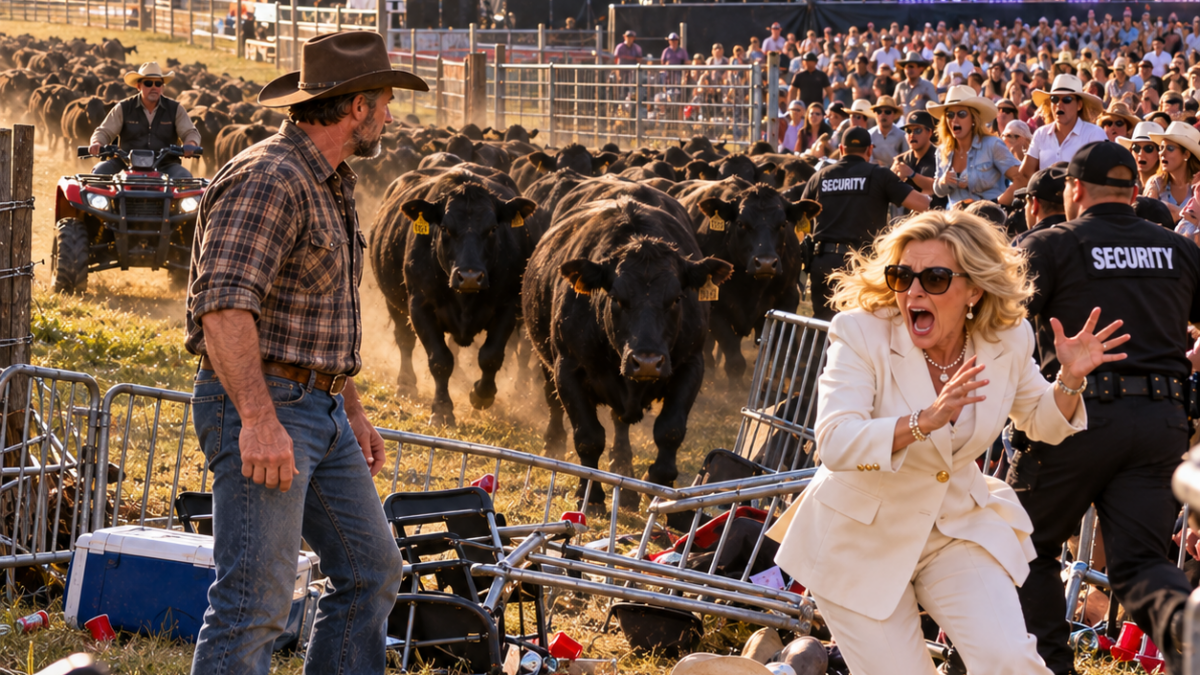
But 146 Angus moving together are a force even at walking pace.
They started toward their normal eastern route.
Water.
Home lane.
The gap.
I called security.
“Close western opening.”
No answer.
Again.
Then Amos’s voice came through radio.
“Wade.”
“What?”
“They’re through.”
My stomach dropped.
“How many?”
“First twenty.”
Then:
“Wade, they’re coming now.”
Four words.
I looked east.
Black cattle began appearing over low rise.
One after another.
Walking.
Not charging.
Walking with purpose.
The same route they used twice every day for years.
Except now that route contained 4,800 humans and a concert stage.
I grabbed radio to event safety manager.
“Livestock entering event footprint from west. Stop music. House lights. Open north evacuation lane. Do not chase cattle.”
He responded immediately.
Professional.
Good.
Music cut mid-song.
Crowd booed.
Then announcer:
“Ladies and gentlemen, please remain calm and follow staff instructions away from the western and central corridors.”
People laughed at first.
Then they saw cattle.
Phones rose.
Of course.
The first cows reached barricade corridor.
Temporary fencing bent under pressure because it had been installed for crowd separation, not livestock.
One cow pushed panel aside.
Another followed.
Security guards started waving arms.
I shouted:
“DO NOT RUN AT THEM.”
Some listened.
One did not.
A young guard stepped in front of lead cow.
Amos grabbed him by vest and pulled sideways.
“Never stand where cow wants to go.”
The herd flowed around stage-left fencing.
Not chaotic yet.
Then smell of water from east troughs and familiar lane pulled them straight toward backstage.
Crew scattered.
A forklift moved.
People climbed risers.
The headliner, Dale Westbrook, was still in trailer.
Good.
Stage manager locked down access.
Several cows walked beneath lighting truss.
One brushed a merch tent.
Tent collapsed.
Nobody under it.
Another cow nudged plastic trash barrel.
Barrel rolled.
Crowd screamed and laughed at same time.
That sound made cattle more nervous.
Now risk rose.
We needed people out of their path.
I got on stage stairs.
Security tried stopping me.
Event manager yelled:
“He owns the cattle. Let him.”
I took microphone.
That was never on my bucket list.
“My name is Wade Ellison. These cattle are not attacking anybody. They are walking to water. Move calmly toward north and south exits. Do not run toward them, touch them, or try to film from ten feet away.”
Half crowd listened.
The other half kept filming.
I added:
“If you’re between the black cows and the east fence, move now.”
That worked better.
Specific beats general.
Security created lane.
Sheriff deputies on event duty started moving people.
Fire marshal ordered controlled evacuation of central pit.
Medics staged.
No panic.
Some pushing.
One minor fall.
One twisted ankle.
A woman later treated for anxiety.
No trampling.
No cattle injury beyond superficial scrape.
That is the outcome I care about.
The herd reached stage front.
The headliner was supposed to walk out in eight minutes.
Instead, twenty-seven Angus stood between barricade and monitor speakers.
Then more came around side.
One cow climbed shallow stage ramp.
That is the photo that went everywhere.
A 1,300-pound black Angus standing under LED screen while giant silver letters behind read FOUNDERS WEEK LIVE.
She was not dramatic.
She was looking for exit.
Another followed.
Then third.
Stage crew evacuated.
Dale Westbrook’s tour manager called show.
Not postponed.
Canceled.
Correct.
Kendra came running from VIP area.
“What is happening?”
I stared.
“You put a stage in a cattle lane.”
“You were supposed to contain them.”
“You removed my gates.”
“We complied with court corridor.”
“No.”
“You built around it.”
She looked toward stage.
“This event has cost over a million dollars.”
“Then you should have rented land.”
She grabbed radio.
“Security, get livestock off stage.”
I took it from her hand.
Not violently.
Just lowered.
“No untrained security near cattle.”
“You don’t control this event.”
I looked around.
“My cows seem to disagree.”
Amos coughed to hide laugh.
We spent next forty-five minutes moving herd.
Not rodeo.
No yelling.
We used feed truck east of crowd.
Opened correct gate.
Reduced people.
Cattle followed.
Routine reestablished.
Once noise stopped, they calmed.
All 146 accounted.
We walked count twice.
That mattered more than concert.
Sheriff command closed venue.
Fire marshal backed.
Promoter agreed.
Guests directed to buses.
Some furious.
Some delighted because they had viral footage.
VIP people wanted refunds.
Everybody wanted explanation.
Kendra wanted a scapegoat.
By 10:00 p.m., her lawyer wanted silence.
Smartest thing that office did all week.
The legal aftermath began Monday.
First question from insurer:
Who owned land?
Me.
Second:
Did HOA have written site-use agreement from owner?
No.
Third:
Was there recorded easement authorizing concert?
No.
Fourth:
Had HOA received notice disputing access?
Yes.
Two certified letters.
Promoter had them too.
That became problem for promoter.
Colin Beck had continued after learning title issue because Kendra assured him:
Court has recognized HOA community rights sufficiently for event.
That was not what court order said.
She also gave him a document titled:
TEMPORARY COMMUNITY USE AUTHORIZATION.
Signed by Kendra.
Not by me.
It stated:
Silver Creek HOA possesses longstanding possessory and recreational rights over Ellison Meadow sufficient for temporary community programming.
No court said that.
No deed said that.
Another problem.
Event insurance application asked:
Do you have written permission/control of venue?
Kendra checked:
YES.
Attached HOA board resolution.
Insurer assumed HOA owned or controlled.
That was expensive.
Then county permit application.
Property owner listed:
SILVER CREEK ESTATES HOA / COMMUNITY OPEN SPACE.
That was false.
My parcel number appeared underneath.
Planning staff had not caught mismatch because organizer submitted mass event packet late and title verification was treated as applicant responsibility.
County immediately opened review.
The bulldozed fence?
Camera footage showed Kendra personally authorizing removal after contractor asked:
“Is this Ellison’s fence?”
She said:
“Within temporary event area. Take it.”
Clear.
The missing ranch gate?
Security work order:
Remove livestock gate obstruction for emergency lane per HOA president direction.
Clear.
The tanker blockage?
Radio logs.
Clear.
The stage across cattle lane?
Site map.
Clear.
The court order requiring livestock corridor?
Clear.
Then internal HOA emails.
That was where Kendra’s situation became worse.
Board member Martin Hale had asked six days before:
Do we actually have Ellison’s permission?
Kendra:
Not required. We have historical community rights and county event authorization.
Martin:
County permit isn’t property permission.
Kendra:
Counsel is comfortable proceeding.
Counsel was not.
Edward Pike produced email he sent Kendra:
Do not represent that my office has confirmed ownership or easement rights. We have not. Event occupancy remains legally disputed.
Another:
If Mr. Ellison does not consent and no court grants access, proceeding may expose Association to trespass and significant liability.
Kendra replied:
Understood.
There is no better word in discovery than:
Understood.
Then she proceeded.
Why?
Money.
Not personal money exactly.
At first.
Silver Creek had created annual Founders Weekend as prestige project.
Kendra wanted it to become regional event.
Sponsors:
$420,000.
Ticket revenue:
Around $600,000 gross.
VIP packages.
Vendor fees.
Parking.
Total projected gross around $1.3 million.
Costs near $900,000.
Potential surplus $300,000-plus for clubhouse renovation and reserve funding.
Kendra had built her presidency around it.
She had already announced new fitness center funded without special assessment.
Canceling concert would destroy promise.
Then another layer.
Her sister owned Mallerie Event Concepts.
That company held a $96,000 event coordination contract.
Disclosed?
Yes, technically.
Buried.
Board minutes said:
Affiliate event coordination support.
But sister’s company also received percentage bonus on sponsorship revenue.
Kendra voted on several related operational decisions without fully recusing.
Not automatically criminal.
Bad governance.
Conflict.
Motive to push.
The board held emergency meeting.
Kendra tried to frame cattle as deliberate sabotage.
She said publicly:
“Mr. Ellison intentionally released livestock into a permitted public event.”
I almost sued her for that sentence alone.
Rachel said:
“Wait.”
We had cameras.
Western pasture.
Gate.
Catering truck.
Security barrier.
Cattle movement.
My calls to safety.
Our efforts to stop them.
No deliberate release.
Amos’s phone call:
“They’re coming now.”
Not:
Let them go.
We also had prior plan to keep herd west.
Water deliveries.
Everything showed mitigation.
Kendra’s theory died in forty-eight hours.
Promoter issued statement:
The livestock incursion resulted from land-access and site-control failures not disclosed accurately to event partners.
Translation:
HOA lied to us.
Dale Westbrook’s team was remarkably gracious.
He posted:
Nobody got hurt. That’s what matters. Those cows had seniority.
That sentence probably saved us from national ridicule.
He refunded his performance fee less unrecoverable travel costs.
Good man.
Ticket refunds became disaster.
Insurer disputed because unauthorized site occupation may trigger exclusions.
HOA faced roughly $700,000 in refunds, vendor claims, restoration, security, stage cancellation, legal expenses, and damage.
Some recovered.
Some not.
Kendra’s sister’s company returned portion of fee under settlement.
The million-dollar night did not generate surplus.
It generated special assessment discussion.
Residents were furious.
Special meeting was brutal.
Kendra entered with attorney.
Not Edward Pike.
Different one.
That tells you something.
Martin Hale chaired.
He opened:
“This meeting concerns whether Ms. Mallerie exceeded board authority in contracting and directing use of land the association did not own.”
A resident shouted:
“Did we own the damn field or not?”
Martin:
“No.”
Simple.
Room erupted.
Kendra said:
“Fee title is not entire question.”
Martin:
“Did we have a recorded concert easement?”
Silence.
“No.”
“Owner permission?”
“No.”
“Court order?”
“No.”
“Then why did we sell 4,800 tickets?”
Kendra launched into:
Historic use.
Community reliance.
Open-space designation.
County permits.
Public-safety planning.
Martin waited.
Then repeated:
“Why did we sell tickets?”
That was end.
Recall petition began same night.
Eighty-one percent later voted remove her.
But before recall, civil court finally addressed title issue.
Judge Bell heard full evidentiary record.
Developer maps.
Deeds.
Surveys.
No easement.
Silver Creek had view protections in some lots.
Drainage rights.
Utility rights.
No right to occupy Ellison Meadow.
No recreational easement.
No public event right.
Judge’s order stated:
Visual integration into a development plan does not create possessory interest in neighboring land.
I liked that.
Kendra did not.
Court also found HOA had interfered with ranch operations and violated prior temporary order by failing to maintain adequate livestock corridor.
Not because cattle walked in.
Because stage, barriers, and crowd configuration materially obstructed required access.
We settled damages later.
Fence.
Pasture rehabilitation.
Compacted soil.
Trash.
Drainage rutting.
Lost grazing.
Water delivery costs.
Legal fees portion.
No absurd punitive jackpot.
Fair.
HOA insurer and association split.
Promoter settled separately.
County changed event-permit checklist requiring documentary proof of site authority for large private-land events.
Good reform.
No more checking box.
Need deed, lease, license, or owner consent.
That might be Kendra’s most useful legacy.
Amos hated when I said that.
“Don’t give her credit.”
“I’m giving paperwork credit.”
“Fine.”
The meadow took almost a year to recover fully.
Crowds compact grass.
Stage trucks worse.
We aerated.
Reseeded.
Repaired fence.
Rebuilt lane.
One area near VIP tent stayed bare until spring.
We joked it was where expensive shoes killed grass.
The cattle returned to normal in two days.
Animals are better at moving on than people.
The cow who climbed stage?
Tag 217.
Her name became Dolly because someone on internet decided.
We did not name every cow before.
Afterward everyone called her Dolly.
Ridiculous.
She became minor celebrity.
People stopped roadside asking for photos.
I stopped that quickly.
Working cattle.
Not petting zoo.
Amos made sign:
DOLLY IS BUSY.
Lily—
No Lily.
Wrong story.
My niece Rachel—different Rachel than lawyer—made T-shirts.
I refused.
She sold fifty at fundraiser for volunteer fire department.
Fine.
Kendra sent one apology letter after settlement.
Not public.
Wade,
I believed Silver Creek’s historical relationship to the meadow created more authority than the documents ultimately supported.
That belief became certainty before it became law.
I also placed the success of Founders Weekend above the practical concerns you repeatedly raised about livestock movement.
I regret that.
I am sorry for damage to your property and for representing your resistance as obstruction rather than ownership.
Kendra.
That was more honest than I expected.
I replied:
Thank you for saying it plainly.
No friendship.
No feud.
Enough.
Silver Creek changed presidents.
Martin served interim.
Then a woman named Denise Carver took over.
Her first meeting with me happened at south gate.
She stayed outside fence.
Important.
“Wade?”
“Yes.”
“I’m Denise.”
“I know.”
“We’d like permission to hold neighborhood picnic on HOA land near ridge.”
“Okay.”
“No meadow.”
“Good start.”
She smiled.
“Could kids tour ranch sometime?”
“Maybe.”
“We’ll sign waivers.”
“Now we’re speaking same language.”
We eventually hosted agricultural day.
Forty kids.
Parents.
No music stage.
They watched cattle from safe pen.
Learned hay.
Water.
Rotational grazing.
One boy asked:
“Is this where the cows attacked concert?”
“No cows attacked anybody.”
“They went on stage.”
“Yes.”
“Why?”
“Water.”
He looked disappointed.
Children prefer rebellion.
I told him:
“Cows do not care about HOA politics.”
He laughed.
That is the real lesson.
People turned herd into justice.
Nature taking land back.
Cattle humiliating tyrant.
Viral stuff.
Fun.
Wrong.
The cattle were not enforcing my deed.
They were thirsty.
They followed routine.
The chaos came because humans had built a temporary world directly on top of an older functioning system and assumed the older system would disappear for one evening.
That is what Kendra did not understand.
Working land is infrastructure.
Not empty scenery.
A cattle lane is not decorative grass.
A trough is not landscape feature.
A gate is not inconvenience.
A drainage cut is not wasted space.
Every piece has function.
When outsiders look at agriculture, they see open.
Farmers see connections.
Where animals move.
Where water runs.
Where trucks turn.
Where soil stays soft after rain.
Where shade falls.
Where fence pressure builds.
Where you can safely bring a trailer.
Kendra saw 118 acres and thought capacity.
I saw 118 acres and thought system.
That difference cost her.
I was not innocent in every way.
I had underestimated how far she’d go.
After first survey trespass, I should have sought injunction sooner.
Rachel told me.
“You hoped embarrassment would stop her.”
“Yes.”
“People invested in public promises become more dangerous when embarrassed.”
True.
I learned.
I also could have moved cattle entirely off parcel before event.
Possible?
Yes.
Expensive.
Stressful.
Would require leased pasture and hauling 146 head.
Should I have done it for safety once I saw crowd?
Maybe.
We debated.
My responsibility to animals and public did not disappear because Kendra trespassed.
That matters.
Once 4,800 people stood there, being legally right was not enough.
We adapted.
Extra water.
Held west.
Monitored.
When breach occurred, we responded.
I am proud of that.
Not because we “let cows ruin concert.”
We did opposite.
We tried to keep cows away.
That truth matters more than satisfying revenge story.
One lawsuit expert asked me:
“Would you agree the cattle were foreseeable?”
“Yes.”
Kendra’s lawyer seemed surprised.
“Then why not remove them?”
“Because this is cattle pasture.”
That sounded glib.
I continued:
“We did modify operations to reduce risk. The event organizer had been warned about routine movement repeatedly. The court ordered livestock corridor. Event staff removed gates and obstructed water access anyway.”
Foreseeable cuts both ways.
If you build stage in cattle lane after written warning, cattle are not surprise.
Judge agreed.
Insurance experts too.
Founders Weekend never returned to my meadow.
Silver Creek held it later on fairgrounds twelve miles away.
Paid rent.
Imagine.
They had 6,200 attendees.
No cattle.
Profitable.
Denise sent me photo.
“Look what happens when we rent a venue.”
I replied:
“Revolutionary.”
We became almost friends.
Not close.
Neighborly.
That is enough.
Ellison Meadow remains.
At sixty-two now, I run fewer cattle.
112 head.
My knees dislike winter.
Amos claims retirement every year.
Still arrives before me.
Dolly is gone now.
Sold with group years later.
People were upset.
She was livestock.
I did not turn her into mascot.
But somewhere somebody probably still owns blurry photo of black cow under stage lights.
I have one too.
Amos printed.
Framed in office.
Under it:
SHE WAS JUST TRYING TO GET A DRINK.
Accurate.
Every time I see, I remember silence after music cut.
Thousands of people.
Then hooves.
Not thunder.
Not stampede.
Just steady hoofbeats on dry ground.
Cattle moving where cattle had always moved.
That sound exposed whole lie.
The meadow had never been empty.
Never been community property.
Never been venue waiting to happen.
It was working ranch.
Kendra’s mistake was not simply trespassing.
It was assuming paperwork, tickets, barricades, and confidence could change what land actually was.
They could change appearance for one night.
They could not change function.
The cattle knew that before any judge did.
They knew where water was.
And when the time came, they walked there.








