HOA President Claimed She Owned My Driveway—So I Towed Her SUV, and 45 Minutes Later She Shoved a Police Officer on My Front Lawn.
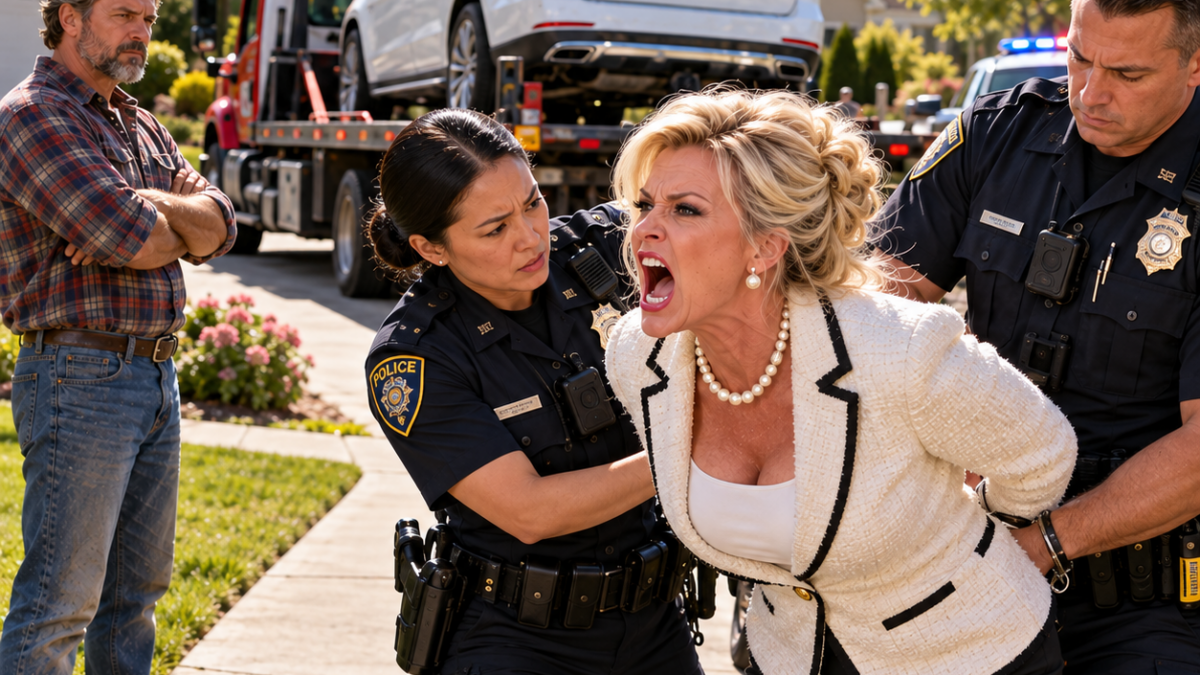
PART2:
Slow enough that I spent three months driving back and forth between Denver and the rehabilitation center convincing myself she would come home.
She never did.
When she left me the house, I told myself moving there temporarily made financial sense.
Sell my condo.
Take a few months.
Find work.
Fix the house.
Decide what came next.
What I did not admit was that the house felt like the last place in the world where somebody had always been happy to see me.
By the time I inherited it, Maple Ridge had changed.
The original neighborhood had been maybe thirty homes scattered among the trees.
Then came Phase Two.
Phase Three.
The clubhouse.
The pool.
Entry monuments.
Decorative streetlights.
Security cameras.
Landscaped medians.
Architectural review committees.
Seasonal-decoration policies.
And the Maple Ridge Homeowners Association.
Grandma hated the HOA.
I remembered that clearly.
PART3:
“They keep finding new ways to tell people what to do,” she once told me.
At the time, I laughed.
Grandma complained about everybody.
Cable companies.
Pharmacists.
The mayor.
Any restaurant that charged more than three dollars for iced tea.
I assumed the HOA belonged in that category.
Then I moved in.
Three days after the funeral, an envelope arrived.
Maple Ridge letterhead.
Inside was a sympathy card signed by five board members.
The largest signature belonged to:
Deborah Callahan
President
A week later, she came to my door.
Mid-fifties.
Cream blouse.
Tailored slacks.
Pearls.
Blonde hair cut so perfectly it looked resistant to weather.
A leather folder rested against her chest.
Her smile belonged in a real-estate brochure.
“Mr. Parker?”
“Yes.”
“Daniel Parker?”
“That’s me.”
“Deborah Callahan. President of the Maple Ridge Homeowners Association.”
She said president the way some people say senator.
Or judge.
Or queen.
“Nice to meet you.”
“Welcome to Maple Ridge.”
“Thank you.”
Her eyes moved immediately past me toward the driveway.
“We’re going to need you to address those cracks.”
I looked over my shoulder.
“The driveway?”
“Yes.”
Two narrow cracks ran near the concrete edge.
I had barely noticed.
“They affect the visual integrity of the property.”
I waited for a smile.
None came.
“I just moved in.”
“Of course.”
She softened her voice.
“We generally allow new owners thirty days to become compliant.”
“Compliant with what?”
“Our community standards.”
That sentence would become familiar.
I looked back at the driveway.
“My grandmother had those cracks for years.”
“Ruth received notices.”
“She never mentioned them.”
Deborah’s smile changed.
“Ruth and the association had a complicated relationship.”
That sounded believable.
“What exactly do I need to do?”
“Seal or replace the affected sections.”
“Fine.”
Then she pointed toward an old wooden mailbox.
“And the post will need repainting.”
“Okay.”
“The garage lantern is no longer approved.”
“Anything else?”
She glanced at her folder.
“Your back fence is technically grandfathered, although if you replace more than twenty-five percent at once, current design standards apply.”
I stared.
“Anything involving the inside of my refrigerator?”
She laughed politely.
“You’ll adjust.”
That was our first conversation.
The first driveway incident happened six days later.
I was supposed to meet a contractor at nine.
At 8:40, I opened the garage and found a white Lexus SUV parked across the bottom of my driveway.
Not beside it.
Across it.
Blocking both lanes of my narrow entrance.
I walked down.
Maple Ridge magnet on the door.
HOA president placard on dashboard.
I called the number from Deborah’s card.
She answered.
“Yes?”
“Your SUV is blocking my driveway.”
“Oh.”
Not surprise.
More like I had reminded her of something.
“I’m with landscapers on Juniper Court.”
“Move it.”
“I’ll be there shortly.”
“I need to leave.”
“Daniel, it’s fifteen minutes.”
“It’s my driveway.”
Silence.
Then:
“Fine.”
She arrived eleven minutes later.
No apology.
“I needed somewhere to park where the landscaping truck could turn.”
“There’s visitor parking seventy yards away.”
“They had equipment.”
“So?”
She unlocked the Lexus.
“This drive has historically been used for HOA access.”
“No, it hasn’t.”
She looked at me.
“Your grandmother allowed service access.”
“Then my grandmother was nicer than I am.”
She smiled.
“Probably.”
And drove away.
I should have noticed the word historically.
Instead, I went about my day.
The second time was two weeks later.
Deborah parked across my driveway during a pool-maintenance inspection.
This time I texted.
Move the Lexus.
She replied:
20 min. Community work.
I wrote:
You do not have permission to block my driveway.
No response.
Twenty-three minutes.
Then she moved.
I sent an email afterward.
Formal.
Polite.
Deborah, please do not park in or block my driveway again. It is private property and I need uninterrupted access.
She answered:
Daniel, the lower driveway apron has historically functioned as part of the Maple Ridge service corridor. I will ask management to clarify the access arrangement.
I looked at that sentence for a while.
Then called the county assessor.
Parcel map showed what I expected.
My driveway.
My lot.
No HOA ownership.
But parcel maps are not title reports.
I ordered one.
The title report arrived four days later.
There was an easement.
Just not the one Deborah apparently wanted.
A twelve-foot utility easement along the north edge.
Electric.
Telecom.
Nothing granting HOA vehicle access.
Nothing authorizing parking.
Nothing making the driveway common.
I emailed Deborah a copy.
Her response:
The HOA’s rights predate the current electronic title summary. We have legacy documentation.
Legacy documentation.
I asked her to send it.
She did not.
The third incident happened on a Monday morning.
I had an interview by video from home.
At 10:15, the hiring manager asked whether I could come to the company’s Boulder office that afternoon to meet the regional director.
I said yes.
The role mattered.
Senior infrastructure program manager.
Good salary.
Good company.
First position in months that actually felt like progression rather than recovery.
Meeting scheduled at one-thirty.
Drive time about an hour and fifteen minutes if traffic cooperated.
At noon I changed suits.
Printed résumés.
Walked outside.
White Lexus.
Across the driveway.
Again.
I called Deborah.
Voicemail.
Texted.
Nothing.
Called HOA office.
The property manager, a woman named Sheila Frost, answered.
“Maple Ridge management.”
“Deborah’s SUV is blocking me in.”
Pause.
“Again?”
That one word mattered.
“Yes.”
“I’ll call her.”
“I need to leave now.”
“I understand.”
Five minutes.
Ten.
I walked to the Lexus.
No keys.
Locked.
I considered calling tow truck.
Then Deborah appeared from a neighboring backyard holding rolled landscape drawings.
“You really need to stop doing this.”
She looked at my suit.
“Going somewhere?”
“Yes.”
“Then I’ll move.”
“Now.”
She sighed.
“Daniel, this driveway apron is HOA-accessible.”
“No.”
“We’ve discussed.”
“You claimed documents. You haven’t shown any.”
“Because I’m not obligated to litigate HOA records with individual homeowners.”
“It’s my property.”
“And it serves association operations.”
She opened the door.
I said:
“Next time I tow it.”
She froze.
“You will not.”
“Yes.”
“You do that and the HOA will treat it as interference with association access.”
“Great.”
She moved.
I arrived in Boulder nine minutes late.
Still got interview.
It went well enough that they scheduled final.
That should have been warning enough for both of us.
The fourth time was the following Thursday.
Final interview.
In person.
Three executives.
I had spent two days preparing.
My appointment was at eleven.
I planned to leave at nine-fifteen.
At nine, I stepped outside.
White Lexus.
Across my driveway.
I actually laughed.
Not because funny.
Because sometimes disbelief comes out that way.
I called Deborah.
No answer.
Text.
Nothing.
HOA office.
Sheila said Deborah was in a board-site meeting somewhere in Maple Ridge.
“Where?”
“I don’t know exactly.”
“She blocked me again.”
“I’m sorry.”
“I told her I’d tow.”
Long pause.
“I remember.”
“Does HOA have documented access rights over my driveway?”
Sheila lowered voice.
“Daniel, I’m not legal counsel.”
“That wasn’t my question.”
“I have never seen an easement.”
There.
“Thank you.”
I called county sheriff non-emergency.
Explained.
Dispatcher said because vehicle blocked private driveway, property owner could contact authorized tow company subject to local requirements, and law enforcement would respond if dispute occurred.
I photographed everything.
SUV.
License plate.
Driveway.
Street.
Time stamp.
Then called Summit Tow & Recovery.
Driver arrived eighteen minutes later.
His name was Ben.
He looked at Lexus.
Then me.
“You sure?”
“Fourth time.”
“Ownership?”
I showed ID, deed copy, title report.
He photographed.
I signed authorization.
He hooked Lexus.
At 9:39, Deborah’s SUV disappeared.
At 9:42, I left.
At 10:58, I got stuck behind an accident on Highway 93.
At 11:19, I walked into interview.
Nineteen minutes late.
Again.
They were polite.
The regional director said:
“These things happen.”
But I knew.
You can only arrive late to so many executive interviews while saying something blocked your driveway before it starts sounding like your life is unstable.
Two days later, I got the email.
We’ve decided to move forward with another candidate.
Maybe the lateness cost me.
Maybe not.
No company tells you.
But I knew how close I had been.
And I knew Deborah had been warned.
That afternoon, I sat on Grandma’s porch with coffee.
That was when Deborah came screaming up the cul-de-sac.
Not in a car.
On foot.
Her husband apparently had driven her back from the tow yard after she discovered Summit required proof of ownership and payment before release.
She crossed my lawn.
“You had my vehicle stolen!”
“I had it towed.”
“You had no authority!”
“It blocked my driveway.”
“That driveway belongs to Maple Ridge!”
“No.”
“You are interfering with association property!”
I put coffee down.
“Leave my yard.”
“You owe me six hundred forty dollars.”
“No.”
“For towing, storage, transportation—”
“No.”
“I am placing this on your account.”
“You can put it on Mars.”
She pulled out phone.
“I am calling police.”
“Please.”
That is how Officer Megan Chen and Officer James Ramirez arrived.
Not because I called.
Deborah did.
She reported vehicle theft.
When officers arrived, I showed photographs.
Texts.
Emails.
Title report.
Tow authorization.
Ben’s receipt.
Deborah interrupted every thirty seconds.
Chen finally said:
“Ma’am, stop talking over him.”
“I am HOA president.”
“I understand.”
“This is a private community.”
“I understand.”
“He removed an authorized association vehicle.”
Ramirez asked:
“What document authorizes you to park across his driveway?”
Deborah said:
“The Maple Ridge access covenant.”
“Do you have it?”
“At the HOA office.”
“Can someone send it?”
“I don’t need to prove HOA authority to a homeowner.”
Ramirez said:
“You called us alleging theft. You need to establish you had lawful possession or access if that matters to your allegation.”
Her face changed.
It was the first time that afternoon somebody had required evidence instead of accepting title.
She pointed at me.
“He has been hostile since he moved in.”
Chen asked:
“Did he threaten you?”
“He threatened towing.”
“After asking you to move?”
“That’s irrelevant.”
“No. It isn’t.”
Then Deborah stepped toward me.
Ramirez blocked lightly.
“Ma’am, stay here.”
She shoved Chen.
Then swung purse into Ramirez.
And screamed the sentence half the neighborhood heard:
“You cannot arrest the president of the HOA!”
They did.
Not because she was HOA president.
Because she had just made physical contact with two officers while refusing lawful commands during an investigation she herself requested.
Ramirez took her purse.
Chen handcuffed her.
Deborah screamed that they were hurting her.
They loosened and checked cuffs.
She screamed that I had orchestrated this.
She screamed Maple Ridge owned my driveway.
She screamed she would have my house.
Then she said something I didn’t understand until later.
“You think Ruth beat us on that strip? She didn’t. It belongs to the association now.”
Chen looked at me.
I looked at Deborah.
“What strip?”
Deborah stopped.
Just for a second.
Then:
“Ask your grandmother.”
“My grandmother is dead.”
For first time, she had nothing to say.
The police took her.
I assumed that was peak.
It wasn’t.
At the scene she was booked initially on relatively ordinary allegations tied to the confrontation—assaulting or obstructing officers depending how prosecutors classified the conduct, disorderly behavior, and resisting.
Nothing about that alone produced a $375,000 bond.
That came later.
Because the next morning, Sheila Frost called.
“Daniel.”
Her voice sounded wrong.
“What happened?”
“I need you to come to HOA office.”
“Why?”
“Not alone.”
That is not a sentence property managers use casually.
“Should I bring lawyer?”
“Yes.”
I did not have one.
So I called a real-estate attorney named Maya Ellison, referred by the title company.
Maya was forty-three, direct, and had the unnerving habit of letting silence force other people to continue talking.
We met Sheila at the Maple Ridge office.
The office sat beside the clubhouse inside a low stone building.
Deborah’s parking spot remained empty.
Sheila locked conference-room door.
Then put three documents on table.
The first was titled:
MAPLE RIDGE COMMUNITY ACCESS AND MAINTENANCE EASEMENT
Grantor:
Ruth Parker.
Grantee:
Maple Ridge Homeowners Association.
Date:
Eight years earlier.
It purported to grant the HOA a twenty-four-foot permanent vehicular easement across the lower half of Grandma’s driveway, continuing down the side of her property toward a maintenance strip near creek.
My signature wasn’t relevant.
Grandma’s was.
Or what looked like Grandma’s.
I stared.
“She never told me.”
Sheila said:
“I don’t think she signed it.”
My stomach changed.
“Why?”
She slid second document.
Letter from Grandma to HOA counsel written seven years earlier.
I have never granted Maple Ridge a driveway easement and will not do so. Please stop allowing contractors to use my property without permission.
Attached was certified-mail receipt.
Third document:
Internal HOA email.
From Deborah.
To prior property manager.
Ruth is confused about historical arrangement. Keep using service route. Legal documentation is being corrected.
Maya leaned forward.
“What does ‘corrected’ mean?”
Sheila shook her head.
“I don’t know.”
“Where is the purported easement recorded?”
She gave county reception number.
Maya pulled it up on laptop.
Recorded six years earlier.
Not eight.
Document itself dated eight years earlier.
Two-year gap.
Not impossible.
But suspicious.
Notary acknowledgment named:
Carlene Moss, Notary Public
Sheila said:
“Carlene was Deborah’s sister-in-law.”
“Was?”
“She died three years ago.”
Maya looked at me.
“When did Ruth die?”
“Seven weeks ago.”
“Was she competent eight years ago?”
“Very.”
“Could signature be hers?”
I stared at scan.
I knew Grandma’s handwriting.
Strong capital R.
Long loop on P.
The signature looked close.
Too close.
Like somebody had practiced.
“I don’t think so.”
Maya said:
“Don’t accuse anybody yet.”
Good lawyer.
Sheila continued.
“The reason I’m showing you is that board secretary asked me last night for access file after police called. I found two versions.”
Another document.
Same easement.
But this version was unsigned.
Draft watermark.
And an email from HOA attorney eight years earlier:
Ruth Parker has declined the requested easement. Do not use her driveway for routine association access absent separate permission. The association’s utility rights do not create general vehicular access.
Maya looked at Sheila.
“Did Deborah receive this?”
“Yes.”
“Who recorded the signed version?”
“Cover sheet lists return address to Deborah’s home.”
Silence.
That is how the driveway stopped being a parking dispute.
Maya told me not to touch anything else.
Sheila preserved files.
HOA board was notified.
County sheriff investigator got documents.
Then district attorney.
The police case expanded.
Not because Deborah yelled she owned everything.
Because there was now a recorded property instrument of questionable origin that materially benefited the HOA and contradicted Grandma’s written refusal.
Investigators asked me for examples of Grandma’s signature.
Checks.
Tax returns.
Birthday cards.
Old deeds.
I provided them.
A forensic document examiner later found significant inconsistencies.
Not enough alone.
Then they found more.
The notary journal.
Colorado notaries are expected to keep records for certain notarizations, depending transaction and period requirements.
Carlene’s surviving records had been stored by family.
The supposed Ruth easement was not there.
The journal entries around date existed.
Nothing for Ruth Parker.
Nothing for Maple Ridge.
Then investigators found Carlene had been in Arizona visiting her daughter on the day the document claimed Ruth appeared before her in Colorado.
Travel records.
Photographs.
Texts.
Again, no single magical proof.
Accumulation.
Then HOA emails.
Deborah had pushed for rear service access because Maple Ridge’s maintenance vehicles otherwise had to use a narrow clubhouse lane that residents complained about.
Grandma’s driveway connected conveniently to a strip leading toward irrigation controls and creek-maintenance area.
The developer had once proposed buying a piece of Grandma’s lot.
She refused.
After developer control ended, Deborah revisited.
Grandma refused again.
Then the easement appeared.
For years, Grandma fought contractors.
She put up chains.
No-parking signs.
Once, according to Sheila, she had a landscaping truck towed.
That made me smile despite everything.
Grandma.
Of course.
Then a board email five years earlier.
Treasurer:
Do we have legal access through Ruth’s drive? She keeps threatening trespass.
Deborah:
Yes. Easement is recorded. Ruth disagrees because she does not understand title effect.
Another director:
Wasn’t she refusing to sign?
Deborah:
That was prior draft. Final was completed later.
Where?
No closing file.
No payment.
No correspondence from Grandma acknowledging execution.
Then financial records.
This is where motive grew.
The HOA had received an estimate to build a proper separate service entrance from its own parcel.
$412,000 at the time because of grading, retaining walls, drainage, and relocation of landscaping.
Using Grandma’s driveway cost almost nothing.
Deborah treated the purported easement as solution.
Maya told me:
“Do not turn this into ‘she forged it’ until prosecutors say what they can prove.”
So I didn’t.
Even in my own head, I tried not to.
But investigators kept finding facts.
A PDF metadata copy of the easement on an old HOA backup drive had been created on Deborah’s personal laptop six years earlier.
Not decisive.
People create documents.
More importantly, a prior draft contained an image layer of Grandma’s signature lifted from a landscaping access acknowledgment she had signed years before.
Same proportions.
Same minor pen break.
Digital forensic examiner concluded the signature image on draft had been imported.
The recorded document appeared to be printed from a version derived from that file.
Then notary block.
Investigators found an email from Deborah to Carlene:
Need you to clean up Ruth access paper. She is making this impossible and board needs recorded certainty before maintenance contract renews.
Carlene replied:
I am not notarizing Ruth without her present.
Deborah:
Call me.
After that:
No email.
Then two weeks later recorded easement.
That was the point prosecutors moved from property dispute toward criminal investigation.
Deborah had been released after the officer incident on modest initial bond.
She returned home.
Board suspended her as president pending review.
Then detectives executed search warrant at her home and HOA office.
No dramatic SWAT team.
Two unmarked vehicles.
Uniformed deputies.
Digital evidence personnel.
They seized laptop, old records, phones under warrant.
The neighborhood went insane online.
I stayed off the Facebook group.
Maya ordered me to.
“Anything you post becomes an exhibit.”
Fine.
The board appointed vice president Martin Hale as acting president.
He came to my house.
Stayed on sidewalk.
Smart.
“Daniel.”
“Yes.”
“I need to apologize.”
“For which part?”
He looked toward driveway.
“All of it.”
He was sixty-two.
Retired accountant.
Had served on board two years.
“I believed the easement was legitimate.”
“So did you park here?”
“No.”
“Then we don’t have problem.”
“We may.”
“How?”
“The HOA has used the access.”
“For how long?”
“Years.”
“Grandma kept blocking it.”
“I know that now.”
“She told you?”
“Not me personally.”
He looked ashamed.
“Deborah framed Ruth as confused and combative.”
“That sounds like Grandma.”
He almost smiled.
“But she wasn’t confused.”
“No.”
Martin handed me letter.
Board formally suspended all claimed vehicular use of my driveway pending title review.
They would use clubhouse lane.
Good.
Then:
“We want to resolve anything the association owes you.”
“Maya will talk.”
He nodded.
No argument.
That was healthy.
The deeper investigation exposed a pattern beyond my driveway.
Not hundreds of forged deeds.
Nothing that absurd.
Three other property matters.
One involved a strip behind a resident’s fence the HOA had claimed as drainage access despite no recorded easement.
Another involved vendor parking on private gravel pad.
The third involved a landscaping license Deborah represented as perpetual although the document expired.
Those were mostly governance overreach.
My driveway was different because of recorded instrument.
Then detectives found something worse.
Deborah had used the purported Ruth easement as collateral evidence when obtaining county approval for a maintenance-access improvement grant.
The HOA had received $96,000 from a district infrastructure program partly based on certified control of the access route.
If document was false and she knew, that created financial exposure beyond a neighbor dispute.
Prosecutors became interested in:
Forgery-related counts.
Offering a false instrument for recording.
Attempted theft or fraud theories tied to obtaining money/value through false documentation.
Computer-related evidence alteration depending what could be proved.
Official? No, she wasn’t public official.
HOA president is not government.
Important distinction.
Then witness issue.
She called Sheila.
After suspension.
Told her:
“You need to remember Ruth signed in my kitchen.”
Sheila said:
“I wasn’t there.”
Deborah replied:
“You knew she signed.”
Sheila recorded next call after consulting counsel.
Deborah said:
“If investigators ask, the board understood Ruth approved it. Nobody needs to make this bigger.”
That created possible witness-tampering or influencing concerns.
Again, not because asking someone to remember is automatically crime.
Because context and repeated pressure mattered.
Then she texted Carlene’s adult daughter asking whether any old notary journals could be “lost in estate cleanup.”
That message was apparently the one prosecutors hated most.
By the time detectives arrested Deborah a second time, the case had changed completely.
She surrendered through attorney.
No front-lawn spectacle.
No neighborhood raid.
At the first substantial bond hearing on the expanded case, the prosecution argued she had:
Already confronted officers physically during earlier incident.
Attempted to influence witnesses.
Contacted family member connected to notary records.
Possessed significant financial resources.
Made statements about leaving Colorado to stay at a second home in Arizona.
Defense argued she was sixty-one, lifelong resident, no serious criminal history, not a flight risk, and charges were document-heavy—not violent felonies beyond the officer confrontation.
Both mattered.
The judge did not call her monster.
Did not rant.
He imposed conditions.
No contact with HOA witnesses except through counsel.
No access to HOA records systems.
Surrender passport? The judge could order travel restrictions; let’s keep: travel outside state required permission.
Then secured bond:
$375,000.
Not as punishment.
Not because shoving one officer was somehow worth that number.
The judge cited the combined allegations, interference concerns, prior conduct after initial release, and need to ensure appearance and compliance.
Her attorney immediately asked for reduction.
Later hearings adjusted some conditions but the bond number was what neighborhood remembered.
Of course.
People love numbers.
HOA PRESIDENT GETS $375K BAIL
Easy headline.
Harder story.
My driveway remained mine.
But legal cleanup took almost a year.
First, quiet title.
Maya filed civil action asking court to declare recorded easement invalid and remove it from title.
The HOA did something surprisingly responsible.
It did not defend Deborah’s document once independent counsel reviewed evidence.
Instead, Maple Ridge stipulated that it could not authenticate the easement, disclaimed any right under it, and joined request to clear title while reserving claims against responsible individuals and insurers.
That saved residents a fortune.
Judge entered order declaring purported access easement invalid and directing corrective recording.
I stood in courthouse afterward with Maya.
“That’s it?”
“For title?”
“Yes.”
“No fireworks.”
“I expected something.”
She smiled.
“You own driveway today exactly like you owned it yesterday. Paper just caught up.”
That was enough.
Then HOA compensation.
They had used driveway for years.
Not constantly.
Landscapers.
Maintenance carts.
Occasional contractor vehicles.
No permanent damage beyond cracked edge and compacted shoulder.
Maya calculated reasonable-use value, repair, legal fees, interference.
We negotiated.
The HOA paid $48,000 plus my title/legal costs.
Insurance covered some.
I didn’t demand more.
Why?
Because homeowners were not Deborah.
Grandma knew them.
Borrowed sugar.
Watched their dogs.
Complained about their Christmas lights.
Making three hundred families pay revenge money would not bring Grandma back or restore job interview.
The board also paid to rebuild my driveway edge and install two stone bollards positioned so normal cars could enter my home but nobody could casually treat apron as HOA staging.
No gate.
I didn’t want one.
Just clarity.
Then employment issue.
The company in Boulder?
Two months after all this started, the hiring manager called.
They had heard nothing about HOA.
Different reason.
The candidate they chose left before starting due relocation issue.
Was I still interested?
I almost laughed.
I interviewed again.
On time.
Got job.
So did Deborah cost me biggest opportunity of life?
Maybe temporarily.
Not permanently.
I am careful about saying more.
Stories get better when everything is causal.
Real life is less neat.
What she definitely cost me:
Time.
Stress.
Tow dispute.
Legal bills before reimbursement.
Trust in institutions that use clipboards.
What she gave me unintentionally:
Reason to read Grandma’s records.
That mattered.
After title case, I went through every box in attic.
Grandma had kept everything.
Receipts from 1984.
Christmas cards from people I didn’t know.
County tax statements.
Old Maple Ridge letters.
And one folder labeled:
DEBORAH — DO NOT LET HER BULLY YOU
I sat on attic floor laughing.
Inside were copies.
Every parking argument.
Every access letter.
Photographs of contractor vehicles.
One handwritten note:
Daniel — if this becomes your problem someday, driveway is ours. Utility line is not road. Make them show you paper.
I cried when I read that.
She knew me.
Knew I might inherit.
Knew Deborah.
Knew exactly which sentence I would need.
Make them show you paper.
That became rule.
Deborah’s criminal case took longer.
I was not central witness on forgery itself.
I testified about ownership, her statements, parking history, towing, and officer confrontation.
Sheila testified about records.
Forensic examiner testified.
Notary records.
Board emails.
Grant application.
Defense attacked digital attribution.
Argued Deborah had relied on others.
Suggested Carlene may have completed notarization incorrectly later.
Pointed out Grandma had occasionally allowed contractors through.
True.
Permission is not easement.
Defense argued HOA board collectively benefited and should not scapegoat president.
Also partly fair.
Several directors had been careless.
But evidence focused on who created, represented, recorded, and later defended disputed instrument.
Some counts were dismissed before trial because prosecutors could not tie every alleged act to Deborah personally.
Good.
Cases should narrow.
She ultimately entered a plea rather than take every count to jury.
Not to murder.
Not racketeering.
Nothing cartoonish.
She pleaded guilty to one felony involving use/recording of a materially false property document and one felony tied to attempting to influence a witness.
She also resolved the officer-confrontation case with misdemeanor assault/interference counts.
Other charges dismissed under agreement.
Sentence included prison.
Not decades.
Restitution.
Probation/supervision afterward.
No HOA service.
Obviously.
The $375,000 bond remained famous even though sentencing was less dramatic.
People confuse bond with fine.
It wasn’t money government kept as punishment.
It was security for appearance/compliance subject to bond rules.
Details matter.
Deborah sold her Maple Ridge house while case was pending.
Her husband stayed with relatives.
I did not celebrate.
Some neighbors did.
That bothered me.
There is a difference between accountability and enjoying collapse.
She had done real damage.
She was also a human being whose worst decisions became public entertainment.
Grandma would have enjoyed ten minutes.
Then told everyone to get a hobby.
Maple Ridge reformed.
Not dramatically.
Bylaws amended.
No board member could direct vendors onto disputed private property without written title verification.
All easement claims had to be reviewed by independent counsel.
President could not unilaterally instruct compliance contractors.
Complaints against non-common property required documentation.
Board adopted record-retention policy.
Annual title/access audit.
The HOA also dropped the phrase Compliance Division.
Good.
Their security contractor uniforms changed.
Polo shirts.
No badge-shaped logos.
No “officer” language unless actual licensed security job required and clearly identified.
I attended one meeting.
Martin said:
“We want residents to understand HOA is a private association, not municipal government.”
I almost applauded.
Instead:
“Put that in welcome packet.”
They did.
Grandma would have framed it.
The cracks in my driveway?
I repaired them.
Not because Deborah was right.
Because they were cracks.
That distinction became a running joke with Maya.
“You complied.”
“I maintained property.”
“Same result.”
“Different sovereignty.”
She laughed.
The old mailbox?
I repainted.
Garage lantern?
Still there.
Apparently nobody cared once Deborah wasn’t president.
Funny.
I became friends with Officer Chen eventually.
Not close.
We ran into each other at coffee shop.
She recognized me.
“How’s driveway?”
“Still mine.”
“Congratulations.”
“How’s shoulder?”
“Survived.”
Ramirez transferred to another division.
At a community safety event he later joked:
“HOA president is not protected class.”
I told him probably don’t put that on department website.
He agreed.
The towing company owner, Ben, sent me Christmas card.
Picture of tow truck.
Inside:
Still towing legally parked HOA presidents by appointment only.
Not true.
Funny.
I taped it in garage.
Sheila resigned from Maple Ridge management after case.
Too much.
She moved to another company.
Before leaving, she came by.
“I’m sorry I didn’t push harder.”
“For what?”
“Your grandmother complained for years.”
“Did you believe her?”
She looked down.
“I believed Deborah had paperwork.”
“Reasonable.”
“I stopped checking.”
There.
Institutional failure in four words.
I stopped checking.
That’s how confidence becomes authority.
Nobody verifies after first year.
Then second.
Then new staff inherit assumption.
Easement appears in folder.
Vehicles use road.
Residents see use.
Soon everyone says:
It has always been this way.
History can be manufactured through repetition if no one goes back to source.
Grandma did.
She kept source.
That’s why Deborah hated her.
Not because Ruth was loud.
She was.
Because Ruth kept receipts.
I took that lesson into new job.
Construction program management has same disease.
People say:
“We’ve always done it this way.”
I ask:
“Where is requirement?”
Sometimes there is one.
Sometimes nobody knows.
My director joked I became company historian.
Fine.
I have a driveway to thank.
One year after Deborah’s plea, I found something unexpected in mailbox.
Letter.
Her handwriting.
Return address from correctional facility.
I almost threw away.
Then opened.
Short.
Daniel,
I do not expect forgiveness. I told myself for years that Ruth was unreasonable and that the community’s needs justified forcing a solution. Once I started treating my judgment as authority, every objection became proof that I needed more authority. I crossed lines long before the day at your house.
I read twice.
Then:
I was wrong about the driveway. I was wrong to enter the records dispute as if I could make ownership true by repeating it. I was wrong to put Megan Chen and James Ramirez in danger.
Specific.
Good.
Then:
Your grandmother once told me, “Deborah, a title is not a deed.” I thought she was being clever. She was warning me.
I laughed.
That sounded exactly like Ruth.
Last line:
I am sorry.
No request to visit.
No plea.
I did not write immediately.
Three months later, I did.
One paragraph.
Thank you for saying it clearly. I accept the apology. The driveway was never the most important part. The important part was learning that no title gives anyone permission to stop checking whether they are right. I hope whatever comes next is quieter.
I did not say forgiven.
Maybe I had.
Maybe not.
Forgiveness is less important to me than people think.
Boundaries.
Truth.
Repair.
Those I understand.
Years passed.
Maple Ridge became ordinary again.
Children rode bikes.
People complained about pool hours.
Board argued over tree trimming.
A resident painted front door orange and triggered six-week email war.
Normal HOA nonsense.
No forged property instruments.
Progress.
Martin left board after term.
New president was a retired school librarian named Evelyn Brooks.
Her first act was to eliminate president parking spot at clubhouse.
She said:
“Nobody needs throne.”
I liked her.
She came to my porch once.
“Daniel, we need temporary access near creek for drainage inspection.”
I stared.
She immediately held up paper.
“Not through driveway.”
Good.
“Utility easement only. Engineer will enter from HOA side. We are notifying you because survey crew may stand near property line.”
I looked.
Everything correct.
“Fine.”
She smiled.
“This is what governance feels like?”
“Boring?”
“Yes.”
“Perfect.”
Grandma’s tomatoes came back too.
I had let garden go first year.
Then planted.
Terrible results.
She had secret soil mix and never wrote it down.
I asked neighbor Mrs. Alvarez.
She said Ruth used compost from a horse farm.
I tried.
Tomatoes improved.
Memory works like that.
You inherit house.
Then discover inheritance is mostly procedures nobody documented.
Where she kept spare keys.
Which pipe freezes.
How long creek rises after snowmelt.
Who gets offended if you don’t wave.
Which HOA president believes your driveway is theirs.
I wish she had stayed longer.
That remains.
No legal victory changes it.
Sometimes I sit on porch where police once cuffed Deborah.
I remember scene.
The scream.
Purse swinging.
Officers.
Phones.
And I think about how misleading dramatic moments are.
Everyone who saw that day probably thought story was:
Entitled HOA Karen attacks cops after car tow.
Technically.
But that wasn’t real story.
Real story started years earlier when somebody decided community convenience mattered more than Ruth saying no.
Then another person believed a document because it was recorded.
Then another.
Then another.
A false thing acquired institutional weight.
By time I moved in, Deborah didn’t merely claim access.
I think she believed in her own version.
That’s the danger.
People assume wrongdoing requires villain who knows every minute they are lying.
Sometimes it begins with rationalization.
Community needs access.
Ruth is difficult.
She’ll eventually agree.
The easement should exist.
It would be better if it existed.
We already use route.
Everyone relies on it.
Therefore maybe making paperwork match reality feels less like theft and more like correction.
One step.
Then another.
Until a woman is standing on somebody else’s lawn screaming:
Maple Ridge belongs to me.
It never did.
Not legally.
Not morally.
Not practically.
A homeowners association is not kingdom.
President isn’t sovereign.
The members collectively have contractual property rights and obligations defined by declarations, bylaws, deeds, statutes, and actual ownership.
That’s plenty.
No crown required.
My grandmother understood simpler version.
Title is not deed.
I framed her note.
Not the letter to Deborah.
The one she left for me.
Driveway is ours. Utility line is not road. Make them show you paper.
It hangs inside garage.
Not because I expect another Deborah.
Because it’s good life advice.
Make them show you paper.
Someone says they own something?
Show title.
Have authority?
Show source.
Fine you?
Show rule.
Enter property?
Show permission.
Claim easement?
Show recorded instrument—and if authenticity disputed, verify.
Not suspicion of everything.
Verification.
Trust works better with records when rights matter.
I learned that the expensive way.
I sometimes wonder what would have happened if Deborah had moved Lexus the first time and never parked there again.
Probably nothing.
I might never discover easement.
It would remain in title.
Years later, selling house could trigger.
Buyer title insurer would see recorded access.
Maybe deal delayed.
Maybe HOA assert.
Maybe someone eventually investigate.
Or maybe false document would survive indefinitely.
That’s uncomfortable.
Her arrogance exposed her own foundation.
She blocked driveway because believed access right.
I towed because knew private.
Police asked for proof.
Records opened.
Everything else followed.
The tow truck didn’t defeat her.
Evidence did.
That’s usually less satisfying as headline.
But true.
One summer, county repaved part of road.
A worker parked equipment near bottom of my driveway.
Not blocking.
Close.
He knocked.
“We need leave roller here overnight. Is that okay?”
Simple.
“Yes.”
He smiled.
“Appreciate it.”
That was all.
Permission.
No fight.
No lawyer.
No $375,000 bond.
Every time somebody asks first, I think of Deborah.
Not angrily anymore.
Just contrast.
Power isn’t getting to skip question.
Respect is asking even when you think answer should be yes.
Grandma taught me that without ever saying it.
She let neighbors cut through yard sometimes.
Let HOA landscapers use hose once.
Let kids sled down side hill.
She wasn’t guarding every inch.
She simply wanted her yes to remain hers.
That’s property at human level.
Not abstract bundle of rights.
Choice.
The right to open your driveway.
The right to close it.
The right to help.
The right to refuse.
The right not to have temporary kindness converted into permanent claim by somebody else.
That was what Deborah took from her.
Or tried.
Years later, when I refinanced house, title company issued clean commitment.
No Maple Ridge access easement.
I stared at page longer than necessary.
Then walked outside.
The driveway looked same.
Concrete.
Two repaired cracks.
Pines dropping needles.
No sign announcing victory.
No plaque.
Just mine.
I stood at bottom where Lexus had blocked me four times.
Then laughed.
It seemed ridiculous that this strip of concrete had caused police, forensic document examiners, board reforms, bond hearings, and criminal charges.
But land disputes are rarely about square feet alone.
They are about who gets to say what is true.
Deborah thought saying community access often enough could become ownership.
Grandma believed recorded facts mattered.
In the end, Grandma won.
Not because she lived to see it.
She didn’t.
Not because I outshouted anybody.
I didn’t.
Because she kept records.
Because Sheila finally checked.
Because officers asked for source.
Because lawyers separated private authority from public authority.
Because board stopped defending something it could not authenticate.
Because investigators followed documents instead of personalities.
That is how systems are supposed to work.
Slowly.
Imperfectly.
Sometimes after damage.
Still.
One evening, I found an old voicemail from Grandma on my phone backup.
Three years before she died.
Nothing important.
“Daniel, honey, call me when you get this. The tomatoes are going crazy and I can’t eat all these damn things.”
I sat in kitchen and listened six times.
Then walked outside.
Picked tomatoes from her garden.
Put some in a paper bag.
Took them to Mrs. Alvarez.
She said:
“Ruth used to bring me these.”
“I know.”
She looked at driveway.
“You finally got that woman to stop parking there.”
I laughed.
“Yeah.”
“Your grandmother would be pleased.”
“About the driveway?”
“About you staying.”
That one got me.
Because maybe that had been real inheritance.
Not house.
Not concrete.
A place where I stopped treating my life as temporary.
I got the Boulder job.
Stayed in Maple Ridge.
Started repairing the house.
Made friends.
Joined no HOA committees.
Important.
Evelyn keeps asking.
I keep saying no.
She respects answer.
That’s why she is a better president.
The white Lexus never returned.
Deborah eventually served sentence, then supervision. After release, she moved away. I heard she lived closer to her daughter.
I don’t follow.
She no longer occupies my day.
That’s another kind of victory.
Hatred is unauthorized access too, if you let somebody keep using mental property after they have left.
I have enough HOA language now to regret that sentence.
Still true.
If you want the dramatic version:
I towed the HOA president’s SUV.
She shoved a cop.
Got handcuffed on my lawn.
A fake or falsely recorded easement unraveled.
Investigators found document manipulation and witness pressure.
A judge set a $375,000 secured bond in the expanded case.
She lost presidency.
Eventually pleaded to serious offenses.
The HOA acknowledged my driveway was private.
All true.
But the part I remember most isn’t handcuffs.
It happened before.
Officer Ramirez asked:
“Do you have a document that gives you access to his driveway?”
Deborah had spent years hearing nobody question her.
Board members.
Vendors.
Managers.
Residents.
She had a title.
A clipboard.
A folder.
A record that looked official.
Then one person asked:
Show me.
And for the first time, confidence wasn’t enough.
That’s where her authority ended.
Not at the handcuffs.
At the question.
My grandmother would have loved that.
Because Ruth Parker believed in simple things.
Tomatoes need sun.
Coffee needs to be hot.
Neighbors should return borrowed tools.
And if somebody says they own your driveway—
make them show you the deed.








