HOA President Brought a Drilling Rig Onto My Ranch—Then Hit the One Line My Grandfather Had Warned Everyone About
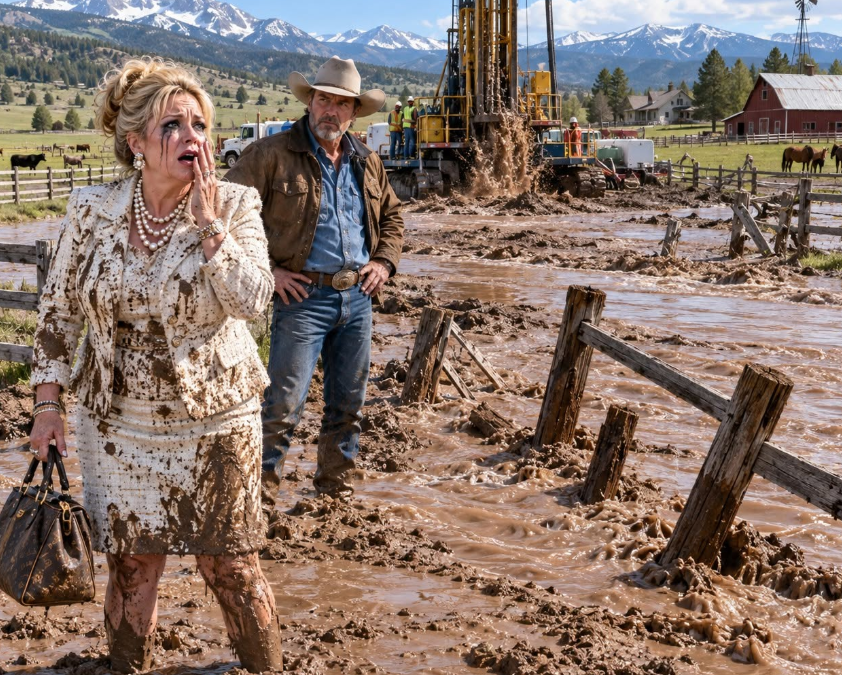
HOA President Brought a Drilling Rig Onto My Ranch—Then Hit the One Line My Grandfather Had Warned Everyone About.
The morning Margaret Whitmore brought a drilling rig onto my ranch, I thought she had finally confused HOA authority with divine ownership.
By lunch, my pasture was turning into a brown river, and the woman who had spent three months calling me a danger to the neighborhood was standing ankle-deep in mud with mascara running down her face.
What she hit underground was not just a pipe, and by the time the county trucks arrived, the real question was not who would pay for the damage—it was how many people had helped her get that far.
I had planned to spend that morning painting the west side of my old barn.
That was the full extent of my ambition.
A ladder.
A bucket of red paint.
An old brush that had survived more summers than most marriages.
And maybe a second cup of coffee if the Texas sun behaved itself.
After thirty years of fixing software disasters for companies that treated every blinking cursor like a national emergency, I had earned the right to worry about barn paint and nothing else.
At least, that was what I told myself when I moved back to my grandfather’s place.
Forty-seven acres in Hill Country.
A tired farmhouse with a porch that groaned when the weather changed.
Two pastures.
One stock pond.
A weather-beaten barn.
And a fence line that had stood in the same place since 1987.
It was not a resort.
It was not an estate.
It was not the sort of place that belonged in a glossy brochure promising elevated rural living.
It was land.
Real land.
The kind that scratched your hands, broke your back, and still gave you peace when the sun dropped behind the mesquite trees.
My name is Jake Thompson, and when this started, I was a year into what I had proudly called my quiet era.
I had sold my place in Austin, handed over my last consulting contract, packed my life into a rented truck, and come home to the only property that had ever felt like mine before my name was on the deed.
My grandfather bought the place when people still shook hands before they called lawyers.
He raised cattle, repaired tractors, and kept every receipt in coffee cans because he trusted paper more than memory.
After he died, the land bounced around the family in that sad way land sometimes does.
Everyone loved it.
Nobody had time for it.
And sooner or later, weeds start making decisions for you.
So I bought everyone out.
Not because I was rich enough to play ranch baron.
Because I could not stand the thought of somebody bulldozing that porch and calling it Phase Two.
For ninety-three days, I lived like a man who had escaped a burning building and refused to look back.
I woke before dawn.
I drank coffee on the porch.
I fixed fences.
I argued with one particular steer who had the moral compass of a career politician.
I learned the names of storms by the way they moved across the pasture.
Then Willow Creek Estates arrived along my eastern fence.
At first, it was just survey flags and construction trailers.
Then came the trucks.
Then came the stucco houses with stone accents, identical mailboxes, and lawns so chemically green they looked like they had been rendered by a computer.
PART2:
Within six months, sixty homes stood where scrub pasture had been.
Within seven months, those homes had an HOA.
Within eight months, that HOA had Margaret Whitmore.
Margaret did not become HOA president.
She ascended.
That was the only word for it.
She carried herself like the neighborhood had been waiting since the founding of the Republic for someone brave enough to regulate porch lights.
She wore tailored suits in August, carried a leather binder thick enough to stun livestock, and smiled in a way that made you check whether your wallet was still there.
Her first visit came on a Tuesday morning.
I was replacing a hinge on the barn door when her white SUV rolled up to my gate.
She got out wearing heels that had no business touching gravel and a cream-colored blazer that looked personally offended by dust.
She did not wave.
She inspected.
That was different.
She looked at my fence, my truck, my barn, the pasture, the old oak near the drive, then finally at me, as if deciding which part of my existence to correct first.
“Mr. Thompson?” she called.
“That’s me.”
She opened her binder.
“Margaret Whitmore. President of the Willow Creek Estates Homeowners Association.”
I wiped my hands on a rag.
“Congratulations.”
She paused just long enough to let me know she did not appreciate the tone, then pressed forward.
“I’m here regarding several compliance concerns.”
I looked behind her at the subdivision.
“Over there?”
“No,” she said. “Here.”
PART3:
That was the first warning sign.
I leaned one elbow on the fence.
“This ranch isn’t part of Willow Creek.”
Her smile tightened.
“We are aware of the technical boundaries.”
That sentence alone should have had thunder behind it.
Technical boundaries.
Those two words told me almost everything I needed to know about Margaret Whitmore.
To normal people, a boundary is where one property ends and another begins.
To Margaret, a boundary was merely an inconvenience waiting to be managed.
“I’m glad you’re aware,” I said. “Then we’re done.”
“We’re not done, Mr. Thompson.”
She turned a page in her binder.
“Your barn is visibly deteriorated.”
“It’s a barn.”
“The paint is faded.”
“That happens outside.”
“There are livestock odors.”
“I have livestock.”
“Your fencing does not meet Willow Creek’s visual standards.”
“My fence predates Willow Creek by thirty-six years.”
“Your stock pond may create mosquito concerns.”
“So may your decorative fountains.”
Her eyes narrowed.
“We prefer civil conversations.”
“So do I.”
“Good. Then let me be direct.”
She stepped closer to the gate.
“Your ranch sits directly adjacent to a premium residential community. The condition of your property affects homeowner enjoyment, resale confidence, and the overall image of Willow Creek Estates.”
I looked across my pasture at a steer chewing cud beside a cedar post.
“He seems worried.”
Margaret did not even glance at him.
“We are prepared to work with you.”
“That sounds expensive.”
“We’d like to establish a formal buffer agreement.”
“There it is.”
“A landscaped transition area along the shared boundary.”
“My pasture.”
“Aesthetic screening.”
“My fence line.”
“Drainage cooperation.”
“My land.”
“Mutual standards.”
“No.”
She inhaled slowly through her nose.
It was the breath of a person trying very hard not to reveal that she had never expected refusal.
“Mr. Thompson, I don’t think you understand how communities function.”
“I understand how deeds function.”
“This isn’t about deeds.”
“That’s usually what people say right before they try to ignore one.”
Her smile disappeared.
“You’re creating unnecessary tension.”
“No. You drove onto my ranch and started reading complaints out of a binder.”
“This is not only your concern.”
“It is exactly my concern.”
Her hand tightened around the binder.
“You may not be inside Willow Creek, but your property impacts Willow Creek.”
“And Willow Creek impacts my view, my road traffic, my drainage, my peace, and every Saturday morning leaf blower within half a mile. I haven’t formed a ranch association and fined your cul-de-sacs.”
She stared at me.
“You think this is funny.”
“I think it’s absurd.”
She closed the binder.
“Then we’ll proceed formally.”
“Formal is fine.”
“You’ll hear from us.”
“I hope not.”
She turned and walked back to her SUV.
Before getting in, she looked once more at the barn.
Then at the pasture.
Then at me.
It was not anger I saw in her face.
It was ownership.
Not legal ownership.
Something worse.
The kind people feel when they have decided they know what should happen to land better than the person who actually holds the deed.
The first letter arrived four days later.
WILLOW CREEK ESTATES HOMEOWNERS ASSOCIATION
NOTICE OF ADJACENT PROPERTY IMPACT
That was the heading.
Not violation.
Not demand.
Not trespass.
Impact.
It accused my ranch of creating visual disruption, odor nuisance, unmanaged runoff, inconsistent fencing, unapproved livestock visibility, and potential health concerns related to standing water.
At the bottom, Margaret requested my cooperation in implementing a boundary improvement and drainage mitigation plan.
Attached was a proposed agreement.
I read it at my kitchen table over coffee.
Then I laughed so hard I spilled half the cup.
The agreement would have granted Willow Creek access to a thirty-foot strip along my eastern fence.
It allowed landscaping, grading, drainage structures, irrigation, vegetation removal, utility work, construction access, and maintenance rights.
For ten years.
Renewable automatically.
Compensation: one dollar.
One dollar.
My grandfather used to say insult becomes comedy when people put it in writing.
I called my attorney, Denise Calloway.
Denise had handled the buyout from my relatives and helped clean up title issues before I moved back.
She was in her late fifties, practical, blunt, and allergic to nonsense.
I emailed her the agreement.
She called twenty minutes later.
“No.”
“That was quick.”
“No.”
“I haven’t said anything.”
“No.”
“So your legal analysis is no?”
“My legal analysis is no, absolutely not, and did they write this with a straight face?”
“Apparently.”
“This grants them nearly every practical right short of naming your steer treasurer.”
“He’d still do better than most boards.”
“Jake.”
“Right. Serious.”
“You are not signing anything. I’ll send a letter.”
“Strong letter?”
“Professional letter.”
“Denise.”
“Fine. Professionally strong.”
Her letter went out the next day.
It stated, calmly, that my property was not part of Willow Creek Estates, had no recorded covenants benefiting the HOA, and would not be subject to HOA rules, access rights, improvement plans, or enforcement activities.
It also warned them not to enter my property without written permission.
For about nine days, nothing happened.
Then Margaret escalated.
She began attending county meetings.
Not quietly.
She submitted public comments about “unmanaged rural parcels impacting residential development.”
She complained about stormwater risks from my pasture.
She claimed my stock pond could overflow into Willow Creek during heavy rain.
That one was impressive because Willow Creek sat uphill from me in several places and their new streets dumped more runoff toward my fence than my pasture had ever sent toward them.
Still, she spoke well.
That was the dangerous part.
A bad argument can be harmless if delivered badly.
Margaret knew how to make nonsense sound civic-minded.
She spoke of safety.
Health.
Shared responsibility.
Responsible growth.
Drainage resilience.
The future of Hill Country living.
People like Margaret rarely say, “I want control over someone else’s land.”
They say, “We need a collaborative framework.”
She also started sending residents to my gate.
Not formally.
Never on paper.
Just little visits.
A man in golf clothes asked whether I would consider screening the cattle from view.
A woman with a stroller asked if I planned to “do something” about the barn.
A retired insurance executive told me property values matter to everyone.
I asked him whether my property value mattered too.
He looked confused.
That told me a lot.
Then came the county complaints.
Loose livestock.
False.
Mosquito breeding.
Unfounded.
Illegal dumping.
A pile of fence wire I had already scheduled for disposal.
Unsafe structure.
The barn had been inspected six months earlier.
Improper drainage.
No evidence.
Every complaint generated a visit, a phone call, a letter, or a request.
Every time, I responded.
Photographs.
Records.
Inspection reports.
Survey documents.
Receipts.
Denise told me to document everything.
I did.
I had spent thirty years building software systems for companies whose entire disaster response consisted of asking why no one had backed up the thing they said was important.
Documentation was not difficult for me.
By the second month, my kitchen table had become a command center.
Three binders.
One for property records.
One for HOA communication.
One for county complaints.
Margaret underestimated me there.
I looked like a retired man with a peeling barn and dust on his boots.
She saw a rural nuisance.
What she did not see was a man who had spent three decades turning chaos into logs, timestamps, issue trails, backups, permissions, and root-cause reports.
People who manipulate process hate people who understand process.
The turning point began with a blue flag.
I found it near the eastern pasture one Monday afternoon.
Then another.
Then a line of them.
They ran along the inside of my fence, several yards onto my land.
I stood there staring.
Utility locate flags.
Blue meant water.
There were also white marks sprayed on the grass.
Proposed excavation.
I took photographs.
Then called the number printed on one flag.
A bored dispatcher answered.
“Utility locate.”
“This is Jake Thompson. I’ve got locate flags inside my pasture.”
“Address?”
I gave it.
Keys clacked.
“Yes, sir. Locate requested for subsurface boring and drainage improvement work.”
“Requested by whom?”
Pause.
“Willow Creek Estates.”
“For my pasture?”
“The work zone includes adjacent eastern boundary area.”
“That boundary belongs to me.”
Another pause.
“You’ll need to contact the requesting party.”
“I’m contacting you because your flags are on private property.”
“We only mark utilities.”
“Who authorized access?”
“Sir, the locate request indicates right-of-entry provided.”
That made me stop.
“Provided by whom?”
“I don’t have that.”
“Send me the request.”
“I can’t release that directly.”
“Then preserve it.”
“Excuse me?”
“Preserve the request, the timestamp, the submitting account, and all attachments.”
Silence.
“Sir, this is utility locate.”
“I know. Preserve it.”
I hung up and called Denise.
She listened without interrupting.
Then said, “Do not remove the flags.”
“I wasn’t going to.”
“Photograph every one.”
“Already did.”
“Do they cross into your pasture?”
“Yes.”
“How far?”
“Twenty, maybe thirty feet.”
“Any equipment?”
“Not yet.”
“Good. I’m sending a cease-and-desist today.”
Denise’s letter was not merely professional this time.
It was sharp enough to shave with.
No right of entry.
No access.
No excavation.
No grading.
No drilling.
No boring.
No installation.
No drainage work.
No personnel.
No contractors.
No surveyors.
No HOA representatives.
Nothing.
She sent it to Margaret, the HOA board, the HOA’s attorney, the developer, and the county.
Margaret replied two hours later.
One sentence.
Your client’s refusal to cooperate will be addressed through proper channels.
I read that three times.
Proper channels.
People use phrases like that when they have already found improper ones.
Two days later, a man named Brent Keller called me.
He worked in the county development office.
His voice was careful.
“Mr. Thompson, I’m calling regarding the Willow Creek drainage improvement plan.”
“There is no plan on my property.”
“Well, there appears to be a submitted right-of-entry document.”
“No, there doesn’t.”
“I’m looking at one.”
“Whose signature?”
Pause.
“Jake Thompson.”
I looked out the kitchen window at the eastern pasture.
“Send it.”
“I’m not sure I can—”
“Brent, listen carefully. If someone submitted a document bearing my signature authorizing construction access to my land, and you are now reviewing county action based on that document, I need a copy immediately.”
He exhaled.
“I’ll have to check with my supervisor.”
“You do that.”
Twenty minutes later, Denise called me.
“Brent Keller sent me something.”
“And?”
“You need to come to my office.”
The document was waiting on her conference table.
RIGHT OF ENTRY AND TEMPORARY CONSTRUCTION AUTHORIZATION.
My name was typed at the bottom.
Jake Thompson.
The signature above it was wrong.
Not terrible.
But wrong.
Too round.
Too slow.
Whoever copied it had looked at my signature but did not understand how I wrote it.
I had signed enough contracts in my life to know my own hand.
“That is not mine,” I said.
“I know.”
“How?”
“You sign like someone in a hurry who distrusts paperwork.”
“Accurate.”
Denise slid another page toward me.
The document granted Willow Creek Estates and its contractors access to perform drainage testing, borings, utility investigation, grading, and any necessary related improvements along my eastern boundary.
“Any necessary related improvements,” I said.
“Broad.”
“Dangerously broad.”
“Yes.”
I looked at the date.
Three weeks earlier.
The same week Margaret had received Denise’s first letter.
The notary stamp belonged to someone named Claudia Mercer.
“Who is she?”
Denise had already looked.
“Administrative assistant for Whitmore Residential Management.”
“Margaret’s company?”
“Her husband’s company. They manage several HOAs.”
I stared at the paper.
“She forged my signature.”
“Maybe.”
“Denise.”
“She may have caused it to be forged. We need proof.”
I pointed at the document.
“This is proof.”
“It is evidence. Proof is what survives court.”
I hated when attorneys were right.
“What now?”
“We notify the county that authorization is disputed and demand all work stop.”
“Already no work allowed.”
“Now doubly no work.”
She leaned forward.
“Jake, if they attempt access after this, call law enforcement immediately.”
“I will.”
She paused.
“No heroics.”
“I’m retired from software, not common sense.”
“That is not the reassurance you think it is.”
For five days, nothing happened.
The flags stayed in the pasture.
The grass moved around them.
The cattle ignored them.
I began to think the threat had worked.
Then came the drilling rig.
It was 7:18 in the morning.
I remember because I had just poured my second cup of coffee.
I had the barn paint staged, the ladder leaning against the west wall, and my dog Rufus lying in the shade pretending he had contributed to the morning’s labor.
Then I heard a diesel engine.
Not a pickup.
Heavier.
I stepped out from behind the barn and saw a rig moving along the fence line from the Willow Creek side.
A small drilling rig.
Two work trucks.
A skid steer.
Three men in high-visibility vests.
And Margaret Whitmore walking beside them with a rolled plan set under one arm.
For a moment, my brain refused to accept the image.
It was so brazen that it seemed unreal.
They had opened a section of my eastern gate.
My gate.
The old service gate my grandfather used when moving cattle between leased pasture decades earlier.
They had cut the chain.
Not broken it accidentally.
Cut it clean with bolt cutters.
The chain lay in the grass like evidence that had already given up trying to be subtle.
I set the coffee down on a fence post.
“Rufus,” I said.
The dog lifted his head.
“Stay.”
For once in his life, he listened.
I walked toward the rig.
Margaret saw me coming.
She did not look surprised.
That was what scared me most.
A person caught doing something wrong reacts.
Margaret looked like she had expected this scene and rehearsed her expression.
“Mr. Thompson,” she called. “Good morning.”
I stopped ten feet away from her.
“You cut my chain.”
“We accessed through the designated service gate.”
“My locked gate.”
“We have authorization.”
“No, you don’t.”
She unrolled the plans.
“I’m not having this argument in the field.”
“You are trespassing.”
She glanced at the contractor.
“Proceed.”
The rig operator looked at me.
Then at her.
Smart man.
He hesitated.
I pointed at him.
“If you drill one inch into my pasture, you are doing it after being personally told the landowner objects.”
Margaret’s smile hardened.
“Mr. Thompson is attempting to obstruct authorized drainage testing.”
“I’m attempting to stop trespass.”
She raised her voice, performing now for the workers.
“Willow Creek Estates has obtained proper right of entry and county acknowledgment for mitigation work related to stormwater concerns affecting sixty families.”
“Show me the original authorization.”
“You’ve seen it.”
“I saw a forged signature.”
One of the workers looked up.
Margaret’s head snapped toward him.
“Continue.”
The rig operator cleared his throat.
“Ma’am, I’m not comfortable—”
“Our attorney has reviewed it,” she said.
“I still need—”
“We are paying your company to perform contracted work.”
That sentence did what pressure often does.
It moved responsibility from conscience to invoice.
The operator looked away.
The rig engine revved.
I pulled out my phone and started recording.
“This is Jake Thompson at Thompson Ranch. It is 7:24 a.m. Margaret Whitmore, president of Willow Creek Estates HOA, is on my property with contractors and a drilling rig after written notice denying access. They cut my chain and entered through my service gate. I am instructing them to stop.”
Margaret walked toward me.
“Turn that off.”
“No.”
“You do not have consent to record me.”
“You’re standing in my pasture.”
“You are escalating.”
“You brought a drilling rig.”
She looked at the phone.
“You are going to regret this.”
“No, Margaret. I think one of us is.”
She turned away and gave the contractor a small nod.
The rig moved into position near the blue flags.
I called 911.
Then Denise.
Then the county sheriff’s nonemergency line because I wanted the duplicate log.
Then the water district number printed on an old metal utility marker near the road.
That last call mattered more than I knew at the time.
While I was on the phone, the rig started drilling.
The sound was ugly.
Metal into earth.
Rotary grind.
Hydraulic pressure.
Men shouting over the engine.
My pasture, which had endured drought, cattle, cedar roots, hail, and one tornado warning that removed part of the barn roof in 2004, now had a drilling rig punching into it because an HOA president thought proper channels meant forged paperwork and cut chains.
I kept filming.
Margaret stood with her arms crossed.
The first deputy arrived twelve minutes later.
Deputy Luis Ramos.
Forties.
Calm eyes.
Hat low.
He stepped out of the cruiser, looked at the cut chain, the rig, the open gate, me filming, Margaret holding plans, and the workers pretending not to notice.
He walked to me first.
“Mr. Thompson?”
“Yes.”
“You called?”
“Yes.”
“Is this your property?”
“Yes.”
Margaret cut in.
“We have authorization.”
Ramos held up one hand without looking at her.
That tiny gesture offended her more than if he had shouted.
He asked me, “Do you have ID?”
I showed him.
Then I handed him the deed summary, survey, and Denise’s cease-and-desist letter from the folder I had started carrying in my truck.
He read quickly.
Then looked at Margaret.
“Ma’am, who are you?”
“Margaret Whitmore. President of Willow Creek Estates HOA.”
“This land part of your HOA?”
“It is adjacent and subject to drainage impact agreements.”
“That wasn’t my question.”
Her face tightened.
“It is not within the platted subdivision.”
“So no.”
“This work is authorized.”
“By whom?”
She handed him a copy of the right-of-entry document.
He read it.
Then looked at me.
“This your signature?”
“No.”
“He claims that now,” Margaret said.
Ramos looked back at her.
“Now?”
“He’s been obstructive for months.”
I almost laughed.
Ramos did not.
He walked toward the rig.
“Shut it down.”
The operator killed the engine immediately.
Silence fell hard.
Then, from underground, came a sound I will never forget.
A deep metallic thump.
Not loud.
Heavy.
Like something huge shifting beneath the earth.
The rig operator turned.
“What was that?”
The ground near the bit pulsed.
Once.
Then again.
A crack opened in the mud around the hole.
Water surged upward.
At first, it looked like a fountain.
Then the fountain became a geyser.
Brown water exploded out of the borehole with enough force to knock one worker backward into the grass.
The rig operator shouted.
Someone cursed.
Deputy Ramos grabbed Margaret by the arm and pulled her back as muddy water shot across the pasture.
Within seconds, the hole widened.
The ground trembled.
A buried line had ruptured.
Not a little irrigation pipe.
Not an old ranch supply line.
Something big.
Something pressurized.
Water roared out of the ground and began spreading across the pasture in a fast, muddy sheet.
The drilling rig tilted.
One wheel sank.
The skid steer backed up too quickly and slid sideways.
My fence posts along the eastern line began leaning as the soil liquefied beneath them.
I stood there recording with one hand and calling the water district again with the other.
Margaret shouted over the roar.
“What is that?”
I turned to her.
“That is the question you should have asked before drilling.”
Her cream blazer was already splattered with mud.
Mascara had started running beneath one eye.
For the first time since I met her, Margaret Whitmore looked genuinely afraid.
Ramos yelled into his radio.
“Need county utilities and emergency public works at Thompson Ranch. Major water line rupture, active flooding, drilling incident, possible unauthorized excavation.”
The rig operator stumbled toward us.
“We marked utilities.”
I pointed at the blue flags.
“You marked them because someone called it in.”
He shook his head.
“No, I mean—this wasn’t supposed to be here.”
I looked toward Margaret.
She said nothing.
The water kept coming.
By the time the first county truck arrived, my pasture had become a brown river.
By the time the second arrived, the eastern fence line was folding into the mud.
By the time the third arrived, Margaret was standing ankle-deep in water, holding ruined plans against her chest like they might still save her.
The man who climbed out of the lead county truck was built like an oak stump and moved like he had been angry since birth.
His name was Hank Alvarez.
Superintendent of the Cedar Basin Water District.
He wore a hard hat, mud boots, and the expression of a man arriving at the scene of a preventable disaster.
He looked at the geyser.
Then at the rig.
Then at the blue flags.
Then at me.
“You Thompson?”
“Yes.”
“You call the district?”
“Yes.”
“Good.”
He turned toward his crew.
“Shutoff valves. East main. Now. Bring me the old map book.”
Then he pointed at the rig operator.
“You drill that hole?”
The operator swallowed.
“Yes, sir.”
“You had clearance from my office?”
“We had utility locate.”
“That’s not what I asked.”
Margaret stepped forward.
“We had county acknowledgment.”
Hank turned toward her.
“Who are you?”
“Margaret Whitmore. Willow Creek Estates HOA president.”
“Did you order drilling over my transmission line?”
“I ordered drainage testing based on approved plans.”
Hank stared at her for a full three seconds.
Then he looked at Ramos.
“Deputy, please keep this woman away from my crews before I say something professionally unfortunate.”
Ramos almost smiled.
Almost.
Crews moved fast.
Valves.
Radios.
Maps.
Shovels.
Pumps.
The water finally began slowing eighteen minutes later.
By then, half my eastern pasture was flooded.
Fence posts leaned.
The service gate hung crooked.
Mud covered the rig up to the rims.
The borehole had widened into a crater that swallowed the drill bit assembly.
Hank walked back carrying a laminated map.
He spread it across the hood of his truck.
“This,” he said, tapping the paper, “is a thirty-inch county water transmission main.”
Margaret went still.
“Thirty-inch?” Ramos asked.
Hank nodded.
“Primary feed from the north treatment plant to the south pressure zone.”
I stared at the map.
I knew about an easement.
My grandfather had mentioned water district access more than once when I was younger.
But I had never seen the line exposed.
I had never truly understood the scale.
Hank continued.
“Installed in 1987. Recorded easement across Thompson property. Clearly marked in district records. No excavation, boring, drilling, trenching, grading, or heavy equipment within the easement without district clearance.”
He looked at the rig.
“You hit it with a drilling rig.”
The operator turned pale.
Margaret recovered enough to speak.
“We submitted proper documents.”
Hank looked at her.
“To whom?”
“The county development office.”
“Development office doesn’t own my main.”
“We were told utilities were cleared.”
“By whom?”
She did not answer quickly enough.
Hank noticed.
So did I.
So did Ramos.
A fourth truck arrived.
Then a fifth.
County public works.
Environmental services.
Another deputy.
A representative from the development office.
Brent Keller.
The man who had sent Denise the forged right-of-entry document.
He stepped out of his county vehicle and stopped dead when he saw the mud, the rig, the water district trucks, Margaret, and me.
His face said he had expected a disagreement.
Not a disaster.
Hank spotted him.
“Keller.”
Brent swallowed.
“Hank.”
“You authorize work over my main?”
“I acknowledged a drainage testing submittal.”
“You authorize work over my main?”
“No. Not directly.”
“Indirectly?”
Brent looked at Margaret.
She looked away.
That was when my quiet morning officially became something larger.
Denise arrived twenty-five minutes later wearing office clothes and rubber boots that did not match anything else about her.
She got out of her car, looked at the flooding, and said exactly one word.
“Wonderful.”
I stared.
“Wonderful?”
“For evidence.”
“You are a terrifying person.”
“I know.”
She walked straight to Deputy Ramos.
“I represent Mr. Thompson. No one removes equipment, documents, field plans, vehicles, digital devices, or contractor records from this site without preservation notice.”
Margaret snapped, “You cannot order that.”
Denise turned.
“I wasn’t speaking to you.”
Margaret looked like someone had slapped her.
Denise faced Ramos again.
“There is an active disputed authorization document bearing my client’s forged signature. My office notified the county and the HOA in writing. They proceeded anyway.”
Ramos looked at Brent.
“You were notified?”
Brent hesitated.
Denise opened her folder.
“I have delivery confirmation.”
Brent rubbed his forehead.
“It was under review.”
Hank barked, “You reviewed it with a drill bit?”
No one answered.
The environmental services woman took photographs of muddy water flowing toward the stock pond.
A public works supervisor measured the washout.
The drilling contractor called his boss.
Margaret called someone named Victor.
I only knew because she said the name three times before walking far enough away that I could not hear the rest.
Denise noticed.
“Who is Victor?”
“Don’t know.”
“Find out.”
“I’m not an investigator.”
“No, but people keep confessing around you.”
Fair.
The answer came from the contractor.
His company was HillStar Geotechnical.
They had been hired by a development consulting firm called Voss Land Strategies.
Voss had been retained by Willow Creek Estates.
Voss’s principal consultant was Victor Voss.
Denise’s eyes lit up in the worst possible way.
“Voss.”
“You know him?”
“I know of him.”
“What does that mean?”
“It means he appears near projects where neighbors suddenly discover their land is ‘needed’ for drainage.”
That sounded bad.
It got worse.
Hank’s crew eventually exposed the damaged section.
The drill had punched into the top of the transmission main, cracked the casing, and compromised a joint.
Repair would not be simple.
They had to isolate a section of line, pump out water, excavate safely, bring replacement pipe, inspect downstream contamination risk, and stabilize the surrounding soil.
Hank estimated the direct water district damage before lunch.
“Quarter million minimum.”
Margaret made a sound.
Hank looked at her.
“That’s before pasture restoration, fencing, environmental mitigation, emergency labor, service interruption, contractor liability, and whatever Mr. Thompson’s attorney does to you.”
Denise said, “I’m standing right here.”
“I noticed.”
Margaret stepped toward Hank.
“This was an accident.”
He pointed at the cut chain.
“That was not.”
She looked at Ramos.
“I did not personally cut the chain.”
Ramos asked, “Who did?”
She hesitated.
One of the workers pointed toward a man in a gray shirt near the second truck.
“He did. She told him the owner signed off.”
The man in gray lifted both hands.
“I was told it was authorized access.”
Ramos wrote that down.
Margaret’s voice sharpened.
“This is becoming a witch hunt.”
“No,” Denise said. “This is becoming a record.”
That was exactly what Margaret feared.
By afternoon, the county had shut down the site.
The drilling rig was immobilized.
The contractor’s vehicles were logged.
The forged right-of-entry document was entered into the sheriff’s report.
The water district issued an emergency damage notice.
The county development office placed all Willow Creek drainage approvals under review.
And Margaret Whitmore, who had arrived that morning ready to impose order on my ranch, stood in the mud while officials asked who had given her the authority to be there.
She did not have a good answer.
She had several bad ones.
The first was the forged document.
The second was the county acknowledgment.
The third was an engineering memo.
The fourth was a board resolution from Willow Creek Estates.
Denise got copies of all of them within a week.
That was when the real story emerged.
Willow Creek had a drainage problem.
Not because of my ranch.
Because of their development.
The subdivision’s original stormwater plan had underestimated runoff during heavy storms.
Water from streets, rooftops, and chemically perfect lawns collected faster than expected along the eastern drainage channel.
The proper fix would have required expensive redesign inside Willow Creek.
New retention capacity.
Regrading.
Possibly losing several premium lots reserved for Phase Two.
Nobody wanted that.
So someone came up with another solution.
Move the water east.
Onto me.
Not openly.
Not with a purchase offer.
Not with a negotiated easement.
Instead, they built a paper trail.
First came complaints that my ranch was unmanaged.
Then claims that my stock pond created downstream risk.
Then meeting minutes discussing “shared drainage mitigation.”
Then Margaret’s public comments about rural parcels impacting residential communities.
Then the forged right-of-entry.
Then the drilling.
The plan was not merely to test soil.
The boring locations matched a proposed drainage channel route.
A route that would have cut through my pasture, crossed the old water easement, and tied into a seasonal creek beyond my south fence.
They were trying to turn my ranch into Willow Creek’s overflow valve.
For one dollar.
Victor Voss’s emails made that clear.
We did not get them voluntarily.
We got them after the county opened an investigation and Denise filed suit.
The lawsuit named Willow Creek Estates HOA, Margaret Whitmore, Voss Land Strategies, HillStar Geotechnical, Whitmore Residential Management, and several unknown parties.
Claims included trespass, property damage, negligence, civil conspiracy, slander of title, fraud, and interference with property rights.
The water district filed separately.
Their complaint was shorter and much angrier.
Hank Alvarez’s deposition later became neighborhood legend.
The opposing attorney asked whether the water main was clearly documented.
Hank said, “It has been on county maps since 1987.”
The attorney asked whether an average person would know not to drill there.
Hank said, “An average person would not bring a drilling rig onto land they do not own.”
The attorney asked whether damage could have been avoided.
Hank said, “Yes. By not doing every single thing they did.”
I liked Hank.
The emails were worse than I expected.
Margaret had written to Victor Voss two months before the drilling.
Jake Thompson will not cooperate voluntarily. We need an alternative path.
Victor replied:
If county sees this as stormwater risk mitigation, we may not need his active cooperation for preliminary testing.
Margaret:
His attorney sent a no-access letter.
Victor:
Then we need documentation showing access was resolved.
Margaret:
I’ll handle the HOA side.
Victor:
Need right-of-entry before field work.
Margaret:
Understood.
That email alone did not prove forgery.
But it pointed in the right direction.
The forged right-of-entry had been notarized by Claudia Mercer, administrative assistant at Whitmore Residential Management.
Claudia folded in eleven minutes once deputies interviewed her.
She had notarized the document without seeing me sign.
Margaret had told her I had signed separately and that formalities could be corrected later.
Claudia knew it was wrong.
She did it anyway.
Why?
Because Margaret was her boss.
People underestimate how much damage can be done by employees who know better but are afraid to say no.
Then came the signature source.
My signature had been copied from a delivery acknowledgment I signed months earlier when Willow Creek sent its first boundary proposal.
They had used that signature, traced it badly, and placed it onto the right-of-entry form.
Not brilliant.
Not even especially competent.
But for a few weeks, it had worked well enough to get a rig into my pasture.
That should scare people more than sophisticated fraud.
Most damage is not done by criminal masterminds.
It is done by confident amateurs who believe process exists for other people.
Margaret tried to separate herself from the forgery.
She claimed Victor handled documentation.
Victor claimed Margaret provided landowner authorization.
Claudia claimed Margaret instructed her to notarize.
Brent Keller claimed the county only acknowledged receipt and did not approve work.
HillStar claimed it relied on client representations and utility locate.
Everyone pointed at someone else.
Denise called it the circle of sudden innocence.
Meanwhile, my ranch looked like a battlefield.
The eastern pasture took weeks to dry.
The water district repair left an excavated scar across the easement.
Three hundred feet of fencing had to be replaced.
The service gate was rebuilt.
Soil had to be stabilized.
The stock pond had to be tested.
The barn did not get painted that summer.
I found that personally offensive.
Willow Creek residents began showing up at my gate too.
At first, I expected hostility.
Some came angry.
Not at me.
At Margaret.
A man named Aaron Bell told me his backyard had flooded twice because the HOA kept insisting drainage fixes were underway.
A woman named Priya Shah said her husband had questioned the stormwater plan and been removed from the landscape committee.
A retired engineer named George Rennick brought me a thumb drive.
“Margaret likes controlling meeting minutes,” he said.
That thumb drive had audio from two HOA meetings.
On one recording, Margaret told residents that cooperation had been obtained from the adjacent ranch owner.
A board member asked, “Thompson signed?”
Margaret answered, “We have the required documentation.”
Not yes.
Required documentation.
Careful words.
On another recording, Victor Voss told the board that rerouting drainage through the Thompson boundary corridor was the most efficient solution.
A resident asked whether that meant an easement.
Victor replied, “The legal access component is being handled.”
Again, careful words.
People who know they are standing on thin ice learn to step lightly.
But recordings preserve footsteps.
The county investigation widened.
Brent Keller did not forge anything.
But he had pushed the acknowledgment through despite Denise’s objection letter sitting in the file.
Why?
Because Victor Voss had emailed him directly.
We have political pressure on this one. Need field testing cleared before rain season.
Brent replied:
Owner dispute noted, but if HOA provides right-of-entry, we can proceed with acknowledgment.
He later said he meant only administrative acknowledgment, not authorization to enter.
Maybe.
Maybe not.
Either way, he resigned before the county board hearing.
Victor Voss lost his county consulting eligibility.
HillStar settled early.
They paid for part of the damage and turned over every communication they had.
Their owner apologized in person.
I respected that.
He said, “We should have stopped when you objected.”
“Yes,” I said.
There was nothing else to add.
Willow Creek Estates held an emergency meeting six weeks after the drilling incident.
I did not attend.
I had no desire to sit inside their clubhouse while residents argued about the disaster Margaret created.
But Denise went.
So did Hank.
Hank did not need to be there.
He said he wanted to see what kind of people thought drilling into a transmission main was community planning.
Denise texted me from the meeting.
Packed room.
Then:
Margaret still acting confident.
Then:
Not going well for her.
Then:
Hank just said “your HOA tried to turn Mr. Thompson’s ranch into a storm drain and hit my water main doing it.”
Then:
Applause.
I saved that message.
Margaret tried to speak for forty minutes.
She blamed me for refusing reasonable cooperation.
She blamed the contractor for improper drilling.
She blamed the county for unclear maps.
She blamed the water district for insufficient markers.
She blamed “anti-growth sentiment.”
Then Priya Shah stood and asked one question.
“Did Jake Thompson sign the right-of-entry document?”
Margaret said, “We relied on professional documentation.”
Priya repeated, “Did he sign it?”
Margaret said, “That is under review.”
That answer removed her.
Not legally.
Socially.
The residents knew.
The board voted to suspend her authority that night.
Three days later, she resigned.
Two weeks after that, Whitmore Residential Management lost the Willow Creek contract.
Her husband filed a statement saying the company had not authorized improper notarization and would cooperate fully.
I wondered how dinner went in that house.
The civil case took nearly a year to resolve.
Insurance companies fought.
Lawyers argued.
Experts wrote reports thick enough to stop bullets.
The final settlement covered my property damage, pasture restoration, legal fees, lost use, fence replacement, gate reconstruction, soil stabilization, stock pond testing, and a permanent recorded no-access acknowledgment from Willow Creek Estates.
No HOA representative, contractor, consultant, landscaper, surveyor, engineer, manager, committee member, drainage specialist, or “community improvement partner” could enter my property without written permission from me or a future owner.
That language was Denise’s masterpiece.
She made them list nearly every title Margaret had used to disguise trespass.
The water district recovered its repair costs separately.
Large number.
Not my number to share.
But Hank smiled the next time I saw him, so I assume it had commas.
Margaret faced charges tied to the forged document and unlawful access.
She did not go to prison.
Stories like this do not always end with people in jumpsuits.
She pleaded to lesser counts, paid fines, received probation, lost notary-related privileges through her company, and became radioactive in HOA management circles.
Victor Voss settled with the county and surrendered several professional registrations.
Claudia Mercer kept her job somewhere else after cooperating, though I heard she never worked near notarized documents again.
Brent Keller moved to private permitting consulting in another county.
I hope he reads objection letters now.
The eastern pasture healed slowly.
Grass returned in patches.
The water district installed new surface markers along the easement.
Blue posts.
Reflective caps.
Clear warnings.
NO EXCAVATION WITHOUT WATER DISTRICT AUTHORIZATION.
Hank asked where I wanted them.
I told him to make them impossible to ignore.
He did.
They looked ugly.
I loved them.
Willow Creek built its proper drainage fix inside its own boundaries.
It cost a fortune.
They lost two premium lots.
Residents complained until the first heavy storm came.
Their streets drained correctly.
My pasture stayed dry.
Amazing what happens when people solve their own problem on their own land.
The barn finally got painted the next spring.
I made a ceremony of it.
Not public.
Just me, Rufus, a ladder, the same old brush, and a fresh bucket of red paint.
The west side took all morning.
The south side took another day.
The east side took longest because every time I looked that direction, I saw the line where the pasture had split open and water had roared out because Margaret Whitmore believed my refusal was just an obstacle to route around.
When I finished, I sat on the porch with coffee.
The barn glowed red in the late sun.
The new fence stood straight.
The service gate had a heavier chain.
Not because chains stop everyone.
They clearly do not.
But because symbols matter.
Beside the gate, I installed a sign.
PRIVATE RANCH
NO HOA AUTHORITY
NO ACCESS WITHOUT WRITTEN PERMISSION
RECORDED WATER MAIN EASEMENT
CALL BEFORE YOU DIG
Denise saw it and said it was too wordy.
I said it was legally educational.
She said that was not a compliment.
I kept the sign.
A few Willow Creek residents became friends.
Not close friends.
Fence-line friends.
The kind who wave.
The kind who call if they see something strange.
Aaron Bell brought over peaches once as an apology for believing Margaret.
Priya Shah asked if her son could see the cattle.
George Rennick helped me rebuild a stretch of fence after a windstorm because he missed working with his hands.
Communities are not boards.
That was something I had to relearn.
Margaret was loud enough to make Willow Creek feel like one person.
It was not.
It was families, retirees, kids on bikes, people with mortgages, people who wanted quiet evenings, people who trusted the wrong leader because challenging confidence takes energy most people do not have after work.
That does not excuse what happened.
But it explains why it went as far as it did.
Margaret’s power came from presenting herself as the only adult in the room.
The person who understood rules.
The person who handled problems.
The person who knew which forms mattered and which objections could be ignored.
People like that become dangerous when everyone else gets tired.
My grandfather understood that better than I did.
Months after settlement, I found another coffee can in the barn loft.
I thought I had opened them all.
This one had rust around the lid and a strip of old masking tape across the side.
WATER LINE / 1987.
Inside were receipts, letters, survey notes, photographs, easement documents, and a folded hand-drawn map.
My grandfather had marked the transmission main in blue pencil.
Beside it, in his blocky handwriting, he had written:
NEVER TRUST ANYONE WHO SAYS A LINE ON PAPER DOESN’T MATTER.
I sat on the barn floor for a long time holding that map.
The man had been dead for years.
Still right.
That sentence became the real ending for me.
Margaret thought boundaries were technical.
Victor thought access was a documentation problem.
Brent thought objection could be noted and bypassed.
Claudia thought notarization was a favor for her boss.
The contractor thought client paperwork was enough.
Every one of them treated a line on paper as flexible.
A fence line.
An easement line.
A signature line.
A property line.
A utility line.
Then the ground opened and reminded everyone that some lines are real whether you respect them or not.
The water main did not care about Margaret’s binder.
It did not care about Willow Creek property values.
It did not care about “elevated rural living.”
It did not care that the forged document had a notary stamp.
It was exactly where the old maps said it was.
Buried.
Pressurized.
Waiting.
Truth is like that sometimes.
Quiet until someone drills into it.
People later asked whether I felt vindicated.
Sometimes.
But mostly I felt tired.
Watching your land torn open is not satisfying just because the other person gets embarrassed.
Yes, Margaret looked ridiculous standing in the mud.
Yes, her authority collapsed.
Yes, the records proved what I had said from the beginning.
But my fence still fell.
My pasture still flooded.
My summer still disappeared into repair crews and lawyers.
Being right does not prevent damage.
That is why boundaries matter before they are violated.
That is why signatures matter before they are forged.
That is why process matters before the drilling starts.
The best conflict is the one stopped at the gate.
Margaret did not stop.
So everything after that became expensive.
For her.
For Willow Creek.
For the county.
For the water district.
For me.
All because one woman looked across a fence and decided my land would be more useful if she controlled it.
One year after the rupture, Hank Alvarez stopped by.
He claimed he was checking markers.
He was actually checking the pie cooling on my kitchen counter because Denise had mentioned it during a phone call.
I gave him coffee.
He stood near the fence afterward, looking at the repaired pasture.
“Held up good,” he said.
“Pasture?”
“Main.”
“That too.”
He looked at the blue marker posts.
“People notice them now.”
“That was the idea.”
He smiled.
“Got a call last week. Willow Creek landscaping crew wanted to plant trees near the easement. Asked before digging.”
“Progress.”
“Fear is educational.”
I laughed.
Then he pointed toward my sign.
“No HOA authority?”
“Too subtle?”
“Needs lights.”
“I’ll consider it.”
He turned serious.
“You know they could’ve killed someone.”
“I know.”
“If that rig had shifted wrong, if the ground collapsed faster, if pressure had broken differently—”
“I know.”
We stood quietly.
The story gets funny in retelling because Margaret ended up covered in mud.
Because the HOA president looked foolish.
Because the drilling rig sank.
Because people like clean consequences.
But Hank was right.
It could have been worse.
Much worse.
That is the part I do not joke about.
Unauthorized digging is not paperwork drama.
It is danger.
People underground trust people aboveground to read maps.
Water lines.
Gas lines.
Fiber.
Sewer.
Electrical.
Drainage.
Each buried line is a promise that someone, somewhere, documented the truth and someone else will respect it before cutting into the earth.
Margaret broke that chain of trust.
The mud was only the visible part.
The following summer, Willow Creek elected a new HOA president.
A man named Daniel Price.
He came to my gate wearing jeans, boots, and the nervous expression of someone approaching a dog that had bitten before.
He did not bring a binder.
Good start.
“Mr. Thompson?”
“Jake.”
“Daniel Price. New Willow Creek HOA president.”
“I heard.”
“I wanted to introduce myself.”
“Okay.”
He glanced at the sign.
“No HOA authority.”
“Educational.”
“Clear.”
He took off his hat.
“I also wanted to apologize.”
“You personally?”
“No. I wasn’t on the board then.”
“Then why are you apologizing?”
“Because the association never did it properly.”
That made me listen.
He continued.
“What happened here was wrong. We can’t undo it, but we’ve changed our procedures. No adjacent landowner contact without board approval. No consultant access without counsel review. No work near shared boundaries without written verification from the landowner and county. Meeting minutes posted. Drainage records public.”
“Sounds expensive.”
“It was.”
“Good.”
He nodded.
“I understand.”
For a moment, neither of us spoke.
Then he said, “We’d like to be better neighbors.”
I looked past him at Willow Creek.
Stucco houses.
Stone accents.
Green lawns.
A place I had resented mostly because Margaret had made it feel like an invading army.
But Daniel was not Margaret.
And land remembers damage, but people do not have to become damage.
“Start by staying on your side of the fence,” I said.
He smiled.
“That seems reasonable.”
“It is amazing how many people struggle with it.”
He laughed once.
Then became serious again.
“You’ll call me if any resident crosses?”
“Yes.”
“I’ll call you if we see anything near your fence.”
“Good.”
He put his hat back on.
Then hesitated.
“One more thing.”
“What?”
“My daughter loves cattle.”
I looked toward the pasture.
The steer with the politician’s morals stood near the pond, chewing like he owned public office.
“That one bites emotionally.”
Daniel blinked.
“What does that mean?”
“You’ll find out.”
Two weeks later, Daniel brought his daughter to see the cattle.
She was six.
She asked if cows had best friends.
I said yes because I had no evidence against it.
She asked if the barn was red because cows liked red.
I said no.
She looked disappointed, so I said maybe.
That seemed to satisfy her.
Rufus followed them along the fence like a deputy supervising visitors.
The steer behaved.
Mostly.
It was the first normal interaction I had with someone from Willow Creek.
Normal felt strange.
Then welcome.
Life moved on.
The pasture grew back thicker where the mud had been.
The barn paint faded slightly by the second summer, which barns are supposed to do.
The stock pond stayed healthy.
The blue utility markers remained ugly and beautiful.
Margaret Whitmore became a story people told in quieter voices.
Eventually, new Willow Creek residents did not know all the details.
They only knew not to cross Thompson Ranch.
That was enough.
Sometimes I still think about her standing in that mud.
Not with triumph.
With warning.
She had built an identity around authority.
President.
Manager.
Decision-maker.
Protector of standards.
But authority without limits becomes delusion.
She thought a binder could turn my ranch into her project.
She thought a forged signature could become consent.
She thought county acknowledgment could become ownership.
She thought drainage language could hide trespass.
She thought my fence was only a technical boundary.
Then she hit a line underground that did not bend for her.
That is what I remember.
Not the mascara.
Not the ruined blazer.
Not the panic.
The line.
Buried in 1987.
Mapped.
Recorded.
Warned.
Ignored.
Still there.
My grandfather had trusted paper more than memory.
Margaret trusted confidence more than paper.
That was the difference between us.
I still keep the coffee can in my office.
The one labeled WATER LINE / 1987.
Not because I need the documents anymore.
They have been scanned, copied, filed, backed up, and placed in enough legal archives to survive a house fire, a server crash, and probably a minor apocalypse.
I keep the can because it reminds me of what land ownership really is.
Not just possession.
Not just a deed in a drawer.
It is attention.
Knowing where the fence stands.
Knowing what is buried.
Knowing what was signed.
Knowing what was refused.
Knowing when someone says “technical boundary” that they are already planning to cross it.
A year after everything ended, I finally had the quiet morning I had wanted.
Coffee on the porch.
Rufus snoring.
Barn glowing red.
Pasture dry.
Fence straight.
No drilling rigs.
No white SUV.
No cream blazer.
No binder.
Just wind moving through mesquite and a steer plotting something near the stock pond.
I walked to the eastern fence with my coffee.
The blue marker posts caught the morning light.
Beyond them, Willow Creek sprinklers clicked on in tidy little rhythms.
For once, the sound did not irritate me.
It stayed where it belonged.
On their side.
I looked down the fence line my grandfather built and thought about that sentence from his map.
Never trust anyone who says a line on paper doesn’t matter.
He was right.
A line on paper can be a fence.
A warning.
A promise.
A boundary.
A water main.
A signature.
A truth.
And if someone ignores it long enough, sooner or later, the ground opens up and shows everyone exactly where the line was all along.








