HOA Paved Over My $70K Private Road Overnight—So I Made 38 Cars Vanish From It
HOA Paved Over My $70K Private Road Overnight—So I Made 38 Cars Vanish From It
The road was gone before my coffee even cooled.
For twenty-two years, that gravel lane had carried every piece of my life down the ridge to my front door.
Then the HOA paved it overnight, billed me for the theft, and learned that asphalt does not turn private land into public property.
The road was gone before my coffee even cooled.
For twenty-two years, I had walked onto that porch every morning with the same routine.
Black coffee in my right hand.
Mechanical pencil behind my ear.
Logbook open on the little cedar table beside the rocking chair.
Fog lifting off the ridge.
Creek murmuring somewhere below the tree line.
My gravel road stretching down the slope toward my house, pale gray and familiar, carrying every truckload of lumber, every propane delivery, every ambulance that had ever come for my late wife, every guest who had ever found my place by following my directions carefully because GPS usually gave up halfway down the hill.
That road was part of my life.
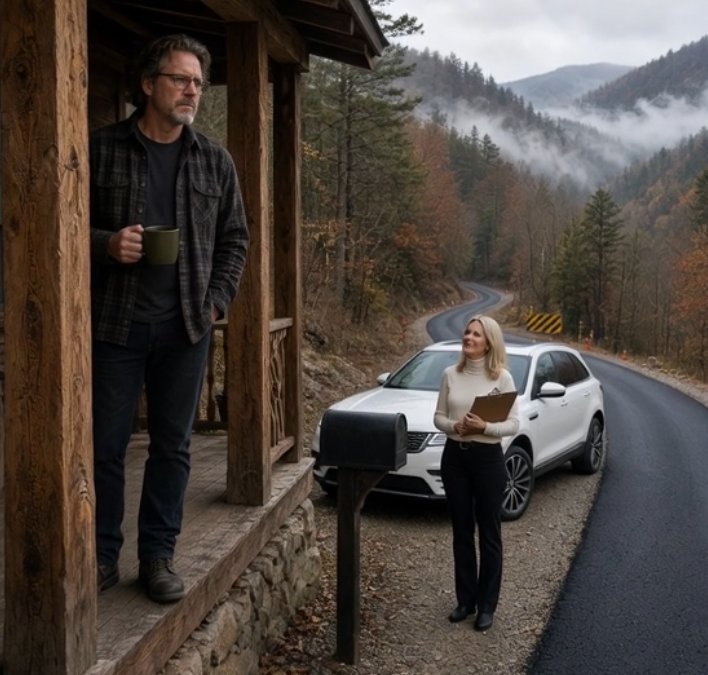
Then one Tuesday morning in late October, I stepped outside and found it paved.
Not patched.
Not graded.
Paved.
Edge to edge.
Jet-black asphalt still smelling sharp and hot in the cold mountain air.
Orange cones stood along the shoulder like little warning flags after the crime had already happened. A new speed bump had been installed near the far end, yellow stripes painted across it as if the person who ordered it wanted the world to admire the audacity.
A laminated note was clipped to my mailbox.
Road improvement complete. Assessment fees begin January 1.
I was still holding the note when Sandra Pruitt’s white Lexus turned into my driveway.
She parked like she had practiced the entrance.
Smooth.
Confident.
Just far enough from the fresh asphalt to keep her tires clean.
She stepped out wearing a cream sweater, dark slacks, and the smile of a woman who had already decided how the conversation would end.
“Dale,” she said brightly, clipboard in hand, “I hope you’re pleased with how it turned out.”
I looked at her.
Then at the road.
Then at the coffee in my hand.
The steam had stopped rising.
“Sandra,” I said, “you paved my private road.”
Her smile did not move, but something behind it tightened.
“The board voted to improve a community access lane.”
“No,” I said. “You paved my private road.”
She glanced at her clipboard as if paper could change land.
“We have legal review confirming HOA jurisdiction.”
I took one slow sip of cold coffee.
People often mistake quiet for uncertainty.
That morning, Sandra made that mistake.
A few weeks later, thirty-eight cars disappeared from that road.
Every single one had driven past a posted notice.
Every single one had ignored a boundary.
PART2:
Every single one ended up at Ridgeline Recovery, accruing storage fees while their owners discovered that a road does not become public just because an HOA president says it in a meeting.
But that morning, standing beside the black asphalt that had been laid across seventy thousand dollars of my own work, Sandra still believed she had won.
She had no idea the road was about to teach her the difference between confidence and title.
My name is Dale Whitfield.
I am sixty-three years old, a retired civil engineer, and I spent thirty-five years reading plats, grading plans, drainage specifications, soil reports, easement notes, culvert schedules, and documents so boring they could make a strong man consider a second career in birdwatching.
In my line of work, being wrong by two inches is not a personality quirk.
It is a flooded basement.
A failed roadbed.
A washed-out shoulder.
A lawsuit.
Precision was not something I admired from a distance. It was how I kept people dry, safe, and able to drive home.
Somewhere along the way, it became how I lived.
My son-in-law calls my recordkeeping excessive.
I call it cheaper than regret.
I moved to Calder Ridge in 2001.
Hawkins County, Tennessee.
The kind of place where the ridgeline turns amber in October and the first frost makes the world smell like wood smoke and iron.
I bought the corner lot on the outer edge of the subdivision, the last parcel before the tree line and a seasonal creek that runs clear in spring and nearly disappears by August.
PART3:
The lot had one complication.
Access.
Without the narrow road running from the main subdivision lane down to my property, there was no vehicle access at all.
At closing, the developer, Gerald Foss, tapped the deed packet with one thick finger and said, “That access road goes with your parcel.”
Gerald was a quiet man.
The kind who measured twice and spoke once.
I liked him immediately.
I nodded, shook his hand, and filed every closing document in a binder that still sits on my office shelf, labeled in black marker:
CALDER RIDGE — LOT 42 — ACCESS / DEED / ROAD.
Most people leave closing with keys and a headache.
I left with keys, a headache, and fourteen certified copies.
The access road was not part of the HOA-maintained streets.
It was a private appurtenant road attached to my lot, built before the HOA existed, reserved in the original plat, and maintained solely at my expense. The recorded documents were unambiguous. Lot 42 included ownership and maintenance responsibility for the twenty-foot-wide roadbed running from the subdivision lane to my home site.
No public easement.
No HOA easement.
No community right of passage.
Just my road.
Gerald had roughed it in during development, but it was not much at first. Gravel over compacted clay. A drainage ditch on one side. One undersized culvert at the lower bend. Enough to get a pickup down in dry weather if the driver respected gravity.
I improved it myself.
Not casually.
Properly.
Over the years, I installed two French drains, replaced the lower culvert, cut back the bank where water had been undercutting the shoulder, added geotextile fabric, placed crushed limestone in lifts, compacted each layer, crowned the surface, and installed timber guard posts along the steepest stretch.
I kept receipts.
Every load of stone.
Every hour of hired grading.
Every drainage pipe.
Every permit, even when permits were not technically required.
All told, I spent just over seventy thousand dollars building that road into something dependable.
Not fancy.
Dependable.
That mattered when my wife, Helen, got sick.
Helen loved that road.
Not because it was beautiful, though she said it was in its own stubborn way. She loved it because it made the house feel hidden without making it unreachable. She used to stand on the porch in the evenings and listen for my truck tires crunching up the gravel.
“That sound means home,” she would say.
When ovarian cancer came back the second time, the road became something else.
A route for nurses.
Oxygen deliveries.
Hospice staff.
My daughter, Claire, driving through tears.
An ambulance one rainy night when Helen’s breathing changed so suddenly that my hands forgot how to work the phone.
The medics made it down safely because the road held.
I remember that more than I remember the ambulance lights.
The road held.
Helen died in that house four months later.
After the funeral, people suggested I move closer to town.
I understood why.
The house was too quiet. The driveway was long. The woods pressed close in winter. Every room had a ghost with her handwriting on it.
But I stayed.
Because grief is heavy enough without packing boxes.
Because Helen had planted mountain laurel by the porch steps.
Because that gravel road still sounded like her definition of home.
For years, the HOA barely noticed me.
That was how I liked it.
Calder Ridge had started as a modest mountain subdivision: half-acre lots near the entrance, larger lots toward the edges, a pool, a small clubhouse, and a list of rules that were annoying but survivable.
Then Sandra Pruitt became HOA president.
Sandra did not join a board.
She ascended.
That was the only word for it.
Before Sandra, the HOA sent boring newsletters about leaf pickup and pool hours.
After Sandra, every email sounded like it had been drafted in a bunker.
Community cohesion.
Architectural integrity.
Shared asset optimization.
Unified visual standards.
Resident compliance culture.
Sandra loved phrases that made ordinary life sound like a failed corporate merger.
She moved to Calder Ridge in 2018 after marrying a regional insurance executive named Martin Pruitt, who traveled constantly and seemed to communicate mostly through Venmo and landscape upgrades.
Sandra discovered the HOA the way some people discover religion.
Immediately.
Intensely.
And with a deep need to convert everyone else.
At first, I was not on her radar.
My house sat below the main lane, mostly hidden by trees. I paid my dues for the facilities I never used. I kept my mailbox repaired, my trees trimmed, and my opinions private.
Then Calder Ridge began changing.
Remote workers moved in.
Weekend rentals appeared despite the rules.
People wanted better roads, better internet, better amenities, better everything.
The developer roads, maintained by the HOA, were aging badly. The hill loop cracked every winter. The cul-de-sacs collected runoff. The main lane needed resurfacing, but the reserve fund was thin because previous boards had preferred low dues and future problems.
Sandra saw a solution.
Not to fix the roads they owned.
To claim mine.
My road formed a tempting shortcut.
From the upper entrance of Calder Ridge, the main subdivision road looped nearly a mile around a steep ridge before reaching the lower lane. My private road cut straight down the slope from the lane to my house and, beyond my lower turnaround, a narrow utility track connected to an old county service road outside the subdivision.
That utility track was not fit for regular traffic, and I did not use it except for maintenance.
But on a map, to someone ambitious and careless, it looked like a connector.
A possible secondary access route.
An emergency lane.
A future amenity.
A way for Sandra to tell residents she had solved a problem she did not understand.
The first sign came in June.
I received an email titled:
Access Equity Discussion.
Dear Mr. Whitfield,
The Board has received several comments regarding the underutilized lane adjacent to your lot. As Calder Ridge evaluates improved circulation and emergency egress options, we would appreciate your cooperation in discussing community access opportunities.
Warmly,
Sandra Pruitt
HOA President
Warmly.
I have learned to distrust that word in official emails.
I replied:
Sandra,
The road is private property attached to Lot 42. It is not available for community access.
Dale Whitfield
She responded forty minutes later.
Dale,
Thank you for your perspective. The Board will continue its review.
Warmly,
Sandra
Perspective.
That word also went on the list.
In July, Sandra showed up with two board members and a contractor named Neal from Summit Paving.
I was in the garage rebuilding an old survey tripod when I saw them walking down the road.
Not up my porch.
Down my road.
Sandra pointed as she walked. Neal nodded and took pictures.
I stepped outside.
“Can I help you?”
Sandra smiled like we had arranged tea.
“Dale. We’re just conducting a preliminary condition assessment.”
“Of my road?”
“Of the community lane.”
“No.”
Neal lowered his phone.
Sandra’s smile tightened.
“We don’t need to be adversarial.”
“I agree. Get off my road.”
One of the board members, a retired school principal named Linda Cross, looked startled.
“Mr. Whitfield, there’s no need—”
“This road is private property. You are trespassing.”
Sandra laughed lightly.
“That is a rather aggressive interpretation.”
“No, Sandra. It is a recorded interpretation.”
Neal cleared his throat.
“I don’t want any trouble. I was told this was HOA property.”
“It is not.”
He looked at Sandra.
Sandra looked annoyed.
“We’ll clarify the documentation.”
“I already have.”
Her eyes narrowed.
“I think this matter deserves legal review.”
“I agree.”
That was the last honest sentence she said that summer.
In August, the notices began.
First, a letter stating that the HOA was reviewing “historic maintenance obligations” related to my road.
Then a request for copies of my private road maintenance records.
Then a proposed special assessment for “shared access improvement planning.”
Then a notice that surveyors would be on site the following Monday.
I denied access in writing.
The surveyors came anyway.
I met them at the top of the road with coffee, my deed binder, and a visible trail camera mounted to the oak tree behind me.
The lead surveyor was a man in his fifties with a sun-cracked face and the defeated patience of someone who had worked too long near property disputes.
He introduced himself as Paul Renner.
“I’m here on behalf of Calder Ridge HOA.”
“No, you’re not.”
He blinked.
“I’m sorry?”
“You’re here because Calder Ridge HOA hired you. That is not the same thing as having the right to enter my property.”
He glanced toward his assistant.
“Sir, we were told there was an access easement.”
“You were told wrong.”
I handed him a copy of the plat.
He read it.
Then he read the deed page.
Then the road reservation.
Then he looked up the slope toward the main lane and down toward my house.
His expression changed.
“This is yours.”
“Yes.”
“No community easement?”
“No.”
“No utility access easement along the road?”
“Only underground electric and phone in a five-foot strip at the far shoulder, and those are recorded separately.”
He exhaled.
“I’m not setting stakes on this.”
“Thank you.”
His assistant looked relieved.
Paul took out his phone and called someone. I could not hear the other side, but I heard him say, “No, Sandra, I’m standing on the deeded road right now. No, the plat does not support that. No, I’m not going to expose my license over an HOA assumption.”
I liked Paul.
Sandra did not.
The next week, she sent a community-wide email.
Residents,
The Board has encountered unexpected resistance from one homeowner regarding the Ridge Connector Improvement Initiative. While we respect all residents, we must also balance individual preferences against broader community safety needs.
The Board remains committed to improving access, emergency responsiveness, and long-term property values for all.
Warmly,
Sandra
Unexpected resistance.
Individual preferences.
I printed it.
Filed it.
Highlighted it.
In September, I hired an attorney.
Not because I thought I needed one yet.
Because I had lived long enough to know that by the time you need an attorney, you usually needed one three weeks earlier.
Her name was Maribel Santos. She was a property attorney in Knoxville, five feet tall, soft-spoken, and absolutely terrifying in the way only lawyers who enjoy footnotes can be terrifying.
She reviewed my documents and smiled once.
“That road is yours.”
“Yes.”
“The HOA has no access rights.”
“Yes.”
“Their legal theory appears to be wishful thinking wearing business casual.”
“I suspected.”
She sent Sandra a letter.
It was polite.
It was clear.
It cited the deed, plat, recorded road reservation, Tennessee property law, prior maintenance records, and my denial of access.
It demanded that the HOA cease all claims of jurisdiction, stop entering the road, and preserve all communications related to the Ridge Connector Improvement Initiative.
Sandra replied herself, not through counsel.
That was her first mistake.
Dear Ms. Santos,
The Board rejects Mr. Whitfield’s attempt to obstruct lawful community planning. The road in question has long served as a visual and geographic extension of Calder Ridge and therefore falls under broad HOA oversight.
Warmly,
Sandra Pruitt
Maribel forwarded it to me with one sentence:
“Visual and geographic extension” is not law.
I printed that too.
By October, the pressure changed.
Residents began turning around in my road.
Not accidentally.
They drove down slowly, looked at my house, then turned at the lower bend. Some waved. Some did not.
Then tire tracks appeared near the utility track.
Someone moved one of my PRIVATE DRIVE signs and leaned it against a tree.
My mailbox was stuffed with anonymous notes.
Share the road.
Stop blocking progress.
Emergency access saves lives.
One note simply said:
Selfish old man.
That one bothered Claire more than it bothered me.
She found it on my kitchen table during a Sunday visit and held it like it smelled bad.
“Dad, this is harassment.”
“It is poor penmanship.”
“I’m serious.”
“So am I.”
Her husband, Mark, looked at me over his coffee.
“You need cameras.”
“I have cameras.”
“More cameras.”
“I have more cameras than some banks.”
Claire folded the note.
“I don’t like you being alone down here with this going on.”
“I’m not alone. I have your mother’s opinion in every room.”
Her face softened.
Then tightened again.
“Mom would tell you to stop pretending this is funny.”
I looked out the window toward the road.
She was right.
Helen would have.
Because Helen had a way of seeing the feeling underneath my sarcasm.
The truth was, I was angry.
Not loud angry.
Not door-slamming angry.
The kind that sits behind your ribs and starts making plans.
Then came the paving.
Overnight.
I later learned how Sandra managed it.
The HOA board had held what Sandra described as an emergency executive session. Only three of five board members attended. Sandra claimed that the Ridge Connector presented “urgent liability exposure” due to its “dangerous gravel condition” and “ambiguous ownership status.”
She produced what she called a legal summary.
Not a legal opinion.
Not a lawyer’s letter.
A summary.
Written by Sandra.
In twelve-point font.
Neal from Summit Paving had declined the job after his July encounter with me. So Sandra hired a different contractor from two counties over, a man named Briggs who specialized in fast commercial patch jobs and apparently did not ask many questions after receiving a deposit.
They came in after midnight.
They scraped, compacted, sprayed tack coat, laid asphalt over my crowned gravel surface, painted stripes, installed a speed bump, and left before dawn.
They did not improve drainage.
They did not adjust shoulders.
They did not account for my culvert edge.
They paved over two cleanouts.
They buried three survey markers.
And they clipped a low branch from Helen’s redbud tree, leaving the broken limb hanging like a warning.
That bothered me more than the asphalt.
Sandra could steal money.
She could steal words.
She could not touch Helen’s tree and expect me to remain reasonable.
So when Sandra arrived that morning smiling beside my newly paved private road, I was already done being patient in the ordinary sense.
“The board voted to improve a community access lane,” she said.
“No,” I said. “You paved my private road.”
She glanced at her clipboard.
“We have legal review confirming HOA jurisdiction.”
“Who wrote it?”
“Our documentation was reviewed.”
“By whom?”
“The board.”
“So no lawyer.”
She lifted her chin.
“The board has authority to interpret governing documents.”
“Not mine.”
“Dale, I understand change can be emotional for residents who have lived here a long time.”
I stared at her.
That was another mistake.
People like Sandra think age makes your property negotiable and your objections sentimental.
“My wife’s ambulance used that road,” I said.
Her expression flickered.
Only slightly.
Then she said, “All the more reason it should be properly maintained for community benefit.”
I set my coffee on the porch rail.
“Sandra, listen carefully. You have trespassed, damaged private property, interfered with drainage infrastructure, buried markers, and created a liability problem for yourself and the HOA.”
Her smile thinned.
“That sounds like a threat.”
“No. It is an inventory.”
She clipped her pen to the clipboard.
“You will receive the assessment schedule by mail. The cost of improvements will be shared proportionally based on community benefit.”
“You are billing me for paving my own road without permission?”
“We are billing all affected residents.”
“I am the affected resident.”
She actually laughed.
Softly.
Like I was being difficult in a charmingly outdated way.
“Dale, this kind of inflexibility is exactly why the board had to act.”
“No,” I said. “It is why the board needed permission.”
Her voice cooled.
“The improvement is complete.”
I looked at the black asphalt.
Then back at her.
“Yes,” I said. “That part is going to help me.”
For the first time, uncertainty crossed her face.
Only a flash.
Then she recovered.
“I hope you’ll choose cooperation.”
I picked up my coffee.
“It is a little late for that.”
She got in her Lexus and drove away.
Slowly.
Confidently.
Down my road.
I watched her tires roll over the asphalt she had stolen onto my land.
Then I went inside.
I did not yell.
I did not call Sandra.
I did not send an email.
I opened the CALDER RIDGE — LOT 42 binder.
Then I called Maribel Santos.
She answered on the second ring.
“Please tell me you are calling with something boring.”
“They paved my road overnight.”
Silence.
Then she said, “They what?”
“Edge to edge.”
Another pause.
“Do not touch anything.”
“I wasn’t planning to.”
“Photograph everything. Video everything. Drone if you can. Do not remove cones. Do not damage the asphalt. Do not block it yet.”
“Yet?”
“Dale.”
“Yes?”
“I am going to enjoy this professionally.”
I spent the next three hours documenting.
Every angle.
Every shoulder.
Every buried drainage cleanout.
Every place asphalt overlapped onto my grass.
Every cone.
Every stripe.
The speed bump.
The clipped redbud branch.
The laminated notice.
I measured widths, slopes, edges, and offsets. I marked locations on an old site plan. I took moisture readings where the asphalt had sealed water against the shoulder. I photographed the buried survey pin at the upper bend where a corner monument had been covered by three inches of hot mix.
Then I called the county.
Then the sheriff.
Then Paul Renner, the surveyor.
Then my insurance company.
Then the state contractor licensing board.
By noon, the road that Sandra had imagined as a finished improvement had become a crime scene made of asphalt.
Deputy Hollis arrived first.
He was young, broad-faced, and looked at the paved road with an expression halfway between confusion and admiration.
“So,” he said, “they paved it?”
“Yes.”
“Without permission?”
“Yes.”
“Your road?”
“Yes.”
He looked down the slope.
“That’s a lot of asphalt.”
“That is the problem.”
The county codes officer arrived next, a woman named Denise Park who had no patience for rich people inventing infrastructure.
She looked at the speed bump.
“Did they pull a permit?”
“No.”
“For grading?”
“No.”
“Drainage modification?”
“No.”
“Stormwater?”
“No.”
“Roadway connection?”
“No.”
She looked delighted in the grim way enforcement officials get when someone has made their job extremely easy.
Paul Renner came at one.
He found the buried markers and took photographs.
Then he placed temporary flags where the property line and road reservation ran.
Every flag said the same thing.
The road was mine.
The asphalt was on my land.
The HOA had no more claim to it than they had to my kitchen table.
By three, Maribel had filed an emergency demand letter.
By five, Sandra had sent a community email.
Residents,
The Ridge Connector Improvement has been successfully completed. Unfortunately, Mr. Whitfield has responded with hostility and baseless legal threats. The Board remains confident in its authority and is pleased to announce that the improved lane will enhance safety, circulation, and community value.
Warmly,
Sandra
At six, I printed it.
At six fifteen, Maribel called.
“She wrote this after receiving my letter?”
“Yes.”
“Wonderful.”
“You say that a lot when people make bad decisions.”
“I like when opposing parties write my exhibits.”
The next week was paperwork war.
Sandra claimed the road was a community asset.
Maribel demanded proof.
Sandra claimed an implied easement.
Maribel requested documentation of open, notorious, adverse, and continuous use for the statutory period.
Sandra claimed emergency necessity.
The county emergency management office responded that emergency access did not create HOA maintenance rights or general resident access.
Sandra claimed the paving improved safety.
Denise Park issued a notice of violation for unpermitted drainage alteration and obstruction of private drainage structures.
Sandra claimed the board had approved the work.
Two board members resigned and submitted written statements saying they had not been told the road was deeded to me.
Briggs Asphalt claimed the HOA represented itself as the owner.
Maribel filed a claim against their bond.
Sandra claimed I was trying to “undo progress.”
I hired a geotechnical consultant to inspect the asphalt.
His report concluded that the paving had been improperly designed for the slope, had sealed drainage outlets, and would likely cause shoulder failure within one to two freeze-thaw cycles unless removed or reconstructed properly.
That report cost me four thousand dollars.
I added it to the damages.
Meanwhile, residents began using the road.
At first, only a few.
Then more.
Sandra had opened the gate at the upper lane by removing my old chain and replacing it with an HOA sign:
RIDGE CONNECTOR
SLOW — RESIDENT ACCESS ONLY
I took the sign down and replaced it with:
PRIVATE ROAD
NO HOA ACCESS
NO THROUGH TRAFFIC
UNAUTHORIZED VEHICLES WILL BE TOWED AT OWNER’S EXPENSE
The sign disappeared the next day.
I installed another.
That one disappeared too.
So I installed a metal post set in concrete with two reflective signs and a camera pointed directly at them.
Those stayed.
Drivers ignored them.
I recorded license plates.
Dates.
Times.
Vehicles.
Directions.
Some slowed to read the sign and continued anyway.
Some waved.
One man in a blue Range Rover actually gave me a thumbs-up, like I had built the road for his convenience and was standing there to admire his use of it.
That was the moment the plan formed.
Not revenge.
Procedure.
Revenge is messy.
Procedure has invoices.
I called Ridgeline Recovery.
The owner, Hank Barlow, was a former state trooper built like a refrigerator and spoke in short sentences as if conserving oxygen for towing.
“You got signs?” he asked.
“Yes.”
“Photos?”
“Yes.”
“Proof it’s your road?”
“Yes.”
“Tow authorization?”
“My attorney is drafting it.”
“Sheriff know?”
“Yes.”
“You blocking access?”
“No.”
“Emergency vehicles?”
“Always allowed.”
“You got a turnaround?”
“Yes.”
“Good. I don’t tow messy.”
I liked Hank.
We met the next morning.
He inspected the road, the signs, the shoulder, the lower turnout, the gate locations, and the camera coverage.
“People really driving down here?”
“Daily.”
“Why?”
“Because Sandra told them they could.”
He nodded.
“HOA president?”
“Yes.”
He made a face.
Hank had towed in enough subdivisions to understand.
“Post one more notice,” he said. “Give it forty-eight hours. Photograph the notice. Send copy to sheriff. Send copy to HOA. Then call me.”
So I did.
NOTICE OF PRIVATE ROAD ENFORCEMENT
This road is private property belonging to Lot 42. No HOA access or general resident access is permitted. Unauthorized vehicles entering, stopping, parking, or using this road for through passage may be towed at owner’s expense beginning November 14 at 8:00 a.m. Emergency vehicles, utility providers, invited guests, and authorized service vehicles are exempt.
I posted it at the top entrance, at the lower bend, and near my driveway.
I sent copies to Sandra, the HOA board, the management company, the sheriff’s office, and Maribel.
Sandra replied to all:
The Board rejects Mr. Whitfield’s attempt to restrict resident use of a completed community improvement.
Maribel replied:
Please preserve this email.
Sandra stopped replying.
For forty-eight hours, traffic increased.
That was not an accident.
Sandra had told residents, explicitly or implicitly, that my notice meant nothing.
On the morning enforcement began, I woke before sunrise.
Black coffee.
Mechanical pencil.
Logbook.
Porch.
Fog lifting off the ridge.
The road below me black instead of pale gray.
It still looked wrong.
Like a stranger wearing my coat.
At 8:03, the first car came down.
A silver BMW.
It slowed at the sign.
Stopped.
The driver leaned forward.
Read it.
Then continued.
I wrote down the plate.
At 8:11, a white Tesla.
At 8:19, a landscaping truck not connected to my property.
At 8:26, a blue Range Rover.
Thumbs-up man.
He waved again.
I waved back this time.
He looked pleased.
At 8:31, I called Hank.
“Ready?” he asked.
“Yes.”
“Sheriff?”
“On the way.”
Deputy Hollis arrived at 8:45.
He parked at my house and looked at the logbook.
“You expecting trouble?”
“No. I’m expecting entitlement.”
“That can be trouble.”
“Usually.”
At 9:02, Hank’s first tow truck arrived at the lower access point.
At 9:07, the BMW came back down the road and parked near the lower bend while the driver got out to take a phone call.
Hank looked at me.
I nodded.
Deputy Hollis watched.
Hank hooked the BMW cleanly, photographed the sign, photographed the vehicle, photographed the plate, logged the time, and hauled it away.
The driver came running when the front tires lifted.
“Hey! What the hell are you doing?”
Hank said, “Towing.”
“You can’t tow me! This is an HOA road!”
Deputy Hollis stepped forward.
“No, sir. It is not.”
The man stared.
“But Sandra said—”
“There it is,” Hank muttered.
That became the phrase of the day.
But Sandra said.
Car after car.
Driver after driver.
But Sandra said this was open.
But Sandra said he couldn’t block it.
But Sandra said the HOA paved it.
But Sandra said we paid for it.
But Sandra said the signs were fake.
But Sandra said.
By noon, Ridgeline Recovery had three trucks cycling between my road and their lot.
By two, they called in a fourth.
Some cars were towed because drivers parked along the road to walk the trail beyond the utility track.
Some were towed after driving past the sign and stopping to argue.
Some were towed from the lower turnout where Sandra had apparently told residents they could park for “temporary access.”
The most satisfying tow was the blue Range Rover.
Thumbs-up man returned at 3:18, parked sideways across my lower turnaround, and started hiking toward the creek with two dogs.
I called Hank.
When the man came back twenty minutes later, the Range Rover was gone.
He stood in the empty turnout holding two leashes and shouted, “Where’s my car?”
Mr. Jenkins from two houses up, who had walked down purely for entertainment, called back, “Improved.”
I nearly choked on my coffee.
By sunset, thirty-eight vehicles had been towed.
Not hidden.
Not stolen.
Not damaged.
Legally removed from private property after posted notice, documented violations, and sheriff’s observation.
But to their owners, they had vanished.
One minute, the road was theirs because Sandra had said so.
The next, their cars were behind a chain-link fence at Ridgeline Recovery, accruing storage fees at thirty-five dollars a day.
At 5:42 p.m., Sandra arrived.
Not in the white Lexus.
In Martin Pruitt’s black Mercedes SUV.
Probably because her Lexus was number twenty-nine.
She stepped out near the upper entrance wearing a charcoal coat and fury.
Behind her came six residents on foot, all talking at once.
“You have lost your mind,” Sandra shouted.
I stood beside the sign with Deputy Hollis and Hank.
“No,” I said. “I found my title.”
“You cannot steal cars!”
Hank’s face changed.
Careful.
Flat.
“Ma’am,” he said, “I operate a licensed towing and recovery business under written authorization from the property owner and observation by law enforcement.”
“You are colluding with him!”
Deputy Hollis said, “Mrs. Pruitt, the sheriff’s office has confirmed this is private property.”
“No. The board has legal review.”
I looked at her.
“Show it.”
She hesitated.
I had asked her that before.
She had never shown it.
“Legal review is privileged.”
“No,” I said. “It is fictional.”
Residents shifted behind her.
Sandra noticed.
“The road was improved with HOA funds.”
“Yes,” I said. “That was also a problem.”
Her face flushed.
“You benefited from that improvement.”
“No. You damaged a private roadbed, buried drainage access, altered runoff, covered survey markers, and created a liability exposure on land you do not own.”
One resident, a woman in a quilted vest, said, “Sandra, you told us the HOA owned it.”
Sandra snapped, “The ownership is under dispute.”
Maribel stepped out of a sedan I had not noticed arriving.
She walked up beside me, carrying a folder.
“No, it is not.”
Sandra’s expression tightened.
“And you are?”
“Maribel Santos. Mr. Whitfield’s attorney.”
A small silence followed.
Lawyers have a way of arriving like weather.
Maribel opened the folder and handed Sandra a copy of the deed, plat, survey confirmation, county statement, and sheriff’s acknowledgment.
“This packet has been provided to the HOA three times.”
Sandra did not take it.
So Maribel handed it to the woman in the quilted vest.
The woman began reading.
Another resident leaned over her shoulder.
Then another.
Sandra said, “This is not the appropriate forum.”
Maribel looked at the thirty-eight tow logs in Hank’s hand.
“I disagree.”
That was when Sandra made her final mistake.
She turned toward the residents and said, “Even if Mr. Whitfield technically owns the road, the HOA has invested in it now.”
Technically.
Owns.
The word went through the crowd like a match.
The woman in the quilted vest looked up slowly.
“Technically?”
Sandra froze.
Another man said, “You told us he was lying.”
“I told you the matter was under review.”
“No,” he said. “You told us he was blocking an HOA road.”
“My car got towed because of you,” someone else snapped.
“My wife’s car too.”
“Do you know what Ridgeline charged me?”
“My Tesla is still there!”
Hank lifted one finger.
“Storage starts at midnight.”
The Tesla owner cursed and started walking.
Sandra raised both hands.
“Everyone calm down. This is exactly what Mr. Whitfield wants.”
“No,” I said. “What I wanted was my gravel road.”
She turned on me.
“You are a selfish old man.”
That was the second time I had heard that phrase.
The anonymous note had been written in blue ink.
Sandra’s clipboard pen was blue.
I did not mention that.
Not yet.
Instead, I said, “Maybe. But I am a selfish old man with a deed.”
Deputy Hollis stepped between us.
“Mrs. Pruitt, you need to leave the private road area.”
She stared at him.
“Are you ordering me?”
“Yes, ma’am.”
“This is outrageous.”
“It is also lawful.”
By the next morning, Calder Ridge was in open revolt.
The community message board filled with posts.
Why was my car towed?
Who authorized paving?
Where did the money come from?
Did we vote on this?
Did Sandra lie about ownership?
Who is paying the towing fees?
Can the HOA be sued?
Where is the legal review?
Someone posted a photo of Sandra’s Lexus behind the fence at Ridgeline Recovery.
Someone else added the caption:
COMMUNITY ACCESS COMPLETE.
That one traveled fast.
The emergency HOA meeting was scheduled for Friday.
I did not plan to attend.
Maribel told me to.
“Why?”
“Because they are going to discuss your road.”
“They’ve discussed it enough.”
“Dale.”
“I hate meetings.”
“So does the truth. It still shows up.”
That was annoyingly persuasive.
The clubhouse parking lot was full when I arrived.
People stood in the hallway.
Chairs had been dragged from the pool storage room.
Sandra sat at the front table with two remaining board members and the management company representative, a man named Evan Thorne, who looked like he had aged six years in one week.
I sat in the back beside Claire and Mark.
Claire squeezed my hand.
“You okay?”
“No.”
She blinked.
I usually lied better.
I looked toward Sandra.
“I’m tired.”
Claire leaned her head briefly against my shoulder.
“Mom would be proud.”
“No. Your mother would have brought snacks and a sharper pen.”
Claire smiled.
The meeting began badly for Sandra.
Evan Thorne opened with a statement confirming that the management company had not approved the paving contract, had not reviewed any legal opinion supporting HOA ownership, and had warned Sandra in writing not to proceed with work on disputed property.
Sandra interrupted.
“That is taken out of context.”
Evan adjusted his glasses.
“I have the context.”
He projected emails onto the screen.
There it was.
Sandra had been warned.
Repeatedly.
By the management company.
By one board member.
By the first paving contractor.
By Paul Renner.
By Maribel.
By me.
She had ignored all of it.
Then the treasurer stood.
Her name was Alice Monroe. She was seventy, precise, and so angry her hands trembled as she read from the financial report.
“The paving deposit was paid from the capital improvement reserve under an emergency authorization signed by Sandra Pruitt and Linda Cross. The final invoice has not been paid. The total contracted amount is sixty-eight thousand four hundred dollars.”
The room erupted.
“Sixty-eight thousand?”
“For a road we don’t own?”
“My car got towed on top of that?”
“Where is Linda?”
Linda Cross had resigned that morning.
Conveniently.
Sandra stood.
“I understand emotions are high.”
That phrase was a mistake.
People who have lost towing fees, reserve funds, and faith in leadership do not enjoy being told they are emotional.
A man in the front row stood.
“My wife missed a medical appointment because her car was at Ridgeline.”
Another said, “You told us the signs were invalid.”
Sandra raised her voice.
“I acted in the best interest of community safety.”
“No,” Claire said from beside me.
The room turned.
My daughter stood.
She had Helen’s eyes and my dislike of nonsense.
“You acted in the interest of control.”
Sandra looked startled.
Claire continued.
“My mother died in the house at the bottom of that road. Every nurse who came to help her used it. Every oxygen delivery. Every ambulance. My father maintained it for years because that road mattered to our family before most of you ever heard of Calder Ridge.”
The room quieted.
Claire’s voice shook, but she kept going.
“And you paved it without permission, not to help him, not to help anyone, but because you could not stand being told no.”
Sandra’s face hardened.
“I am sorry for your loss, but this is not relevant to the ownership issue.”
That sentence destroyed her.
Not legally.
Humanly.
The room went cold.
Even people who had supported her looked away.
Claire sat down slowly.
I stood.
Not because I had planned to.
Because something in me had reached its limit.
I walked to the front.
Sandra watched me with wary irritation.
I turned to the room.
“I am not here to make anyone feel sorry for me. I am not here to argue about grief. I am here to show you documents.”
I opened my binder.
The room actually went silent at the sight of it.
A good binder does that.
“This is my deed. This is the recorded plat. This is the private road reservation. This is twenty-two years of maintenance records. This is the surveyor’s statement. This is the county acknowledgment. This is the sheriff’s notice. This is the attorney letter your board received before paving. This is the email where your management company warned against unauthorized work.”
I placed the pages on the table one by one.
“Sandra told you confidence was evidence. It is not. These are evidence.”
No one spoke.
I looked at Sandra.
“You paved over a road that did not belong to you. Then you told residents to ignore posted notices. Thirty-eight vehicles were towed because people trusted your authority more than they trusted my signs.”
Sandra’s mouth tightened.
“You orchestrated that humiliation.”
“No,” I said. “I documented trespass.”
I looked back at the room.
“If you want to be angry about towing fees, be angry at the person who told you my property was yours to use. If you want to be angry about HOA money, be angry at the person who spent it after being warned not to. If you want to be angry about the road, you can be angry at me too. I’m old enough to survive it. But do not confuse your inconvenience with ownership.”
That was all I had.
I returned to my seat.
Claire took my hand again.
This time, hers was shaking too.
The recall motion passed that night.
Sandra was removed as HOA president by a margin that would have embarrassed a dictator.
The remaining board suspended the Ridge Connector project, terminated any claim to my road, and voted to pursue recovery of unauthorized expenditures from Sandra, Linda Cross, and any insurance coverage available.
The management company formally apologized.
Residents still had to get their cars from Ridgeline.
Hank did not waive fees.
“Hank is a harsh man,” Mark said later.
“Hank is a consistent man,” I replied.
The legal process continued for months.
The paving contractor filed a lien notice, then withdrew it after Maribel sent proof that the HOA had misrepresented ownership.
The HOA’s insurer denied some claims, accepted others, and created enough paperwork to heat a cabin.
Sandra hired her own attorney.
Linda Cross claimed she had relied entirely on Sandra’s representations.
Sandra claimed she had relied on “community necessity.”
Community necessity did not survive contact with the deed.
Eventually, the settlement required the HOA to pay for engineering review, drainage restoration, legal fees, and either remove the asphalt or reconstruct the road properly as my private driveway at no cost to me.
That created a choice.
Remove it and return to gravel.
Or keep it, if properly fixed.
I hated that choice.
The gravel road had been mine in a way asphalt was not.
I knew its sound.
Its dust.
Its washboard spots.
The way rain darkened it before storms.
The way Helen listened for my tires.
But the world does not give us back every stolen thing in its original form.
Sometimes justice can only decide who pays to repair what should never have been broken.
The engineer said removal would damage the stabilized base I had built over twenty-two years. The better option was reconstruction: cut proper edges, expose and raise the drainage cleanouts, correct the shoulders, remove the illegal speed bump, mill the surface, install water breaks, repair the culvert transition, and seal everything to my specifications.
My specifications.
That mattered.
So I agreed.
The road stayed paved.
But not Sandra’s way.
Mine.
The speed bump came out first.
I watched the crew grind it down.
It felt petty how much I enjoyed that.
The buried drainage cleanouts were exposed and fitted with steel covers.
The shoulders were rebuilt.
The redbud branch was trimmed properly by an arborist, and the HOA paid for a replacement tree beside it.
A new sign went up at the top.
Not laminated.
Not temporary.
Steel.
PRIVATE ROAD
WHITFIELD ACCESS
NO HOA OR THROUGH TRAFFIC
AUTHORIZED VEHICLES ONLY
Below it, smaller:
VIOLATORS TOWED AT OWNER’S EXPENSE
Hank installed that sign personally.
“Looks good,” he said.
“Threatening.”
“Clear.”
“Same thing sometimes.”
He nodded.
Sandra’s house went on the market in spring.
She did not wave when she passed.
I did not either.
The white Lexus disappeared from Ridgeline only after Martin Pruitt paid the tow bill, which I knew because Hank told me with the solemnity of a man reporting weather.
The HOA held elections in May.
Alice Monroe became president.
Her first act was eliminating the phrase resident compliance culture from all newsletters.
Her second act was sending me a formal letter acknowledging no HOA right, title, interest, easement, access claim, maintenance authority, or improvement authority over my road.
Maribel called it “beautifully boring.”
I framed that one too.
Life settled after that.
Not back to normal.
Normal was gravel.
Normal was Helen on the porch listening for my truck.
Normal was a world where no one thought paving another man’s road overnight was leadership.
But it settled.
The new asphalt, properly reconstructed, held through spring rain.
Propane delivery came without trouble.
Claire and Mark visited on Sundays.
My grandson rode his bike carefully down the slope, braking too much, laughing anyway.
The creek kept murmuring below the trees.
Fog still lifted off the ridge.
I still drank black coffee on the porch with a mechanical pencil behind my ear and a logbook open on the cedar table.
Some mornings, I missed the crunch of gravel so fiercely it surprised me.
Other mornings, I admitted the paved surface made winter access easier.
Both things could be true.
That is one of the irritating lessons age keeps handing out.
You can win and still mourn what was damaged.
You can be right and still be tired.
You can keep the road and miss the sound it used to make.
The first hard frost came in late November.
I stepped onto the porch before sunrise and saw the road shining faintly beneath a thin silver skin of ice. The new drainage worked. No pooling. No shoulder wash. No water trapped where Sandra’s crew had sealed it.
My coffee steamed.
The ridge glowed amber at the edges.
For a moment, I could almost hear Helen.
Not words.
Just the shape of her approval.
Then a vehicle turned carefully from the upper lane.
Claire’s Subaru.
She drove slowly past the sign, down the road, and parked near the porch. She got out carrying a paper bag from the bakery in town.
“Brought biscuits,” she said.
“You’re early.”
“I wanted to see the road in frost.”
We stood side by side.
She looked down the slope.
“It’s different.”
“Yes.”
“Do you hate it?”
I thought about that.
“No.”
“Do you like it?”
“No.”
She smiled.
“Very clear.”
“I tolerate it under protest.”
“That sounds like you.”
She handed me the bag.
Then she looked toward the redbud tree.
The replacement sapling stood beside Helen’s old tree, staked against the wind.
“Mom would have named the new one,” Claire said.
“Yes.”
“What would she call it?”
I looked at the small tree, stubborn and fragile at once.
“Probably Sandra.”
Claire stared at me.
Then burst out laughing so hard she nearly dropped the biscuits.
I laughed too.
That surprised me.
Not because the joke was good.
It was not.
Helen would have groaned.
But the laugh came easily, and that made it matter.
A month later, on Christmas Eve, snow began falling just after dusk.
Not much.
Enough to soften the shoulders.
Enough to quiet the woods.
I built a fire, made coffee I did not need, and sat near the window looking at the road.
Headlights appeared at the top.
Slow.
Careful.
Then another pair behind them.
Claire.
Mark.
My grandson.
They drove down the private road that had survived theft, arrogance, asphalt, lawyers, tow trucks, and thirty-eight angry vehicle owners.
They parked near the porch.
My grandson jumped out first, waving a wrapped gift over his head.
“Grandpa! We made you something!”
Inside, he handed me a framed photograph.
It showed me standing beside the PRIVATE ROAD sign while Hank’s tow truck hauled away the blue Range Rover in the background.
Someone had caught me mid-sip of coffee.
Beneath the photo, my grandson had written in careful marker:
GRANDPA’S ROAD — ASK FIRST.
Claire looked embarrassed.
“Mark thought it was funny.”
Mark raised both hands.
“I still do.”
I stared at the photograph.
Then I laughed.
Helen would have hated it.
Then secretly loved it.
I hung it in the garage beside the framed HOA acknowledgment.
Years from now, people in Calder Ridge will probably tell the story wrong.
They will say I made thirty-eight cars vanish.
They will say I trapped the HOA.
They will say I got rich from towing fees, which is funny because Hank kept those.
They will say Sandra paved my road and I declared war.
That is not quite true.
Sandra declared something.
Ownership, maybe.
Authority.
Control.
She declared that my road belonged to whoever could speak most confidently in a board meeting.
All I did was answer with paper.
Deeds.
Surveys.
Notices.
Photographs.
Tow logs.
Receipts.
The boring things that hold civilization together when loud people try to replace facts with momentum.
That was the lesson Calder Ridge learned.
A road does not become public because an HOA calls it a connector.
A theft does not become improvement because someone prints a laminated note.
A property line does not move because a board votes.
And a quiet old man with a binder is not the same thing as an easy target.
I still miss the gravel.
I miss the sound of it under my truck tires.
I miss the way Helen turned her head when she heard me coming home.
But the road is still mine.
It still runs from the ridge to my porch.
It still carries the people I love safely down the slope.
And every time someone slows near the top, reads the sign, and decides not to test it, I feel a small, private satisfaction.
Not because I enjoy keeping people out.
But because some boundaries exist to protect what remains.
Sandra thought she had erased my road overnight.
She only changed its surface.
The ownership was still underneath.
And when thirty-eight cars vanished from that fresh black asphalt, Calder Ridge finally learned what I had known since the day Gerald Foss tapped that deed packet with one thick finger.
That access road goes with your parcel.
Not with the HOA.
Not with Sandra.
Not with anyone who mistakes confidence for title.
With mine.








