HOA Patrol Smashed My Ranch Mailbox Five Times—On the Fifth Attempt, Their SUV Crumpled Around the Post and Four Cameras Caught Why They Were Really There.
HOA Patrol Smashed My Ranch Mailbox Five Times—On the Fifth Attempt, Their SUV Crumpled Around the Post and Four Cameras Caught Why They Were Really There.
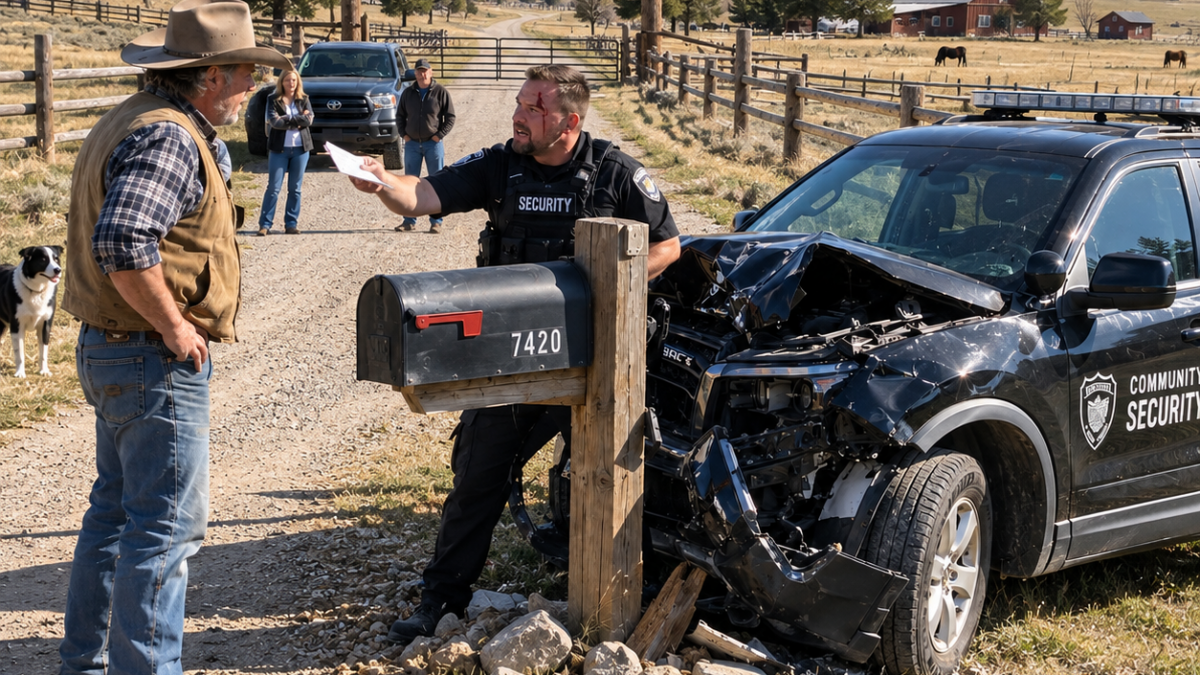
The fifth time Cedar Hollow’s fake “community patrol” came after my ranch mailbox, their SUV folded around the post while the mailbox stayed standing.
The driver climbed out bleeding, handed me a $1,500 HOA citation on land his association did not own, and warned me my road would become theirs whether I agreed or not.
What he did not know was that four cameras had recorded everything, and a real federal inspector was about to ask why a homeowners association needed my land badly enough to keep destroying federal mail property.
At 6:11 that morning, I heard the impact from inside my workshop.
It was not the hollow crack of a wooden post snapping.
I knew that sound.
I had heard it four times already.
This was different.
Heavy.
Flat.
Violent.
Steel hitting something that refused to move.
I set the socket wrench in my hand on the workbench and stood still for half a second.
Then I walked toward the side door.
I did not run.
By then, Cedar Hollow Estates had taught me not to run toward anything they did.
Running meant reacting.
Reacting meant giving them the version of me they wanted.
The angry rancher.
The unreasonable neighbor.
The old man blocking community safety.
I had learned to walk slowly, look carefully, and document everything.
Dust was already hanging over County Road 17 when I stepped outside.
Then I saw the white Ford Explorer.
CEDAR HOLLOW COMMUNITY PATROL was printed across both front doors in large dark letters.
The SUV sat nose-first in the gravel shoulder beside my driveway.
The front bumper had collapsed inward.
One headlight hung from its wiring.
The hood was buckled near the center.
White airbag material filled the driver’s side window like a sheet blown through a broken frame.
And six feet away stood my mailbox.
Straight.
Level.
Untouched.
I stopped near the edge of the driveway.
For eight months, somebody associated with Cedar Hollow had been trying to teach me a lesson.
Refuse their offer.
Lose a mailbox.
Refuse again.
Get fined.
Question their authority.
Find orange cones on your land.
Ask for documents.
Get another threat.
They believed repetition could turn intimidation into ownership.
That morning, for the first time, something had pushed back.
The driver’s door opened with a grinding scrape.
Derek Caldwell climbed out.
Derek was thirty-four, broad-shouldered, and built like a man who enjoyed standing too close to people. He wore dark tactical pants, a navy polo tucked tightly into his belt, a radio high on his chest, and a silver badge that looked official from twenty feet away.
From ten feet, it looked like something bought from a uniform catalog.
A thin line of blood ran from his hairline.
He looked at the Explorer.
Then at the mailbox.
Then at me.
His face hardened.
“You did this.”
I did not answer.
He took two steps toward me.
“That thing is a road hazard.”
PART2:
He pointed at my mailbox as though it had jumped into traffic and attacked him.
“You installed an illegal obstruction inside a community safety corridor.”
I looked down at the gravel.
Tire marks began near the center of County Road 17.
They drifted gradually toward the shoulder.
Then they cut directly toward the mailbox.
There were no real skid marks until the final few feet.
I looked back at Derek.
He was still talking.
“You’re looking at a fifteen-hundred-dollar safety violation. Minimum. Probably more after the board reviews the damage to the patrol vehicle.”
I reached into my jacket and pulled out my phone.
His posture changed.
Just slightly.
“What are you doing?”
I took a photograph of the Explorer from the front.
Then one from the side.
Then the license plate.
Then the tire tracks.
Then the road.
Then the mailbox.
Then the distance between the mailbox and the traveled lane.
Derek stepped closer.
“You need permission to photograph patrol operations.”
I raised the phone.
Then I took a picture of his badge.
That stopped him.
His hand moved instinctively toward it.
“What the hell are you doing?”
“Documenting.”
His eyes narrowed.
PART3:
“You people always think a camera makes you right.”
“No,” I said. “But it helps prove when somebody else is wrong.”
He reached into the back pocket of his tactical pants and pulled out a folded citation form.
The paper was damp with his sweat.
He held it toward me with two fingers like a process server in a bad mood.
I did not take it.
He pushed it closer.
“This is official notice.”
“From who?”
“Cedar Hollow Estates Homeowners Association.”
“I don’t live in Cedar Hollow.”
“You border Cedar Hollow.”
“That is not a legal category.”
His face reddened.
“The board has designated this corridor as a community safety zone.”
“This is County Road 17.”
“The road serves our residents.”
“It served my ranch before your residents learned how to spell HOA.”
That was when Derek stepped close enough for me to smell the airbag dust on his shirt.
“You need to get something through your head, Mr. Harlan. Your little ranch road is going to become our emergency access. The county knows it. The board knows it. The developer knows it. You can keep playing old cowboy as long as you want, but the road is going to be ours.”
There it was.
Not the mailbox.
Not the “safety corridor.”
The road.
He had said the quiet part out loud.
My name is Wade Harlan.
I am sixty-eight years old, and Harlan Ranch has sat outside Briar County since before there was a Cedar Hollow Estates, before there were decorative stone entrance signs, before there were newsletters about approved mulch colors, before men like Derek Caldwell decided a polo shirt and a radio made them law enforcement.
My grandfather bought the first eighty acres in 1949.
My father added the back pasture in 1968.
I bought the adjoining forty after my wife, Annette, convinced me that cows were easier neighbors than people.
She was right.
Annette died six years before Cedar Hollow started knocking down my mailbox.
Cancer took her slowly, which is the cruelest way a thing can take someone. The last spring she was well enough to sit on the porch, she painted the old mailbox herself.
Harlan Ranch.
Black letters.
Little bluebonnets along the side, though bluebonnets did not grow well on our land.
She said they looked hopeful anyway.
For years after she died, I kept touching up that paint every spring.
Not because the mail cared.
Because she had made it.
The first time Cedar Hollow hit the mailbox, they shattered the post and crushed the box beyond saving.
I stood in the ditch at dawn holding twisted metal with blue paint still clinging to one side and felt grief hit me from a stupid direction.
A mailbox is a small thing until it is the last thing your wife painted.
I reported it to the sheriff.
A deputy came out, looked at the tire marks, looked toward Cedar Hollow’s entrance, and said, “Could be kids.”
“Kids driving a patrol SUV?”
He sighed.
“Wade, I’m not saying I don’t believe you.”
That is what people say right before they prove they do not believe you enough to do anything.
The second time, the mailbox was ripped sideways by a chain.
The third time, someone backed into it and left white paint on the post.
The fourth time, I found orange cones around it with a printed notice taped to the flag.
UNAUTHORIZED MAIL RECEPTACLE OBSTRUCTING COMMUNITY ACCESS.
By then, I had stopped thinking it was vandalism.
Vandalism is random.
This was a campaign.
It started after Cedar Hollow Phase Three was announced.
Seventy-two new houses on the east side.
A private clubhouse.
A walking trail.
A retention pond shaped like a kidney bean because developers love making drainage sound like recreation.
The problem was access.
Cedar Hollow had one main entrance off Highway 8. The county fire marshal had made it clear that Phase Three would require a secondary emergency route before occupancy could be approved.
The developer’s preferred route ran through what their glossy map called “future community access.”
My property records called it Harlan Ranch Road.
It was a narrow caliche road that ran from County Road 17 through my east pasture, past the old windmill, over the low creek crossing, and up to the back fence. My family used it for cattle, hay equipment, fence repair, and fire access long before Cedar Hollow existed.
Cedar Hollow wanted that road.
At first, they asked nicely.
Or what rich people think is nicely.
Their HOA president, Vivian Ashford, came to my porch one afternoon wearing a white blouse, tan slacks, and sunglasses too large for her face. Derek came with her, standing two steps behind as if she needed a bodyguard to talk to an old man with a coffee mug.
Vivian was in her early fifties, polished in a way that made every movement feel rehearsed. Her hair was dark, smooth, and expensive. Her smile had no warmth in it, only strategy.
“Mr. Harlan,” she said. “Cedar Hollow wants to be a good neighbor.”
I almost laughed.
By then, I had learned that when someone with a folder says they want to be a good neighbor, they usually want something that belongs to you.
Vivian explained that the community needed a secondary safety route for emergency vehicles. She said my ranch road was “naturally positioned” to serve the neighborhood. She called it a public benefit. She said the HOA was willing to compensate me for a limited easement.
She placed a one-page offer on my porch table.
The number was so low I thought she had left off a zero.
“No,” I said.
She blinked once.
“You haven’t heard the full proposal.”
“I heard enough.”
Derek shifted behind her.
Vivian kept smiling.
“Mr. Harlan, this is an opportunity to contribute to public safety.”
“My road already contributes to public safety. Mine.”
“The county may see it differently.”
“Then the county can come talk to me.”
Her smile thinned.
“Sometimes cooperation is more cost-effective than resistance.”
“Sometimes trespass is more expensive than manners.”
That was the day Vivian stopped smiling at me.
After that came letters.
Noise complaints about cattle trailers.
Dust complaints about hay trucks.
Fence line concerns.
Visual nuisance concerns.
Improper mailbox placement.
Unauthorized ranch signage.
One letter claimed my mailbox obstructed the “future Cedar Hollow emergency corridor.”
I wrote back once.
Harlan Ranch is not subject to Cedar Hollow HOA authority. No easement has been granted. Do not enter my land.
After that, I stopped answering.
They did not stop sending.
Derek’s patrol SUV began cruising by twice a day.
Sometimes three times.
He would slow near my driveway and stare at the mailbox.
Once, I walked down with my coffee and waved.
He did not wave back.
The new mailbox went up after the fourth strike.
I did not build it out of anger.
I built it out of memory.
I called Alma Jensen first.
Alma had delivered mail on our rural route for twenty-three years. She knew every dog, gate, bad culvert, and widow between Briar and Ash Creek. She was five feet tall, carried pepper spray on her belt, and drove her mail jeep like a woman who had made peace with death years ago.
She stood beside County Road 17 with a measuring tape and looked at my broken mailbox post.
“You want it legal or you want it stubborn?”
“Both.”
She smiled.
“That’s the correct answer.”
We measured distance from the edge of the traveled lane.
Height.
Reach.
Shoulder clearance.
Then I called a county road supervisor I knew from church, and he confirmed the mailbox stood outside the traveled lane and outside the county maintenance path. It was on my frontage, accessible to the mail carrier, not blocking the road.
Then I built the post.
A steel pipe inside a treated cedar sleeve.
Set behind the ditch line.
Anchored deep.
Painted black.
Mailbox mounted at regulation height, with Annette’s name repainted on the side because I would be damned if Vivian Ashford got to erase that too.
Then I added cameras.
Four of them.
One on the workshop corner.
One in the live oak across from the driveway.
One solar cellular camera hidden near the cattle guard.
One on the gatepost aimed down the road.
Travis Redmond would have approved, though he had nothing to do with this story. Every working man knows redundancy is just paranoia with a better name.
For three weeks, nothing happened.
Then Derek hit it with the Explorer.
And lost.
I looked at him standing in my driveway, blood on his forehead, fake citation in his hand, and said, “You need an ambulance.”
He scoffed.
“You need to remove that mailbox.”
“You drove into it.”
“It is illegally reinforced.”
“It is legally placed.”
“It is a hazard.”
“Only if you aim at it.”
His hand tightened around the citation.
“I am issuing notice of immediate removal.”
“You are bleeding on your citation.”
That made him look down.
Blood had dripped onto the top corner of the paper.
His jaw clenched.
A second Cedar Hollow patrol vehicle rolled up then. A smaller SUV. Two men climbed out, both wearing the same navy polo and catalog badges.
They looked at Derek.
Then at the destroyed Explorer.
Then at the mailbox.
One of them whispered, “Jesus.”
Derek snapped, “Get cones.”
The younger man hesitated.
“Derek, maybe we should call—”
“Get cones.”
I raised my phone again.
Derek pointed at me.
“You post any of that, and the HOA will sue you for interfering with safety operations.”
“I am not posting.”
“Then what are you doing?”
“Saving.”
Sirens came from the west.
Not an ambulance.
Briar County sheriff.
Deputy Luis Marquez pulled in behind the wreck and stepped out slowly, taking in the scene with the expression of a man who had finally arrived at the chapter everyone had been avoiding.
Luis was younger than me by thirty years, but he had old eyes. He had answered two of my previous mailbox reports and never quite said what I wanted him to say, but he had never mocked me either.
He looked at Derek.
Then at the SUV.
Then at the mailbox.
Then at me.
“Morning, Wade.”
“Deputy.”
Derek stepped forward.
“Deputy, I need this man cited for creating a road hazard inside a community safety corridor.”
Luis looked at him.
“You need a paramedic first.”
“I’m fine.”
“You have blood on your face.”
“That is irrelevant.”
“To your brain, maybe.”
The younger patrol guy coughed into his hand.
Derek glared at him.
Luis walked to the road and crouched near the tire marks.
He took his time.
He photographed them.
Measured with his boot.
Looked toward the mailbox.
Then back toward the lane.
“Derek,” he said, “why were you driving on the shoulder?”
Derek straightened.
“To inspect an obstruction.”
“At speed?”
“I wasn’t speeding.”
“You hit a stationary mailbox hard enough to deploy airbags.”
“It was illegally installed.”
Luis stood.
“That mailbox is not in the lane.”
“It is within the future Cedar Hollow emergency corridor.”
Luis looked at me.
I smiled slightly.
He looked back at Derek.
“Future corridors don’t get to jump in front of moving cars.”
Derek’s face turned red.
Before he could answer, another vehicle pulled up behind the deputy’s cruiser.
Dark blue sedan.
Plain.
Government plates.
A woman stepped out wearing dark slacks, a navy jacket, and the calm expression of somebody who did not need a fake badge because she carried a real one.
She was maybe mid-forties, brown skin, black hair pulled tight, eyes sharp enough to cut rope.
She closed the car door and looked at the wreck.
Then the mailbox.
Then me.
“Mr. Harlan?”
“Yes, ma’am.”
She walked over and showed me her credentials.
“Inspector Elena Ortiz. United States Postal Inspection Service.”
The Cedar Hollow patrol men went very quiet.
Derek frowned.
“Postal what?”
Inspector Ortiz turned her head slowly toward him.
“Postal Inspection Service.”
He blinked.
“This is a traffic matter.”
“No,” she said. “This is the fifth reported incident involving damage or attempted removal of a mail receptacle on an active rural delivery route. I was already scheduled to meet Mr. Harlan this morning.”
Derek looked at me.
His face changed.
Just a fraction.
I had not told him that part.
I had mailed the first packet of evidence six days earlier.
Photographs.
Sheriff reports.
Copies of citations.
Pictures of damaged mail.
One video from the fourth incident showing a Cedar Hollow patrol vehicle idling near the mailbox at 1:32 in the morning.
Alma had helped me write the cover letter.
“You want postal attention?” she said. “Mention repeated obstruction of delivery and destruction of mail receptacles. Keep it factual. No rancher poetry.”
“What is rancher poetry?”
“Calling them lying sons of—”
“I get it.”
Inspector Ortiz had called me two days later.
Her voice was calm.
Too calm.
Federal calm.
“Mr. Harlan, I’d like to come out Thursday morning and review the site.”
I agreed.
Derek just had bad timing.
Or maybe the best timing of his life, depending on how much truth a man needed collected in one morning.
Inspector Ortiz walked to the mailbox without asking permission.
She examined the post.
Measured the distance from the traveled lane.
Looked at the shoulder.
Looked at the tire tracks.
Looked at the Explorer.
Then she turned to me.
“You have cameras?”
“Yes, ma’am.”
“How many?”
“Four.”
Derek said, “We are not consenting to—”
She did not look at him.
“Did I ask you anything, Mr. Caldwell?”
His mouth closed.
That was the first time I enjoyed the morning.
I led Inspector Ortiz to the workshop while Deputy Marquez kept Derek and the patrol men outside. My workshop smelled like sawdust, oil, coffee, and old leather. I pulled the footage onto the monitor above the tool bench.
Camera one showed the road from the workshop corner.
Camera two showed the mailbox close enough to count insects.
Camera three, hidden near the cattle guard, showed the county road from behind a cedar branch.
Camera four caught the wider angle.
At 6:09, Derek’s Explorer entered frame.
It slowed.
Then stopped.
For thirty-two seconds, it sat in the lane.
The driver’s window lowered.
Derek looked toward the house.
Then toward the mailbox.
Then he backed up.
Not far.
Just enough to line up.
Inspector Ortiz leaned closer.
The Explorer accelerated.
Not fast like a highway crash.
Fast enough.
Straight toward the mailbox.
At the last second, brake lights flashed.
Too late.
The SUV hit the steel-reinforced post and folded.
On camera, the mailbox barely moved.
Inspector Ortiz did not speak for a long moment.
Then she said, “Do you have the previous incidents saved?”
“Yes, ma’am.”
I opened the folder.
Incident one.
A dark vehicle at 2:43 a.m.
Blurry, but the rear light pattern matched Cedar Hollow patrol.
Incident two.
A chain attached to the post, pulled by a white SUV with the plate covered in mud.
Incident three.
Derek standing beside the mailbox at night with a flashlight while another man painted orange X marks on the ground.
Incident four.
Cedar Hollow patrol placing cones and taping a notice to the mailbox flag.
Ortiz watched everything twice.
Her face did not change.
That worried me more than anger would have.
People think federal investigators are dramatic.
They are not.
The good ones are quiet because the evidence should make the noise.
“Mr. Harlan,” she said, “has any mail been damaged, delayed, or removed during these incidents?”
“Yes.”
I handed her a folder.
Photographs of wet envelopes after the second strike.
A crushed medication shipment.
A torn property tax notice.
Two letters from my daughter in Colorado that arrived dirty and ripped after being knocked into the ditch.
Ortiz’s jaw shifted slightly when she saw the medication shipment.
“Is this yours?”
“My blood pressure prescription.”
“Delayed?”
“Two days.”
She made a note.
“Who else has seen the footage?”
“No one except you.”
“Good.”
She straightened.
“Do not send copies to the HOA. Do not argue with them. Do not warn them about what you have. I’m going to request original files, metadata, and your written statement.”
“You think this matters?”
She looked at the monitor, where Derek’s SUV sat frozen in the moment before impact.
“Mr. Harlan, people tend to underestimate mailboxes.”
Outside, Derek was arguing with Deputy Marquez again.
His voice carried through the workshop door.
“This is Cedar Hollow’s designated emergency access alignment!”
Ortiz turned toward the sound.
“Is that why they need your mailbox gone?”
I looked at her.
“That is part of it.”
“What is the rest?”
“My ranch road.”
I walked her to the big map pinned on the workshop wall.
It was old, paper, with fence lines marked in pencil and a coffee stain in the corner. Annette used to joke it looked like something pirates would use if pirates cared about drainage easements.
I showed Ortiz County Road 17.
My driveway.
The mailbox.
The Harlan Ranch Road.
The east pasture.
The old creek crossing.
The back fence.
Then I pointed to Cedar Hollow Phase Three.
“They need a second emergency access before they can sell those houses. Their preferred route cuts through here.”
“Your private road.”
“Yes.”
“Do they have an easement?”
“No.”
“Have they claimed one?”
“They have claimed everything except the moon.”
Ortiz stared at the map.
“Show me the documents.”
That took longer.
I pulled the Cedar Hollow letters from a file cabinet. The first few were printed on HOA letterhead. Later ones had grown more aggressive. One included a “Notice of Corridor Compliance.” Another claimed “historic community use.” Another demanded removal of “unauthorized rural mail structure encroaching on emergency access planning area.”
Ortiz read in silence.
Then she looked up.
“This was mailed to you?”
“Yes.”
“Through USPS?”
“Yes.”
She tapped the paper.
“Interesting.”
That word did not sound good for Cedar Hollow.
Two days later, Inspector Ortiz came back with another federal investigator, a county road supervisor, Deputy Marquez, and Alma Jensen in her postal jeep.
Alma stepped out wearing her uniform shorts, compression socks, and the fierce expression of a woman who had delivered mail through hail, goats, and men with opinions.
She pointed at the mailbox.
“That box is where I told him to put it.”
Ortiz asked, “Is delivery obstructed?”
“Only by people knocking it down.”
“Is it reachable from the route?”
“Yes.”
“Is it unsafe for you?”
Alma looked at Derek’s tire marks still visible in the gravel.
“Not unless Cedar Hollow starts aiming at me too.”
The county road supervisor confirmed what I had said.
The mailbox was outside the traveled lane.
Outside the county maintenance path.
Not in violation.
Not a road hazard.
Not part of any legally recognized Cedar Hollow corridor.
Then Ortiz asked to see the ranch road.
We loaded into two vehicles and drove through my gate.
Ranger, my old blue heeler mix, watched from the porch and decided not to waste energy barking at government employees.
The ranch road ran east through mesquite and pasture grass, past the old hay barn, through a low dip where spring storms turned the caliche soft, and over the creek crossing my father poured by hand in 1972.
Ortiz studied everything.
The width.
The turns.
The cattle guards.
The gates.
The creek.
The fence line near Cedar Hollow.
At the back boundary, fresh orange survey ribbon hung on my fence.
CEDAR HOLLOW EMERGENCY ACCESS.
Ortiz photographed it.
So did Deputy Marquez.
I did too because habit is a good dog once trained.
“Who placed this?” Ortiz asked.
“Not me.”
The county road supervisor said, “This is not approved county access.”
Ortiz looked through the fence at the development land beyond it.
Graded pads.
Idle bulldozers.
Stacks of pipe.
A big sign promising luxury living.
A private security truck sat near the far side, watching us.
Ortiz lifted her camera and photographed that too.
The investigation grew legs after that.
Not fast legs.
Government legs.
Steady.
Heavy.
Hard to stop once moving.
Ortiz requested records from Cedar Hollow.
Vivian Ashford responded through an attorney claiming the HOA patrol had acted only to protect community safety and preserve emergency access routes under review.
Ortiz requested the review documents.
The HOA sent a packet.
The packet created more problems than it solved.
There was a map labeled Cedar Hollow Emergency Corridor Plan.
The line ran directly through my mailbox, my driveway shoulder, my east pasture gate, and down Harlan Ranch Road.
There was a board resolution declaring the corridor “necessary for public safety.”
There was a patrol directive authorizing “obstruction documentation and compliance pressure.”
There were five citations issued to me.
All mailed.
All claiming authority the HOA did not have.
Then there was the exhibit that changed everything.
A declaration attached to the Phase Three county application stated that Cedar Hollow had secured “pending cooperative access through adjacent rural property owner.”
Adjacent rural property owner meant me.
Cooperative meant they were lying.
Ortiz asked me whether I had signed any access agreement, letter of intent, easement, permission, or emergency use document.
I laughed once.
“No.”
“Did you verbally agree?”
“No.”
“Did you authorize them to represent ongoing negotiations as secured access?”
“No.”
“Did you authorize patrol activity around your mailbox?”
“No.”
She nodded.
That was all.
Three days later, Vivian Ashford came to my ranch.
Not alone this time.
She brought Derek, wearing a bandage on his forehead and sunglasses though the sky was overcast, and a man I recognized from the developer’s office named Brennan Vale.
Brennan had the worried look of a man whose project schedule had started bleeding money.
Vivian did not ask to come through the gate.
She stood outside it in a camel-colored coat, looking at the new temporary federal evidence sticker Ortiz had placed discreetly near the damaged shoulder.
“You’ve escalated this beyond reason,” she said.
I leaned on the inside of the gate.
“You drove into my mailbox five times.”
“We did not drive into anything. Derek suffered an accident caused by your illegal installation.”
“Then why did he back up first?”
Her mouth tightened.
Derek stepped forward.
“You think a camera tells the whole story?”
“No,” I said. “But four cameras get close.”
Brennan Vale looked at Vivian.
“You told me there was no footage.”
Vivian ignored him.
“This community needs emergency access.”
“You should have bought land that came with it.”
“This is bigger than you.”
“That’s what people say when they want something smaller than their ambition to move out of the way.”
Her eyes sharpened.
“You are one rancher standing in the path of progress.”
“I am one landowner standing on a recorded deed.”
Derek laughed.
“You always talk like a courthouse plaque?”
I looked at him.
“You always drive like you hate your insurance company?”
His jaw flexed.
Brennan stepped in quickly.
“Mr. Harlan, perhaps there is still a business solution.”
I looked at him.
“There was one eight months ago. It involved asking honestly and paying fairly.”
Vivian’s face twisted.
“We offered fair compensation.”
“You offered ditch-water money for a road my family built and maintained for fifty years.”
“It is barely used.”
“By me.”
“Exactly. Underused infrastructure.”
That sentence told me more about Cedar Hollow than any board minutes ever could.
To Vivian, anything not monetized by her was wasted.
A road used by cattle, tractors, mail carriers, fire crews when needed, and one old rancher checking fences was “underused.”
My wife’s mailbox was an “obstruction.”
My gate was “anti-community.”
My refusal was “selfish.”
They had renamed theft until it sounded like planning.
“Leave,” I said.
Vivian stepped closer to the gate.
“You should be careful, Wade.”
Derek smiled.
Brennan looked uncomfortable.
I pointed toward the workshop camera.
“That one records audio.”
Vivian stopped.
Her gaze flicked to the camera.
For the first time since I had known her, Vivian Ashford looked uncertain.
“Good day,” I said.
She turned and walked back to her car.
Derek stared at me for two seconds longer, then followed.
Brennan stayed.
He looked at the gate, the road, the mailbox, then at me.
Quietly, he said, “Did you ever sign anything?”
“No.”
His face went pale.
He nodded once and walked away.
That was the moment Cedar Hollow’s lie began eating itself from the inside.
Brennan Vale called the county two hours later.
By the next morning, the county suspended review of Cedar Hollow Phase Three’s emergency access plan pending verification of legal rights.
The developer’s lender requested clarification.
The fire marshal withdrew conditional support.
The planning commission postponed the next hearing.
Vivian told residents it was a temporary paperwork matter caused by an “uncooperative adjacent owner.”
Then Inspector Ortiz served a federal preservation notice demanding Cedar Hollow retain all communications regarding my mailbox, mail delivery, community patrol directives, emergency access, citations, and any reference to Harlan Ranch Road.
That was when the emails started surfacing.
Not because Cedar Hollow suddenly became honest.
Because people who once feared Vivian began fearing federal subpoenas more.
The first break came from a board member named Martin Clay.
Martin was a retired accountant who had joined the HOA board because he wanted the pool budget to make sense. He later told me Vivian made him feel useful until he realized she only found people useful when they nodded.
He copied a batch of emails to Ortiz through his attorney.
One subject line read:
Harlan obstruction strategy.
Another:
Mailbox pressure schedule.
In one email, Vivian wrote:
If he loses the box enough times, rural delivery will become impractical, and we can argue relocation to the cluster unit near Cedar Hollow entrance.
Derek replied:
Mailbox is the visual anchor. Remove that and residents stop seeing it as his frontage.
Vivian wrote back:
Exactly. The road must feel inevitable.
I read those lines later in Brena’s office.
Yes, I hired Brena Fairchild too.
After hearing about what happened to my neighbor Nolan Prescott’s equipment yard years earlier, I knew better than to fight a land grab with good manners and loose papers. Brena had become famous in our county for turning fake authority into expensive regret.
When she read the Cedar Hollow emails, she removed her glasses and rubbed the bridge of her nose.
“HOA presidents,” she said, “need hobbies that don’t involve felony-adjacent land planning.”
“Is this felony-adjacent?”
“Wade, if there were a map, they parked on felony’s lawn.”
The next email was worse.
Vivian to Derek:
Do not damage mail itself. We need obstruction, not federal attention.
Derek:
Too late on second hit. Some envelopes got wet.
Vivian:
Then keep it clean going forward.
Brena looked at me.
“Did she just document awareness of federal exposure?”
“Seems so.”
“She is either arrogant or stupid.”
“Both?”
“Always possible.”
Inspector Ortiz did not laugh when she saw the emails.
She simply added them to the file.
Federal interviews began the following week.
Derek went first.
He came out looking like a man who had found a cliff where he expected a hallway.
The two other patrol men went next.
One of them, the younger one from crash day, broke quickly.
His name was Evan Pollard.
Twenty-six.
Former mall security.
Two kids.
He admitted the patrol team had been instructed to “create a consistent record of obstruction.”
He said Vivian wanted photographs, citations, and “incident history” to support a county request to relocate my mailbox and classify the ranch road as an emergency corridor under community necessity.
He said Derek called it “making the old man look unreasonable.”
He said the first two mailbox strikes were done by another patrol vehicle.
He said he was there for the fourth incident with the cones.
He said Derek told him, “Once the box is gone, the road is next.”
When asked about the fifth impact, Evan said Derek planned to “clip” the mailbox while recording commentary about the hazard.
He did not expect the post to hold.
Nobody did.
That was the thing about bullies.
They get used to weak resistance.
They forget what solid feels like.
Vivian denied everything.
Of course she did.
She claimed emails were taken out of context.
She claimed the patrol misunderstood her safety concerns.
She claimed my mailbox had been improperly hardened.
She claimed the HOA had been acting under advice of counsel, though the attorney immediately denied advising anyone to ram federal mail infrastructure with an Explorer.
Derek claimed brake failure.
Then Ortiz showed him the footage from four angles.
Then the vehicle inspection showed the brakes worked.
Then his phone revealed a voice memo recorded seven minutes before the crash.
Derek had been talking to himself like a man auditioning for authority.
“Approaching Harlan obstruction. Documenting hazardous placement. Owner has refused repeated compliance. Corrective contact will demonstrate risk to patrol vehicles and emergency access.”
Corrective contact.
That phrase did not help him.
The county hearing happened three weeks later.
Cedar Hollow residents filled the room.
So did ranchers from County Road 17, because nothing brings rural people together like watching an HOA discover property law.
Vivian sat at the front in a dark green suit, chin lifted. Derek was not there. His attorney probably had enough sense to keep him away from microphones.
Brennan Vale sat two rows behind her, no longer close enough to look associated.
Inspector Ortiz sat near the aisle.
Brena sat beside me with three binders and the calm energy of a woman who had brought receipts for everyone.
The county commissioner opened the hearing by stating that Cedar Hollow Phase Three emergency access approval was under review due to contested land rights.
Vivian stood first.
She spoke beautifully.
I will give her that.
She talked about safety.
Children.
Fire trucks.
Evacuation routes.
Community planning.
Responsible development.
The need for cooperation between old and new neighbors.
She did not mention mailboxes.
Funny, that.
Then Brena stood.
She carried one binder to the podium.
“Commissioners,” she said, “my client supports public safety. What he does not support is fabricated authority, repeated destruction of a rural mail receptacle, false citations, and the conversion of private ranch infrastructure into HOA property by harassment.”
Vivian’s jaw tightened.
Brena placed a map on the overhead projector.
Harlan Ranch Road.
Private.
No recorded easement for Cedar Hollow.
No public dedication.
No emergency access agreement.
Then she placed the Cedar Hollow corridor map over it.
The room murmured.
The line ran straight across my land.
Then Brena showed the citations.
Five of them.
Then the crash footage.
The room went silent when Derek backed up, lined up, and accelerated.
Someone behind me whispered, “Idiot.”
The mailbox did not move.
The Explorer crumpled.
A few people gasped.
One man laughed before his wife elbowed him.
Then Brena read the emails.
If he loses the box enough times…
The road must feel inevitable.
Do not damage mail itself. We need obstruction, not federal attention.
By the time she finished, Vivian’s face looked carved from ice.
The commissioner turned to her.
“Ms. Ashford, did your association instruct patrol staff to interfere with Mr. Harlan’s mailbox?”
“No.”
Brena lifted another document.
“Would you like to revise that answer before Inspector Ortiz is asked to speak?”
Vivian looked toward Ortiz.
Inspector Ortiz did not move.
She did not need to.
Vivian sat down.
That silence did more than any confession.
The county suspended Phase Three emergency access approval indefinitely. Cedar Hollow was ordered to submit a new plan relying only on property it owned or legally controlled. The planning office opened a review of all prior representations made by the HOA and developer regarding access.
Then Inspector Ortiz stood.
She did not speak long.
“Separate from county land-use matters,” she said, “my office is investigating repeated interference with a rural mail receptacle, destruction of mail infrastructure, obstruction of delivery, and use of mailed instruments asserting false authority over the recipient. We will coordinate with the U.S. Attorney’s Office as appropriate.”
Vivian’s attorney whispered something sharply in her ear.
For once, she listened.
The hearing ended with Cedar Hollow residents furious.
Not at me.
At Vivian.
That may have been the most satisfying part.
People who had spent months calling me stubborn suddenly realized their HOA dues had paid men to smash a rancher’s mailbox in pursuit of a road they did not own.
Within forty-eight hours, Cedar Hollow called an emergency board meeting.
Martin Clay moved to suspend Vivian from all board authority.
Another member seconded.
Vivian tried to speak over them.
Residents shouted her down.
A mother from Cedar Hollow stood in the back and asked why her family’s dues had been used to finance fake patrol citations instead of repairing the playground fence.
An elderly man asked whether the HOA insurance would cover federal investigation costs.
Someone else asked if Phase Three assessments would increase because the board lied about access.
Vivian pounded the gavel until Martin gently took it from her hand.
The vote to suspend her passed unanimously.
Derek Caldwell resigned from Cedar Hollow Community Patrol the same day, though resign is a generous word for leaving after being told your fake badge could become evidence.
The patrol program was dissolved two weeks later.
The SUVs were sold.
The badges disappeared.
The radios were boxed up.
The navy polos became embarrassing laundry.
Federal charges took longer.
They always do.
Derek eventually entered a plea related to destruction of mail infrastructure and obstruction. Evan cooperated and avoided the worst of it. Vivian was not charged for every ugly thing she had done, but she was charged for enough.
Mail fraud tied to the false citations.
Conspiracy related to interference with delivery.
Misuse of association funds became a state matter.
The U.S. Attorney did not need to prove she personally drove the SUV into my mailbox.
The emails did what her hands had not.
The civil side took even longer.
Brena filed claims against Cedar Hollow for trespass, property damage, harassment, and slander of title related to the access representations. The settlement terms were mostly confidential, which annoyed the neighbors more than it annoyed me.
But three things became public.
Cedar Hollow recorded a formal acknowledgment that it had no ownership, easement, emergency access right, maintenance interest, or community corridor across Harlan Ranch Road.
The HOA paid for all mailbox damage, legal fees, and security upgrades.
And Cedar Hollow agreed that no association officer, agent, contractor, patrol, volunteer, resident committee member, or person acting on its behalf would enter, mark, cite, inspect, patrol, cone, survey, or otherwise interfere with my frontage, driveway, mailbox, gates, fences, or ranch road.
Brena called that paragraph “the adult version of keep your hands to yourself.”
I framed it.
Not in the house.
In the workshop.
Right beside the monitor showing all four camera feeds.
The mailbox stayed.
The post stayed.
The bluebonnets stayed.
Alma delivered mail to it the morning after the settlement was recorded.
She pulled up, opened the box, placed three letters inside, and shut it with unnecessary ceremony.
Then she looked toward the porch where I stood with Ranger at my feet.
“Still standing,” she called.
“Yes, ma’am.”
She pointed at me.
“Don’t let it go to your head. It’s still just a mailbox.”
I smiled.
“No, Alma. It’s federal infrastructure now.”
She laughed so hard she nearly dropped her scanner.
After everything ended, I thought I would feel victorious.
I did, in pieces.
But mostly, I felt tired.
The kind of tired that lives under your ribs after months of being forced to prove what should have been obvious.
My land was mine.
My road was mine.
My mailbox was legal.
My wife’s painted letters were not a community obstacle.
No one should have needed four cameras, a federal inspector, a lawyer, a county hearing, and a stack of emails to establish that.
But that is how power works when it gets used by people who are certain nobody will check the details.
It does not always kick down your door.
Sometimes it sends a letter.
Sometimes it prints a badge.
Sometimes it calls trespass safety.
Sometimes it calls theft progress.
Sometimes it hits your mailbox five times and acts offended when the fifth hit hurts.
One evening, months later, I stood by County Road 17 with a small brush in my hand.
The sun was low.
The air smelled like dry grass and warm dust.
I was touching up the black letters on the mailbox.
Harlan Ranch.
The same words Annette had painted years ago.
My hand was not as steady as hers had been, but the letters came out clean enough.
Ranger sat beside me, watching the road with the seriousness of a dog who believed all painting projects required supervision.
A Cedar Hollow resident drove by slowly.
Not Vivian.
Not Derek.
Just a man in a pickup truck.
He lifted one hand from the wheel.
A small wave.
I stared for a second.
Then I lifted mine.
That was how peace started.
Not with apologies from everyone.
Not with every wrong repaired.
Just fewer people pretending not to know where the line was.
A few weeks after that, the county installed a new sign near the Cedar Hollow entrance.
NO THROUGH ACCESS TO HARLAN RANCH ROAD.
PRIVATE PROPERTY BEYOND COUNTY RIGHT-OF-WAY.
Vivian would have hated it.
That pleased me more than it probably should have.
I saw her once after sentencing.
At the grocery store in Briar.
She was thinner.
No expensive sunglasses.
No perfect posture.
She saw me near the coffee aisle and stopped.
For a moment, I thought she might say something.
Maybe apologize.
Maybe blame me.
Maybe try one last time to make herself the injured party.
Instead, she looked away.
That was fine.
Some people only understand consequences as silence.
As for Derek, I heard he moved two counties over and got a job selling security systems.
That sounded about right.
A man who spent years pretending to protect things finally ended up selling alarms to people worried about men like him.
Cedar Hollow Phase Three was redesigned with a different access route that cost the developer a fortune and killed the clubhouse. The kidney-shaped retention pond became a regular rectangular drainage basin, which I considered an improvement because at least it stopped pretending to be leisure.
The houses still sold eventually.
They always do.
People need places to live, and most buyers never know what was buried under the marketing brochure.
But Harlan Ranch Road stayed private.
My mailbox stayed by the ditch.
And every morning, Alma opened it like nothing unusual had ever happened.
That is the thing about defending a boundary.
The victory is not always dramatic.
Sometimes the victory is ordinary.
A gate closed.
A road quiet.
A letter delivered.
A name still painted where someone tried to erase it.
People ask me why I fought so hard over a mailbox.
They are asking the wrong question.
It was never about the mailbox.
It was about whether fake authority could become real if printed in bold letters.
It was about whether a private road could be stolen by repetition.
It was about whether an HOA could turn harassment into paperwork and paperwork into ownership.
It was about whether my wife’s last painted piece of this ranch could be smashed flat because a development map looked cleaner without it.
So yes, I fought for a mailbox.
Because sometimes the smallest post marks the biggest line.
Cedar Hollow thought they were hitting metal.
They were hitting a deed.
A history.
A memory.
A boundary.
And on the fifth try, when their SUV folded around that post and the mailbox stayed standing, it was not just steel that refused to move.
It was the truth.
And the truth, once recorded from four angles, is a hard thing to run over.








