HOA Moved Its $1.9 Million Pool Onto My Ranch—Then a Cut Yellow Pipeline Post Exposed Who Ordered the Entire Project Shift
PART2:
Working pipeline inspection jobs wherever I could find them.
I remember being angry when the easement went in.
Good grazing ground.
Access corridor.
Markers.
Restrictions on what we could build over it.
My father didn’t care about my complaining.
He stood beside the original yellow test station and said:
“We still own the ground.”
Then he put one hand on the post.
“But we don’t get to pretend the pipe isn’t there.”
I remembered that sentence for thirty-eight years.
Eventually, I spent twenty-six of those years inspecting pipelines myself.
Corrosion control.
Right-of-way issues.
Test stations.
Coating surveys.
Construction crossings.
Utility coordination.
I was not a pipeline engineer.
I was not a surveyor.
I did know enough to respect buried steel.
That old yellow post became part of the landscape.
Cattle ignored it.
I checked it occasionally out of habit.
Then development arrived.
Sterling Oaks was built east of us.
One hundred twelve homes.
Clubhouse.
Walking trails.
Stone entrance sign.
Artificial pond.
HOA.
Nothing inherently wrong with any of that.
For the first several years, relations were fine.
The subdivision’s landscapers sometimes mowed an open strip between my cattle fence and the clubhouse.
I let them.
Saved me work.
Kept brush down near the pipeline corridor.
My father had built the cattle fence inside our true property line when the pipeline was installed.
He wanted livestock away from operator vehicles and maintenance crews.
Everybody who understood the ranch knew that.
But memory changes faster than deeds.
By the time Laura Baines became HOA president, the fence had been in the same place for decades.
People began treating it like the boundary.
That mistake was the seed of everything.
Laura was probably fifty-four.
Very capable.
Very organized.
Scarlet jackets.
White hard hat during construction.
Never seemed to sweat, which in central Texas should have been investigated.
Before the pool project, I had no major conflict with her.
She had overseen clubhouse repairs.
Renegotiated landscaping.
Pushed through drainage improvements after a bad storm.
Residents liked that she got things done.
I even respected it.
The problem was that “gets things done” can become dangerous when somebody starts viewing every obstacle as evidence that other people simply need more pressure.
Sterling Oaks had wanted a pool for years.
Not a little rectangle behind the clubhouse.
A resort-style pool.
Large deck.
Shade structures.
Family area.
Premium cabanas.
Landscaping.
Lighting.
The whole project was budgeted around $1.9 million.
Some financed.
Some reserves.
Some future revenue assumptions.
The approved design sat entirely on HOA property.
I knew that much because the first time I saw the rendering, the pool stopped well east of my line.
There were three mature live oaks near the western deck.
Beautiful trees.
Big enough that you don’t replace them in a landscaping budget and pretend nothing changed.
Apparently, after design approval, an arborist warned that the permitted deck could damage their root zones.
At the same time, the construction committee realized shifting the pool west would create more deck area beside the clubhouse.
More deck area meant more cabanas.
Four became ten.
Six additional premium cabanas.
Residents would pay annual license fees for priority use.
Those two facts mattered later.
The trees made the shift look responsible.
The cabanas made it profitable.
I didn’t know any of that when the excavator arrived.
The first thing I noticed was dirt.
A lot of dirt.
Spoil piled near my cattle fence.
Then construction fencing.
Then an orange excavator working a deep hole.
I had seen the original plan months earlier.
Something felt wrong.
I walked the ranch side.
Measured roughly from landmarks.
Could not tell enough.
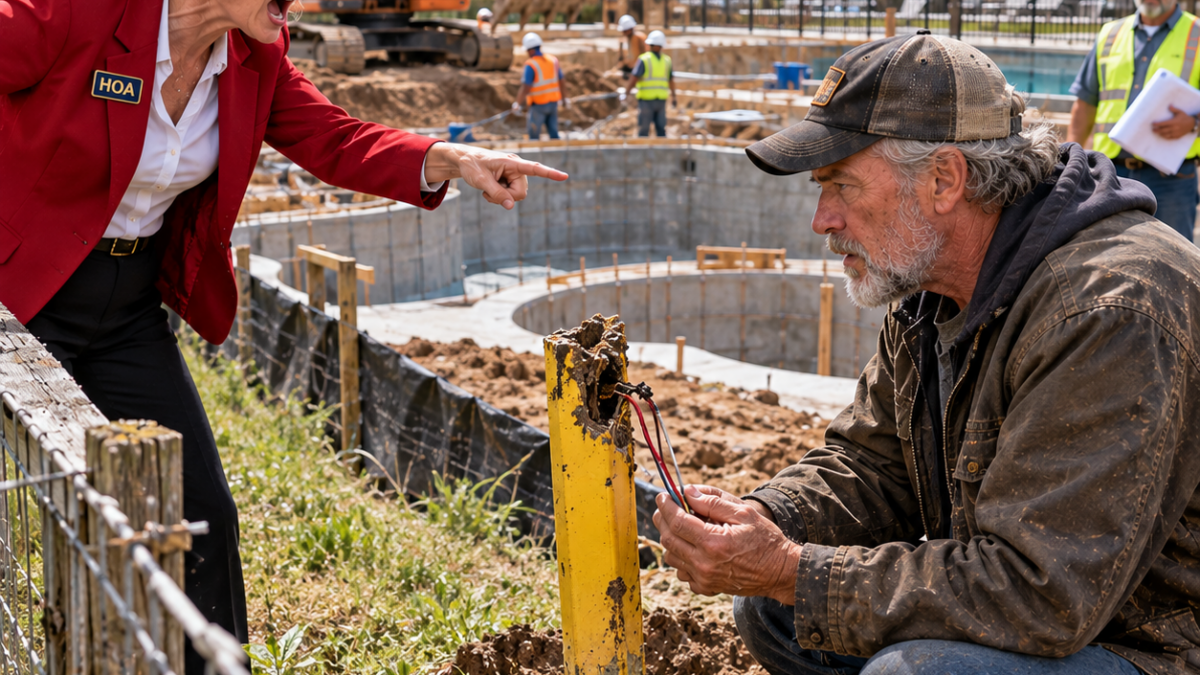
Then I saw the yellow post.
Or what remained of it.
Not standing.
Behind the HOA maintenance shed.
Cut loose.
Both mounting bolts sliced clean.
Fresh yellow locator paint still on the base.
Two clipped test wires hanging below.
Across the fence, the excavator sat maybe eleven feet below grade in what would become the deep end.
Laura stood nearby in a scarlet jacket and white hard hat.
Concrete forms were already going in east of the hole.
The pool shell pour was scheduled for Friday.
The eastern deck pour earlier.
A project that large develops momentum.
Crews booked.
Concrete ordered.
Inspectors scheduled.
Financing draws.
Customer—meaning homeowner—expectations.
Every day matters.
Laura understood that better than anyone.
I held up the post.
“Laura.”
She looked.
No surprise.
That bothered me.
“What is this doing back here?”
She walked toward the fence.
“Old marker.”
“It was connected.”
“Abandoned line.”
I looked at the wires.
“No.”
“Our consultant reviewed it.”
“An active test station doesn’t become abandoned because somebody cuts it off.”
The excavation foreman climbed out.
Darren Holt.
Late forties.
Construction superintendent.
Practical man.
He looked from me to the post.
“Nobody told me the wires were live.”
Laura said:
“They’re not live in the electrical sense.”
Darren frowned.
“That isn’t what I meant.”
I stepped closer to the fence.
“Where’s your utility clearance?”
Laura pointed toward the site trailer.
“Current.”
“For this exact footprint?”
“Yes.”
I had worked around enough construction to know what question came next.
“Show me the map.”
Laura’s posture changed.
“Grant, this is an HOA project.”
“And that’s a pipeline test station.”
“The active transmission line is nowhere near the excavation.”
“You know that how?”
She pointed toward the west.
“Old development utility exhibit.”
I said:
“Surface markers don’t tell you exact buried alignment.”
She folded her arms.
“Which is why we used professionals.”
Darren was listening very carefully now.
I asked him:
“Did your crew remove this?”
“No.”
“Did you see it standing?”
He looked toward the pit.
“Before excavation, yeah.”
Laura said:
“It marked the abandoned gathering line.”
Darren looked at the wires.
“Then why did it have connected leads?”
Nobody answered.
He turned toward his excavator operator.
“Shut it down.”
Laura immediately said:
“Darren.”
He looked at her.
“My machine stays out until somebody confirms that post.”
“The concrete crew on the east can continue.”
Darren shrugged.
“Not my crew.”
That distinction became Laura’s strategy for the next several days.
Lose one zone.
Keep another moving.
I called the emergency number on the current pipeline sign near the county road.
Before I finished giving dispatch the parcel information, workers twenty yards east were still setting forms.
Laura had lost the deep end for the morning.
She had not surrendered the schedule.
The pipeline operator sent Elena Ruiz.
Field representative.
Forties.
Calm in the way people become calm after enough years dealing with excited landowners and impatient contractors.
She arrived with two technicians.
First thing she did was establish a temporary buffer.
No excavation inside it.
Laura handed over a laminated map.
“The abandoned line is west of the clubhouse.”
Elena studied it.
“This is a development exhibit.”
“It shows the utilities.”
“It shows somebody’s understanding of utilities at the time this exhibit was created.”
“The transmission line is outside the pool.”
“Maybe.”
Laura’s eyes narrowed.
“Maybe?”
Elena pointed at the cut post.
“I have an active operator-owned test station that has been removed.”
Laura said:
“Your records will confirm it’s abandoned.”
“That’s what we’re checking.”
The technicians started north of the disturbed area.
Receiver equipment.
Signal tracing.
They found one trace.
Lost it near spoil.
Picked up another at a different angle.
Laura almost smiled.
“Two lines.”
“Exactly what our consultant said.”
Elena did not smile.
“We have one known active line.”
“One retired facility shown on an old exhibit.”
“A disabled test station.”
“And a work area whose shape has changed.”
Laura asked:
“Can you confirm the pool is clear?”
Elena said:
“Not today.”
That sentence changed the temperature of the site.
But only a little.
No emergency existed.
No leak.
No exposed line.
No strike.
Elena could stop work inside her temporary safety buffer while records were checked.
She could not yet declare that the active line crossed the pool.
Laura immediately divided the project.
Western excavation paused.
Eastern deck work continued.
Carpenters.
Plumbing sleeves.
Forms.
Rebar.
I said:
“You’re still building.”
Laura looked toward the east crew.
“Outside the operator’s buffer.”
“Your boundary’s disputed.”
“Your claim is disputed.”
“That’s not the same thing.”
She stared.
“Every hour that work continues makes your demand to move the entire project less reasonable.”
I understood immediately.
She was building sunk cost.
Concrete has psychological weight.
Once something hardens, boards hate tearing it out.
I called Priya Desai.
Licensed surveyor.
She had updated my ranch survey three years earlier.
I told her what was happening.
Her first sentence was:
“Do not use my old survey as field proof around active construction.”
That was why I trusted her.
She came after lunch.
Recovered the southern monument near the county road.
Then tried walking north to a second control point behind the clubhouse.
Sterling Oaks security stopped her.
Laura had issued a written restriction.
No access to HOA property without association counsel present.
Priya came back to my side.
“I can make preliminary measurements.”
“But?”
“I will not sign an encroachment drawing without closing the survey.”
“Can you tell where the fence is?”
“Yes.”
“And?”
She looked at her equipment.
“Your fence appears to be well inside your recorded boundary.”
I expected satisfaction.
Didn’t feel any.
“Appear?”
“Appear.”
She pointed toward Sterling Oaks.
“I need that northern monument.”
Laura produced a 2001 development landscape exhibit.
On it, my cattle fence was labeled:
WEST PROPERTY LINE.
For the first time that day, she had something that actually supported her position.
Not deed-level evidence.
But something.
“Twelve years of HOA maintenance to that fence,” Laura said.
“She has a map.”
“Historic acceptance.”
That part stung because I had allowed the mowing.
I said:
“Permission to mow isn’t a deed.”
“No.”
“But twenty years of behavior matters.”
Priya photographed the exhibit.
“Behavior can matter.”
Laura looked pleased.
Priya added:
“So can monuments.”
Laura’s smile disappeared.
Priya packed.
“I’ll return when counsel arranges access.”
Laura watched her go.
“Your own surveyor couldn’t verify your claim.”
Priya stopped.
“She refused to guess.”
Then left.
That evening, Sterling Oaks emailed all 112 homeowners.
I received a forwarded copy from someone I knew.
The message said a neighboring landowner had challenged a long-recognized boundary after construction began.
It said the pipeline operator had found no emergency.
It estimated delay costs at $18,000 per day.
Every sentence contained enough truth to be dangerous.
I had challenged the line after excavation began.
There was no emergency.
Delay could be expensive.
What it did not say:
The operator had not cleared the pool.
The test station had been cut.
The true deed line had not yet been verified.
And the pool footprint was not the same one the board originally approved.
That last part came from Miles Avery.
HOA treasurer.
Late fifties.
Financial guy.
Not my friend.
Not Laura’s enemy.
He came to my cattle gate that evening carrying the board packet.
“I want to see the post.”
I showed him.
He looked through the fence.
Then at Priya’s preliminary flags.
“Laura says your family accepted the fence as the line.”
“My family accepted it as a cattle fence.”
He opened the board packet on the hood of his SUV.
The approved pool rendering showed lawn west of the pool.
Three live oaks.
Then a thin parcel line.
The cattle fence wasn’t shown.
Miles frowned.
“The board never voted to move it this far.”
“How far did you vote?”
He flipped pages.
“Approved plan stays east.”
Then his eyes stopped on the revenue schedule.
Four premium cabanas.
The construction sign at the entrance advertised ten.
Miles looked toward the sign.
Then back at his papers.
“Where did six more come from?”
“Good question.”
He photographed the sign.
“I am not accusing Laura of anything.”
“Didn’t ask you to.”
“Field changes can be within committee authority.”
“Maybe.”
“If the boundary and utilities still work.”
“That’s a big if.”
He nodded.
Then told me the construction lender had a progress inspection Friday.
Same day as the planned shell pour.
Two clocks.
Construction.
Money.
The next morning, a concrete truck arrived for the eastern deck.
Darren called me from the gate.
“Grant.”
“Yeah.”
“Deck is outside the pipeline buffer.”
“Is it on HOA land?”
Pause.
“According to the plan Laura gave us.”
“Which plan?”
Longer pause.
“That’s becoming the expensive question.”
Darren sent his truck off-site while his insurer reviewed the conflict.
Laura did not wait.
She hired or reassigned a different concrete subcontractor.
By nine, wet concrete was flowing through a pump into eastern deck forms.
I stood at my fence listening to the drum turn.
Every rotation made the strategy visible.
If she couldn’t prove the western work legal quickly, she could make retreat more painful.
My attorney, James Rawlins, sent preservation letters.
Permit set.
Utility locates.
Change orders.
RFIs.
Survey documents.
Emails.
Contractor questions.
Maintenance records.
HOA counsel replied that Sterling Oaks would preserve relevant materials but reserved all claims against me for delay and interference.
Then a courier delivered a demand letter.
It did not say I belonged to the HOA.
They knew better.
It alleged my inaccurate boundary claims were interfering with a permitted project and warned that Sterling Oaks could pursue costs if I continued contacting contractors directly.
I stopped.
Not because Laura was right.
Because James told me:
“Stop helping them turn this into a personality fight.”
“So what do I do?”
“Collect.”
That was good advice.
Pipeline records came first.
The original utility locate ticket covered the permitted pool footprint.
East of my deed boundary.
Not my ranch.
The work map attached to the ticket matched the county-approved site plan.
That did not yet prove fraud or intent.
Maybe fieldwork had remained inside that area.
Maybe somebody had reused a ticket incorrectly without understanding.
Elena refused shortcuts.
She returned with technicians.
They exposed the active line at a controlled location north of excavation.
Confirmed pipe.
Traced south.
One signal was distorted by an old repair lead and nearby abandoned facility.
Laura seized on it.
“Exactly what our consultant found.”
Elena said:
“Not enough.”
Second verification point.
Compare separation.
Trace again.
Laura asked:
“You have two known points.”
“Yes.”
“Project the line between them.”
Elena looked at her.
“Projection is how people put excavators where they shouldn’t.”
I liked her.
The active signal moved south.
Disappeared under the spoil pile.
They brought vacuum equipment.
Carefully removed loose material at an undisturbed shoulder.
Eastern deck work kept going.
Concrete.
Rebar.
Crews.
Laura checked her watch constantly.
Near noon, Elena’s technicians recovered a clean trace.
Yellow flags advanced south.
One by one.
Through grass.
Toward the excavator.
Then into the deep end.
I will never forget the silence.
Nobody shouted.
The excavator wasn’t running.
Nobody was in immediate danger.
Elena simply walked the line, looked down into the excavation, and said:
“The active transmission line crosses the revised pool footprint.”
Laura stared at the flags.
“No.”
Elena looked at her.
“No?”
“Our utility clearance showed it outside.”
Elena held up the original ticket map.
“The clearance did not move.”
She pointed toward the hole.
“The excavation did.”
That sentence became the spine of the whole case.
The operator expanded the no-work zone.
Engineering review.
Check remaining cover.
Equipment loading.
Inspect for damage.
No leak detected.
No strike found.
No evacuation required.
Good news.
Very good news.
But the deep end could not continue.
That afternoon, Sterling Oaks counsel finally allowed Priya supervised access to the northern monument.
It was behind overgrown landscaping near the clubhouse.
Undisturbed.
Consistent with the county-road monument.
Priya set the deed line.
White flags.
Straight.
Merciless.
The pool had been shifted thirty-six feet west from its permitted location.
Twenty-eight feet of the deep end crossed onto my ranch.
My cattle fence?
Inside my property.
Exactly where my father had put it.
It had never been the boundary.
The mowing had not changed that.
The 2001 landscape exhibit was wrong.
Or, more accurately, it was never a legal survey and had been treated as one because it was convenient.
For about an hour, I thought the dispute was over.
Naive.
Proving where the pool sat answered one question.
Not why it had moved.
Laura changed arguments.
Reasonable field adjustment.
Three live oaks.
Outdated utility information.
Historic fence line.
No malicious intent.
And frustratingly, parts of that were true.
The trees were real.
The arborist report existed.
The permitted western deck endangered roots.
An abandoned gathering line really did appear on an old development exhibit.
If somebody saw only that page, they could plausibly think the yellow post belonged to retired infrastructure.
This is where stories usually become simpler in retelling.
Bad person lies about everything.
Good person proves truth.
Reality was messier.
Laura had genuine problems.
The approved pool threatened trees residents loved.
The original deck was cramped.
An old utility exhibit was confusing.
She solved those real problems by spending land and safety margin she did not own.
At the county development office, James obtained the approved permit set.
Western pool wall stopped eight feet east of my boundary.
Pipeline corridor shown on adjoining ranch parcel.
Nothing authorized the excavation as built.
Then we found the change-order block.
Issued nine days before digging.
Shift pool thirty-six feet west.
No matching revised county site plan.
No new utility locate.
No recorded land purchase.
No new survey.
Why thirty-six feet?
Trees.
And cabanas.
The westward move widened the clubhouse-side deck.
Six more premium cabanas.
Four on approved plan.
Ten on construction sign.
Miles Avery pulled the HOA deposit records.
All six additional cabanas already reserved.
Residents had paid $3,000 deposits.
Now Laura had another kind of protection.
Not legal.
Political.
Ordinary homeowners had money tied to the shifted plan.
One called me.
Angry at first.
“My family paid three thousand dollars for one of those cabanas.”
“I heard.”
“You’re going to make them tear up the pool over twenty-eight feet of grass?”
I looked out at my pasture.
“Would you sign over twenty-eight feet of your backyard after a builder dug into it first?”
Silence.
Then:
“I didn’t know it was actually on your parcel.”
“That’s why surveys come before excavators.”
His voice softened.
“What happens to our money?”
“I don’t know.”
That was the pressure Laura understood.
Not pipeline theory.
Homeowners losing something they’d paid for.
She had converted a field change into a constituency.
Wednesday afternoon, she came to my porch.
Settlement folder.
Behind her, the concrete pump boom was still visible above the clubhouse.
Offer:
$65,000 for the encroached strip.
Sterling Oaks would pay survey costs.
Restore the pipeline test station.
Rebuild my cattle fence on the deed line.
Provide landscaping.
In return:
Permanent easement for construction and pool maintenance.
Access across the pipeline corridor.
Statement that the association had relied in good faith on the historic fence.
Release of claims.
I read the proposed deed.
The strip was wider than the actual encroachment.
“Why four extra feet?”
“Maintenance tolerance.”
“You mean future access.”
“A practical buffer.”
“You also want the pipeline corridor.”
“We need construction access.”
“The operator controls access under its easement.”
“We can coordinate.”
I looked at her.
“Who approved moving the pool?”
“The project team.”
“The board?”
“Board authorized the project.”
“Not the same question.”
She closed the folder.
“Grant.”
“Every day this continues increases your exposure.”
“My exposure?”
“Delay costs.”
“You moved the project.”
“That is disputed.”
“Survey isn’t.”
She tapped the folder.
“You can be paid by Friday.”
“The pool keeps moving.”
“The trees stay.”
“The homeowners keep their cabanas.”
“And you avoid litigation.”
I looked at the signature line.
Then the paragraph she wanted from me.
Sterling Oaks had reasonably relied on the existing fence and historical maintenance patterns in establishing construction limits.
That sentence mattered more than the money.
She wasn’t just buying dirt.
She was buying a version of the past.
I closed the folder.
“No.”
Her eyes hardened.
“Think carefully.”
“I did.”
She left.
That evening, Darren called.
Not from the site.
From his insurer’s office.
“I can’t give you our whole project file.”
“I know.”
“But I’ve been authorized to describe the sequence to the board.”
“What sequence?”
“We got two dig packages.”
My heart slowed.
“First?”
“Matched county permit.”
“And locate?”
“Yes.”
“Second?”
“Pool shifted west.”
“How far?”
“About thirty-six feet.”
“New locate ticket?”
“No.”
“Why not?”
“The clearance number repeated.”
“Same ticket?”
“Yes.”
He paused.
“We sent an RFI.”
“When?”
“Friday morning before deep excavation.”
“About what?”
“The yellow post.”
I stood.
“Was it standing?”
“Yes.”
“Photograph?”
“Yes.”
“What happened?”
“Our RFI asked whether revised excavation conflicted with the marker.”
“And?”
“Consultant answered that it belonged to abandoned line.”
“Who gave consultant the exhibit?”
“Sterling Oaks.”
“Did the RFI authorize removing the post?”
Darren went quiet.
“Reply said: ‘Proceed. Remove obsolete surface marker and protect schedule.’”
I gripped the phone.
“When?”
“Forty-three minutes after we submitted.”
“Who physically removed it?”
“Not us.”
I knew who might know.
My trail camera.
Feral hogs had been tearing up the open strip near the fence.
Months earlier, I mounted a camera facing that area.
I hadn’t thought of it because I was focused on construction.
The memory card still held footage.
Thursday afternoon before excavation.
Sterling Oaks utility cart.
Two maintenance employees.
They stopped at the yellow post.
Unbolted part.
Saw wires.
One man crouched.
Other made a phone call.
They waited.
Then one returned with a battery saw.
Cut the bolts.
Removed the post.
Loaded it into cart.
No audio.
No proof who answered the call.
But there was more.
HOA maintenance work-order system.
Miles obtained it through the board.
Task:
REMOVE OBSOLETE YELLOW MARKER BEFORE EXCAVATION START.
Approved through Laura’s project account at 5:42 p.m.
Maintenance notes:
WIRES PRESENT BELOW MARKER. PROJECT OFFICE CONFIRMED REMOVAL.
That line changed the nature of the problem.
Nobody had mistaken the post for loose junk.
They found connected infrastructure.
Asked.
Then cut it after confirmation.
Laura’s counsel responded carefully.
Project assistants sometimes routed routine work under the president’s credentials.
Approval under her account did not prove she personally read the field note.
Possible.
Annoying.
But possible.
We still needed the document that showed what Laura actually knew.
It came from the lender.
Sterling Oaks’s construction lender had its progress inspection Friday.
Before releasing the next draw, the inspector requested current:
Title materials.
Survey.
Site plan.
Utility exhibits.
Insurance.
Change orders.
The lender retained earlier uploads.
Three weeks before excavation, Laura’s account had uploaded the complete project package.
Not one utility page.
Both.
Abandoned gathering line.
Active transmission line crossing my ranch.
Original permitted pool footprint.
Recorded boundary reference.
Laura had not inherited an incomplete file.
Her own project account contained the active-line sheet.
Then came the change-order email.
Nine days later.
Laura approved shifting the pool thirty-six feet west.
Her written reasons:
Preserve three mature live oaks.
Avoid retaining-wall reconstruction.
Create six additional premium cabanas.
Then:
RETAIN EXISTING UTILITY CLEARANCE REFERENCE TO PROTECT EXCAVATION START.
A follow-up from a project coordinator asked whether a new locate should be opened because the footprint had changed.
Laura replied:
DO NOT REOPEN CLEARANCE OR WE LOSE THE START DATE.
That was it.
Not:
Ignore an active gas line.
Not:
Dig dangerously.
Not:
Trespass on Grant’s ranch.
Something more ordinary.
More believable.
Protect schedule.
The pool moved.
The locate did not.
The old clearance map stayed attached.
The working utility folder later contained only the abandoned-line exhibit.
The yellow post became inconvenient.
By the time I found it behind the maintenance shed, the entire project story depended on pretending the ground had not changed even though the pool had.
The emergency HOA board meeting happened Thursday night.
Clubhouse packed.
Homeowners standing along walls.
Construction had paused in the disputed zone.
County inspectors had questions.
Lender had questions.
Operator had questions.
Everybody wanted an answer before more money disappeared.
Laura stood at the front.
Scarlet jacket.
No hard hat this time.
Miles Avery controlled the presentation.
He was not dramatic.
That made it worse for her.
First image:
Approved county plan.
Pool entirely on Sterling Oaks property.
Four cabanas.
Second image:
Priya’s survey.
White deed line.
Revised deep end twenty-eight feet across.
Third image:
Laura’s change-order email.
Thirty-six-foot western shift.
Existing clearance retained.
Laura stood.
“The project team believed the active transmission line was elsewhere.”
Miles clicked.
Next slide.
Lender package uploaded three weeks earlier.
Both utility sheets.
Active line.
Abandoned line.
Laura said:
“I do not personally review every technical appendix.”
Miles nodded.
“That may be true.”
Then:
“But you personally approved keeping the existing locate after moving the excavation.”
Laura looked toward the room.
“The alternative was losing three mature trees, removing retaining work already designed, reducing deck capacity, and delaying a community project this board approved.”
Miles answered:
“The board approved this.”
He pointed at the permitted rendering.
“Not that.”
He pointed at the shifted plan.
Darren spoke.
Explained the RFI.
Photograph of yellow post.
Reply.
Elena spoke.
Active line.
Current test station.
No leak.
No strike.
But not abandoned.
Priya spoke.
Two monuments.
Recorded deed.
Fence not boundary.
Twenty-eight-foot encroachment.
Nobody needed dramatic accusations.
The measurements were enough.
Then the cabana issue surfaced.
One homeowner stood.
Same man who had called me.
“We paid three thousand dollars for one of the new cabanas.”
Laura nodded.
“Yes.”
“Were we told those cabanas depended on moving the pool onto Grant’s land?”
“The project team believed the property issue was resolved by the historical fence.”
Miles held up the approved revenue sheet.
“Then why did the board approve four?”
Laura said:
“The committee had authority for field optimization.”
“Does field optimization include land purchases?”
Silence.
Another homeowner asked:
“The $18,000-a-day delay number.”
“Yes?”
“Does that include concrete poured after Grant challenged the boundary?”
Laura’s face changed.
Construction consultant answered instead.
“We would need to separate committed costs from discretionary work performed after notice of conflict.”
That sentence shifted the room.
Until then, Laura had used sunk cost as leverage.
Move the pool now and waste all this money.
But if some of the extra cost came from continuing construction after the dispute was known, sunk cost was no longer neutral.
It was a decision.
Laura made one final proposal.
Authorize purchase of my strip.
Keep revised excavation.
Redesign around pipeline.
Preserve trees.
Preserve as many cabanas as possible.
I stood from the second row.
Everyone looked.
“The operator needs its corridor.”
“I need my land.”
“The county needs a compliant permit.”
“You cannot cure an unauthorized move by asking me to sign it after the excavator arrives.”
Laura said:
“You were offered fair market value.”
“This isn’t about value.”
“Then what is it about?”
“Order.”
She frowned.
“You survey before digging.”
“You locate after moving a footprint.”
“You ask before using somebody else’s land.”
I looked at the board.
“The fact that undoing it is expensive is not a reason I should be required to legalize it.”
Nobody answered.
Miles made the motion.
Suspend Laura’s authority over the pool project.
Appoint independent construction counsel.
Reject land purchase at that stage.
Pause further discretionary work pending redesign.
Vote passed.
Laura requested her objection be entered into the minutes.
No screaming.
No collapse.
No dramatic confession.
She closed her folder.
Walked out under the framed rendering of the original pool.
The one she had moved thirty-six feet west.
The lender withheld the next draw.
County postponed inspections because field construction did not match the approved permit.
Pipeline operator completed engineering review.
Good news:
No strike.
No leak.
Steel sound.
Some cover reduced near the corridor.
Test station had to be replaced.
Heavy-equipment access controls needed.
But no emergency.
The pool could not stay.
That became final.
Redesign returned the shell entirely to Sterling Oaks property.
Western end shortened.
Deck reshaped.
The three live oaks were saved using a smaller north terrace and adjusted retaining design.
Not all ten cabanas survived.
The original four did.
Two additional smaller structures fit after redesign.
Deposits for the others were refunded with interest and an apology from the board.
Sterling Oaks restored my twenty-eight-foot strip.
Topsoil.
Seed.
Erosion repair.
Permanent survey markers placed at strategic points.
They offered to move my cattle fence to the deed line.
I said no.
Elena was there when the operator installed the new yellow test station.
Bright.
Tall.
Impossible to confuse with landscaping.
She asked:
“You sure you don’t want that fence moved?”
I looked at it.
Old posts.
Wire.
Exactly where my father put it.
“No.”
“People will keep thinking it’s the boundary.”
“Then the map needs to tell the truth.”
She smiled.
“Fair.”
That fence had always served a purpose.
Keep cattle away from the pipeline access corridor.
My ownership did not erase the operator’s easement.
Their easement did not own my ranch.
The HOA’s mowing never moved the deed.
And permission to build one pool never authorized another.
Laura remained on the board briefly while attorneys sorted responsibility.
Then an independent review came back.
The board released enough of it that residents understood the findings.
The western shift was not merely a contractor field adjustment.
Laura had authorized it under delegated project authority.
The change should have triggered:
Survey confirmation.
Permit revision.
New utility locate.
Board disclosure because of material scope and revenue change.
None happened before excavation.
The report did not conclude Laura intended to hit a pipeline.
Of course she didn’t.
Nobody believed that.
It concluded she made schedule preservation the controlling priority after the physical scope changed.
That was enough.
She resigned as president before a removal vote.
Stayed in the neighborhood.
For a while.
I saw her occasionally.
At first she looked through me.
Fine.
I had no need for a cinematic confrontation.
Then one morning, maybe five months later, she came to my ranch gate.
No scarlet jacket.
Jeans.
Sunglasses.
She waited outside until I walked over.
“Grant.”
“Laura.”
“I wanted to ask you something.”
“Ask.”
“Would you really have made them tear out the whole pool?”
“If necessary.”
“Even after the deck?”
“Yes.”
“Even with homeowner deposits?”
“Yes.”
She looked irritated.
Then tired.
“Why?”
“Because it wasn’t yours.”
She stared.
“I offered to buy it.”
“After digging.”
“I was trying to solve it.”
“You were trying to make the solution fit the mistake.”
She looked toward the clubhouse.
“You know why I moved it.”
“Trees and cabanas.”
“And the retaining wall.”
“Yes.”
“The original layout was bad.”
“Maybe.”
“The arborist was right.”
“Yes.”
“The shifted layout was better for the community.”
“Except for the part where it used my ranch and crossed an active line.”
Her jaw tightened.
“I believed the line was abandoned.”
“No.”
“You don’t know what I believed.”
“You had both exhibits.”
“I didn’t study them.”
“That isn’t the defense you think it is.”
She took off the sunglasses.
“I did not order anyone to endanger a pipeline.”
“I never said you did.”
“Everyone treats me like I did.”
“No.”
I leaned on the gate.
“You ordered a schedule protected after the footprint changed.”
“You accepted an old clearance.”
“You approved moving a project without proving the new land was yours.”
“Then when problems appeared, you kept building whatever pieces you still could.”
Laura looked away.
“I was trying not to lose control of a two-million-dollar project.”
“That was the problem.”
She looked back.
“What?”
“You thought control meant never stopping.”
Silence.
I continued.
“Sometimes control is knowing when to stop before the mistake gets expensive.”
That landed.
Not dramatically.
She just stood there.
Then said:
“I lost the presidency.”
“Yes.”
“I know you don’t care.”
“I don’t.”
“I cared.”
“I know.”
She looked toward the ranch.
“My father would’ve called me an idiot.”
“Mine too.”
That surprised her.
I smiled slightly.
“My father called me an idiot fairly often.”
Laura almost smiled.
Then:
“I’m sorry about the land.”
“Thank you.”
“And the post.”
I nodded.
“I should’ve reopened the locate.”
“Yes.”
“I knew that before the board meeting.”
That interested me.
“When?”
“When Elena found the second trace.”
“Why didn’t you stop everything?”
Her answer came slowly.
“Because by then stopping meant admitting I had been wrong before.”
There it was.
Not greed.
Not pure malice.
Pride after sunk cost.
The most expensive material on the project.
“I thought if we could finish enough safe work, we’d have room to negotiate.”
“You were pouring leverage.”
She looked at me.
“Yes.”
I appreciated the honesty.
Did not excuse it.
But appreciated it.
She left a few minutes later.
We were never friends.
No reason to be.
By late summer, Sterling Oaks opened the redesigned pool.
Smaller.
Still nice.
Families used it.
Kids screamed.
Music played.
Four original cabanas.
Two new smaller ones.
The live oaks remained.
Honestly, the finished design looked better than I expected.
From my ranch, you could barely tell there had been a dispute.
Except for the yellow post.
Bright against the grass.
Pipeline operator installed permanent signage and updated field mapping.
Sterling Oaks installed boundary markers.
The HOA added a new capital-project policy.
Any construction within a specified distance of a non-HOA parcel required current survey confirmation.
Material footprint changes required board reapproval.
Utility locates had to match final work limits.
No reused ticket numbers after site-plan changes.
Seems obvious.
Most good policies do after the expensive lesson.
Miles stayed treasurer one more term.
Then quit.
He told me:
“I’ve had enough pools for one lifetime.”
Darren’s company remained in business.
His insurer apparently appreciated that he’d shut down the excavator when he saw the connected wires.
So did I.
Elena came by once the following spring for pipeline work.
She stood at the gate.
“Post still there?”
I pointed.
“Bright enough?”
“Could paint it neon.”
“No.”
“Please don’t.”
We laughed.
The cattle still graze west of the same fence.
I still maintain the ranch.
Fewer cattle now.
Knees aren’t what they were.
Every time I pass the yellow post, I think about my father.
“We own the ground.”
“But we don’t get to pretend the pipe isn’t there.”
He had been talking about easements.
He was also talking about reality.
Ownership doesn’t erase constraints.
Neither does authority.
Neither does money.
Neither does schedule.
People ask me whether I would’ve accepted more money.
A hundred thousand.
Two hundred.
Half a million.
I don’t know.
Everything has a number somewhere.
But that was never the offer Laura actually made.
Her offer included a sentence.
That Sterling Oaks had relied in good faith on the old fence.
That I would validate the story after the mistake.
That mattered.
If she’d come before excavation and said:
Grant, we have a tree problem.
We want to shift the pool.
Can we buy a strip?
Can we reroute access?
Can we coordinate with the pipeline operator?
Maybe we would’ve talked.
Probably expensive.
Maybe impossible because of the pipeline.
But legitimate.
Instead the excavator came first.
Then the offer.
People misunderstand property disputes because they focus on dirt.
Twenty-eight feet of grass.
What is grass worth?
Not much by itself.
But property isn’t valued only by square footage.
It is valued by who gets to decide.
If somebody can dig twenty-eight feet onto your land and then force you to sell because undoing their mistake costs too much, you don’t really own twenty-eight feet.
You own whatever remains after somebody else’s concrete budget.
That’s not how it works.
At least not if you can prove the line.
And proving the line took everyone doing their actual job.
Priya refused to guess.
Elena refused to project a pipe from incomplete information.
Darren stopped equipment when the post didn’t make sense.
Miles opened the board books because numbers stopped matching.
James preserved records.
The lender kept old uploads.
The maintenance workers documented the wires they found.
Even the trail camera did its job.
None of them had the whole answer.
Together they made it impossible to keep pretending.
That’s how most real investigations work.
Not one smoking gun.
A chain.
One fact makes the next question necessary.
Why was the post cut?
Who ordered it?
Why did they think it was abandoned?
What map were they using?
Why was only one utility page in the working folder?
Did somebody have the complete set?
Why did the footprint move?
Who approved it?
Why wasn’t the locate reopened?
Who benefited from the extra deck?
Why were six extra cabanas already sold?
Why did concrete keep pouring after the dispute began?
Each question was boring by itself.
Together they dismantled a $1.9 million project plan.
The part people like best is the cut yellow post.
I understand why.
Visually, it’s perfect.
Fresh paint.
Cut bolts.
Wires.
Excavator in the background.
But the post did not prove the pool was on my ranch.
It did not prove the active line crossed the hole.
It did not prove Laura knew anything.
It proved only that something important had been removed.
The real turning point was patience.
Not accepting the first explanation.
Not assuming the second signal was the right one.
Not treating the cattle fence as a deed line.
Not treating the old utility exhibit as current truth.
Not letting concrete become evidence.
Laura’s greatest advantage was speed.
My greatest advantage was that I had spent twenty-six years around infrastructure that punishes shortcuts.
Pipelines teach patience.
You verify.
You expose.
You trace.
You test.
You do not decide buried steel is somewhere because a PowerPoint says so.
Land is similar.
You do not decide a boundary exists because a mower stopped there for twelve years.
Documents matter.
Markers matter.
Monuments matter.
Recorded rights matter.
And if two maps disagree, confidence is not a survey instrument.
One evening after the pool opened, I sat on my porch.
Could hear children laughing from Sterling Oaks.
My daughter was visiting.
She looked toward the clubhouse.
“So that’s the famous pool.”
“Yep.”
“Smaller than I expected.”
“Cost enough.”
She laughed.
Then pointed.
“That’s the new yellow post?”
“Yes.”
“Ugly.”
“Very.”
“Important?”
“Extremely.”
She knew the story.
Everybody in the family did.
Then she asked:
“Granddad really put the fence in the wrong place?”
“No.”
“Inside the line.”
“Yes.”
“Why?”
“Pipeline access.”
“So the fence caused all this?”
“No.”
I thought.
“People forgetting what the fence meant caused this.”
That’s different.
Objects don’t lie.
People assign meaning.
Fence became boundary.
Old exhibit became utility truth.
Approved project became permission for revised project.
Cabanas became obligation.
Concrete became inevitability.
The yellow post became obsolete because the schedule needed it to be obsolete.
That’s how bad decisions survive.
Not by one giant lie.
By enough small assumptions lining up in the same convenient direction.
Laura wasn’t stupid.
That’s worth repeating.
Stupid people do not usually manage projects of that size.
She was competent.
Experienced.
Persuasive.
Focused.
And increasingly unwilling to reopen decisions once they threatened schedule.
Competence without humility becomes dangerous fast.
Especially when somebody has authority to approve incremental changes.
A foot here.
A week there.
A reused ticket.
One removed marker.
A little more concrete.
Every step explainable.
Until you stand back and discover the pool is twenty-eight feet into somebody else’s ranch.
Years earlier, my father and I had argued about the pipeline easement.
I told him:
“We own this place.”
He said:
“Yes.”
“Then why does some company get to tell us what we can’t put over that strip?”
“Because we signed an easement.”
“I didn’t.”
“I did.”
“That doesn’t seem fair.”
He laughed.
“Fair ain’t the same as agreed.”
I hated that answer at twenty-four.
Understood it at sixty-two.
Sterling Oaks owned its property.
They could build a pool.
Residents could pay for cabanas.
The board could save trees.
Laura could manage a schedule.
All true.
My ranch started where their deed ended.
Also true.
The pipeline operator had easement rights across my ranch.
Also true.
My cattle fence sat inside my line.
Also true.
Multiple rights can exist over the same landscape.
Mature systems work because people know which right controls which decision.
Laura treated one visible line—the fence—as though it simplified everything.
It did not.
The whole dispute was a lesson in invisible lines.
Deed line.
Easement line.
Permit footprint.
Locate area.
Construction authority.
Board authority.
Contractor responsibility.
Lender conditions.
Every one of those lines existed before anyone dug.
The excavator simply revealed which ones had been ignored.
Sterling Oaks eventually published a project accounting.
Final cost exceeded original budget.
Redesign.
Demolition.
Surveying.
Legal.
Restoration.
Pipeline coordination.
Refunds.
Delay.
I won’t quote the final number because I never verified every line.
It was substantial.
Some residents were angry at me anyway.
One stopped me at a gas station.
“You could’ve just taken the sixty-five grand.”
“Could’ve.”
“Saved everybody money.”
“Maybe.”
“You didn’t need that strip.”
I looked at him.
“Then why did the HOA need it?”
He had no answer.
That’s another useful question.
People often call something insignificant only when it belongs to someone else.
Twenty-eight feet wasn’t important enough for me to protect.
But apparently important enough for a $1.9 million project to move onto.
Can’t be both.
A year after construction, I found an envelope in my mailbox.
No return address.
Inside was a photograph.
The old cut yellow post.
Someone had taken the pieces before disposal and laid them beside the replacement.
On the back, handwritten:
OLD MAP. NEW LESSON.
No signature.
I suspect Miles.
He denies it.
I framed the photograph in my workshop.
Not because I enjoy remembering the fight.
Because it reminds me how close certainty can get to becoming permanent.
Five days.
That’s what Laura told me.
Five days until the shell pour.
If I delayed a $1.9 million project over a fence dispute, Sterling Oaks would document every cost.
She thought time was her weapon.
In a way, she was right.
If the shell had been poured, the political pressure would’ve increased.
If the cabana deck had finished, more people would’ve had money tied to the mistake.
If the lender released another draw, unwinding would’ve become harder.
Every day mattered.
But time also preserved things.
My father’s deed.
Recorded easement.
Old survey monuments.
Utility operator records.
Lender uploads.
Contractor RFI.
Maintenance work order.
Email history.
My trail camera.
Laura kept pushing forward because she believed each new layer of construction would make the previous question less important.
Instead every layer created another record.
By the end, she had not buried the problem.
She had documented it.
There is some justice in that.
Not revenge.
Documentation.
People love revenge stories because they want a moment.
A villain loses.
Hero wins.
Reality rarely gives you a clean one.
Laura lost the presidency.
But she did not go to prison.
She did not lose her house.
She did not confess to some grand scheme.
The HOA did not collapse.
Sterling Oaks still exists.
The pool opened.
Residents swim.
The trees survived.
My ranch survived.
The pipeline survived.
Everybody paid more than they should have.
That’s reality.
The lesson isn’t that every HOA president is corrupt.
Most aren’t.
The lesson is that authority without verification gets expensive.
The lesson is that sunk cost does not turn trespass into ownership.
The lesson is that the right time to reopen a utility locate is when the work area moves, not after a yellow flag appears under your deep end.
And the lesson I already knew from my father:
You can own land and still owe respect to what legally crosses it.
The reverse is also true.
Someone else can have rights near your property without gaining the right to treat your property like blank space.
Late this summer, I walked the eastern pasture at sunset.
Cattle near the lower tank.
Sterling Oaks pool lights came on across the way.
Children were still swimming.
The replacement test station stood between us.
Bright yellow.
New bolts.
Fresh ID plate.
My old cattle fence remained several feet west of the deed line.
Exactly where it had always been.
If you didn’t know the story, you would think the fence marked my boundary.
That’s why Priya placed small permanent survey monuments.
That’s why the county file was corrected.
That’s why Sterling Oaks’s new site plan labels the actual line.
A map shouldn’t depend on somebody remembering my father.
As I passed the post, I rested one hand against it.
Just like he had in 1988.
I could almost hear him.
We still own the ground.
But we don’t get to pretend the pipe isn’t there.
I smiled.
Then looked across at the pool.
Sterling Oaks had learned the other half.
They owned the clubhouse.
They owned the pool.
They owned every square foot shown inside their deed.
But they didn’t get to pretend my ranch wasn’t there either.
And in the end, that was all the yellow post exposed.
Not some elaborate conspiracy.
Something simpler.
A project had moved.
The truth had not.








