HOA Karen’s Son Called 911 Because I Locked My Own Ranch Gate—Then Deputies Heard the Bridge He Called Safe Collapse
HOA Karen’s Son Called 911 Because I Locked My Own Ranch Gate—Then Deputies Heard the Bridge He Called Safe Collapse
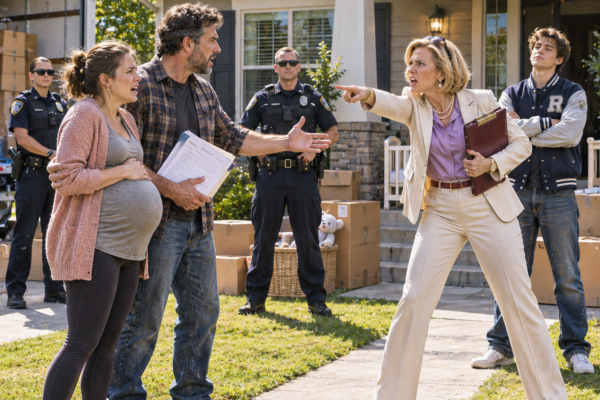
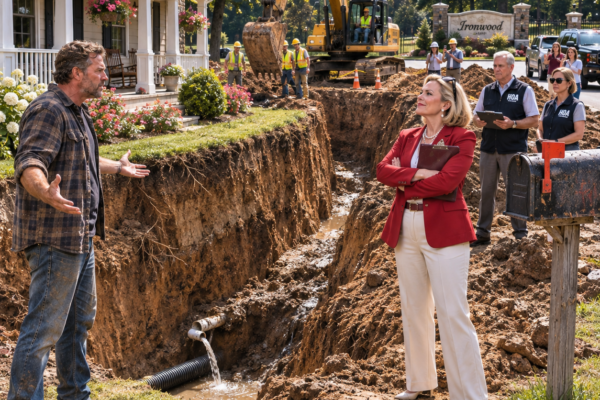
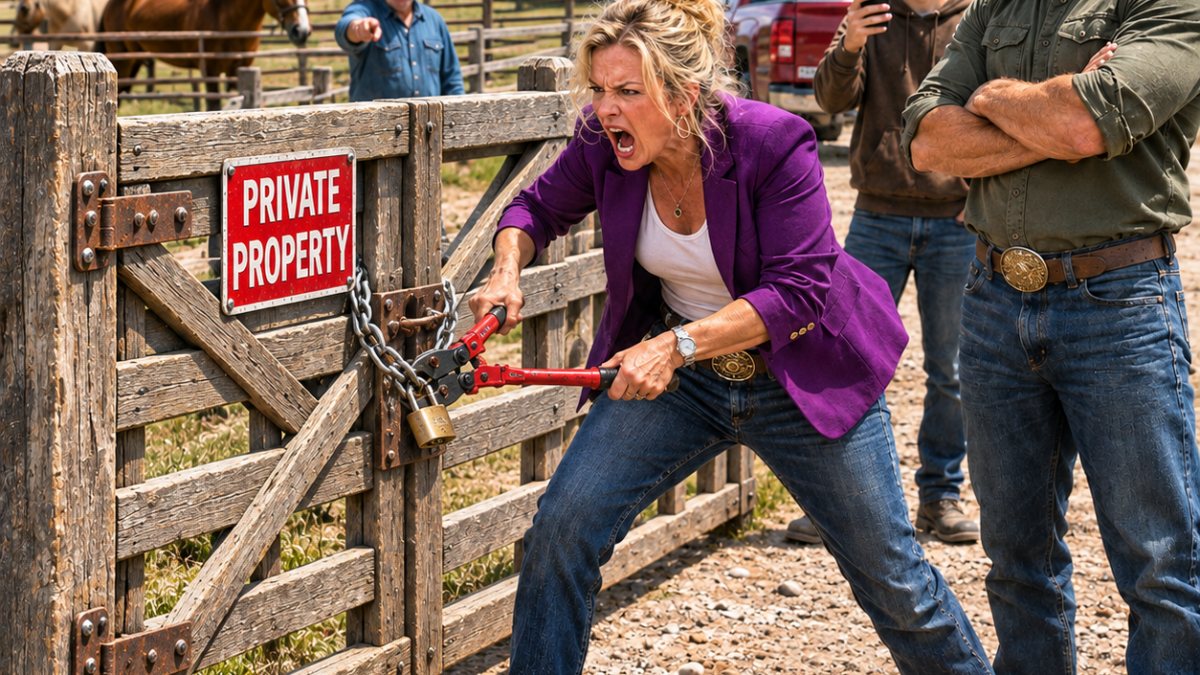
**“ARREST THIS SELFISH OLD RANCHER RIGHT NOW! HE’S LOCKED OUR EMERGENCY EXIT, TRAPPED NINETY FAMILIES IN THEIR OWN NEIGHBORHOOD, AND IF SOMEBODY DIES, IT’S GOING TO BE HIS FAULT!” Dylan Voss screamed into his phone while his mother, HOA president Marjorie Voss, stood beside my steel ranch gate, smiling as though the sheriff was about to hand them the keys to my 940-acre Colorado property.**
**I had locked that gate because the private road behind it crossed a rotting wooden bridge that an engineer had declared unsafe, but Dylan had already sold prospective homeowners on a promised second entrance and was now accusing me of endangering the same families he was secretly directing toward the closed crossing.**
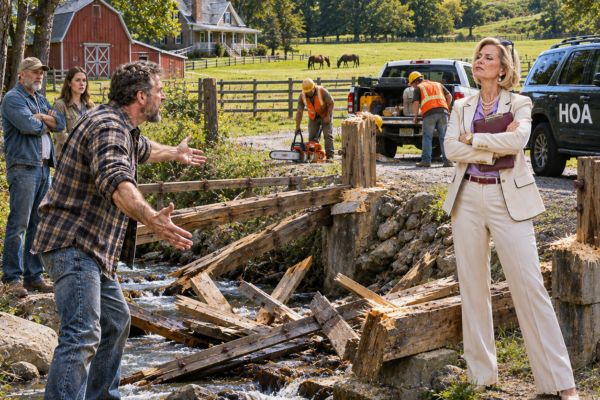
**Then my ranch hand called to say a white passenger van carrying children had entered through a broken section of fence, and as Deputy Andrew Hayes turned toward the creek, we heard a terrifying crack from beyond the cottonwood trees—followed by a little girl’s scream and the sound of a vehicle dropping through the bridge.**
The chain had been locked for less than twenty minutes when Dylan Voss called 911.
I was still standing beside the main entrance to Willow Bend Ranch, checking the hinges of a steel gate my father had installed years earlier.
The afternoon sun reflected off the new padlock.
Behind me stretched a narrow gravel road leading across the eastern pasture, through a stand of cottonwood trees, and down toward Willow Creek.
That road belonged to my ranch.
So did the gate.
So did the ground beneath it.
And the bridge near the creek had been closed because its wooden supports were no longer safe.
None of that mattered to Dylan.
He stood outside the gate in polished boots, designer jeans, and an expensive watch that caught the sunlight whenever he pointed at me.
His silver pickup was parked across the neighborhood road.
Beside it stood his mother, Marjorie Voss.
She wore a cream-colored jacket, dark sunglasses, and the kind of satisfied smile people get when they believe somebody else is about to do their fighting for them.
Dylan held his phone close to his face.
“YES, I’M REPORTING AN EMERGENCY! THIS MAN HAS BLOCKED THE ONLY SAFE EXIT FOR OUR NEIGHBORHOOD!”
I stared at him.
“The main entrance to Aspen Ridge is open, Dylan.”
He turned away.
“HE’S THREATENING RESIDENTS WHO TRY TO USE THE ROAD!”
“I haven’t threatened anybody.”
“HE REFUSES TO REMOVE THE LOCK!”
“Because it’s my gate.”
Marjorie stepped closer.
“Jack, this would all be easier if you’d cooperate.”
I looked at her.
“Cooperate with what? Letting your son send traffic across a bridge that could collapse?”
She ignored the question.
“Families depend on this route.”
“Then somebody has been telling those families something that isn’t true.”
Dylan lowered his phone.
“You just made a serious mistake.”
I pointed toward the warning sign attached to the gate.
PRIVATE RANCH ROAD.
BRIDGE CLOSED — UNSAFE CROSSING.
NO PUBLIC THROUGH ACCESS.
“Your mistake was promising people a road you don’t own.”
His face reddened.
“You have no idea how much money is involved in this project.”
I looked him straight in the eyes.
“Then you should’ve settled the property rights before spending it.”
He turned back to his phone.
A few minutes later, the first sheriff’s SUV arrived.
Deputy Andrew Hayes stepped out, glanced at the locked gate, and asked everyone to move away from the entrance.
Dylan practically ran toward him.
“Officer, arrest him! He’s creating a public safety emergency!”
Andrew looked at me.
“Sir, are you the property owner?”
“Yes. Jack Mercer.”
“And this gate belongs to you?”
“Yes.”
“What’s beyond it?”
“A private service road and a closed wooden bridge.”
Marjorie lifted a colorful neighborhood map.
PART2:
“This road is part of Aspen Ridge’s emergency access system.”
Andrew examined the map.
“Do you have a recorded agreement granting the association access?”
“Our legal advisers have the paperwork.”
“That’s not what I asked.”
Dylan interrupted.
“People have used that road for years!”
I folded my arms.
“My father occasionally allowed neighbors to walk along part of it. He never turned it into a public street.”
Andrew looked at the warning sign.
“Why is the bridge closed?”
“Rotting supports. I have the inspection report in my truck.”
Dylan laughed.
“He exaggerates everything.”
Andrew turned toward him.
“Mr. Voss, is anyone currently trapped or trying to evacuate?”
Dylan hesitated.
“There could be an emergency.”
“Is there one right now?”
He didn’t answer.
Then my phone rang.
Samuel Price.
My senior ranch hand.
I answered.
“Samuel?”
His voice was strained.
“Jack, we’ve got a van in the eastern pasture.”
I looked toward the cottonwoods.
“What van?”
“White passenger van. Came through the maintenance opening somebody forced apart.”
“Where is it?”
“Heading toward the creek.”
My stomach tightened.
“Samuel, the bridge is closed.”
“I know! I’ve been trying to stop them!”
I turned toward Andrew.
“Deputy, somebody’s driving toward the unsafe bridge.”
Andrew reached for his radio.
Then Samuel shouted through the phone.
“They’re going past the warning signs!”
I looked at Dylan.
“Did you send a white passenger van through my ranch?”
His expression changed.
For the first time that afternoon, he looked frightened.
Marjorie immediately stepped between us.
“My son doesn’t have to answer accusations.”
Then a sharp cracking sound echoed from the creek.
Another followed.
Louder.
I heard Samuel scream.
“JACK, THEY’RE ON THE BRIDGE!”
Andrew called for additional units.
I was already moving toward my truck.
Then came the sound I’ll remember for the rest of my life.
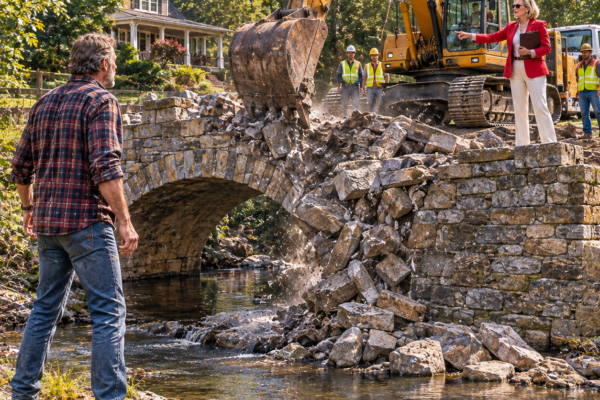
A deep wooden crash.
Metal grinding.
People screaming.
Samuel shouted:
“THE VAN’S GOING THROUGH!”
The phone filled with static.
And somewhere beyond the trees, a child began crying for her mother.
Three months earlier, I would’ve told you the hardest part of returning to Willow Bend Ranch was going to be fixing old fences.
I was forty-nine.
I’d spent years working in Denver, saving money, dealing with traffic, and promising myself that eventually I’d return to the place where I grew up.
When my father died, I inherited the ranch.
Nine hundred forty acres outside Redstone Valley, Colorado.
Green pastures.
Cottonwood groves.
An old creek winding through the eastern fields.
Several barns.
Miles of fencing.
And a farmhouse my father, William Mercer, had built room by room whenever he could afford it.
The property had belonged to my family for more than sixty years.
Dad raised cattle, repaired equipment, and somehow always found time to help a neighbor.
He taught me to ride horses before I was old enough to reach the stirrups properly.
He taught me how to fix a broken fence without spending money we didn’t have.
Most importantly, he taught me that keeping people safe mattered more than making life convenient.
When I returned from Denver, I hired two men to help run the ranch.
Samuel Price was fifty-six.
Gray beard.
Weathered hands.
Thirty years of experience working beside my father.
Samuel knew every field, every water trough, and every weak spot in the fencing.
My younger ranch hand was Noah Fletcher.
He had recently finished agricultural training and wanted to work with livestock.
Noah was hardworking, eager, and sometimes too quick to believe he could solve any problem by running toward it.
Samuel was forever telling him to slow down.
I enjoyed working with both of them.
We checked cattle before sunrise.
Repaired irrigation lines.
Cut hay.
Maintained the barns.
And spent more money fixing old machinery than I liked to admit.
One of my favorite places was the eastern pasture.
An old gravel service road crossed Willow Creek on a wooden bridge Dad had built decades earlier.
The crossing was never intended for heavy public traffic.
It served ranch vehicles and occasional farm equipment.
During my first month back, Samuel noticed deterioration in several support beams.
A contractor inspected the bridge.
His assessment was clear.
The supports had serious damage.
The bridge needed major repairs before it could safely carry ordinary vehicles.
I closed it immediately.
We placed warning signs at both approaches.
Restricted the service road.
And began planning a replacement.
I had no intention of allowing a family to drive onto a bridge that might break beneath them.
The decision seemed straightforward.
Then I discovered how much Aspen Ridge Estates had grown while I was away.
The development sat along my eastern boundary.
Large houses.
Decorative stone walls.
Perfect lawns.
Expensive landscaping.
More than ninety homeowners.
Its main entrance connected to the county highway several miles away.
But one of its smaller streets ended near my ranch gate.
From there, my old service road looked like a convenient shortcut through the pastures to the western highway.
It could save drivers almost fifteen minutes.
That was the problem.
A route that seemed useful on a map wasn’t necessarily a road people had the right—or ability—to use safely.
My father had occasionally let neighbors walk beside the pasture.
But he’d never agreed to open the road for regular public traffic.
The recorded property maps confirmed that the road belonged to Willow Bend Ranch.
No broad public driving easement crossed the old bridge.
At first, my relationship with Aspen Ridge residents was friendly.
Dorothy Collins lived near the southern edge of the development.
She was seventy-two and had known my parents for years.
Her eleven-year-old grandson, Benjamin, visited during school vacations.
Benjamin loved animals.
Especially Copper, the older brown horse that had belonged to my father.
He could spend an entire afternoon brushing Copper and asking questions.
Dorothy often brought homemade bread or apple pie.
Several other Aspen Ridge families bought eggs from us or came to small ranch demonstrations.
I liked having good neighbors.
Then Marjorie Voss arrived.
Her black luxury SUV pulled into my driveway one Tuesday morning.
She stepped out wearing a bright green jacket and carrying an oversized leather handbag.
Everything about her appearance suggested she expected to be taken seriously.
“Jack Mercer?”
“Yes.”
“I’m Marjorie Voss, president of the Aspen Ridge Homeowners Association.”
She smiled.
“I represent more than ninety homeowners.”
I invited her onto the porch.
Offered water.
She complimented the mountain views.
Then mentioned the eastern service road.
“Our residents have used that shortcut for years.”
“Some people might have walked there with my father’s permission,” I said. “That doesn’t make it a public road.”
She waved one hand.
“We’d like you to remove the gate and let our association maintain the route.”
“No.”
Her smile faded.
“Excuse me?”
“The bridge is unsafe. We’ve closed it.”
“Our residents need that road.”
“Then they’ll need a different route.”
“Do you understand how inconvenient that is?”
“Yes. But inconvenience doesn’t make a damaged bridge safe.”
She leaned forward.
“Our engineers can handle the bridge.”
“Then your engineers can discuss a proposal with mine once the land rights are settled.”
Marjorie laughed.
“Jack, you’re making this unnecessarily complicated.”
I looked toward the eastern pasture.
“It’s private ranch land with cattle, machinery, fences, and a dangerous creek crossing.”
She folded her arms.
“The road is covered by an old access arrangement.”
“Then show me the recorded agreement.”
Her expression hardened.
“I don’t carry legal paperwork everywhere I go.”
“Your attorney can send it.”
She left unhappy.
I called my attorney, Laura Mitchell.
Laura had helped handle my inheritance.
She reviewed the property records and confirmed that the eastern road was part of Willow Bend Ranch.
She found no recorded agreement granting Aspen Ridge homeowners general vehicle access through the property.
She reminded me to respect any valid specific access rights that might exist.
But she also advised me to keep the bridge closed, preserve the inspection report, and document all warnings.
We did.
Large signs.
Photographs.
Written notice to the HOA.
I thought reasonable people would understand.
Then the violation letters began.
One claimed I’d created a traffic hazard by restricting an established neighborhood route.
Another demanded removal of my gate.
The letters threatened to report the ranch for violating local safety requirements.
Laura replied with the property documents and bridge inspection.
Marjorie called the following afternoon.
“YOU’RE DELIBERATELY MAKING LIFE DIFFICULT FOR OUR RESIDENTS!”
“No, Marjorie. I’m preventing them from driving across an unsafe bridge.”
“You simply don’t like wealthy homeowners!”
“I don’t care what houses they own.”
“Then unlock the gate!”
“No.”
She went silent.
Then said:
“My son knows how to handle people like you.”
Dylan arrived the next morning.
Thirty-one years old.
Silver pickup.
Oversized tires.
Expensive watch.
He introduced himself as a development consultant.
Then spread a large color map across the hood of his truck.
Aspen Ridge Estates.
The western highway.
Willow Bend Ranch.
A thick blue line crossed my eastern pasture and continued directly over the old bridge.
“That’s the planned second entrance,” he said.
I studied the drawing.
“You’ve drawn a public road through my cattle pasture.”
“An improved access road.”
“On land you don’t own.”
“We’ve been using it for years.”
“Occasional use doesn’t establish whatever rights your company wants.”
Dylan tapped the map.
“We have forty additional homes planned for the expansion.”
“Then you should secure access before advertising it.”
He smiled tightly.
“The second entrance will improve safety and property values.”
“Not if it collapses under traffic.”
“Our contractors can strengthen the bridge.”
“After the road opens?”
“That’s part of the process.”
I stared at him.
“You don’t open a dangerous bridge and repair it afterward.”
Dylan offered a small payment to let crews begin work.
I refused.
Then he leaned across the truck hood.
“Jack, millions of dollars depend on this project.”
“Then your company should be careful with those millions.”
“You don’t understand who you’re dealing with.”
I folded the map.
“And you don’t understand that my answer is no.”
He drove away furious.
That evening, Samuel told me Dylan’s father, Charles Voss, had once approached Dad about buying access through the same pasture.
Dad had refused.
The bridge wasn’t suitable for public traffic.
The route interfered with cattle operations.
And the family never wanted a busy neighborhood road crossing the ranch.
Samuel helped me search Dad’s files.
We found a letter from the original developer requesting access.
And Dad’s written refusal.
That mattered.
I made copies.
Then Dorothy arrived with the latest Aspen Ridge newsletter.
On page two was a cheerful map announcing improved emergency access to the western highway.
The route ran straight across my property.
Through the bridge I’d already closed.
I called Laura.
She sent another letter warning the HOA not to advertise an unsafe private road as an available emergency exit.
That should’ve ended the matter.
Instead, tire tracks appeared around my eastern fence.
Someone had forced a vehicle through a narrow grassy opening.
Broken posts.
Damaged fencing.
A water trough knocked sideways.
The tracks continued toward the closed bridge.
I repaired the fence with Samuel and Noah.
Then installed a stronger steel gate and chain.
Marjorie arrived that afternoon.
“REMOVE THAT LOCK!”
“No.”
“YOU’RE BLOCKING OUR EMERGENCY ROUTE!”
“Your neighborhood has another entrance.”
“This is our second exit!”
“Not without a legal agreement and a safe crossing.”
She pointed toward the chain.
“My son knows people who can cut through that in minutes.”
“Cutting a lock doesn’t create property rights.”
Then Dylan began showing prospective buyers the entrance.
One afternoon, a white passenger van stopped outside the gate.
Dylan stood beside it holding a map.
I heard him describing the route as the future western exit.
I approached.
A woman near the van asked whether the road was already approved.
“No,” I said.
Dylan’s smile disappeared.
“Jack, we’re conducting a private tour.”
“Then give your visitors accurate information.”
One prospective buyer looked confused.
“The brochure says this is a guaranteed second entrance.”
I pointed toward the locked gate.
“My ranch road is private. The bridge is unsafe and closed.”
Dylan snapped.
“STOP INTERFERING WITH MY BUSINESS!”
“Stop promising something you don’t control.”
The visitors returned to the van.
Dylan watched them leave.
His expression told me I’d just cost him something.
That evening, an unknown number sent me a threatening message.
STOP INTERFERING WITH ASPEN RIDGE’S FUTURE.
YOU’LL REGRET IT.
I saved the message.
Forwarded it to Laura.
Then went outside to check the horses.
I was tired of arguing.
But I wasn’t going to unlock an unsafe bridge because somebody wanted to sell more houses.
A week later, Samuel and I replaced the damaged gate chain.
I installed another padlock.
Checked the warning signs.
Made sure the fence was secure.
Then Dylan arrived.
Silver pickup.
Angry expression.
Phone already in his hand.
“YOU CAN’T LOCK THIS!”
“It’s my gate.”
“YOU’RE BLOCKING THE WHOLE NEIGHBORHOOD!”
“The main entrance is open.”
“You’re creating an emergency!”
“Then explain what emergency is happening.”
He didn’t answer.
Instead, he dialed 911.
And within minutes, Deputy Andrew Hayes was standing beside my locked gate listening to Dylan accuse me of holding ninety families hostage.
That was the moment Samuel called about the white passenger van.
And that was when everything changed.
The driver had entered through an old maintenance opening someone had forced apart.
Samuel tried stopping him.
But the van continued down the private service road toward Willow Creek.
Inside were prospective homeowners.
Adults.
Children.
People who had been told the route was approved.
I followed Andrew’s patrol SUV along a safer ranch road toward the creek.
As we approached, I saw dust hanging over the cottonwoods.
Then I saw the van.
White.
Large.
Partially suspended through the broken center of my wooden bridge.
The rear wheels rested on remaining planks.
The front end hung toward muddy water.
Part of the railing had collapsed against the passenger side.
The creek was swollen from recent rain.
Samuel stood on firm ground waving us away from the damaged structure.
“DON’T GET ON THE BRIDGE!”
Andrew immediately radioed for firefighters and medical assistance.
A man inside the van shouted through an open rear window.
“PLEASE! WE’VE GOT KIDS IN HERE!”
I moved as close as I could safely approach.
“Help is coming!”
The van shifted.
A wooden beam cracked.
Someone screamed.
Samuel grabbed my arm.
“Jack, stay back. That bridge could go any second.”
I knew he was right.
But hearing frightened children inside that vehicle while I stood helplessly on the bank was unbearable.
The first fire engine arrived.
Captain Olivia Brooks stepped out and studied the scene.
She immediately ordered everyone away from the unstable decking.
Her crew positioned rescue equipment from firm ground and worked to secure the van.
Inside were several passengers.
A ten-year-old boy named Tyler.
His grandfather.
Other adults.
A woman named Melissa Grant.
And Melissa’s seven-year-old daughter, Abigail.
Abigail was trapped near the front.
The damaged side of the van had pushed a seat against her leg.
Melissa couldn’t reach her.
“MY DAUGHTER’S STUCK!” she screamed.
Captain Brooks spoke calmly through the broken passenger window.
“Abigail, I’m Olivia. We’re going to help you.”
The little girl was crying.
“My leg hurts!”
“I know, sweetheart. Stay as still as you can.”
Firefighters secured the vehicle and began helping passengers escape through the rear.
Tyler came out first.
Then his grandfather.
Then several adults.
Each person who reached solid ground brought relief.
But Abigail remained trapped.
Melissa was still inside.
A plank broke beneath the rear wheels.
The van dropped several inches.
Water splashed against the lower passenger door.
Someone shouted.
I instinctively moved forward.
Samuel caught my arm again.
“Let the rescuers work.”
I stopped.
Olivia and another firefighter reached Abigail.
They carefully freed the damaged seat.
Then lifted her toward safety.
When Olivia emerged carrying the little girl, Melissa started crying.
A moment later, the mother was helped out too.
The remaining passengers and driver followed.
Paramedics rushed toward Abigail.
She was conscious.
Breathing.
Frightened.
But alive.
Melissa held her daughter’s hand and thanked the firefighters through tears.
Then, only minutes after the last passenger was removed, another section of the bridge collapsed.
The van shifted downward with a terrible metallic crash.
Rescue workers moved everyone farther away.
I stood staring at the broken crossing.
That could have happened while Abigail was still inside.
I turned toward Samuel.
He looked as shaken as I felt.
Deputy Hayes approached.
“Jack, I need to ask you some questions.”
I showed him the bridge inspection.
Photographs.
Warning signs.
Property records.
He asked whether anyone had permission to drive the van through the ranch.
“No.”
Then he questioned the driver.
Peter Lawson.
Peter explained that he was conducting a tour for prospective Aspen Ridge buyers.
The development company had supplied a route map.
It showed the ranch road as an approved second entrance.
Peter admitted he’d seen the warning signs.
But somebody from Dylan’s company assured him the route was safe.
Andrew asked who had given that assurance.
Peter hesitated.
Then answered.
“Dylan Voss.”
My hands tightened into fists.
Dylan had stood at my gate screaming about public safety.
While a van full of families was being directed toward a bridge I had repeatedly warned him was unsafe.
I wanted to confront him.
Andrew stopped me.
“Let us establish exactly what was said.”
I nodded.
He was right.
Anger wouldn’t change the evidence.
That evening, after emergency crews secured the broken crossing, I returned to the farmhouse.
The ranch was quiet.
But I kept hearing the screaming.
The cracking beams.
The grinding metal.
The little girl calling for her mother.
The next morning, I visited Abigail at the hospital.
Her ankle was broken.
She had painful bruises.
But doctors expected her to recover.
Melissa sat beside her bed.
When she saw me, she stood.
“Mr. Mercer?”
“Yes.”
“I heard you own the ranch.”
I nodded.
She looked embarrassed.
“They told us that road was open.”
“I know.”
“We believed them.”
“You had no reason to think the developer was sending your family somewhere dangerous.”
Abigail looked toward me.
“Did the bridge break because I was too heavy?”
My throat tightened.
I pulled a chair beside her bed.
“No, sweetheart.”
She looked unconvinced.
“The bridge was already damaged,” I explained. “That’s why I closed it.”
She nodded slowly.
“You didn’t do anything wrong.”
A small smile appeared.
Then she asked whether I had horses.
I showed her a picture of Copper.
For the first time since entering the room, she laughed.
That sound meant more to me than I could explain.
When I returned home, Dorothy was waiting with Benjamin.
She brought bread.
Benjamin wanted to know whether the children in the van were safe.
I told him about Abigail.
Then he asked the same question that had been running through my mind.
“Why would somebody drive across a bridge marked unsafe?”
“Because they were told it was safe.”
He thought about that.
“Then the person who told them should’ve checked.”
I nodded.
“Exactly.”
The accident changed how Aspen Ridge residents viewed the proposed entrance.
Some homeowners had purchased properties partly because of the promised shortcut.
Others had paid extra for homes close to what they believed would become the western exit.
Now families were discovering that no agreement had been secured with me.
Thomas Wilson, a retired mail carrier who lived near the main entrance, invited me to a meeting.
About twenty homeowners attended.
I brought the property map and bridge inspection.
I explained that the road was private.
The bridge had been closed for safety.
And I’d never refused to cooperate with genuine emergency responders.
One woman asked whether the developer knew the bridge was dangerous.
“I warned Marjorie and Dylan personally.”
Several residents exchanged looks.
Then Thomas showed the expansion brochure.
The words GUARANTEED SECOND ENTRANCE appeared beside the route crossing my ranch.
I stared at them.
Nothing in that brochure changed the ownership of a single foot of land.
But buyers had trusted it.
Then Marjorie and Dylan arrived.
Marjorie demanded to know why I was speaking at an HOA meeting.
Thomas calmly explained that residents wanted accurate information.
Dylan stepped forward.
“The bridge accident was unfortunate, but it doesn’t change our development plans.”
A woman near the front raised her hand.
“Did you tell the tour driver the road was safe?”
Dylan’s expression hardened.
“That’s under investigation.”
“Did you?”
He avoided answering.
Marjorie accused me of trying to damage the Voss family’s reputation.
I looked at her.
“I’m explaining why I locked my gate.”
She leaned closer.
“You’ll regret humiliating us.”
I didn’t respond.
Then the meeting ended with residents demanding copies of the road agreements and development records.
For almost two weeks, things were quiet.
Samuel and Noah repaired fencing.
Benjamin returned to brushing Copper.
I hoped everyone would finally focus on finding a safe alternative route.
Then survey flags appeared upstream from Willow Creek.
Orange markers.
Fresh tire tracks.
Gravel piled beside a drainage channel.
A temporary wooden crossing.
Nobody had asked permission to enter my property.
Laura checked the development filings.
Dylan’s company had submitted preliminary plans for a new creek crossing near the damaged bridge.
The documents included drainage pipes and a raised gravel approach extending toward my eastern boundary.
Submitting plans wasn’t permission to build.
But somebody was already moving material.
Then a young construction worker named Wesley Finch came to my gate.
He looked nervous.
“Mr. Mercer, can I talk to you?”
I invited him onto the porch.
Samuel joined us.
Wesley explained that his crew had been instructed to prepare a temporary crossing before the county finished reviewing the project.
The supervisor claimed investors expected construction to begin soon.
Several workers were concerned.
The drainage pipes were small.
The gravel embankment could block stormwater.
And heavy rain was forecast.
Wesley showed me photographs.
Large piles of gravel were being pushed into the creek.
Pipes had been placed to carry water beneath the temporary road.
But branches and debris could easily clog them.
I thanked Wesley for coming forward.
Then contacted Laura and the county.
An inspector visited the site.
He confirmed the work needed proper review.
The contractor was instructed to stop until the drainage concerns were resolved.
Dylan drove to my gate that afternoon.
He carried another set of drawings.
“THE COUNTY IS MAKING A BIG DEAL OUT OF NOTHING!”
I looked at him.
“An inspector says your crossing could interfere with the creek.”
“Our engineers know what they’re doing.”
“Then let the inspection finish.”
“You’re trying to destroy my business!”
“No, Dylan. I’m trying to prevent another accident.”
He leaned out his truck window.
“If you keep interfering, I’ll make sure this ranch suffers financially.”
I stared at him.
“Your company’s promises aren’t my responsibility.”
He drove away.
That evening, Dorothy invited Samuel, Noah, and me for dinner.
Benjamin talked excitedly about a school project on rivers.
He’d been learning how streams changed during storms.
Then he said something that made Samuel stop eating.
“Mr. Jack, if somebody blocks a creek, doesn’t the water have to go somewhere else?”
I looked at him.
“Yes.”
“Then won’t that gravel make the water go toward Grandma’s house?”
Dorothy’s cottage sat below an old drainage channel.
Usually dry.
But capable of carrying overflow during heavy storms.
Samuel and I exchanged looks.
The next morning, I checked the forecast.
Thunderstorms were expected across the upper valley.
We moved equipment away from low ground.
Secured cattle on higher pasture.
Checked fencing.
Then I called Dorothy.
“Keep an eye on the weather alerts.”
She laughed gently.
“Jack, I’ve lived here long enough to know when rain is coming.”
“I know. But I’m worried about the temporary work upstream.”
She became quiet.
“Should we leave?”
“Follow any official evacuation guidance, and be ready to go if the route is safe.”
She promised.
By late afternoon, dark clouds covered the mountains.
Thunder rolled across Redstone Valley.
Then rain began falling.
Hard.
By seven o’clock, the eastern creek was rising faster than usual.
Samuel called from high ground near the equipment shed.
“Jack, water’s backing up behind the gravel crossing.”
“Are you somewhere safe?”
“Yes.”
“Don’t go near it.”
He reported branches collecting around the drainage pipes.
Water was spilling around the sides.
I called emergency dispatch.
Then Dorothy.
She answered sounding frightened.
“Jack, there’s water in the garden.”
“How much?”
“Almost to the porch.”
“Where’s Benjamin?”
“With me.”
“Follow the emergency instructions and get to higher ground if there’s a safe route.”
Then Noah came running into the farmhouse.
His boots were covered in mud.
“The temporary crossing is holding back a huge amount of water.”
I looked outside.
Rain hammered the windows.
Then a low rumble came from the eastern pasture.
It sounded like a distant train.
My phone rang.
Samuel.
His voice was almost unrecognizable.
“JACK, THE CROSSING’S GONE!”
“What?”
“THE GRAVEL BANK BROKE!”
A rush of muddy water had burst through the failed temporary construction.
Instead of flowing naturally along the creek, the surge was moving through the old drainage channel.
Toward Dorothy’s cottage.
I called her immediately.
She answered.
“Jack, the backyard’s flooding!”
I could hear Benjamin shouting in the background.
Something crashed.
Then the boy took the phone.
“MR. MERCER, THE TREE FELL ACROSS OUR DRIVEWAY!”
“Benjamin, listen carefully.”
His breathing was fast.
“Don’t go into the moving water.”
“Grandma can’t walk very fast!”
“Stay together and follow the dispatcher and rescue crew’s instructions.”
Then another crash came through the phone.
Dorothy screamed.
Water was striking the house.
I ran toward my truck.
The road to her cottage was already covered by moving water.
I stopped well before the flooded section.
The current was strong enough to carry debris and damage vehicles.
I called dispatch again.
Reported their location.
Reported that the driveway was blocked.
Then I looked across the flooded meadow.
Dorothy’s yellow cottage stood beneath the trees.
Water rushed around its front steps.
A large log struck the porch.
The railing broke.
Another impact shook the building.
The phone crackled.
Dorothy’s voice came through.
“Jack, we’re upstairs.”
“Good. Stay away from the windows.”
“The water’s coming inside.”
“Rescuers are coming.”
She began crying.
“Promise me Benjamin will be safe.”
I swallowed.
“We’re doing everything we can.”
Then I heard Benjamin scream.
“GRANDMA FELL!”
The staircase had begun breaking apart.
Dorothy was injured.
Benjamin couldn’t lift her.
A flashlight appeared in the upstairs window.
Then disappeared.
Another mass of floating timber struck the side of the cottage.
The building shuddered.
Its foundation began shifting.
And before my eyes, the little yellow house started leaning toward the creek.
Deputy Andrew Hayes arrived beside me.
Fire trucks followed.
Captain Olivia Brooks stepped out into the rain.
I pointed toward the upstairs window.
“Two people trapped. Elderly woman injured. Eleven-year-old boy with her.”
Olivia studied the flood.
Then ordered a rescue from higher ground.
Nobody was allowed to enter the current.
A narrow ranch trail approached the cottage from behind.
Dad had once used it during spring floods.
I explained the route.
Olivia sent trained rescuers around the upper pasture with equipment.
I called Benjamin again.
He answered after several attempts.
“Mr. Jack?”
“I’m here.”
“Grandma’s hurt.”
“I know. Firefighters are coming from behind the house.”
He began crying.
“Are we going to die?”
I felt tears filling my eyes.
But I kept my voice steady.
“Remember how you calm Copper when there’s thunder?”
A pause.
“Yes.”
“Keep talking to your grandma the same way. Stay together. Listen to the firefighters when they reach you.”
He promised.
Then I watched rescue lights move through the trees behind the cottage.
A firefighter reached the upstairs window.
Benjamin appeared behind the glass.
The rescuers established a safe exit from the rear.
The boy was brought out first.
He kept looking back.
He wouldn’t leave until a firefighter promised someone was helping his grandmother.
Dorothy was trapped beneath a fallen cabinet.
Her leg was badly injured.
The rescue crew freed her.
Secured her on a stretcher.
Then brought her through the upstairs opening.
When Benjamin saw his grandmother emerge, he began crying again.
This time with relief.
I leaned against my truck.
My legs felt weak.
They were alive.
Both of them.
Then, less than ten minutes after the rescue, Dorothy’s cottage collapsed.
The porch disappeared.
Part of the roof fell.
The yellow walls tilted and broke apart.
Pieces of furniture floated through the flooded garden.
I watched helplessly.
The house where Dorothy had spent decades of her life was gone.
But Benjamin was standing beside the rescue vehicle holding his grandmother’s hand.
I kept looking at them.
Reminding myself what mattered most.
Dorothy was taken to the hospital with a broken leg and severe bruising.
Benjamin went with her.
I returned to the ranch after midnight.
Samuel and Noah were checking cattle.
Several fences had been damaged.
One water trough was gone.
Mud and construction debris covered the lower pasture.
But most of the animals were safe.
The next afternoon, I visited Dorothy.
She lay in bed with her injured leg supported by pillows.
Benjamin sat beside her holding a photograph of the cottage.
When I entered, he stood and hugged me.
“Our house is gone.”
I held him.
“I know.”
Dorothy looked toward me.
“I don’t know where we’re going to live.”
I sat beside her.
“I’ve got empty bedrooms at the farmhouse.”
She shook her head immediately.
“Jack, I can’t impose on you.”
“You’ve been bringing food to my family for years.”
“That isn’t the same.”
“It’s close enough.”
Benjamin looked up.
“Can Copper come to the house?”
I laughed softly.
“Copper’s a little big for the living room.”
He smiled.
It was the first time I’d seen him smile since the flood.
Within a week, Dorothy and Benjamin moved into my guest rooms.
Thomas brought blankets.
Neighbors donated clothes and household supplies.
Melissa Grant visited with Abigail, who was recovering from her broken ankle.
She brought cookies and a small toy horse for Benjamin.
Watching the children laugh together reminded me that most Aspen Ridge residents had nothing to do with the decisions causing all this harm.
They were ordinary families.
They wanted safe homes.
Reliable roads.
Good neighbors.
And people in charge who told them the truth.
Meanwhile, Laura obtained preliminary findings about the temporary creek crossing.
The contractor had been warned about inadequate drainage.
An engineer had recommended delaying construction.
But Dylan’s company continued pushing the project.
Investors were expecting visible progress.
The expansion included more than forty expensive homes and additional roads.
The second entrance was an important selling point.
If Dylan couldn’t deliver it, financing could be threatened.
Now his desperation made sense.
Not his behavior.
But his motive.
He’d made promises involving land he didn’t own.
Then treated every warning as an obstacle to overcome.
And innocent people had suffered.
Then Laura discovered something worse.
A new document had appeared in the county records.
A supposed permanent road easement across my eastern pasture.
It carried my father’s signature.
William Mercer.
According to the filing, Dad had authorized the neighboring development to construct and maintain a road through Willow Bend Ranch.
I stared at the signature.
It looked similar to his.
But the date bothered me immediately.
The document claimed he’d signed it during a period when he was seriously ill and living in a nursing facility.
I remembered those months.
I’d spent countless afternoons beside his bed.
He’d been unable to handle complicated business decisions.
And I had never heard him mention granting a permanent road easement.
Laura laid another document beside it.
Dad’s original refusal.
Clear.
Dated.
Signed.
Two papers telling opposite stories.
I felt sick.
Somebody was using my father’s name to create a right he had specifically refused to grant.
Laura warned that the document would need proper examination.
Recorded paperwork wasn’t automatically valid simply because someone submitted it.
She began challenging the filing through the appropriate process.
Then Samuel remembered something.
Dylan’s father, Charles Voss, had been involved in the original negotiations.
Charles was Marjorie’s late husband.
The original developer had asked Dad for access.
Dad refused because the route crossed working pastures and depended on a bridge that would require major rebuilding.
Samuel agreed to provide a statement.
Then former development employee Rachel Simmons contacted Laura.
Rachel had worked as an office manager for Dylan’s company.
She said investors wanted proof of the second entrance before releasing additional financing.
She remembered seeing an old unsigned draft agreement between Charles Voss and Dad.
The draft required several conditions.
A safe crossing.
Proper county approval.
A completed agreement.
But a later version appeared in the company files with a signature and wording suggesting permanent access already existed.
Rachel didn’t know who changed every document.
But she knew the versions were different.
Then she showed us the investor schedule.
The deadline for confirming the second entrance was less than two weeks away.
I looked at Laura.
“That’s why he’s rushing.”
She nodded.
“It’s certainly relevant.”
I wanted to believe the investigation would stop further harm.
Then another demand letter arrived from Voss Ridge Development Holdings.
It claimed my gate interfered with planned improvements.
It demanded access for survey workers.
It threatened financial consequences.
Laura rejected the demand.
She reminded the company that disputed paperwork didn’t authorize construction.
Three nights later, Dylan cut my lock.
I woke to heavy engines outside the farmhouse.
Work lights shone across the eastern pasture.
A yellow bulldozer stood near my steel gate.
Trucks moved along the private service road.
I checked the gate camera.
Two men had cut through the heavy chain.
A pickup pulled the gate open.
Then construction vehicles entered.
Dylan’s silver truck led the convoy.
I called 911.
Then Samuel called.
“Jack, they’re tearing out the cattle fence!”
I hurried outside.
Noah had gone toward the lower pasture to secure a livestock gate.
More than fifty cattle were becoming frightened by the lights and machinery.
I followed the main ranch road toward a safe viewing area.
When I arrived, a bulldozer had already knocked down part of the eastern fence.
Workers stood beside the equipment.
Dylan argued with Samuel near a pickup.
I shouted.
“SHUT THOSE ENGINES OFF! YOU’RE GOING TO STAMPEDE THE HERD!”
Dylan turned.
“WE HAVE AUTHORIZATION TO BUILD THIS ROAD!”
He waved a document bearing what looked like a court stamp.
“YOU’VE BEEN ORDERED TO STOP INTERFERING!”
“No court has authorized you to cut my gate and destroy my fences.”
Dylan laughed.
“Your lawyer can complain tomorrow.”
Then he ordered the bulldozer forward.
Samuel shouted.
“STOP! THE CATTLE ARE BUNCHING UP!”
The animals were pressing together near the damaged fence.
Heads raised.
Ears twitching.
Trying to get away from the engines.
Then the bulldozer struck a gate support.
Metal crashed.
Fence rails snapped.
The herd panicked.
Dozens of cattle ran through the opening.
Dust swallowed the lower pasture.
Samuel yelled for everyone to move away.
Noah appeared near a side gate, trying to redirect the animals toward safer ground.
I shouted for him to get clear.
But the gate was jammed.
His ranch vehicle had stalled beside a broken fence post.
Then a cow struck the fence.
The rails collapsed.
Noah fell.
His flashlight disappeared into the dust.
I couldn’t see him clearly.
But I knew he was lying in the path of the herd.
Then I saw a large bull turning toward him.
The frightened animal lowered its head.
Noah tried crawling backward.
His leg was trapped beneath a fallen rail.
“NOAH! GET AWAY!”
He couldn’t move.
Meanwhile, several cattle were running downhill toward Willow Creek.
The old bridge was gone.
Only temporary barriers stood near the steep bank.
Those barriers weren’t designed to stop a stampede.
Samuel shouted that the herd was splitting.
One group toward Noah.
Another toward the creek.
Then the bull charged.
Noah raised one arm over his head.
For one terrible second, I thought he was going to die.
Samuel reacted first.
He moved toward the safer side of a heavy feed trailer and used its metal gate to redirect the bull.
Another worker switched off the bright lights shining directly toward the animals.
The bull struck the trailer gate.
Then changed direction.
I rushed toward Noah once the path was clear.
He was lying on his side.
Breathing.
Blood ran from a cut near his forehead.
His leg remained trapped beneath the broken fence.
“Noah, can you hear me?”
His eyes opened.
“My leg.”
“I know. Stay still.”
He tried moving.
I placed a hand on his shoulder.
“Help’s coming.”
Then a terrible crash came from the creek.
Several cattle had broken through the temporary barrier.
Mud collapsed beneath them.
Two animals struggled near the bank.
One managed to climb toward higher ground.
Another disappeared behind a fallen tree.
Samuel began directing the ranch hands toward the upper pasture gates.
Nobody approached the unstable creek edge.
Deputy Hayes arrived with additional responders.
Then Captain Olivia Brooks and the medical team reached Noah.
Paramedics stabilized his injured leg.
He kept apologizing.
“Jack, I couldn’t get the gate open.”
I took his hand.
“You were trying to protect the herd.”
“Are the cattle okay?”
Even injured, that was his first concern.
I swallowed.
“Samuel’s handling it.”
Most of the cattle were eventually moved into the western pasture.
Several were injured.
A veterinarian examined them once the area was safe.
One animal had suffered a severe leg injury and couldn’t be saved.
I stood beside Samuel afterward, staring toward the creek.
My father had taught me that livestock weren’t simply numbers in a ledger.
They depended on us.
And now one was dead because strangers had forced heavy equipment into a working pasture in the middle of the night.
Deputy Hayes ordered the construction crew to stop.
He separated witnesses.
Took statements.
Then approached Dylan.
“Who authorized cutting Mr. Mercer’s gate?”
Dylan held up the paper.
“We have a right to use the road.”
“That isn’t what I asked.”
Dylan’s mouth tightened.
“The easement gives us access.”
Andrew looked toward the broken fence.
“A disputed easement doesn’t automatically authorize breaking locks and damaging livestock facilities.”
Then my phone rang.
Laura.
Her voice was urgent.
“Jack, the supposed court order Dylan’s showing is not valid.”
I closed my eyes.
“The court issued no permission for construction.”
“I know.”
“There’s something else.”
I waited.
“Someone filed a document this afternoon claiming you’ve transferred the eastern section of Willow Bend Ranch to Voss Ridge Development Holdings.”
I stared toward the bulldozers.
“What?”
“It carries your signature.”
“I never signed anything.”
“I know.”
For a moment, everything felt unreal.
Abigail’s broken ankle.
Dorothy’s destroyed cottage.
Benjamin trapped in the flood.
Noah being carried toward an ambulance.
The dead cow near the creek.
And now somebody had filed paperwork pretending I’d sold part of the ranch.
Dylan wasn’t simply trying to open my gate.
He was trying to take control of the land behind it.
Then Marjorie arrived.
Her black SUV stopped near the broken fence.
She stepped out wearing an expensive cream-colored coat.
She barely looked at the ambulance.
Or the frightened cattle.
Instead, she marched toward Andrew.
“WHY ARE YOU STOPPING MY SON’S CONSTRUCTION PROJECT?”
Samuel turned toward her.
“A young man nearly died tonight.”
Marjorie looked uncomfortable for a moment.
Then said something that made me stare at her.
“This could all have been avoided if Jack had simply opened the gate.”
I walked toward her.
“Abigail broke her ankle because a driver was sent across an unsafe bridge.”
She didn’t answer.
“Dorothy lost her home after unauthorized creek work contributed to a flood.”
Marjorie looked away.
“Noah nearly died tonight because Dylan forced bulldozers into my cattle pasture.”
She folded her arms.
“And none of that would’ve happened if you’d cooperated.”
For a moment, I couldn’t speak.
Then I remembered my father’s voice.
Stay calm when somebody wants an argument.
So I asked one question.
“Marjorie, how many people have to get hurt before you admit this road was never yours to promise?”
She stared at me.
No answer.
That night, I returned to the farmhouse exhausted.
Dorothy sat on the porch with Benjamin.
She was still recovering from her broken leg.
Benjamin asked about Noah.
I told him the doctors expected him to recover.
Then he hugged me.
“I wish everyone would stop fighting.”
I looked toward the mountains.
“So do I.”
Dorothy asked whether I regretted returning to the ranch.
“No.”
“Even after everything?”
I looked toward the barns.
The fields.
The place Dad had spent his life protecting.
“I’m tired,” I admitted. “But I’m home.”
The following Monday, Laura showed me the supposed land transfer.
It claimed I’d sold the eastern pasture to Voss Ridge Development Holdings.
My name appeared on the document.
So did an imitation of my signature.
It referenced a payment I’d supposedly received.
But the bank account listed wasn’t mine.
No money had been transferred to any account I controlled.
I hadn’t negotiated a sale.
Hadn’t signed a contract.
Hadn’t agreed to surrender an inch of the ranch.
Laura compared the signature with earlier documents.
There were differences.
Subtle.
But visible.
She arranged for proper examination and filed the necessary challenges.
Rachel Simmons supplied more records from Dylan’s company.
One showed an internal discussion about investors refusing to release financing without proof of the second entrance.
Another referenced using older development papers to show that the road rights had already been settled.
Investigators interviewed contractors.
One admitted helping prepare copies of old property documents but claimed he believed they were genuine.
Another confirmed Dylan ordered the bulldozers onto my land because he wanted visible progress before an investor meeting.
The evidence was building.
Not through threats.
Not shouting.
But records.
Statements.
Dates.
Signatures.
Financial transactions.
Exactly the things Dylan and Marjorie had spent months dismissing.
Meanwhile, Aspen Ridge homeowners demanded another meeting.
This time, more than sixty people attended.
Melissa Grant was there with Abigail, who was recovering with a walking boot.
Thomas Wilson stood near the front with a stack of financial documents.
Residents wanted to know why their HOA had promised a second entrance across private property.
Why the tour van had been sent toward a closed bridge.
Why contractors had worked near Willow Creek despite drainage concerns.
And whether HOA money had been used to support Dylan’s private development company.
I attended with Laura.
When I entered, several homeowners thanked me for warning them about the bridge.
One elderly couple apologized for believing Marjorie’s claims.
I told them I didn’t blame ordinary residents for trusting their leaders.
Then I showed the property map again.
My ranch.
My road.
My gate.
No general public vehicle access.
The bridge inspection.
The written warnings.
The original refusal signed by my father.
Thomas asked Marjorie whether the HOA had ever obtained a valid road agreement from my family.
She stood.
“MY LATE HUSBAND ARRANGED EVERYTHING YEARS AGO!”
Thomas remained calm.
“Then show us the signed agreement.”
“Our attorneys are handling it.”
“Where is it?”
She pointed toward Dylan.
He didn’t answer.
Then Melissa stood.
Her voice shook.
“My daughter was trapped in a van above a creek because your tour company told us the bridge was safe.”
The room went quiet.
She looked at Dylan.
“Abigail thought the bridge broke because she was too heavy.”
Dylan stared at the floor.
Melissa continued.
“I don’t care how many millions of dollars your expansion is worth.”
She pointed toward her daughter.
“I care that she almost died.”
Nobody spoke.
Not even Marjorie.
Then Thomas announced that residents were beginning a formal review of HOA leadership and finances.
Several board members supported him.
Marjorie accused them of organizing a rebellion.
But the homeowners were no longer interested in being shouted down.
They wanted answers.
Over the following months, the legal investigations and property dispute moved forward.
The court reviewed the supposed road agreement and transfer documents.
My attorneys presented the original deed.
Dad’s written refusal.
His medical history.
The inconsistent signatures.
Financial records showing no payment had reached me.
And evidence of unauthorized construction.
The court granted protection against further construction while the disputed claims were examined.
Eventually, the challenged transfer was determined to be invalid.
The improper claim was cleared from the property records.
Laura called me with the news.
I was sitting in Dad’s old study.
His photograph stood beside the window.
He was holding Copper’s reins when the horse was young.
For several seconds, I couldn’t speak.
“Jack?” Laura said.
“I’m here.”
“The property claim has been cleared.”
I looked down at the old map of Willow Bend Ranch.
The eastern pasture was still mine.
The creek.
The road.
The land Dad had spent his life protecting.
I swallowed.
“Thank you.”
She reminded me that financial claims and other legal matters remained unresolved.
But the greatest threat to ownership had been defeated.
The investigations into Dylan continued separately.
Evidence connected him to false property documents and unauthorized construction.
He eventually faced criminal charges involving the false filings and other misconduct.
Some matters were resolved through a plea agreement.
Civil claims for property damage, injuries, and losses proceeded through insurance, settlements, and court processes.
It wasn’t immediate.
Not every expense was recovered quickly.
But Dylan could no longer use false paperwork to claim he’d acquired part of Willow Bend Ranch.
Marjorie’s position collapsed too.
The independent financial review found serious problems with how the HOA had represented the second entrance and approved spending connected to the expansion.
Residents learned that their association had never obtained the broad rights Marjorie kept claiming it possessed.
After following their voting procedures, homeowners removed her as HOA president.
A new board was elected.
When Thomas told me, I didn’t celebrate.
I was relieved.
Most Aspen Ridge residents wanted safe roads, decent neighbors, and a place to raise their children.
They hadn’t asked for a false access promise.
They hadn’t wanted a van to fall through a bridge.
They hadn’t wanted Dorothy’s cottage destroyed.
And they certainly hadn’t wanted bulldozers frightening cattle on a private ranch.
They’d trusted people who failed to protect them.
Now they were taking responsibility for their own community.
The county completed its review of the failed creek crossing.
Engineers confirmed that the temporary work had created serious drainage problems and contributed to the flooding that destroyed Dorothy’s cottage.
Responsible parties faced enforcement action and claims connected to the unauthorized construction and resulting damage.
The creek restoration required careful planning.
I worked with qualified specialists because I wanted water flowing safely through the valley.
Not simply redirected toward somebody else’s home.
By spring, Willow Bend Ranch was beginning to recover.
Samuel and Noah repaired the eastern fences.
Noah had returned on lighter duty after his injuries healed enough for him to work.
The first morning back, he arrived carrying a small toolbox.
Samuel looked at him.
“First job?”
Noah smiled.
“Whatever needs doing.”
Samuel pointed toward a fence near the barn.
“Something that doesn’t involve bulls, broken gates, or bulldozers.”
Noah laughed.
“Sounds good.”
Watching him walk toward the pasture was one of the happiest moments I’d experienced in months.
We’d almost lost him.
And now he was home.
The damaged wooden bridge was removed under a safe plan.
A replacement crossing was designed for ranch operations.
Until construction was completed, the eastern road remained closed to ordinary traffic.
The fences were rebuilt.
Broken construction materials were removed.
Grass began growing over the bulldozer tracks.
Copper continued grazing beneath the cottonwood trees as though none of the chaos had ever happened.
Dorothy’s future improved too.
Insurance, where coverage applied, recovery assistance, and donations from neighbors helped her arrange a new cottage.
I offered a quiet place near the main ranch road.
But she wanted to remain close to longtime friends.
Eventually, a suitable location was found on safer ground.
Benjamin insisted the new cottage should be yellow.
Just like the old one.
When Dorothy moved in, neighbors gathered to celebrate.
Thomas brought flowers.
Melissa baked a cake.
Samuel helped Benjamin hang a wooden sign he’d made.
HOME IS WHERE LOVE LIVES.
Dorothy cried when she saw it.
She had lost the house where she’d spent years making memories.
But she hadn’t lost the people who loved her.
One afternoon, the new Aspen Ridge board requested a meeting with Laura and me.
They didn’t arrive with threats.
Or colorful maps announcing rights they hadn’t obtained.
They came with questions.
They acknowledged that the road through Willow Bend Ranch was private.
They acknowledged the old bridge had never been an approved public entrance.
Then they asked whether I’d cooperate with county emergency planners if a genuine evacuation need arose in the future.
I appreciated that.
“Absolutely,” I said. “But any route through the ranch needs proper legal access, safe construction, and clear responsibilities.”
They agreed.
The neighborhood began exploring other routes where the required property rights could be secured.
For the first time since returning from Denver, I felt Aspen Ridge and Willow Bend could become good neighbors.
Not because I’d surrendered anything.
Because the people across the fence were finally willing to respect it.
That summer, I organized a small gathering at the ranch.
Samuel.
Noah.
Dorothy.
Benjamin.
Thomas.
Melissa.
Abigail.
Several families who’d helped with repairs.
We placed picnic tables beneath the cottonwoods.
Grilled hamburgers.
Shared homemade food.
Children watched the horses from behind the pasture fence.
Samuel explained how to approach animals safely.
Abigail, now walking without her boot, stood beside Benjamin as Copper lowered his head to accept a gentle scratch.
Melissa watched them with tears in her eyes.
For a moment, I remembered the broken bridge.
The van hanging above muddy water.
Olivia carrying Abigail to safety.
Then I looked at the little girl laughing beside Copper.
And I felt grateful.
After dinner, Thomas asked whether I’d say something.
I stood near the picnic tables.
Looked around.
And tried to find words.
“When I came home to Willow Bend,” I began, “I thought my biggest problems would be broken fences and stubborn cattle.”
People laughed.
“I never expected somebody to call 911 because I locked my own gate.”
More laughter.
“But I also never imagined that a road dispute would lead to a collapsed bridge, a dangerous flood, injuries, and a fight over property documents that didn’t tell the truth.”
The laughter faded.
I looked toward Dorothy.
Then Abigail.
Then Noah.
“The biggest part of this story wasn’t the gate.”
I paused.
“It was what people did after everything went wrong.”
Firefighters rescued the passengers from the van.
They saved Dorothy and Benjamin from the flood.
Ranch hands protected the cattle.
Neighbors brought food.
Opened their homes.
Rebuilt fences.
Helped injured families recover.
Those things had strengthened our community far more than an expensive new entrance ever could.
Then Benjamin raised his hand.
“Mr. Jack?”
“Yes?”
“Are you ever going to unlock the eastern gate again?”
Everyone laughed.
I smiled.
“Of course.”
He looked surprised.
“When?”
“When we need it for safe ranch work, or when proper access is authorized and the road is safe.”
He thought about that.
“So it’s not locked because you don’t like the neighbors?”
“No, Benjamin.”
I looked toward the eastern pasture.
“It’s locked because I have a responsibility to protect what’s behind it.”
He nodded.
“That makes sense.”
I wished Dylan and Marjorie had understood it three months earlier.
As the evening ended, I walked toward the eastern gate alone.
The grass was growing back.
The damaged fences had been replaced.
The creek flowed quietly beneath the summer sky.
The dangerous bridge was gone.
The chain on my steel gate was strong.
The padlock was secure.
And a clear sign explained that the road beyond was private ranch property.
I remembered Dylan standing outside that same entrance.
Screaming into his phone.
Telling the dispatcher I was holding ninety families hostage.
Marjorie beside him.
Smiling.
Both convinced that their position, money, and influence could force me to surrender a road my father had never given away.
Then I remembered everything that followed.
A van dropping through rotten timber.
Abigail trapped above the creek.
A temporary crossing collapsing during a storm.
Dorothy’s yellow cottage being torn apart by floodwater.
Noah lying beneath a broken fence while a frightened bull charged.
The animals injured during the stampede.
The false documents carrying my father’s signature.
And the people who had to rebuild after those decisions.
All because Dylan and Marjorie treated a private gate like an insult they couldn’t tolerate.
I looked toward the farmhouse.
Warm lights glowed through the windows.
Samuel and Noah were laughing near the equipment shed.
Copper grazed peacefully beyond the barn.
Somewhere down the road, Dorothy and Benjamin were spending their first quiet summer in their new yellow cottage.
The ranch was still mine.
But more importantly, the people who’d suffered were finally rebuilding their lives.
I thought about my father.
He always said kindness didn’t mean allowing others to take advantage of you.
You could welcome neighbors.
Share food.
Offer help.
And still protect the home entrusted to your care.
I checked the padlock one last time.
It was exactly where it belonged.
Dylan believed unlocking that gate would solve all his problems.
Instead, the locked gate exposed promises his company couldn’t keep, dangers he refused to acknowledge, and property rights he never possessed.
I hadn’t locked it to punish anyone.
I’d locked it because an unsafe road shouldn’t be open.
Because working cattle pastures aren’t public shortcuts.
And because protecting people sometimes requires saying no, even when somebody powerful demands yes.
In the end, Marjorie lost control of the HOA.
Dylan faced consequences for the documents and actions behind his development scheme.
The false property transfer was invalidated.
The neighborhood began making safer plans.
And Willow Bend Ranch remained in my family’s hands.
I turned toward the farmhouse and started walking.
Behind me, the gate stood closed beneath the cottonwoods.
Just as it had on the afternoon Dylan called 911.
Only now, nobody was screaming for it to be opened.
And after everything we’d survived, I finally understood what my father meant when he told me that land was more than something a person owned.
It was something a person was responsible for.
**Because sometimes the most important thing you protect with a locked gate isn’t the property behind it—it’s the people, memories, and lives that make that property worth protecting.**