PART 2: HOA Dug a 10-Foot Trench Around My House to Force Me Into Their Rules — They Had No Idea I Held Their $423,000 Debt
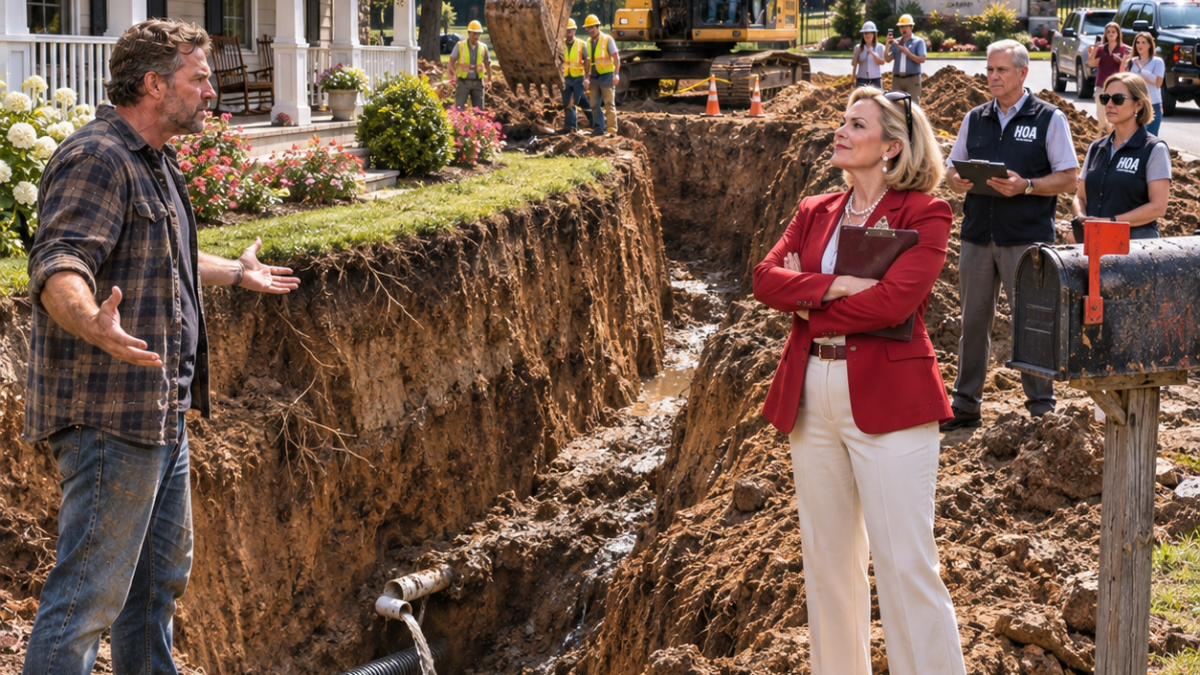
The morning I stepped onto my porch and found a ten-foot trench carved around three sides of my property, my driveway severed, my irrigation line ripped open, and my mailbox stranded on a muddy island, the excavator foreman leaned out of his cab and told me, almost apologetically, that the Ironwood HOA had ordered him to block access until I paid dues I had never owed.
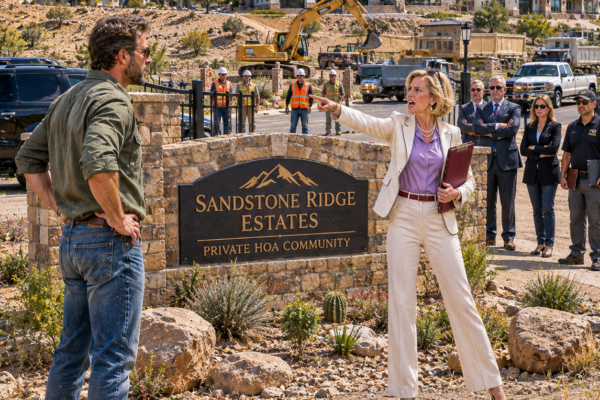
Across the road, Karen Whitley stood in a red blazer with her arms folded and a smile on her face while neighbors watched through blinds, because after weeks of fake fines, trespass notices, and threats, she had finally decided that if paperwork could not force me into her association, heavy equipment would.
What Karen did not understand was that the most dangerous document in Ironwood was not one of her violation notices, and by the time she discovered whose signature sat on the other side of the HOA’s largest unpaid debt, the trench around my house would be the least expensive mistake she had made.
My name is Robert Hayes, and the house Karen tried to isolate had belonged to my family long before Ironwood Acres had an entrance sign, a clubhouse, or a board arguing over approved shades of beige.
My father built the place on three acres beside the old county road. There were two oak trees out front, a small barn behind the house, a windmill that complained whenever the weather changed, and enough open ground for my mother to grow vegetables by the bushel.
When my parents died, I moved back.
I had spent almost twenty years in real-estate finance—distressed loans, commercial workouts, defaulted development notes, the unglamorous side of property where people stopped talking about granite countertops and started talking about collateral.
By then, I was semi-retired.
I wanted quiet.
Instead, I got Karen.
Her first letter arrived three weeks after I moved in.
“Dear Resident,” it began.
It informed me that my property fell under Ironwood Homeowners Association jurisdiction and that I owed $1,200 in annual dues.
I laughed, then wrote back.
“Not a member. Property predates the association. Please update your records.”
Two days later, Karen appeared at my gate.
She was in her mid-fifties, sharp haircut, red lipstick, red blazer, clipboard tucked against her chest like a courtroom exhibit.
“Mr. Hayes, we need to discuss your noncompliance.”
“My what?”
“HOA standards.”
“My property is not in your HOA.”
Her smile tightened.
“The subdivision boundary was expanded.”
“Show me.”
She blinked.
“The recorded plat. Deed restriction. Annexation agreement. Anything with my parcel number and my consent.”
For the first time, she looked annoyed.
“We have our own records.”
“Then bring the real ones next time.”
That should have ended it.
Instead, the fines started.
Fifty dollars for my horse, Daisy.
Seventy-five because my house was supposedly the wrong beige.
Then notices for my windmill, flagpole, and mailbox.
I saved every one.
Then orange paint appeared across my driveway.
VIOLATION.
I pressure-washed it off before dinner.
Karen escalated.
Voicemails from her “compliance committee.”
Warnings that failure to pay dues could result in “access restrictions.”
I thought that was nonsense.
Until the excavator arrived.
The foreman looked uncomfortable when I approached.
“Sir, I’m just doing the job they hired us for.”
“Who hired you?”
He pointed.
Karen lifted one hand from across the road.
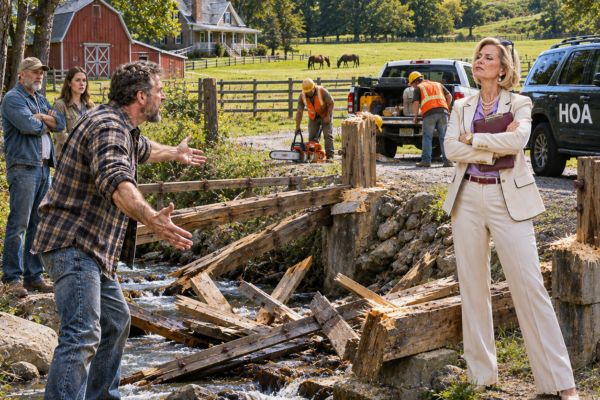
I looked at the trench again. It crossed my driveway and exposed part of the irrigation line feeding the lower field.
“Did anyone show you a survey?”
The foreman hesitated.
“I was given markings.”
“By the HOA?”
“Yes, sir.”
“Did you verify ownership?”
His face answered before he did.
Karen called across the trench.
“Maybe now you’ll answer your mail, Robert.”
“You ordered this?”
“The board approved an access-control measure.”
“You dug through private property.”
“You’re delinquent.”
“I’m not a member.”
“You keep saying that.”
“Because deeds don’t change when you get annoyed.”
Her smile disappeared.
Then she said the sentence that made me stop treating this as neighborhood theater.
“You can’t win against the HOA.”
I looked past her toward the clubhouse roof above the trees.
Then back at the muddy trench.
For the first time that morning, I smiled.
Because sitting in a fireproof cabinet inside my study was a loan file Karen had never seen, bearing the name of the same association that had just cut off my driveway.
I went inside and dialed my attorney.
“Mike,” I said when he answered, “pull the Ironwood note.”
There was a pause.
“What happened?”
I looked through the window at Karen standing beside the hole she had ordered around my house.
“It’s time we found out exactly what they still owe me.”
PART 2
Mike was silent for about three seconds.
Then I heard his chair scrape backward.
“The Ironwood note?”
“Yes.”
“The clubhouse loan?”
“And pool.”
“Robert, you told me you never intended to enforce that thing aggressively.”
“I didn’t.”
“What changed?”
“They excavated my driveway.”
Another pause.
“They what?”
“I’m looking at a ten-foot trench.”
“Tell me you’re exaggerating.”
“I wish I were.”
“Don’t touch anything.”
“Wasn’t planning to.”
“And don’t threaten anybody with foreclosure.”
“I haven’t.”
“Good.”
“Yet.”
“Robert.”
I almost smiled.
“Pull the file, Mike.”
“I’ll call you.”
I hung up and went back outside.
The excavator had stopped.
Good.
I didn’t want another bucket of dirt moved until somebody with authority looked at the damage.
The foreman climbed down.
His name was Luis Alvarez.
Mid-forties. Work boots covered in clay. Face tight with the uncomfortable realization that his company may have taken the wrong job.
“Mr. Hayes, I need you to understand something.”
“I do.”
“No, I mean—we were told this was HOA-controlled common access.”
“Did they give you a parcel map?”
“They gave us a drawing.”
“What kind?”
He walked to his truck and returned with a laminated sheet.
I looked at it.
Someone had taken an aerial photograph of Ironwood Acres and drawn a thick red boundary around my three acres.
No surveyor’s stamp.
No county seal.
No parcel numbers.
At the bottom:
**IRONWOOD COMMUNITY ACCESS ENFORCEMENT PLAN**
Signed:
**Karen Whitley, President**
I took out my phone.
“Hold that still.”
Luis did.
I photographed it.
He swallowed.
“We shouldn’t have started.”
“No.”
“I’ll get my guys out.”
“Leave the equipment until the sheriff’s office documents where it is.”
His eyes widened.
“You calling police?”
“You cut my driveway and irrigation line.”
“Yes.”
“I’d call them if you backed over my mailbox too.”
He nodded.
“Fair.”
Across the trench, Karen raised her voice.
“Mr. Alvarez, you were hired to complete a job.”
Luis turned.
“Ma’am, I’m suspending work.”
“You have a contract.”
“Your map’s not a survey.”
“It was approved by the board.”
“That doesn’t make it a survey.”
Karen’s face reddened.
“You’ll be hearing from our attorney.”
Luis looked at me.
Then back at her.
“Great. He can call mine.”
I liked him already.
Karen pointed toward me.
“This man owes our association thousands of dollars.”
I called back:
“Send me the recorded covenant.”
She ignored me.
Neighbors had begun coming outside.
Not close.
Ironwood residents had learned the art of watching Karen without appearing to watch Karen.
Curtains moved.
Garage doors opened halfway.
A man walked the same trash bag to the curb twice.
Karen hated an audience she couldn’t control.
“This is a private board matter,” she announced.
Nobody moved.
I called the county sheriff.
Two deputies arrived.
They photographed the trench.
Measured where it cut through the driveway.
Took Luis’s statement.
Then Karen approached.
“Deputy, I’m glad you’re here.”
The older deputy, Sanders, looked at her.
“Yes, ma’am?”
“This homeowner has repeatedly refused lawful association directives.”
Sanders glanced at me.
Then at the trench.
“What does that have to do with excavation?”
“This is an access-control project.”
“Who owns the land?”
“The HOA has jurisdiction.”
“That wasn’t my question.”
Her lips tightened.
“Mr. Hayes claims ownership.”
I laughed.
“Claims?”
Sanders looked at me.
“Deed?”
“Inside.”
I brought it out.
Along with my most recent property tax statement and the recorded survey.
Sanders studied the survey.
The trench was plainly inside my parcel.
Karen stepped closer.
“Those documents predate the Ironwood expansion.”
Sanders pointed to the survey.
“Recorded last year.”
Karen opened her mouth.
Closed it.
The younger deputy asked:
“Do you have a newer county record?”
Karen said:
“Our board records supersede this.”
I watched Sanders’ face.
He was trying very hard to remain professional.
“Ma’am, HOA board records don’t supersede county property records.”
“This is a civil dispute.”
“Part of it may be.”
He pointed toward the severed irrigation line.
“But intentional property damage isn’t something I’d recommend continuing.”
Karen turned to me.
“You called police over landscaping.”
“You dug a moat around my house.”
“It isn’t a moat.”
Luis looked into the trench.
Then toward me.
I shrugged.
He looked away before he smiled.
The deputies documented everything.
They did not arrest Karen.
I didn’t expect them to.
Property disputes become messy fast when contracts and boundary claims are involved.
But now there was a report number.
More importantly, there was an independent record of what Ironwood had done before anybody repaired it.
By noon, the county building inspector arrived.
He wasn’t amused.
The trench was deep enough in sections to create a fall hazard.
The irrigation break had destabilized one side.
Rain was forecast.
The inspector ordered temporary safety barriers and prohibited additional excavation pending review.
Karen protested.
He ignored her.
I liked him too.
By two, the spectacle had quieted.
No bulldozer noise.
No shouting.
Just yellow barriers, exposed soil, and a driveway I couldn’t use.
I crossed the trench on a temporary plank Luis’s crew laid for me.
Karen watched from the sidewalk.
“You could end this today.”
I turned.
“How?”
“Pay the dues.”
“I don’t owe them.”
“Join the association.”
“No.”
Her voice dropped.
“Then don’t complain about consequences.”
That sentence stayed with me.
“Consequences?”
She smiled.
“Of choices.”
I stared at her for a moment.
Then said:
“Karen, do you know how debt works?”
She frowned.
“What?”
“Never mind.”
I walked inside.
Mike called at 3:17.
His first words were:
“Oh, this is interesting.”
I sat at my desk.
“How interesting?”
“Do you remember exactly what you bought?”
“A distressed note secured by the clubhouse parcel and certain association revenues.”
“Good. You actually read your investments.”
“I used to do this for a living.”
“Then you’ll appreciate the irony.”
“Go ahead.”
“The original principal was six hundred fifty thousand.”
“I remember.”
“They refinanced once.”
“Right.”
“Then started missing payments.”
“How far behind?”
“Eighteen scheduled payments have been missed or short-funded over four years.”
I leaned back.
“Current balance?”
“Principal, default interest, and recoverable fees bring it to approximately four hundred twenty-three thousand.”
“Security?”
“The clubhouse parcel, pool improvements, certain equipment, and assignment of designated association receivables. Not homeowners’ individual houses.”
“Good.”
That mattered.
Owning an HOA’s debt does not make you king of a neighborhood.
It does not give you residents’ homes.
It does not let you erase covenants because you’re annoyed.
It gives you whatever rights the loan documents and law provide against the debtor and pledged collateral.
Nothing more.
Mike continued.
“The bank sold the note into the distressed pool your LLC bought two years ago. Assignment is recorded. Chain looks clean.”
“Any cure notices?”
“Prior servicer sent several.”
“Recent?”
“Last formal default notice nine months ago.”
“So we’d need to send a current notice before any enforcement.”
“Correct.”
I looked through the window.
Karen stood near the trench talking to Ronda and Jeanette.
Ronda pointed toward my house.
Karen waved both hands.
Even at distance, I could tell she was furious.
“Mike.”
“Yeah?”
“Do it properly.”
“What does that mean?”
“Fresh accounting. Confirm every payment. Check every notice requirement. I don’t want revenge paperwork. I want enforceable paperwork.”
He became quieter.
“That’s the Robert Hayes I know.”
“And Mike?”
“Yeah?”
“Add the property damage claim separately.”
“Oh, absolutely.”
That evening, I walked the perimeter.
Daisy stood near the barn, unimpressed by human stupidity.
The windmill creaked.
Water had begun collecting in the bottom of the trench.
My father used to say land remembered what you put into it.
Seeds.
Sweat.
Neglect.
Care.
I wondered what it remembered about a bulldozer cutting through it for an argument that should have ended with a deed.
My phone buzzed.
Unknown number.
A picture message.
It showed my house from across the road.
Caption:
**PAY WHAT YOU OWE.**
I saved it.
Didn’t respond.
The following morning, the Ironwood neighborhood Facebook page exploded.
Somebody had posted photographs of the trench before sunrise.
Comments divided almost perfectly into three groups.
People defending Karen.
People quietly questioning her.
And people making jokes about medieval warfare.
Karen posted an official statement.
**THE IRONWOOD HOA HAS TAKEN TEMPORARY ACCESS MEASURES REGARDING A NONCOMPLIANT PARCEL THAT HAS REFUSED TO PARTICIPATE IN REQUIRED COMMUNITY OBLIGATIONS.**
I read that twice.
Then forwarded it to Mike.
His reply:
**SHE PUT THAT IN WRITING?**
I typed:
**YES.**
A minute later:
**PLEASE TELL HER THANK YOU FOR ME.**
I laughed for the first time since the trench appeared.
At ten, an overnight courier delivered Ironwood HOA’s formal notice of default.
Not from me.
From Mike’s office.
Twenty-two pages.
Accounting.
Loan history.
Recorded assignment.
Default provisions.
Cure period.
Reservation of rights.
Nothing theatrical.
No threats about teaching lessons.
No cute lines.
Just numbers.
Karen appeared at my gate before noon.
She held the notice like it smelled bad.
“What is this?”
I remained on the porch.
“You can read.”
“You bought our loan?”
“Yes.”
“When?”
“Two years ago.”
“Why?”
“It was in a distressed-debt portfolio.”
“You targeted this community.”
“No.”
“You bought our debt because you planned this.”
“I moved here after I bought the portfolio.”
Her face changed slightly.
She hadn’t expected that.
“This is a conflict of interest.”
“How?”
“You live here.”
“Outside the HOA.”
“You can’t be both.”
“Both what?”
“A resident and creditor.”
“Of course I can.”
“This is extortion.”
“No.”
“You’re threatening foreclosure if I don’t stop enforcement.”
“No.”
I walked down the porch steps.
“My lawyer sent a contractual default notice because your association hasn’t paid its secured loan.”
“You’re using it against me.”
“Your board dug up my driveway yesterday.”
Her voice rose.
“That has nothing to do with the loan.”
“Exactly.”
I let the word hang.
“That’s why they’re separate.”
She stared.
I continued.
“Repair my property because you damaged it.”
I pointed to the notice.
“And cure your loan because you owe it.”
She looked down.
For the first time since I’d met Karen, the clipboard wasn’t in her hand.
The debt notice was.
She seemed smaller without the clipboard.
“This clubhouse belongs to the residents.”
“Then the board should have paid the loan secured against it.”
“You wouldn’t foreclose on a community center.”
“I don’t want to.”
“That means you won’t.”
“No.”
I met her eyes.
“It means I’d prefer you cure the default.”
She laughed once.
“You’re bluffing.”
“Have your lawyer call Mike.”
“I don’t need your permission.”
“No.”
She turned.
Then stopped.
“You think this makes you powerful?”
I shook my head.
“No.”
“Then why are you smiling?”
“Because yesterday you told me I couldn’t win against the HOA.”
Her jaw tightened.
“I wasn’t trying to beat one.”
I pointed toward my land.
“I was trying to live next to it.”
She walked away.
That afternoon, three board members called my lawyer.
Not Karen.
Actual directors.
They had questions.
A lot of them.
Had the loan really been unpaid?
Yes.
Was the amount really over four hundred thousand?
Approximately.
Was the clubhouse really collateral?
Yes.
Had the board been told the debt was current?
Apparently.
That last question interested Mike.
He called me.
“They’re confused.”
“About?”
“The debt.”
“How confused?”
“One board member thought the clubhouse loan was paid off last year.”
I sat upright.
“Who told him?”
“Guess.”
“Karen.”
“Correct.”
“What do their financial statements show?”
“I’m getting them.”
The next day, another surprise appeared.
Three signs had been driven into the ground along my fence.
**IRONWOOD HOA PROPERTY**
**NO TRESPASSING**
They were on my side.
I photographed them.
Called the sheriff’s office.
Deputy Sanders returned.
He looked at the first sign.
Then me.
“She’s committed to the bit.”
“I was trying not to say that.”
He measured the location against the survey markers.
“They’re definitely on your parcel.”
“Yes.”
Karen arrived while he was writing the supplemental report.
“These signs identify community-controlled land.”
Sanders didn’t look up.
“Ma’am, we’ve been through this.”
“Mr. Hayes is interfering with a lawful safety project.”
“Show me the legal instrument giving your HOA control here.”
She pulled a folded map from her bag.
Same aerial drawing.
Same red line.
Sanders compared it with the county survey.
“This is not recorded.”
“It was approved by our board.”
“Your board cannot vote itself somebody else’s acreage.”
Karen’s face hardened.
“That’s your interpretation.”
“No.”
Sanders finally looked at her.
“That’s how property ownership works.”
She pointed toward me.
“He’s manipulating you because he’s wealthy.”
Sanders glanced at me.
“I didn’t know he was wealthy.”
“Neither did I,” I said.
Karen stormed off.
Sanders waited until she was out of earshot.
“You are wealthy?”
“Apparently.”
“Good for you.”
He kept writing.
By Friday, Mike had obtained Ironwood’s publicly available nonprofit filings and several financial statements supplied by board members.
The picture wasn’t pretty.
Dues had risen.
Maintenance spending had fallen.
The clubhouse loan payments had been irregular for years.
Meanwhile, administrative expenses increased.
So had reimbursements to officers.
One line caught my attention.
**Executive Community Coordination Stipend — $18,000**
“Karen?” I asked.
Mike nodded.
“Looks that way.”
“Authorized?”
“Minutes show a vote.”
“Fine.”
“Except two directors claim they never voted for it.”
I put the paper down.
“Now we’re somewhere else.”
“Exactly.”
“Don’t send this to residents yet.”
“Wasn’t going to.”
“I don’t want to turn rumor into evidence.”
Mike smiled.
“You’re getting less fun every year.”
“Occupational hazard.”
A private security company showed up at my fence on Monday.
Three uniformed men.
Polite.
Embarrassed.
Their supervisor told me the HOA had requested a “site safety inspection.”
I asked for authorization.
He produced a work order signed by Karen.
No warrant.
No easement.
No owner consent.
I handed it back.
“You’re welcome to stand on the public road.”
“We were told this section belonged to Ironwood.”
“It doesn’t.”
He studied the trench.
“Was this them too?”
“Yes.”
He whistled.
“I think we’re done.”
Karen called him before he reached his truck.
I could hear her yelling through his phone.
He held it away from his ear.
Then said:
“Ma’am, we’re not entering private property without legal authority.”
He hung up.
I called Mike.
“Send the intent-to-enforce notice.”
“You sure?”
“Yes.”
“We can still negotiate first.”
“They sent private security onto my property after the sheriff documented the boundary twice.”
Mike sighed.
“All right.”
“What?”
“Nothing.”
“Say it.”
“You sound happy.”
“I’m not happy.”
“You’re a little happy.”
I looked toward the trench.
“Maybe ten percent.”
“Human after all.”
The notice was served on every board member.
Not just Karen.
That mattered.
**NOTICE OF INTENT TO ENFORCE SECURITY FOLLOWING FAILURE TO CURE**
It explained the collateral.
The amount.
The cure deadline.
The association’s rights.
My rights.
And the fact that any foreclosure would require the appropriate legal process.
Karen called an emergency board meeting.
Then, unbelievably, she sent me a summons.
**HOA DISCIPLINARY HEARING**
Allegations:
Nonpayment of dues.
Defamation.
Obstruction of community improvements.
Property maintenance violations.
I showed it to Mike.
“We’re going.”
He stared.
“Why?”
“Because I’m curious.”
“Curiosity gets expensive.”
“I own the debt.”
“You do not own the building.”
“I know.”
“Good. Because you’ve made that joke twice.”
“I’m learning.”
The clubhouse smelled like stale coffee and lemon cleaner.
Karen sat at the center table.
Ronda and Jeanette beside her.
Five directors spread along the row.
Most looked nervous.
A large sign behind them read:
**PROTECTING IRONWOOD’S INTEGRITY**
Mike leaned toward me.
“Don’t laugh.”
“I wasn’t.”
“You were about to.”
Karen called the meeting to order.
“Mr. Hayes, you have repeatedly refused to comply with association obligations.”
I raised my hand.
“Before we start.”
“This is not your meeting.”
“Agreed.”
“Then don’t interrupt.”
“Fine.”
She looked down.
“You currently owe eight thousand four hundred dollars in dues, fines, penalties, and enforcement fees.”
Mike wrote something on a pad and slid it toward me.
**ASK FOR COVENANT.**
I almost smiled.
Karen continued.
“You have defamed this board publicly.”
“How?”
“By accusing us of trespass.”
“The sheriff’s report says you entered my property.”
“This hearing is not about your interpretation.”
Mike finally spoke.
“Mrs. Whitley, could you identify the recorded instrument binding Mr. Hayes’s parcel to the Ironwood association?”
Karen glared.
“This hearing concerns conduct.”
“It concerns alleged dues.”
“We have jurisdiction.”
“Document?”
Ronda whispered to Karen.
Karen ignored her.
“Our expansion map—”
“Recorded instrument.”
Silence.
A man at the far end of the board table, George Bell, slowly removed his glasses.
“Karen.”
She looked at him.
“What?”
“Do we actually have one?”
“George, we’ve discussed this.”
“No.”
He shook his head.
“You said the expansion had been approved.”
“It was.”
“By whom?”
“The board.”
George stared at her.
Mike leaned back.
Karen changed direction.
“Regardless, Mr. Hayes has engaged in financial intimidation against this association.”
Now we were getting there.
“He acquired a community debt instrument and is threatening to seize neighborhood property.”
Mike placed a folder on the table.
“Mr. Hayes’s investment company acquired the note two years before this dispute began.”
George looked at Karen.
“Two years?”
Karen said nothing.
Mike continued.
“The association is in documented default. This is the payment history.”
He gave copies to every director.
Pages turned.
Faces changed.
George stopped halfway.
“This can’t be right.”
Another director, Andrew Cole, leaned toward him.
“What?”
“The loan balance.”
Karen snapped:
“These documents are disputed.”
George looked at her.
“You told us this was paid off.”
A silence descended.
Karen’s expression changed.
Not much.
Enough.
“I said the refinancing addressed it.”
“What refinancing?”
“The board authorized financial restructuring.”
Andrew said:
“I don’t remember that vote.”
“You were absent.”
“No.”
He shook his head.
“I wasn’t.”
Ronda looked down.
Jeanette suddenly became fascinated with her pen.
Mike spoke calmly.
“The current secured balance is approximately four hundred twenty-three thousand dollars.”
George’s chair squeaked backward.
“Four hundred twenty-three thousand?”
Karen said:
“Stop dramatizing.”
He stared at her.
“You told residents we were debt free.”
“The finances are complicated.”
“You told me personally.”
“George—”
“You asked us to raise dues for landscaping because we had no debt payments anymore.”
The room began talking over itself.
Karen hit the table.
“Enough.”
Nobody stopped.
She hit it again.
“This is exactly what Mr. Hayes wants.”
I finally stood.
“No.”
The room quieted.
“I don’t want your association.”
I looked at Karen.
“I don’t want your clubhouse.”
Then the board.
“I don’t want your pool.”
I held up one of the violation notices.
“I wanted you to leave property that isn’t yours alone.”
I placed it down.
“You dug through my driveway to collect dues you can’t legally show I owe.”
Then I pointed to Mike’s file.
“Separately, your association borrowed money and stopped making required payments.”
I looked around.
“Those are two different problems.”
Karen’s voice was low.
“What do you want?”
“Repair the trench.”
“That’s it?”
“Repair the irrigation system.”
She stared.
“Remove every false claim that my parcel belongs to Ironwood.”
No response.
“And for the debt?”
George asked.
I looked at Mike.
He answered.
“The association needs to provide complete financial disclosure and negotiate a cure, restructure, or lawful resolution before the enforcement deadline.”
George nodded slowly.
Karen said:
“You expect us to believe you aren’t using the debt as revenge?”
I looked at her.
“I could have sent that default notice two years ago.”
She had no answer.
We left.
In the parking lot, Mike exhaled.
“That was worse than I expected.”
“For them?”
“For everyone.”
“You think she’s hiding something?”
He stopped walking.
“Robert.”
“What?”
“She told her own board a four-hundred-thousand-dollar secured loan had been paid.”
“Maybe she misunderstood refinancing.”
“Maybe.”
“You don’t believe that.”
“No.”
Neither did I.
The next forty-eight hours changed Ironwood.
Residents learned about the debt.
Not from me.
George demanded an emergency financial report.
Somebody leaked the board packet.
Screenshots spread.
People compared dues increases with maintenance reductions.
Questions multiplied.
Where had the money gone?
Why had the fountain been broken for eight months?
Why were pool repairs delayed?
Why had the HOA paid “consulting fees” to unfamiliar vendors?
And why had Karen repeatedly described the association as debt free?
For the first time, residents who once watched me from behind blinds walked openly to my gate.
Mrs. Dalton came first.
Seventy-two.
Silver hair.
Voice like sandpaper.
“Are you taking our clubhouse?”
“No.”
“Could you?”
“Under the loan, if default isn’t resolved, the secured creditor may seek remedies against pledged collateral through legal process.”
She stared.
“English.”
“I don’t want the clubhouse.”
“Better.”
She looked at the trench.
“That woman is crazy.”
“I try not to diagnose neighbors.”
“I’m old. I can.”
She handed me a folder.
“What is this?”
“Every fine she ever gave me.”
“Why?”
“Because you’re fighting her.”
“I’m dealing with my property.”
“Same thing.”
I opened the folder.
Garden gnome.
Curtains.
Grandson’s bicycle.
Holiday wreath displayed four days too long.
“Three hundred dollars for sidewalk marks?”
Mrs. Dalton nodded.
“His bike tire left them.”
I closed the folder.
“You appealed?”
“Karen chaired the appeal.”
Of course.
By Saturday, twenty residents were in my barn.
I had not planned a meeting.
Mrs. Dalton apparently had.
She arrived with folding chairs.
Others followed.
A mechanic named David brought a tow receipt.
“They took my truck while I was at work.”
“Why?”
“Color.”
I blinked.
“Factory blue.”
Another woman, Nina Patel, held up photographs.
“My wheelchair ramp.”
“What about it?”
“Unapproved architectural modification.”
“Who uses it?”
“My mother.”
She stared at the floor.
“I paid the fine because I didn’t want them making her life harder.”
That one bothered me.
A young father named Chris said Karen had threatened a lien over a basketball hoop.
Another resident had been fined for a child’s chalk drawings.
Someone else had paid for a mandatory mailbox replacement through a vendor owned by Ronda’s brother.
Mike sat beside the barn door taking notes.
Not legal statements.
Just patterns.
At the end, Mrs. Dalton asked me:
“What happens if the HOA can’t pay you?”
I answered carefully.
“We follow the loan documents.”
“Meaning foreclosure.”
“Possibly.”
People exchanged worried looks.
I continued.
“But a default doesn’t automatically mean foreclosure.”
George, the board director, had come quietly.
He raised his hand.
“What would you accept?”
“Full financial transparency first.”
“And then?”
“Then we know whether the association can restructure.”
Karen wasn’t there.
That helped.
George looked around.
“What if the numbers are worse?”
Mike answered.
“Then pretending won’t improve them.”
Monday morning, county inspectors formally declared the trench an immediate safety concern and issued a remediation order against the contractor and party responsible for commissioning the excavation.
Luis’s company cooperated.
He produced the contract.
Signed by Karen.
Ironwood HOA letterhead.
Work description:
**DELINQUENT PROPERTY ACCESS RESTRICTION AND COMMUNITY BOUNDARY CONTROL**
I stared at those words.
Mike whistled.
“She literally put it in the contract.”
“Apparently.”
“Your lawsuit just got friendlier.”
The HOA’s insurance carrier became involved.
That changed behavior faster than philosophy ever could.
By Tuesday, heavy machinery returned.
Same company.
Different purpose.
They filled the trench.
Rebuilt the driveway base.
Repaired the irrigation line under supervision.
Karen did not attend.
I stood on the porch as dirt poured back into the hole.
Daisy grazed in the field.
The windmill turned.
Mrs. Dalton came over with coffee.
“You look disappointed.”
“I am not.”
“You wanted to watch Karen fill it with a shovel.”
I smiled.
“Maybe a little.”
The scar remained.
Fresh soil around three sides of the property.
Ugly.
But passable.
When the final truck left, I drove my pickup across the repaired driveway.
Not dramatic.
Still satisfying.
That night, an unknown number texted:
**ENJOY THE WIN. SOME HOLES GO DEEPER THAN YOU THINK.**
I stared at it.
Saved a screenshot.
Sent it to Mike.
He called.
“Police?”
“I don’t know if it’s a threat.”
“Still document.”
“I will.”
“Could be Karen.”
“Could be anyone.”
“Who are you and what have you done with my client?”
“I’m becoming responsible.”
“Terrible development.”
The following morning, Ironwood filed a civil response to my debt-enforcement notice.
Karen’s attorney argued several things.
Some plausible.
Some desperate.
One argument claimed I lacked standing to enforce against certain association assets because my property was not governed by Ironwood and I therefore had “no legitimate community interest.”
Mike read that sentence aloud.
Then stopped.
We looked at each other.
I smiled.
“Say it.”
“They just admitted your property isn’t governed by the HOA.”
“That’s how I read it.”
“In a filed pleading.”
“Yes.”
He laughed.
Not quietly.
“Robert, I’ve been practicing twenty-six years. Sometimes opposing counsel gives you gifts.”
“Frame that page.”
“I might.”
The false dues claim weakened dramatically after that.
Karen’s side tried to amend the language.
Too late.
The original filing remained.
More importantly, county property records had always supported me.
The argument wasn’t the magic weapon.
It was simply one more example of Karen’s position collapsing under its own contradictions.
Then came the community Q&A.
Mike suggested neutral ground.
County courthouse auditorium.
No HOA clubhouse.
No red banners.
No Karen-controlled agenda.
Residents packed the room.
Some stood in back.
A local reporter attended.
Karen arrived with Ronda, Jeanette, and attorney Gregory Falk.
I’d heard of Falk.
Aggressive civil litigator.
Good suit.
Better voice.
The kind of lawyer who made “good afternoon” sound like cross-examination.
Mike started with documents.
Original loan.
Security agreement.
Recorded assignment.
Payment history.
Default notices.
No commentary.
Just paper.
Then he showed the current balance.
$423,000 and change.
A murmur moved through the room.
Karen stood.
“These documents do not tell the full story.”
Mike nodded.
“That’s why we’re here.”
She hadn’t expected agreement.
“The association entered into a refinancing arrangement.”
“Please provide it.”
Falk spoke.
“Certain financial documents remain confidential.”
George called from the front row:
“I’m on the board. I’ve never seen them.”
Andrew added:
“Neither have I.”
Karen turned.
“This isn’t the place.”
Mrs. Dalton said:
“Apparently neither was the boardroom.”
A few people laughed.
Karen’s face hardened.
Then questions began.
Pool reserves.
Landscaping contracts.
Security cameras that had been budgeted but never installed.
Administrative stipends.
Vendor relationships.
The mailbox company.
A homeowner asked:
“Why did dues rise twenty-two percent if the clubhouse loan was supposedly paid?”
Karen said:
“Inflation.”
Another:
“Why did maintenance drop?”
“Deferred projects.”
Another:
“Where is the reserve account?”
Falk intervened.
“This is becoming hostile.”
I had barely spoken.
Then Karen pointed at me.
“This man engineered all of this.”
I stood.
“No.”
“You purchased our debt.”
“Two years ago.”
“You waited until I challenged you.”
“I waited because I wasn’t trying to take anything from you.”
“You filed foreclosure.”
“I initiated enforcement after your association remained in default and then damaged my property.”
She laughed bitterly.
“You’re pretending you’re noble.”
“No.”
I looked around.
“I’m a creditor.”
Then back at her.
“That’s not a moral title.”
Silence.
“It means I’m owed money under a contract.”
I gestured toward the residents.
“And they’re entitled to truthful accounting from the organization collecting their dues.”
Karen’s hand tightened around the microphone.
“You’re destroying this community.”
Mrs. Dalton stood.
“No, Karen.”
Everyone looked at her.
“You made us afraid of our own front yards.”
Karen’s eyes narrowed.
“You were fined because you refused standards.”
“You fined me because my grandson rode a bicycle.”
“He damaged common concrete.”
“He was nine.”
Another resident stood.
Then another.
The meeting stopped being about me.
That was the moment Karen actually began losing.
Not when I revealed the debt.
When residents started speaking without waiting for her permission.
Nina told the room about the wheelchair ramp.
David held up the tow receipt.
Chris described the basketball hoop.
One woman said she’d stopped decorating for Christmas because she couldn’t afford another fine.
Karen kept trying to answer.
Eventually nobody listened.
George made a motion from the floor requesting the board place Karen on administrative leave pending an independent audit.
Five directors were present.
Vote.
Four yes.
One no.
Karen stared at them.
“You can’t do this.”
Andrew said:
“We just did.”
“You’ll regret it.”
George looked exhausted.
“Maybe.”
He folded his hands.
“But at least it’ll be our mistake.”
Karen left.
Outside, she waited near my truck.
“You think this is over?”
“No.”
“Good.”
Her voice shook.
“You embarrassed me.”
“You did most of the talking.”
“You made them turn against me.”
“I showed them a loan.”
“You ruined my reputation.”
“I didn’t dig the trench.”
Her eyes filled with something I had not seen before.
Not sadness.
Fear.
“What do you want from me?”
That question finally sounded genuine.
“Why didn’t you ask that before?”
She stared.
I answered anyway.
“Fix what you damaged.”
“It is fixed.”
“Then stop claiming my property.”
Silence.
“And give your board honest books.”
Her eyes flickered.
That was it.
Small.
Fast.
But Mike saw it too.
After Karen drove away, he said:
“Books.”
“Yeah.”
“She reacted.”
“Yeah.”
“Time to find the refinancing.”
We didn’t have to wait long.
The anonymous email arrived the next evening.
Subject:
**YOU SHOULD SEE WHAT SHE SIGNED**
Attachment:
A scanned loan amendment.
Borrower:
**Whitley Development LLC**
Collateral description included the clubhouse parcel.
Karen’s signature appeared as manager.
Below it were purported approvals from three Ironwood directors.
Mike stared at the screen.
“Don’t forward this.”
“I won’t.”
“Could be fake.”
“Either way?”
“Either way we authenticate it.”
The next morning, we went to the county recorder.
There it was.
Not the full refinancing agreement.
A recently filed quitclaim deed purporting to transfer the clubhouse parcel from Ironwood HOA to Whitley Development LLC.
Karen’s company.
George’s signature appeared.
So did Andrew’s.
Mike called both.
George’s response:
“I never signed that.”
Andrew:
“What the hell is Whitley Development?”
My stomach tightened.
This was no longer simply a badly managed HOA.
We hired a forensic document examiner through counsel and referred the records to the county investigator.
Detective Marcus Rowan met us in a small conference room.
He had a gray suit, battered notebook, and the tired expression of a man who preferred numbers because numbers usually lied less than people.
He studied the documents.
“Walk me through it without conclusions.”
I liked him immediately.
Mike explained.
Ironwood borrowed for clubhouse development.
Loan defaulted.
My investment entity acquired the debt.
Karen later recorded an instrument purporting to transfer secured property to an LLC she controlled.
Board members denied authorizing it.
Documents contained their signatures.
Rowan asked:
“Any evidence she attempted refinancing?”
Mike showed him lender correspondence obtained during civil discovery.
Rowan read quietly.
Then:
“I’m taking copies.”
“Of course.”
He looked at me.
“You understand your civil case and any criminal investigation are separate?”
“Yes.”
“You don’t direct me.”
“I wouldn’t try.”
“Everybody says that.”
“I mean it.”
He closed his notebook.
“If these signatures are forged, we’ll figure that out.”
Three days later, George called.
“Robert.”
His voice shook.
“What happened?”
“The auditors found a second account.”
“What kind?”
“HOA money.”
“How much?”
“I don’t know yet.”
“Call your lawyer.”
“We have.”
“Then listen to them.”
“You’re not curious?”
“Very.”
“But?”
“This stopped being neighbor gossip.”
That was something my father taught me without using those words.
When a thing becomes serious, you get quieter.
Karen got louder.
She filed a lawsuit accusing me of defamation, harassment, financial coercion, intentional infliction of emotional distress, and interference with community governance.
Falk sent the complaint.
Mike read it over coffee.
He looked up.
“You have a history of predatory property investment.”
“Apparently.”
“You exploited an elderly community.”
“Half the board is younger than me.”
“You caused Karen anxiety.”
“I’m devastated.”
“She wants punitive damages.”
“How much?”
“Enough to buy several trenches.”
I laughed.
Then stopped.
“Can she hurt us?”
“Anybody can hurt you with litigation.”
“Can she win?”
“Different question.”
We answered properly.
No press attacks.
No mockery.
No social-media war.
Documents.
Dates.
Recorded deeds.
Her own notices.
Contractor agreement.
County survey.
Sheriff reports.
The trench photographs.
Ironwood’s pleading admitting my parcel stood outside the association.
And the loan chain.
Meanwhile, the audit deepened.
Payments to a landscaping company with no employees.
Consulting fees to Whitley Development.
Reimbursements for “executive travel” that matched Karen’s personal trips.
HOA money used toward her vehicle.
False invoices.
Not every suspicious expense became a crime.
Some were merely sloppy.
Some were authorized badly.
But enough appeared deliberate that Rowan sought warrants.
The morning investigators entered the HOA office, I stayed home.
I could see the clubhouse roof beyond the trees.
News crews arrived later.
I didn’t.
Mike called.
“They’re serving warrants at Karen’s house too.”
“Arrest?”
“Not yet.”
“Good.”
“You sound disappointed.”
“No.”
“You sure?”
I looked at the flowerless scar where the trench had been.
“I want this right.”
“Me too.”
By afternoon, Karen appeared outside the clubhouse.
Reporters surrounded her.
She shouted:
“This is a coordinated attack by Robert Hayes.”
I turned off the television.
An hour later, Rowan called.
“We need a formal interview from you.”
“When?”
“Tomorrow.”
“About what?”
“Your acquisition of the note.”
“Fine.”
“And every communication with Ms. Whitley.”
“Also fine.”
“Bring originals where available.”
“I will.”
I spent three hours with investigators.
They questioned my debt purchase.
Why I bought it.
Whether I knew Ironwood was attached.
Whether I planned to move there.
Whether I had contacted Karen before the dispute.
Whether I had used the debt strategically.
The questions were uncomfortable.
Good.
Real investigations should be uncomfortable for everyone whose motives matter.
I answered.
The distressed portfolio contained eleven loans.
Ironwood was one.
I knew the development from childhood but did not expect the note to become personal.
I had taken no enforcement action for two years because returns from the portfolio were adequate and I preferred negotiated cures.
I did not threaten Karen before the trench.
I did not ask anyone to harass the board.
I had not created the anonymous emails.
At the end, Rowan closed his notebook.
“Thank you.”
“That’s it?”
“For today.”
“Do you think I did something?”
He studied me.
“I think I don’t build cases by deciding who the good guy is first.”
That might have been the best answer anyone gave me throughout the entire mess.
“Fair.”
Two days later, Karen Whitley was arrested.
Forgery.
Fraud-related charges.
Misappropriation allegations.
Filing false instruments.
The exact counts changed as prosecutors reviewed evidence.
I watched none of the arrest.
Mrs. Dalton did.
She called before breakfast.
“They put her in handcuffs.”
“I heard.”
“You don’t sound happy.”
“What should I sound like?”
“I don’t know.”
Neither did I.
A woman who had ordered a trench around my home was in custody.
Part of me felt satisfaction.
I’d be lying if I said otherwise.
But another part kept thinking about that first afternoon at my gate.
She could have walked away.
One no.
That was all.
Instead she built an entire disaster out of being unable to accept it.
The new interim board called me that afternoon.
Ben Carter, an accountant who had avoided every leadership position until nobody else wanted the job, became acting president.
His first words were:
“Mr. Hayes, I hate this.”
“Good start.”
“I don’t want to be president.”
“Even better.”
He laughed nervously.
“We want to resolve the debt.”
“Talk to Mike.”
“We want to resolve the trench damages too.”
“Insurance is already handling part.”
“And the rest?”
“Talk to Mike.”
Ben sighed.
“Do you say anything else?”
“Sometimes I say no.”
He laughed harder.
The negotiations lasted weeks.
Not because I wanted blood.
Because Ironwood’s books were a mess.
Actual available cash was far below what residents had been told.
The clubhouse needed repairs.
The pool had deferred maintenance.
Insurance coverage was disputed.
If I pushed immediate foreclosure to the limit, I might have acquired valuable collateral.
I could have sold it.
Made money.
Legally.
That option sat on the table.
Mike asked me one evening:
“What do you actually want?”
We were on my porch.
The trench had been filled for weeks.
Grass had not returned.
The soil remained a brown scar.
“I want them to pay what they can reasonably pay.”
“That isn’t an answer.”
“I don’t want to own a clubhouse.”
“Good.”
“I don’t want a pool.”
“Better.”
“I definitely don’t want to run an HOA.”
“Best thing you’ve said all year.”
I looked toward Ironwood.
“What if we restructure?”
Mike waited.
“New board gives full audited financials.”
“Yes.”
“Association sells one unused parcel it already planned to sell.”
“Possible.”
“Insurance and Karen-related recovery go toward the debt.”
“Likely.”
“Residents don’t get special assessments just to make me whole.”
Mike raised an eyebrow.
“You’re leaving money on the table.”
“I have enough.”
“That is not how creditors traditionally speak.”
“I’m semi-retired.”
He smiled.
“What about the remaining collateral?”
“Keep the lien until principal is satisfied.”
“And default interest?”
I thought.
“Waive part if they meet the settlement.”
Mike looked at me for a long moment.
“You could foreclose.”
“I know.”
“And you’re not.”
“No.”
“Why?”
I pointed toward the neighborhood.
“Because Karen spent years treating legal authority like permission to dominate people.”
I shook my head.
“I’d look pretty stupid replacing her.”
The settlement took another month.
Ironwood agreed to an audited payment plan.
Sold an unused maintenance parcel.
Recovered money from certain accounts.
Insurance funded part of the trench repair.
My company waived a portion of default interest in exchange for timely principal repayment and stronger financial controls.
The clubhouse stayed with the residents.
The pool stayed open.
Nobody’s home was touched.
That became important once reporters started asking whether I now “owned the HOA.”
“No,” I told one.
“You don’t?”
“I own a debt.”
“But you could take their assets.”
“Only through rights attached to the loan and lawful process.”
“So you’re not taking the clubhouse?”
“No.”
“Why not?”
“Because they agreed to pay.”
The reporter seemed disappointed.
Drama prefers villains.
Contracts prefer boring answers.
The criminal case was less boring.
Investigators traced Whitley Development.
Karen had formed it quietly.
Documents showed an attempted transfer of association assets.
Several signatures were fraudulent.
Money had been routed through accounts she controlled.
Her defense claimed she believed the board had authorized broad restructuring authority.
George testified otherwise.
Andrew did too.
Ronda eventually cooperated.
That shocked everyone.
Jeanette stopped answering Karen’s calls almost immediately after the arrest.
Loyalty built on fear tends to become flexible when subpoenas arrive.
The trial began eight months after the trench.
I testified for less than an hour.
The prosecutor asked about the beginning.
“The dues letter.”
I explained.
“Were you an Ironwood member?”
“No.”
“Did Ms. Whitley know that?”
“I told her repeatedly.”
“Did she ever provide a recorded declaration binding your parcel?”
“No.”
“Then what happened?”
“Fines.”
“Then?”
“Harassment.”
“Then?”
“The trench.”
Photographs appeared on the screen.
The jury saw my driveway cut in half.
Mailbox stranded.
Irrigation pipe exposed.
Excavator.
Karen in red across the road.
The prosecutor asked:
“What did you do when you discovered the association owed money on a loan you held?”
“Called my attorney.”
“Did you tell Ms. Whitley you owned her neighborhood?”
“No.”
“Did you claim ownership of homeowners’ houses?”
“No.”
“Did you immediately foreclose?”
“No.”
“What did you do?”
“Verified the note, sent contractual notices, and separated the debt issue from my property-damage claim.”
The defense attorney stood.
“Mr. Hayes, you enjoyed having leverage over Ms. Whitley.”
“Sometimes.”
He paused.
That wasn’t the answer he expected.
“Sometimes?”
“I was angry.”
“So this was revenge.”
“No.”
“You threatened foreclosure.”
“My company enforced a defaulted loan.”
“After she angered you.”
“After the HOA had missed payments for years and after I had previously chosen not to accelerate enforcement.”
“You expect this jury to believe timing was coincidence?”
“No.”
He smiled.
There.
He thought he had me.
Then I continued.
“The trench made me unwilling to continue overlooking an unresolved default while the same organization claimed I owed it money.”
His smile faded.
“So you used financial power.”
“I used contractual rights.”
“To punish her.”
“To collect a debt.”
He stepped closer.
“You could have taken their clubhouse.”
“Possibly, through foreclosure.”
“But you didn’t.”
“No.”
“Why?”
“Because the new board entered a reasonable cure agreement.”
He looked toward the jury.
“Isn’t that convenient?”
“For everyone.”
He changed subjects.
The strongest testimony came from the board members.
George described Karen telling them the debt had been paid.
Andrew described signatures he never made.
A forensic examiner explained differences in handwriting and digital records.
Bank evidence traced transfers.
The county recorder authenticated the disputed deed.
Then Ronda testified.
She looked smaller without Karen beside her.
The prosecutor asked:
“Did Ms. Whitley ever discuss Robert Hayes’s property with you?”
“Yes.”
“What did she say?”
Ronda looked toward me.
Then down.
“That he needed to be brought under control.”
“What did that mean?”
“Join the HOA. Pay.”
“Did she discuss the trench?”
“Yes.”
The courtroom became still.
“What did she say?”
Ronda swallowed.
“She said if he couldn’t easily get in or out, he’d finally understand that living beside Ironwood came with obligations.”
My hands tightened.
The prosecutor asked:
“Did you object?”
“No.”
“Why?”
Ronda’s eyes filled.
“Because Karen always made disagreement feel like betrayal.”
That sentence did more than any insult could have.
Karen testified too.
She said the transfer documents were part of an emergency refinancing effort.
That she believed she possessed authority.
That the debt crisis required quick action.
That bookkeeping mistakes were not theft.
Some of her explanation made sense.
That’s what made it dangerous.
She wasn’t a cartoon.
She had built rationalizations one on top of another until every boundary became negotiable if she believed the outcome justified it.
Then the prosecutor asked about my property.
“Why did you continue assessing dues after Mr. Hayes showed you his deed?”
“He benefited from proximity to Ironwood.”
“Was he a member?”
“He was effectively part of the community.”
“Legally?”
Karen hesitated.
“I believed so.”
“Based on what recorded document?”
“Our expansion plan.”
“Was it recorded?”
“No.”
“Was it signed by Mr. Hayes?”
“No.”
“Approved by the county?”
“No.”
“Then you ordered excavation?”
“It was meant as drainage and access management.”
The prosecutor displayed the contractor’s work order.
**DELINQUENT PROPERTY ACCESS RESTRICTION.**
Karen stared.
“No further questions.”
The jury convicted her on several major fraud and forgery counts while acquitting or declining to convict on a few weaker ones.
That mattered too.
Justice wasn’t a sweep.
It was specific.
At sentencing, residents submitted statements.
So did I.
I kept mine short.
“When Ms. Whitley ordered a trench cut through my property, I thought my anger was about the damage.”
I looked at the judge.
“It wasn’t.”
Then at Karen.
“It was about somebody deciding that because I said no, my boundaries no longer deserved respect.”
I paused.
“I’ve spent my career working with debt. Debt gives creditors rights. It does not give creditors moral ownership over debtors.”
The courtroom stayed silent.
“Her mistake taught me the same thing from the other direction. A title can give authority. It does not give ownership over people.”
Karen looked at me.
For the first time, there was no rage.
Just exhaustion.
She received a prison sentence and restitution obligations based on the convictions.
Not forever.
Long enough to lose the presidency, the company, the illusion of invulnerability, and years she would never get back.
Her civil claims against me collapsed later.
The HOA formally removed her months before.
Ronda resigned.
Jeanette did too.
Ben refused to run for permanent president.
“Smart man,” I told him.
Ironwood held its first genuinely competitive election in years.
Three candidates.
One campaigned on pool hours.
Another on landscaping costs.
The winner promised monthly financial statements and term limits.
Nothing exciting.
Beautiful.
Then came the question nobody expected.
Should Ironwood keep the HOA at all?
Residents packed the clubhouse.
Some wanted dissolution.
Others worried about the pool, roads, and shared property.
You cannot simply shout “freedom” and make common expenses disappear.
So they hired counsel.
Reviewed covenants.
Mapped assets.
Calculated obligations.
After months, residents approved a restructuring.
The mandatory HOA corporation was wound down under its governing procedures and legal requirements.
Common recreational assets were transferred into a smaller voluntary community association with opt-in membership and usage fees.
Public maintenance responsibilities were separated from private amenities where legally possible.
Existing deed restrictions that could not simply vanish remained until lawfully modified.
Messy.
Slow.
Real.
Mrs. Dalton called it:
“Freedom with paperwork.”
I liked that.
My debt settlement survived the transition.
The new community entity paid according to schedule.
Two years later, the secured principal was satisfied.
Mike brought the release document to my porch.
“Sign.”
I did.
“That it?”
“That is it.”
“No clubhouse.”
“No clubhouse.”
“No pool.”
“No pool.”
“No suburban empire.”
He smiled.
“I know you’re disappointed.”
I handed him the pen.
“Deeply.”
He looked toward the former trench line.
“You ever going to fix that grass?”
“I did.”
“You planted flowers.”
“Exactly.”
After the trench had been filled, the soil stayed uneven.
Grass struggled.
So I stopped fighting it.
I planted wild daisies.
Lavender.
Black-eyed Susans.
A long curved bed followed the path where Karen had once tried to isolate my home.
Neighbors noticed.
Mrs. Dalton brought bulbs.
Nina added purple coneflowers.
Children painted little stones.
By the second spring, the old trench line had become the prettiest part of my property.
One evening, I stood there with my father in my head.
He used to say:
“The land remembers what you put into it.”
Karen had put fear into that strip of ground.
I put flowers.
The land seemed happier with my choice.
A letter arrived from Karen during her incarceration.
County correctional facility return address.
I almost left it unopened.
Then curiosity won.
One page.
Her handwriting was neat.
**Robert,**
**I still believe Ironwood needed structure. I still believe people underestimate how quickly communities fall apart when nobody enforces anything.**
**But I know now that I confused enforcement with ownership.**
I stopped reading for a second.
That was more than I expected.
The letter continued.
**I kept thinking if I controlled every problem early enough, nothing could surprise me. Then you refused me, and I treated your refusal like a threat.**
**The trench was supposed to scare you.**
**Instead it exposed me.**
**I suppose that is the part I understand now.**
**Karen**
No apology.
Not exactly.
But no accusation either.
I folded it.
Put it in a drawer.
Never answered.
Some endings don’t need conversation.
Ironwood changed slowly.
Without Karen, people initially overcorrected.
Someone painted a house bright turquoise simply because they could.
It looked terrible.
Nobody died.
A teenager left a basketball hoop near the curb.
Children played until sunset.
Mrs. Dalton put two garden gnomes in her front yard.
Then four.
Eventually seven.
I suspected revenge had become landscaping.
David parked his blue truck outside.
Nobody towed it.
Nina’s mother used the wheelchair ramp without receiving threatening mail.
Those little things mattered more than my foreclosure rights ever had.
One summer night, residents held a potluck near my field.
Not an HOA event.
No attendance sheet.
No bylaws.
Just tables.
Barbecue.
Children chasing fireflies.
Someone asked if they could put chairs near the flower bed.
They asked.
That word mattered.
“Of course.”
Mrs. Dalton handed me a plate.
“You know everyone calls those the Karen flowers.”
“I wish they wouldn’t.”
“Too late.”
“What happens when people forget her?”
“They’ll call them Robert’s flowers.”
“That’s worse.”
She laughed.
Later, after people left, I walked along the bed.
Lavender moved in the wind.
Something caught light near the soil.
I bent down.
Metal.
Rusty.
One of Karen’s old signs.
**IRONWOOD HOA ENFORCEMENT AREA**
It must have been buried when the trench was filled.
I wiped dirt from it.
For a moment, I considered keeping it.
Trophy.
Proof.
Then I looked at the flowers.
No.
I carried the sign to the barn.
Dropped it in the scrap pile.
That felt better.
Years passed.
My semi-retirement became actual retirement.
I stopped buying distressed debt.
Mike complained because he enjoyed sending me bad deals.
Daisy got older.
The windmill complained louder.
The oak trees kept doing what oak trees do—growing slowly enough that humans mistake persistence for stillness.
New families moved into Ironwood.
Some knew the story.
Most didn’t.
Occasionally somebody would point toward the flower bed.
“Wasn’t there a trench here?”
“Yes.”
“HOA really dug it?”
“Yes.”
“Because you wouldn’t pay dues?”
“Basically.”
“And you owned their debt?”
“I held the secured note.”
They always looked disappointed by the correction.
“Same thing.”
“Not remotely.”
Then they’d ask:
“Did you take their clubhouse?”
“No.”
“Why not?”
That question became more interesting as I got older.
Why hadn’t I?
I had legal leverage.
I had anger.
I had opportunity.
At the time, I told myself it was because foreclosure wasn’t economically necessary after the board agreed to cure.
True.
But not the whole truth.
The whole truth was simpler.
The morning Karen dug the trench, what offended me most wasn’t the dirt.
It was the assumption behind it.
**I have power, therefore your choices belong to me.**
If I had responded by saying:
**I have more power, therefore your community belongs to me,**
then nothing important would have changed.
Only the person holding the shovel.
I didn’t understand that immediately.
I learned it while watching residents speak at the courthouse.
While Mrs. Dalton described her grandson’s bicycle.
While Nina talked about her mother’s ramp.
While Ronda admitted fear made her cooperate.
While Karen sat in court trying to explain how a boundary became optional once she convinced herself she was protecting order.
My revenge wasn’t taking Ironwood from her.
It was refusing to become her once I had the ability to.
That realization surprised me.
So did one last encounter years later.
Karen eventually completed her sentence and supervision.
I knew she was out because Mike sent me a newspaper clipping.
Nothing dramatic.
A small article.
Former Ironwood official released after fraud sentence.
I folded it.
Didn’t think much more.
Then one autumn afternoon, I was at a garden store buying mulch when I heard:
“Robert.”
I knew the voice.
Older.
Quieter.
I turned.
Karen stood near a display of mums.
Gray in her hair.
No red blazer.
No clipboard.
She looked like somebody’s tired aunt.
For several seconds, neither of us spoke.
Then:
“Hello, Karen.”
Her eyes went to the bags in my cart.
“Still working on that flower bed?”
“You know about it?”
“I saw pictures.”
I nodded.
She looked down.
“Pretty.”
“Thank you.”
Silence.
She touched one of the mum pots.
“I owe you an apology.”
I waited.
“I know I wrote.”
“You did.”
“That wasn’t an apology.”
“No.”
She almost smiled.
“You always were difficult.”
“You dug around my house.”
“I remember.”
Her smile disappeared.
Then she looked at me.
“I was wrong.”
Two words.
No speech.
No defense.
I didn’t realize how much weight they would carry until I heard them.
“About the trench?”
“About a lot.”
People moved around us.
Shopping carts.
A child whining about pumpkins.
Nobody knew who we were.
Perfect.
Karen continued.
“I kept thinking if I admitted you were outside the HOA, everybody else would start challenging me.”
“Probably.”
“I thought that would destroy everything.”
“Did it?”
She looked toward the garden center entrance.
“No.”
“People managed.”
“Yes.”
She nodded.
“Better than I expected.”
I didn’t tell her she’d been right about one thing.
Communities do need structure sometimes.
Shared property does require rules.
Budgets need collection.
Pools need maintenance.
Roads need repair.
The mistake wasn’t believing organization mattered.
The mistake was believing the organizer mattered more than the people.
Karen said:
“I saw the flowers.”
“You mentioned that.”
“They’re where the trench was?”
“Yes.”
She took a breath.
“That’s cruel.”
I frowned.
“Cruel?”
“Making something beautiful out of my worst decision.”
For the first time, I laughed.
She did too.
Quietly.
It lasted maybe three seconds.
Then she said:
“I’m glad you didn’t take the clubhouse.”
“So am I.”
“You could have.”
“Maybe.”
“I hated you for not doing it.”
That surprised me.
“Why?”
“Because I needed you to be the monster I said you were.”
There it was.
The most honest thing Karen Whitley ever told me.
“If you’d taken everything, I could have blamed you forever.”
I nodded.
“I didn’t do it for you.”
“I know.”
She picked up a small pot of lavender.
Then:
“Take care, Robert.”
“You too.”
She walked away.
I bought the lavender.
Didn’t need it.
Planted it anyway.
The next spring, it bloomed along the old trench.
My father had been gone for many years by then, but I thought of him often when I worked outside.
He had never dealt in mortgages or HOA law.
He fixed tractors.
Raised vegetables.
Paid bills the day they arrived because debt made him nervous.
He would have thought my career unnecessarily complicated.
But he understood land.
And people.
Once, when I was sixteen, a neighbor moved a fence post six inches onto our property.
I expected Dad to explode.
Instead he walked over with the survey.
Talked.
The neighbor apologized.
They moved it together.
I asked Dad afterward why he hadn’t gotten angry.
He said:
“Being right doesn’t mean you have to make the other man small.”
I had forgotten that.
Until Ironwood.
Karen tried to make me small.
Then I got the chance to make an entire neighborhood small.
And finally understood what Dad meant.
The old windmill still stands.
The barn still leans slightly east.
Daisy is gone now, buried beneath one of the oaks.
Mrs. Dalton eventually moved closer to her daughter.
Before she left, she brought me her favorite garden gnome.
I told her absolutely not.
She left it anyway.
It sits among the lavender.
Hideous thing.
I would never remove it.
Ironwood itself isn’t called an HOA neighborhood anymore.
Residents still use the name.
Old habits.
The voluntary association manages the pool and clubhouse.
People who use them contribute.
The annual meeting has coffee.
Arguments.
Budget spreadsheets.
Nobody wears a red blazer as a uniform of office.
At least not intentionally.
One evening, years after the trench, I sat on my porch watching children ride bikes along the road.
A little girl stopped beside the flower bed.
Her father caught up.
She pointed.
“Why does the garden go around the house like that?”
He looked at me.
I smiled.
“Long story.”
The girl crouched near a daisy.
“Did you make it?”
“Lots of people did.”
“Why?”
I looked over the curve of flowers.
At the oak trees.
The driveway.
The mailbox.
Everything Karen once tried to isolate.
“Because there used to be a hole there.”
The girl accepted that explanation immediately.
Children often understand restoration better than adults.
She ran back to her bicycle.
Her father waved.
They rode away.
The wind shifted.
Lavender moved.
The old windmill creaked.
For a moment, I could picture that first morning again.
Bulldozer.
Mud.
Karen across the street.
Mailbox stranded.
Foreman saying:
**HOA orders, sir.**
I remembered the anger.
Then the satisfaction when Mike confirmed the debt.
How easy it would have been to turn that satisfaction into something uglier.
Instead, the debt got paid.
The fraud got exposed.
Karen faced consequences.
Residents reclaimed their voices.
The trench disappeared.
The flowers stayed.
I went inside as the sun dropped.
On my desk was the final release of lien Mike had framed as a retirement joke.
Beside it sat the first HOA dues letter Karen ever sent me.
**$1,200 due within thirty days.**
I kept that one too.
Not because I was proud of winning.
Because the two documents belonged together.
One represented authority Karen imagined she had.
The other represented authority I actually had and eventually gave up once the obligation was satisfied.
That difference mattered.
I turned off the light.
Locked the door.
Then stepped back onto the porch one last time.
The garden was dark except for a few small solar lights between the lavender.
From above, I suppose it still followed the shape of a trench.
But standing there, you would never know.
You would only see flowers.
And that was the ending I liked best.
Karen had dug a ten-foot trench around my house because she wanted me to feel trapped.
Years later, there was no trench.
No debt.
No HOA dictatorship.
No courtroom.
No cameras.
Just the same house my parents left me, the same land Karen never owned, and a long bed of wildflowers growing exactly where fear had once tried to draw a boundary.
[END OF STORY]