HOA Karen Called 911 to Stop Me Building My Lake Cabin—Then the Sheriff Discovered I Owned Her Entire 2.5-Mile Riverfront
HOA Karen Called 911 to Stop Me Building My Lake Cabin—Then the Sheriff Discovered I Owned Her Entire 2.5-Mile Riverfront
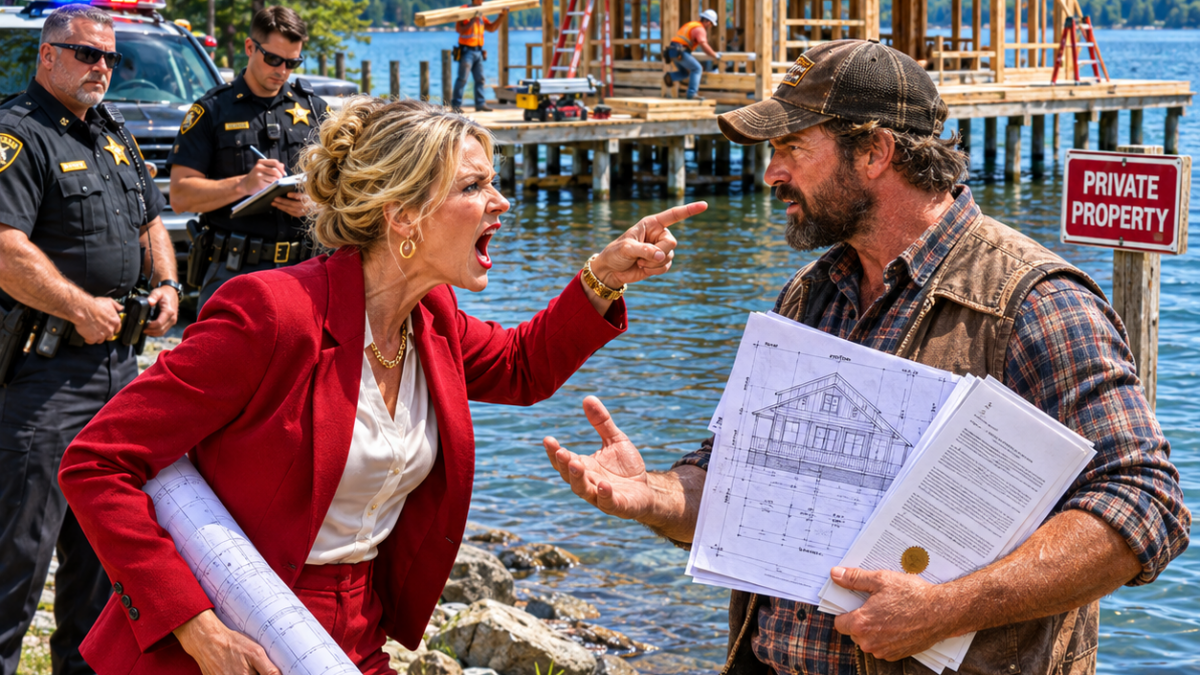
“GET THIS TRESPASSING BASTARD OFF MY WATERFRONT RIGHT NOW! THAT CABIN IS ILLEGAL, AND IF THE POLICE WON’T ARREST HIM, I’LL HAVE MY EXCAVATOR TEAR IT DOWN MYSELF!”
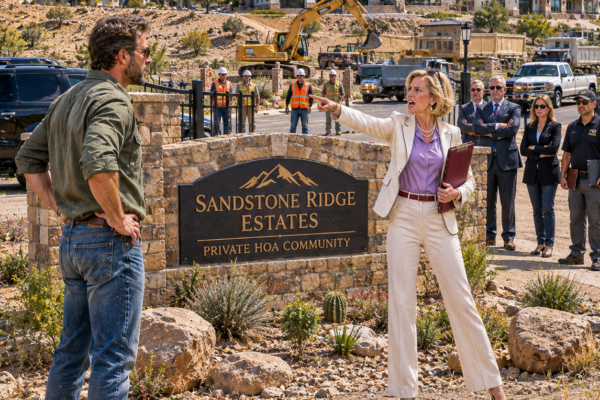
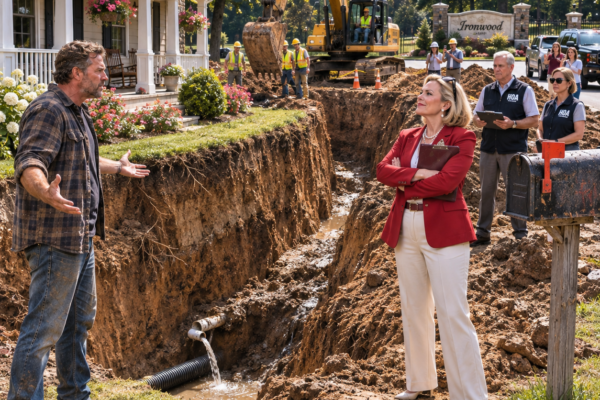
HOA president Denise Hargrove stood in front of my half-built Wisconsin lake cabin, screaming into her phone while two workers waited beside a yellow excavator, completely unaware that the walking trails, fishing platform, and entire two-and-a-half-mile stretch of riverbank behind her wealthy neighborhood belonged to me.
But when the first sheriff’s deputy unfolded my property survey, a construction worker came running from the river shouting that the ground was collapsing—and seconds later, an eleven-year-old boy screamed from a wooden fishing platform that was breaking loose in the rising current.
The first thing I noticed was the excavator.
It was parked beside the foundation of my cabin, its bucket raised over the wooden framing Paul Bennett and I had spent three weeks building.
The second thing I noticed was Denise Hargrove.
She stood in the middle of my driveway wearing a bright red jacket, expensive sunglasses, and an expression of absolute fury.
Her phone was pressed against her ear.
“YES, I NEED OFFICERS IMMEDIATELY! THERE’S A DANGEROUS MAN BUILDING ON PROTECTED COMMUNITY PROPERTY!”
I stopped beside my pickup.
“Denise, tell the dispatcher you’re standing on my land.”
She spun toward me.
“YOU DON’T OWN THIS WATERFRONT!”
“I have the deed.”
“I DON’T CARE WHAT YOU THINK YOUR DEED SAYS!”
Paul, my fifty-two-year-old contractor, stood beside the unfinished cabin with his crew.
Nobody was moving.
Two men from an excavation company waited near the yellow machine.
One was holding construction drawings.
The other kept looking toward the lower riverbank.
Denise pointed at me.
“You’ve been warned repeatedly. That cabin is coming down.”
I looked at the excavator.
“Who hired those men?”
“The association.”
“For what?”
“Emergency removal of an illegal structure.”
I almost laughed.
My cabin had a valid county building permit.
Its foundation had passed inspection.
The site was outside Cedar Cove Estates, the homeowners association Denise claimed to represent.
And the riverfront she kept calling community property was part of the 310 acres I’d purchased three months earlier.
But Denise had apparently decided that repeating a claim loudly enough would eventually make it true.
I reached into my truck and retrieved my folder.
Recorded deed.
Licensed survey.
Boundary map.
County building permits.
Approved construction plans.
Every document necessary to establish where my property began and where Cedar Cove Estates ended.
Denise glanced at the folder.
“Those papers won’t help you.”
“Then you shouldn’t mind the deputies examining them.”
Her face reddened.
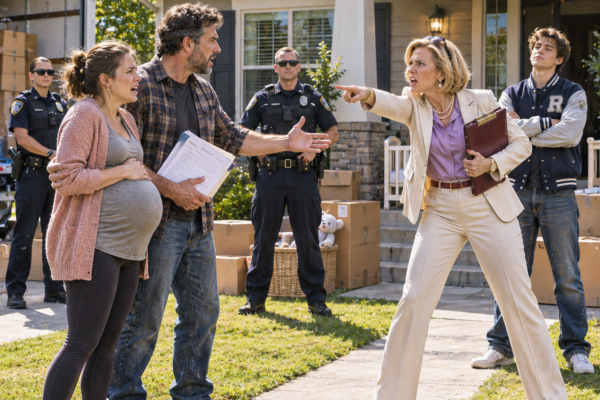
Two sheriff’s vehicles rolled into the driveway.
Deputy Sarah Collins stepped out of the first one.
Denise hurried toward her.
PART2:
“OFFICER! THAT MAN IS TRESPASSING ON HOA WATERFRONT AND THREATENING MY CONSTRUCTION WORKERS!”
Sarah looked from Denise to me.
“Everybody stay calm. Who owns this parcel?”
“I do,” I answered.
“HE DOES NOT!” Denise screamed.
Sarah raised a hand.
“Ma’am, I need one person speaking at a time.”
I handed her my documents.
She examined the survey.
Then looked toward the river.
“Three hundred ten acres?”
“Yes, ma’am.”
“And this shaded section?”
“The privately owned riverbank along Cedar Cove Estates.”
Sarah followed the boundary with her finger.
The line extended north and south for approximately two and a half miles.
Denise stepped closer.
“That’s impossible. Our homeowners have used that shoreline for decades.”
I looked at her.
“Using somebody’s land with permission doesn’t mean you own it.”
Before Sarah could answer, a worker came running up the lower trail.
His face was pale.
“DEPUTY! THE CULVERT’S WASHING OUT!”
We turned.
“THE FISHING PLATFORM’S MOVING!”
Then a child’s scream echoed through the trees.
I recognized the voice.
Owen Cooper.
Eleven years old.
A boy who loved drawing fish, birds, and river otters.
His grandmother had been taking him to that platform for years.
I started toward the upper trail.
Sarah called for fire and water-rescue units.
Behind us, Denise was still shouting that the emergency was somehow my fault.
Then I reached the overlook and saw the wooden platform tilting above the muddy river.
Owen was holding the railing.
His grandmother stood helplessly on the bank.
And the walkway connecting them was already breaking apart.
Three months earlier, I had come to northern Wisconsin looking for peace.
My name is Caleb Morgan.
I was forty-six years old and had spent most of my adult life working as a building contractor in Milwaukee.
I knew how to frame houses, manage crews, repair old structures, and argue with subcontractors who believed deadlines were optional.
Construction had given me a comfortable living.
But it had also taken years of early mornings, late nights, and weekends away from home.
After my father died, I started thinking about what I wanted from the rest of my life.
Dad’s name was Walter Morgan.
He’d been a carpenter for nearly fifty years.
He could build a staircase without wasting a board and repair furniture that most people would’ve thrown away.
When I was a kid, he took me fishing whenever he could.
Those afternoons were some of the happiest memories I had.
Before he died, he told me he wished he’d spent more time beside the water.
So I made myself a promise.
One day, I’d build a small cabin near a lake.
Not a mansion.
Not an expensive resort.
Just a place with a wide porch, a workshop, and somewhere to keep Dad’s old fishing rod.
Then I found a property listing outside a small community in northern Wisconsin.
Three hundred ten acres.
Pine forest.
Open meadows.
An old stone boathouse.
A long gravel driveway.
And a beautiful section of the Blue Heron River that widened into a calm, lake-like stretch locals called Alder Lake.
The property bordered an upscale neighborhood named Cedar Cove Estates.
The houses were built along higher ground overlooking the water.
But the land between those homes and the river was privately owned.
It belonged to the property being sold.
All two and a half miles of it.
The seller was Robert Ellis, a seventy-two-year-old man whose family had owned the land for more than sixty years.
Robert showed me the original surveys.
The recorded deed.
The old boundary markers.
And a narrow trail winding along the riverbank.
There were benches beneath the trees and a simple wooden fishing platform supported by posts near a bend in the river.
“Families have been using this path for generations,” Robert explained.
“Does the neighborhood own it?”
“No.”
“Is there a public easement?”
“There’s an old access arrangement. My father allowed people to walk the designated trail and fish at certain locations. The precise terms are in the property records.”
I studied the map.
The land was clearly separate from Cedar Cove Estates.
Robert smiled.
“Most neighbors understand that.”
“Most?”
He hesitated.
“The current HOA president has been talking about building private docks and a marina.”
“On whose property?”
He looked toward the water.
“That’s the question she doesn’t seem interested in answering.”
I didn’t take the warning seriously enough.
Robert had lived there for decades.
I assumed a new owner could settle any misunderstanding with a survey and a polite conversation.
After inspections, title review, and meetings with my attorney, Rebecca Hale, I bought the property.
I hired a surveyor to confirm the important boundaries.
The privately owned shoreline, walking trail, old fishing platform, and boathouse were part of my purchase, subject to any valid recorded rights.
I didn’t own the flowing river itself or have the right to interfere with lawful public use of the water.
But the banks and upland land along Cedar Cove were mine.
I chose a small rise overlooking Alder Lake for my cabin.
High enough to respect the shoreline setbacks.
Far enough from the river to protect drainage.
Close enough to watch the sunrise through the pines.
Paul Bennett agreed to help me build it.
We designed two bedrooms, a kitchen, a living room with large windows, and a covered porch.
I handled the county approvals before construction began.
Building permit.
Setback verification.
Wastewater plan.
Driveway approval.
Everything the county required.
I wasn’t about to spend my savings building a home on land I couldn’t legally develop.
The first few weeks were wonderful.
Paul and I worked during the day.
In the evenings, I walked the river trail.
That’s how I met Lillian Cooper.
Seventy-four years old.
Widowed.
Living in a cottage near the northern end of Cedar Cove Estates.
Her husband had been a schoolteacher.
They’d spent years walking beside the Blue Heron River, watching the seasons change.
Lillian’s grandson, Owen, visited almost every weekend.
The first time I met him, he was sitting beside the fishing platform with a notebook.
He showed me a drawing of a frog.
Then a blue heron.
Then a river otter that looked suspiciously like a sausage with whiskers.
I laughed.
“What do you want to be when you grow up?”
“A wildlife scientist.”
“Good choice.”
“Are you going to close the trail?”
I looked toward the water.
“Not if people use it respectfully and it’s safe.”
He smiled.
“Grandpa used to fish here.”
Lillian touched his shoulder.
“Robert’s family always let us enjoy the river.”
I told her I’d like to continue that tradition.
It seemed like the right thing to do.
Then Denise Hargrove arrived.
She pulled up beside my cabin site in a black luxury SUV.
Bright red jacket.
Designer sunglasses.
Shoes that sank into the soft dirt.
She stepped out and immediately demanded to know why I was building near the lake.
“Because I own the property,” I answered.
She frowned.
“I’m Denise Hargrove, president of Cedar Cove Estates.”
“Caleb Morgan.”
“You didn’t submit these plans to our architectural committee.”
“My property isn’t in your HOA.”
She laughed.
“Every waterfront project requires association approval.”
“Not on land outside the association.”
She pointed toward the river.
“That shoreline belongs to our community.”
I looked at her.
“Your residents have been allowed to use the trail. That isn’t the same as owning it.”
Her expression hardened.
“We’ve maintained those walking paths for years.”
“I appreciate that, but maintenance doesn’t transfer title.”
“Don’t lecture me about property law.”
“I wasn’t planning to.”
She turned toward Paul.
“Stop work immediately.”
Paul looked at me.
I told him to continue unloading materials.
Denise stared.
“You’re making a serious mistake.”
I offered to show her the survey.
She refused.
Then she drove away, promising to have the county stop construction.
Three days later, an HOA violation notice appeared on my windshield.
Unauthorized construction.
Failure to obtain architectural approval.
Fine: $1,000.
I forwarded it to Rebecca.
She confirmed the association couldn’t impose its private restrictions on my separate property merely because it bordered the neighborhood.
We sent a written response explaining the boundary and requesting that the invalid demand be withdrawn.
Denise replied with another letter.
My cabin was supposedly destroying the neighborhood’s natural beauty and reducing property values.
I looked at the expensive houses above the river.
Many were three times the size of the little cabin I wanted.
Some had enormous decks and three-car garages.
Apparently, my modest two-bedroom building was the thing threatening the landscape.
I didn’t argue.
Paul and I kept working.
We controlled dust.
Respected construction hours.
Protected nearby trees.
Then a man named Thomas Reed stopped by.
Thomas was a retired firefighter who had lived in Cedar Cove for twenty years.
He apologized for Denise.
“Most of us aren’t like that,” he said.
“I figured.”
He looked at my cabin plans.
“Beautiful location.”
“Thanks.”
Then he lowered his voice.
“Denise has been promising homeowners a private marina.”
I looked up.
“What?”
“Boat slips. Restaurant deck. Private storage. A gated entrance.”
“Where?”
Thomas pointed toward the water.
Almost directly below my cabin.
“She keeps saying the association already controls the shoreline.”
I looked toward the unfinished foundation.
Suddenly, Denise’s hostility made more sense.
My cabin wasn’t simply offending her sense of neighborhood appearance.
It stood near the entrance to a waterfront project her son wanted to build.
A project worth millions.
A week later, her son arrived.
Blake Hargrove.
Early thirties.
Clean white shirt.
Expensive sunglasses.
Silver pickup.
He introduced himself as a manager with Silvercrest Waterfront Partners.
He said the company had an exciting development opportunity.
He spread architectural drawings across my worktable.
A marina.
Private boat slips.
A restaurant deck.
Parking.
A new access road.
And a luxury waterfront recreation area intended for Cedar Cove’s wealthiest homeowners.
The entrance crossed my land.
The parking area crossed my land.
Several docks connected to my privately owned shoreline.
My cabin site sat directly in the proposed route.
“Move the cabin farther into the woods,” Blake suggested.
“Why would I?”
“We can provide discounted building materials.”
“No, thank you.”
He smiled.
“This is a multimillion-dollar project.”
“Congratulations.”
“Your little cabin shouldn’t be allowed to interfere with it.”
I looked at the plans.
“Have you purchased any of this land?”
“The HOA controls community waterfront access.”
“That wasn’t my question.”
His smile disappeared.
“Powerful investors expect this project to move forward.”
“Then you need a lawful agreement from the property owner.”
He pointed toward the cabin frame.
“You’re being selfish.”
“I bought this land to live on it.”
“Everything has a price.”
“Not everything.”
He folded the drawings.
“You’re making an expensive mistake, Caleb.”
Then he drove away.
Paul watched him leave.
“Think they’re going to give up?”
I looked toward the river.
“No.”
Within days, county inspector Richard Mason arrived.
He’d received complaints that my cabin was being built illegally.
I showed him the approved plans.
He checked the setbacks, foundation, and permits.
Everything matched.
Then he mentioned something strange.
A separate application had been submitted for waterfront improvements near Cedar Cove.
Some proposed work appeared to overlap my parcel.
Rebecca obtained a copy.
Silvercrest’s plans showed a private marina entrance, parking area, docks, and modifications to a drainage channel near the old fishing platform.
No agreement from me was attached.
No deed showed HOA ownership of the shoreline.
We sent formal notices identifying the property and requiring unauthorized work to stop.
Meanwhile, orange survey flags began appearing beside the old platform.
Red markings crossed the trail.
Stakes surrounded a stone culvert that carried stormwater toward the river.
I photographed everything.
Then came the Thursday morning Denise called 911.
Thomas had alerted me that excavation trucks were working near the culvert.
Paul and I walked down the trail.
The crew supervisor, Daniel Price, was surprised when I told him the land belonged to me.
He had been shown paperwork claiming the HOA controlled the shoreline.
I asked him to stop until the property rights and permits were verified.
He agreed.
But Denise arrived with Blake.
She demanded that the excavation continue.
Daniel told her the bank was unstable.
Blake said investors couldn’t afford more delays.
I warned that rain was moving through the watershed and the culvert was carrying more water than usual.
One worker pointed out cracks forming in the soil.
Denise called him incompetent.
Then she called 911 and accused me of trespassing.
That was how Deputy Sarah Collins ended up examining my deed beside an excavator while an unstable riverbank began collapsing below us.
And that was how Owen became trapped.
When I reached the upper trail, the wooden walkway had already separated from the fishing platform.
Lillian stood on the bank crying.
“Owen! Stay still, sweetheart!”
The boy gripped the railing.
His fishing rod lay near his feet.
The river was swollen and muddy.
I shouted for him to stay low.
“DON’T JUMP, OWEN!”
He looked toward me.
“MR. MORGAN! I CAN’T GET BACK!”
“I know! Help’s coming!”
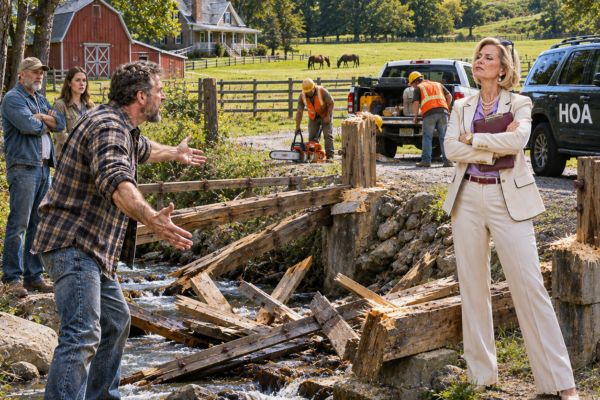
A support post snapped.
The platform tilted.
Owen fell to his knees.
Lillian started toward the broken walkway.
Thomas caught her arm.
“Lillian, that bank won’t hold you.”
Then the ground beneath the trail gave way.
A section of wet soil collapsed into the river.
The final connection between the platform and shore broke.
The entire structure began drifting downstream.
Owen screamed.
I ran along the safer upper path, keeping him in sight.
Deputy Collins was calling for water rescue.
Paul brought a long rope from our construction truck, but the river was moving too fast for an untrained person to attempt a rescue safely.
The platform struck a floating branch.
It spun sideways.
One railing snapped.
Owen slid toward the edge.
Then the structure hit a submerged rock.
It broke apart.
For one terrible moment, the boy disappeared beneath the muddy water.
Lillian screamed his name.
Then I saw a small hand gripping a floating board.
Owen was still alive.
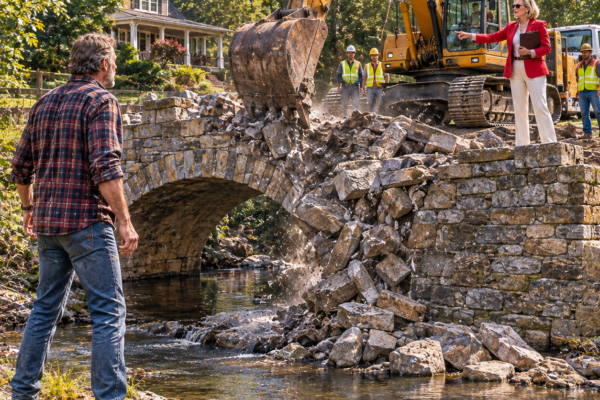
But the current was carrying him toward a narrow stone bridge where fallen branches had collected beneath the opening.
If he was pulled under that debris, reaching him would become almost impossible.
The first fire truck arrived.
Captain James Miller immediately organized his water-rescue team.
One group moved downstream to a safer bend.
Another secured a rope line.
A trained rescuer entered from a calmer section wearing proper equipment.
I pointed toward Owen.
“THERE! BESIDE THE BROKEN BOARD!”
The rescuer moved through the current.
Owen’s grip weakened.
One hand slipped.
Then the rescuer caught his jacket.
The rope team pulled.
For several frightening seconds, the water seemed determined to drag them both toward the bridge.
Then the line tightened.
The rescuer turned toward the safer bank.
Two firefighters waded into the shallow edge and helped bring Owen onto the grass.
He was coughing.
Shaking.
Crying.
But breathing.
Lillian nearly collapsed when she saw him.
Paramedics wrapped him in blankets and checked his breathing.
They transported him to the hospital for observation after his immersion in the river.
Before the ambulance left, Owen looked toward me.
“I’m sorry, Mr. Morgan.”
I shook my head.
“You have nothing to apologize for.”
He began crying again.
I put a hand on his shoulder.
“I’m glad you’re here.”
When the ambulance disappeared, I turned toward the river.
The fishing platform was gone.
The walkway had been ripped apart.
The bank near the culvert had collapsed.
And the beautiful place where Robert’s family had allowed generations of children to fish was scattered across the current.
Behind me, Denise was arguing with Sarah.
“This is Caleb’s fault! His illegal construction disturbed the land!”
Sarah asked who had authorized the excavation beside the drainage channel.
Daniel Price stepped forward.
“Mrs. Hargrove and her son hired us.”
“Did the property owner authorize the work?”
“No, ma’am. We were told the HOA owned the site.”
“Did you stop when Mr. Morgan objected?”
“Yes, but we’d already removed some soil.”
Sarah documented the statement.
She also made something clear to Denise.
Calling 911 didn’t give an HOA president the authority to decide land ownership or order an arrest.
Denise threatened to complain about the entire sheriff’s department.
I barely listened.
An eleven-year-old boy had nearly drowned.
And she was still trying to win an argument.
That evening, I visited Owen at the hospital.
Lillian sat beside him holding a cup of coffee with both hands.
He was awake.
Tired.
Still coughing occasionally.
When he saw me, he managed a small smile.
“Did the willow tree survive?”
I stared at him.
After nearly losing his life, he was worried about a tree.
“I think so.”
“Can you check?”
“I promise.”
Then he asked whether I’d close the whole shoreline.
I told him the damaged area had to remain closed until engineers made it safe.
But I wanted families to enjoy the river again.
He nodded.
“Okay.”
I drove home feeling more determined than ever.
Not to fight Denise.
To protect the place.
Rebecca soon discovered that Silvercrest Waterfront Partners had been advertising the marina to investors as though shoreline access was already secured.
Blake had promised exclusive boat slips.
A restaurant deck.
Private parking.
An entrance near my cabin.
Several customers had apparently paid reservation deposits.
But Silvercrest didn’t own the required land.
And I hadn’t agreed to sell it.
Rebecca notified the development company and relevant county offices.
We also began documenting the riverbank damage.
Engineers examined the failed culvert and prepared a stabilization plan.
The county restricted access to the dangerous section.
Meanwhile, Cedar Cove homeowners started asking questions.
Lillian told me residents had paid special assessments for waterfront improvements.
They believed the money would repair trails, replace benches, and improve the fishing platform.
Most had never agreed to an expensive private marina with restricted boat slips.
Thomas organized a community meeting.
I attended with copies of my deed and survey.
About fifty homeowners sat in the clubhouse.
When my turn came, I explained that I owned the 310 acres beside their neighborhood.
The privately held banks.
The old boathouse.
The walking trails.
The land beneath the proposed marina entrance.
An older man asked whether his grandchildren would still be allowed to fish.
I told him I hoped to reopen the platform after proper repairs.
A woman asked whether I intended to build vacation cabins along the whole shoreline.
“No. I bought the property because I want to protect it.”
Then Thomas asked the important question.
“Has Cedar Cove obtained a signed agreement allowing Silvercrest to build a marina?”
I shook my head.
“No.”
The room became quiet.
Denise stood.
“He’s misleading you! This has always been community waterfront!”
I looked toward her.
“Denise, you’re welcome to show everyone the deed proving that.”
She didn’t.
Blake stepped forward.
“Our company has several ways to secure the project.”
A homeowner asked whether those ways included purchasing the land from me.
Blake refused to answer.
Another asked why the HOA had already collected money.
Denise called the finances complicated.
The meeting ended with more questions than answers.
For the first time, I felt the ordinary homeowners were beginning to understand what was happening.
Then Denise returned to my cabin site with another violation notice.
She called the building unsafe.
She demanded an HOA inspection.
She threatened demolition.
I reminded her that the county had approved our work.
She pointed toward the framing.
“That cabin will never be finished.”
I looked at her.
“Not because you say so.”
Her eyes narrowed.
Blake arrived and pulled her toward his SUV.
Before leaving, he warned that investors were running out of patience.
A few days later, a red notice appeared on my gate.
EMERGENCY CONSTRUCTION SUSPENSION.
It bore what looked like an official county stamp.
Rebecca checked with the county.
No such order had been issued for my cabin.
Only the damaged shoreline remained restricted.
Inspector Richard Mason came out and confirmed that approved construction could continue on the higher ground.
I thought Denise might finally stop.
Then the storms arrived.
Heavy rain swept across the valley.
The river rose.
Paul secured the unfinished roof and protected our materials.
One Friday evening, he called to say unfamiliar vehicles were entering the lower access road.
I checked my cameras.
Headlights moved through the rain.
Then Thomas called.
“Caleb, there are construction trucks heading toward your cabin.”
I drove out immediately.
A large excavator stood beside the unfinished building.
Men were carrying metal barriers and demolition equipment.
The machine’s engine was running.
I stopped at a safe distance and called the sheriff’s office.
Then I called Paul.
He answered after several rings.
“Caleb?”
“Where are you?”
“Inside the cabin.”
My stomach tightened.
“Get out.”
“I came back for the electrical plans, but they’ve blocked the entrance.”
“Paul, listen carefully. There’s an excavator outside.”
“I know. I told them I’m here.”
“Find a safe exit. Stay away from the walls facing the machine.”
Then I heard a crash through the phone.
Paul shouted.
The excavator’s bucket had struck a support post.
I jumped out of my pickup.
“STOP! SOMEONE’S INSIDE!”
One worker turned.
He started waving toward the operator.
But the machine moved again.
A second support was hit.
The upper floor shifted.
Several boards crashed into the cabin.
Denise’s SUV arrived.
Blake climbed out beside her.
He shouted at the workers to finish the demolition.
I ran toward him but stopped before getting close to the equipment.
“PAUL IS INSIDE!”
Blake stared.
Then said the cabin had been declared unsafe.
“There is no demolition order!”
Denise pointed toward the building.
“You ignored our warnings!”
The excavator struck another section.
The upper framing bent.
A loud crack split the night.
Paul screamed through my phone.
A heavy beam had fallen across the rear doorway.
His leg was trapped.
I told him firefighters were coming.
Then another crash shook the structure.
The lakeside wall began leaning.
Rainwater rushed through the damaged foundation trench.
The excavator had disturbed the drainage beside the building.
I called out to the operator again.
He finally backed away.
But by then, the cabin was collapsing.
Two sheriff’s vehicles arrived.
Deputy Sarah Collins jumped out.
She ordered the machinery stopped.
Then she learned Paul was trapped.
She immediately called for firefighters and EMS.
Blake tried to leave.
A deputy instructed him to remain available for the investigation.
He climbed into his pickup anyway.
Another patrol vehicle blocked the exit.
Then a portable fuel tank near our temporary generator was knocked loose by falling materials.
Fuel spread across the wet ground.
A damaged electrical connection sparked.
I warned everyone to move back.
Sarah relayed the hazard to the fire department.
Then a bright flash lit the rain.
Flames spread beneath the broken timber.
My unfinished cabin was burning.
And Paul was still inside.
For one terrible moment, I thought I was going to watch a friend die inside the home we’d built together.
Captain James Miller arrived with his rescue team.
He took one look at the structure and began organizing crews.
Firefighters controlled the flames around the generator.
Others checked the unstable supports.
Then a rescue team entered through an opening they had made safe.
I stood beside Sarah.
Every second felt unbearable.
Then a firefighter shouted.
“WE FOUND HIM!”
The team worked to free Paul’s trapped leg.
I heard him cry out in pain.
Then the rescuers carried him outside on a stretcher.
His face was covered in dust.
His jacket was torn.
But his eyes were open.
When he saw me, he reached for my hand.
“Caleb, I’m sorry about the cabin.”
I shook my head.
“The cabin can be rebuilt.”
He tried to speak again.
I leaned closer.
“You can’t.”
Paramedics took him to the hospital.
By sunrise, the cabin was ruined.
The front wall had collapsed.
The upper floor was destroyed.
Rain had filled part of the foundation trench.
Charred lumber lay across the ground.
The porch Dad and I had dreamed about was gone before it had ever been finished.
Then Sarah showed me the document Blake had given the deputies.
An emergency demolition order.
Official-looking stamp.
County letterhead.
But the county had no record of issuing it.
The document was being treated as evidence.
The excavator operator, Scott Williams, told investigators Blake had ordered him to strike the cabin supports even after a worker warned that someone might be inside.
Blake called him a liar.
Denise claimed she had merely been enforcing HOA rules.
Investigators separated the witnesses.
I didn’t interfere.
I wanted the truth established properly.
Not another shouting match in the rain.
The next morning, I visited Paul.
His wife, Jennifer, sat beside his hospital bed.
Their seventeen-year-old son, Tyler, stood near the window.
Paul’s leg was broken.
He had bruises and cuts.
Doctors expected him to recover.
But he would need time.
Tyler asked whether his father would lose his job.
I looked at him.
“Your dad isn’t losing his place on this project because somebody else brought an excavator onto our land.”
Jennifer began crying.
I told them we’d work through the insurance and injury arrangements together.
Then I looked at Paul.
“When you’re ready, we’re rebuilding.”
He smiled weakly.
“I’ll be there.”
I drove home to a property that no longer looked peaceful.
The fishing platform was gone.
The riverbank was damaged.
My cabin was destroyed.
And somebody was still trying to build a marina on land they didn’t own.
Rebecca began preparing our property damage claims.
County officials investigated the false demolition order and unauthorized excavation.
Silvercrest’s investor materials became part of the review.
Then Robert Ellis called.
He’d heard about the cabin.
He wanted to help.
We met near the old stone boathouse at the northern end of the property.
Robert looked older than he had when he sold me the land.
He stood beside the stone wall, studying the river.
“My father always worried somebody would try to turn this shoreline into a private resort,” he said.
I looked toward him.
“Did he leave any documents about the old neighborhood access?”
Robert nodded.
“There were agreements.”
“Where?”
“Some were recorded. He also kept copies.”
He pointed toward the boathouse.
“I remember a storage compartment beneath the floor.”
We inspected the building from outside.
It was old but beautiful.
Stone walls.
Wooden roof.
A narrow door facing the river.
Robert remembered a hidden space near the back wall where his father stored papers and photographs.
Rebecca arranged for a safe inspection.
Then we noticed something strange.
Fresh footprints near the rear entrance.
Flattened grass.
An empty drink bottle.
Somebody had been there recently.
Security footage from the northern access road showed a dark pickup arriving at night.
A man carried a small bag into the boathouse.
Twenty minutes later, he returned to the truck.
The plate wasn’t readable.
We preserved the footage.
Then Cedar Cove homeowners hired an independent accountant.
The review found payments to businesses connected to Blake’s marina project that didn’t clearly match the improvements residents believed they’d funded.
Some were described as shoreline maintenance.
Others as planning services.
Thomas told me the board wanted answers.
Denise was losing control.
She visited my property one afternoon without her usual entourage.
Her voice was unusually calm.
“Caleb, we should settle this.”
I watched her carefully.
She offered me money to stop challenging the marina and move my cabin farther into the woods.
I declined.
Then I asked something I’d wanted to know for months.
“Why do you want this marina so badly?”
She looked toward the river.
“Cedar Cove should be the most valuable neighborhood in this county.”
“Is that what the homeowners want?”
“Ordinary homeowners rarely understand what’s best for them.”
I stared at her.
She continued.
“Important investors are depending on this project.”
“Then they should have made sure you owned the land.”
Her face reddened.
“You’ll regret refusing this offer.”
She drove away.
That night, Rebecca discovered Silvercrest had advertised exclusive access to the northern shoreline near the old boathouse.
Several expensive boat slips appeared on marketing maps.
The proposed entrance crossed the same trail where the dark pickup had been recorded.
Robert remembered more about the hidden compartment.
His father had once stored a small metal box there.
Old property maps.
Letters.
Possibly the original access agreement with Cedar Cove’s developer.
Then my phone buzzed.
An unknown number.
A photograph of the boathouse.
A message underneath:
THEY KNOW THE OLD PAPERS ARE INSIDE.
I stared at it.
I forwarded it to Rebecca.
She contacted the sheriff’s office.
We decided not to enter the boathouse until the area could be checked.
Robert agreed.
At least, I thought he did.
The next afternoon, he called me.
His voice was shaky.
“Caleb, I’m at the boathouse.”
I stood.
“Robert, we agreed to wait.”
“Somebody called me. Said the documents would be destroyed before sunset.”
“Get away from the building.”
“The back door is open.”
“Robert, listen to me. Go back to your truck.”
He hesitated.
“I can see the old fishing float. My father kept the compartment key inside it.”
“Leave it. We’ll check with the sheriff.”
Then I heard a loud noise.
Robert shouted.
“WHO’S THERE?”
The phone crackled.
A second crash.
Then silence.
I called 911 and reported the situation.
Then drove toward the northern trail.
A dark pickup was parked near the boathouse.
Its engine was running.
A thin line of smoke rose behind the roof.
I stopped well away from the building.
“ROBERT!”
No answer.
Then I heard coughing inside.
The smoke thickened.
Flames appeared beneath the wooden roof.
A man in a dark jacket suddenly ran from the side entrance.
He carried a small metal box.
I shouted for him to stop.
He froze when he saw me.
Then ran to the pickup.
I photographed the vehicle as he drove away.
Then Robert screamed.
His voice came from inside the burning building.
A heavy shelf had fallen across the doorway.
His leg was trapped.
I could hear him coughing.
I told him firefighters were coming and begged him to stay low if he could.
The wind shifted.
Sparks blew into dry grass.
Small flames spread toward the trees.
Above the shoreline, Cedar Cove houses stood behind a line of pines.
If the fire reached those trees, the neighborhood could be in danger.
Then a heavy beam crashed inside the boathouse.
Robert screamed again.
His voice disappeared.
My phone vibrated.
Another message from the unknown number.
A photograph of the metal box.
Then a second photograph.
Denise and Blake standing beside the same dark pickup earlier that afternoon.
The message read:
THE ORIGINAL AGREEMENT PROVES EVERYTHING.
Captain James Miller arrived moments later.
I told him Robert was inside.
His firefighters began organizing a rescue.
Another crew moved toward the growing brush fire.
Then I heard Lillian screaming from the hillside.
I looked up.
She was trapped beside an old wooden footbridge with two young children.
A girl in a yellow jacket.
A boy who looked about seven.
One end of the bridge was burning.
Smoke blocked the trail behind them.
I shouted for them to stay away from the bridge.
Lillian waved.
Captain Miller divided his crews.
One team for Robert.
One for the wildfire.
One to reach Lillian and the children from the upper maintenance road.
I pointed out the road on my property map.
The firefighters used it to approach from safer ground.
Meanwhile, flames climbed into the lower branches of several pine trees.
Deputies began warning Cedar Cove residents to leave the threatened area.
Additional fire trucks arrived from neighboring communities.
Families hurried toward their cars.
Smoke drifted across the hillside.
Then I saw firefighters reaching Lillian.
They guided her and the children away from the burning bridge.
One firefighter carried the younger boy.
The girl held Lillian’s hand.
All three reached an open clearing.
I felt relief wash through me.
But Robert was still inside the boathouse.
Then a firefighter shouted from the side entrance.
Two rescuers appeared through the smoke carrying someone between them.
Robert.
His clothes were blackened.
His face was pale.
They placed him on a stretcher.
For a moment, he didn’t move.
Then he coughed.
Opened his eyes.
And reached for my hand.
“Caleb…”
“I’m here.”
“The box…”
“Forget the box.”
He tried to speak.
I squeezed his hand.
“Just get better.”
Paramedics took him to the hospital.
Fire crews continued fighting the flames for hours.
By evening, they’d kept the fire from reaching the main residential area.
Some fences and small structures were damaged.
The boathouse roof was destroyed.
But every person reported missing had been accounted for.
I stood beside the burned stone walls feeling exhausted.
In a few months, Denise’s obsession with the marina had been followed by three frightening emergencies.
Owen had nearly drowned.
Paul had been trapped inside my collapsing cabin.
Now Robert had nearly died trying to protect his father’s records.
The problem was no longer just who owned the shoreline.
It was how far people were willing to go to hide the truth.
Deputy Sarah Collins collected my statement.
I gave her the photographs of the fleeing pickup.
The anonymous messages.
The picture of Denise and Blake.
And the details Robert had told me.
The investigation continued.
The following morning, I visited Robert in the hospital.
His daughter Susan sat beside his bed.
He was recovering from smoke inhalation and painful bruises.
He apologized for going to the boathouse alone.
I shook my head.
“Nothing in that building was worth your life.”
He nodded.
Then told me what had happened.
A man in a dark jacket had been inside.
Carrying the old metal box.
When Robert confronted him, the man pushed past.
Robert fell against a shelf.
The shelf collapsed.
Then smoke began filling the room.
Before leaving, the stranger had complained on his phone that Blake should have removed the documents months earlier.
I asked Robert whether another copy of the agreement might exist.
He thought for a moment.
“My father was careful. He probably left one with the county or his attorney.”
Rebecca began checking.
Within days, she found an old recorded development map.
It clearly showed Cedar Cove’s boundary along the higher residential land.
The riverfront below remained with the Ellis family.
The old trail was marked as a permitted access route.
Not HOA-owned land.
Not a marina site.
Not a public parking lot.
Then investigators identified the pickup.
It belonged to Trevor Wallace, a contractor who worked on special projects for Silvercrest Waterfront Partners.
The sheriff’s department located the vehicle and pursued evidence connected to the boathouse theft and fire.
That was when the anonymous sender finally revealed herself.
Her name was Hannah Cole.
Twenty-eight.
An office assistant at Silvercrest.
She’d sent the messages because she was frightened by what she’d discovered.
Blake had been telling investors that shoreline access was secured.
But internal documents showed his company had never purchased the land.
Hannah had seen plans that depended on forcing me away from my cabin site.
She’d also seen correspondence showing that Denise knew Cedar Cove did not hold title to the privately owned riverbank.
Hannah told Rebecca she’d been afraid to speak.
Her job helped support her younger sister through college.
Blake had made it clear that disloyal employees would be fired.
Then Hannah saw Trevor bring a metal box into the development office.
Denise and Blake were waiting beside his truck.
She photographed the box.
Then photographed the two of them.
She sent the images to me.
At the time, she didn’t know the boathouse was burning or that Robert was trapped inside.
When she learned what had happened, she couldn’t stay silent.
She obtained legal advice and agreed to provide relevant records to investigators.
I thanked her.
“You may have helped prevent something even worse.”
She began crying.
“I should’ve come forward sooner.”
I didn’t argue with her.
The important thing was that she’d chosen to tell the truth.
Weeks later, investigators recovered the missing metal box.
Inside were old maps, letters, photographs, and copies of the original agreement between Robert’s father and the developer who built Cedar Cove Estates.
The wording was clear.
Designated shoreline trail access.
Limited recreational use.
Permission for neighborhood families to reach an existing fishing area under defined conditions.
No transfer of ownership.
No authority to construct commercial docks.
No permanent rights to build a private marina.
No right to relocate the landowner’s cabin.
Robert’s father had wanted neighboring families to enjoy the river.
He had not given their HOA the riverfront.
Rebecca compared the authenticated documents with my recorded deed and current survey.
The ownership boundary was unchanged.
From the northern bend near the stone boathouse to the southern meadow below Cedar Cove, the privately held shoreline remained part of the 310 acres I’d purchased.
I still had to respect applicable public rights, permits, and valid access arrangements.
But Denise’s claim that the HOA owned the entire riverbank was wrong.
It had always been wrong.
And the documents proving it had existed long before I bought the property.
Then the financial questions surfaced.
An independent review of Cedar Cove’s accounts identified payments to businesses connected to Blake’s marina development.
Some were described as shoreline improvements.
Others as planning expenses.
Homeowners had been told their money would repair trails, benches, and fishing areas.
But significant planning had involved private boat slips, a restaurant deck, and a commercial marina many residents didn’t want.
At a special HOA meeting, Thomas presented the findings.
Homeowners demanded explanations.
Why had Denise spent association money on a project without securing the land?
Why had contractors been sent onto private property?
Why had a child nearly drowned after unauthorized excavation?
Why had an excavator been used against a permitted cabin?
Denise tried to defend herself.
She claimed the marina would increase property values.
She said Cedar Cove deserved to become the county’s most prestigious waterfront neighborhood.
Then an older homeowner stood.
“We didn’t elect you to steal someone else’s shoreline.”
The room went silent.
Another resident asked why Denise hadn’t accepted my offer to review the property maps.
She didn’t answer.
A woman near the back said she’d paid waterfront improvement fees because she wanted her grandchildren to fish safely.
Not because she wanted an exclusive marina.
Other residents agreed.
Under the association’s governing procedures, homeowners removed Denise as president.
A new board began reviewing the financial records and canceling unauthorized development commitments where legally possible.
The marina project on my property was abandoned.
Silvercrest’s investors faced the reality that their supposed waterfront rights had never been secured.
The criminal and civil investigations continued.
Trevor faced charges connected to the theft of the old documents and the boathouse fire.
Blake faced consequences connected to false paperwork, unauthorized construction, and damage associated with the attempted demolition.
Denise’s role in arranging work and supporting false property claims was also examined.
Trevor eventually admitted responsibility for taking the box and starting the boathouse fire.
Blake admitted his involvement in using false documents to support the marina scheme.
Denise faced legal consequences for her part in the unauthorized operations and misleading property claims.
Separate civil proceedings addressed the destruction of my cabin, the damaged shoreline, and the losses resulting from those incidents.
I didn’t celebrate.
I was relieved that the truth had been established.
But no court decision could make Owen forget the river pulling him toward the bridge.
It couldn’t erase Paul’s months of rehabilitation.
Or Robert’s memories of waking inside a burning boathouse.
Those things had happened.
The best we could do was make sure the people responsible were held accountable and prevent anything like it from happening again.
By the following spring, I was ready to rebuild.
Paul returned to work with his doctor’s approval.
He moved carefully at first.
The injured leg still bothered him after long days.
But the first morning we stood beside the cleared cabin site, he smiled.
“Ready to start again?”
I looked toward Alder Lake.
“More than ready.”
We rebuilt using the approved plans.
Engineers reviewed the drainage protection.
The damaged foundation area was repaired.
Temporary barriers kept construction well away from the unstable shoreline.
We chose the same large windows.
The same two bedrooms.
The same modest kitchen.
And the wide porch I’d dreamed about building with my father.
Every new beam felt like taking back something that had almost been stolen.
One afternoon, Paul stood beside the porch framing.
“Your dad would’ve loved this view.”
I smiled.
“He probably would’ve said the porch needed to be bigger.”
Paul looked at the plans.
“We could still make room for one more fishing chair.”
I laughed.
“Don’t tempt me.”
Robert recovered too.
His breathing gradually improved.
He returned to the riverfront with his daughter Susan.
Together, we planned the restoration of the stone boathouse.
We preserved the original walls wherever possible.
Used safe new timber for the roof.
And kept the building simple.
No restaurant.
No luxury marina office.
Just a quiet place reflecting the Ellis family’s history.
When the restoration was complete, Robert brought an old photograph of his father standing beside the boathouse.
We hung it near the door.
Below it, I placed a small plaque thanking the Ellis family for caring for the riverfront for generations.
Robert stood in front of it for a long time.
Then turned toward me.
“My father would’ve liked you, Caleb.”
I couldn’t speak for a moment.
Finally, I said, “I think I would’ve liked him, too.”
The damaged riverbank required more work.
Engineers stabilized the drainage channel.
The old fishing platform was replaced with a safer structure after appropriate reviews and approvals.
We added stronger railings.
Clear safety signs.
And improved access along the designated trail.
Thomas and several Cedar Cove residents volunteered to help clean the surrounding area.
Lillian brought sandwiches.
Owen supervised everybody with his notebook.
He asked the engineers so many questions that one finally laughed and told him to consider a career in environmental science.
Owen grinned.
“That’s already the plan.”
On the morning the fishing platform reopened, Owen arrived carrying a small rod.
Lillian held his hand.
He stopped at the beginning of the walkway.
“Mr. Morgan?”
“Yeah, buddy?”
“Is it really safe now?”
“The engineers checked it, and the required inspections are complete. But you still have to follow the rules and stay with your grandmother.”
He nodded.
Then stepped onto the platform.
Lillian followed.
They sat beside the railing.
Owen lowered his fishing line into the water.
For a long time, I just watched.
The river was calm.
The willow tree had survived.
Birds moved through the branches.
And the boy who had once been carried helplessly downstream was fishing again.
That moment meant more to me than any court ruling.
A few weeks later, Cedar Cove’s new board contacted Rebecca.
They wanted a proper agreement addressing trail maintenance, access, safety, and respect for my property boundaries.
I agreed to discuss it.
This time, nobody arrived demanding control.
They brought maps.
Asked questions.
Listened.
And accepted that my ownership and the community’s permitted access were different things.
We worked toward a clear written arrangement that respected both.
I didn’t want ordinary families punished for Denise’s behavior.
Robert’s family had shared the riverfront with neighbors for generations.
I wanted to continue that tradition where it was safe and lawful.
That summer, my cabin was finally finished.
The porch faced Alder Lake.
Large windows filled the living room with morning light.
I built a workbench in a small room beside the garage.
Then I brought Dad’s old fishing rod from Milwaukee.
I placed it beside the cabin door.
For the first time in years, I felt I’d kept my promise to him.
One evening, I invited the people who’d helped me through everything.
Paul came with Jennifer and their son Tyler.
Robert arrived with Susan.
Lillian brought Owen and homemade cookies.
Thomas and his wife helped arrange chairs on the porch.
Deputy Sarah Collins stopped by briefly.
Captain James Miller and several firefighters were invited too.
We watched the sunset turn the water orange.
Paul raised a glass.
“To the cabin that almost didn’t survive.”
Everyone laughed.
Then Robert thanked the firefighters who had saved him from the boathouse.
Lillian thanked the rescue team that had pulled Owen from the river and saved her and two other children from the wildfire.
For a moment, nobody spoke.
We remembered how close we’d come to losing people we loved.
Then Thomas asked me to say a few words.
I looked around the porch.
“When I bought this land, I thought I was buying a quiet place to spend the rest of my life.”
A few people smiled.
“I never expected to have an HOA president calling 911 because I was building a cabin on my own property.”
That drew some laughter.
“But I also never expected to meet this many people who’d stand beside me when things went wrong.”
I looked toward Paul.
“People who helped build something and came back to rebuild it after it was destroyed.”
Toward Robert.
“People who cared enough about their family’s history to protect it.”
Toward Lillian and Owen.
“And people who reminded me why this riverfront mattered long before I ever bought it.”
I paused.
“Denise believed her HOA title meant she could decide who owned the shoreline. Blake believed powerful investors could make property boundaries disappear.”
I looked out toward the water.
“But a deed doesn’t change because somebody shouts louder than the person holding it.”
Then I looked toward the neighbors.
“And owning land doesn’t mean you have to become selfish with it.”
My father had taught me that.
Robert’s family had lived it.
And the people on my porch had helped me understand it more clearly than ever.
After everyone left, I sat alone outside.
The cabin lights glowed softly behind me.
The restored boathouse stood beneath the northern pines.
Farther downstream, the new fishing platform rested safely above the water.
I could hear the river moving across the rocks.
I thought about the first morning Denise arrived in her red jacket.
She’d told me I needed her permission to build.
She’d threatened fines.
Then demolition.
Then called 911 demanding that police arrest me.
She had acted as though seeing the water from an expensive house gave her the right to control the land beside it.
But the truth had been there from the beginning.
Recorded in deeds.
Drawn on surveys.
Preserved in the Ellis family’s original agreement.
I didn’t own just the small patch of ground beneath my cabin.
I owned the 310-acre property, including the privately held two-and-a-half-mile riverfront bordering Cedar Cove Estates.
The old walking trails.
The banks.
The fishing platform site.
The boathouse.
And the proposed marina entrance.
All subject to the applicable legal access rights and public water laws, but never owned by Denise’s HOA.
She’d tried to take control of a shoreline her association had never purchased.
And in doing so, she’d nearly destroyed everything that made the place worth protecting.
Still, I didn’t want to remember the experience only through her actions.
I wanted to remember Owen fishing again.
Robert smiling beside his restored boathouse.
Paul standing on the porch he’d helped rebuild.
And neighbors enjoying the river without demanding they own it.
I stood and walked toward the cabin door.
Dad’s old fishing rod rested beside the wall.
For a moment, I imagined him standing on the porch, looking out across Alder Lake.
He would’ve loved the quiet.
The pine trees.
The open sky.
And the sound of water moving through the valley.
Then I smiled.
Because after everything Denise Hargrove had tried to do, I’d finally built the home I wanted.
The cabin was standing.
The riverfront was protected.
The marina scheme was finished.
And the neighbors who truly loved that beautiful stretch of Wisconsin shoreline could enjoy it again.
Denise called 911 because she thought a loud voice and an HOA title could force me off my own land.
But she made one mistake she could never undo.
She never checked who actually owned the riverfront she was trying to control.
And by the time the truth came out, the man she wanted arrested was still standing on his own porch, watching the sunset over the very shoreline she had spent months trying to steal.