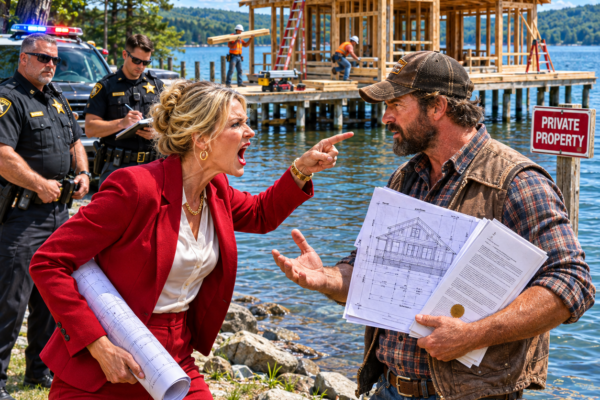
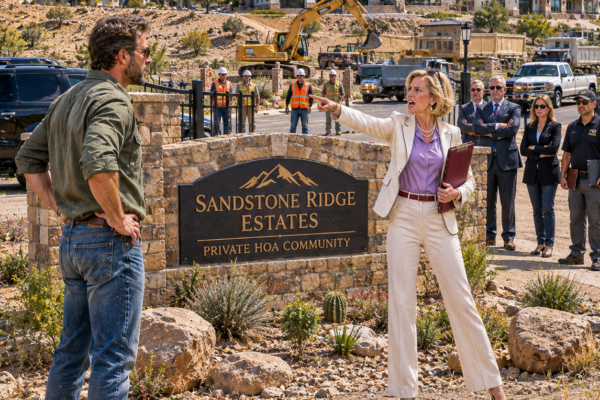
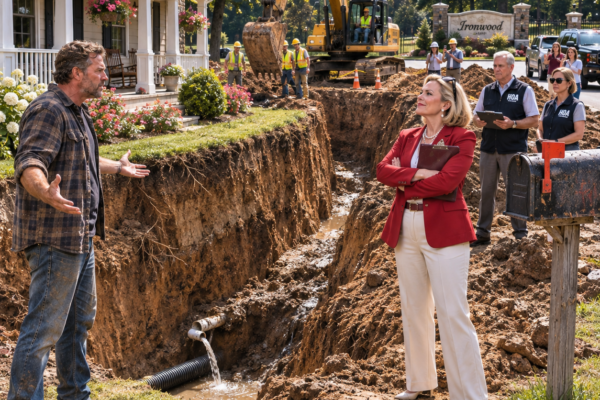
PART 2: HOA Bulldozed the Bridge I Built With My Late Wife to “Teach Me a Lesson” — I Wasn’t Even in Their HOA
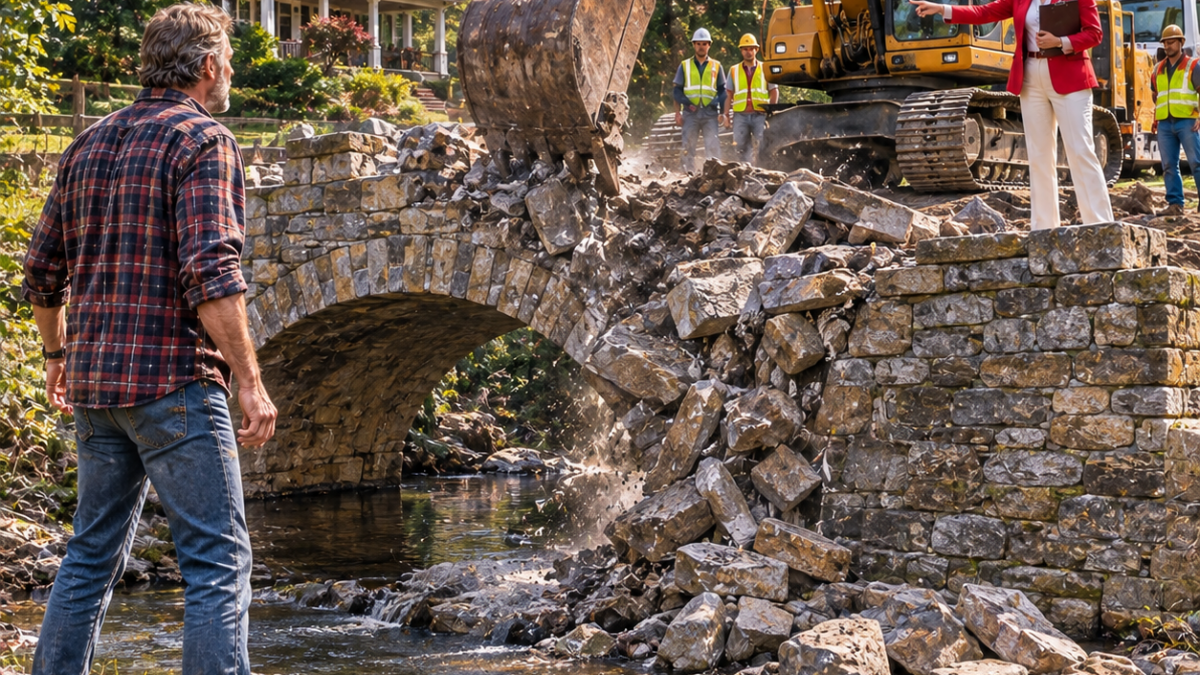
The morning I heard the first crack, I thought a tree had split somewhere along the creek, but when I reached the bank I found an excavator crushing the stone bridge my late wife and I had built by hand twenty-five years earlier while Linda Parker, president of an HOA I had never joined, stood on the opposite side with a clipboard and watched like she was supervising routine landscaping.
By the time I got close enough to shout, one of the hand-laid limestone railings had already fallen into the water, the contractor was waving an HOA work order with no county seal or permit number, and Linda calmly told me they were “teaching me to cooperate” because the bridge offended Creekside Meadows’ standards.
What Linda did not know was that I had spent a lifetime designing bridges, reading plans, and documenting construction failures, and as I watched another stone disappear beneath the black water, I realized the only thing keeping me from losing control was the certainty that every arrogant decision she had made had left a paper trail.
My name is Thomas Harris, and before Creekside Meadows existed, there was only my pasture, the creek, and Eleanor.
We built the bridge in 1999. The creek was narrow enough to cross by foot most of the year, but Eleanor hated the temporary planks I kept throwing across it.
“They look like something a man builds when he plans to leave,” she told me.
“So what do you want?”
“A bridge that looks like it belongs here.”
Eleanor was an artist. I was a civil engineer.
I wanted load calculations, drainage clearance, and stone that could survive spring flooding. She wanted an arch that reflected cleanly in the water at sunset.
We compromised.
The result was slightly overbuilt and far prettier than anything I would have designed alone.
For years, Eleanor crossed it every morning with coffee and a sketchbook. After she died, I maintained it exactly as we had built it. I replaced cracked mortar, reset loose stones, and kept moss from choking the joints.
But I never changed the shape.
Then a developer bought the land across the creek.
Within five years, pasture became Creekside Meadows—gated entrance, walking trails, matching lights, and an HOA headed by Linda Parker.
My property remained outside it.
The recorded boundary followed the creek, and my bridge connected only to my private gravel road. I paid no dues and signed no declaration.
That should have made our relationship simple.
Linda disagreed.
She first came to my property while I was repairing a weathered stone near the lower arch.
“Mr. Harris?”
I looked up. Pastel suit. Clipboard.
“Yes?”
“I’m Linda Parker, president of the Creekside Meadows Homeowners Association.”
“I know.”
“We’ve received concerns about your bridge.”
“From whom?”
“Residents.”
“About what?”
“It appears rustic.”
I waited.
She added, “Potentially unsafe.”
That made me laugh.
I had designed municipal bridges that carried loaded dump trucks. This little stone crossing could have held more weight than anything on Creekside’s walking trail.
“Linda, the bridge is permitted, inspected, and entirely on my property.”
Her smile tightened.
“Community standards affect shared views.”
“My bridge isn’t shared property.”
“The creek creates a natural community corridor.”
“That sounds poetic.”
“It’s policy.”
“Not on my land.”
That was the beginning.
Then came the letters. Removal warnings. Daily fine threats. One claimed my riverstone did not meet Creekside’s approved design palette. Another ordered me to remove an “unauthorized crossing.”
I mailed Linda certified copies of my deed, county survey, and original bridge permit.
She sent another violation.
Then survey crews appeared using an outdated developer map that placed the creek nearly thirty feet off its recorded boundary.
I sent them away.
The county surveyor certified my line again.
Still Linda continued.
Anonymous safety complaints. Drone photographs. Orange flags along my bank. A final HOA “removal directive.”
That was when I installed a camera facing the bridge.
Two weeks later, the letters stopped.
The drone vanished. Linda’s Lexus disappeared from the road.
I should have known better.
Just after midnight, diesel engines woke me.
I ran toward the water with a flashlight and found floodlights cutting through the trees, a yellow excavator parked beside the bridge, and two contractors already working from Linda’s side of the creek.
The first blow had broken the railing.
The second had cracked the arch.
I shouted for them to stop.
The foreman lifted a clipboard.
“Creekside HOA authorization, sir.”
Then headlights swept across the water.
Linda stepped from her silver Lexus and looked directly at me.
“Mr. Harris,” she called, “you were given every opportunity to cooperate.”
Behind her, the excavator’s hydraulic arm rose again.
PART 2
“Shut it down!”
My voice cracked across the creek.
The excavator operator froze with his hand on the controls.
The hydraulic arm hung above the bridge like a fist.
For one second, everything went still except the water running beneath the damaged arch.
Then Linda raised one hand.
“Continue.”
The operator looked at her.
Then at me.
“Don’t.”
I stepped closer.
“This is private property. You have no demolition permit. You have no county authorization. You have no easement.”
The foreman moved between me and the machine.
“Sir, please stay clear of the equipment.”
“What’s your name?”
He hesitated.
“Darren.”
“Darren, I’m Thomas Harris. I own this parcel and that bridge. I am telling you, on camera, that you do not have permission to be here.”
I raised my phone.
The red recording light was already on.
The man swallowed.
“We were told the HOA owns the crossing.”
“By her?”
I pointed toward Linda.
Linda laughed from across the creek.
“This performance is unnecessary.”
“No, Linda. What’s unnecessary is destroying somebody else’s bridge in the middle of the night.”
“It has been designated unsafe.”
“By whom?”
“The board.”
“Which structural engineer signed that finding?”
Her expression tightened.
“The board has the authority—”
“Name the engineer.”
She didn’t.
I turned to Darren.
“Ask her for the county demolition permit.”
He looked toward Linda.
She snapped:
“Your work order is your authorization.”
“No,” I said. “It isn’t.”
Darren looked at the sheet on his clipboard.
For the first time, he seemed to actually read it instead of simply holding it.
Creekside Meadows letterhead.
Work Order 214.
**REMOVAL OF NONCOMPLIANT COMMUNITY CROSSING.**
No permit number.
No county seal.
No parcel owner authorization.
No licensed engineer’s report.
Darren’s shoulders changed.
“I need to call my supervisor.”
Linda stepped forward.
“I am your client’s representative.”
“You’re not my company’s supervisor.”
“Your company has already been paid.”
That caught my attention.
“Paid by whom?”
Linda glared at me.
“That’s none of your concern.”
I laughed once.
“You’re standing over my demolished bridge. Everything about this is my concern.”
Then the excavator operator made the mistake that changed the night.
Maybe he didn’t hear Darren.
Maybe he saw Linda’s signal.
Maybe he simply wanted the job finished.
The bucket moved.
Stone struck stone.
The central section of the arch gave a deep, ugly crack.
I felt it in my chest.
The same arch Eleanor and I had spent three weekends laying by hand split down its center.
A limestone block dropped.
Then another.
The center collapsed into the creek.
Water exploded upward.
I heard myself say Eleanor’s name.
Not loudly.
Barely a whisper.
The excavator stopped.
This time nobody ordered it to continue.
Linda stood motionless on the far bank.
Maybe even she understood something irreversible had happened.
I walked toward what remained.
Darren reached for my shoulder.
“Sir—”
“Don’t.”
He stopped.
I stepped through wet grass until my boots reached the edge.
The bridge was no longer a bridge.
One arch shoulder remained.
Part of the railing.
Two stones Eleanor had carved little leaf patterns into while the mortar cured.
Everything else lay in black water.
I had spent nearly fifty years around construction sites.
I had seen collapsed culverts.
Bridge failures.
Flood damage.
Bad concrete pours.
Steel deformed by impact.
I understood structural loss intellectually.
This was different.
I could see Eleanor sitting on the old parapet with charcoal on her fingers.
I could hear her complaining that engineers made ugly things because we thought rectangles were personalities.
I could remember the morning she had stood on the finished bridge and said:
“Now it looks like we meant to stay.”
Linda broke the silence.
“You were warned.”
I turned slowly.
She stood with her clipboard against her chest.
“Say that again.”
Her confidence flickered.
“You received multiple notices.”
“You destroyed my bridge because I didn’t obey your notices.”
“We removed a dangerous noncompliant structure.”
“On property outside your HOA.”
“The creek affects our community.”
“Then call the county.”
“We did.”
“And they rejected your complaints.”
Her jaw moved.
“You’ve made this difficult from the beginning.”
I stared at her.
“No, Linda.”
I held up my phone.
“You’ve made it documented.”
That changed her face.
She looked at the phone.
Then toward the camera mounted near my house.
I saw the exact moment she realized there were two recordings.
“Turn that off.”
“No.”
“You cannot publish people without permission.”
“This isn’t your board meeting.”
I looked at Darren.
“I need your company name.”
He looked uncomfortable.
“Parker Construction Group.”
Everything inside me went quiet.
“Parker?”
He nodded.
Linda’s head snapped toward him.
Darren realized too late what he’d revealed.
I looked across the creek.
“Relation?”
Linda said:
“That is irrelevant.”
“Your brother?”
Silence.
“Linda.”
Her voice sharpened.
“The HOA uses qualified contractors.”
“Your brother owns the company.”
“That doesn’t make them unqualified.”
“No.”
I nodded.
“It makes the invoice interesting.”
For the first time that night, she looked afraid.
Not terrified.
Not yet.
Just aware.
I called the sheriff’s office.
By the time Deputy Collins arrived, the excavator crew had shut everything down.
The machine stayed.
I insisted.
I did not want tracks, equipment positions, or debris disturbed before the scene was photographed.
Collins listened to my statement.
Watched part of my phone recording.
Then looked at Linda.
“Ma’am, are you responsible for ordering this work?”
Linda crossed her arms.
“I acted as president of Creekside Meadows.”
“That wasn’t the question.”
She stared at him.
“Yes.”
“Do you have documentation establishing HOA ownership of the bridge?”
“Our legal records support community jurisdiction.”
“Can I see them?”
She produced the old developer map.
Collins held it beneath his flashlight.
“This says preliminary.”
“The boundaries were established during development.”
I walked to my truck and brought back the certified county survey I’d begun carrying like a man carrying antibiotics in a plague.
Collins compared them.
He looked at Linda.
“This county survey puts the entire crossing on Mr. Harris’s parcel.”
“That survey is disputed.”
“By whom?”
“The HOA.”
“Has a court changed it?”
“No.”
“Has the county recorder changed it?”
“No.”
“Then tonight I’m going with the recorded survey.”
Linda’s voice rose.
“You’re taking his side.”
“I am looking at documents.”
“He’s been harassing our association for months.”
I almost laughed.
Collins didn’t.
“Did he enter your property tonight?”
“No.”
“Did he demolish anything you own?”
“No.”
“Then I’m not sure how that’s relevant.”
Linda looked toward me.
Her eyes promised something.
I had seen that look on contractors before arbitration.
The look that said:
**I have already lost the facts, so now I’ll attack the person.**
Fine.
Facts were where I lived.
Collins photographed the work order.
Took names.
Collected copies.
Asked Darren to preserve all job records.
Then he pointed toward the creek.
“Nothing else moves until county officials inspect this.”
Linda said:
“You don’t have authority to halt HOA maintenance.”
Collins turned.
“Ma’am, it’s one in the morning and a private-property owner is alleging his bridge was demolished without consent.”
He paused.
“Nothing else moves.”
Linda walked to her Lexus.
Before getting in, she looked at me.
“You could have avoided all of this.”
That sentence hurt almost as much as the bridge.
Because people like Linda always need the victim to become the cause.
I said nothing.
She drove away.
I spent the rest of the night on the bank.
Not because there was anything I could do.
Because I couldn’t leave.
Mist rose from the water.
Broken limestone gleamed pale beneath it.
At four thirty, I found one of Eleanor’s carved stones wedged between two rocks downstream.
I waded in.
Cold water soaked my jeans.
I lifted it carefully.
A small sycamore leaf was carved into one corner.
Eleanor had made that one.
She’d laughed because the leaf looked more like a hand.
I carried it home.
Washed the mud off.
Set it on the kitchen table.
Then I sat down and cried.
Not politely.
Not the dignified grief people perform when they know someone might see.
I cried like a man who had already buried his wife once and had just watched strangers take a hammer to one of the few things their hands had built together.
By sunrise, there wasn’t much left in me except focus.
That I understood.
I made coffee.
Opened a fresh notebook.
On the first page, I wrote:
**CREEKSIDE MEADOWS — BRIDGE DEMOLITION**
Then the date.
Then every fact I could remember.
Time engines started.
Number of workers.
Equipment description.
Work order number.
Linda’s statements.
Darren’s statements.
Deputy Collins’s arrival.
Weather.
Lighting.
Camera locations.
Nothing dramatic.
Memory becomes unreliable faster than people admit.
Paper doesn’t.
At eight, I called Mark Jennings.
Mark had retired from the county engineering department six years earlier.
We had argued professionally for three decades.
That made him ideal.
He answered with:
“Some of us are retired, Thomas.”
“My bridge is gone.”
Silence.
“What?”
“Creekside demolished it last night.”
“Your stone bridge?”
“Yes.”
“The Eleanor bridge?”
I closed my eyes.
“Yes.”
Mark’s voice changed.
“I’ll be there in forty minutes.”
He arrived in thirty-two.
Old Ford pickup.
Coffee thermos.
Survey vest he technically no longer needed.
He walked down to the creek.
Stopped.
Removed his cap.
“Jesus.”
I stood beside him.
He didn’t speak for a while.
Then:
“You get video?”
“Yes.”
“Sheriff’s report?”
“Yes.”
“Equipment still here?”
“Yes.”
“Good.”
He crouched near the abutment.
His professional mind took over.
“Don’t move these stones.”
“I wasn’t planning to.”
“Where’d the bucket hit first?”
I showed him.
“Original plans?”
“Inside.”
“Permit?”
“Inside.”
“Maintenance records?”
“Mostly.”
He looked at me.
“You kept maintenance records on a little private stone bridge?”
“I’m an engineer.”
“Of course you did.”
We spent the next two hours documenting.
Mark photographed fractured mortar.
Scrape patterns.
Tire tracks.
Sediment disturbance.
Concrete fragments.
He examined the surviving abutment.
“Thomas.”
“What?”
“This wasn’t failing.”
“I know.”
“I mean I can say that professionally.”
He pointed.
“Old mortar, yes. Surface weathering. But look at the core.”
Solid.
“No evidence of progressive displacement. No scour failure. No emergency.”
I stared at the rubble.
“Put that in writing.”
“I will.”
Around ten, the county environmental office arrived.
The creek was regulated for disturbance.
Not some untouchable wilderness.
But heavy equipment work still required review.
Especially demolition in the waterway.
The inspector, Dana Brooks, asked:
“Who obtained the permit?”
I pointed across the creek.
“Apparently nobody.”
She frowned.
“Excavation company?”
“Parker Construction.”
She wrote that down.
“Any relation to the HOA president?”
“Brother.”
Her pen stopped.
“Of course.”
She looked embarrassed.
“Sorry.”
“No. That’s about where I am too.”
Dana took water samples.
Photographed sediment.
Marked debris locations.
Then asked to see the work order.
Her reaction was almost identical to Collins’s.
“This is not a permit.”
“Linda believes HOA letterhead has magical properties.”
Dana gave me a look that said she wanted to laugh but professionally could not.
“I’ll be contacting the contractor.”
“Please do.”
By afternoon, I had three independent records.
Sheriff.
Engineering assessment in progress.
Environmental inspection.
Then I drove to the county recorder.
Brian Ellis was working the counter.
He recognized me before I reached it.
“Bridge guy.”
“That is not how I hoped to become known.”
He smiled.
“What happened?”
“They demolished it.”
His smile disappeared.
“What?”
I laid the old preliminary developer map Linda had used beside the certified survey.
“I need everything tied to parcel 214-B.”
“How far back?”
“Original subdivision.”
“That’ll be a pile.”
“Good.”
Twenty minutes later, the counter looked like a paper mill had exploded.
Historic plats.
Final plats.
Preliminary planning maps.
Deed records.
Survey revisions.
Creek easement records.
Original bridge permit.
I found what I already knew.
My bridge was mine.
Then Brian noticed something.
“Thomas.”
“Yeah?”
He pointed to Linda’s map.
“See this notation?”
Tiny letters at the bottom:
**BOUNDARY ADJUSTMENT PENDING COUNTY APPROVAL**
He pulled the final recorded plat from the following year.
The proposed adjustment was gone.
Rejected.
The official creek boundary stayed where my current survey showed it.
“She’s using a preliminary planning draft,” Brian said.
“I told her that.”
“No, I mean this was never a legal boundary.”
“I know.”
“You sent her the certified map?”
“Twice.”
Brian looked at me.
“Then why would she keep using this?”
That was the question.
At home, I replayed my camera footage.
Linda standing under the floodlights.
Clipboard in hand.
Calling the boundary dispute “technicalities.”
Then another thought hit me.
Parker Construction Group.
I searched old public development records.
The original developer across the creek had been Parker Development LLC.
Linda Parker’s father.
One of the names on the early filing matched.
Richard Parker appeared repeatedly as construction contractor.
Linda’s brother.
A landscaping vendor used by the HOA shared an address with a company registered to Linda’s husband.
I leaned back.
Family businesses aren’t automatically corruption.
Neither are related-party contracts if properly disclosed and approved.
But the pattern deserved questions.
The bridge demolition invoice answered the first one.
Emily Rogers brought it to me three days later.
She lived in Creekside.
Early forties.
Two kids.
She approached from the walking trail and stopped at my boundary.
“Mr. Harris?”
“Yes?”
“Can I come over?”
That question alone made me like her.
“Yes.”
She crossed using a temporary footpath upstream.
When she saw the rubble, her face fell.
“Oh.”
“What?”
“I hadn’t seen it close.”
She looked at the broken stone.
“Linda told everyone the county ordered emergency removal.”
I let that sit.
Emily’s eyes went to mine.
“They didn’t?”
“No.”
“She said an inspector declared it unsafe.”
“No inspection.”
She covered her mouth.
“God.”
“What did you bring?”
She handed me folded papers.
“Board packet.”
I unfolded them.
Parker Construction Group.
Emergency infrastructure removal.
$6,500 deposit.
Additional estimated charges.
I looked at the authorization line.
Linda’s signature.
“Board approval?”
Emily shook her head.
“We didn’t vote.”
“You’re on the board?”
“Secretary.”
That was useful.
“Was there an emergency meeting?”
“No.”
“Written consent?”
“Not that I saw.”
“Who approved payment?”
“Linda said she had executive authority.”
“Does she?”
Emily looked ashamed.
“We stopped asking.”
That sentence told me more about Creekside than the bylaws ever could.
“Why?”
“Because every question becomes a fight.”
She looked across the creek.
“She keeps files on people.”
“What kind?”
“Violations. Complaints. Late fees. Personal things residents tell her.”
“To use against them?”
Emily didn’t answer directly.
“She knows how to make people tired.”
I understood.
“What do you want from me?”
“Nothing.”
She looked at the rubble again.
“I wanted you to know most of us didn’t vote for this.”
“I believe you.”
“Some people supported removing the bridge.”
That hurt more.
“Why?”
“Because Linda told them it was public access and dangerous.”
“Did anyone ask to see an inspection?”
“No.”
She closed her eyes.
“We should have.”
“Yes.”
I didn’t soften it.
Emily nodded.
“Yes.”
Before leaving, she said:
“There’s another board meeting Thursday.”
“I’m not a member.”
“I know.”
“Good.”
She almost smiled.
“I think that’s becoming clear.”
Thursday night, I received an email from Creekside’s attorney.
It accused me of defamatory public statements.
I had made no public statements.
It demanded I stop “interfering with HOA infrastructure.”
I printed it.
Put it in the binder.
Then called Rachel Nguyen.
Rachel had represented engineering firms I’d consulted for before retirement.
Smart.
Blunt.
Unimpressed by drama.
She answered:
“Tell me you haven’t posted anything stupid online.”
“Hello to you too.”
“Thomas.”
“I have posted nothing.”
“Good.”
“They demolished Eleanor’s bridge.”
Silence.
Rachel knew.
Everybody close to me knew.
“Send me everything.”
I did.
Two hours later she called back.
Her first sentence:
“This is astonishing.”
“Legally or emotionally?”
“Yes.”
“Helpful.”
“You have recorded survey proof?”
“Yes.”
“Original permit?”
“Yes.”
“Video?”
“Yes.”
“County environmental inspection?”
“Yes.”
“Sheriff report?”
“Yes.”
“Independent structural opinion?”
“Mark’s finalizing it.”
“And their contractor is related to the HOA president?”
“Brother.”
“Board authorization?”
“Secretary says no formal vote.”
Rachel breathed out.
“Do not contact Linda directly anymore.”
“Fine.”
“Do not threaten her.”
“Fine.”
“Do not say you’re going to destroy the HOA.”
“I wasn’t planning to.”
“Do not post your revenge speech online.”
I paused.
“Thomas.”
“I recorded one.”
“Delete it.”
“It was good.”
“Delete it.”
I deleted it.
That probably saved me from becoming exactly the kind of person Linda wanted the world to see.
Rachel sent a preservation letter.
HOA records.
Emails.
Texts.
Meeting minutes.
Construction bids.
Invoices.
Payment approvals.
Maps.
Complaints.
Insurance communications.
Parker Construction records related to the bridge.
Then she filed a civil action.
Trespass.
Property damage.
Wrongful demolition.
Related claims based on the evidence and applicable law.
She also notified Creekside’s insurer.
That changed everything.
Insurance companies have a remarkable ability to locate facts once their money becomes involved.
The carrier requested the authorization documents.
Creekside produced the old preliminary map.
The carrier requested the county demolition permit.
None existed.
The carrier requested the engineering report proving emergency danger.
None existed.
The carrier requested the board vote.
That became complicated.
Linda produced meeting minutes.
Emily called me the same evening.
“She made minutes.”
“What?”
“Rachel needs to know.”
“Tell Rachel, not me.”
“I already did.”
“Good.”
The minutes claimed the board had approved emergency removal at a special meeting two days before demolition.
Emily had never attended such a meeting.
Neither had two other directors listed as present.
One director was in Denver visiting family.
Another had been hospitalized that week.
Rachel became very quiet when she learned that.
Quiet lawyers are more frightening than loud ones.
The insurer reserved rights.
The board panicked.
Linda went public.
She posted an article on the Creekside website.
**UNSAFE PRIVATE STRUCTURE REMOVED AFTER YEARS OF COMMUNITY CONCERN**
It described my bridge as deteriorating.
Claimed residents had feared for children.
Claimed the crossing obstructed the natural waterway.
Claimed “multiple agencies” had been notified.
That part was technically true.
Linda had notified them.
They simply hadn’t agreed with her.
Then she used a drone photo of the bridge taken at a tilted angle that made the arch appear uneven.
Mark Jennings saw it and drove to my house furious.
“She called that structurally unstable?”
“Yes.”
“That’s camera perspective.”
“Yes.”
“I inspected the damn thing.”
“I know.”
He slapped his completed report onto my table.
“Read page six.”
I did.
His conclusion was measured.
Professional.
No theatrics.
Pre-demolition photographs, maintenance history, surviving structural evidence, and prior permit records did not support the claim of imminent structural failure.
He couldn’t say the bridge had been perfect.
No honest engineer would.
But nothing supported emergency demolition.
“That enough?” he asked.
“More than enough.”
He sat down.
Then his anger disappeared.
He looked toward Eleanor’s carved stone on my shelf.
“You okay?”
“No.”
“Still?”
“What do you mean still?”
“You’ve been treating this like a project.”
I looked at him.
“That’s how I treat things.”
“That’s how you avoid things.”
I hated when old friends became insightful.
He nodded toward the stone.
“She would’ve been furious.”
“Eleanor?”
“Not about the bridge.”
I frowned.
“About you.”
“Why?”
“You haven’t slept.”
“I sleep.”
“Three hours isn’t sleep.”
I looked away.
Mark said:
“She loved that bridge.”
“I know.”
“She loved you more.”
I closed my eyes.
That ended the conversation.
For the first time since demolition night, I let myself remember something other than the collapse.
Eleanor mixing mortar badly.
Eleanor insisting every fifth stone needed “personality.”
Eleanor dropping my level into the creek.
Eleanor sitting on the completed railing with her feet dangling above the water.
She had died after a long illness.
Twenty years earlier.
I had promised not to change the bridge because preserving it made me feel as if one corner of life had refused to move on without her.
Maybe that wasn’t fair to either of us.
But Linda hadn’t earned the right to make that decision for me.
Nobody had.
The story hit local news after the lawsuit became public.
I didn’t contact reporters.
Public filings did the work.
A journalist named Sarah Monroe called.
“Mr. Harris, can you confirm Creekside Meadows demolished your privately owned bridge?”
“Yes.”
“Were you part of the HOA?”
“No.”
“Did the HOA have a county permit?”
“Ask the county.”
“Do you have video?”
“Yes.”
“Will you provide it?”
I called Rachel.
Her answer:
“Edited excerpt after I review it.”
Sarah’s report aired that evening.
No shouting.
No viral revenge speech.
She showed the county survey.
The old preliminary map.
Part of my video.
Linda saying:
“You were given every opportunity to cooperate.”
Then the excavator striking the bridge.
The report ended with:
“Creekside Meadows representatives maintain they acted for community safety. County records reviewed by this station show no demolition permit issued for the bridge.”
That was enough.
The next morning, Creekside residents began asking questions.
Not about me.
About Linda.
Where were the board minutes?
Who authorized Parker Construction?
Why wasn’t a competing bid obtained?
Why did the president’s brother receive HOA money?
Why had residents been told the county demanded demolition?
Linda scheduled a board meeting.
Emily invited me.
I declined.
“I’m not a member.”
She laughed.
“That line is becoming popular.”
“Good.”
Mark Ellis, the retired teacher who lived near the walking trail, called afterward.
“You missed a show.”
“What happened?”
“Linda yelled.”
“Shocking.”
“Emily read the county letter.”
“Which one?”
“The one saying there was never a demolition order.”
I leaned back.
“Then?”
“George asked about Parker Construction.”
“And?”
“Linda called the question defamatory.”
“Useful.”
“Richard Parker was sitting in the back.”
“Her brother?”
“Yep.”
“What did he say?”
“That his company relied entirely on the work order supplied by the HOA.”
That interested me.
“Anything else?”
“Linda adjourned early.”
Of course.
The following day, Parker Construction’s attorney contacted Rachel.
They wanted to separate themselves from Creekside.
Rachel called me.
“Remember Darren?”
“The foreman.”
“He kept texts.”
My pulse changed.
“What kind?”
“Linda sent him the work order.”
“Expected.”
“She also told the company the county had already cleared the demolition.”
I said nothing.
Rachel continued.
“Richard Parker asked for the permit number.”
“What did she say?”
“Quote: ‘Use HOA authorization. County is aware.’”
I closed my eyes.
“Did Richard verify?”
“No.”
“So he’s not innocent.”
“No.”
“But Linda lied to her own contractor.”
“Looks that way.”
That discovery mattered.
Then came the environmental findings.
Debris had obstructed part of the channel.
Heavy machinery disturbed the bank.
Sediment controls had not been installed.
The agency issued violations and required restoration.
Penalties followed.
Not cartoonishly enormous.
Enough to hurt.
Enough that Creekside homeowners became very interested in who had authorized the project.
Then Rachel found the invoice.
Parker Construction had billed considerably more than the number Emily first showed me.
Mobilization.
Night work surcharge.
Debris handling.
Emergency demolition.
The total was more than the board had been told.
Payment had come from Creekside’s maintenance reserve.
Residents thought that reserve was for storm repairs and road upkeep.
A forensic audit began after three directors demanded one.
Linda fought it.
That only made them more determined.
While lawyers worked, I did something Linda didn’t expect.
I began rebuilding.
Not immediately.
First came county review.
New structural drawings.
Hydraulic assessment.
Environmental clearance.
A modern permit.
I wasn’t going to recreate the old bridge stone for stone.
I couldn’t.
The surviving material had been damaged.
Standards had changed.
The creek had changed.
And maybe I had too.
I sat at my drafting table late one night.
Eleanor’s old sketchbook beside me.
The final design took pieces of both of us.
A reinforced internal structure.
Stone cladding using salvaged limestone where feasible.
A higher arch for better flow.
Iron railing inspired by vines Eleanor had drawn repeatedly.
On each end, one recovered original stone.
Including the little sycamore leaf.
Mark reviewed the plans.
“Overbuilt.”
“Thank you.”
“That wasn’t a compliment.”
“I accepted it as one.”
“You could drive a fire truck across this.”
“Maybe.”
“It’s a foot-and-light-vehicle bridge.”
“I know.”
He pointed at the railing.
“Eleanor?”
I nodded.
He smiled.
“Good.”
The county approved it.
No special favors.
No skipped steps.
When construction began, Creekside residents gathered along the trail.
Some watched.
Some waved.
A few looked ashamed.
Then Linda arrived.
Silver Lexus.
Pastel suit.
No clipboard this time.
She walked toward the creek.
“What are you doing?”
I held up the permit.
“Building.”
“You cannot make major changes while litigation is pending.”
Rachel had anticipated this.
“The original structure is documented. The court has approved preservation protocols. Reconstruction isn’t destroying evidence.”
Linda stared at the new stone.
“This is deliberately provocative.”
“How?”
“You’re making it larger.”
“Engineering requirement.”
“You’re changing the visual character.”
I looked at her.
“Linda.”
“What?”
“I’m not in your HOA.”
A worker behind me coughed suspiciously like he was hiding a laugh.
Linda’s face reddened.
“You think this is funny.”
“No.”
I pointed to the salvaged stone.
“Not remotely.”
She followed my hand.
For a moment she looked at Eleanor’s carved leaf.
Then away.
“You could settle.”
“Rachel’s office has sent terms.”
“You want to humiliate me.”
“I want my damages covered.”
“You want me removed.”
“Your residents decide that.”
“You want Parker Construction ruined.”
“Your brother has his own lawyer.”
Every answer took something away from her.
She wanted a personal war.
I refused to give her one.
Finally she said:
“You’re building that thing as a monument to yourself.”
I looked at the design.
“No.”
“To her?”
I didn’t answer.
Linda understood.
Her face shifted.
For one second, something almost human appeared there.
Then pride covered it.
She left.
The new bridge took six weeks.
The first day I walked across it alone, I carried Eleanor’s sketchbook.
Halfway over, I stopped.
The water below reflected the arch.
Different bridge.
Same creek.
I sat where the old railing used to be.
Opened the sketchbook.
Her drawings filled page after page.
Sunrise.
Winter ice.
Floodwater.
Me standing with a shovel.
The bridge from below.
The bridge from above.
On the final page she had written one sentence:
**Beauty doesn’t last, but love leaves shape.**
I had read it hundreds of times.
That day it felt new.
The old bridge had not survived.
That didn’t mean what we built together had disappeared.
I touched the salvaged stone set into the new parapet.
Then I cried again.
This time without anger.
The board vote happened two days later.
Emily called.
“She’s out.”
“Linda?”
“Five to two.”
I sat quietly.
“President?”
“Removed.”
“What about the board?”
“She’s still contesting everything.”
“Of course.”
“Thomas?”
“Yeah?”
“People clapped.”
“I’m not sure how I feel about that.”
“I know.”
“Do you?”
“Yeah.”
She paused.
“They’re not celebrating her suffering.”
“What are they celebrating?”
“Not being afraid to disagree anymore.”
That I understood.
Linda’s removal didn’t end the case.
If anything, it made discovery easier.
The interim board turned over records.
Minutes.
Invoices.
Emails.
Expense reports.
Vendor agreements.
The audit discovered years of related-party transactions.
Again, not all illegal.
Some had been disclosed.
Others had not.
Parker Construction received repeated work without competitive bids.
A landscaping company connected to Linda’s husband received maintenance contracts.
Developer records showed Linda’s family had used old preliminary maps in several boundary disputes.
Mark Ellis wasn’t the only resident affected.
A couple named the Garcias had moved a fence three years earlier after Creekside claimed six feet of their yard belonged to common space.
A widow named Elaine Porter had surrendered a narrow strip behind her garden for a walking-trail extension.
County records suggested both parcels may have been misrepresented using the same preliminary boundary map.
That was bigger than my bridge.
Rachel called one evening.
“You need to hear this.”
She explained the pattern.
I sat at my kitchen table.
“So she knew the map was invalid.”
“We can’t say that yet.”
“She had the final plats.”
“Her office had them.”
“Same thing.”
“No.”
Rachel’s voice sharpened.
“Not in court.”
I hated that she was right.
“What can we say?”
“That preliminary maps were repeatedly used despite final recorded plats showing different boundaries.”
“Better lawyer sentence.”
“That’s why you pay me.”
The county attorney became interested.
Then the state investigators.
Not because of HOA bullying.
Because falsified or misleading property documents, disputed signatures in minutes, related-party payments, and potential misuse of association funds deserved examination.
I gave my evidence once.
Then stepped back.
That was harder than social media would later make it look.
I didn’t “take Linda down.”
I built a case for my own property.
Other people followed where the documents led.
That’s how it should work.
Linda sued me for defamation anyway.
Rachel practically smiled when the complaint arrived.
“That bad?”
“It’s ambitious.”
“Translation?”
“She is suing you over statements that are either opinion, supported by records, or made in litigation.”
“Can we make it disappear?”
“Eventually.”
Eventually is a lawyer’s favorite unit of time.
Linda’s attorney tried to stop my public comments.
I mostly stopped commenting anyway.
The bridge was enough.
People could see it.
The trial on my civil claims began months later.
By then Creekside had settled part of its responsibility through insurance and board-approved negotiations, but Linda and Parker Construction remained disputed parties on several issues.
The courtroom was smaller than television makes courtrooms look.
Wood benches.
Old carpet.
Water pitcher.
No dramatic music.
Rachel sat beside me.
Linda sat across the aisle in navy.
Not pastel.
She looked tired.
The first witness was the county surveyor.
Rachel displayed the recorded plat.
“Where is Mr. Harris’s property line?”
The surveyor pointed.
“Along this recorded boundary.”
“Where is the bridge?”
“Entirely inside Mr. Harris’s parcel.”
“Is his parcel part of Creekside Meadows HOA?”
“Not according to the recorded documents I reviewed.”
“Did the preliminary developer map supersede the final plat?”
“No.”
Linda’s attorney stood.
“Creek channels move, correct?”
“Yes.”
“Natural boundaries can create ambiguity?”
“Sometimes.”
“So the HOA could reasonably have believed—”
The surveyor interrupted politely.
“The recorded ownership line is not determined by somebody’s belief about where the water looked that year.”
That was useful.
Next came Mark Jennings.
He explained structure.
Condition.
Permit history.
The defense pushed the “unsafe bridge” theory.
“Mr. Jennings, you did not inspect the bridge the morning before demolition, correct?”
“No.”
“So you cannot guarantee there was no hidden defect.”
“No engineer can guarantee a structure has zero hidden defects.”
“Then it could have been dangerous.”
“Anything could be dangerous.”
The attorney smiled.
“Exactly.”
Mark continued:
“But responsible engineers don’t demolish structures because of philosophical possibility.”
A few people smiled.
The judge didn’t.
Mark explained there had been no documented emergency inspection, no failure notice, no load restriction, no engineering condemnation.
Then Dana Brooks testified about the creek disturbance.
Then Deputy Collins.
Then Darren.
The foreman looked miserable.
Rachel asked:
“Who hired Parker Construction?”
“Creekside Meadows.”
“Who was your principal contact?”
“Linda Parker.”
“Did she tell you the county had authorized the work?”
“Yes.”
“Did you receive a county demolition permit?”
“No.”
“Did you ask for one?”
“My supervisor did.”
“What were you told?”
“That HOA authorization covered it.”
“By whom?”
“Mrs. Parker.”
Linda stared straight ahead.
Then Emily testified.
That was the turning point.
She described the absence of a board vote.
The later appearance of meeting minutes.
The emergency payment.
Rachel showed the minutes claiming Emily had attended.
“Were you present at that meeting?”
“No.”
“Did the meeting occur?”
“Not that I know of.”
“Where were you that evening?”
“At my daughter’s school concert.”
“Do you have records?”
“Yes.”
Photos.
School program.
Time-stamped video.
The defense objected to the implication.
The judge overruled some questions and limited others.
Good.
Court wasn’t supposed to become theater.
Then Richard Parker testified.
Linda’s brother.
He was not warm.
He wasn’t stupid either.
He had already reached a separate arrangement resolving some of his company’s civil exposure.
Rachel asked:
“Did your company receive payment for demolishing Mr. Harris’s bridge?”
“Yes.”
“Did you know the bridge belonged to Mr. Harris?”
“I was told it was under HOA control.”
“By whom?”
“Linda.”
“Your sister.”
“Yes.”
“Did that relationship influence your decision to accept the job?”
“No.”
“Did you verify ownership independently?”
“No.”
“Why not?”
“She was HOA president.”
Rachel waited.
Richard’s own answer hung there.
Authority mistaken for accuracy.
The whole case in one sentence.
Then I testified.
Rachel began with Eleanor.
Not sentimentally.
Carefully.
“When was the bridge built?”
“1999.”
“Who designed it?”
“I handled the engineering.”
“And aesthetics?”
“My wife won that argument.”
A few smiles.
“What was her name?”
“Eleanor.”
“Did she help construct it?”
“Yes.”
“How?”
“Stone selection. Mortar. Railing design. Carrying material. Telling me everything I did was ugly until I fixed it.”
The courtroom softened.
Rachel displayed an old photograph.
Eleanor on the bridge.
Coffee mug.
Sketchbook.
Hair blowing across her face.
I had forgotten Rachel had that image.
My throat tightened.
“What happened after your wife died?”
“I maintained the bridge.”
“Why?”
“Because it mattered to me.”
Then we moved to Linda.
Letters.
Certified surveys.
Warnings.
The demolition.
Rachel played the video.
I had watched it dozens of times.
It never became easy.
The courtroom heard my voice:
“This is my property. You’re trespassing.”
Then Linda:
“You were given every opportunity to cooperate.”
Then the excavator.
Crack.
Stone falling.
I stared at the table.
When the video ended, Rachel waited.
“Mr. Harris, did you give permission for demolition?”
“No.”
“Did you receive a county condemnation?”
“No.”
“Did you receive an engineering order?”
“No.”
“Were you a Creekside HOA member?”
“No.”
“Did you ever agree to be bound by Creekside’s architectural standards?”
“No.”
“Why did you rebuild?”
That question surprised me.
I looked toward the judge.
Then at Rachel.
“Because I realized I had spent twenty years treating the original bridge like preserving every stone was the same thing as preserving my wife.”
I swallowed.
“It wasn’t.”
Silence.
“The bridge mattered because we built it together. Linda destroyed the structure.”
I looked toward Linda.
“She didn’t destroy what Eleanor put into my life.”
Rachel sat down.
Linda’s attorney approached.
He was good.
He didn’t yell.
“Mr. Harris, you were angry.”
“Yes.”
“You told Mrs. Parker she had declared war.”
“Yes.”
“You began investigating her family businesses.”
“I reviewed public records after discovering her brother’s company demolished my bridge.”
“You contacted reporters.”
“Reporters contacted me.”
“You provided video.”
“After my attorney reviewed it.”
“You wanted public embarrassment.”
“Sometimes.”
He paused.
Again, honesty disrupted the expected answer.
“Sometimes?”
“I was angry. I wanted people to see what happened.”
“So revenge.”
“No.”
“What’s the difference?”
“Revenge doesn’t require accuracy.”
He stared.
I continued.
“I kept documents because I expected to be challenged.”
“Did you enjoy seeing Mrs. Parker removed?”
I thought before answering.
“I felt relief.”
“Not satisfaction?”
“Some.”
He nodded as if he’d caught me.
Then asked:
“You rebuilt a larger bridge.”
“Yes.”
“With engraved signs.”
“One boundary marker.”
He displayed a photograph.
**PRIVATE PROPERTY — CREEKSIDE BOUNDARY ENDS HERE**
“Would you call that provocative?”
“I’d call it accurate.”
A few quiet laughs.
He changed direction.
“You claim deep emotional significance, yet you changed the bridge.”
“Yes.”
“Doesn’t that suggest it was replaceable?”
“No.”
“Why?”
I looked at the photograph of Eleanor.
“Because replacement and restoration are different things.”
He had no useful follow-up.
Linda testified.
She said she’d acted for safety.
She said residents had complained.
Some had.
She said the bridge looked deteriorated.
Subjectively, maybe.
She said the preliminary map created uncertainty.
That part was possible until the certified surveys arrived.
Rachel stood.
“Mrs. Parker, did Mr. Harris send you a certified county survey?”
“Yes.”
“Once?”
“I don’t remember.”
“Would seeing the certified-mail receipts help?”
Linda’s face tightened.
“Possibly.”
Rachel showed two.
“Did you receive them?”
“Yes.”
“Did either place the bridge inside Creekside?”
“No.”
“Did you obtain a competing certified survey?”
“No.”
“Did the county condemn the bridge?”
“No.”
“Did a licensed engineer working for Creekside inspect it before demolition?”
“We relied on community reports.”
“That’s a no?”
“No.”
“Did you tell Parker Construction the county was aware?”
“Yes.”
“Was the county aware of the planned demolition?”
“We had previously contacted offices.”
“That wasn’t my question.”
The judge looked at Linda.
She answered:
“Not specifically.”
Rachel then showed the purported emergency board minutes.
“Did you prepare these?”
“My office did.”
“Why does the document state Emily Rogers attended?”
“She may have been listed in error.”
“George Stanton?”
“Same.”
“George was hospitalized.”
Linda looked at her attorney.
Rachel continued.
“Was there an actual meeting?”
“I discussed the matter with directors.”
“That is not what the minutes say.”
“I was acting under emergency authority.”
“Where in the bylaws does that authority permit demolition of property outside the HOA?”
Linda’s voice sharpened.
“We believed it was not outside.”
Rachel placed the certified survey on the screen.
“You believed that after receiving this?”
Linda stared at it.
Her answer was quiet.
“I believed the map was disputed.”
“By you.”
Objection.
Sustained.
Rachel nodded.
“No further questions.”
The civil ruling came weeks later.
Not a dramatic instant verdict.
The court found liability against the responsible parties on the supported property-damage and trespass claims.
The judgment covered restoration loss, costs associated with clearing and repairing the creek, and additional damages permitted under the applicable claims for willful conduct.
Creekside’s insurer covered portions.
Parker Construction paid under its settlement and judgment obligations.
Linda faced personal exposure on conduct not protected by the association.
The court also rejected the idea that Creekside had possessed authority over my bridge.
That sentence mattered more to me than the number.
**The property was never subject to Creekside Meadows HOA control.**
Never.
Not temporarily.
Not aesthetically.
Not because Linda believed it should be.
The environmental case proceeded separately.
So did the financial investigation.
The audit uncovered enough irregularities for state investigators to examine falsified records and misuse of HOA funds.
Some claims were administrative.
Some civil.
Eventually, prosecutors brought charges involving falsified documents and financial misconduct.
Linda fought them.
She was entitled to.
She lost several major counts after evidence showed records had been altered and association money had been directed through undisclosed or inadequately disclosed related-party transactions.
I was not involved in those charging decisions.
I testified only where my evidence touched the case.
That distinction mattered to me.
I wanted justice.
Not a private prosecution disguised as one.
By then, Creekside residents had already voted Linda off the board.
Ronda resigned.
Two other directors stepped aside.
Emily stayed long enough to help stabilize finances, then refused to run for president.
“Why?” I asked.
“Because I enjoy sleeping.”
Fair.
The new board did something the old one had never done.
It apologized.
Officially.
Emily walked over one Saturday morning carrying an envelope and a box of muffins.
“Peace offering.”
“Which one?”
“Muffins.”
“What’s the envelope?”
“More dangerous.”
I opened it.
A letter signed by board members and dozens of residents.
It acknowledged the bridge demolition.
Acknowledged that many residents had accepted Linda’s claim that the county ordered it.
Apologized for not asking questions sooner.
At the bottom someone had handwritten:
**If the bridge ever needs work, you have neighbors now—not an HOA crew.**
I read that twice.
Emily waited.
“Well?”
“The muffins better be good.”
She smiled.
“That’s all I get?”
I folded the letter.
“No.”
I looked across the creek.
“Thank you.”
That afternoon, three Creekside families helped remove the last hand-sized pieces of old stone from downstream areas approved for cleanup.
One man named Doug barely spoke.
Finally he said:
“I voted for Linda’s safety resolution.”
I looked at him.
“Okay.”
“She told us your bridge was county-condemned.”
“It wasn’t.”
“I know.”
He picked mud from his shovel.
“My wife asked why we never saw the county report.”
“What did you tell her?”
“That Linda had it.”
“Did she?”
“No.”
He looked embarrassed.
“I should’ve asked.”
“Yes.”
Again, I didn’t rescue people from responsibility.
Doug nodded.
“I’m sorry.”
“Thank you.”
We worked.
No speeches.
No grand forgiveness.
Just shovels.
Stone.
Water.
That felt more real.
The criminal proceedings eventually stripped away the rest of Linda’s power.
The sentence was serious but not mythical.
Financial restitution.
Restrictions.
A period of incarceration and supervision based on the convictions.
Parker Construction survived, barely, after Richard reorganized it, paid penalties and settlements, and separated himself from Creekside work.
Linda’s husband sold his landscaping interest.
Creekside amended its charter.
No related-party contracts without disclosure and competitive review.
No president acting alone on property enforcement.
Independent verification for boundary disputes.
Recorded votes.
Resident access to financial statements.
Perhaps most importantly:
No HOA action against any parcel outside the recorded declaration.
It was almost funny that such a sentence needed writing.
But history often teaches obvious lessons expensively.
Three months after the civil case ended, the creek looked healthy again.
Willows planted along disturbed banks had taken root.
Sediment had settled.
The new bridge had weathered just enough to stop looking new.
I preferred it that way.
Perfect things make me nervous.
I walked it most evenings.
At sunset, the iron railings cast vine-shaped shadows across the stone.
Eleanor would have liked that.
One evening, Mark Jennings joined me.
He leaned against the railing.
“Still standing.”
“High praise from a retired inspector.”
“Give it time.”
“You’re horrible.”
He tapped the stone.
“You know what I like?”
“What?”
“It isn’t the old bridge.”
I looked at him.
He continued.
“For months you kept calling it rebuilt.”
“It is rebuilt.”
“No.”
He shook his head.
“You built another bridge.”
I stared at the water.
He was right.
“What difference does that make?”
“Maybe none.”
He looked toward the salvaged sycamore stone.
“Maybe all of it.”
The old bridge belonged to a younger Thomas and Eleanor.
The new one belonged to me carrying Eleanor forward.
That wasn’t betrayal.
It was continuation.
I understood that slowly.
The local newspaper ran one final feature.
The headline called it **The Bridge That Came Back**.
I hated the title.
Bridges don’t come back.
People rebuild.
But the article did something I appreciated.
It focused less on Linda and more on the residents who changed Creekside afterward.
Emily pushing financial transparency.
Doug joining the maintenance committee.
Families volunteering for creek restoration.
Kids planting willow cuttings.
The journalist interviewed me on the bridge.
“What do you think this bridge means now?”
I looked at the stone beneath my hand.
“Depends who you ask.”
“What does it mean to you?”
I thought of Eleanor.
Then Linda.
Then the night the arch collapsed.
“Permission.”
She frowned.
“Permission?”
“To let something change without believing you’ve lost what it meant.”
That wasn’t the answer she expected.
It was the true one.
I stopped giving interviews after that.
The story had already become bigger and stupider online.
People said I had secretly owned the creek.
False.
People said I was a federal judge.
False.
One video claimed Linda sent twenty bulldozers.
It was one excavator.
Another said I rebuilt a bridge large enough for tanks.
Mark sent me that one with:
**YOUR DREAM FINALLY CAME TRUE.**
I ignored him.
The strangest part was becoming a symbol for strangers who knew almost nothing about me.
Letters arrived from people fighting their own associations.
Some genuine.
Some clearly exaggerating.
I answered a few.
My advice was always less exciting than they wanted.
Read your deed.
Get the recorded plat.
Document everything.
Don’t trespass back.
Don’t threaten people.
Don’t assume every HOA rule is invalid just because you dislike it.
Use lawyers when needed.
Call regulators for actual violations.
Don’t turn a property dispute into a personal identity.
Patience.
Proof.
Boring things.
Boring things had saved me.
A year after the demolition, I received a letter with no return address.
Inside was one sheet.
Linda.
I recognized the handwriting from twenty violation notices.
**Thomas,**
**I know you probably expect an apology.**
That wasn’t a promising start.
I kept reading.
**I still believe communities need standards, and I still believe your bridge created a conflict that should have been addressed.**
I almost stopped.
Then:
**But I know now that I decided the outcome before I had the authority to make the decision. Once you refused, I stopped treating the boundary question as a legal question and treated it as disobedience.**
I read that sentence again.
**I told myself I was protecting Creekside. The truth is, I could not tolerate being told no.**
There it was.
The closest thing to honesty she’d ever given me.
**I had no right to destroy what you and your wife built.**
**I am sorry for that.**
**Linda**
No excuses after.
No warning.
No philosophy.
I put the letter inside Eleanor’s sketchbook.
Not because Linda deserved a place there.
Because the story did.
Years passed.
Mark Jennings died before the bridge ever needed a major repair.
Heart attack.
Fast.
Unfair.
At his memorial, his daughter handed me an envelope.
Inside was a photograph of Mark standing on the unfinished new bridge, hands on his hips, pretending to inspect my work.
On the back he’d written:
**STILL OVERBUILT. GOOD JOB.**
I framed it in the workshop.
Emily eventually became Creekside president for one reluctant two-year term.
Her first rule was that nobody could serve more than two consecutive terms.
“Planning ahead?” I asked.
“Escape route.”
The community mellowed.
House colors varied.
The walking trail stayed.
The pool stayed.
Rules remained.
Some were annoying.
That’s life around shared property.
But the board stopped pretending rules could float across a creek and attach themselves to strangers.
The Garcias recovered the disputed strip behind their fence after a survey correction and settlement.
Elaine Porter received compensation for the trail encroachment and negotiated an easement instead of losing land through intimidation.
Those outcomes meant more to me than Linda’s punishment.
Because a bully being removed is only half a victory.
The system that let the bully grow needs fixing too.
On what would have been Eleanor’s seventy-fifth birthday, I took her sketchbook to the bridge.
The sycamore beside the creek had become enormous.
One branch reached over the water.
I sat beneath it.
Opened to her final page.
**Beauty doesn’t last, but love leaves shape.**
I used to read that as sadness.
Now I didn’t.
The original bridge was gone.
Eleanor was gone.
Mark was gone.
One day I would be too.
Stone cracks.
Steel rusts.
Water moves.
Boundaries get surveyed again.
Neighborhoods change names.
People leave.
But shape can remain after material disappears.
Eleanor shaped the bridge.
The bridge shaped me.
Even Linda, through one terrible act, forced Creekside to become something different.
Not because destruction was useful.
Because people chose what to build afterward.
That distinction mattered.
I ran my hand over the rescued sycamore stone.
The carving still looked like a strange little hand.
“You were never very good at leaves,” I told Eleanor.
The creek answered for her.
A few weeks later, a family from Creekside came walking along the trail.
Their little girl stopped.
“Is that the famous bridge?”
Her father looked embarrassed.
“Sorry, Mr. Harris.”
“It’s fine.”
The girl pointed at me.
“Did you build it?”
“This one?”
“Yes.”
“I helped.”
She frowned.
“Who else?”
“People I trust.”
That satisfied her.
Then she pointed to the older carved stone.
“Why is that one different?”
I looked at it.
“My wife made it.”
“Where is she?”
Her father went pale.
Children are direct.
I smiled.
“She died a long time ago.”
The girl studied the stone.
“Then why did you put it in the new bridge?”
I thought about the answer.
“Because new doesn’t have to mean forgetting old.”
She nodded as though that was obvious.
Maybe it was.
They continued down the trail.
I stayed.
The sunlight hit the arch.
Reflection clean in the water.
Just the way Eleanor wanted in 1999.
For years, I thought the satisfying ending to this story would be Linda losing everything.
Her presidency.
Her authority.
Her reputation.
Her court cases.
Her money.
And yes, consequences mattered.
She had destroyed private property deliberately after being shown proof she had no jurisdiction.
She deserved the legal outcome that followed.
But punishment wasn’t the part that finally gave me peace.
The bridge did.
Not because it was stronger.
Not because the county permit was framed in my workshop.
Not because a brass boundary plaque told Creekside where its authority ended.
The bridge gave me peace because I stopped treating it as something Linda could win or lose.
The night she destroyed the old one, she thought she’d taught me humility.
She hadn’t.
She taught me something she never intended.
No one can preserve a life by freezing it.
No stone is permanent.
No title is permanent.
No authority is permanent.
What matters is what we choose to build while we have the chance.
One autumn afternoon, I found myself repairing a small mortar joint near the south railing.
Same kind of job I had been doing when Linda first introduced herself years earlier.
I laughed when I realized it.
Past repeating itself, only quieter.
Emily walked across from the Creekside side.
She stopped at the boundary marker.
“Permission to enter?”
“You’ve been doing that joke for six years.”
“And you still haven’t answered.”
“Come over.”
She crossed.
She had gray in her hair now.
So did I.
More, in my case.
“What are you fixing?”
“Tiny crack.”
“Dangerous?”
“Catastrophic.”
She smiled.
“Should I notify the HOA?”
I pointed toward the creek.
“Try it.”
She laughed.
Then became serious.
“We’re replacing the old walking-trail lights next month.”
“Congratulations.”
“One fixture is near your side.”
“Still your land?”
“Yes.”
“Then why are you telling me?”
“Because the maintenance truck might need temporary access near your driveway.”
I stared at her.
She waited.
“You’re asking?”
“Yes.”
I smiled.
“Permission granted.”
She nodded.
“Look at us.”
“Civilization.”
That small conversation may have been the real ending.
Years earlier, Creekside arrived with maps, drones, notices, and an excavator.
Now its president came with a question.
Can we cross?
Yes.
No paperwork war.
No threats.
Just respect.
When Emily left, I finished the mortar.
Packed my tools.
Then stood at the center of the bridge.
The water was low.
Leaves collected along the bank.
Across the creek, children rode bicycles toward Creekside’s playground.
Behind me, my old house sat beneath the sycamores.
No reporters.
No lawyers.
No construction crews.
No Linda.
Just evening.
I opened Eleanor’s sketchbook one last time.
A loose paper slipped from between two pages.
I had never noticed it.
An unfinished drawing.
The original bridge.
Only half the arch completed.
On the other side, Eleanor had sketched two tiny figures.
One looked like her.
One probably me.
Beneath them, faint pencil:
**A bridge only matters if both sides are worth reaching.**
I laughed softly.
“Show-off.”
I sat there until the light faded.
Eventually, Creekside’s porch lights came on one by one.
Their side.
My side.
Different properties.
Different rules.
Same creek.
A bridge between them because I wanted one there.
That choice mattered.
Linda Parker once stood on the opposite bank and told me my property line was a technicality.
She thought authority meant being able to cross any boundary if you used enough official-looking paper.
She was wrong.
The bridge taught a better lesson.
A boundary doesn’t have to become a wall.
Respect it, and sometimes someone will invite you across.
Ignore it, and even the strongest bridge in the world can’t connect you.
I closed Eleanor’s sketchbook.
Ran my hand over the stone railing.
Then walked home.
Behind me, the bridge stood quietly over the water—not the same bridge Linda destroyed, not a replacement pretending nothing had happened, but something stronger because it carried the old stones without being trapped by them.
And for the first time since the night I watched twenty-five years of memories collapse into that creek, I no longer looked at the bridge and saw what Linda Parker had taken.
I saw what Eleanor and I had started.
What I had chosen to rebuild.
And what no HOA had ever owned.
[END OF STORY]