PART 2: I Came Home After a Year to Find 20 HOA Mansions on My Land—Then They Learned Whose Name Was Still on the Deed
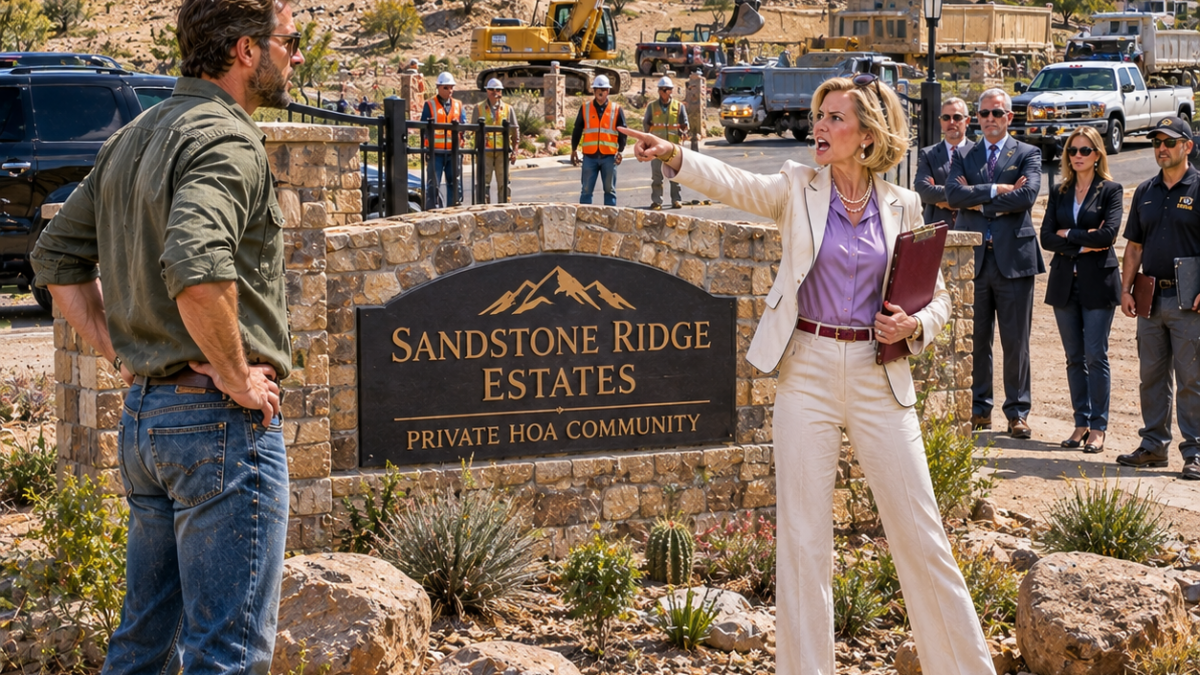
The first thing I saw when I came home after a year overseas was not the little house I had built on my Arizona hilltop, but a stone monument bolted into my soil that read SANDSTONE RIDGE ESTATES — PRIVATE HOA COMMUNITY, with twenty brand-new luxury mansions lined up behind it where eight acres of desert and mesquite had belonged to me since long before any HOA existed there.
When I demanded to know who had authorized a private subdivision on land whose taxes I was still paying, the HOA president, Karen Holdridge, calmly told me my property had been declared “transitional” after twelve months of non-occupancy and suggested I visit the HOA office if I wanted help understanding my new status as a “neighbor.”
I might have exploded right there if her explanation had not sounded so rehearsed, because the moment she mentioned county procedure, unanswered notices, and a development approval I had never signed, I realized somebody had not simply mistaken my absence for abandonment—they had prepared for the possibility that I would come back and had built their entire plan around making my ownership disappear on paper.
My name is Riley Martin, and for fifteen years that hilltop had been the one place in Arizona where nobody could tell me what to do with my own front porch.
It wasn’t fancy.
Eight acres of sun-baked ground, stubborn mesquite, open sky, and a modest house I had built largely with my own hands. The road was dirt. The wind carried dust through everything. At night there were no streetlights, no golf carts, no matching mailboxes, and absolutely no HOA.
That was exactly why I loved it.
Then work pulled me overseas for a year.
The job was brutal—twelve-hour shifts in heat that made Arizona feel almost polite by comparison—but it paid enough to justify the sacrifice. Before leaving, I filed my temporary absence information, kept the property insured, kept taxes current, maintained monitoring service on the house, and left the utilities in the condition required for an unoccupied property.
Every bad shift ended the same way in my head.
I pictured that hill.
My porch.
My coffee mug on the railing.
The quiet.
So when my truck turned onto the familiar road a year later, I expected dust.
Instead, I found asphalt.
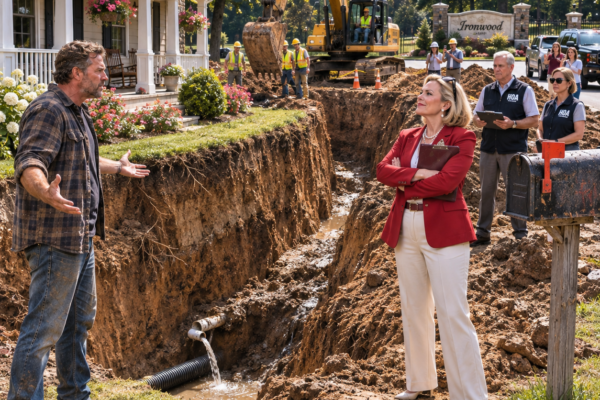
Fresh blacktop ran through what had once been open desert. New electrical poles stood in numbered rows. Decorative stone walls cut across the ridge. Irrigated landscaping pushed unnatural green into ground that had spent generations surviving without it.
And then I saw the houses.
Twenty of them.
Two stories. Tile roofs. Balconies. Garage doors. Pools behind block walls. The kind of homes developers photograph at sunset and call “desert luxury.”
I stopped my truck in the middle of the road.
For several seconds, I honestly wondered whether exhaustion had made me miss a turn.
Then I saw my own house above them.
Still standing.
Still mine.
Except now it looked like somebody had built a gated neighborhood around it while I was gone.
I got out.
A couple sitting on the nearest porch stared at me like I was the problem.
Then came the sound of heels on pavement.
Karen Holdridge approached in a tan linen suit, oversized sunglasses, clipboard under one arm.
“Can I help you?”
“Yeah,” I said. “You can tell me why there are twenty houses on my property.”
She barely reacted.
“Your property?”
“My deed says so.”
Her expression shifted into a thin professional smile.
“This land was classified as transitional after extended non-occupancy.”
“No, it wasn’t.”
“There were no responses to notices.”
“I was overseas. I filed my absence.”
“We followed county procedure.”
“Who is ‘we’?”
She extended a manicured hand.
“Karen Holdridge. President of the Sandstone Ridge HOA.”
I didn’t take it.
She continued.
“Emergency provisional development authorization was approved after the parcel appeared abandoned.”
“Appeared?”
“No utilities. No mail response. No owner present.”
“My taxes were paid.”
Her smile tightened.
“You can take your concerns to the county.”
I looked beyond her at the mansions.
At the road.
At the security cameras.
At the stone entrance sign.
Then I noticed something else.
Where my old rural mailbox had stood, there was now a polished cluster mailbox bearing the HOA logo.
I pointed at it.
“What happened to my mail?”
Karen’s face changed.
Only slightly.
But enough.
“That would be handled by management.”
“Which management?”
“Our office in Phoenix.”
“Why would my mail be going to your office?”
For the first time, she didn’t answer immediately.
Then she adjusted her sunglasses.
“You should speak to the county, Mr. Martin.”
I had never told her my name.
I stood there staring at her.
And suddenly the twenty mansions were no longer the strangest thing on my land.
PART 2
“How do you know my name?”
Karen’s expression went still.
It lasted maybe one second.
Then the polished smile returned.
“It’s public record.”
“Which record?”
“You just told me you own the property.”
“I told you I own it. I didn’t tell you my name.”
She shifted the clipboard against her hip.
“You’re upset. I understand that.”
“Don’t do that.”
“Do what?”
“Answer a question I didn’t ask so you don’t have to answer the one I did.”
Her lips thinned.
Around us, sprinklers hissed over a patch of decorative grass that had no business surviving on that ridge without somebody pouring money into it.
One of the homeowners on the nearby porch had stopped pretending not to listen.
Karen lowered her voice.
“Mr. Martin, I suggest you contact the county. Sandstone Ridge acquired development rights through proper procedure. Standing here creating a disturbance won’t help you.”
“A disturbance.”
“Yes.”
“On my land.”
“That’s precisely the issue in dispute.”
“No. You say there’s a dispute. I have a deed.”
“And we have county authorization.”
I looked at her clipboard.
“Show me.”
She hugged it closer.
“You aren’t entitled to internal HOA documents.”
“If those documents supposedly took my property, I think I’ll manage to become entitled to them.”
“You need an attorney.”
“That’s the first useful thing you’ve said.”
The smile vanished.
I turned toward my truck.
“Where are you going?”
“Home.”
“Mr. Martin.”
I stopped.
She pointed toward the road leading uphill to my little house.
“That residence is now within the Sandstone Ridge community boundary.”
I stared at her.
“No, it isn’t.”
“You should review the updated plat.”
“Was my house moved while I was gone?”
She frowned.
“Obviously not.”
“Then neither was the boundary.”
I got into the truck.
She stepped closer.
“If you’re planning to stay there, you’ll need to register your vehicle with the HOA office.”
I almost laughed.
“Karen.”
She leaned toward the open window.
“Yes?”
“If you put one HOA sticker on my truck, we’re going to have a very different conversation.”
Then I drove away.
The asphalt curved uphill.
My old dirt track had once followed the natural shape of the ridge. Whoever designed the development had cut across it, widened it, and connected side streets to the twenty new houses.
My house stood at the top like an artifact nobody had known what to do with.
The porch was dusty.
Windows intact.
Roof intact.
The old water tank was still behind it.
Nothing about the structure looked abandoned.
That made me angrier than the mansions.
Somebody had looked at a maintained house, paid tax records, a documented temporary absence, and decided they could make a different story work if they created enough paper.
I parked.
The lock still took my key.
Inside, the air smelled stale.
But it was mine.
My father’s old chair sat beside the west window.
My coffee cups were still in the cabinet.
A framed photograph of Dad and me at the Grand Canyon leaned slightly crooked on the wall because I had never bothered fixing it.
Nothing had been stolen from inside.
That felt almost insulting.
They had respected the front door while stealing the ground underneath it.
I checked my monitoring panel.
Six months of security history were gone.
Not disconnected.
Deleted.
The system showed remote administrative access.
I stared at the screen.
Now I understood why Karen had known my name.
This wasn’t a development that had bumped into my property accidentally.
They had studied me.
I took photographs of every screen.
Then I tried logging into the cloud account.
Some settings had been changed.
An alternate recovery email I didn’t recognize had been added seven months earlier.
I changed the password immediately and disconnected all remote sessions.
Then I sat on the edge of my bed.
For the first time since arriving, anger wasn’t the strongest thing I felt.
I felt violated.
Not because strangers had built houses outside.
Because somebody had reached through paperwork, mail, and electronics and touched parts of my life they had no right to touch.
I thought about calling Karen.
Then I remembered her face when I asked about the mail.
No.
She already knew more than she should.
I needed to learn what she thought I didn’t know.
That evening I left the hilltop.
Not because I was surrendering it.
Because I didn’t trust the situation enough to sleep there yet.
I checked into a roadside motel twenty minutes away.
The room smelled faintly of cigarettes despite a NO SMOKING sign taped directly beneath the air conditioner.
I spread my documents across the table.
Deed.
Property tax receipts.
Insurance.
The temporary travel notice I’d filed before leaving.
A copy of the monitoring-service contract.
Dad’s original paperwork from when he helped me refinance years earlier.
My father, Gerald Martin, had been dead seven years.
That fact mattered to me emotionally.
I had no idea how much it would matter legally by breakfast.
I barely slept.
At 7:42 the next morning, I walked into the county recorder’s office.
The building hadn’t changed.
Same beige tile.
Same fluorescent lighting.
Same stack of government pamphlets nobody appeared to read.
A young clerk in a faded county polo sat behind the counter.
“Morning.”
“Morning.”
“I need the complete ownership file for parcel 86091.”
“Owner name?”
“Riley Martin.”
He typed slowly.
Then frowned.
Then typed again.
“You have identification?”
I slid my driver’s license over.
He compared it to the screen.
“Okay.”
“What?”
“There are two active file histories attached to this parcel.”
“Two?”
“One original ownership chain.”
“Mine.”
“Yes.”
“And the other?”
He leaned closer.
“Transitional forfeiture claim.”
The phrase made my stomach tighten.
“Open it.”
“I can give you certified copies.”
“Open it first.”
He clicked.
A scanned document appeared.
**STATEMENT OF INTENT TO VACATE AND FORFEIT**
My name was typed at the top.
My parcel number beneath it.
The document claimed I intended to relinquish the property after extended absence.
At the bottom was a signature.
Supposedly mine.
It looked vaguely similar if you had never seen me sign anything.
But it wasn’t mine.
Then I noticed the second line.
**Witness/Co-Owner Confirmation: Gerald Martin**
For a moment I couldn’t breathe properly.
The clerk saw my face.
“You okay?”
“Gerald Martin is my father.”
“All right.”
“He’s been dead seven years.”
The clerk sat back.
“Oh.”
That was all he said.
Oh.
I pointed toward the screen.
“Print that.”
“Yes, sir.”
“Everything connected to it.”
He started clicking.
“Submission record?”
“Yes.”
“Digital history?”
“Yes.”
“Attachments?”
“Yes.”
“Notary page?”
“Yes.”
The printer started.
I looked at the notary certification.
**Leonard Pierce.**
I knew Leonard.
He’d notarized old loan paperwork for me years ago.
I also knew he’d retired five years earlier.
“What’s the filing date?”
“Nine months ago.”
“Who verified the notary?”
The clerk looked uncomfortable.
“It’s marked digitally verified.”
“By whom?”
“I don’t know from this screen.”
“Find out.”
“Sir, there are procedures—”
“Somebody signed my dead father’s name on a document transferring my land. Let’s discover how enthusiastic your supervisor is about procedure.”
He stood.
Ten minutes later, a manager came out.
Her name was Carla Ruiz.
She listened without interrupting.
Then she looked at the document.
“You’re certain that’s not your signature?”
“Yes.”
“And your father?”
“Death certificate is public record.”
She nodded.
“We need to preserve this file immediately.”
That was the first time anybody in government had said something that made me feel slightly less insane.
Carla locked the digital file from routine modification.
She gave me certified copies and an audit request form.
Then she said something I didn’t expect.
“Mr. Martin, you should contact counsel before confronting anyone involved.”
“That’s the plan.”
“And law enforcement.”
“I think we’re heading there.”
She lowered her voice.
“Don’t assume everyone in county government knew about this.”
“I don’t.”
“But somebody processed it.”
“Yes.”
She didn’t argue.
My next stop was planning and zoning.
I gave the receptionist my parcel number.
Her fingers froze over the keyboard.
That reaction alone told me she recognized it.
“Problem?”
“No.”
“Then why did you stop typing?”
She forced a professional smile.
“I didn’t.”
“Okay.”
I waited.
She read the screen.
Then said:
“This parcel was approved for provisional residential development.”
“When?”
“Last year.”
“By whom?”
She glanced at the monitor.
“Supervisor Milton Sharp.”
“I want the entire permit file.”
“You’ll need a records request.”
“I’ll file it.”
“Some documents may take time.”
“I have twenty houses on my land. I’ve already spent a year away. I can wait thirty minutes.”
She didn’t smile.
A supervisor wasn’t available.
Milton Sharp was on leave.
“Since when?”
“Three weeks.”
Three weeks.
Almost exactly when my return travel had appeared in the monitoring company’s reconnect logs.
Maybe coincidence.
I didn’t say that out loud.
The first permit in the file carried a February 14 approval date.
Utility trench authorization came later.
Road grading later still.
On paper, everything appeared orderly.
But one note bothered me.
A contractor progress report referenced “foundation set B” three months before the official permit date.
I pointed at it.
“How can a foundation progress report predate construction approval?”
The receptionist, Mara, looked at it.
Then looked away.
“I can’t interpret the file for you.”
“You don’t need to interpret it. Read the date.”
“I can only provide records.”
“Then provide all of them.”
She did.
I left with another stack of paper.
Back at the property, a delivery van pulled beside the new cluster mailbox.
I asked the driver:
“What happened to rural box 117?”
He checked his handheld scanner.
“Old delivery point was discontinued.”
“By who?”
“Management request.”
“What management?”
He squinted.
“Sandstone Ridge Property Management.”
“Where does mail addressed to the old box go?”
“Looks like forwarding to their Phoenix office.”
Every warning.
Every tax notice.
Every county letter.
Everything that might have told me what was happening.
Forwarded to the people doing it.
I sat in my truck until the delivery van disappeared.
Karen had been right about one thing.
I needed a lawyer.
Her name was Dana Pritchard.
She had represented me once when a contractor dispute almost turned ugly.
Dana was not theatrical.
She didn’t pound tables.
She didn’t call people criminals before proving they were.
She listened.
Then she built boxes around facts until whoever was lying had nowhere left to stand.
She answered on the second ring.
“Riley?”
“Dana, I have a problem.”
“How expensive?”
“Twenty houses.”
Silence.
“What?”
“An HOA built twenty luxury houses on my eight acres while I was overseas.”
Another pause.
“Start over.”
I did.
She interrupted only twice.
“When did you leave?”
I gave her the date.
“When did your father die?”
“Seven years ago.”
When I finished, she said:
“Where are you?”
“Cotton Hollow.”
“Do not speak to Karen again.”
“I’ve already spoken to her once.”
“Then make that the last time without counsel.”
“What about county offices?”
“Stop asking questions for now. Preserve what you have.”
“There’s more. My security history was remotely deleted.”
The silence changed.
“Who has technical access?”
“Supposed to be me and the monitoring company.”
“Send screenshots.”
“I have them.”
“Good. I’m driving down.”
“You’re two hours away.”
“Then you have two hours to organize everything chronologically.”
She hung up.
That was Dana.
The second person I called was Leo Barden.
Leo did digital forensics for insurance litigation and private security work.
We had met years earlier on an industrial project.
He answered with:
“Riley. Go.”
I explained the missing footage.
The recovery email.
Remote login.
“Don’t touch the system anymore.”
“I already changed the password.”
“Fine. Don’t factory-reset anything.”
“Can you trace access?”
“If logs exist.”
“I need to know if somebody from the HOA got in.”
“You need to know what happened. Don’t pick the answer first.”
Everybody around me seemed determined to stop me from becoming the angry man I felt like becoming.
That was probably saving me.
The third person was Angela Dominguez.
Former NYPD detective.
Now a licensed investigator in Arizona.
Angela had helped Dana on my contractor case.
When I told her somebody had signed my dead father’s name, she said:
“That’s bold.”
“Bold?”
“Bold and stupid are cousins.”
“Can you help?”
“Text me the parcel.”
By noon, the motel room looked like an improvised command center.
Dana spread paperwork across the bed.
Leo sat at the table with two laptops.
Angela arrived carrying coffee and a folder she’d somehow already started filling.
Dana studied the forfeiture statement.
“Your signature is obviously questionable, but we need an examiner if this goes far.”
“Fine.”
She tapped my father’s signature.
“This is worse.”
“For them.”
“For everyone.”
She turned to the notary line.
“Leonard Pierce.”
“Retired five years.”
“Alive?”
“As far as I know.”
Angela lifted her phone.
“I’ll find him.”
Leo plugged an external drive into his laptop.
“I pulled the monitoring logs you exported.”
“And?”
“Six months of camera clips deleted through administrative access.”
“From where?”
“Working on it.”
Dana looked at me.
“Who knew you were gone?”
“Neighbors. Monitoring company. County had my notice. My employer. A few friends.”
“Karen?”
“I had never met her.”
“Sandstone Ridge existed before you left?”
“No.”
That mattered.
The HOA hadn’t been waiting next door.
It had been created around the development.
Angela spread several printed photographs on the bed.
Aerial shots.
My ridge.
“What are these?”
“Drone hobbyist named Caleb Moore. He photographs desert storms and construction sites.”
The first image showed my land untouched.
Timestamp: thirteen months earlier.
Second showed survey stakes.
Eleven months.
Third showed trenching.
Ten months.
Fourth showed graders.
Nine and a half.
I looked at Dana.
“The permit says eight months.”
“Exactly.”
Angela pointed to the dates.
“They broke ground months before the permits.”
Dana became very still.
“Get Caleb’s original files.”
“Already asked.”
“You’ve known about this for two hours.”
Angela smiled.
“I work fast.”
Leo said:
“I have the remote access trail.”
We turned.
He rotated the laptop.
“One login originated from an IP range registered to Sandstone Ridge HOA’s management office.”
Dana leaned closer.
“Can you establish it cleanly?”
“I can establish that the request came through their line. I’m not saying which person used the keyboard.”
“Good.”
“There’s more.”
He opened another log.
“The administrator token used to override local-only storage was issued under credentials assigned to planning supervisor Milton Sharp.”
My stomach tightened.
“The man on leave.”
Leo nodded.
“Could credentials be stolen?”
“Absolutely.”
“Could somebody be framing him?”
“Possible.”
“Can you prove he used them?”
“Not yet.”
Dana smiled slightly.
I recognized that smile.
She liked evidence that created questions.
Not because questions were answers.
Because liars hated questions they hadn’t prepared for.
Angela’s phone rang.
She answered.
Listened.
Then held up one finger.
“Leonard Pierce is alive.”
“Where?”
“Retirement community outside Tucson.”
“Will he talk?”
“He says he hasn’t notarized anything since 2018 and wants to know why his name is on a forfeiture document.”
Dana stood.
“Good.”
I looked at the papers covering the motel bed.
“My father would’ve hated this.”
Dana glanced at me.
“The houses?”
“The paperwork.”
Dad believed a handshake should mean something.
He also distrusted HOAs on principle, banks on instinct, and printers because, according to him, “anything that jams when you need it most is plotting against you.”
I picked up the page bearing his forged signature.
For the first time that day, my anger turned personal in a different way.
“They used him because he’s dead.”
Dana’s voice softened.
“Probably.”
“He can’t defend his name.”
“You can.”
That landed.
Leo interrupted.
“Found an internal HOA portal.”
Dana turned sharply.
“Authorized access?”
“Publicly reachable index. No password on one section.”
“Don’t enter anything restricted.”
“I’m not.”
He clicked a cached document.
A board memo appeared.
**Martin parcel should be ready for full site integration by Q2. Assume he won’t be back. Board needs this completed quietly before next sales phase.**
No poetry.
No ambiguity.
My surname.
My parcel.
Assume he won’t be back.
I read it twice.
Then a third time.
Karen hadn’t met me when I arrived.
But she’d known exactly who I was.
Dana looked at Leo.
“Preserve that correctly.”
“Already hashing the file.”
Angela folded her arms.
“Somebody knew he was coming back eventually.”
I looked at the memo again.
“No.”
“What?”
“They didn’t think I’d come back.”
Dana shook her head.
“They didn’t need certainty. They needed enough time to create innocent buyers, mortgages, infrastructure, and a mess so expensive that you’d feel pressured to settle.”
That thought chilled me.
The houses weren’t merely buildings.
They were leverage.
Every family moved in.
Every loan issued.
Every contractor paid.
Every road connected.
Every layer made returning my property harder.
I sat down.
“What do we do?”
Dana answered immediately.
“Emergency injunction. Freeze transfers. Freeze new construction. Preserve records. Notify title insurers. Notify lenders through proper channels. Then we make them explain the forged forfeiture.”
“And the houses?”
“Later.”
“They’re on my land.”
“I know.”
“What happens to the people living in them?”
“That depends on who owns what, who bought in good faith, whether sales closed, what title policies exist, and what a court orders.”
I hated that answer because it was complicated.
But twenty families did not become enemies just because somebody sold them houses built on stolen land.
I remembered the couple on the porch.
Maybe they had spent their life savings.
Maybe they had no idea.
My revenge couldn’t be aimed at people who had been lied to too.
That became important faster than I expected.
Two days later we attended a court-ordered emergency mediation before the injunction hearing.
Karen arrived with an attorney named Victor Hale and three HOA representatives.
One was Greg Stanton, a dentist who also served as treasurer.
Karen wore navy.
No sunglasses indoors.
She looked more controlled than when we’d met.
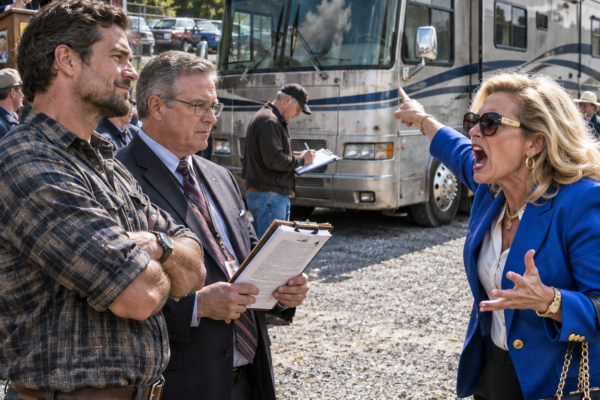
“Mr. Martin.”
“Karen.”
The mediator asked everyone to remain civil.
Karen opened with:
“We believe this entire dispute could have been avoided if Mr. Martin had maintained proper contact information.”
Dana didn’t move.
“My client’s contact information was current.”
“It clearly wasn’t.”
“His mail was redirected to your management office.”
“That was part of centralized development processing.”
“Who authorized you to redirect privately addressed mail?”
Victor stepped in.
“Let’s avoid accusatory phrasing.”
Dana looked at him.
“I’m asking a factual question.”
The mediator said:
“Ms. Holdridge?”
Karen answered.
“Property-related correspondence was consolidated once the parcel entered provisional development.”
Dana placed the forged forfeiture statement on the table.
“How did the parcel enter provisional development?”
Karen glanced at it.
“Through county procedure.”
“Who signed this?”
“Mr. Martin.”
“No.”
Victor said:
“That is disputed.”
Dana placed Dad’s death certificate beside it.
“And Gerald Martin?”
Karen’s expression flickered.
“I’m not familiar with his family records.”
“He died seven years before your filing.”
Nobody spoke.
Greg looked toward Karen.
Karen didn’t look back.
Dana continued.
“Who notarized the document?”
“A contracted digital notary.”
“Leonard Pierce?”
“Yes.”
“Mr. Pierce retired five years before the notarization date and has signed an affidavit saying he did not notarize this document.”
Victor leaned toward Karen.
She whispered something.
Then he said:
“We will need to investigate the filing vendor.”
Dana nodded.
“Good. Because the upload originated from an HOA-controlled connection.”
Victor’s pen stopped.
Leo sat behind us as a technical consultant.
Dana passed his preliminary report across the table.
Karen’s eyes moved down the first page.
Then she looked at Leo.
“This information was obtained illegally.”
Leo didn’t answer.
Dana did.
“The audit trail was provided from my client’s own security account and public filing metadata.”
Karen’s jaw tightened.
Angela placed the drone photographs on the table.
One after another.
Empty land.
Stakes.
Trenches.
Foundations.
Framing.
Each timestamp before official permit approval.
Victor’s expression changed.
“Where did these come from?”
“Original geotagged files from a local photographer.”
“These could be altered.”
“They can be examined.”
The mediator looked overwhelmed.
Karen spoke.
“The county authorized emergency construction.”
Dana asked:
“After you had already started?”
“We were working under preliminary assurances.”
“From Milton Sharp?”
Victor raised his hand.
“My client will not speculate regarding county employees.”
Dana smiled.
“We’ll subpoena him.”
Karen’s fingers tightened around her pen.
Then Dana placed the internal memo in front of her.
**Assume he won’t be back.**
For the first time, Karen lost color.
Victor read it.
Then looked at her.
“Where did this come from?”
She ignored him.
Dana said:
“An unsecured HOA portal.”
Victor looked furious.
At the HOA.
Not us.
Karen recovered.
“This is taken out of context.”
I spoke for the first time in several minutes.
“Give me the context.”
She looked at me.
“Riley—”
“No. You wrote my name into a development plan before we ever met. You knew I owned the parcel. You knew I was absent. Then somebody created a document saying I surrendered it.”
“I did not forge your signature.”
“I didn’t say you held the pen.”
Her eyes narrowed.
Dana put a hand lightly against my forearm.
Enough.
Karen said:
“The land was unused.”
There it was.
Not abandoned legally.
Unused.
“We improved it,” she continued. “The county needed housing. Investors had committed. The area was economically stagnant.”
I stared at her.
“To whom did my land look unused?”
She frowned.
“What?”
“To me it was home.”
“You were gone.”
“For work.”
“For a year.”
“I paid taxes.”
“The property generated nothing.”
“That’s none of your business.”
“Land has obligations to a community.”
“Not ownership obligations to you.”
Her control cracked.
“One man shouldn’t be able to hold eight acres hostage while families need housing.”
Dana leaned back.
“Thank you.”
Karen looked at her.
“For what?”
“For explaining motive.”
Victor put both hands flat on the table.
“Karen, stop talking.”
Too late.
The mediator called a recess.
In the hallway, I stood beside a vending machine that hummed louder than anyone needed.
Dana came out.
“You okay?”
“She thinks she improved my life by stealing from me.”
“She thinks she improved the land.”
“Same arrogance.”
“Yes.”
I looked toward the mediation-room door.
“What about those families?”
Dana knew immediately what I meant.
“The purchasers?”
“Yes.”
“We’ll separate them from the wrongdoers as much as possible.”
“I don’t want somebody losing their home because Karen wanted a subdivision.”
“You may not get to control every outcome.”
“I know.”
“But we can ask for solutions that protect innocent buyers while preserving your property rights.”
I nodded.
That was the first moment the eventual answer began taking shape.
Not demolition.
Not bulldozers.
Not twenty families carrying boxes while I watched.
Something smarter.
But before there could be settlement, we needed the truth.
The injunction hearing was three days later.
Judge Evelyn Harper presided.
She had silver hair, narrow glasses, and the expression of someone who considered wasted words a personal insult.
Dana presented the forged forfeiture first.
The county clerk testified to the filing.
Leonard Pierce appeared by video from Tucson.
“Did you notarize this document?”
“No.”
“Is that your seal?”
“It’s an image of an old seal I used years ago.”
“Was it valid on the date shown?”
“No.”
“Did you authorize anyone to use it?”
“Absolutely not.”
Dad’s death certificate came next.
Judge Harper read the date.
Then the signature.
She looked over her glasses toward Victor.
“Counsel?”
He stood.
“We do not concede that the association created the document.”
“I’m not asking you to.”
He sat.
Next came the permit timeline.
Angela’s drone photographs.
County records.
Construction before approval.
Then Leo.
He explained the deleted security footage carefully.
No theatrics.
No hacking jargon designed to impress people.
“The log reflects remote access.”
“From where?” Dana asked.
“An address block assigned to the Sandstone Ridge management office.”
“Can you identify the individual?”
“No.”
“Were elevated credentials used?”
“Yes.”
“Whose?”
“Credentials associated with Milton Sharp’s county zoning account.”
Victor cross-examined.
“Credentials can be stolen?”
“Yes.”
“IP addresses can be shared?”
“Yes.”
“Therefore you cannot say Ms. Holdridge personally deleted anything.”
“Correct.”
Karen visibly relaxed.
Then Leo added:
“But I can say somebody using a connection assigned to her HOA office and credentials associated with the zoning supervisor accessed Mr. Martin’s security account and deleted six months of footage.”
Her relief disappeared.
Dana introduced the memo.
Assume he won’t be back.
Victor objected to foundation.
Leo established where the file came from and how it had been preserved.
The judge admitted it provisionally.
Karen shifted in her chair.
The hearing lasted nearly six hours.
At the end, Judge Harper did not hand me twenty houses with a dramatic gavel strike.
Real life was messier.
But she did something that mattered more immediately.
She froze the entire development.
No sales.
No transfers.
No new leases.
No new construction.
No destruction of records.
No interference with my original house.
And no HOA attempt to enforce rules against me until ownership was adjudicated.
Then she ordered the county recorder to flag the disputed forfeiture instrument pending further proceedings.
I walked out of court still owning the same fight.
But for the first time, nobody could make it worse while we were proving it.
That night I slept in my own house.
I hadn’t planned to.
Dana wasn’t thrilled.
But the locks were changed.
Leo had secured the monitoring system.
And I was tired of a motel room smelling more familiar than my bedroom.
I sat on the porch after dark.
Below me, twenty mansion windows glowed.
They looked beautiful.
That was the worst part.
If they’d been ugly, I could have hated them without complication.
But workers had built them well.
Families had decorated several.
A child’s bicycle lay near one garage.
Wind chimes moved on another porch.
These houses were evidence of a crime.
They were also homes to people who might be innocent.
Around nine, someone walked up the road.
A man from the first house.
The wine-glass neighbor.
He stopped several yards away.
“Mr. Martin?”
“Yes.”
“Can we talk?”
I pointed toward the porch step.
He didn’t come closer.
“My name’s David Mercer.”
“Okay.”
“My wife is Lisa.”
“I remember.”
He looked embarrassed.
“From the day you arrived.”
“You thought I was trespassing.”
“We were told you were.”
“By who?”
“The HOA.”
Of course.
He rubbed his hands together.
“We bought six months ago.”
“Closed sale?”
“Yes.”
“Title insurance?”
“Yes.”
He looked toward his house.
“We put everything into that place.”
I said nothing.
“What happens to us?”
“I don’t know.”
He stared.
“I have two kids.”
“I don’t know, David.”
“Are you going to tear the houses down?”
That question hit harder than anything Karen had said.
“No.”
His shoulders dropped.
“I can’t promise what the court does. I can’t promise what title companies do. But I’m not out here dreaming about bulldozers.”
“Thank you.”
“Don’t thank me yet.”
He nodded.
Then:
“Karen told everyone you were some hermit who abandoned the property years ago.”
“I was gone twelve months.”
“I know now.”
“Did she ever show you the ownership paperwork?”
“No.”
“What did your closing documents say?”
“Sandstone Development Holdings.”
That was new.
“Not the HOA?”
“No.”
“The seller entity was Sandstone Development Holdings LLC.”
I wrote the name down.
“Who signed?”
“I’d have to check.”
“Check.”
He nodded.
Then he looked at my old house.
“You built this?”
“Most of it.”
“It’s nice.”
Compared with his mansion, my house looked like a tool shed.
But the way he said it didn’t sound patronizing.
“Thanks.”
He left.
I called Dana.
She answered:
“You’re supposed to sleep.”
“Sandstone Development Holdings.”
Silence.
“What about it?”
“That’s who sold at least one house.”
“Where did you get that?”
“Homeowner.”
“Send me the name.”
I did.
The next morning Dana found the LLC.
Registered eleven months earlier.
Manager listed as Greg Stanton.
The HOA treasurer.
Now the structure of the scheme started showing itself.
The HOA wasn’t simply an overreaching association.
People tied to its board had formed a development company.
Deposits had come in before official permits.
Several homes had already closed.
Others remained owned by the LLC.
The pool, clubhouse, fitness room, private road, and gatehouse sat on common parcels controlled through the association.
Except according to the real county plat, much of that “common parcel” remained inside my eight acres.
My land wasn’t underneath twenty unrelated mistakes.
It was the foundation of a business model.
Dana subpoenaed records.
Title files.
Loan files.
Board minutes.
LLC accounting.
County communications.
Then Milton Sharp returned from leave.
Or rather, his lawyer returned calls.
Sharp invoked his rights in the criminal investigation.
That told us enough to stop expecting friendly cooperation.
The district attorney’s office became involved after the forged notary document and Dad’s signature were formally referred.
From then on, Dana made me separate two fights in my head.
The civil case was mine.
Ownership.
Damages.
Structures.
Leases.
Money.
The criminal investigation belonged to the state.
Forgery.
Public records.
Unauthorized access.
Possible conspiracy.
“Do not confuse them,” she told me.
“I want people accountable.”
“Good. But you don’t get to use criminal charges as settlement leverage.”
“I know.”
“Say it like you believe it.”
“I know.”
“Better.”
Discovery lasted months.
Every week brought another piece.
An email from Greg:
**Need foundations in before monsoon delays. Paperwork will catch up.**
A message from Karen:
**Martin has been out of country almost a year. No sign of return. Move forward.**
A planning note from Sharp’s account:
**Provisional approval can be dated after administrative review. Don’t circulate draft.**
An internal sales memo:
**Do not discuss legacy parcel status with buyers. Title handled centrally.**
That sentence made me sick.
They hadn’t only lied to me.
They had intentionally kept buyers from asking.
David and several other residents obtained lawyers of their own.
At first I worried that meant twenty enemies.
Instead, something unexpected happened.
Their attorneys began cooperating with Dana.
Not because they loved me.
Because their clients had been deceived too.
Title insurers joined.
Lenders joined.
The developer’s insurer joined.
What had looked like one man versus an HOA became a room full of institutions trying to figure out who would pay for the same lie.
Karen’s confidence changed.
I saw it at the second mediation.
No smile.
No little speeches about community.
Victor did most of the talking.
Dana opened with a proposal.
“My client retains legal title to the original parcel.”
Victor said:
“That’s not acceptable.”
“The county record says otherwise.”
“The improvements complicate title.”
“Improvements built without ownership do not erase ownership.”
A title-insurance lawyer interrupted.
“Can we focus on resolution rather than slogans?”
Dana smiled.
“Absolutely.”
The proposal had three tracks.
First, residents who had closed in good faith could choose rescission through title insurers and sellers where available, or negotiate continued occupancy under a properly documented arrangement.
Second, unsold structures and common facilities would be transferred to me as part of settlement of my civil claims, subject to lender and insurer agreements.
Third, Sandstone Ridge could continue operating shared amenities only under a lease from me, because the clubhouse, pool, fitness facility, portions of the private road, and landscaping infrastructure sat on land that had never left my title.
Victor stared at her.
“You want the HOA to pay rent.”
“I want the HOA to stop pretending it owns land it doesn’t.”
Karen spoke for the first time.
“This is extortion.”
Dana didn’t even look at her.
“No. Extortion involves improper threats. This is a proposed lease for continued use of someone else’s property.”
Karen leaned forward.
“You’re going to let him profit from everything we built?”
I answered.
“You built it on my land.”
“We improved your property.”
“You keep saying that like I hired you.”
“You’ll make millions.”
“I’d rather have come home to the hill I left.”
She stopped.
That was the truth none of them could negotiate away.
I had not asked for twenty mansions.
I had not spent a year overseas dreaming of becoming a landlord.
I had wanted my desert house.
My ridge.
My dirt road.
They had changed my life permanently.
Even a victory couldn’t restore the exact thing I lost.
The criminal case moved faster after the second mediation.
Leonard Pierce’s old notary seal had been reproduced from a scanned county file.
Investigators traced document preparation through computers used by Sandstone Development Holdings.
Dad’s signature had been copied from an old refinancing instrument.
My signature had been pulled from a permit application fourteen years earlier.
That part affected me more than the money.
Someone had opened old records containing a day when Dad was alive, extracted our names, and used them to steal from me years later.
When Dana told me, I didn’t speak for a while.
“You okay?”
“No.”
“You want to stop for today?”
“No.”
“Riley.”
“I said no.”
She closed the folder anyway.
“Go home.”
“I can handle it.”
“I know. Go home.”
I drove to the hilltop.
Sat in Dad’s old chair.
The chair was ridiculous.
Brown vinyl.
Cracked armrest.
He’d insisted I take it because Mom threatened to throw it out after he bought a new recliner.
He had sat in that chair during the first winter after I finished the house and told me:
“Never own anything you’re afraid to defend.”
Back then I’d laughed.
“What am I defending? Coyotes?”
He’d shrugged.
“Could be worse. Could be developers.”
I remembered that line while twenty developer houses glowed outside my window.
Dad would have found the irony unbearable.
I laughed once.
Then cried harder than I had since his funeral.
Not because of the land.
Because somebody had made his name part of something ugly.
The next morning I called Dana.
“What do I need to do to make sure the court record says his signature was forged?”
“It already does in our filings.”
“I want the final resolution to state it.”
“We can ask.”
“I don’t care if it costs me part of a settlement.”
She paused.
“All right.”
That became one of my non-negotiable terms.
Any civil settlement had to acknowledge that Gerald Martin had never consented to anything.
His name would not remain in history as a co-signer to his son’s dispossession.
Months later, we finally reached trial on the core ownership claims.
Cotton Hollow courthouse was packed.
Not because I wanted publicity.
Because by then the story had spread.
Twenty mansions.
Forged dead man’s signature.
HOA.
County supervisor.
People love scandals where paperwork turns out to be more dangerous than a gun.
Judge Harper heard testimony over several days.
The recorder’s office established my original ownership chain.
Tax records showed payments never stopped.
Insurance showed continuous coverage.
My travel notice proved I had documented temporary absence.
The monitoring company showed service remained active.
The postal records showed redirection requests had not originated from me.
Leonard Pierce denied notarizing anything.
A handwriting examiner testified that my signature on the forfeiture statement was inconsistent with known samples.
Dad’s signature was compared with decades-old records.
Copied characteristics were obvious.
Then came the construction timeline.
Drone photographs.
Contractor invoices.
Material orders.
Foundation inspections performed after walls were already framed.
Permits dated months after grading began.
Angela explained the chronology without calling anyone evil.
She didn’t need to.
Dates are merciless.
Leo testified about digital access.
Again, carefully.
He never claimed Karen personally sat at a computer deleting my footage.
He established what could be established.
Access came from the HOA network.
Sharp’s credentials were used.
Security history vanished.
An unauthorized recovery address was added.
Then Dana called Greg Stanton.
Greg had reached a cooperation agreement in the criminal investigation.
The confident dentist from mediation looked twenty years older.
“Were you treasurer of Sandstone Ridge HOA?”
“Yes.”
“Were you also manager of Sandstone Development Holdings?”
“Yes.”
“Did that company sell homes on Mr. Martin’s parcel?”
“Yes.”
“Did you know Riley Martin remained the recorded owner?”
Greg looked toward his attorney.
Then answered.
“I knew there were unresolved title issues.”
A murmur moved through the courtroom.
Dana continued.
“Unresolved title issues.”
“Yes.”
“Did you tell buyers?”
“No.”
“Why?”
“We were told the county process would clear them.”
“By whom?”
“Karen and Milton Sharp.”
Karen’s lawyer objected.
Judge Harper allowed the answer for limited purposes and cautioned how it would be considered.
Dana showed Greg the memo.
**Assume he won’t be back.**
“Were you at the meeting where this was discussed?”
“Yes.”
“What did it mean?”
Greg swallowed.
“That Riley Martin was overseas.”
“Anything else?”
“We believed he’d probably remain overseas.”
“Why did that matter?”
Another pause.
“Because if he returned before enough construction was complete, he’d challenge the development.”
Nobody breathed.
I looked at Karen.
She stared straight ahead.
Dana asked:
“So speed mattered because construction itself created leverage?”
Greg’s lawyer objected.
Dana rephrased.
“Why did completion matter if you believed you already owned the land?”
Greg looked toward the floor.
“It made reversal less likely.”
There it was.
The entire plan in six words.
Build enough.
Sell enough.
Create enough innocent third parties.
Make giving my land back so painful that the easier solution would be making me accept what they’d done.
Karen finally testified.
Victor walked her through the same defense we’d heard for months.
Housing need.
County assurances.
Apparent abandonment.
Good faith.
Economic improvement.
She denied forging signatures.
Denied altering records.
Denied ordering anyone to delete security files.
Some of those denials may even have been true.
The scheme had enough people involved that no one person needed to touch every piece.
Then Dana stood.
“Ms. Holdridge, when did you first learn Riley Martin owned parcel 86091?”
Karen hesitated.
“During preliminary development review.”
“So before construction.”
“Yes.”
“Did you meet him?”
“No.”
“Did you call him?”
“We attempted notification.”
“At what address?”
“The parcel address.”
“Mail later redirected to your management office.”
“That occurred after provisional status.”
“Did you email him?”
“I don’t recall.”
“Call?”
“I don’t recall.”
“Use the emergency contact listed with his monitoring company?”
“No.”
“Contact his tax mailing address?”
“I don’t know.”
“Contact his employer?”
“No.”
“Hire a title company to locate him?”
“The development company handled title.”
Dana lifted the forfeiture statement.
“When did you first see this?”
“I don’t remember.”
“Before or after construction started?”
“I don’t remember.”
“Did you rely on it?”
“Yes.”
“Did you verify his signature?”
“No.”
“His father’s?”
“No.”
“Did you know Gerald Martin was dead?”
“Not then.”
“When did you learn?”
“When Mr. Martin returned.”
Dana turned toward me briefly.
Then back.
“You told Mr. Martin his land had been declared transitional because he failed to answer notices.”
“Yes.”
“Notices routed to your own management office.”
“That’s a mischaracterization.”
“Who requested the forwarding?”
“I don’t know.”
“Your management company?”
“Yes.”
“Your HOA?”
“It served the development.”
“Did Mr. Martin authorize that?”
“I don’t know.”
Dana walked toward the evidence monitor.
The memo appeared.
**ASSUME HE WON’T BE BACK.**
“Did you write this?”
Karen looked at it.
“I participated in the memo.”
“Did you write that sentence?”
“I don’t remember.”
“Did you agree with it?”
“At the time, we believed the parcel was effectively abandoned.”
“Why not say ‘legally forfeited’?”
Karen frowned.
“What?”
“The memo doesn’t say title is clear. It says assume he won’t be back.”
“It was informal language.”
“Because you knew he might come back.”
“Anyone might come back.”
“He was the owner.”
“We believed the forfeiture was valid.”
“Then his return shouldn’t matter legally.”
Silence.
Dana waited.
Judge Harper watched Karen.
Dana asked:
“If you truly believed title had lawfully transferred, why were you concerned whether Mr. Martin came back?”
Karen’s eyes shifted toward Victor.
No answer.
Dana continued.
“You told the mediator that one man shouldn’t stand in the way of progress.”
“That’s a philosophical statement.”
“Was it your philosophy when you developed his land?”
“No.”
“Then why say it?”
“I was frustrated.”
“You believed his ownership stood in the way.”
“I believed unused land could serve the community.”
“Even if he owned it?”
Victor stood.
“Argumentative.”
“Sustained.”
Dana stepped back.
Then asked one final question.
“Ms. Holdridge, did Riley Martin ever give you permission to build one house on his property?”
Karen’s voice was quiet.
“No.”
“Twenty?”
“No.”
“No further questions.”
Judge Harper’s final ruling came the next afternoon.
She took nearly forty minutes reading findings.
I remember very little of the legal phrasing.
I remember the parts that mattered.
The purported forfeiture was invalid.
My title had never lawfully transferred.
The recorded deed remained mine.
The development had been constructed without valid ownership authority.
The court permanently barred the HOA and affiliated entities from claiming jurisdiction over my original home or parcel except through future lawful agreements.
The disputed instruments would be corrected.
And the judgment explicitly stated that Gerald Martin, deceased seven years before the filing, had never signed or consented to the purported forfeiture.
I closed my eyes when she read that.
Dana touched my arm.
That was the moment I felt like we had actually won something.
Not the land.
Dad’s name.
Then Judge Harper addressed the twenty houses.
Because innocent buyers, lenders, and insurers were involved, she did not order twenty mansions flattened the next morning.
Instead, she ordered the parties into a structured resolution process and prohibited continued occupancy transfers until agreements protecting my ownership were approved.
The criminal evidence was formally referred to the district attorney.
Karen’s face had gone pale.
Greg didn’t look up.
Sharp wasn’t in the courtroom.
His lawyer was.
When the hearing ended, two investigators approached several defendants regarding outstanding warrants and interview orders connected to the separate criminal case.
Karen was taken into custody later that day on allegations tied to fraud and conspiracy after the district attorney moved forward.
There was no cinematic speech.
No slow-motion handcuffs for my benefit.
Just officers.
Paperwork.
A woman who had walked across my land like a queen suddenly being told where she could and couldn’t go.
Outside, reporters shouted questions.
I ignored them.
Dana walked beside me.
“You all right?”
“I think so.”
“You’re the owner.”
“I was always the owner.”
She smiled.
“That’s the point.”
The next phase took almost four months.
That was the part viral headlines never understand.
Victory can take longer to clean up than defeat takes to cause.
Title companies negotiated with buyers.
Lenders negotiated with insurers.
Sandstone Development Holdings entered receivership.
Several buyers chose rescission—money returned through insurance and settlement mechanisms, mortgages unwound, moving expenses compensated.
Others wanted to stay.
I met them individually.
Not because the court required me to.
Because I needed to look at the people whose lives were tangled with mine.
David and Lisa Mercer came first.
They brought a binder.
I laughed when I saw it.
“Please don’t tell me you’re starting an HOA.”
David smiled nervously.
“Never again.”
They had two children.
Their daughter loved the school district.
Their son had finally made friends after moving from Nevada.
They wanted to stay.
“What do you want?” David asked.
“From you?”
“Yes.”
“Honesty.”
He waited.
“I don’t want your house.”
“You legally own the ground under it.”
“Correct.”
“And depending on settlement, the structure—”
“I know.”
He looked scared.
I hated that.
“I’m not Karen.”
His shoulders loosened slightly.
“I want an agreement that recognizes my land title, pays a fair ground rent, gives you long-term security, and makes sure neither of us can pretend the other doesn’t exist.”
“Ground lease.”
“Yes.”
“For how long?”
“Long enough that your kids won’t wake up wondering whether I changed my mind.”
Dana later structured ninety-nine-year renewable ground leases for the homeowners who chose to stay.
The rent was not punitive.
I could have demanded more.
I didn’t.
Each agreement acknowledged my ownership.
Residents retained rights to their homes under the settlement structure.
Title insurers covered parts of the cost caused by the fraud.
Some people left.
Some stayed.
The HOA itself became the strangest problem.
The clubhouse sat on my parcel.
So did the pool.
Fitness center.
Gatehouse.
Parts of the road.
Utility infrastructure.
Sandstone Ridge could dissolve those facilities.
Or lease them.
The new board—because Karen was obviously gone—asked for a meeting.
I walked into the clubhouse they had built on my land.
It had stone fireplaces.
A gym.
A kitchen nicer than mine.
A meeting room with a polished walnut table.
The interim president was a woman named Rebecca Hall.
She looked exhausted.
“We need to discuss the common facilities.”
“I assumed.”
“We can’t operate without them.”
“You can.”
She frowned.
“You can close the pool.”
“That would destroy property values.”
“Then lease it.”
She hesitated.
“The residents already paid HOA dues.”
“To an organization that built shared amenities on land it didn’t own.”
“We didn’t know.”
“I believe most of you didn’t.”
She looked relieved.
Then I continued.
“But not knowing doesn’t turn my property into yours.”
She nodded.
“What terms?”
Dana slid a proposed lease across the table.
Monthly rent for the clubhouse, pool, fitness center, gatehouse footprint, and designated road-access areas.
Insurance obligations.
Maintenance obligations.
No claim of ownership.
No HOA authority over my original hilltop house.
No architectural control over my private land outside the defined lease.
Automatic termination provisions for fraud or attempted encroachment.
Rebecca read slowly.
Then looked up.
“This rent is less than I expected.”
“I don’t want to bankrupt the residents.”
“You could.”
“I know.”
“Why don’t you?”
I looked around the room.
“Because I’m trying not to become the person who did this to me.”
She closed the document.
“I think they’ll accept.”
They did.
The first rent payment from Sandstone Ridge HOA landed in my account on a Friday morning.
I stared at the notification.
For months I had imagined that moment as revenge.
I thought I’d laugh.
Call Dana.
Maybe pour whiskey at nine in the morning like some movie character who’d finally defeated his enemies.
Instead, I sat at the kitchen table.
Quiet.
The payment wasn’t funny.
It was strange.
The same HOA that had placed a MEMBERS ONLY sign on my land was now paying me every month for permission to keep using its own clubhouse.
There was satisfaction in it.
Absolutely.
But the deeper feeling was relief.
The paperwork finally matched reality.
That afternoon Tommy Bates drove up.
Tommy’s family had known mine for decades.
He climbed out carrying a pry bar.
“You ready?”
“For what?”
He pointed toward the giant Sandstone Ridge entrance sign.
Court settlement gave me control over the entrance parcel.
The sign still read:
**PRIVATE HOA COMMUNITY — MEMBERS ONLY**
I smiled.
“Yeah.”
We removed it.
Not destroyed.
Removed.
I kept the metal letters for about two weeks.
Then realized I didn’t want them.
They went to scrap.
In their place, Tommy and I installed simple stonework with a wooden sign.
**MARTIN RIDGE**
Underneath:
**PRIVATE PROPERTY — RESIDENT AND GUEST ACCESS**
No threats.
No crown.
No HOA logo.
Just the truth.
Then I turned my attention to the houses that had reverted to the development receiver and ultimately transferred to me through settlement.
There were more than I expected.
Several sales had never closed.
Three buyers chose rescission.
Others had been investment units.
By the end, I controlled a substantial number of the twenty houses outright while the remaining occupied houses sat under long-term ground agreements.
Tommy walked through one of the empty mansions with me.
White cabinets.
Gray tile.
Chrome fixtures.
Everything spotless.
Everything generic.
“What are you going to do with these?”
“Sell?”
“Could.”
I looked through the glass doors toward the desert.
The house faced the wrong way.
Not literally.
Emotionally.
Its biggest windows looked toward the subdivision.
The canyon sat behind a blank wall.
“They built houses in Arizona and somehow forgot the desert.”
Tommy laughed.
“Developers.”
I walked outside.
Sage moved in the wind.
My old mesquite trees remained in scattered patches where graders hadn’t reached.
I thought about Dad.
He would have hated the fake grass.
I said:
“Let’s change them.”
“How much?”
“All the empty ones.”
Tommy stared.
“Riley.”
“What?”
“That’s not a renovation. That’s a second career.”
“I’ve had worse jobs.”
We hired local craftspeople.
Not to destroy perfectly good homes.
To make them belong.
Reclaimed wood.
Desert stone.
Adobe textures.
Porches oriented toward canyon views where construction allowed.
Native landscaping replacing thirsty decorative grass.
Shade structures.
Rain capture.
Solar improvements.
We removed HOA ornamental plants that required ridiculous water and replaced them with agave, sage, brittlebush, palo verde, and mesquite.
The first house became a short-term desert retreat.
Then another.
Then another.
I resisted calling it a resort.
Dana said:
“If it has twelve units and a booking website, Riley, words are losing the fight.”
I named the rental operation Martin Ridge Retreats.
The first guests were a retired couple from Colorado.
They booked three nights.
Stayed five.
Then wrote to ask if they could come back the following winter.
Bookings grew from there.
Writers.
Families.
Photographers.
Veterans who wanted quiet.
People passing through Arizona who preferred a porch and open sky to a hotel corridor.
I never gave tours about “the HOA scandal.”
The story existed.
People knew.
But I didn’t want my home turned into a theme park about Karen.
The rentals paid well.
Better than I’d expected.
The HOA rent arrived every month.
Ground lease payments arrived from the residents who stayed.
The irony was not subtle.
I had left for a year trying to earn enough money to make life easier.
I came home to discover strangers had turned my land into an accidental real-estate portfolio.
But money didn’t make the theft acceptable.
That distinction mattered to me.
One afternoon, Angela sat on my porch drinking coffee.
“You know people think you’re the luckiest man in Arizona.”
“I know.”
“Twenty free mansions.”
“They weren’t free.”
She looked at me.
“Fair.”
“They cost a year of my life. Dad’s name. Months of court. A development I never wanted.”
“And now?”
I looked across the ridge.
“Now they’re useful.”
She smiled.
“That’s probably healthier than setting them on fire.”
“Low bar.”
“Still counts.”
The criminal cases unfolded separately.
Milton Sharp was charged in connection with public-record manipulation and abuse of his zoning access.
Greg faced fraud-related charges tied to Sandstone Development Holdings.
Two board members accepted plea agreements after cooperating.
A contractor who knowingly continued work after title concerns surfaced faced financial and licensing consequences.
Karen’s case took longest.
Her lawyer challenged digital evidence.
Disputed intent.
Argued she relied on county representations.
Some counts were narrowed.
Others survived.
Eventually she entered a plea agreement involving fraud-related conduct and conspiracy exposure rather than risking trial on everything.
She faced incarceration, substantial financial penalties, restitution obligations, and a prohibition that effectively ended her ability to hold HOA leadership again.
I didn’t attend sentencing.
People found that surprising.
“You don’t want to see her go down?” Tommy asked.
“She already did.”
“You sure?”
I looked toward the ridge.
“Court isn’t entertainment.”
That wasn’t entirely noble.
Part of me did want to see her face.
I just didn’t want that part controlling me anymore.
Dana attended because she had related civil matters.
She called afterward.
“Finished.”
“What happened?”
She told me.
I listened.
Then said:
“Okay.”
“That’s it?”
“What am I supposed to say?”
“You’ve spent a year fighting this.”
“More than a year.”
“You don’t sound happy.”
I walked onto my porch.
The sun was dropping behind the canyon.
“I’m home, Dana.”
She was quiet.
Then:
“Good answer.”
Life after the case was not instantly peaceful.
For months, tourists drove up just to photograph the sign.
Reporters called.
Documentary producers emailed.
One offered money for exclusive access.
I said no.
My father had taught me that attention was another kind of debt.
Once you take too much of it, people start believing they own part of you.
I had enough ownership problems.
The remaining Sandstone residents became neighbors in a way they hadn’t been before.
Not HOA subjects.
Neighbors.
Rebecca handled the board differently.
She asked.
That was revolutionary.
One morning she called.
“The HOA wants to repaint the gatehouse.”
“Why are you asking me?”
“It’s leased from you.”
I laughed.
“What color?”
“Desert brown.”
“Sounds fine.”
“You don’t want a committee?”
“Rebecca.”
“I’m joking.”
Months earlier, I would not have believed an HOA president could make me laugh.
David Mercer became a friend.
Not immediately.
Trust takes time.
He helped me repair a section of old fence damaged during construction.
His son started coming uphill to ask questions about tools.
One Saturday I found the kid staring at Dad’s old workbench.
“What is that?”
“A planer.”
“Does it still work?”
“Depends how much you respect electricity.”
David said:
“Don’t teach him anything dangerous.”
I said:
“Then why’d you bring him to my house?”
We eventually built the boy a small wooden toolbox.
Dad would have liked that.
The thing I hadn’t expected was how much the land itself could recover.
We removed unnecessary pavement where it served no function.
Restored drainage.
Replanted native species.
Cut irrigation use dramatically.
The mansions remained.
They would always remain.
But the ridge stopped looking like somebody had tried to force Scottsdale onto the desert.
At dusk, coyotes returned to the lower wash.
Quail nested near one rental.
Sage pushed through areas where decorative gravel had been removed.
The land did not need to forget what happened.
It adapted.
So did I.
A year after my return, I woke before sunrise and made coffee.
Same mug I’d pictured while working overseas.
I carried it onto the porch.
The hill was quiet.
Not empty.
Quiet.
There is a difference.
Below me, lights glowed in several houses.
A family from Minnesota occupied one rental.
David and Lisa lived in another.
The clubhouse lights were off.
Pool still.
The old Sandstone road curved across the property, but it no longer felt like an invasion every time I looked at it.
My phone buzzed.
Bank notification.
**SANDSTONE RIDGE HOA — MONTHLY LEASE PAYMENT RECEIVED.**
I laughed.
A real laugh.
Dad’s old chair creaked when I sat down.
I could almost hear him.
*Developers, huh?*
“Yeah, Dad.”
The wind pushed against the porch.
I took a drink.
A truck came slowly up the road.
Tommy.
He parked and walked toward me carrying a cardboard box.
“Too early?”
“You’re asking after arriving?”
“Fair.”
He set the box down.
Inside was something metal.
The old brass plaque from my original rural mailbox.
**117 MARTIN**
He’d found it in a pile of construction debris one of the cleanup crews had stored.
I picked it up.
Scratched.
Bent.
Still readable.
“Thought you might want it.”
I ran a thumb across the numbers.
“Where’d you find this?”
“Behind the old maintenance shed.”
“They threw it away.”
“Apparently.”
I looked toward the cluster mailbox Karen’s development had installed.
That one still served residents.
No reason to remove it.
But my old mailbox had been part of the place before any of them arrived.
Tommy said:
“We could put it back.”
I smiled.
“Yeah.”
We spent the morning setting a cedar post beside the road leading to my original house.
Nothing fancy.
No stone pillars.
No logo.
Just wood.
We screwed the old plaque onto it.
Bent corner and all.
Tommy stepped back.
“Crooked.”
“My father would’ve approved.”
“You want me to straighten it?”
“No.”
We left it.
That afternoon, a couple staying in one of the rentals walked uphill.
They had heard enough of the story to recognize me.
The man asked:
“Are you Riley?”
“Depends who’s asking.”
His wife laughed.
“We’re staying in number seven.”
“How is it?”
“Beautiful.”
“Good.”
They looked toward the houses below.
“Is it true all of this was built while you were gone?”
“Yes.”
“And they tried to say you abandoned the land?”
“Yes.”
“And now the HOA pays you rent?”
I smiled.
“Every month.”
The man shook his head.
“That has to feel incredible.”
I looked across the ridge.
Once, I would have said yes immediately.
Instead I said:
“It feels complicated.”
He waited.
“I didn’t win twenty mansions.”
I pointed toward my little house.
“I won the right to come back to that without somebody telling me it belonged to them.”
His expression softened.
“That makes sense.”
They walked back downhill before sunset.
I stayed on the porch.
The lights began appearing one by one below.
Not like intruders anymore.
Just lights.
My father’s forged signature had been formally voided.
My deed was clean.
My home was outside HOA control.
The residents who stayed had security.
The people who left had been compensated through settlements and insurance.
The shared facilities remained open because the HOA paid me to use the land beneath them.
The empty mansions had become homes and rentals rather than rubble.
And the desert was slowly reclaiming the spaces where it had been pushed aside.
I could have spent the rest of my life measuring victory by what Karen lost.
Her office.
Her reputation.
Her money.
Her freedom.
That would have meant she still occupied the center of the story.
She didn’t.
The center was the hill.
The small house.
The old mailbox plaque.
Dad’s chair.
The wind.
Home.
Night settled over Martin Ridge.
I checked the gate once before going inside.
The massive Sandstone Ridge Estates sign was long gone.
In its place stood the simple wooden marker Tommy and I had installed.
**MARTIN RIDGE.**
My truck sat beside the house.
Coffee cup on the porch rail.
Dad’s chair behind me.
And down below, twenty houses that were supposed to make it impossible for me to reclaim my land were helping pay to preserve it.
I looked toward the old mailbox plaque one last time.
117 MARTIN.
Still bent.
Still mine.
Then I went inside and closed the door of the house they had assumed I’d never come back to.
I was home.
[END OF STORY]