HOA Karen’s Entitled Teenage Son Trespassed Into My Private Fishing Pond Despite Months of Warnings—Then He Sank Waist-Deep Into the Mud. When Karen Came Screaming, the Entire Neighborhood Learned Why He Was Really There.
HOA Karen’s Entitled Teenage Son Trespassed Into My Private Fishing Pond Despite Months of Warnings—Then He Sank Waist-Deep Into the Mud. When Karen Came Screaming, the Entire Neighborhood Learned Why He Was Really There.
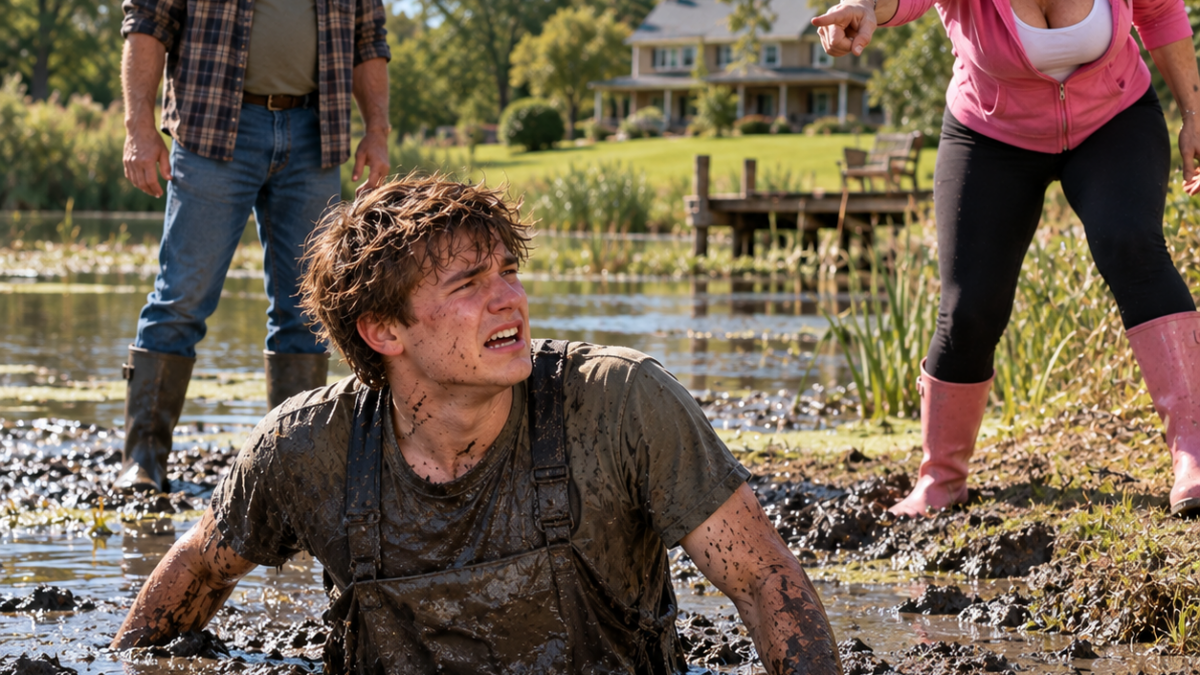
The first scream came from the far side of my pond just after four in the afternoon, and by the time I reached the bank, my neighbor’s sixteen-year-old son was buried nearly to his waist in mud on property I had warned him to stay off at least six times.
His mother came charging across my lawn demanding to know what I had “done” to him, threatening lawsuits and police before anyone had even pulled the boy free.
What Karen Caldwell did not know was that Jason’s phone was still recording from the grass—and half the neighborhood was about to hear him admit exactly why he had trespassed onto my land in the first place.
My name is Daniel Harper.
I was sixty-one years old when a teenager stepped into my pond and somehow turned mud into a neighborhood legal crisis.
I bought my property because I wanted peace.
Not drama.
Not homeowners-association politics.
Not arguments over fences, lawns, parking, dogs, garbage cans, flags, basketball hoops, or whether somebody else’s idea of “community” gave them a right to use things they did not own.
Peace.
That was the entire point.
My house sat on a little more than six acres at the edge of a rural residential development called Meadow Ridge.
The name made it sound fancier than it was.
Most of us had two to eight acres.
Some people kept horses.
One family raised goats.
Two neighbors had workshops bigger than their houses.
There were no sidewalks.
Mailboxes stood along the county road.
The neighborhood association existed mostly to maintain the entrance sign, negotiate a bulk trash contract, and occasionally send passive-aggressive emails about people driving too fast.
That was how it had operated for years.
Then Karen Caldwell discovered committees.
Karen lived directly east of me.
“Directly” being relative.
Her house sat about a hundred fifty yards away, separated from mine by a shallow swale, some scrub oak, a wire fence, and three survey monuments installed by professionals whose existence Karen considered a personal insult.
She moved in three years after I did.
Within two months, I knew exactly what kind of neighbor she was.
Not evil.
That would have been simpler.
Karen was the sort of person who believed inconvenience created entitlement.
If something would be easier for her, then whoever stood in the way was unreasonable.
Her Labrador wandered through my vegetable garden.
“He’s friendly.”
PART2:
Her landscaper dumped clippings beyond the property line.
“They’re biodegradable.”
Her sister parked across my equipment lane during a birthday party.
“It was only twenty minutes.”
Her sprinkler sprayed across my fence onto stacked firewood.
“It’s just water.”
Every incident was tiny.
That was her specialty.
Make each violation small enough that objecting made you look petty.
Then repeat.
The first real argument involved the pond.
My pond was about an acre and a half.
Spring-fed along the northwest corner, rain-fed across most of its basin.
Bass.
Bluegill.
Catfish.
Bullfrogs loud enough in June to make phone conversations pointless.
A few painted turtles.
Too many dragonflies to count.
The bottom varied.
Near the dock, I maintained gravel and stone.
The northern edge had a gradual firm slope.
The western inlet was different.
PART3:
Years of leaf litter and runoff had built a deep layer of organic silt.
Soft.
Sticky.
Unpredictable.
Not quicksand.
Nothing cinematic.
But step into the wrong spot and you could sink to your knees before realizing how deep the muck was.
In wet years, deeper.
I knew because I maintained it.
I also knew because fifteen years earlier I had tried to pull a clogged intake screen by walking out from the west bank.
I sank to mid-thigh.
Lost one boot.
Nearly lost the other.
Spent forty minutes extracting myself while my late wife, Susan, stood on shore laughing so hard she couldn’t help.
For years afterward, whenever I became overly confident about anything, Susan would say:
“Remember the boot.”
It was one of those marriage references that meant nothing to anyone else.
She had been gone four years by the time Karen’s son stepped into that same mud.
I still heard her saying it sometimes.
Remember the boot.
The pond mattered because Susan and I had restored it together.
When we bought the place, it was a neglected agricultural pond.
Banks eroding.
Invasive brush.
Trash in the shallows.
Old beer cans.
Broken fence.
We spent years fixing it.
Nothing glamorous.
We planted native grasses.
Stabilized the runoff channel.
Added a small aerator.
Removed junk.
Built a dock with our daughter Emily when she was twelve.
Susan chose the bench on the south side.
Cedar.
Facing west.
After dinner, we would sit there with coffee and watch the light disappear behind the trees.
When cancer arrived, the pond became one of the few places where conversations did not begin with treatment.
We talked about weather.
Ducks.
Neighbors.
Nothing.
Nothing became precious.
After Susan died, I kept the pond the same.
Not frozen in time.
Just cared for.
That distinction mattered to me.
It wasn’t a shrine.
It was still alive.
Children occasionally asked permission to fish.
I often said yes.
Neighbors came by.
My brother visited.
I wasn’t territorial for sport.
I simply wanted people to ask.
Karen never understood that.
Her first pond incident happened during a July barbecue at her house.
I looked out and saw four teenagers on my dock.
Jason was fourteen then.
Two boys.
Two girls.
Fishing rods.
Music playing from somebody’s phone.
I walked down.
“Guys.”
They turned.
Jason recognized me.
“Oh. Hey, Mr. Harper.”
“You have permission to be here?”
Silence.
One girl said, “Jason said it was okay.”
Jason looked embarrassed.
“It’s just the pond.”
“It’s my pond.”
“We’re not hurting anything.”
“That’s not the question.”
One boy started packing.
Jason remained.
“My mom said people used to come down here.”
“They did.”
“So?”
“With permission.”
He rolled his eyes.
That was the first time I saw Karen in him.
Not cruelty.
Assumption.
The idea that permission was some unnecessary ceremony adults used to feel important.
I told them to leave.
They did.
Twenty minutes later, Karen texted.
DANIEL, DID YOU REALLY KICK KIDS OFF THE POND?
I replied:
YES.
WHY?
PRIVATE PROPERTY.
Three dots appeared.
Disappeared.
Then:
THAT SEEMS A LITTLE EXTREME.
I didn’t respond.
The next summer, Jason came back twice.
Once with a fishing pole.
Once with a girl.
Both times cameras caught him.
Both times I spoke to Karen.
The second conversation was face-to-face.
She stood near the boundary line holding pruning shears.
“He’s a kid.”
“He’s fifteen.”
“Exactly.”
“He knows what private property means.”
“Daniel, nobody’s damaging anything.”
“I have a liability issue.”
Her expression changed.
That was always the phrase people respected when respect for ownership failed.
Liability.
“What liability?”
“The west bank is unstable.”
“Then fix it.”
I stared.
“The pond is functioning exactly as a natural pond functions.”
“Kids could get hurt.”
“Which is why they’re not allowed there unsupervised.”
She folded her arms.
“I don’t like the implication that Jason is irresponsible.”
“I didn’t imply it.”
“What does that mean?”
“He has trespassed twice after being told not to.”
She laughed once.
“It’s not like he’s breaking into your house.”
“No.”
I pointed toward the fence.
“He’s ignoring a clear boundary.”
She looked at the pond.
“You know, this whole neighborhood could probably benefit from access.”
There it was.
Not concern.
Opportunity.
“No.”
“You didn’t even let me finish.”
“You were about to suggest shared pond access.”
She smiled thinly.
“Would that be so terrible?”
“Yes.”
“Why?”
“Because I don’t want it.”
Karen stared.
That answer offended her more than a technical argument would have.
People like Karen prefer reasons they can debate.
Safety?
We can install signs.
Insurance?
We can get waivers.
Maintenance?
We can form a committee.
But I don’t want it?
Nothing to negotiate.
She called it selfish.
I called it property.
We stopped there.
For about three months.
Then Meadow Ridge’s association created a “recreation and amenities committee.”
Guess who chaired it.
Karen.
The neighborhood had never needed an amenities committee.
We had no shared amenities beyond a tiny grass island at the entrance.
That did not stop her.
She circulated a survey.
Would residents support:
A community walking trail?
A dog area?
A fishing area?
A seasonal picnic space?
People checked boxes because surveys are free.
Then Karen published the results in the neighborhood email group.
SEVENTY-THREE PERCENT OF RESIDENTS SUPPORT COMMUNITY WATER ACCESS.
There was no community water.
There was my pond and two privately owned drainage ponds elsewhere.
I wrote:
For clarity, no private pond owner has offered property for community use.
Karen replied publicly:
No one said they had. We are exploring future possibilities.
That should have been the end.
Instead, Jason began telling other teenagers my pond was “going community soon.”
I heard it from a neighbor named Tom Willis whose granddaughter had asked if she could swim there.
I corrected it.
Then from the Parkers.
Then the Nguyen family.
Then two high school kids I did not know showed up with fishing rods.
I sent them home.
Karen denied telling anyone access was approved.
“I can’t control rumors.”
“Jason is telling people.”
“He’s sixteen.”
“Exactly.”
“You seem obsessed with blaming my son.”
“No.”
I looked at her.
“I am asking you to parent him.”
That conversation went badly.
For the next six weeks, Karen barely spoke to me.
I considered it an improvement.
Then she became vice president of the neighborhood association.
Our association was not an HOA in the traditional suburban sense.
No architectural enforcement.
No power over privately owned improvements.
No gate.
No fines for paint color.
It had a voluntary board and mandatory maintenance dues established in the original subdivision documents.
But Karen loved titles.
Vice President, Meadow Ridge Property Association.
She printed it in her email signature.
Within two months, she was referring to association “jurisdiction.”
I asked the president, a retired engineer named Frank Donnelly, what exactly that meant.
He sighed.
“Nothing.”
“Does Karen know?”
“She knows words.”
Frank was seventy.
Tired.
He had taken the board position because nobody else wanted it.
Karen treated that as a power vacuum.
Then came the signs.
PRIVATE PROPERTY.
NO TRESPASSING.
POND CLOSED TO UNAUTHORIZED ACCESS.
I hated how ugly they looked.
Susan would have too.
But my insurance agent recommended them after I explained the repeated trespassing.
I placed three around the pond and two along the eastern boundary.
Within ten days, one disappeared.
Camera footage showed Jason removing it.
Not accidentally.
He approached at 9:14 p.m.
Looked toward my house.
Pulled the sign off its metal stake.
Carried it home.
I saved the clip.
The next morning, I knocked on Karen’s door.
She opened wearing running clothes.
“What?”
“I need the sign back.”
“What sign?”
I held up my phone.
Video.
Jason.
Karen watched three seconds.
Her expression barely changed.
“He probably thought it was unnecessary.”
“It’s mine.”
“I’ll talk to him.”
“I want it back.”
“Daniel, it’s a twelve-dollar sign.”
“Then returning it should be easy.”
She exhaled.
“Fine.”
Jason brought it over that afternoon.
No apology.
He held it out.
I took it.
“Why’d you remove it?”
He shrugged.
“It looks stupid.”
“Don’t touch things on my property again.”
“You really think a sign makes people stop?”
“No.”
I looked at him.
“Cameras help.”
His face changed.
Good.
For the next month, nothing happened.
Then, on a Saturday afternoon in early September, the screaming started.
I was in my workshop repairing a drawer slide.
The first scream was high and sharp.
My brain categorized it before I consciously understood it.
Young male.
Distress.
Not joking.
Then:
“HELP!”
I dropped the screwdriver.
Ran outside.
The sound came from the west side of the pond.
I went downhill fast enough to feel my knee complain.
At the edge, I saw two boys.
One stood on the bank.
Phone in hand.
The other was Jason.
In the mud.
He was thirty feet from shore in the shallow western inlet.
Except shallow was deceptive.
Water maybe eight inches above the muck.
Jason had sunk past his knees.
Then thighs.
As he struggled, he had driven himself deeper.
By the time I reached them, mud was near his waist.
“Stop moving!”
Jason looked at me.
Panic.
“Get me out!”
“Stop moving.”
“I can’t!”
“Yes, you can. Stop fighting it.”
The boy on shore was Tyler Warren.
Seventeen.
He looked terrified.
“Mr. Harper, he’s stuck.”
“I can see that.”
Jason twisted.
The mud sucked around him.
“Jason!”
He froze.
“Hands out.”
“What?”
“Put your arms out. Don’t lean forward.”
He obeyed.
“Are your feet touching anything firm?”
“No!”
“Can you wiggle toes?”
“I think.”
“Any pain?”
“My legs!”
“Sharp pain?”
“No.”
Good.
Not entrapment against debris.
Probably suction.
I turned to Tyler.
“Call 911.”
Jason shouted, “No!”
I looked at him.
“You want professional rescue or you want to keep negotiating with mud?”
“No police.”
“Why?”
He looked toward Tyler.
Tyler looked at the ground.
That was my first clue.
“Call.”
Tyler hesitated.
Then pulled out his phone.
Jason shouted, “Mom’s coming!”
Wonderful.
I called anyway.
Then I got two long tow straps from the equipment shed and brought my compact tractor down the firm south path.
I did not drive near the soft bank.
That would have created a second problem.
I tossed Jason a loop.
“Under your arms.”
He struggled.
“It’s gross.”
“You’re currently buried in pond mud. We’ve moved beyond gross.”
Tyler almost laughed.
Jason didn’t.
He got the strap around himself.
I did not yank.
That could injure knees or hips.
Slow tension.
Side-to-side movement.
Break suction.
I explained.
“Lean back slightly.”
“It’s pulling my shoes off!”
“Let them go.”
“They’re new!”
I stared.
“Jason.”
“Fine!”
One sneaker disappeared into the mud.
Then the other.
I increased tension slightly.
He moved two inches.
Suction released with an obscene bubbling sound.
Jason screamed.
Not pain.
Fear.
Then Karen arrived.
I heard her before seeing her.
“JASON!”
She came across my lawn at a run.
Behind her was her husband, Mark.
Karen reached the bank.
Saw the tractor.
Saw the strap.
Saw her son waist-deep.
And somehow, within two seconds, decided I was responsible.
“What did you do?”
I looked at her.
“What?”
“What did you do to him?”
“Karen, back up from the edge.”
“He is trapped!”
“Yes.”
“Why?”
“Because he walked into the mud.”
Jason shouted, “Mom!”
Karen moved closer.
The bank crumbled slightly under her shoe.
I pointed.
“Back.”
“Don’t order me around.”
“Then enjoy joining him.”
Mark grabbed her elbow.
“Karen.”
She pulled away.
“Daniel, get him out!”
“I am.”
“You have a tractor!”
“Which I am using slowly because his knees are attached to him.”
She turned toward Tyler.
“What happened?”
Tyler went pale.
Jason yelled, “Don’t!”
Karen heard that.
So did I.
I tightened the strap another few inches.
Jason moved.
Mud released one leg.
He cried out.
“Good.”
“It hurts!”
“Cramp?”
“I don’t know.”
“Can you move your knee?”
“Yes.”
“Good.”
Sirens became audible from the road.
Karen’s head snapped toward me.
“You called 911?”
“Yes.”
“This is humiliating.”
That word told me everything about Karen.
Her son was stuck waist-deep in unknown mud.
She was thinking humiliation.
Paramedics arrived with the volunteer fire department.
The rescue became easy once they assessed him.
Two firefighters used boards from shore to distribute weight.
Another secured a second line.
Ten minutes later Jason came out.
Barefoot.
Covered from waist down in black-brown mud.
Smelling like decomposing leaves and every bad decision made since spring.
He collapsed onto a tarp.
Paramedics checked circulation.
No injury beyond bruising, muscle strain, scratches, and wounded pride.
I felt relief.
Even angry, I had no desire to see him injured.
Then Deputy Hannah Cole arrived.
She knew me casually.
Small county.
She looked at the scene.
Then signs.
Then Karen.
“What happened?”
Karen answered first.
“My son fell into an unsafe condition on Mr. Harper’s property.”
Hannah looked at Jason.
“How’d you get onto the property?”
Karen said, “The pond is adjacent to ours.”
Hannah looked at her.
“I asked Jason.”
Jason stared at the tarp.
“Walked.”
“Through where?”
Silence.
I said nothing.
Hannah waited.
“Fence,” Jason muttered.
“Gate?”
“No.”
“Then how?”
Jason looked at Tyler.
Tyler looked like he wanted to become invisible.
Hannah asked, “Did you climb the fence?”
“No.”
“Then?”
Karen interrupted.
“This is not relevant to his safety.”
Hannah looked at her.
“It’s extremely relevant.”
Tyler finally said, “There was a gap.”
I frowned.
“What gap?”
Neither answered.
My eastern wire fence had no gap.
At least not yesterday.
I walked toward the line.
Fifty yards north of the pond, two fence wires had been cut.
Cleanly.
Fresh metal.
I turned.
“Jason.”
His face changed.
Karen saw.
“Did you cut his fence?”
“No.”
Too fast.
Tyler said nothing.
Hannah asked, “Who cut it?”
Karen snapped, “They’re minors.”
“Karen,” Mark said quietly.
She looked at him.
He looked tired.
Not surprised.
That mattered.
Hannah asked Jason again.
He said, “We didn’t cut it today.”
I stared.
“Today?”
Jason closed his eyes.
Tyler whispered, “Oh, dude.”
Hannah almost smiled.
“Okay. Let’s slow down.”
She separated the boys.
Karen protested.
They were sixteen and seventeen.
Parents present.
Hannah kept it informal.
No interrogation room.
Just statements.
Then she asked me about cameras.
Karen’s expression changed.
“You have cameras aimed at my property?”
“No.”
“At the boundary?”
“Yes.”
“That is invasive.”
“The camera looks at my fence.”
Hannah said, “Daniel, can you access footage?”
“Yes.”
I pulled up the app.
The boundary camera had captured them.
3:42 p.m.
Jason and Tyler entered frame carrying backpacks.
Jason had bolt cutters.
Not huge.
Compact.
He knelt.
Cut lower wire.
Then middle.
Bent them back.
Both climbed through.
Karen stared at the screen.
“Jason.”
He looked away.
I continued.
3:47.
They approached a NO TRESPASSING sign.
Jason turned it around so the printed side faced the trees.
Then he looked directly into Tyler’s phone.
Audio was faint through my camera but clear enough.
“We’re at Karen’s community pond.”
My head turned.
Karen’s face went white.
Community pond.
Jason continued.
“Mr. Harper keeps pretending this belongs to him, but everybody knows water isn’t private.”
Tyler laughed.
Then Jason said:
“Mom says once people start using it, he can’t keep pretending nobody has access.”
Nobody spoke.
The paramedic stopped packing equipment.
Deputy Hannah looked at Karen.
Karen said immediately, “He is paraphrasing.”
I looked at her.
“Paraphrasing what?”
“Things he’s heard.”
“From who?”
“He’s a teenager.”
Jason shouted from the tarp, “You said that!”
Every adult turned.
Karen’s mouth opened.
Jason continued.
“You said if enough people use it, he’d have to stop being weird about it.”
“Jason.”
“You did!”
“That’s not what I meant.”
“You told me to get video.”
There it was.
Half the neighborhood did not hear it yet.
But they would.
Because Tyler’s phone was still live.
I learned that three minutes later.
A notification sound kept repeating.
Tyler reached for it.
Hannah said, “Leave the phone.”
“It’s my phone.”
“You can have it. What are you doing?”
He swallowed.
“Streaming.”
Karen stared.
“To who?”
Tyler whispered, “Neighborhood kids.”
“How many?”
He checked.
Eighty-seven viewers.
Not half the neighborhood literally.
But enough.
Enough parents were watching over shoulders.
Enough people screen-recorded.
By dinner, everybody would know.
Karen’s expression was something I had never seen before.
Not anger.
Loss of control.
She stepped toward Tyler.
“Turn it off.”
Hannah blocked her.
“Don’t touch the phone.”
“This is private.”
Tyler muttered, “It was public.”
Mark put both hands over his face.
Jason sat covered in mud, realizing for the first time that the worst thing happening to him was no longer physical.
Hannah asked, “Why were you in the pond?”
Jason said nothing.
“Fishing?”
“No.”
“Swimming?”
“No.”
“Then why walk into the west side?”
Tyler answered.
“The challenge.”
“What challenge?”
Jason glared.
Tyler was done protecting him.
“Jason wanted a video walking across the shallow part.”
I laughed once despite myself.
Not because it was funny.
Because the west inlet looked shallow precisely because the water was shallow.
The mud underneath wasn’t.
Tyler continued.
“He said if he could cross it, it’d prove Mr. Harper was lying about it being dangerous.”
Karen said, “I never told him to do that.”
Jason looked at her.
“You said the warning signs were fake liability crap.”
Silence.
Mark looked at Karen slowly.
“Did you?”
She said, “I said Daniel exaggerates things.”
I felt something colder than anger.
Months.
I had said the bank was dangerous.
I had told her teenagers should not be there.
She had translated safety into control because accepting my warning meant accepting my boundary.
And her son had listened.
Not to me.
To her.
Jason said, quieter now, “You said he just doesn’t want anybody using it.”
Karen looked at him.
For the first time, she had no answer.
The paramedic finished wrapping a scrape on Jason’s shin.
“He’s medically fine.”
Hannah nodded.
Then looked at me.
“Do you want to make a trespass complaint?”
Karen turned.
“Daniel.”
Not angry now.
Warning.
I looked at the cut fence.
Then at the turned sign.
Then Jason.
Mud drying on his clothes.
Still shivering from adrenaline.
Sixteen.
Stupid.
Embarrassed.
Scared.
I said, “Yes.”
Karen exploded.
“You cannot be serious.”
“I am.”
“He almost got hurt!”
“Yes.”
“And now you want him charged?”
“I want a record that he cut a fence and entered private property after repeated warnings.”
“You vindictive—”
Mark said, “Karen.”
She spun.
“What?”
“Our son cut his fence.”
“He’s sixteen.”
Mark looked at Jason.
“You knew better.”
That might have been the first useful sentence anyone in that family had said all afternoon.
Jason looked down.
Karen said, “This is because Daniel hates us.”
“No,” I said.
She turned.
“If I hated you, I would have let you walk onto the bank when you were running toward the mud.”
That shut her up.
Hannah did not arrest Jason.
Juvenile trespass and property damage in our county generally went through citation and diversion unless aggravating factors existed.
He and Tyler were released to their parents.
The bolt cutters were photographed.
The cut fence documented.
Tyler’s involvement was lower.
He had followed Jason through but had not cut the wire.
Still trespass.
His parents came.
They apologized before leaving.
Karen did not.
She helped Jason into their SUV.
Before the door closed, he looked at me.
Not defiant anymore.
Just miserable.
I said, “Jason.”
Karen stiffened.
He looked.
“You weren’t in quicksand.”
He frowned.
“That mud wasn’t trying to punish you.”
Nothing.
“You stepped where I told you not to step.”
He looked away.
I continued.
“Remember the difference.”
Karen slammed the door.
By six-thirty, the video was everywhere in Meadow Ridge.
Tyler had ended the livestream only after leaving my property.
Too late.
Clips spread.
Jason saying:
“We’re at Karen’s community pond.”
Then:
“Mom says once people start using it…”
Then Karen:
“That’s not what I meant.”
Then Jason:
“You told me to get video.”
There are neighborhood disputes you can survive by controlling the story.
This was not one.
Karen tried.
At 7:12 p.m., she posted to the Meadow Ridge residents group:
TODAY MY SON WAS INVOLVED IN A FRIGHTENING ACCIDENT AT THE POND ADJACENT TO OUR PROPERTY. WE ARE GRATEFUL HE WAS NOT SERIOUSLY INJURED. THERE ARE IMPORTANT QUESTIONS ABOUT WHETHER APPROPRIATE SAFETY MEASURES EXIST AROUND THIS HAZARD, AND I WOULD ASK EVERYONE TO AVOID RUSHING TO JUDGMENT BASED ON CLIPS OF DISTRESSED MINORS.
The comments started immediately.
Tom Willis:
Wasn’t the pond posted No Trespassing?
Karen:
Signs do not eliminate an owner’s responsibility to maintain safe conditions.
Meredith Lane:
Did Jason cut Daniel’s fence?
No response.
Frank Donnelly, association president:
For clarity, the pond is entirely on Daniel Harper’s deeded property. It is not an association amenity and never has been.
That hurt.
Then Karen replied:
The board has discussed long-term recreational opportunities involving natural resources within Meadow Ridge.
Frank:
No. Karen has discussed them.
I took a screenshot.
That one deserved preservation.
Then Rachel Porter, a pediatric nurse who lived three houses away, wrote:
My daughter watched the live stream. Jason specifically said his goal was to prove Daniel’s safety warnings were false. Please stop reframing this as a pond maintenance issue.
Another neighbor:
Did Karen tell Jason to record people using the pond to establish access?
Another:
That’s what it sounds like.
Another:
This is insane.
Karen deleted her original post.
Screenshots remained.
Digital life is cruel to people who depend on revision.
The next morning, association president Frank called.
“Daniel.”
“Yes.”
“I’m sorry.”
“You didn’t send them.”
“No.”
“But Karen’s position on the board contributed.”
“Yes.”
I appreciated that.
No defensive committee language.
No “both sides.”
He said, “Emergency meeting Friday.”
“I don’t want to come.”
“I think you should.”
“Why?”
“Because Karen is demanding the association retain counsel against you.”
I laughed.
“For what?”
“Unsafe attractive nuisance.”
“Jason is sixteen.”
“I know.”
“The pond is fenced.”
“I know.”
“Posted.”
“I know.”
“He cut the fence.”
“I know.”
“Frank.”
“I know.”
He sounded exhausted.
“She says you’re creating liability for the entire neighborhood.”
“My private pond creates liability for the association?”
“I did not say her theory was coherent.”
Friday evening, the Meadow Ridge meeting room was packed.
Normally eight people attended.
That night, forty-seven did.
Karen sat at a folding table beside Frank.
Her husband did not come.
Jason definitely did not.
I sat in the back.
Did not speak until asked.
Karen went first.
She had prepared.
Folders.
Printed statutes.
Photographs.
Aerial image.
She wore a navy blazer like she was appearing before the Supreme Court.
“This is not about personalities.”
Whenever someone begins that way, it is about personalities.
“This is about a known hazard within the geographic center of our residential community.”
I almost admired the phrase.
Geographic center of our residential community.
Not private pond.
Not Daniel’s land.
Language doing trespass before people did.
Karen continued.
“The western edge contains deep silt capable of trapping a person.”
Frank said, “On Daniel’s property.”
“Yes, Frank.”
“Behind his fence.”
“Yes.”
“With warning signs.”
She looked irritated.
“Signs do not cure all hazards.”
One resident raised her hand.
“What exactly do you want?”
Karen answered:
“A professional safety review.”
“Paid by who?”
“The association initially.”
A murmur.
Then:
“Potentially reimbursement from the property owner.”
That went badly.
Another neighbor laughed aloud.
Karen continued.
“At minimum, the association should require improved barriers.”
I raised my hand.
Frank recognized me.
I stood.
“The association has no authority to require improvements on my property.”
Karen replied, “That remains legally debatable.”
“No.”
I looked at Frank.
“Is it?”
He said, “No.”
People laughed.
Karen flushed.
I continued.
“My fence complied with county code. Jason cut it.”
“He made a mistake.”
“He brought bolt cutters.”
“He is a child.”
“Then why were you encouraging him to create evidence of public use?”
Her face hardened.
“I did no such thing.”
I connected my laptop to the projector.
Karen said, “What are you doing?”
“Context.”
Security footage played.
Jason and Tyler.
Bolt cutters.
Fence.
Turned sign.
Then audio.
“Mom says once people start using it, he can’t keep pretending nobody has access.”
The room changed.
Karen said, “Teenagers misstate things.”
I switched clips.
This one from three weeks earlier.
My driveway camera.
Karen and Jason standing near the property line.
I had never reviewed it because nothing happened.
Now I had.
Audio traveled farther than I realized.
Karen’s voice:
“He has cameras, so don’t do anything stupid.”
Jason:
“Then how am I supposed to get footage?”
Karen:
“From your side or public view.”
Jason:
“That won’t show people using it.”
Karen:
“Then be creative. I am not telling you to trespass.”
Jason:
“Basically you are.”
Karen:
“I am telling you we need to demonstrate the pond has historically functioned as part of the neighborhood.”
Silence.
I stopped the clip.
Karen looked genuinely stunned.
She had forgotten it happened within range.
I said, “That conversation was on my driveway. The camera is visible.”
Frank rubbed his forehead.
One neighbor whispered, “Oh my God.”
Karen recovered.
“I explicitly told him not to trespass.”
I nodded.
“You did.”
That surprised her.
Then I said:
“After explaining you needed evidence that depended on people trespassing.”
Silence again.
She looked around.
“This is being twisted.”
A man named George Patel spoke from the second row.
“No.”
Karen turned.
George was an attorney.
Retired.
He rarely attended meetings.
“This is fairly straightforward.”
Karen stiffened.
George continued.
“You wanted evidence of historic recreational use because you believed it might support some form of access claim.”
“I was researching community options.”
“You involved your minor son.”
“No.”
“He believed he was acting toward your objective.”
“He misunderstood.”
George nodded.
“Perhaps.”
Pause.
“But after Daniel repeatedly told you the western bank was unsafe, you also told your son Daniel exaggerated the danger.”
Karen’s face changed.
“How do you know that?”
“Because your son said it on the livestream.”
Someone played the clip from a phone.
Jason:
“My mom says the signs are liability crap. It’s not even deep.”
Karen closed her eyes.
That was the first moment I felt sorry for her.
Not enough to forget anything.
But enough to recognize humiliation has a physical weight.
She sat differently afterward.
Smaller.
Frank called for a board motion.
Karen objected.
He ignored her.
The motion removed her from the recreation committee.
Unanimous.
Second motion:
The association formally acknowledged in meeting minutes that my pond was private property with no community access rights.
Unanimous.
Third:
The association would not spend member funds pursuing access.
All but one.
Karen voted no.
A woman behind me muttered, “Of course.”
The meeting could have ended there.
Then Mark Caldwell walked in.
Karen looked shocked.
He carried a manila folder.
“Mark.”
He did not sit beside her.
He stood near the door.
Frank asked, “Do you need something?”
Mark said, “I do.”
His voice shook slightly.
“I need to correct something.”
Karen stood.
“No.”
Mark looked at her.
“Yes.”
The room went silent.
He opened the folder.
Inside were printed emails.
Karen closed her eyes.
I knew immediately these were worse.
Mark said, “Karen has been contacting a real estate attorney about the pond.”
I stared.
Karen whispered, “Those are private.”
Mark replied, “So was Daniel’s property.”
That landed.
He handed copies to Frank.
The emails went back almost a year.
Karen had asked whether “continuous neighborhood recreational use” could establish an implied easement.
The attorney repeatedly told her no.
One email read:
Casual permissive use does not create public ownership, and unauthorized use should not be encouraged. Any deliberate attempt to manufacture use after the owner objects could expose participants to trespass claims.
Karen replied:
What if access predates the current owner’s objections?
Attorney:
You would need credible evidence.
Karen:
What constitutes evidence?
Photos?
Resident statements?
Social media?
The attorney answered.
Karen had stopped corresponding after being warned against manufacturing it.
Mark looked at me.
“I found these after Jason came home.”
Karen said, “You went through my email?”
“Our shared account.”
“Mark.”
“You told our son that pond should belong to everyone.”
“I said Daniel was unreasonable.”
“You told him people had used it for years.”
“They had.”
“With permission.”
She looked at me like this was my fault.
Mark continued.
“You told Jason if he could show the neighborhood already treated it as shared space, Daniel would eventually have to accept it.”
Karen said, “That was not legal advice.”
“No.”
Mark’s voice became harder.
“It was parenting advice.”
She flinched.
That sentence hurt her more than any accusation from me.
Mark looked around.
“I’ve spent years telling myself this stuff was harmless because Karen gets intense.”
He swallowed.
“I should have stopped it sooner.”
Jason was not in the room, but suddenly he was the center of it.
Not the mud.
Not trespass.
The lesson.
Children learn boundaries partly from what parents dismiss.
Jason had not invented Karen’s worldview.
He had inherited it.
Not permanently.
That became important.
Karen left before the meeting ended.
No dramatic speech.
No threats.
She simply picked up her bag and walked out.
The juvenile case moved into diversion.
Jason had to repair the fence.
Not pay somebody.
Repair it.
That was my request.
The juvenile coordinator asked whether I was comfortable with him being on my property supervised.
“Yes.”
Karen objected.
The coordinator ignored her.
So, three Saturdays later, Jason came over wearing work gloves.
His father accompanied him.
No mother.
Jason barely looked at me.
I handed him fencing pliers.
“Know how?”
“No.”
“I’ll show you.”
We removed the damaged wire.
Reset tension.
Spliced properly.
Reattached to posts.
It took two hours.
Halfway through, Jason said:
“This is stupid.”
I looked at him.
“You cut it in thirty seconds.”
“So?”
“So damage is fast.”
I pulled wire tight.
“Repair takes longer.”
He rolled his eyes.
But he heard it.
When we finished, I took him to the pond.
He stopped.
“Why?”
“Education.”
“I know what mud is.”
“No.”
I gave him a six-foot fiberglass pole.
We stood on firm ground.
“Push it into the west inlet.”
He did.
Two feet.
Three.
Four.
His expression changed.
The pole kept going.
“How deep?”
“Organic silt varies.”
I pointed.
“Where you stepped, probably three feet of muck beneath the water.”
He stared.
“You said it wasn’t quicksand.”
“It isn’t.”
“Could I have died?”
“Unlikely where you were.”
I don’t lie to scare kids.
“But if you’d fallen forward and panicked? If you were alone? If it was colder? If nobody knew you were there?”
He looked at the water.
I continued.
“Risk doesn’t have to be dramatic to be real.”
Jason swallowed.
“My mom said you were exaggerating.”
“I know.”
“She says you’re trying to make her look crazy.”
“I haven’t called your mother crazy.”
“You hate her.”
“No.”
He looked skeptical.
“I don’t trust her judgment around boundaries.”
“Same thing.”
“No.”
I thought.
Then decided he was old enough.
“You can dislike what someone does without deciding they’re entirely bad.”
Jason looked toward his house.
“You don’t know her.”
“True.”
He pushed the pole again.
“She’s mad at Dad.”
“I imagine.”
“She says he betrayed her.”
“Did he?”
Jason thought.
“He showed everyone the emails.”
“Yes.”
“That was messed up.”
“Maybe.”
He looked at me, surprised.
I continued.
“But hiding something because the truth embarrasses a person isn’t always loyalty.”
He pulled the pole free.
Mud sucked around it.
“She says you got what you wanted.”
“What do you think I wanted?”
“To win.”
I looked around the pond.
“No.”
“Then what?”
“For you to stop coming here without permission.”
He was quiet.
That simple answer seemed to bother him.
No grand feud.
No desire to defeat his mother.
A fence.
A no.
A boundary.
Jason asked, “If I’d asked?”
“To fish?”
“Yeah.”
“I probably would have said yes.”
His face changed.
“What?”
“I let people fish.”
“You kicked us out.”
“You didn’t ask.”
“So if I ask now?”
I looked at him.
“Not today.”
He almost smiled.
“Why?”
“Because you’re repairing trust too.”
That silenced him.
The civil part should have died.
It didn’t.
Karen hired a lawyer.
Not the one who had warned her.
A different one.
She sent a demand letter alleging:
Dangerous condition.
Inadequate fencing.
Emotional distress to Jason.
Defamation arising from my showing security footage at the association meeting.
I sent it to my attorney, Sarah Klein.
Sarah called.
“Do you want my professional reaction?”
“Yes.”
“This is garbage.”
“That’s professional?”
“I cleaned it up.”
We responded.
Video of Jason cutting fence.
Warning signs.
Prior written notices.
Karen’s emails.
Livestream.
Rescue records.
No lawsuit followed.
Instead, Karen filed a complaint with the county about pond safety.
An inspector came.
Nice man named Roy.
He walked the perimeter.
Looked at signs.
Fence.
Bank.
He said, “Natural pond?”
“Yes.”
“Any public access?”
“No.”
“Commercial use?”
“No.”
“Pool?”
“No.”
He looked confused.
“Then I don’t know why I’m here.”
“Neither do I.”
He wrote no violation.
Karen appealed to county zoning.
Denied.
Then tried the environmental office.
They confirmed the pond predated subdivision development and had no current violations.
Each attempt made her position weaker.
Neighbors noticed.
That was the part Karen could not control.
Not because they all loved me.
Some didn’t.
I was private.
Occasionally blunt.
I refused to join social events more often than I attended them.
But they understood proportionality.
A boy trespassed.
Got stuck.
Was rescued.
Lesson should end.
Karen kept escalating.
Eventually even friends stopped defending her.
One of them, Lisa Monroe, came to my door.
“I owe you an apology.”
“For?”
“I signed Karen’s recreation petition.”
“That isn’t a crime.”
“She told us you had agreed in principle to seasonal access.”
I stared.
“When?”
“Last spring.”
“I never did.”
Lisa looked embarrassed.
“I know that now.”
“How many people did she tell?”
“I don’t know.”
That explained the rumors.
Karen had not merely proposed access.
She had manufactured social expectation.
Not legal evidence yet.
Pressure.
If enough people believed access was inevitable, refusing made me the obstacle.
I began collecting screenshots.
Not because I planned revenge.
Because memory becomes political in neighborhood disputes.
Three months after the mud incident, association elections came.
Karen ran for president.
I assumed she’d lose badly.
I underestimated grievance.
Her campaign message was essentially:
The board had surrendered community rights because certain property owners intimidated volunteers.
She never named me.
Didn’t need to.
Some residents liked her.
Some believed the entire situation was overblown.
Some resented Frank.
Neighborhood politics survives on boredom and resentment.
Karen lost.
Twenty-nine votes to eleven.
Not humiliating.
Decisive.
Afterward she stopped attending meetings.
For a while.
Jason changed first.
That surprised me.
He completed diversion.
Paid for the cut warning sign.
Wrote an apology letter required by the program.
It was exactly what you expect from a sixteen-year-old forced to apologize.
“I understand that entering private property without permission was wrong and caused inconvenience.”
Inconvenience.
I signed completion anyway.
A month later, another letter arrived.
Not required.
Handwritten.
Mr. Harper,
The first letter was what they told me to write.
I wanted to say something else.
I knew the pond wasn’t ours.
I knew cutting the fence was wrong.
I did it because I wanted the video and because I thought you couldn’t really do anything about it.
My mom made me think you were being selfish, but she didn’t make me cut the fence.
I did that.
I also knew Tyler didn’t want to go and I called him scared until he did.
I was an ass.
You still pulled me out.
Thanks.
Jason
I kept that letter.
Not as evidence.
Because accountability deserves preservation too.
The next spring, Jason knocked on my door.
Seventeen.
Taller.
Less attitude around the eyes.
“Can I ask something?”
“Yes.”
“Can I fish?”
I waited.
He shifted.
“You said maybe if I asked.”
“I did.”
“I’m asking.”
“Rules.”
He nodded quickly.
“No friends unless I approve.”
“Okay.”
“No west bank.”
“Obviously.”
“Catch and release on bass over fourteen inches.”
“Okay.”
“Trash leaves with you.”
“Yes.”
“And if I tell you the pond is closed, it’s closed.”
He looked at me.
“Okay.”
I handed him the gate key.
Temporary.
He stared.
“Seriously?”
“Don’t make me regret it.”
He fished for two hours.
Caught nothing.
Came back the next Saturday.
Asked again.
Eventually, Jason became one of the more respectful people who used the pond.
Life enjoys irony.
Karen hated it.
She found out after three weeks.
I heard them arguing from across the property.
“You’re going over there?”
“Yes.”
“After what he did?”
Jason said something I couldn’t hear.
Karen raised her voice.
“He humiliated this family!”
Then Jason, loud enough:
“No, Mom. I got stuck in mud because I cut his fence.”
Silence.
I did not enjoy hearing that.
Not exactly.
But I was glad he understood.
Karen and Jason’s relationship became strained.
That wasn’t victory.
It was sad.
Parents want loyalty.
Teenagers eventually need reality.
Sometimes those conflict.
Mark later told me they began family counseling.
I did not ask details.
None of my business.
That phrase is underrated.
A year after the incident, Susan’s old bench collapsed.
Rot at one leg.
I found it tilted near the south bank.
For hours I considered repairing it.
Then Jason came by carrying a fishing pole.
“What happened?”
“Age.”
“You fixing it?”
“Maybe.”
He examined the leg.
“Wood’s gone.”
“I know.”
“Build another.”
I looked at him.
He shrugged.
“That’s what you’d tell me.”
“What?”
“Damage is fast. Repair takes longer.”
I laughed.
He grinned.
We built another.
Not because Jason replaced Susan.
No one does.
I dislike sentimental stories where new relationships are forced into old spaces as substitutions.
He was a kid who needed something useful to do.
I was an older man who knew carpentry.
We used cedar.
Same dimensions.
I carved Susan’s initials beneath the seat where nobody could see unless they looked.
Jason noticed.
Didn’t ask.
That restraint told me more about his growth than any apology.
When we finished, he sat.
“Nice.”
“Your side is uneven.”
“No, it’s not.”
“It is.”
“You’re impossible.”
“So I’ve heard.”
He looked across the pond.
“It’s weird.”
“What?”
“I almost drowned over there.”
“You did not almost drown.”
“That’s how Mom tells it.”
“Your mother tells many versions.”
He laughed.
Then became serious.
“She doesn’t talk about it much now.”
“Probably healthy.”
“She says you turned everyone against her.”
I looked at him.
“What do you say?”
He picked at a splinter.
“I say people saw the video.”
Good answer.
Evidence.
Not allegiance.
The pond controversy faded.
Neighborhoods need new material.
A failed septic system generated two months of gossip.
Then someone built an enormous metal barn painted bright blue.
Karen hated it.
I stayed out.
Growth.
Three years later, Jason graduated high school.
He came to tell me.
Not because we were family.
Because somehow I had become one of the adults he checked in with.
He was studying environmental engineering.
I laughed for almost thirty seconds.
“What?”
“You.”
“What?”
“Environmental engineering.”
“Yeah.”
“You entered a pond specifically to prove environmental conditions were fake.”
He groaned.
“I was sixteen.”
“Science remembers.”
He pointed.
“You know that mud is why I picked it.”
I stopped laughing.
“What?”
He looked toward the west inlet.
“Afterward I started reading about sediment.”
Of course.
“Wetlands. Retention ponds. Watersheds.”
He shrugged.
“I realized I didn’t know anything.”
That may be the first requirement for actual education.
Realizing ignorance.
He said, “I like figuring out why water does what it does.”
“Susan would have liked that.”
He knew who Susan was by then.
The whole neighborhood did.
Not because I told a tragic story.
Because her name came up naturally.
“What was she like?”
I smiled.
“Mean.”
Jason laughed.
“Seriously?”
“No.”
I looked at the bench.
“She would have laughed at you for a month.”
“In the mud?”
“Forever.”
“Great.”
“She laughed when it happened to me.”
Jason stared.
“You got stuck?”
I told him about the boot.
His mouth fell open.
“You never told me!”
“No.”
“You acted like you were an expert.”
“I became an expert because I lost a boot.”
He laughed until he bent forward.
“That is unbelievable.”
“Experience is expensive.”
“That should’ve been your speech.”
“I was busy keeping your mother out of the mud.”
That made him laugh harder.
Years later, Jason would introduce me to his college girlfriend as:
“The guy whose pond almost ate me.”
I corrected him every time.
“You walked into mud.”
He would say:
“Same thing.”
It wasn’t.
That distinction remained important.
Things don’t always happen to us.
Sometimes we choose into them.
Not every consequence is persecution.
Not every boundary is hostility.
Not every warning is control.
Sometimes somebody saying “don’t walk there” knows where the mud is.
Karen took longer.
Much longer.
She and Mark separated two years after the incident.
I do not blame the pond.
Marriages are too complicated for one mud hole.
Mark stayed in the house for a while.
Karen moved into town.
One afternoon before leaving, she came to my door.
I nearly did not answer.
She stood there holding nothing.
No folder.
No petition.
No phone.
Just Karen.
“Can we talk?”
“Yes.”
She looked toward the pond.
“I owe you an apology.”
I waited.
She noticed.
“You’re going to make me say it specifically, aren’t you?”
“Yes.”
For the first time in years, she smiled.
Barely.
“Fair.”
She took a breath.
“I treated your property like your ownership was negotiable because I wanted something else.”
I said nothing.
“I encouraged Jason to think your rules were unreasonable.”
Pause.
“I dismissed your safety warnings because admitting you were right would have meant admitting I wasn’t entitled to solve the access issue.”
Still nothing.
She looked at me.
“And when he got hurt, my first instinct was to blame you because the alternative was recognizing what I’d taught him.”
That was the real apology.
Not “sorry for the misunderstanding.”
Not “sorry if you felt.”
Ownership.
I nodded.
“Thank you.”
She seemed surprised.
“That’s it?”
“What do you want?”
“I don’t know.”
“Punishment?”
She laughed sadly.
“I think I handled that myself.”
We stood.
Then Karen said, “Was it really that dangerous?”
“The mud?”
“Yes.”
“Potentially.”
She looked embarrassed.
“I genuinely thought you were exaggerating.”
“I know.”
“Why didn’t you tell me you’d gotten stuck there?”
I smiled.
“Would it have mattered?”
She thought.
“No.”
That honesty I respected.
“I would have said you maintained it badly.”
“Probably.”
“God.”
She covered her face briefly.
“I was exhausting.”
I did not answer.
Some truths don’t require confirmation.
Before she left, she asked:
“Do you hate me?”
“No.”
She looked unconvinced.
“I was angry.”
“Were?”
“Mostly.”
“How?”
“Jason asks permission now.”
That made her smile.
“He talks about you too much.”
“I apologize.”
“He says you taught him boundaries.”
“No.”
I looked toward the pond.
“The mud did most of the work.”
Karen actually laughed.
Maybe for the first time with me instead of at me.
Then she left.
The house next door sold six months later.
New family.
Two children.
First week, the father came over.
“Hi. I’m Peter.”
“Daniel.”
He pointed toward the pond.
“Kids saw it.”
I waited.
“Can I ask what your rules are?”
That simple question almost made me emotional.
Ask.
That’s all.
I explained.
Children only with adult supervision.
Permission first.
No swimming.
Fish from dock or north bank.
Stay away from west inlet.
Peter nodded.
“No problem.”
His daughter, maybe eight, whispered:
“Why can’t we go over there?”
I pointed toward the mud.
“Very soft bottom.”
She looked impressed.
“Like quicksand?”
“No.”
“Can it eat people?”
“No.”
From behind me, Jason—home from college for summer—called:
“Yes.”
I turned.
“Don’t.”
The girl stared at him.
Jason pointed solemnly toward the inlet.
“It took both my shoes.”
Her eyes widened.
Peter looked confused.
I said, “Long story.”
Jason grinned.
The legend continued.
I finally replaced the ugly NO TRESPASSING signs with smaller ones.
Still clear.
Still legal.
But less hostile.
The fence remained.
Not because I expected everyone to violate it.
Because boundaries work best when visible.
People sometimes ask whether the mud taught Jason a lesson.
Yes.
But not the one social media preferred.
The viral version became:
Entitled Teen Trespasses and Gets Instant Karma.
I hated that headline.
Karma had nothing to do with it.
Mud isn’t moral.
Nature does not administer justice.
The pond did not know Jason had cut a fence.
It did not know Karen was entitled.
It did not know I was a widower.
Mud behaved like mud.
Jason ignored information.
Then encountered reality.
That’s not karma.
That’s consequence.
There is a difference.
Karma makes people cheer when someone gets hurt.
Consequence asks what can be learned before the next mistake.
I never wanted Jason injured.
When I heard him scream, I ran.
No hesitation.
No satisfaction.
No standing on shore saying I told you so.
Those fantasies belong to people who have never watched real panic.
A sixteen-year-old in trouble stops being an annoying trespasser pretty quickly.
He becomes a sixteen-year-old in trouble.
You help first.
You argue later.
That was one lesson I hoped Jason remembered too.
Boundaries do not cancel humanity.
He violated mine.
I still pulled him out.
Years later, Jason returned after graduating college.
Environmental engineering degree.
He had a job with a regional watershed firm.
He walked down to the pond wearing work boots.
“Those waterproof?”
I asked.
He smiled.
“Very.”
“Want to test them?”
“No.”
Progress.
We sat on Susan’s bench.
He said, “We do retention pond assessments now.”
“Congratulations.”
“You know how many homeowners think every pond should be clean around the edges?”
“I can imagine.”
“They want us to remove vegetation.”
“Bad idea.”
“I know.”
“They think mud means neglect.”
I looked at him.
He laughed.
“Yeah.”
Then he said something I never expected.
“I’ve told your story at work.”
“My story?”
“The pond.”
“You mean your story.”
“Both.”
He stared over the water.
“When clients refuse to listen because they think we’re being overcautious, I tell them I once walked into a natural sediment pocket because I thought a property owner was lying about it.”
I smiled.
“Do you include the livestream?”
“No.”
“Coward.”
“Professional editing.”
We sat.
Dragonflies crossed the water.
Frogs called.
Nothing dramatic.
Jason said, “I used to think rules were mostly about people wanting control.”
“Some are.”
“I know.”
He looked at me.
“That’s the annoying part.”
“What?”
“You never taught me that every rule is good.”
“No.”
“Just that I should understand one before deciding it’s stupid.”
“That sounds useful.”
“Very.”
He paused.
“My mom is doing better.”
“Good.”
“She still hates homeowner associations.”
I laughed.
“Growth comes in mysterious forms.”
He smiled.
“She says she’ll never join another committee.”
“Tell her humanity appreciates the sacrifice.”
Jason laughed.
Then grew quiet.
“Thanks for not treating me like I was my mom.”
That one stayed with me.
Because I had almost done exactly that.
When Jason was younger, every eye roll looked like Karen.
Every argument sounded like Karen.
Every boundary violation felt inherited.
But teenagers are unfinished people.
Maybe adults are too.
You can learn entitlement.
You can unlearn it.
You can learn apology.
Responsibility.
Asking.
Repair.
The fence Jason cut eventually rusted.
Years later, I replaced that entire section.
When I removed the old splice we had made together during juvenile diversion, I held it in my hand.
Two pieces of wire joined imperfectly.
Visible repair.
Stronger than I expected.
I almost threw it away.
Instead, I set it on the workshop shelf.
Susan would have mocked me.
“You’re keeping fence wire now?”
Yes.
Apparently.
We keep strange things when they mark moments people changed.
That splice reminded me of something.
A cut takes seconds.
Repair takes patience.
Trust works the same way.
Karen spent years pushing boundaries.
Jason cut one literally.
Mud stopped him.
But mud didn’t repair anything.
People did.
Jason repaired the fence.
Mark told the truth.
Frank corrected the association record.
Neighbors stopped repeating rumors.
Karen eventually apologized.
I allowed Jason back.
None of those things happened automatically.
Consequences open a door.
People still have to walk through.
My pond looks almost the same today.
Cedar bench.
Dock.
Bass moving beneath shade.
West inlet dark and quiet.
The mud is still there.
Of course it is.
I did not fill it.
Did not dredge it for Karen.
Did not pour concrete.
Did not transform a natural pond into a swimming pool because somebody ignored a warning.
I maintain erosion.
I inspect banks.
I keep signage.
I do what responsible ownership requires.
But I do not pretend nature should become harmless enough for people who refuse to listen.
Sometimes the safest landscape is one treated with respect.
Jason understands that now better than most.
Every once in a while, when he’s home visiting his father, he comes over.
Always knocks.
Always asks.
Even if I have told him ten times he no longer really needs to.
He asks anyway.
I think he likes the ritual.
“Can I fish?”
“Yes.”
“North bank?”
“You know.”
“No west side?”
“Unless you miss your shoes.”
He smiles.
Then walks to the dock.
The first scream from that pond happened just after four on a Saturday afternoon.
At the time, I thought it would become another ugly feud with Karen Caldwell.
In some ways it did.
Police report.
Association meeting.
Lawyer letters.
Public embarrassment.
But when I think about that day now, I don’t remember Karen shouting first.
I remember Jason’s face when he realized pulling harder made him sink deeper.
Panic.
Then relief when he stopped fighting and listened.
That’s a useful image.
Not just for mud.
Sometimes the way out begins when you stop insisting reality should behave the way you were told it would.
Jason had been told the signs were exaggeration.
That ownership was selfishness.
That enough people ignoring a boundary could somehow erase it.
The mud did not argue.
It did not post online.
It did not hire a lawyer.
It simply remained exactly what it was.
Deep.
Soft.
Unimpressed.
And for the first time, Jason encountered a boundary his mother’s confidence could not negotiate away.
I pulled him out.
Then I made him repair what he had cut.
Years later, he thanked me for both.
I think Susan would have liked that ending.
She always believed embarrassment was survivable.
Arrogance too, if reality got there early enough.
And if she had been standing beside me that afternoon watching Jason emerge barefoot, coated in black mud from the waist down, she would have tried to remain serious.
She would have failed.
Then she would have leaned toward me and whispered the same thing she had said after I lost my own boot fifteen years earlier.
“Remember the mud.”
I do.
So does Jason.
And after everything that happened, even Karen probably does too.








