HOA Karen’s Daughter Stole My BMW and Wrecked It Fleeing Police—Then Karen Told Officers I Gave Her the Keys and Tried to Make Me the Criminal.
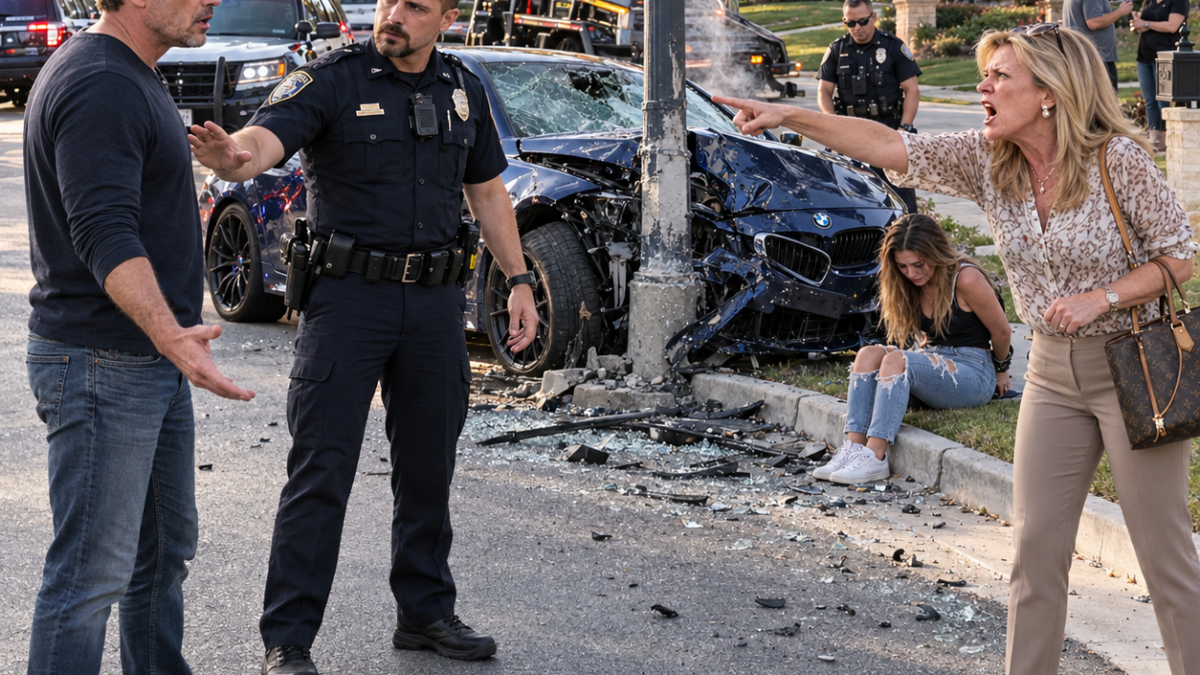
PART2:
PART3:
“No, I didn’t.”
“You two have been talking for months.”
“We’ve spoken maybe four times.”
Karen’s expression sharpened.
“People have seen you.”
“Yes.”
I looked at Tessa.
“Usually because your daughter drives through this neighborhood like she’s qualifying for Indianapolis.”
Tessa looked up.
Only for half a second.
Karen snapped:
“She’s twenty-two.”
“I’m aware.”
“You have no authority over her.”
“I didn’t claim I did.”
“You’ve repeatedly confronted her.”
“I asked her not to drive forty-five through a residential street where children ride bikes.”
“You yelled at her.”
“No.”
Tessa whispered:
“He didn’t yell.”
Karen turned.
“What?”
Tessa looked away again.
Karen stared at her.
Then back at me.
“She’s upset.”
Cole said:
“Everyone needs to stop talking over each other.”
He looked at me.
“Did you report the vehicle stolen?”
“No.”
Karen immediately said:
“There.”
I looked at Cole.
“I hadn’t had time.”
“When did you discover it missing?”
“Maybe ten minutes before your department called.”
“Who contacted you?”
“An officer asked whether I owned a midnight-blue BMW M4 with my plate.”
Cole nodded.
Karen crossed her arms.
“Convenient.”
“What’s convenient?”
“You supposedly discover your car missing at exactly the same time police catch Tessa.”
I stared at her.
“How would that benefit me?”
“Insurance.”
There it was.
The first version of the story.
I almost admired how quickly she had built it.
My car disappears.
Her daughter is caught driving it.
Her daughter runs from police.
Her daughter crashes.
And somehow Karen had already found a way to place me at the center of the scheme.
Cole looked at me.
“Do you have cameras at your residence?”
That question hit harder than anything Karen had said.
Because I did.
Or I thought I did.
Two exterior cameras covered the driveway and garage entrance.
When I realized the car was gone, I had opened the security application.
Both feeds were offline.
I had assumed an internet glitch.
Now I remembered the small network module mounted inside the garage.
Easy to reach if you knew what it was.
“I have cameras.”
Karen’s expression changed.
Tiny change.
Corner of her mouth.
Almost a smile.
I continued:
“But they were offline this morning.”
“Oh.”
Karen nodded.
“How convenient.”
I looked at her.
“No footage?”
She was enjoying this.
Cole noticed too.
“So the system had been disconnected?”
“I don’t know yet.”
“You normally keep it active?”
“Twenty-four seven.”
“Any outage notification?”
“I haven’t checked logs.”
Karen folded her arms.
“Because there was nothing to record.”
My pulse jumped.
“You seem very confident about my security system.”
“I’m confident my daughter is being framed.”
Tessa flinched.
Again.
Karen still didn’t notice.
Cole did.
He looked toward Tessa.
Then back at Karen.
“Mrs. Matthews, nobody has decided anything yet.”
“Then why is my daughter in handcuffs?”
“Because she failed to stop for police, reached speeds well above the posted limit, and crashed a vehicle that does not belong to her.”
“She was scared.”
“That may explain behavior.”
“It does not necessarily excuse it.”
Karen’s jaw tightened.
Before she could answer, another officer approached.
“Mr. Reynolds?”
“Yes?”
“We need a complete statement.”
“I’ll give you one.”
“We’ll also need to establish how Ms. Matthews obtained the vehicle.”
“Fine.”
Karen opened her mouth.
I held up one hand.
“Not with her.”
Her eyes flashed.
Cole almost smiled.
Almost.
They separated us.
Good.
I needed distance.
Because every time I looked at the BMW, something inside me tightened.
People like saying:
“It’s just a car.”
Usually people who do not understand why certain objects matter.
The BMW had not been a financial investment.
Cars are terrible investments.
It was personal.
I spent most of my twenties driving whatever survived.
A used sedan with one working speaker.
A pickup whose transmission slipped whenever the road climbed.
A Toyota with a passenger window that stayed shut only because I wedged rubber between the glass and door.
I worked.
Paid debt.
Worked more.
Built a small business.
Put money back into it.
Skipped expensive vacations.
Bought a house.
Paid that down.
And when I finally reached the point where I could purchase something completely unnecessary simply because I loved it, I ordered the M4.
Midnight blue.
Black leather.
Manual.
No giant modifications.
No obnoxious exhaust.
Just the exact car I had wanted for years.
I knew every scratch.
Every vibration through the shifter.
Every cold-start sound.
I washed it myself.
Never took it through automatic washes.
My friends mocked me.
Deservedly.
I did not care.
Now its front end resembled crushed aluminum foil.
And Karen was trying to convince police I had voluntarily handed it to the one person in our subdivision I had repeatedly asked to slow down.
After my statement, Officer Cole let me inspect the BMW from outside.
Driver airbag deployed.
Passenger curtain airbags hanging loose.
My sunglasses broken on the floor.
Glove compartment open.
A small prescription bottle had rolled beneath the passenger seat.
I pointed.
“Is that hers?”
Cole looked.
“Don’t touch anything.”
“I wasn’t going to.”
He called another officer over.
They photographed it.
I stared at the interior.
Karen approached from behind.
“You know.”
I turned.
She lowered her voice.
“This could still go away.”
“What could?”
“The theft accusation.”
“My car was taken without permission.”
“Tessa made a mistake.”
“She ran from police in a stolen car.”
“She panicked because officers were chasing her.”
“That’s generally how police pursuits work.”
“You know what I mean.”
“No.”
She glanced toward her daughter.
“She’s under tremendous pressure.”
“Then she shouldn’t steal cars.”
Karen stepped closer.
“You should think carefully before ruining a young woman’s life over property.”
That sentence told me almost everything I needed to know about Karen Matthews.
Not because she loved her daughter.
Of course she did.
Because she believed love meant removing consequences.
I said:
“Is that the plan?”
“What?”
“Make me feel guilty enough not to tell the truth?”
“I’m asking you to be reasonable.”
“Reasonable would have been Tessa not taking my BMW.”
“She says you gave her permission.”
That was new.
I looked toward Tessa.
“She told you that?”
Karen hesitated.
Only half a second.
“She doesn’t need to tell me anything.”
“I know my daughter.”
“Did she tell you I gave her the keys?”
Her eyes hardened.
“She will.”
I stopped.
Not:
She did.
She will.
I stored that sentence in my head.
Karen realized what she had said.
Her face changed.
But only briefly.
Then she turned away.
The next morning, the neighborhood knew about the crash before I had finished my first coffee.
Three texts by seven-thirty.
Six by eight.
At 8:42, Mrs. Anjali Patel sent me a screenshot.
Our subdivision had a private community Facebook group.
Karen had posted:
There was an unfortunate vehicle incident yesterday involving my daughter and another resident. There is a great deal of misinformation being spread. Please remember that young people can make poor decisions under pressure, and adults should not attempt to avoid their own responsibility by rewriting events.
No name.
None necessary.
Everyone knew whose M4 had been on the tow truck.
I read the post twice.
The phrasing was deliberate.
Not:
My daughter stole a car.
Not:
Police are investigating.
Instead:
Vehicle incident.
Another resident.
Misinformation.
Adult responsibility.
Karen had moved the story from:
Tessa took Mr. Reynolds’s BMW.
To:
Two adults are disputing what happened.
That was all she needed.
Ambiguity.
Then Mrs. Patel called.
“I don’t want to get involved.”
Anyone who says that is about to get involved.
“What happened?”
She hesitated.
“Karen came by.”
“Of course.”
“She says you were drinking with Tessa Friday night.”
I actually moved the phone away from my ear.
“What?”
“She says you gave her the spare keys.”
“I was home Friday night.”
“Alone?”
“Yes.”
“She also implied you two have been…”
Mrs. Patel stopped.
“Been what?”
“Friendly.”
“We are neighbors.”
“No.”
“That isn’t what she meant.”
I closed my eyes.
“Just say it.”
“She implied you’ve been flirting with Tessa.”
I laughed.
One sharp laugh.
Not because it was funny.
Because absurdity sometimes leaves the body that way.
“I have spoken to that woman four times.”
“I know.”
“Every conversation was basically ‘please stop speeding.’”
“I know.”
“She’s twenty-two.”
“I know.”
“Karen is saying this to people?”
“Yes.”
I rubbed my forehead.
“There’s more.”
“Wonderful.”
“She says your cameras were disabled because you did not want proof.”
I sat down.
“The cameras being disabled is exactly why I think somebody entered the garage.”
“I know.”
“But people are talking.”
“Are they believing her?”
“Some.”
That bothered me more than I expected.
Our neighborhood was the kind of place where everybody knew just enough about everybody else to create the illusion of closeness.
Barbecues.
HOA clean-up day.
Borrowed ladders.
Kids playing basketball.
Package retrieval.
Snow shovels.
People knew my car.
They knew I was obsessive about it.
They knew Tessa drove too fast.
Yet certainty is persuasive.
Karen possessed enormous amounts of it.
She never said:
I think.
She said:
I know.
By noon, the HOA emailed an emergency meeting notice.
SUBJECT: RESIDENT SAFETY AND PROPERTY INCIDENT.
I stared at it.
My car had been taken.
My property destroyed.
Her daughter had fled police.
And somehow the HOA wanted to review me.
I considered staying home.
Then realized absence would become evidence.
He wouldn’t even face us.
So Monday at seven, I walked into the clubhouse.
Nearly every chair was full.
Neighborhood drama has excellent attendance.
Karen sat in the front row.
Gray blazer.
Pearl earrings.
Leather binder.
Calm now.
Tessa was absent.
Probably on her attorney’s advice.
At the board table sat HOA president Arthur Donnelly.
Sixty-three.
Retired accountant.
Generally reasonable.
Beside him were three board members.
Karen was vice president and chair of the compliance committee.
A fact she had always treated less like volunteer governance and more like a diplomatic posting.
The moment I entered, conversations stopped.
I recognized everyone.
People I had fed hamburgers in my driveway.
Parents whose children swam in my pool.
A man whose battery I had replaced in the rain.
Several looked away.
That hurt more than Karen’s rumors.
Karen smiled.
Not enough for anyone to call it smug.
Enough for me.
Donnelly tapped the microphone.
“Let’s start.”
I sat in the second row.
He looked at me.
“Mr. Reynolds, thank you for attending.”
“I wasn’t sure attendance was optional.”
“It is.”
Karen leaned toward another board member and said loudly enough for three rows:
“Apparently choices are optional around here too.”
I looked at her.
She smiled.
Donnelly sighed.
“Karen.”
“What?”
“Please.”
He turned to me.
“We’ve received concerns regarding Saturday’s incident.”
“My car being stolen?”
Karen scoffed.
Donnelly raised a hand.
“We are not making a determination yet.”
“That sounds encouraging.”
“There are allegations that Ms. Matthews had permission to use your vehicle.”
“False.”
“And that after the accident you characterized the matter as theft for insurance reasons.”
“Also false.”
Karen said:
“Of course he says that.”
I ignored her.
Donnelly continued.
“We’re additionally concerned by police activity within the neighborhood and the impact on resident safety.”
I stared at him.
“My vehicle was stolen.”
“I understand your position.”
“My position?”
He immediately realized the problem with the phrase.
“Your account.”
“It isn’t an interpretation that the BMW belonged to me.”
“No one disputes ownership.”
“Apparently Karen disputes everything after that.”
Karen leaned back.
“Then prove it.”
Silence.
That word.
Prove.
She looked completely comfortable.
Because she knew my exterior cameras had been offline.
She thought she had removed the only neutral witness.
And that was the moment something clicked in my head.
The BMW.
Not my house.
The BMW.
Dash camera.
Two years earlier, after somebody backed into my old car in a parking lot and drove away, I installed a high-end dual-channel dash camera in the M4.
Front.
Cabin.
Parking mode.
Motion and ignition wake.
But more importantly:
Cloud synchronization.
When the car had Wi-Fi access in the garage or connected through its mobile module after ignition, event clips uploaded automatically.
I barely used the application.
Months passed without opening it.
Karen was still talking.
“No exterior footage.”
“No witness who saw Tessa supposedly break in.”
“Nothing.”
I pulled out my phone.
Donnelly said:
“Mr. Reynolds?”
“One second.”
Karen laughed.
“Calling your attorney?”
“No.”
I opened the camera application.
Forgot the password.
Tried again.
Wrong.
My palms were sweating.
Someone behind me whispered.
Karen said:
“This is exactly what I mean.”
I reset through Face ID.
Archive loaded.
Saturday.
7:56 a.m.
Cloud file available.
For a second, I simply stared.
Then tapped.
The video buffered.
Garage.
Dim morning light.
My M4 stationary.
Then the side entrance opened.
A figure stepped inside.
Gray sweatshirt.
Hood up.
Tessa.
My heartbeat changed.
I looked at Donnelly.
“Can I put this on the clubhouse television?”
Karen straightened.
“What is that?”
Donnelly pointed toward the AV connection.
“Mike, help him.”
One of the board members connected my phone.
The television behind the table turned black.
Then the garage appeared.
Twenty-five people leaned forward simultaneously.
Tessa walked into frame.
Karen stood.
“This is inappropriate.”
Nobody responded.
The video continued.
Tessa looked around.
Walked toward the wall.
Reached above the workbench.
Unplugged the small network switch powering the exterior security bridge.
Both indicator lights disappeared.
Mrs. Patel whispered:
“Oh my God.”
Karen said:
“That does not prove—”
Donnelly turned.
“Let the video play.”
Tessa opened one drawer.
Nothing.
Second.
Nothing.
Then she found the small metal lockbox mounted beneath a shelf.
It was not designed to stop burglary.
It was where I kept miscellaneous spare keys.
She pried the cheap latch.
Opened it.
Found the BMW fob.
Held it up.
Smiled.
The entire clubhouse went silent.
She opened the driver’s door.
Slid behind the wheel.
Cabin camera activated.
Her face appeared clearly.
She pressed the starter.
The M4 woke with the deep cold growl I knew instantly.
Tessa looked around the interior.
Touched the steering wheel.
Then looked almost directly into the dash camera.
And said:
“Let’s see if they catch me now.”
Nothing moved in the clubhouse.
No cough.
No chair.
Nothing.
The garage door rose.
Tessa reversed.
Then disappeared down the street.
I paused the video.
Turned toward Karen.
“So.”
She looked as though somebody had removed all the blood from her face.
“Do you still think I loaned her the car?”
Karen’s mouth opened.
Closed.
Then:
“That proves she took it.”
A man behind me said:
“Yes.”
Karen ignored him.
“It does not prove you didn’t tell her where the key was.”
For a half-second the room remained quiet.
Then somebody laughed.
That triggered another.
Suddenly half the room was laughing.
Not happily.
In disbelief.
Karen’s face reddened.
“You think this is funny?”
Donnelly leaned back.
“Karen.”
“No.”
She pointed at me.
“This could still be staged.”
I stared.
“You think I staged your daughter breaking into my garage and stealing my BMW?”
“You’re obsessed with that car.”
“That sentence does not help your argument.”
“Insurance fraud happens.”
Donnelly’s patience broke.
“Enough.”
Karen turned toward him.
“The board needs to investigate this.”
“I said enough.”
“Arthur—”
“Your daughter is on video entering his garage, intentionally disconnecting security equipment, forcing open a key container, taking his vehicle, and making a statement that strongly suggests she knows she is doing so without permission.”
Karen slapped one palm against the table.
“He manipulated this.”
“How?”
“He could have known she was coming.”
“Why?”
“To stage a theft?”
“Yes.”
“Then why would she flee police?”
Karen hesitated.
“Panic.”
Donnelly stared.
“At being caught in the staged theft?”
People laughed again.
Karen spun.
“You’re all enjoying this.”
Nobody answered.
Donnelly looked at me.
“Mr. Reynolds.”
“Yes?”
“I believe this resolves the association’s immediate concern regarding your alleged role.”
“Good.”
“We’ll issue a written clarification.”
Karen stood.
“This is absurd.”
“Karen.”
“You’re taking his side.”
“I am looking at video.”
“You’ll regret this.”
She grabbed her purse.
Started toward the door.
Then turned.
“This doesn’t prove I knew anything!”
The room became quiet again.
I stared at her.
Nobody had accused Karen of knowing in advance.
Not yet.
But that statement told me she was thinking about that question.
Three moves ahead.
Then she left.
The door slammed.
For several seconds, nobody spoke.
Then Mrs. Patel approached.
“I’m sorry.”
“For what?”
“I listened to her.”
“That isn’t a crime.”
“I should have asked you.”
“Probably.”
She winced.
I smiled slightly.
“It’s okay.”
Others came.
Apologies.
Questions.
Shock.
One man asked whether insurance would replace the car.
I didn’t know.
Another asked whether Tessa would go to jail.
Also didn’t know.
But I left that meeting thinking the nightmare had peaked.
I was wrong.
Two mornings later, someone knocked hard on my front door.
Police.
Different officer.
Officer Brian Shaw.
Mid-forties.
Tired eyes.
“Mr. Reynolds?”
“Yes?”
“We received a harassment complaint.”
I stared.
“Against who?”
“You.”
I laughed.
Could not help it.
He did not.
“Sorry.”
“Who filed it?”
“Karen Matthews.”
Of course.
“What exactly am I alleged to have done?”
Shaw looked at his notebook.
“Following her vehicle.”
“Sending threatening text messages.”
“Damaging landscaping near her mailbox.”
“Driving repeatedly past her house overnight.”
I leaned against the doorframe.
“You’re serious.”
“A report was made.”
“What evidence?”
“She provided screenshots from an unidentified phone number.”
“What messages?”
He read:
“You should’ve kept your mouth shut.”
Another:
“This neighborhood would be better without you.”
Then:
“Watch what happens next.”
I shook my head.
“Not me.”
“She believes they came from you.”
“Based on?”
“Recent conflict.”
“That is not proof.”
“No.”
He nodded.
“It isn’t.”
Good answer.
“She also says you threatened her during the HOA meeting.”
“I did not.”
“She says you’re angry.”
“I am angry.”
Shaw almost smiled.
“That isn’t illegal either.”
“Exactly.”
He looked toward my driveway.
“She reported tire marks near her mailbox.”
“My M4 is sitting in an impound yard.”
“You own another vehicle.”
“Pickup.”
“Can you establish where the pickup was Tuesday between midnight and two?”
“Yes.”
“Where?”
“Here.”
“Anyone else in the house?”
“No.”
“That makes confirmation difficult.”
“Not really.”
He raised one eyebrow.
“Why?”
I stepped inside.
Opened my phone.
“Because after Tessa unplugged my cameras, I replaced the entire system.”
More cameras.
Battery backup.
Cloud storage.
Wider angles.
I pulled up Tuesday night.
11:30.
Truck in driveway.
Midnight.
Truck.
12:30.
Truck.
1:00.
Truck.
1:30.
Truck.
2:00.
Truck.
No person leaving.
No garage opening.
No vehicle movement.
Shaw watched.
“All night?”
“All night.”
“What about the messages?”
“Get the carrier records.”
“We can request them.”
“I’ll consent to whatever you need from my phone.”
That surprised him.
“Okay.”
“I have nothing to hide.”
He closed his notebook.
“I’ll document this.”
“Will Karen face consequences if this report is false?”
“That determination isn’t mine.”
“Fair.”
He hesitated.
Then:
“Unofficially?”
I waited.
“She appears very committed to escalating this.”
“That’s diplomatic.”
“Be careful.”
“I intend to.”
That afternoon I called Rebecca Sloan.
My attorney.
Rebecca had represented my business for years.
Sharp.
Dry.
Almost impossible to impress.
After I explained the crash, HOA meeting, footage, and harassment complaint, she remained silent for five seconds.
Then:
“Do you enjoy chaos?”
“No.”
“Chaos seems very attached to you.”
“What do I do?”
“First, stop speaking directly to Karen.”
“I already have.”
“Good.”
“No texts.”
“None.”
“No emails.”
“None.”
“Do not approach her house.”
“I have no interest.”
“If she contacts you, preserve everything.”
“I will.”
“And stop thinking the fact that something is absurd means nobody will believe it.”
That sentence stayed with me.
Because Rebecca was right.
Karen did not need a plausible story.
She needed a story plausible enough to survive until someone checked.
Three days later, someone egged my front windows.
Three eggs.
One exploded across the living-room glass.
One hit siding.
One landed in the flower bed.
I stood outside at six in the morning with coffee.
The whole thing was so juvenile I almost found it funny.
Except it wasn’t.
Someone was coming onto my property at night.
I checked cameras.
The existing angles missed the thrower.
Shrubs created a blind spot near the sidewalk.
I filed a non-emergency report.
The following night, my trash cans were knocked over.
Then a note appeared on the porch.
YOU DESTROYED A YOUNG WOMAN’S LIFE OVER A CAR.
Photograph.
Evidence bag.
Report.
Rebecca called.
“You think Karen.”
“I know Karen.”
“No.”
She corrected me.
“You suspect Karen.”
I sighed.
“Fine.”
“Say it again.”
“I suspect Karen.”
“Better.”
“Does law school teach you to be annoying?”
“It perfects natural talent.”
I expanded the security system.
One motion camera inside a landscape fixture near the front garden.
Another watching the drive from low angle.
One covering the side access.
Then I waited.
First night:
Nothing.
Second:
Raccoon.
Third:
At 3:14 a.m., a neighborhood cat stared directly into the hidden camera for seven straight minutes like it was working counterintelligence.
Fourth night.
2:03 a.m.
Phone vibration.
Motion detected.
I opened the feed from bed.
Karen.
For several seconds my brain refused to accept it.
HOA Karen Matthews.
Vice president until recently.
Compliance-chair Karen.
Woman accusing me of stalking her.
Walking toward my house at two in the morning in a bathrobe, sneakers, and a coat.
Carrying a carton of eggs.
I sat completely still.
She looked around.
Reached into the carton.
Threw.
Splat.
Second egg.
Then walked to my trash cans.
Pushed one over.
The camera captured her face clearly.
I felt a surge of anger so intense my whole body tightened.
Go outside.
Confront her.
Ask what the hell she thought she was doing.
My hand reached toward the bedroom light.
Then Rebecca’s voice appeared in my head.
Do not give somebody else’s bad behavior a chance to become evidence against you.
So I stayed in bed.
Watched Karen leave.
Saved the footage.
Downloaded it.
Backed it up.
Sent it to Rebecca.
Then sent it through the police reporting portal.
And went back to sleep.
That last part took twenty minutes.
But eventually I did.
Officer Shaw came the next afternoon.
He looked more tired than before.
“You were right.”
“I suspected correctly.”
He nodded appreciatively.
“Your lawyer train you?”
“Yes.”
“Video is clear.”
“I know.”
“Do you want to pursue charges?”
“Yes.”
“No hesitation?”
“None.”
“Okay.”
Karen had moved beyond gossip.
Beyond HOA politics.
Beyond protecting her daughter.
She had filed a complaint accusing me of harassing her and then entered my property at night to vandalize it.
Rebecca sought a protective order.
Temporary relief was granted.
Karen was served.
And immediately told neighbors I was weaponizing the legal system.
Mrs. Patel called.
“She says you’re stalking her.”
“She came to my house at two in the morning carrying eggs.”
“I know.”
“She says she only went because you had been threatening her.”
“With what?”
“I’m repeating what she said.”
“Please stop doing that.”
Mrs. Patel laughed.
Then became serious.
“She’s unraveling.”
“I know.”
“Be careful.”
“I am.”
Then came Tessa.
About a week after Karen was served, my phone buzzed with a message from an unknown number.
Mr. Reynolds, this is Tessa. I need to tell you something.
I did not answer.
I screenshot it.
Sent it to Rebecca.
She called immediately.
“No casual conversation.”
“I know.”
“If she wants to provide information, keep everything written.”
“What if she apologizes?”
“Still written.”
I responded:
You can send anything you want to say in writing. My attorney may review it.
Five minutes.
Nothing.
Then:
I’m not apologizing because I know sorry doesn’t fix your car. But my mom is making everything worse and I can’t keep doing this.
Another.
I stole the BMW. You never gave me permission. You didn’t know I was taking it.
I sat down.
Then:
My mom knew that before the HOA meeting.
I stopped breathing for a second.
Another message.
She told me to say you let me borrow it because she said a grand theft charge would destroy my future.
Then:
She said if I admitted I stole it she would stop paying for my lawyer and cut me off completely.
Then:
I disconnected the cameras. I found the spare key myself. You never told me where it was.
Then the last one:
I had taken pills that morning. When the cops tried to stop me, I panicked because I knew if I pulled over they’d realize I stole your car. So I ran.
I read the sequence twice.
The dash cam had already proved the physical theft.
But this was different.
This explained the cover story.
Karen had not merely believed Tessa.
She knew.
And then pressured her daughter to lie.
I forwarded everything to Rebecca.
She arranged communication through counsel.
Tessa eventually provided a formal statement.
She admitted:
Entering my garage.
Disabling security.
Breaking the spare-key container.
Taking the BMW.
Driving without permission.
Fleeing police.
Crashing.
And allowing Karen to claim afterward that I had loaned it to her.
More importantly, she stated Karen knew the theft was real before the emergency HOA meeting.
That changed everything.
The police case already had evidence.
Now the neighborhood had its answer too.
Karen’s final shield had always been:
I’m a mother believing my daughter.
Tessa had just removed it.
Arthur Donnelly called me.
“We need another special board meeting.”
“I would rather have a root canal.”
“I understand.”
“Am I required?”
“No.”
“Then I’m not coming.”
He laughed nervously.
“We are discussing Karen’s board status.”
“That’s an internal issue.”
“Her actions affected you.”
“I’ll submit a statement.”
Pause.
“That may be better.”
I wrote one page.
Rebecca stopped me after draft four.
The first version was angry.
The second sarcastic.
The third twelve hundred words.
The final was short.
Timeline.
Theft.
Crash.
Public accusations.
Emergency meeting.
Dash-cam evidence.
Harassment report.
Video disproving parts of it.
Nighttime trespass.
Vandalism.
Protective order.
Tessa’s formal statement.
Last paragraph:
I am not asking the Board to punish Ms. Matthews on my behalf. I am asking the Board to determine whether a person who knowingly used association authority to amplify false personal accusations and retaliate against a resident should continue exercising authority over other homeowners.
Rebecca read it.
“Good.”
“It feels unsatisfying.”
“That usually means it is legally smarter.”
The board removed Karen from leadership.
All of it.
Vice presidency.
Compliance committee.
Hearing authority.
Everything.
She remained a homeowner.
Of course.
An HOA cannot exile somebody because everyone is tired of them.
But she no longer sat behind the table deciding whether everyone else had followed the rules.
Donnelly issued a written correction to the entire community.
Evidence establishes that Mr. Reynolds did not authorize Ms. Tessa Matthews to use his vehicle.
The prior association discussion suggesting otherwise was not supported.
Another notice clarified that Karen’s allegations were personal claims, not official HOA findings.
People apologized again.
By then, apologies exhausted me.
Because there was no victory feeling.
My M4 was still destroyed.
Tessa still faced criminal consequences.
Insurance still had to settle.
Karen still blamed me for damaging her family.
The protective-order matter remained open.
And every time I drove past Maple and Ridgeway, I saw broken glass in my head.
Then insurance called.
“Mr. Reynolds?”
“Yes.”
“We’ve completed the evaluation.”
I already knew.
“Total loss?”
“Yes.”
Two words.
I thought I was prepared.
I wasn’t.
The adjuster explained numbers.
Actual cash value.
Deductible.
Recovery from responsible parties.
Replacement considerations.
I barely listened.
Cars are replaceable.
Obviously.
No one died.
That mattered more.
But objects can still mean something without being more important than people.
That BMW represented twenty years of work and delayed gratification.
Tessa destroyed it in less than thirty minutes.
Before the insurer took possession, I went to the impound yard.
An employee let me retrieve personal items.
The driver’s side barely opened.
Metal complained.
I found:
Coffee mug.
Sunglasses case.
Parking receipt.
Winter gloves.
A charger.
I sat in the passenger seat.
The cabin smelled wrong.
Dust.
Airbag propellant.
Coolant.
Rain.
I ran one hand across the dashboard.
Then laughed.
The attendant looked over.
“You okay?”
“Yeah.”
“Nice car.”
“Was.”
He winced.
“Sorry.”
“Not your fault.”
That became the sentence everyone used.
Not your fault.
Officer Cole.
Rebecca.
Insurance adjuster.
Neighbors.
Eventually Tessa.
Because Karen had spent so much effort trying to make it my fault that everyone else felt obligated to remind me it wasn’t.
The strange part was I never truly doubted that.
What bothered me was how quickly other people did.
Consider the objective facts available the first day.
My car disappeared.
Tessa was caught driving it.
Police tried stopping her.
She fled.
She crashed.
Yet Karen produced enough noise that people briefly entertained the possibility that I was somehow responsible.
Maybe I loaned it.
Maybe I had a relationship with Tessa.
Maybe insurance fraud.
Maybe I told her where the spare was.
Maybe my missing cameras were suspicious.
One confident person had turned obvious facts into a debate.
That scared me more than gossip probably should.
Several months later, I bought another M4.
Midnight blue.
Rebecca saw it outside her office.
“You bought the same car.”
“It is not the same car.”
“It looks identical.”
“Different model year.”
“Same color.”
“Different paint code.”
She stared.
“You people are exhausting.”
“What people?”
“Car people.”
The first night I parked it in the garage, I changed where I kept the spare key.
Real safe.
Keypad.
Mounted inside locked cabinet.
Probably excessive.
I slept beautifully.
The final protective-order hearing happened weeks later.
Karen arrived with her attorney.
No HOA binder.
No title.
No committee seat.
No supportive neighbors behind her.
Without institutional authority she looked different.
Not physically smaller.
Institutionally smaller.
Just another person explaining to a judge why she had been filmed entering a neighbor’s property at 2:03 a.m. while carrying eggs.
Her lawyer argued stress.
Family crisis.
Emotional escalation.
Rebecca had timestamps.
Incident numbers.
Video.
Phone records.
That had become the pattern.
Karen brought narrative.
We brought dates.
The order was extended.
Afterward, Karen saw me in the hallway.
Her attorney quietly said:
“Keep walking.”
Karen did not.
“You happy now?”
Rebecca turned immediately.
“Karen.”
I answered before Rebecca could stop me.
“No.”
Karen looked surprised.
“You got everything you wanted.”
“No.”
“You got me removed.”
“The HOA removed you.”
“You pressed charges.”
“You came to my house at two in the morning.”
“You turned my daughter against me.”
“Tessa told the truth.”
“She’s confused.”
“She stole my car.”
“She made one mistake.”
“She made several.”
Karen’s eyes flashed.
“You had insurance.”
That sentence stopped me.
You had insurance.
As if insurance erased theft.
As if replacing a car erased a police chase.
As if nobody could have been killed.
As if Tessa’s conduct mattered only if I personally lost enough money.
I stepped slightly closer but remained well outside any boundary of the order.
“This stopped being about my BMW a long time ago.”
Karen laughed.
“Please.”
“The BMW started it.”
“You’re obsessed with that car.”
“No.”
I shook my head.
“This became about you deciding your daughter could not be responsible, so somebody else had to be.”
“I was protecting my child.”
“You were teaching her consequences belong to whoever can be blamed fastest.”
Her face changed.
“You don’t have children.”
“No.”
“So you have no idea.”
“I don’t need children to know lying to police and pressuring a witness isn’t parenting.”
Her attorney stepped between us.
“That’s enough.”
Rebecca touched my arm.
“Come on.”
She was right.
I walked away.
Tessa’s case moved forward.
I will not pretend we became friends.
We did not.
I did not visit her.
Did not mentor her.
Did not suddenly decide a heartfelt apology erased a stolen vehicle and dangerous pursuit.
Accountability matters precisely because people can be more than the worst thing they did.
Months later, through appropriate channels, I received a message.
I’m sorry.
A second followed.
For the car. For breaking into your garage. For running. For letting my mom blame you.
I stared at it.
Rebecca was in my office.
“You answering?”
“Yes.”
“What are you going to say?”
I typed:
I accept your apology. What you did was serious. I hope you learn from it and make better decisions from here.
Rebecca read.
“That’s all?”
“That’s all.”
“No paragraph about the BMW?”
“I have another one.”
She smiled.
“Growth.”
“Don’t push it.”
The neighborhood became boring.
Beautifully boring.
HOA meetings returned to:
Landscaping.
Pool hours.
Trash bins.
Clubhouse thermostat.
Donnelly introduced a conflict-of-interest rule.
Any board member involved personally in a dispute had to recuse themselves from official HOA action on that matter.
Another rule required factual review before community safety notices could accuse or clearly imply resident misconduct.
Karen’s legacy.
Just not the one she would have chosen.
One Saturday I washed the new BMW in the driveway.
Mrs. Patel walked by.
“Very pretty.”
“Thank you.”
“Same color.”
“Different paint code.”
She laughed.
“Looks exactly the same.”
“You wound me.”
She stopped.
“Can I ask you something?”
“Sure.”
“Do you still hate Karen?”
I sprayed soap off the hood.
“No.”
She looked surprised.
“Really?”
“I don’t trust her.”
“That’s different.”
“Yes.”
“But no hate?”
I considered.
“Hating somebody requires maintenance.”
Mrs. Patel smiled.
“That sounds healthy.”
“It’s mostly laziness.”
She laughed.
Then became quiet.
“I almost believed her.”
“I know.”
“I’m embarrassed.”
“Don’t be.”
“I should’ve known.”
“How?”
“She was so certain.”
I shut off the hose.
“That’s why it worked.”
Mrs. Patel nodded.
“Confidence is convincing.”
“Yes.”
“Even when it’s wrong.”
“Especially before anybody checks.”
That became the lesson I carried.
Not karma.
Not revenge.
Evidence.
Karen had volume.
I had timestamps.
Karen had rumors.
I had cloud footage.
Karen had anonymous threatening texts.
I had carrier records.
Karen said I drove by her home at night.
My cameras showed my truck never moved.
Karen said somebody vandalized her mailbox.
No evidence tied me to it.
Then she vandalized my house.
Camera.
She claimed she only believed Tessa.
Tessa said no.
Karen knew.
Every escalation created another opportunity for the truth to become more specific.
Eventually Karen’s entire defense had nowhere to go.
Almost a year later, the HOA installed new cameras around the clubhouse parking lot.
Donnelly announced it during a meeting.
Karen attended as an ordinary homeowner.
She raised one hand.
“Why do we need more surveillance?”
I almost choked on water.
Donnelly kept his face completely straight.
“Property protection.”
“This community is becoming paranoid.”
Someone behind me whispered:
“Wonder why.”
I looked at the floor.
Could not help smiling.
Karen turned.
Our eyes met.
I said nothing.
She looked away.
Enough.
People usually tell the story now in six sentences.
Karen’s daughter stole Reynolds’s BMW.
Police chased her.
She crashed.
Karen blamed Reynolds.
His dash cam proved everything.
Then Karen got caught egging his house.
All true.
But that isn’t the part I remember most.
I remember the intersection.
My M4 crushed around the streetlight.
Tessa cuffed.
Karen pointing.
“He gave her the keys!”
And the strange, cold realization that people might believe her.
At that point, I did not know the dash camera had uploaded.
I knew only that my exterior security was dead.
Karen had influence.
She held an HOA title.
And accusations travel much faster than corrections.
For about twenty-four hours, she controlled the story.
That was enough for neighbors I had known for years to look at me differently.
That taught me how fragile reputation can become when certainty is mistaken for truth.
The second lesson was more useful.
You do not beat a false story by shouting a louder story.
You make it survive contact with evidence.
Karen could explain one inconsistency.
Then the explanation created another.
Why were the exterior cameras offline?
Maybe I disabled them.
Dash footage showed Tessa disabling them.
How did Tessa obtain my key?
Maybe I gave it to her.
Video showed her searching.
Why would I claim theft?
Insurance scam.
Cloud footage existed before the crash.
Why was I harassing Karen?
Anonymous messages.
Carrier data did not connect them to me.
Where was my truck during the alleged stalking?
Driveway.
All night.
Who vandalized my property?
Karen.
On camera.
Why did Tessa say I loaned her the vehicle?
Her later statement said Karen pressured her.
Each new explanation narrowed Karen’s available space until eventually there was only one version left.
Tessa entered my garage.
Tessa disabled the cameras.
Tessa found my key.
Tessa stole the BMW.
Tessa fled police.
Tessa crashed.
Karen learned what happened.
Karen tried to reverse responsibility.
When the first cover story failed, she escalated.
When the retaliation was recorded, she faced her own consequences.
Simple.
The criminal and civil processes eventually finished.
Tessa accepted responsibility under terms handled by lawyers and the court.
Karen dealt with consequences connected to her own reports and vandalism.
She paid for damage.
Legal bills.
Protective-order restrictions.
She lost HOA authority.
Insurance recovered what it could.
Anything else followed ordinary civil channels.
No enormous jackpot.
No ten-million-dollar settlement.
No mansion funded by Karen’s downfall.
Real life usually ends with paperwork.
I got another car.
My windows were repaired.
My name was cleared.
The HOA withdrew its allegations.
The neighborhood calmed down.
That was enough.
Eighteen months after the crash, I saw Tessa walking near the entrance of the subdivision.
I was driving home.
She stopped.
I slowed.
For a moment neither of us knew whether to acknowledge the other.
I lowered my window.
“Hey.”
“Hey.”
She looked at the M4.
“Nice car.”
“Thanks.”
“Same color.”
“Different paint code.”
A small smile.
“Of course.”
Then she became serious.
“I’m leaving.”
“The neighborhood?”
“The state.”
“School?”
“Job.”
“Good.”
She nodded.
“I wanted to tell you something.”
I waited.
“I know what I did could have killed somebody.”
That mattered more than:
I’m sorry.
“Yes.”
“At first I didn’t really understand that.”
“I figured.”
“I thought…”
She stopped.
“What?”
“I thought it was just stealing a car.”
I raised an eyebrow.
She gave an embarrassed laugh.
“I know how stupid that sounds.”
“Stealing a car was already serious.”
“I know.”
She looked down.
“After I took it, I kept thinking I could somehow fix the situation before anybody found out.”
“How?”
“I don’t know.”
“Exactly.”
“When the police lights came on, I knew I was caught.”
“So you ran.”
“Yes.”
“Which made everything worse.”
“Yes.”
Silence.
Then:
“My mom kept telling me admitting it was the worst thing I could do.”
I looked at her.
“She was wrong.”
“I know.”
“What was the worst thing?”
Tessa took a breath.
“Not admitting it sooner.”
Probably the healthiest sentence anyone in that family had spoken.
“Good luck, Tessa.”
She looked surprised.
“You mean that?”
“Yes.”
“After everything?”
“I hope you learned.”
“I did.”
“I hope you keep learning.”
She nodded.
I added:
“And maybe never steal another BMW.”
She laughed.
“Definitely not.”
Then she walked away.
No hug.
No friendship.
No dramatic forgiveness.
Closure.
Enough.
Karen stayed another year.
The protective order and cameras made direct contact rare.
Eventually a FOR SALE sign appeared in her yard.
Mrs. Patel called me within twelve minutes.
“You saw?”
“I have functioning eyes.”
“She’s moving.”
“So it appears.”
“You happy?”
I thought.
“No.”
“You always give boring answers.”
“I’m happy about quiet.”
“That counts.”
Two months later, moving trucks arrived.
I returned home while workers were loading furniture.
Karen stood at the end of her driveway.
We noticed each other.
For once, she did not look furious.
Mostly tired.
Her eyes moved to my BMW.
Then me.
I expected a last insult.
Instead:
“You got what you wanted.”
I turned off the engine.
“No.”
She frowned.
“What?”
“I wanted my original car not to be stolen.”
“That’s not what I meant.”
“I know.”
“Everyone turned against me.”
“No.”
She stared.
“You gave people reasons to stop trusting you.”
She laughed bitterly.
“Still self-righteous.”
“Maybe.”
“You could have dropped it.”
“Tessa stole my car.”
“She apologized.”
“And I accepted her apology.”
“You kept pursuing me.”
“You filed false accusations and came onto my property at two in the morning.”
“That happened after you humiliated me.”
“You humiliated yourself.”
She flinched.
I regretted the sharpness for maybe half a second.
Then she said:
“You think cameras make you right.”
“No.”
I shook my head.
“They just made it impossible for you to make me wrong.”
She stared.
Neither of us said anything else.
Karen moved out.
The new owners were painfully normal.
Mike and Jennifer Lawson.
Two children.
Golden retriever.
First week, Mike knocked on my door.
“Hi.”
“Hey.”
“We bought the Matthews house.”
“I figured.”
He looked awkward.
“People have told us some stories.”
“I’m sorry.”
He laughed.
“We’re trying not to inherit any neighborhood wars.”
“You won’t.”
“Great.”
He looked toward my garage.
“Is that an M4?”
“Yes.”
“Manual?”
“Yes.”
He nodded appreciatively.
“Nice.”
That was our entire first conflict.
There wasn’t one.
Jennifer joined the garden committee.
Mike helped repair the clubhouse fence.
Their kids rode bikes.
Nobody accused me of insurance fraud.
Wonderful neighbors.
The neighborhood forgot Karen slowly.
Controlling people often believe their absence will create a vacuum.
Usually it creates silence.
Board seats get filled.
Grass grows.
Trash gets collected.
Meetings continue.
Karen became a story.
Whenever a board member became too enthusiastic about using HOA authority in a personal dispute, somebody would joke:
“Careful. We already survived the Karen era.”
Rules still existed.
They should.
The community did not collapse into lawlessness.
People simply became more careful about letting personal grudges wear an HOA badge.
The new BMW eventually stopped feeling like a replacement.
It became my car.
I drove it.
Added miles.
Took trips.
Got one tiny rock chip on the hood.
I stared at it for twenty minutes.
Mrs. Patel saw me.
“Oh no.”
“Rock chip.”
She leaned closer.
“That?”
“Yes.”
“That microscopic dot?”
“Yes.”
“You survived a stolen-car police pursuit.”
“The previous car did not.”
“You know what I mean.”
“This is different.”
She shook her head.
“Men.”
I repaired the chip.
Peace returned.
People sometimes ask:
“How did Tessa know where the key was?”
She searched.
“How did she know how to kill the cameras?”
The component was visible.
“Why steal your car?”
She wanted to drive it and had more confidence than judgment.
“Why run?”
Because stopping meant admitting the theft.
Then the harder question:
“Why did Karen lie?”
I used to answer:
“Because she was Karen.”
Satisfying.
Too easy.
Eventually I understood it differently.
Karen had spent Tessa’s entire life preventing consequences.
Speeding complaint?
Neighbor overreacting.
Parking ticket?
Officer targeting her.
Noise complaint?
People jealous.
School discipline years earlier?
Teacher had a grudge.
Karen loved her daughter.
I believe that.
But she confused protection with absolution.
Instead of teaching Tessa:
I will stand beside you while you face what you did.
She taught:
I will make sure somebody else is responsible.
Then Tessa finally made a mistake too large for Karen’s usual methods.
A stolen M4.
Police pursuit.
Crash.
Cameras.
Karen reached for the only parenting strategy she knew.
Blame.
Me.
Because if I had loaned Tessa the car, Tessa was irresponsible but not a thief.
If I had flirted with her, perhaps I was manipulating her.
If it was insurance fraud, perhaps Tessa was merely caught inside my scheme.
If I had harassed Karen afterward, maybe Karen became the victim.
Each story existed to avoid one unbearable sentence:
My daughter did this.
When the dash cam removed me as the villain, Karen’s whole system started collapsing.
Because then Tessa had to be responsible.
And if Tessa was responsible, Karen had to confront the possibility that years of shielding her had not produced a responsible adult.
That may have hurt more than losing the HOA office.
I understand wanting to protect someone you love.
But standing beside someone while they face consequences is protection too.
Sometimes the better kind.
Tessa eventually learned that.
Whether Karen ever did, I don’t know.
I hope so.
Not for me.
For whoever lives next door to her now.
The following year my dash-cam cloud subscription renewed.
I considered canceling it.
For maybe two seconds.
Then laughed.
Five-year renewal.
Rebecca texted:
Wise.
I replied:
Paranoid.
She answered:
Documented paranoia is called risk management.
Lawyers.
The exterior cameras stayed too.
Cloud backup.
Battery backup.
No blind spots.
The hidden landscape camera remained beside my flower bed, though it wasn’t really hidden anymore.
Every time I watered plants near it, I thought about Karen in her robe with the carton of eggs.
The memory eventually became funny.
Not because vandalism was harmless.
Because both Karen and Tessa made the same mistake.
Tessa believed unplugging visible cameras meant nothing else recorded.
Karen believed darkness meant nobody was watching.
They confused not seeing evidence with evidence not existing.
The most important proof, however, was not electronic.
It was Tessa.
Dash cam proved theft.
Security footage proved vandalism.
Phone records weakened the harassment claim.
But Tessa’s statement proved Karen knew.
That changed the moral shape of everything.
Before Tessa spoke, Karen could still claim:
I was a frightened mother who believed my daughter.
Afterward:
I knew what happened and tried to change the story.
Different.
Legally.
Socially.
Morally.
Everything.
One December, Donnelly invited me to the HOA holiday dinner.
I almost declined.
Then decided normal participation mattered.
So I went.
People talked about snow removal.
Clubhouse heating.
Someone complained about dog waste near the walking path.
Mrs. Patel brought enough food for an infantry battalion.
A toddler spilled juice.
Nobody accused anyone of grand theft.
Excellent evening.
Donnelly sat beside me.
“You know, you almost made me resign.”
I looked over.
“What?”
“The first emergency meeting.”
“Why?”
“I realized halfway through that I had basically summoned the victim of a car theft to defend himself.”
“Not your finest hour.”
“No.”
“You corrected it.”
“After you produced video.”
“That’s usually when people should correct things.”
He sighed.
“I should have demanded evidence before allowing the meeting.”
“Yes.”
He looked offended.
“You don’t have to agree that quickly.”
“I value efficiency.”
He laughed.
Then:
“We changed policy because of you.”
“Because of Karen.”
“Both.”
I looked around.
Boring Christmas party.
Good.
“What still bothers me,” Donnelly said, “is how fast we treated an accusation like a fact.”
“That happens everywhere.”
“Doesn’t make it acceptable.”
“No.”
He lifted his glass.
“To boring meetings.”
I raised mine.
“To extremely boring meetings.”
That became my favorite HOA tradition.
Nothing happening.
After everything, I learned to appreciate uneventful.
The day Tessa stole my BMW began with coffee and sunlight.
By lunch:
Stolen car.
Police pursuit.
Crash.
Karen accusing me of engineering my own victimization.
Then:
Rumors.
HOA meeting.
Cloud footage.
Harassment complaint.
Eggs.
Hidden camera.
Protective order.
Tessa’s confession.
Karen’s removal.
All because Karen could not tolerate one simple reality.
Her daughter did something wrong.
No conspiracy.
No secret romance.
No insurance plot.
No consensual loan.
No campaign against their family.
Tessa entered my garage.
Disabled cameras.
Found the fob.
Took the car.
Ran from police.
Crashed.
Karen tried to reverse victim and offender.
And for a short period, socially, it almost worked.
People paused.
Wondered.
Whispered.
That is why I remember Karen’s expression when the cloud footage appeared on the clubhouse television.
People sometimes describe it as fear.
It wasn’t.
It was recognition.
The moment she realized the story no longer belonged to whoever spoke with the most confidence.
It belonged to what actually happened.
And what actually happened was sitting in a server somewhere with a timestamp.
No arguing with Tessa on screen.
No debating the garage door.
No explaining away her hand unplugging the network unit.
No explaining away the forced key box.
No explaining away the fob in her hand.
And definitely no explaining:
“Let’s see if they catch me now.”
They caught her.
Then the evidence caught Karen.
Everything afterward was simply how long Karen chose to keep running.
In the end:
Insurance replaced the car.
Police records reflected the theft.
The HOA withdrew its claims.
Karen lost her leadership position.
Her harassment narrative failed.
Her vandalism was recorded.
Tessa admitted both the theft and the pressure to lie.
The neighborhood moved on.
And I got something more valuable than public victory.
Peace.
Real peace.
The kind where Saturday morning means washing your car instead of defending yourself under fluorescent lights at an HOA meeting.
Where a knock at your door is Mike asking to borrow a socket wrench instead of an officer investigating another complaint.
Where you can park something you spent years earning inside your garage and reasonably expect it to still be there tomorrow.
People call the ending karma.
Maybe.
I think it was simpler.
Karen kept betting against evidence.
Evidence kept winning.
She blamed me for the theft.
Dash cam.
She accused me of stalking.
Security logs.
She implied my cameras were suspiciously offline.
Dash cam showed who disabled them.
She denied vandalizing my house.
Hidden camera.
She claimed ignorance of the cover story.
Tessa.
Every time Karen created a new version, reality produced another receipt.
By the end, she was no longer fighting me.
She was fighting timestamps.
And timestamps do not care whether you sit on an HOA board.
They do not care how frightened your daughter looks.
They do not care who tells the better story.
They simply say:
This happened.
At this time.
In this place.
That was enough.
The last time I polished the M4 before putting it away for winter, I caught my reflection in the hood.
Midnight blue.
Almost the same shade as the old one.
Almost.
I thought about Maple and Ridgeway.
Crushed metal.
Steam.
Tessa cuffed on the curb.
Karen pointing toward me.
“He gave her the keys!”
That first awful moment when something obvious suddenly became something I might have to prove.
Then I looked above the garage.
Small green light.
Camera active.
Recording.
I smiled.
Not because I expected trouble.
Because I had learned something.
You cannot prevent another person from lying.
You cannot always stop a reckless person from making a terrible decision.
You cannot force a parent to accept that protecting a child sometimes means letting that child face consequences.
But when somebody tries to rewrite reality, there is something far more powerful than shouting louder.
Proof.
Karen had a story.
I had footage.
And once everybody saw what actually happened, her story never stood a chance.








