HOA Karen Walled Off My 30-Foot Cattle Easement—Then 120 Cows Reached the Dead End and Exposed the Deed She Thought She Could Ignore.
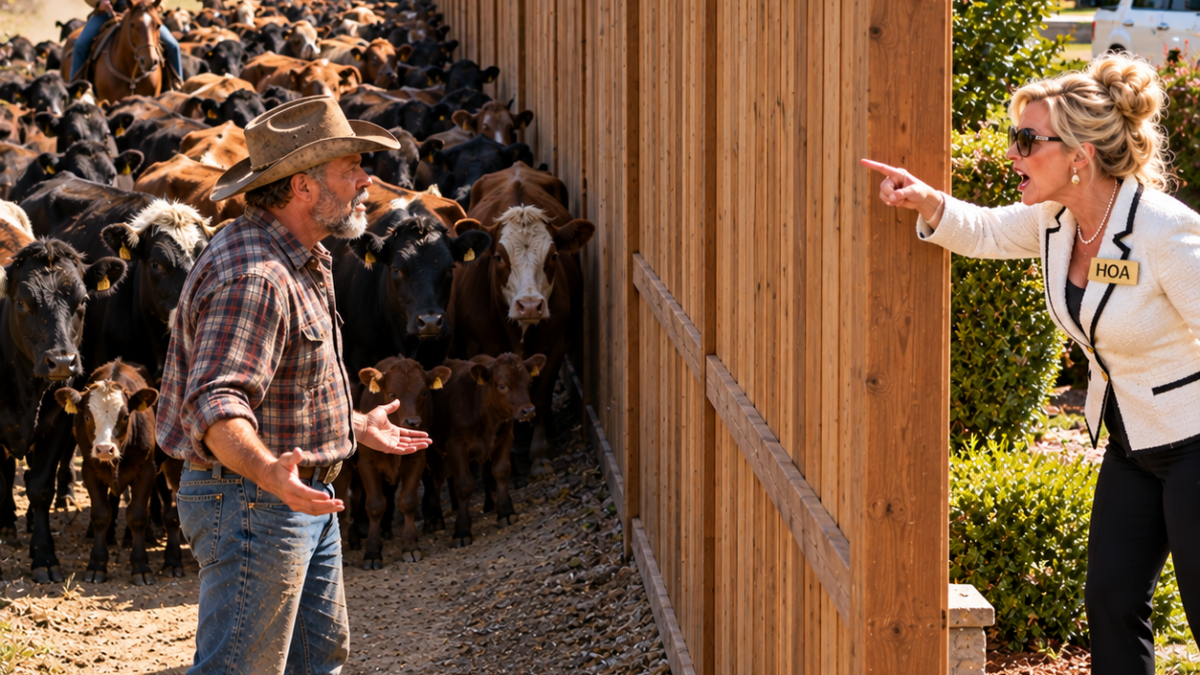
PART2:
But your brain does strange things when reality presents something impossible.
Where there should have been a thirty-foot livestock opening, there was a wall.
Fresh cedar.
Eight feet high.
Continuous.
No gate.
No gap.
No removable section.
Just vertical boards running north to south across the exact place our cattle had crossed for eighteen years.
I got out.
The old galvanized ranch gate was still hanging from its posts on my side.
It looked almost absurd.
A gate opening to another fence.
Less than six feet beyond it, the new cedar wall blocked everything.
Fresh concrete around the posts was still pale.
Mulch had been spread neatly along the neighborhood side.
Somebody had planted small evergreens in front of the panels.
It looked finished.
Deliberate.
Permanent.
Then I heard the cattle.
One hundred and twenty animals moving toward me.
The first cows emerged between the trees.
They saw the familiar gate.
They began turning naturally toward it.
Except there was nowhere to go.
“Wade!”
I raised both arms.
“TURN THEM!”
The lead cows stopped.
The animals behind them did not know why.
Bodies compressed.
A few calves started bawling.
PART3:
Two cows moved toward the gate because that was what every previous rotation had taught them to do.
Wade reacted immediately.
He swung his horse sideways across the lane.
“HAH! GET AROUND!”
The front animals hesitated.
Then one cow tried to turn.
Another bumped her flank.
Dust rose.
That is how trouble starts.
Not with a stampede.
With confusion.
A herd moving one direction encounters an unexpected obstruction.
The first animals stop.
The back does not.
Pressure builds.
One animal panics.
Then another.
I ran to the old gate and swung it shut before any cow could push through into the six-foot pocket between the gate and wall.
“BACK THEM!”
Wade raised one arm and moved his horse in a slow arc.
My nephew Aaron, who had been following farther behind on an ATV, came up fast.
“What happened?”
“Fence.”
“What fence?”
“Exactly.”
We spent the next fifteen minutes turning one hundred and twenty cattle around in a lane never designed for turning one hundred and twenty cattle around.
No heroics.
No shouting unless necessary.
Slow pressure.
Release.
Pressure.
Release.
The cows nearest the front finally began flowing back toward the wider holding field.
The rest followed.
A calf slipped in mud, stood back up.
One cow kicked at another.
No one got hurt.
But it was closer than I liked.
By the time the last animal cleared the bottleneck, Wade’s shirt was soaked through.
He rode up beside me and stared at cedar wall.
“What in hell is that?”
“I don’t know.”
He leaned over saddle horn.
“You change the gate?”
“No.”
“County?”
“No.”
“HOA?”
We both looked through a narrow gap between the boards.
On the other side was Briarcrest’s greenbelt.
Fresh mulch.
Walking path.
Decorative grasses.
And a white Lexus SUV parked on the service lane.
Beside it stood Karen Hollis.
President of the Briarcrest Homeowners Association.
She wore white pants.
Tan boots that had never seen livestock.
A blue blouse.
Sunglasses.
Clipboard.
Of course.
She saw me.
Raised one hand.
Not greeting.
The little stop gesture people use when they think they are directing traffic.
I walked around the end of the cedar run where the HOA’s pedestrian path connected to county road.
Wade followed on horseback until I told him to stay with herd.
Aaron came with me.
Karen waited.
“Ethan.”
“What did you do?”
She smiled.
“Good morning to you too.”
“Where is my cattle crossing?”
She looked at wall.
“We completed perimeter security improvements yesterday.”
“Where is the gate?”
“Removed.”
“By who?”
“Our fencing contractor.”
“At whose instruction?”
“Mine.”
There it was.
Clean.
Direct.
No ambiguity.
Aaron looked at me.
I said:
“You personally ordered them to remove the easement gate?”
Her mouth tightened slightly.
“I ordered them to complete the privacy wall according to the approved landscaping plan.”
“That gate is part of a recorded thirty-foot agricultural easement.”
“No.”
“Yes.”
“That strip is Briarcrest common property.”
“Burdened by my easement.”
She sighed.
“Ethan, we’ve discussed this.”
We had.
Three times.
Apparently I had mistaken discussion for comprehension.
The easement was old.
Older than Briarcrest.
In 1987, my father had sold twenty-six acres along the eastern edge of our ranch to a man named Harold Leighton.
Leighton wanted access to a county road.
Dad wanted to preserve a route between our north and lower pastures in case the land ever developed.
The deed created two rights.
Leighton received access.
The Mercer ranch retained a thirty-foot-wide agricultural and livestock easement across the southern edge.
Recorded.
County records.
Metes and bounds.
Purpose specifically stated:
for movement of livestock, agricultural equipment, feed vehicles, maintenance equipment, and related ranch operations.
When Leighton later sold to the developer who built Briarcrest, the deed referenced it.
When Briarcrest’s HOA eventually took title to the greenbelt, its deed referenced it again.
The thirty-foot strip was theirs.
Subject to our right to cross.
That’s how easements work.
You can own land somebody else has a legal right to use for a defined purpose.
Karen hated that sentence.
She preferred:
“Our property.”
As if ownership erased burdens written into title.
I said:
“You’ve seen the deed.”
“I’ve seen your interpretation.”
“It’s not interpretation.”
“The board’s counsel believes the easement may no longer be enforceable in its original form.”
That was new.
“Who said that?”
“Our legal team.”
“Send it to me.”
“Privileged.”
“Then stop quoting it.”
She removed sunglasses.
“The agricultural character of this area has changed.”
“My cattle haven’t.”
“The easement was created before there were homes here.”
“That’s why it was created.”
“It’s disruptive.”
“To who?”
“Residents.”
I stared toward houses.
The closest backyard was almost two hundred feet away.
We moved cattle through the crossing maybe eight times a year.
Always daytime.
No loading.
No overnight holding.
No manure storage.
Just transit.
Karen continued.
“Residents have complained about smell, noise, flies, and safety.”
“During fifteen-minute cattle crossings?”
“Yes.”
“Then they bought houses beside a ranch.”
Her jaw tightened.
“That’s the attitude that prevents cooperation.”
“No. Building a wall through a recorded cattle easement prevents cooperation.”
Aaron muttered:
“Pretty effectively.”
Karen ignored him.
“You have alternate routes.”
“No.”
“You have forty acres west.”
“Two hundred eighty.”
She blinked.
Apparently she had never looked at parcel map closely.
“The lower pasture can be reached from your southern drive.”
“With cattle?”
“Yes.”
“That’s county road.”
“So?”
“So you want me moving one hundred twenty cattle down a public road because you dislike a thirty-foot easement specifically created to avoid that?”
She paused.
Not long.
Enough.
“We have to balance interests.”
“You removed my gate without notice.”
“We sent notice.”
“No.”
“We sent community boundary-improvement notice.”
“To Briarcrest residents.”
“Yes.”
“I am not a Briarcrest resident.”
“You were copied.”
“No.”
“You should check your email.”
“I did.”
She glanced at clipboard.
“This is becoming unproductive.”
“No. We’re finally at productive part.”
I pointed.
“You are going to reopen thirty feet.”
“No.”
“You’re going to reinstall livestock gate.”
“No.”
“You’re going to do it today.”
Her expression changed.
“Don’t threaten me.”
“I didn’t.”
Aaron said:
“He’s describing cure.”
She looked at him.
“And you are?”
“A guy who nearly got run over because Aunt HOA built a wall.”
I almost smiled.
Wrong moment.
I took photographs.
Video.
Close-ups of post locations.
Old gate.
New cedar.
Concrete date stamps on contractor tags.
Landscaping.
Karen.
White SUV.
Then asked:
“Who is contractor?”
She answered before thinking.
“West Ridge Fencing.”
“Who approved change order?”
“I did.”
Second sentence.
Second gift.
She realized it almost immediately.
Her eyes narrowed.
“Why?”
“Just curious.”
She put sunglasses back on.
“Have your lawyer contact ours.”
“I will.”
Then I walked away.
No cutting fence.
No tractor.
No cows through flowerbeds.
Nothing satisfying.
Wade was disappointed.
“So we’re not knocking it down?”
“No.”
“Could.”
“Also could spend afternoon explaining criminal damage.”
“It’s blocking easement.”
“Still their fence.”
He looked offended by legality.
“Lawyers ruin farming.”
“Sometimes keep farmers out of jail.”
“Same thing.”
We moved cattle back to north pasture.
That created a problem.
They were supposed to rotate because forage was short and lower pasture had fresh grass.
I could truck them around.
Twelve miles.
Multiple loads.
Stress.
Fuel.
Time.
Or use county road with flaggers and sheriff coordination.
Neither made sense for something we already had legal right to do through thirty feet of land.
I called my attorney.
Her name was Rachel Donnelly.
Forty-six.
Real-estate litigation.
Daughter of a ranch family.
She had represented me once during a pipeline access dispute.
The first thing she said when I explained:
“Do not remove the wall yourself.”
“Wade already hates you.”
“Wade is welcome to pay your legal bills.”
“What’s next?”
“Send pictures.”
I did.
Then deed.
Easement.
Briarcrest parcel.
Rachel called back an hour later.
“This is not subtle.”
“Good.”
“The easement is clearly recorded.”
“I know.”
“Briarcrest took title subject to it.”
“I know.”
“Do they have termination agreement?”
“No.”
“Relocation agreement?”
“No.”
“Abandonment?”
“No.”
“Have you used it regularly?”
“Eight to ten times a year.”
“Records?”
“Cattle logs, vet scheduling, photos, probably cameras.”
“Excellent.”
“Can we make them remove wall?”
“Yes. Question is how fast.”
She sent emergency demand by email and certified delivery.
Restore crossing within forty-eight hours.
Preserve all records.
No additional obstruction.
Provide contractor documents.
The HOA lawyer responded that afternoon.
Not Karen.
His name was Paul Benton.
His letter was careful.
The Association acknowledges existence of a recorded easement but disputes the scope of present-day use and denies that recent landscaping improvements constitute impermissible interference.
Rachel read aloud.
Then:
“He acknowledges it.”
“So wall goes?”
“Not yet.”
“What is there to dispute?”
“Lawyers need sentences.”
“I’m serious.”
“So am I. They’re going to argue easement permits access but not necessarily a thirty-foot open gate at all times.”
“The deed says thirty feet.”
“I know.”
“They installed a solid wall.”
“I know.”
“Can judge read?”
“Usually.”
Forty-eight hours passed.
Wall remained.
Rachel filed for temporary restraining order and temporary injunction.
Trespass to easement.
Interference with easement rights.
Declaratory judgment.
Damages.
Immediate restoration of safe livestock passage.
Hearing set four days later.
Meanwhile, I needed cattle moved.
Briarcrest suggested temporary opening could be arranged “upon twenty-four-hour HOA notice and security supervision.”
That might sound reasonable if you ignore that I already possessed legal crossing right.
They proposed unlocking a temporary construction gate six hundred feet north.
Narrow.
Fifteen feet.
Sharp turn between decorative stone columns.
Not suitable for herd.
Rachel replied:
“No.”
Karen sent separate email.
Mr. Mercer is refusing reasonable accommodation because he prefers confrontation.
Rachel called me.
“Do not respond.”
“I wasn’t.”
“You were thinking.”
“Yes.”
“Stop.”
At temporary-injunction hearing, Briarcrest brought diagrams.
Photos of walking path.
Resident declarations.
One woman said cattle crossings made her dog bark.
Another said she feared a bull could escape.
A third complained manure remained on path after herd crossed.
All understandable concerns.
None erased deed.
Rachel called me.
I explained route.
Usage.
Why thirty feet mattered.
A cattle herd doesn’t move like golf cart.
Width helps prevent crowding.
Keeps calves with cows.
Allows truck, horse, ATV alongside.
Old gate measured thirty-two feet between posts.
The recorded easement was thirty.
Briarcrest counsel asked:
“Could you move cattle by trailer?”
“Yes.”
“So alternate method exists.”
“Yes.”
“Could you use southern county road?”
“With permits and traffic control.”
“So alternate route exists.”
“Yes.”
“Then obstruction doesn’t prevent ranch operation.”
Rachel stood.
“Objection. Easement holder is not required to abandon recorded right because servient owner prefers alternate route.”
Judge nodded.
“Sustained.”
Then Karen testified.
That was where things began unraveling.
Paul Benton asked:
“Why was fence installed?”
“Resident safety and visual continuity.”
“Did you intend to block Mr. Mercer’s cattle operation?”
“No.”
Rachel stood later.
“Ms. Hollis, did you know a gate existed in this location?”
“Yes.”
“Did you know Mr. Mercer used it?”
“I knew he claimed crossing rights.”
“Did you see recorded easement before project?”
“I saw documents.”
“Yes or no?”
“Yes.”
“Did West Ridge Fencing identify gate on site?”
“Yes.”
“Did contractor ask whether it should remain?”
Pause.
“I don’t recall exact phrasing.”
Rachel handed exhibit.
Email obtained voluntarily from contractor after preservation notice?
Actually through subpoena/discovery not yet. For hearing Rachel may have contractor affidavit because we called them directly. West Ridge owner cooperated after receiving letter.
Email from estimator:
Existing 30′ livestock gate appears tied to recorded Mercer agricultural access shown on HOA survey. Recommend legal confirmation before removal.
Karen had replied:
Proceed with continuous privacy wall. HOA controls greenbelt and no active livestock crossing is authorized.
Rachel:
“Is that your email?”
Karen stared.
“Yes.”
“Did contractor warn you?”
“They raised question.”
Second warning.
Another email three days later:
Before setting posts across existing gate, please confirm in writing. Crew notes ranch personnel state easement remains active.
Karen replied:
Confirmed. Remove gate from HOA side and continue wall.
Then the change order.
Signed electronically.
DELETE EXISTING LIVESTOCK OPENING / INSTALL CONTINUOUS 8′ CEDAR PRIVACY FENCE
Approved by:
KAREN HOLLIS, HOA PRESIDENT
Rachel said:
“So you personally authorized removal.”
“Yes.”
“Despite two warnings.”
“I believed HOA had right.”
“Based on what legal opinion?”
“Counsel discussions.”
“Written?”
“Not written.”
Paul looked unhappy.
Judge asked:
“Mr. Benton, did your firm advise association that it could permanently obstruct easement?”
Paul stood.
Ethics make that difficult because privilege. HOA client can assert. Karen had invoked advice as defense potentially waiving limited privilege. After conference, board counsel clarified.
“We advised association that landscape modifications should not materially interfere with recorded access pending further review.”
Courtroom went very quiet.
Rachel did not smile.
Professionals rarely smile at best moments.
Judge issued temporary injunction.
Briarcrest had seventy-two hours to restore a usable thirty-foot crossing substantially equivalent to prior condition.
No obstruction.
No advance-notice requirement beyond ordinary coordination for temporary maintenance.
No decorative wall across easement.
No interference with livestock movement.
Briarcrest could install gates on its own property only if gates did not unreasonably burden easement and were mutually coordinated.
Karen left courtroom without looking at me.
West Ridge came next morning.
Same crew that built wall.
Foreman named Luis Ramirez.
He climbed out of truck.
“Mr. Mercer?”
“Yes.”
He looked toward fence.
“I told them.”
“I saw.”
“I hate doing job twice.”
“I bet.”
“We’re making removable double gates.”
“Thirty feet clear?”
“Thirty-two.”
“Good.”
He hesitated.
“Sorry.”
“You did what client ordered.”
“We probably should’ve refused.”
“Maybe.”
He nodded.
No need punish contractor for documenting warning.
By afternoon, wall had opening again.
Heavy cedar-clad steel gates.
Looked nicer than original.
I did not care.
Next morning we moved cattle.
Same herd.
Same route.
This time Karen wasn’t there.
But half of Briarcrest was.
Not inside easement.
Along walking path behind temporary barrier.
Phones.
Children.
Curiosity.
I almost turned around.
Rachel said no legal reason.
So we proceeded.
Wade brought herd.
Slow.
The first cows came through cedars.
Saw gate.
Recognized route.
No hesitation.
They moved through.
One hundred twenty cattle.
Not charging.
Walking.
Dust.
Hooves.
Breathing.
A few calves calling.
Residents watched.
For years Karen had described easement as an obsolete paper artifact.
Now 120 cows walked through exactly where deed said they could.
One boy pointed.
“That’s a lot of cows.”
His father said:
“Yes.”
That was entire revelation.
No stampede.
No broken fences.
Reality.
When herd cleared, Miguel and I cleaned manure from greenbelt path.
Always had.
That was part of our routine.
A resident named Susan approached after.
“Mr. Mercer?”
“Yes.”
“I live over there.”
She pointed.
“I complained about manure once.”
“Okay.”
“I didn’t know you cleaned it.”
“We do.”
“Karen said you left it.”
“Sometimes one gets missed.”
She looked at gate.
“She told us this easement wasn’t used anymore.”
“Well.”
We both looked toward last calves disappearing.
She smiled.
“Clearly.”
Then:
“Can I ask why it has to be thirty feet?”
I explained.
She listened.
Not agreed with everything.
Listened.
That helped.
But lawsuit continued.
Temporary injunction solved gate.
Not damages.
Not governance.
Discovery began.
That’s where Karen’s decision became expensive.
Not millions.
No cartoon $10 million verdict.
But expensive enough.
West Ridge invoices.
Board emails.
Management company notes.
HOA counsel warnings.
Insurance communications.
The change order.
We learned project started because Karen wanted a “continuous visual buffer” before Briarcrest’s spring home tour.
Several homes near greenbelt were listed.
A realtor had complained cattle gate looked “industrial.”
Karen proposed cedar wall.
Management company flagged easement.
Email:
Please confirm gate must remain due to recorded agricultural access.
Karen:
The easement is ancient and functionally abandoned. Mercer has other access. We are not redesigning $84k fence around one rusty ranch gate.
Ancient.
The easement was thirty-seven years old.
Property rights do not expire from aesthetics.
Another board member, Daniel Cho, replied:
Has counsel confirmed abandonment?
Karen:
Counsel is overly conservative. I have reviewed documents.
Daniel:
Please get written opinion before removing.
No written opinion.
Another board member:
Could we install double gate matching fence?
Karen:
That defeats privacy objective and invites livestock use.
There.
Invites livestock use.
The very use easement protected.
Then more.
Two weeks before construction, Karen sent internal message:
Once continuous wall is up, Mercer will have to negotiate alternate crossing. Better to solve this permanently now than keep accommodating obsolete ranch operations.
That was bad.
Not criminal.
Very bad civil fact.
It showed purpose.
She was not merely unaware.
She intended physical obstruction as leverage to force relocation.
Why?
Briarcrest wanted the easement relocated south onto county-adjacent strip so existing greenbelt could become part of planned dog park and expanded walking loop.
The board had discussed offering me $15,000 for relocation.
I had never received offer.
Karen apparently decided wall might force conversation.
It did.
Not way expected.
Rachel said:
“She attempted self-help relocation.”
“Meaning?”
“She couldn’t legally relocate easement by building over it.”
“Obviously.”
“Obvious things keep lawyers employed.”
Then survey issue.
Karen claimed easement’s exact path ambiguous.
It wasn’t.
Recorded metes and bounds.
Thirty feet.
Survey monuments.
We hired surveyor.
HOA hired surveyor.
They agreed within inches.
Fence bisected easement almost exactly.
No ambiguity.
Then insurance.
HOA’s general liability carrier reserved rights because intentional known interference might not be fully covered.
That got board’s attention.
Intentional acts exclusions are where volunteer confidence turns into personal panic.
Karen had director-and-officer coverage, but coverage depended on scope and good-faith duties.
No one knew final allocation yet.
Residents learned.
Special meeting.
Packed clubhouse.
I did not attend first half.
Rachel suggested I arrive only for my portion.
The board hired independent attorney because Paul Benton’s firm had become witness regarding prior advice.
New lawyer, Margaret Ellis, explained.
Facts:
Recorded easement valid.
Court had temporarily enjoined obstruction.
Discovery showed president approved fence after multiple warnings.
Counsel had not advised permanent obstruction.
Litigation expenses already exceeded $63,000 between both sides? HOA own maybe $41k. My fees around $28k. Insurance paying some subject reservation.
Potential settlement should include:
Permanent acknowledgment.
Restoration.
My attorney fees.
Livestock-related costs.
Fence costs.
Future maintenance protocol.
Possible damages from disrupted rotation.
Nothing catastrophic.
But avoidable.
Then questions.
A resident asked:
“Why did we build over gate?”
Karen said:
“For privacy and safety.”
Daniel Cho said:
“No. Board never voted to remove easement.”
Karen turned.
“We approved fence project.”
“We approved fence subject to legal requirements.”
“That’s not what minutes—”
Management representative displayed minutes.
Motion: approve perimeter privacy fence project not to exceed $84,000, subject to preservation of existing utility and access rights and counsel review.
That sentence.
Subject to preservation.
Karen had signed change order eliminating one.
Someone asked:
“Did you tell contractor board wanted gate removed?”
Karen:
“I exercised implementation authority.”
Daniel:
“Against motion condition.”
Karen:
“I believed easement abandoned.”
Resident:
“Based on what?”
Silence.
Another:
“Did lawyer tell you?”
“No.”
Another:
“Did surveyor?”
“No.”
Another:
“Did title company?”
“No.”
Then Susan—the woman who had spoken to me—stood.
“You told us Mercer stopped using crossing years ago.”
Karen:
“That was my understanding.”
Susan:
“I watched 120 cows go through last Tuesday.”
Murmurs.
Karen:
“After he manufactured spectacle.”
That annoyed me.
Rachel put hand on my arm.
Don’t.
Susan answered herself.
“They walked.”
Good.
No need me.
Then board treasurer revealed costs.
Fence originally $84,000.
Change order added $11,700.
Emergency gate restoration $18,400.
Legal expenses.
Insurance deductible.
Potential settlement.
All because matching double gate initially quoted at additional $6,200 had been rejected.
Six thousand two hundred dollars.
That was cost of respecting easement aesthetically.
Karen chose wall.
The room changed.
People understand principle.
They understand $6,200 versus maybe $150,000 much faster.
Recall petition started.
Karen blamed me.
Not publicly at first.
She sent email to board:
Mercer is exploiting situation to destabilize community governance and preserve unsafe cattle practices.
Discovery produced that too.
I had never contacted residents about recall.
Never requested her removal.
Never posted online.
My goal was crossing.
But once people see someone ignores written limits, other grievances surface.
Landscape contracts.
Closed meetings.
Selective enforcement.
Nothing necessarily illegal.
Pattern of centralized decision-making.
Two weeks before recall vote, Karen resigned as HOA president.
Not board.
Daniel Cho became interim.
Then recall petition continued regarding director seat.
Karen resigned entirely.
Her letter:
I can no longer serve effectively in an environment where every operational decision is second-guessed through hindsight and litigation.
Operational decision.
Eight-foot wall across recorded cattle easement.
Hindsight.
Two contractor warnings.
One management warning.
One board condition.
Counsel caution.
Interesting definition.
Settlement came shortly after.
Briarcrest recorded formal Easement Recognition and Maintenance Agreement.
Confirmed thirty-foot agricultural easement.
No relocation without my written consent.
HOA could maintain compatible double gates, but opening must remain full-width and operable without special permission.
I would provide reasonable advance notice for planned large herd movements when practicable—not as condition of use, but neighbor courtesy.
Emergency/unscheduled agricultural use remained allowed.
I agreed to clean significant manure deposited on paved walking path after crossings, which I already did.
HOA agreed to keep residents and pets clear during livestock movement.
No events or structures within easement.
They reimbursed my attorney fees up to negotiated amount.
Paid $17,800 for additional feed, transport preparation, veterinary rescheduling, labor, and pasture damage linked to blocked rotation.
Not life-changing.
Fair.
Insurance covered much.
HOA paid deductible.
Karen paid nothing personally under settlement.
People online dislike that.
They want president personally bankrupted.
Real governance does not always work like that.
The consequence was loss of office, reputation, and control.
The HOA bore costs because she acted as its president within project, even if badly.
Then HOA could pursue her separately if policy allowed.
They didn’t.
Board decided enough money already burned.
I agreed.
The point was not ruin Karen.
It was reopen gate.
One thing I insisted on:
No language calling cattle crossing “temporary accommodation.”
Margaret Ellis understood.
Final document called it what deed called it.
Recorded agricultural easement.
Words matter.
The new gates remained cedar-faced to match wall.
Fine.
I didn’t hate nice fence.
I hated blocked right.
For six months, every cattle movement drew spectators.
Kids.
Phones.
One resident started posting schedule on neighborhood page:
MERCER CATTLE CROSSING — DOGS INSIDE 9–10 AM
Useful.
I had not requested.
Daniel called.
“Okay with that?”
“As long as it isn’t requirement.”
“No. Courtesy.”
“Then yes.”
Conflict became coordination.
Amazing what happens when nobody pretends permission belongs to them.
A year later, Briarcrest wanted dog park.
They moved it north.
No conflict.
Daniel sent plan.
“Any easement issue?”
“No.”
“Noise affect cattle?”
“Probably first week.”
“Anything we can do?”
“Solid lower fence section.”
They added.
Good neighbor.
Not submission.
Not domination.
Adjustment.
Karen stayed in Briarcrest another two years.
We saw each other occasionally.
She never came to ranch.
Once at grocery store.
She looked.
I nodded.
She nodded.
That was all.
Then one spring, a letter came.
Handwritten.
No lawyer.
Ethan,
I still believe Briarcrest needed a continuous privacy treatment, but I was wrong to treat the easement as something I could resolve through construction. I should have stopped when the contractor asked the first time. I am sorry for creating a safety issue for your herd and for putting the board in a position I had not explained fully.
Not perfect.
Good enough.
Then:
I did not understand how cattle move until I saw them use the restored crossing. I assumed thirty feet was excessive because I was thinking about vehicles, not animals. That was ignorance on my part.
That mattered more.
Specific.
Not “communication failures.”
Not “if you were offended.”
She named error.
I wrote back:
Thank you. The gate is open. That’s what mattered.
Nothing more.
She moved later.
I heard Arizona.
No idea.
The easement remains.
I am sixty now.
Fewer cattle.
Wade retired from horseback after hip replacement.
He still shows up in pickup and criticizes everybody.
Aaron runs more day-to-day operation.
One hundred twenty cows became ninety-four after drought.
Then back to one hundred ten.
The route remains.
North pasture.
Cedar windbreak.
Thirty-foot crossing.
Lower lane.
Boring.
Exactly how I want.
Sometimes I stop at gate.
Fresh cedar wall has weathered gray.
The double gates look like they were always designed there.
If Karen had approved that original $6,200 option, no lawsuit.
No recall.
No viral videos.
No attorney fees.
No stories.
Just gates opening a few times a year.
That’s one thing property disputes teach.
The cheapest solution often arrives before ego.
After ego, everything gets expensive.
My father understood easements because he understood neighbors.
He didn’t create crossing because he expected conflict.
He created it so conflict would not be necessary.
Write right down.
Record it.
Future people don’t have to remember handshake.
He used to say:
“Good fence makes good neighbor only if gate’s where people need it.”
I thought he stole line.
Maybe.
Farmers steal wisdom wholesale.
After lawsuit, I found his original 1987 closing file.
Yellowed.
There was a note to Leighton:
Harry — cattle crossing stays 30′. Keep it clear and we’ll never bother you otherwise.
Leighton wrote beneath:
Agreed. Your cows scare my wife anyway.
Two men.
One sentence.
Recorded deed.
Decades of peace.
Then Karen decided one gate looked ugly.
That’s all.
People sometimes ask why thirty feet.
Not fifteen.
Not twenty.
I show cattle.
One hundred bodies do not flow like cars through tollbooth.
They need space.
Turning room.
Separation.
Cow-calf pairs.
Horse.
ATV.
Sometimes tractor.
Sometimes emergency equipment.
An easement’s stated width reflects purpose.
You don’t get to shrink because servient owner thinks holder could “make do.”
Likewise, I don’t get to use thirty feet for anything.
No picnic tent.
No storage.
No permanent corral unless consistent and agreed.
It’s crossing.
Rights have scope.
That is healthy.
Karen’s error wasn’t caring about Briarcrest.
A president should.
Privacy wall wasn’t bad concept.
Dog concerns weren’t imaginary.
Residents had right to ask safety questions.
Her error was deciding competing right disappeared because inconvenient.
That’s where power breaks.
She had authority to manage HOA fence project.
Not authority to extinguish recorded easement.
A president is not title company.
A contractor change order is not deed amendment.
A cedar wall cannot repeal county records.
And cattle absolutely do not care what board minutes say when they arrive at gate they’ve used for years.
The 120 cows didn’t “expose” deed in legal sense.
Recorded deed was already public.
They exposed absurdity of pretending it didn’t matter.
A paper easement can look old and theoretical until herd arrives.
Then thirty feet suddenly has dimension.
Purpose.
Weight.
Noise.
Dust.
Life.
That’s why that morning became turning point.
Residents heard versions from Karen:
obsolete easement.
inactive crossing.
historic artifact.
Then watched one hundred twenty cows move through without drama once gate restored.
No attack.
No chaos.
Just use.
Routine itself became evidence.
I think about first blocked morning sometimes.
What if we had been moving faster?
What if Wade farther back?
What if cattle already through old gate before we saw wall, packed into six-foot pocket?
Could have broken fence.
Injury.
Animal injury.
Human injury.
That’s what angered me longest.
Not disrespect.
Safety.
Some people imagine agricultural gates as convenience.
They are control points in system involving large animals with momentum.
Changing one without telling operator is like moving stop sign because color clashes with landscaping.
The appearance is not the function.
After settlement, Briarcrest added policy:
Any construction affecting recorded easement, utility, drainage, or access rights requires written legal review before change order.
Daniel sent me copy.
“You inspired bureaucracy.”
“Worst insult you’ve ever given me.”
He laughed.
Policy prevented another mistake later.
Utility company had underground fiber easement.
Landscaper wanted plant trees directly over.
Review caught.
Trees moved.
No drama.
Boring wins again.
Wade hated hearing that.
He preferred version where we took chainsaw to wall.
“We would’ve been done before lunch.”
“And in court by dinner.”
“Still satisfying.”
“That’s why you’re not lawyer.”
“That’s why lawyers need us.”
Maybe.
One afternoon years later, Wade and I sat truck watching Aaron move herd through gate.
He said:
“Remember wall?”
“Yes.”
“Could’ve knocked it down.”
“I know.”
“Still think should’ve.”
“No.”
He looked offended.
“Why?”
I pointed to gates.
“Because now nobody can say farmers just break things when mad.”
Wade considered.
“Less fun.”
“Yep.”
“More expensive.”
“Initially.”
“Lawyers got paid.”
“Rachel sends Christmas card.”
He grunted.
Then:
“Karen was something.”
“She was.”
“You hate her?”
“No.”
“Really?”
“I hated what she did.”
“That sounds therapist.”
“I’m getting old.”
We watched cattle.
A calf hesitated at gate.
Mother moved.
Calf followed.
Routine.
I realized I truly did not hate Karen.
Hatred requires maintenance.
Ranch gives enough maintenance.
She made a bad decision.
Then doubled.
Then defended.
Then lost authority.
Eventually apologized.
Life moved.
That is enough.
My daughter, Emma, lives in Austin.
She jokes ranch will become condos when I die.
I tell her I’ll haunt.
She says HOA will regulate ghosts.
Good child.
She has no interest in cattle.
That’s okay.
Aaron might lease or buy eventually.
I have estate planning now.
Actual easement maps.
Digitized.
Recorded.
No boxes nobody opens.
Karen taught me that too.
Documents need be understandable by next person.
My father recorded right.
Good.
But I still had to know.
We now keep binder labeled:
EASEMENTS / ACCESS / DO NOT IGNORE
Aaron laughed.
Then scanned everything.
One copy at lawyer.
One cloud.
One safe.
Farmers evolve.
At Briarcrest welcome packet, there is now a page titled:
ADJACENT RANCH OPERATIONS
It says cattle may cross greenbelt at recorded easement several times annually.
Residents should keep pets controlled.
Temporary odors, dust, and livestock noise expected.
Do not obstruct gate.
Do not feed cattle.
Do not approach livestock.
Children love crossing.
Some families stand back when scheduled.
I sometimes wave.
The irony?
What Karen considered visual nuisance became neighborhood attraction.
But difference is consent.
People observe from their side.
We operate.
No one claims cows are community amenity.
Daniel once suggested educational sign.
I said:
“No cow biographies.”
He laughed.
We compromised on small sign:
ACTIVE LIVESTOCK CROSSING — PLEASE KEEP CLEAR
Perfect.
No branding.
No rustic font.
No inspirational quote.
Function.
The deed still sits in county records exactly where it always did.
Karen could have read.
She did read.
That’s what makes story.
Ignorance can be corrected.
Arrogance argues with paper.
Contractor gave her two chances.
Management gave one.
Board condition gave another.
Counsel warned not to materially obstruct.
Each was a gate, metaphorically.
She closed every one.
Then built actual wall.
People often imagine dramatic downfall caused by one mistake.
Usually no.
It’s sequence.
First warning.
Ignore.
Second.
Rationalize.
Third.
Now reversing feels like admitting error.
So keep going.
By the time consequence comes, person says it was unforeseeable.
It wasn’t.
That applies beyond HOAs.
Farmers too.
I have ignored weather forecast because hay already cut.
Ignored mechanic noise because needed one more day.
Kept a bull too long because good genetics despite bad temperament.
Pride has invoices everywhere.
Karen’s arrived as legal bills.
Mine have arrived as tractor repairs.
Humans.
The morning wall appeared, I thought story would end with someone removing it.
It did, technically.
But real ending was years later.
I was driving past Briarcrest gate when I saw landscaping crew working near cattle crossing.
I stopped.
Worker waved.
“Mr. Mercer?”
“Yes.”
“We’re replacing two cedar boards.”
“Okay.”
“We’re not touching gate.”
He said it before I asked.
I smiled.
“Good.”
He pointed to laminated work order on dashboard.
In bold:
DO NOT BLOCK 30′ MERCER AGRICULTURAL EASEMENT.
I laughed.
“What?”
“Nothing.”
Institution remembered.
That’s victory.
Not Karen losing title.
Not reimbursement.
Not apology.
System learned.
Because individual conflict only matters long-term if next person doesn’t have to fight same one.
I drove on.
That afternoon we moved twenty-seven replacement heifers through gate.
No spectators.
No lawyers.
No camera.
Gate opened.
Animals crossed.
Gate closed.
Boring.
Successful.
Exactly as my father intended.
If you want the dramatic version, yes:
HOA Karen built an eight-foot wall across my thirty-foot cattle easement.
One hundred twenty cows arrived.
She admitted she ordered gate removed.
Contractor emails proved she had been warned twice.
Change order had her signature.
The court ordered crossing restored.
Discovery exposed she had tried to force relocation without my consent.
Residents learned.
She lost presidency.
All true.
But the lesson is quieter.
Property rights do not become weaker because they are old.
Easements do not disappear because neighborhood gets prettier.
An HOA president can manage common property, but she cannot erase burdens attached to it.
A contractor warning is not paperwork nuisance.
A gate is not visual defect when its whole reason for existing is to let two thousand-pound animals pass safely.
And when someone tells you a boundary, access right, or recorded agreement is “obsolete,” ask them to show where it was actually terminated.
Not what they believe.
Not what board prefers.
Not what landscape plan shows.
The document.
Because cedar can hide a gate.
Mulch can hide old tire tracks.
Evergreens can make a fence look permanent.
But none of that changes deed.
And one hundred twenty cows do not need law degree to prove a crossing is still being used.
They only need somebody to open it.








