HOA Karen Towed Our Camper—Then She Learned Five Active-Duty Soldiers Were Living Inside
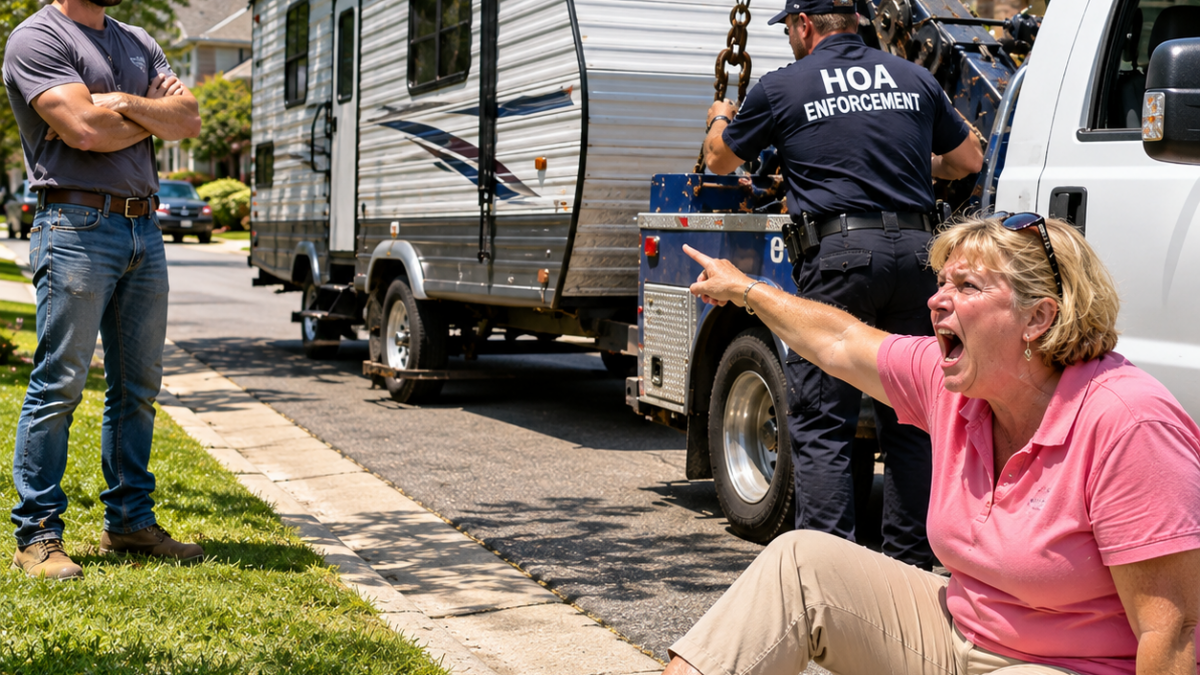
HOA Karen Towed Our Camper—Then She Learned Five Active-Duty Soldiers Were Living Inside
Cassandra Green thought she had removed an ugly camper from her perfect neighborhood, but she had actually stolen the only temporary home five activated soldiers had left.
She told the tow company we were vagrants trespassing on HOA land, then smiled while a blind young soldier’s guide dog, medication, uniform, phone, and military orders disappeared behind a locked impound gate.
By sunset, the orange tow slip she waved like victory had become evidence, and the woman who called us abandoned property was about to learn what happens when fake authority touches real federal lives.
When I returned to the church parking lot, the camper was gone.
For a few seconds, my mind refused to accept what my eyes were seeing.
The far corner of Grace Community Church’s lot was empty except for two cracked leveling blocks, a black streak where one stabilizer jack had dragged across the pavement, and a torn piece of reflective tape fluttering against the curb.
That was where our camper had been.
That was where five men under active orders had slept the night before.
That was where we kept uniforms, medication, service records, medical documents, spare boots, field bags, phones, chargers, one VA-issued cane, and the only place any of us could call ours while Fort Halston tried to find us beds.
Now there was nothing.
No warning.
No note.
No call.
No police report.
No base notification.
Just empty pavement.
Behind me, Specialist Noah Bell stopped walking.
He was twenty-two, the youngest of us, tall and thin in that unfinished way some young soldiers still look before life fills out their shoulders. He had been legally blind since a training accident took most of the vision in his left eye and damaged the right badly enough that night movement became dangerous without help.
His guide dog, Ranger, went everywhere with him.
Everywhere except that morning.
Because Ranger had been asleep inside the camper when we left for a two-hour medical appointment, and Noah had figured it was kinder to let him rest in the air-conditioned shade than make him lie on a clinic floor while doctors repeated what he already knew.
Now Ranger was gone too.
Noah’s face changed before he spoke.
Not panic.
Worse.
Emptiness.
He took three steps forward, then dropped to both knees on the pavement where the camper should have been.
“Ranger?” he called.
No answer.
His hand swept the ground once, as if maybe the camper could be found by touch.
“Ranger!”
The sound of his voice hit me harder than any accusation could have.
Private First Class Malik Jones froze beside the church van. Corporal Luis Alvarez put both hands on top of his head and stared at the empty space. Sergeant Tommy Walsh whispered something I will not repeat in a church parking lot, even now.
I stood there holding the medical folder, looking at the drag mark on the pavement.
I had been shot at in Kandahar.
I had pulled men from overturned vehicles.
PART2:
I had slept under armored trucks in dust storms and eaten meals cold because nobody had time to heat them.
I had buried friends in dress uniforms and folded flags for families who would never hear the whole story of what their sons had done.
Still, nothing prepared me for the humiliation of coming home and being treated like abandoned property.
My name is Staff Sergeant David Monroe.
I served eighteen years between the Army and the National Guard.
I was forty-one years old when Cassandra Green had our camper towed out of a church parking lot and started the most expensive fight Willow Creek had ever seen.
There were five of us living in that camper.
None of us had chosen it as a permanent home.
We had all been activated on temporary orders while waiting for available quarters near Fort Halston. The housing office had run into delays after a plumbing failure shut down one of the older barracks buildings. The Guard arranged temporary accommodations where it could. Two men were placed in a motel nearly forty miles away. Several stayed with relatives. The five of us were assigned to a large white camper owned by a veterans’ outreach ministry connected to Grace Community Church.
The arrangement was not glamorous.
It was cramped.
It smelled like old carpet, coffee, boot leather, wet towels, and the lemon cleaner Pastor Abigail insisted made everything “feel hopeful.”
But it was documented.
The church gave us written permission to park at the far edge of its lot. Our command knew where we were. The veterans transition office knew where we were. The camper carried equipment inventories, medical paperwork, medication, uniforms, and personal information protected under military and medical privacy rules.
To the people who approved it, the camper was temporary lodging for activated service members.
To Cassandra Green, it was ugly.
That was enough for her.
Willow Creek was the kind of neighborhood where every lawn looked freshly measured.
The houses were large without being distinctive. Mailboxes matched. Fences matched. Even the flowering trees seemed to bloom according to an approved schedule. Grace Community Church had existed long before most of the subdivision, an old brick building near the western entrance, surrounded by a parking lot large enough for Sunday services, food drives, funerals, community events, and whatever else people needed when life got heavier than they could carry alone.
The camper sat in the farthest corner behind a row of elm trees.
It did not block traffic.
It did not sit on residential property.
PART3:
It was barely visible from the closest homes.
But Cassandra could see it during her morning walks.
Cassandra Green was the president of the Willow Creek Homeowners Association, though calling her president did not fully describe the role she had created for herself. She was part administrator, part inspector, part self-appointed ruler.
She wore an HOA identification badge on a lanyard as if issued by the federal government.
Her clipboard went everywhere.
She photographed garbage cans, work trucks, children’s bicycles, porch flags, holiday decorations, slightly crooked shutters, basketball hoops, and anything else she believed disturbed community harmony.
Residents said she once measured a lawn with a ruler after deciding the grass appeared half an inch too tall.
She fined a widow because wind chimes made noise after ten at night.
She threatened a family over a mailbox painted a shade of white she considered too warm.
Most people complained about Cassandra privately.
Few challenged her publicly.
That was how people like Cassandra became powerful.
Not because the rules gave them unlimited authority.
Because everyone else learned resisting cost more energy than surrendering.
The first time she noticed the camper was on a crisp Friday morning.
She was walking past the church with iced coffee in one hand and her phone in the other when sunlight reflected from one of the camper’s scratched side panels.
The camper was old.
Its white paint had faded toward gray. The lower trim carried scars from years of travel. One window had been repaired with a different shade of sealant. A small veterans outreach decal sat near the door. It did not look like the polished recreational vehicles parked behind some Willow Creek homes.
It looked used.
To Cassandra, used meant undesirable.
A church gardener named Manuel later told us he heard her speak before she called anyone.
“This is a residential neighborhood,” she said.
“Not a truck stop.”
Manuel tried to explain that the camper belonged to the church.
Cassandra dismissed him with a wave.
“You maintain the landscaping,” she said. “I handle community compliance.”
That was Cassandra’s first lie.
She did not handle church compliance.
Grace Community Church was not part of Willow Creek HOA.
The church predated the development by decades. Its property was exempt from Willow Creek covenants. The HOA had no ownership interest in the church lot, no parking enforcement authority there, and no right to decide what ministry vehicles could sit behind elm trees.
But Cassandra had built her entire authority on sounding official long enough for people to stop arguing.
She called the church office that same afternoon.
Pastor Abigail Price answered.
Pastor Abby, as everyone called her, was sixty-three, five feet tall, and possessed the alarming ability to make stubborn men confess things simply by offering them tea. She had gray hair cut short, kind eyes, and a backbone reinforced by years of funerals, poverty visits, addiction counseling, and board meetings with men who mistook gentleness for weakness.
Cassandra introduced herself as “President Cassandra Green of Willow Creek Community Compliance.”
Pastor Abby told her kindly that Grace Community was not governed by the HOA.
Cassandra said the camper created a negative impression at the neighborhood entrance.
Pastor Abby explained that the camper housed activated service members temporarily assigned near Fort Halston.
Cassandra paused.
Then said, “That may be admirable, but military status does not override property standards.”
Pastor Abby replied, “Neither does your HOA override church property.”
Cassandra hung up.
That should have been the end of it.
It was not.
The following week, Cassandra began taking pictures.
Every morning.
From the sidewalk.
From across the street.
From the edge of the church driveway.
At first, we ignored her.
We had more important things to worry about.
Formation times.
Medical appointments.
Transportation.
Paperwork.
Orders.
Uniform inspections.
The kind of small grinding logistics that come with being activated while the system that activates you pretends temporary means easy.
Noah had it worst.
He was the youngest, and he hated being seen as fragile. Ranger gave him freedom, but losing vision had changed the way people spoke to him. Too loud. Too slow. Too careful. Like blindness had lowered his intelligence instead of his sight.
He joked about it because that was easier.
“Don’t worry,” he told Malik one morning when Malik left a duffel in the walkway. “I only trip over things I hate.”
“You hate my bag?”
“I hate your packing style.”
Ranger, a black Lab with a white patch on his chest and eyes wiser than most officers I had known, would sigh whenever we argued, like he was disappointed in the whole chain of command.
The camper was tight, but we made it work.
I slept on the foldout near the front because I was oldest and apparently that meant my back had already suffered enough to be negotiable. Alvarez took the dinette. Walsh slept in the top bunk and complained every morning like the ceiling had personally betrayed him. Malik had the lower bunk. Noah had the rear bed because Ranger needed floor space near him at night.
We kept things squared away.
Boots lined beneath the bench.
Uniforms hung in garment bags.
Medication locked in a plastic case near the rear cabinet.
Phones charged along a power strip we secured with tape so nobody kicked it loose.
Every morning, we folded bedding, opened windows if weather allowed, and made sure the outside area stayed cleaner than most suburban garages.
Pastor Abby checked on us twice a day whether we needed it or not.
The church ladies brought casseroles.
Manuel brought coffee so strong it could probably remove rust.
For a little while, it almost felt like dignity.
Temporary dignity, maybe.
But dignity.
Then Cassandra came in person.
It was Wednesday afternoon. I was sitting outside the camper checking a roster on my phone while Alvarez repaired the step latch with a screwdriver and profanity. Noah sat under the elm tree brushing Ranger. Malik had gone with Walsh to pick up supplies.
Cassandra crossed the parking lot like she had purchased the pavement beneath her feet.
She wore a cream blazer, black pants, sunglasses, and her HOA badge on a blue lanyard. A younger woman followed her with a tablet. I later learned her name was Denise Miller, secretary of the HOA board and professional witness to Cassandra’s decisions.
“Who is in charge here?” Cassandra asked.
I stood.
“That depends what you need.”
She looked me up and down.
“You’re living in this vehicle?”
“Temporarily.”
“How many?”
“Ma’am, this is church property. You should speak with Pastor Price.”
“I already have. She was uncooperative.”
“That sounds like her being correct.”
Alvarez coughed to hide a laugh.
Cassandra’s eyes moved to him, then to Noah, then Ranger.
Her mouth tightened.
“This is not acceptable.”
Noah stopped brushing Ranger.
“Excuse me?”
Cassandra gestured toward the camper.
“Temporary or not, this is an occupied recreational vehicle in public view. It creates safety concerns, sanitation concerns, and a negative visual impact.”
I looked around the empty far corner of the parking lot.
“We’re behind trees.”
“You are visible from Willow Creek Drive.”
“Then look somewhere else.”
Alvarez whispered, “Staff Sergeant.”
He was right.
I took a breath.
“Ma’am, the camper belongs to Grace Community’s veterans outreach ministry. We have written permission to be here. Our command is aware.”
Cassandra smiled.
Not pleasantly.
“I respect service. Truly, I do. But this is not a base.”
“No one said it was.”
“And Willow Creek families should not have to look at a transient camp every morning.”
Noah’s hand tightened on Ranger’s collar.
“Transient camp?” he said quietly.
Cassandra glanced at him.
“I’m using the common meaning.”
“You mean homeless.”
“I mean temporary occupants in a parked trailer.”
I stepped forward.
“Careful.”
She lifted her chin.
“Do not threaten me.”
“I’m advising you.”
“Then let me advise you. This camper needs to be removed.”
“By whose authority?”
“The Willow Creek HOA has standards.”
“The church is not in Willow Creek HOA.”
“The church sits at our entrance.”
“No. Your neighborhood was built beside the church.”
Denise looked up from her tablet, suddenly unsure.
Cassandra did not like being corrected in front of witnesses.
Her voice sharpened.
“You have forty-eight hours.”
“For what?”
“To relocate this vehicle.”
“No.”
She blinked.
People like Cassandra were used to arguments.
They were not used to clean refusal.
“No?”
“No.”
“I will contact the proper authorities.”
“Please do. Start with the church, then our command, then maybe someone who understands property boundaries.”
Her face reddened.
“I tried being polite.”
“No, ma’am. You tried being powerful.”
For one long second, I thought she might slap me.
Instead, she turned to Denise.
“Document noncompliance.”
Then she walked away.
Alvarez watched her go.
“I do not like that woman.”
Ranger sneezed.
Noah said, “Ranger agrees.”
The next day, Pastor Abby received a second call.
This time Cassandra claimed residents had reported “unknown men” living near the church entrance and expressed concerns about safety.
Pastor Abby reminded her the “unknown men” were active-duty service members temporarily housed with church permission.
Cassandra asked whether background checks had been performed.
Pastor Abby said, “Madam, the Army seems to have looked into them.”
Cassandra did not appreciate that either.
Friday morning, the church received a letter from the HOA.
It had no legal force.
But it had formatting.
That was Cassandra’s gift.
Bold headings.
Deadlines.
Official-looking language.
Phrases like community impact, unauthorized habitation, nuisance vehicle, risk exposure, immediate corrective action, and failure to comply.
Pastor Abby brought it to us after breakfast.
“She’s escalating,” she said.
“I’ll send it to command,” I told her.
“I already sent it to the outreach attorney.”
“Pastor.”
“What?”
“You have an outreach attorney?”
She smiled gently.
“David, we feed homeless veterans, negotiate medical debt, and fight landlords twice a month. Of course we have an attorney.”
I should have felt reassured.
Instead, I felt tired.
People think soldiers hate battle.
That is not exactly true.
We hate pointless battle.
We hate fighting battles that should not exist because someone with a clipboard decided dignity was unsightly.
Saturday morning, I took Noah to a medical appointment in the church van.
Walsh and Malik came along because they needed to stop at the pharmacy. Alvarez stayed behind for a while, then got called to base for paperwork and left the camper locked, generator running low, windows cracked, Ranger asleep on Noah’s blanket in the back.
We were gone less than three hours.
When we returned, the camper had vanished.
Noah called Ranger’s name until his voice broke.
Malik ran to the church office.
Walsh checked the far curb like maybe a thirty-foot camper could be hiding behind a sedan.
I walked to the empty space and saw something on the pavement near the drag mark.
A scrap of paper.
Tow receipt.
Not even placed properly.
Just dropped.
It listed the company.
CROWDER’S TOWING AND RECOVERY.
Reason for tow:
ABANDONED CAMPER / TRESPASS / HOA ORDER.
Authorized by:
C. GREEN, WILLOW CREEK HOA PRESIDENT.
I read it three times.
Then handed it to Alvarez, who had just pulled back into the lot and jumped from his truck before it stopped moving.
His face went dark.
“She did what?”
Pastor Abby came outside.
One look at Noah on his knees and every soft line in her face hardened.
“David?”
I handed her the receipt.
She read it.
Then said, very quietly, “No.”
That was all.
Just no.
But I had heard officers use fewer words before combat and less resolve inside them.
I called Crowder’s first.
The dispatcher answered like we were arguing over a Honda Civic left in an apartment lot.
“Crowder’s Towing.”
“This is Staff Sergeant David Monroe. You towed a camper from Grace Community Church this morning.”
“What’s the lot number?”
“I don’t know your lot number. It was a white camper removed from a church parking lot under an HOA order.”
Typing.
Then: “Yes, we have it.”
“There is a service animal inside that camper.”
Silence.
“What?”
“A guide dog. Black Lab. Name Ranger. There are also military uniforms, medication, phones, and official documents inside. You need to stop whatever you’re doing and confirm the dog is alive.”
The dispatcher’s voice changed.
“Sir, we were told the unit was abandoned.”
“You were told wrong.”
“Hold, please.”
“No. Do not put me on hold.”
She put me on hold.
Noah stood now, but barely. His face had gone gray. Malik had one hand on his shoulder. Alvarez paced like a man trying not to punch the air. Walsh was already calling our unit.
Pastor Abby called the sheriff.
The dispatcher came back.
“Sir, our driver says he heard barking after arrival at the yard. We have not opened the unit because it’s locked.”
“You towed an occupied camper with a service animal inside and did not inspect it?”
“We were told there were no occupants or animals.”
“By whom?”
“I can’t release—”
“You will release it to the sheriff, NCIS, JAG, or whoever gets there first. But right now, you are going to have someone stand beside that camper and verify that dog is alive.”
Another pause.
“Sir—”
I lowered my voice.
“Listen carefully. That dog belongs to a soldier under active orders. His medication is inside. His phone is inside. His uniform is inside. If that dog dies behind your fence because you’re worried about policy, this will be the worst day your company has ever had.”
The dispatcher stopped arguing.
“We’ll send the yard manager now.”
“Video call me.”
“I don’t know if—”
“Video call me.”
Two minutes later, my phone rang.
A man with a red face and a gray beard appeared on screen. Behind him stood our camper, crooked but intact, parked in an impound yard between a repossessed pickup and a wrecked delivery van.
I heard barking.
Noah heard it too.
“Ranger!” he shouted toward my phone.
The barking changed.
Higher.
Frantic.
Alive.
Noah folded in on himself like somebody had cut strings inside him.
The yard manager swore under his breath.
“We’re opening it.”
“You damage that lock, you pay for it,” Alvarez snapped.
The manager ignored him and moved to the door. A deputy had not arrived yet, but common sense finally had. They cut the small external lock on the storage cover first, then found the spare key in the emergency box Pastor Abby had mounted beneath the frame. It had been labeled, which should have told any competent tow driver this was not abandoned.
When the camper door opened, Ranger pushed out so fast the manager nearly fell backward.
The dog barked once at the phone, then spun in confusion, searching for Noah’s scent.
Noah made a sound I hope I never hear from another grown man.
“We’re coming,” I said.
Pastor Abby had already pulled the church van around.
The sheriff’s deputy arrived as we were leaving.
Deputy Carla Mendes.
Thirty-six.
Calm eyes.
No patience for nonsense.
Pastor Abby handed her the tow slip, the church permission letter, the HOA letter, and a folder of our lodging documentation.
Mendes read fast.
Then looked at the empty space.
“This was on church property?”
“Yes,” Pastor Abby said.
“Church authorized parking?”
“Yes.”
“HOA authorized towing from church property?”
“That is what the slip says.”
Mendes looked at me.
“Staff Sergeant, go get your dog and medication. I’ll meet you at the tow yard.”
“Noah’s dog,” I corrected.
She looked toward Noah.
Something in her face softened.
“Then go get Noah’s dog.”
Crowder’s yard was twelve minutes away.
It felt like twelve hours.
When we pulled in, Ranger heard the van before we opened the doors.
He lunged toward the fence, barking and crying at the same time.
Noah stumbled out.
I caught his elbow, but he pulled free.
“Ranger!”
The yard manager opened the gate.
Ranger hit Noah in the chest so hard they both went down in the gravel.
Noah wrapped both arms around that dog and sobbed.
No shame.
No restraint.
No soldier mask.
Just a young man holding the one living thing that helped him move through the world safely.
Every person in that yard stopped.
The mechanics.
The dispatcher.
The tow driver.
Even Deputy Mendes, who had arrived behind us, looked away for a second.
I let Noah have that moment.
Then I walked to the camper.
The inside was chaos.
Cabinets had opened during the tow. A medication case had fallen from the rear shelf. Uniforms were crumpled. One phone had slid beneath the dinette. Ranger’s water bowl had tipped over. Noah’s cane lay jammed behind a storage compartment. Malik’s orders folder had spilled across the floor.
Nothing looked stolen.
Everything looked violated.
That is a strange word for property.
But when five men live in a temporary box because the system has nowhere else to put them, that box becomes more than property. It becomes privacy. Routine. Medicine. Proof that you still have a place to put your boots at night.
Deputy Mendes photographed everything.
The broken seal.
The fallen medication.
The location of Ranger’s bowl.
The condition of the camper.
Then she spoke to the yard manager.
“Who authorized the tow?”
He swallowed.
“Mrs. Green.”
“Did she own the property?”
“She said the HOA controlled the entrance area.”
“Did you verify with the church?”
“No.”
“Did you check whether anyone had permission to park?”
“She said it was abandoned.”
I stepped out of the camper.
“She knew it wasn’t.”
The tow driver, a heavyset man named Frank Crowder Jr., looked miserable.
“She told us transients were using it. Said the church wanted it gone but didn’t want a confrontation.”
Pastor Abby’s voice came from behind us.
“She said what?”
Frank turned.
Pastor Abby stood at the gate, small, gray-haired, and absolutely terrifying.
“I’m Pastor Abigail Price,” she said. “This is my church’s property. I did not authorize this tow. I did not request this tow. I did not tell anyone to remove that camper. That camper is part of our veterans ministry.”
Frank looked like he wanted the gravel to swallow him.
“Ma’am, I’m sorry. We were told—”
“You were told a lie,” she said.
Deputy Mendes held up the tow sheet.
“Mrs. Green signed this authorization?”
“Yes,” Frank said.
“Do you have any additional paperwork?”
He nodded toward the office.
“She emailed photos and a removal request.”
“I’ll need copies.”
Frank looked relieved to give them.
People who get tricked often become cooperative once they realize they are holding the wrong end of someone else’s lie.
Inside the office, the printer produced Cassandra’s mistake one page at a time.
Email subject:
URGENT NUISANCE VEHICLE REMOVAL — HOA ENTRANCE ZONE.
Her message claimed the camper was abandoned, illegally parked in a shared entrance area, occupied by “unknown individuals,” and creating “potential sanitation and safety hazards.”
She stated that Willow Creek HOA had authority to clear the area under its community compliance rules.
She wrote:
No known occupants, animals, or medical concerns.
That line became the heart of the case.
Because Cassandra knew.
She knew about us.
She had seen us.
She had spoken to us.
Pastor Abby had told her.
Manuel had told her.
The HOA secretary Denise had taken pictures of Noah brushing Ranger under the elm tree.
Cassandra did not misunderstand.
She erased us in writing because the truth would have made the tow company hesitate.
Deputy Mendes read the email, then looked at Pastor Abby.
“Do you want to pursue a criminal complaint?”
Pastor Abby did not hesitate.
“Yes.”
I called our command from the tow yard.
Within twenty minutes, Captain Ellis was on the phone with Deputy Mendes.
Within forty-five, Fort Halston’s legal office was involved.
By midafternoon, a military liaison arrived with two officers from base security and a woman from the Inspector General’s office.
That was when Cassandra’s problem stopped being an HOA dispute.
Military property had been removed without authorization.
Medical supplies had been taken.
Protected personal documents had been seized.
A service animal had been trapped inside a towed camper.
Active-duty personnel had been deprived of uniforms and communications.
A church had been falsely represented.
And an HOA president had signed her name to the lie.
Cassandra still did not understand.
That afternoon, she drove to the tow yard in her white SUV.
She stepped out wearing a pale green blouse, white pants, and the same badge lanyard.
I have always believed there are people who can see a burning building and complain the smoke is violating neighborhood standards.
Cassandra was one of them.
She looked at the gathering of deputies, soldiers, church staff, tow employees, and military officials with irritation, not concern.
“Why is the camper still here?” she asked.
Everyone turned.
Ranger growled.
Noah placed a hand on his harness.
Deputy Mendes stepped forward.
“Mrs. Green?”
“Yes.”
“You authorized the removal?”
“I authorized enforcement of community standards.”
“From church property.”
“From the Willow Creek entrance zone.”
Pastor Abby said, “That is not a legal property category.”
Cassandra ignored her.
“These men were given notice.”
“No,” I said. “We were not.”
She looked at me.
“You were verbally informed the camper had to be removed.”
“By someone with no authority.”
She pointed toward the camper.
“That vehicle is unsightly. It lowers the appearance of the neighborhood and creates concern among residents.”
Captain Ellis had arrived by then. He was not a large man, but command has a posture when real authority enters a conversation. Cassandra, unfortunately for her, had spent too long around fake authority to recognize the difference.
He stepped forward.
“Mrs. Green, did you tell Crowder’s Towing there were no known occupants, animals, or medical concerns?”
She turned to him.
“And you are?”
“Captain Marcus Ellis, United States Army.”
“This is a civil matter.”
“No, ma’am. It was a civil matter until you caused the removal of temporary military lodging containing medical items, official records, and a service animal.”
Her eyes narrowed.
“I was not informed of any dog.”
Noah lifted his head.
“You watched me brush him.”
She barely glanced at him.
“I see many dogs in this community.”
Pastor Abby said, “I personally told you the camper housed activated service members.”
“You said veterans.”
“I said soldiers.”
“The distinction was not clear.”
I laughed once.
Not because anything was funny.
Because hearing Cassandra Green pretend the word soldier had confused her nearly broke whatever restraint I had left.
Captain Ellis did not laugh.
“Mrs. Green, you signed a statement that the unit was abandoned.”
“It appeared abandoned.”
“We were standing next to it two days ago,” Alvarez said.
Cassandra looked annoyed.
“People come and go from vehicles all the time.”
Deputy Mendes said, “You also stated the church wanted it removed.”
Cassandra shifted.
“I believed the church would prefer not to have the burden of enforcement.”
Pastor Abby stared at her.
“You lied about my church to remove soldiers from shelter.”
Cassandra’s face hardened.
“That is a dramatic interpretation.”
“No,” Pastor Abby said. “It is a sentence.”
For the first time, Cassandra seemed to notice the number of phones recording.
Denise had arrived too, pale and silent, standing near Cassandra’s SUV. She looked like someone who had followed orders for too long and was beginning to understand obedience does not protect you once the record opens.
Deputy Mendes took Cassandra aside.
Captain Ellis took statements from us.
The Inspector General representative photographed the camper and collected copies of the tow authorization. Fort Halston’s legal office issued a preservation notice before evening.
Willow Creek HOA.
Crowder’s Towing.
Cassandra Green.
Denise Miller.
Grace Community Church.
The management company.
Every email, text, board note, photo, complaint log, tow authorization, invoice, and communication about the camper had to be preserved.
That was when the truth started coming out.
Cassandra had not acted alone in emotion.
She had built a paper trail.
The problem was that it was made of lies.
The first HOA email thread began with a resident complaint, though calling it a complaint was generous.
A man named Peter Lang wrote:
Is something being done about the old trailer by the church? It looks trashy.
Cassandra responded within twelve minutes.
Working on it.
A board member asked whether the church was part of HOA jurisdiction.
Cassandra replied:
Entrance-impact rules allow us to act when non-member property creates adverse visual conditions affecting Willow Creek.
That rule did not exist.
Another board member asked if the men in the camper were connected to the military.
Cassandra replied:
Unclear. They appear to be using military language to avoid compliance.
Denise attached photographs.
One showed me in uniform.
One showed Noah brushing Ranger.
One showed Pastor Abby handing us a box of donated supplies.
Another message from Cassandra:
We cannot let emotional manipulation override standards.
That sentence traveled fast once residents saw it.
Emotional manipulation.
That was what she called five activated soldiers sleeping in a church camper because military housing had failed us.
That was what she called a blind young man and his guide dog.
That was what she called Pastor Abby trying to help.
The tow company produced more.
Cassandra had called three companies.
Two refused once they learned the camper sat on church property.
Crowder’s accepted after Cassandra signed an indemnity agreement claiming she had authority to order removal.
She also sent a cropped property map that made the church lot appear inside Willow Creek’s entrance zone.
Maria Chen, the church outreach attorney, found that detail first.
Maria was small, direct, and had the kind of smile lawyers use when someone hands them a document that proves intent.
“She cropped out the parcel boundary,” Maria said.
Pastor Abby looked at the map.
“So she knew.”
Maria nodded.
“She knew enough to hide it.”
The Willow Creek board called an emergency meeting four days after the tow.
I did not want to go.
Noah did not either.
But Pastor Abby said, “People need to see who was inside that camper.”
So we went.
All five of us.
Uniforms pressed.
Boots clean.
Ranger at Noah’s side.
The clubhouse was packed.
Residents filled every chair and stood against the walls. Some looked angry. Some embarrassed. Some curious in the way people get when scandal is close enough to smell but not yet close enough to stain them.
Cassandra sat at the front table.
No clipboard.
No lanyard.
That told me more than her expression did.
The HOA attorney, a tired-looking man named Howard Vance, opened with a statement about ongoing investigations and cooperation.
Bob Grant, an older resident in the front row, interrupted.
“Did we tow soldiers from a church or not?”
Howard closed his eyes briefly.
“That question is under review.”
Pastor Abby stood.
“No, it is not.”
The room turned.
“The camper belonged to our veterans outreach ministry,” she said. “It was parked on church property with our written permission. These five men were living there temporarily under active orders. Their belongings, medical items, official documents, and a service dog were taken because your president lied.”
Cassandra stood.
“I will not be slandered.”
Pastor Abby looked at her.
“Then sit down before you add to the evidence.”
A murmur moved through the room.
I had seen drill sergeants with less command presence than Pastor Abby in that moment.
Cassandra pointed at me.
“They were warned.”
I stood.
“No, we were harassed.”
Her face flushed.
“You admitted the camper was temporary.”
“That did not give you authority to remove it.”
“It was visible.”
“So are your houses.”
A few residents laughed despite themselves.
Cassandra snapped, “This is not funny.”
“No,” I said. “It isn’t. A soldier with impaired vision had his guide dog taken. His medication was taken. His phone was taken. Our uniforms were taken. Our documents were taken. All because you decided a church ministry looked bad from your morning walk.”
Noah stood beside me.
His voice was quiet.
“I called for my dog on empty pavement.”
The room went still.
“I thought someone stole him. Then I thought he was dead. Ranger helps me cross streets. Find doors. Move at night. Wake me from panic when I can’t see where I am. You didn’t take a trailer. You took my eyes.”
Cassandra looked away.
That was the first time I saw shame try to reach her.
It did not last.
“You should not have left an animal unattended,” she said.
The room erupted.
Even people who had defended her before turned.
A woman shouted, “Are you serious?”
Another said, “You towed him!”
Denise began crying quietly at the board table.
Howard the attorney tapped his microphone.
“Order, please.”
Bob Grant stood again.
“I want to know whether the board approved this.”
Howard hesitated.
Cassandra answered too quickly.
“The president has enforcement discretion.”
Denise lifted her head.
“No.”
Cassandra turned.
“Denise.”
“No,” Denise repeated, voice shaking. “We did not vote. You told us you were sending another letter. You said the church had agreed in principle. You said the tow company would verify before removal.”
Cassandra’s face drained.
Howard looked at Denise.
“Do you have documentation?”
Denise nodded.
Cassandra whispered, “Denise.”
But obedience had finally reached its limit.
Denise opened a folder and placed printed emails on the table.
That was the sound of Cassandra’s kingdom cracking.
Over the next hour, residents learned more than they wanted.
Cassandra had used HOA funds to pay for towing consultation.
She had contacted companies without board authorization.
She had misrepresented church property as HOA-controlled.
She had cropped maps.
She had signed the removal order personally.
She had sent messages describing us as “itinerant military men” and “a optics problem.”
She had ignored warnings from two board members.
She had never called Fort Halston.
She had never called the church after Pastor Abby refused.
She had never posted notice on the camper.
She had never verified whether anyone or anything was inside.
By the time the emergency vote came, even Cassandra’s closest supporters sat silent.
Howard read the motion.
Immediate removal of Cassandra Green as HOA president pending investigation.
The vote was unanimous.
Cassandra stood.
“You are making a terrible mistake.”
Bob Grant replied, “No. We are correcting yours.”
She left through the side door without looking at us.
The consequences did not come all at once.
They rarely do.
Real accountability is slower than anger.
Crowder’s Towing reached a settlement with the church and with Noah for mishandling the camper after failing to verify property authority or occupancy. Frank Crowder Jr. personally apologized to Noah, then donated a year of towing support to the veterans outreach ministry. Noah accepted the apology because Noah had a better heart than I did.
The company changed its policy.
No occupied-looking camper, trailer, or RV could be removed from religious, nonprofit, or outreach property without direct property-owner confirmation, law enforcement notification, and animal-occupancy inspection.
That mattered.
Cassandra faced more.
The county investigated false towing authorization.
The state looked into misuse of HOA authority and association funds.
Fort Halston filed a formal complaint over interference with activated personnel and mishandling of military property.
The federal side did not result in a dramatic arrest in front of her house, though Malik admitted he had been hoping for “just a little perp walk.”
Instead, it resulted in civil penalties, legal fees, resignation from every Willow Creek committee, and a settlement that required Cassandra personally to reimburse costs tied to the tow, emergency retrieval, damaged property, veterinary evaluation for Ranger, replacement locks, document security, transportation, and temporary hotel accommodations after the camper was held for inspection.
Then came the hardest consequence for her.
Public record.
The final report stated plainly that Willow Creek HOA had no authority over Grace Community Church property and that Cassandra Green had misrepresented facts to cause removal of temporary lodging used by active-duty service members.
No amount of pearls or lawn perfection could make that sentence pretty.
The church got the camper back.
But it did not feel the same at first.
For days, Noah could not sleep in it. Ranger hesitated at the steps the first night, sniffing every corner like the world had become unreliable. Alvarez repaired the latch again, this time with such intensity that I joked the step could survive artillery.
Nobody laughed much.
Trauma does that.
Even small trauma.
Especially humiliating trauma.
People think soldiers only get hurt by bullets, explosions, and war.
They forget what it means to come home and have your shelter dragged away because someone thinks you are an eyesore.
Pastor Abby knew.
She moved us into the church fellowship hall for a week while the camper was cleaned, inspected, and re-secured. Volunteers set up cots. Someone brought curtains for privacy. The church women labeled a cabinet for medication. Manuel installed a camera facing the parking lot.
Then the story spread.
Local news first.
HOA PRESIDENT ORDERS TOW OF CAMPER HOUSING ACTIVE-DUTY SOLDIERS.
Then regional outlets.
Then national veterans groups.
People sent donations.
Some sent angry emails to Willow Creek.
Some sent dog treats for Ranger.
Noah enjoyed that part.
Ranger enjoyed it more.
But the attention was uncomfortable.
I had not wanted to become a symbol.
I wanted a bed, a locker, a functioning housing system, and a world where a blind soldier did not have to kneel on asphalt calling for a dog taken by a woman with no authority.
Two weeks after the tow, Fort Halston finally opened temporary quarters.
Real beds.
Lockers.
Showers.
A room where Noah could place Ranger’s mat beside his bunk and know nobody would drag the building away because it looked bad from the sidewalk.
On our last night at Grace Community, Pastor Abby held a dinner.
Not a ceremony.
She insisted on that.
“Ceremonies make men like you uncomfortable,” she told me.
“What do men like me prefer?”
“Food and pretending you’re not emotional.”
She was not wrong.
The fellowship hall filled with church members, a few Willow Creek residents who had helped after the truth came out, Deputy Mendes, Frank Crowder Jr., Denise Miller, and the new HOA president, Bob Grant.
Bob looked nervous approaching us.
“I know this doesn’t fix anything,” he said, handing Pastor Abby an envelope, “but the board voted to make a donation to the veterans outreach fund. Not HOA money. Personal contributions from residents.”
Pastor Abby accepted it.
“Thank you.”
He turned to me.
“I’m sorry.”
“You didn’t tow us.”
“No. But I let Cassandra run people over for years because she mostly aimed at other people.”
That was honest.
Honesty is heavier than apology.
“I appreciate you saying that,” I told him.
Denise approached Noah.
She held a small toy for Ranger and an apology letter folded in both hands.
“I should have spoken up sooner,” she said.
Noah took the letter.
“Yeah.”
Denise flinched, but he was not cruel.
Just honest.
“I’m sorry,” she whispered.
Noah looked down at Ranger, then back at her.
“I believe you.”
He did not say it was okay.
It was not okay.
But believing an apology is sometimes the first step toward letting it change something.
Cassandra did not attend.
I did not expect her to.
Three months later, a letter arrived at the church.
No return address at first glance, but the handwriting was careful, controlled.
Pastor Abby called me to her office.
“I think this is for all of you,” she said.
The envelope contained a check and a letter from Cassandra Green.
The check was made out to Grace Community Veterans Outreach.
The letter was short.
Staff Sergeant Monroe, Pastor Price, Specialist Bell, and the men I harmed,
I have been advised not to write this. I am writing anyway.
I told myself I was protecting a neighborhood. The truth is that I was protecting an image of control I had mistaken for leadership. I saw something that looked untidy and decided the people inside it mattered less than how it appeared from the street.
I lied to make removal easier.
I cannot soften that.
I said there were no animals or medical concerns when I knew enough to ask. I said the church wanted the camper gone when I knew that was false. I used authority I did not have because I was accustomed to people obeying me.
I am sorry.
I do not expect forgiveness. I only hope this donation helps someone I would have once looked past.
Cassandra Green
Noah read it twice.
Then handed it back.
“Is she forgiven?” Malik asked.
Pastor Abby looked at all of us.
“Forgiveness is not a group policy.”
That was the most Pastor Abby answer possible.
I did not know what I felt.
Part of me wanted to reject the check.
Part of me thought money from Cassandra’s pride ought to buy beds for men she would have once called unsightly.
In the end, the church accepted it.
Not because Cassandra deserved peace.
Because future soldiers deserved shelter.
A year later, Grace Community opened the Monroe House.
I argued with Pastor Abby for three weeks about the name.
I lost.
It was a small renovated building behind the church with four bedrooms, accessible bathrooms, secure storage, a fenced service-dog relief area, and enough dignity built into the floor plan that men could sleep without feeling like a burden.
At the dedication, I stood beside Noah, Alvarez, Walsh, Malik, Ranger, and Captain Ellis while Pastor Abby spoke.
She told the story without making us look pitiful.
That mattered.
She spoke about temporary housing, bureaucracy, pride, community failure, and the difference between charity and respect.
Then she said, “This house exists because people were harmed here, and because harm should either make us harder or make us build something better.”
Noah cut the ribbon.
Ranger tried to eat it.
Everyone laughed.
Even me.
The new Willow Creek HOA board attended. They had amended their procedures, limited enforcement authority, published property-boundary maps, and removed the word compliance from nearly everything because Bob Grant said it made the neighborhood sound like a prison.
The church and the HOA signed a formal cooperation agreement.
Not control.
Cooperation.
If church outreach vehicles needed temporary parking, the HOA would not interfere. If residents had concerns, they would contact the church directly. No towing. No threats. No fake authority.
Simple rules.
The kind adults should not need but often do.
Cassandra sold her house that spring.
I saw her once before she left.
It was outside the grocery store.
She looked different.
No lanyard.
No clipboard.
No armor.
For a second, I considered walking past.
Then Ranger, retired from guide work by then but visiting with Noah, wagged his tail at her.
Dogs are unreasonable that way.
Cassandra stopped.
Noah stood beside me.
She looked at him first.
“How is he?” she asked.
“Spoiled,” Noah said.
Ranger wagged harder.
Cassandra’s eyes filled.
“I’m glad.”
Nobody spoke for a moment.
Then she looked at me.
“I can’t fix what I did.”
“No.”
“But I think about it.”
“Good.”
She nodded slowly.
That was all.
No dramatic forgiveness.
No hug.
No clean ending that made everyone comfortable.
Just a woman carrying the weight of what she had done, and a few of us willing to let her carry it without kicking her while she walked away.
Years have passed since then.
The camper is still used sometimes, though never again as the only shelter for active-duty soldiers. It sits behind Monroe House now, restored, repainted, and protected by a security camera Manuel checks like it owes him money.
The side panel still has one long scratch from the tow.
Pastor Abby refused to repair it.
She says scars can be educational.
Noah stayed in.
He fought to remain deployable in a limited role, then transitioned into adaptive training for soldiers learning to work with service dogs. Ranger retired with him and became the most spoiled animal in three counties.
Alvarez opened a repair shop.
Malik became a recruiter and tells every kid who thinks service is just uniforms and action movies that paperwork can be more dangerous than bullets if nobody reads it.
Walsh went back to school and somehow became a counselor, which surprised everyone except those of us who had seen him sit awake with younger soldiers during bad nights.
As for me, I stayed Guard until my body finally convinced my pride that eighteen years was enough.
I now help Pastor Abby run logistics for Monroe House.
Beds.
Transportation.
Donated uniforms.
Medical appointments.
Storage lockers.
The unglamorous work of keeping people from falling through cracks that institutions swear are temporary.
Sometimes Willow Creek residents volunteer.
They paint rooms, stock shelves, bring meals, repair bicycles, and walk dogs for veterans who need both company and quiet.
A few still look uncomfortable around us.
That is fine.
Discomfort can be useful if it keeps people honest.
Every now and then, someone asks me what the worst part was.
I could say it was the tow.
The missing medication.
The legal fight.
The public humiliation.
The moment I saw the camper gone.
But that is not the truth.
The worst part was watching Noah on his knees calling for Ranger across empty pavement.
Because in that moment, I understood exactly what Cassandra had taken.
Not a camper.
Not property.
Not some ugly thing from a parking lot.
She had taken security from a man who had already lost too much of it.
She had taken the fragile dignity five soldiers had built inside an imperfect temporary shelter.
She had taken the assumption that if we followed every rule, got every permission, and documented every arrangement, we would be left alone.
That assumption never fully came back.
But something else grew in its place.
A house.
A ministry.
A policy.
A neighborhood that learned to ask before it acted.
A tow company that changed procedures.
An HOA that finally understood its borders.
A young soldier who got his dog back and later helped others keep theirs.
Maybe that is what justice looks like sometimes.
Not just punishment.
Repair.
Cassandra Green saw an old camper and thought it lowered the neighborhood.
She never understood that the people inside it had already carried more weight than her perfect streets would ever show.
She thought authority was a badge on a lanyard.
A signature on a tow form.
A clipboard.
A title.
But real authority is accountable to truth.
It checks jurisdiction before issuing orders.
It protects the vulnerable before protecting appearances.
It knows the difference between a nuisance and a neighbor.
The day Cassandra towed our camper, she thought she was removing an eyesore.
Instead, she exposed one.
Not the scratched white camper behind the church.
The cruelty of a community that had learned to value clean sightlines over human dignity.
And once everyone saw that clearly, no one could pretend the neighborhood was perfect again.
Good.
Perfect neighborhoods are overrated.
Give me one with room for an old camper, a tired soldier, a blind young man, a loyal dog, and a church stubborn enough to say no when the world tries to tow compassion away.
That is the kind of place worth defending.








