HOA Karen Towed My Legal Car From My Own Driveway and Told Me I Had “No Appeal”— So I Parked a 20-Ton Tank in My Driveway
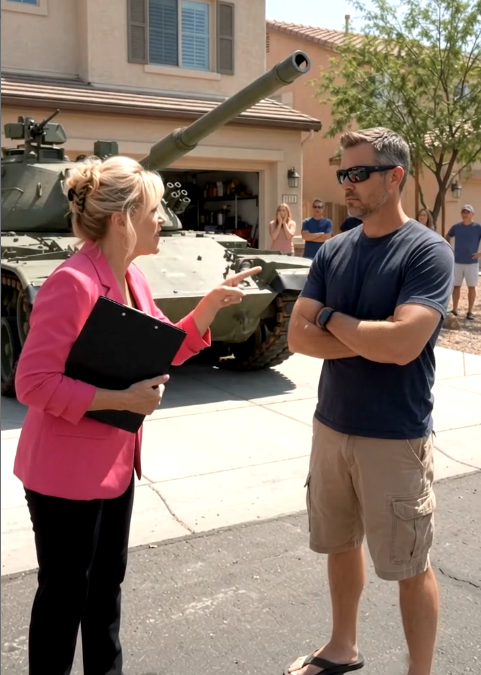
HOA Karen Towed My Legal Car From My Own Driveway and Told Me I Had “No Appeal”— So I Parked a 20-Ton Tank in My Driveway
I knew something was wrong before I even understood what I was looking at, because my driveway had never seemed that empty.
By the time Karen told me she had personally authorized the tow and that I had “no appeal,” I stopped arguing and started reading every line of the HOA rules she loved using against everyone else.
What I found buried in those rules gave me a way to answer her without raising my voice once.
My name is Ethan Cole, and I had lived in Briarwood Estates for almost eight years when our HOA president decided my perfectly legal sedan had become a threat to neighborhood standards.
Briarwood was one of those Arizona developments where every house looked different enough to feel private but similar enough to keep the HOA satisfied.
Tan stucco.
Gravel landscaping.
Trimmed desert shrubs.
Two-car garages.
Wide concrete driveways.
And an HOA handbook thick enough to qualify as defensive equipment.
For years, I mostly stayed out of HOA politics.
I paid my dues.
I kept the yard clean.
I put my trash cans away on time.
I parked my car in my own driveway.
Apparently, that last habit became controversial when Karen Whitmore became president.
Karen had been on the board for years, but presidency transformed her.
Before, she was annoying.
Afterward, she became administrative weather.
You did not invite her.
You simply checked the forecast and hoped she passed over your property.
Her signature accessory was a black clipboard.
She carried it everywhere.
Pool area?
Clipboard.
Mailboxes?
Clipboard.
Weekend garage sales?
Clipboard.
Christmas-light inspection?
Clipboard.
Once, she photographed my neighbor’s pickup truck because one tire touched decorative gravel for twenty minutes while he unloaded mulch.
She called it “community preservation.”
He called it something I probably should not repeat.
My own problems with Karen started small.
A warning because my recycling bin remained visible until 7:18 p.m.
The rules allowed it until 8:00.
A notice because my garage door was open for “an extended period.”
I was replacing a water heater.
A complaint about “vehicle maintenance activity” because I changed a dead battery in my driveway.
Every time I challenged her, the notice disappeared.
Every time a notice disappeared, Karen found something new.
Still, nothing prepared me for the morning my car vanished.
I walked outside around seven wearing yesterday’s T-shirt and carrying coffee.
The driveway was empty.
PART2:
For several seconds, my brain did not process it.
I looked toward the street.
Then the side of the house.
Then back at the driveway as if my Honda might somehow reappear if I stared long enough.
Nothing.
Just faint tire marks and one dark spot where the engine usually sat.
I checked my phone.
No email.
No HOA notice.
No warning.
No towing sticker.
No missed call.
Then a text arrived from Karen.
Your vehicle was towed for unauthorized overnight parking.
I actually laughed.
Not because it was funny.
Because sometimes stupidity arrives so confidently that laughter is the only response your body can produce.
My car had been parked in my driveway.
Not the street.
Not a fire lane.
Not a guest space.
My driveway.
PART3:
I opened the HOA documents immediately.
Section 8.4.
Residential vehicle parking.
I read it once.
Then again.
Then I took screenshots.
Registered passenger vehicles were allowed overnight in residential driveways.
No special permit.
No time restriction.
No prohibition matching anything Karen had accused me of.
The rule was painfully clear, and the original incident was exactly that simple.
The car had been legally parked in my driveway.
Karen had it towed anyway.
And she refused to identify a legitimate violation.
I walked straight to Karen’s house.
She opened the door before I finished knocking.
Pink blazer.
Sunglasses resting on top of her hair.
Clipboard already in hand.
Almost as if she had been waiting.
“Morning, Ethan.”
“You had my car towed.”
“It violated community standards.”
I held up my phone.
“Show me the rule.”
“The board has discretion.”
“That isn’t a rule.”
Her smile appeared.
Small.
Satisfied.
“Your vehicle created an inappropriate overnight appearance.”
“It was parked in my driveway.”
“Exactly.”
I stared at her.
“Which board members approved the tow?”
She tapped the clipboard.
“The board supports enforcement.”
“Who voted?”
“That isn’t relevant.”
“Where was my warning?”
“Warnings are not always required.”
“Where does it say that?”
“Ethan.”
She lowered her voice like she was trying to calm a difficult child.
“The tow is already complete.”
Then she smiled.
“You can pay the release and storage charges.”
That smile changed everything.
This was not confusion.
This was not a mistake.
Karen knew exactly what she had done.
She wanted me inconvenienced.
She wanted neighbors watching.
She wanted my empty driveway to become an example.
So I stopped arguing.
I walked home.
I sat on my front steps.
And I stared at the empty slab of reinforced concrete Karen had so thoughtfully cleared for me.
The first person to come over was my neighbor, Luis Ramirez.
Luis lived across the street, retired from running a roofing company, and had the permanent squint of a man who had spent forty years staring into Arizona sun.
He stood at the edge of my driveway with both hands on his hips.
“Where’s your car?”
“Towed.”
He looked at the driveway.
Then at the street.
Then at me.
“From here?”
“Yes.”
“By who?”
“Karen.”
Luis made a sound that was not quite a laugh and not quite a cough.
“That woman needs a hobby that doesn’t involve other people’s blood pressure.”
“She says it violated overnight parking rules.”
Luis pointed at the empty slab.
“This driveway?”
“That driveway.”
“The driveway attached to your house?”
“The same.”
He shook his head slowly.
“My wife said Karen would eventually tow somebody’s car for existing. I told her she was being dramatic.”
“Apologize to your wife.”
“I will.”
He looked back at Karen’s house down the street.
“She’s watching?”
I did not need to turn around.
I already knew.
“Probably.”
Luis lowered his voice.
“You want help?”
“At the moment? No.”
“You sure?”
I took another sip of coffee.
“I need to read.”
That was one of the few useful things my father taught me.
Read before you react.
My father was not a lawyer, but he had spent thirty years as a city building inspector, which meant he had witnessed every possible variation of people lying about codes they had not read.
He used to say most bullies count on two things.
First, that you will get angry.
Second, that you will get tired.
If you refuse both, they start making mistakes.
So I read.
Every covenant.
Every bylaw.
Every architectural standard.
Every parking rule.
Every enforcement procedure.
Every amendment.
Every meeting minute I could access through the resident portal.
I printed documents until my office smelled like hot toner.
I highlighted.
I tabbed.
I made notes.
And by ten that morning, I knew three things.
One, my Honda had been towed illegally under the HOA’s own rules.
Two, the towing company had accepted authorization from Karen personally, not from a documented board vote.
Three, buried in the vehicle section was the strangest loophole I had ever seen in an HOA handbook.
Section 8.9.
Historic and Collector Vehicles.
I almost missed it.
It was tucked between the rules banning recreational vehicles and the rules regulating trailers.
The section had clearly been added years earlier by someone with a very specific problem.
Privately owned antique, military, restored, or collector vehicles may be displayed or parked on an owner’s lot, provided such vehicle is maintained in good condition, does not leak fluids, does not obstruct sidewalks or common roads, is not used for commercial storage or habitation, and is positioned wholly on an approved paved surface.
I read it twice.
Then a third time.
Military.
Restored.
Collector vehicles.
Wholly on an approved paved surface.
No weight limit.
No height restriction.
No requirement that the vehicle be a passenger car.
No prohibition on tracks.
No prohibition on armored vehicles.
I leaned back in my chair.
For the first time that morning, I smiled.
Then I opened a folder on my computer labeled M24.
That requires explanation.
Fifteen years earlier, before I bought the house in Briarwood, I was part owner of a small restoration shop outside Mesa. We restored old military vehicles for museums, veterans’ groups, historical displays, and collectors with more money than sense.
Mostly jeeps.
A few deuce-and-a-half trucks.
One half-track.
Two armored scout cars.
And one decommissioned M24 Chaffee light tank.
Technically, it belonged to a nonprofit historical vehicle foundation my old business partner Vance and I had started back when we believed paperwork and passion were enough to keep a side project alive.
The tank had no functioning weapon systems.
The main gun was welded and demilitarized.
The machine gun mounts were replicas.
The engine ran, but we rarely drove it. Moving it required permits, rubber track pads, a licensed heavy-haul trailer, and enough patience to make a saint file complaints.
It weighed just under twenty tons depending on fuel and fittings.
It was loud.
It was green.
It was absurd.
And under Section 8.9 of Briarwood Estates’ governing documents, it was a privately owned restored military collector vehicle.
I called Vance.
He answered on the second ring.
“Somebody dead?”
“No.”
“Then why are you calling before noon?”
“Do we still have the Chaffee inspected?”
A pause.
“What did you do?”
“Nothing yet.”
“That is not comforting.”
“Is it registered under the foundation as a historic display vehicle?”
“Yes.”
“Insurance current?”
“Yes.”
“Fluids clean?”
“Dry as my divorce.”
“Rubber track pads still mounted?”
“Yes.”
“Can it sit on a residential reinforced concrete driveway without cracking it?”
Another pause.
“Ethan.”
“Yes?”
“Why are you asking me if a tank can sit in a driveway?”
I looked out the window at the empty slab where my car used to be.
“Because Karen towed my Honda.”
Vance said nothing for two full seconds.
Then he began laughing so hard he had to put the phone down.
I waited.
He came back wheezing.
“Please tell me you found something in your HOA rules.”
“Section 8.9.”
“Read it to me.”
I did.
When I finished, he whispered, “Beautiful.”
“I need the tank for a historic display.”
“In your driveway.”
“Yes.”
“What’s the theme?”
“Community standards.”
He laughed again.
Then his voice turned serious.
“Do this clean.”
“I intend to.”
“No street driving. We use the lowboy. Permitted delivery. Drop it entirely on your driveway. No blocking sidewalk. No fuel leak. No weapons visible beyond inert equipment. Documentation taped inside a weatherproof sleeve if she calls anyone.”
“Already thinking the same thing.”
“And Ethan?”
“Yes?”
“Put a camera on the driveway before it arrives.”
I looked at my empty slab.
“Already ordered.”
The tow yard charged me $412 to release my Honda.
Two hundred for the tow.
One hundred eighty for storage.
Thirty-two in “administrative processing.”
I paid with a credit card, took photographs of the car from every angle, requested the authorization form, and asked the clerk who had called it in.
She looked at the paperwork.
“Briarwood Estates HOA. Authorized by Karen Whitmore.”
“Any violation code?”
She looked again.
“Just says unauthorized overnight parking.”
“Any photo from before the tow?”
“No.”
“Any warning tag?”
“No.”
“Any board authorization?”
She shrugged.
“We tow when the property representative calls.”
“From private driveways?”
That made her pause.
She looked at the paperwork again.
“Sir, you’ll need to talk to your HOA.”
“I plan to.”
On the way home, I called my attorney.
Her name was Rachel Kim.
Every neighborhood should have one person who scares bullies by being calm.
Rachel was mine.
She was five foot three, wore black suits even when Arizona heat tried to kill everyone equally, and had the voice of a woman who could cut a contract in half without raising her blood pressure.
I explained the tow.
She listened.
Then I explained Section 8.9.
She was silent for a while.
“Ethan,” she said.
“Yes?”
“Are you about to park a tank in an HOA subdivision?”
“Yes.”
Another pause.
“Is it legal?”
“According to their rules.”
“Send me the section.”
“I already did.”
“Send me the vehicle documents.”
“Already did.”
“I hate when clients prepare properly. It makes me suspicious.”
“You taught me.”
“That also annoys me.”
She reviewed everything that afternoon.
The tow.
The parking rule.
The lack of warning.
The collector vehicle exception.
The enforcement procedure.
By five o’clock, she called back.
“Your car tow was improper under their documents.”
“I know.”
“The collector vehicle provision is poorly drafted.”
“I noticed.”
“It does not exclude tracked vehicles.”
“I also noticed.”
“It requires good condition, no leaks, no obstruction, no commercial use, paved surface.”
“We can comply.”
“Then legally, their own handbook gives you room.”
I smiled.
“But?”
“But this will start a war.”
“Karen started it at seven this morning.”
“No,” Rachel said. “Karen started harassment. The tank starts theater.”
“Effective theater?”
“Potentially.”
“That sounds like approval.”
“That sounds like I am writing a letter tonight making sure the record is clean before your historic armored vehicle arrives.”
That is why I paid Rachel.
At 8:13 p.m., she emailed the board.
The letter was polite in the way rattlesnakes are polite before they strike.
It stated that my legally parked Honda had been towed from my private driveway in violation of Section 8.4.
It demanded reimbursement for towing, storage, administrative fees, ride-share costs, and legal consultation.
It requested all communications related to the tow.
It demanded proof of board authorization.
It warned the HOA to preserve records.
Then, in a final paragraph written so cleanly it deserved music, Rachel notified the board that I intended to park a properly maintained historic military collector vehicle on my approved driveway surface in compliance with Section 8.9.
She attached the documentation.
Insurance.
Registration.
Inspection.
Photographs.
Demilitarization certificate.
Fluid check.
Noncommercial use statement.
Foundation ownership papers.
Delivery permit.
She ended with one sentence.
Any attempt to tow, damage, restrict, or otherwise interfere with Mr. Cole’s compliant collector vehicle will be treated as knowing misconduct following written notice.
Rachel copied every board member.
Not just Karen.
That mattered.
Bullies love private pressure.
Documentation works better in sunlight.
At 8:41 p.m., Karen emailed me personally.
Ethan,
This stunt will not be tolerated.
Karen
I forwarded it to Rachel.
Rachel replied:
Excellent.
The tank arrived Saturday morning.
It came on a lowboy trailer pulled by a heavy-haul tractor, with two escort pickups, permits in the windshield, and Vance riding shotgun like a man on his way to a parade he had been waiting his whole life to attend.
I had measured everything twice.
The driveway was twenty-two feet wide, thirty-eight feet long, reinforced concrete poured by the previous owner, who had once parked a motorhome on it.
No sidewalk obstruction.
No street overhang.
No common area encroachment.
The Chaffee would sit centered, nose facing the street, tracks fully on concrete, hatch closed, inert barrel secured and capped.
A historic collector vehicle.
Clean.
Insured.
Documented.
Absurdly legal.
By 8:30 a.m., half the neighborhood was outside.
Luis came with coffee.
His wife, Maribel, came with a folding chair.
“You brought a chair?” I asked.
She looked at the trailer backing carefully toward my driveway.
“Ethan, a tank is being delivered to a cul-de-sac. I would be disrespecting the moment if I stood.”
Fair point.
Across the street, a teenager filmed from his upstairs window.
Two little kids on scooters stopped so suddenly one of them almost fell.
Mr. Halpern from lot 42 came outside in pajamas and whispered, “Is that real?”
Vance heard him and yelled, “Mostly!”
Karen arrived before the tank touched the driveway.
Of course she did.
She marched down the sidewalk in a red blouse, black slacks, and the kind of expression usually reserved for discovering a raccoon in the pantry.
Her clipboard was in hand.
But even from fifty feet away, I could tell she was less confident than usual.
A Honda is easy to bully.
A twenty-ton tank changes the emotional math.
“What is this?” she demanded.
I stood at the edge of my driveway with a folder in one hand.
“Historic military collector vehicle.”
“That is a tank.”
“Yes.”
“You cannot park a tank in Briarwood Estates.”
I opened the folder.
“Section 8.9 permits privately owned antique, military, restored, or collector vehicles on an owner’s lot if maintained in good condition, not leaking fluids, not blocking sidewalks or common roads, not used for commercial storage or habitation, and positioned wholly on approved paved surface.”
Karen’s mouth opened.
Closed.
Opened again.
“That does not mean tanks.”
“It says military vehicles.”
“It means old jeeps.”
“It does not say old jeeps.”
“That was the intent.”
“Intent is harder to tow than text.”
Luis made a choking sound behind his coffee cup.
Karen turned on him.
“Mr. Ramirez, this is not a community event.”
Maribel lifted her hand from the folding chair.
“It became one when the tank arrived.”
The heavy-haul driver lowered the ramp.
Metal groaned.
The Chaffee rolled backward slowly, guided by Vance and two spotters. The engine rumbled low enough to vibrate in my chest. It was not fast. Not threatening. Just massive in the way old machines are massive, built when weight meant survival and style meant not dying.
Karen stepped back despite herself.
Vance guided it perfectly.
Tracks onto concrete.
Centered.
No sidewalk obstruction.
No street contact.
Engine off.
Silence fell over the cul-de-sac.
For one beautiful moment, Briarwood Estates had nothing to say.
Then Karen found her voice.
“This violates aesthetic standards.”
I handed her a copy of the section.
“No aesthetic limitation in 8.9.”
“It is a nuisance.”
“It is silent and stationary.”
“It is intimidating.”
“It is demilitarized.”
“It will lower property values.”
“Your illegal towing did that to my opinion of the neighborhood.”
Her eyes narrowed.
“I am calling code enforcement.”
“Good.”
“And the sheriff.”
“Even better.”
“And the board.”
“Please do. Rachel already emailed them.”
That name landed.
Karen knew Rachel.
Karen had learned Rachel’s name the previous year after she tried to fine a widower for installing a wheelchair ramp without first submitting paint samples.
Rachel ended that dispute in forty-eight hours.
Karen stepped closer, lowering her voice.
“Ethan, you are making yourself look ridiculous.”
“No, Karen. You towed a legal sedan from a legal driveway. I am following the rules.”
“You’re abusing the rules.”
I smiled.
“That sounds familiar.”
Code enforcement arrived first.
The officer was a man named Glenn Pritchard.
He stepped out of his truck, looked at the tank, looked at my house, looked back at the tank, and sighed with the tired resignation of a man who had not expected this when he chose public service.
“Mr. Cole?”
“That’s me.”
“Is that your armored vehicle?”
“Technically owned by a nonprofit historical vehicle foundation. Parked with permission on my lot.”
He looked at Karen.
She started talking before he finished inhaling.
“This is a residential neighborhood. He has placed military equipment in open view. It is dangerous, unsightly, and obviously prohibited.”
Glenn turned back to me.
“Is it operational?”
“Engine runs. Weapons are demilitarized and nonfunctional. It is insured, registered as a historic display vehicle, not leaking, and fully on my driveway.”
I handed him the folder.
He read.
Carefully.
That irritated Karen more than anything.
People like her hate when officials read instead of react.
Glenn crouched to check the driveway edge.
Walked around the tank.
Checked the sidewalk clearance.
Looked underneath for leaks.
Read the demilitarization certificate.
Then he stood.
“City code does not prohibit this as currently positioned.”
Karen’s face tightened.
“It is a tank.”
“Yes, ma’am.”
“In a driveway.”
“Yes, ma’am.”
“And you are saying that is allowed?”
“I am saying I do not see a city code violation from what is in front of me.”
“What about HOA rules?”
Glenn handed the folder back to me.
“That is a civil matter.”
The sheriff’s deputy arrived ten minutes later.
Deputy Morris stepped out, looked at the tank, and said, “I’m going to need a minute.”
I liked him immediately.
Karen repeated her speech.
I handed over the same folder.
Morris read the documents, then asked, “Any weapons functional?”
“No.”
“Any ammunition?”
“No.”
“Any threat made?”
“No.”
He looked at Karen.
“Has Mr. Cole threatened anyone with the vehicle?”
“He knows what he’s doing.”
“That was not my question.”
She flushed.
“No.”
Morris walked around the tank.
“Is it blocking traffic?”
“No.”
“Blocking sidewalk?”
“No.”
“Parked on his property?”
“Yes.”
He closed the folder.
“Then there is no law enforcement action for me to take.”
Karen’s voice rose.
“So he can just keep a tank here?”
Morris glanced at the Chaffee.
“Ma’am, from a law enforcement perspective, this is a very large lawn ornament.”
Luis whispered, “Best day of my life.”
Deputy Morris heard him and tried not to smile.
Karen was not finished.
Not even close.
That afternoon, every Briarwood resident received an emergency email.
Subject: URGENT COMMUNITY STANDARDS VIOLATION
Dear Homeowners,
The Board is aware of an unauthorized military vehicle currently displayed in violation of Briarwood Estates’ aesthetic integrity, safety expectations, and neighborhood harmony. We are taking immediate steps to address this hostile act and restore community order.
Hostile act.
That was my favorite part.
Not illegal act.
Not rule violation.
Hostile act.
Because Karen could not cite the rule.
By sunset, my driveway had become Briarwood’s most popular destination.
Neighbors walked past slowly.
Some pretended to check mail.
Some brought dogs they had not walked in years.
One man circled the block four times on a bicycle he clearly did not enjoy riding.
Kids wanted pictures.
I allowed pictures from the sidewalk.
No climbing.
No touching.
No pretending to fire the fake gun.
I was making a point, not running a carnival.
Around six, Luis came over with two folding chairs.
“I brought backup seating.”
“Why?”
“Karen’s emergency board meeting starts in twenty minutes. We thought we’d watch the arrivals.”
I did not ask who “we” meant.
Within ten minutes, six neighbors sat along the opposite curb with coffee, iced tea, and the calm focus of people who had spent years waiting for Karen to meet consequences.
The board meeting was at Karen’s house.
Board members arrived one by one.
Phil Sanders, vice president, drove a white pickup and looked like he regretted being born into this agenda.
Nancy Lee, secretary, parked quickly and avoided eye contact with everyone.
Harold Blake, treasurer, stopped in the street and stared at the tank for a full thirty seconds before getting out.
Then came Diane Mercer, architectural chair, who had once denied Luis’s request for a shade sail because the color “suggested commercial energy.”
She looked at the tank.
Then at Luis.
Luis lifted his coffee in greeting.
Diane went inside without waving.
Rachel called me during the meeting.
“Are you behaving?”
“I am sitting on my porch.”
“That is not a direct answer.”
“I have not moved the tank, threatened anyone, or started a marching band.”
“Good.”
“Karen sent an email calling it a hostile act.”
“I saw. I printed it for the file.”
“What happens now?”
“Now the board has to decide whether they want to defend an illegal tow and a handbook loophole Karen failed to read.”
“Will they?”
“Some will want to.”
“And the others?”
“The others will look out Karen’s window and see twenty tons of why legal review matters.”
That night, I slept better than expected.
The tank helped.
Not because it solved the problem.
Because for the first time since Karen’s reign began, the neighborhood was laughing at the right person.
The next morning, Karen posted a violation notice on my front door.
Not mailed.
Not emailed.
Posted.
She had to walk past the tank to do it.
I respected the commitment.
The notice accused me of:
Unauthorized military display.
Failure to maintain residential character.
Creation of visual disturbance.
Potential property-value impairment.
Use of driveway inconsistent with intended purpose.
No rule numbers.
No section citations.
No board vote.
Just adjectives wearing a badge.
I scanned it and sent it to Rachel.
Her reply came five minutes later.
Do not respond directly. I will.
Rachel’s response went out that afternoon.
It was nine pages.
That may sound excessive.
It was not.
Rachel attached Section 8.9.
Photos showing full compliance.
City code confirmation.
Deputy Morris’s incident notation.
The tow yard authorization form.
Screenshots proving my Honda was legal under Section 8.4.
Karen’s email saying the tow had no appeal.
The emergency email calling my compliant vehicle a hostile act.
Then she demanded a hearing.
Public.
Recorded.
With the entire board present.
Karen tried to refuse.
Rachel cited their own dispute resolution procedure.
Section 12.3.
A homeowner accused of a violation had the right to a hearing upon written request.
The board had ten days to schedule it.
Karen hated her own handbook by then.
The hearing was held the following Thursday at the Briarwood clubhouse.
It was the best-attended HOA meeting in neighborhood history.
People arrived early.
Someone brought cookies.
Luis wore a shirt that said ASK ME ABOUT SECTION 8.9.
Maribel made him wear a jacket over it until the meeting started.
Karen sat at the front table with the board, lips pressed tight, clipboard centered before her like a shield.
I sat in the first row with Rachel.
Rachel had one folder.
I had three.
That was not necessary, but it made me feel better.
Karen opened the meeting.
“We are here to discuss a serious violation of Briarwood community standards.”
Rachel raised one hand.
“Before we begin, please identify the specific governing document provision allegedly violated.”
Karen stared at her.
“As I said, community standards—”
“Section number, please.”
“The board has broad authority—”
“Section number.”
Karen looked at the board.
Phil suddenly became very interested in his pen.
Harold adjusted his glasses.
Nancy looked down.
Diane whispered something.
Karen said, “The violation concerns the intent of the vehicle restrictions.”
Rachel nodded.
“So no specific section.”
“I did not say that.”
“Then please provide it.”
Silence.
For the first time since I had known Karen, she had nothing useful on her clipboard.
Rachel turned to the board.
“My client’s vehicle is permitted under Section 8.9, which expressly allows privately owned antique, military, restored, or collector vehicles on an owner’s lot, provided they meet listed conditions. Mr. Cole meets every listed condition.”
Karen leaned forward.
“That provision was never meant to allow tanks.”
Rachel looked at her.
“Then the board should have written a rule that did not allow tanks.”
A murmur moved through the room.
Karen’s face reddened.
“This is bad-faith exploitation.”
Rachel’s voice stayed calm.
“Mrs. Whitmore, you authorized the tow of Mr. Cole’s legally parked sedan from his private driveway based on a rule that did not exist. Now you are objecting because he followed a rule that does exist.”
That was the first time someone clapped.
It was Luis.
Maribel grabbed his hand and lowered it, but not quickly enough.
Karen glared.
Rachel continued.
“We are also here regarding reimbursement for the improper tow, formal withdrawal of the violation notice, written correction to residents, and board action limiting unilateral enforcement by the HOA president.”
Karen snapped, “This hearing is not about the tow.”
“It is now,” Phil said.
The room shifted.
Karen turned toward him slowly.
“What?”
Phil cleared his throat.
He was not a brave man by nature.
But sometimes public embarrassment gives courage a place to stand.
“I said, it is now. Ethan’s car was towed from his driveway. We need to address that.”
Karen’s eyes narrowed.
“The board supports enforcement.”
Harold said quietly, “I never approved that tow.”
Nancy added, “Neither did I.”
Diane looked trapped.
Karen’s fingers tightened around her pen.
“We discussed unauthorized vehicles generally.”
Phil looked at her.
“We did not discuss towing Ethan’s Honda.”
Rachel slid copies of the tow authorization across the table.
“The form lists Mrs. Whitmore as the authorizing representative. There is no board approval attached. No violation code. No warning. No photograph. No notice.”
Harold picked up the paper.
His face changed.
“This is a problem.”
Karen snapped, “The problem is the tank.”
“No,” Harold said, surprisingly firm now. “The tank is embarrassing. The tow is a liability.”
That sentence changed the room.
Because it told every homeowner present what the board had finally understood.
Karen’s problem was pride.
The HOA’s problem was money.
Rachel did not miss the opening.
“My client is seeking reimbursement of all towing-related expenses, legal fees incurred as a result of the improper tow and subsequent violation notice, written retraction of the unauthorized parking claim, and formal withdrawal of the collector vehicle violation.”
Karen laughed sharply.
“That is ridiculous.”
Rachel looked at the board.
“If the HOA refuses, we are prepared to pursue claims for wrongful towing, improper enforcement, breach of governing procedures, and selective harassment. We are also prepared to request records showing how many unilateral enforcement actions Mrs. Whitmore has authorized without proper board vote.”
The room went silent.
That last line was not just about me.
Everyone felt it.
The wind-chime fine.
The baby pool notice.
The wheelchair ramp dispute.
Luis’s shade sail.
The pickup tire.
The open garage notices.
The Christmas-light inspection.
Karen had spent years turning annoyance into enforcement.
Now Rachel had opened the door to all of it.
A woman in the third row stood.
“My husband and I paid a fine last year after Karen threatened a lien over our mailbox numbers.”
Karen said, “This is not open comment.”
Phil said, “Sit down, Karen.”
Nobody breathed.
Karen stared at him.
Phil looked surprised by his own sentence.
Then he straightened.
“I mean it. Sit down.”
She sat.
The meeting lasted two hours.
By the end, the board voted four to one to reimburse my towing costs immediately.
Karen voted no.
They voted to withdraw the tank violation.
Karen voted no.
They voted to suspend unilateral towing authority pending legal review.
Karen voted no.
They voted to review all enforcement actions from the previous two years.
Karen did not vote at all.
She was too busy staring at the table.
The tank stayed for twelve days.
I could have moved it sooner.
I did not.
Every day, someone new came by to see it.
A retired Army mechanic from the next block brought his grandson and told him stories about armored units.
A history teacher asked whether his students could take photos for a Veterans Day project.
I said yes, with rules.
No climbing.
No touching.
No pretending war is a toy.
That mattered to me.
The Chaffee was funny in my driveway because Karen made herself ridiculous.
But it was still a machine built for war.
I never forgot that.
On the sixth day, a little boy named Mason asked why there was a tank at my house.
I told him, “Because sometimes adults make rules without reading them.”
He nodded seriously.
“My teacher says read directions first.”
“Your teacher is wise.”
On the eighth day, Karen stopped walking past my house.
On the ninth, someone removed her name from the neighborhood social committee page.
On the tenth, Phil sent a community email.
Dear Briarwood Homeowners,
Following legal review, the Board confirms that the recent tow of Mr. Ethan Cole’s registered passenger vehicle was not authorized under Briarwood’s governing documents. The Association has reimbursed Mr. Cole’s tow and storage fees.
The Board further confirms that Mr. Cole’s historic military collector vehicle complies with the current text of Section 8.9. The Board recognizes that this provision requires clarification and will propose amendments through proper homeowner vote.
Effective immediately, no vehicle may be towed from a private driveway without documented violation, notice where required, and board approval consistent with governing documents and applicable law.
We apologize for the confusion and inconvenience caused.
It was not perfect.
But it was public.
And it said the thing Karen never could.
She had been wrong.
Two days later, Karen resigned as HOA president.
Her resignation email was a masterpiece of avoiding responsibility.
Due to recent hostility, mischaracterizations, and the increasingly uncivil environment surrounding volunteer board service, I have decided to step back from my role as president.
She did not mention the illegal tow.
She did not mention the tank.
She did not mention Section 8.9.
She did not mention that three board members had threatened to call for a removal vote if she did not resign voluntarily.
But everyone knew.
That was enough.
Phil became acting president.
His first act was to ask Rachel to review the towing procedure.
His second was to apologize to me in person.
He came over while Vance and I were preparing the Chaffee for transport back to the storage facility.
Phil stood at the end of my driveway looking tired.
“I’m sorry, Ethan.”
I wiped my hands on a rag.
“I appreciate that.”
“I should have challenged her sooner.”
“Yes.”
He winced.
“I deserved that.”
“Yes.”
He looked at the tank.
“Is it strange that I’m going to miss it?”
“A little.”
“My wife says the neighborhood has never been this friendly.”
He was not wrong.
For twelve days, people had gathered outside my house and talked.
Not just about Karen.
About service.
About old vehicles.
About HOA overreach.
About whether neighborhood rules should protect people or control them.
Luis met the retired Army mechanic.
Maribel met the history teacher.
The mailbox-number couple found out three other families had been fined under questionable authority.
A strange thing happened.
Karen tried to use my empty driveway to make me an example.
The tank made the whole neighborhood look at what she had been doing.
Vance climbed down from the trailer ramp.
“You ready?”
I looked at the Chaffee sitting in my driveway, absurd and beautiful under the Arizona sun.
“Yes.”
The loading took twenty minutes.
By then, half the cul-de-sac had gathered again.
Not as many as delivery day.
But enough.
Mason, the little boy, waved as the tank rolled slowly up the ramp.
“Bye, rule tank!”
Everyone laughed.
Even Phil.
The driveway looked empty again after the hauler left.
But this time, it did not feel wrong.
It felt claimed.
My Honda sat where it had always sat, freshly washed, entirely legal, boring in the most satisfying way possible.
Karen avoided me for three weeks.
Then one morning, I found her at the mailboxes.
No clipboard.
No blazer.
Just sunglasses and a white blouse.
She saw me and stiffened.
I checked my mail.
She checked hers.
For a moment, we stood in the kind of silence that happens when two people both know a battle ended and neither wants to discuss the treaty.
Finally, she said, “You made your point.”
I looked at her.
“No, Karen. You made mine.”
Her lips pressed together.
“I was trying to protect standards.”
“You towed my car from my driveway.”
“You escalated.”
“I read the rules.”
She looked away.
“That tank made the neighborhood look ridiculous.”
“No. The tank made the neighborhood pay attention.”
She had no answer.
I started to leave, then stopped.
“You know what the worst part was?”
She looked back.
“The tow?”
“No. The smile.”
Her expression changed.
“You smiled when you told me I had no appeal. That was when I knew it wasn’t about the car.”
For the first time since I had known her, Karen did not argue immediately.
Her fingers tightened around the mail.
Then she said, very quietly, “I may have gone too far.”
It was not an apology.
Not really.
But from Karen, it was close enough to be interesting.
“Yes,” I said. “You did.”
I walked home.
The HOA eventually amended Section 8.9.
The new version excluded armored vehicles over 8,000 pounds, tracked vehicles, military vehicles larger than standard passenger dimensions, and anything requiring heavy-haul delivery.
The amendment passed easily.
I voted for it.
Luis was offended.
“You voted against future tanks?”
“I made my point.”
“You destroyed art.”
“I prevented copycats.”
He sighed.
“Responsible behavior ruins everything.”
The new towing policy also passed.
That mattered more.
No vehicle could be towed from a private driveway without written notice, photographic evidence, a cited rule, an opportunity to cure unless immediate safety was involved, and board approval by recorded vote.
That was the real victory.
Not the tank.
Not Karen’s embarrassment.
Not the viral neighborhood photo that someone posted online under the caption LOCAL HOA DEFEATED BY ARMOR.
The real victory was boring.
Procedures.
Checks.
Records.
Limits.
The things that keep one person with a clipboard from becoming a private government nobody voted for in any meaningful way.
Months passed.
Briarwood became quieter.
Not perfect.
No HOA neighborhood is perfect.
Someone still complained about holiday inflatables.
Someone still accused a neighbor’s bougainvillea of “aggressive spillover.”
The board still debated paint shades with a seriousness that suggested national security implications.
But something had changed.
People read the handbook now.
Board members asked for section numbers.
Residents appealed.
Phil answered emails with citations instead of threats.
Karen remained on the board for a few months, but without the presidency, she seemed smaller. Eventually, she resigned entirely, citing personal priorities.
Luis said her personal priority was avoiding eye contact with the tank house.
That name stuck.
For almost a year, delivery drivers referred to my place as the tank house.
I did not hate it.
One evening, after the weather cooled and the desert sunset turned the stucco walls copper, I sat on my front steps with coffee, looking at the driveway where everything had happened.
A legal Honda had disappeared.
A twenty-ton loophole had arrived.
An HOA president had resigned.
A neighborhood had learned to read.
My father would have loved that last part.
Read before you react.
He had said it a hundred times.
Maybe more.
I thought about calling him before remembering, as I still did sometimes, that he had been gone six years.
Grief does that.
It turns ordinary thoughts into locked doors.
So I sat there instead and imagined what he would have said.
Probably something like, “Good work, but next time use a fire truck. Easier on the concrete.”
He would have been right.
The concrete did survive, by the way.
I had it inspected.
Not a crack.
Karen was wrong about that too.
People ask me sometimes whether I regret parking the tank.
The honest answer is no.
Was it petty?
A little.
Was it dramatic?
Absolutely.
Was it legal?
Painfully.
But more than anything, it was precise.
Karen used rules like weapons because she believed nobody would pick them up and examine the handle.
She thought authority meant speaking first, smiling hardest, and daring people to spend the time, money, and energy to prove her wrong.
She thought towing my Honda would make me look powerless.
Instead, she cleared my driveway for the most compliant act of rebellion Briarwood Estates had ever seen.
That is the thing about people who hide behind rulebooks.
They forget rulebooks have more than one page.
They forget definitions matter.
They forget process matters.
They forget discretion is not the same as permission to do whatever you want.
And they really forget that somewhere in every badly written handbook, there may be a sentence waiting patiently for the right person with a highlighter, an attorney, and access to a demilitarized twenty-ton historic military vehicle.
Karen Whitmore towed my legal car because she wanted to teach me a lesson.
She did.
She taught me that the quietest way to beat a bully is not always shouting.
Sometimes it is reading.
Sometimes it is documenting.
Sometimes it is letting them explain themselves in public.
And sometimes, when the rules allow it, it is parking a tank exactly where your Honda used to be and watching the whole neighborhood finally understand who had been blocking the road.








