HOA Karen Spent $2 Million Building a Marina on My Private Lake—Then, Five Minutes Before the Ribbon Cutting, Three Sheriff’s SUVs Rolled Down the Access Road.
PART2:
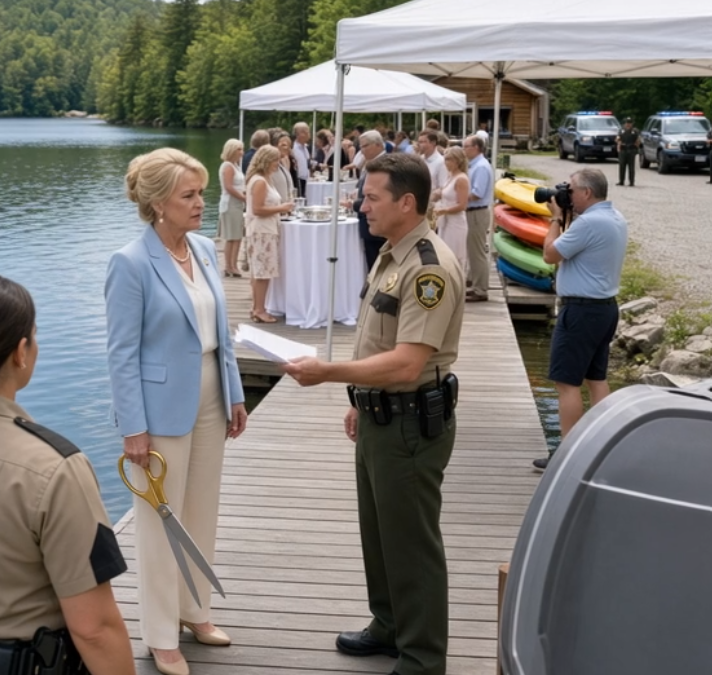
Deputy Carson handed her the closure notice.
“This marina is being shut down pending investigation into unlawful construction, commercial trespass, unauthorized lake access operations, and unresolved environmental violations.”
Half the crowd looked confused.
The other half looked terrified.
One homeowner near the champagne table laughed nervously because he honestly thought this had to be a misunderstanding.
Then Diane spotted me standing near the shoreline hill.
Her face changed.
There it was.
Recognition.
She walked toward me fast, heels clicking across the dock while photographers and residents turned to watch.
“You did this?” she snapped.
I looked past her toward Mercer Lake, blue and still under the morning sun, the same way it had looked when my father taught me to cast a fishing line there sixty years earlier.
“No,” I said calmly. “You did.”
Diane stopped three feet away and stared at me like she still could not process the fact that the old widower living beside the lake had quietly waited until opening day to let her entire project collapse in front of investors, homeowners, local reporters, vendors, and half the county.
That silence bothered her more than yelling ever could have.
“This community invested two million dollars into this marina,” she hissed.
I nodded slowly.
“Probably should have checked who owned the lake first.”
That landed hard.
PART3:
Behind her, deputies began zip-tying bright orange closure notices onto the marina gates. Confused residents crowded around asking questions all at once.
“Wait, what do you mean private property?”
“We paid for annual memberships.”
“Are the boat slips canceled?”
“Diane, what is going on?”
Memberships.
There was the real problem.
Diane had spent nearly a year selling boat access, fishing passes, kayak rentals, dock privileges, and summer events to homeowners using a lake her HOA never legally controlled.
Mercer Lake looked public from their back patios.
But appearance and ownership are two very different things in America.
Important difference.
One deputy asked the catering crew to start packing equipment. Another blocked the launch ramp before anyone could unload a boat into the water. The jazz trio stopped playing halfway through a song. Even the wind seemed quieter.
Diane stepped closer and lowered her voice.
“You could have warned us before today.”
I almost laughed.
Because she knew.
Deep down, Diane Fairchild absolutely knew something was wrong months earlier when certified letters started arriving from my attorney, when county survey maps showed every inch of shoreline belonged to my family, and when she kept building anyway because she thought pressure and money would carry her through.
People like Diane always mistake silence for surrender.
“I did warn you,” I replied. “Three times by certified mail.”
Her jaw tightened instantly.
Around us, residents were pulling out phones, reading HOA membership contracts, and searching county property maps online while deputies continued locking down the marina one section at a time.
Public humiliation moves fast once paperwork enters the room.
Especially waterfront paperwork.
I stood there listening to confused voices echo across the dock while sunlight rolled over Mercer Lake behind the unfinished celebration tents.
The strangest part was how peaceful the water still looked through all of it.
Same lake.
Same shoreline.
Same wind moving across the surface.
Only difference was now everybody finally understood something my father taught me when I was a kid standing on that same shore holding a fishing pole bigger than I was.
Water remembers who owns it.
Even when people pretend not to.
Let me back up, because people hear the words private lake and immediately imagine some billionaire compound with gates, cameras, and armed security.
Mercer Lake was never like that.
It sat deep in northern Michigan, about twenty minutes outside Grayling, surrounded by pine trees, cattails, old fishing cabins, and enough silence to make city people uncomfortable after dark.
My father bought the first piece of shoreline in 1958 after coming home from Korea with thirty dollars in his pocket and a survey map folded into quarters.
Back then, nobody wanted swampy shoreline land full of mosquitoes and bluegill. But my father saw something different the first time he stood beside that water at sunrise.
He saw peace.
He spent the next twenty years slowly buying every acre around the shoreline until the entire lake belonged to our family, including the lake bed itself.
Important detail.
Most people never realize shoreline ownership and lake-bed ownership are not always the same thing.
That misunderstanding creates a lot of expensive problems later.
I grew up on Mercer Lake.
I learned how to row a boat before I could properly ride a bicycle. I learned how to identify fish by the movement of water before I learned algebra. During summers, my father would wake me before dawn, and we would push the old aluminum fishing boat away from the dock while fog rolled low across the lake like smoke drifting over glass.
Cold mornings.
Quiet mornings.
Sometimes we sat for thirty minutes without saying a word while loons called somewhere near the western reeds.
Those were the best mornings.
My father was not a sentimental man in public. He was a contractor, a veteran, and the kind of man who believed most problems got worse when people talked too much before doing the work.
But on the lake, he softened.
He would hand me a sandwich wrapped in wax paper, point toward the shoreline, and say, “Tommy, land is one thing. Water is another. People will respect a fence because they can see it. They forget water has boundaries too.”
I was too young to understand.
Later, I would.
My father put Mercer Lake into a family trust before he died. Not because there was much money left, but because he wanted the lake protected. No subdivision docks. No public marina. No gas pumps. No commercial rentals. No shoreline scraping. Fishing by permission only. Quiet use. Conservation easements on the wetland side. Everything recorded properly because my father trusted handshakes for neighborly favors, not for property rights.
For decades, the system worked.
Local kids fished from the old south bank if they asked.
A church group used the shoreline once a summer for a picnic.
Fire rescue had written emergency access.
The DNR had permission to monitor fish habitat.
Neighbors respected the lake because they knew someone had cared for it before they arrived and someone would care for it after they left.
Then Harbor View Estates happened.
At first, it was just a development sign.
COMING SOON
HARBOR VIEW ESTATES
LUXURY LIVING BESIDE MERCER LAKE
Beside.
That word mattered.
Not on.
Not owning.
Beside.
The developer bought eighty acres uphill from my western boundary. Nice land, high enough to see the lake through the pines, not close enough to touch it without crossing the old logging road and my shoreline parcel.
I reviewed the county filings when they came through.
I had concerns.
The roads were too close to runoff channels.
The marketing materials showed kayaks on water they did not own.
The first subdivision map labeled the view corridor “lake lifestyle zone,” which meant nothing legally but plenty in sales language.
My attorney, Maribel Santos, sent the developer a letter before the first lot sold.
Mercer Lake and all shoreline access remain private property held by the Mercer Family Trust. Harbor View Estates has no deeded, implied, recreational, commercial, or riparian access rights to Mercer Lake. Any marketing suggesting lake access must be corrected immediately.
To the developer’s credit, he corrected the first brochure.
For a while.
The early residents were decent enough.
Most waved.
Some asked permission to walk the western trail.
A retired dentist named Paul Hensley asked if he could photograph birds near the marsh. I said yes. He sent me a Christmas card with a picture of a heron on it.
That was how neighbor life was supposed to work.
Then Diane Fairchild moved in.
Lot 14.
Tall modern house.
Black windows.
Outdoor fireplace.
Driveway lights bright enough to guide aircraft.
She arrived with money, confidence, and a belief that every place improved when she organized it.
Within six months, she was on the HOA board.
Within nine, she was president.
Within a year, she was talking about “activating underutilized lakefront assets.”
I heard that phrase from Paul Hensley at the post office.
I laughed because I thought he was joking.
He was not.
“She says the lake is why most of us bought here,” Paul said.
“You bought a view.”
“That’s what I told her.”
“And?”
“She said views become access when communities mature.”
I looked at him.
“Paul, that sentence means nothing.”
“I know.”
But Diane was good at meaningless sentences. She wrapped them in polished newsletters and PowerPoint slides until residents who should have known better started repeating them like law.
Community shoreline opportunity.
Legacy access.
Recreational enhancement.
Amenity equity.
Underutilized water resource.
She never said trespass.
Funny how people avoid the accurate word.
The first real problem came when Harbor View residents started walking down to the lake without asking.
At first, I assumed confusion.
A couple wandered onto my west bank with fishing rods.
I explained politely.
They apologized and left.
A family launched an inflatable raft from the cattails.
I explained less politely.
They left too.
Then a group of teenagers dragged kayaks across the trail and scraped a fresh path through young saplings.
That was when I put up signs.
PRIVATE PROPERTY
MERCER LAKE
NO LAUNCHING, FISHING, SWIMMING, OR DOCK ACCESS WITHOUT WRITTEN PERMISSION
Two days later, the signs were gone.
I put up new ones.
Those disappeared too.
A week later, Diane called.
“Mr. Mercer,” she said, voice warm enough to sound rehearsed. “This is Diane Fairchild, president of Harbor View Estates HOA.”
“I know who you are.”
“Wonderful. Then I’ll be direct. We seem to have a misunderstanding about lake access.”
“No misunderstanding.”
“I appreciate that your family has been here a long time.”
“That’s not the issue.”
“But Harbor View was clearly developed as a lake community.”
“Beside a lake. Not on it.”
She laughed softly.
The laugh told me we were not going to be friends.
“With respect, Mr. Mercer, that distinction may be more emotional than legal.”
I looked out my kitchen window at the water.
“Diane, do you have a deed?”
“We have community reliance.”
“Do you have an easement?”
“We have documented marketing history.”
“Do you have written access from the Mercer Trust?”
Pause.
Then: “I think this conversation would be better handled in person.”
“I think it’s over.”
I hung up.
The first certified letter went out the next day.
Maribel drafted it.
Private lake.
Private shoreline.
No access rights.
No HOA authority.
No removal of signs.
No launching.
No construction.
No commercial activity.
Cease and desist.
Diane signed for it herself.
Then she ignored it.
That spring, Harbor View announced a “Lake Vision Committee.”
I learned about it from a glossy pamphlet left in my mailbox.
Not mailed.
Left.
Which meant someone from Harbor View had driven down my private lane to deliver a brochure about their plans for my lake.
I still remember the cover.
Children in life jackets.
A golden retriever on a dock.
A smiling couple holding wine glasses.
The headline:
MERCER LAKE: A SHARED FUTURE
Shared.
Another funny word.
Inside, the plan showed a “proposed private marina,” “resident kayak launch,” “event dock,” “seasonal slip program,” and “future fuel and service station.”
The map was worse.
It showed the marina sitting on my western shoreline.
Not adjacent.
Not nearby.
On it.
The access road crossed my land.
The dock extended over my lake bed.
The fuel cabinet sat within fifty feet of the waterline.
I drove to Harbor View’s clubhouse that afternoon.
Diane was in the conference room with three board members and a man in a navy polo shirt with a marina engineering logo.
She looked surprised to see me.
Not guilty.
Surprised.
As if the object in her plan had walked into the meeting uninvited.
“Mr. Mercer,” she said. “We’re in a private session.”
“That makes two of us.”
I dropped the pamphlet on the table.
“This stops today.”
The engineer looked at the map, then at me.
“You’re the adjacent owner?”
“I’m the lake owner.”
That got his attention.
Diane smiled.
“Mr. Mercer’s family owns certain historic parcels around the lake. We’re still clarifying shared-use rights.”
“No,” I said. “You’re selling access you don’t have.”
One board member, a retired banker named Leonard Pike, frowned.
“Diane, I thought counsel reviewed this.”
“They did,” she said quickly.
“Whose counsel?” I asked.
Diane’s face tightened.
“HOA counsel.”
“Then have them send me the deed, easement, license, or court order.”
The room went quiet.
The engineer closed his folder slightly.
Smart man.
Diane stood.
“Mr. Mercer, you cannot interrupt association planning meetings.”
“You’re planning trespass on my land.”
“We are exploring community options.”
“Explore somewhere else.”
She leaned forward.
“You do realize this marina would increase property values throughout the area.”
“My father did not protect this lake for your appraisal.”
That was the first time I saw the real Diane.
Not polished.
Not diplomatic.
Not community-minded.
Cold.
“You are one elderly man standing in the way of an entire community.”
“I’m the one elderly man with the deed.”
I left.
The second certified letter went out the next morning.
This one was longer.
It included copies of the trust deed, lake-bed ownership records, shoreline plat, conservation easement, and the emergency access agreement with fire rescue showing that even public agencies asked permission.
Diane signed for that letter too.
Then construction stakes appeared on my shoreline three weeks later.
Red flags.
Orange paint.
A cleared strip through the brush.
Someone had cut two young pines and dragged them aside.
That changed the matter from annoying to dangerous.
I photographed everything.
Then I called Deputy Carson.
He had handled a trespass case for me years earlier when a hunter crossed the north ridge. He was calm, patient, and allergic to nonsense.
He met me at the shoreline.
Walked the stakes.
Read the signs.
Looked at the cut trees.
“HOA?” he asked.
“Yes.”
He sighed.
“Why is it always an HOA?”
“Because people behave worse in groups when they think minutes were taken.”
He almost smiled.
“Do you want a report?”
“Yes.”
“Do you want me to talk to them?”
“Not yet.”
That surprised him.
“You sure?”
“I want the report first. Clean. No argument. No warning they can twist.”
Carson studied me.
“You’re building a file.”
“I am.”
“Good.”
The third certified letter went out with the sheriff’s incident report attached.
This time, Maribel also copied the county zoning office, the Department of Environment, the marina contractor, the engineering firm, and Harbor View’s insurer.
That got attention.
Not from Diane.
From everyone around her.
The engineering firm withdrew within a week.
Their letter was short.
They had been retained based on representations that the HOA possessed necessary shoreline control. Because ownership was disputed and documentation had not been provided, they were suspending professional services pending verification.
Diane replaced them.
Fast.
The second firm was smaller, cheaper, and less curious.
The contractor was a company called NorthStar Marine Works.
Its owner, Calvin Boyd, called me himself.
“Mr. Mercer, I don’t want trouble.”
“Then don’t build on my lake.”
“I was told the HOA had access.”
“Ask them for the recorded document.”
“They said it’s in legal review.”
“That means no.”
Calvin sighed.
“I’ve got a signed contract.”
“With them. Not me.”
“I understand.”
“Do you?”
He was quiet.
Then said, “I’ll talk to Diane.”
Two weeks later, NorthStar equipment rolled onto my shoreline at 6:40 in the morning.
Excavator.
Flatbed.
Pile sections.
Decking.
Floating dock frames.
I stood in my driveway and watched them pass.
That was the moment I understood Diane’s strategy.
Move fast.
Spend money.
Create facts on the ground.
Make the project look too expensive to undo.
Then force me to negotiate.
People like Diane believe momentum is ownership.
They are wrong.
But correcting them takes patience.
For the next three months, I documented everything.
Every truck.
Every workday.
Every tree removed.
Every foot of shoreline disturbed.
Every post driven.
Every load of stone.
Every piece of decking.
Every new advertisement Harbor View sent residents.
I kept a binder on my kitchen table.
Maribel called it “the obituary.”
“For what?” I asked.
“For Diane’s defense.”
I did not sue immediately.
That frustrated people who knew me.
Paul Hensley stopped by twice.
“Tom, they’re building the dock.”
“I know.”
“They’re pouring the ramp.”
“I know.”
“They’re selling slips.”
“I know.”
“You’re awfully calm.”
“No,” I said. “I’m documented.”
There is a difference.
Diane sent newsletters every month.
The marina became Harbor View’s crown jewel.
Early-bird slip reservations.
Annual fishing passes.
Kayak storage plans.
Founder memberships.
Private launch privileges.
A summer concert series.
Wine on the water.
I saved every announcement.
Every price sheet.
Every contract screenshot residents forwarded me once doubts started spreading.
The founder memberships cost $12,000 each.
Annual slip fees ranged from $4,000 to $8,500.
Kayak storage was $1,200.
Fishing access was $600 per household.
Diane had turned my lake into an HOA revenue stream before the first dock section touched water.
That was not misunderstanding.
That was business.
Then came the environmental mistake.
Fuel cabinets.
I saw them arrive on a flatbed one Thursday afternoon.
Two gray cabinets with hazard placards, intended for dockside fueling.
I called Maribel.
She called the county.
The county called the state.
The state sent an inspector named Rosa McKee.
Rosa arrived wearing field boots, no makeup, and the face of a woman who had once been lied to by better people than Diane.
We walked the shoreline together.
She took notes without speaking much.
Disturbed cattails.
Unauthorized grading.
Sediment controls missing.
Wetland buffer intrusion.
Commercial dock construction without verified ownership consent.
Fuel storage too close to water.
Unpermitted shoreline hardening.
When Diane arrived, she brought two board members and a folder.
Rosa asked one question.
“Do you have written authorization from the lake owner?”
Diane smiled.
“Harbor View Estates is the lake community.”
Rosa looked at her.
“That was not my question.”
Diane’s smile faded.
“We are in the process of clarifying certain historical rights.”
Rosa made a note.
“Meaning no.”
Diane’s voice sharpened.
“This project has been approved by our board.”
“I don’t regulate your board.”
The inspection lasted ninety minutes.
The notice of violation arrived ten days later.
Diane called it “administrative housekeeping” in the next newsletter.
That was when I decided to wait for opening day.
Not because I wanted drama.
Because Diane had spent months turning theft into ceremony.
She had sold the illusion publicly.
It needed to end publicly.
Maribel filed for emergency injunctive relief two days before the grand opening. The county filed its own enforcement action. The environmental office issued a pending closure recommendation. Deputy Carson prepared the trespass and access report.
Everything converged on Saturday morning.
Ribbon cutting day.
Diane had picked perfect weather.
Blue sky.
Light wind.
Sun on the water.
The tents went up early.
White fabric.
Gold ribbons.
Champagne tables.
A stage.
A banner.
The jazz trio.
Photographers.
Local reporters.
Residents in linen shirts and summer dresses.
Children with new life jackets.
Pontoon boats decorated with little Harbor View flags.
I watched from the tree line with my hands in my jacket pockets.
Mercer Lake looked beautiful.
That angered me more than the crowd did.
Because Diane had counted on the lake making her look good.
She had counted on the water forgiving her before anyone asked whether she had the right to stand there.
At 10:55, the sheriff’s SUVs came down the gravel road.
At 11:00, Diane lifted the scissors.
At 11:01, Deputy Carson said, “Nobody launches a boat today.”
And everything Diane built began to collapse.
Not physically.
Not yet.
First came confusion.
Then denial.
Then phones.
Then residents realizing their membership contracts promised “exclusive HOA-managed lake access” but contained no deed reference, no easement, and no lake-owner consent.
A man named Richard Bale shouted, “I paid for Slip 14.”
Deputy Carson said, “No one is using Slip 14 today.”
A woman in a white hat asked, “Are we trespassing right now?”
Another deputy answered, “You are being instructed to leave the restricted dock area.”
Someone yelled, “Diane, where is the access agreement?”
Diane did not answer.
That silence did more damage than anything I could have said.
Calvin Boyd from NorthStar Marine stood near the ramp, pale and sweating. He had ignored my warning and built anyway. Now deputies were photographing his work and environmental officers were marking disturbed shoreline.
He walked up to me.
“I should have stopped.”
“Yes.”
“I asked her three times for documents.”
“What did she say?”
“That legal had it handled.”
“And you believed her?”
He looked back at the dock.
“I wanted to.”
That was honest enough to be useless.
By noon, the marina was emptying.
By 12:30, the catering crew had loaded the last trays.
By 1:00, the jazz trio was gone.
By 1:15, the banner was folded on the ground.
HARBOR VIEW PRIVATE MARINA
GRAND OPENING
The words looked smaller off the frame.
Diane stayed until the last reporter left.
Then she walked toward me one more time.
“You enjoyed this.”
“No.”
“You waited until today.”
“Yes.”
“That was cruel.”
I looked at the orange closure notices fluttering from the gate.
“Cruel was selling people access to something you knew you didn’t own.”
“I built something beautiful.”
“You built it in the wrong place.”
“You could lease it to us.”
“No.”
“You haven’t even heard the offer.”
“I heard it every time you trespassed.”
Her hands trembled slightly.
“This lake could be more than your private memory.”
That got through.
For the first time all morning, I felt anger rise hot enough to speak before thinking.
“My father bought this lake when everyone else thought it was worthless. He protected the wetlands when developers laughed at him. He let rescue crews in, let local kids fish, let neighbors enjoy it when they asked. He did not preserve it for sixty years so you could sell champagne memberships and call theft a community amenity.”
Diane stared.
I lowered my voice.
“You did not discover value here. You tried to harvest someone else’s.”
For once, she had no answer.
The court hearing happened the following Wednesday.
Diane arrived with HOA counsel, personal counsel, two board members, and the strained posture of a woman whose supporters had begun calculating how far away they needed to stand.
Maribel laid out the case.
Trust deed.
Lake-bed ownership.
Shoreline plats.
Conservation easement.
Certified letters.
Sheriff’s reports.
Environmental violations.
Marketing materials.
Membership contracts.
Construction invoices.
Photographs.
Diane’s newsletters.
The judge, a quiet man named Robert Haskins, read the membership brochure twice.
Then he looked over his glasses.
“Harbor View sold fishing passes?”
HOA counsel stood.
“Your Honor, the association believed in good faith that—”
Judge Haskins lifted one finger.
“I asked whether Harbor View sold fishing passes.”
Counsel paused.
“Yes.”
“For Mercer Lake.”
“Yes.”
“Without a signed access agreement from the Mercer Trust.”
Counsel looked at Diane.
“Yes.”
“Boat slips?”
“Yes.”
“Kayak rentals?”
“Storage, Your Honor.”
“On a dock built over a lake bed it does not own.”
Silence.
The judge made a note.
Diane’s attorney tried the same argument she had been making for a year.
Community reliance.
Historic expectations.
Economic investment.
Visual integration of the lake into the development.
The judge finally stopped him.
“Counsel, people can see the moon from their patios. That does not create a lunar access right.”
Nobody laughed.
Not because it was not funny.
Because Diane looked like she might shatter.
The injunction was granted.
Immediate closure.
No launches.
No rentals.
No events.
No fuel storage.
No dock use.
No marketing access.
No collection of membership fees.
No representation that Harbor View controlled Mercer Lake.
Then came the restoration question.
Maribel requested removal.
The HOA argued removal would be economically wasteful and environmentally disruptive.
Rosa McKee testified that leaving the marina in place created ongoing access pressure, runoff concerns, shoreline hardening, and fuel-risk issues.
Calvin Boyd testified under subpoena that Diane had represented the HOA’s lake access as “resolved pending final paperwork,” and that she told him not to contact me directly after my first warning because I was “emotionally attached and legally confused.”
That phrase did not help her.
Judge Haskins ordered a phased removal plan.
Fuel cabinets first.
Then rental racks.
Then launch ramp modifications.
Then floating docks.
Then shoreline restoration.
He allowed one narrow exception: the county and emergency services could use the old gravel turnout for rescue access with my written permission, the same as before.
Diane’s marina did not become hers.
It became evidence.
The financial collapse began immediately.
Residents demanded refunds.
Founder members threatened lawsuits.
The insurer reserved rights.
The contractor filed claims.
The HOA board held an emergency meeting that lasted four hours and ended with Diane resigning “to protect the community from further distraction.”
That phrase must come in a handbook somewhere.
Within a month, Harbor View issued a correction.
Mercer Lake is private property owned by the Mercer Family Trust. Harbor View Estates HOA has no recreational, commercial, boating, fishing, dock, marina, or lake-bed rights. All prior statements suggesting HOA lake access were incorrect.
Incorrect.
Another funny word.
I would have chosen unlawful.
But correction was enough.
The marina came apart slower than it went up.
That surprised people.
Building always looks fast until you watch something get removed carefully enough not to make the damage worse.
The aluminum slips were floated away one by one.
The kayak racks were unbolted.
The launch ramp was cut back.
Stone landscaping was removed from the buffer.
Cattails were replanted.
Sediment barriers went up.
Native grasses returned.
The fuel cabinets left on a flatbed before dawn, which felt appropriate.
Diane never came to watch.
Some residents did.
Paul Hensley stood beside me one morning while workers pulled cedar decking from the shoreline.
“I’m sorry,” he said.
“You didn’t build it.”
“No. But I believed her longer than I should have.”
That was more honesty than most people offered.
I looked at the half-dismantled dock.
“She gave people what they wanted to hear.”
Paul nodded.
“That’s how expensive lies usually start.”
He was right.
The lawsuits inside Harbor View were none of my business, though bits of news traveled.
Founder memberships refunded through special assessments.
Board insurance fighting coverage.
Diane accused of exceeding authority.
Contractors unpaid.
Homeowners furious.
Property values did not collapse, though several residents had predicted doom without marina access.
People still had their big houses.
Their patios.
Their lake views.
Their walking trails.
They had simply lost the thing they never owned.
That is not loss.
That is correction.
One year after the shutdown, Mercer Lake looked like itself again.
Not perfect.
Scars take time.
The restored shoreline was still young. Newly planted grasses moved thinner than the old growth. The cattails had not fully filled in. The soil near the former launch ramp settled unevenly after rain.
But the water was quiet.
Loons returned to the western reeds.
Bluegill nested in the shallows.
The heron Paul photographed came back, though I liked to think it looked suspiciously at the place where Diane’s champagne table had been.
That summer, I unlocked the old south bank for the church picnic again.
Children fished from the grass.
Parents sat in folding chairs.
Someone asked if this was the lake from the marina story.
I said yes.
A little boy looked at the water and asked, “Where’s the marina?”
“Gone,” I said.
“Why?”
“Because it didn’t belong here.”
He accepted that more easily than adults had.
Children understand belonging better than people with investment committees.
That evening, after everyone left, I walked down to the dock my father built.
Not the fancy marina dock.
Our dock.
Twelve feet of weathered boards, repaired more times than I can count. One corner sits a little low no matter how often I level it. My father carved M into the underside of the last board when I was eleven, claiming no one would ever see it, which was exactly why it mattered.
I sat there until sunset.
The lake turned copper.
Then purple.
Then black.
For a few minutes, I could almost hear my father’s oars dipping into the water.
People think property disputes are about greed.
Sometimes they are.
This one was not.
I did not need every fish.
I did not need every view.
I did not need to keep people away just to feel powerful.
I had shared Mercer Lake for years with people who asked.
That was the difference Diane never understood.
Permission is not the enemy of community.
Permission is what keeps community honest.
Diane wanted the lake without the asking.
She wanted the beauty without the history.
The amenity without the owner.
The revenue without the right.
She thought if she built enough, sold enough, celebrated enough, and cut a ribbon in front of enough people, the lake would become what she had promised.
But water does not care about brochures.
A dock does not write a deed.
A champagne tent does not create an easement.
And a banner saying private marina means nothing when the private part belongs to someone else.
The next morning, I found a folded envelope in my mailbox.
No return address.
Inside was a check from Paul Hensley for one dollar and a handwritten note.
For my annual fishing permission, if you’ll still allow an old fool with a camera near the marsh.
I laughed for the first time in days.
Then I wrote him a receipt.
Permission granted.
No boat.
No guests.
No HOA meetings.
Bring your camera.
He framed it.
I know because he showed me later.
That is how access should work.
Clear.
Limited.
Written.
Respectful.
A boundary does not mean no one ever crosses.
It means the owner opens the gate.
Years later, people around Grayling still talked about Diane’s marina.
They said the deputies shut it down five minutes before the ribbon cutting.
They said the jazz trio packed up in silence.
They said Diane Fairchild stood on a two-million-dollar dock and learned she had built an empire on someone else’s water.
All true.
But when I remember that day, I remember something quieter.
I remember the moment after everyone left.
After the deputies drove away.
After the orange notices fluttered in the wind.
After the champagne went warm under the tents.
I walked down to the shoreline alone.
The lake tapped gently against the floating dock Diane had built without asking.
Same rhythm as always.
Same patient water.
I stood there and thought of my father in that old aluminum boat, telling me fences are easy because people can see them, but water needs better guardians.
He was right.
Water needs records.
Memory.
Patience.
A willingness to be called stubborn by people who arrive late and want what someone else protected.
That day, Mercer Lake did not roar.
It did not fight.
It did not explain itself.
It simply waited while the paperwork caught up.
And when it did, the truth was as calm and complete as the water itself.
The marina was gone.
The memberships were gone.
The ribbon was never cut.
But Mercer Lake remained exactly what my father intended it to be.
Quiet.
Private.
Protected.
And still ours.








