HOA Karen Spent $100,000 Building a Road to My Locked Gate—Then Her Cop Brother Staked Out My Weekly Route and Arrested Me for DUI.
PART2:
Barn that stopped being a real barn sometime around 1992.
A detached workshop.
Trees along the eastern side.
A quarter-mile gravel driveway connecting to the county road.
Behind the house, an old farm track once continued west into what used to be dairy pasture.
That part matters.
When I was a kid, there was nothing behind us except cows.
The farmer, Mr. Wainwright, occasionally used that old track to bring equipment toward the back field.
My father didn’t care.
They were neighbors.
There was no written easement.
No deeded access.
No legal arrangement.
Just two men who had known each other for twenty years and sometimes opened a gate for one another.
Mr. Wainwright died.
His children sold the land.
Twelve years before Karen came into my life, developers bought the farm and built sixty-two houses.
Maple Ridge Estates.
Brick entrance monument.
Decorative pond.
Walking trail.
Clubhouse.
HOA.
All the usual things.
The development had a perfectly good entrance on Jefferson Road.
Actually, it had a very good entrance.
Two lanes.
Turn lane.
Streetlights.
But because of the way the subdivision curved around the old fields, residents living on the western side had to drive maybe six or seven extra minutes to reach the county road.
The old farm track behind my house would have shortened that.
The developer noticed.
So did residents.
For the first few years, people occasionally used it anyway.
There was no proper road on the subdivision side.
Just remnants of the farm track.
A few SUVs cut through.
Then pickups.
Then teenagers.
I tolerated it longer than I should have.
My mistake.
When people do something repeatedly without being challenged, eventually they stop remembering it was a favor.
The end came on a Saturday afternoon.
I was repairing a pressure washer in the garage when I heard gravel spray.
I looked outside just in time to see a blue pickup fly down my driveway.
Too fast.
Way too fast.
It clipped my mailbox at the county road.
Mailbox exploded.
Truck kept going.
Didn’t stop.
That evening I drove steel posts into the old connection behind the house.
Two days later, I installed a twelve-foot steel farm gate.
Then a chain.
Then a padlock.
Access ended.
Nobody challenged it.
Not the developer.
Not the HOA.
Not residents.
Nine years passed.
The gate became background scenery.
Then Karen Bell became HOA president.
I knew who she was before I actually met her.
Everybody near Maple Ridge did.
She had been on the board two years.
Former commercial real estate manager.
Mid-fifties.
Very organized.
Very polished.
She drove a silver Lexus SUV and treated every meeting like she was negotiating an international treaty.
To be fair, she had accomplishments.
She got the landscaping company replaced after residents complained about poor service.
She negotiated a better pool maintenance contract.
She caught an insurance billing error that saved the HOA several thousand dollars.
People respected her.
Then she became president.
Something about that title seemed to change the size of the territory she believed she governed.
The first time she came to my door, she carried a blue folder.
Color tabs.
Maps.
Printed traffic estimates.
I opened the door.
“Mr. Reeves?”
“Yes.”
“Karen Bell.”
“I know.”
She smiled professionally.
“Do you have a few minutes?”
I stepped onto the porch.
She opened the folder.
“I’ll be direct.”
That was the first true thing Karen ever said to me.
“Our residents currently lose approximately six to seven minutes using the main entrance depending on destination.”
“Lose?”
She ignored that.
“If your rear driveway connection were reopened, residents on the western half of Maple Ridge could reach Jefferson Road much more efficiently.”
“My driveway.”
“Yes.”
She smiled.
“Which is why we want to formalize it.”
“We?”
“The association.”
“No.”
She blinked.
“You haven’t heard the proposal.”
“I heard enough.”
“Mr. Reeves—”
“Gordon.”
“Gordon. We’re prepared to contribute toward maintenance.”
“No.”
“We would install a keypad gate at association expense.”
“No.”
“You would retain access.”
“To my own property?”
She paused.
“Of course.”
“Generous.”
Her smile weakened.
“We’re talking about sixty-two families.”
“I’m talking about one driveway.”
“School traffic alone—”
“Karen.”
I pointed behind the house.
“You want sixty cars every morning passing my kitchen window?”
“Not sixty simultaneously.”
“That improves it.”
“We can set a fifteen-mile-per-hour rule.”
“Who’s enforcing it?”
“The HOA.”
I laughed.
She didn’t.
“What happens when somebody slides into my ditch during snow?”
“We’ll address liability.”
“Somebody hits my dog?”
“Gordon.”
“Somebody’s teenager decides my driveway is the fastest way to test his Mustang?”
She closed the folder slightly.
“We’d carry insurance.”
“Insurance doesn’t make me want a road through my yard.”
She stared.
“You’re being emotional.”
“No.”
I smiled.
“I’m being proprietary.”
That word bothered her.
Maybe because she understood it.
“It is my property.”
She took a breath.
“Would you at least consider it?”
“I just did.”
“And?”
“No.”
Karen left.
I thought that was the end.
Two weeks later, I received an HOA letter.
It did not say “request.”
It said “proposed access coordination.”
I replied.
No access granted.
A month later, another letter.
This one discussed historic agricultural use and possible community access rights.
I wrote back.
No.
Then came a third.
It referred to the possibility of “asserting rights based on historical use.”
That got my attention.
Not because I thought they had a case.
Because threats become more expensive when ignored.
I took my deed.
Survey.
Plat.
Old closing papers.
Tax maps.
Everything.
My attorney was named Adrian Cole.
He was younger than me by fifteen years and had the irritating habit of reading documents silently for long periods while I sat there wondering whether he had forgotten I existed.
Finally he looked up.
“I don’t see an easement.”
“Neither did I.”
“No recorded right-of-way.”
“Good.”
“Any written agreement between your father and the Wainwright farm?”
“Not that I’ve ever found.”
“Did subdivision residents use the driveway continuously?”
“No.”
“How long?”
“Maybe three years off and on before I gated it.”
“And the gate’s been there nine years?”
“Yes.”
“Any objection?”
“No.”
He leaned back.
“Claims based on old use can get complicated, but based on what you’ve shown me, Karen does not have what she’s pretending she has.”
“Can you tell her?”
“I’d enjoy that.”
His letter was short.
No easement established.
No permission.
No consent to access.
No authorization for construction affecting my parcel.
Any future plan should assume the gate remained closed.
Certified mail.
Signature required.
That was my third refusal.
I kept the receipt.
Remember that.
Three weeks later, surveyors appeared behind my house.
I walked down.
They were on Maple Ridge common property.
Not mine.
One man waved.
I asked what they were doing.
“Road layout.”
“Road to where?”
He pointed at my gate.
I laughed.
He looked confused.
“Something funny?”
“Maybe.”
I called Karen.
Voicemail.
“Karen, surveyors are staking a road toward my gate. My answer remains no. Please make sure your board understands that.”
She never returned the call.
Then came orange stakes.
Drainage pipe.
A bulldozer.
Earthwork.
At first I assumed they were improving their walking trail.
Then the alignment became obvious.
Straight toward my gate.
I called Adrian.
“Can they build a road on their own land?”
“Yes.”
“Even if it ends at me?”
“Yes.”
“So I can’t stop them?”
“Not unless they cross your boundary.”
“What if it’s obviously intended to connect?”
“That is their expensive problem.”
So I watched.
Later I learned what happened inside the board meeting.
Vice President Bruce Harmon asked whether Karen had secured access.
Treasurer Sylvia Chen asked for written documentation.
Karen told them my lawyer was “involved” and final access details were being worked through.
Technically, my lawyer was involved.
He was telling her no.
Karen apparently left that part out.
Contractor pricing was supposedly about to expire.
Construction costs were rising.
Karen argued they should build the association’s portion immediately and finalize the last connection later.
The board voted.
Five to two.
They approved approximately one hundred thousand dollars.
Grading.
Drainage.
Retaining wall.
Curb.
Asphalt.
Lighting.
Striping.
Everything.
The project took eleven weeks.
I watched construction workers build one of the nicest dead ends in Virginia.
When the asphalt crews arrived, I sent Karen one final email.
Karen,
I want to avoid any misunderstanding.
The new road does not have permission to connect to my property.
My gate will remain closed.
Regards,
Gordon.
She replied seventeen minutes later.
Noted, thanks.
That email eventually became very expensive.
By August, the road was done.
It looked great.
Honestly.
Smooth asphalt.
Clean curb.
Six black LED poles.
Storm drains.
The whole thing sloped gently downhill from a Maple Ridge cul-de-sac and ended directly in front of my steel gate.
Eighteen inches before the boundary.
On the Friday before Labor Day, Karen arrived with the contractor’s project manager.
Two residents stood farther uphill.
A car idled behind them.
I was mowing near the gate.
Karen waved.
The contractor looked uncomfortable.
“So,” she said.
“So.”
“It’s finished.”
“I noticed.”
She smiled.
“We need the key.”
“No.”
That smile disappeared.
“Gordon.”
“No.”
“The association has spent nearly a hundred thousand dollars.”
“I know.”
“You watched us.”
“Yes.”
“You watched us spend that money and didn’t say anything?”
That made me angry.
“I said no at my front door.”
“You said no twice in writing.”
“Three times.”
“My lawyer said no.”
“And I emailed you while paving trucks were literally on the road.”
Karen stared.
“Those were negotiating positions.”
“No.”
“Everyone begins with a position.”
“That was my final position.”
I paused.
“I just gave it to you early.”
Behind Karen, one of the residents coughed to hide a laugh.
Her face flushed.
“We offered to improve your driveway.”
“I don’t want it paved.”
“Snow removal.”
“I own a tractor.”
“Cameras.”
“I own cameras.”
“Maintenance contribution.”
“I don’t need one.”
She pointed at the gate.
“This road is eighteen inches from being useful.”
“Yes.”
“Eighteen inches.”
“Exactly.”
“And those eighteen inches are yours?”
“Yes.”
She stared at me like I had personally moved the property line overnight.
Then she said, “You’re doing this to embarrass me.”
I actually stopped.
“Karen.”
“What?”
“I didn’t build the road.”
Silence.
“You promised people something on my property without asking me.”
“I did ask.”
“And I said no.”
“Any reasonable person would’ve come around.”
There it was.
Not permission.
Expectation.
She had never believed my no counted.
She believed persistence converted ownership.
“I told residents it would be open by Labor Day.”
“Why?”
“Because that’s what the project schedule required.”
“No.”
I shook my head.
“That is what your project schedule wanted.”
She closed the clipboard.
“Fine.”
“What?”
“We’ll handle it differently.”
Something in the way she said it made me uneasy.
But I didn’t know how literally to take it.
Labor Day passed.
My gate remained locked.
A handwritten NO OUTLET sign appeared at the top of the new road.
Residents complained.
Some blamed Karen.
Some blamed me.
One guy drove down and yelled through the gate that I was “holding sixty families hostage.”
I asked whether he needed food or water.
He called me an asshole and left.
Kids started skateboarding there.
Raymond started walking his beagle.
Life settled.
Then in October, Bruce Harmon knocked on my door.
He was about sixty-five.
Retired defense contractor.
Quiet man.
Always wore khakis.
“Gordon?”
“Yeah.”
“Can I ask you something?”
“Sure.”
“Were you ever close to granting the HOA access?”
“No.”
“Never?”
“No.”
“Did Karen ever have a verbal agreement?”
“No.”
“Conditional agreement?”
“No.”
“Handshake?”
“No.”
“Anything?”
I stared.
“Bruce, what’s going on?”
He rubbed his jaw.
“I’m trying to understand something.”
I went inside.
Brought the folder.
Letters.
Adrian’s certified letter.
My email.
Karen’s “Noted, thanks.”
Bruce read everything.
Then asked, “Can I photograph these?”
“Yes.”
He did.
When he finished, he said, “Thank you.”
“Bruce.”
He stopped.
“Did she tell the board something different?”
His face told me before his mouth did.
“I think we need to review our records.”
Then he left.
Three weeks later, I had dinner with my sister.
Her name is Linda.
Every Thursday.
For years.
She lives about twelve miles away.
Our wives had been friends before my wife, Anne, died from ovarian cancer six years earlier.
After Anne died, Linda made Thursday dinner mandatory.
Her exact words were, “If I leave you alone, you’ll eat cereal over the sink.”
She was right.
Thursday became routine.
I drove over around six.
Ate.
Complained about politics.
Fixed whatever minor thing Linda had broken.
Drove home around nine-thirty.
That Thursday, dinner was meatloaf.
I drank two glasses of iced tea.
No alcohol.
Not one beer.
Not a sip.
At nine-forty-five, I left.
Half a mile from home was a four-way stop beside Grace Fellowship Church.
Quiet intersection.
I stopped.
Looked left.
Right.
Continued.
Seconds later, blue lights filled my mirrors.
I remember saying, “What the hell?”
I pulled over.
Sheriff’s cruiser behind me.
A second deputy was inside.
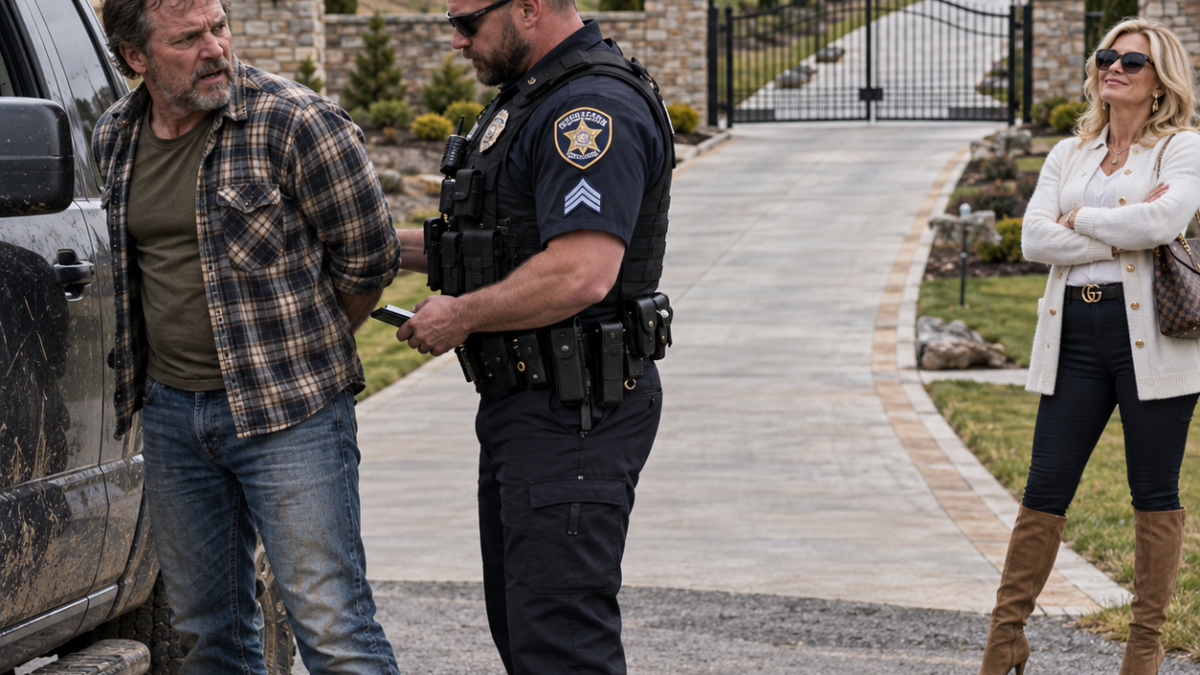
The driver’s door opened.
A man in his forties approached.
Short dark hair.
Broad build.
His nameplate said D. BELL.
At the time, that meant nothing to me.
He came to the window.
“Evening, Gordon.”
That should have registered.
It didn’t.
Not immediately.
“Evening.”
“License, registration, insurance.”
I handed them over.
He hadn’t looked at my license yet.
But he’d called me Gordon.
It bothered me later.
At the time, I assumed maybe he knew me.
Small town.
“Know why I stopped you?”
“No.”
“You rolled the stop sign.”
I frowned.
“I don’t think I did.”
“You don’t think?”
“I’m pretty sure I stopped.”
“Pretty sure.”
His voice changed.
Little sharper.
He returned to the cruiser.
The second deputy stayed near the passenger side.
Younger.
Maybe late twenties.
His name was Nolan Pierce.
Ten minutes passed.
Derek Bell returned.
“Where are you coming from?”
“My sister’s.”
“Where’s she live?”
I told him.
“Been drinking tonight?”
“No.”
“Nothing?”
“Iced tea.”
He leaned closer.
“Your eyes look glassy.”
“You’ve got a flashlight pointed at them.”
Wrong answer.
His expression hardened.
“Step out.”
I did.
My left knee had been reconstructed after a ladder accident.
Two surgeries.
On uneven surfaces, balance wasn’t perfect.
Road shoulder was loose gravel.
Derek told me to stand near the cruiser.
“I’m going to run some field sobriety tests.”
I looked at him.
“Why?”
“I smell something.”
“What?”
“Possible intoxicant.”
“What kind?”
He ignored me.
“Follow the tip of this pen with your eyes.”
I did.
Then he described a heel-to-toe walk.
I said, “My knee is bad.”
“Which knee?”
“Left.”
He looked at it.
“Can you walk?”
“Yes.”
“Then you can do the test.”
That didn’t sound right.
My cousin worked as a paralegal.
Years earlier he’d told me roadside coordination exercises were different from the formal chemical testing procedures after an arrest.
I wasn’t confident enough to quote law.
So I said, “I’d rather not do the balance tests with my knee. If you’ve got a breath test, I’ll take that.”
Derek’s face changed.
“So you’re refusing.”
“I’m declining the balance tests.”
“That’s refusing.”
“Not a breath test.”
“When people refuse tests, it tells me something.”
“It tells you my knee is bad.”
Nolan looked uncomfortable.
I noticed.
Derek stepped closer.
“Your speech sounds thick.”
“I don’t know what that means.”
“You’re swaying.”
“I’m standing on gravel.”
“Turn around.”
“What?”
“Hands behind your back.”
My stomach dropped.
“For what?”
“You’re under arrest for driving under the influence.”
For one second, I thought he was trying to scare me.
Then handcuffs closed.
Real cuffs.
Cold steel.
My truck sat on the roadside.
Nolan guided my head into the cruiser.
“Watch your head, sir.”
I looked at him.
“Did you see me roll the stop?”
He hesitated.
“I was on the radio, sir.”
That answer would matter later.
At the station, the anger wore off.
Fear replaced it.
I had never been arrested.
Not once.
No criminal record.
Barely any traffic tickets.
Suddenly I was sitting under fluorescent lights while someone inventoried my wallet.
Derek read instructions for the evidentiary breath test.
I agreed immediately.
There was an observation period.
Then I blew.
Machine processed.
Printed a strip.
Derek tore it off.
Looked.
0.00.
He stared longer than necessary.
Then said, “Could be drugs.”
“What drugs?”
“Medication?”
“Lisinopril.”
“What else?”
“Vitamins.”
“Cannabis?”
“No.”
“Prescription pain medication?”
“No.”
Derek requested a drug recognition evaluator.
She arrived maybe forty minutes later.
Woman named Sergeant Elena Morales.
Professional.
Calm.
She asked about my knee before making me do anything physical.
Checked pupils.
Pulse.
Blood pressure.
Coordination.
Speech.
Questions.
I answered everything.
At one point she stepped outside with Derek.
Door wasn’t fully closed.
I heard her say, “I’m not seeing indicators supporting impairment.”
Derek said something I couldn’t hear.
Morales answered more firmly.
“Nothing here supports it.”
Eventually I went before a magistrate.
Derek sought a DUI warrant.
It was not issued.
Insufficient basis.
I did receive a traffic summons for failing to stop.
My sister picked me up shortly before three in the morning.
She took one look at me.
“What happened?”
“I apparently became an alcoholic without drinking.”
The joke fell flat.
My truck had been towed.
One hundred eighty-five dollars.
The next morning I felt ashamed.
That’s what surprised me.
I knew I hadn’t done anything.
Still felt ashamed.
Handcuffs do something to you.
Being searched.
Put in a cruiser.
Standing while people drive by looking.
I kept wondering whether anyone I knew had seen.
Then anger returned.
My truck had a dash camera.
I had installed it after a deer collision years earlier.
Front camera.
Wide field.
Good timestamp.
Audio.
I retrieved the footage.
Nine fifty p.m.
Church intersection.
My truck slowed.
Stopped.
Completely.
More than two seconds.
Then proceeded.
I watched it five times.
Full stop.
No ambiguity.
Then I rewound.
There was something else.
As I approached the intersection, the sheriff’s cruiser was visible.
Parked in the dark church lot.
No emergency lights.
Facing the road.
Waiting.
That bothered me more than the fake stop violation.
A deputy can mistakenly think a vehicle rolled a stop.
Human error.
But why was he sitting in that exact lot on the exact route I drove every Thursday night?
I brought the video to Adrian.
He watched once.
Then again.
“Don’t post this.”
“I wasn’t going to.”
“Don’t send it around.”
“Why?”
“Because first we preserve everything.”
He started writing.
“Dash camera original file.”
“Dispatch records.”
“Body camera.”
“Patrol video.”
“Plate queries.”
“Radio traffic.”
“Personnel complaint.”
I stared.
“You think this was deliberate?”
“I think we don’t guess.”
He pointed at the screen.
“We investigate.”
That word became my life for months.
January.
Traffic court.
Prosecutor reviewed the dash footage.
Stop-sign charge dismissed.
No drama.
No apology.
Just dismissed.
I filed a formal complaint with the sheriff’s office.
Professional standards interviewed me in February.
Two investigators.
Detailed questions.
They asked whether I knew Deputy Derek Bell personally.
“No.”
“Know his family?”
“No.”
Then one asked, “Do you know Karen Bell?”
Everything inside me went still.
“What?”
“Karen Bell.”
“Maple Ridge HOA president?”
“Yes.”
I stared.
“Why?”
The investigator’s face revealed nothing.
“Answer the question.”
“Yes.”
“How?”
I explained the road.
The gate.
The dispute.
The letters.
The hundred thousand dollars.
The investigator wrote quietly.
Then asked, “Did you know Deputy Bell is her brother?”
No.
I did not.
Suddenly “Evening, Gordon” sounded different.
Much different.
I called Adrian from the parking lot.
“He’s her brother.”
“I suspected.”
“You suspected?”
“Same surname.”
“Bell isn’t exactly rare.”
“No.”
“Why didn’t you tell me?”
“Because suspicion isn’t evidence.”
I hated that answer.
He was right.
Months passed.
Nothing.
Professional standards investigations move slowly.
Civil cases move slower.
Adrian filed notice of potential claims.
Requested preservation.
Then in June, I received a letter.
Deputy Derek Bell had resigned while disciplinary proceedings were pending.
The sustained findings referenced inaccurate reporting and professional conduct.
Nothing said Karen.
Nothing explained why Derek had been waiting.
I should have felt satisfied.
I didn’t.
Something remained unanswered.
Why me?
Why there?
Why Thursday?
Adrian filed suit.
Not because I wanted a payday.
Because discovery gives you something complaints often don’t.
Records.
We requested Derek’s report.
Body camera.
Dash camera.
Computer-aided dispatch records.
Plate checks.
Internal messages.
Texts relevant to the stop.
Subpoenaed phone data within legal limits.
Deposed Nolan.
Derek’s written report said I had rolled the stop.
False.
Said my speech was slurred.
Video showed normal speech.
Said I swayed.
Video showed me standing with weight off my bad knee.
Said he detected the odor of an unknown intoxicant.
Nobody else documented any odor.
Post-arrest breath test was 0.00.
Drug recognition evaluator found no impairment.
Each fact alone could be explained.
Together they looked ugly.
Then dispatch records arrived.
My plate had been queried at 9:12 p.m.
The traffic stop began at 9:51.
Thirty-nine minutes.
Why was Derek running my plate thirty-nine minutes before the supposed violation?
Nolan’s deposition answered the next piece.
Adrian asked, “Why were you parked at Grace Fellowship?”
Nolan shifted.
“Deputy Bell chose the location.”
“Did he say why?”
“Not specifically.”
“Did he refer to Mr. Reeves?”
Long pause.
“Yes.”
“What did he say?”
Nolan looked toward his lawyer.
Then answered.
“He said we were waiting for a particular vehicle.”
My skin went cold.
“What vehicle?”
Adrian asked.
“Mr. Reeves’s truck.”
“Did Deputy Bell tell you how he knew Mr. Reeves would be there?”
“Yes.”
“What did he say?”
Nolan swallowed.
“He said, ‘That’s the guy giving my sister hell over a road.’”
I was sitting beside Adrian.
I didn’t move.
Nolan continued.
“He indicated the approaching truck before it reached the intersection.”
Adrian asked, “Before any traffic violation?”
“Yes.”
That was enough to make me angry.
The next production made me sick.
Messages.
Two days before my arrest, Karen texted Derek.
She sent my plate number.
Vehicle description.
Then:
He goes to his sister’s every Thursday.
Another message:
Usually comes back around 9:30.
Derek replied:
What do you want me to do?
Karen:
Nothing crazy.
Then:
Just shake him up a little.
Maybe he’ll finally be reasonable about the road.
Derek:
I’ll take a look.
I read the messages three times.
Maybe I was hoping the words would change.
They didn’t.
My first feeling wasn’t anger.
It was violation.
Karen knew where I went.
She knew my routine.
She knew Thursday dinners.
How?
Maybe she had seen me.
Maybe followed.
Maybe asked around.
It didn’t matter.
A property dispute had become personal surveillance.
Then she had handed my routine to a police officer.
Her brother.
“Just shake him up.”
Adrian sat across from me.
“You okay?”
“No.”
“We can stop for today.”
“No.”
I kept reading.
There were other texts.
Nothing saying “arrest him.”
Nothing saying “fabricate DUI.”
Karen would later build her defense around that.
But there was enough.
Her brother knew who I was.
Knew where I’d be.
Ran my plate before the stop.
Waited.
Invented a stop-sign violation contradicted by video.
Escalated to DUI.
Documented impairment unsupported by testing.
The story Karen wanted was simple.
She had merely vented to her brother.
Her brother independently overreacted.
Maybe.
But lawsuits don’t ask what story sounds nicest.
They ask what evidence supports.
An excerpt from those messages entered a public filing.
That changed everything.
Local news found it.
Headline:
HOA DISPUTE LINKED TO DEPUTY’S DUI ARREST, COURT RECORDS SHOW.
I hated seeing my name online.
People I hadn’t spoken to in twenty years called.
One asked whether I was going to sell movie rights.
I hung up.
Then the HOA received subpoenas.
Road project records.
Board minutes.
Email.
Access negotiations.
That was when Maple Ridge residents finally learned the whole story.
Bruce already knew enough to be concerned.
Sylvia knew the numbers.
Now they had everything.
My March refusal.
April refusal.
Adrian’s May letter.
June construction vote.
Karen’s statements to the board.
My paving email.
Her “Noted, thanks.”
Then communications involving Derek.
The board scheduled an emergency meeting.
Bruce asked me to attend.
I almost refused.
Adrian said, “Go.”
“Why?”
“Say as little as possible.”
“That’s your reason?”
“Yes.”
So I went.
Clubhouse packed.
People standing along walls.
I sat in the back.
Karen sat at the front with the board.
She looked composed.
Bruce opened.
“This meeting concerns the rear access project and related litigation.”
Murmurs.
Sylvia displayed the timeline.
March 4.
Gordon declines access.
March 27.
Second refusal.
May 8.
Attorney letter states no access will be granted.
June 12.
Board approves road project.
A resident raised his hand.
“Why did we approve it after the lawyer said no?”
Bruce looked at Karen.
So did everyone.
Karen leaned toward the microphone.
“At that time negotiations remained ongoing.”
Sylvia said, “What negotiations?”
Karen looked at her.
“Correspondence.”
“No.”
Sylvia held up Adrian’s letter.
“This says no.”
“People change positions.”
Bruce asked, “Did Gordon ever indicate he would?”
Karen sighed.
“He refused to engage constructively.”
Bruce looked toward me.
“Gordon.”
I stood.
“Did you ever tell Karen, verbally or in writing, that you might grant access?”
“No.”
“Did you authorize her to represent that your attorney was finalizing terms?”
“No.”
“Did Adrian?”
“No.”
“Was there ever a proposed easement agreement being negotiated?”
“No.”
I sat.
Karen spoke immediately.
“You’re hearing one side.”
Sylvia looked furious.
“No, Karen.”
She held up documents.
“We are reading your own emails.”
One email to Bruce before the vote said:
Gordon’s attorney is involved. I expect final access details to be resolved during construction.
Bruce said, “His attorney had already told us no.”
Karen replied, “That didn’t mean discussion was impossible.”
“You told us details were being finalized.”
“That was my assessment.”
“It was false.”
“I disagree.”
A resident shouted, “We spent a hundred grand!”
Karen snapped, “And we still have the road.”
Someone else yelled, “To a padlock!”
Laughter.
Angry laughter.
Karen’s composure cracked.
“The project remains valuable infrastructure.”
“For what?” a woman asked.
Karen answered, “Future access.”
I stood again.
“No.”
The room turned.
I looked directly at the board.
“There will be no future access.”
Then sat.
That ended that phrase.
Bruce moved to the texts.
Karen’s lawyer objected to discussing pending litigation.
Bruce said, “We are discussing conduct by an HOA officer related to an HOA dispute.”
Then he read:
He goes to his sister’s every Thursday.
Just shake him up a little.
Maybe he’ll finally be reasonable.
The clubhouse became silent.
Karen’s face changed.
She leaned toward the microphone.
“I was venting.”
Bruce stared.
“You sent a sheriff’s deputy his plate.”
“My brother.”
“A sheriff’s deputy.”
“I never told Derek to arrest him.”
Nobody spoke.
“I never told him to lie.”
Still silence.
“It was a private conversation between siblings.”
Sylvia asked, “Why did you give him Gordon’s weekly schedule?”
Karen looked at her.
“Because I was frustrated.”
A man near the front said, “That’s insane.”
Karen glared.
Bruce banged the table once.
“Please.”
Another resident stood.
“My daughter drives that intersection every night.”
Nobody answered.
He looked at Karen.
“You used a cop because somebody wouldn’t give you his property?”
“I did not use anyone.”
“Your text says shake him up.”
“My words were inappropriate.”
“That isn’t the same thing as accidental.”
Karen’s voice rose.
“I cannot control what my brother did.”
Bruce nodded slowly.
“No.”
Then looked at her.
“But you could control what you asked him to do.”
That was the moment she knew.
Under Maple Ridge bylaws, board officers served at board pleasure.
A motion was made to remove Karen as president.
Vote.
Four to one.
Karen voted no.
She remained temporarily a board member.
Residents began organizing the membership process to remove her entirely.
She resigned before that vote happened.
Bruce became acting president.
His first official project?
A turnaround at the end of Karen’s road.
And a permanent NO OUTLET sign.
Several thousand more dollars.
I offered him my old sign for free.
He did not find that funny.
The road remained.
Too expensive to tear out.
No point.
Technically it provided access to some utility infrastructure.
Mostly it provided exercise for Raymond’s beagle.
Derek’s situation continued separately.
Because he resigned during disciplinary proceedings, the department referred the matter for state certification review.
I don’t know every consequence.
I never chased rumors.
His law-enforcement career was no longer my business.
My civil lawsuit continued.
Karen was added as a defendant under theories my attorney explained and I won’t pretend to reproduce accurately.
There were motions.
Depositions.
Mediation.
More paper than I thought one bad traffic stop could generate.
Derek’s defense argued he independently believed I was impaired.
Our side pointed to the prior plate query.
The waiting location.
False stop allegation.
0.00 breath result.
DRE findings.
Nolan’s testimony.
Texts.
Karen argued she had merely asked her brother to speak with me if he happened to see me.
The phrase “shake him up” became the center of many expensive hours.
Twenty months after the arrest, the case settled.
Terms involving Karen were confidential.
My settlement covered legal costs.
Tow fee.
Additional compensation.
I did not become rich.
I did not buy an island.
I did replace the old roof on my workshop.
Linda joked that unlawful arrest had finally solved my gutter problem.
I told her not to make me laugh about it.
Then laughed anyway.
The money wasn’t the point.
The record mattered.
The traffic charge gone.
The DUI never supported.
Professional standards findings.
Documents.
Truth written somewhere official.
Because for months after the arrest, I had struggled with something I didn’t tell many people.
I kept seeing those lights.
Whenever a cruiser appeared behind me at night, my chest tightened.
Even when I knew I was doing nothing wrong.
Especially then.
I would check my speed.
Mirror.
Hands.
Seat belt.
Recheck.
My body remembered something my brain wanted to dismiss.
Linda noticed.
One Thursday, I stayed at her house until nearly eleven.
“You don’t want to drive.”
“I’m fine.”
“Gordon.”
“I’m fine.”
“You’ve been drinking iced tea for four hours.”
“Very dangerous beverage.”
She sat across from me.
“Don’t let them take Thursday.”
I looked at her.
“What?”
“Anne died.”
Her voice softened.
“We started these dinners because I wasn’t going to let you disappear.”
She pointed toward the driveway.
“You’ve been driving that route for years.”
“Don’t let Karen and her idiot brother own it.”
So I drove home.
Same intersection.
Same church.
Full stop.
Two seconds.
Then I continued.
Nothing happened.
The next Thursday, same thing.
Eventually my body stopped expecting blue lights.
That’s another kind of victory nobody talks about.
Taking back ordinary things.
The HOA road remained visible from my kitchen.
At first I hated looking at it.
It reminded me how stupid the whole situation had become.
Then I started finding it funny.
The streetlights especially.
All six.
Every evening at dusk.
Perfect illumination.
Straight to my padlock.
Raymond and his beagle became regulars.
His dog’s name was Chester.
Not after anyone involved.
I checked.
One evening Raymond stopped at the gate while I was outside splitting wood.
“Beautiful road.”
“Thanks.”
“You build it?”
“Not exactly.”
He laughed.
“Worth every penny.”
“Yours?”
“Unfortunately.”
He patted Chester.
“At least this idiot likes it.”
A year after Karen resigned, Maple Ridge held another board election.
Bruce didn’t run for president permanently.
Sylvia did.
She won.
One afternoon she came to see me.
No folder.
No maps.
No traffic study.
Just herself.
“Gordon.”
“Sylvia.”
“I wanted to tell you we updated our capital project rules.”
“Congratulations.”
She smiled.
“Anything requiring access to non-HOA property now needs written proof before board approval.”
“Seems advanced.”
“We’re innovators.”
I laughed.
Then she became serious.
“We should’ve verified what Karen told us.”
“Yes.”
“I voted for the road.”
“I know.”
“I trusted her.”
“I know.”
“That’s not an excuse.”
I respected that.
“No.”
“We owe you an apology.”
“The board?”
“Yes.”
She handed me a letter.
Formal.
No claim to my driveway.
No easement.
No right of access.
No future construction assumption.
It also acknowledged that prior representations concerning expected permission had not been supported by written consent.
I read it.
“Thank you.”
She nodded toward the gate.
“One question.”
“What?”
“Would you ever consider emergency-only access?”
I stared.
Her face fell.
“Sorry. Forget I asked.”
I laughed.
“No.”
“Fair.”
Then something unexpected happened.
Karen sold her house.
About eighteen months after she resigned.
Not immediately.
I saw the Lexus occasionally.
She still lived inside Maple Ridge.
We never spoke.
Then one morning a moving truck appeared.
By afternoon, boxes.
Furniture.
A new family moved in the following month.
I learned Karen had relocated to Maryland to be closer to her daughter.
That should have been the end.
Then she came to my house.
Two weeks after moving.
I was in the workshop.
A car pulled in.
Not the Lexus.
Rental sedan.
Karen stepped out.
No binder.
No HOA polo shirt.
No audience.
I wiped my hands and walked outside.
“What do you need?”
She stopped several feet away.
“Nothing.”
That surprised me.
“I wanted to speak to you.”
“My lawyer?”
“No lawyers.”
“Then talk.”
She looked older.
Not dramatically.
Just tired.
“I’ve been thinking about whether to come here.”
“Why?”
“To apologize.”
I said nothing.
She continued.
“For the road.”
“The road was stupid.”
“Yes.”
That caught me off guard.
“For what I told the board.”
“Also stupid.”
“Yes.”
She almost smiled.
Then lost it.
“And Derek.”
The air changed.
“That one’s harder.”
“I know.”
“Do you?”
Her eyes filled.
“Yes.”
She looked toward the ground.
“I told myself I was asking my brother to scare you.”
“That doesn’t improve it.”
“No.”
“I told myself he would pull you over, tell you to stop being difficult, maybe write a warning.”
“You gave a deputy my schedule.”
“Yes.”
“My plate.”
“Yes.”
“You wanted police authority to win a property argument.”
She swallowed.
“Yes.”
I appreciated the answer.
Hated it.
But appreciated it.
“I never asked him to arrest you.”
“I believe that.”
She looked surprised.
“That doesn’t make you innocent.”
Her expression tightened.
“I know.”
I leaned against the workshop door.
“Why did you care that much?”
Karen laughed softly.
Not humor.
“I don’t know.”
“You spent a hundred thousand dollars.”
“I know.”
“You risked your brother’s career.”
“I know.”
“Why?”
She looked toward Maple Ridge.
“I promised people.”
“That can’t be all.”
“No.”
She thought.
“I spent my career getting projects approved.”
“Land deals.”
“Access agreements.”
“Commercial development.”
“People always start with no.”
I remembered her words at the gate.
Opening positions.
She continued.
“My job was to turn no into yes.”
“And when I wouldn’t?”
“I thought you were playing.”
“I wasn’t.”
“I know.”
“Now.”
She nodded.
“I had built my whole identity around being the person who could make things happen.”
There it was.
Not power exactly.
Competence.
The addiction underneath it.
“When the board questioned whether I had your permission, I told them I’d get it.”
“Why?”
“Because I believed I would.”
“So you lied.”
“Yes.”
She didn’t soften it.
“Then the road was under construction.”
“Then I couldn’t admit I had been wrong.”
“So you doubled down.”
“Yes.”
“And when it was done?”
She looked at my gate.
“I thought if the pressure became embarrassing enough, you’d give in.”
“I didn’t.”
“No.”
Then she said, “And I hated you for making me look stupid.”
“You made yourself look stupid.”
“I know.”
That one sounded painful.
I crossed my arms.
“Karen, your brother put me in handcuffs.”
Her eyes filled.
“I know.”
“I sat in a police station wondering whether I was losing my license.”
“I know.”
“My sister picked me up at three in the morning.”
She looked away.
“I know.”
“You don’t get to turn that into a lesson you learned and feel good.”
“I don’t.”
Silence.
Wind moved through the trees.
Then she said, “Derek blames me.”
That surprised me.
“Maybe he should blame himself.”
“He does that too.”
I said nothing.
“He shouldn’t have done what he did.”
“No.”
“I shouldn’t have put him there.”
“No.”
She looked at me.
“I am sorry.”
I believed her.
That didn’t obligate me to make it easier.
So I said the truth.
“I accept that you’re sorry.”
Karen nodded.
Not forgiveness.
Not friendship.
Just acknowledgment.
She started toward the car.
Then stopped.
“Did you ever consider opening the gate after I left?”
I laughed.
Actually laughed.
Karen did too.
“Sorry.”
“I had to ask.”
“No, you didn’t.”
She got in the car.
Drove away.
I never saw her again.
A few months later, a storm came through.
Nothing major.
Heavy rain.
Trees down.
Power outage.
Maple Ridge’s main entrance became temporarily blocked because a large oak fell across Jefferson Road.
For approximately six hours, the western half of the development had an inconvenient detour through a secondary service road the county opened.
Some resident posted online:
Too bad Gordon won’t open his gate.
Sylvia replied publicly:
Mr. Reeves has no obligation to provide access through his private property. Please use the authorized detour.
I printed that.
Put it beside Karen’s old email.
Not because I’m petty.
All right.
Partly because I’m petty.
Today, nearly two years after the traffic stop, the gate remains locked.
I replaced the chain once because it rusted.
Same padlock style.
The $100,000 road still ends eighteen inches away.
The streetlights still come on every evening.
Raymond still walks Chester.
Kids still skateboard.
A teenager painted a chalk finish line near the gate one summer.
Nobody bothered removing it.
Sometimes people ask why I don’t just open it.
After everything, wouldn’t that prove Karen no longer controls me?
No.
Opening my property is not moral growth.
Keeping it closed is not bitterness.
It is my driveway.
That’s the entire point.
The lesson was never “Karen was bad because she wanted a shortcut.”
Wanting one was reasonable.
Asking was reasonable.
Offering to pay was reasonable.
Even arguing about it was reasonable.
What happened after no was not.
That’s where ordinary disagreements become something else.
The road project wasn’t truly about convenience by the end.
It became about proving my refusal had no meaning.
The traffic stop wasn’t really about DUI.
It became about using someone else’s badge to put weight behind an argument she had already lost.
People often imagine abuse of power as something dramatic.
Bribes.
Blackmail.
Suitcases of money.
Sometimes it starts much smaller.
A person believes they deserve an exception.
Then access.
Then compliance.
Then obedience.
Every step feels tiny when you’re taking it.
By the time someone says, “Just shake him up a little,” the person saying it may have already rewritten the story in their own head.
They’re not abusing power.
They’re solving a problem.
They’re not intimidating a neighbor.
They’re dealing with an unreasonable man.
They’re not wasting association money.
They’re investing in infrastructure.
They’re not lying to a board.
They’re being optimistic.
They’re not sending a police officer after somebody.
They’re asking family for help.
Language makes almost anything sound respectable if you choose the right words.
Paperwork makes it official.
A badge makes it frightening.
Evidence makes it harder to hide.
My dash camera never got angry.
It didn’t know Karen.
Didn’t care about the road.
It simply showed my truck stopping.
The dispatch system didn’t dislike Derek.
It simply recorded when he ran my plate.
Nolan didn’t have to call his partner corrupt.
He simply described what Derek said.
Karen’s phone didn’t accuse her.
It preserved her words.
That’s what finally broke the story apart.
Facts.
Boring, timestamped facts.
My father taught me something similar.
He was a surveyor.
Maybe that’s why property lines matter to me.
When I was sixteen, I helped him place stakes on a parcel near Culpeper.
I asked why people became so angry over inches.
He said, “Because an inch is only small until someone takes yours.”
At sixteen, I thought that was about land.
Now I know better.
The road stopped eighteen inches from my gate.
The entire fight was about those eighteen inches.
Karen saw them as meaningless.
A tiny gap preventing a hundred-thousand-dollar project from becoming useful.
I saw them as the boundary between asking and taking.
She believed enough money, pressure, embarrassment, procedure, and authority should make the line move.
It didn’t.
Property lines don’t care how confident you are.
Neither should personal boundaries.
The strangest thing is I don’t hate Maple Ridge.
Never did.
Most residents had nothing to do with any of this.
Some were angry with me.
Some supported me.
Most just wanted to drive to work.
After everything happened, several apologized.
One man brought me bourbon.
I told him I don’t drink much.
He said, “Good. Apparently that’s dangerous around here.”
That was funny.
Even I had to admit it.
Bruce resigned from the board the following year.
Not because of scandal.
His wife became ill.
Before leaving, he stopped by.
“I should’ve challenged Karen before the vote.”
“Yes.”
He laughed.
“You could pretend to make me feel better.”
“You came here for honesty.”
“Fair.”
He looked toward the road.
“One hundred thousand dollars.”
“Don’t forget the turnaround.”
“Hundred and six.”
“Lights?”
“Maintenance.”
We stood quietly.
Then he said, “You know what bothers me most?”
“What?”
“I knew something didn’t feel right.”
I looked at him.
“But Karen was confident.”
He shook his head.
“So I assumed she knew something I didn’t.”
That sentence may be more important than anything Karen did.
Power doesn’t belong only to the loud person.
Sometimes it is loaned to them by everyone quieter who decides confidence is the same thing as correctness.
Bruce wasn’t malicious.
Sylvia wasn’t stupid.
The board wasn’t corrupt.
They were busy people.
They trusted the president.
That was enough.
Until it wasn’t.
Derek’s badge worked the same way.
When he said I rolled the stop, the system initially trusted him.
When he wrote that I smelled like an intoxicant, his report carried authority.
When he said my speech sounded slurred, that statement became official.
Then objective evidence contradicted him.
A badge deserves respect.
It should never demand blindness.
The best people in that whole episode weren’t dramatic.
Sergeant Morales simply did her job honestly.
She evaluated me and said she saw no impairment.
Nolan told the truth under oath even though it made a former colleague look bad.
The prosecutor watched my video and dismissed the stop-sign charge.
Professional standards investigated one of their own.
Sylvia read the HOA documents instead of protecting the board.
Adrian told me repeatedly not to turn the situation into social media entertainment.
“Why not?” I asked once.
“Because you want facts, not followers.”
He was right.
I could have posted Karen’s texts the day we got them.
Could have put the dashcam video online.
Could have made myself locally famous.
Instead we let the case move.
Slowly.
Painfully.
Properly.
Karen had already taught me what happens when someone starts believing process is optional because they are certain they’re right.
I wasn’t making the same mistake.
Last Thursday, I had dinner at Linda’s.
Chicken this time.
Terrible gravy.
She’ll deny that.
At nine-thirty I drove home.
Reached Grace Fellowship.
Stopped.
Full stop.
No police car.
No lights.
I looked toward the church lot anyway.
Empty.
Then drove through.
When I got home, Raymond was finishing his evening walk.
He stood on the HOA side of the gate with Chester.
I stood on mine.
“Late tonight,” he said.
“Sister’s.”
“Every Thursday?”
“Every Thursday.”
Chester sniffed the padlock.
Raymond laughed.
“He keeps checking.”
“For what?”
“Maybe he thinks one day it’ll open.”
I looked at the gate.
Then the beautiful road behind him.
Twenty-two feet wide.
Perfect asphalt.
Six streetlights glowing.
A hundred thousand dollars leading nowhere.
“I wouldn’t count on it.”
Raymond smiled.
“Neither would I.”
He turned around.
Walked back uphill.
Chester trotted beside him.
I stood there another minute.
There are people who would look at that road and call it wasted money.
They’re right.
Mostly.
But I have come to think it has one useful purpose.
Every night those six lights turn on.
They illuminate the curb.
The pavement.
The retaining wall.
The clean black surface.
And at the very end, they illuminate my old steel gate.
Anybody who walks down can see exactly where public authority stops and private property begins.
Eighteen inches.
Karen spent almost a hundred thousand dollars trying to erase those eighteen inches.
Her brother nearly destroyed his career trying to frighten me across them.
Lawyers spent months arguing about what happened because I refused to pretend those boundaries didn’t matter.
The gate still stands.
Not because I won.
Winning suggests it belonged to someone else first.
It didn’t.
I never took anything from Karen.
Never stole an HOA road.
Never sabotaged a project.
Never trapped her.
I said no.
Then I kept saying no when she decided the word meant “try harder.”
That was all.
Karen lost her position because she lied to the people who trusted her.
Derek lost his because he used authority in a situation where personal loyalty should never have mattered.
The HOA lost money because its board approved construction before verifying permission.
And I lost a night of my life in handcuffs because two people decided my right to say no was less important than their desire to hear yes.
Eventually, I got an apology.
A settlement.
My towing money.
My clean record.
My Thursday nights.
What I never gave them was the key.
And maybe that’s why that ridiculous road still makes me smile.
Because for all the money Karen spent, all the letters she sent, all the pressure she applied, and all the authority she tried borrowing from somebody else’s badge, the ending came down to the simplest fact in the world.
She could build a road anywhere the HOA owned.
She could light it.
Pave it.
Drain it.
Name it.
Spend a hundred thousand dollars on it.
But the last eighteen inches were mine.
And no amount of power could turn that into hers.








