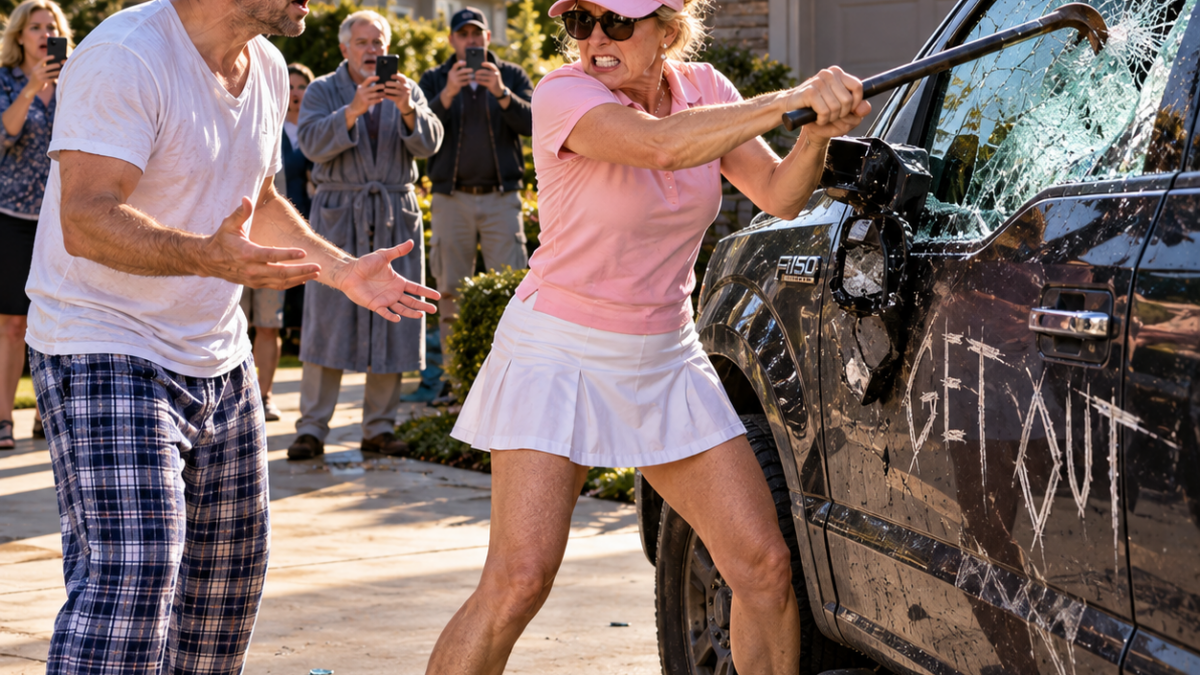
HOA Karen Smashed My Guest’s Pickup Truck With a Crowbar and Carved “GET OUT” Into the Door—Then I Revealed Who Actually Owned It. Her Face Went Pale as the Neighbors Kept Filming.
PART2:
Riley stopped ten feet away.
“That is not my truck!”
Victoria looked at him.
“I don’t care whose trash it is.”
Then she dragged the pointed end of the crowbar down the driver’s door.
Metal screamed.
She carved crooked letters.
G.
E.
T.
Then lower:
O.
U.
T.
Across the street, Mrs. Chen had opened her front door.
Two houses down, Mr. Johnson stood on his porch in a robe holding his phone upright.
A curtain shifted in the Whitakers’ upstairs window.
Another door opened.
Then another.
Willowbrook Estates was waking up.
Riley forced both hands open at his sides.
That mattered.
He had lived there eighteen months.
Long enough to learn that Victoria Peton wanted people angry.
She knew how to take somebody else’s reaction and make it the story.
If you raised your voice, you were aggressive.
If you questioned a fine, you were hostile.
If you refused to sign something, you were uncooperative.
If you told her to leave your property, you were “creating an unsafe interaction with HOA representatives.”
Riley had watched her do it.
Again and again.
So he stood barefoot in his driveway while a woman destroyed a truck fifteen feet from him and made himself speak slowly.
“Victoria.”
She looked at him.
“Put down the crowbar.”
She laughed.
“You are finally going to learn that rules matter in this community.”
“That truck belongs to my guest.”
“Your guest has been parked here in violation of our new overnight vehicle guidelines for three consecutive nights.”
“There are no valid new guidelines.”
“Oh, Riley.”
She lifted the crowbar.
“Still pretending you understand law.”
That was when the truck alarm started screaming.
Lights flashed.
Horn pulsed.
Victoria flinched.
Then raised the crowbar again anyway.
Riley said:
“You might want to stop.”
“Don’t threaten me.”
“I’m not.”
He glanced toward the front window of his house.
“My guest is awake.”
Victoria smiled.
“Good. Maybe she can move her truck after she explains why she’s been violating community rules.”
Riley almost laughed.
Instead he said:
“Victoria, that truck belongs to District Attorney Maria Alvarez.”
The crowbar stopped in midair.
Not lowered.
Stopped.
Victoria stared at him.
Riley watched the color leave her face.
Behind them, the alarm kept screaming.
“You’re lying.”
“No.”
“Why would the district attorney’s truck be here?”
“She’s my guest.”
Victoria looked toward the house.
Then at the F-150.
Then back at Riley.
“No.”
It came out quieter.
Riley nodded toward the front door.
“You can ask her.”
The door opened.
Maria Alvarez stepped onto the porch.
She wore gray sweatpants, an old college sweatshirt, and one sock.
Her dark hair was loose.
No makeup.
No heels.
Nothing about her looked like the woman whose photograph appeared on courthouse press releases.
Except her expression.
Maria had spent sixteen years prosecuting people who believed confidence could substitute for legality.
She knew the look.
Her eyes went from Riley.
To Victoria.
To the crowbar.
To her truck.
The broken windshield.
The hanging mirror.
GET OUT cut into the door.
Then back to Victoria.
Maria said:
“Put it down.”
Victoria did.
Immediately.
The crowbar hit the concrete.
The truck alarm kept screaming.
Riley found the key fob on the kitchen counter and shut it off.
The silence afterward felt bigger than the noise.
Maria walked down the steps.
Carefully.
Glass had reached the edge of the driveway.
She stopped beside the truck.
Touched the gouged door.
Looked at the windshield.
Then at Victoria.
“Did you do this?”
Victoria’s mouth opened.
Closed.
“I was enforcing HOA regulations.”
Maria looked at the crowbar.
“By smashing my vehicle?”
“You were parked in violation.”
“Of what?”
“Our overnight guest-parking rule.”
Riley said:
“There is no overnight guest-parking prohibition.”
Victoria snapped:
“You are not on the board.”
“No.”
He nodded.
“I just read what I sign.”
Maria looked at him.
“Back up.”
Riley stopped.
Not physically.
Verbally.
He knew that tone.
Maria was already separating facts from emotion.
She looked at Victoria.
“Were you given permission to enter this driveway?”
Victoria straightened.
“I am HOA president.”
“That wasn’t my question.”
“This association has inspection authority.”
“Does that authority include damaging vehicles?”
“It includes abatement.”
Maria stared.
“Abatement.”
Victoria’s confidence flickered.
“We have adopted enforcement procedures allowing removal or disabling of unauthorized vehicles.”
Riley almost interrupted.
Maria held one finger out without looking at him.
He stayed silent.
“Removal,” Maria repeated.
“Yes.”
“Disabling?”
“Yes.”
“Where does it authorize breaking windshields?”
Victoria swallowed.
“This vehicle had been repeatedly warned.”
Maria looked at the truck.
“No notice.”
“I placed one yesterday.”
Riley said:
“She put a warning sticker on my mailbox.”
Victoria pointed.
“Exactly.”
Maria turned.
“On his mailbox.”
“The vehicle was parked on his property.”
“Correct.”
Victoria seemed to realize that answer had not helped.
Maria asked:
“Was it blocking a sidewalk?”
“No.”
“Fire hydrant?”
“No.”
“Emergency access?”
“No.”
“Public road?”
“No.”
“Common area?”
“No.”
“Was it abandoned?”
“It had been here three nights.”
Maria looked at her.
“That is not what abandoned means.”
Victoria’s jaw tightened.
“It does under our community rules.”
Mrs. Chen called from across the street:
“No, it doesn’t!”
Victoria turned.
Mrs. Chen raised her phone higher.
“I have the covenants open.”
Mr. Johnson shouted:
“So do I!”
Something almost absurd was happening.
Willowbrook Estates had lived under Victoria’s interpretation of rules so long that neighbors had finally begun keeping PDFs ready.
Maria noticed the phones.
“How many people are recording?”
Riley counted.
“Probably six.”
Victoria looked around for the first time.
Really looked.
Porches.
Windows.
Phones.
Witnesses.
She whispered:
“This is being taken out of context.”
Maria looked at the crowbar.
“What context improves it?”
A siren approached.
Then another.
Victoria spun toward Riley.
“You called the police?”
“No.”
Mrs. Chen lifted her hand.
“I did.”
Mr. Johnson called:
“Me too.”
A voice from somewhere farther down:
“I called at 6:19.”
Victoria’s expression changed again.
This time the fear stayed.
Two patrol cars entered Willowbrook Lane.
No emergency speed.
Lights on.
No sirens now.
The first officer stepped out.
Sergeant Paul Dwyer.
Riley recognized him from neighborhood traffic meetings.
Dwyer surveyed the scene.
Crowbar.
Broken truck.
Victoria.
Maria.
Half the street outside.
He stopped.
“Morning.”
Nobody answered.
Then he recognized Maria.
His eyebrows moved.
“Madam District Attorney.”
Maria said:
“Paul, please don’t.”
“Yes, ma’am.”
“I mean it.”
He nodded.
Maria continued:
“You need to treat this like any other property-damage call.”
Dwyer looked at the truck.
“That going to be difficult psychologically.”
“Try.”
He did.
That mattered later.
Maria stepped away from the scene and put both hands in her sweatshirt pockets.
She knew better than to direct anything.
District attorney or not, she was the victim.
Nothing more.
Dwyer spoke to Riley first.
Then witnesses.
Then Victoria.
A second officer photographed the truck.
The damage was significant.
Windshield.
Mirror.
Deep gouging on two doors.
Front quarter panel dented.
One headlight cracked.
Later estimate:
$11,840.
The threshold for felony criminal mischief in that state was far below that.
Victoria didn’t know yet.
She kept explaining.
“We issued a warning.”
Officer Dwyer asked:
“To the truck owner?”
“To the residence.”
“For what violation?”
“Unapproved overnight visitor parking.”
“Show me the rule.”
Victoria pulled out her phone.
Opened a PDF.
Scrolled.
Riley watched.
There it was.
A document titled:
WILLOWBROOK ESTATES VEHICLE AND GUEST PARKING POLICY — REVISED.
Effective three weeks earlier.
Victoria pointed.
“No guest vehicle may remain overnight on a private driveway for more than two consecutive nights without written board authorization.”
Dwyer read.
Then looked at Riley.
“You know about this?”
“No.”
“Was it distributed?”
“Not to me.”
Mrs. Chen shouted:
“Not to anybody!”
Mr. Johnson added:
“It isn’t in the last board packet.”
Victoria snapped:
“It was adopted in executive session.”
Maria finally spoke.
Not to the officers.
To Riley.
“Executive session can’t amend recorded covenants.”
Victoria looked at her.
“We are not discussing your legal opinion.”
Maria’s eyes narrowed.
“Good.”
She took out her phone.
“Then I’ll save it for whoever gets assigned after I recuse.”
That word landed.
Recuse.
Victoria blinked.
Maria looked at Dwyer.
“Paul, once a report is completed, I want this referred outside my office.”
Dwyer nodded.
“Neighboring circuit?”
“Or special prosecutor. I don’t care.”
Victoria said quickly:
“So you admit there’s a conflict.”
Maria looked at her.
“Yes.”
Victoria seemed encouraged.
Then Maria continued:
“And that is why someone with no relationship to me will decide what charges these facts support.”
The encouragement disappeared.
Dwyer asked Victoria to step toward his patrol car.
She did not.
“Am I under arrest?”
“Not yet.”
“That sounds coercive.”
“It means I am still investigating.”
“I want my attorney.”
“You’re free to call one.”
“Am I free to leave?”
Dwyer looked at the truck.
Then at the witnesses.
Then at the crowbar.
“No.”
That was the moment the phones across Willowbrook all captured.
Victoria Peton.
HOA president for eight years.
Woman who had issued hundreds of fines.
Threatened liens.
Towed cars.
Measured fences.
Photographed trash cans.
Demanded residents remove flowerpots, children’s toys, porch swings, flags, basketball goals, and once an inflatable snowman because its “visual mass” exceeded seasonal standards.
Standing beside a police cruiser.
Quiet.
Riley expected satisfaction.
He felt almost none.
Mostly exhaustion.
Because this had not started with a truck.
It had started eighteen months earlier with a planter.
Riley and his wife, Elena, bought their Willowbrook house after moving back from Phoenix.
Riley was thirty-eight.
Worked in cybersecurity risk.
Elena was a physical therapist.
They had no children.
One elderly beagle named Walter.
They chose Willowbrook because it was boring.
That was the dream.
Tree-lined streets.
Brick houses.
Walking paths.
Community pool.
HOA dues high enough to keep landscaping decent but not so high that Riley expected fresh fruit in the mailbox.
Before closing, he read the covenants.
All seventy-three pages.
Elena mocked him.
“You read software license agreements too?”
“No.”
“You definitely do.”
“I skim.”
“You’re sick.”
Maybe.
But Riley’s work trained him to distrust anything beginning with by agreeing you acknowledge.
Willowbrook’s rules were strict but understandable.
No commercial vehicles overnight.
No unapproved exterior changes.
No fences over six feet.
No short-term rentals.
Guest vehicles allowed on private driveways.
Street overnight parking restricted by city ordinance.
Nothing unusual.
Three days after they moved in, Victoria appeared because Elena placed two ceramic planters by the front steps.
“They haven’t been approved.”
Riley thought she was joking.
She wasn’t.
Elena smiled.
“They’re pots.”
“Exterior decorative installations.”
“Flowers.”
“The containers.”
Riley asked:
“Is there a rule requiring approval for movable planters?”
Victoria looked at him.
“Section 12 gives the association broad authority over visible exterior modifications.”
“Movable objects aren’t modifications.”
Her smile tightened.
“You must be Riley.”
“Yes.”
“You’re going to enjoy Willowbrook.”
He wasn’t sure if it was a welcome or threat.
Elena submitted the form.
Approved.
Then came the mailbox.
Wrong shade of black.
The previous owner had installed it.
Still Riley’s problem.
Then Walter.
Somebody reported him off leash on Riley’s own front lawn.
The rules only required restraint in common areas.
Riley appealed.
Fine removed.
Victoria remembered.
The first time Riley appeared at a board meeting with highlighted covenants, she stared at him like he had brought a weapon.
Over eighteen months, they collided eight times.
Not because Riley enjoyed it.
Because Victoria had begun enforcing things that did not exist.
Holiday lights had to be removed by January 10.
Not in the rules.
She claimed it was “established practice.”
Garage doors couldn’t remain open more than thirty minutes.
Not in the rules.
She called it a “security guideline.”
Children’s bicycles could not remain visible from the street.
No rule.
“Community appearance standard.”
Pickup trucks over a certain wheelbase supposedly required approval.
Again, invented.
The problem was most residents never challenged her.
They paid $50.
$100.
$250.
Cheaper than arguing.
Victoria learned the most dangerous lesson small authority can teach:
People comply.
Not necessarily because you’re right.
But because resistance costs time.
Then compliance starts looking like proof of legitimacy.
Riley became a problem because he had time.
More importantly, he had documentation.
Every notice.
Every reply.
Every rule citation.
Every appeal.
He created folders.
Elena called them his Victoria Files.
“You realize this is making you weird.”
“She’s already weird.”
“Two weird people can exist simultaneously.”
Fair.
Then Elena’s mother became ill.
In March, Elena temporarily moved two hours away to help her.
Riley stayed because of work.
Maria Alvarez began visiting.
Maria and Riley had known each other since college.
Not romantically.
Never.
They met freshman year because Maria stole his reserved study-room slot.
She claimed she had more people.
He claimed reservations mattered.
She said law was about interpreting rules.
He said she wasn’t in law school.
She eventually became district attorney.
He never let her forget the study room.
Maria’s marriage had ended amicably years earlier.
She lived across town.
She and Riley remained close friends.
Her brother was also one of Riley’s oldest friends.
The weekend of the truck incident, Maria was staying at Riley’s house because her home was being treated after a plumbing leak caused mold behind a kitchen wall.
Hotels were available.
Riley had a spare room.
Simple.
Maria arrived Wednesday evening.
Parked her F-150 in Riley’s driveway.
Thursday morning:
A yellow HOA sticker appeared on the driver’s window.
OVERNIGHT VISITOR VEHICLE — REGISTER WITH HOA.
Riley photographed it.
Called management.
The manager, Lisa Ford, sounded confused.
“We don’t require guest registration.”
“That’s what I thought.”
“I’ll check.”
Friday:
Second notice.
FINAL WARNING.
Riley emailed the board.
No response.
Maria laughed.
“Your neighborhood has parking parole.”
“I told you.”
“Do I need an ankle monitor?”
“Only if Walter reports you.”
Friday evening, Victoria appeared at the door.
Riley answered.
Maria was in the kitchen.
“Your visitor needs to remove the truck tonight.”
“No.”
“Then towing may occur.”
“Show me authority.”
“The revised parking policy.”
“Send it.”
“You were notified.”
“No.”
Victoria held up her phone.
“This board is not required to personally educate every homeowner who refuses to engage with community communications.”
Riley stared.
“I read every board email.”
She looked irritated.
“Then you know.”
“No.”
He smiled.
“That’s the problem.”
She left.
Riley emailed Lisa.
No response before close of business.
He moved Maria’s truck farther up the driveway anyway.
Not because he believed Victoria.
Because he didn’t want a tow operator claiming it obstructed the sidewalk.
Then Saturday morning came.
6:17.
Crowbar.
By 7:30, Victoria was in handcuffs.
Not because Maria demanded it.
Maria actually said nothing during the probable-cause discussion.
Dwyer spoke with the neighboring prosecutor by phone.
Video existed.
Six independent witnesses.
Victoria admitted damaging the truck.
The estimated damage clearly exceeded the felony threshold.
Her stated belief that HOA policy authorized her actions did not magically make destruction legal.
Dwyer approached.
“Mrs. Peton, turn around, please.”
Victoria stared.
“You’re arresting me?”
“Yes.”
“For enforcing HOA policy?”
“For damaging another person’s vehicle.”
“I am president of the association.”
“That doesn’t change anything.”
“You haven’t spoken with HOA counsel.”
“I don’t need HOA counsel to investigate a smashed truck.”
She turned toward Maria.
“This is because of you.”
Maria shook her head.
“No.”
Her voice was calm.
“This is because of the crowbar.”
Victoria looked toward Riley.
“You planned this.”
That startled him.
“What?”
“You brought her here.”
Riley laughed once.
“You think I invited the district attorney to sleep in my guest room because I predicted you’d attack her truck at dawn?”
“You baited me.”
Maria said:
“Stop talking.”
Victoria stared.
Maria repeated:
“Not as district attorney.”
She nodded toward Dwyer.
“As another lawyer telling you that every additional sentence is making somebody’s job easier.”
For once, Victoria listened.
She was booked.
Released that afternoon on bond.
By noon, the Willowbrook residents’ group had exploded.
Not because of rumor.
Because videos existed.
Mr. Johnson posted the cleanest angle.
Victoria raising the crowbar.
Strike.
Strike.
GET OUT.
Riley asking her to stop.
Victoria citing HOA authority.
Then Riley:
“That truck belongs to District Attorney Maria Alvarez.”
The moment Victoria froze became a GIF within hours.
Riley hated that.
Maria hated it more.
“People are sending me my own truck getting murdered.”
“Technically the truck survived.”
“Do not joke about Bluebell.”
“You named the truck?”
“Don’t judge me.”
The internet did what it does.
But Willowbrook had a more immediate problem.
If Victoria believed she had authority to disable a vehicle, why?
At 11:04 that morning, board treasurer Calvin Price sent a neighborhood email:
Residents,
In light of today’s incident involving Board President Victoria Peton, I want to clarify that I was not aware of any policy authorizing physical damage or disabling of privately owned vehicles.
That looked responsible.
Until Mrs. Chen replied:
Were you aware of the revised guest parking policy?
Calvin did not answer.
Then board secretary Janine Holt wrote:
I was not.
That was the first crack.
By Monday, four of seven board members publicly stated they had never voted on the policy Victoria showed police.
Riley downloaded the PDF.
Metadata.
His specialty.
He couldn’t resist.
Creation date:
Eleven days earlier.
Author:
VPeton.
Modified:
Friday 10:43 p.m.
The night before the vandalism.
He stared.
Then called Lisa Ford, the management company’s representative.
“Lisa.”
“Yes.”
“Did Victoria amend a parking policy last night?”
Silence.
“Why?”
“The PDF metadata says Friday.”
Longer silence.
“Riley, can you send me that?”
“I will.”
“Don’t post it yet.”
“Why?”
“Because I need to verify something.”
Two hours later, Lisa called.
Her voice had changed.
“There is no board resolution.”
“I know.”
“No meeting.”
“I know.”
“No vote.”
“I assumed.”
“Riley.”
Pause.
“She uploaded the document into the association portal using administrative credentials.”
“Can she do that?”
“Technically?”
Lisa sighed.
“She had permission to upload board-approved documents.”
“Not invent them.”
“No.”
Then came the worse part.
“This isn’t the first policy file she created.”
Riley stopped.
“What?”
“I started checking.”
There were eleven.
Vehicle restrictions.
Holiday decoration rules.
Contractor-hour limitations.
Temporary basketball hoop rules.
Guest occupancy standards.
Home-based-business guidelines.
Pet-size restrictions.
Political-sign placement.
Most had never received formal board approval.
Some contradicted recorded covenants.
Yet residents had been fined under them.
For years.
Riley sat down.
“How many fines?”
“I don’t know yet.”
“Guess.”
“I won’t.”
“Lisa.”
“I won’t guess.”
That told him enough.
Tuesday night, an emergency HOA meeting was scheduled.
The clubhouse overflowed.
People stood outside windows.
Victoria did not attend physically.
Her attorney sent a letter.
It said the board was engaging in “premature scapegoating” while criminal allegations remained unresolved.
It claimed Victoria had acted under “good-faith interpretation of nuisance-abatement authority.”
Then:
Any attempt to invalidate duly enacted policies will be challenged.
Janine Holt stood.
“How can they be duly enacted if none of us voted?”
Applause.
Calvin looked ill.
Lisa had prepared a presentation.
She put twelve documents on screen.
One legitimate.
Eleven questionable.
Then bank records.
Enforcement revenue had increased almost 480 percent during Victoria’s presidency.
Fines.
Late fees.
Compliance-review fees.
Towing referral fees.
“Referral fees?” somebody shouted.
Lisa hesitated.
“Yes.”
Riley leaned forward.
That sounded wrong.
Willowbrook used a towing company called Metro Secure Towing.
Residents hated them.
Cars disappeared fast.
Guest permit expired by an hour?
Tow.
Street cleaning confusion?
Tow.
Wheel touching grass?
Tow.
Everybody assumed Metro was simply aggressive.
Lisa displayed the contract.
Then Mrs. Chen raised her hand.
“Who owns Metro Secure?”
Lisa looked toward the board.
Calvin said:
“Don’t.”
That single word turned every head toward him.
Lisa stared.
“Calvin?”
He removed his glasses.
Rubbed his face.
“Victoria’s son-in-law.”
The room erupted.
Riley felt his stomach drop.
Not because conflicts are automatically criminal.
Because nobody knew.
Eight years.
Hundreds of tows.
Referral fees paid to the association.
And perhaps something else.
Calvin continued:
“I raised it when the contract started.”
“When?” Janine asked.
“Six years ago.”
“You knew?”
“Yes.”
“Why didn’t you tell homeowners?”
“Victoria said counsel approved the relationship.”
“Did counsel?”
“I never saw the opinion.”
A man shouted:
“Then why did you sign checks?”
Calvin looked at him.
“Because I was a coward.”
The room quieted.
Not because that solved anything.
Because unexpected honesty interrupts anger.
Calvin continued:
“She controlled everything.”
A woman yelled:
“You were treasurer!”
“Yes.”
He nodded.
“And I let being uncomfortable become an excuse for being passive.”
That mattered.
Riley remembered it.
Later, he would respect Calvin for confessing before evidence forced him to.
But that night, nobody was ready to forgive.
Lisa disclosed that Metro Secure had remitted $42,600 in “administrative cooperation fees” to the HOA over six years.
Whether legitimate depended on contracts and state law.
Then another resident, Marcus Hill, stood.
“My daughter’s car was towed from my own driveway.”
People turned.
“Three years ago.”
Marcus looked at Lisa.
“Victoria said our covenants allowed emergency removal because the registration sticker was expired.”
Lisa’s face drained.
“From your private driveway?”
“Yes.”
Riley looked at Maria.
She was seated in the back.
Not as prosecutor.
As truck owner and resident guest witness.
Maria whispered:
“That gets interesting.”
Riley said:
“Criminal?”
“Could be civil. Could be more. Depends on facts.”
“Helpful.”
“You asked a lawyer.”
Fair.
Then Mrs. Talbot—every HOA seems to have one elderly resident everyone underestimates—stood from the second row.
In Willowbrook, hers was Mrs. Evelyn Brooks.
Eighty-one.
Former elementary-school principal.
She carried a three-ring binder.
“I kept mine.”
Lisa looked confused.
“Kept what?”
“Every violation.”
Victoria had fined Evelyn repeatedly after Evelyn’s husband died.
Trash can visible.
Weeds.
Porch chair color.
Vehicle parked overnight while her grandson stayed.
Evelyn had paid.
Until one tow.
Her grandson’s truck disappeared from her driveway at 2:11 a.m.
She had kept the tow receipt.
Metro Secure.
$480.
She had also kept a copy of Victoria’s handwritten warning.
Tow authorized by president due to repeated guest parking abuse.
Evelyn said:
“I called the management office the next morning.”
Lisa looked at her.
“I remember.”
“You told me the board had approved.”
Lisa closed her eyes.
“I believed it had.”
Evelyn nodded.
“So did I.”
She looked around the room.
“That is how this worked.”
Nobody interrupted.
“Everybody believed somebody else had checked.”
That sentence would become central.
Board assumed counsel checked.
Management assumed board approved.
Residents assumed rules existed.
Tow operators assumed HOA authority.
Police occasionally assumed private disputes were civil.
Everyone moved one step.
Nobody looked at the whole staircase.
Until a crowbar hit the district attorney’s truck.
The board voted that night.
Victoria suspended as president pending investigation.
All discretionary enforcement frozen.
All towing from private driveways suspended.
Independent legal audit authorized.
Forensic accounting approved.
Residents cheered.
Maria did not.
She leaned toward Riley.
“Don’t celebrate yet.”
“Why?”
“Because you don’t know what’s underneath.”
She was right.
The audit began.
The deeper they looked, the stranger it became.
Metro Secure Towing’s owner was Victoria’s daughter, Andrea Peton-Lowe, on paper.
Operational manager:
Andrea’s husband, Grant Lowe.
Victoria had pushed the contract through six years earlier.
Meeting minutes claimed competitive bids.
No competing bids could be found.
Minutes listed a motion by former board member Howard Sinclair.
Howard had died four months before the meeting date.
That was not a clerical error easily explained.
Riley stared when Lisa showed him.
“Dead people make terrible motions.”
“Usually.”
The meeting minutes had been falsified.
Once that surfaced, association counsel notified law enforcement.
Not Maria’s office.
Neighboring county prosecutor Daniel Reese had already been appointed special prosecutor for Victoria’s truck case.
The state attorney general’s financial crimes unit became involved after the forged board records emerged.
Maria stayed completely out.
That frustrated residents.
Some wanted her to “do something.”
She kept giving the same answer:
“I am a witness.”
At one meeting a man said:
“But you’re the district attorney.”
Maria replied:
“Exactly why I don’t touch it.”
That was power used correctly.
Riley admired her for it.
Privately, she was furious.
Her truck sat at a body shop for three weeks.
Insurance covered repairs.
Victoria’s attorney offered restitution before trial.
Maria accepted payment toward the damage because refusing would not improve justice.
But she refused any condition requiring nondisclosure.
The special prosecutor’s investigation produced more.
Metro Secure had towed 417 vehicles from Willowbrook over six years.
One hundred thirty-eight from private driveways.
Many under questionable HOA authority.
Metro collected more than $220,000.
A portion returned to the HOA.
Another portion went to a consulting LLC.
Peton Community Standards LLC.
Registered to Victoria’s home address.
That was bad.
Very bad.
Payments labeled:
Policy drafting.
Compliance review.
Enforcement coordination.
Over six years:
$74,300.
Victoria had never disclosed the company to residents.
Calvin, the treasurer, said he believed the payments went to an external consultant.
Why?
Invoices listed PCS Consulting.
Not Peton Community Standards.
Victoria had approved the invoices herself before Calvin signed checks.
He had not checked the vendor registration.
Again:
Someone else probably checked.
Riley’s cybersecurity brain hated that sentence more each day.
Most large failures aren’t caused by sophisticated attacks.
They’re caused by trust without verification.
Maria called one evening.
“Want dinner?”
“Is this official prosecutorial intimidation?”
“I’m recused.”
“Convenient.”
She brought Thai food.
Riley’s dining table was covered in HOA documents.
Maria stopped.
“You need a hobby.”
“This is my hobby now.”
“That is the saddest thing you’ve ever said.”
Elena was still helping her mother, though she followed everything by phone.
She told Riley the same.
“Please stop turning the HOA into Watergate.”
“It forged minutes.”
“Okay, HOA-gate.”
“That’s worse.”
Walter sat under the table waiting for curry he would never receive.
Maria looked at a diagram Riley had made.
Board.
Management.
Towing company.
Victoria’s LLC.
“You know you cannot investigate this for law enforcement.”
“I know.”
“You cannot hack anything.”
“I know.”
“You cannot impersonate anybody.”
“Maria.”
“You work in cyber.”
“I am aware.”
“I know you are aware. I’m reminding you because you get curious.”
Riley looked offended.
She laughed.
“College study room.”
“That was twenty years ago.”
“You tried to bypass the booking system.”
“I found a configuration issue.”
“You exploited it.”
“I responsibly disclosed it.”
“After you got the room.”
Details.
Riley did not touch anything not publicly or lawfully available.
He didn’t need to.
Residents started bringing records.
Boxes.
Emails.
Receipts.
Screenshots.
One resident had a 2019 audio recording of Victoria threatening:
“If you want to play legal games, I can make your house impossible to sell.”
Another had an email:
Continued noncompliance may affect association standing during lender questionnaires.
Another:
The board reserves broad authority to protect market reputation.
Those weren’t automatically illegal.
But they showed a culture.
Fear.
Residents had learned the HOA was not just rules.
It was Victoria.
Then came the lien files.
Willowbrook had foreclosed on two homes during Victoria’s tenure.
Both for unpaid assessments and accumulated fees.
That was legally possible under their covenants and state law.
But one file belonged to a widower named Thomas Reeves.
Original unpaid amount:
$620.
By foreclosure:
$9,870.
Attorney fees.
Compliance charges.
Late penalties.
Collection costs.
Thomas had moved away after losing the house.
Riley found him through public records.
He called Maria first.
“Can I contact him?”
“As a resident?”
“Yes.”
“Why?”
“HOA audit.”
“Don’t coach him.”
“I know.”
“Don’t promise anything.”
“I know.”
“You hate when I do this.”
“I really do.”
Thomas answered on the fourth ring.
Riley introduced himself.
Long silence.
Then:
“Victoria still there?”
“For now.”
Thomas laughed.
No humor.
“Of course.”
He agreed to talk.
They met at a diner forty minutes away.
Thomas was sixty-seven.
Former machinist.
Hands scarred.
Wore a faded cap.
His wife died in 2018.
He fell behind.
Not because he refused to pay dues.
Because after her death, he stopped opening mail.
Depression.
One quarter missed.
Then another.
By the time he tried to fix it, fees had multiplied.
Thomas said:
“I had the money for assessments.”
“How much?”
“Couple grand.”
“Why didn’t they take it?”
“They wanted everything.”
He showed Riley letters.
One from Victoria:
Partial payment will not cure standing deficiencies while unresolved exterior violations remain.
Exterior violations?
Unpainted mailbox post.
Two missing shrubs.
Garage trim.
Thomas had fixed them.
Still more fees.
Then foreclosure.
He sold nothing.
The association sold through process.
The buyer?
A company called Willow Ridge Acquisitions.
Registered agent:
Grant Lowe.
Victoria’s son-in-law.
Riley stopped breathing for a second.
“How much?”
Thomas looked at him.
“House went for one hundred seventy-eight thousand.”
Market value then:
About $330,000.
Willow Ridge renovated.
Resold eight months later.
$386,000.
Riley called Maria from the parking lot.
“You’re going to hate this.”
“I already hate all of it.”
He told her.
Silence.
Then:
“Send it to association counsel.”
“That’s it?”
“And the special prosecutor if counsel advises.”
“Maria.”
“I am recused.”
“Right.”
He hated good ethics when inconvenient.
The audit identified the second foreclosure.
Same pattern.
Association debt.
Buyer linked to Grant Lowe.
Resold at profit.
Now law enforcement had more than sloppy governance.
Potential self-dealing.
Potential fraud.
Potential conspiracy.
Potential theft, depending on transaction specifics and state statutes.
Search warrants followed.
Victoria’s home.
Metro Secure.
Peton Community Standards.
HOA office records.
At 6:12 one Thursday morning, police returned to Willowbrook.
This time Victoria wasn’t holding a crowbar.
She stood on her front porch wearing a robe while investigators carried boxes out.
Neighbors watched.
Riley did not.
He closed his blinds.
Elena, now home, noticed.
“You’re not going outside?”
“No.”
“Why?”
“Because I don’t want to become her.”
Elena kissed his cheek.
That was the moment she stopped teasing him about the Victoria Files.
Charges came months later.
Separate from the truck case.
Forgery of association records.
Fraud-related counts.
Theft or misapplication of association funds.
Conspiracy involving towing referrals.
Charges tied to undisclosed related-party transactions.
Grant Lowe faced charges too.
Andrea was investigated but ultimately not charged after prosecutors concluded she had little operational involvement and had allowed her husband to use her name on company records.
Calvin cooperated.
No criminal charge.
But residents removed him from the board anyway.
He understood.
“I should have checked.”
That became almost a motto.
Victoria still insisted she was being persecuted.
Her attorney held a press conference.
“My client devoted nearly a decade to preserving one of this county’s most desirable communities.”
True.
“Financial arrangements being portrayed as sinister were legitimate vendor relationships.”
For a jury to decide.
“The incident involving the district attorney’s vehicle has been exploited to criminalize ordinary HOA governance.”
Maria watched the clip from Riley’s couch.
She nearly choked on popcorn.
“Ordinary.”
Riley said:
“You don’t smash guest trucks in your HOA?”
“Only on Thursdays.”
The truck case went first.
Special prosecutor Reese offered a plea.
Felony criminal mischief reduced under conditions.
Restitution.
Probation.
Anger-management evaluation.
No contact with Maria.
No board office during probation.
Victoria refused.
She wanted trial.
Bad decision.
Her defense:
She believed HOA rules authorized abatement.
She did not intend criminal wrongdoing.
She acted to protect community standards.
The prosecution played the driveway video.
Full length.
Not edited.
Victoria hitting the windshield.
Riley:
“Stop.”
Victoria:
“This junk is destroying our property values.”
Strike.
“That is not my truck.”
“I don’t care whose trash it is.”
Then:
“Put down the crowbar.”
“You are finally going to learn that rules matter in this community.”
Then the reveal.
“That truck belongs to District Attorney Maria Alvarez.”
Victoria freezing.
The jury saw everything.
Her attorney tried to make the DA status irrelevant.
Correctly.
Special prosecutor Reese agreed.
He told the jury:
“This case would be exactly the same if that truck belonged to a plumber.”
That was smart.
Maria liked him after that.
Reese continued:
“The title of the victim changes nothing.”
Pause.
“The title of the defendant changes nothing either.”
He pointed toward Victoria.
“HOA president is not a criminal-law exemption.”
The prosecution introduced the fake overnight parking policy.
Metadata.
No vote.
No board authorization.
Created Friday night.
Modified hours before the vandalism.
Victoria took the stand.
Her attorney asked:
“Why did you create the policy?”
“To formalize long-standing community practice.”
“Did you believe you had authority?”
“Yes.”
“Did you intend to commit a crime?”
“No.”
“Why did you damage the truck?”
She paused.
Then made the mistake Riley expected.
“Because Mr. Castellanos refused to respect the board.”
Not because of safety.
Not because it blocked anything.
Riley.
Disrespect.
Her attorney tried to redirect.
But the sentence remained.
On cross, Reese asked:
“The truck belonged to Mr. Castellanos?”
“No.”
“You knew that when he told you.”
“Yes.”
“And you said?”
Victoria looked down.
“I don’t care whose trash it is.”
Reese played the clip.
Exactly.
He asked:
“Was the truck trash?”
“No.”
“Was it abandoned?”
“No.”
“Blocking emergency access?”
“No.”
“Preventing another resident from using property?”
“No.”
“Then what was the emergency requiring a crowbar at 6:17 in the morning?”
Victoria had no good answer.
The jury deliberated less than three hours.
Guilty.
Maria was not in the courtroom for the verdict.
She had a murder hearing.
Life does not schedule dramatic symmetry.
Riley texted:
GUILTY.
Maria replied:
BLUEBELL AVENGED.
He sent:
You are the chief law enforcement officer of this county.
She replied:
AND BLUEBELL HAD FEELINGS.
The larger financial case took another year.
That one was uglier.
Not because of dramatic video.
Because spreadsheets are where deliberate misconduct becomes difficult to romanticize.
Payments.
Dates.
Connections.
Invoices.
Falsified minutes.
Foreclosure records.
Bid documents.
Towing fees.
Shell-company deposits.
Victoria’s defense argued the LLC had provided real services.
Maybe some.
But prosecutors showed invoices generated for meetings that never happened.
Policy consulting billed on dates Victoria was on vacation.
“Competitive procurement review” for the Metro Secure contract when no competitive bid occurred.
Then a recovered email from Grant Lowe:
MIL WILL HANDLE BOARD PAPER. JUST KEEP THE NUMBERS UNDER WHAT LOOKS STUPID.
MIL.
Mother-in-law.
Victoria.
Another:
V says old minutes can be cleaned if anyone asks.
Cleaned.
The prosecution loved that word.
Thomas Reeves testified.
Quietly.
No anger.
That made him stronger.
He described his wife’s death.
The unopened mail.
Trying to pay.
Losing the house.
Then learning the buyer was connected to the HOA president’s family.
Victoria’s attorney asked:
“Mr. Reeves, you did owe the association money.”
“Yes.”
“You failed to pay on time.”
“Yes.”
“You failed to respond to notices.”
“Yes.”
“You understand those facts are not the defendant’s fault?”
Thomas nodded.
“Yes.”
The attorney sat.
Then the prosecutor stood.
“Mr. Reeves, did you ask to pay what you owed?”
“Yes.”
“Did the association refuse partial cure while disputed compliance fees remained?”
“Yes.”
“Were those compliance fees based in part on policies now shown never to have been properly adopted?”
“Yes.”
“Did anyone disclose that the entity acquiring your home was controlled by the board president’s son-in-law?”
“No.”
That was the issue.
Not whether Thomas had made mistakes.
He had.
Whether people with hidden financial interests exploited them.
The jury convicted Victoria on several counts and acquitted on others.
Real cases are messy.
She was not convicted of every accusation.
Grant was convicted too.
Sentencing came months later.
Residents attended.
Riley almost didn’t.
Elena said:
“You should.”
“Why?”
“Because you spent two years pretending you aren’t emotionally invested.”
He went.
Victoria spoke.
For the first time, she did not sound like HOA president Victoria Peton.
No blazer.
No binder.
No certainty.
“I believed I was protecting something.”
She looked toward the gallery.
“Willowbrook.”
Pause.
“My work.”
“Standards.”
“My reputation.”
She swallowed.
“I don’t know when protecting those things became more important than people.”
Nobody moved.
She looked at Thomas Reeves.
“I told myself everyone who fought me was irresponsible.”
Then Riley.
“Disrespectful.”
Maria wasn’t there.
Conflict.
She had kept distance.
Victoria continued.
“And once I decided someone was a problem, everything they did became proof.”
That sentence Riley understood.
Confirmation bias dressed as governance.
She received prison time on the financial convictions.
Probation on the property-damage case ran concurrently with later supervision.
Restitution.
Barred from association fiduciary roles for years.
Not forever.
Courts sentence conduct, not identity.
Willowbrook faced the harder question.
What now?
Residents could remove Victoria.
They could not remove the culture that had allowed her to operate.
New elections came.
Nobody wanted to run.
Eventually Mrs. Chen did.
So did Mr. Johnson.
And, to everyone’s surprise, Calvin Price.
He stood at the candidate meeting.
“I don’t expect your vote.”
Someone asked:
“Then why run?”
“Because I spent years assuming being the nice board member was enough.”
He looked around.
“It wasn’t.”
He lost.
Narrowly.
But residents appreciated the honesty.
Mrs. Chen became president.
Her first proposal:
No president may unilaterally create enforcement policy.
Everyone laughed.
Then voted yes.
Other reforms followed.
All rules published in one official repository.
Version history.
Board vote references.
Conflict-of-interest disclosures.
Competitive bidding above a threshold.
No related-party vendor without homeowner notice and independent approval.
No towing from private property without clearly documented legal authority.
Appeal process before non-emergency towing.
Annual financial audit.
Meeting recordings retained.
Riley helped with document security.
Voluntarily.
Elena stared when he agreed.
“You joined the HOA.”
“No.”
“You are consulting for the HOA.”
“Cybersecurity only.”
“You have become what you hated.”
“Take that back.”
She laughed.
The old unauthorized policies were revoked.
Fines reviewed.
Hundreds of residents received refunds or account credits.
Evelyn Brooks got $2,340 back.
She showed up at Riley’s house holding a bottle of champagne.
“I am spending Victoria’s money.”
“Technically HOA money.”
“Don’t ruin this.”
Thomas Reeves’s situation became more complicated.
The HOA couldn’t simply give him his old house back.
A new family had bought it lawfully after the resale.
They were innocent too.
Instead, the HOA’s insurer and related settlement funds compensated Thomas.
Not enough to erase what happened.
Enough to help.
He moved closer to his daughter.
Riley visited once.
Thomas had a smaller house.
A workshop.
Tomato plants.
He seemed lighter.
“You miss Willowbrook?”
Thomas laughed.
“Not even slightly.”
Fair.
Maria’s truck came back from the body shop.
Perfect paint.
New windshield.
New mirror.
The shop owner refused to repaint the carved GET OUT section entirely until Maria approved the color match.
She considered leaving a tiny piece visible.
Riley said:
“That is extremely dramatic.”
“I prosecute people professionally.”
“True.”
She had it repaired properly.
No scar.
But she kept one thing.
The damaged driver-side door skin after the shop replaced it.
Riley discovered it leaning against her garage wall months later.
“You mocked me for documents.”
“This is evidence.”
“The case is over.”
“Historical evidence.”
“You’re weird.”
“You started it.”
They eventually hung it inside Riley’s garage.
Not at Maria’s.
Elena objected.
“I am not looking at GET OUT every time I park.”
Riley said:
“It’s history.”
“It’s ugly.”
Maria said:
“Democracy is ugly.”
Elena stared.
“Both of you need help.”
They kept it behind a cabinet.
Compromise.
Riley’s relationship with Willowbrook changed.
Before Victoria, he had believed community rules were annoying but mostly irrelevant.
During Victoria, he treated them like adversarial code.
Afterward, he saw the reason governance mattered.
Most rules are boring.
That’s good.
Most boards should be boring too.
Budgets.
Roof repairs.
Pool maintenance.
Insurance.
Landscaping.
Streetlights.
The dangerous moment is when a person’s identity merges with the institution.
Victoria had stopped saying:
The board decided.
She said:
I will allow.
I will fine.
I will approve.
I will tow.
She treated Willowbrook like a kingdom because nobody wanted to spend Tuesday nights arguing with her.
Convenience had created a monarch.
Riley explained that once during a resident orientation.
A new homeowner asked:
“How did she get away with it for eight years?”
Riley said:
“Mostly because people had jobs.”
Everyone laughed.
He wasn’t joking.
People were busy.
Kids.
Work.
Illness.
Travel.
Bills.
Nobody wants to spend life checking whether board minutes accurately reflect a landscaping vote.
People outsource attention.
Necessary.
But every system based on trust also needs checks.
Riley used a cybersecurity analogy.
“Most people imagine hacking as somebody breaking through a wall.”
He pointed toward the HOA portal.
“More often somebody gets credentials they’re trusted to use and nobody checks what they do with them.”
A resident said:
“So Victoria was an insider threat?”
Riley smiled.
“Exactly.”
Mrs. Chen hated when he said that.
“Stop calling former presidents malware.”
“Technically—”
“No.”
Fair.
Two years after Victoria’s sentencing, Andrea Lowe knocked on Riley’s door.
Victoria’s daughter.
Riley had never spoken with her.
She looked exhausted.
“Can I talk to you?”
“Sure.”
They sat on the porch.
Andrea said:
“I know everybody thinks I knew.”
Riley waited.
“My name was on Metro.”
“Yes.”
“I signed things Grant gave me.”
“Yes.”
“I shouldn’t have.”
“No.”
She winced.
“I’ve heard you do that.”
“What?”
“Just say yes when people want you to make them feel better.”
Riley smiled slightly.
“I learned from Maria.”
Andrea looked toward Victoria’s old house.
It had sold.
New family now.
“My mother could make everything sound normal.”
Riley understood.
“Grant too.”
She nodded.
“Metro was supposed to be his business. My credit was better.”
Pause.
“I knew Mom helped get the contract.”
Riley said nothing.
“I didn’t ask how.”
She looked at him.
“Does that make me responsible?”
Riley thought.
“Some.”
Andrea nodded.
Not the answer she wanted.
Maybe the one she expected.
“How much?”
“I don’t know.”
She looked away.
“I spent a year wanting somebody to tell me I was completely innocent.”
Riley said:
“Are you?”
“No.”
She started crying quietly.
“I didn’t forge minutes. I didn’t know about those foreclosures. I didn’t know Mom was getting consulting money.”
“But?”
“I benefited.”
Riley nodded.
“Yes.”
Andrea wiped her face.
“I hate that.”
“You should.”
She almost laughed.
“You’re terrible at comfort.”
“Very.”
“Maria?”
“Yes.”
Andrea eventually started paying voluntary restitution beyond what courts required from assets remaining after her divorce from Grant.
Nobody forced her.
Riley learned about it from HOA counsel.
He did not tell neighbors.
Some accountability deserves privacy too.
Life moved.
Elena’s mother recovered.
Elena returned home full-time.
Walter died at fourteen.
That was harder than either expected.
The dog had been present through every violation notice.
Riley buried his collar beneath a maple in the backyard.
HOA rules prohibited pet burial.
Mrs. Chen knew.
She said nothing.
Governance also requires judgment.
Maria won reelection as district attorney.
Riley teased her about campaign signs.
“Need HOA approval?”
“Don’t start.”
“Political signs have dimensions.”
“I will prosecute you.”
“Conflict.”
She rolled her eyes.
The truck incident followed Maria longer than she liked.
People at events asked:
“Are you the DA whose truck the HOA lady smashed?”
Maria would answer:
“Yes, but I have prosecuted more important things.”
Sometimes they listened.
Usually they wanted the story.
She learned to laugh.
One reporter once asked:
“Did your office get special treatment because you were the victim?”
Maria said:
“My office did not handle the prosecution.”
“Would a normal citizen’s truck have produced the same investigation?”
Maria paused.
Important question.
She answered carefully.
“It should have.”
The reporter pushed.
“But would it?”
Maria said:
“I think that’s a better question than whether I received too much attention.”
Riley watched the interview later.
That stayed with him.
Would people have cared if it were a plumber’s truck?
A teacher’s?
A teenager’s old Honda?
Would police have taken HOA claims as seriously?
Would residents have challenged policies?
Would the forged records still be sitting in a portal?
The district attorney’s truck was not more legally valuable.
It was more symbolically disruptive.
Victoria damaged something connected to a person she recognized as powerful.
Suddenly everyone questioned whether her authority had ever been real.
That was uncomfortable.
Because rights shouldn’t activate only when important people are involved.
At the next annual meeting, Riley raised it.
“I don’t want us to learn the wrong lesson.”
Mrs. Chen asked:
“What’s the wrong lesson?”
“That Victoria’s mistake was picking the wrong truck.”
Silence.
Riley continued.
“The problem wasn’t that it belonged to Maria.”
Pause.
“The problem was that Victoria believed she could destroy anybody’s property because a homemade policy told her she was in charge.”
People nodded.
“That has to remain wrong even when the owner has no title, no lawyer friend, no camera, and no neighbors filming.”
That became the standard they tried to build.
Not perfect.
Nothing involving homeowners ever is.
There were still disputes.
Fence color.
Pool hours.
Roof materials.
A ridiculous six-month war over whether dark bronze gutters qualified as brown.
Riley refused involvement.
Elena said that was personal growth.
Once, Mrs. Chen called him.
“Can you review a new guest parking policy?”
“No.”
“Why?”
“Trauma.”
“Riley.”
“Fine.”
He checked.
Valid vote.
Proper notice.
Reasonable language.
No crowbar clause.
Approved.
Willowbrook became boring.
Beautifully boring.
Then, five years after that Saturday morning, Riley woke at 6:20 to another driveway alert.
He froze.
Old reaction.
Opened phone.
A woman stood beside a pickup.
For half a second his body remembered Victoria.
Then he saw Maria.
Older.
Coffee in one hand.
Keys in the other.
Her new truck.
She was dropping something off before court.
Riley walked outside.
Shoes this time.
“Why are you here at sunrise?”
She handed him a box.
“Birthday.”
“My birthday is tomorrow.”
“I have a trial.”
He opened it.
Inside was a miniature crowbar mounted on a plaque.
Riley stared.
Engraved:
HOA COMPLIANCE TOOL — RETIRED.
He laughed so loudly Elena opened the window upstairs.
“What?”
“Maria is being stupid.”
Maria shouted:
“Happy birthday!”
Elena closed the window.
Riley looked at the plaque.
“You had this made?”
“Taxpayer funds.”
He stared.
Maria smiled.
“Kidding.”
“Not funny.”
“Extremely funny.”
They stood in the driveway.
Same concrete.
Same angle of morning light.
Different world.
Maria looked toward the street.
“Do you ever think about it?”
“Sometimes.”
“The truck?”
“No.”
“Victoria?”
“Sometimes.”
“What then?”
Riley thought.
“The pause.”
“What pause?”
“When I told her whose truck it was.”
Maria’s expression changed.
“She froze.”
“Yeah.”
Riley looked down the quiet street.
“She wasn’t afraid she’d done something wrong.”
Maria nodded slowly.
“She was afraid she’d done it to somebody powerful.”
“Exactly.”
That was the detail that bothered him years later.
Before he said district attorney, Victoria had no hesitation.
Riley said stop.
She swung.
Neighbors watched.
She swung.
Truck alarm screamed.
She swung.
Private property.
No emergency.
No danger.
No lawful authority.
None of it mattered enough.
Then:
District Attorney.
Freeze.
Maria looked at him.
“That is ugly.”
“Yes.”
“But useful.”
“How?”
“Because now you know what the real lesson is.”
He smiled.
“Don’t smash trucks?”
“Also that.”
She took a sip of coffee.
“Power reveals people.”
Riley waited.
“Sometimes by what they do when they have it.”
Pause.
“Sometimes by who they suddenly respect when they meet more of it.”
That was Maria.
Always turning a driveway story into jurisprudence before breakfast.
Riley said:
“You rehearsed that.”
“Absolutely.”
She left for court.
Riley carried the miniature crowbar inside.
Elena refused to let him hang it in the living room.
He put it in the garage.
Beside the damaged truck-door panel.
History.
Willowbrook’s new residents occasionally asked about both.
Riley would tell them the short version.
Former HOA president vandalized visitor truck.
Visitor turned out to be district attorney.
President arrested.
Then he’d add:
“That isn’t actually the interesting part.”
The interesting part was everything before.
Eight years of people paying fines because arguing cost more.
Board members signing papers because someone else had prepared them.
Management trusting board approval.
Residents assuming contracts were reviewed.
A towing company profiting from rules written by the family that owned it.
Fictitious minutes.
Vendor invoices.
Foreclosures.
Everybody looking only at their piece.
Victoria understood fragmentation.
Maybe not consciously.
But she benefited from it.
No one person saw enough to challenge everything.
Then one Saturday morning she took a crowbar to a truck.
Loud mistakes attract attention quiet systems can avoid.
Glass broke.
Neighbors filmed.
Police came.
A name changed the emotional temperature.
Then people finally looked backward.
Not just at the windshield.
At the years.
That’s what exposed her.
Not Maria’s title.
Attention.
Riley never forgot Thomas Reeves either.
The man who lost his house because grief made him vulnerable and a system made vulnerability expensive.
The truck cost twelve thousand dollars.
Insurance fixed it.
Thomas lost years of equity.
No viral video.
No district attorney.
No neighbors outside at dawn.
That imbalance bothered Riley.
So when Willowbrook established a resident legal-assistance fund after the settlements, Riley contributed.
Not huge.
Enough.
The fund helped residents review








