HOA Karen Slapped a $500 Violation Sticker on My 25-Foot Navy Patrol Boat and Said, “Military People Aren’t Special”—Then One Phone Call Turned Her Sticker Into Evidence.
HOA Karen Slapped a $500 Violation Sticker on My 25-Foot Navy Patrol Boat and Said, “Military People Aren’t Special”—Then One Phone Call Turned Her Sticker Into Evidence.
Karen Whitmore thought the word NAVY painted on my patrol boat was just decoration she could punish with a five-hundred-dollar HOA sticker.
She thought I was a broken divorced dad too tired to fight another suburban bully with a clipboard.
Thirty minutes later, the sticker she slapped on federal military property became evidence, and her perfect little neighborhood kingdom began collapsing one document at a time.
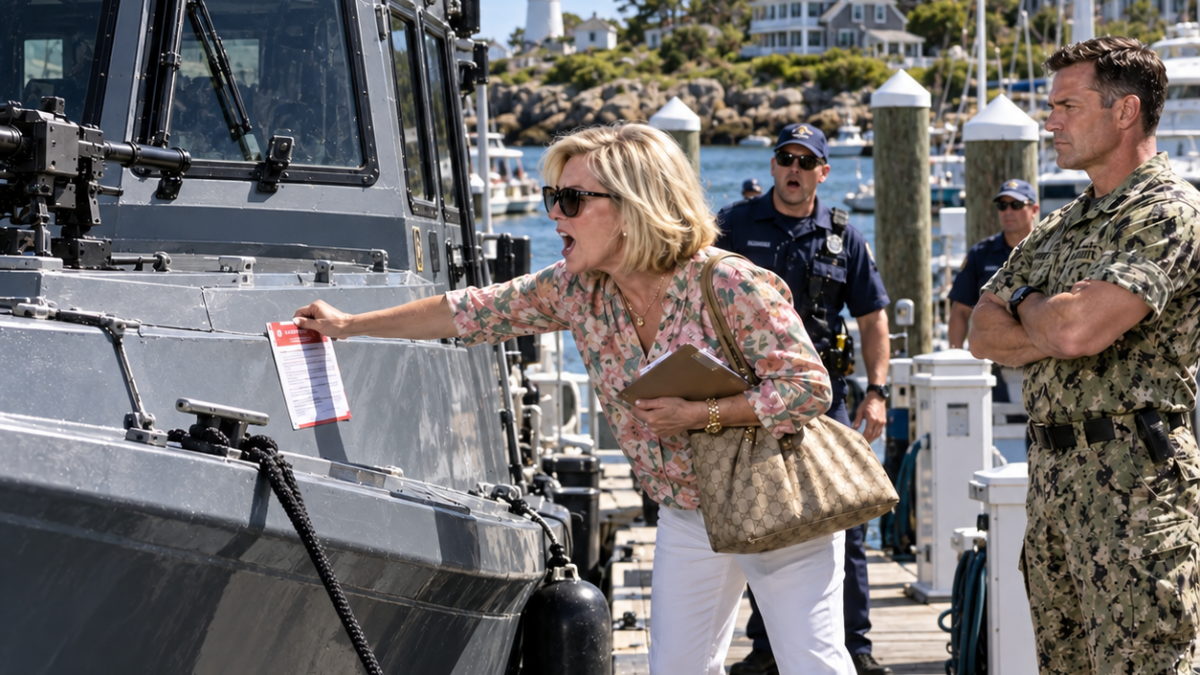
Karen Whitmore placed the orange violation sticker on my Navy patrol boat like she was tagging an abandoned camper.
She smoothed it down with two fingers.
Pressed the corners flat.
Then stepped back with the satisfied look of a woman who believed she had just restored civilization to Riverside Meadows.
The word NAVY sat in six-inch white letters less than a foot from her hand.
She saw it.
Of course she saw it.
Karen saw everything.
A mailbox leaning half an inch.
A lawn edging line imperfect by the sidewalk.
A trash can rolled out twelve minutes too early.
A flag bracket installed without the proper finish.
A child’s scooter left on a porch.
A truck parked in a driveway with what she called “workmanlike energy.”
Karen Whitmore did not miss details.
She simply chose which details mattered.
“Five hundred dollars,” she said, tapping the sticker with one manicured nail. “Plus daily penalties if the violation is not corrected within seventy-two hours.”
I stood at the edge of my driveway with a socket wrench still in my hand, grease on my fingers, and my teenage daughter Emma beside me, holding the roll of marine wire we had been feeding through the old console.
For a few seconds, nobody spoke.
Not because Karen had frightened us.
Because even Emma, who had inherited my stubbornness and her mother’s surgical talent for verbal damage, seemed stunned by the sheer confidence required to slap an HOA sticker on a Navy vessel and then stand there like the Constitution had personally appointed you driveway queen.
“Ma’am,” I said carefully, “you need to remove that.”
Karen turned toward me.
She wore white yoga pants, a pale blue zip-up jacket, oversized sunglasses pushed on top of her head, and the expression of a woman who had been waiting all week to be underestimated.
“Commander Thornfield,” she said, making my rank sound like a neighborhood nuisance, “you were notified twice that boats, trailers, military equipment, commercial equipment, industrial equipment, recreational equipment, and visually disruptive property are not permitted in driveways.”
Emma muttered, “That sentence needs a respirator.”
I gave her a look.
She gave me one back.
Karen ignored her.
“You have continued to store this vessel in open view of the street despite written warnings from the board. That is a violation of section eight, subsection four, exterior appearance standards, and section twelve, subsection two, vehicle and equipment storage.”
I looked at the sticker again.
It was bright orange.
Aggressively orange.
The kind of orange used for tow notices, code violations, and caution signs near open trenches.
Across the top, in bold black letters, it read:
RIVERSIDE MEADOWS HOMEOWNERS ASSOCIATION
NOTICE OF VIOLATION
UNAUTHORIZED VEHICLE / EQUIPMENT
FINE: $500
PART2:
Karen had placed it across the forward starboard panel, partially covering a small metal plate riveted beneath the old hull number.
The plate was not decorative.
It was federal inventory marking.
“Do you understand what you just put adhesive on?” I asked.
Karen smiled thinly.
“I understand you military people think rules are for everyone else.”
Emma’s head snapped toward her.
“Excuse me?”
Karen did not even glance at my daughter.
“I respect service, of course,” she said in the tone people use when they are about to prove the opposite. “But living in Riverside Meadows means respecting community standards. Your title does not grant you special privileges.”
“My title has nothing to do with this.”
“Good,” Karen said. “Then we agree. You’ll remove the boat.”
I took one slow breath.
I had commanded men during storms at sea. I had stood on a heaving deck at two in the morning while alarms screamed and young sailors looked at me like my face might tell them whether they were going to live. I had handled inspection boards, divorce mediation, casualty notifications, budget fights, and one captain who believed shouting counted as leadership.
I knew how to stay calm.
But there are certain forms of stupidity that test a man differently.
“Karen,” I said, “that vessel is not subject to your sticker.”
“Everything visible from the street is subject to HOA standards.”
“No.”
“Yes.”
“No,” Emma said. “Like legally no.”
Karen finally looked at her.
“Sweetheart, adults are speaking.”
Emma smiled.
It was not a nice smile.
My daughter had turned sixteen three months earlier, and she had recently discovered that silence was sometimes optional.
“Sweetheart,” Emma said, “if you want to keep all your teeth inside your argument, don’t talk to me like I’m furniture.”
“Emma,” I said quietly.
“What? I’m being diplomatic.”
Karen’s lips tightened.
PART3:
“This behavior is exactly why standards matter.”
I stepped between them before Emma could achieve full deployment.
“Karen, listen to me carefully. You need to remove that sticker before the adhesive sets.”
“I will not be intimidated.”
“This is not intimidation. This is advice.”
“Then here is mine.” Karen reached into her folder and pulled out another copy of the violation notice. “Remove the boat from view, pay the fine, and submit a storage compliance plan by Friday. Failure to comply will result in additional penalties, legal fees, and possible towing referral.”
I stared at her.
“Towing referral.”
“Yes.”
“For a Navy patrol vessel.”
“For an unauthorized vehicle.”
“It weighs nearly seven tons on the trailer.”
“We have contractors.”
Emma made a small choking sound.
I could not tell if it was rage or laughter.
Karen pointed toward the hull.
“I do not care if that says Navy, Coast Guard, Boy Scouts, or your bowling league. This community is not a storage yard.”
Thirty minutes later, one phone call turned her sticker into evidence.
But to understand how expensive that orange square of adhesive became, you need to understand how Karen Whitmore got powerful enough to believe she could tag anything she disliked and make the world obey.
My name is Jake Thornfield.
Commander, United States Navy.
Fifteen years of service.
Two long deployments.
One divorce that left me feeling like my life had been dropped from a helicopter without a parachute.
And one daughter named Emma, who had inherited my stubbornness, her mother’s sharp tongue, and absolutely no patience for fools in designer sneakers pretending to be government officials.
When I moved into Riverside Meadows, I was not looking for drama.
That is the kind of sentence every man says right before drama walks across his driveway carrying a clipboard.
Riverside Meadows looked harmless when I first saw it.
Upper-middle-class development built around 2015.
Quiet streets.
Waterfront access.
Houses close enough to borrow sugar but far enough apart to pretend privacy still existed.
The biggest crisis, according to the realtor, had been an argument over sprinkler overspray on a Lexus.
After the marriage ended, that sounded peaceful enough to qualify as therapy.
I chose the house for two reasons.
First, the driveway was long enough for my boat trailer.
Second, the community had lake access.
The boat was not just a boat.
Her official designation had once been Harbor Security Patrol Craft 214. She was twenty-five feet of old Navy steel and reinforced fiberglass, decommissioned, stripped of weapons, stripped of classified electronics, and transferred into a federal historical restoration program after sitting for years in a storage yard where good machines go to be forgotten.
My father had served in World War II, back when men came home with medals in drawers and nightmares they never named. He had been a machinist’s mate. He could fix anything with a socket set, a cigarette, and language my mother said would get him barred from church if God kept transcripts.
When the Navy heritage office approved local restoration partnerships for several decommissioned patrol craft, I applied because it felt like a way to keep my father close. The boat was in my custody, stored at my residence under a written restoration agreement, pending public display and eventual transfer to a veterans’ maritime education center.
She was not armed.
She was not classified.
She was not dangerous.
But she was still federally tagged.
Still inventoried.
Still documented.
Still covered by an agreement thicker than Karen’s HOA handbook and written by people who did not care about her opinions on curb appeal.
I worked on that boat the way other people go to church.
Cleaning fittings.
Replacing wiring.
Sanding corrosion.
Checking old systems that had once served a purpose bigger than weekend recreation.
After my marriage fell apart, the boat gave my hands something useful to do while my mind wandered through rooms I no longer lived in.
Then Emma started helping me.
Every other weekend, she showed up with a backpack, earbuds, and a level of teenage skepticism usually reserved for school assemblies.
At first, she mocked the boat.
“Dad, it smells like diesel and old man decisions.”
“History,” I said.
“Same thing.”
But she kept coming outside.
She learned the difference between a socket wrench and an adjustable wrench.
She learned how to splice marine wire, label circuits, clean fuel filters, read hull plates, and take photographs for the restoration log better than some junior officers I had deployed with.
Eventually, our Saturday boat maintenance became ours.
Not mine with her nearby.
Ours.
That mattered.
Divorce breaks family routines into pieces. Some pieces disappear. Some cut you when you pick them up. Some lie on the floor for years because nobody knows where they used to fit.
The patrol boat became a piece we could still hold.
Riverside Meadows seemed ideal for that.
Bob Fletcher lived three doors down, a retired Marine with a bass boat in his driveway and a laugh loud enough to qualify as artillery. He welcomed me to the neighborhood with a six-pack of root beer because he had been sober twenty-one years and said he liked starting friendships with the truth.
Maria Santos lived across the street with two kids, a stack of legal files always visible through her front window, and the calm efficiency of someone who could find a missing comma during a hurricane. She was a civil attorney, widowed young, and one of the few people I had ever met who could make “let me review that document” sound like a threat.
Normal families.
Normal lives.
Normal problems.
Then Karen Whitmore bought the McMansion at the end of the cul-de-sac.
Karen was what happens when someone with no meaningful authority gets handed a clipboard and mistakes it for divine appointment.
She had been an insurance claims investigator before marrying David Whitmore, a regional executive who seemed to travel for business ninety percent of the time and spend the remaining ten percent apologizing with expensive landscaping.
Karen had no children, no visible hobbies, and the kind of free time that becomes dangerous when mixed with resentment, a ruler, and access to HOA letterhead.
The HOA itself was supposed to be simple.
Keep lawns reasonable.
Do not blast music at midnight.
Do not leave trash cans on the curb for three days.
Pay dues so the boat launch, small community center, and common landscaping stayed functional.
Basic neighbor stuff.
The kind of organization that should have been boring enough to cure insomnia.
Then the builder turned control over to residents.
Nobody wanted the headache.
Karen did.
She ran unopposed.
That was the neighborhood’s first mistake.
Within six months, she transformed Riverside Meadows from a quiet community into a low-budget police state with decorative shrubs. She carried a ruler to measure grass height.
A ruler.
For grass.
She timed when people rolled trash cans to the curb. She photographed porch lights, mailbox posts, driveway stains, wreath sizes, garden gnomes, patio cushions, and one poor man’s inflatable snowman like she was collecting evidence for The Hague.
But the real problem was not enforcement.
It was selective enforcement.
Bob Fletcher’s bass boat trailer sat in his driveway year-round. Karen never said a word because Bob attended every meeting and had once loudly praised her “commitment to order.”
The Henderson kids left bikes, scooters, and plastic dinosaurs scattered across their lawn like a cheerful archaeological disaster. Nothing. Mrs. Henderson chaired the social committee and made the lemon bars Karen liked.
The corner house once had a dead shrub leaning against the garage for three weeks. Karen called it “seasonal transition.”
But question her authority, refuse to flatter her, ask where dues went, or commit the unforgivable crime of not looking impressed when she introduced herself as HOA president, and suddenly she could discover seventeen violations before breakfast.
My first mistake was not bowing.
It happened two weeks after I moved in.
Karen knocked on my door at 8:07 on a Saturday morning with a welcome basket in one hand and a folder in the other. The basket contained banana bread wrapped in plastic and a printed card that said Riverside Meadows Welcomes You.
The folder contained twenty-three pages of rules highlighted in yellow.
“Commander Thornfield,” she said, smiling too widely. “We are so honored to have military residents here.”
“Jake is fine.”
Her smile tightened.
“Of course. We do like to maintain a certain standard of address during official HOA interactions.”
“This is official?”
She looked down at the basket, then up at me.
“In a welcoming capacity.”
I should have known then.
Karen liked kindness only when it wore a badge.
She gave me the folder, explained approved mailbox finishes, warned me against “excessive flags,” and mentioned that military memorabilia should be “tastefully integrated.”
I asked what that meant.
She said, “Nothing that makes the community feel like a base.”
I said, “The community is not in danger of feeling like a base.”
She did not laugh.
A week later, I received my first courtesy notice.
Unapproved driveway equipment.
I responded with a copy of my closing disclosure, the HOA covenants, and the storage exemption for legally registered boats and trailers under thirty feet, provided they were maintained, parked on paved driveways, and did not block sidewalks.
My boat trailer met every requirement.
Karen sent back a note saying the board would “review the military nature of the vessel.”
Maria saw me reading it at the mailbox.
“That face says someone used official language incorrectly,” she said.
I handed her the letter.
She read it, then looked at my driveway.
“That boat is allowed under their own rules.”
“Yes.”
“So this is harassment.”
“Maybe incompetence.”
“Never underestimate the overlap.”
The second notice came after Emma and I placed a small Navy jack decal on the console cover.
Unauthorized exterior display.
The third came after I installed a locked storage chest beside the trailer.
Industrial container visible from street.
The fourth accused me of performing “mechanical activity” in the driveway.
I was changing a battery.
Bob Fletcher called that one “anti-American.”
Karen escalated when I began asking questions about HOA finances.
At the annual meeting, I asked why launch maintenance costs had doubled despite no visible improvements to the boat ramp.
Karen said, “The board is handling it.”
I asked whether bids had been solicited.
She said, “We are not obligated to burden residents with operational details.”
Maria, sitting behind me, whispered, “That means no.”
I asked again.
Karen stared at me like I had poured oil on her carpet.
Two days later, I received a violation for “noncompliant nautical storage.”
I appealed.
The board never scheduled the hearing.
Then Emma posted a photo.
That was the spark.
It was a simple picture of us working on the boat. Me in an old Navy T-shirt, Emma sitting cross-legged on the trailer tongue labeling wires with blue tape, the patrol craft behind us with NAVY visible along the hull.
Caption: Dad’s weird boat is less weird now. Still smells like history and bad decisions.
It got the normal amount of teenage attention.
Three friends liked it.
One asked if she could ride in it.
Bob commented with a saluting emoji because Bob had recently discovered emojis and treated them like tactical symbols.
Somehow, Karen saw it.
The next morning, she sent an email to the entire community with the subject line:
IMPORTANT: UNSIGHTLY MILITARY EQUIPMENT IN RESIDENTIAL DRIVEWAYS
She did not name me.
She did not need to.
The email warned that Riverside Meadows was a residential community, not “a storage facility for military surplus, industrial vessels, or intimidating equipment.” It said children should not be exposed to “martial displays” and that property values depended on “visual harmony.”
Emma read it at breakfast during her weekend visit.
“Martial displays?” she said. “Does she think the boat is going to invade the cul-de-sac?”
“Apparently.”
“Can I reply?”
“No.”
“Can I reply from a fake account?”
“No.”
“Can I print it and put it in the boat’s bathroom?”
“The boat does not have a bathroom.”
“Then we have priorities.”
I should have expected Karen in person.
People like Karen can only hide behind email for so long before they need to watch someone react.
She arrived at 10:12 a.m.
Clipboard.
Folder.
Orange sticker.
A second HOA board member named Linda Voss trailed behind her holding a phone like she had been brought along to document justice.
Emma and I were running new wire to the restored navigation lights.
“Good morning,” Karen said.
“No,” Emma murmured. “It isn’t.”
Karen ignored her.
“Commander Thornfield, you were formally notified that this equipment violates community aesthetic standards.”
“I responded that the covenants allow registered boats and trailers.”
“That exemption applies to recreational boats.”
“The covenants say boats.”
“The board interprets that to mean recreational boats.”
“Show me the amendment.”
Karen’s eyes narrowed.
“The board has interpretive authority.”
“Not legislative authority.”
Linda whispered, “He’s filming.”
I was not.
Emma was.
She had set her phone on the porch railing the moment Karen stepped onto the driveway.
My daughter was many things, but slow was not one of them.
Karen walked to the boat.
“Do not touch the vessel,” I said.
She peeled the backing off the orange sticker.
I stepped forward.
“Karen.”
She slapped it onto the hull.
Right across the starboard panel.
Right over the edge of the federal inventory plate.
The sound was small.
Paper and adhesive against paint.
But something inside me went still.
Not angry.
Still.
There is a kind of quiet that settles over trained people when the situation crosses from irritating to serious.
Emma knew it.
She stopped smirking.
“Dad?” she said.
Karen looked pleased.
“There. Notice served.”
I set the wrench down on the trailer.
Very carefully.
“Karen,” I said, “remove that sticker.”
“No.”
“You just affixed an unauthorized adhesive notice to federally inventoried property in my custody under a written naval heritage agreement.”
She rolled her eyes.
“Do not start with military jargon.”
“It is not jargon.”
“This is private HOA enforcement.”
“On federal property.”
“This is your driveway.”
“The location does not change the status of the item.”
She laughed once.
“Military people are not special, Commander.”
Emma stepped down from the porch.
“My dad didn’t say he was special. He said you just vandalized federal property.”
Karen turned toward her.
“Young lady, I suggest you learn respect.”
Emma’s voice went flat.
“I suggest you learn acronyms.”
“Enough,” I said.
Not loudly.
Emma stopped.
Karen smiled again, believing she had won something.
“You have seventy-two hours.”
I looked at the sticker.
Then at the inventory plate partly covered beneath it.
Then at Emma’s phone.
“Emma, stop recording and save the file.”
Karen blinked.
Emma picked up her phone.
“Already backed up to the cloud.”
“That is unauthorized recording,” Karen snapped.
“We’re in our driveway,” Emma said. “Smile for federal court.”
Karen scoffed.
I walked into the garage, pulled my restoration binder from the steel cabinet, and opened it to the emergency contact sheet. Every item in that binder was tabbed, copied, and logged because the Navy had taught me that if it was not written down, it did not exist.
I called Lieutenant Commander Aaron Myles at the Naval Heritage and History liaison office.
He answered on the third ring.
“Thornfield.”
“Aaron, I need to report interference with HSPC-214.”
His tone changed immediately.
“What kind of interference?”
“Unauthorized HOA enforcement sticker placed on the hull across federal inventory marking. Photographic and video documentation available. Individual refuses removal.”
There was a pause.
Then: “Do not remove it.”
“I was hoping you’d say something else.”
“Do not remove it. Do not let them remove it. Photograph everything. Wide shots, close shots, plate visibility, sticker placement, driveway location. Email me immediately. I’m looping legal and property control.”
Karen had moved close enough to hear only parts of the call.
Her expression shifted from smug to irritated.
“You are being dramatic,” she said.
I ignored her.
Aaron asked, “Any threats to tow or remove the vessel?”
“Yes. Written and verbal.”
Another pause.
“Send that too.”
“Understood.”
“And Jake?”
“Yeah.”
“Do not get into a driveway debate with a civilian HOA president. Let the paper do the work.”
I looked at Karen.
“With pleasure.”
Thirty minutes later, I received a call from a number I did not recognize.
The man identified himself as Special Agent Paul Vickers with the Federal Bureau of Investigation, regional office, property crimes and public corruption liaison.
I stared at my phone for half a second.
“A federal agent?” Emma whispered.
Karen had not left. She stood at the edge of my driveway typing aggressively into her phone, probably informing the board that I was being difficult.
I put the call on speaker.
“Commander Thornfield,” Vickers said, “I understand there may have been unauthorized marking and attempted enforcement action against federal property in your custody.”
Karen stopped typing.
Her eyes lifted.
“Yes,” I said. “I’ve sent photographs and video to Navy liaison.”
“We have those. I’m coordinating with NCIS and the Navy property office. For now, preserve the scene. Do not remove the sticker. Do not alter the vessel. If the HOA or any contractor attempts towing or physical removal, call local law enforcement immediately and then contact me.”
Karen’s face changed.
It was subtle.
A little tightening around the mouth.
A slight widening of the eyes.
Not fear yet.
Recognition that the room had become larger than she thought.
Vickers continued.
“Has anyone represented themselves as having legal authority to seize, tow, fine, or control the vessel?”
I looked at Karen.
“Yes.”
Karen said quickly, “This is a civil HOA matter.”
Vickers heard her.
“Who is speaking?”
I said, “Karen Whitmore, Riverside Meadows HOA president.”
There was a slight pause.
“Mrs. Whitmore, this is Special Agent Vickers. Do not touch the vessel. Do not remove the notice. Do not direct anyone else to touch the vessel. Preserve all HOA communications regarding this enforcement action.”
Karen’s mouth opened.
Closed.
Then opened again.
“I placed a community violation notice on a prohibited driveway object.”
“Preserve all communications,” Vickers repeated. “That includes emails, text messages, board minutes, photographs, contractor messages, towing inquiries, and drafts.”
“I don’t answer to the FBI over HOA rules.”
“No, ma’am,” Vickers said calmly. “You answer to the FBI when HOA enforcement intersects with federal property, potential false claims of authority, and attempted interference with federally documented assets. Someone will be in contact.”
The call ended.
For once, Karen Whitmore had no immediate sentence ready.
Emma leaned toward me and whispered, “Can I breathe now?”
“Yes.”
“Can I laugh?”
“No.”
“What about internally?”
“Acceptable.”
Karen pointed at me.
“This is harassment.”
I almost admired the reflex.
She had slapped a sticker on federal property, threatened towing, ignored direct warning, been told by a federal agent to preserve evidence, and still managed to place herself at the center as victim.
“No,” I said. “This is documentation.”
Her voice sharpened.
“You think you can bring federal intimidation into my community?”
“I think you brought your community onto my boat.”
Linda Voss took one step backward, as if distance might protect her from being included in the word “you.”
Karen noticed.
“Linda, we’re leaving.”
Linda looked relieved enough to need medical attention.
Karen turned back to me.
“This is not over.”
“No,” I said. “I don’t think it is.”
By sunset, half the neighborhood knew the FBI had called me.
By morning, the other half had improved the story beyond recognition.
Bob Fletcher came over at 8:00 a.m. with coffee and an expression of spiritual delight.
“I heard Karen slapped a sticker on a Navy boat and now the feds are coming.”
“That is a simplified version.”
“I like mine.”
“She may have triggered a property review. That’s all I know.”
Bob looked at the sticker.
“Orange was a bold choice.”
“Bob.”
“What? I’m respecting evidence.”
Maria Santos arrived ten minutes later with a legal pad.
She had already obtained a copy of the HOA covenants, bylaws, enforcement procedures, amendment history, board meeting notices, and the last three years of budgets.
I stared at her.
“How?”
She gave me the look attorneys give laypeople when we ask childish questions.
“Public records, owner portal, and the fact that Linda Voss emails documents without removing metadata.”
Emma appeared beside me holding a bowl of cereal.
“Maria is my favorite adult.”
“I’m not taking applications,” Maria said, flipping through pages.
She tapped one section.
“Your boat is allowed under the plain language. Karen’s interpretation is unsupported. But that’s not the most interesting part.”
“What is?”
“The enforcement policy requires two board votes before fines over two hundred dollars. Your notice cites a five-hundred-dollar fine. I checked the meeting minutes. No vote.”
“She may claim emergency enforcement.”
“No emergency provision applies to driveway storage.”
Maria turned another page.
“Also, towing requires ten-day written notice, an appeal opportunity, and proof the object violates municipal code or blocks access. She had none of that.”
Bob sipped his coffee.
“So she went rogue.”
Maria smiled faintly.
“Rogue with letterhead.”
The first federal visit happened that afternoon.
Two agents arrived in an unmarked sedan. Special Agent Vickers from the FBI and Special Agent Nolan Price from NCIS. A Navy property officer joined by video call from the regional office.
Karen watched from her porch.
So did six other neighbors pretending to water lawns, retrieve mail, inspect shrubs, and perform other natural suburban surveillance behaviors.
Vickers was calm, mid-forties, square-jawed, with the patient expression of a man who had listened to many people explain why they were exceptions.
Price was younger, sharp-eyed, and less patient.
They photographed the boat, the sticker, the inventory plate, the trailer, the driveway, the street view, the HOA notices, and the binder documentation.
Emma stood beside me, unusually quiet.
Vickers noticed.
“You recorded the placement?”
“Yes,” Emma said.
“May we obtain a copy?”
She looked at me.
I nodded.
“Yes, sir.”
Vickers softened slightly.
“You did the right thing preserving it.”
Emma tried not to smile.
Price examined the sticker.
“She put it right over the tag.”
“Yes,” I said.
“Did she know it was federal?”
“I told her before and after.”
Price’s jaw shifted.
“Of course you did.”
The agents left after forty-five minutes.
They did not make a scene.
That was worse for Karen.
She would have preferred flashing lights, drama, a confrontation she could spin as government overreach. Instead, two calm federal agents documented her action like professionals building a file.
Three days later, Riverside Meadows received preservation notices.
Not just Karen.
The HOA board.
The management company.
The towing contractor Karen had contacted.
The attorney she had emailed.
The web portal administrator.
The board treasurer.
Every person connected to the enforcement action was instructed to preserve records.
That was when Karen’s polished kingdom began to crack.
Linda Voss came to my door first.
She looked like she had not slept.
“I didn’t vote on the fine,” she said before I could speak.
“Good morning.”
“I need you to know that.”
“Okay.”
“I thought Karen was sending a warning letter. She told us she had authority to handle routine violations.”
“Did you review the notice?”
“No.”
“That seems unwise.”
Linda’s eyes filled.
“I know. I know. I should have asked. She made it sound like you were refusing to follow basic rules and using your rank to bully the community.”
I leaned against the doorframe.
“Linda, I have been asking for a hearing for weeks.”
“I never saw that request.”
“Karen did.”
Linda closed her eyes.
“I think she has been filtering board emails.”
That turned out to be an understatement.
Maria helped several residents request HOA records. Once the preservation notices went out, the management company suddenly became extremely interested in compliance.
Documents appeared.
Minutes that did not match emails.
Fines issued without votes.
Appeals never forwarded.
Vendor contracts signed without full board approval.
Launch maintenance payments made to a company registered to Karen’s brother-in-law.
Security camera invoices inflated beyond reason.
A “community compliance consultant” fee paid monthly to a sole proprietorship that turned out to be Karen herself under a business name.
Riverside Meadows had not been an HOA.
It had been Karen’s private toll booth.
My boat sticker did not create the scandal.
It exposed the system.
At the emergency board meeting, the clubhouse overflowed.
People stood along walls, spilled into the hallway, and gathered near the open doors. Bob Fletcher sat in the front row wearing his Marine Corps cap and the expression of a man attending a show he had paid for in aggravation.
Karen entered ten minutes late.
That was a mistake.
Control depends on arriving before doubt.
She wore a black dress, pearls, and a face arranged into wounded dignity. David Whitmore stood behind her, looking like a man who had returned from a business trip to find his house on fire and the matchbook in his wife’s hand.
The interim association attorney, a nervous man named Harold Keene, opened the meeting.
“We are here to discuss recent enforcement irregularities, document preservation obligations, and board governance concerns.”
Bob whispered loudly, “That’s attorney for Karen messed up.”
Karen stood.
“I will not sit here while my years of service to this community are dragged through the mud by a military officer angry that he cannot park war equipment in his driveway.”
Emma, sitting beside me, muttered, “War equipment? It doesn’t even have a working horn.”
Karen pointed toward us.
“This is exactly the disrespect I have endured.”
Maria stood from the second row.
“Mrs. Whitmore, before you continue, please answer whether the board voted to issue the five-hundred-dollar fine to Commander Thornfield.”
Karen’s eyes narrowed.
“This is not a courtroom.”
“No,” Maria said. “It’s worse for you. These are the people who paid you dues.”
A murmur went through the room.
The attorney cleared his throat.
“Mrs. Whitmore, please answer.”
Karen looked toward the board table.
Linda would not meet her eyes.
“No formal vote was required for routine enforcement.”
Maria lifted a document.
“Section six of your enforcement policy says otherwise.”
“That policy was superseded.”
“By what amendment?”
Karen looked at Harold.
Harold looked at his papers as if hoping an amendment would appear out of kindness.
It did not.
A man in the back stood.
“Did you pay your own company with HOA funds?”
Karen’s face flushed.
“That is a gross mischaracterization. I provided compliance review services during a period when the association lacked administrative support.”
“You paid yourself?”
“For documented work.”
“Did the board approve it?”
Karen’s mouth tightened.
Another resident stood.
“Why did Lakeside Maintenance get paid forty thousand dollars for launch repairs when the ramp still looks like garbage?”
Karen snapped, “Maintenance costs are complex.”
Maria said, “Lakeside Maintenance is registered to your brother-in-law.”
The room exploded.
Not literally.
Suburbia rarely explodes literally.
But voices rose, chairs scraped, people turned on one another, and Harold the attorney began tapping the microphone like volume control could fix fraud.
David Whitmore leaned toward his wife.
“What did you do?”
Karen looked at him with pure fury.
“What I had to.”
That was the moment I understood her.
Not liked.
Not forgave.
Understood.
Karen was not merely power hungry. She believed chaos lived one unmeasured lawn away. She believed rules made her important because rules gave her a way to force the world into straight lines. Somewhere along the way, enforcing standards had become controlling people, and controlling people had become money, and money had become proof she was as competent as she had always insisted.
My boat had not threatened the neighborhood.
It threatened her illusion of control.
So she tagged it.
And in doing so, she finally touched something that could push back harder than a tired homeowner.
The board removed Karen as HOA president that night.
Not unanimously.
There are always two people willing to defend a disaster if admitting reality would require self-examination.
But the vote was overwhelming.
Karen did not scream.
She did not cry.
She simply stood, gathered her folder, and said, “You will regret choosing disorder.”
Bob said, “We already tried order your way.”
The room went quiet.
Karen left.
The federal side continued.
Vickers interviewed me twice.
NCIS reviewed the restoration agreement.
The Navy property office filed a formal incident report.
The adhesive had damaged part of the protective coating over the inventory plate, minor but documented. More importantly, the threats to tow and remove the vessel raised questions about attempted interference, false authority, and whether Karen or the HOA had contacted contractors to move federal property.
They had.
The towing company provided the email.
Karen had described the boat as “abandoned military surplus illegally stored” and requested removal as soon as possible. She had attached photos, cropped to avoid showing the federal tag clearly.
That mattered.
Intent often hides in cropping.
The towing contractor, to his credit, had asked for proof of authority and declined to proceed without additional documentation.
Karen had replied: The HOA has full authority. Owner is noncompliant and using military status to obstruct enforcement.
Vickers read that line aloud during one meeting at my kitchen table.
Emma sat beside me doing homework, though she was clearly listening to every word.
The agent looked at me.
“She knew enough to frame it.”
“Yes.”
“That helps.”
Emma looked up.
“For us or for her?”
Vickers almost smiled.
“Not for her.”
In the end, Karen was not dragged away in handcuffs from the clubhouse, though Bob admitted he had hoped for it “just a little, for closure.”
Real consequences arrived less theatrically and more permanently.
The FBI referred the financial issues to state investigators.
The federal property interference was resolved through a consent agreement after Karen’s attorney convinced her that pretending innocence was becoming expensive. She admitted to unauthorized marking of federally inventoried property, agreed to pay for inspection and restoration of the affected area, and accepted a civil penalty.
The HOA’s insurance carrier refused to cover certain costs because Karen had acted outside board authority.
The state opened an inquiry into misuse of association funds.
Karen resigned from the board completely.
Then from the architectural committee.
Then from the neighborhood.
Three months later, a For Sale sign appeared in front of her McMansion.
No one vandalized it.
No one mocked it publicly.
No one slapped an orange sticker on it, though Emma admitted the temptation was “emotionally rich.”
Riverside Meadows changed after that.
Not overnight.
Communities do not become healthy simply because one bully loses power. People who allowed the bully to thrive still have to ask why they stayed quiet. Some residents had enjoyed Karen’s enforcement when it targeted people they disliked. Some had ignored unfairness because their own lawns passed inspection. Some had praised order until order came for them.
That reckoning was uncomfortable.
It should have been.
Maria was elected HOA president six weeks later.
She accepted only after making every board member agree in writing to transparent records, open bidding, appeal procedures, and quarterly financial review.
Bob became head of the maintenance committee and immediately renamed it “the department of not being stupid,” which Maria changed in the official minutes to “Facilities Review.”
Emma framed a copy of Karen’s violation sticker.
Not the original.
The original stayed in evidence until it was released to the Navy property office, then returned sealed with documentation for the restoration file.
Emma made a copy and placed it in a cheap frame from a craft store. Beneath it, she printed:
THE DAY THE HOA ATTACKED THE NAVY AND LOST.
I told her it was inappropriate.
She hung it in my garage.
I left it there.
The boat stayed in my driveway while the restoration continued, now under a revised community policy that clearly allowed documented boats and trailers within the existing rules. Maria made sure the language was boring, precise, and impossible to weaponize.
The best rules usually are.
One Saturday morning, about six months after Karen moved out, Emma and I finished repainting the starboard side.
The NAVY lettering looked clean again.
The hull plate shone.
The damaged coating around the inventory mark had been repaired, documented, photographed, and logged.
Emma stood back with her hands on her hips.
“She looks good,” she said.
“She does.”
“Grandpa would’ve liked her.”
My throat tightened.
“Yes.”
Emma looked at me.
“You okay?”
“Yeah.”
She bumped my shoulder.
“Liar.”
I laughed once.
She had me there.
We stood in the driveway, looking at the old patrol craft, and I thought about everything that boat had carried.
Not just sailors, once upon a time.
Not just patrol missions.
Not just rust, paint, and records.
It had carried my father’s memory.
It had carried my divorce grief.
It had carried Saturday mornings with my daughter when I did not know how else to rebuild a family routine.
Then it carried an orange sticker that exposed a woman who had mistaken authority for ownership.
Funny thing about old military equipment.
People see steel and assume force.
But sometimes the strongest thing it carries is paperwork.
One year after the sticker incident, the veterans’ maritime education center held a small dedication for the restored patrol craft. The Navy heritage office approved the display. The vessel was moved from my driveway to the center’s outdoor exhibit near the river.
Emma and I rode with the transport crew.
Bob followed in his truck.
Maria came later with her kids.
Even Special Agent Vickers sent a brief email wishing us well, which Emma printed because she had decided federal emails were “collectible.”
The center director asked me to say a few words.
I had prepared something about service, restoration, and maritime history.
Then I looked at Emma standing beside the boat, one hand resting on the rail she had helped sand smooth, and I put the paper away.
“My father served before I was born,” I said. “Like many men of his generation, he came home with stories he did not tell. This boat gave me a way to remember him with my hands.”
The small crowd quieted.
“After my divorce, it also gave me something to share with my daughter. We worked on it when we did not always know what to say to each other. We fixed wires, scraped paint, argued about music, dropped tools, learned patience, and kept showing up.”
Emma looked down, but she was smiling.
“This vessel was once built for patrol. Later, it became evidence. Today, I hope it becomes something better than either. A reminder that service does not end when equipment is decommissioned. That history deserves care. And that nobody, no matter how official their letterhead looks, gets to rewrite the truth with a sticker.”
Bob started clapping first.
Of course he did.
Then everyone else joined.
Afterward, Emma and I stood beside the boat while families walked around it. Little kids touched the rail. Veterans read the display board. A retired Navy chief studied the hull and told me I had done “not terrible work,” which is the highest praise chiefs are legally allowed to give.
Emma leaned against me.
“You know,” she said, “Karen accidentally made this boat famous.”
“That is not how we describe it on the display board.”
“It should be.”
“No.”
“Historical accuracy matters.”
“It does. Selectively.”
She laughed.
For a moment, the last two years felt less like wreckage and more like salvage.
That is what restoration teaches you.
Not everything broken is lost.
Not everything old is useless.
Not every scar needs to be hidden.
Sometimes the damaged place becomes the part of the story people need most.
Riverside Meadows is quieter now.
The lawns are still neat.
Trash cans still come in on time.
The boat launch finally got repaired, properly bid and properly documented. Bob oversees it with the intensity of a man defending Normandy. Maria’s board posts monthly financial summaries so boring they could sedate wildlife, which is exactly how HOA records should be.
Karen’s old house sold to a retired school principal named Mrs. Denby, who planted sunflowers near the mailbox and once told Bob his boat looked “cheerful.”
Bob nearly cried.
As for me, I still keep the original orange sticker in a clear evidence sleeve inside the restoration binder. It sits behind the property documents, the federal correspondence, the repair receipts, and a photo of Emma the day we finished repainting the hull.
I keep it because it reminds me of something important.
Bullies love surfaces.
They love signs.
They love uniforms when they can misuse them, rules when they can twist them, and authority when no one asks where it came from.
Karen saw a boat in a driveway and thought she saw weakness.
A divorced dad.
A teenage girl.
A neighborhood rule.
A chance to make an example.
She did not see the paperwork.
She did not see the federal plate.
She did not see Emma’s phone recording from the porch.
She did not see Maria reading bylaws across the street.
She did not see Bob watching with Marine-level delight.
She did not see the years of service, memory, grief, and restoration sitting under that old Navy paint.
Most of all, she did not understand that authority is not the same as power.
Power can slap a sticker on something.
Authority knows whether it has the right.
Karen Whitmore had power for a while.
A clipboard.
A title.
A board seat.
A community afraid of becoming her next target.
But the day she slapped that orange sticker on my Navy patrol boat, she finally touched something her little kingdom could not absorb.
The truth had a hull number.
The evidence had adhesive.
And the lesson was sitting right there in six-inch white letters beside her hand.
NAVY.








