HOA Karen Showed Up at 6:12 A.M. With a Sledgehammer and Started Smashing My Family Cabin—She Had No Idea I’d Already Saved the Footage From Her First Visit.
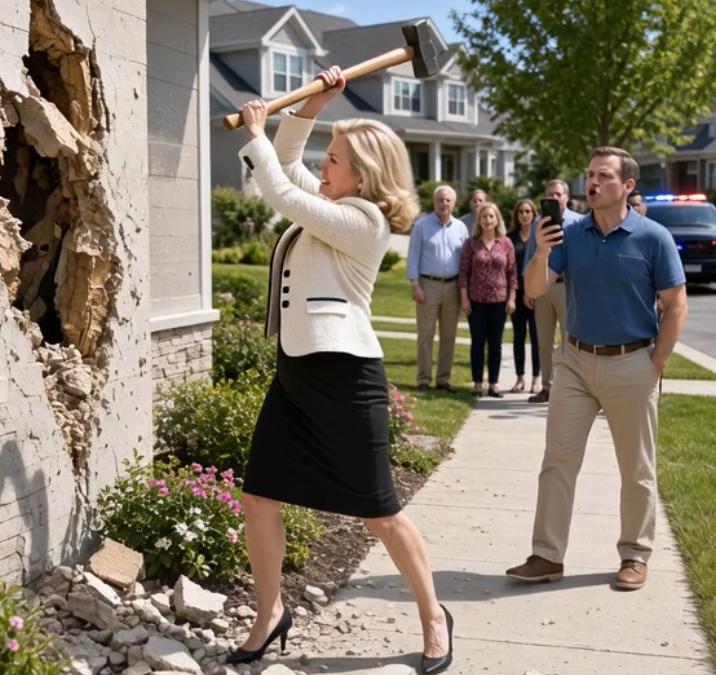
HOA Karen Showed Up at 6:12 A.M. With a Sledgehammer and Started Smashing My Family Cabin—She Had No Idea I’d Already Saved the Footage From Her First Visit.
At 6:12 on a cold Colorado morning, my phone buzzed with a security alert and showed Vanessa Crowley standing on my front porch in a bright pink suit with a steel-handled sledgehammer resting against her shoulder.
Three nights earlier, the same camera had caught her slipping into my family cabin with a copied key, searching my late father’s study, and stealing a survey envelope connected to eighteen acres her luxury-development company desperately needed.
She thought a disabled fifty-two-year-old veteran would come outside angry enough to give her the confrontation she needed.
Instead, I called the sheriff, unlocked the live camera feed, and waited.
My name is Cole Mercer.
Cole to most people.
Commander to only a handful of men who remember what I was before Kandahar turned my left leg into unreliable equipment.
I retired from the Navy after twenty-seven years. Most of that time, I worked in places where maps mattered.
A line on a map could mean a safe route.
Or a minefield.
A wall could mean cover.
Or a trap.
A road could belong to the village everyone claimed it belonged to, or to the man with the rifle who had been waiting three hours to prove otherwise.
You learned very quickly not to trust the first person who sounded certain.
You checked.
Then checked again.
That habit probably saved my house.
It may have saved half of Silver Crest Estates too.
I live in Black Pine Ridge, Colorado, on eighteen acres of pine forest, open meadow, an old equipment barn, two horse paddocks, and a family cabin my grandfather built before most of the people in the neighboring subdivision were born.
The cabin is not elegant.
Heavy pine.
Stone chimney.
Wide porch.
Iron stove.
Low ceilings in the original rooms.
My father added a study in the 1980s with tall windows facing the eastern hillside. The windows mattered because Dad was a surveyor. He liked seeing land while looking at maps of it.
Thomas Mercer trusted measurements more than promises.
He spent almost forty years surveying ranch boundaries, timber leases, road corridors, utility easements, and mountain development sites. He was lean, gray-eyed, hard-handed, and almost impossible to rush.
I remember watching him set a transit when I was twelve.
A contractor kept saying, “Tom, close enough.”
Dad finally looked up and said, “If close enough means the same thing tomorrow, you won’t mind waiting while I measure it.”
That was my father.
He died four years before Vanessa swung the hammer.
Stroke.
It took his speech first.
Then part of his movement.
Never his awareness.
During his final months, he spent a lot of time pointing toward the steel safe in his study.
I thought I understood.
Family deed.
Old survey books.
Maybe cash.
Dad had lived through enough recessions to distrust banks slightly more than bears.
I kept telling him, “I know. I’ll protect it.”
He would stare at me.
Frustrated.
I assumed he wanted me to protect the deed.
I was wrong.
He wanted me to understand what was in the safe.
I did not open it until Vanessa forced me to.
By then, the cabin had become more than property.
It was where I returned after my life ended overseas.
At least, the version of my life I recognized.
The blast happened during a joint operation outside Kandahar. I remember heat. Dust. A pressure change. Then nothing for a while.
When I woke, a medic named Luis Ortega was leaning over me.
Blood across his sleeve.
Mine.
He kept saying, “Stay here, Commander.”
I remember being irritated.
Where exactly was I going?
PART2:
The damage ran from my left hip almost to my knee.
Fragments.
Nerve injury.
Muscle damage.
Pelvic involvement.
Spinal complications showed up later.
Surgeries.
Rehabilitation.
The leg technically worked.
Most days.
Cold weather made the nerves burn. Some mornings, the foot went numb. Other mornings, my knee lost confidence before I did.
I hated the cane.
Black hickory.
Brass handle.
My physical therapist told me to view it as equipment.
I told her I had spent half my life carrying equipment and none of it had announced weakness quite like a cane.
She said, “That’s because the cane isn’t announcing anything. You are.”
I disliked her.
She was excellent.
I went home to Black Pine Ridge because I needed somewhere that did not treat injury like a public identity.
The horses did not care.
The trees did not care.
My father certainly would not have cared.
He would have looked at the cane and asked whether the brass handle was loose.
Silver Crest Estates sits east of my land.
Luxury mountain subdivision.
Sixty-eight homes.
PART3:
Private roads.
Stone entry monument.
Clubhouse.
Fitness center.
Decorative ponds.
Views that appear in real-estate listings under words like unmatched, serene, and exclusive.
Developers carved the subdivision out of old ranchland twelve years earlier.
My property stayed in the middle like a stone they could not dig out.
Originally, nobody cared.
Then Vanessa Crowley became HOA president.
Vanessa was forty-eight.
Five-eight.
Slim.
Blond hair curled carefully around her shoulders.
Pearl earrings.
Expensive heels.
And an astonishing number of bright pink suits.
She wore color like authority.
People saw her coming.
That was probably the point.
Vanessa had served as Silver Crest HOA president for six years. Before that, luxury real estate. Before that, her father’s law office.
Her father, Richard Crowley, had been a respected property attorney in Black Pine County.
Dad knew him.
That fact became important later.
Vanessa inherited contacts.
Developers.
Surveyors.
Planning staff.
Bankers.
Real-estate investors.
People sometimes mistake access for legitimacy.
Vanessa encouraged that.
My first HOA fine arrived four years before the sledgehammer.
IMPROPER FENCING.
I ignored it.
Then:
UNAPPROVED LIVESTOCK.
Two horses.
On private agricultural-residential land.
Not HOA property.
Then:
EXCESSIVE EXTERIOR LIGHTING.
One porch light.
Then:
FAILURE TO MAINTAIN COMMUNITY LANDSCAPING.
That one confused me enough to call.
“I don’t have community landscaping.”
Vanessa answered personally.
“Cole, your parcel is visually integrated with Silver Crest.”
“Visually?”
“Yes.”
“Legally?”
She paused.
“Your property affects community standards.”
“So does the mountain.”
“Don’t be difficult.”
“I’m asking whether my deed has changed.”
“No.”
“Then stop sending fines.”
They did not stop.
I threw most notices into a storage box.
That was a mistake.
Not legally.
Strategically.
The notices told a story.
I was not listening yet.
Then Margaret Sloan came to my door.
Margaret lived near the southern edge of Silver Crest. Seventy-one. Short silver hair. Blue Subaru held together through maintenance and optimism. Her husband, Arthur, had died two years earlier after heart disease ate away at him slowly.
Margaret had become quieter afterward.
Not weaker.
There is a difference.
She looked at one of my HOA notices and said, “Vanessa did this to Arthur.”
“What?”
“Fines.”
“For what?”
“Fence stain. Side-yard equipment. Drainage. A shed.”
“Was he in the HOA?”
“Yes.”
“But?”
“He owned a narrow strip beside our lot separately.”
She explained.
That strip connected an old county road to the rear of Silver Crest. Contractors wanted it. Vanessa started pressure.
Fines on the house.
Threats.
Legal letters.
Arthur’s medical costs climbed.
They sold the strip.
Six months later, it became a contractor service lane.
Margaret sat at my kitchen table with her hands around coffee.
“She doesn’t start by taking the land,” she said.
“What does she start with?”
“Making ownership too exhausting to keep.”
That sentence stayed with me.
I should have reacted then.
I did not.
Veterans are not immune to denial.
Sometimes we specialize in it.
I told myself Vanessa was annoying.
Not dangerous.
Then one Thursday night, while I was ninety miles away at the Denver Veterans Medical Center for a spinal evaluation, she entered my house.
2:18 a.m.
Phone vibration.
Security alert.
Hospital room dark.
Disinfectant.
Burnt coffee.
My leg burning from the day’s tests.
I opened the camera app.
A woman walked onto my porch.
Long camel-colored coat.
Hair.
Build.
Movement.
Vanessa.
She did not knock.
She reached into her purse.
Removed a key.
Inserted it.
The lock turned.
I stopped breathing.
No one outside my family had a key.
She entered.
Closed the door.
The living-room camera found her.
Small flashlight.
No overhead lights.
She knew the layout.
That realization bothered me more than the entry.
She opened the cabinet beside the fireplace.
Desk drawer.
Kitchen file drawer.
Property-tax records.
Then my father’s study.
I watched from a hospital bed.
Ninety miles.
Unable to do anything immediately.
That kind of helplessness is uniquely infuriating.
I had spent twenty-seven years training to move toward danger.
Now I was watching someone enter Dad’s study through a four-inch phone screen.
She opened every drawer.
Photographed papers.
Moved stacks.
Then found a brown envelope.
Dad’s copies of a 1976 survey notebook.
A letter about the eastern hillside.
I recognized the paper.
The report said the slope carried unstable soils and old drainage channels. Heavy construction would require major retaining work.
Vanessa slid the envelope beneath her coat.
Then she stood in front of the steel safe.
Seven minutes.
Tried five combinations.
Pressed her ear against the door.
Tried again.
She left at 2:41.
I signed myself out of the hospital before sunrise.
Against medical advice.
The doctor said, “You need observation.”
I said, “My house was burglarized.”
He paused.
“By someone you know?”
“Yes.”
“That doesn’t make your spine more stable.”
“Neither does lying here.”
He hated that.
I left.
Mason Reed met me at the cabin.
Mason was fifty-four.
Former teammate.
Thick neck.
Shaved head.
Black square beard.
After leaving the Navy, he built a civilian security company in Colorado Springs.
He had the temperament Vanessa did not expect from men like us.
Patient.
Measured.
He never moved first merely because he could.
We watched the footage twice.
“She knew what she wanted,” Mason said.
“Yes.”
“Anything else missing?”
“No.”
“Cash?”
“Still there.”
“Watch?”
“Still there.”
“Gun cabinet?”
“Untouched.”
“Documents.”
“Yes.”
He froze the video on the safe.
“She thinks something bigger is in there.”
“Probably.”
“What?”
“I don’t know.”
That was embarrassing.
My father spent his last months pointing at the safe.
I never opened it.
Grief does strange things.
Dad’s death came while I was already fighting to accept my own body. The cabin became a place full of unfinished conversations.
I avoided some rooms.
The safe belonged to one of them.
Ellie Harper waited near the horse fence.
Seventeen.
Freckles.
Auburn ponytail.
Small and deceptively fearless.
Her mother managed the neighboring ranch. Ellie cared for my horses when I traveled. She built drones from used parts and repaired electronics better than most adults.
She had seen Vanessa’s white BMW near the forest road around two that morning.
“You sure?”
“Yes.”
“How?”
“Left rear taillight flickers.”
Good observation.
“Did she see you?”
“No.”
“Keep it that way.”
The next morning, I sat across from Deputy Daniel Brooks at the Black Pine County Sheriff’s Office.
Daniel was forty-six.
Lean.
Short brown hair.
Hazel eyes.
Pale scar across his chin.
He listened without interrupting.
Mason put the footage on his desk.
Vanessa’s face was partly obscured by her coat collar and the dark exterior camera. Interior footage was clearer. Daniel recognized her.
But recognition was not arrest-quality identification by itself.
Then he told me something worse.
Vanessa had already called.
She claimed I had once given Silver Crest HOA a key for emergency wildfire inspections.
“She said what?”
“She claims your property is part of an emergency response corridor.”
“No.”
“She says she saw signs of an electrical problem and entered for safety.”
“At 2:18 in the morning?”
Daniel’s face did not change.
“I did not say I believed her.”
“Then arrest her.”
“I need probable cause I can defend.”
I hated that answer because it was correct.
He advised me to document, replace the lock, serve formal no-entry notice, preserve recordings, and not confront.
Mason smiled slightly.
“What?” I asked.
“You hate waiting.”
“I can wait.”
“You hate lawful waiting.”
Also true.
That afternoon, Mason arrived with three black cases.
By sunset, my front door was no longer ordinary.
Fingerprint recognition.
Rotating access codes.
Encrypted control.
Reinforced steel bolts hidden inside the pine frame.
Facial-recognition porch camera.
Vibration sensors.
Off-site recording.
Interior camera hidden inside the peephole.
Silent emergency button linked to sheriff dispatch.
“You securing the cabin or Fort Knox?” I asked.
Mason tightened a plate.
“Fort Knox has tourists.”
Ellie helped test blind spots with her drone.
She hovered near the roof.
“Porch left corner has four degrees you don’t see.”
Mason looked up.
“Show me.”
She did.
He adjusted.
“Engineering school,” he said.
She smiled.
“If I can afford it.”
I remembered that.
While Mason worked, I opened the storage box containing old HOA notices.
Four years.
Patterns.
The dates aligned suspiciously with development activities east of my land.
Then Margaret arrived.
She gave me Arthur’s correspondence.
Emails.
Old minutes.
A note Arthur had handwritten.
Vanessa says Mercer land is next problem.
I stared.
“Arthur wrote this?”
“Yes.”
“When?”
“Three years ago.”
The property pressure predated my awareness.
Vanessa arrived thirty minutes later.
Bright-pink suit.
Cream blouse.
Pearls.
Heels sinking into dirt.
She demanded the access code to the new lock.
“For wildfire inspection authority,” she said.
I handed her a formal trespass notice prepared through veterans legal assistance.
No HOA entry.
No contractor entry.
No access without my written permission.
She read it.
Smile steady.
Then she said, “You are endangering the community.”
“How?”
“Your cabin interferes with the proposed emergency evacuation route.”
Interesting.
After she left, I pulled county planning records.
The “evacuation route” did not lead toward Highway 24.
It did not lead to open fire-safe land.
It crossed my front meadow and continued into a sixty-four-acre development proposal behind the eastern tree line.
Luxury lodge.
Wedding hall.
Parking for one hundred twenty vehicles.
Private service road.
The route ended at the future lodge entrance.
Not an evacuation route.
An access road.
Then the mail arrived.
Department of Veterans Affairs.
Independent living review.
Anonymous report:
My injuries allegedly made me incapable of safely maintaining the property.
I read it twice.
Vanessa was not only attacking ownership.
She was building a narrative that I was incapable of keeping the land.
That was personal.
Also strategic.
At 11:38 that night, the camera alerted.
Vanessa.
Dark coat over pink suit.
Copied key.
Try once.
Twice.
Three times.
No entry.
Then she placed her hand on the doorframe and measured the width with her fingers.
Slowly.
Methodically.
Then she walked away.
The next morning, I called Rachel Donovan.
Rachel was forty-three.
Five-nine.
Straight black hair.
Dark eyes.
Charcoal suits.
Flat shoes.
No jewelry except a silver watch.
Her younger brother had returned from Afghanistan with traumatic brain injury and nearly lost their family farm to a predatory lender. She built her legal career representing veterans, landowners, and people who found themselves crushed between institutions and money.
She arrived with two file boxes.
Watched footage.
Read HOA notices.
Reviewed Margaret’s documents.
Read the VA letter.
Then she said, “This is coordinated.”
“That’s what I think.”
“No.” She looked at me. “You think Vanessa wants your land.”
“Yes.”
“I think she financially needs it.”
Corporate records proved her right.
Crowley Mountain Development.
Two investment managers publicly listed.
Holding companies behind them.
Vanessa owned thirty-two percent through an LLC connected to her real-estate office.
The proposed development depended on a hundred-foot-wide road through my meadow.
Investor presentation:
ACCESS CORRIDOR EXPECTED TO FALL UNDER HOA CONTROL PRIOR TO PHASE ONE CLOSE.
I read it.
“Expected.”
Rachel nodded.
“Like ownership is administrative.”
Then came the survey.
Someone had shifted my eastern boundary roughly one hundred thirty feet toward the cabin. The fake line placed the road outside my property. It also moved much of the planned wedding hall onto land the developer claimed it controlled.
Survey signature:
Harold Keen.
Retired.
Dead three years.
I stared.
“Dead surveyor.”
“Yes.”
“Convenient.”
“Very.”
Then county agencies started arriving.
Fire Marshal Owen Pike.
Anonymous complaint:
Chimney wildfire hazard.
I showed records.
Recent sweep.
Spark arrestor.
Permit.
Inspection.
Complaint collapsed.
Next day:
Environmental officer Dana Holt.
Fuel dumping near creek.
Nothing.
Then planning officer.
Illegal rental operation.
Nothing.
Every complaint cost time.
Every complaint created a record suggesting something was wrong.
That was the strategy.
Bureaucratic sediment.
Layer after layer until someone says, “Maybe the property is a problem.”
Vanessa expected paperwork to exhaust me.
My father raised me on survey records.
The Navy trained me to maintain logs under mortar fire.
Wrong target.
Margaret returned with Arthur’s banker’s box.
Old HOA minutes.
One sentence:
REMOVE MERCER OBSTRUCTION FROM PROPOSED ACCESS CORRIDOR BEFORE INVESTOR REVIEW.
Vanessa’s name beside it.
Not a crime by itself.
But it proved intent.
The land was a target.
Ellie flew her drone above the eastern woods.
Three orange survey stakes hidden beneath branches.
Fake boundary.
Mason and I walked out.
Fresh tire tracks.
Narrow heel marks.
Mason photographed tread and compared it with Vanessa’s BMW.
Same asymmetric tires.
Same damaged right-rear edge.
Then Rachel hired Dr. Samuel Price.
Geotechnical engineer.
Sixty-one.
White beard.
Wire glasses.
A landslide early in his career had killed two workers.
He never signed a stability report without walking the ground himself.
He spent six hours on the eastern hillside.
Soil cores.
Drainage paths.
Old slips.
By sunset, he stood where the wedding hall was supposed to overlook the valley.
“This slope is moving.”
“How much?”
“Slowly.”
“Meaning?”
“Heavy construction could trigger a major failure.”
That brought Dad’s stolen letter back into focus.
If Vanessa stole the copy, maybe the original was in the safe.
That night, I took Dad’s old military identification card from a wooden box.
He had been an Army engineer before surveying.
Behind the card, scratched into metal:
Six numbers.
The safe opened on my first attempt.
Inside:
Rolled official map.
County seals.
Boundary certification.
Legal opinion.
Original eastern-road records.
The entire disputed strip belonged to the Mercer family.
Then I saw the signature beneath the 1994 legal opinion.
Richard Crowley.
Vanessa’s father.
I read it three times.
Richard had represented Dad during a timber-company dispute. He personally confirmed the eastern road, hillside, and meadow were all exclusively Mercer property.
Then came the line that made my hands go cold.
No future neighborhood association or successor development may claim access absent the written consent of the Mercer owner.
Vanessa had grown up around her father’s law office.
The fake development document copied wording from Richard’s original drafts.
Private access road became shared community access.
Temporary survey permission became permanent easement.
Same page numbering.
Same format.
Someone had access to the old file.
Rachel’s expression changed.
“This isn’t an aggressive HOA dispute anymore.”
“What is it?”
“Possible forgery. Attempted property theft. Investor fraud.”
“Can we prove Vanessa did it?”
“Not yet.”
Her name did not appear on the forged pages.
Contractors.
Holding companies.
Consultants.
Distance.
People with money use layers.
So we gave Vanessa something to find.
The original Mercer file went into a bank vault.
At home, I placed high-quality copies inside a brown envelope in Dad’s bottom desk drawer.
Visible enough.
Mason adjusted interior cameras.
Desk.
Safe.
Doorway.
Directional microphone hidden inside an old wall clock.
Daniel reviewed the setup.
“If she comes inside again, you do not confront.”
“I know.”
“Say it.”
“I do not confront.”
“Good.”
“You enjoying this?”
“No.”
“You look like you are.”
“I look like this all the time.”
Fair.
Life continued while Vanessa built her plan.
That part matters.
Stories about conflict often make it seem like everyone stands frozen waiting for the villain.
We did not.
Mason began repairing the old equipment barn.
We planned to convert it into a rehabilitation workshop for injured veterans.
Luis Ortega joined.
Forty-nine.
Former Army medic.
Salt-and-pepper beard.
Right hand damaged by an explosion in Iraq.
Could not fully close it.
Crowded workplaces triggered him.
Engines calmed him.
We rebuilt workbenches.
Installed lifts.
Created stations where people could work seated.
Good lighting.
Quiet area.
The project gave the property a future beyond defending itself.
Ellie received acceptance to an engineering program in Fort Collins.
Scholarship covered part.
Not all.
She folded the letter and said, “I can wait a year.”
I knew that tone.
Giving up before anyone could watch her fail.
Dad had left me a 1967 Mustang.
Dark green.
Original V8.
Restored together when I was eighteen.
The most valuable thing I owned besides land.
I called a collector.
Sold it.
Ellie received a notice that an “education fund” covered the remaining tuition.
She looked at me.
“Cole.”
“What?”
“What did you sell?”
“Nothing important.”
She stared.
“You lie badly.”
“Go to school.”
She never asked directly again.
I think she knew.
Margaret worked residents quietly.
Six families gave Rachel copies of HOA emails, expense statements, and board documents.
HOA funds had paid for soil tests, survey crews, planning consultants, and legal reviews.
All connected to Crowley Mountain Development.
Residents had been told the expenses were wildfire planning.
Vanessa used HOA dues to finance her private investment.
Then came the offer.
Three times market value.
Twenty-four-hour deadline.
Confidentiality.
Withdraw complaints.
I rejected formally.
Rachel said, “You could just let it expire.”
“No.”
“Why?”
“I want the record to say no.”
That mattered to me.
At 11:17 that night, Vanessa returned.
Dark coat.
Gray slacks.
Copied key.
Failed.
Again.
Again.
Then she walked to her BMW.
Opened the trunk.
Camera zoomed.
Steel-handled sledgehammer.
She did not take it out.
Not that night.
She looked at it.
Closed the trunk.
Drove away.
The next morning at 8:14, Rachel and I were preparing to leave for a county planning meeting.
My phone vibrated.
Vanessa on porch.
Bright pink suit.
Matching heels.
Hair perfect.
Copied key inserted.
No.
Again.
No.
Four keypad codes.
Red denial.
She pulled the handle.
Hit the keypad with her palm.
Pressed her face near the window.
Then walked to the BMW.
Returned with the sledgehammer.
First strike.
A slab of pine tore from the outer door.
I felt the old part of me rise.
Second strike.
Frame split.
Steel reinforcement appeared.
The bolts held.
Third strike.
Vibration alarm.
Live video went to my phone.
Mason.
Rachel.
Sheriff dispatch.
Every recording backed up remotely.
I stood in the planning-office parking lot.
My first instinct:
Go home.
Take the hammer.
End it.
That is what Vanessa needed.
A wounded former SEAL confronting a middle-aged HOA president on camera.
She could say fear.
Threat.
Violence.
Self-defense.
I called Daniel.
“She is attacking the door.”
“We see it.”
“Documents may be inside.”
“We’re moving.”
“Tell me when.”
“Do not confront.”
“I’m not there.”
“Keep it that way.”
Mason was at the rehabilitation barn.
His truck moved toward the cabin.
I called him.
“Stop at the pasture gate.”
“She is destroying your house.”
“And six cameras are watching.”
“Cole.”
“Do not give her a fight.”
He stopped.
For men trained to move toward danger, standing still can require more discipline than charging.
Ellie heard the alarm at the neighboring stable.
She stayed nearly a hundred yards away.
Phone recording.
Horses nervous at each strike.
Margaret started calling residents.
Cars appeared along the gravel road.
Silver Crest homeowners gathered beyond the property line, watching their president attack the home of the man she had publicly described as unstable.
That mattered.
Witnesses.
Not because I wanted humiliation.
Because authority survives in private.
Sunlight helps.
Rachel drove toward the cabin with the original comparison report, forged agreement, and financial records.
At the eastern hillside, Dr. Price saw something else.
Three excavators.
One bulldozer.
Engines off.
Waiting.
He called Daniel.
A second deputy responded.
Crew supervisor Travis Boone showed a paid authorization from Crowley Mountain Development.
Begin clearing service road that morning.
The planning board had not approved anything yet.
Vanessa intended to create facts on the ground while she searched my cabin.
At the house, she swung again.
Keypad shattered.
Plastic scattered.
Steel lock remained.
She shouted.
Camera audio captured it clearly.
“The HOA has emergency authority!”
Then:
“He put community records inside!”
Then:
“I am recovering association property!”
Useful.
The same camera had recorded her taking the hammer from her trunk.
Two sheriff cruisers turned onto my road.
Daniel stepped out.
Hand raised.
“Put the hammer down.”
Vanessa froze.
Transformation instant.
Rage into outrage.
“He stole HOA property!”
Daniel said, “Put the hammer down.”
“This is an emergency entry.”
“Put it down.”
She dropped it.
Not gently.
Pointed at the house.
“The documents inside belong to Silver Crest.”
Daniel looked at the broken door.
“How do you know what’s inside?”
Vanessa stopped.
Small moment.
Important.
I remotely unlocked the cabin after Daniel called.
He did not allow entry until Rachel arrived.
They photographed the door.
Keypad.
Copied key hanging from lock.
Hammer.
BMW.
Footprints.
Then interior.
The decoy brown envelope still visible in Dad’s drawer.
Daniel reviewed old footage.
Vanessa entering.
Stealing the first envelope.
Then the new footage.
Trespass notice had been served.
Copied key.
Multiple codes.
Hammer retrieval.
Door destruction.
No ambiguity.
He handcuffed her on the porch.
Broken pine around her heels.
I watched live.
Felt almost nothing.
People imagine satisfaction.
It was not.
Mostly exhaustion.
Then deputies searched the BMW under proper authority.
Inside:
Copied key.
Altered boundary survey.
Excavator receipts.
Clearing authorization.
Leather folder.
Typed list.
Properties Vanessa planned to pressure into selling.
Margaret Sloan second.
COLE MERCER — PRIORITY ONE.
My name first.
At the eastern woods, deputies stopped Travis before a blade touched my land.
That mattered more to me than the arrest.
Trees remained standing.
The investigation lasted two months.
By the end of week one, the sledgehammer was the smallest part.
Deputies and prosecutors followed records.
HOA emails.
Invoices.
Shell companies.
Investor communications.
Survey files.
Contractor authorizations.
VA complaint.
Anonymous county complaints.
Everything.
Vanessa had used HOA money to finance Crowley Mountain Development.
Surveyors.
Environmental consultants.
Attorneys.
Development planning.
Residents thought they were paying for wildfire safety.
In reality, they were subsidizing her lodge project.
Assistant District Attorney Caroline Hayes handled the case.
Forty-five.
Tightly curled brown hair.
Narrow glasses.
Controlled voice.
Her father had lost a hardware store years earlier through a fraudulent development partnership.
She did not grandstand.
Facts did the work.
Unlawful entry.
Property destruction.
Attempted forced entry.
Forged land instruments.
Investor misrepresentation.
Misuse of association money.
Conspiracy-related allegations tied to pressuring vulnerable landowners.
The phrase prosecutors used carefully was:
Pattern of coercive property acquisition.
That described it.
Margaret.
Arthur.
Me.
Others.
Board members were questioned.
Two admitted signing blank payment authorizations because Vanessa told them delays would cost emergency grants.
Others produced emails in which she repeatedly said:
Mercer corridor already secured.
My land.
Never sold.
Already secured.
That mindset fascinated me.
If she said something enough, she seemed to believe the paperwork would eventually become true.
The false survey was more sophisticated than we first knew.
Harold Keen’s old survey stamp had been reproduced digitally. His signature had been copied from a legitimate subdivision map. Boundary points were shifted. Description language changed.
One consultant claimed Vanessa provided the “historic source documents.”
Another claimed he assumed counsel had verified them.
Layers.
Everyone trusting someone else.
Rachel said, “Fraud loves delegated assumptions.”
I wrote that down.
Dr. Price’s geotechnical report destroyed investor confidence.
The proposed wedding hall stood on a moving slope. Heavy construction could trigger failure. The original report Vanessa stole from Dad matched his conclusions.
That raised another question.
Did she know the slope was dangerous before raising money?
Investor presentation called the site:
STABLE BEDROCK RIDGE WITH LOW GEOTECHNICAL RISK.
It was not.
Vanessa’s stolen envelope contained the opposite.
Evidence of knowledge.
That turned a property scheme into potential investor fraud.
Crowley Mountain Development collapsed before trial.
Investors pulled funding.
One sued separately.
The wedding-hall project vanished.
Orange stakes were removed under county supervision.
The excavators left.
The eastern trees became trees again.
Margaret sat at my kitchen table the week after Vanessa’s arrest.
She held Arthur’s correspondence.
“You think they can return my strip?”
“Rachel thinks so.”
Her eyes filled.
Arthur died believing they had lost it permanently.
Vanessa had used pressure. The sale itself had legal defects tied to misrepresentation. County and civil proceedings eventually voided the forced transfer.
Margaret got the strip back.
The morning the deed was restored, I drove with her. She walked to the old fence post, put one hand on it, and stayed silent.
I did too.
Some moments do not improve with dialogue.
Silver Crest held an emergency election.
Margaret became interim president after residents nominated her.
She protested.
Naturally.
Then accepted because nobody else trusted anyone.
Her first reforms were public votes for property-related decisions, independent audits, disclosure of board-member financial interests, no blank payment approvals, outside verification of easements, legal review before any claim against adjacent property, and no anonymous complaints submitted in the association’s name without board authorization.
Passed unanimously.
Funny how corruption makes transparency popular.
The veterans workshop continued.
Mason finished electrical.
Luis became shop supervisor.
We formed a nonprofit.
I donated one acre around the barn.
The deed permanently restricted it from commercial development.
Rachel laughed when she read my draft.
“You’ve become your father.”
“Insult?”
“Observation.”
Veterans came slowly.
One man restored chairs.
Another rebuilt carburetors.
A woman who lost part of her hand in a training accident learned small-engine repair.
A Marine with PTSD preferred sanding furniture because repetition quieted his mind.
Nobody was forced to talk.
That was important.
Modern rehabilitation sometimes thinks healing requires explaining yourself.
Sometimes a person just needs a socket wrench and a job that ends when the engine starts.
Ellie left for Fort Collins.
Before she did, she designed security for the workshop.
Cameras.
Emergency lighting.
Electronic access.
Battery backup.
She put the original cabin security-system test in her university portfolio.
Her professor loved it.
Real-world adaptive security design.
Mason said, “Meaning we gave her homework.”
She never told me she knew about the Mustang.
But during her first semester, she mailed me a photograph of a dark-green 1967 Mustang she saw at a car show.
On the back, she wrote:
Still think you lie badly.
I kept it.
The case against Vanessa did not end instantly.
People love stories where evidence equals conviction by dinner.
Real justice is paperwork.
Depositions.
Motions.
Expert reports.
Financial tracing.
Negotiations.
Vanessa initially fought everything.
Claimed HOA authority.
Claimed emergency access.
Claimed the hammer was necessary to recover community documents.
Claimed development investment was properly disclosed.
Claimed survey errors came from consultants.
Claimed VA complaint was unrelated.
Then investigators found metadata.
Draft documents linked to her office computer.
Emails requesting a survey “reflecting anticipated corridor ownership.”
A message to one consultant:
Use historic Crowley legal language. Mercer consent expected later.
There it was.
Expected later.
Create the document now.
Permission later.
Another email:
If Mercer resists, continue compliance pressure. Disability review may create alternative acquisition path.
I read that in Rachel’s office.
My hands shook.
Not fear.
Rage.
She had weaponized my injuries deliberately.
I had spent years learning not to view my body as failure.
Vanessa had looked at the same disability and seen a property strategy.
Rachel closed the file.
“Cole.”
“I’m fine.”
“No.”
I stared.
She waited.
Finally, I said, “I want five minutes.”
“For what?”
“To be angry.”
“Take ten.”
I walked outside.
Cold air.
Cane against pavement.
I thought about hospital rooms.
Physical therapists.
VA forms.
The humiliation of asking for help putting on a boot after a nerve flare.
All the work required to accept needing assistance.
Then a stranger had turned those vulnerabilities into a line item.
Alternative acquisition path.
That email became central.
Prosecutors did not need to prove every anonymous complaint was personally written by Vanessa. They tied enough to her associates.
Property pressure.
Development gain.
False records.
The pattern held.
Faced with video, documents, financial records, contractors, consultants, board emails, and investor testimony, Vanessa accepted a plea rather than risk a much longer sentence.
The exact resolution did not satisfy everyone.
Some residents wanted decades.
Others wanted every board member charged.
Law is not designed to satisfy emotional arithmetic.
Vanessa received incarceration.
Restitution.
Permanent loss of real-estate license.
Financial penalties.
Civil judgments remained.
Crowley Mountain Development dissolved.
Some associates resolved claims separately.
Several board members avoided charges because prosecutors found negligence rather than knowing participation.
That angered Margaret at first.
“They signed,” she said.
“Yes.”
“They didn’t read.”
“Yes.”
“That should be illegal.”
“Being stupid?”
“Maybe.”
I laughed.
She did not.
Silver Crest survived.
Important.
The HOA did not need to vanish.
Roads.
Snow removal.
Shared fire infrastructure.
Clubhouse.
Drainage.
Someone had to manage those.
Under Margaret, meetings became unbearable.
In the best way.
Agenda.
Treasurer report.
Public questions.
Written conflict disclosures.
Independent invoices.
People argued about snowplow contracts for forty-five minutes.
Mason attended once.
Returned.
“Worst operation I’ve ever seen.”
“Because?”
“Nobody knows when to stop talking.”
“Democracy.”
“I prefer missions.”
The restored Sloan strip became a small memorial garden for Arthur.
Margaret planted two aspens.
One died.
She replaced it.
“No symbolism,” she told me. “Trees die.”
Good.
The rehab workshop grew.
We named it Mercer Ridge Veterans Workshop only because everyone rejected my preferred name:
The Barn.
Luis told me marketing mattered.
“Vanessa said that,” I told him.
He stared.
“We’ll call it the Barn.”
Compromise.
The sign outside read:
MERCER RIDGE VETERANS WORKSHOP
Smaller letters beneath:
THE BARN
Good.
Mason offered me partnership in his security company.
Property vulnerability assessments.
Rural owners.
Veterans.
Elderly landowners.
People without political influence.
I reviewed boundaries and physical systems.
Cameras.
Access control.
Document security.
Emergency response.
The income changed my life.
Not because I became rich.
Because my disability check stopped being a countdown.
For years, every major repair meant asking whether I could afford it before the next payment.
Now I had work.
Useful work.
My leg still burned.
The cane still existed.
But disability stopped being the main economic fact of my life.
That mattered.
One afternoon, a client apologized.
“I don’t mean to ask, but with your leg, can you walk the north boundary?”
I looked at the slope.
“Probably slower than you.”
“Should we use an ATV?”
“Yes.”
No shame.
Practical.
My therapist would have been unbearable about that progress.
I sent her an email.
Subject:
CANE REMAINS EQUIPMENT. YOU WERE RIGHT. DO NOT RESPOND.
She responded:
I know.
I regretted contact.
Ellie thrived in engineering school.
Second year, she interned with county planning. She studied GIS boundary systems and drone mapping.
Coincidence?
No.
At twenty, she found a minor mapping discrepancy affecting an old ranch easement. Her supervisor said it could wait.
She wrote:
Ownership deserves accuracy before convenience.
He fixed it.
I was proud.
She eventually learned the Mustang truth.
Or admitted knowing.
We were in the workshop when she said, “I found the bill of sale in an old insurance file.”
“You weren’t supposed to read that.”
“I design security systems. I also read folders.”
“Your tuition was worth more.”
“You loved that car.”
“I loved Dad more.”
She looked confused.
“What does your dad have to do with it?”
“He would have sold it too.”
She hugged me.
Ellie rarely hugged.
I almost fell.
“Watch the leg.”
“Sorry.”
Good moment.
Years later, Vanessa wrote me from prison.
Handwritten.
I left the letter unopened for three weeks.
Mason saw it on the counter.
“You going to read?”
“No.”
“Then throw it away.”
“No.”
“Helpful.”
I opened it eventually.
She did not deny much.
That surprised me.
She wrote that her father’s files had shaped her understanding of Mercer property. She knew the original boundary. She believed development could create enough economic pressure that eventual transfer was inevitable.
She used the word inevitable twice.
I hated it.
She admitted that she viewed my injury as “a practical vulnerability.”
That phrase.
Again.
She wrote:
I convinced myself the project would benefit Silver Crest enough to justify aggressive methods.
Aggressive methods.
Copied key.
Fake fines.
VA complaint.
Forged survey.
Sledgehammer.
Language is incredible.
Near the end, she wrote:
I am sorry I attacked your home.
Not the door.
Home.
That mattered.
Then:
I am more sorry that I used your father’s work and your injuries against you.
I folded the letter.
Did not reply.
Forgiveness became less important over time.
At first, I imagined some dramatic moment where I would say, “I forgive you,” and sunlight would break through the window with music.
No.
I simply stopped carrying her.
Different.
Better.
The door remained.
The plaque remained.
But Vanessa stopped occupying the cabin.
That is freedom.
One summer afternoon, a wildfire started twelve miles west.
Smoke.
Wind.
County activated evacuation planning.
Silver Crest used new routes.
My temporary meadow easement opened.
Vehicles crossed in organized flow.
The Barn served as a staging point for two residents with mobility issues.
Fire turned north.
No homes lost.
After the all-clear, David Lin, the new Silver Crest president, stood in my meadow.
“Thank you,” he said.
“You had a legal easement.”
“Still.”
“We planned it.”
“Yes.”
Vanessa once claimed she needed permanent HOA control over the same land for wildfire safety.
The real system used consent, triggers, and limits.
It worked.
That was satisfying.
No revenge.
Proof.
Authority does not need theft to be effective.
Often, theft makes systems weaker because nobody trusts them.
Silver Crest residents once resisted emergency planning because they assumed it hid development.
After reform, transparency increased cooperation.
Governance is not only rules.
It is trust.
Hard to build.
Easy to destroy.
Vanessa’s biggest damage may not have been financial.
Everyone suspected everything.
Margaret’s first year, residents challenged a snowplow invoice as a hidden land scheme.
Ridiculous.
Understandable.
She started to say, “Trust me.”
Then stopped herself.
“No,” she said. “I’ll upload the invoice.”
That became culture.
Do not trust.
Verify.
Then trust based on verification.
Healthy.
Dad would have liked it.
One day, I found an old note from him in a different survey notebook.
Richard C. says Silver Ridge developer may expand someday. Keep originals. People remember agreements differently when money arrives.
I sat in the study laughing.
Dad had predicted the entire case in one sentence.
People remember agreements differently when money arrives.
Richard Crowley had been honest in 1994.
Vanessa used his own language to distort it.
I wonder what he would have thought.
Probably shame.
Maybe anger.
Children are not parents.
Parents’ integrity does not transfer automatically any more than land does.
Neither does guilt.
I never blamed Richard.
His signature helped save me.
Irony.
If Vanessa had destroyed the original files before I found them, certified county records still existed, but the private drafts linking altered language would have been harder to prove.
Dad’s insistence on originals mattered.
So did the safe.
So did his six numbers scratched behind the ID.
I apologized to him once.
Alone.
In the study.
“For taking so long.”
No answer.
Obviously.
Still helped.
Grief often needs ritual more than logic.
The cabin holds many.
Dad’s jacket.
Mom’s recipe box.
My grandfather’s compass.
The scarred door piece moved to the Barn, not the house.
I wanted home to stop being a crime scene.
That was deliberate.
You cannot live in evidence forever.
The new oak door has no visible steel.
Beautiful.
Heavy.
Secure.
I sometimes run my hand over the grain and think of the morning Vanessa attacked.
Then I think:
Door closed now because I choose.
Not because I am waiting.
That difference is peace.
At the workshop opening night, voices carried across the meadow. Mason stood beside the path. Ellie and Margaret walked ahead. Luis laughed inside.
I locked the cabin from my phone.
Steel bolts slid.
For the first time in years, closing the door did not feel like preparation for attack.
It felt like leaving home because I had somewhere else to go.
That was bigger than arrest.
Bigger than restitution.
A future.
I still walk with a cane.
Cold mornings still hurt.
Crowley Mountain Development is gone.
Vanessa’s pink suit lives only in old evidence photos.
Silver Crest still debates mailboxes.
Margaret still mails me jam.
Ellie studies engineering.
Mason complains the security company needs marketing.
Luis runs the Barn better than I ever could.
Daniel is captain.
Rachel still tells clients not to improvise.
And Dad’s eastern boundary remains exactly where he measured it.
The road through the forest is mine.
The meadow is mine.
The cabin is mine.
Not because I fought harder.
Because it already was.
That is important.
People tell stories as if asserting rights creates them.
No.
I did not win ownership.
I prevented theft.
Vanessa’s title never gave her more land.
Her investors never made the fake survey real.
The sledgehammer never transferred the deed.
Power cannot manufacture ownership simply by acting confident.
That is why Mason’s plaque is correct.
POWER DOES NOT CREATE OWNERSHIP.
Sometimes power delays truth.
Makes it expensive.
Makes people tired.
But if records survive and someone keeps asking questions, truth has weight.
Maps.
Video.
Signatures.
Invoices.
Emails.
Physical land.
Reality accumulates.
That is what happened.
Vanessa almost succeeded not because she had law.
Because she expected exhaustion.
Arthur had been exhausted.
Medical bills.
Fines.
Letters.
He sold.
Margaret lived with that regret.
I had disability forms.
Hospital appointments.
Pain.
She assumed the same.
That calculation enrages me even now.
But it also taught me where to help.
Our security company works with vulnerable owners.
We tell them:
Do not wait until the hammer.
Read early.
Respond early.
Document selective enforcement.
Get certified deeds.
Know easements.
Store originals safely.
Use cameras if needed.
Get legal help before threat becomes crisis.
Boring prevention.
Best kind.
One older veteran asked me, “What if I can’t fight?”
I said, “You shouldn’t have to fight alone.”
That is another lesson.
I tried at the beginning.
Ignored notices.
Stored letters.
Thought competence meant handling it alone.
Wrong.
Mason.
Margaret.
Ellie.
Rachel.
Daniel.
Dr. Price.
Residents.
Every one contributed.
My military identity had taught self-reliance.
Actual military operations never worked alone.
Teams.
Why did I forget at home?
Pride.
Maybe pain.
I relearned.
The story people repeat is simple.
Retired SEAL outsmarts HOA Karen.
Camera trap.
Sledgehammer.
Cops.
Satisfying.
But the real victory was collective.
Margaret saved Arthur’s records.
Ellie found stakes.
Rachel traced company ownership.
Samuel found slope danger.
Mason built security.
Daniel waited for defensible evidence.
Residents shared emails.
Travis gave authorization.
Dad preserved originals.
I mainly refused to punch anyone.
Useful.
Not heroic.
Restraint can be strategy.
When Vanessa hit the door, every part of my training said move toward the problem.
Instead, I called.
Waited.
That waiting won.
She could not claim self-defense.
Could not claim I threatened.
Could not blur the event.
Camera showed sequence.
Her key.
Her codes.
Her trunk.
Her hammer.
Her strikes.
Sheriff arrival.
Sequence matters.
People can argue motives.
Harder to argue timestamps.
That principle entered our workshop training too.
Veterans building civilian lives sometimes face disputes.
Employers.
Landlords.
Benefits.
We teach:
Write down.
Save emails.
Do not let anger make your opponent’s case.
One Marine hated that.
“So we’re supposed to let people walk over us?”
“No.”
“Sounds like it.”
“Documentation isn’t surrender.”
“Feels like it.”
“I know.”
“Then?”
“Do it anyway.”
Months later, his landlord dispute resolved because he had photos.
He apologized.
I said, “Don’t thank me. Thank the timestamp.”
He laughed.
Dad would approve.
A year after Vanessa’s case, I visited the unstable eastern slope with Dr. Price.
No construction.
Pines.
Drainage.
He pointed to slight movement.
“Still moving?”
“Yes.”
“Danger?”
“If left forested, manageable. Roads and foundations would change loads and water.”
I looked at the planned wedding-hall view.
Beautiful.
“People would’ve paid a lot.”
“Yes.”
“For the view.”
“Yes.”
“And maybe watched the building slide.”
He smiled.
“Engineering is cruel to marketing.”
Good phrase.
The land itself became warning.
Another investor later bought the parcel for conservation.
That was good.
Vanessa’s ambition could have caused a landslide.
That is the part people forget behind the sledgehammer.
Her crime was not only against me.
She pushed development on unstable ground.
A wedding hall full of people.
Parking lot.
Road.
Water routing.
Dad’s report might have prevented disaster decades before one happened.
Documentation again.
Sometimes paper saves lives long after the writer dies.
I think of his safe differently now.
Not a hiding box.
A time capsule.
A responsibility.
He pointed because he knew I would need to know.
I wish I had opened it while he lived.
Could have asked him.
Did you expect Vanessa?
Why Richard’s opinion?
What happened with the timber company?
Lost conversations.
We all have them.
Regret does not make them recoverable.
But I can read his notes.
Measurements are another kind of voice.
One margin note said:
Cole hates surveying. Too impatient. Navy will cure him.
I laughed.
Dad predicted that too.
The Navy did not cure impatience.
Just weaponized it.
Years after, at a Silver Crest picnic, a child saw my cane.
“What happened?”
His parent looked horrified.
I said, “Old injury.”
“Does it hurt?”
“Sometimes.”
“Can you run?”
“Badly.”
He thought.
“My grandma runs badly.”
“Smart woman.”
The parent apologized.
“No need.”
Before Vanessa, I would have hated the question.
After being legally described as incapable, I stopped guarding image so much.
Strength is not the absence of injury.
One can carry a cane and still own eighteen acres.
Obvious.
Yet I needed to learn it.
Vanessa saw cane.
Disability check.
Veteran.
She thought fragile.
Mason saw the same and knew exactly how dangerous stubbornness remained.
Rachel saw vulnerability in the system, not the man.
Margaret saw someone being targeted.
Ellie saw a mentor.
Different perceptions.
We choose which to believe.
I now answer younger injured veterans honestly.
“I lost part of who I was.”
Then:
“I built something else.”
Not better.
Not worse.
Different.
The Barn exists because enough damaged people refused uselessness as a verdict.
That is probably why the plaque resonates.
Power does not create ownership.
Injury does not erase it either.
Nor personhood.
One morning, I woke at 6:12.
Same time.
Phone buzz.
Security alert.
My heart jumped.
Screen:
Margaret on the porch.
Holding a jar.
No hammer.
I laughed.
Opened the door remotely.
She entered the kitchen and left raspberry jam.
Note:
Emergency HOA inspection.
I called her.
“You’re trespassing.”
“You opened the door.”
“Details.”
She laughed.
Fear had become joke.
That is healing.
Not forgetting the original alert.
Transforming its meaning.
The sledgehammer morning will always exist.
But it is not the only 6:12 anymore.
Time creates new layers.
The final official action in Vanessa’s case occurred when the county corrected every public map referencing the false corridor.
Ellie came home and insisted we watch the GIS update.
Pixel line moved east.
Back to the true boundary.
She said, “That’s it?”
“That’s it.”
“No fireworks?”
“No.”
“Years of fighting, and someone drags a line on a screen.”
“Welcome to property law.”
She laughed.
The digital line matched Dad’s 1994 map.
The land itself never moved.
Only representations did.
That is almost philosophical.
Vanessa tried to make the map more real than the ground.
The ground waited.
Then records caught up.
When I stand in the meadow now, I can see Silver Crest roofs between pines.
No hostility.
Some residents wave.
I wave.
We share wildfire planning.
Road maintenance occasionally.
Workshop events.
Boundaries remain.
Community works better with them.
People think boundaries only divide.
They also define responsibility.
My land.
My maintenance.
Their road.
Their maintenance.
Shared emergency route by agreement.
Clear.
Trust grows when nobody pretends clarity is hostility.
Vanessa called refusal dangerous.
In reality, her disregard created danger.
Important reversal.
I have no interest in abolishing HOAs.
People ask.
“After what happened?”
Silver Crest needs organization.
Snow.
Roads.
Fire cisterns.
Shared facilities.
The problem was not existence.
The problem was unchecked concentration, conflicts of interest, and residents not reading.
A title became a crown because nobody challenged.
Vanessa mistook presidency for ownership.
Clipboard for deed.
Investor urgency for public necessity.
Sledgehammer for emergency authority.
Systems must prevent that.
Margaret’s reforms did.
Later, David improved them.
Boards changed.
Rules outlast leaders.
Good governance makes bad behavior harder.
That is more durable than revenge.
Vanessa eventually finished her sentence.
I heard she moved out of state.
Not my concern.
Her old house sold.
New owners invited me to a neighborhood barbecue.
I went.
Pink was not the theme.
Good.
Someone asked if I wanted to see the former HOA office.
“No.”
“Why?”
“I’ve seen enough paperwork.”
We laughed.
I ate a hamburger.
Left early because my leg hurt.
No shame.
Ordinary life.
Gift.
The old 1967 Mustang occasionally appears in collector listings.
I saw it once.
Same green.
Price higher than what I sold it for.
Mason teased me.
“Bad investment.”
“Education did better.”
Ellie later graduated with honors.
First job:
Resilience engineer for a county infrastructure firm.
She bought me a used 1970 Ford pickup.
Green.
Not Mustang.
Card said:
You said nothing important was sold. So I bought you something unimportant.
I cried.
Alone.
Then called.
“This truck leaks oil.”
“I know.”
“Engineering failure.”
“Historic authenticity.”
Dad would love her.
The Barn celebrated its fifth anniversary.
Fifty veterans had used programs.
Some regular.
Some one-time.
One started a furniture company.
Another returned to school.
Some simply repaired a lawnmower and went home feeling capable.
That counts.
At the anniversary, Mason tried a speech.
Terrible.
Luis took the microphone.
“This place exists because a crazy woman broke Cole’s door.”
I shook my head.
“No.”
Luis continued.
“It exists because Cole didn’t break her.”
Laughter.
Then quiet.
He had a point.
Restraint created space for evidence.
Evidence created accountability.
Accountability freed land.
Land supported workshop.
Chain.
But again, Vanessa does not get credit.
Our choices after do.
I spoke briefly.
“Most of us came here because something broke.”
I looked around.
“Bodies. Careers. Families. Plans.”
Then:
“We are not here to pretend nothing broke.”
That mattered.
“We are here because broken is not the same as finished.”
Luis nodded.
Mason looked at the floor.
Ellie filmed.
Margaret cried openly and blamed allergies.
I ended with no dramatic slogan.
Just:
“Build something.”
They did.
If there is one lesson from the whole story, it is not install expensive cameras.
Though cameras help.
It is not hire a better lawyer.
Though Rachel saved me.
It is not distrust every HOA.
Not every HOA is Vanessa.
The lesson is this:
Do not let other people’s confidence replace your knowledge of what is yours.
Read the deed.
Know the boundary.
Keep originals.
Document harassment.
Ask who benefits.
Check corporate records.
Question emergency claims tied conveniently to private profit.
And when someone tries to provoke you into becoming evidence against yourself, refuse the role.
That last one was hardest.
I could have been on the porch.
Could have grabbed the hammer.
Maybe she would swing.
Maybe I would disarm her.
Maybe someone would be hurt.
Then the case becomes messy.
Instead, I waited.
Sheriff came.
Hammer down.
Camera played.
Clean sequence.
Sometimes the strongest action is allowing someone to finish proving who they are.
Vanessa did.
The first hammer strike did not shock me.
The third did not either.
What shocked me was how ordinary she looked afterward.
Pink suit.
Pearls.
Broken wood.
No monster.
Just a person convinced enough in her own authority to destroy someone else’s door in daylight.
That is why systems matter more than personalities.
Monsters are easy to identify.
Confident administrators are harder.
Danger often wears official language.
Emergency authority.
Community safety.
Evacuation route.
Compliance.
Independent living concern.
Each phrase can describe something legitimate.
Or a weapon.
The question is evidence.
What is the recorded authority?
Where does the route lead?
Who owns the company?
Who profits?
Who signed the survey?
When did the surveyor die?
What does the original say?
Questions are anti-bullshit technology.
Dad knew.
He did not argue loudly.
He measured.
I became more like him late.
Good enough.
The final time I stood where the proposed service road would have cut through my meadow, snow was melting.
Water running.
Horses grazing.
No bulldozers.
I placed my cane in soft earth and looked east.
Silver Crest.
Then back.
Cabin.
Barn.
Workshop lights.
Ellie’s truck.
Mason arguing with Luis about the compressor.
Margaret’s Subaru.
Life.
Vanessa saw corridor.
I saw all of that.
That is the difference maps cannot always show.
A hundred-foot strip can look empty.
But emptiness on a plan is often someone else’s world.
I walked back slowly.
Leg burning.
Did not care.
At the porch, the oak door opened with my fingerprint.
Steel bolts moved.
The frame Vanessa split had been rebuilt.
One small section of original pine remained visible near the hinge.
I kept it.
Not scar as trophy.
Continuity.
House changed.
Still house.
I changed.
Still me.
My father’s jacket still hangs behind the study door.
Safe still there.
Now opened often.
Documents organized.
No fear.
When I close the door at night, I hear the bolt slide.
Once, that sound meant defense.
Now it means home.
And that is why, when people ask what I did when the HOA president took a sledgehammer to my house, I tell them the least dramatic part first.
I called the cops.
Then I waited.
Because the cameras were already watching.
The deed was already mine.
The boundary had already been surveyed.
The forged documents were already false.
The development was already dependent on land Vanessa did not own.
I did not need to prove any of that with my fists.
I only needed to make sure she could not rewrite what happened after the hammer fell.
So I waited.
Daniel arrived.
The door survived.
The truth did too.
And years later, that old hammer mark is no longer the thing I see when I look at my home.
I see Margaret walking across the strip Arthur thought they had lost.
I see Ellie leaving for engineering school.
I see Luis teaching a wounded veteran how to rebuild a carburetor one-handed.
I see Mason standing beside the pasture gate, furious enough to fight but disciplined enough not to.
I see my father’s survey map.
Richard Crowley’s honest signature beneath it.
The real line.
Still exactly where it always was.
Vanessa tried to move that line with paperwork.
Then with money.
Then with fear.
Finally with a sledgehammer.
None of it moved the land one inch.
And that is the thing she never understood.
A title is not a crown.
A board vote is not a deed.
A copied key is not permission.
A hammer is not authority.








