HOA Karen Sent Private Guards to Arrest My Elderly Parents and Seize Their Home With Fake Papers—Then She Locked the Neighborhood Gate Just as a Presidential Protective Convoy Arrived for Me.
PART2:
Vanessa had a gift for making absurd things sound administrative.
She rarely screamed in the beginning.
She didn’t need to.
She spoke in the flat, confident tone of somebody announcing a rule that supposedly already existed.
“Inside Brier Crest, the board decides.”
She said variations of that sentence constantly.
The board decides what vehicles are allowed.
The board decides which contractors can enter.
The board decides how long visitors remain.
The board decides what landscaping is acceptable.
The board decides when enforcement becomes necessary.
My father hated that phrase.
The board decides.
One Thanksgiving, he told me:
“She talks like the neighborhood is a separate country.”
I laughed.
My mother didn’t.
Elaine had already started keeping files.
That’s what she did.
She saved everything.
HOA notices.
Receipts.
Emails.
PART3:
Meeting announcements.
Assessment statements.
Even envelopes.
My father mocked her.
“What are we doing, preserving the historical record?”
Mom would hold up a notice.
“One day you’ll thank me.”
Dad would say:
“One day I’ll be dead.”
“Then you’ll thank me from wherever you are.”
They had been married forty-three years.
That was how affection sounded in their house.
The files started with small things.
In 2019, Vanessa’s board introduced a new “exterior harmony standard.”
Nobody knew exactly what that meant.
My parents received a notice because the fence was “nonconforming white.”
My father called me.
“Apparently my white fence is the wrong white.”
I thought he was joking.
He wasn’t.
The notice required:
Approved Alpine Pearl or equivalent.
Dad bought one gallon.
Held the paint chip against his fence.
Called me again.
“It is white.”
“Paint it.”
“I already painted it white.”
“Then paint white over the white.”
“That is how dictators win.”
Mom yelled from somewhere in the background:
“Martin, paint the fence.”
He painted the fence.
Fine avoided.
Two months later, a notice about their mailbox.
Then driveway oil staining.
Then two flowerpots Mom had placed beside the garage.
Then an “unapproved exterior utility container.”
It was Dad’s garden-hose reel.
He appealed that one.
Vanessa denied the appeal personally.
That was another thing Brier Crest residents should have challenged earlier.
The same woman helped define rules, initiate violations, participate in hearings, and announce outcomes.
No separation.
No independent review.
No meaningful appeal.
Residents were busy.
They paid.
Corrected.
Moved on.
That’s how small authority grows.
Not through dramatic conquest.
Through inconvenience.
Most people would rather pay seventy-five dollars than spend three evenings reading bylaws.
Vanessa understood that.
Then came the security company.
Crowell Community Protection Services.
The name should have raised questions.
Vanessa insisted there was no relationship.
Crowell was her married name.
The security company, she explained, belonged to a “separate Crowell family branch.”
That separate branch turned out to be her brother, Scott.
Nobody knew that at first.
The guards wore dark uniforms.
Black polos.
Cargo pants.
Utility belts.
Metal badges that said:
BRIER CREST SECURITY.
From fifty feet away, they looked enough like police to make people slow down.
They drove black SUVs with amber light bars.
Vanessa called them officers.
They were not.
Private guards.
No arrest power beyond whatever any private citizen might have under narrow circumstances.
No authority to adjudicate property disputes.
No power to evict residents.
But the language changed how people responded.
“Security officer needs access.”
“Security officer is documenting a violation.”
“Security officer has ordered the vehicle removed.”
“Security officer is enforcing a board directive.”
Authority theater.
Uniform.
Badge.
Radio.
Clipboard.
Most people don’t stop to ask exactly which statute gave the man at their driveway a right to issue orders.
My father did.
That made Vanessa dislike him.
The first direct confrontation happened over my mother’s gardener.
His name was Hector Ruiz.
He had maintained their yard for fifteen years.
Same truck.
Same trailer.
Same Tuesday morning.
One day security refused him entry.
Dad drove to the gate.
Vanessa happened to be there.
“Why can’t Hector come in?”
She said:
“Vendor certification.”
“He’s been our gardener fifteen years.”
“All contractors now require approved registration.”
“We weren’t told.”
“It was announced.”
“When?”
“Board communication.”
Dad called Mom.
She checked every email.
Nothing.
Vanessa said:
“Maybe you overlooked it.”
My mother does not overlook paperwork.
Hector lost three hours that morning.
Eventually entered after paying a seventy-five-dollar vendor fee.
My father reimbursed him.
Then went to the next board meeting.
He asked where the vendor policy had been adopted.
Vanessa said:
“Executive administrative authority.”
Dad asked:
“Does that mean no vote?”
Vanessa replied:
“It means routine operational procedures don’t require homeowner debate.”
Dad looked around the room.
“What else doesn’t require us?”
People laughed.
Vanessa didn’t.
From that moment, Martin Sloan became a “hostile resident.”
Mom discovered that phrase later in an internal file.
HOSTILE RESIDENT — HEIGHTENED DOCUMENTATION RECOMMENDED.
My father.
A retired auto-parts store manager who owned three cardigans and cried at dog movies.
Heightened documentation.
Then the fines accelerated.
Fence discoloration.
Trash can visible.
Unregistered contractor.
Garage door open too long.
Guest vehicle parked overnight.
Lawn edge inconsistent.
Holiday lighting installed before the approved date.
That last one was November 24.
Dad had put one string of lights along the porch because my niece was visiting Thanksgiving weekend.
$100.
He paid none of those without appeal.
That was his principle.
Mom’s principle was documentation.
Between them, they became Vanessa’s least favorite couple.
By the time I became seriously involved, the alleged balance had reached $6,840.
Almost none of it was regular dues.
My parents paid dues automatically.
Every quarter.
Never late.
The balance was:
Violation fines.
Late charges on disputed fines.
Administrative review fees.
Security inspection charges.
Legal processing fees.
Interest.
Dad called it “money growing from paper.”
Then Vanessa introduced what she called Community Possession Procedure.
Even the HOA’s management company seemed uncomfortable.
Residents with “substantial unresolved obligations” could supposedly have amenity rights suspended.
That part was normal.
Pool access.
Clubhouse reservations.
Then Vanessa went further.
She claimed the HOA could place a lien.
Also possible under certain conditions.
Then initiate foreclosure where law permitted.
Again, potentially possible with proper process.
Then she started using a phrase that wasn’t normal.
Pre-foreclosure possession.
That is where everything left reality.
Her position was that where a residence had accumulated “serious compliance debt,” Brier Crest security could temporarily secure the property to protect community interests pending court resolution.
No judge had signed that.
No statute created it.
No covenant authorized guards to take physical possession of an occupied home.
But Vanessa wrote a twelve-page policy.
Put a lawyer-looking footer on it.
Called it:
RESIDENTIAL ASSET PRESERVATION AND POSSESSION PROTOCOL.
Most residents had no idea it existed.
The first family targeted was the McKennas.
They had moved out temporarily while repairing storm damage.
Security changed an exterior gate code.
Vanessa said the house was vacant.
The McKennas’ attorney threatened suit.
The code was restored.
Everybody moved on.
Second incident involved a rental property.
More complicated.
Tenant had already left.
Nobody paid much attention.
Then my parents received a notice.
FINAL POSSESSION WARNING.
Mom called me.
That was when I started reading everything.
My name is Nathan Sloan.
At the time, I was forty-two.
I worked as a federal communications-security engineer.
Most of what I did was boring in exactly the way important technical work should be boring.
Secure networks.
Resilient communications.
Temporary command systems.
Protected movement support.
Redundant links.
The kind of systems nobody sees on television because cameras prefer the people standing in front of them.
My work occasionally placed me around high-level government travel.
Not politically.
Technically.
If the President, Vice President, or another protected official traveled, large teams moved ahead and behind them to make sure communications worked where they were supposed to.
My role that week involved a presidential visit to our region.
I was not famous.
Not political.
Not senior enough to have anyone recognize my face.
I was simply one technical specialist assigned to a secure communications package supporting the visit.
Because my parents lived twenty minutes from one of our staging sites, I stayed with them for two nights instead of a hotel.
That mattered later.
So did the fact that on Saturday morning, a protective transport was scheduled to collect me from Brier Crest and take me to the secure site before the principal movement.
The convoy was not the presidential limousine.
The President was not coming to my parents’ house.
I wish I didn’t need to clarify that, but afterward internet stories became ridiculous.
It was a support transport operating inside the larger protective movement plan.
Motorcycle units.
Black SUVs.
Federal protective personnel.
Communications staff.
The kind of convoy people recognize even if they do not know exactly who is inside.
It was supposed to arrive at 6:40.
At 5:52, my mother called.
I was already driving toward their house after an overnight systems check.
Her voice was wrong.
“Nathan.”
“What happened?”
“Security is here.”
“How many?”
“Four.”
“Why?”
“They say they’re taking possession.”
I almost laughed because the phrase was so absurd.
Then I heard my father yelling in the background.
“Get off my property.”
Mom said:
“They brought a locksmith.”
That stopped me.
“Call 911.”
“I did.”
“Where’s Dad?”
“Outside.”
“Stay inside.”
“No.”
“Mom.”
“Nathan, they’re touching him.”
My foot went down.
Not reckless.
Fast.
I called local police dispatch through the non-emergency coordination contact already in my phone.
Then my federal duty coordinator.
I said:
“I may have a problem at my pickup address.”
“What kind?”
“Private security dispute involving my parents.”
“Any weapons?”
“Unknown.”
“Are you secure?”
“In vehicle.”
“We’ll move pickup if needed.”
“No.”
I thought.
“Keep the scheduled pickup. Local police are being called.”
That decision would later become controversial.
People accused me of summoning a presidential convoy to intimidate Vanessa.
I did not.
The convoy was already scheduled.
The address had already been approved.
The route already planned.
Changing secure movement at the last minute creates its own complications.
So they kept coming.
I reached Hawthorne Ridge at 6:17.
That’s when I saw my father.
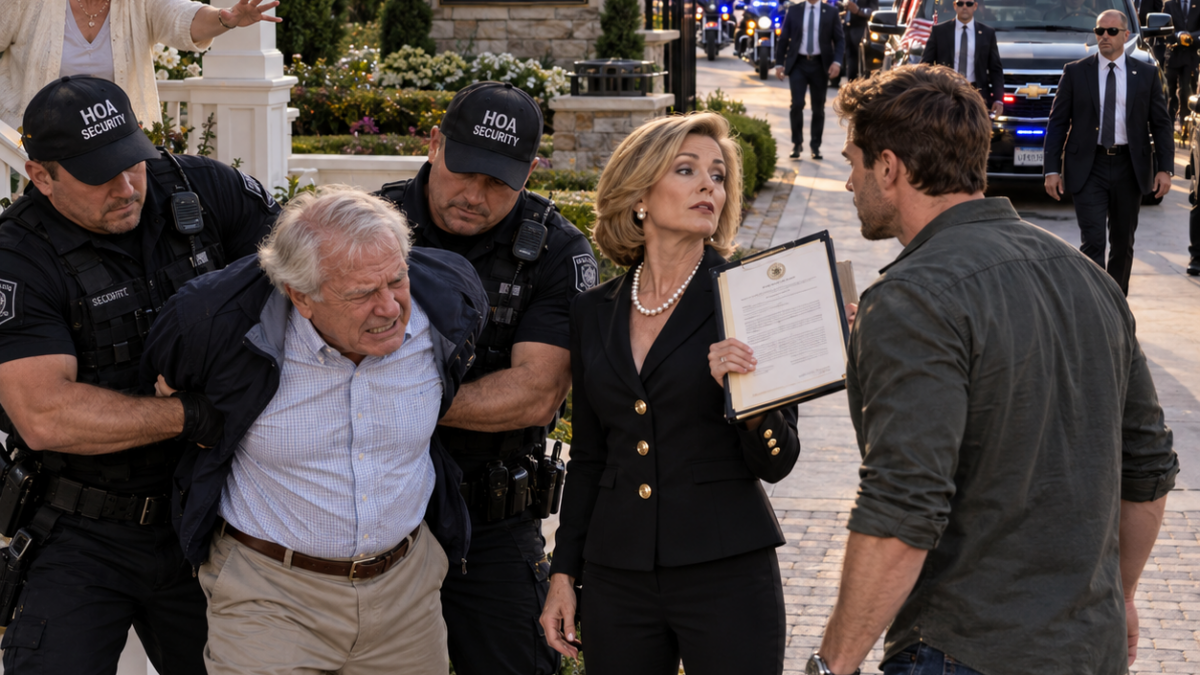
Two guards had his arms behind him.
He wasn’t handcuffed.
Not yet.
One guard held each arm.
Dad was bent slightly forward.
Angry.
Mom stood on the porch holding her phone.
Recording.
Vanessa stood beside the driveway.
Navy blazer.
White pants.
Leather folder.
There were two additional guards near the garage.
A locksmith beside his van looked like he regretted every decision that had brought him there.
I stopped in the street.
Got out.
“Let him go.”
Everybody turned.
Vanessa looked at me.
“Nathan.”
She knew who I was as Martin’s son.
Nothing more.
“This is an association enforcement matter.”
“My father is sixty-seven.”
“He assaulted security.”
Dad shouted:
“I pulled my arm away.”
One guard said:
“He resisted lawful detention.”
I looked at him.
“Lawful detention for what crime?”
Vanessa said:
“This is not criminal detention.”
That sentence was almost impressive.
“You just said detention.”
“It is a temporary property-control action.”
“Release him.”
Vanessa opened her folder.
“Your parents have been served.”
She held up a document.
BRIER CREST COMMUNITY POSSESSION ORDER.
Large red stamp:
AUTHORIZED.
I walked closer.
“Who signed it?”
“The board.”
“I asked who signed the court order.”
“This is not a court process.”
“Then it’s not a possession order.”
She smiled.
“You’re confusing state foreclosure procedure with contractual community authority.”
“No.”
I pointed at Dad.
“I’m looking at two private guards restraining an owner in his driveway because your board printed something.”
“Nathan.”
Her tone became patronizing.
“Your parents owe the association more than eighteen thousand dollars.”
Dad shouted:
“Bullshit.”
Mom said:
“Regular dues are current.”
I asked:
“Court judgment?”
Vanessa said:
“Lien.”
“Foreclosure judgment?”
“Pending.”
“Writ of possession?”
“Our counsel has confirmed—”
“Show me a judge’s signature.”
She did not.
I stepped toward my father.
One guard moved between us.
“Sir, back up.”
I stopped.
“Name?”
“Officer Dean Mercer.”
“Police officer?”
His face changed.
“Security officer.”
“License number?”
Vanessa snapped:
“You are obstructing.”
“No.”
I looked at Dean.
“I am asking whether you are a sworn law-enforcement officer.”
“No.”
“Then don’t call yourself one while restraining my father.”
He loosened his grip slightly.
Vanessa noticed.
“Maintain control.”
My father looked at her.
“I am not your property.”
The sentence stayed with me.
Vanessa lifted the fake order.
“The residence is under association possession.”
“My name is on the deed.”
“That is subject to enforcement rights.”
Mom shouted from the porch:
“We have a court hearing next week.”
I looked at her.
“What?”
She held up a folder.
Of course.
Elaine Sloan.
Paperwork in the middle of chaos.
“Our attorney filed yesterday. The court set a hearing on the lien.”
Vanessa said:
“There is no stay.”
Mom replied:
“There doesn’t need to be a stay because you don’t have a writ.”
I almost smiled.
My mother had done her homework.
Vanessa didn’t like that.
“Elaine, go inside.”
Mom stared.
“This is my house.”
One of the guards stepped toward her.
I said:
“Don’t.”
He stopped.
Vanessa looked at me.
“You don’t issue commands here.”
“Neither do you.”
That did it.
Her face changed.
The polished control cracked.
“Remove him.”
I thought I misheard.
“What?”
She pointed at me.
“He is interfering with authorized security operations. Escort him off association property.”
Dean looked uncertain.
The second guard, a younger man named Kyle, did not.
He stepped toward me.
“Sir, you need to come with us.”
“No.”
“You are being ordered to leave.”
“I am an invited guest of the homeowners.”
“The property is under HOA possession.”
“No court says that.”
“Sir.”
He reached for my arm.
I stepped back.
Hands visible.
“No.”
That word mattered.
Kyle reached again.
Then we all heard motorcycles.
Distant first.
Then closer.
Not one.
Several.
Vanessa looked toward the gate.
So did the guards.
My phone vibrated.
Secure transport lead.
ARRIVING TWO MINUTES.
I looked at Vanessa.
“Open the gate.”
“What?”
“I have a scheduled federal pickup.”
She laughed.
Actually laughed.
“Not today.”
“Open the gate.”
“No vehicles enter while the property action is underway.”
“This is not about my parents anymore.”
“It is my gate.”
“Open it.”
She turned to a guard near the curb.
“Lock down entry.”
He radioed gate security.
Mom stared at me.
“What pickup?”
“I’ll explain later.”
Dad, still restrained, said:
“Are you in trouble?”
That was my father.
Held by private guards.
Still worried I’d done something.
“No.”
Motorcycles became louder.
Vanessa crossed her arms.
“This neighborhood is private.”
I said:
“You are making a very bad decision.”
“There it is.”
“What?”
“The threat.”
“No.”
I pulled out my federal credential.
Not dramatically.
No badge waving.
Opened wallet.
Held it where Dean could see.
“My name is Nathan Sloan. I am a federal employee assigned to protected communications support for a presidential movement today.”
Dean’s hands released my father.
Immediately.
Vanessa stared.
I continued.
“A federal protective transport is scheduled to collect me at this address.”
Nobody spoke.
“You have just ordered the gate locked.”
Vanessa’s face went blank.
Then:
“That’s impossible.”
I looked toward the entrance.
“You’re about to find out.”
My father straightened.
Rubbed his shoulders.
Dean took two steps away from him.
Kyle looked at Vanessa.
“What do you want us to do?”
She whispered:
“Hold position.”
That might have been the stupidest instruction she gave all morning.
At the Brier Crest entrance, the first two police motorcycles arrived at 6:39.
Behind them:
Two black SUVs.
Then another.
Then a communications support vehicle.
The gate was closed.
Private Brier Crest guard at the gate stood in front of it with one hand raised.
I saw it later on security footage.
A federal protective agent stepped from the lead SUV.
Dark suit.
Earpiece.
Credential displayed.
“Open the gate.”
The guard said:
“Neighborhood temporarily sealed by HOA order.”
The agent stared.
“For what?”
“Property enforcement operation.”
“Open the gate.”
“I need authorization from the HOA president.”
The agent looked at the motorcycles.
Then the gate camera.
Then back at the guard.
“Call her.”
The guard did.
Vanessa’s phone rang in front of me.
She answered.
“Yes?”
I could hear only her side at first.
“This is Vanessa Crowell.”
Pause.
“Yes, president.”
Pause.
“No, the community is temporarily restricted.”
Pause.
Her face changed.
“I understand who you are.”
Pause.
“This is private property.”
Another pause.
Longer.
Then:
“No, you may not enter until our security matter is resolved.”
Dean closed his eyes.
He knew.
Kyle did not yet.
I asked:
“Still want to grab me?”
Kyle took a step back.
Vanessa hung up.
She looked at me.
“They can wait.”
I said nothing.
That was when local police arrived from the secondary entrance.
Two patrol cars.
Officer Jennifer Wade and Sergeant Marcus Hill.
I knew neither.
Good.
No special treatment.
They parked.
Wade got out.
“What is going on?”
Vanessa answered first.
“This family is obstructing an HOA possession action.”
I said:
“These private guards were restraining my father. There is no court writ.”
Dad held up his arms.
Red marks.
Mom’s camera still running.
Sergeant Hill looked at Vanessa.
“Show me the possession order.”
She handed it over.
He read the heading.
Then turned the page.
Then another.
“Where’s the court caption?”
“It is an association order.”
“Where’s the sheriff’s writ?”
“This is private contractual enforcement.”
Hill stared.
“You’re taking physical possession of an occupied residence?”
“Yes.”
“Without a court order?”
“Our counsel—”
“That wasn’t my question.”
Silence.
Hill looked at Dean.
“Did you restrain that man?”
Dean swallowed.
“Yes.”
“Why?”
“He interfered.”
“With what?”
“Possession.”
Hill looked at the paper again.
Then at Dad.
“Did he strike you?”
“No.”
“Threaten you with a weapon?”
“No.”
“Try to injure anyone?”
“No.”
Dad said:
“I told them to get off my property.”
Hill turned back to Dean.
“And you put hands on him?”
Dean’s face went pale.
Vanessa stepped in.
“They were acting under my authority.”
Sergeant Hill looked at her.
“That’s not helping.”
At 6:43, my transport lead called.
“Nathan.”
“Yes.”
“Gate obstruction. We have local units?”
“They’re here.”
“You secure?”
“Yes.”
“Any threat to protected movement?”
“No direct threat. Civilian access interference.”
“We are holding outside.”
Correct.
Professional.
Nobody rammed a gate.
Nobody drew weapons.
Nobody turned my parents’ driveway into a federal action movie.
That’s another part internet versions got wrong.
Protective teams do not exist to settle HOA arguments.
They secured themselves.
Maintained distance.
Coordinated with local law enforcement.
Waited.
But the optics were devastating.
Brier Crest residents woke to motorcycles and black federal SUVs parked outside their locked gate while their HOA president insisted she had authority to keep them out.
Phones came out.
Of course.
Half the neighborhood knew something was happening before breakfast.
Sergeant Hill called county dispatch.
“I need clerk verification on any active writ or possession order involving Martin and Elaine Sloan at 114 Hawthorne Ridge.”
Vanessa said:
“You cannot interfere with private enforcement.”
Hill ignored her.
Dispatch came back.
“No active writ located.”
Vanessa’s jaw tightened.
Hill asked:
“Pending foreclosure?”
Dispatch checked.
“Civil filing exists. Hearing scheduled next Thursday. No judgment. No writ.”
Mom said:
“Thank you.”
Dad muttered:
“Told you.”
Vanessa said:
“That filing doesn’t negate HOA possession rights.”
Hill looked at her for a long second.
“Ma’am, I need you to stop saying that until your attorney gets here.”
Her face turned red.
“This is outrageous.”
“No.”
He handed the paper back.
“What I’m looking at appears to be something your board created.”
“It is legally binding.”
“Maybe as an internal notice.”
He pointed toward my father.
“It does not let private guards detain homeowners.”
Dean whispered:
“Sergeant?”
Hill turned.
“I want to cooperate.”
Good decision.
Vanessa spun.
“Do not make statements without company counsel.”
Dean looked at her.
“You told us the order had sheriff authorization.”
Silence.
Everybody heard.
Mom’s phone.
My phone.
Police body cameras.
Neighbors.
Kyle said:
“You said local law enforcement had been notified.”
Vanessa’s mouth opened.
Dean continued:
“Briefing sheet says court-cleared.”
Sergeant Hill held out a hand.
“What briefing sheet?”
Dean looked at Vanessa.
She said:
“You are violating confidentiality.”
Hill said:
“Give me the sheet.”
Dean went to the security SUV.
Came back with a clipboard.
Top page:
BRIER CREST POSSESSION ACTION — SLOAN RESIDENCE.
Instructions included:
Occupants may resist.
Security personnel authorized to use reasonable restraint.
Property under court-supported association control.
Law enforcement notified.
No one could produce the court support.
No one had notified police.
Vanessa had told private guards they were enforcing something that did not exist.
Officer Wade looked at my father’s arms.
Then at Vanessa.
“Who wrote this?”
“Community counsel reviewed procedure.”
“Who wrote this sheet?”
Vanessa said nothing.
The footer carried:
Prepared by Office of the President.
Then things got worse.
For her.
Mom walked down from the porch holding a thick binder.
“Sergeant.”
“Yes, ma’am?”
“You may want these.”
Vanessa snapped:
“Elaine.”
My mother ignored her.
She opened the binder.
Tabs.
Assessments.
Appeals.
Security.
Lien.
Court.
My father muttered:
“Historical record.”
Mom looked at him.
“This is not the time.”
Even Sergeant Hill smiled.
Mom handed him a certified-mail receipt.
“We disputed the alleged balance six months ago.”
Another.
“Paid all regular assessments.”
Another.
“Requested accounting.”
Another.
“Received this.”
A statement.
$18,460 due.
But the line items were absurd.
Exterior compliance:
$2,150.
Security monitoring:
$3,840.
Legal administration:
$4,925.
Possession preparation:
$2,600.
Special enforcement assessment:
$1,400.
Interest and fees made up the rest.
Sergeant Hill asked:
“What is security monitoring?”
Dad said:
“Men sitting outside our house taking pictures.”
Vanessa answered:
“Enhanced compliance review.”
Officer Wade looked at her.
“You charged them for surveillance?”
“It was necessitated by repeated hostility.”
My mother opened another tab.
“Here are photographs of security sitting outside our home eleven times.”
Then invoices.
$320 each.
Paid to Crowell Community Protection.
Sergeant Hill looked at Vanessa.
“Crowell?”
“Common surname.”
Dad laughed.
Vanessa glared.
Mom continued.
“Her brother owns it.”
There it was.
Hill looked at Vanessa.
“Is that true?”
She said:
“The relationship was disclosed.”
Mom said:
“No.”
“Elaine—”
“Show me where.”
Vanessa had no answer.
My transport lead called again.
“We cannot hold here indefinitely.”
“I know.”
I looked at Sergeant Hill.
“My federal pickup needs access.”
He nodded.
“Open the gate.”
Vanessa said:
“No.”
Everyone turned.
Even her guards.
Hill said:
“Ma’am?”
“This is private association infrastructure. Police cannot order the gate opened absent emergency authority.”
Hill stared.
Officer Wade stared.
I stared.
Then Dad said:
“Oh, for God’s sake.”
Sergeant Hill asked:
“Are you intentionally preventing federal protective personnel from reaching a scheduled resident pickup?”
“They can use the visitor entrance once this matter is resolved.”
“There is no separate visitor entrance.”
Silence.
Hill stepped closer.
“Open the gate.”
Vanessa crossed her arms.
“No.”
He nodded slowly.
Then radioed:
“Dispatch, contact Brier Crest gate contractor and fire department. We need emergency access override.”
That was smart.
Brier Crest’s gate had fire access.
Of course it did.
Emergency vehicles needed entry.
Within five minutes, a fire battalion vehicle arrived.
The chief used the emergency access key.
Gate opened.
Vanessa looked betrayed.
As if safety infrastructure had violated HOA policy.
The motorcycles entered first.
Then the federal SUVs.
Slow.
Controlled.
They stopped at my parents’ house.
Residents stood outside everywhere.
A protective agent I knew as Special Agent Turner stepped out.
He looked at me.
“You good?”
“Yes.”
“Parents?”
Dad said:
“I’ve been better.”
Turner looked at the private guards.
Then police.
Then Vanessa.
He did not ask for drama.
He asked:
“Do local officers have the scene?”
Sergeant Hill said:
“Yes.”
Turner nodded.
That was all.
No chest-beating.
No arrest threats.
He turned to me.
“We need to move.”
I looked at Mom.
Dad.
I did not want to leave.
My duty coordinator called.
“Nathan, local has control. We need you at site.”
That’s the ugly thing about responsibility.
Sometimes your family is in crisis and the world still expects your part somewhere else.
Mom understood before I did.
“Go.”
“No.”
“Nathan.”
“Mom.”
She looked directly at me.
“We have police.”
Dad rubbed his shoulder.
“And your mother’s binder.”
Mom said:
“Martin.”
“What?”
“Go,” Dad told me.
“I’ll come back as soon as I can.”
“You better.”
I hugged Mom.
Then Dad.
He whispered:
“Don’t get fired because I argued about a fence.”
I laughed despite everything.
Then got into the SUV.
As we pulled away, Vanessa stood beside her BMW surrounded not by authority, but questions.
Police.
Guards.
Neighbors.
Documents.
For the first time in eight years, saying “the board decides” wasn’t ending the conversation.
It was starting one.
By noon, Brier Crest’s management company had suspended all possession actions.
By 1:30, Crowell Community Protection pulled its guards from the neighborhood pending legal review.
By 3:00, the HOA’s attorney sent residents an emergency notice:
No homeowner should interpret any HOA correspondence as authorizing forced entry, physical removal, or detention without lawful court process.
That was lawyer language for:
What Vanessa did this morning was not approved by us.
My parents’ civil attorney, Rachel Levin, filed an emergency motion that afternoon.
The court stayed any lien enforcement until the disputed charges could be reviewed.
Not that Vanessa had a lawful right to seize the house before.
She never did.
But now it was explicit.
I returned after ten that night.
Dad was asleep in his recliner.
Mom wasn’t.
She sat at the kitchen table with three open binders.
Of course.
“How was your day?” she asked.
I looked at her.
She smiled.
“Sorry.”
I sat.
“What did police say?”
“The guards gave statements.”
“Vanessa?”
“Lawyer.”
“Dad?”
“Bruising. Nothing torn.”
I exhaled.
Mom closed one binder.
“Nathan.”
“What?”
“I found something.”
Those are dangerous words when your mother has spent five years saving HOA paperwork.
She pulled out old assessment statements.
Then newer ones.
“Look at the security fees.”
I did.
Brier Crest’s annual security budget had grown dramatically.
$74,000.
Then $118,000.
Then $186,000.
Current year:
$242,000 projected.
“For forty-eight homes?”
“One hundred twelve.”
Still.
“That’s more than two thousand per house.”
“Not evenly.”
She handed me a page.
Residents labeled “enhanced compliance” were charged additional monitoring fees.
Twenty-three homes.
My parents were one.
Another belonged to Margaret Ellis, a seventy-six-year-old widow.
Another to the Hsu family.
Another to a disabled veteran named Robert Gaines.
Mom said:
“These are people who challenged fines.”
I looked at her.
“How do you know?”
“I called.”
Of course she did.
“When?”
“Today.”
“Mom.”
“What? Police were here.”
She had started her own audit by lunch.
The pattern was obvious.
Homeowners who appealed frequently were referred to security.
Security documented them.
HOA charged them for being documented.
Those unpaid charges generated late fees.
Late fees contributed to liens.
Liens justified more legal and security fees.
A closed loop.
Conflict produced revenue.
That was bad enough.
Then Mom showed me Crowell Community Protection invoices.
The company billed the HOA hourly.
But homeowners were often charged fixed “security action” amounts far above documented hours.
Example:
Security patrol visit:
Vendor invoice $96.
Homeowner charge $320.
Difference:
$224.
Where did it go?
The statements called it administrative enforcement recovery.
I said:
“We need the board books.”
Mom looked at me.
“Already requested.”
I should have known.
The next HOA meeting occurred four days later.
Vanessa did not resign.
That surprised everybody except me.
People who fuse themselves to authority rarely step away voluntarily.
The clubhouse was packed.
My parents attended.
So did I.
No federal vehicles.
I drove Dad’s old Buick.
Vanessa sat at the board table with four other members.
Vice president Thomas Keel.
Treasurer Linda Baines.
Secretary George Morrison.
Member-at-large Patricia Crowell.
Yes.
Patricia Crowell.
Vanessa’s sister-in-law.
Nobody had cared before.
Now everyone did.
Vanessa opened:
“The events of Saturday have been grossly mischaracterized.”
Residents shouted.
She raised a hand.
“I will maintain order.”
Dad muttered:
“Here we go.”
Vanessa continued.
“The Sloan property was subject to advanced lien enforcement.”
A homeowner shouted:
“You had guards grab Martin!”
“After he became physically disruptive.”
Dad stood.
“I pulled away after strangers entered my driveway.”
Applause.
Vanessa banged a gavel.
Of course she owned one.
Mom whispered:
“Every dictator buys office supplies.”
I almost laughed.
Vanessa said:
“Mr. Sloan, sit down.”
He did not.
“Show the writ.”
Silence.
“Martin—”
“Show the writ.”
People picked it up.
“Show the writ.”
Someone else.
Then another.
Within seconds:
“SHOW THE WRIT.”
Vanessa’s face changed.
HOA counsel, a man named Peter Lang, stood.
“I need to clarify something.”
Room quieted.
“My firm did not authorize physical possession of an occupied residence absent judicial process.”
Every head turned toward Vanessa.
She stared at him.
Peter continued.
“We reviewed general lien remedies.”
He looked uncomfortable.
“We did not draft the document labeled Community Possession Order.”
The room exploded.
Vanessa said:
“You advised us on enforcement.”
“Not this.”
He held up the fake possession order.
“This document uses legal terminology but is not a court order.”
My father said:
“That’s what we’ve been saying.”
Peter looked at Vanessa.
“Who drafted it?”
She said:
“Board administrative staff.”
The management-company representative stood.
“Not us.”
Another collapse.
Sarah Kim, a homeowner in the second row, asked:
“Then who?”
Nobody answered.
Mom raised her hand.
Not waiting to be recognized.
“What about the security briefing that said court-cleared?”
Peter’s face tightened.
“What briefing?”
Mom held up a copy police had provided to Dad as part of the incident report.
Peter read.
He looked genuinely stunned.
“I have never seen this.”
Vanessa leaned toward him.
“Privileged discussion.”
Peter sat back.
“No.”
Quiet.
Firm.
“I am not claiming privilege over a document my office did not create.”
That was when board treasurer Linda Baines started looking nervous.
A man near the wall shouted:
“Who owns the security company?”
Vanessa said:
“That is irrelevant.”
Bad answer.
“Who?”
“My brother has an ownership interest.”
The room erupted.
A woman yelled:
“You’ve paid your brother hundreds of thousands of dollars!”
Vanessa said:
“Through an approved vendor contract.”
Thomas Keel leaned toward her.
“Was that disclosed?”
She looked at him.
“Thomas.”
He repeated:
“Was it?”
She whispered something.
He sat back.
Face pale.
That was the beginning.
The board voted that night to place Vanessa on administrative suspension pending an independent audit.
Three to two.
Vanessa and Patricia opposed.
The residents demanded recall proceedings anyway.
Before that could happen, the audit found the second layer.
Brier Crest had collected more than $614,000 over four years in enforcement-related charges.
Not regular assessments.
Fines.
Security.
Legal review.
Administrative penalties.
Possession preparation.
Vendor registration.
Some legitimate.
Some questionable.
Some apparently invented.
Crowell Community Protection received $391,000 of that ecosystem.
More than the HOA had spent on the pool, clubhouse, landscaping, and gate maintenance combined.
Then auditors found something stranger.
“Legal administration” charges paid to a company called Civic Residential Solutions.
Address:
A mailbox center.
Owner:
Patricia Crowell’s husband.
$86,400 over three years.
Another vendor:
Keel Property Compliance.
Related to Vice President Thomas Keel’s adult son.
Thomas claimed he had disclosed it verbally.
No written disclosure.
$47,000.
Treasurer Linda Baines had approved checks.
She claimed Vanessa presented the vendors as independent.
Maybe true.
Maybe convenient.
The forensic audit widened.
So did police interest.
My parents were not the only residents subject to bogus possession pressure.
Seven households had received Community Possession Orders.
Three guards had physically entered yards.
Two locks had been changed on unoccupied houses.
One elderly couple had paid $14,000 in disputed charges after Vanessa threatened “association control of the residence.”
No one had asked the same question Dad asked.
Show the writ.
Then came Margaret Ellis.
Seventy-six.
Widow.
She brought Mom a file.
Her balance started with a $300 landscaping fine.
She disputed it.
Then security monitoring.
Then appeal charge.
Then legal fee.
Within two years:
$9,740.
She paid $8,000 from savings because she believed her home could be taken.
My mother cried when she told me.
Not dramatically.
Quietly.
“I knew something was wrong.”
I said:
“You couldn’t know all of it.”
“I should have called her.”
“You didn’t know.”
“She lives three streets away.”
That is how systems isolate people.
Each victim thinks their paperwork is unique.
Each feels embarrassed.
Each assumes everyone else is complying easily.
Nobody compares folders.
Until they do.
The recall meeting happened six weeks later.
Vanessa came.
I respected that, in a strange way.
She could have resigned.
She didn’t.
The clubhouse filled.
Residents stood outside.
The independent auditor presented first.
No theatrics.
Numbers.
Contracts.
Vendor relationships.
Disclosure failures.
Unsupported charges.
Policy documents lacking proper board votes.
Security procedures outside governing authority.
Then the attorney.
Then homeowners.
Margaret Ellis spoke.
Her voice shook.
“I thought if I didn’t pay, men would come to my house.”
She looked at Vanessa.
“You made an old woman afraid of her own front door.”
Silence.
Vanessa looked down.
Then Dad.
He walked to the microphone slowly because his shoulder still hurt.
“I’ve lived here twenty-seven years.”
Pause.
“I paid every assessment.”
“My wife saved every receipt.”
Mom raised her binder.
People laughed softly.
Dad continued.
“I argued about stupid things.”
More laughter.
“The fence was white.”
Applause.
He smiled.
Then became serious.
“But disagreement is not delinquency.”
Pause.
“And owing money is not permission to put hands on people.”
That one stayed.
Vanessa spoke last.
“I made decisions I believed were necessary to preserve order.”
Someone shouted:
“This isn’t a prison.”
She continued.
“Brier Crest had serious compliance problems before my presidency.”
Maybe.
“We had inconsistent enforcement.”
True.
“Unpaid assessments.”
True.
“Residents who ignored standards.”
Also true.
Then she said:
“I built systems.”
I believed her.
That was exactly what she had done.
The problem was the system.
She had taken real HOA powers and extended them step by step until nobody remembered where legitimate authority ended.
Notice.
Fine.
Lien.
Security.
Possession.
Detention.
Every step dressed in paperwork.
“I was trying to protect the community.”
My mother stood.
“From us?”
Vanessa looked at her.
Mom continued.
“We are the community.”
That ended it.
Recall vote:
96 in favor.
11 against.
5 abstentions.
Vanessa Crowell was removed.
Patricia resigned that night.
Thomas resigned two days later.
Linda remained temporarily to help the auditor, then stepped down.
George Morrison, the secretary, was the only board member who survived because records showed he had repeatedly voted against expanding security powers and had been excluded from several executive sessions.
He became interim president.
His first announcement:
“No more private possession actions.”
Dad called me.
“Strong opening platform.”
The criminal investigation took longer.
Private guards restraining my father was one piece.
False representations to them were another.
Financial self-dealing another.
Investigators had to separate:
Bad governance.
Civil violations.
Contract breaches.
Potential fraud.
Potential theft.
Potential unlawful restraint.
Not everything stupid is criminal.
Not everything unethical is felony conduct.
People online hated that distinction.
Real law requires it.
Dean Mercer, the guard who released Dad when I showed my federal credential, cooperated immediately.
He gave investigators the training packets.
Vanessa had told guards that the HOA possessed “delegated civil enforcement powers equivalent to private repossession authority.”
Nonsense.
They had been trained to:
Control occupants.
Secure premises.
Remove unauthorized persons.
Preserve association assets.
One slide actually said:
RESIDENT RESISTANCE DOES NOT INVALIDATE BOARD AUTHORITY.
Dean told investigators:
“I thought attorneys had reviewed it.”
That sentence again.
Someone else checked.
Kyle said the same.
The security-company owner, Scott Crowell, claimed Vanessa developed the policies.
Vanessa said Scott trained the guards.
Scott said HOA counsel reviewed them.
HOA counsel produced emails showing he repeatedly warned against self-help eviction.
One email from Peter Lang to Vanessa:
The Association should not attempt physical possession of an occupied residence without a court-issued writ enforced through lawful process.
Vanessa replied:
Understood.
Six months before my father’s driveway.
That changed things.
Another:
Security may document, observe, and protect common property. They should not detain residents in connection with civil debt.
Understood.
Again.
She knew.
Prosecutors eventually charged Vanessa with offenses tied to fraudulent representations, financial misconduct, and the unlawful possession operation.
Scott Crowell faced charges related to billing and guard practices.
Patricia’s husband faced financial counts.
Thomas’s son became part of a civil recovery case but was not criminally charged.
Linda cooperated.
No charges.
She admitted signing checks without verifying conflicts.
At one hearing she said:
“I thought my job was making sure the totals matched.”
The prosecutor asked:
“Not who got the money?”
She looked ashamed.
“I understand now.”
That may sound pathetic.
It is also how fraud survives.
People narrow their job description until no one owns the whole truth.
Vanessa’s case never became the giant conspiracy movie residents imagined.
She pleaded to several counts.
Other charges were dismissed.
Restitution.
Custodial sentence.
Probation afterward.
Restrictions on fiduciary positions.
Scott took a separate deal.
Civil suits recovered some money.
Insurance covered some.
Not all.
Brier Crest had to issue a special assessment to rebuild reserves.
That hurt.
Residents who had done nothing wrong paid for governance they failed to watch closely enough.
My father hated that.
“Why should Margaret pay?”
“She shouldn’t.”
“But she will.”
“Yes.”
He shook his head.
“Then this isn’t justice.”
“No.”
He looked at me.
“What is it?”
“Repair.”
He didn’t like that answer.
Neither did I.
Justice and repair overlap.
They are not the same.
My parents’ lien disappeared.
Every disputed enforcement charge was removed.
They received a civil settlement for the detention and possession attempt.
Dad used part of it to repaint the fence.
White.
The exact same white.
He sent me a photograph.
Caption:
VICTORY.
Mom replied in the family thread:
IT WAS ALREADY WHITE.
Dad:
THAT IS THE POINT.
My sister sent eleven laughing emojis.
Brier Crest changed.
Not magically.
Procedurally.
George Morrison pushed reforms through.
Independent management company.
No related-party vendors without written disclosure and resident notice.
No executive-session policy creation except narrow emergencies.
All fines appealable to a panel excluding the person who initiated them.
Security contract terminated.
Gate attendants hired only for access control.
No badges.
No quasi-police uniforms.
No word officer.
No restraint authority beyond immediate personal safety allowed by ordinary law.
Lien actions required outside legal review.
Foreclosure required full-board recorded vote.
Every legal filing posted to an owner portal with private information redacted.
And one rule my mother personally suggested:
Any board document using the word possession must identify the court and case number authorizing possession.
Unanimous.
I laughed when she told me.
“You wrote HOA policy.”
“I corrected one sentence.”
“You joined them.”
“Don’t insult me.”
Dad said:
“She has a binder now.”
“Martin.”
“What?”
Some things survived unchanged.
The presidential convoy became neighborhood mythology.
That embarrassed me.
People told the story as if the President personally drove up Hawthorne Ridge to rescue my parents.
No.
He did not.
The protective transport was doing its job.
I was a scheduled pickup.
They were delayed by a locked gate.
Local police handled the property dispute.
Federal agents did not arrest Vanessa.
They did not seize the clubhouse.
They did not threaten the guards.
The most dramatic thing Special Agent Turner did was ask whether local police controlled the scene.
That restraint mattered.
Power should know its boundary too.
At a later HOA meeting, someone said:
“Vanessa only stopped because Nathan had federal people coming.”
Dad corrected him.
“No.”
Everyone looked.
“She didn’t stop.”
True.
“She locked the gate.”
People laughed.
Dad continued:
“The police stopped it.”
Then Mom:
“And paperwork.”
Also true.
The convoy made the absurdity visible.
It did not create our rights.
That’s the part I cared about.
My father should not have needed a son in federal service.
He should not have needed black SUVs.
He should not have needed neighbors filming.
He should not have needed an HOA lawyer horrified by his own client’s paperwork.
He owned his house.
No court had ordered him removed.
That should have been enough.
Years later, I was asked to speak at a regional community-association conference.
I said no.
They asked again.
Mom said:
“Go.”
“Why?”
“So they stop making possession orders.”
Fair.
My talk was called:
“Authority Ends Somewhere.”
I did not tell the dramatic version first.
I started with the fence.
Wrong white.
Small fine.
Nobody cared.
Then vendor registration.
Security.
Monitoring charges.
Fake administrative authority.
Liens.
Possession.
Restraint.
I showed the progression.
“Bad systems rarely begin at the worst step.”
I told them.
“They teach people to accept the earlier steps first.”
A board member asked:
“So should associations have less enforcement power?”
I said:
“Not necessarily.”
He looked surprised.
“Then what?”
“Clear power.”
Pause.
“Specific power.”
“Reviewable power.”
“Power you can point to in a document somebody else can verify.”
Then:
“And consequences when someone exceeds it.”
I pointed to a slide showing the phrase:
THE BOARD DECIDES.
I crossed out the last word.
Underneath:
THE GOVERNING DOCUMENTS DECIDE WHAT THE BOARD MAY DECIDE.
That was my mother’s contribution.
Of course.
She edited my slides.
Dad said they needed fewer words.
Marriage remained healthy.
My parents stayed in Brier Crest.
People asked why.
Because home is not the same thing as an association.
Their oak tree still stood.
The laundry-room marks still existed.
Dad’s garage still smelled like motor oil and sawdust.
Mom’s Christmas boxes still occupied the attic corner.
Vanessa did not get to turn twenty-seven years of life into contaminated ground.
The new board offered to reimburse them if they wanted to move.
Dad said:
“Why would we leave?”
The interim president said:
“After everything?”
Dad looked confused.
“This is my house.”
Simple.
That was always the point.
Vanessa had treated ownership as a status the board could condition on obedience.
Dad understood it differently.
You own the place.
You follow valid rules attached to it.
You pay legitimate assessments.
You respect neighbors.
But the house does not become a government-issued privilege because the HOA president is annoyed.
The gate changed too.
After the convoy incident, county fire officials reviewed it.
Emergency override worked.
Good.
But board lockout procedures had allowed Vanessa to place the whole neighborhood in restricted-entry mode too easily.
They removed that feature from HOA control.
Only management, emergency services, or authorized gate technicians could initiate full closure.
Vanessa had believed controlling the gate meant controlling Brier Crest.
The reform made the gate what it should have been:
A gate.
Not a border.
Dad loved saying that.
“This ain’t North Korea. It’s a gate.”
Mom told him to stop.
He didn’t.
Five years after the incident, Dad had shoulder surgery.
Not directly because of the guards.
Old rotator-cuff problem.
Age.
Years of home repairs he should have hired people for.
I flew in.
Different job by then.
Less presidential travel.
More program management.
At the hospital, Dad woke groggy.
First thing he said:
“Did HOA approve this?”
I laughed so loudly the nurse stared.
Mom said:
“Martin, please.”
He pointed weakly toward me.
“Tell her.”
“Go back to sleep.”
The next morning we drove home.
As we entered Brier Crest, Dad looked at the gate.
New sign:
WELCOME HOME.
No SECURITY ENFORCEMENT notice.
No patrol SUV.
No black uniforms.
He said:
“Better.”
“Yeah.”
Then:
“Fence needs paint.”
I looked.
Still white.
“It’s fine.”
“No.”
“You are the problem.”
“Maybe.”
He smiled.
The story followed me too.
Colleagues found it online.
One sent a headline:
HOA KAREN MESSES WITH FEDERAL OFFICIAL’S PARENTS, INSTANTLY REGRETS IT.
I hated that one.
Why?
Because it implied the lesson was:
Be careful whose kid is important.
That is not the lesson.
The most dangerous part of that morning happened before Vanessa knew anything about my work.
Two guards had their hands on my father because a woman with a title told them a homemade piece of paper gave them authority.
That’s the story.
If I had been a plumber, the paper would still have been fake.
If I had been unemployed, Dad’s deed would still have been valid.
If Mom had never saved a single receipt, the board still could not invent a court writ.
If no convoy had arrived, private guards still had no right to seize an occupied house over disputed HOA fines.
The convoy mattered because it forced everyone to stop pretending the situation was routine.
Black SUVs at a locked gate made the absurdity visible.
But the abuse existed before anybody important-looking arrived.
Years after Vanessa finished her sentence, my mother received a letter.
Not me.
Not Dad.
Elaine.
That made sense.
Vanessa wrote:
Mrs. Sloan,
You were right to keep every document.
Dad laughed when Mom read that line.
“Frame it.”
She glared.
Vanessa continued:
I spent years treating documentation as something I could produce to support decisions I had already made. You treated documentation as a record of what actually happened. I understand the difference now.
Mom stopped reading.
Then continued.
I believed Brier Crest needed stronger leadership. Over time, I stopped distinguishing between leadership and control. When people resisted me, I interpreted resistance as proof that more control was necessary.
That was accurate.
Then:
The morning at your home, I knew there was no court writ. I convinced myself the board’s lien rights justified temporary possession until the court caught up with what I believed should happen.
Dad said:
“There.”
He pointed.
“That’s the whole disease.”
Mom kept reading.
When Nathan told me federal transport was coming, I was not afraid because I suddenly realized what I was doing was wrong. I was afraid because I realized I might finally be challenged by people I could not control.
The kitchen went quiet.
That was the line.
The honest one.
Vanessa apologized.
Not perfectly.
But specifically.
Mom folded the letter.
Dad asked:
“You writing back?”
“No.”
“Why not?”
“I don’t know yet.”
She eventually did.
One sentence.
Authority is safest when the people holding it remember they are temporary.
That was my mother.
Sixty-five when guards tried to take her house.
Seventy-one when she wrote that sentence.
Still keeping receipts.
Still terrifying people with folders.
My father died three years later.
Stroke.
Quick.
Home.
His home.
I got there the next morning.
Mom sat at the kitchen table.
Same place.
There was a white paint chip beside Dad’s coffee mug.
I picked it up.
“Why?”
She smiled through tears.
“He was going to paint the fence again.”
“Of course.”
At the funeral, George Morrison came.
Mrs. Ellis.
Officer Wade, retired by then.
Even Dean Mercer, one of the guards.
That surprised me.
He stood near the back.
Afterward, he approached.
“I don’t expect you to remember me kindly.”
“I remember.”
He looked older.
“I quit security two weeks after.”
“I heard.”
“I was twenty-nine.”
Pause.
“I thought uniforms meant somebody above me had checked the law.”
I said nothing.
“I don’t think that anymore.”
“Good.”
He looked toward Dad’s casket.
“Your father could’ve hit me.”
“Yes.”
“He didn’t.”
“No.”
“He just kept saying, ‘Show me the court order.’”
That sounded like Dad.
Dean swallowed.
“I’m sorry.”
I nodded.
“Thank you.”
That was enough.
After the funeral, I went back to the house.
Walked into the laundry room.
Height marks.
My sister’s.
Mine.
Dates.
Pencil.
Dad had once threatened to sand the doorframe during a remodel.
Mom nearly killed him.
It remained.
I stood there a long time.
That was what Vanessa had almost reduced to “association-controlled asset.”
A house is wood.
Drywall.
Wire.
Concrete.
But ownership is never only the materials.
It’s accumulated life.
The argument in the kitchen.
The repair you did badly.
The scratch behind the couch.
The paint under six layers of newer paint.
The mark showing your son was four feet eleven in 1994.
Law protects property partly because property contains choices.
Where people live.
What they build.
What they save.
What they leave their children.
An HOA can regulate some things.
It should.
Shared communities require agreements.
But regulating property is not owning people.
That line seems obvious.
Until someone crosses it gradually enough that everyone gets used to each step.
Vanessa Crowell did not wake up one morning and decide to become a tyrant.
She began by believing she cared more than everyone else.
Then that she knew better.
Then that disagreement was obstruction.
Then that obstruction required enforcement.
Then enforcement required security.
Then security required stronger rules.
Then stronger rules needed creative interpretation.
Then paper could fill whatever authority was missing.
Eventually two men had their hands on my father’s arms in his own driveway.
And Vanessa still believed she was administering policy.
That’s what frightened me.
Not screaming villains.
Administrative ones.
People who can turn cruelty into a form.
People who can print a title above something and stop asking whether the thing underneath is legitimate.
Possession Order.
Security Action.
Compliance Debt.
Resident Control.
Words can make behavior feel cleaner than it is.
Dad preferred simpler language.
“My house.”
“My driveway.”
“Get off me.”
Sometimes simple words save you.
Brier Crest is still there.
The gate works most days now.
The pool still breaks every summer.
The clubhouse roof leaked last year.
Mom still lives in the house.
My sister wants her to move closer.
Mom refuses.
“She says the HOA finally behaves.”
That’s her argument.
The fence is still white.
Actually white.
Not Alpine Pearl.
Not ivory.
Not heritage snow.
White.
The new HOA president once joked about sending a violation.
Mom stared at him until he apologized.
Healthy boundaries.
I visit often.
Sometimes I stand in the driveway where everything happened.
Nothing marks the spot.
No plaque.
No scar.
No broken glass.
Just concrete.
The place where Dean grabbed Dad.
Where Vanessa held that fake order.
Where I told her a presidential protective transport was coming and watched disbelief turn into fear.
Where motorcycles appeared at the gate.
Where local police asked the question nobody in Vanessa’s system wanted asked:
Where is the court order?
There wasn’t one.
That question did more than the convoy.
More than my credential.
More than every black SUV.
Show me the authority.
Four words.
Every system with power should survive them.
If it can’t, you have a problem.
People still tell me Vanessa made the worst decision of her life when she locked the gate on a presidential protective convoy.
Maybe.
It was certainly memorable.
But I think her worst decision happened much earlier.
The day she stopped asking whether she had authority and started asking whether anybody could stop her.
Everything after that was just paperwork catching up.








