HOA Karen Sent Her Police Officer Husband to Seize the Keys to My Late Father’s Private Pool—But She Had No Idea I Was a Former Federal Investigator. One Discovery Exposed Their Biggest Secret.
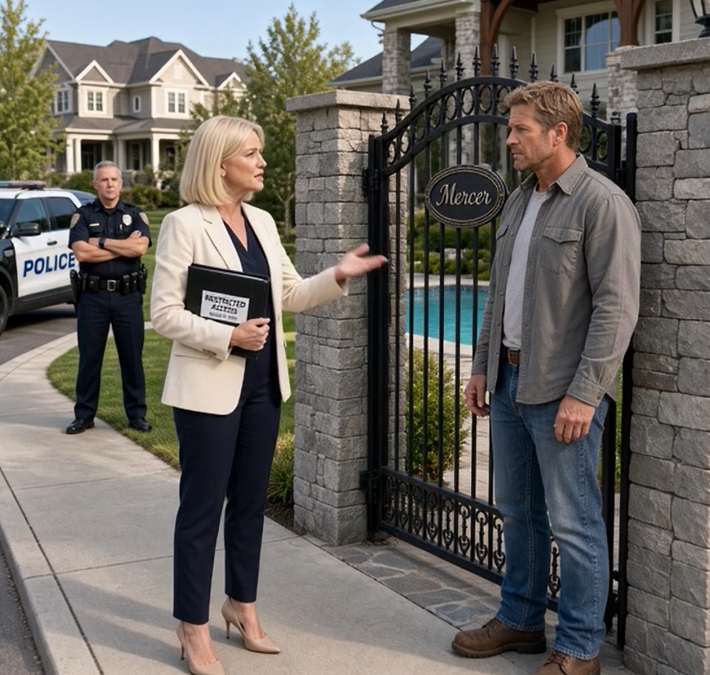
HOA Karen Sent Her Police Officer Husband to Seize the Keys to My Late Father’s Private Pool—But She Had No Idea I Was a Former Federal Investigator. One Discovery Exposed Their Biggest Secret.
Karen Langford spent months fining me, flying drones over my backyard, and using her police-officer husband’s badge to convince the neighborhood that the pool my father built forty years ago somehow belonged to her HOA.
When her husband finally stood at my gate in uniform and ordered me to hand over the keys, neither of them knew I had spent years conducting federal investigations—or that every threat, patrol-car visit, questionable invoice, false boundary map, and missing dollar was already sitting inside a carefully dated evidence file.
Then Karen called one final public meeting to humiliate me in front of the neighborhood, held out her hand for my pool keys, and heard government vehicles pulling into the clubhouse parking lot before I could answer.
“Sure.”
I looked at Officer Langford.
“Hand over the pool keys.”
That was the first thing out of his mouth.
Not:
Good evening.
Not:
Can we talk?
Not:
There seems to be some confusion.
An order.
Keys.
Now.
He stood outside my gate in uniform with one hand resting near his duty belt and the other held open toward me.
His patrol cruiser idled at the curb.
Red and blue lights were not activated.
They did not need to be.
The uniform did enough.
Karen stood several feet behind him with her arms folded.
Satisfied.
Calm.
Almost smiling.
She looked like someone watching the final scene of a movie whose ending she had written herself.
I looked at him.
Then her.
“You really sent your husband for this?”
Karen did not blink.
“You ignored three notices.”
“The pool belongs to the community.”
I almost laughed.
Almost.
Officer Langford tightened his jaw.
“It’s on my property.”
“Not according to her.”
That answer told me everything.
Not according to the county.
Not according to a deed.
Not according to a court order.
According to her.
Karen stepped closer.
“Cole, don’t play dumb.”
Her voice had the soft edge she used when she wanted threats to sound reasonable.
“You cooperate, or we escalate.”
Officer Langford moved half a step forward.
Karen stayed behind him.
One had a badge.
PART2:
The other understood exactly how useful that badge looked when standing beside an HOA demand.
I had been studying that combination for weeks.
Not emotionally.
Professionally.
Dates.
Times.
Photos.
Copies.
Video.
Financial records.
County plats.
Emails.
I could feel pressure coming from both of them.
That was the point.
Make the homeowner feel isolated.
Make the request seem inevitable.
Make resistance feel expensive.
Then call surrender “compliance.”
But underneath my silence, I was almost smiling.
Because Karen thought we were arguing about pool keys.
We were not.
We were arguing about power.
And she had just walked several steps deeper into something I had been documenting without her realizing it.
Officer Langford held out his hand again.
“Keys.”
I stepped closer.
Not aggressive.
Just close enough that he had to look directly at me.
“You might want to be careful about who you’re threatening, Officer.”
His eyes narrowed.
Karen gave a short laugh.
Neither understood what I meant.
Not yet.
He did not get the keys.
There was no lawful order requiring me to surrender them.
No warrant.
No county citation.
No police case.
No court judgment.
Just an HOA disagreement wearing a uniform.
Eventually he left.
The cruiser rolled away slowly.
I stood beside the pool and watched its reflection move across the water until the red taillights disappeared at the end of the street.
My hands were steady.
My heart was not.
Because no matter how calm you are, there is something deeply unsettling about your neighbor sending her law-enforcement husband to demand access to property your father built with his own hands.
I looked across the water.
Blue.
Quiet.
The pump humming.
Old stonework catching the porch light.
The truth was that none of this had ever really been about a pool.
With people like Karen, the thing written on the notice is rarely the point.
The point is whether you obey.
My name is Cole Mercer.
I moved back into my childhood home the previous spring after my father died.
He was seventy-eight.
Heart failure.
Slow enough for us to know what was happening.
Fast enough that neither of us was ready.
The house had been in our family since 1978.
When Dad bought the property, most of what eventually became Pine Hollow Estates was still woods, dirt access roads, and scattered homes.
There was no HOA.
No entrance monument.
No architectural committee.
No community Facebook group.
No three-page application to repaint a mailbox.
Just land.
Pines.
A shallow hill behind the house.
And my father.
His name was Arthur Mercer.
He had been a construction foreman for thirty-six years.
Framer first.
Then concrete.
Then superintendent.
He could look at a wall and tell you whether the person who built it understood what plumb meant.
He could identify bad mortar from twenty feet away.
He owned levels older than me and trusted them more than most people.
The house was partly his work.
Cedar porch.
Stone retaining walls.
Detached workshop.
Back steps.
Outdoor fireplace.
And the pool.
Especially the pool.
Dad built it himself over two summers.
Not because that was efficient.
It was not.
Not because he had unlimited knowledge.
He didn’t.
He built it because he could.
He rented equipment.
Excavated.
Formed the shell.
Installed reinforcing steel.
Mixed some concrete himself and hired trucks for the rest.
Laid stone by hand.
Ran the water line.
Built a pump enclosure that looked like a miniature version of the house.
I was eleven when the project began.
My job was mostly handing him things and asking annoying questions.
“Why so much steel?”
“Because water is heavy.”
“Why that stone?”
“Because your mother likes it.”
“Why are you checking the level again?”
“Because I enjoy not fixing things twice.”
That was Dad.
If you build it right, you only build it once.
His other favorite line was:
Never let somebody claim what you built.
I thought he meant tools.
Or fences.
Or property.
I understood later that he meant something bigger.
Ownership of work.
Ownership of truth.
Ownership of your own boundaries.
My mother died when I was twenty-eight.
Breast cancer.
Dad lived another fourteen years.
After Mom died, he kept the pool running even though he rarely swam.
“Your mother liked the light on the water.”
That was his explanation.
Every evening in summer, he turned the underwater lights on.
Sat on the cedar porch.
Coffee or beer.
Watched the blue glow.
When Dad died, I was living outside Washington, D.C.
My job involved federal investigative work.
Not glamorous.
Despite what television teaches people, most serious investigations involve less running and more reading.
Financial records.
Procurement files.
Property documents.
Interview notes.
Timelines.
Cross-checking representations against what can actually be proven.
Years of learning one basic truth:
People lie emotionally.
Documents lie structurally.
And the second kind is often easier to catch.
I had worked cases involving procurement fraud, contracting irregularities, false certifications, misuse of federal money, and environmental compliance.
Some high profile.
Most not.
I was good at the quiet part.
Organizing facts until the pattern stopped being deniable.
When Dad got sick, I came home more often.
After he died, I requested a transfer arrangement that allowed remote work and reduced field assignments.
Eventually, I moved back permanently.
I told people it was temporary.
It was not.
I wanted the house.
Not because it was valuable.
Because every wall contained him.
The cedar porch still showed the mark where I dropped a hammer at twelve and chipped the rail.
One basement stud had pencil lines recording my height from age seven to seventeen.
The workshop smelled faintly of sawdust even after months empty.
And the pool was waiting.
Leaves at the bottom.
Filter barely working.
Two cracked coping stones.
One pump bearing screaming for mercy.
I spent most of that spring restoring it.
New filter media.
Pump rebuild.
Stone repair.
Tile patching.
I cleaned until the water turned clear enough to see the deep end drains.
The first evening I switched the lights back on, I sat where Dad used to sit.
For a few minutes, it felt as though nothing had changed.
Then Karen Langford arrived.
She introduced herself six weeks after I moved home.
July.
Hot enough that asphalt softened.
Karen was wearing a blazer.
That should have warned me.
“Cole?”
“Yes.”
She smiled brightly.
“I’m Karen Langford. HOA president.”
She handed me a glossy booklet.
COMMUNITY HARMONY GUIDELINES.
I looked at the cover.
“Community harmony?”
“We updated the neighborhood standards this year.”
“Okay.”
“You’ll want to familiarize yourself.”
“I’ll read it.”
Her smile sharpened.
“Wonderful.”
She looked past me toward the backyard.
“I heard you’re restoring the old pool.”
“Yes.”
“You’ll need to register it.”
“With who?”
“The association.”
“It predates the association.”
“That actually makes registration more important.”
I stared.
“Why?”
“Grandfathered structures require review.”
“Grandfathered under what?”
“Our current standards.”
I smiled.
Not because it was funny.
Because I had spent enough years interviewing people to recognize confidence filling the space where authority should be.
“I’ll read the documents.”
“You’ll want to do that quickly.”
Then she left.
Two days later:
First notice.
UNAPPROVED STRUCTURE DETECTED.
POOL REQUIRES INSPECTION.
I ignored it.
Not recklessly.
I checked my deed first.
Subdivision declaration.
County records.
The HOA existed.
My parcel was inside certain association covenants created after a later subdivision expansion.
But the pool and water system predated those documents by decades.
Nothing obvious gave the association ownership or direct operational control.
I planned to address it.
Then a second notice arrived.
Then a $250 fine.
Then $500.
Karen had discovered escalation.
At the next HOA meeting, she announced:
“Mr. Mercer has an unregistered water structure.”
Someone laughed.
“It’s a swimming pool.”
I said.
“Unregistered.”
She repeated.
“Existing since 1979.”
“Then it is certainly due for compliance review.”
“That isn’t how retroactive regulation works.”
Her expression changed slightly.
“Are you an attorney?”
“No.”
“Then perhaps we should leave interpretations to the board.”
I looked around.
Half the board stared at their papers.
Karen was the board.
At least emotionally.
Afterward, one resident approached me.
Older man.
Tom Willis.
Seventy-two.
Retired city planner.
He whispered:
“Don’t fight her in meetings.”
“Why?”
“You’ll become a project.”
He walked away before I could ask more.
I became a project anyway.
The next notice alleged unauthorized use of community water resources.
That was when I laughed.
The pool was not connected to any HOA water system.
Dad had established a permitted spring-fed line decades earlier.
The spring originated uphill on our property.
There was an old storage cistern.
Pump system.
Municipal water supplied the house.
The spring served landscape irrigation and could supplement pool make-up water under the existing arrangement.
No HOA meter.
No community connection.
Karen’s letter claimed:
Residents may not divert association-controlled water features for private recreational purposes.
Association-controlled.
That phrase bothered me.
Not because I thought she was right.
Because people who confidently say something false often believe a document somewhere supports them.
I started looking.
First at current bylaws.
Then declarations.
Then plat maps.
The recorded HOA common-property boundary did not include the spring.
Not even close.
No easement granting association control.
No water-right transfer I could find.
Nothing.
I sent Karen a short response.
Please identify recorded authority supporting the association’s claim of ownership or control over the spring and pool located entirely within Parcel 18-B.
Her reply:
THE BOARD IS NOT REQUIRED TO PROVIDE LEGAL EDUCATION TO NONCOMPLIANT OWNERS.
Capital letters.
A classic sign that rational discussion was approaching extinction.
Then came the $2,500 invoice.
Unauthorized community water usage.
No hearing.
No usage measurement.
No calculation.
Just:
$2,500.
I walked to Karen’s house.
She was trimming roses.
Visor.
Garden gloves.
Perfectly composed.
“Is this a joke?”
I held up the invoice.
“Rules are rules.”
“I don’t owe the association twenty-five hundred dollars.”
“Payment instructions are on the reverse.”
“My water source is private.”
Karen clipped one rose stem.
“You keep saying that.”
“Because it’s true.”
“You think you’re different because that pool belonged to your daddy.”
The word daddy was deliberate.
Small.
Condescending.
I stared at her.
Karen lowered the shears.
“Around here, Cole, we do things by the book.”
“Whose book?”
She looked me straight in the eye.
“Mine.”
Snip.
The shears closed.
I walked home.
That evening I sat beside the pool.
Flashlight.
Dad’s old plans.
County records.
HOA documents.
Receipts.
Old permits.
The air smelled like pine and chlorine.
Exactly like childhood.
I could almost hear him.
Never let anyone claim what you built.
That was when I stopped thinking of Karen as irritating.
And started treating her as a factual problem.
I opened a notebook.
Date.
Notice number.
Amount.
Claimed authority.
Document response.
Photographs.
Every interaction.
My federal work had taught me something most bullies hate.
Memory argues.
Documentation accumulates.
Karen escalated.
A drone appeared over the pool.
Small quadcopter.
Camera angled downward.
I stepped outside.
Waved.
It stayed.
Next morning:
Again.
Two days later, an HOA volunteer walked slowly along the road with a telephoto lens.
“What are you photographing?”
“Possible compliance issues.”
“From where?”
“Public area.”
“Stay off my property.”
He smiled.
“Of course.”
Then came noise complaints.
Excessive splashing after dark.
Commercial gathering.
Unauthorized guests.
I lived alone.
I had invited three friends over once.
Apparently that became a commercial aquatic operation.
Most complaints arrived through HOA letters.
Several were delivered personally.
By Officer Daniel Langford.
Karen’s husband.
First time, he walked up in uniform while I was washing my truck.
“Got something for you.”
He handed me an HOA envelope.
I looked at it.
“Are you serving this officially?”
“No.”
“Then why are you delivering it in uniform?”
His expression hardened.
“Helping my wife.”
“Using your department vehicle?”
He looked toward the cruiser.
“Don’t make this into something it isn’t.”
That was interesting language.
I said:
“I’m trying to determine what it is.”
He left.
I logged it.
Date.
Time.
Cruiser number.
Second visit:
Same.
Third:
He parked near my mailbox for sixteen minutes.
No contact.
Headlights facing the house.
Then left.
I checked my exterior cameras.
Saved footage.
Karen seemed to think visibility created fear.
Maybe for others it did.
For me, visibility created evidence.
I began talking to neighbors carefully.
Not gossip.
Questions.
Tom Willis had stories.
So did Rosa Greene.
So did Melissa Hart.
Karen had a pattern.
Selective enforcement.
If you supported her board, minor violations disappeared.
If you challenged her, notices multiplied.
One family received fines for temporary trash-bin placement while another close friend of Karen stored a trailer openly for months.
A retired teacher was cited three times over garden edging.
Another homeowner’s pool access card was disabled after he questioned a landscaping contract.
Karen offered to “clear the issue” if he paid a $300 administrative reinstatement fee in cash.
Cash.
No receipt.
That word stuck.
At first, I thought:
Poor governance.
Then I saw HOA financials.
Public to members.
Pool maintenance fund.
Odd expenditures.
Several service vendors.
Blue Leaf Services.
Cedar Reserve Pool Liability Coverage.
Miscellaneous access-control expenses.
The numbers were not enormous individually.
That made them more interesting.
Fraud often hides better in repeated ordinary amounts than one dramatic transfer.
I requested supporting invoices as an association member.
Karen replied:
Some vendor documentation is confidential.
That was nonsense.
I requested again.
The treasurer, Linda Perez, emailed privately.
Can we talk?
We met at my garage.
She brought a grocery bag full of copies.
That was another warning sign.
Nobody carries clean accounting in a grocery bag.
Linda looked exhausted.
“I’ve been trying to reconcile this for eight months.”
“What’s wrong?”
“I don’t know.”
“Karen approves expenses before I see them.”
“Board approval?”
“Sometimes.”
“Sometimes?”
“She says emergency discretion.”
“What emergency?”
Linda laughed bitterly.
“Apparently everything.”
She showed me invoices.
Blue Leaf Services.
Landscape repairs.
Pool gate maintenance.
Security review.
Water compliance consulting.
No detailed scope.
No employee names.
No clear business website.
One invoice billed $4,800 for “aquatic access audit.”
“What is that?”
“I asked.”
“And?”
“Karen said specialist work.”
“Specialist who?”
“No answer.”
Then Cedar Reserve Pool Liability Coverage.
Annual payment.
Substantial.
“Where’s policy declaration?”
Linda shook her head.
“I’ve asked.”
“No certificate?”
“No.”
I searched the state business registry that night.
Cedar Reserve Pool Liability Coverage.
Dissolved.
Years earlier.
Maybe trade name.
Maybe broker.
Maybe legitimate arrangement through another entity.
I did not jump.
I verified.
Called the listed state insurance contact.
No active entity under that exact name.
I sent Linda:
Do not accuse anyone yet.
She answered:
Agreed.
Meanwhile, Karen intensified pressure.
One morning, a yellow violation notice appeared on my gate.
One afternoon, a drone hovered low enough I could hear propeller changes.
Another week, mail arrived partially opened.
Could have been postal damage.
I logged it without conclusion.
Trash cans tipped overnight.
Could have been teenagers.
Logged.
Orange sticker on my work vehicle:
UNAUTHORIZED COMMERCIAL VEHICLE.
The truck had my federal contractor identification magnet on the door from a field assignment.
I removed nothing.
Photographed everything.
Officer Langford returned several times.
Once near midnight.
Patrol cruiser.
Parked across from my driveway.
Ten minutes.
Fifteen.
Twenty.
No stop.
No visible traffic enforcement.
I walked outside with my phone.
Stayed on my property.
He saw me.
Rolled the window down.
“Problem?”
“Just wondering why you’re sitting here.”
“Public street.”
“That wasn’t my question.”
He smiled.
“Go back inside, Cole.”
That tone.
Not official enough to be an order.
Authoritative enough to sound like one.
I stayed on the porch.
He drove away after four more minutes.
The next morning, I checked public shift information through appropriate channels available to me.
I did not access restricted databases.
I was careful.
Some visits occurred while he appeared to be on duty.
That mattered.
Not proof of misconduct.
Evidence requiring explanation.
I called an old colleague.
Evan Miller.
We had worked together years earlier.
He now handled investigations involving financial and environmental issues in a federal oversight role.
I said:
“I may have private interference involving an old federally documented water-resource easement.”
“That all?”
“No.”
“Of course not.”
“Possible HOA financial irregularities.”
“Local matter?”
“Mostly.”
“Why call me?”
“Because the historical water filing touches a federal conservation arrangement, and an officer may be using public authority in a private dispute.”
Pause.
“Send me a factual summary.”
“No theories?”
“You know better.”
“I do.”
“Then act like it.”
That evening, I built the package.
Timeline.
Pool ownership.
Spring documentation.
HOA claims.
Drone surveillance.
Notices.
Officer visits.
Financial questions.
No adjectives.
No:
Corrupt.
No:
Extortion.
No:
Fraud.
Just:
On this date, this happened.
Document says this.
County record says that.
Payment appears here.
Entity status appears here.
Facts first.
Miller called two days later.
“This deserves preliminary review.”
“That’s all I need.”
“No promises.”
“I know.”
“Stay quiet.”
“I know.”
“And Cole?”
“Yes?”
“Do not turn your backyard into one of your old cases.”
Too late.
But I understood.
He meant do not investigate beyond lawful boundaries.
Do not bait.
Do not trespass.
Do not hack.
Do not invent.
Document what reaches you.
I did.
Then Karen sent her husband for the pool keys.
That was the night everything changed.
After he left, I saved security footage to three locations.
One local.
One encrypted drive.
One cloud.
The next morning, I called Miller.
“He came in uniform?”
“Yes.”
“Demanded keys?”
“Yes.”
“Police order?”
“No.”
“HOA basis?”
“That’s what he said.”
“Any written authority?”
“Nothing governmental.”
“Send footage.”
I did.
He called later.
“Continue doing nothing.”
That sounds easy.
It wasn’t.
Karen’s public campaign got worse.
Flyers appeared near mailboxes.
COMMUNITY SAFETY CONCERN.
NONCOMPLIANT RESIDENT.
My address beneath it.
Photo of my house.
No specific allegation.
I found one on my windshield.
Another under the doormat.
SELL BEFORE FINES INCREASE.
YOU ARE NOT WANTED HERE.
I photographed them.
Bagged originals.
Logged dates.
Karen posted a statement on the HOA website alleging I had tampered with “community water infrastructure.”
The image attached was my backyard pool equipment.
That was useful.
Because she had now publicly asserted ownership.
I returned to county records.
Historical plats.
1970s water filings.
Subdivision maps.
There it was.
Dad’s 1979 documentation.
The spring.
Private parcel.
Old federal conservation notation.
Clear HOA boundary ending before the source.
Then another discovery.
The map Karen distributed to residents showed the association boundary extending farther than the recorded plat.
Not dramatically.
Just enough to make the spring look included.
I showed Tom Willis.
Retired planner.
He put on reading glasses.
Compared maps.
Then looked at me.
“They extended the line.”
“Yes.”
“Official amendment?”
“I can’t find one.”
“There won’t be one.”
“How do you know?”
“Because you can’t move a recorded boundary with Microsoft Publisher.”
I laughed.
Tom did not.
“Someone created a presentation map.”
“Maybe mistakenly.”
“Maybe.”
He pointed.
“But if they used this to claim authority…”
“That’s the issue.”
I sent both maps to Miller.
No accusation.
Just copies.
Then Linda found more.
Pool access cards.
Residents paying cash.
Amounts not matching ledger deposits.
Some records missing.
Some payments coded as “miscellaneous amenity recovery.”
Blue Leaf Services appeared repeatedly.
I searched business registrations.
A mailing address connected through several layers to a residential property owned by Officer Langford’s cousin.
Not enough.
Then Officer Langford appeared at my house in civilian clothes.
No cruiser.
He stood beyond the gate.
“You should stop.”
“Stop what?”
“These accusations.”
“I haven’t made any publicly.”
“People are talking.”
“People usually do.”
“You’re starting to look paranoid.”
“I’m documenting records.”
He smirked.
“Keep filming.”
He raised one hand casually.
That was when I noticed his ring.
B.L.
Could mean anything.
Initials.
Sports club.
Company.
Nothing.
I did not build a theory around jewelry.
I noted it privately.
Sent nothing.
A week later investigators found the real connection themselves.
Blue Leaf Services had been created by a business partner of Daniel Langford’s brother.
Bank records later showed transfers that investigators considered relevant.
I did not know that yet.
Karen did.
Or suspected someone was looking.
Because her behavior shifted.
Confidence became performance.
She drove past more often.
Posted more.
Spoke louder at meetings.
People in control rarely announce control repeatedly.
People losing it do.
At the next HOA meeting, she stood at the front beside a thick binder.
Officer Langford stood in the back in uniform.
“We have multiple ongoing compliance issues.”
She looked directly at me.
“Residents should understand our enforcement personnel may act when necessary.”
Enforcement personnel.
There was no HOA enforcement department.
No government delegation.
But everybody looked toward the badge.
I raised my hand.
Karen ignored it.
After the meeting, I caught her near the exit.
“You’re not as subtle as you think.”
She smiled.
“You should consider selling.”
“Why?”
“These situations become exhausting.”
“I’m not tired.”
Her smile tightened.
“You will be.”
I went home.
That night, for the first time, I opened real-estate listings.
I hate admitting that.
I had faced people with far more institutional power than Karen.
Had interviewed contractors with attorneys beside them.
Handled records involving millions.
Yet there is something uniquely exhausting about conflict at home.
Work ends.
Home should be where vigilance stops.
Karen had brought the dispute to my mailbox.
My gate.
My backyard.
My porch.
My pool.
Selling looked peaceful.
Clean.
A fresh house somewhere else.
No notices.
No drone.
No cruiser.
No Karen.
I sat staring at listings for forty minutes.
Then went outside.
The pool lights were on.
Dad’s stonework glowed under the water.
The cedar porch creaked beneath me.
I remembered another thing he used to say.
You only lose what you hand over.
I closed the listings.
I was staying.
The next envelope arrived taped to my front door.
URGENT HOA LEGAL ACTION.
Inside:
CEASE AND DESIST.
Unauthorized use of community water feature.
Demand to surrender pool access keys.
And at the bottom:
Daniel Langford
COMMUNITY ENFORCEMENT LIAISON.
I stared at it.
Officer Langford had signed an HOA document using a title designed to sound official.
I called the county.
No governmental enforcement action.
No water citation.
No code case.
No order.
Private paper.
I called Miller.
“Send it.”
I did.
Twenty minutes later:
“Do not contact him about this.”
“Understood.”
The evidence file grew.
By then, Linda was cooperating with outside reviewers through counsel.
Tom had provided historical planning context.
Several residents gave statements about cash access fees.
Another homeowner said Officer Langford had accompanied Karen during a dispute over parking and stood beside her while she threatened fines.
One woman cried during her interview.
Not because he had threatened arrest.
He hadn’t.
Because she believed he could.
That distinction became central later.
Power can be misused without explicit words.
Sometimes the threat exists in staging.
Uniform.
Cruiser.
Hand on belt.
Spouse making demands.
Silence fills in the rest.
Miller called me on a Thursday.
“We have enough to move to formal record preservation.”
“What does that mean?”
“It means stop asking.”
“I wasn’t.”
“Good.”
“Karen scheduled an emergency meeting Saturday.”
“I know.”
I paused.
“You know?”
“We were contacted through separate channels.”
Interesting.
“Should I go?”
“Yes.”
“Why?”
“Because you are a member.”
“That’s not the real reason.”
“No.”
He said nothing more.
Friday evening, I sat beside the pool.
For months, the water had felt like contested territory.
Photographed.
Measured.
Discussed.
Threatened.
That night it looked like Dad’s pool again.
I put one hand on the coping stone he had laid when I was twelve.
Uneven slightly.
He knew.
Kept it anyway because my mother said the imperfection gave it character.
“Tomorrow.”
I whispered.
I don’t know who I was talking to.
Dad.
Myself.
Saturday’s meeting began at six.
The clubhouse was full.
Not normal full.
Every chair.
People standing along walls.
Karen had sent an email:
EMERGENCY COMMUNITY ENFORCEMENT MEETING.
ATTENDANCE STRONGLY REQUESTED.
She stood at the front.
Gray blazer.
White blouse.
Pearl earrings.
Binder.
Perfect hair.
Officer Langford stood beside her.
Not full patrol gear.
But badge visible.
Sidearm.
Radio.
Authority displayed carefully enough to maintain plausible deniability.
I entered.
The room quieted.
Karen smiled.
“Mr. Mercer.”
“Karen.”
“Thank you for joining us.”
I sat in the second row.
Linda avoided looking at me.
Good.
Tom sat farther back.
Karen began.
Photograph of my pool on a screen.
Then gate.
Then cameras.
Then spring line.
“This community has spent months attempting to resolve one homeowner’s refusal to respect established standards.”
Murmurs.
A few supportive.
More uncertain than before.
Karen clicked.
Another slide.
“Mr. Mercer has repeatedly denied the association lawful access to a community water feature.”
I raised my hand.
She ignored me.
“He has installed surveillance equipment aimed toward community personnel.”
My cameras covered my gate and yard.
“He has obstructed enforcement.”
I stood.
Karen stopped.
“I have one question.”
“This isn’t an open forum yet.”
“Then make it part of your presentation.”
People turned.
Karen hated losing choreography.
“What?”
“Do you have a recorded deed or easement establishing HOA ownership of my spring or pool?”
She smiled.
“We have already addressed this.”
“That’s a no?”
“We have governing authority.”
“Recorded where?”
Officer Langford stepped forward.
“Cole.”
I looked at him.
“Sit down.”
“Are you ordering me as a police officer?”
Silence.
He froze.
That was the question he never wanted asked publicly.
“Sit down so the meeting can continue.”
“HOA request or law-enforcement order?”
Karen interrupted.
“Stop grandstanding.”
“I’m clarifying roles.”
People began whispering.
Her face tightened.
Then she changed direction.
“Fine.”
She lifted an envelope.
“We are resolving this now.”
Officer Langford held it.
He walked toward me.
“As acting community enforcement liaison, I am collecting association property.”
He extended his hand.
“Pool keys.”
There it was.
Months of implication compressed into one sentence.
I stood.
“You really want to make that official?”
Karen said:
“It already is.”
“Say it clearly.”
Her chin lifted.
“The pool is subject to community oversight.”
Officer Langford’s hand stayed open.
“Keys.”
Outside, engines approached.
At first, nobody paid attention.
Then headlights crossed the clubhouse windows.
One vehicle.
Then another.
Then another.
Dark government SUVs.
Karen turned toward the glass.
“What is this?”
I looked at her.
“You’re about to find out.”
Knock.
Firm.
Officer Langford moved toward the door.
When he opened it, four investigators stood outside.
Miller behind them.
Gray suit.
Same calm expression he had worn through a dozen difficult interviews years earlier.
One investigator spoke.
“Please step away from the entrance.”
Daniel Langford blinked.
“I’m law enforcement.”
“Then you understand the instruction.”
He stepped aside.
That sentence changed the room.
No yelling.
No threat.
Authority rarely needs volume when it is real.
The investigators entered.
Miller looked at me once.
Tiny nod.
Then Karen.
“Mrs. Langford?”
“Yes.”
“My name is Evan Miller.”
He identified his office and supporting agencies.
“We are here pursuant to lawful process to preserve and obtain association financial and operational records relevant to an ongoing investigation.”
Karen laughed.
Too quickly.
“This is absurd.”
Miller did not react.
“We’ll need access to the HOA office, computers, financial files, vendor records, insurance records, access-control records, and board documentation identified in the preservation order.”
“You cannot simply walk in here—”
One investigator handed her papers.
Karen took them.
Read the first page.
Her face changed.
Officer Langford stepped toward the document table.
“Sir.”
Another investigator spoke.
“Please remain where you are.”
“This is my wife’s association.”
“Exactly.”
“Excuse me?”
“You are not acting in an official police capacity here.”
The room went utterly silent.
For months, his badge had been enough to end arguments.
Now it meant nothing except another fact investigators needed to account for.
Karen pointed at me.
“This is him.”
Nobody responded.
“He set this up.”
Miller looked at her.
“Mr. Mercer preserved records and reported concerns.”
“You know him.”
“Yes.”
The room reacted.
Karen stared at me.
“What?”
Miller did not elaborate.
He did not need to.
Karen’s eyes narrowed.
She looked at my face as though seeing a person who had been replaced by someone else.
“You’re not just some homeowner.”
“No.”
That was all I said.
I did not tell the room my résumé.
Did not list federal work.
Did not announce cases.
The facts had arrived.
They did not need theater.
Investigators began photographing boxes.
Securing computer drives.
Labeling binders.
Linda was asked to accompany them into the office.
She stood.
For one second, she looked frightened.
Then relieved.
Karen saw.
“Linda.”
The treasurer stopped.
Karen’s voice dropped.
“What are you doing?”
Linda turned.
“My job.”
That may have hurt more than anything I could have said.
One homeowner whispered:
“About time.”
Karen heard.
She looked around.
People who had once lowered their eyes were now watching her directly.
No applause.
No mob.
Just absence of fear.
That is how power ends sometimes.
Not with defeat.
With people realizing they can remain seated while you speak.
Miller opened a summary document.
“We have questions involving several vendor invoices.”
Karen crossed her arms.
“Every expense was approved.”
“We’ll determine that.”
“Approved by the board.”
“Some records do not indicate that.”
“You’re misreading them.”
“We’ll review originals.”
He continued.
“We also have concerns regarding insurance representations.”
Karen’s face tightened.
“What insurance?”
“Pool liability coverage.”
Officer Langford looked down.
Tiny movement.
Miller saw.
So did I.
“Additionally,” Miller said, “we’re reviewing possible financial relationships among vendors, association officers, and individuals connected to those vendors.”
Karen’s voice rose.
“This is an HOA.”
“Yes.”
“You’re acting like we’re criminals.”
“No.”
Miller’s tone stayed flat.
“We are conducting an investigation.”
Those are very different sentences.
Karen had never understood that difference.
To her, inquiry itself meant disrespect.
If anyone asked:
Show authority.
She heard:
You are accused.
That is why she escalated every challenge.
Now professional investigators asked questions she could not fine away.
Miller continued:
“We are also reviewing representations of association jurisdiction over property that recorded county documents appear not to place under HOA ownership or control.”
Karen pointed toward me again.
“His pool violates neighborhood rules.”
“Possibly some rules apply.”
Miller said.
“That does not establish ownership.”
“It’s connected to our water system.”
“Records currently reviewed indicate otherwise.”
“Those records are old.”
“Age does not invalidate recorded documents.”
Tom Willis almost smiled from the back.
Karen turned toward Officer Langford.
For help.
He did not look at her.
That was the moment she finally became afraid.
I did not enjoy it.
I thought I would.
After months of notices.
Drones.
Cruiser visits.
Flyers.
Threats.
I had imagined satisfaction.
Instead, she looked suddenly older.
Small.
Not powerless.
Human.
A woman who had spent years confusing control with safety and had now lost both.
I felt no sympathy for what she had done.
But I took no pleasure in fear.
Investigators collected records for hours.
The meeting dissolved without formal adjournment.
Residents gathered in whispered groups.
Some came to me.
One man said:
“I’m sorry.”
“For what?”
“I thought you were being difficult.”
“I was.”
He laughed.
“You know what I mean.”
A woman approached.
“Karen disabled our pool access last year.”
“I heard.”
“We paid cash.”
“Tell investigators.”
“I will.”
Another:
“My husband got cited after he questioned a vendor bill.”
“Tell them.”
People kept arriving.
Not because I had become leader.
I did not want that.
Because once fear breaks, memory returns.
Every strange fine.
Every questionable payment.
Every threat.
Every moment people had convinced themselves was probably normal.
Now they reconsidered.
Miller found me outside after midnight.
Government vehicles still filled the lot.
“You okay?”
“Yeah.”
“You look tired.”
“I wanted peace.”
“Usually why people end up doing the most work.”
I looked toward my house.
Pool lights visible through trees.
“What happens now?”
“We verify.”
“Then?”
“Depends what’s true.”
Exactly.
Not what feels obvious.
Not what Karen deserves.
What can be proven.
I nodded.
“Good.”
Miller started walking away.
Then turned.
“Cole.”
“What?”
“You did this correctly.”
“I’m not sure Karen agrees.”
“She’s not the metric.”
He drove away.
I went home.
Sat beside the pool.
For the first time in months, it was just water.
No evidence photo.
No jurisdictional argument.
No disputed asset.
Water.
Dad’s pool.
I put my feet in.
Cold.
I laughed.
Three weeks later, consequences started becoming public.
First:
Officer Langford was placed on administrative leave pending departmental review.
Not arrested dramatically.
No handcuffs in front of cameras.
Internal affairs reviewed off-duty conduct, cruiser use, association involvement, and financial connections.
Second:
The HOA’s accounts were subjected to forensic examination.
Third:
Karen resigned as president after the board voted to suspend her authority.
She insisted the suspension was politically motivated.
The board attorney advised her to stop making public statements.
She did not.
For two days.
Then her attorney apparently succeeded where reason had failed.
Silence.
The financial picture developed slowly.
Investigators determined Cedar Reserve Pool Liability Coverage was not a valid current insurer.
Payments categorized under that name had moved through intermediaries.
Some money eventually reached legitimate insurance expenses.
Some did not.
Blue Leaf Services had billed the association tens of thousands over several years.
The company performed some work.
That mattered.
This was not imaginary-vendor simplicity.
But invoices appeared inflated.
Several services could not be substantiated.
Records connected the business to people financially associated with the Langford family.
Investigators alleged improper self-dealing and concealment.
Karen denied knowing the full ownership structure.
Daniel Langford claimed his signatures represented approval of work he believed legitimate.
Prosecutors sorted culpability.
That process took months.
Then years.
Reality is slower than internet stories.
There was no single morning where fifteen SUVs arrived and everybody went to prison.
There were subpoenas.
Interviews.
Forensic accounting.
Lawyers.
Administrative hearings.
Employment review.
Insurance claims.
Civil litigation.
Eventually:
Karen accepted a plea involving financial misconduct and false filings.
Probation.
Restitution.
Community service.
Substantial legal costs.
Daniel resigned from the police department before the disciplinary process concluded.
His state law-enforcement certification later became part of a separate administrative proceeding.
He was not charged for “demanding pool keys.”
That would have been ridiculous.
The issue was the broader pattern.
Use of official appearance in private matters.
Financial approvals.
Association dealings.
Statements.
Records.
Blue Leaf.
Context.
Karen’s defenders said the case was politically exaggerated.
Some residents agreed.
Others thought consequences were too light.
I stayed out of both camps.
My interest was the property.
County and title records were clarified.
HOA withdrew every fine concerning the pool and spring.
The altered neighborhood boundary map was replaced.
The recorded plat became controlling in all future documents.
A written statement acknowledged:
The association possesses no ownership interest in the Mercer spring or private swimming pool.
I framed that.
Dad would have hated the frame.
He disliked legal language.
But I put it in the workshop anyway.
The HOA itself nearly collapsed.
At an emergency membership meeting, residents voted to amend almost everything Karen had used aggressively.
They could not legally erase every covenant overnight.
That part of the story later became exaggerated.
What actually happened was more responsible.
A new board was elected.
Management moved to an outside company.
Fines were capped.
Appeals received neutral procedures.
Cash payments prohibited.
Vendor conflicts required disclosure.
Contracts above a threshold needed independent bids.
Pool-access suspensions required written cause.
Off-duty law-enforcement officers could not be presented as HOA enforcement personnel.
The association became boring.
That was a tremendous success.
People sometimes say:
“You ended the HOA.”
I did not.
I helped end Karen’s version of it.
There is a difference.
An HOA can maintain common property without becoming a government cosplay operation.
Linda became interim president.
She hated the job.
That made her perfect.
At her first meeting:
“I want to be clear.”
She looked around.
“I do not want this position.”
People laughed.
“So please behave so I can leave it.”
Meetings shortened.
Notices became fewer.
People stopped treating minor disagreements like constitutional crises.
One of the first things Linda did was bring me the entire disputed pool file.
“Do you want these?”
Copies of notices.
Photos.
Karen’s memos.
The fake cease-and-desist.
I looked.
“No.”
“You sure?”
“I have mine.”
She smiled.
“Of course you do.”
Then handed me another folder.
Inside was a community historical proposal.
The natural spring Dad had documented in 1979 would receive local recognition.
Not ownership transfer.
No HOA claim.
Just historical notation.
Arthur Mercer Spring.
I stared at it.
“Who suggested this?”
“Tom.”
“Of course.”
“Residents voted.”
“Why?”
Linda shrugged.
“Because people like your dad built this place before the rest of us arrived.”
I swallowed.
Dad would have thought it was absurd.
He did not like plaques.
Once refused an employee-service award because he said:
“They already paid me every Friday.”
I approved a small wooden sign anyway.
Not at the pool.
Near the spring trail.
ARTHUR MERCER SPRING
EST. 1979.
I carved it myself.
One afternoon, Tom came over while I installed it.
“Level?”
He asked.
I held up the bubble level.
“Perfect.”
“Your father would move it half an inch after you left.”
“Absolutely.”
We laughed.
The neighborhood changed.
Slowly.
Fear had been infrastructure.
Karen had not maintained control alone.
People had helped by assuming resistance was too inconvenient.
Once she was gone, residents had to relearn participation.
Some discovered governance is mostly boring.
Budgets.
Insurance.
Drainage.
Landscaping.
Reserve funds.
Vendor contracts.
Not policing your neighbor’s birdbath.
Rosa joined the board.
Her first proposal simplified garden rules.
Passed.
A retired electrician volunteered to review lighting bids.
Tom reviewed planning documents when needed.
Linda demanded receipts.
Every receipt.
“Trauma response.”
She called it.
Officer Langford’s old cruiser stopped appearing.
Drones disappeared.
My trash remained upright.
Mail arrived unopened.
You do not appreciate normal mail until somebody has made every envelope feel like an attack.
I repaired the pool.
Properly this time.
Not just functional.
Restored.
Repointed stone joints.
Replaced old tile.
Rebuilt one section of coping.
Installed a more efficient pump.
Updated electrical bonding.
Dad would have approved that.
Probably criticized my choice of control panel.
On the day I refilled it, I sat on the cedar porch and watched the water rise.
Slow.
Blue.
Steady.
Linda came by.
“You going to throw a community pool party?”
“No.”
She laughed.
“Still private?”
“Very.”
“Fair.”
I did invite a few neighbors.
Tom.
Linda.
Rosa.
Melissa.
Families.
Children swimming.
Adults talking.
No forms.
No access cards.
No cash fees.
Just people.
That afternoon, a little boy asked:
“Is this the pool Karen tried to steal?”
His mother almost died.
“Ethan!”
“What?”
I laughed.
“Yes.”
“Did she really send police?”
His mother covered her face.
“Ethan, go swim.”
He ran off.
Tom lifted a beer.
“To historical accuracy.”
Years later, that became the simplified neighborhood version.
Karen tried stealing a pool.
Cop husband demanded keys.
Federal agent homeowner exposed fraud.
Government raid.
HOA destroyed.
Reality was messier.
And more interesting.
Karen did not wake one morning intending to become a criminal mastermind.
She started with something smaller.
Control.
She liked being obeyed.
Then created systems reinforcing obedience.
Selective fines.
Private deals.
Opaque vendor arrangements.
Her husband’s presence.
Residents stopped asking questions.
When people stop asking questions, bad decisions become easier.
When bad decisions become normal, financial lines become blurry.
When lines blur long enough, somebody eventually steps over one and discovers nobody stopped them.
Then farther.
Then farther again.
By the time I moved back, Karen was not governing.
She was ruling.
The pool offended that system because it represented something she could not absorb.
Old rights.
Old documentation.
Private ownership.
A person willing to say:
Show me where it says that.
That sentence threatens weak authority more than yelling ever does.
Show me.
Show the deed.
Show the vote.
Show the invoice.
Show the policy.
Show the law.
Show the account.
Show the jurisdiction.
Real authority can usually answer.
Fake authority becomes angry.
That became the lesson I eventually taught at investigative training sessions.
Not about HOAs.
About claims generally.
Confidence is not evidence.
Uniform is not jurisdiction.
A letterhead is not lawful authority.
A title is not proof.
And anger at being questioned is often information.
Five years after everything happened, I received a letter.
Handwritten.
No HOA logo.
Return address from Arizona.
Karen.
I almost threw it away.
Then opened it.
Cole,
I have rewritten this letter many times.
You probably believe I still think you caused what happened.
For a while, I did.
It was easier.
I told myself you had targeted us because of the pool dispute.
I told myself investigators misunderstood.
I told myself the neighborhood turned against me because people are ungrateful.
Some of those beliefs survived longer than they should have.
There are things I still disagree with.
There are consequences I think went too far.
But I also know I used Daniel’s position in ways I should not have.
I know I treated questions as attacks.
I know I convinced myself I was protecting the neighborhood when often I was protecting my ability to control it.
I am sorry for what we did to you.
I do not expect an answer.
Karen.
I read it three times.
Then put it in Dad’s old desk drawer.
I did answer eventually.
One sentence.
Thank you for saying it.
Nothing else.
Forgiveness is not the same as restoring access.
Another boundary Dad might have appreciated.
Daniel never contacted me.
I heard through others that he moved away.
Worked private security for a while.
Later insurance investigations.
Maybe he rebuilt his life.
I hope he did.
That surprises some people.
They expect revenge stories to end with enemies permanently destroyed.
I never wanted permanent destruction.
Accountability, yes.
Truth, yes.
Boundaries, absolutely.
But if a person can change after consequences, good.
Otherwise what is the purpose?
Dad believed mistakes were expensive teachers.
“If you pay for the lesson,” he once told me after I ruined a section of stonework at fifteen, “at least learn something.”
I had been trying to rush mortar joints.
He made me tear the whole section out.
I was furious.
Next day he handed me the trowel.
“Again.”
That wall is still standing.
So is the pool.
That matters more to me now than the investigation.
When I sit beside it in summer, I do not think of Karen first.
That took time.
For months, every reflection carried conflict.
Now I remember Dad.
His old work boots.
Forearms covered in concrete dust.
Thermos on the table.
The way he checked levels twice.
Mom sitting with her feet in the shallow end.
My teenage friends jumping where Dad had specifically told us not to jump.
Birthday parties.
Summer heat.
Funerals afterward.
Silence.
Restoration.
The pool returned to being part of a life.
Not evidence.
That was the real victory.
Peace stopped feeling temporary.
One evening, years after the case ended, a new family moved into the house across from mine.
Young couple.
Two daughters.
They knew nothing about Karen.
Nothing about the investigation.
Nothing about my job.
The father walked over while I was trimming shrubs.
“Hey, sorry.”
“Yes?”
“Our girls keep asking about your pool.”
I laughed.
“Of course.”
“I told them not to bother you.”
“They can come over Saturday if you’re with them.”
“Seriously?”
“Sure.”
He smiled.
“Thanks.”
Then:
“Do we need to submit anything to the HOA?”
I stared at him.
For one second, old history came rushing back.
Then I laughed so hard he looked worried.
“No.”
“Okay.”
“No form.”
“Got it.”
“No access fee.”
He held up his hands.
“Understood.”
“Just bring towels.”
Saturday, the girls swam for three hours.
One climbed out and asked:
“Who built this?”
“My dad.”
“By himself?”
“Mostly.”
“That’s cool.”
“Yes.”
She ran back to the water.
Simple.
No dispute.
No control.
Just recognition of work.
Dad would have liked that.
The wooden sign by the spring weathered.
I resealed it every other year.
Eventually, Tom died.
Seventy-nine.
His family asked if I would speak at the memorial.
I talked about maps.
Not glamorous.
Tom loved maps.
I told the story of him comparing Karen’s neighborhood boundary against the recorded plat.
His finger tracing the difference.
“They cannot create jurisdiction with a marker.”
People laughed.
Linda whispered afterward:
“He would’ve loved that.”
Rosa became HOA president later.
Reluctantly.
At her first meeting, she placed an ordinary twelve-inch ruler on the table.
Everyone stared.
She said:
“Relax.”
Then snapped it in half.
Standing ovation.
I wish Dad had seen that.
My career changed too.
I moved out of active federal field investigations.
Consulting.
Training.
Internal compliance review.
Less travel.
More time home.
When younger investigators asked how to know when a complaint is worth pursuing, I told them:
“Don’t start with whether the complainant seems likable.”
“Start with whether the records disagree with the story.”
Because I had been angry.
Personally involved.
That could have made me unreliable.
The reason the case mattered was not that I disliked Karen.
It was that independent records supported concerns.
That distinction protects everyone.
Including people accused unfairly.
I told them about the pool case sometimes without names.
“A homeowner says HOA is claiming his private water source.”
“What do you do?”
Someone would say:
“Check the bylaws.”
“Good.”
Another:
“Plat records.”
“Good.”
“Deed.”
“Good.”
“Water rights.”
“Good.”
“Financial motive?”
“Eventually.”
Then:
“What do you not do?”
Silence.
“Assume the HOA is corrupt because the president is unpleasant.”
That lesson mattered.
Karen being controlling did not prove financial misconduct.
Daniel delivering notices in uniform did not automatically prove a crime.
A dissolved corporate listing did not prove theft.
Each was a reason to verify.
Only evidence closed the gap.
I had learned that professionally.
The dispute forced me to practice it personally.
Harder.
Anger likes conclusions.
Investigation requires patience.
One afternoon, almost ten years after Dad died, I found one of his notebooks in the workshop.
Measurements.
Material lists.
Sketches.
Pool dimensions.
Then a sentence written near the back:
Cole will probably tear half this out someday because he thinks he knows better.
I laughed.
He was correct.
Below it:
Let him.
If he’s still taking care of the place, I did my job.
I sat at the workbench holding the notebook for a long time.
That was Dad.
Never sentimental out loud.
Always hiding it inside practical things.
I took the notebook to the porch.
Pool light came on automatically at sunset.
Same blue glow.
I thought about everything the property had survived.
My parents’ deaths.
Years empty.
Karen.
Investigation.
Repairs.
Neighbors.
Time.
Dad’s words came back.
Never let anyone claim what you built.
For years, I thought the line meant:
Fight.
Defend.
Hold.
Now I understood another part.
Protecting something also means knowing when it is safe enough to stop guarding it.
Karen had mistaken control for protection.
I almost made the opposite mistake.
After her, I became suspicious of every HOA email.
Every car slowing near the house.
Every drone sound, even when it was clearly a kid’s toy.
Hypervigilance can become its own prison.
One summer evening, I caught myself reviewing an ordinary landscape notice three times.
Nothing wrong.
No threat.
I laughed.
“Code Four.”
I said aloud.
Wrong story.
But right idea.
Stand down.
The war was over.
The neighborhood belonged to ordinary life again.
The pool belonged to me.
Not because I had defeated anyone.
Because it always had.
That is another thing people misunderstand about rights.
Winning does not create them.
Sometimes winning simply forces others to recognize what was already true.
Karen’s notices never owned the water.
Daniel’s badge never owned the gate.
The HOA binder never owned Dad’s stonework.
Fear merely made those claims feel temporarily real.
Documents caught up.
People spoke.
Authority returned to its limits.
That was enough.
Every once in a while someone online still shares a distorted version of the story.
HEADLINE:
HOA KAREN SENDS COP HUSBAND TO STEAL VETERAN’S POOL—HOMEOWNER TURNS OUT TO BE FEDERAL AGENT.
I am not a veteran.
Another version says twenty FBI agents arrested Karen during a pool party.
No.
One claims I secretly owned the neighborhood water system.
Absolutely not.
Somebody added a helicopter once.
I wish I knew why.
Truth rarely survives social media intact.
The true story does not need embellishment.
A woman believed position gave her ownership.
Her husband allowed professional authority to bleed into private conflict.
Residents became afraid.
Money stopped being transparent.
A homeowner asked for records.
The records did not match the story.
That is enough.
When people ask what moment I remember most, they expect:
Government vehicles arriving.
Karen realizing who I was.
Investigators entering.
They are wrong.
I remember the night her husband demanded the keys.
The pool behind me.
His hand open.
Karen smiling.
“Keys.”
And the strange calm that came over me.
Because by then, I understood something neither of them did.
They believed power was the ability to force an answer immediately.
I had spent my career learning real power often looks like patience.
Let them speak.
Let them sign.
Let them send the letter.
Let them state the claim clearly.
Then preserve it.
Karen thought every notice increased pressure on me.
In reality, every notice added another page.
Every drone added another entry.
Every unexplained cruiser visit added another timestamp.
Every questionable invoice added another question.
Every public assertion of ownership became something records could contradict.
She was building the file herself.
All I had to do was stop interrupting.
Dad built the pool one stone at a time.
I built the case the same way.
Layer.
Check.
Level.
Next layer.
No shortcuts.
If you build it right, you only build it once.
He had taught me investigative work before I knew what an investigator was.
Years later, Linda asked whether I ever wished I had simply handed over the keys that first night.
We were sitting at the community barbecue.
Kids running.
Music playing.
No Karen.
No tension.
I thought about it.
“If I had, what would she have done?”
Linda shrugged.
“Probably claimed control.”
“Then demanded access whenever she wanted.”
“Probably.”
“Then no.”
Linda smiled.
“You’re stubborn.”
“My father preferred difficult to move.”
“Sounds hereditary.”
Maybe.
But I learned another distinction.
There is a difference between refusing to move and refusing to listen.
Dad did the first.
Karen did the second.
One preserves boundaries.
The other destroys them.
I try to remember which is which.
The pool is older now.
So am I.
I replaced the pump again last year.
One section of stone needs work.
The cedar porch has been refinished twice.
Nothing lasts without maintenance.
Not houses.
Not communities.
Not trust.
Not institutions.
That may be the final thing Karen accidentally taught me.
Good systems do not remain good because good people created them once.
They remain good because people keep checking.
Receipts.
Conflicts.
Authority.
Boundaries.
The boring work.
The work she disliked.
She preferred the performance of leadership.
Real leadership is mostly maintenance.
Linda understood.
Rosa understood.
Dad understood.
You keep the pump running before the water turns green.
You repair the crack before winter widens it.
You review the account before missing money becomes normal.
You stop the badge from becoming an HOA prop before neighbors learn to fear it.
Maintenance feels unimportant right until failure.
One night last September, I sat beside the pool alone.
Crickets.
Warm air.
Blue light under water.
Dad’s notebook on the table.
I could hear laughter from the neighbors’ yard.
No anxiety.
No suspicion.
Just people living.
I thought about Karen’s final letter.
About Daniel.
About the meeting.
About everything.
Then I remembered the first notice.
UNAPPROVED STRUCTURE DETECTED.
I laughed.
The pool had been there longer than half the neighborhood.
Longer than Karen.
Longer than the HOA.
Longer than my career.
It had outlasted all of them.
Water does not care who is president.
Stone does not care who has a badge.
Recorded boundaries do not move because somebody prints a prettier map.
Truth is stubborn that way.
Dad would have liked that.
I put one hand into the water.
Cool.
Still.
Then I looked toward the gate where Officer Langford had once stood demanding the keys.
The gate was unlocked.
Not because anyone had won access.
Because I was home.
Because I felt safe.
Because peace had finally become ordinary enough that I no longer needed every boundary reinforced every minute.
That may be the best ending any fight can have.
Not your enemy destroyed.
Not applause.
Not a viral headline.
The day comes when you stop thinking about the fight before breakfast.
When the thing they tried to turn into a battlefield becomes itself again.
A house.
A porch.
A neighborhood.
A pool.
Somebody once asked whether I had one piece of advice for people dealing with someone who acts like Karen.
I said:
“Do not confuse calm with weakness.”
Then thought about it.
“That’s incomplete.”
“What would you add?”
“Know what you own.”
“Know what they actually control.”
“Put important things in writing.”
“And?”
I smiled.
“When somebody insists they have authority, ask them to show you where it comes from.”
Real authority usually can.
That is the thing about power.
The loudest version is often the weakest.
Karen had binders.
Notices.
Fines.
A board title.
A golf cart.
My address on flyers.
Her husband had a uniform.
A cruiser.
A badge.
For months, it looked overwhelming.
Dad had an old permit.
A recorded property line.
A spring easement.
A pool he built by hand.
And one stubborn son who knew how to preserve documents.
In the end, that was enough.
Karen thought she was coming for my pool keys.
What she actually handed me was the last piece of evidence proving exactly how far she was willing to go when someone refused to obey.
And by the time she realized the difference, the keys were the least important thing in the room.








