HOA Karen Sent Her 16-Year-Old Son to Steal My Groceries—Then Threatened to Call the Police When I Refused. She Had No Idea I Was the Police Chief
PART2:
His smirk faded slightly.
“Why?”
“I asked you a question.”
“She said you owed the association and somebody needed to make you understand consequences.”
“That’s not what I asked.”
He shifted.
“She said if you’re not going to respect the fines, then we can collect something of value.”
I nodded.
“Okay.”
“Okay?”
“Yes.”
I lifted the remaining bags.
“Go home.”
He stepped sideways and blocked the walkway.
“My mom said—”
“Cody.”
The way I said his name finally changed something.
I had spent twenty-two years talking to frightened witnesses, angry suspects, drunk fathers, armed teenagers, grieving mothers, and people who believed volume could replace judgment.
You learn how to put authority into a voice without raising it.
“Move.”
He moved.
Immediately.
Then looked embarrassed that he had.
I walked inside.
Closed the door.
Set the groceries on the kitchen counter.
Through the front window, I watched Cody stand alone in my driveway for almost a minute.
Then he got into the golf cart.
Reversed.
Drove across the cul-de-sac.
I knew his mother would come.
I expected ten minutes.
She made it in four.
The doorbell rang three times.
Fast.
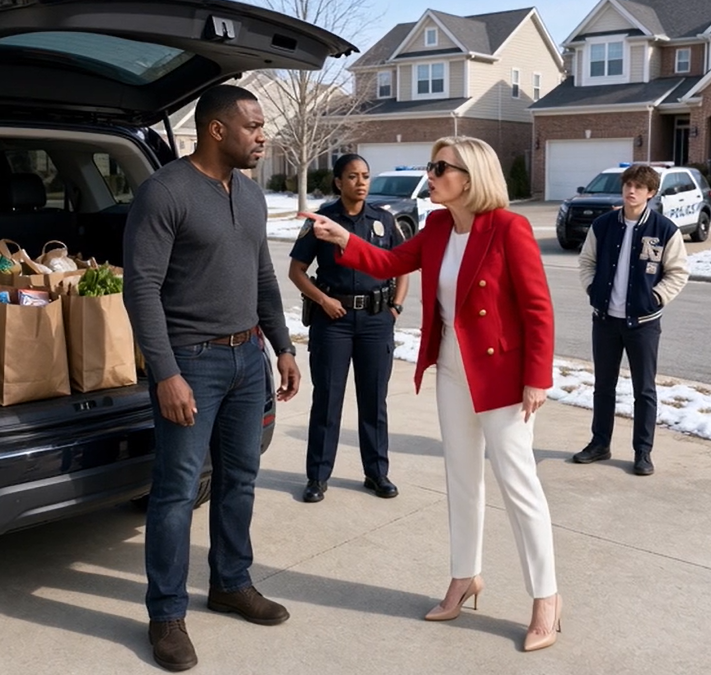
Bettina Whitmore stood on my porch already holding her phone.
Fifty-three.
Perfectly highlighted hair.
Black athletic pants.
White quilted vest with the Meadowlark Estates HOA logo embroidered over the left chest.
Yes.
The HOA had branded outerwear.
Bettina had ordered it during her second year as board president.
I opened the door.
She started before I could speak.
“What did you say to my son?”
“Good afternoon.”
“Do not patronize me.”
“I haven’t started yet.”
“He came home extremely upset.”
“Then you should ask him why.”
“He said you threatened him.”
“No.”
“You told him there would be consequences.”
“No.”
“He told me—”
“I told him to think carefully about demanding my groceries.”
She pointed her phone at me.
“You owe this association money.”
“No.”
“You have outstanding fines.”
“I have disputed notices.”
“Same thing.”
“No.”
“It is in this community.”
I leaned lightly against the doorframe.
“Bettina, did you send Cody here to take my groceries?”
Her expression changed.
Tiny.
But I saw it.
She had spent years controlling meetings, conversations, committees.
Questions bothered her when they had clean answers.
“I sent my son to remind you that obligations have consequences.”
“Did you tell him to take my groceries?”
“He misunderstood.”
“Did you use the phrase collect something of value?”
Silence.
That was enough.
“I’m calling the police.”
She said it as though revealing a hidden weapon.
“You’re going to regret this.”
“Do you understand me?”
I looked at her phone.
Then at her.
“Do you have any idea who I am in this neighborhood?” she demanded.
That sentence almost made me laugh.
Not because I thought my own title mattered more.
Because that was Bettina’s entire problem.
She was obsessed with who she was.
President.
Board.
Authority.
The person with the clipboard.
The person who decided.
Never once did she ask who anybody else might be.
I picked up the grocery bag I had forgotten by the entry table.
“Ma’am.”
She stopped.
“Make the call.”
So she did.
Confident.
Satisfied.
Not once asking who I was.
Only reminding me who she believed she was.
That was the last mistake Bettina Whitmore ever made in Meadowlark Estates.
My name is Darnell Okafor.
At the time, I was fifty-one years old.
Chief of the Ridgecroft Police Department.
I had held the job for eight months.
Before that:
patrol officer.
field training officer.
detective.
sergeant.
lieutenant.
deputy chief.
Twenty-two years in law enforcement.
I had worked homicides.
Fraud.
Domestic violence.
Burglary.
Public corruption.
Teenagers making terrible choices.
Adults making worse ones.
And after two decades of watching people become different the instant they learned what I did for a living, I had developed one rule for my personal life:
I did not introduce myself as the chief unless there was a reason.
Not because it was secret.
The department website had my picture.
The local newspaper covered my appointment.
Anyone could Google me in fifteen seconds.
But most people don’t.
And I liked that.
I wanted to be Darnell.
Not Chief Okafor.
Not the man asked to fix somebody’s parking dispute at a barbecue.
Not the neighbor people stopped swearing around.
Not the person homeowners approached because somebody’s teenager smoked behind the mailboxes.
Just Darnell.
The therapist I had started seeing after a particularly ugly year at work was the person who convinced me to move.
At the time I lived in an apartment almost directly above the precinct parking area.
The location had been convenient when I was lieutenant.
It became ridiculous when I was chief.
Sirens at two in the morning.
Officers waving from below.
People knocking because they knew my car was there.
Dr. Elaine Foster looked at me during one appointment and said:
“You live at work.”
“No, I live above work.”
“That is worse.”
“It’s efficient.”
“You use that word whenever something is unhealthy.”
I looked at her.
She smiled.
“Buy a house.”
“I own furniture.”
“That was not my question.”
“I don’t need a house.”
“Do you need a yard?”
“No.”
“Quiet?”
I stopped.
She saw it.
“Find somewhere with a tree, Darnell.”
That was how I ended up buying 14 Briarwood Court in Meadowlark Estates.
Three bedrooms.
Two and a half baths.
A deck that needed refinishing.
A badly over-pruned dogwood tree in front.
A garage large enough for the workbench my father had left me.
And, unfortunately, a homeowners association.
When my realtor mentioned the HOA, I asked the normal questions.
Annual dues?
Reasonable.
Reserves?
Healthy enough.
Major litigation?
None.
Architectural rules?
Mostly standard.
I had dealt with gangs, organized theft rings, angry city councils, hostile witnesses, and armed suspects.
A homeowners association did not make my threat matrix.
That was an error.
I moved in during July.
Hot Tennessee summer.
Fresh-cut grass.
Pressure washers.
Cicadas so loud you had to pause phone calls when they hit full volume.
I introduced myself to immediate neighbors.
“Darnell Okafor.”
“What do you do?”
“City employee.”
Technically true.
Most did not press.
Everett Sims lived to my left.
Seventy-one.
Widower.
Retired machinist.
He had been in Meadowlark eighteen years.
Across the street lived the Whitmores.
Bettina.
Her husband, Roger, who traveled often for medical-equipment sales and seemed to have perfected the art of being elsewhere whenever HOA drama happened.
And Cody.
The first time I saw Bettina, she was standing beside my mailbox.
Not near it.
Inspecting it.
I was unloading a box from my car.
She smiled.
“You must be the new owner.”
“I am.”
“Bettina Whitmore.”
She extended her hand.
“HOA president.”
“Darnell.”
“Welcome to Meadowlark.”
“Thank you.”
She looked toward the house.
“Beautiful property.”
“Needs work.”
“Nothing major.”
Then her eyes landed on the mailbox post.
White.
Fresh enough.
No peeling.
She said:
“You may want to review the approved exterior palette.”
I looked at her.
“For what?”
“The mailbox.”
“What’s wrong with it?”
“Technically the approved color is antique linen.”
I looked at white post.
Then her.
“Looks white to me.”
She laughed.
A little too brightly.
“That’s why we have standards.”
Three weeks later, I received my first violation.
FAILURE TO MAINTAIN APPROVED EXTERIOR PAINT INTEGRITY.
Fine:
$40.
I paid.
That embarrasses me now.
Not because forty dollars mattered.
Because I knew better.
People who abuse minor authority rarely interpret easy compliance as kindness.
They interpret it as available territory.
At the time I had seven active cases on my desk, staffing shortage, city budget meeting, and a homicide review.
Forty dollars seemed cheaper than my attention.
I mailed the check.
Bettina learned the wrong lesson.
Within six weeks, I was receiving weekly notices.
Gutters allegedly needed cleaning.
I had cleaned them.
Recycling bin was approximately three inches too close to my property line on collection day.
The word approximately amused me.
Someone had clearly measured badly.
Decorative stone around dogwood was unauthorized hardscape modification.
The stones had come with the house.
I had photographs from inspection.
Then:
Driveway stormwater concern.
That one arrived through Cody.
He knocked one Friday.
Golf cart in driveway.
One hand on doorframe.
“My mom says your response letter has mistakes.”
“What mistakes?”
“She says your stone border isn’t grandfathered.”
“I sent the pre-purchase inspection photos.”
“She said that doesn’t count.”
“Okay.”
“And she said you have drainage coming through your driveway expansion joint.”
I stared.
“What?”
“It violates county stormwater rules.”
“Which one?”
He blinked.
“What?”
“Which code section?”
“My mom knows.”
“Have her send it.”
“She’ll report you to county.”
“Excellent.”
That answer bothered him.
“You’re not worried?”
“I would love a written citation.”
Cody left.
That evening I pulled county stormwater rules.
My driveway was fine.
I already suspected that.
Sixteen years earlier, as detective, I had worked a contaminated-runoff case involving illegal dumping into a storm drain.
I knew more about municipal water systems than Bettina anticipated.
By September, the notices had evolved into something else.
Not merely fines.
Narrative.
Neighbors began hearing I was difficult.
Noncompliant.
Slow to cooperate.
The Donovans at Number 12 apologized one afternoon.
Marcus Donovan said:
“Bettina mentioned you’ve had repeated code issues.”
“Did she?”
“Community coffee.”
His wife looked embarrassed.
“We didn’t ask.”
“I know.”
The Kowalchiks told me similar.
Bettina was isolating me before escalating.
That pattern was familiar.
Good investigators learn that people who want control often try to define the target before the target defines themselves.
Troublemaker.
Unstable.
Difficult.
Uncooperative.
Once those labels spread, future action gets interpreted through them.
So I started documenting.
Nothing dramatic.
Notebook.
Date.
Time.
Notice.
Rule cited.
Actual language.
Photographs.
Responses.
I also began doing something Bettina had not expected.
I became a neighbor.
Not strategically at first.
Genuinely.
Marcus helped refinish my deck.
I helped the Kowalchiks find a plumber for a leaking line.
Everett and I drank coffee on his porch.
I learned Millicent Vance, retired teacher three streets over, loved wind chimes.
The HOA did not.
I learned the Osay family had been paying monthly penalties over a shed installed by a prior owner years earlier.
I learned Everett had once received a violation for replacing a dead hedge with a different species.
I learned multiple households believed Bettina retaliated against people who questioned her.
But nobody coordinated.
That was what gave her power.
Everyone thought they were the only one.
November board meeting confirmed my suspicion.
I attended quietly.
Bettina ran the room beautifully.
That is worth saying.
Competence and fairness are different traits.
She had agenda.
Gavel.
Timing.
She recognized allies immediately.
Opponents waited.
During new business, she introduced a mandatory property audit for any homeowner receiving three violations in one calendar year.
Guess who had more than three?
The designated inspector would be the HOA president.
Bettina.
After meeting I approached Philip Greer, the association’s management representative.
Tired man.
Rolling briefcase.
The look of somebody professionally exhausted by people who consider shrubs a constitutional issue.
“When does that audit rule take effect?”
“Assuming it is validly adopted, after comment period.”
“How long?”
“Thirty days.”
“So not until January.”
“Correct.”
I nodded.
“Thank you.”
He looked at me.
“You planning something?”
“No.”
That was mostly true.
Then came the first grocery incident.
Cody showed up wanting “the stuff.”
I refused.
Bettina came over.
Twenty-two minutes of lecture.
The important part was not what she said.
It was what she believed.
In her mind, HOA authority was not contractual.
It was personal.
She ran the neighborhood.
Therefore her decisions became obligations.
When she left, I called attorney.
Cecily Farr.
Municipal and property law.
Sharp enough to make legal research sound recreational.
“Send everything.”
I did.
Two weeks later she called.
“I found problems.”
“How many?”
“Do you want categories or pages?”
“That sounds bad.”
“For her?”
“Yes.”
“Then yes.”
First:
The mandatory audit amendment did not comply with Meadowlark’s own recorded procedures.
Second:
The fine schedule Bettina had been using for years had never been ratified as required by the original declaration.
Potentially invalid.
Third:
A line item in the HOA financial disclosures caught Cecily’s attention.
Administrative services.
Approximately $9,000.
Payee:
Whitmore Property Management Solutions.
Owner:
Bettina Whitmore.
“Is she allowed to pay herself?”
“Maybe, if properly disclosed and approved.”
“Was it?”
“Not in records I have.”
I sat at kitchen table.
Outside, Cody’s golf cart passed.
“Interesting.”
Cecily laughed.
“That is a very police-chief answer.”
“I didn’t tell you I’m chief.”
“You’re on municipal website, Darnell.”
“Right.”
“Does Bettina know?”
“No.”
Pause.
“Please tell me we can keep it that way for a little while.”
“Cecily.”
“What?”
“I need lawyer.”
“I can be professional and entertained.”
She was.
For next month, we built.
Original CC&Rs.
Board minutes.
Fine notices.
Financial statements.
Resident stories.
I requested county compliance inspection of my property.
Passed.
I paid sixty dollars for written certificate.
No code violations.
No drainage violation.
No unauthorized hardscape.
No gutter issue.
Official.
Then I went to county recorder and pulled original Meadowlark documents.
Page after page.
And buried deep in enforcement section was a clause Bettina either had never read or hoped residents never would.
If the association initiated enforcement without documented proof of actual violation, affected homeowner could recover reasonable costs under dispute procedures, subject to the declaration’s limits.
Eleven notices.
I had records for every one.
Not a financial windfall.
That was not the point.
The point was evidence of pattern.
Cecily found something better.
Special membership meeting provision.
Ten percent of owners could petition.
Meadowlark had 174 homes.
Eighteen signatures.
I had nine quickly.
People Bettina had pressured.
Needed nine more.
I talked.
Not campaigning against her.
Just:
Have you had problems?
Do you want independent review?
Would you sign a petition for membership meeting?
The responses surprised me.
By second week January:
twenty-three signatures.
More than required.
We filed.
Meeting now mandatory.
At same time, Cecily sent notices to board and management company.
Invalid audit rule concerns.
Fine schedule concerns.
Conflict-of-interest accounting demand.
The two other board members, Gerald Fitch and Diana Pruitt, suddenly discovered legal anxiety.
Gerald called Cecily’s office.
Diana became difficult to locate.
Bettina responded differently.
She became more aggressive.
She hired private inspector to photograph my house from public easement.
No violations.
She sent handwritten letter accusing me of harassment.
Demanded I withdraw petition.
Threatened police involvement.
I photographed it.
Forwarded to Cecily.
Then blocked number texted:
LAST CHANCE.
Forwarded that too.
January 15 was scheduled audit day.
I knew Bettina would show.
I also knew she would eventually call police.
People in her position often do.
When every private lever stops working, they reach for public authority.
I did not want a junior patrol officer walking into an HOA argument without context.
So I notified duty sergeant.
Antoinette Webb.
Six years under my command.
Twenty years policing.
Calm enough that even angry people lowered volume around her.
I said:
“There may be an HOA dispute at my home January fifteenth.”
She laughed.
“You?”
“Yes.”
“What did you do?”
“Bought a house.”
“Always dangerous.”
“I expect they may call alleging obstruction.”
“I’ll flag address.”
“Don’t give me special treatment.”
“I never do.”
“That’s why I called you.”
I also called JoEllen Paske at Ridgecroft Courier.
Not because I wanted spectacle.
Because by then Bettina had made public accusations.
If the confrontation happened, I wanted an independent witness who understood municipal affairs.
JoEllen agreed to park two houses down.
Cecily came to my house early.
January fifteenth.
Gray morning.
Cold.
Kitchen coffee.
Folders laid out.
County certificate.
Original CC&Rs.
Audit-amendment challenge.
Financial records.
Special-meeting petition.
At 8:43, we heard golf cart.
Cody first.
Then Bettina walking.
HOA fleece.
Clipboard.
Measuring tape clipped to belt.
Cecily looked through blinds.
“She brought a tape measure.”
“I see.”
“I love her.”
“No.”
“Professionally.”
Doorbell rang.
I opened.
“Mr. Okafor.”
“Ms. Whitmore.”
“The board is here to conduct the mandatory compliance audit.”
“Who is the board?”
She glanced back.
Nobody.
Cody on golf cart.
“That is not relevant.”
“It seems relevant.”
“You are required to provide access to your rear yard.”
“No.”
“If you obstruct, I will contact police.”
“You should.”
Her eyes narrowed.
“You think this is funny?”
“No.”
“You’ve been attempting to intimidate this board with frivolous legal threats.”
“No.”
“You’ve organized residents against me.”
“I petitioned for meeting.”
“You are creating hostile environment.”
“I’m standing inside my house.”
She took phone out.
“Last chance.”
I smiled.
“Call.”
She dialed.
Reported combative homeowner.
Refusing official HOA inspection.
Potentially threatening.
Dispatch placed her on hold.
My phone vibrated.
Webb:
ON WAY.
I pocketed it.
“They’re coming.”
Bettina smiled.
“Good.”
Patrol cruiser arrived at 9:04.
Webb got out.
Full uniform.
Unhurried.
Bettina met her halfway down drive.
“Thank you for coming.”
She gestured at me.
“This gentleman has repeatedly obstructed lawful association enforcement and is now refusing mandatory inspection. I’m concerned about escalating behavior.”
Webb looked at me.
Then Bettina.
“Ma’am, your name?”
“Bettina Whitmore.”
“Role?”
“HOA president.”
Webb wrote.
“And property owner?”
She pointed.
“Darnell Okafor.”
Webb gave tiny nod.
The kind that would mean nothing to anyone who didn’t know her.
Cecily stepped onto porch.
Folder in hand.
I said:
“The audit amendment’s validity has been formally challenged.”
Bettina snapped:
“That is not for you to decide.”
Cecily answered.
“Correct.”
“It is subject to governing documents and applicable law.”
She opened folder.
“Formal notice was delivered January eighth.”
“Management company acknowledged receipt.”
“There is also an unresolved question regarding the board’s fine schedule.”
“And approximately nine thousand dollars in undisclosed administrative payments made to a company registered to Ms. Whitmore.”
Bettina’s clipboard lowered.
Webb’s expression did not change.
The street was quiet.
Everett appeared on porch in robe.
Across cul-de-sac, Marcus Donovan opened front door.
Cody sat frozen on golf cart.
Bettina looked at Webb.
“This is a civil dispute.”
“Yes, ma’am.”
“Then you need to make him cooperate.”
“No, ma’am.”
“He is refusing an official inspection.”
“Police don’t enforce private HOA inspections.”
“He threatened my son.”
Webb turned to me.
“What happened?”
I answered exactly.
No embellishment.
Cody requested groceries as collection for HOA fine.
I told him to think carefully.
Told him to leave.
No physical threat.
Cody was within hearing distance.
Webb called:
“Cody.”
He looked at mother.
“Come here.”
He approached slowly.
“Did Mr. Okafor threaten to hurt you?”
“No.”
Bettina cut in:
“He intimidated him.”
Webb looked at her.
“Please let him answer.”
Cody swallowed.
“He just said I should think carefully about what I said.”
“Anything else?”
“He told me move.”
“Did he touch you?”
“No.”
“Did he threaten arrest?”
“No.”
“Did he threaten violence?”
“No.”
Webb nodded.
“Thank you.”
Bettina’s face tightened.
“Then I want him cited for obstruction.”
Webb looked at her.
“There’s nothing to cite.”
“You’re refusing to enforce—”
I interrupted.
First time.
“Bettina.”
She turned.
“I’m Chief Darnell Okafor.”
Silence.
Real silence.
Not conversational pause.
The kind that changes air.
Cody stopped breathing for second.
Bettina stared.
“What?”
“Police chief.”
Webb said:
“He is.”
Bettina looked from me to Webb.
Then back.
For six months, I had wanted this moment less than people later believed.
I did not feel triumphant.
I felt tired.
Because suddenly I could see every conversation replaying inside her head.
The mailbox.
Stormwater.
Cody.
The letters.
The threats.
The phone calls.
Her accusation that I might be dangerous.
The decision to summon police.
None of that became wrong because I was chief.
That mattered.
If I had been cashier, plumber, retiree, teacher—it would still have been wrong.
My title did not create my rights.
It only destroyed her assumption that she controlled the public authority she was trying to use.
I said:
“I moved here last July.”
“I have not interfered with any legitimate HOA function.”
“I have documented eleven enforcement notices.”
“I have retained counsel.”
“I have requested review through governing procedures.”
“I have a county compliance certificate.”
“I have not threatened you.”
“I have not threatened your son.”
“I have not obstructed law enforcement.”
“And I am not granting access to my property for an inspection whose authority is formally disputed.”
Bettina said nothing.
JoEllen Paske approached from two houses down.
Notebook.
“Ms. Whitmore?”
Bettina turned.
JoEllen:
“Ridgecroft Courier.”
“I’d like comment regarding special membership petition and payments to Whitmore Property Management Solutions.”
The color left Bettina’s face slowly.
That was the moment.
Not “caught criminal.”
Nothing so simple.
The moment when a person whose entire power depended on narrative realized she no longer controlled who was listening.
She looked at clipboard.
Then Cody.
Then Webb.
She turned around.
Walked home.
Cody followed in golf cart.
Everett raised coffee mug.
I raised mine.
Webb stayed.
Completed report.
“No criminal conduct.”
“Civil HOA dispute.”
“Caller advised police do not enforce private inspection.”
Before leaving, she looked at me.
“You waited six months to tell her?”
“I was hoping I wouldn’t need to.”
Webb smiled.
“Chief.”
“Yes?”
“She sent her kid for your groceries.”
“I’m aware.”
“I’m going to tell people this story when I retire.”
“Please don’t.”
“I absolutely am.”
The Courier story ran four days later.
JoEllen was careful.
No sensational headline.
No “Karen versus chief.”
She focused on governance.
Special meeting.
Fine schedule.
Conflict-of-interest questions.
Resident complaints.
Police call.
The article did not accuse Bettina of crimes.
Neither did we.
That distinction mattered.
The fallout was still immediate.
Philip Greer’s management company paused enforcement under disputed fine schedule pending legal review.
Gerald Fitch resigned.
Diana Pruitt sent email saying she would not seek another board term.
Residents who had never attended meetings began reading CC&Rs.
That alone almost destroyed Bettina’s system.
Bad governance often survives because rules are boring.
The moment enough people read them, magic disappears.
February seventh.
Special membership meeting.
Clubhouse full.
One hundred twelve units represented.
People stood along walls.
Millicent Vance brought her daughter.
Osays came together.
Everett sat front.
Marcus Donovan had stack of papers.
Bettina did not attend.
Her attorney sent letter disputing several allegations and urging orderly transition.
Vote was 104 to 8 to remove her from presidency and recall her board seat under association procedures.
No screaming.
No arrest.
No cinematic police escort.
Just ballots.
That was better.
Power taken through same documents she had used to intimidate everyone.
New interim board appointed independent accountant.
That audit found administrative-services payments to Whitmore Property Management Solutions lacked proper conflict disclosures and approval documentation.
Bettina disputed wrongdoing.
Her attorney argued services had actually been performed.
Probably true.
But the governance failure remained.
Months of negotiation.
Civil settlement.
Approximately seventy-five percent repaid.
No criminal case.
Fine schedule reviewed.
Improper fines canceled.
Some residents reimbursed administrative costs under dispute clause.
Millicent’s wind-chime warning disappeared.
Osay shed fines rescinded.
Everett’s old landscaping citation closed.
My forty-dollar mailbox fine?
Refunded.
I taped check above my workbench for three months.
Then deposited because Cecily called that “weird.”
The funniest part:
My mailbox remained white.
Nobody died.
The neighborhood did not collapse.
Property values did not plunge.
Civilization survived.
The new board rewrote enforcement procedures.
Photos required.
Specific rule citations.
Written notice.
Opportunity to cure.
Appeal process.
No officer could inspect private property without consent unless governing documents and law clearly provided authority.
Conflict disclosures mandatory.
No board member companies without independent review and membership notice.
Boring reforms.
Excellent reforms.
The recovered funds did something better.
Marcus Donovan proposed resident assistance fund.
Three thousand dollars initially.
For elderly or financially struggling homeowners facing legitimate common-area obligations.
First recipient:
Millicent Vance.
She repainted porch.
Blue-gray.
Approved.
Then she put wind chimes back.
I heard them on evening walks.
Soft.
Metallic.
Perfectly legal.
Cody disappeared for a while.
Not literally.
Stopped golf cart patrol.
Stopped showing up at doors.
A month later I saw him at Fresh Market.
Loading groceries into car.
He noticed me.
Frozen.
I could have walked past.
Instead:
“Hey, Cody.”
He looked surprised.
“Hey.”
Pause.
“I’m sorry about… the bags.”
I nodded.
“Don’t let adults send you to do their fights.”
He looked down.
“Yeah.”
“You’re sixteen.”
“You’re supposed to be making your own bad decisions.”
That got a small laugh.
He nodded.
I moved on.
No lecture.
He was not Bettina.
He had been a child raised inside her version of authority.
That did not excuse taking groceries.
It did mean he was capable of becoming someone else.
Bettina moved out of Meadowlark eleven months later.
Her marriage survived as far as I know.
She kept working in real estate.
I never followed closely.
People expected me to enjoy her leaving.
Mostly I felt relief.
Conflict takes rent from attention.
Even when you win.
Especially when you win publicly.
For months strangers in town recognized me from article.
“Chief, you’re HOA guy.”
“I’m police chief.”
“Yeah, HOA thing.”
Humbling.
Dr. Foster—my therapist—laughed for nearly a minute when I told her.
“You moved to reduce stress.”
“I did.”
“How’s that?”
“I have a dogwood tree.”
She looked at me.
“Worth it?”
I thought.
“Yes.”
Because something good happened after.
Meadowlark became a neighborhood.
Not suddenly.
Not magically.
But people who had been privately afraid of being targeted began speaking to each other.
Board meetings became less theatrical.
More irritatingly democratic.
People disagreed.
A lot.
But disagreement was no longer treated as disobedience.
Everett argued against pool resurfacing budget.
Marcus argued for it.
Millicent complained that meetings ran too long.
The Osays volunteered for landscaping committee.
Philip’s management company eventually resumed under new contract with clearer controls.
I declined every invitation to join board.
Absolutely not.
I had one government already.
At home, I wanted none.
My deck held.
The dogwood recovered from over-pruning.
Spring flowers came thick.
One April morning Everett stood beside me.
“Good tree.”
“Yes.”
“Bettina always wanted you to cut that thing down.”
“She did?”
“Said shape was inconsistent.”
I looked at him.
“You’re telling me now?”
“She’s gone.”
“Everett.”
He laughed.
We stood beneath flowers.
For long time I thought the story was about exposing Bettina.
It wasn’t.
She mattered because she was visible.
The bigger problem was what everyone else had learned to tolerate.
Millicent taking down wind chimes.
The Osays paying fines.
Everett avoiding conflict.
Gerald voting yes because Bettina “did the work.”
Diana choosing absence.
Philip processing whatever board sent because contract said so.
Cody believing his mother’s title gave him collection rights over somebody’s groceries.
Systems become abusive long before anybody uses dramatic force.
They become abusive when normal people decide resistance costs more than compliance.
Forty dollars.
Take down chimes.
Move bins.
Stay quiet.
Don’t appeal.
Don’t attend.
Don’t ask.
That is how little authority becomes big.
Not because the person in charge is powerful.
Because everybody else becomes isolated.
My title helped at final moment.
It did.
I would be dishonest to pretend otherwise.
When Webb confirmed I was chief, Bettina’s confidence collapsed faster.
When reporter heard it, story sharpened.
But police badge was not what defeated her.
Paper did.
Residents did.
Meetings did.
Signatures did.
The original declaration sitting in a county recorder’s office did.
The fact that twenty-three households finally compared notes did.
If I had revealed my job on day one and barked at her to leave me alone, she might have left me alone.
Only me.
Millicent still takes down chimes.
Osays keep paying shed fines.
Everett keeps quiet.
That would have been easier.
It would also have been worse.
Months after everything settled, a new family moved into Number 22.
Young couple.
Toddler.
The husband knocked on my door.
“Are you Chief Okafor?”
“At work.”
He laughed nervously.
“I mean, yes.”
“We got a violation about trash bins.”
My stomach dropped.
“What?”
Then he smiled.
“Proper notice.”
“Photo.”
“Rule citation.”
“Seven-day cure.”
“I just forgot them.”
“Oh.”
“I wanted to tell you system works now.”
I stared.
“That’s why you knocked?”
“Yes.”
“You could’ve waved.”
He laughed.
“Sorry.”
I closed door smiling.
That was victory.
Not no rules.
Fair rules.
An HOA without enforcement is not automatically good.
Roads need maintenance.
Pools need budgets.
Shared property needs standards.
The issue was never that Bettina enforced rules.
The issue was she treated rules as extensions of herself.
Law does not work that way.
Neither should neighborhoods.
Three years later, I retired from police department.
Twenty-five years total.
Ceremony at city hall.
Webb gave speech.
She told grocery story.
Despite explicit instructions not to.
Everybody laughed.
I glared.
She enjoyed that.
At end, she handed me framed photo.
Not badge.
Not department portrait.
A grocery bag.
Printed on plaque:
HAND OVER THE BAGS.
Underneath:
NO.
I laughed harder than anyone.
Retirement was strange.
Quiet I once wanted became available.
Then I discovered too much quiet had edges.
So I volunteered occasionally with youth mentorship program.
Gardened badly.
Walked more.
Sat on deck.
Neighbors still knew me.
Not Chief.
Mostly Darnell.
That was what I wanted.
Cody graduated high school.
I got invitation.
Did not expect.
Small envelope.
Handwritten:
Mr. Okafor,
You were right about not doing adults’ fights.
Thank you for not treating me like I was already who I was going to become.
—Cody
I kept that longer than mailbox check.
He went to community college.
Last I heard, studying electrical work.
Bettina never apologized.
People sometimes ask if that bothers me.
No.
Apology from somebody forced into one is mostly theater.
Consequences mattered more.
The new system mattered.
Cody learning mattered.
Neighbors speaking mattered.
I did not need Bettina to understand me.
That was another mistake she had made from beginning.
She believed every conflict had one center.
Herself.
If you liked her, good resident.
If you questioned her, hostile.
If you complied, community-minded.
If you pushed back, dangerous.
That worldview is powerful until enough people refuse their assigned role.
The final time I saw Bettina was nearly five years after she moved.
Ridgecroft Fresh Market.
Of course.
I was choosing tomatoes.
She appeared at end of aisle.
Older.
Same posture.
She saw me.
Stopped.
For a second, both of us could have turned away.
She said:
“Darnell.”
“Bettina.”
No titles.
No board.
No police.
She looked at tomatoes.
Then:
“I heard you retired.”
“Yes.”
“Congratulations.”
“Thank you.”
Silence.
Then she said something surprising.
“I was trying to keep the neighborhood from falling apart.”
I believed she believed that.
“That wasn’t your job alone.”
She looked.
“I thought nobody else would do it.”
“That’s how it starts.”
She knew what I meant.
Her mouth tightened, but not angry.
Tired.
“I made mistakes.”
“Yes.”
Not cruel.
Just true.
She gave small laugh.
“You’re still direct.”
“Occupational damage.”
Then she walked away.
No reconciliation.
No dramatic apology.
Just two people in grocery store.
That was enough.
I bought tomatoes.
No one tried to collect them.
When I tell the story now, people usually love reveal.
“You should’ve seen her face when she found out you were chief.”
They want humiliation.
Power reversal.
Bullies getting what they deserve.
I understand.
It is satisfying.
But the title is not the lesson.
If I had been nobody important, Bettina still would have been wrong.
That is what matters.
Rights do not increase with job title.
A quiet neighbor deserves same process as police chief.
A retired teacher deserves appeal.
A family deserves accurate fine.
A teenager deserves adults who do not send him to collect disputed debt.
A board member deserves enough independence to say no to president.
A management company should not blindly process questionable instructions.
Rules matter most when powerful person dislikes person using them.
That is when you find out whether they are rules or tools.
On spring mornings, I still sit under dogwood.
Wind chimes from Millicent’s porch sometimes carry down street.
Everett died two years after I retired.
His nephew sold house to a young paramedic and her wife.
Good neighbors.
Marcus Donovan became HOA president for one term.
Hated every minute.
Stepped down.
Said union bargaining was easier.
Meadowlark continues.
Lawns.
Bins.
Budgets.
Arguments about pool hours.
Ordinary neighborhood.
Exactly what I had wanted when I moved in.
Sometimes I think about those grocery bags.
Cody blocking trunk.
“My mom says you owe us.”
That sentence contained whole problem.
Not “the documents say.”
Not “the board decided after process.”
Not “here is invoice.”
My mom says.
Authority had become personal.
Six months later, after board vote, newspaper story, repayment agreement, canceled fines, and reforms, Meadowlark finally learned better sentence.
“What do the rules actually say?”
That is less dramatic.
It is also how communities stay free.
Bettina called police because she believed police would enforce her authority.
Instead, the sergeant enforced something simpler:
the law did not care who thought they ran the neighborhood.
Neither did recorded CC&Rs.
Neither did signatures.
Neither did evidence.
And neither did I.
She spent six months asking everyone around her if they knew who she was.
She never thought to ask who anyone else might be.
In the end, that was not her biggest mistake.
Her biggest mistake was assuming it should have mattered.








