HOA Karen Sent Fake “Cops” to Pry Open My Wife’s ’67 Mustang—Then She Called 911 and Panicked When the Real Officers Recognized Her.
PART2:
He used to joke that he bought the car because he needed something beautiful enough to give him a reason to come home.
Then he did come home.
Not unchanged.
Nobody comes home from war unchanged.
But alive.
He served twenty-five years.
Raised a daughter.
Kept the Mustang.
Rebuilt the engine once.
Transmission twice.
Repainted it with Rachel helping him sand the panels during high school.
She knew that car bolt by bolt.
When William got sick near the end of his life, Rachel spent Saturdays in his garage.
He could not bend over the engine anymore.
So she did.
He would sit on a stool giving instructions she already knew.
“Easy with that wrench.”
“I know, Dad.”
“You’ll round it.”
“I know.”
“You’re turning the wrong—”
“Dad.”
“What?”
“Go drink your coffee.”
He died in 2019.
Left Rachel the Mustang.
His last serious request was four words.
“Keep the old girl running.”
Rachel promised.
She took promises seriously.
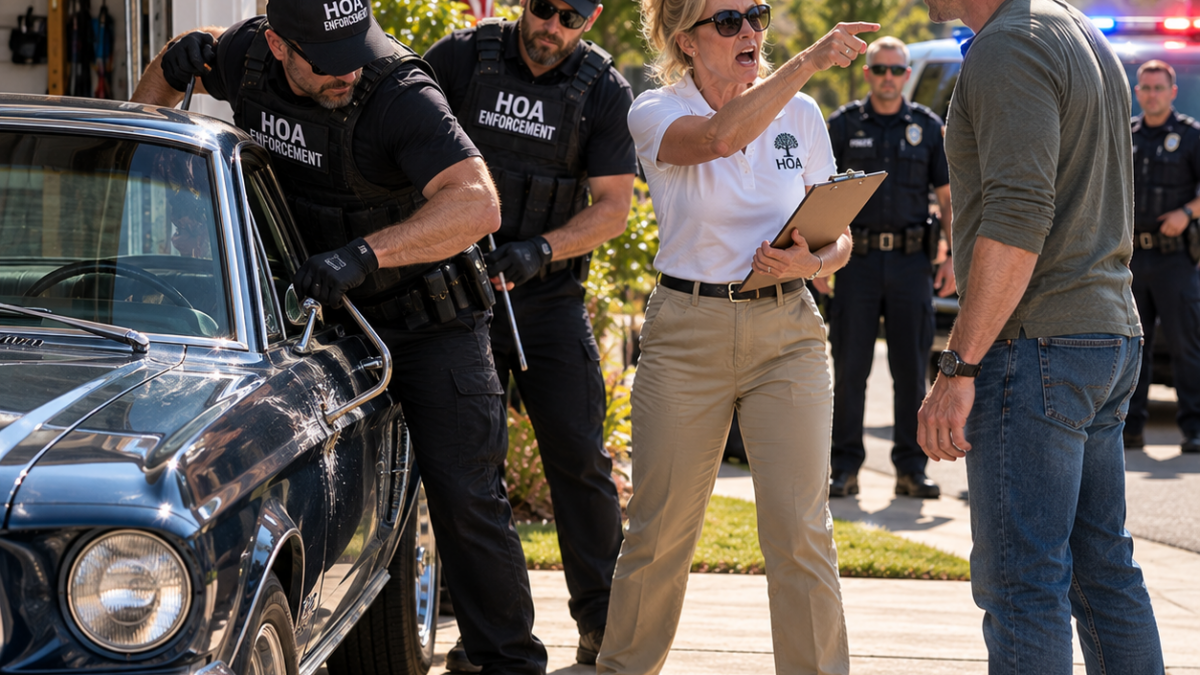
So on that Saturday morning, when I saw a crowbar flexing the driver’s door frame, I did not see a damaged classic car.
I saw someone breaking a promise my wife had spent years protecting.
I walked down the porch steps.
“Take that tool out of the door.”
Patricia raised her clipboard.
“This vehicle is currently subject to HOA enforcement.”
“It’s my wife’s car.”
“It is in violation of Section 4.7.”
“What violation?”
“Inoperable classic vehicles may not remain visible from common areas.”
“It isn’t inoperable.”
“That has been disputed.”
“By who?”
“We received complaints.”
“Who?”
“Complaints may remain confidential.”
“It was driven three days ago.”
Patricia looked toward the Mustang.
“The board has determined the vehicle constitutes a nuisance.”
“The board is wrong.”
The security man holding the crowbar glanced at her.
He already looked uncomfortable.
Good.
At least one person there possessed a functioning conscience.
I pointed.
“Take it out.”
Patricia said:
“Do not interfere.”
“It’s in my driveway.”
“The governing documents permit corrective action.”
“Show me.”
She smiled.
Not kindly.
“You may file an appeal.”
“After you destroy the car?”
“We aren’t destroying anything.”
The man pulled.
The door frame cracked.
The sound went straight through me.
“You just cracked the frame.”
Patricia barely looked.
“Any incidental damage arising from owner noncompliance is the owner’s responsibility.”
I stared at her.
“Say that again.”
Her eyes narrowed.
“Mr. Crawford, control yourself.”
“I’m standing here watching strangers pry open my wife’s Mustang.”
“You are becoming aggressive.”
“I haven’t touched anybody.”
“Your posture is threatening.”
“My posture?”
I took one step toward the car.
Patricia immediately stepped backward.
Dramatically.
As if I had lunged.
“Stay where you are!”
The guard stopped completely.
The second man removed his tool from the window.
Across the street, blinds moved.
Patricia saw that too.
Her voice became louder.
“I said do not approach HOA personnel!”
“They are damaging private property.”
“You are threatening them.”
“No. I am telling them to stop.”
She already had her phone out.
“I’m calling 911.”
I laughed once.
Not because it was funny.
Because I genuinely could not understand what kind of person commits property damage, gets confronted by the property owner, and decides the police are somehow reinforcements.
“You’re calling police on me?”
“You are behaving aggressively toward authorized personnel.”
“Authorized by who?”
“The association.”
“That doesn’t make them police.”
“They are contracted security.”
“Then why are they breaking into a vehicle?”
Patricia turned away and dialed.
The moment the dispatcher answered, her voice changed.
That fascinated me.
Suddenly she sounded frightened.
Breathless.
Careful.
“Hello? Yes. I need officers at Ridgewood Estates immediately.”
Pause.
“There’s an aggressive male confronting our staff.”
I stared at her.
“He’s making threatening movements.”
I said loudly:
“I’m standing twelve feet away.”
Patricia spun.
“Do not come closer!”
“I didn’t move.”
Back to the phone.
“He’s escalating now.”
One guard looked at the ground.
The other stepped farther away from the Mustang.
Patricia continued.
“We are attempting a lawful vehicle-enforcement action and he has become hostile.”
That was when I took out my own phone.
Recording.
Her eyes flashed.
“Put that away.”
“No.”
“You do not have permission to record HOA personnel.”
“We’re standing in my driveway.”
“This area is visible from common property.”
“I don’t care.”
“Mr. Crawford—”
“I’m recording.”
She returned to 911.
“He’s filming us now.”
As though I had added another felony.
Then the back door opened.
Rachel stepped onto the porch.
She had been upstairs on a Saturday work call.
Black sweatpants.
Gray T-shirt.
Hair tied back.
Laptop still in one hand.
She looked half awake.
Until she saw the Mustang.
Then something changed.
Rachel did not scream.
Did not run.
Did not curse Patricia.
She walked slowly down the steps.
Her eyes moved across the damage.
Bent mirror.
Scratched paint.
Cracked door frame.
Crowbar.
Two men.
Then Patricia.
One of the security guys muttered something.
The other backed away again.
Rachel stopped beside me.
I said quietly:
“They say it’s inoperable.”
Her eyes stayed on the car.
“It isn’t.”
“I know.”
She looked at Patricia.
Patricia lowered her phone slightly.
“And who are you?”
Rachel’s voice was flat.
“I own the vehicle.”
Patricia smiled.
“Well, perhaps you can explain to your husband that threatening association personnel is unacceptable.”
Rachel glanced at me.
“Did you threaten anybody?”
“No.”
Patricia interrupted.
“He advanced on them.”
“He walked toward his wife’s car?”
“His approach was aggressive.”
Rachel looked at the two guards.
“Did he touch either of you?”
Neither spoke.
Patricia said:
“That isn’t the point.”
Rachel nodded once.
“What authority did you use to enter the vehicle?”
Patricia straightened.
“Section 4.7.”
“That regulates vehicle condition.”
“Yes.”
“That doesn’t answer my question.”
“Mrs. Crawford, your legal interpretations are not relevant.”
Rachel looked at her for several seconds.
Then said:
“Okay.”
That single word unsettled Patricia more than yelling would have.
She wanted argument.
Rachel gave her none.
Patricia lifted her chin.
“I have already called the police.”
“Good.”
Patricia blinked.
Rachel continued:
“I would like them here.”
Definitely not the answer Patricia expected.
She turned toward the guards.
“Continue documenting the vehicle.”
Rachel said:
“Do not touch it again.”
The two men stopped.
Patricia snapped:
“I gave them instructions.”
Rachel looked at the crowbar.
Then at Patricia.
“They heard mine.”
Neither guard moved.
Sirens became audible a few minutes later.
Patricia’s shoulders relaxed.
She believed help was coming.
What she did not understand was that calling 911 had just created the first independent record of what she was doing.
A patrol car turned onto our street.
Then a second.
Two officers stepped out.
Their attention went first to the men in dark uniforms.
Then me.
Then Patricia.
Patricia rushed toward them.
“Officers, thank you.”
Like she had summoned employees.
One officer raised a hand.
“Ma’am, hold on.”
But Patricia continued.
“This man became aggressive when our authorized security team attempted to enforce an HOA violation.”
She pointed at me.
“He advanced despite repeated warnings.”
The officer looked at me.
“Sir, give me a few steps back.”
I did.
No argument.
Hands visible.
Patricia nodded slightly, as though my compliance confirmed her version.
“We have had repeated issues with these new residents.”
False.
We had lived there three months.
Our greatest offense before that morning had been leaving the recycling container at the curb overnight once.
The officer said:
“Ma’am, I need you to stop talking for a second.”
Finally.
He turned toward me.
“Name?”
“Daniel Crawford.”
“What happened?”
I pointed toward the Mustang.
“These men were forcing entry into my wife’s car with a crowbar. I came outside and told them to stop. Mrs. Henderson called 911.”
The officer looked at the damaged door.
“Who owns the vehicle?”
Rachel stepped forward slightly.
“I do.”
The second officer looked at her.
Something shifted in his expression.
Recognition.
Not certainty.
He narrowed his eyes as if trying to place her.
Rachel noticed.
Did not react.
Patricia said:
“The vehicle was subject to lawful removal.”
The first officer looked back.
“You were towing it?”
“Preparing it for removal.”
“Why force the door?”
“Access procedure.”
The officer looked at the guards.
“Who told you to pry open the door?”
Silence.
Patricia answered for them.
“I authorized it.”
The officer stared.
“You authorized them to break into the vehicle?”
“Not break into. Gain access.”
“What’s the difference?”
“The association’s governing documents provide corrective authority.”
“Do you have a court order?”
Patricia looked confused.
“A what?”
“Any court order allowing seizure or forced entry?”
“The bylaws are contractual authority.”
“That isn’t what I asked.”
Her mouth tightened.
Then she pivoted back to me.
“He became threatening.”
“I didn’t.”
“You advanced.”
“I walked down my own driveway.”
“You raised your voice.”
“My wife’s car was being damaged.”
The man with the crowbar finally spoke.
“He didn’t touch anybody.”
Patricia turned sharply.
“Mark.”
Mark looked uncomfortable.
“He didn’t.”
The second guard added:
“He was angry.”
“Yes.”
I looked at the officer.
“I was.”
“Did you threaten violence?”
“No.”
“Touch anyone?”
“No.”
“Gesture toward a weapon?”
“No.”
“Do you have a weapon?”
“No.”
Patricia said:
“Aggression doesn’t require a weapon.”
Rachel spoke.
“Neither does filing a false report.”
Patricia turned.
“Excuse me?”
Rachel said nothing else.
The second officer looked at her again.
Then toward his partner.
He still seemed to know her from somewhere.
Patricia kept talking.
“These people are attempting to intimidate association leadership.”
The first officer said:
“Ma’am, what I can clearly see right now is property damage.”
“It was authorized.”
“By your board.”
“Yes.”
“That still doesn’t automatically allow you to force entry into privately owned property.”
Patricia’s voice sharpened.
“That is your opinion.”
“It’s why I’m telling everyone to stop touching the car until ownership and civil authority are clarified.”
Patricia looked offended.
By then half the street was watching.
An older couple.
A jogger.
A woman with a dog.
Two parents standing near mailboxes.
Patricia turned just enough that her voice carried.
“This is precisely why Ridgewood Estates has standards. If every new resident ignores the governing documents, property values decline.”
A neighbor nodded.
One tiny nod.
I remember it.
Because those people did not know us.
They knew Patricia.
And for many of them, that was enough.
The first officer sighed.
“Everyone needs to stop making speeches.”
I nearly loved him.
He examined the Mustang.
The scratch.
Frame.
Mirror.
Then looked at Rachel.
“Ma’am, is the vehicle operable?”
“Yes.”
“It starts?”
“Yes.”
Patricia interrupted:
“We have received reports—”
The officer held up his hand.
Rachel reached into her pocket.
Keys.
She walked toward the Mustang.
One guard moved instinctively.
Rachel stopped.
“Are you still blocking me from my car?”
He immediately stepped aside.
She opened the damaged door carefully.
Sat behind the wheel.
Turned the key.
The old V8 came alive on the first try.
Deep.
Smooth.
Mechanical.
The rumble filled the cul-de-sac.
Every neighbor heard it.
Rachel let it idle ten seconds.
Then shut it down.
Got out.
The officer looked at Patricia.
“Inoperable?”
Patricia recovered quickly.
“Operability includes visual condition.”
“No.”
The officer shook his head.
“That’s not what the word means.”
“That is the HOA’s definition.”
“Then call it an appearance violation. Don’t tell me a running vehicle is inoperable.”
The first real crack appeared in Patricia’s expression.
Then she said:
“I still want to file a complaint against Mr. Crawford.”
“For what?”
“Threatening conduct.”
“Did he threaten you verbally?”
“His body language—”
“Did he say he would harm you?”
“No.”
“Touch you?”
“No.”
“Touch either guard?”
“No.”
“Then I can document your allegation. That doesn’t mean a crime occurred.”
“That’s unacceptable.”
The officer looked at her.
“I don’t work for the HOA.”
I almost smiled.
Rachel did not.
The officers gave us an incident number.
Advised everyone to avoid escalation.
Told Patricia the removal action should stop until the underlying civil issue was clarified.
She hated that.
“You’re allowing an active violation to remain?”
The officer answered:
“I’m preventing a civil dispute from becoming criminal damage.”
Then he turned toward Rachel one last time.
“You work downtown, right?”
Patricia looked over.
Rachel hesitated only a second.
“Yes.”
“I thought I recognized you.”
“Probably court.”
He nodded.
“That’s it.”
Nothing dramatic.
No salute.
No whispered revelation.
Just recognition.
Patricia heard it.
But at that point she only knew Rachel was some kind of lawyer.
That seemed to amuse her more than frighten her.
The patrol cars left.
Patricia waited until they disappeared.
Then turned toward us.
“This will go before the board.”
Rachel said:
“Good.”
“I don’t believe we have formally met.”
“I know who you are.”
Patricia smiled.
“Then you know Ridgewood takes compliance seriously.”
“I’m learning.”
“I suggest you retain counsel.”
For the first time that morning, the corner of Rachel’s mouth moved.
Barely.
“I’ll consider that.”
Patricia did not understand why that was funny.
Neither did I.
Not yet.
Her golf cart rolled away.
The guards followed.
Neighbors slowly went inside.
Nobody came over.
Nobody asked whether Rachel was okay.
That bothered me more than I expected.
We stood beside the Mustang.
Up close, the damage looked worse.
Paint down to metal.
Mirror bent.
Door frame distorted.
The crowbar had left a deep pressure mark.
Rachel slowly walked around the car.
“Rach.”
Nothing.
“Are you okay?”
She stopped near the quarter panel.
“My dad repaired this side himself.”
“I know.”
“Three weekends.”
“I remember you telling me.”
“He kept saying the line wasn’t right.”
Her voice broke slightly.
“They put a crowbar into it.”
There it was.
Everything she had been holding down.
I stepped toward her.
She closed her eyes.
Breathed.
Then opened them.
The courtroom face returned.
She pulled out her phone.
Started taking photographs.
“What are you doing?”
“Preserving the damage.”
“They’re gone.”
“Damage changes.”
“What does that mean?”
“Rain. Dust. Repair. Different angles. Nothing gets touched until we get an estimate.”
“You think we’re suing?”
“I think we’re documenting.”
Inside, she opened her laptop.
Created a folder using that day’s date.
Transferred the photos.
Then imported video.
Doorbell camera.
Entire incident.
Security arriving.
Patricia walking up.
Crowbar entering the door before I ever appeared.
A second video.
Her laptop camera.
She had been on a work call upstairs when she heard the noise.
She muted herself.
Turned the computer enough to capture the driveway through the window.
Third.
Phone audio.
Patricia’s 911 call.
My voice.
The guards.
Police.
Everything.
I stared at her.
“You recorded all of this?”
“Yes.”
“Why?”
Rachel looked at me.
“Because I know Patricia Henderson.”
Something in the way she said it made me sit down.
“What does that mean?”
She opened another directory.
RIDGEWOOD.
Six folders.
Six different family names.
Inside:
HOA notices.
Photographs.
Tow bills.
Emails.
Written complaints.
One family had paid more than two thousand dollars after an allegedly unauthorized tow.
Another had a garden removed.
Another had a vehicle taken.
An elderly couple had accumulated fines after objecting to Patricia’s interpretation of landscaping rules.
“What is this?”
“My office received complaints.”
“Your office?”
I knew Rachel was a lawyer.
I knew she worked for Maricopa County.
I knew her work involved government.
That was about the extent of my curiosity.
I write software.
She reads statutes.
Our marriage functioned partly because we respected separate forms of boredom.
“What office exactly?”
“District Attorney.”
“I know that.”
She looked at me.
“I’m an Assistant District Attorney, Daniel.”
I stared.
“You said county counsel.”
“No. You assumed county counsel.”
“Why did you let me assume that?”
“You lose consciousness when I explain jurisdiction.”
“That is not a defense.”
She almost smiled.
Then became serious.
“These complaints arrived through different channels. None was enough alone to show a prosecutable pattern.”
“And we moved here?”
“We chose the house before I connected Patricia’s name.”
“You recognized her afterward?”
“Yes.”
“And didn’t tell me?”
“I didn’t want suspicion changing how we behaved.”
“That sounds insane.”
“Maybe.”
“You knew she might have been doing this to people.”
“I knew there were allegations.”
“And now?”
Rachel turned the laptop toward me.
“Now she created evidence.”
She clicked.
“Property damage captured on video.”
Next.
“Statements to 911 inconsistent with video.”
Next.
“Private security acting beyond ordinary authority.”
Next.
“Statements about an inoperable vehicle contradicted by registration, maintenance records, and the car starting in front of officers.”
Then:
“And now there’s a complainant who can establish the entire timeline.”
I looked toward the garage.
“My wife.”
Her expression changed.
For one moment the prosecutor disappeared.
William Torres’s daughter returned.
“Yes.”
She stared at the screen.
“I wish it had been anybody else.”
That mattered.
Rachel had not wanted the car damaged so she could build a case.
She was devastated.
She was simply prepared.
“What happens now?”
“I recuse.”
“What?”
“Immediately.”
“You just said this might be criminal.”
“Yes.”
“Then shouldn’t you be involved?”
“No.”
“Why?”
“Because I’m a victim now.”
“You know the history.”
“Which makes me more conflicted, not less.”
“You could make sure they take it seriously.”
Her eyes sharpened.
“That would be exactly what Patricia does.”
“What?”
“Use authority personally.”
I did not answer.
“If there’s a real case, Daniel, it needs to survive without my thumb on the scale.”
That became the principle of everything that followed.
Evidence over ego.
Patricia chose the opposite.
The next morning, Ridgewood residents received an email.
COMMUNITY SAFETY ALERT — INCIDENT INVOLVING NEW RESIDENT.
It did not use my name.
It used our address.
Described “aggressive behavior.”
Included a photograph of Rachel’s Mustang.
The caption said the vehicle had generated repeated complaints and negatively affected neighborhood appearance.
By noon, comments multiplied.
Dangerous.
Hostile.
Unstable.
One resident wrote:
“I always knew something was weird about the new guy.”
I had never spoken to him.
Someone suggested parents keep children away from our property.
Another asked why Rachel “allowed” me to behave like that.
I wanted to post the video.
Rachel said:
“No.”
“They’re calling me dangerous.”
“I know.”
“She’s lying.”
“I know.”
“We can prove it.”
“Yes.”
“So post it.”
“Not yet.”
“Why?”
“Once she sees what we have, she adjusts her story.”
I hated that she was right.
Then came a cease-and-desist letter from the HOA attorney.
It accused me of harassment.
Intimidation.
Interference with contracted security.
I had contacted none of them.
Rachel photographed the envelope.
Scanned everything.
Requested police body-camera footage.
The next night, an HOA golf cart rolled past our house every thirty minutes.
Patricia called it enhanced safety patrol.
I called it intimidation.
Rachel called it:
“Useful.”
After the fourth time, I snapped.
“Stop saying useful.”
She looked up.
“What should I say?”
“Horrible.”
“It is horrible.”
“You don’t act like it.”
She closed her laptop.
“Do you think I’m not angry about my father’s car?”
“No.”
“Do you think I enjoy neighbors believing my husband is dangerous?”
“No.”
“Do you think I don’t want to walk across the street and tell Patricia exactly what I think?”
I hesitated.
“I don’t know.”
Rachel stood.
Walked to the window.
The Mustang remained in the driveway because we were preserving the scene until the damage estimate.
“My job isn’t to feel less.”
She turned.
“It is to let feelings decide less.”
I stopped arguing.
Patricia discovered Rachel was an attorney a few days later.
Another community post appeared.
It has come to our attention that the spouse of the individual involved in last week’s incident is an attorney.
Then:
Certain residents may believe professional status exempts them from community standards.
Comments became uglier.
Typical lawyer.
Lawsuit people.
Predatory.
Trying to bully volunteers.
Rachel closed the app.
“Still nothing?”
“Not yet.”
“You are killing me.”
“Bodycam tomorrow.”
It arrived.
We watched together.
Officer’s perspective.
Patricia rushing toward them.
Talking over everyone.
Calling me aggressive.
Then something we had not noticed.
As one officer walked toward me, Patricia leaned close to the security guard with the crowbar and said quietly:
“Stick to what we discussed.”
Rachel paused.
Rewound.
Again.
“Did you hear that?”
“Yes.”
She wrote the timestamp.
Later Patricia told police the Mustang had not moved in weeks.
Our driveway camera showed Rachel driving it three days earlier.
Timestamp.
She told officers I had “charged” the guards.
Bodycam showed me walking at normal speed.
Timestamp.
Then Patricia uploaded a fifteen-second silent clip to the neighborhood group.
Me leaving the porch.
Angry.
No audio.
No footage of the crowbar.
Caption:
SEE FOR YOURSELF. THIS IS WHO WE ARE DEALING WITH.
Rachel watched it twice.
“She edited it.”
“Obviously.”
“No. This matters.”
“Why?”
“She has now affirmatively published a misleading version while full footage exists.”
She created another folder.
PUBLIC REPRESENTATIONS.
Screenshot.
Timestamp.
Archived copy.
I stared at the growing evidence tree on her computer.
“You’re building a war.”
“No.”
“What do you call this?”
“A record.”
The emergency HOA meeting happened Thursday night.
One hundred forty-seven residents signed in.
Patricia sat at the front with the two security guards.
Board members.
Projector.
Microphone.
Coffee.
Everything designed to look authoritative.
Rachel and I sat in the last row.
Before we went inside, she told me:
“Say almost nothing.”
“Why?”
“Let her commit.”
“You make her sound like she’s testifying.”
Rachel looked toward the meeting room.
“She is.”
Patricia told her story.
Routine enforcement.
Dangerous homeowner.
Threatened personnel.
Police intervention.
Legal HOA authority.
The guard with the crowbar claimed I had advanced aggressively.
The second said he feared imminent confrontation.
Nobody mentioned the crowbar.
Nobody mentioned the cracked door.
Nobody mentioned the Mustang starting immediately.
Then board member Harold Crenshaw proposed a $5,000 fine.
My hands actually went cold.
Mustang officially designated nuisance vehicle.
Mandatory removal in thirty days.
Failure would result in towing and storage.
Patricia nodded.
“A reasonable and measured response.”
I started to rise.
Rachel’s hand landed on my forearm.
Wait.
Someone in front asked:
“Do the Crawfords get to speak?”
Patricia smiled.
“Of course.”
Rachel nodded at me.
I stood.
Walked forward.
Handed the secretary one page.
“This is a formal objection based on the association’s own notice and due-process provisions. Please enter it in the minutes.”
Then I sat down.
Patricia stared.
“That’s all?”
I said nothing.
Whispers started around us.
“If they had proof, they’d show it.”
“Guilty people lawyer up.”
“The wife’s a lawyer.”
Patricia let the room build its own verdict.
Then she said:
“I would like the record to reflect that Mrs. Crawford is an attorney.”
Rachel looked toward her.
“One would expect a legal professional to appreciate community standards. Instead, she has chosen silence while her husband’s conduct speaks for itself.”
Rachel said nothing.
Patricia smiled.
“I will also be filing a professional complaint against Mrs. Crawford with the Arizona State Bar.”
Rachel’s eyebrows moved.
Just slightly.
I knew enough about my wife to understand that Patricia had just made a serious tactical error.
Vote.
Seven to two.
Fine approved.
Removal approved.
We walked out.
Most residents avoided us.
Near the door an older man touched my elbow.
“Mr. Crawford?”
“Yes?”
He held out a USB drive.
“My name is Walter Morrison.”
He looked toward Patricia.
“They destroyed my wife’s garden three years ago.”
“What?”
“Said it attracted pests.”
He pushed the drive toward me.
“Pictures. Letters. Fines.”
“Why didn’t you fight?”
His face changed.
“My wife was sick.”
That answer stopped me.
“We had enough happening.”
He looked at Rachel.
“I kept everything.”
Rachel stepped closer.
“How many other people?”
“Six. Maybe seven.”
“Similar?”
“Towing. Fines. Security visits. Property damage.”
Rachel accepted the drive.
“Thank you.”
Walter glanced toward the meeting room.
“She thinks everybody eventually gets tired.”
Rachel followed his eyes.
“Yes.”
Then quietly:
“That’s usually how people like this survive.”
Walter’s files broke the case open.
His documents matched complaints already in Rachel’s office.
Unauthorized towing.
Property destruction.
Escalating fines.
Threats.
Private security.
A pattern.
Rachel formally recused.
An independent prosecutor named David Brennan took over.
She had no role in warrants.
Charging.
Negotiations.
Strategy.
That frustrated me more than it should have.
“You understand this better than anyone.”
“That is exactly why I shouldn’t prosecute it.”
“Patricia is already claiming you’re behind everything.”
“She can.”
“You could publicly destroy that argument.”
Rachel looked at me.
“The documents will.”
Evidence over ego.
Again.
Weeks later, a press conference was held at the Maricopa County District Attorney’s Office.
Reporters.
Cameras.
Patricia attended through counsel.
Perfect suit.
Perfect hair.
Attorney beside her.
She saw Rachel in the room and smirked.
At that point Patricia believed my wife was simply an angry attorney spouse using professional contacts to make trouble for an HOA.
David Brennan took the podium.
“We are announcing the results of an investigation into alleged false reporting, harassment, property damage, abuse of private enforcement authority, and related conduct within Ridgewood Estates.”
Patricia’s smile weakened.
The first video played.
Police bodycam.
Patricia describing me as threatening.
The image showing me standing away from everyone.
Her contradictions.
Second video.
Doorbell footage.
The two guards arriving.
The crowbar going into the Mustang before I came outside.
Patricia standing behind them.
Then audio amplified.
“Hurry up. He’s going to come out soon.”
I looked at Rachel.
“I never heard that.”
“I did.”
Reporters leaned forward.
Patricia whispered urgently to her attorney.
Third video.
Rachel’s laptop angle.
Then her phone recording.
“There’s an aggressive male.”
Video:
Me standing still.
“He’s making threatening movements.”
Video:
Me pointing at the damaged car.
“Our staff is afraid.”
Video:
Patricia directing those same men.
Then Brennan displayed an old photograph.
Young William Torres.
Army uniform.
Standing beside the Mustang.
Rachel lowered her eyes.
“The vehicle at issue is a fully operational 1967 Ford Mustang Fastback formerly owned by Master Sergeant William Torres, a decorated United States Army veteran who served in Vietnam and later completed twenty-five years of military service.”
Current registration appeared.
Insurance.
Maintenance records.
Footage of Rachel driving three days before Patricia called it inoperable.
“The claim that the vehicle was inoperable was false.”
Patricia went pale.
Then Walter’s records appeared.
Seven families.
Three years.
Fines.
Unauthorized towing.
Property damage.
Threats.
Security intimidation.
The story was no longer Daniel Crawford versus Patricia Henderson.
It was Patricia Henderson versus documentation.
Brennan explained that formal charges and additional review had been authorized against multiple individuals.
Patricia stood before her attorney could stop her.
“This is a setup!”
Cameras turned.
She pointed at Rachel.
“That woman has been planning this from the beginning!”
Brennan did not react.
“For clarity, Assistant District Attorney Rachel Crawford formally recused herself from all prosecutorial decisions in this matter three weeks ago.”
Silence.
The kind of silence you can feel.
Patricia froze.
She already knew Rachel was an attorney.
She had threatened to report her to the Bar.
She had insulted her publicly.
What she had not understood was where Rachel worked.
Patricia stared.
“You work here?”
Rachel said nothing.
Brennan continued.
“The investigation and charging decisions were handled independently.”
Patricia looked at Rachel again.
“You’re a prosecutor?”
Rachel remained silent.
Her attorney leaned close.
“Sit down.”
Patricia did not.
“This is corruption!”
“No member of the Crawford family participated in charging decisions.”
“She moved into my neighborhood to entrap me!”
I almost laughed.
We bought that house because the garage fit a Mustang.
Brennan continued:
“The evidence under review predates the Crawford family’s residency by several years.”
That ended the entrapment theory.
Patricia shifted.
“The videos were manipulated.”
“Multiple independent recordings corroborate the sequence.”
“The police believed me!”
“The body-camera footage does not show a finding supporting your accusation.”
“They told him to back up!”
“That is a scene-safety instruction, not a criminal determination.”
Patricia’s voice cracked.
“I was protecting the neighborhood.”
Brennan looked toward her.
“Those arguments can be raised through counsel.”
That was all.
No theatrical arrest.
No handcuffs in front of cameras.
No prosecutor shouting “gotcha.”
Procedure.
Court dates.
Filings.
Evidence.
Patricia’s system had always depended on speed.
Fine now.
Tow now.
Threaten now.
Embarrass now.
Make resistance expensive before anyone can organize.
The legal system moved slower.
That drove her crazy.
Several months later she accepted a negotiated resolution.
A no-contest plea on false-reporting and harassment counts.
Other allegations resolved or reduced through the agreement.
Probation.
Community service.
Financial penalties.
Restrictions on serving in HOA leadership during the probationary period.
The security guards faced separate consequences.
Termination.
Restitution.
Criminal exposure.
Then came civil claims.
Seven families.
The total settlement reached roughly $180,000.
Our portion covered the Mustang restoration and related damages.
When I told Rachel we had “won,” she looked at the paperwork.
“Money repairs metal.”
“What repairs everything else?”
“It doesn’t.”
Then:
“Structure helps.”
Ridgewood entered court-supervised reforms.
No vague security-enforcement authority.
No private property seizure based solely on board declarations.
Written notice.
Hearings.
Evidence.
Documented appeals.
Independent compliance review.
Transparency.
Boring things.
Important things.
Six weeks after the press conference, Ridgewood held a special election.
Highest turnout anyone remembered.
Every incumbent lost.
Walter Morrison became president.
The quiet older man who had handed us the USB drive stood at the microphone.
No projector.
No uniformed security.
No performance.
He said:
“I stayed quiet too long.”
The room became still.
“A lot of us did.”
He looked around.
“We told ourselves it wasn’t our problem when somebody else got fined.”
Pause.
“When somebody’s car was towed.”
Pause.
“When somebody’s property was destroyed.”
His voice broke.
“My wife loved that garden.”
He stopped.
Breathed.
Then continued.
“We thought silence kept us safe.”
Rachel squeezed my hand.
Walter said:
“It didn’t.”
Another pause.
“It only made sure somebody else paid the price.”
People applauded.
Not cheering.
Recognition.
The apologies came slowly.
An older couple across from us brought wine.
“We should have asked what actually happened.”
Yes.
They should have.
A man who called me dangerous online knocked on our door.
“I believed Patricia.”
“Why?”
He looked embarrassed.
“She was president.”
“That’s it?”
“Yes.”
That answer seemed to disturb him more than it disturbed me.
Rachel said:
“Remember that next time.”
Nothing more.
No lecture.
No demand for forgiveness.
Responsibility.
The Mustang went to a restoration shop in Phoenix.
The owner was a veteran.
He walked around it in silence.
Then opened the glove box and found the photograph Rachel always kept there.
William Torres.
Young.
Uniformed.
One hand resting on the Mustang roof.
The shop owner looked at Rachel.
“You want it original?”
“As much as possible.”
He nodded.
“Good.”
Estimate came to a little over eighteen thousand dollars.
Door frame.
Mirror.
Glass.
Trim.
Paint.
Lock damage.
Alignment.
The work took months.
Rachel never rushed them.
“Do it right.”
Six months later, I heard the engine before the Mustang turned onto our street.
That V8 sound.
Deep and steady.
Rachel drove slowly into the driveway.
Parked in the exact place where Patricia’s guards had attacked it.
Shut off the engine.
Sat behind the wheel for several seconds.
Then got out.
I walked around.
The car looked beautiful.
Dark blue paint.
Chrome.
Straight door.
New mirror.
Then under the right light I noticed a faint mark near the repaired edge.
“Did they miss that?”
“No.”
Rachel touched it.
“I asked them to leave it.”
“Why?”
“It isn’t structural.”
“I mean why keep it?”
She looked at the thin line.
“Because repaired doesn’t mean erased.”
I understood.
The Mustang had a scar.
So did we.
Healing did not require pretending nothing happened.
Later Rachel proposed a memorial bench near the community lake.
Not about Patricia.
Not the lawsuit.
Not us.
Her father.
The plaque said:
IN MEMORY OF MASTER SERGEANT WILLIAM TORRES
SERVICE. SACRIFICE. HOME.
At the dedication, Rachel said almost nothing.
Afterward I asked what she had been thinking.
“Dad driving.”
“The Mustang?”
“Yeah.”
She smiled.
“Windows down. Terrible music.”
“His music was probably better than yours.”
“Absolutely not.”
“Creedence?”
“Probably.”
“Good man.”
She laughed.
Then looked at the lake.
“He didn’t talk much when he drove.”
“You don’t either.”
“I learned that from him.”
Her fingers brushed the plaque.
“That car meant he came home.”
I waited.
“He survived something enormous.”
She swallowed.
“Then spent the rest of his life caring for something beautiful.”
That was the first time I completely understood why the crowbar had hurt her so deeply.
Patricia saw old metal.
Rachel saw survival.
A year after the incident, we took the Mustang out on a Sunday.
No destination.
Just desert roads.
Sun low.
Windows partly down.
We stopped near the lake.
Rachel cut the engine.
I asked something I had avoided.
“Do you ever wish we went harder?”
“Harder how?”
“Bigger lawsuit. Maximum charges. Publicly destroy Patricia.”
Rachel looked across water.
“No.”
“Not even a little?”
She thought.
“Sometimes.”
I laughed.
“Finally.”
“But wanting something isn’t the same as doing it.”
“What stopped you?”
“Dad.”
“What would he have said?”
“Something annoyingly honorable.”
“Sounds right.”
She smiled.
Then:
“Winning isn’t how much you can take from somebody after they hurt you.”
“What is it?”
“What you protect.”
She looked at the Mustang.
“What you repair.”
Then toward the homes beyond the lake.
“What you leave better.”
I said:
“Patricia wanted a war.”
Rachel nodded.
“I gave her consequences.”
“That line sounds rehearsed.”
“It isn’t.”
“It should be.”
She smiled.
“Wars destroy everything.”
Then:
“Consequences end.”
We drove home after sunset.
Walter was watering his yard.
Rachel honked twice.
He waved.
Small thing.
But small things mattered after Ridgewood.
The neighborhood physically looked the same.
Trimmed lawns.
Sidewalks.
Pool.
Same houses.
Rules felt different.
Under Patricia, rules had been weapons.
Afterward, they became guardrails.
Complaints needed evidence.
Meetings were recorded.
Minutes posted.
Appeals actually happened.
Security meant watching common property, not pretending to be police.
Nobody touched private vehicles.
Nobody invented emergency authority.
Nobody called 911 because a homeowner asked why somebody was prying open his wife’s car.
At least not without consequences.
Normal life returned.
That may be the strangest part of stories like this.
Eventually you stop waking up thinking about the antagonist.
Lawyer emails slow down.
The evidence folders move into a cabinet.
Neighbors discuss weather.
Somebody complains about pool hours.
A teenager leaves a bicycle on a sidewalk.
The Mustang becomes a car again.
One afternoon a teenager stopped outside our driveway.
“Is that a ’67?”
Rachel was nearby.
“Yes.”
“Fastback?”
“Yes.”
“Can I see it?”
She smiled.
“From there.”
He laughed.
“Fair.”
“My grandfather had one.”
“What color?”
“Red.”
“Good choice.”
Then:
“Is this the Mustang from the HOA story?”
Rachel sighed.
“Unfortunately.”
“Heard security guys broke into it.”
“Yes.”
“Why?”
Rachel looked at me.
I answered:
“Because somebody thought a title gave her more authority than it actually did.”
The kid nodded.
“Did you beat her in court?”
Rachel said:
“Evidence did.”
He probably thought that was boring.
It was also true.
Patricia’s greatest mistake was not calling 911.
That was simply one mistake among many.
Her greatest mistake was believing she controlled reality because she controlled the first story people heard.
For years that worked.
She called a garden a nuisance.
The garden became a nuisance.
Called a vehicle abandoned.
People accepted it.
Called a homeowner hostile.
Neighbors stepped away.
She used official language.
Board minutes.
Notices.
Fines.
Uniforms.
Security contractors.
Eventually people stopped asking:
Is this true?
They asked:
How do I avoid becoming next?
That is how small systems become abusive.
Not because one person possesses magical power.
Because compliance becomes cheaper than resistance.
Patricia assumed Rachel and I would reach the same conclusion.
Damage Mustang.
Call police.
Post online.
Threaten professional complaint.
Hold public hearing.
Fine us $5,000.
Order the car removed.
Make Ridgewood painful enough and eventually we would obey or leave.
What she never expected was that Rachel understood something Patricia did not.
Authority has to survive documentation.
Patricia’s authority survived silence.
Once cameras existed?
Once timelines matched?
Once Walter’s files matched ours?
Once police bodycam contradicted the 911 call?
Once maintenance records contradicted “inoperable”?
Once independent prosecutors—not Rachel—reviewed the material?
The performance collapsed.
Years later Patricia sent an indirect request through counsel.
She wanted early modification of some probation conditions.
Planned public apology.
Asked whether Rachel would support modification.
Rachel showed me the letter.
“What do you think?”
My first instinct:
Absolutely not.
Instead:
“Your decision.”
Rachel took two days.
Then wrote:
“The consequences imposed were determined through ordinary legal process based upon the available evidence. Because I am both a victim and a prosecutor who recused from the matter, I do not believe it would be appropriate for me to advocate for modification. Any request should proceed through the same neutral process applicable to anyone else.”
I read it.
“That’s cold.”
“No.”
“It is very you.”
“What does that mean?”
“Professional knife.”
She rolled her eyes.
Then added one sentence.
“I wish Ms. Henderson no further harm.”
That mattered.
Not forgiveness.
Not friendship.
Not leniency.
A boundary.
Later I asked:
“Any regrets?”
Rachel was beside the Mustang.
Hand resting on hood.
“No.”
“None?”
She thought.
“I regret the people before us.”
“Walter?”
“Everyone.”
She looked along the street.
“The people who paid.”
“Sold their homes.”
“Stayed quiet.”
“Why?”
“Because they didn’t know how to fight.”
She looked at me.
“Or couldn’t afford to.”
That changed how I understood everything.
Our advantage had not simply been Rachel’s profession.
It was access.
We knew how to preserve evidence.
Request records.
Understand process.
Wait.
Find counsel.
Recognize when a threat was bluster.
Most people have jobs.
Children.
Ill parents.
Medical bills.
They receive a five-hundred-dollar demand from an HOA attorney and pay because fear is cheaper than learning an entire legal system.
Patricia relied on that exhaustion.
So Rachel began volunteering with a legal-aid organization handling housing and HOA education.
Not Ridgewood cases.
No conflict.
General workshops.
Read your governing documents.
Ask for written authority.
Understand appeal procedures.
Document interactions.
Know the difference between private security and police.
One evening she came home exhausted.
“How many people showed?”
“Forty.”
“That many HOA problems?”
“More.”
She dropped her bag.
“People aren’t stupid, Daniel.”
“I didn’t say they were.”
“They’re overwhelmed.”
I nodded.
“That’s what Patricia counted on.”
“Yes.”
Then Rachel smiled.
“Not anymore.”
Our marriage changed too.
Before Ridgewood, Rachel’s work had been abstract to me.
Cases.
Hearings.
Files.
Court.
I knew she was competent.
I did not understand the discipline required to remain quiet while somebody publicly lied about you.
I would have posted video immediately.
Rachel waited.
I wanted to confront neighbors.
She waited.
I wanted to embarrass Patricia.
She waited.
At first I confused patience with passivity.
It wasn’t.
Rachel was controlling timing.
There is power in that.
But the best moment was never the press conference.
Not Patricia realizing Rachel was ADA Crawford.
Not the criminal case.
Not the settlement.
Not the board election.
The best moment happened on an ordinary Sunday.
Rachel opened the garage.
Started the Mustang.
Then tossed me a look.
“Want to drive?”
I stared.
“What?”
“You heard me.”
“Your Mustang?”
“My father’s Mustang.”
“You don’t let me drive it.”
“I’ve let you.”
“Once.”
“Twice.”
“The second time you told me ‘easy’ every nine seconds.”
“You were shifting like you hated the transmission.”
I held my hand out.
“Keys.”
She pulled them back.
“Say please.”
“Rachel.”
“Say it.”
“Please.”
She tossed them.
I caught them.
We drove forty miles.
No destination.
Rachel complained about my shifting.
I complained about her music.
We stopped for coffee.
Two strangers walked over.
“Beautiful car.”
Rachel smiled.
“Thanks.”
“Yours?”
“My dad rebuilt it.”
That was all.
Not:
The HOA damaged it.
Not:
It became evidence.
Not:
It was part of a prosecution.
Just:
My dad rebuilt it.
That was when I knew we had actually won.
Patricia no longer owned the Mustang’s story.
William Torres did.
Rachel did.
The car was no longer Exhibit A.
No longer “nuisance vehicle.”
No longer an eighteen-thousand-dollar damage estimate.
It was a 1967 Mustang Fastback again.
A father’s car.
A daughter’s promise.
One afternoon I found the original violation notice in a box.
SECTION 4.7.
INOPERABLE CLASSIC VEHICLE.
I carried it to Rachel.
“Keep or trash?”
“Trash.”
“You sure?”
“Yes.”
“Historic document.”
“No.”
“Evidence.”
“Case closed.”
“Souvenir?”
She stared at me.
I threw it away.
That felt surprisingly good.
Not because forgetting mattered.
Because remembering no longer required keeping every piece of Patricia.
Bodycam?
Archived.
Settlement?
Filed.
Damage photos?
Stored.
Doorbell footage?
Backed up.
Yellow HOA notice?
Trash.
Some things deserve preservation.
Some deserve garbage.
People still ask dramatic questions.
“Is it true the HOA sent fake cops to break into your wife’s Mustang?”
They were private security dressed with far more authority than they actually possessed.
So, close enough.
“Did Patricia really call 911 on you?”
Yes.
“Did the cops panic when they realized Rachel was a prosecutor?”
No.
Real life was less cinematic than that.
The officers did not suddenly salute Rachel or arrest Patricia on our driveway.
One officer vaguely recognized Rachel because he had seen her in court.
That was all.
The real panic came weeks later.
When Patricia stood inside the District Attorney’s Office and realized the woman she had publicly mocked, threatened with a Bar complaint, and accused of hiding behind professional privilege was an Assistant District Attorney.
And then learned something even worse for her argument.
Rachel had stepped aside.
Recused.
Allowed an independent prosecutor to make the decisions.
Patricia could not credibly point at my wife and say:
She abused her office to destroy me.
Rachel never gave her that gift.
That may be the part I respect most.
Anyone can misuse power after being hurt.
It feels righteous.
You tell yourself:
They deserve it.
Maybe they do.
But the moment you bend rules because your cause feels morally superior, you begin standing on the same ground as the person you oppose.
Rachel refused.
She could have made calls.
Didn’t.
Could have influenced charging.
Didn’t.
Could have gone on television and personally humiliated Patricia.
Didn’t.
She preserved evidence.
Filed complaints.
Recused.
Testified when required.
Waited.
Consequences arrived anyway.
Cleanly.
That frustrated Patricia more than revenge would have.
She could never point to a corrupt act and say:
See?
Rachel really is the villain.
There wasn’t one.
Only evidence.
Several years later, I woke on a Saturday to metal clicking in the garage.
For half a second my heart jumped.
Then I remembered.
Rachel.
I walked out.
She was leaning under the Mustang’s hood.
“What broke?”
“Nothing.”
“Then why are you touching it?”
“Preventive maintenance.”
“That phrase terrifies software engineers.”
She laughed.
I leaned against the workbench.
“You know your dad would’ve hated Patricia.”
Rachel kept working.
“He didn’t hate many people.”
“He’d have hated the crowbar.”
“That, yes.”
“What do you think he would’ve done?”
She paused.
“Probably stood quietly while she talked.”
“Like you.”
“Then asked her a question she couldn’t answer.”
“Also like you.”
She smiled.
“He taught me.”
I looked at the Mustang.
“Think he’d like the ending?”
“Yes.”
“Why?”
Rachel lowered the hood.
“Because we kept what mattered.”
The Mustang.
Our home.
William’s memory.
Our integrity.
And Ridgewood became better.
Walter’s wife’s garden was replanted in a common area.
The board asked the family first.
A small plaque carried her name.
The family whose vehicle had been improperly towed received restitution.
Old fines were reviewed.
Several refunded.
People asked questions now.
Board meetings became boring.
Rachel loved that.
“Good governance should be boring.”
“You sound fun at parties.”
“I prosecute fraud for a living.”
“Exactly.”
Some residents occasionally complained that the new board was too slow.
Too many discussions.
Too much documentation.
Too many questions.
Walter once answered:
“Democracy takes longer than dictatorship.”
Rachel almost choked laughing when I told her.
Ridgewood did not become perfect.
Still arguments about paint.
Parking.
Pool hours.
Noise.
Landscaping.
But disagreement stopped being treated as disloyalty.
That was the cultural change.
Patricia’s system had depended on one principle:
Good residents obey.
The new board replaced it with another:
Good residents participate.
One morning Rachel returned from a drive and stood beneath an old framed photograph of her father hanging in the garage.
William beside the Mustang.
Young.
Smiling.
She stared at it.
“You okay?”
She nodded.
Then:
“Dad would be happy we kept it running.”
“He would.”
“And annoyed about the replacement mirror.”
“Why?”
“He’d say the chrome is too shiny.”
“Sounds exhausting.”
“It was.”
She smiled.
Then hung the Mustang keys on the hook.
That is where the story ends for me.
Not Patricia’s plea.
Not the press conference.
Not the settlement.
Not Walter winning the election.
The keys on the wall.
The Mustang safe in our garage.
My wife able to look at her father’s car without thinking first about a crowbar.
That is victory.
Patricia wanted our home to become hostile.
It did not.
She wanted neighbors to fear us.
They do not.
She wanted Rachel punished for challenging her.
Rachel now helps other people understand how to challenge bad systems correctly.
Patricia wanted the Mustang removed.
It still starts every time Rachel turns the key.
And whenever that old V8 comes alive—deep, steady, unmistakably running—I remember Patricia standing in our driveway with a clipboard telling me:
“The decision has been made.”
She believed a decision became legitimate because she announced it confidently.
What happened afterward taught her otherwise.
Decisions need authority.
Authority needs limits.
Accusations need evidence.
Private uniforms do not create police powers.
Calling 911 does not make your version true.
And the person who speaks first does not automatically get to own the story.
That Saturday morning Patricia Henderson thought she had everything she needed.
A title.
A clipboard.
Two men dressed like officers.
A phone in her hand.
An HOA board behind her.
She thought the only thing left was for us to obey.
She was wrong.
Because while Patricia was busy controlling the narrative, Rachel was quietly preserving the evidence.
And evidence has one advantage over people like Patricia.
It does not care who sounds more confident.








