HOA Karen Sent Excavators to Destroy My Dead Wife’s Vineyard—Then the Sheriff Opened the Deed and Asked Why Her Clubhouse Was Sitting on My Land.
PART3:
For a year and a half, the vineyard saved me.
It gave me orders when grief made days shapeless.
Check moisture.
Train vines.
Trim leaves.
Inspect trellis tension.
Test sugar.
Clean filters.
Repair emitters.
Move forward.
That is the mercy of honest work.
It does not ask whether you are healed.
It simply gives your hands a task until your heart remembers how to beat without supervision.
Then Constance Whitfield slithered into my paradise wearing designer sunglasses and carrying a clipboard like it had been blessed by petty gods.
She was sixty.
Maybe sixty-one.
Silver-blonde hair.
White Escalade.
Gold HOA lapel pin.
One of those soft voices people mistake for kindness until they realize every sentence is a threat wrapped in customer-service training.
She had been elected president of Willowbrook Estates six months after I moved in.
The old president had been a retired dentist who spent most meetings talking about pool filters.
I missed him immediately.
Constance ran on three promises:
Protect property values.
Restore architectural consistency.
Modernize community assets.
That last phrase would eventually cost the HOA several hundred thousand dollars and most of its dignity.
Our first disagreement came over the vineyard.
She arrived one morning while I was tying new growth to the lower wire.
“Mr. Tatum?”
“Marcus is fine.”
She looked down the rows.
“This is quite extensive.”
“That is usually what vineyards do.”
She smiled politely.
“I understand you planted this after moving in.”
“Yes.”
“Did you submit an architectural request?”
“No.”
Her smile disappeared.
“Why not?”
“Because this acreage isn’t subject to the architectural restrictions you’re thinking of.”
She tilted her head.
“Every property in Willowbrook is subject to the declaration.”
“Mine isn’t entirely.”
She gave me the same expression civilians used to give when they believed rank had been misunderstood.
“Your address is inside Willowbrook.”
“My mailing address is.”
“That means—”
“No.”
I stood.
My parcel had history.
That mattered.
The development had been assembled from several larger tracts in the late 1990s.
My two and a half acres were part of an older family parcel owned by a man named Arthur Kline.
When Willowbrook’s developer bought most of Kline’s land, Arthur retained the strange L-shaped piece around his house and workshop.
The subdivision wrapped around him.
Years later Arthur died.
His children sold.
Eventually I bought it.
Some portions had been subjected to limited utility easements.
But the parcel had never been annexed fully into the HOA declaration.
The house itself was voluntarily added to certain common-service assessments in 2004 for road maintenance and gate access.
The back acreage?
Different chain.
No landscaping covenant.
No architectural-control clause.
No prohibition on agriculture.
I had read everything before closing.
Twice.
Constance had not.
“You’re mistaken,” she said.
“I’m not.”
“I’ll have management send documents.”
“Good.”
They did.
Generic declaration.
Map.
Rules.
No instrument adding my vineyard acreage.
I replied:
Please identify the recorded annexation instrument affecting Parcel 17B-West.
Silence.
Then a violation.
UNAPPROVED AGRICULTURAL INSTALLATION.
Fine:
$250.
I disputed it.
Another.
UNAPPROVED TRELLIS STRUCTURES.
$500.
Another.
NONCONFORMING IRRIGATION APPURTENANCES.
$150.
Then one that still makes me laugh.
COMMERCIAL AGRICULTURAL ACTIVITY.
I had never sold a grape.
Not one.
Elena’s memorial vineyard had somehow become a commercial enterprise because Constance needed a category.
I requested hearing.
Constance chaired it.
Naturally.
I brought deed.
Survey.
Title report.
Recorded instruments.
She brought a binder.
That was our first real battle.
“Mr. Tatum,” she said, “your interpretation creates an unacceptable patchwork of governance.”
“My interpretation is the recorder’s.”
“Communities cannot function if every homeowner selectively decides which restrictions apply.”
“Correct.”
I slid deed copy toward her.
“That is why restrictions are recorded.”
She ignored it.
“Our legal counsel has advised the Board that your property is functionally integrated.”
“Functionally is not recorded.”
Her eyes hardened.
“You enjoy being difficult.”
“No.”
I pointed at vineyard.
“I enjoy growing grapes.”
Board member named Sandra Lopez looked at my documents.
She was a retired CPA.
Quiet.
Careful.
She asked:
“Constance, where is the annexation?”
Constance turned.
“Counsel is reviewing.”
Sandra:
“Then why are we fining him before review is complete?”
Good question.
Fine hearing ended without decision.
Two weeks later, all penalties were “held in abeyance.”
Translation:
They could not prove jurisdiction.
I thought that was victory.
It was reconnaissance.
Constance changed tactics.
Instead of saying vineyard violated HOA rules, she said it violated a “community open-space corridor.”
I had never heard of one.
Neither had county planning.
She produced a development map showing a green strip across the back half of my land.
COMMUNITY LANDSCAPE BUFFER.
Problem:
It was a conceptual planning exhibit from 1997.
Not recorded plat.
Not easement.
Not deed.
Developers draw things.
That does not make them ownership.
Constance sent landscaping crews anyway.
I caught two men measuring my trellis rows.
They left when I asked.
Then the HOA installed little survey flags.
I removed none.
Photographed.
Called attorney.
Her name was Paige Ellison.
Fifty.
Land-use specialist.
Dry sense of humor.
She reviewed the green map.
Then my title.
Then said:
“Your HOA president is confusing a developer’s wish list with property law.”
“Can she do anything?”
“She can annoy you.”
“Already.”
“Then she’s reached current legal capacity.”
Paige sent letter.
Stop entering.
Stop notices.
No jurisdiction over vineyard acreage established.
No open-space easement.
No right to remove improvements.
Constance’s lawyer responded carefully.
The HOA did not concede.
But no immediate action.
Three months of peace.
Then clubhouse expansion started.
Willowbrook’s clubhouse sat two lots north of me.
Pool.
Storage shed.
Covered patio.
Tennis courts.
Constance wanted upgrades.
New events room.
Fitness center.
Expanded pool deck.
Outdoor kitchen.
Resort-style cabanas.
The project budget:
$1.8 million.
Special assessment plus reserves.
Residents fought.
Then approved narrowly.
Construction began.
I did not care.
Their land.
Their money.
Except trucks began using the old utility strip beside my property.
Fine.
A recorded utility easement existed.
Then crews started staging pallets partly over my northern boundary.
I warned contractor.
They moved.
Constance sent email:
Mr. Tatum continues attempting to obstruct community improvement projects through hypertechnical boundary objections.
Hypertechnical boundary objection.
Meaning property line.
I printed it.
Paige said:
“Keep everything.”
Always good advice.
Then survey stakes disappeared.
My stakes.
Installed during purchase.
One morning I found two gone.
A third bent.
I hired licensed surveyor, Jacob Rees, to re-establish.
Jacob spent two days.
Then called.
His voice sounded strange.
“Marcus.”
“What?”
“You need to come here.”
He stood north edge beside pool fence.
Tripod.
GPS rover.
Old plat copies.
He pointed.
“Your line is not where the HOA thinks.”
“How far?”
“Depends section.”
He walked.
The legal description created an L-shaped hook wrapping behind clubhouse tract.
Everyone had been treating an old chain-link fence as boundary.
It wasn’t.
Actual boundary sat farther north.
Much farther.
“How much?”
He looked at me.
“Pool deck crosses about eighteen feet.”
I stared.
“Clubhouse?”
“Southwest corner.”
“Storage?”
“Mostly.”
“What do you mean mostly?”
He pointed.
“That shed is nearly entirely on your parcel.”
I laughed because alternatives were worse.
Jacob did not.
“There’s more.”
Of course.
An old 1998 boundary adjustment was never finalized.
Developer drafted.
County planning approved conceptually.
But deed transferring that narrow strip from Arthur Kline to developer?
Never recorded.
Title remained with retained parcel.
My parcel.
Somehow, for twenty-five years, everyone assumed fence reflected completed adjustment.
It did not.
“How did title company miss structures?”
“They noted encroachments generally but survey exception was broad.”
I remembered.
Old improvements near northern line.
I had assumed fence discrepancy a few feet.
Not clubhouse.
Jacob said:
“You need attorney.”
“I have one.”
“Good.”
Paige came next day.
Read.
Then said one word.
“Oh.”
I knew from lawyers that “oh” costs money.
“What?”
“The HOA has bigger problem than your grapes.”
“How big?”
She looked toward pool.
“Potentially swimming-pool sized.”
We did not attack.
Important.
No locking clubhouse.
No demanding residents leave pool.
No dramatic sign.
We verified.
Second survey firm.
Independent.
Same result.
Title search.
Same.
County records.
Same.
The missing deed did not exist.
Arthur Kline’s retained parcel extended under:
approximately twenty-two percent of clubhouse footprint,
a significant section of pool deck,
most storage shed,
part landscaping wall,
utility service area.
Not pool itself.
Close.
But enough.
Paige ordered historical file.
Developer correspondence.
Then found a letter from 1999.
Arthur Kline to Willowbrook Development LLC:
I am willing to convey the southern clubhouse strip upon payment of the agreed $72,000 and relocation of irrigation line.
Developer response:
We will finalize after lender approval.
Then nothing.
No closing.
No payment record.
No deed.
But construction proceeded.
How?
A title affidavit prepared by developer manager stated boundary adjustment “pending recording.”
Building permits referenced revised site plan.
County apparently assumed land-control issue handled privately.
Clubhouse was built partly on land developer did not yet own.
Then developer dissolved years later.
HOA inherited common tract according to recorded deed.
But deed could not transfer what developer never acquired.
A crack.
A tiny old crack.
Twenty-five years later, whole kingdom rested on it.
Paige said:
“Do not tell Constance yet.”
“Why?”
“Because I want certified records before fireworks.”
Good.
I waited.
Then Constance sent excavators.
Why?
She had decided vineyard blocked a “fire-access and landscape restoration corridor” needed for clubhouse expansion.
The new fitness center required revised emergency egress.
Architect proposed service lane along southern side.
They could have used HOA parcel.
More expensive retaining wall.
Or cross my vineyard.
Cheap.
Constance picked cheap.
She wrote:
The Association will restore the designated community buffer to its intended function beginning Monday.
Restore.
Meaning remove my vines.
I replied:
No permission.
Private property.
No recorded easement.
Any entry will be trespass.
Paige followed with formal cease-and-desist.
Contractor received copy.
County planning received copy.
Sheriff’s office non-emergency received notice.
Then Saturday morning, Constance called.
“Marcus, we are proceeding Monday.”
“No.”
“You don’t have authority to stop safety work.”
“You don’t have authority to enter my land.”
“The corridor predates your purchase.”
“Show recorded interest.”
“Your attorney has the documents.”
“She does not.”
“You have had every opportunity to cooperate.”
“You have had every opportunity to stay on your property.”
She hung up.
Monday at 6:37 a.m., diesel woke me.
I looked through window.
Two excavators.
Skid steer.
Landscape crew.
HOA security golf cart.
Constance’s white Escalade.
They entered from clubhouse side.
Crossed old fence opening.
Onto vineyard acreage.
I called 911 because machinery was actively entering after notice.
Then camera.
Body-worn phone mount.
I walked out.
“Stop equipment.”
Foreman raised hand.
“We have work order.”
“You have trespass notice.”
Constance stepped forward.
White blouse.
Tan slacks.
Sunglasses.
Clipboard.
Always.
“Marcus, don’t create a scene.”
“You brought excavators to my wife’s ashes.”
Foreman looked at her.
That was first he heard.
Constance said:
“This is unpermitted landscaping.”
“It’s a vineyard.”
“It is in community buffer.”
“No.”
“County plans show—”
“Concept plan.”
She pointed toward operator.
“Begin with western row.”
I stepped between machine and vines.
Not in bucket path.
Far enough.
“Operator.”
He stopped.
Good man.
“Do you have landowner authorization?”
He looked at work order.
“HOA.”
“I am record owner.”
Constance snapped:
“Do not engage him. Proceed.”
Operator stayed stopped.
Smart.
“You told me this was HOA common property,” he said.
“It is under community control.”
“That isn’t same.”
Constance’s face reddened.
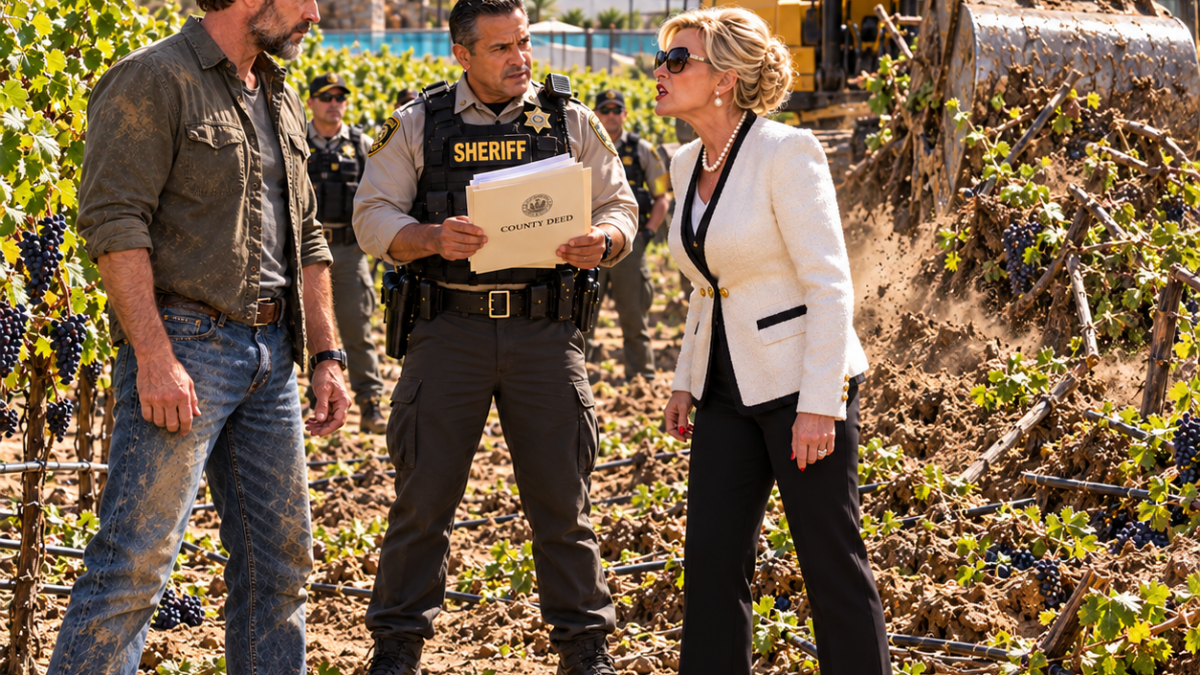
Then Sheriff Martinez arrived.
Two units.
Martinez himself in lead.
I knew him slightly from veterans event.
Never socialized.
He stepped out.
“Morning.”
“Sheriff.”
Constance immediately moved.
“Thank God.”
Wrong assumption.
She handed him notices.
“Mr. Tatum is obstructing authorized HOA restoration and required safety access.”
Martinez looked at equipment.
Then me.
“Whose land?”
“Mine.”
Constance:
“HOA-controlled.”
Martinez:
“Who owns deed?”
She hesitated.
“It’s part of Willowbrook.”
I handed my folder.
Deed.
Survey.
Second survey.
Paige’s letter.
County title certification.
Martinez opened.
He read more carefully than I expected.
Then asked deputy to call county recorder.
Constance kept talking.
“The vineyard violates community landscape requirements.”
Martinez raised hand.
“Ma’am, stop for a minute.”
She stopped.
He looked at Jacob’s survey.
Walked twenty feet.
Looked toward clubhouse.
Back to map.
Then:
“Mr. Tatum, where is your north line according to this?”
I pointed.
“Through that wall corner.”
Martinez stared.
“Clubhouse?”
“Yes.”
Constance laughed.
Actually laughed.
“That is absurd.”
Martinez looked at her.
“Why?”
“Because clubhouse has been there twenty-five years.”
He looked again at deed.
“Age doesn’t answer ownership.”
Her smile vanished.
Deputy returned.
“Recorder confirms Parcel 17B description matches.”
Martinez looked toward clubhouse.
Then storage shed.
Then pool deck.
Then Constance.
“Ma’am, why is your clubhouse on his land?”
Silence.
That moment lived on three phones.
Mine.
Deputy bodycam.
One neighbor filming from pool fence.
Constance removed sunglasses.
“That survey is wrong.”
“Two licensed surveys.”
“It can’t be.”
“Maybe.”
Martinez closed folder.
“But until someone resolves it, you’re not sending excavators farther onto disputed parcel.”
She pointed at vines.
“Those are definitely HOA buffer.”
“No.”
Martinez’s voice hardened.
“What I have is a record owner telling you not to enter, two surveys supporting him, and no easement presented by you.”
He turned to contractor.
“Equipment backs out.”
Constance:
“Sheriff, this is an emergency access project.”
“Where’s permit?”
She produced county site approval for clubhouse expansion.
Martinez looked.
“Doesn’t grant property rights.”
“It approves corridor.”
“On site plan.”
“Yes.”
“Site plan is not deed.”
That sentence became neighborhood legend.
Constance tried one last route.
“He is endangering residents.”
“How?”
“Blocking fire access.”
Martinez called fire marshal.
On speaker.
Fire marshal reviewed address.
“No immediate deficiency. Expansion project requires compliant secondary path before occupancy of new addition, but existing clubhouse remains approved under current configuration.”
Not emergency.
Future permit condition.
Exactly.
Martinez said:
“No excavation today.”
Constance looked at me.
Pure hate.
Then said something she would regret.
“You think you’ve won because of a paperwork mistake from 1998?”
I smiled.
“No.”
“But thank you for acknowledging it.”
Her face changed.
She had not meant clubhouse.
But everyone heard.
Excavators withdrew.
The western bucket had stopped inches from Cabernet row.
Hydraulic line dripped.
One drop landed near trellis.
I stared after machines.
Then knelt.
Touched soil.
Elena’s vines still stood.
I cried after everyone left.
Not in front of Constance.
After.
Inside pump shed.
Hands shaking.
Grief does that when threat passes.
You hold until safe.
Then body collects bill.
That afternoon Paige came.
I poured coffee.
She inspected vines.
Then clubhouse.
“Constance knows now.”
“Yes.”
“Good.”
“Good?”
“We were going to tell her.”
“Now sheriff did.”
“Better witness.”
We sent demand letter.
Not eviction.
Not absurd ownership grab.
Notice of title defect and encroachment.
Request immediate meeting.
Preserve records.
No further entry.
No alteration to disputed structures.
No new construction.
Discuss boundary resolution.
HOA lawyer responded within four hours.
Different tone.
Very different.
They requested standstill agreement.
Paige agreed.
No one would disturb vineyard.
I would not interfere with ordinary existing clubhouse/pool use while title investigated.
Smart.
Children did not need losing pool because adults had deed problem.
Then neighbors learned.
Of course.
Stonehaven—
No.
Willowbrook.
Neighborhood group exploded.
CLAIMS CLUBHOUSE IS HIS.
VETERAN TRIES TO SEIZE HOA.
VINEYARD OWNER DEMANDS POOL.
None true.
I posted one statement:
I have not demanded closure of clubhouse or pool. A title issue predating my ownership and the HOA’s ownership has been identified. Attorneys are reviewing it. Please do not harass staff or neighbors.
Done.
Constance posted twelve paragraphs.
Naturally.
She accused me of “weaponizing obsolete records.”
Obsolete records.
Deeds.
Paige framed phrase.
Then discovery.
The HOA’s title insurer got involved.
So did developer successor.
County risk management.
HOA lender because clubhouse property secured a small line of credit.
Suddenly everybody cared where line was.
A forensic title examiner reconstructed history.
The 1998 proposed adjustment was real.
Arthur agreed conditionally.
Developer never paid $72,000.
Why?
Records suggested lender froze discretionary acquisitions during financial trouble.
Yet architect continued with revised clubhouse plan.
Construction manager assumed closing completed.
County plan review accepted developer certification.
Fence built on proposed line.
No one closed land transaction.
Arthur complained twice.
1999 letter:
I have not been paid and no deed has been signed.
2000 letter:
Any structures placed beyond the existing property line remain at developer risk.
There it was.
Developer knew.
Then Arthur died 2003.
Children apparently did not know issue.
The retained parcel changed hands twice.
Broad survey exceptions obscured.
Clubhouse use continued.
Could HOA claim adverse possession or prescriptive rights?
Maybe.
Lawyers argued.
Long occupation.
Open.
Continuous.
But complications:
Initial occupation began with negotiations and conditional permission, undermining hostility for some period.
Developer’s knowledge.
Tax parcels.
Recorded ownership.
Later acknowledgments.
Not simple.
Paige said:
“This will cost everyone money if litigated.”
I agreed.
HOA counsel agreed.
Constance did not.
She wanted fight.
Why?
Because if settlement admitted my title, her entire vineyard campaign looked catastrophic.
And clubhouse expansion stalled.
Her presidency depended on project.
She pushed board to sue me.
Board vote:
3–2.
Sandra Lopez voted no.
Another member, Henry Bell, no.
Constance yes.
Two allies yes.
Lawsuit filed.
Quiet title.
Declaratory judgment.
Claim of adverse possession.
Easement by implication.
Equitable rights.
We counterclaimed.
Trespass.
Vineyard interference.
Gate and irrigation disturbances.
Declaratory title.
Encroachment.
Not immediate demolition.
I explicitly told Paige:
“I do not want clubhouse torn down.”
She said:
“Good.”
“Can we still use leverage?”
“Yes.”
“Very.”
Then audit revealed why Constance wanted expansion so badly.
Clubhouse contract included performance bonus to project-management consultant.
Consultant:
Whitfield Community Development Advisors LLC.
Owned by Constance’s husband.
Not Constance directly.
Still related.
Board packet disclosed “affiliated local project advisor.”
Did residents understand?
No.
Fee potential:
$96,000 if project completed before year-end.
Constance claimed full disclosure.
Sandra said board never saw beneficial ownership clearly.
That changed politics.
Then excavation contractor produced email.
Constance wrote:
Tatum’s vines need to be cleared before title issue becomes another excuse for delay.
Another:
If we physically restore corridor before Monday, we strengthen the Association’s position that area has always functioned as common buffer.
That line mattered.
She wanted facts on ground before title dispute matured.
Another:
Do not let him turn sentimental vineyard story into ownership argument.
Sentimental vineyard story.
I read that alone in workshop.
Elena’s ashes between rows.
Twenty-seven years.
Sentimental story.
I nearly drove to clubhouse.
Did not.
Instead sent to Paige.
Three words:
Use this carefully.
She did.
At deposition.
“Mrs. Whitfield, what did you mean by physically restoring corridor?”
“Removing unapproved landscaping.”
“Before title issue?”
“Yes.”
“Why would removal strengthen HOA ownership position?”
“It would restore historic condition.”
“Did you know Mr. Tatum claimed ownership?”
“He always claimed things.”
“Did you know he provided deed?”
“Yes.”
“Did counsel tell you title was unresolved?”
She hesitated.
“Yes.”
“And you sent excavators anyway?”
“Under approved site plan.”
“Did site plan grant ownership?”
“No.”
There it was.
Then:
“Were you aware his wife’s ashes had been scattered in vineyard?”
Long pause.
“I learned shortly before work.”
“Before excavators?”
“Yes.”
That hurt.
Not legally most important.
Humanly.
She knew.
Still.
But deposition continued.
No drama.
Facts.
The board recall petition started that week.
Again, not me.
Sandra.
She resigned board first.
Then circulated.
Residents were less upset about vines than conflict-of-interest money.
Always.
Special meeting.
Constance defended.
“This is about protecting community assets from opportunistic private claims.”
I sat back row.
No speaking.
Sandra stood.
Held survey.
“Constance sent excavators onto land after counsel knew title was disputed.”
Constance:
“Because our permits—”
“Permits don’t convey title.”
Sheriff’s sentence had spread.
Then Henry:
“Did your husband’s LLC have completion bonus?”
“Yes.”
“Did you vote on actions advancing project?”
“I disclosed affiliation.”
“Did you leave room?”
“No.”
“Did you recuse?”
“On contract approval.”
“Not on enforcement against Marcus.”
Silence.
Then Mrs. Park, eighty-two, lived there from beginning.
She stood with cane.
“I remember Arthur Kline.”
Everyone quiet.
“He used to complain clubhouse was too far south.”
That was new.
She continued.
“He came to pool opening angry.”
“Developer told us boundary would be fixed.”
Her son found photo later.
Arthur at chain-link fence.
Handwritten date.
History waking.
Recall passed seventy-eight percent.
Constance removed.
Her husband’s LLC contract terminated for convenience.
Expansion paused.
The excavator never returned.
New interim president Sandra called me next morning.
“I’m sorry.”
“I know.”
“No, I mean institutionally.”
“Okay.”
“We failed.”
“Yes.”
She sighed.
“You could make this very expensive.”
“Yes.”
“What do you want?”
I looked at vines.
“Peace.”
“That sounds cheap.”
“It isn’t.”
We began settlement.
Hard negotiation.
Because clubhouse encroachment had value.
My land mattered.
HOA needed certainty.
I needed vineyard protected.
Final arrangement took eleven months.
Not revenge.
Exchange.
HOA purchased specific encroached strip under clubhouse, pool deck, storage, and necessary setback.
Independent appraisal.
Plus premium for title risk.
Not outrageous.
Fair.
I retained vineyard acreage.
Recorded permanent conservation/no-HOA-control covenant on it.
No association landscaping authority.
No architectural jurisdiction over agricultural improvements within defined parcel.
HOA received narrow emergency utility easement around clubhouse utilities.
No general access.
Boundary monumented.
Fence moved.
Storage shed partially relocated because it blocked irrigation.
Clubhouse stayed.
Pool stayed.
Kids swam.
No kingdom seized.
Purchase proceeds?
I used part to establish Elena Tatum Memorial Agricultural Scholarship at local community college.
Viticulture.
Horticulture.
Water management.
Small.
Annual.
Elena would have loved that more than another monument.
The rest paid mortgage and vineyard improvements.
Then something unexpected.
The settlement required HOA to reimburse vineyard damage.
But excavator never touched vines.
Minor irrigation line crushed by staging.
So damages limited.
Good.
I did not want windfall.
I wanted them alive.
First harvest after settlement produced enough grapes for small batch.
Not commercially good.
Too hot.
Pinot struggled.
Cabernet decent.
I made sixty-two bottles with help from local winemaker.
Label:
ELENA — ROW ONE
Ugly label.
Perfect.
I gave bottle to Sheriff Martinez.
He laughed.
“I don’t drink wine.”
“Then cook with it.”
“You’re telling me it’s bad?”
“Yes.”
Honesty.
Sandra got one.
Paige got two because lawyers consume resources.
Jacob surveyor got one.
Excavator operator?
His name was Eli Romero.
I gave him one too.
Why?
He stopped machine.
When Constance told him proceed, he paused.
That choice mattered.
He came to vineyard months later.
“I almost hit those vines.”
“But you didn’t.”
“I should’ve verified.”
“Yes.”
He looked down row.
“I’ve thought about it.”
“Good.”
Not cruel.
Professional.
He said:
“My boss changed policy. We don’t enter disputed residential land without owner authorization now.”
Progress.
I gave bottle.
“What’s this?”
“Bad wine.”
He smiled.
“I’ll save it.”
“No.”
“Drink it before it becomes worse.”
He laughed.
Constance faced no criminal prosecution for excavator incident.
People expected.
No.
It was primarily civil/property dispute.
Her financial disclosures led to separate HOA governance and civil claims.
The husband’s consulting contract settlement involved repayment of certain unearned fees.
No prison.
No sirens.
Consequences:
Recall.
Lost position.
Civil settlement.
Attorney fees.
Reputation.
Project role ended.
She sold house eighteen months later.
Before leaving, she sent letter.
Typed.
Marcus,
I did not understand your vineyard when this began.
I saw unauthorized use of land I believed belonged to the association and treated your resistance as obstruction.
By the time evidence challenged that belief, I had invested too much of my identity in being right.
That does not excuse sending equipment forward when title was unresolved.
I am sorry.
I also regret the way I spoke about Elena’s memorial.
Constance
I read it three times.
The last sentence mattered.
I wrote back:
Thank you.
Nothing more.
Some apologies close doors.
They do not reopen relationship.
Fine.
Willowbrook changed.
New board became boring.
Bless them.
The expansion resumed two years later with revised design.
No vineyard corridor.
They built retaining wall.
Cost more.
Safe.
Legal.
Clubhouse fitness center opened.
I use it sometimes.
That surprises people.
“You sued HOA and still use gym?”
“I pay dues for services that actually apply.”
Remember, house portion remained member for roads/gate/common amenities under 2004 agreement.
The land governance split stayed weird.
But clear now.
At gym, old men ask about vineyard.
I give pruning advice despite none asked.
Normal.
Sandra eventually stepped down.
Henry became president.
His biggest scandal:
Choosing wrong shade of pool umbrella.
Residents fought three meetings.
I attended one.
Sat back.
Smiled.
Healthy institution.
Arguments about umbrellas mean nobody is sending excavators into ashes.
The vineyard matured.
Desert viticulture is hard.
Heat.
Sunburn.
Water.
Monsoon humidity at wrong time.
Birds.
Javelina once broke fence.
But vines adapted.
Cabernet became respectable.
Pinot less.
I replaced some with Tempranillo.
Elena would accuse betrayal.
I talk to her sometimes among rows.
Not because I think ghosts answer.
Because marriage leaves conversational habits.
“Elena, your Pinot is dramatic.”
Wind.
No answer.
“Just like you.”
More wind.
Probably agreement.
Three years after settlement, scholarship recipient came.
Young woman named Marisol Vega.
First-generation college student.
Studying irrigation technology.
She wanted to see vineyard.
I showed drip lines.
Soil sensor.
Shade cloth.
She asked:
“Why scholarship in your wife’s name?”
I told story.
Not HOA version.
Just Elena.
Dream.
Cancer.
Vines.
She listened.
Then said:
“So this place is a memorial.”
“Yes.”
“I thought memorials were statues.”
“Some are work.”
She touched leaf.
“That’s better.”
I nearly cried.
Again.
Grief never retires.
It just becomes less bossy.
Sheriff Martinez retired eventually.
At his retirement barbecue, he introduced me to wife:
“This is the guy who almost owned an HOA swimming pool.”
I corrected.
“Twenty-two percent deck.”
He laughed.
Precision.
He told story about opening deed folder.
People loved:
“Why is clubhouse on his land?”
Good line.
But real discovery did not happen in one magical sheriff moment.
The folder raised issue.
Surveys confirmed.
Title exam proved.
Letters showed history.
Lawyers negotiated.
Stories compress.
Fine.
Just keep core honest.
I did not suddenly own “half kingdom.”
I owned strip everyone had forgotten belonged to retained parcel.
Enough to matter.
Enough to expose arrogance.
That is what I learned.
Property disputes often live in assumptions.
Fence must be boundary.
Clubhouse must be on HOA land.
Old map must be right.
Address must mean full covenant.
Twenty-five years must mean ownership.
Maybe.
Maybe not.
Check.
Combat engineering taught me ground truth matters more than map annotation when bullets fly.
Civilian property taught similar lesson:
Recorded truth matters more than landscaping.
Constance thought physical occupation proved control.
Clubhouse.
Pool deck.
Shed.
Fence.
People used them decades.
Therefore theirs.
But physical confidence can be built on paperwork crack.
Same with vineyard.
She saw it inside development.
Therefore HOA-controlled.
Wrong.
Structures lie when foundation assumption wrong.
That was the crack.
One missing deed.
One unpaid $72,000 acquisition.
One fence installed to proposed line.
One developer who built anyway.
Then twenty-five years of people trusting appearance.
That is how institutional myths form.
Nobody wakes up deciding to steal land.
Somebody assumes closing happened.
Next person assumes survey matches fence.
Next board assumes common tract includes structures.
Next president receives map.
Then says:
Of course this is ours.
Until someone opens recorder.
I do not call every prior board corrupt.
They inherited mistake.
Constance’s wrongdoing was continuing after warning.
That distinction matters.
Ignorance is one thing.
Persistence after contradiction is another.
When Paige showed her title issue, she had off-ramp.
Pause.
Survey.
Negotiate.
Instead she accelerated excavator.
Why?
Project deadline.
Money.
Ego.
Probably all.
Power becomes dangerous when admitting uncertainty feels like weakness.
Marine Corps taught opposite.
If terrain report conflicts with what you see, stop.
Reassess.
Nobody awards medal for confidently driving into washout.
Leadership is not certainty.
It is willingness to update before consequences.
Constance never learned until bucket inches from vines.
Maybe afterward.
I hope.
My vineyard now covers just under two acres.
Rows straight.
Trellis taller.
I added small stone marker near first Cabernet row.
Not grave.
Elena’s name.
Dates.
And one line:
WE WERE GOING TO MAKE TERRIBLE WINE TOGETHER.
People laugh.
Good.
She would.
Every harvest, friends come.
We pick.
Eat.
Argue.
I cook.
Badly.
We drink last year’s wine.
Better now.
No one pretends Napa.
That was never point.
One bottle from first batch sits unopened.
On shelf beside Elena’s photograph.
I will not drink it.
Probably vinegar by now.
Does not matter.
Some things can be useless and priceless simultaneously.
HOAs struggle with that concept.
So do men.
The excavator incident became less central with years.
Good.
For a while vineyard felt like battlefield.
Cameras.
Lawyers.
Notices.
I checked road every morning.
I hated Constance more than I tended vines.
That was dangerous.
Because then she still controlled place.
Therapist told me:
“You built vineyard for Elena, but you are maintaining it for Constance.”
I hated sentence.
Which means true.
So I changed rituals.
No checking HOA email before sunrise.
First hour:
Vines.
Coffee.
Gideon—
No dog in this story.
I did eventually adopt dog.
A shepherd mix named Rosie.
Terrible with irrigation hoses.
She comes down rows.
First hour belongs life.
Then disputes.
Eventually disputes ended.
Vineyard became Elena’s again.
That mattered more than settlement.
People ask whether I would have forced HOA to tear clubhouse down if they refused fair deal.
I don’t know.
Legally maybe options.
Emotionally no desire.
Destroying community building would not bring Elena back.
It would turn my grief into somebody else’s inconvenience.
Land rights are leverage.
Not obligation to maximize pain.
We found practical solution.
HOA bought what it had used.
I protected what mattered.
Boundaries corrected.
Everyone moved.
That is adult victory.
Less satisfying than bulldozer revenge.
Better to live beside afterward.
One morning a new resident stopped fence.
“Are those wine grapes?”
“Yes.”
“Can I buy bottle?”
“Not licensed retail.”
“Oh.”
“Maybe charity harvest later.”
She nodded.
Then:
“I heard HOA tried bulldozing them.”
“Almost.”
“Why?”
“Long story.”
She looked clubhouse.
“And you own that?”
“No.”
“Someone said—”
“HOA owns it now.”
“Did you?”
“For a weird eleven months, part of dirt under it.”
She stared.
I laughed.
Rumors are faster than deeds.
I showed boundary marker.
“This is line now.”
She said:
“Seems simple.”
“It is now.”
That is success.
Simple now.
Marker.
Recorded deed.
Recorded settlement.
No ambiguity.
The best ending to property war is boring clarity.
I am sixty now.
Not fifty-four.
Back aches.
Vines unforgiving.
Marisol sometimes helps.
She graduated.
Works for irrigation firm.
Scholarship continues.
HOA contributes now voluntarily.
That was Sandra’s idea.
Five hundred dollars annually.
No strings.
Recorded resolution states contribution creates no property rights.
Paige insisted.
We all laughed.
Trauma makes excellent boilerplate.
Clubhouse deck was resurfaced last year.
Contractor called me.
“Just checking boundary before staging.”
I nearly hugged him.
“Thank you.”
“HOA said call.”
Progress.
No excavator enters vineyard.
No one calls vines violation.
Children sometimes tour.
I teach drip irrigation.
One boy asked:
“Are your wife’s ashes under all these?”
His mother looked horrified.
I said:
“Some.”
He thought.
“Does that help grapes?”
I smiled.
“Not scientifically.”
He nodded.
Kids.
Then:
“So she’s part of farm?”
“Yes.”
“That’s cool.”
His mother apologized.
I told her not to.
He understood memorial better than adults.
Elena is not vineyard.
But vineyard is something grief taught me to keep alive.
Constance nearly crushed that because she thought jurisdiction was bigger than memory, deed, and consent.
The sheriff’s question became headline.
WHY IS YOUR CLUBHOUSE ON HIS LAND?
Funny.
But better question:
Why did nobody check?
That haunts me more.
Developer.
County.
HOA.
Title companies.
Owners.
Me.
I bought parcel and accepted broad survey exception instead of boundary survey at closing because house price good and structures looked settled.
I could have discovered earlier.
Would it have changed anything?
Maybe.
Maybe not.
I do not blame myself for developer mistake.
But I learned.
Survey matters.
Not fence.
Not lawn.
Not wall.
Survey.
My Marine buddies laugh.
“Combat engineer gets surprised by boundary?”
Yes.
Humility.
I was trained for bridges, obstacles, demolition.
Not suburban title ghosts.
Different battlefield.
Same principle:
Trust, then verify terrain.
If I could speak to man buying property after Elena died, I would tell:
Get full ALTA-style survey.
Read exceptions.
Ask what odd L means.
Do not assume clubhouse fence is line.
And plant vineyard anyway.
Definitely that.
Because despite Constance, lawsuits, excavators, ashes, sleepless nights—
the vines were worth it.
They did what I needed.
They made tomorrow require something from me.
Grief hates that at first.
Then depends on it.
A vine does not care whether you want to get out of bed.
Bud break happens.
Heat arrives.
Water needed.
Harvest comes.
Life is rude that way.
It keeps scheduling itself.
Elena would laugh if she knew HOA paid fair-market value for land partly under pool.
She always said:
“If you’re going to be emotionally unavailable, at least be financially useful.”
I can hear her.
I used some settlement money to build shaded pergola at end first row.
Her blue scarf is framed inside house, not outside.
On pergola post, small brass plate:
ELENA’S ROW.
No HOA approval requested.
Not required.
That gives me unreasonable satisfaction.
One evening Constance’s replacement, Henry Bell, came for harvest.
He brought wife.
Picked grapes badly.
Crushed several.
I mocked.
He said:
“You know, six years ago board would have sent violation for this event.”
“Good thing you’re learning.”
He looked toward clubhouse.
“Sometimes I think about how close we came.”
“To what?”
“Turning every neighbor into enemy.”
I understood.
Institutions do that when authority becomes identity.
You stop seeing Marcus.
See noncompliant parcel.
Stop seeing Elena.
See unapproved landscaping.
Stop seeing vineyard.
See buffer obstruction.
Words flatten human cost.
I spent career in Marines.
We did same sometimes.
Mission language protects you from feeling everything.
Necessary occasionally.
Dangerous if permanent.
Constance lived inside mission language.
Community standards.
Restoration corridor.
Safety access.
Modernization.
Each phrase made it easier not to see ashes in soil.
That does not mean policy is wrong.
It means language must never replace facts.
Good leaders keep both.
The rule.
And the person under it.
I wish I had known that younger.
Elena did.
She once told me after argument:
“You keep explaining why you’re right like it cancels how you made me feel.”
Twenty years of marriage and she still had to teach combat engineer basic load distribution.
A relationship collapses too if one support carries everything.
I learned late.
Maybe vineyard was my apology.
Not to ghost.
To myself.
Build something softer.
I still have Constance’s first violation notice.
UNAPPROVED AGRICULTURAL INSTALLATION.
Framed in workshop beside survey showing clubhouse encroachment.
Visitors laugh.
I tell them:
“Never underestimate agricultural installation.”
The excavator photo also exists.
Bucket inches from Cabernet.
Dawn light.
Constance in white.
Sheriff truck behind.
It looks staged.
Wasn’t.
I do not display publicly.
Too close.
Some memories can become stories without becoming decor.
Rosie sleeps under workbench.
Sprinkler leaks sometimes.
Pool kids scream over fence summers.
Clubhouse music Fridays.
Vines rustle.
Elena’s rows alive.
No boom.
No dust.
No demolition.
That is how I measure victory now.
By things that did not happen.
Bucket did not drop.
Vines did not fall.
Clubhouse did not get torn down.
Children did not lose pool.
Neighbors did not spend decade in court.
I did not turn grief into weapon.
The strongest thing I ever built as combat engineer might be outcome where nobody destroyed anything.
Funny.
Constance thought power was excavator.
I thought power was crack.
Now?
I think power is knowing when not to use either.
The county deed exposed crack.
Survey showed truth.
Sheriff stopped machine.
Lawyers drew new line.
Neighbors changed board.
We chose repair.
That is harder than destruction.
Any fool can swing bucket.
It takes more discipline to stop it inches before something living.








