HOA Karen Sent Bulldozers to Destroy My 80-Year-Old Family Barn and Ranch—Then Three Federal SUVs Arrived and Officers Discovered Something Beneath the Wreckage. What Happened Next Left Her Terrified.
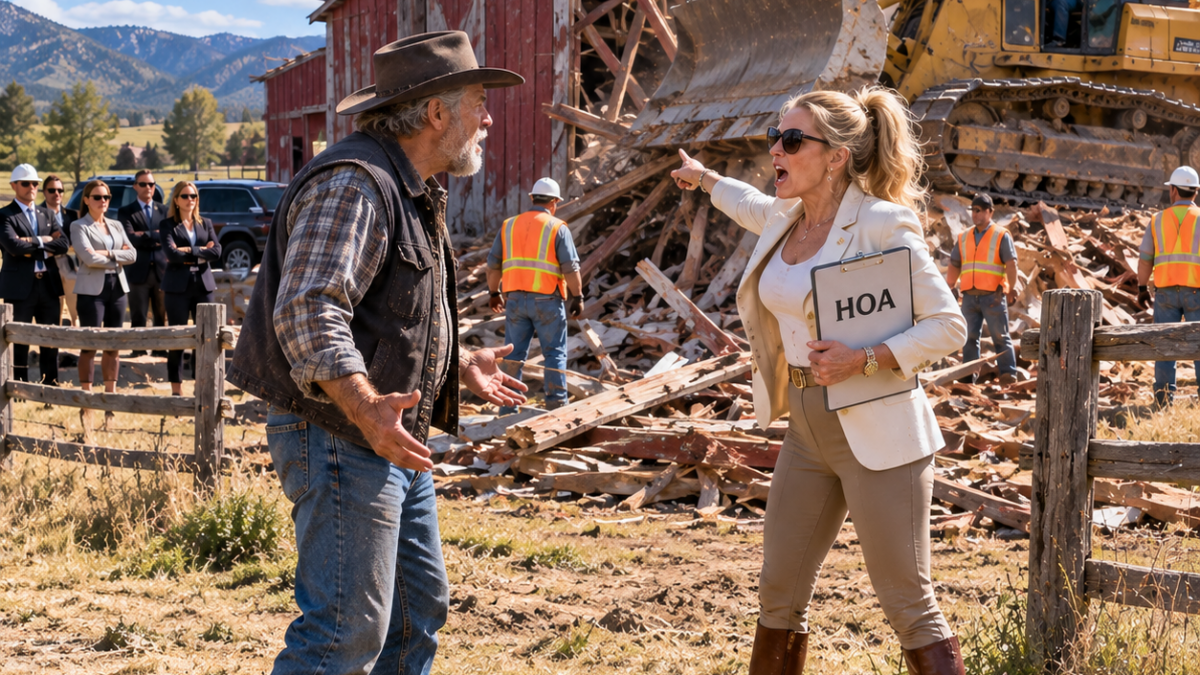
PART2:
And by the time she finally understood it, fifty-eight acres of federal property had already been damaged, my barn was gone, and investigators had started asking why a wildfire-safety project seemed strangely interested in reaching a road that could save Brenda’s husband’s development company nearly three million dollars.
Brenda Whitmore became president of Canyon Ridge about eighteen months before the bulldozers appeared.
She was one of those people who looked as if she had never accidentally worn the wrong shoes for any occasion.
Straight posture.
Perfectly styled hair.
Expensive jackets.
Leather folders.
Clean boots even when she came to my ranch.
The first letter from her administration arrived on a Tuesday afternoon.
CANYON RIDGE VISUAL QUALITY NOTICE.
I read the heading twice.
Then the first paragraph.
Then laughed.
The violation involved cows.
I called the HOA office.
Brenda answered.
“Canyon Ridge Estates.”
“Brenda?”
“Yes?”
“Henry Lawson.”
PART3:
Her voice changed immediately.
“Hello, Henry.”
“You sent me a violation notice about livestock.”
“Not exactly.”
“It says livestock visible from Canyon Ridge homes creates an inconsistent residential landscape.”
“That is one of the concerns.”
I looked through the kitchen window.
Twenty-three cows stood beside a fence chewing grass.
They looked unconcerned about residential consistency.
“My ranch existed before your houses.”
“We understand that.”
“Then why are we talking?”
“Canyon Ridge has architectural and visual standards.”
“Wonderful.”
“And?”
“Several homeowners have raised concerns that commercial agricultural activity affects property values.”
“My cows affect their property values?”
“There are broader issues.”
“Brenda, my property isn’t in Canyon Ridge.”
Silence.
“I understand that.”
“Then your HOA rules don’t apply to me.”
“Our governing documents include provisions relating to neighboring nuisance conditions.”
I actually lowered the phone and stared at it.
Then put it back.
“Your HOA thinks it can issue violations to people who aren’t members?”
“This isn’t about technical jurisdiction, Henry.”
Those five words told me everything I needed to know about Brenda.
“It is exactly about jurisdiction.”
“You don’t need to be hostile.”
“I’m not hostile.”
“I’m confused.”
“You sent a rancher a letter complaining that his cows are visible from houses built beside his ranch.”
“We are trying to protect the character of Canyon Ridge.”
“So am I.”
“What does that mean?”
“It means you’re going to keep seeing cows.”
I hung up.
I thought that was the end of it.
Three weeks later came the second letter.
This one concerned the western barn.
It described the structure as a “deteriorated outbuilding presenting visual blight and elevated wildfire fuel risk adjacent to a residential community.”
Attached were photographs.
Somebody had stood near my fence and taken them with a telephoto lens.
I recognized the angle.
The photos came from Canyon Ridge’s western walking trail.
The barn sat roughly two hundred yards from the subdivision boundary.
Between it and Canyon Ridge were irrigated pasture, gravel, and a creek corridor.
Calling it an immediate wildfire threat required imagination.
I called Brenda again.
“You photographing my barn now?”
“We document safety concerns.”
“From two hundred yards away?”
“The roof shows visible deterioration.”
“The roof doesn’t burn.”
“The surrounding vegetation does.”
“The surrounding vegetation is grazed pasture.”
“Henry, wildfire science has evolved considerably.”
“So has trespass law.”
“Nobody trespassed.”
“Good.”
“Let’s keep it that way.”
She went quiet.
Then:
“You could remove the structure voluntarily.”
I laughed.
That was my mistake.
Brenda heard laughter as disrespect.
Some people should not be given authority if disrespect causes them physical pain.
“The barn stays.”
“Then we may need to involve other agencies.”
“Please do.”
I meant it.
That was mistake number two.
Two days later, Ada County Fire Marshal’s office called.
A courteous inspector named Neil Hastings asked if he could look at the western side of the ranch after receiving a wildfire hazard complaint.
“Absolutely.”
He arrived Friday morning.
We walked the property.
Neil looked at the barn.
Looked at the grazed pasture.
Looked at Prairie Creek.
Then at me.
“Where’s the hazard?”
“Apparently the barn has offended civilization.”
He laughed.
His inspection noted a few ordinary recommendations.
Clear dried weeds around one equipment shed.
Move stacked lumber farther from a fuel tank.
Replace a cracked electrical box.
Nothing requiring demolition.
Nothing approaching emergency status.
He wrote:
No immediate wildfire hazard requiring abatement was observed at the western barn or adjacent pasture.
I emailed Brenda the report.
Her response came six minutes later.
County assessment does not resolve private community risk concerns.
That sentence sat in my inbox like a small warning flare.
She was not looking for an answer.
She was looking for permission.
There is a difference.
Canyon Ridge had been built in stages.
The original subdivision sat northeast of my ranch.
Nice homes.
Curving streets.
Large lots.
The final row backed toward Lawson land.
For years, the developer had discussed a Phase II expansion beyond the eastern ridge.
That project stalled because the only practical road connection required either a costly bridge over Prairie Creek or a long detour around a steep drainage corridor.
The original developer eventually gave up.
Then Brenda’s husband entered the picture.
His name was Grant Whitmore.
Fifty-eight.
Former civil engineer.
Now president of Whitmore Development Group.
Grant had built shopping centers, medical-office parks, and suburban housing across southern Idaho.
Smooth man.
Soft voice.
Always looked slightly amused.
He had bought the dormant Phase II option through a subsidiary called RidgeLine Communities.
Most Canyon Ridge residents didn’t know that.
I didn’t either.
Not yet.
The first time Grant approached me, he did not mention development.
He showed up in a silver pickup one Saturday morning while I was repairing irrigation pipe.
“Henry Lawson?”
“Depends.”
He smiled.
“Grant Whitmore.”
“I know.”
“Brenda’s husband.”
“Also know.”
He looked across the pasture.
“Beautiful ground.”
“Usually prettier when I’m not standing in mud.”
He laughed.
Then he started with friendliness.
How long had my family owned the ranch?
Did my children plan to keep it?
Was cattle still profitable?
Had I considered conservation easements?
Was I interested in selling any western acreage?
“No.”
“You didn’t ask price.”
“Didn’t need to.”
“Everything has a number.”
“My daughter once sold my best saddle at a garage sale for thirty dollars.”
“That doesn’t mean it was worth thirty.”
Grant smiled.
“Fair point.”
Then he pointed toward an old two-track road running west from the barn.
“That ranch road still connect to County Route 44?”
“Eventually.”
“How wide?”
“Depends where.”
“Vehicle-capable?”
“For ranch vehicles.”
“Emergency vehicles?”
“What are you really asking?”
Grant put both hands in his jacket pockets.
“Canyon Ridge has evacuation concerns.”
“No, it doesn’t.”
His eyebrows lifted.
“Fire marshal inspected.”
“I heard.”
“Then you know.”
“A community can plan beyond minimum requirements.”
“Through my land?”
“Potentially through an easement.”
“There isn’t one.”
“Could be.”
“No.”
“Henry.”
“Grant.”
He smiled again.
“I’ll make you a serious offer.”
“No.”
“You don’t even know what for.”
“The answer’s still no.”
His smile finally disappeared.
“I’d like a fifty-foot emergency-access easement from Canyon Ridge, along the western pasture, connecting into County Route 44.”
“That crosses my barnyard.”
“We can relocate structures.”
“We?”
“Obviously at our cost.”
“No.”
He looked toward the barn.
“You’re emotionally attached.”
“Yes.”
“I respect that.”
“No, you don’t.”
Grant’s mouth tightened.
“You’re sixty-one.”
“Last I checked.”
“Ranching is difficult.”
“So is listening, apparently.”
He left.
The following Monday, Brenda sent an HOA letter proposing an “intercommunity wildfire evacuation corridor.”
Now the pieces began touching.
I drove to the county recorder’s office.
Old habit.
My father trusted people.
My grandfather trusted fences.
I trusted documents.
Lawson Ranch had a complicated western boundary because of Prairie Creek.
In 1962, the federal government acquired a fifty-eight-acre conservation strip along part of the creek under a watershed-restoration program.
The United States retained title.
My grandfather negotiated grazing and maintenance privileges over portions of it.
The strip looked like ranch land because for sixty years we had managed it beside our own pasture.
But it wasn’t ours.
It belonged to the federal government.
Specifically, title was administered through the Department of the Interior.
There were survey monuments along the boundary.
Small brass disks set in concrete.
Most were half buried.
I knew where they were because my father showed me when I was twelve.
“Never move these.”
“Why?”
“Because men with badges care more about these little circles than they care about most barns.”
As a boy, I thought he was joking.
He wasn’t.
The old ranch road Grant wanted followed my side of the federal tract before crossing it near the creek and reaching County Route 44.
That crossing was the problem.
No legal public road existed.
No HOA easement.
No development easement.
No emergency road.
Nothing.
I emailed Grant:
The route you described crosses privately owned Lawson Ranch and federally owned land. No access easement exists. Do not enter either property.
He replied:
Understood. We are only exploring safety alternatives.
Three days later Brenda called an HOA meeting.
Carlos Mendez, one of the Canyon Ridge homeowners who bought beef from me, called afterward.
“You need to know something.”
“What?”
“Brenda is telling people you blocked an emergency evacuation route.”
“There is no route.”
“I know.”
“She showed a map.”
“What map?”
“Looked official.”
“What did it show?”
“A road from our western loop through your pasture.”
“Did it cross Prairie Creek?”
“Yeah.”
“What was it labeled?”
He hesitated.
“Historic fire access.”
I closed my eyes.
There had never been a historic fire road there.
Not public.
Not HOA.
Not county.
My grandfather’s cattle track, maybe.
But a ranch track does not become a public emergency route because somebody chooses a confident font.
“Send me a picture.”
Carlos did.
The map carried the Canyon Ridge logo.
A red line crossed my pasture.
Then the federal strip.
Then County Route 44.
In the corner:
PROPOSED EMERGENCY ACCESS RESTORATION
Restoration.
That word mattered.
You restore something that once existed.
I requested the source.
Brenda refused.
“Internal planning document.”
I contacted the county.
No approval.
Fire marshal.
No request.
Sheriff.
No emergency designation.
Department of Interior field office.
Nothing.
Then the intimidation started.
Letters to me.
Calls.
A certified demand claiming I was interfering with wildfire evacuation planning.
A notice that Canyon Ridge would seek reimbursement from me for “increased emergency-preparedness costs caused by landowner obstruction.”
I sent each one to my attorney.
Her name was Rebecca Shaw.
Fifty-two.
Boise property litigator.
Grew up on an alfalfa farm.
Did not frighten easily.
Rebecca read Brenda’s letter and said:
“She has no authority over you.”
“I know.”
“She knows?”
“Questionable.”
“She has counsel?”
“HOA uses a firm called Benson Clark.”
Rebecca looked at the letter.
“This isn’t from them.”
“No.”
“Interesting.”
“Why?”
“Because lawyers generally dislike putting nonsense on letterhead.”
We sent a formal cease-and-desist.
No access.
No removal.
No disturbance.
No entry.
We included the county wildfire report.
Private title records.
Federal parcel map.
Photographs of boundary monuments.
Rebecca ended the letter with:
Any entry by Canyon Ridge Estates, its officers, agents, contractors, or affiliates onto Lawson Ranch or adjoining federally owned property without lawful authorization will be treated as trespass and referred to appropriate state and federal authorities.
I thought that was clear.
Brenda responded personally.
The HOA rejects your characterization and reserves all emergency powers available under law.
Rebecca read it.
“Emergency powers?”
“Apparently.”
“She isn’t a government.”
“I noticed.”
“Save everything.”
I did.
November passed.
Snow came.
The issue went quiet.
I made the mistake of assuming quiet meant resolution.
It meant planning.
In February, a survey crew appeared along my east fence.
I drove over.
“Can I help?”
The lead surveyor introduced himself.
Private firm.
Hired by RidgeLine Communities.
“To survey what?”
“Potential corridor.”
“You have permission?”
“We’re staying outside your boundary.”
He showed me the work order.
RidgeLine.
Grant’s company.
Not HOA.
There it was.
“Emergency corridor?”
The surveyor looked uncomfortable.
“That’s what the plan says.”
“Development too?”
He paused.
“I’d talk to the client.”
I did.
Grant called me that afternoon.
“Henry, you’re overreacting.”
“You sent surveyors.”
“Outside your property.”
“For what?”
“Long-term planning.”
“You said wildfire.”
“Uses can overlap.”
And there it was.
First crack.
“What development use?”
“Potential secondary ingress.”
“For Phase II.”
Silence.
“Grant?”
“Nothing is approved.”
“But that’s why you want the road.”
“Partly.”
“How many homes?”
“Preliminary.”
“How many?”
“Approximately one hundred eighty.”
“What does your current route cost?”
Long silence.
“I don’t understand the question.”
“Yes, you do.”
The stalled Phase II plan required constructing a major bridge and improving almost two miles of county roadway.
I checked planning estimates later.
Projected infrastructure premium:
$2.7 to $3.1 million.
If Grant could connect Phase II through Canyon Ridge, across Lawson Ranch, and onto County Route 44, he could avoid most of that.
A “fire road” could become secondary access.
Secondary access could satisfy subdivision requirements.
Then private emergency access could become development infrastructure.
Three million dollars buys a lot of concern about wildfire safety.
I called Rebecca.
“We have motive.”
“For what?”
“Pressure.”
“Not crime.”
“Yet.”
She was right.
That word mattered later.
Yet.
Spring arrived.
Cattle went back to pasture.
Prairie Creek rose with snowmelt.
My daughter Kate came out from Boise every Sunday with her husband and my grandson Eli.
Kate was thirty-four, an elementary-school teacher, stubborn in exactly the same way her grandmother had been.
When I told her what Grant wanted, she said:
“Sell him an easement for thirty million.”
“I’d still have to look at him.”
“Good point.”
My son Luke lived twenty miles south.
He helped with the ranch during branding season.
Both of them worried.
Not about the HOA.
About me.
“You’re sixty-one,” Kate said.
“You keep saying that like I’m ninety.”
“You climbed the windmill last month.”
“Needed fixing.”
“Use Luke.”
“He’s afraid of heights.”
Luke, standing ten feet away, said:
“I am not.”
“You threw up at the grain elevator.”
“I was twelve.”
Family keeps accurate records.
The western barn remained our center.
Branding supplies.
Old tack.
Spare fencing.
Tools.
My father’s workbench.
My grandfather’s initials cut into one support beam:
W.L. 1947.
Kate had once suggested moving the beam if we ever renovated.
I refused.
“Barn dies with the beam.”
She rolled her eyes.
That sentence would hurt later.
The day before the demolition, nothing looked wrong.
That is one thing I remember most.
Monday evening.
Clear sky.
Cattle moving toward water.
Barn shadow across grass.
I locked the western equipment bay at 7:10.
I left my father’s old saddle inside because Eli had been asking to learn to ride.
I had cleaned it that week.
Oiled leather.
Replaced one stirrup strap.
I stood in the barn doorway for a minute.
No reason.
Just habit.
Then drove home.
At 5:42 Tuesday morning, my phone rang.
Ranch hand named Miguel.
He had worked for me nineteen years.
“Henry.”
His voice told me something was wrong.
“What?”
“Equipment.”
“What equipment?”
“Dozers.”
“Where?”
“West pasture.”
I was dressed before the call ended.
By the time I reached the ridge above the barn, there were seven machines.
Two excavators.
Three bulldozers.
A skid steer.
A forestry mulcher.
Contractor pickups.
Men in reflective vests.
Orange stakes.
The west fence had already been cut.
Not opened.
Cut.
Posts pushed down.
A thirty-foot entrance carved through.
I drove my truck straight toward them.
Miguel followed.
Then I saw the barn.
One bulldozer blade was against the west wall.
“STOP!”
I leaned on the horn.
A worker raised both hands.
Dozer paused.
I jumped out.
“Who authorized this?”
Foreman approached.
Forties.
Hard hat.
Vest reading HAWTHORNE SITEWORKS.
“We have work authorization.”
“From who?”
“Canyon Ridge.”
“You’re on Lawson Ranch.”
“We were told corridor rights had been secured.”
“By who?”
“Client.”
“Shut everything down.”
He looked toward another pickup.
Brenda stepped out.
White SUV.
Clean boots.
Leather folder.
Of course.
“Henry.”
I stared at her.
“What are you doing?”
“Please don’t create a dangerous scene.”
That sentence almost broke something in me.
“Get every machine off my property.”
“This is an emergency fuels-mitigation action.”
“No.”
“The board issued final notice.”
“Your board doesn’t own this.”
“Henry—”
I pointed at the barn.
“Touch that building again and I call the sheriff.”
Brenda opened her folder.
She actually had paperwork ready.
“Canyon Ridge declared the corridor an imminent wildfire threat last night.”
“Your HOA?”
“Yes.”
“Declared an emergency on my ranch?”
“Under counsel’s advice.”
“Whose counsel?”
She ignored that.
“The corridor creates a critical evacuation bottleneck. Our contractor is removing hazardous structures and vegetation within the historic access alignment.”
“There is no historic access alignment.”
“Records differ.”
“No.”
She held out a page.
A map.
Same red line.
Now stamped:
CANYON RIDGE EMERGENCY ACCESS RESOLUTION 24-17
“Your resolution doesn’t create ownership.”
“It authorizes emergency action.”
“On your land.”
“Not mine.”
Brenda’s face hardened.
“We have spent months trying to work with you.”
“No.”
“You’ve spent months trying to take something I won’t give you.”
I called the sheriff.
Then Rebecca.
Then a third number.
The Department of Interior field office.
Because one excavator was already beyond my boundary.
Near the creek.
Near the brass monument my father had shown me.
A bulldozer had pushed a temporary crossing over a drainage swale.
The federal strip.
I gave the dispatcher the parcel number.
Said heavy equipment had entered federal property without authorization.
That changed things.
The sheriff’s office said deputies were coming.
Federal field office said stay clear of equipment.
Document.
Do not interfere physically.
I started recording.
Brenda saw.
“Henry, filming doesn’t change the resolution.”
“No.”
“It preserves evidence.”
Her face changed.
The contractor foreman returned.
“I need confirmation.”
“You have it.”
Brenda answered before me.
“Continue.”
I looked at him.
“If you continue after I’ve personally told you you’re on private property without permission, that’s on you.”
He froze.
Brenda snapped:
“Mr. Hawthorne, your contract indemnifies you.”
He looked between us.
“Mrs. Whitmore, we were told this was HOA-controlled corridor land.”
“It is subject to community access.”
“That is not the same thing.”
Good.
At least one adult understood words.
The foreman raised his radio.
“Stand down.”
For roughly ninety seconds, everything stopped.
Then Grant Whitmore’s truck entered.
I had never been happier to see a man prove my suspicions.
He stepped out.
“What is going on?”
Brenda moved toward him.
“Contractor stopped.”
Grant looked at the foreman.
“You have authorization.”
“Mr. Lawson disputes site control.”
Grant turned to me.
“This has been researched.”
“Show me the easement.”
“Not now.”
“Then leave.”
“You’re obstructing emergency work.”
I walked closer.
“Grant, I’ll ask you once.”
“What development does this road serve?”
Brenda said:
“Don’t engage.”
Grant looked at her.
That told me enough.
Then he made the mistake.
“This isn’t about development.”
I held up my phone.
“Great.”
“Say it again.”
He saw the recording.
His jaw tightened.
“Henry.”
“Say RidgeLine has no financial interest in this corridor.”
Silence.
“Say Phase II doesn’t benefit.”
Brenda interrupted.
“This is harassment.”
I ignored her.
“Say it, Grant.”
He didn’t.
Behind us, machinery idled.
Then something happened I still replay.
One dozer operator apparently did not receive the stand-down clearly.
Or did receive another radio instruction.
His machine moved.
Blade pushed against the western barn.
The old wall buckled.
I heard timber crack.
Not a dramatic movie sound.
Sharp.
Dry.
Final.
I turned.
“STOP!”
The dozer kept moving.
One support post snapped.
Roofline folded.
Metal screamed.
Miguel ran forward.
I grabbed his arm.
“No!”
We could not stop a thirty-ton machine with anger.
The west half of the barn collapsed.
Dust.
Red boards.
Roofing.
My father’s workbench disappeared beneath a beam.
The eastern addition leaned.
Then fell after it.
Less than ten minutes from standing to gone.
I didn’t scream.
Didn’t threaten.
Didn’t hit anyone.
I just stood there.
Sometimes rage gets so large it becomes quiet.
Brenda approached carefully.
“Henry.”
I looked at her.
She gestured toward the ruins.
“I know this is emotional.”
That word.
Emotional.
As though eighty years of family history were a sentimental inconvenience beside her administrative judgment.
“But the structure was unsafe.”
I said nothing.
“The HOA will discuss reasonable compensation.”
Still nothing.
“You should be grateful nobody was injured.”
Miguel whispered:
“Don’t.”
I wasn’t sure whether he meant me or himself.
Brenda continued.
“Frankly, this corrected a dangerous fire hazard.”
I looked down at the barn.
My grandfather’s beam.
Somewhere inside.
My father’s saddle.
Workbench.
Old branding irons.
Tools.
History flattened beneath steel tracks.
Then I noticed another machine moving toward the cottonwoods beside Prairie Creek.
“Stop that.”
Grant followed my gaze.
“It’s clearing the corridor.”
“That is federal land.”
Brenda sighed.
“Henry, we’ve reviewed this.”
“No.”
“You reviewed a red line on a map.”
Grant said:
“The federal strip is subject to historical ranch access.”
“My grazing permit.”
“Not yours.”
He looked annoyed.
“Access is access.”
“No.”
I pointed toward the creek.
“You don’t understand federal property law well enough to finish that sentence.”
The forestry mulcher entered the cottonwoods.
Small trees disappeared into churning teeth.
Dust and shredded wood filled the air.
A cottonwood that had probably grown there since my father was a teenager snapped and vanished.
Then we heard sirens.
Two county sheriff units.
Brenda visibly relaxed.
That told me she still thought law enforcement was coming to manage me.
Deputy Aaron Cole stepped out.
I knew him casually.
His kids had been to ranch day.
He saw the barn.
His expression changed.
“Henry.”
“Morning.”
“What happened?”
I pointed.
“They entered without permission.”
Brenda stepped forward.
“Deputy, I’m Brenda Whitmore, president of Canyon Ridge.”
Aaron looked at her.
“I know who you are.”
“We’re conducting an emergency wildfire-access project pursuant to board authority.”
“On his ranch?”
“Within an established access corridor.”
Aaron looked at me.
“Easement?”
“None.”
“Court order?”
“None.”
“County approval?”
“None.”
Brenda said:
“This is a private easement dispute.”
I pointed toward the federal tract.
“It isn’t anymore.”
Aaron followed my finger.
“Federal land?”
“Yes.”
Grant said:
“That classification is disputed.”
I almost laughed.
“No, Grant.”
“The United States deed is not disputed.”
Aaron told every operator to shut down.
This time they did.
Silence fell so suddenly I could hear Prairie Creek.
Thirty minutes later, three black SUVs came through the ranch gate.
No lights.
No sirens.
Government plates.
Men and women in field clothes.
One wore a badge on his belt.
Another carried a hard case and GPS equipment.
The first officer introduced himself.
“Special Agent Daniel Ruiz, Department of the Interior.”
With him:
BLM law-enforcement ranger Sarah Keller.
Federal land survey specialist Mark Jensen.
Grant’s face changed.
Brenda still looked annoyed.
“Why is Interior here?”
Agent Ruiz looked toward the damaged corridor.
“We received a report of unauthorized mechanized entry and vegetation removal on federal property.”
“There appears to be a misunderstanding.”
“Probably.”
His tone said misunderstandings were his profession.
He asked me to show the boundary.
I walked them toward the creek.
Brenda followed.
Grant too.
The contractor stayed near his truck.
The old brass monument sat beside a crushed patch of grass.
Mud covered the disk.
A dozer track passed six inches from it.
Agent Ruiz crouched.
Used a gloved hand to clear dirt.
Then water from a bottle.
Brass appeared.
Stamped letters.
UNITED STATES PROPERTY
Below:
DO NOT DISTURB
Brenda’s face went blank.
Ruiz looked up.
“Who authorized equipment beyond this monument?”
Nobody answered.
He stood.
“Mrs. Whitmore?”
Brenda blinked.
“The HOA relied on historical access documentation.”
“Who provided it?”
“Our planning consultant.”
“Name?”
She looked at Grant.
That look became important later.
Grant answered.
“RidgeLine Communities commissioned preliminary corridor research.”
Ruiz looked at him.
“RidgeLine?”
“My company.”
“Why is a development company commissioning an HOA emergency-access corridor?”
There are moments when an entire story changes genre.
That was one.
Until then, we had a property dispute.
Now a federal investigator had asked the right question.
Grant responded:
“Canyon Ridge and RidgeLine share infrastructure concerns.”
“Financial relationship?”
“Potential future development nearby.”
“How nearby?”
Grant didn’t answer immediately.
Ruiz did not rescue him from silence.
“Approximately adjacent,” Grant finally said.
I almost smiled.
Federal agents apparently don’t accept approximately adjacent.
Ruiz continued.
“How many units?”
“Preliminary.”
“How many?”
“One hundred eighty-two.”
“Would this corridor provide access?”
“Potential emergency connectivity.”
“Would it satisfy any county development requirement?”
Grant’s face tightened.
“Our engineers can answer.”
“Good.”
“Give me their names.”
Brenda interrupted.
“This has nothing to do with what happened today.”
Ruiz looked at her.
“Ma’am, machines hired under your association’s authorization are sitting on United States land after removing vegetation and constructing an unauthorized crossing.”
He pointed toward the ruined barn.
“They also appear to have demolished a private structure before entering federal property.”
“I would avoid deciding what has nothing to do with today.”
Brenda said nothing.
Jensen set up survey equipment.
Within twenty minutes, he confirmed what I already knew.
The contractor had entered federal property in three locations.
Approximately 6.8 acres disturbed that morning.
But the planned clearing corridor extended through the full fifty-eight-acre federal parcel.
Orange stakes had already been installed across much of it.
Some carried ribbons marked:
RIDGELINE PHASE II ACCESS
Agent Ruiz held one ribbon between two fingers.
Then looked at Grant.
Nobody spoke.
Brenda whispered:
“What is that?”
Grant did not answer.
That was the first moment I realized Brenda might not know everything.
She knew plenty.
She had authorized demolition.
She had lied about authority.
But maybe Grant had given her a sanitised version of why.
Ruiz photographed the ribbon.
Then ordered all equipment left in place pending documentation.
The contractor foreman looked horrified.
“You’re seizing machines?”
“Not yet.”
“Then can I remove them?”
“Not from the federal tract until location and evidence are documented.”
The word evidence made Brenda finally stop talking.
By noon, more federal personnel arrived.
Environmental specialist.
Photographer.
Another ranger.
The western pasture looked like a crime scene because, legally, parts of it were becoming one.
I spent three hours giving statements.
Then I walked back to the barn.
Ruins.
The dozer had moved off enough that we could enter safely only around the perimeter.
Miguel stood beside me.
“I’m sorry.”
“It wasn’t you.”
“I should’ve called sooner.”
“You called when you saw them.”
“I should’ve stopped them.”
“How?”
He didn’t answer.
We both understood guilt’s favorite trick.
Inventing impossible alternatives.
Kate arrived.
She had seen my text.
I had written only:
They tore down Grandpa’s barn. Don’t bring Eli yet.
She got out of her car and stopped fifty feet away.
“Oh, Dad.”
That broke me.
Not the bulldozer.
Not Brenda.
Not Grant.
My daughter looking at the place where she learned to saddle a horse.
I sat on a broken beam.
She sat beside me.
For a while neither of us spoke.
Then she said:
“Grandpa’s workbench?”
“Under there.”
“His saddle?”
“Yes.”
“The initials?”
“I don’t know.”
Kate stared at the wreckage.
“What happens now?”
I looked toward the federal vehicles.
“They picked the wrong field.”
The story hit Boise media that afternoon.
HOA PROJECT DAMAGES PRIVATE RANCH, FEDERAL LAND
Then television.
Then national social media.
Headlines became less careful.
HOA BULLDOZES 80-YEAR-OLD FAMILY BARN
FEDERAL INVESTIGATORS PROBE IDAHO ACCESS ROAD
DEVELOPER CONNECTION QUESTIONED
Brenda issued a statement.
“The Canyon Ridge board acted in good faith to address a documented wildfire evacuation deficiency based on professional guidance. We are cooperating fully with authorities.”
Professional guidance.
Rebecca called.
“Do not respond publicly.”
“I wasn’t planning to.”
“Good.”
“Can I say they destroyed my barn?”
“That is observable fact.”
“Can I say Brenda is a—”
“No.”
“Didn’t finish.”
“Didn’t need you to.”
The HOA board held an emergency meeting that night.
Brenda tried to run it.
Homeowners refused.
Carlos called me afterward.
“It was a bloodbath.”
“What happened?”
“Three board members say they never approved demolition.”
That got my attention.
“Resolution?”
“Brenda says executive emergency authority.”
“Bylaws allow that?”
“Not for bulldozing somebody else’s property.”
Apparently, Brenda had circulated a motion authorizing legal counsel and emergency planning.
It did not authorize construction.
She interpreted broad language as permission to act.
More importantly, invoices showed the contractor deposit had not been paid from normal HOA operating funds.
It came from a “public safety contribution.”
Source:
RidgeLine Communities.
Grant’s company had paid $86,000 toward the project.
Now the fire-safety explanation started smelling like gasoline.
The next morning, federal agents interviewed Brenda separately from Grant.
Then the contractor.
Then board members.
Hawthorne Siteworks produced everything.
Contract.
Maps.
Emails.
Instructions.
They had their own survival to worry about.
One email came from Grant to the contractor:
Need corridor opened before county staff revisits Phase II access assumptions. HOA will provide local-authority cover.
Another:
Barn removal included. H has refused reasonable accommodation and will litigate no matter what. Better to establish completed condition.
H.
Henry.
Me.
Better to establish completed condition.
I read that sentence months later during discovery.
It remained one of the coldest things anybody said in the entire case.
Destroy it first.
Argue later.
Brenda’s emails were less sophisticated.
She wrote:
The old barn is exactly the kind of eyesore residents have complained about. If emergency work solves two problems, fine by me.
Another:
Henry likes saying no because he thinks ranch history makes him untouchable. Once the corridor is physically open he’ll negotiate.
That one hurt differently.
Not because it was cruel.
Because she had mistaken attachment for strategy.
I wasn’t keeping the barn to win.
I was keeping it because it was mine.
The federal investigation widened.
The fifty-eight-acre tract had riparian-protection conditions.
The mulcher damaged cottonwoods and willow habitat.
Equipment crossed a seasonal wetland.
A temporary fill dumped into one drainage required federal authorization they did not have.
No endangered species catastrophe.
No dramatic poisoned river.
But enough violations to make the government expensive.
Grant had also submitted a Phase II concept to county planning six months earlier.
Buried in an appendix was the red corridor.
Listed as:
Proposed Secondary Emergency/Resident Access via Existing Historic Route
Existing.
There had never been an existing public route.
Where did that claim come from?
A 1978 aerial photograph showing my grandfather’s ranch truck trail.
That was their evidence.
Private ranch road.
Grant’s consultant had taken a line visible in an old photograph and transformed it into “historic route.”
Then Brenda repeated it.
Then the HOA board heard it.
Then a contractor bulldozed it.
Bad facts can become dangerous when enough paperwork sits on top of them.
The county froze review of RidgeLine Phase II.
Grant blamed politics.
Nobody needed politics.
He had marked development stakes on federal land.
RidgeLine’s investors became nervous.
One withdrew.
Then another.
Banks dislike unresolved access.
They dislike federal investigations more.
Canyon Ridge homeowners turned on Brenda quickly.
Some of that was unfair.
People who had voted for her projects suddenly behaved as though she had arrived from another planet.
But many had genuine reasons to be furious.
Their HOA insurance carrier issued a reservation-of-rights letter.
Intentional property damage might not be fully covered.
Legal bills could fall on the association.
Property owners who thought they were paying $105 a month for landscaping now faced possible special assessments because their president had commissioned bulldozers.
At the next meeting, one homeowner asked Brenda:
“Did you actually verify that the HOA owned the corridor?”
Brenda replied:
“We relied on professionals.”
Carlos stood.
“Name one professional who told you we owned Henry’s ranch.”
Brenda said:
“This is being distorted.”
“Name one.”
She couldn’t.
The board voted to suspend her.
Five days later, the membership removed her.
Not unanimously.
There are always four people in every HOA who will defend the falling piano until it lands.
Grant attended none of the meetings.
His marriage to Brenda had apparently been tense before.
Now it became combustible.
I didn’t celebrate.
I had enough wreckage.
The barn demolition became a state criminal investigation too.
Ada County prosecutors considered charges including felony malicious injury to property, conspiracy, and trespass-related offenses.
Brenda’s attorney argued she believed she had legal authority.
Grant’s attorney said he relied on counsel and consultants.
Everyone relied on someone else.
That is another thing paperwork is good for.
Spreading fingerprints.
The contractor’s equipment operators were not charged.
They had been given apparently valid work orders and stopped after being clearly instructed by law enforcement.
Hawthorne Siteworks ultimately cooperated and paid part of the civil damages through its insurer.
The company president came to see me personally.
His name was Dale Hawthorne.
Sixty-four.
Looked older the day he arrived.
He stood beside the barn ruins.
“I’ve been in excavation thirty-eight years.”
I said nothing.
“Never demolished a structure without a signed site-control certification.”
“What happened?”
“We got one.”
“From who?”
“RidgeLine project manager and HOA president.”
“Not owner.”
“No.”
“Didn’t anybody check?”
He looked at me.
“Not enough.”
That was the only honest answer.
He removed his hat.
“My operator who hit the barn hasn’t been sleeping.”
“Tell him I’m not blaming the operator.”
Dale looked surprised.
“Really?”
“He was told he had authority.”
“He still pushed it.”
“So did your company.”
Dale nodded.
“I know.”
A month later Hawthorne sent a crew—under my direction—to stabilize the debris and salvage what could be saved.
We found my father’s workbench.
Split lengthwise.
One leg crushed.
Top scarred.
Still recognizable.
Kate cried.
I did not throw it away.
A furniture restorer in Nampa spent months rebuilding it.
He preserved every original piece possible.
The finished bench had visible repairs.
Dark joints.
New braces.
Scars.
I liked it better that way.
We found my grandfather’s W.L. 1947 beam too.
Snapped at one end.
The initials survived.
That became part of the new barn later.
The saddle was ruined.
Metal twisted.
Tree crushed into leather.
Eli asked what happened.
He was nine.
I told him the truth in nine-year-old language.
“Some adults thought they had permission they didn’t have.”
“Why?”
“Because they wanted a road.”
“Did they ask you?”
“Yes.”
“And you said no?”
“Yes.”
“Then why’d they do it?”
I thought for a moment.
“Sometimes people decide wanting something badly makes their reason more important than your answer.”
Eli frowned.
“That’s dumb.”
“Very.”
“Are they in trouble?”
“Yes.”
“Good.”
Grandchildren understand due process selectively.
The federal case took almost a year.
People expected dramatic arrests.
Black SUVs.
Handcuffs.
That didn’t happen.
Real investigations are emails.
Interviews.
Maps.
Invoices.
Subpoenas.
GPS files.
Contracts.
Hours.
The U.S. Attorney’s Office eventually announced a civil enforcement action related to unauthorized use and damage of federal land, alongside a criminal information against Grant involving false statements submitted in connection with the access proposal and conspiracy to cause unauthorized work.
The exact legal outcome was less cinematic than television wanted.
Grant entered a plea agreement.
He admitted directing consultants to describe the private ranch road as an existing emergency access route despite knowing no public right of access had been established.
He also admitted RidgeLine financed the HOA project because Phase II development stood to benefit.
He received probation with home confinement, a substantial fine, and restitution obligations tied to federal restoration costs.
RidgeLine paid a separate civil settlement.
The company lost its option on Phase II after financing collapsed.
The project died.
Not because I stopped housing.
Not because environmentalists chained themselves to trees.
Because the developer tried to save three million dollars by pretending somebody else’s road already belonged to him.
Brenda was not federally charged with conspiracy.
That disappointed some people.
Evidence showed Grant had concealed parts of the development strategy from her.
But ignorance did not rescue her from the state case or civil consequences.
She eventually entered a plea to a reduced state charge related to intentional property damage and unlawful entry.
No prison.
Community service.
Restitution.
Probation.
She also agreed in the HOA settlement that she would never again serve on Canyon Ridge’s board.
The internet hated that outcome.
People wanted orange jumpsuits.
I didn’t.
By then, I had learned something.
Punishment is not measured only in jail.
Brenda lost the presidency she had built her identity around.
Lost much of her standing in the neighborhood.
Paid tens of thousands personally after insurance exclusions and settlement contributions.
Her marriage to Grant ended eighteen months later.
She sold the Canyon Ridge house.
Grant’s development company shrank dramatically.
The project he tried to create disappeared.
And for years, every Google search of their names returned the barn.
That is a strange kind of sentence.
My own civil case ended after twenty-two months.
Settlement total was enough to rebuild the barn, replace fencing, restore damaged pasture, cover business interruption, pay attorney fees, compensate for destroyed equipment and personal property, and establish a conservation fund for Prairie Creek restoration.
I will not pretend the money replaced the old barn.
It couldn’t.
You cannot invoice someone for your father’s hands.
No line item exists for the sound of your grandfather hammering roof nails in a story you’ve heard since childhood.
Insurance likes replacement cost.
Memory doesn’t.
I struggled with that.
For months I refused to rebuild.
Every design looked wrong.
Too clean.
Too modern.
Too engineered.
Kate finally got tired of me.
“You know Grandpa built the barn because he needed a barn, right?”
“I know.”
“He didn’t build a museum.”
“I know.”
“If he were here he’d tell you to stop staring at broken boards and put a roof over the equipment.”
“That sounds like him.”
“So build.”
I looked at the ruins.
“What if it isn’t the same?”
“It won’t be.”
She said it without hesitation.
“That’s okay.”
That became the answer.
We rebuilt.
Not a replica.
A continuation.
Reclaimed red siding where possible.
New timber framing.
Modern electrical.
Fire suppression.
Better ventilation.
Wide doors.
My father’s restored workbench inside.
Grandpa’s W.L. 1947 beam mounted above the central aisle.
Not structural anymore.
Still holding something up.
Eli helped drive the ceremonial first nail.
Bent it immediately.
We left it bent.
Family tradition.
Canyon Ridge homeowners helped too.
That surprised me.
Carlos organized volunteers.
Thirty-seven residents came one Saturday.
They moved salvaged lumber.
Cleared debris.
Planted native grasses along the repaired pasture.
Mrs. Kim from the subdivision brought enough sandwiches to feed a rodeo.
Teenagers painted siding.
Children picked up nails with magnetic rollers.
Nobody was required.
Nobody represented the HOA.
They just came.
At lunch, Carlos sat beside me on a stack of lumber.
“You know people online think we’re all monsters.”
“I don’t.”
“Good.”
“Most of you never asked for any of this.”
He looked toward Canyon Ridge.
“We let Brenda run things too long.”
“That’s different.”
“Is it?”
I thought.
“Maybe.”
He nodded.
“We liked not having to pay attention.”
That was painfully honest.
Brenda did the meetings.
Brenda read the documents.
Brenda dealt with complaints.
Brenda made decisions.
People enjoyed the convenience of disengagement.
Until decisions became bulldozers.
“That part’s on us,” Carlos said.
I didn’t argue.
The new Canyon Ridge board became almost comically cautious.
Every motion documented.
Legal review.
Conflict disclosures.
No emergency authority except actual life-safety situations.
They amended their bylaws to explicitly prohibit the association from asserting control over property outside the subdivision without documented legal rights.
That seemed obvious.
Apparently obvious things need paragraphs after they fail.
The new HOA president was a retired librarian named Susan Park.
Five foot three.
Soft voice.
Terrified of unnecessary drama.
Perfect.
Her first letter to me began:
Dear Mr. Lawson, please be advised that Canyon Ridge Estates acknowledges Lawson Ranch is not subject to Canyon Ridge covenants.
I framed it.
Hung it in the barn office.
Kate laughed for five minutes.
The federal tract took longer to heal.
The damaged cottonwoods could not be replaced instantly.
The drainage crossing had to be removed.
Soil restored.
Native willow planted.
The Department of Interior contracted part of the work.
I volunteered equipment without charging.
Agent Ruiz told me I didn’t have to.
“I know.”
“You’re not responsible.”
“I know.”
“Then why?”
I looked toward Prairie Creek.
“My grandfather managed this ground sixty years.”
“Still feels partly ours even when the deed says United States.”
Ruiz smiled.
“That sentence would terrify our real-estate office.”
“Don’t quote me.”
We became friendly, in the occasional government-agent-who-investigated-your-neighbor sort of way.
Two years after the demolition, he visited during ranch open house.
No black SUV.
His own pickup.
His daughter fed a calf.
We stood near the restored brass monument.
New protective posts around it now.
Bright orange caps.
Impossible to miss.
Ruiz said:
“People still ask me whether Brenda actually stood on the marker.”
“She did.”
“Right beside it.”
“Yep.”
“That’s almost too perfect.”
“I know.”
“Did she really say the HOA had emergency authority?”
“Repeatedly.”
“Did she really tell you to be grateful?”
“Unfortunately.”
He shook his head.
Then:
“You know what surprised me most?”
“What?”
“Not the arrogance.”
“The paperwork.”
I laughed.
“That sounds like a federal agent.”
“No.”
He pointed toward the ranch.
“People imagine fraud is somebody inventing everything.”
“Usually it’s not.”
“It’s ninety percent true documents arranged to make the last ten percent feel inevitable.”
That stuck with me.
The wildfire risk was real in Idaho.
Emergency access mattered.
Canyon Ridge did need planning.
The old ranch road existed.
A 1978 aerial image really showed it.
The HOA really had concerns.
Grant’s development really could benefit from secondary access.
Every piece contained truth.
The lie was the connection between them.
Historic ranch road became public route.
Community concern became emergency authority.
Private development benefit became wildfire safety.
Desire became permission.
That is how sophisticated people trespass.
Not by saying:
I know this isn’t mine, but I’m taking it.
They say:
This has always functioned as access.
This benefits everyone.
This is urgent.
This is only temporary.
Our lawyers reviewed it.
The board approved it.
Then the bulldozer starts.
The barn reopening happened on a Saturday in September.
Exactly eighteen months after it was destroyed.
We did not plan a ceremony.
Kate did.
Apparently I had no vote.
She invited family.
Neighbors.
Ranch customers.
Federal restoration crew.
Sheriff deputies.
Hawthorne workers.
Even Neil Hastings from the fire marshal’s office.
Above the new sliding doors hung a small wooden sign:
LAWSON WEST BARN — 1947 / 2026
Below it:
BUILT. DESTROYED. BUILT AGAIN.
I complained that the second line was dramatic.
Kate said:
“You sued an HOA and the federal government showed up. You lost the right to complain about dramatic.”
Fair.
Before we opened the doors, she handed me something.
A piece of old red siding.
One edge splintered from the demolition.
She had burned words into it.
My father’s rule:
NEVER CONFUSE KINDNESS WITH SURRENDERING YOUR RIGHTS.
I stared at it.
“You remember him saying that?”
“All the time.”
“I thought you weren’t listening.”
“Children hear everything you hope they don’t.”
I hung it above the workbench.
Eli ran inside.
Kids followed.
People talked.
A bluegrass group played by the hay wagons.
Cattle ignored the entire event.
Normal.
That was what I wanted back.
Normal.
Brenda did not come.
I hadn’t invited her.
But six months later, I saw her once.
Last time.
She had already moved out of Canyon Ridge but was back meeting a real-estate agent.
I was at the mailbox on the county road.
She pulled over.
For a moment I considered leaving.
Then she got out.
No leather folder.
No perfect jacket.
Jeans.
Sweatshirt.
She looked smaller.
“Henry.”
“Brenda.”
Silence.
“I heard you rebuilt.”
“Yes.”
“I’m glad.”
I nodded.
She looked toward the ranch.
“I owe you more than an apology.”
“Probably.”
That startled a laugh out of her.
Then her eyes filled.
“I convinced myself you were being unreasonable.”
I said nothing.
“Grant kept saying if we could open the corridor, people would understand after.”
“Once it existed.”
Those words again.
Completed condition.
“Did you know about Phase II?”
“Not all of it.”
“Did you know the road helped him?”
“Yes.”
“How much?”
“I knew it mattered.”
“Did you know he was paying the contractor?”
She looked away.
“Two days before.”
“And you still went ahead.”
“Yes.”
At least she didn’t hide.
“Why?”
Brenda took a long time.
“Because by then it felt like backing down meant admitting I’d been wrong about everything.”
There it was.
Not money.
Not law.
Pride.
The most expensive building material ever invented.
“So you doubled down.”
“Yes.”
“You destroyed my barn.”
“I know.”
“My pasture.”
“I know.”
“Federal land.”
“I didn’t know that part.”
“You didn’t check.”
“No.”
Wind moved across the roadside grass.
Brenda looked at me.
“I am sorry.”
I had imagined hearing that sentence many times.
In the fantasy, it felt better.
Reality was quieter.
“I believe you.”
Her face changed.
“Do you forgive me?”
I looked toward the new barn roof visible beyond cottonwoods.
“I don’t spend much time being angry at you anymore.”
“That isn’t what I asked.”
“No.”
She accepted it.
That surprised me.
“I hope someday.”
“Maybe.”
She nodded.
Then returned to her car.
I never saw her again.
Years later, my grandson asked about the brass federal marker.
He was twelve by then.
We were repairing fence near Prairie Creek.
He kicked dirt off the protective post.
“Why does the government own this little piece in the middle of our ranch?”
“Long story.”
“Everything here is a long story.”
“Correct.”
I explained watershed projects.
Federal acquisition.
Grandpa’s grazing agreement.
Survey boundaries.
Eli listened.
Then:
“So if it belongs to them, why do we take care of it?”
“Because ownership and responsibility aren’t always the same.”
“That sounds like something teachers say.”
“Your mother is a teacher.”
“Exactly.”
I laughed.
He pointed toward the monument.
“This is the one Brenda stood by?”
“Yep.”
“The exact one?”
“Exact.”
He crouched.
Read:
UNITED STATES PROPERTY.
DO NOT DISTURB.
Then looked toward the barn.
“She didn’t see that?”
“Mud covered it.”
“But didn’t she know federal land was here?”
“I had told them.”
He stared at me.
“Adults are weird.”
“You have no idea.”
We finished the fence.
On the walk back, Eli asked:
“Grandpa?”
“Yeah?”
“What would’ve happened if the federal land wasn’t there?”
That question stopped me.
Because people loved that part of the story.
The brass marker.
Federal SUVs.
The instant reversal.
Government land made a perfect ending.
Except it wasn’t really the point.
“If the federal strip wasn’t there?”
I thought.
“I still would’ve fought.”
“Would you win?”
“Probably.”
“Why?”
“Because they still didn’t own my ranch.”
“So the federal part just made it faster?”
I smiled.
“Much faster.”
He nodded.
That was exactly right.
People sometimes think justice only worked because Brenda made the spectacular mistake of crossing United States property.
The federal land brought investigators.
Preserved records.
Exposed Grant’s development interest.
Raised consequences.
But even without it, the fundamental issue was simple.
No.
I had said no.
No easement.
No sale.
No access.
No demolition.
No permission.
Everything after that was people trying to turn my no into something negotiable.
An obstacle.
A safety problem.
An outdated attachment.
An irrational landowner.
A technical dispute.
But no remains one of the shortest legal concepts we have.
No.
You cannot enter.
No.
You cannot destroy.
No.
You cannot take.
Paperwork sometimes makes it complicated afterward.
The boundary itself was never complicated.
My father understood that.
Probably why he showed me those brass monuments when I was twelve.
Never move these.
Lines matter.
Not because land matters more than people.
Because clear lines are one way people avoid becoming enemies.
You know what is yours.
I know what is mine.
If we want to cross, we ask.
If the answer is yes, good.
If the answer is no, we find another way.
Civilization isn’t much more complicated than that.
Grant wanted another way to cost three million dollars.
So he decided my way was unreasonable.
That decision cost him far more.
Phase II never got built.
Several years later another developer bought the option.
They designed a completely different entrance.
Bridge.
County road improvements.
Exactly the expensive solution Grant tried to avoid.
The project was smaller.
Better drainage.
More fire infrastructure.
They approached me once about allowing a water line along an existing utility corridor.
They brought engineers.
Title documents.
Compensation proposal.
Asked.
I said yes.
Because helping somebody when it costs you little and means a lot to them is still a good rule.
People who heard the bulldozer story assumed I would never grant another easement in my life.
Wrong.
The problem was never access.
The problem was entitlement.
That distinction mattered.
The new subdivision funded a second water tank that improved wildfire protection for the entire area.
Including my ranch.
Canyon Ridge connected through the proper public route.
Nobody bulldozed anything they didn’t own.
Amazing what can happen when adults use paperwork before heavy machinery.
The western barn grew old again.
Not eighty years old.
But ranch buildings age quickly.
Dust.
Boots.
Hay.
Weather.
Coffee stains.
Within five years, the new workbench beside Dad’s restored one was scratched enough that the building stopped feeling new.
I liked that.
Eli carved his initials into a spare board when he was fourteen.
I caught him.
“What are you doing?”
He froze.
“Nothing.”
“Knife.”
He handed it over.
I looked at the letters.
E.L.
“Grandpa did it.”
“My grandfather carved his initials into a structural beam after building the barn.”
“So?”
“You carved yours into a tack-room shelf you did not build.”
He thought.
“Can I build something?”
That summer we built a small feed cabinet.
When it was finished, I handed him the knife.
“Now.”
He carved:
E.L.
Below it, I added:
H.L.
Then we stood there looking at two sets of initials on new lumber and W.L. 1947 on the salvaged beam overhead.
Three generations.
That was the thing Brenda never understood when she looked at the old barn and saw blight.
Value is not always the number you can enter into a spreadsheet.
The old barn’s market value might have been twenty thousand dollars.
Maybe less.
Replacement cost was much higher.
Historic value?
Depends who you ask.
To me, it held the hands of dead men.
You cannot appraise that.
But you also cannot let sentiment become an excuse to refuse change forever.
That was what Kate taught me.
Rebuild.
Use the old beam.
Keep the scars.
Add something new.
Don’t confuse preservation with paralysis.
I kept Brenda’s original visual-quality notice.
The one about the cows.
Framed beside Canyon Ridge’s later written acknowledgment that the HOA had no jurisdiction over Lawson Ranch.
Visitors sometimes noticed.
They laughed.
My favorite sentence remained:
Livestock visible from residential lots creates an inconsistent landscape character.
Underneath it, I added a photograph of twenty-three cows staring toward Canyon Ridge.
No caption required.
Carlos became a good friend.
He served two years on the Canyon Ridge board before resigning.
“Why?”
I asked.
“People complain about mailbox paint.”
“That seems safer than bulldozers.”
“You’d think.”
Susan Park remained president longer.
No scandals.
No federal agents.
No machinery on property she didn’t own.
Nobody outside Canyon Ridge ever learned her name.
That is how you know she did an excellent job.
Agent Ruiz transferred to Nevada eventually.
Before leaving, he mailed me a photograph from demolition day.
Brenda standing near the brass monument.
Government SUVs behind her.
Grant looking toward the orange Phase II stake.
Me thirty feet away.
Barn ruins in the background.
I almost threw it in a drawer.
Then noticed what was written on the back.
Henry — boundaries only work if somebody is willing to honor them. Thanks for knowing yours. — D. Ruiz
I put it in the ranch office.
Not because I wanted to remember Brenda.
Because I wanted to remember the moment the story changed.
For months, Brenda and Grant controlled the language.
Visual quality.
Fire hazard.
Historic access.
Emergency corridor.
Community safety.
They kept naming what they wanted until it sounded legitimate.
Then Ruiz wiped mud off a piece of brass.
UNITED STATES PROPERTY.
Three words.
No interpretation.
No HOA resolution.
No development presentation.
No leather folder.
Just ownership.
Brenda looked down.
And for the first time, somebody else’s boundary became real to her.
That is the version people ask me to tell at ranch dinners.
They like the SUVs.
The federal badges.
The look on Brenda’s face.
The bulldozer frozen on government land.
I tell it.
It’s funny now.
Mostly.
But when I’m alone in the west barn late in the afternoon, I don’t think about Brenda.
I think about my grandfather.
William Lawson.
Twenty-three years old when he came home from the war.
Bought the first 320 acres with borrowed money.
Built half a barn before winter.
My grandmother said he spent one entire week trying to hang the first sliding door because the ground wasn’t level and he refused to admit his measurements were wrong.
My father used to laugh telling that story.
Grandpa did not.
He’d say:
“Door still works.”
That was his standard.
Not perfect.
Works.
The old barn worked for nearly eighty years.
Then it didn’t.
The new one works now.
Maybe that’s enough.
One evening after everyone left, I stood beneath W.L. 1947.
Dad’s restored workbench below.
Eli’s feed cabinet against the wall.
Sunlight came through the west doors.
Dust floating in it.
Cattle outside.
Prairie Creek beyond.
And farther still, behind cottonwoods we replanted after the federal restoration, the little brass marker sat in the ground.
The monument Brenda didn’t notice.
The line Grant thought could be converted into a road.
The line that stopped everything.
Except it hadn’t really stopped everything.
People did.
The contractor who finally shut his machines down.
The deputy who listened before assuming it was civil.
The federal dispatcher who took the parcel number seriously.
The surveyor who verified the boundary.
The investigators who followed the money.
The Canyon Ridge homeowners who stopped letting Brenda speak for them.
My attorney.
My kids.
My ranch hands.
Even Hawthorne, eventually, when the company decided telling the truth mattered more than protecting the contract.
Lines need people.
So do rights.
A deed sitting in a drawer is only paper until somebody honors it.
A boundary monument under mud is only brass until somebody bends down and reads it.
A no is only a sound until you’re prepared to stand behind it.
That morning, Brenda brought bulldozers because she thought force could turn her plan into a fact.
She believed once the barn was gone and the road was open, I would accept the new reality.
Completed condition.
Her words through Grant.
Destroy first.
Negotiate afterward.
They were wrong.
The barn came back.
The road did not.
The development failed.
The federal land was restored.
Canyon Ridge changed.
And every spring, cattle still stand along the eastern pasture chewing grass where homeowners can see them.
Very inconsistent with the residential landscape.
I hope they enjoy the view.








