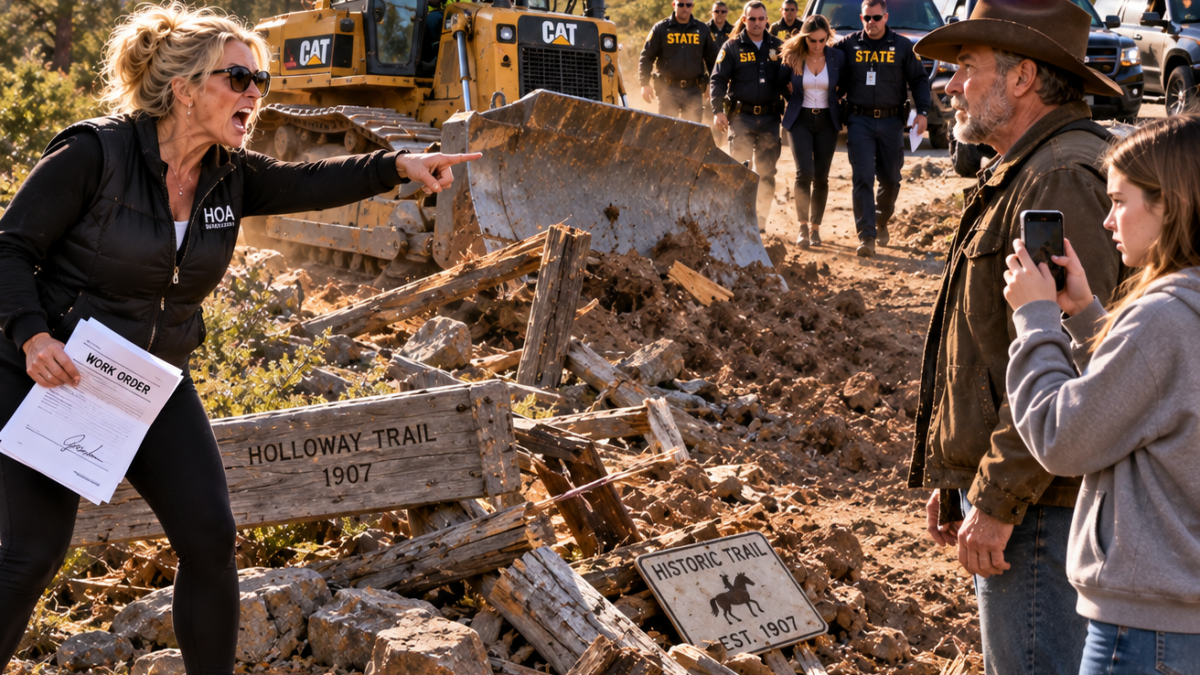
HOA Karen Sent a Bulldozer at 6 AM to Destroy My Family’s 118-Year-Old Horse Trail—Crushing Historic Landmarks and Ignoring Federal Signs. By Lunchtime, State Investigators Were at Her Door.
PART2:
That form became the last document I ever watched my father sign.
After he died, I kept a copy.
Sometimes when I missed him, I’d take it out and run my thumb over his handwriting.
Not because ink somehow holds a person.
Because grief isn’t reasonable.
You use whatever is left.
The trail itself was recorded.
A stockman’s easement.
Three miles north to south.
Part of it crossed land my family had once owned.
Then developers bought the acreage and created Aspen Bluffs Estates in 2003.
Forty-eight homes.
Every single deed referenced the easement.
Page two.
Same language.
Same recording information.
It wasn’t hidden.
It wasn’t some forgotten handshake arrangement from 1907.
Lawyers reviewed it when people bought houses.
Title companies insured around it.
Surveyors mapped it.
The subdivision plat showed it.
Nobody buying in Aspen Bluffs could honestly say they had never been told horses and livestock had a legal right to move along that corridor.
Then Diane Pedigrew arrived.
Diane and her husband Roger moved from Newport Beach in 2021.
Pearl-white Escalade.
Vanity plate:
MTN VIB.
She had been in Montana maybe three weeks before she started telling people how Montana should be managed.
Roger operated something called Pedigrew Land Strategies LLC from an office above the feed store.
Nobody seemed entirely sure what the company did.
That should have been a warning.
Diane joined the Aspen Bluffs HOA board almost immediately.
Within a year, she was president.
She dressed like someone had designed “Montana” for a luxury catalog.
Fitted Western jackets.
Designer boots that never had manure on them.
Turquoise jewelry.
Felt hats expensive enough that I suspected they had their own insurance.
She liked phrases like:
“Community vision.”
“Lifestyle standards.”
“Property-value preservation.”
And my personal favorite:
“Curated mountain living.”
I had lived in those mountains my entire life.
They had never seemed especially interested in being curated.
The first time Diane complained about my trail, she did it politely.
That was the dangerous phase.
She appeared at my ranch in April with Roger.
I was cleaning tack.
My daughter, Ellie, was thirteen then.
She sat on the fence rail eating an apple while our bay gelding Jasper searched her pockets for the rest of it.
Diane looked over the corral.
“Beautiful animals.”
“Thanks.”
Roger nodded toward the ridge.
“That your historic trail?”
“That’s the one.”
Diane smiled.
“We’ve been discussing it at the association.”
“Why?”
“Resident concerns.”
“About horses?”
“About compatibility.”
I set the saddle soap down.
“With what?”
“Our community.”
Ellie looked at me.
I knew that look.
She wanted to hear my answer.
“The trail was there first.”
Diane laughed gently.
“We understand the history.”
“No.”
“You understand that I just told you it was there first.”
Her smile tightened.
Roger stepped in.
“We’re not looking for conflict.”
“Good.”
“We’re exploring options.”
“For what?”
“Relocating portions of the easement.”
I stared at him.
“Why?”
Diane answered.
“The current alignment passes behind nine residences.”
“Correct.”
“Some homeowners feel uncomfortable with livestock moving so close.”
“Then they bought unusual houses.”
“They bought premium mountain property.”
“Beside a recorded stock trail.”
“That doesn’t mean conditions can never evolve.”
I looked toward the ridge.
“What exactly do you want?”
Roger took out a folded map.
He spread it on my tailgate.
A bright red line followed the original Holloway Trail.
A blue line diverted east.
Down a drainage.
Across steeper ground.
Then back north.
“Proposed reroute.”
I laughed.
Roger looked offended.
“You haven’t even studied it.”
“I don’t need to.”
“Why?”
“Blue route crosses shale.”
“Engineering can address that.”
“It crosses elk winter range.”
“We’d coordinate.”
“It drops almost three hundred feet then climbs back up.”
“Modern trail construction—”
“I’m moving cattle.”
“Not hosting mountain-bike tours.”
Ellie tried not to smile.
Diane folded her arms.
“You’re dismissing this before hearing the benefits.”
“What benefits?”
“Privacy for residents.”
“Not my benefit.”
“Improved trail maintenance.”
“I maintain it.”
“Potential compensation.”
“No.”
Roger leaned closer.
“Everything has a number, Wyatt.”
“Not everything.”
He smiled.
“That’s usually what people say before they hear the number.”
I rolled up his map.
Handed it back.
“Then save both of us time.”
“No.”
Diane’s expression changed.
Not angry yet.
More surprised.
People told Diane no less often than they should have.
“We’ll revisit.”
“No need.”
She looked toward Ellie.
Then at me.
“You might want to think about your daughter’s future.”
My entire body changed.
Diane heard it.
So did Roger.
“What does my daughter have to do with this?”
Diane lifted both hands.
“Nothing threatening.”
“Then choose better words.”
“I meant succession.”
“Your ranch.”
“Taxes.”
“Maintenance.”
“Legacy properties become burdens.”
Ellie jumped off the fence.
I said:
“Meeting’s over.”
They left.
Ellie waited until their Escalade disappeared.
Then:
“I hate her.”
“No.”
“She basically threatened me.”
“She talked stupid.”
“Different.”
“She did it on purpose.”
“Maybe.”
“Dad.”
“What?”
“You’re too nice to people you dislike.”
“That’s called being an adult.”
“That sounds terrible.”
She was fourteen by the time she understood how terrible it could actually get.
Diane started with complaints.
Horses passing too early.
Cattle dust.
Manure.
Riders using the trail on weekends.
A loose dog once chased my heifers, but somehow that became a complaint about my cattle disturbing a resident’s dog.
Then she sent a formal HOA notice.
Addressed to me.
That was entertaining because I was not in Aspen Bluffs.
The notice cited “community nuisance provisions.”
I called the management office.
Diane answered.
“Wyatt.”
“You sent me a violation.”
“It’s really more of a courtesy notice.”
“It says VIOLATION.”
“Standard template.”
“I’m not a member.”
“The trail crosses association-managed property.”
“No.”
“It crosses lots inside Aspen Bluffs.”
“Correct.”
“Which are subject to association standards.”
“The houses are.”
“The easement isn’t.”
“We disagree.”
“No.”
“You disagree.”
“The county recorder disagrees with you too.”
She sighed.
“You’re being unnecessarily combative.”
“I’m sitting at my kitchen table.”
“Hardly combat.”
“Wyatt.”
“Diane.”
Silence.
Then:
“The board is trying to protect homeowners.”
“From horses?”
“From uncontrolled use.”
“The use is recorded.”
“Historic use does not mean unlimited use.”
“Correct.”
“It means what the easement says.”
She stopped.
I continued.
“Livestock.”
“Horseback passage.”
“Maintenance.”
“Trail repair.”
“Associated stock movement.”
“I read it.”
“You should too.”
She hung up.
The next move came through a law firm.
Not a big firm.
Bozeman.
Letterhead.
The letter argued that the easement’s continued use might have become “unreasonably burdensome” because the surrounding property had transformed from agricultural land into high-value residential development.
I sent it to my attorney.
Her name was Maggie Sloan.
Fifty-eight.
Born in Livingston.
Property lawyer.
Horsewoman.
Smoked exactly one cigarette a year on her birthday, according to rumor.
She read the letter.
Then said:
“They’re fishing.”
“For what?”
“Fear.”
“Any merit?”
“Maybe enough to spend money arguing.”
“Can they move the trail?”
“Not because Diane dislikes manure.”
“Good.”
Maggie looked at me.
“What are they actually after?”
“Privacy.”
She stared.
“What else?”
I shrugged.
She tapped the letter.
“This is expensive privacy.”
Roger’s company answered that question eventually.
Pedigrew Land Strategies began buying small parcels northwest of Aspen Bluffs.
Three lots.
Then five.
Then an old ranch parcel.
Total:
A little over 140 acres.
They weren’t all under the Pedigrew name.
LLCs.
Rock Lantern Holdings.
AB Ridge Ventures.
Yellowstone Vista Partners.
Maggie found the connections.
“Development assembly,” she said.
“You think?”
“Almost certainly.”
“To build what?”
“Ask Roger.”
So I did.
He denied everything.
“Investment land.”
“For?”
“Future opportunities.”
“Road access?”
“Potentially.”
“Trail in the way?”
“No.”
His answer came too fast.
The Holloway Trail ran through the narrowest practical corridor between Aspen Bluffs and Roger’s assembled acreage.
If the trail disappeared, the corridor widened.
If the easement moved east, he could potentially build a road along the original alignment.
A road serving new luxury lots.
A road that could connect his land directly into Aspen Bluffs.
Diane wasn’t protecting residents from horses.
Her husband’s land needed my history out of the way.
That changed the fight.
I hired a surveyor.
Then another.
We re-established the easement boundaries.
Photographed every cairn.
Mapped the bench.
Found old filing references.
County archives.
State historical records.
A 1914 grazing map.
Aerial photographs.
My father’s 2004 bench registration.
And one document I had not known existed.
A federal trail-protection agreement.
In 1978, part of the route intersected land subject to federal conservation funding after a watershed restoration project.
The federal agreement didn’t own my trail.
But it protected several markers and a short drainage crossing as part of a cooperative historic-landscape program.
Those small brown signs Diane later called “obsolete trail plaques” were federal markers.
Maggie looked at the document.
“Do not lose this.”
“I wasn’t planning to.”
She made three copies.
Then scanned it twice.
“Now we can lose one.”
I started a trail file.
Ellie called it the dad apocalypse binder.
“What are all these tabs?”
“Evidence.”
“You’ve become weird.”
“You’re fourteen.”
“You think everyone over forty is weird.”
“Correct.”
She picked up Dad’s historical registration.
Then became serious.
“This is Grandpa Edward’s signature?”
“Yeah.”
She traced the photocopy with one finger.
“Do you ever miss him?”
“Every day.”
She nodded.
“Me too.”
She had been four when he died.
People assume children forget because memories become fuzzy.
Emotion doesn’t always need clarity.
She knew his smell.
Leather and coffee.
His laugh.
His hands.
Enough.
By fall, Diane had stopped pretending the trail fight was minor.
She proposed an HOA “Trail Modernization Initiative.”
Brochure.
Renderings.
Trail relocation.
Landscaping.
New fencing.
An asphalt walking path where parts of the old stock trail ran.
Roger’s company was listed as consultant.
Maggie nearly fell out of her chair laughing.
“Conflict disclosure?”
“None.”
“Bid process?”
“Don’t know.”
“Compensation?”
“Don’t know.”
Then we found the first missing money.
Aspen Bluffs had a reserve fund.
Roads.
Snow removal.
Gate repairs.
Drainage.
Emergency work.
According to annual summaries, reserves should have held around $860,000.
A homeowner named Calvin Reese called me.
Former CPA.
Lives on Aspen Meadow Lane.
“Wyatt.”
“Cal.”
“You know anything about an HOA trail project?”
“Unfortunately.”
“Did your family ever get paid for easement relocation?”
“No.”
“Never?”
“No.”
He went quiet.
“Interesting.”
“Why?”
“Our financial statement shows two hundred twenty thousand dollars spent on ‘Holloway Trail acquisition and mitigation.’”
I thought I misheard.
“How much?”
“Two-twenty.”
“Paid to who?”
“Doesn’t say.”
“I got zero.”
Cal said:
“That’s why I’m calling.”
That money became the thread.
Cal requested records.
Diane delayed.
Then provided summaries.
No invoices.
He requested invoices.
They cited confidentiality.
He requested vendor names.
They said proprietary.
Cal went to the board meeting.
Asked publicly:
“Who received $220,000 for the Holloway Trail?”
Diane answered:
“Professional services and land-use mitigation.”
“Which professionals?”
“We’re not discussing vendor contracts in open session.”
“Why?”
“Legal strategy.”
Cal held up the annual statement.
“This is owner money.”
Diane banged the gavel.
Apparently every HOA president eventually buys a gavel.
“The board has complied with its fiduciary obligations.”
Cal replied:
“Then show us.”
Meeting adjourned early.
Two weeks later, Cal received a violation for having a camper in his driveway.
He had owned the camper for nine years.
That made other residents curious.
Curiosity is the enemy of comfortable accounting.
A group formed.
Not revolutionaries.
Retired engineer.
Dentist.
Teacher.
Nurse.
Cal.
They requested three years of records.
Then four.
Diane fought every request.
Her board backed her.
Vice president Louis Archer.
Treasurer Ben Harrow.
Secretary Melissa Crane.
Member-at-large Robert Vane.
All five had served with Diane for at least two years.
All five had approved payments.
All five had signed statements certifying annual finances.
Cal found $430,000 in vaguely categorized “land-use” spending.
Then $96,000 in “emergency slope stabilization.”
Then $71,000 for “trail safety improvements.”
Homeowners could not identify the improvements.
The original trail remained unchanged.
My family received nothing.
Federal agencies received nothing.
County permits showed nothing.
Where did the money go?
We didn’t know.
Cal filed a complaint with the state.
Not a dramatic one.
Financial irregularities.
Potential misuse of association funds.
Supporting documents.
He told me afterward.
“Will anything happen?”
“Probably an audit letter.”
That was December.
By February, two state investigators quietly contacted him.
By March, they contacted me.
Agent Mara Ellison.
Financial-crimes investigator.
Mid-forties.
Direct.
No wasted words.
She sat at my kitchen table with another investigator named Jonah Price.
“Mr. Holloway, have you ever received payment from Aspen Bluffs HOA?”
“No.”
“Any payment from Pedigrew Land Strategies?”
“No.”
“Any option payment?”
“No.”
“Any relocation agreement?”
“No.”
“Any trail-maintenance contract?”
“No.”
She slid a document across the table.
Vendor authorization.
HOLLOWAY HISTORIC TRAIL MITIGATION — PHASE I
$85,000.
Vendor:
Rock Lantern Environmental Services.
I recognized Rock Lantern.
One of Roger’s LLC names.
“Not mine.”
Ellison asked:
“Do you recognize this signature?”
My name.
WYATT HOLLOWAY.
Forged.
Not even good.
“That’s not my signature.”
“Certain?”
“My signature looks like somebody falling down stairs.”
“That looks like a school principal.”
Jonah smiled slightly.
Ellison didn’t.
Another.
EASEMENT CONSULTATION PAYMENT ACKNOWLEDGMENT
$42,500.
My forged signature again.
Then:
OWNER CONSENT — PRELIMINARY TRAIL RELOCATION
Forged.
That one made me cold.
“They’re creating paperwork showing I agreed.”
Ellison nodded.
“That’s one possibility.”
“What’s the other?”
“They created paperwork to justify disbursements.”
“So they stole the money.”
She gave me the investigator answer.
“We are investigating.”
“What do you need?”
“Everything.”
I gave her the apocalypse binder.
Copies only.
My father raised me right.
For three months, nobody knew the investigation existed.
Not Diane.
Not the other board members.
At least as far as I knew.
State investigators subpoenaed banks.
Vendors.
Email accounts.
Management records.
Cal kept asking questions publicly.
Diane kept retaliating with violations.
One homeowner was fined for a shed color.
Another for firewood.
Another for “excessive equestrian visibility.”
That one referred to my horse visible through a homeowner’s window.
I considered framing it.
Then June arrived.
That was when Diane got desperate.
The county planning department had begun preliminary review of Roger’s proposed development.
Transportation staff questioned access.
One proposed road overlapped the Holloway Trail corridor.
Staff requested proof that the easement could be relocated.
Roger apparently needed something tangible.
Not a proposal.
A changed condition.
A trail that no longer existed.
On Monday evening, Diane held an executive HOA meeting.
All five board members attended.
No homeowners.
No minutes initially released.
At 10:43 p.m., an email went to Black Peak Excavation.
Subject:
ABANDONED TRAIL HAZARD REMOVAL — EMERGENCY WORK ORDER
Attached PDF.
HOA logo.
Signatures from five board members.
Diane.
Louis.
Ben.
Melissa.
Robert.
County permit number.
There was only one problem.
The permit number belonged to a culvert repair completed six miles away two years earlier.
Another attachment:
LANDOWNER CONSENT
My forged signature.
Another:
HISTORIC RESOURCE RELEASE
Supposedly issued by the state.
Fake.
Another:
FEDERAL MARKER DECOMMISSION AUTHORIZATION
Also fake.
They had built a complete permission package.
Enough to fool a contractor at 5:40 in the morning.
And then Diane made the mistake that turned a quiet financial investigation into a public collapse.
She emailed copies through the HOA management server.
The same server state investigators were already preserving.
Agent Ellison later told me the system flagged the documents before the bulldozer reached my trail.
They saw the forged permit.
My signature.
Federal release.
Emergency work order.
Then a message from Diane to Roger:
Once the trail is gone, everyone negotiates from reality instead of nostalgia.
That sentence obtained a warrant.
Fast.
At 5:32 Tuesday morning, I woke to our dog barking.
Blue heeler.
Name was Cricket.
He usually barked at coyotes.
This sounded different.
Engine.
Heavy diesel.
I looked out the upstairs window.
Lights moving near the north trailhead.
I pulled on jeans.
Boots.
No shirt at first.
Then remembered I was fifty-two and had a teenage daughter.
Shirt.
Ellie opened her bedroom door.
“Dad?”
“Stay inside.”
“What is it?”
“Equipment.”
She was already putting on boots.
“Ellie.”
“Dad.”
That tone came from her mother.
Her mother, Sarah, died when Ellie was eight.
Drunk driver.
One icy January night.
I don’t talk about it often.
Some losses become structural.
You stop explaining the beam.
You just live underneath it.
Ellie had Sarah’s dark hair.
Sarah’s eyes.
And my bad habit of walking toward trouble if told not to.
“Bring your phone.”
That was the compromise.
We drove the ranch truck north.
At 5:48, we reached the easement entrance.
Caterpillar D6.
Excavator.
Two pickups.
Diane’s white Escalade.
Roger’s truck.
Three board members.
Not all five.
Louis and Melissa were physically there.
Ben arrived later.
Robert apparently stayed home.
The dozer operator was already pushing brush from beside the trail.
I parked sideways.
Jumped out.
“STOP!”
The operator stopped.
Diane walked toward me.
Coffee in one hand.
Folder in the other.
“Wyatt.”
“What the hell are you doing?”
“Executing an emergency trail-safety order.”
“No.”
“The trail has been officially abandoned.”
“No.”
“You signed relocation consent.”
“No.”
She opened the folder.
Held up a page.
My name.
My fake signature.
For a second, I didn’t feel anger.
I felt almost impressed.
Not by quality.
By nerve.
“You forged my signature.”
Diane looked offended.
“This is the agreement your counsel transmitted.”
“My attorney transmitted no agreement.”
Roger stepped forward.
“Wyatt, don’t make this worse.”
I turned.
“Worse?”
“The board has legal authority.”
“Your wife is holding a forged document.”
“You received consideration.”
“No.”
“Records show you did.”
“Where’s the money?”
Neither answered.
That was when I knew.
The forged financial records.
The trail payments.
The missing reserve funds.
This wasn’t just about development.
They needed the trail gone because the physical landscape contradicted four years of fake accounting.
Their books claimed mitigation.
Acquisition.
Relocation work.
Professional services.
But the original trail still existed.
Every cairn.
Every marker.
Every board.
Every turn.
Anybody could walk it and ask:
What exactly did the HOA spend half a million dollars changing?
Erasing the trail would erase the easiest proof that nothing had been done.
Diane turned toward the dozer operator.
“Continue.”
I stepped forward.
“No.”
The operator, a man named Clint Madsen, removed one glove.
“Mrs. Pedigrew, he says that’s forged.”
“It isn’t.”
“Sir?”
He looked at me.
“Do you own the trail rights?”
“Yes.”
“Can you prove it?”
“Ten minutes.”
Diane snapped:
“You already have the county work order.”
Clint looked uncomfortable.
“We were told landowner dispute was resolved.”
“It is.”
“No,” I said.
“It isn’t.”
Roger walked closer.
“Wyatt, the safest thing is let the contractor complete work, then litigate damages if you believe you’re entitled.”
That sentence told me the plan.
Completed condition.
Destroy first.
Argue later.
I looked at Clint.
“If you push another foot, I’m calling the sheriff and state historic preservation.”
Diane laughed.
“You think the sheriff is going to stop a permitted safety project because you yell about your great-grandfather?”
Ellie had been recording.
Good girl.
Then Diane made another mistake.
She pointed down the trail.
“Take the bench first.”
Clint looked.
“What bench?”
“The old wood structure.”
My entire body tightened.
“Don’t.”
Diane looked directly at me.
“It’s listed as debris.”
“No.”
“Registered historic feature.”
She rolled her eyes.
“That bench is rotten.”
“It has state registration.”
“Had.”
She handed Clint a page.
The forged resource release.
He read it.
Then looked at me.
“Sir?”
“Fake.”
Diane shouted:
“Proceed.”
Clint had a choice.
He made the wrong one.
Maybe because his boss had already taken a large deposit.
Maybe because Diane’s paperwork looked official.
Maybe because contractors learn that property owners threaten lawsuits every day.
He climbed into the dozer.
Started forward.
I called the sheriff.
Then Maggie.
Then Agent Ellison.
No answer from Ellison.
I left a message.
“Diane’s here with a dozer and forged paperwork.”
Then I called the state historical office.
At 6:01, the Caterpillar blade hit the first cairn.
One hundred sixteen-year-old stones scattered.
Ellie whispered:
“Oh my God.”
I held out an arm.
“Stay behind the truck.”
The dozer continued.
Trail surface flattened.
Juniper crushed.
Another marker disappeared.
Then the federal brown sign.
The blade bent the metal post.
Pushed it flat.
Diane watched.
Not smiling.
Focused.
Like somebody finally correcting a problem.
Roger took photographs.
That seemed strange.
Later I understood.
They wanted proof the “mitigation work” had happened.
Backdating reality.
At 6:14, the machine reached the overlook.
The bench sat under an old limber pine.
Weathered.
Gray.
One board had been replaced in 1988.
Another reinforced by Dad.
The original iron nails still existed on the rear support.
My father had sat there with me after my first divorce.
My mother scattered part of his ashes nearby despite me telling her regulations probably prohibited it.
She said:
“Arrest me.”
Nobody did.
The dozer blade touched the bench.
I walked forward.
Clint stopped.
Diane screamed:
“Wyatt, move.”
“No.”
“You’re obstructing lawful work.”
“Good.”
Roger approached.
“You don’t want an arrest in front of your daughter.”
I turned.
“Are you threatening me?”
“No.”
“I’m telling you the sheriff is coming.”
“Good.”
“Then we can all wait.”
Diane shook her head.
“We’re on a schedule.”
That sentence mattered.
“Why?”
She realized too late.
“What schedule?”
“You said you’re on one.”
“Contractor availability.”
“No.”
“What’s at noon?”
Her face changed.
I didn’t know yet.
But the state did.
At 6:21, Clint shut down.
Not because of me.
Because two sheriff vehicles appeared below.
Deputy Rachel Ames arrived first.
Then Sergeant Dan Kline.
Rachel knew the Holloway Trail.
Everybody local did.
She looked at the scattered cairns.
Then the bench.
Still standing.
Barely.
“What happened?”
I pointed toward Diane.
“She brought equipment.”
Diane immediately handed Rachel the folder.
“Emergency HOA safety project.”
Rachel flipped through.
“You have county approval?”
“Attached.”
She read the permit number.
Radioed dispatch.
Diane kept talking.
“Mr. Holloway has been resisting this project for years.”
Rachel held up one finger.
Wait.
Dispatch answered.
Rachel’s face changed.
She looked at Diane.
“This permit is for culvert work on Mill Creek Road.”
Diane said:
“There must be a clerical error.”
Rachel turned another page.
“Landowner consent?”
I said:
“Forged.”
Rachel looked at me.
“You want to make a criminal complaint?”
“Yes.”
Diane laughed.
“This is ridiculous.”
Rachel closed the folder.
“Equipment stays off.”
“We have legal authority.”
“Not from what I’m holding.”
Roger stepped forward.
“Our counsel can verify.”
“Call them.”
He did.
Nobody answered.
At 6:34, Diane’s confidence cracked for the first time.
Not much.
But enough.
Then my phone rang.
Agent Ellison.
“Mr. Holloway.”
“Yeah.”
“Are you still on site?”
“Yes.”
“Is Diane Pedigrew there?”
“Yes.”
“Other board members?”
“Louis Archer.”
“Melissa Crane.”
“Roger.”
“Contractor.”
“Do not discuss our prior interview.”
I looked at Diane.
“What’s happening?”
Ellison’s voice remained flat.
“State investigators are executing warrants this morning.”
“When?”
“Now.”
I turned away.
“At the trail?”
“Clubhouse first.”
“Financial records.”
“Management server.”
“Pedigrew business office.”
“Mr. Holloway, do not interfere.”
“I’ve been trying to get everyone to stop interfering all morning.”
She almost laughed.
Almost.
Then:
“We have probable cause that documents being used today are fraudulent.”
I looked at the bulldozer.
The broken cairns.
The bent federal sign.
The bench.
“Little late.”
“Photograph everything.”
“My daughter is.”
“Good.”
Ellie looked proud.
I wish she hadn’t needed to be.
By 7:00, Black Peak Excavation’s owner had arrived.
Clint’s boss.
Name was Aaron Madsen.
His brother.
He saw the paperwork.
Called his insurance company.
Then walked straight to me.
“Mr. Holloway.”
“Yeah.”
“We’re standing down.”
“You should’ve never started.”
“I agree.”
“Your operator hit federal markers.”
His face went gray.
“We were given release paperwork.”
“Fake.”
“I understand that now.”
Diane overheard.
“This is not fake.”
Aaron turned.
“Mrs. Pedigrew, your permit number belongs to another project.”
“Clerical error.”
“Your state resource release has a phone number that goes to a disconnected office.”
Diane’s eyes widened.
Aaron continued.
“And your federal authorization has the wrong agency seal.”
Silence.
“You checked?”
He looked at the crushed sign.
“I started checking when the sheriff did.”
Roger said:
“Everyone needs to stop making conclusions before counsel arrives.”
Rachel said:
“No equipment moves.”
“No documents leave.”
“I need identifying information from all parties.”
She was no longer treating it as a civil easement dispute.
At 7:18, Agent Ellison and two state investigators walked into the Aspen Bluffs clubhouse.
I wasn’t there.
Calvin Reese was.
He later told me.
Diane’s assistant unlocked the office.
Investigators presented the warrant.
Computer drives.
Accounting files.
Meeting records.
Check stock.
Vendor files.
Backup hard drives.
They found a shred bin full of fresh paper.
That made people very interested.
At 7:42, agents entered Pedigrew Land Strategies.
Roger’s office.
He was still at my trail and did not know.
At 8:05, investigators served bank warrants.
At 8:21, state historical staff reached my ranch.
An archaeologist named Denise Rowland walked the damaged section.
She stopped at the first crushed cairn.
Then the federal sign.
Then the bench.
Her face went quiet.
“Who authorized this?”
I pointed at Diane.
Diane said:
“We have a release.”
Denise asked:
“From whom?”
Diane handed over the forged document.
Denise read it.
Then looked up.
“I didn’t sign this.”
That was the moment even Melissa Crane backed away from Diane.
Literally.
One step.
“What?”
Diane turned.
Melissa’s face had drained white.
“You told us the state signed off.”
“They did.”
Denise held up the page.
“My name is on this.”
“Yes.”
“I did not sign it.”
Everyone stared.
The forged signature belonged to the woman holding the paper.
Diane tried:
“Your office transmitted—”
“No.”
Denise removed her phone.
“I’m calling my director.”
Melissa whispered:
“Diane.”
“What?”
“You said counsel handled all authorizations.”
“They did.”
“Who?”
“Roger’s team.”
Melissa looked toward Roger.
He said nothing.
Then she asked the question that started unraveling the board publicly.
“What else isn’t real?”
Diane snapped:
“Do not panic.”
That is generally what people say just before panic becomes appropriate.
At 8:47, investigators at the clubhouse opened a locked filing cabinet.
Inside:
Duplicate invoice templates.
Blank vendor letterhead.
Rubber signature stamp for the treasurer.
Checks made to entities connected to Roger.
Trail-acquisition records carrying my forged signature.
Payment schedules.
And a spreadsheet.
Cal later called it the stupidest criminal document in Montana.
Columns:
Vendor.
Actual Cost.
HOA Billed.
Reserve Allocation.
Difference.
Split.
Split.
They had literally tracked who received what.
Diane.
Roger.
Louis.
Ben.
Melissa.
Robert.
Not every payment equal.
Not every board member receiving money directly.
But each had benefited.
Some through consulting fees.
Some “stipends.”
Some family businesses.
Some reimbursements.
Four years.
Approximately $612,000 diverted or falsely documented.
The Holloway Trail had become the largest category because it offered a believable excuse for expensive professional services nobody could easily verify.
Environmental study.
Historic mitigation.
Easement acquisition.
Survey.
Engineering.
Legal review.
Trail stabilization.
All vague.
All expensive-sounding.
Much of it never happened.
They had been billing owners for a phantom project.
Then I refused relocation.
Year after year.
The real trail remained right where it had always been.
The longer it stayed, the more dangerous it became to their cover story.
Roger’s proposed development forced the issue.
He needed the trail moved physically.
Diane needed the landscape to match the books.
Everybody’s incentives finally aligned around a bulldozer.
That was why the work order came at 5:40.
Not nine.
Not when county offices opened.
Dawn.
Destroy first.
Questions later.
By 9:12, state investigators had warrants expanded to include the residences of two board members.
At 9:30, the HOA management company froze association accounts.
At 9:44, Ben Harrow called a lawyer.
At 10:03, Melissa Crane asked Deputy Ames whether she could “leave and cooperate separately.”
Rachel said:
“You’ll need to ask the investigators.”
Melissa began crying.
Diane told her:
“Stop.”
Melissa turned.
“No.”
It was a small word.
Quiet.
But maybe the first no Diane had heard from her own board in years.
“You told us it was legal.”
“It is legal.”
“No.”
“You told me the stipends were permitted.”
Diane’s face changed.
Roger said:
“Melissa, don’t talk.”
That made Rachel very interested.
“Stipends?”
Melissa covered her mouth.
Too late.
At 10:26, state investigators arrived at the trail.
Two vehicles.
Agent Ellison first.
She took in everything.
The dozer.
Sheriff.
Historical staff.
Board members.
Me.
Ellie.
Then looked at the crushed federal sign.
“Busy morning.”
“You could say that.”
She asked Diane to step aside.
Diane demanded counsel.
Correct choice.
Ellison stopped substantive questioning.
Then she spoke to Roger.
He also requested counsel.
Louis did the same.
Melissa did not.
She talked.
For forty-one minutes.
In the back of a sheriff SUV with door open.
Not handcuffed.
Yet.
By 11:18, investigators knew enough to move.
Ellie and I sat by the damaged overlook.
The bench still stood, but one side had been crushed inward.
One leg snapped.
One board split.
Dad’s repair brace twisted.
I touched the juniper.
Ellie sat beside me on a rock.
“Can it be fixed?”
“Yes.”
“You don’t know.”
“No.”
She leaned against my shoulder.
“You’re mad.”
“Yep.”
“You’re doing the quiet thing.”
“What quiet thing?”
“The thing where you look normal and everybody else should run.”
I laughed.
“Your mother used to say that.”
“I know.”
“How?”
“You told me.”
Fair.
She looked down trail where agents photographed everything.
“Are they going to jail?”
“I don’t know.”
“They should.”
“Maybe.”
“They destroyed Grandpa’s bench.”
“Great-grandpa.”
“You know what I mean.”
“I do.”
“Dad?”
“Yeah?”
“Why would people steal money if they already have huge houses?”
That question is harder than adults admit.
“Because having enough and feeling like you have enough aren’t the same.”
She thought.
“That sounds dumb.”
“Most expensive problems do.”
At 11:52, Agent Ellison walked toward us.
“Mr. Holloway.”
I stood.
“We will be making arrests.”
“All of them?”
“We have warrants for five board members and Mr. Pedigrew.”
I looked toward Diane.
She was on her phone.
Probably still believed someone would rescue the situation.
“What charges?”
“Initial warrants include theft-related offenses, forgery, deceptive practices, conspiracy, and falsification of records.”
“And the trail?”
“Additional charges under review.”
“Historic damage?”
“Yes.”
“Federal signs?”
“Federal partners are being notified.”
Ellie whispered:
“Holy crap.”
I looked at her.
“Sorry.”
“Not because of the word.”
Ellison almost smiled.
Then:
“Your daughter should step back when arrests happen.”
Ellie immediately said:
“Why?”
“Because people get unpredictable.”
Diane wasn’t violent.
But Ellison was right.
We moved uphill.
At 12:07, two investigators walked toward Louis Archer.
He was handcuffed without incident.
12:14, Ben Harrow arrived in his Mercedes after being told to come provide records.
He was arrested in the parking area.
12:22, Robert Vane was arrested at his home.
12:31, state officers arrested Melissa.
She had already agreed to cooperate.
Still handcuffed.
She cried.
12:44, Roger Pedigrew was arrested at his office.
Diane watched pieces disappear.
She stopped talking.
For the first time all morning, there was no lecture.
No community standards.
No historic-relocation theory.
No emergency order.
Just a woman standing beside a bulldozer that should never have been there.
Agent Ellison approached her at 2:09.
“Diane Pedigrew?”
Diane looked at her.
“Yes.”
Ellie was thirty feet away.
Phone lowered.
I said:
“You don’t need to film.”
She looked at me.
“I want to.”
I considered telling her no.
Then remembered the last year.
The forged signatures.
The threats.
The bench.
“Stay back.”
She nodded.
At 2:11, Ellison said:
“Diane Pedigrew, you are under arrest pursuant to a state warrant.”
Diane’s shoulders dropped.
Not dramatically.
Just enough.
Ellison read her rights.
Diane looked once toward me.
I expected anger.
Instead, confusion.
Almost betrayal.
As though reality had violated procedure.
Then she looked toward the damaged trail.
That was when I saw it.
The first genuine understanding.
Not remorse.
Not yet.
But comprehension.
She had believed the bulldozer would solve the problem.
Instead it made everything visible.
The money.
The forged records.
Roger’s development.
The fake permits.
The board signatures.
The entire structure.
She thought she was erasing evidence.
She had driven a Caterpillar across it in daylight.
Ellie recorded until Diane entered the state vehicle.
Then stopped.
Her hands shook.
“You okay?”
“Yeah.”
“No, you’re not.”
“No.”
I put an arm around her.
“Me neither.”
We watched the vehicles leave.
The trail stayed damaged behind them.
Justice doesn’t rebuild anything.
That was lesson number one.
By evening, local news trucks lined the road.
I turned everybody away.
One reporter shouted:
“Mr. Holloway, do you feel vindicated?”
I almost walked over.
Then didn’t.
Vindicated.
My father’s registered bench was broken.
Historic markers crushed.
Neighbors had lost hundreds of thousands.
A fourteen-year-old watched people she knew get handcuffed.
Vindication was not the word.
I went home.
Made hamburgers.
Ellie ate half.
Then said:
“Dad.”
“What?”
“Can we fix the bench tomorrow?”
“Yes.”
We couldn’t.
Not yet.
Crime scene.
Historic review.
Insurance.
Documentation.
Nobody could touch it for nine days.
Those nine days felt longer than the previous year.
State investigators released more details.
$612,438.
That was the initial missing amount.
Eventually, the forensic total rose to $731,000 in questionable expenditures.
Not all stolen.
Important distinction.
Some legitimate services.
Some inflated.
Some duplicated.
Some routed through related entities.
Final provable criminal loss was lower.
Still enormous.
The scheme started before Diane became president.
Treasurer Ben had used vague maintenance categories to cover personal reimbursements.
Then Diane joined.
Roger saw opportunity.
Professional-services entities multiplied.
Board stipends appeared.
“Emergency consulting.”
“Development-impact review.”
“Trail mitigation.”
Each board member got something.
Louis’s son received a landscaping contract.
Robert’s wife ran a design company paid for “community branding.”
Melissa received bookkeeping stipends.
Ben approved checks.
Diane directed spending.
Roger’s LLCs received the largest payments.
The trail account was the perfect container.
People understood roads.
Snowplows.
Clubhouse repairs.
But historic-easement mitigation?
Complicated.
Legal.
Technical.
Easy to bury money inside.
The irony was that my refusal helped expose them.
If I had taken Roger’s first offer and quietly relocated the trail, nobody might have asked why the HOA had supposedly spent hundreds of thousands before paying me.
But I kept saying no.
So the books and the ground drifted farther apart.
Eventually somebody had to make them match.
Diane chose a bulldozer.
The trial didn’t happen quickly.
Nothing legal does.
Melissa took a cooperation agreement.
She pleaded guilty to a reduced theft-related charge and falsifying association records.
Probation.
Restitution.
Testimony.
Robert also cooperated.
Ben fought longer.
Louis longer still.
Roger fought everything.
Diane refused a deal initially.
Her attorney argued she had relied on Roger’s representations.
Then prosecutors produced emails.
Lots of emails.
One read:
WYATT STILL HAS NOT SIGNED. USE PRIOR ACKNOWLEDGMENT FORMAT.
Roger replied:
Same signature image?
Diane:
Yes. Nobody checks county scans unless litigation starts.
Another:
Trail account gives us room through Q3.
Another:
Once physical relocation is complete, the paper will stop looking ahead of reality.
That phrase entered evidence.
Paper ahead of reality.
They knew.
Diane eventually pleaded guilty to multiple felony counts.
The judge sentenced her to a combination of prison time, suspended time, restitution, and restrictions on serving in fiduciary positions.
Roger received a longer sentence because prosecutors tied him directly to the shell entities and forged land documents.
Ben received prison plus restitution.
Louis received a shorter custodial sentence.
Melissa and Robert avoided prison under cooperation agreements but paid restitution and served probation.
The internet would probably argue about whether sentences were enough.
I stopped caring.
The criminal system handled them.
My job was the trail.
Aspen Bluffs entered financial receivership temporarily.
Homeowners were furious.
Some with Diane.
Some with themselves.
Some with everybody.
Special assessment.
Insurance claims.
Legal fees.
Reserve reconstruction.
It hurt innocent families.
That bothered me.
People liked telling the story as:
HOA board arrested.
Good.
Except forty-eight families were left paying to repair what five people did.
Justice sends invoices to bystanders too.
Calvin Reese became interim treasurer.
He looked ten years older by Christmas.
The new board hired an outside management firm.
Independent annual audits.
Two-signature checks.
Related-party disclosures.
No closed executive expenditures above a small threshold.
No board-member vendor contracts without competitive bids.
Online owner access to ledgers.
Diane had spent years making accounting opaque.
Cal made it painfully boring.
Perfect.
As for the trail, state historians spent weeks documenting damage.
Six original cairns destroyed or materially disturbed.
Three could be reconstructed from photographs.
Federal sign replacements.
Native vegetation restoration.
Trail surface repair.
And the bench.
The bench was judged salvageable.
Barely.
One original support crushed.
Two boards cracked.
Iron fasteners bent.
The restoration specialist asked:
“Do you want it made to look new?”
“No.”
“Good.”
I liked her immediately.
Her name was Marcy Holt.
She worked with historic timber.
She preserved every original piece possible.
Used hand-cut juniper for replacement supports.
Forged square nails to match originals.
Left scratches.
Left weathering.
Left my father’s brace.
“Damage is part of its history now.”
I didn’t like that sentence at first.
Then I did.
Ellie helped.
She sanded one replacement support by hand.
Complained for three hours.
Then refused power tools because Great-Grandpa Winona hadn’t used them.
“Your great-grandfather would’ve used an orbital sander if Home Depot existed.”
“No.”
“He wasn’t religious about inconvenience.”
“You don’t know.”
“I met his son.”
She rolled her eyes.
Teenagers preserve ancestors more romantically than adults.
When the bench returned to the overlook, Marcy added a small brass conservation tag beneath it.
Not visible unless you crouched.
ORIGINAL STRUCTURE 1923 — RESTORED 2026 AFTER UNAUTHORIZED DEMOLITION DAMAGE
Ellie asked:
“Can we add ‘by idiots’?”
“No.”
“Why?”
“Historic records prefer neutral language.”
“Cowards.”
We sat on the restored bench at sunset.
First time after the damage.
Ellie touched Grandpa Edward’s old brace.
“You think he’d be mad?”
“About Diane?”
“No.”
“About us repairing it.”
“Why would he?”
“Because it’s not all original anymore.”
I looked at the bench.
Neither was the ranch.
Neither was I.
Neither was she.
“Your grandfather repaired this thing at least six times.”
“How do you know?”
“I held the boards.”
“So he wouldn’t care.”
“He’d care if we made it too pretty.”
She smiled.
“Good.”
A year after the arrests, Aspen Bluffs held a community meeting at the trailhead.
The new president invited me.
Her name was Dr. Lillian Cho.
Veterinarian.
Had lived there fifteen years.
Never wanted HOA office.
Another good qualification.
She stood in front of homeowners.
No gavel.
No fancy jacket.
“We owe the Holloway family an apology.”
I disliked public apologies.
They make everybody stare.
Lillian continued.
“Not because every homeowner participated.”
“They didn’t.”
“But because our association became a tool used to attack a right that every deed required us to respect.”
She looked at me.
“We’re sorry.”
I nodded.
“Thank you.”
Then she announced Aspen Bluffs would fund restoration of damaged sections not covered by restitution or state grants.
I started to object.
Cal cut me off.
“Shut up, Wyatt.”
People laughed.
I looked at him.
“You’re very confident for an accountant.”
“Retired accountant.”
“Dangerous.”
They funded the work.
Properly.
Invoices public.
Funny how different transparency feels.
Roger’s planned development died.
His assembled parcels were sold during bankruptcy proceedings.
A conservation buyer acquired most of the acreage.
No luxury road.
No trail relocation.
The Holloway easement remained exactly where it had been.
Minus reconstructed stones.
Plus one thing.
New plaques.
Not big.
No tourist attraction.
Just small brass markers at each Aspen Bluffs crossing:
HOLLOWAY STOCKMAN’S TRAIL — RECORDED HISTORIC EASEMENT — EST. 1907 — PLEASE YIELD TO LIVESTOCK AND RIDERS.
The first time I rode through after installation, a homeowner stepped off the path with her dog.
“Morning, Wyatt.”
“Morning.”
Her dog barked.
My gelding ignored him.
She looked at the plaque.
“Hard to believe anybody tried to erase this.”
I thought about it.
“It wasn’t the trail they were really trying to erase.”
“What then?”
“Questions.”
That was the truth.
The trail itself had become a question.
Where did the money go?
What exactly was acquired?
Who authorized relocation?
Why was the physical route unchanged?
Who signed for mitigation?
Why did Wyatt Holloway supposedly accept money he never received?
Every hoofprint contradicted the books.
Every cairn said:
Still here.
Every ride said:
Still active.
The bench said:
Nobody cleared this.
Diane did not hate the trail because it was old.
She hated it because it remained visible.
Evidence sometimes looks like paperwork.
Sometimes it looks like three miles of dirt.
Ellie became obsessed with the case afterward.
Not crime.
Records.
History.
She started volunteering with the county museum.
At sixteen, she digitized old ranch maps.
At seventeen, she wrote a school research paper about easements and private land use.
At eighteen, she announced she wanted to study historic preservation and land-use planning.
I stared at her.
“You’ve spent your entire childhood complaining about paperwork.”
“Trauma response.”
“You’re blaming me?”
“Mostly Diane.”
“Fair.”
She went to Montana State.
Changed majors twice.
Came back to land-use planning.
Of course.
Her senior project involved mapping historic stock routes threatened by development.
At graduation, she wore Grandpa Edward’s old silver belt buckle.
I cried discreetly.
She photographed me.
Not discreetly.
“Evidence.”
She said it just like I used to.
The case followed us in strange ways.
Ranch magazines called.
Local news revisited anniversaries.
Podcast people wanted dramatic interviews.
“Tell us what it felt like watching the bulldozer destroy your legacy.”
I hated questions like that.
Legacy.
Big word.
My legacy was more likely a barn full of mismatched bolts and a daughter who swore when fence wire snapped.
But I understood why people cared.
The story had everything.
Luxury HOA.
Historic trail.
Bulldozer.
Forgery.
Missing money.
Board arrested by lunch.
Perfect internet food.
They wanted a villain and a cowboy.
I refused cowboy.
I own cattle.
That’s different.
One documentary producer asked whether I had intentionally delayed legal action so Diane would expose herself.
No.
Absolutely not.
I would have preferred she stop after the first letter.
People assume justice is satisfying while it’s happening.
Mostly it’s expensive.
Slow.
Scary.
And destructive.
If I could trade every arrest for my original bench never being touched, I would.
No hesitation.
That’s something revenge stories usually leave out.
The best victory is avoiding the damage.
But once damage happens, you choose what to build from it.
I chose documentation.
Restoration.
And boundaries.
I never closed the trail to Aspen Bluffs residents completely.
Walking wasn’t part of their legal easement.
But historically I’d allowed neighbors to hike certain sections by permission.
After Diane, people assumed I’d stop.
I didn’t.
I installed a small permission box at the southern trailhead.
Name.
Phone.
Date.
Pedestrian use by permission.
Yield to livestock.
Dogs leashed.
No motor vehicles.
People asked:
“Why keep letting strangers use it after what happened?”
Because Diane wasn’t everybody.
Punishing forty-eight families for five board members would just be a different kind of arrogance.
Trust can survive betrayal.
It just gets paperwork.
Cal laughed when he saw the form.
“You’ve become one of us.”
“Accountant?”
“No.”
“Bureaucrat.”
“Get off my ranch.”
He signed the hiking form first.
Years passed.
The cairns weathered again.
New stones lost their fresh edges.
Juniper on the bench turned gray.
Good.
Restoration should eventually stop looking restored.
Diane wrote me once.
From prison.
I didn’t expect that.
Envelope forwarded through Maggie.
Four pages.
I read the first.
Then all of it.
She did not ask forgiveness directly.
Mostly she explained.
That can be dangerous.
Explanations easily become excuses.
But hers was stranger.
She wrote that the first financial irregularity had been small.
An inflated snow-removal invoice.
Ben suggested moving money temporarily between categories.
Then correcting it later.
Nobody did.
Then Roger provided consulting.
The board approved it casually.
Then conflicts became embarrassing to disclose.
So they stopped disclosing.
Then one fake invoice covered another.
Then reserve shortfalls had to be hidden.
Then trail mitigation became a convenient category.
She wrote:
By the time I understood we were committing crimes, I had already committed enough that admitting the truth felt impossible.
That sentence I believed.
Then:
I began seeing anyone who asked questions as an enemy because every question threatened to make me say aloud what I already knew.
Also believable.
Then she wrote about the morning of the bulldozer.
I thought if the trail were physically relocated, the documents would finally stop being false.
That was the part that stayed with me.
Not:
I thought nobody would catch us.
Instead:
She believed destroying reality could make the paperwork true.
There is a lesson in that larger than HOAs.
I answered once.
Three sentences.
Diane, I received your letter.
The trail has been restored.
I hope you use whatever comes next to become someone who no longer needs other people’s reality to match her paperwork.
Ellie said that sounded cruel.
“Was it?”
“A little.”
“Should I have lied?”
“No.”
“Then?”
She shrugged.
“You could’ve said I hope you’re okay.”
“Do I?”
She thought.
“Eventually, maybe.”
Children become wiser and more annoying as adults.
Diane served part of her sentence and was later released under supervision.
Roger stayed incarcerated longer.
I never saw either again.
Ben died several years after release.
Heart attack.
Louis moved out of state.
Melissa eventually wrote a public apology to Aspen Bluffs homeowners.
Robert started attending recovery meetings for gambling addiction, which apparently explained where some of his money went.
Human beings remain complicated even after court assigns case numbers.
Aspen Bluffs survived.
Property values survived.
The mountains survived.
Imagine that.
For years Diane had warned that horses, manure, trail rights, and old easements threatened the neighborhood’s value.
What actually threatened it?
Fraud.
Secrecy.
Conflicts of interest.
People afraid to challenge authority.
The horses were innocent.
Jasper lived to twenty-seven.
That bay gelding carried Ellie along the Holloway Trail from childhood into adulthood.
His final ride happened when she was twenty-one.
Slow.
Two miles.
She stopped at the bench.
Took a picture between his ears looking over the valley.
He died that winter.
Old age.
We buried him on ranch land near cottonwoods.
Ellie cried harder for that horse than she had cried at some human funerals.
No judgment.
Animals occupy places people can’t.
Afterward, she donated his saddle to the local youth riding club.
Kept one horseshoe.
Hung it beneath Grandpa’s historic-registration form in the ranch office.
The office wall became crowded over time.
Dad’s signature.
Historic bench certificate.
Trail maps.
Photo of Ellie sanding juniper.
Restoration report.
One crushed federal sign.
Yes.
They let me keep it after evidence release.
Bent nearly flat.
Brown paint scraped.
I mounted it.
Underneath, Ellie made a plaque:
DIANE’S LAST TRAIL IMPROVEMENT.
I told her that was petty.
She said:
“Genetics.”
Fair.
At sixty-eight, I started transferring ranch operations to Ellie and my nephew Cole.
I still worked.
Just more slowly.
Knees.
Shoulders.
Time.
One autumn afternoon, Ellie and I rode the trail together.
She was thirty.
Married.
Pregnant.
Still stubborn.
I told her she shouldn’t be riding that late in pregnancy.
She informed me women had been riding horses while pregnant for several thousand years.
I told her most didn’t have orthopedic surgeons.
We compromised by moving at walking speed.
At the high overlook, we dismounted.
Sat on the bench.
The restored support had weathered beautifully.
You could tell which wood was old only if you knew what to look for.
Ellie touched the underside.
“Think this lasts another hundred years?”
“No.”
“Why not?”
“Nothing wooden does without somebody fixing it.”
She looked at me.
“That’s depressing.”
“No.”
“That’s maintenance.”
She smiled.
“Very Wyatt Holloway answer.”
“Thank you.”
Below us, Aspen Bluffs roofs caught late sunlight.
Beyond them, open parcels where Roger’s planned development never happened.
Cattle moved through grass.
Trail curved along limestone.
Visible.
Still there.
Ellie said:
“Grandpa Edward would’ve loved this.”
“Probably complain about the restoration bill.”
“Also true.”
She leaned back.
“I remember Diane getting arrested.”
“I know.”
“I still have the video.”
“Of course you do.”
“Never posted it.”
“I know.”
“People offered money.”
“I know.”
“You never told me not to.”
That surprised me.
“Would you have?”
“If I’d wanted?”
I thought.
“I would’ve asked why.”
She nodded.
“I didn’t want her arrest to be entertainment.”
I looked at my daughter.
Fourteen-year-old Ellie had filmed because she needed proof.
Thirty-year-old Ellie understood dignity.
“Your mother would’ve been proud.”
Her eyes filled.
She looked out over the valley.
“She would’ve hated Diane.”
I laughed.
“That’s exactly what you said at fourteen.”
“Was I wrong?”
“No.”
“Mom had standards.”
We sat there until cold came down.
Before mounting, Ellie took something from her coat pocket.
Small brass plaque.
“What’s that?”
She turned it over.
Engraving:
WINONA & CLARA HOLLOWAY OVERLOOK
BENCH BUILT 1923
RESTORED AFTER 2026 DAMAGE
MAY THE VIEW OUTLAST THE ARGUMENTS
I read the last line twice.
“Too sentimental.”
“Too late.”
She screwed it beneath the seat where nobody would notice unless looking.
Just like the conservation tag.
“Why hidden?”
“Because not everything needs to perform.”
That line came from Sarah.
Her mother used to say it about kindness.
Do the thing.
Don’t announce the thing.
I looked at Ellie.
“Your mom said that.”
“I know.”
Grief again.
Ink.
Wood.
Phrases.
Whatever is left.
The Holloway Trail is one hundred eighteen years old in the story people tell.
Older now.
It still carries horses.
Occasional cattle.
Hikers by permission.
Children learning to ride.
No asphalt.
No decorative lighting.
No luxury gate.
No “curated trail experience.”
Just dirt.
Stone.
Grass.
History.
People ask whether I worry another HOA board might challenge it.
Not really.
Aspen Bluffs deeds now contain an additional acknowledgment at transfer.
Trail easement.
Recorded.
Active.
Not subject to HOA relocation without lawful agreement of all affected rights holders.
The new language is painfully clear.
Diane accomplished that, in a backward way.
Sometimes the person trying hardest to erase a boundary ends up making everybody engrave it deeper.
Calvin Reese once joked that we should name the trail after her.
I told him I’d bury him under the bench.
He believed me.
We stayed friends.
The missing money was eventually recovered in pieces.
Insurance.
Restitution.
Asset sales.
Civil settlements.
Never all of it.
Money rarely comes home completely after theft.
Aspen Bluffs reserve fund recovered slowly.
Special assessments hurt.
Some homeowners sold.
Some stayed.
The community changed.
Not because outsiders “ruined” it.
Because trust costs more to rebuild than a road.
That’s another thing people underestimate.
A board can steal $600,000.
The financial loss has a number.
How do you price every future meeting where people wonder whether the treasurer is lying?
Every invoice questioned?
Every neighbor suspicious?
Every election treated like a criminal-background check?
Money has accounting.
Trust has weather.
It returns slowly.
If at all.
Still, Aspen Bluffs rebuilt it.
Transparent books.
Rotating board.
Independent audits.
Open contracts.
Homeowners who paid attention.
Eventually meetings became boring again.
That was success.
The most dramatic meeting five years later involved snowplow placement.
Nobody was arrested.
Excellent governance.
Sometimes people ask me what I felt at 2:11 when Diane was handcuffed.
They expect:
Satisfaction.
Revenge.
Justice.
Maybe.
Mostly I remember the bulldozer.
The bench.
Ellie’s shaking hands.
And one thought:
This never needed to happen.
She could have accepted no.
The board could have shown the books.
Roger could have built somewhere else.
Ben could have corrected the first bad transfer.
Melissa could have spoken sooner.
Robert could have refused a payment.
Louis could have asked one question.
Any one of them could have stopped.
The distance between a mistake and a conspiracy is often just the number of chances people ignore to tell the truth.
They kept going.
One invoice.
Then another.
One fake signature.
Then another.
One threat.
Then another.
Until dawn came and there was a Caterpillar on a 118-year-old trail.
That’s the part I remember.
Big crimes don’t always begin big.
Sometimes they begin with someone saying:
We’ll fix the paperwork later.
Then later becomes a bulldozer.
My father hated paperwork.
Maybe he had it half right.
Forms do not make people honest.
But honest records make dishonesty harder.
His shaky signature on that historical registration became one of the documents that proved Diane’s release was forged.
The paperwork he hated helped save the bench he loved.
I wish I could tell him.
Maybe that is why I still keep his copy.
Not because ink holds a person.
Because sometimes what a person bothered to write down keeps speaking after they’re gone.
The bulldozer crushed stones.
Bent federal signs.
Split old juniper.
But it couldn’t erase the recorded easement.
Couldn’t erase Dad’s signature.
Couldn’t erase bank transfers.
Couldn’t erase emails.
Couldn’t erase the state archive.
Couldn’t erase forty-eight deeds.
Couldn’t erase Ellie’s video.
Diane thought destruction would make her records true.
Instead, every broken thing pointed back at the lie.
That is the strange thing about evidence.
Sometimes the harder you try to bury it, the more clearly you mark where everyone should dig.
Today, if you ride north from the Holloway ranch just after sunrise, the trail looks almost exactly the way it did before that morning.
Almost.
The reconstructed cairns are slightly neater.
The juniper bench carries scars.
One old federal marker has a replacement post.
And near the trailhead stands a new sign paid for by Aspen Bluffs.
Nothing flashy.
Brown metal.
White letters.
It reads:
HOLLOWAY STOCKMAN’S TRAIL
ESTABLISHED 1907
RECORDED EQUESTRIAN & LIVESTOCK EASEMENT
HISTORIC ROUTE — DO NOT ALTER
I didn’t write the last line.
Cal did.
He said some people need short sentences.
Underneath, in smaller letters:
ALL MODIFICATIONS REQUIRE DOCUMENTED LEGAL AUTHORITY.
Accountant humor.
But my favorite marker isn’t official.
It’s a small piece of weathered juniper Ellie nailed to a fence post beside our southern trailhead.
She carved it herself.
Only four words.
STILL HERE. KEEP RIDING.
That’s the whole story, really.
Diane had a bulldozer.
A board.
Forged papers.
Money.
Lawyers.
A development plan.
And years of practice making people feel too tired to resist.
The trail had dirt.
Stone.
Old filings.
A bench.
A dead rancher’s shaky signature.
And people willing to say:
No.
By lunchtime, the bulldozer had stopped.
By afternoon, the board was in custody.
By the next spring, the cairns were back.
And every time hoofbeats pass that bench now, I think about how close Diane came to destroying something she believed was only old wood and dirt.
She never understood what made it hard to remove.
It wasn’t the stones.
It wasn’t the juniper.
It wasn’t even the easement.
It was that too many people had remembered where the trail was supposed to be.








