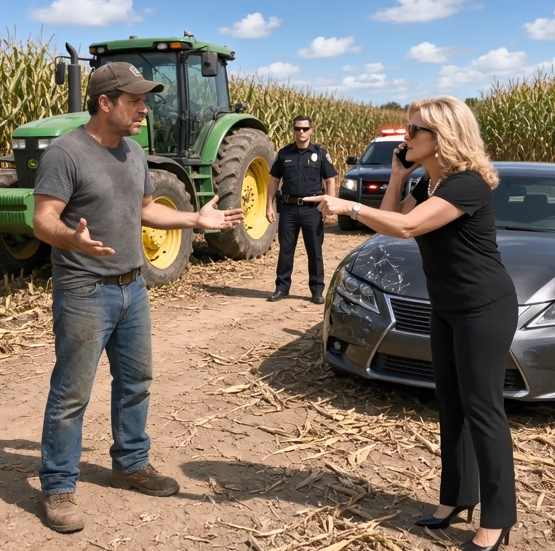
**HOA Karen Rammed Her Lexus Into My Tractor During Harvest and Framed Me for Assault—Then My Forgotten Dashcam Recorded Her Smashing Her Own Car and Lying to 911.**
PART2:
TEMPORARY LOADING AND TRANSFER OPERATIONS.
REASONABLE AGRICULTURAL HOURS INCLUDING EARLY-MORNING AND LATE-EVENING OPERATIONS DURING SEASONAL NECESSITY.
Dust.
Noise.
Mud.
Equipment.
All contemplated.
Most people who bought homes there understood.
They had signed paperwork saying they understood.
Some even liked it.
Their kids waved at the combine.
A few residents brought coffee during harvest.
One retired couple let me stage a water tank on the corner of their property one dry year.
Then Karen became HOA president.
Karen had not always been my enemy.
That was what made everything harder.
She had been Sarah’s friend.
My wife.
My late wife.
Even two years after Sarah died, I sometimes still thought her name in present tense before correcting myself.
Sarah and Karen met through a county fundraiser.
Karen was polished where Sarah was messy.
Karen planned.
Sarah improvised.
Karen wore pressed blouses to charity events.
Sarah spilled barbecue sauce on hers before guests arrived.
They became close.
Karen came to our wedding.
She helped paint Emily? No, don’t introduce daughter unless needed. Josh maybe no kids? Let’s keep none, maybe they had no children; could deepen grief. Let’s say no children. We don’t need. She sat with Sarah through chemo. Need careful.
When Sarah was diagnosed with ovarian cancer, Karen showed up.
I will give her that.
She brought casseroles.
Drove Sarah to treatment twice when I was planting.
Organized meal trains.
Sat beside Sarah during chemo.
Held her hair while she got sick in hospital bathroom.
She gave a speech at Sarah’s memorial.
“I’ve never known anyone who loved this land the way Sarah did.”
That sentence destroyed me at the time.
I believed every word.
Maybe Karen believed it too.
People can care about someone and still become dangerous later.
Life would be simpler if villains arrived already wearing signs.
About six months after Sarah died, Karen brought me an offer.
We were standing in my kitchen.
Same kitchen where she had once helped Sarah frost a birthday cake.
She set a folder on the table.
“What’s this?”
“An opportunity.”
I opened it.
Letter of intent.
Derek Edwards Development.
Karen’s nephew.
They wanted eighty-four acres along the eastern side of my farm.
The acreage beside Cedar Ridge Estates.
“Why?”
“Expansion.”
“Of what?”
“Residential.”
“Meadow View Estates.”
I pushed folder back.
“No.”
“Josh, look at number.”
“I did.”
“It’s well above agricultural value.”
“No.”
Karen leaned back.
“You should think about it.”
“I did.”
“For six seconds?”
“Enough.”
Her voice softened.
“This place has to be hard for you.”
I knew where she was going.
“Don’t.”
“Sarah is everywhere here.”
“Karen.”
“Maybe that isn’t healthy.”
That anger came so fast I had to stand.
“You don’t get to use her.”
“I’m not.”
“You just did.”
“I’m saying she wanted you to live.”
“She wanted this farm.”
“People change.”
“Dead people don’t.”
Silence.
Karen’s face tightened.
Then she gathered folder.
“I was trying to help.”
“Then stop.”
That was the first crack.
After that, the HOA notices started.
TRACTOR NOISE BEFORE 7 A.M.
Response:
Agricultural easement permits seasonal early operations.
CORN DUST ON WILLOW LANE.
Response:
Normal agricultural use; road swept when practical.
MUD TRACKING.
Response:
Same.
TEMPORARY GRAIN CART PARKING.
Response:
Explicitly permitted.
WORK LIGHTS AFTER DARK.
Response:
Harvest activity protected.
ENGINE IDLING.
Response:
Necessary for safe loading.
Every complaint came signed by Karen as HOA president.
Every time I answered with a copy of the easement and county right-to-farm statute.
Every time she found something new.
I kept records.
Army taught documentation.
Farming taught it again.
Fuel receipts.
Yield.
Moisture.
Inputs.
Maintenance.
Weather.
Contracts.
If you cannot prove what happened, somebody else eventually gets to tell the story.
That sentence turned out to be more important than I knew.
The collision happened during corn harvest.
October 17.
Dry morning.
Wind out of northwest.
Fields running about eighteen percent moisture, which was a little higher than I wanted but acceptable.
I had a contract with Harper Grain to deliver a minimum volume by end of month.
Penalties kicked in after deadline.
Nothing catastrophic if I missed by day.
Potentially brutal if weather turned.
I was moving a John Deere tractor pulling a loaded grain cart along Willow Lane toward the field entrance.
Slow.
Maybe twelve miles per hour.
Flashers.
SMV triangle.
Beacon.
Everything legal.
Karen appeared behind me in her Lexus SUV.
I saw headlights in side mirror.
Then closer.
Then too close.
She laid on horn.
I stayed course.
There was nowhere safe to pull over for another hundred yards.
The paved lane narrowed between drainage ditch and decorative stone entrance wall.
I raised hand through rear glass in a wait gesture.
She accelerated.
I heard engine.
Then impact.
The Lexus struck rear-left corner of grain cart and bounced sideways.
The sound was violent.
Metal.
Plastic.
Glass.
The tractor jerked but remained upright.
I braked.
Heart pounding.
Looked back.
Karen’s Lexus sat angled partly across lane.
Front passenger corner crushed.
Airbags had not deployed.
I climbed down.
“Karen!”
Her door opened.
She got out.
Walking.
No obvious injury.
“Are you okay?”
She looked at Lexus.
“Oh my God.”
“Are you hurt?”
“No.”
“What happened?”
“I thought you were pulling over.”
“I wasn’t.”
“You waved.”
“I waved for you to wait.”
She covered mouth.
“Oh God.”
Then:
“I’m sorry.”
Clear as day.
“I’m so sorry.”
I remember because anger drained slightly.
An accident.
A stupid, reckless accident.
But she apologized.
I said:
“Sit down.”
“I’ll call sheriff.”
“No.”
She looked at me.
“No police.”
“We need report.”
“My insurance—”
“Karen, you hit farm equipment.”
“I know.”
“We need report.”
Her expression changed.
Not much.
Then she looked down road.
Empty.
No houses close enough to see directly.
Cornfields both sides for stretch.
She looked at tractor.
Then me.
Then back toward subdivision.
I was checking hitch and cart damage.
My back turned maybe ten seconds.
I heard rock hit glass.
Crack.
I turned.
Karen stood beside Lexus holding landscaping stone from roadside bed.
“What the hell are you doing?”
She dropped it.
The left headlight—opposite impact side—was broken.
I stared.
She stared back.
Then pinched her upper arm hard.
Once.
Twice.
“What are you doing?”
She took out phone.
“Karen.”
She dialed.
I stepped toward.
“Stop.”
She backed away instantly.
Then screamed.
“Don’t come near me!”
I froze.
“What?”
Her voice changed.
Crying.
Breathless.
“911?”
She turned slightly away.
“Yes, my name is Karen Edwards.”
“I’ve been attacked.”
I felt entire world tilt.
I said:
“Are you serious?”
She raised hand toward me.
“Stay back!”
On phone:
“He hit my car with tractor.”
“No.”
“He forced me off road.”
“No.”
“Then he came at me.”
“Karen, stop.”
“He’s intoxicated.”
I laughed once because accusation was absurd.
I had not had drink in months.
That laugh later sounded terrible in witness reconstruction.
She kept going.
“He’s a veteran.”
“I think he has weapons.”
That is when I understood she was not panicking.
She was building.
Each sentence placed brick.
Violent.
Drunk.
Veteran.
Weapons.
Danger.
I stepped away.
Hands visible.
Called my attorney? No time. First I called 911 too.
Dispatcher said units already en route.
I told:
“I’m driver of tractor.”
“The other party is making false assault allegations.”
“I am unarmed.”
“I will remain by tractor.”
Good.
Then Karen picked up phone and started filming herself.
Tears.
Voice trembling.
“Please stay with me.”
As if speaking to invisible audience.
Within minutes neighbors arrived.
Phones.
Curiosity.
Karen cried harder when people watched.
Then Deputy Mason Bell pulled up.
Youngish.
Early thirties.
I knew his father.
Not him well.
Second deputy arrived behind.
Bell approached.
Hands visible.
“Sir, step away from tractor.”
I did.
“Any weapons?”
“Pocketknife.”
He removed.
“Anything else?”
“No.”
“Have you consumed alcohol?”
“No.”
He looked at Karen.
She sat on curb holding arm.
Blood at knuckle? Headlight maybe. She claimed I grabbed.
Her story:
I deliberately blocked road.
She honked.
I backed tractor into Lexus.
Then I got down yelling.
Grabbed arm.
Shoved her into car.
Broke headlight with something.
Threatened.
I stared.
“That is a lie.”
Deputy Bell said:
“Sir, I need you to stay calm.”
“I am calm.”
“You’re raising voice.”
I lowered.
“She hit me.”
Karen began sobbing.
“I was scared.”
Neighbors filmed.
HOA board member Janice Price came.
Karen shouted:
“He’s been threatening us for months!”
I had never threatened anyone.
Bell separated.
He photographed.
Impact pattern.
Marks.
My tractor.
Lexus.
Karen’s arm.
One red mark.
Maybe pinch.
No obvious serious injury.
Then Karen told him I had been drinking in cab.
He asked to perform breath test.
I agreed.
0.000.
That should have helped.
It did some.
But assault allegation remained.
Karen claimed I grabbed and shoved.
No witness.
I denied.
Bell called supervisor.
At 9:52 a.m., I was handcuffed.
Not formally arrested at first—detained while they sorted.
Still.
Handcuffs.
On harvest road.
Neighbors watching.
Karen stopped crying the instant she thought deputies were turned away.
That is image I remember.
She raised phone.
Smiled slightly.
Then addressed people:
“The dangerous farmer has finally been arrested.”
Finally.
That word mattered.
Deputy heard? Not clearly.
I did.
I said:
“Karen.”
Bell turned.
“Sir.”
I shut up.
The Army teaches you quickly there are moments when being right and acting right are separate problems.
I went to sheriff’s office.
Interview.
Statement.
Breath test documented.
Released later pending investigation, but Karen went to court same day with attorney and sought emergency protective order.
She alleged repeated harassment.
Threats.
Stalking via “surveillance devices.”
Dangerous access through neighborhood.
Assault.
The judge granted temporary order until hearing.
Five hundred feet.
Normally reasonable sounding.
For me catastrophic.
Karen lived within roughly three hundred feet of the agricultural easement at one point near her property.
The order effectively meant:
I could not use Willow Lane.
The only practical route for my combine and loaded grain trucks to eastern fields.
My attorney, Rebecca Hale, filed emergency motion immediately.
Hearing set five days out.
Five days during harvest is not five ordinary days.
A crop does not care about court calendar.
Rain forecast.
Moisture rising.
Harper Grain deadline approaching.
I called county roads.
Could I access from west?
Maybe with smaller equipment.
Not combine without crossing culvert rated too low.
Could build temporary access?
Permits.
Time.
Cost.
Could neighbor let me cross?
Terrain poor.
Fences.
Drainage.
No.
Karen knew geography.
That was when I started understanding collision differently.
Maybe accident had been accident.
Everything after was not.
HOA held emergency meeting.
I was not allowed due order and Karen’s proximity.
They passed temporary “safety restriction” banning heavy farm equipment through Willow Lane pending investigation.
Illegal under easement, Rebecca said.
But challenging required court.
Karen posted community message:
For safety of our families, agricultural vehicle access is temporarily suspended after a violent incident involving Mr. Roberts.
Violent incident.
Not alleged.
Not disputed.
Fact, in her wording.
Half county knew by nightfall.
Facebook did rest.
FARMER ATTACKS HOA PRESIDENT.
VETERAN THREATENS SUBDIVISION MOM.
TRACTOR ROAD RAGE.
People who had never met me wrote:
PTSD.
Alcohol.
Dangerous.
One person asked why “combat veterans with anger issues” were allowed to operate heavy machinery.
I almost threw phone.
Rebecca told me:
“Get off social media.”
“People think I assaulted her.”
“Social media is not courtroom.”
“It becomes jury pool.”
“Then stop feeding it.”
She was right.
I went home.
Sarah’s picture sat kitchen shelf.
I talked to her sometimes when alone.
That night:
“She used you.”
I was angrier about that than arrest.
Karen had sat beside Sarah during chemo.
Then used Sarah’s death to soften me for land sale.
Was all friendship fake?
I do not think so.
That is harder.
If fake, easy hate.
I think Karen loved Sarah in whatever way Karen could love.
And later wanted something badly enough to step over memory.
Humans contain both.
Day two, rain began.
Not hard.
Enough.
Corn moisture crept.
Grain contract penalties projected.
Bank note due in thirty days.
I called loan officer.
Explained.
He listened.
“We can discuss extension if necessary.”
Relief.
Not enough.
Because operating loan already tight.
I needed harvest cash.
Day three, Derek Edwards called.
Karen’s nephew.
That was when trap became obvious.
“Josh.”
I almost hung up.
“What?”
“I heard situation.”
“From your aunt?”
“Yes.”
“Sorry.”
No.
He was not.
“I’m not interested in gossip.”
“Then why call?”
“Maybe this is time to revisit eastern acreage.”
I went cold.
“What did you say?”
“I can close quickly.”
“Cash.”
“Your legal costs go away.”
“Harvest problem goes away.”
“How?”
“You wouldn’t need harvest those fields if sale includes crop rights.”
I gripped phone.
“You think I’m selling because your aunt got me blocked?”
“I think you have difficult situation.”
“You created it?”
Pause.
“No.”
“Did Karen?”
“Josh.”
“Answer.”
“I’m offering solution.”
That told me enough.
“How much?”
He gave number.
Lower than first offer.
Of course.
Distressed seller discount.
I laughed.
“Go to hell.”
He sighed.
“Don’t make emotional decision.”
Then Sarah’s phrase, weaponized again:
“Sometimes holding onto family land becomes unhealthy.”
I hung up.
Rebecca said:
“Document call.”
I wrote every word.
Then asked:
“Can we prove collusion?”
“Not from this.”
“Yet.”
She liked yet.
Day four, county agricultural commissioner came out.
Old friend of my father.
Measured alternative routes.
None practical fast.
He said:
“This is nonsense.”
“Yes.”
“Easement clear.”
“Yes.”
“Judge should modify.”
“Yes.”
“Why hasn’t?”
“Because hearing day after tomorrow.”
He shook head.
“You’re losing crop.”
“Yes.”
“I’ll write affidavit.”
That helped.
Day five morning, I went into tractor shed looking for service records.
Insurance adjuster needed serial photos.
My tractor sat where deputy allowed me move it after release, away from easement.
I climbed cab.
Dust.
Coffee cup.
Gloves.
Then saw tiny red light.
Dash camera.
I stopped breathing.
I installed it two years earlier.
Not for Karen.
For insurance.
Farm machinery on public roads increasingly risky.
A neighbor had been sued after car rear-ended wagon and claimed tractor swerved.
So I bought commercial dual-camera unit.
Forward-facing.
Rear-facing through back glass.
Cab audio.
Loop recording to memory card.
It overwrote every seven days unless event sensor locked clip.
Collision sensor.
I stared at camera.
Then:
“Oh my God.”
I nearly broke my neck climbing down.
Called Rebecca.
“Do not touch card.”
“What?”
“Dashcam.”
Silence.
“What dashcam?”
“In tractor.”
“Are you serious?”
“Yes.”
“Does it record audio?”
“Yes.”
“Josh, do not touch it.”
“I already touched camera.”
“Hands off now.”
“Why?”
“Chain of custody.”
She called forensic video technician.
Then sheriff.
Not deputy Bell directly.
Evidence preservation.
They came.
Pulled card with body camera running.
Copied forensic image.
The clip was there.
Rear camera first showed Lexus approaching.
Speed not directly displayed? My dashcam GPS did log own speed, not theirs, but reconstruction later estimated 43 mph based data and damage. Better phrase collision speed later expert. Audio recorded horn.
Impact.
Forward camera angle partially showed road.
Cab audio captured me:
“Karen!”
Then exterior mic? Dashcam cab mic through open door? When I exited, maybe audio still captures nearby conversation well enough because tractor door open. Rear camera may show much of scene.
Karen:
“Oh my God.”
“I thought you were pulling over.”
“I’m sorry.”
Clear.
Then me checking cart.
Camera saw reflection? Rear angle included roadside.
Karen picking landscaping stone.
Smashing opposite headlight.
Pinching arm was visible enough when she stepped back toward camera.
Then 911.
Her words.
“He attacked me.”
My words:
“That is a lie.”
Then she whispered something while dispatcher placed her on hold:
“He should’ve taken the offer.”
Rebecca replayed.
Again.
“He should’ve taken the offer.”
That was not proof of whole scheme.
It was gasoline.
Sheriff’s detective watched.
Once.
Then again.
His face changed.
“Who knew about land offer?”
“Karen.”
“Derek.”
“Attorney.”
“Sarah before she died? No, offer came later.”
Detective took notes.
Deputy Bell was called.
He watched.
He looked sick.
“Mr. Roberts.”
“What?”
“I’m sorry.”
“You followed report.”
“I cuffed you.”
“You had allegation.”
He shook head.
“I should’ve looked harder at vehicle damage.”
Maybe.
But footage mattered.
Rebecca said:
“Let process.”
Sheriff’s office referred false-report evidence to prosecutor.
Protective-order hearing next morning changed entirely.
Karen arrived with counsel.
Pastel suit.
Controlled.
She did not know video existed until courtroom.
Rebecca stood.
“Your Honor, we received material evidence yesterday and provided authenticated copy to opposing counsel this morning.”
Karen’s attorney looked furious.
Judge allowed.
The courtroom monitor showed collision.
Karen apologizing.
Stone.
Headlight.
Pinching.
911 call.
Then:
“He should’ve taken the offer.”
Silence after video ended was extraordinary.
Judge asked Karen’s lawyer:
“Counsel?”
He requested recess.
Granted.
They came back twenty minutes later.
Karen looked gray.
Her attorney said they would withdraw petition.
Rebecca objected.
“We request findings.”
Judge agreed enough to state temporary order dissolved immediately.
No evidence supporting continued protection.
Then addressed HOA access issue separately? The HOA wasn’t party. Rebecca had filed for injunction in another proceeding, same judge perhaps. Emergency petition to enforce easement was heard that afternoon.
HOA attorney tried:
“Safety concerns.”
Rebecca:
“What safety concern remains after alleged assault basis collapsed?”
They argued board authority.
Recorded easement.
Right-to-farm statute.
Commissioner affidavit.
Judge issued temporary injunction prohibiting HOA interference with agricultural access pending full case.
By 4:30 p.m., Willow Lane reopened.
I drove combine through at 5:12.
Neighbors stood.
Some looked embarrassed.
Some waved.
One man held hand-written sign:
SORRY JOSH.
I almost cried.
No time.
Rain forecast overnight.
We harvested until 2:00 a.m.
Three neighbors came with trucks.
Then another farmer brought grain cart.
My cousin drove semi.
People who had believed nothing or waited quietly showed up.
Some Cedar Ridge residents organized traffic spotters.
Not because I was hero.
Because once footage circulated through legal channels—then eventually local news after prosecutor filing—story flipped hard.
I hated that too.
Yesterday violent farmer.
Today innocent farmer.
People crave simple roles.
Reality slower.
Harvest still at risk.
We lost days.
Corn moisture rose.
Drying costs increased.
Harper Grain assessed some penalties but later waived portion after documentation.
Bank extended.
We got crop out.
Not all before rain.
Enough.
The criminal side took months.
Karen was charged with filing false report and related offenses appropriate to jurisdiction; I won’t pretend I memorized every count because Rebecca handled civil and criminal prosecutor handled theirs.
The important thing:
video made denial difficult.
Karen’s defense shifted.
She had panicked.
She was confused after collision.
She feared me.
The stone?
She claimed she broke headlight in frustration.
The bruises?
Stress behavior.
The false statements?
Trauma.
Her attorney did his job.
But footage showed sequence.
Look down empty road.
Stone.
Bruises.
Call.
And calm moments between performances.
That mattered.
Then detective began looking at land offer.
Derek’s company records required subpoenas.
That took longer.
Nothing cinematic.
No secret folder labeled FARM SCAM.
Instead:
Emails.
Purchase options.
Parcel maps.
Consultant memos.
HOA meeting notes.
Messages between Karen and Derek.
One email became central.
Three weeks before collision:
Need east access pressure before November. If harvest route becomes unusable, he’ll have liquidity problem.
From Karen to Derek.
Derek replied:
Keep everything within HOA process.
Not exactly confession.
But ugly.
Another:
If Roberts won’t sell willingly, we need him motivated.
Then older names appeared.
Henderson Farm.
McCall Orchard.
Benson Dairy.
Properties Derek’s company or affiliates had acquired near other subdivisions.
Rebecca became curious.
So did prosecutor.
I called Henderson.
Tom Henderson was seventy.
Sold eighty acres two years earlier.
“Why?”
“Couldn’t fight everybody.”
“What happened?”
Noise complaints.
Access disputes.
County citations later dismissed.
A nuisance suit.
His lender got nervous.
Development company offered purchase.
He took.
“Karen involved?”
“No.”
Different HOA.
Same consultant.
That was key.
A land-use consulting firm advised multiple associations near target parcels.
Derek’s company paid firm separately for “community compatibility assessments.”
Maybe legal.
Maybe not.
Pattern deserved examination.
McCall family had drainage complaint that blocked orchard trucks for weeks.
Benson had alleged code issues.
Again, not identical criminal scheme.
But pressure followed by purchase offers.
The county commissioners eventually ordered review of agricultural access enforcement and conflict disclosures.
State investigators? We should ground. Local prosecutor and civil discovery uncovered enough to prompt state attorney general? Maybe no need.
My civil case expanded.
Trespass? Karen collision.
Defamation.
Abuse of process/malicious prosecution depending requirements after proceedings terminated.
Interference with easement.
Economic losses from harvest delay.
HOA negotiated separately.
Their insurer became involved.
Residents were furious—not all at me.
At Karen.
Because legal fees meant association exposure.
Emergency HOA meeting packed clubhouse.
I attended first time since arrest.
Karen had been suspended as president pending investigation.
Vice president Martin Ellis ran meeting.
People shouted.
He asked quiet.
One resident stood:
“I bought here knowing farm road existed.”
Another:
“We were told Mr. Roberts was dangerous.”
Another:
“Who authorized banning his equipment?”
Board members looked at one another.
Minutes showed Karen pushed emergency resolution through with only three of seven members present? Need plausible quorum issue. Let’s say four of seven, valid emergency, based on her account, but counsel had not reviewed easement. Bad governance.
Janice Price said:
“We believed police report.”
I answered:
“You believed Karen.”
She looked down.
A younger resident asked:
“Is farming protected or not?”
HOA lawyer finally said:
“Yes.”
Clear.
The easement could not be unilaterally suspended.
That admission changed room.
Then someone asked Karen, who sat back row with lawyer:
“Why did you say Josh attacked you?”
Her lawyer stood.
“No questions.”
Good.
Not mob.
Process.
Karen resigned from HOA board two weeks later.
Recall would have removed otherwise.
Derek distanced.
Press release:
Company had no involvement in personal dispute between Ms. Edwards and Mr. Roberts.
Then discovery showed emails.
Their insurer and counsel changed tone.
Derek himself was not immediately charged simply because emails were unethical-looking. Important. Civil exposure and potential conspiracy questions investigated; outcome maybe settlement without criminal charges. We can say no criminal case against Derek ultimately, but development scheme collapsed and county scrutiny. Grounded.
Prosecutor did not charge Derek with collision scheme.
Evidence insufficient to prove he told Karen to fabricate assault.
I was disappointed.
Rebecca said:
“Disappointment is not evidence.”
She was right.
But civil discovery supported interference claim enough to make case expensive.
Derek’s company eventually withdrew Meadow View expansion application.
Not because judge ordered.
Because financing partner backed away amid litigation and reputational risk.
The eastern fields stayed corn.
Karen’s case resolved nearly a year later.
Plea agreement.
False reporting.
Evidence tampering/property misrepresentation? She damaged own vehicle, not evidence tampering unless to mislead investigation could be obstruction. Let’s say she pleaded to false informing and obstruction-type count under applicable state law, with probation, fines, restitution, community service. Avoid prison fantasy.
No dramatic prison sentence.
Probation.
Fines.
Restitution related to investigation and damages as ordered.
No-contact provision.
She lost board position.
Her real punishment, if you call it that, was credibility.
For years she had built identity around being organized, respectable, trusted.
One video stripped that.
That is enough sometimes.
The civil matter lasted longer.
Insurance paid part of tractor/cart repair? Damage from Lexus maybe auto insurance.
Lost harvest costs disputed.
Economic experts.
Drying charges.
Penalties.
Extra labor.
Road delays.
Legal fees.
Defamation damages.
Eventually settlement.
Confidential amount.
People online invented numbers.
Two million.
Five million.
Karen lost mansion.
Derek bankrupt.
None accurate.
She sold her Cedar Ridge house about eighteen months later.
Whether because finances, shame, or wanting move, I do not know.
Derek’s company continued operating elsewhere for a time but Meadow View died.
County adopted clearer agricultural easement enforcement policies.
Any HOA complaint affecting recorded farm access required legal review before action.
Emergency restrictions needed documented immediate safety basis.
Agricultural liaison created.
Boring reforms.
Good reforms.
I care more about boring reforms than viral revenge.
Because dashcam saved me once.
Policy might keep next farmer from needing one.
There was another part I did not expect.
Sarah.
Karen’s betrayal contaminated memories for months.
Every photograph of them together became question.
Was she fake then?
Did Sarah misjudge her?
Did I?
I took one photo down.
Wedding.
Karen standing beside Sarah laughing.
Then felt guilty.
Sarah’s memory should not be edited because Karen changed.
So I put it back.
People are not retroactively one thing.
Karen had sat through chemotherapy.
That was real.
She also tried to pressure me into selling after Sarah died.
Also real.
I had to let both exist.
One afternoon, months after settlement, I found an old voicemail from Sarah.
Random.
She was laughing.
“Josh, Karen says you’re impossible because you won’t sell east field for what some developer offered.”
I froze.
Date from before Sarah’s death.
So there had been earlier feeler.
I had forgotten.
Sarah continued:
“I told her good luck. That field is more stubborn than you are.”
Then laughter.
I played five times.
Not evidence.
Too old.
No legal use.
But emotional.
Sarah knew Karen had development interest.
And Sarah sided with farm.
I cried.
Then laughed.
“She knew.”
The farm had never been burden Sarah wanted me to escape.
Karen invented that.
Maybe convinced herself.
But Sarah knew.
That mattered.
The dash camera became local legend.
I hated.
People asked brand.
Where mounted.
Storage capacity.
At feed store:
“That famous camera?”
“It’s a camera.”
“You should sell ad.”
“No.”
Someone joked:
“Karen cam.”
I did not laugh.
Because before footage, I spent five days watching life collapse.
That stays.
Handcuffs.
Protective order.
Corn standing.
Phone ringing.
Bank.
Neighbor looks.
A lie can move faster than proof.
Even when proof exists.
If I had remembered camera day one, damage less.
Why did I forget?
People ask.
Stress.
The camera was background.
Installed years before.
Automatically recording.
When collision happened, my brain focused:
Karen.
Police.
Arrest.
Sarah.
Farm.
I never thought about little black box near windshield.
Trauma narrows attention.
Five days later, ordinary maintenance memory brought it back.
That itself scared me.
What if loop overwrote?
Collision sensor saved locked clip.
If not, by day seven maybe gone.
Two days margin between truth and overwrite.
I changed system after.
Cloud backup.
Automatic event upload.
Not because paranoid.
Because documentation only useful if preserved.
Other farmers installed cameras.
Some thought excessive.
Maybe.
But roads changed.
Subdivisions expand into agricultural land.
Conflict increases.
A tractor moving twelve mph and SUV moving forty-plus create narratives quickly.
Video helps.
I also started wearing body camera? Too much. No.
I did install cameras at grain loading entrance.
Posted notices.
Transparent.
Legal.
No secret surveillance.
Karen had called my dashcam “illegal surveillance equipment.”
It was not.
Public roadway, my vehicle, lawful recording under applicable rules; Rebecca verified.
But phrase worked socially because sounded sinister.
That taught me language matters.
“Camera” versus “surveillance system.”
“Farm access” versus “industrial traffic.”
“Harvest dust” versus “air-quality hazard.”
People shape conflict by naming ordinary things frighteningly.
Karen was good at naming.
Video was better.
It did not argue.
It showed.
Still, even video needs context.
Some viewers online clipped only stone scene.
Others removed collision.
Others claimed entire event staged.
You cannot win internet.
So I stopped trying.
Harvest next year was strange.
First morning, I approached Willow Lane.
Heart rate rose.
Same curve.
Same stone bed.
No Karen.
New HOA president stood near entrance.
Grace Holloway.
Seventy.
Retired accountant.
She waved.
Then handed thermos.
“Coffee.”
I almost laughed.
“Is this official HOA coffee?”
“No.”
“Personal.”
“Good.”
She looked at tractor.
“We put notice in newsletter.”
“What notice?”
“Agricultural easement active.”
“Residents should expect seasonal machinery.”
“Do not interfere.”
“Call board with concerns.”
I nodded.
“That’s all I ever wanted.”
“I know.”
“Apparently we needed twenty pages of litigation to learn.”
“Expensive newsletter.”
She smiled.
“Very.”
Harvest went.
Dust.
Mud.
Noise.
No crisis.
That normality felt victorious.
The eastern field yielded better than expected.
At sunset I parked combine where Sarah used to bring dinner.
I sat cab.
Remembered her climbing steps with sandwich.
Complaining about dust.
She loved farm but hated harvest laundry.
I said aloud:
“We kept it.”
Wind moved corn.
No answer.
That was okay.
Years passed.
I leased twenty acres to younger farmer starting out.
Planted cover crops.
Improved drainage.
Did not sell.
Could someday.
Important.
Holding land out of spite would let Karen control me differently.
If one day selling makes sense, I will sell because I choose.
That is property right too.
Not “never sell.”
Consent.
Timing.
Choice.
Derek once sent another offer through broker three years later.
Higher.
I read.
Filed.
No anger.
Not ready.
Maybe never.
Maybe someday.
My grandfather said land only thing they aren’t making more of.
True.
But land also not moral obligation to suffer forever.
You care for it until decision.
Then decide freely.
That freedom was what Karen tried to take.
Not just acres.
Choice.
She wanted pressure so strong sale stopped being voluntary.
That was real offense.
The collision?
Expensive.
The false report?
Dangerous.
The protective order?
Devastating.
But underlying:
Make him desperate enough to sign.
Once I saw that, everything fit.
Why harvest timing mattered.
Why road.
Why Derek called day three.
Why Karen said:
“He should’ve taken the offer.”
She believed land was already hers if she could increase cost of keeping it.
She was wrong.
Not because I was tougher.
Because records existed.
Easement.
Dashcam.
Emails.
Contracts.
Affidavits.
Paperwork.
Boring things.
My grandfather built farm with hands.
My father expanded with machinery.
I nearly saved it with metadata.
That is modern farming.
I sometimes speak to county farm groups now.
Not motivational.
Practical.
I tell them:
Read easements.
Record access.
Keep copies offsite.
Use cameras lawfully.
Document complaints.
Notify insurers.
Do not threaten back.
If law enforcement arrives, cooperate even when accusation false.
Call attorney.
Do not post angry videos.
Preserve evidence.
Most farmers look disappointed because they want more dramatic.
One asked:
“What if somebody smashes own headlight and frames me?”
“Hopefully once per career.”
They laughed.
Then I said:
“Your biggest enemy during false accusation is urge to prove you’re right immediately.”
“Why?”
“Because you say too much.”
“Do too much.”
“Get angry.”
“Give them material.”
I learned.
Karen wanted violent farmer.
If I had grabbed phone.
Blocked her.
Yelled threats.
Anything.
She could splice truth around lie.
Instead, camera showed me backing away.
Calling 911.
Breath test zero.
That mattered.
My Army background became weapon in her story.
Then some people overcorrected and made it reason I was credible.
Also wrong.
Veteran does not equal violent.
Veteran does not equal honest.
Farmer does not equal good.
HOA president does not equal bad.
Evidence.
Actions.
That is enough.
Deputy Bell became friend, oddly.
A year later he stopped by.
Not official.
“I still think about cuffs.”
I said:
“Stop.”
“I should’ve—”
“You had complainant with marks and damaged car.”
“Still.”
“What would you do differently?”
He thought.
“Photograph scene more systematically before detention.”
“Ask about cameras.”
“Separate statements faster.”
“Notice damage mismatch.”
“Good.”
Then I said:
“Then do that.”
He nodded.
That was all.
We cannot demand people erase mistakes.
We can demand learning.
He later trained new deputies on agricultural-road collision scenes.
Good outcome.
Karen never apologized to me directly.
Not real apology.
Through attorney during settlement:
Ms. Edwards regrets escalation and harm caused.
Lawyer language.
Fine.
I did not need personal closure.
Some people think apology is necessary.
Not always.
Sometimes distance plus accountability enough.
The last time I saw her was grocery store.
Two years after she moved? Wait if she moved away, maybe before move. Let’s say shortly before.
She stood produce aisle.
We saw each other.
No lawyers.
No cameras that I knew.
She looked older.
So did I.
She said:
“Josh.”
“Karen.”
Long pause.
Then:
“Sarah would hate this.”
That anger almost returned.
I breathed.
“Don’t use her.”
Karen’s eyes filled.
“I miss her too.”
I believed that.
“Then remember her without speaking for her.”
She nodded.
That was closest to peace.
Not forgiveness.
Not friendship.
Boundary.
She walked away.
I bought apples.
Life continued.
The tractor dashcam is still mounted.
Newer model.
The original memory card sits in safe deposit box with deed? The evidence copy retained by counsel; I keep authenticated duplicate, not original maybe law enforcement returned original. Let’s be plausible: original card returned after case and stored with legal file.
Sometimes I look at thumbnail.
Never play.
No need.
I know every second.
Impact.
Apology.
Stone.
Bruises.
Call.
“He should’ve taken the offer.”
The most frightening part is not collision.
It is the pause before she picks up stone.
Three seconds.
Maybe four.
You can see thought happen.
She looks road.
Looks me.
Looks Lexus.
Then decides.
That decision nearly cost me farm.
Not physical crash.
Story she built afterward.
That is why documentation matters.
Accidents happen fast.
Lies can be designed after.
The corn got harvested that year.
Not smoothly.
Not profitably enough.
But harvested.
Loan paid.
Farm stayed.
Meadow View never crossed line.
Cedar Ridge Estates still borders east.
Children live there now who know tractors pass.
Some wave.
Some complain about dust.
Normal.
HOA sends annual reminder before planting and harvest:
AGRICULTURAL ACCESS EASEMENT NOTICE
Farm machinery may use Willow Lane.
Expect temporary delays.
Do not block equipment.
Yield as directed.
That one-page notice cost thousands of legal fees to rediscover.
But it exists.
Sarah’s memorial tree stands behind farmhouse.
Sugar maple.
Karen helped plant it after funeral.
For awhile I considered removing because Karen touched it.
Then realized stupidity.
Tree did nothing.
Sarah loved maples.
It stays.
Every October leaves turn red around harvest.
Sometimes I park tractor there.
Eat lunch.
Talk to Sarah.
One afternoon I told her whole story aloud though she obviously did not answer.
At end:
“I almost sold.”
Not true. I never almost signed, but financially desperation.
“Maybe eventually.”
Wind.
Leaves.
I smiled.
“You’d probably tell me not to be stubborn.”
Then remembered old voicemail.
Good luck. That field is more stubborn than you are.
I laughed.
Maybe she would.
The farm survived Karen.
It will not survive forever unchanged.
No farm does.
Roads.
Markets.
Climate.
Families.
Development.
Everything shifts.
The goal is not freeze.
Goal is make decisions honestly.
Voluntarily.
Without somebody manufacturing crisis.
That is why I tell story.
Not because HOA Karen got caught.
Not because dashcam revenge satisfying.
Because there were five days when legal system believed wrong story first.
Five days enough to damage a livelihood.
Proof existed all along.
Tiny red light.
Blinking.
Silent.
Waiting for me to remember.
When I finally did, footage did not magically solve everything.
It took lawyers.
Hearings.
Investigators.
Months.
Money.
Stress.
Crop losses.
But truth changed direction.
Protective order dissolved.
Easement reopened.
Harvest resumed.
False report exposed.
Land pressure documented.
And for first time, Karen had to answer questions instead of creating them.
People sometimes ask what I said to her when footage played in court.
Nothing.
I did not look at her.
I watched screen.
There I was in corn dust.
Forty-one.
Tired.
Confused.
Standing beside tractor while someone I had once trusted built a crime around me.
Then video showed her picking up stone.
Rebecca leaned toward me.
“Don’t react.”
I whispered:
“I’m not.”
And I wasn’t.
Because by then I finally understood something my grandfather used to say whenever land dispute came up.
“Never wrestle a liar in mud when you’ve got a survey in the drawer.”
His version was about boundaries.
Mine became cameras.
Records.
Evidence.
Let facts do heavy lifting.
Karen had counted on anger.
She counted on grief.
She counted on harvest pressure.
She counted on money.
She counted on my reputation collapsing before I could defend it.
What she did not count on was an old habit from the Army and a cheap camera I had installed after an insurance seminar.
That camera remembered the morning better than any witness could.
It remembered her first words after impact.
“I’m sorry.”
It remembered the stone.
The marks.
The call.
The lie.
And it remembered the sentence that exposed what the entire fight had really been about.
“He should’ve taken the offer.”
No, Karen.
I shouldn’t have.
I didn’t.
And the cornfield she tried to turn into Meadow View Estates is still there.
Every October, the combines roll through Cedar Ridge.
They make noise.
They throw dust.
They leave mud.
And when they cross Willow Lane, nobody pretends anymore that farming arrived after the subdivision.
The farm was there first.
The easement was there in writing.
And so was the truth.
It just took five days—and one blinking red light—for me to remember where I had left it.








