HOA Karen Ordered My Private Emergency Gate Torn Down to Turn My Ranch Road Into a Shortcut—Then a Wildfire Swept Toward the Neighborhood. When the Sheriff Arrived, One Question Left Everyone Frozen.
PART2:
Then Vanessa Pike got elected president of the Silver Ridge Homeowners Association.
I first met Vanessa at my gate on a Wednesday morning in February.
She arrived in a white SUV that looked freshly detailed despite three days of rain.
I was repairing a fence post when I saw her get out.
She was somewhere in her forties, dressed like she expected a camera crew to appear at any moment, with a Silver Ridge HOA jacket zipped perfectly to her throat.
She didn’t introduce herself.
She just looked past me toward the gravel road.
“So this is the west access.”
I leaned on the post driver.
“This is my road.”
“Yes, the west access.”
“My private road.”
She smiled patiently.
It was the kind of smile people use when they think they’re explaining something to a slow child.
“We’re reviewing community transportation options.”
“I’m happy for you.”
“We believe this should become a permanent secondary entrance.”
I stared at her for a second.
“No.”
Her smile flickered.
“Excuse me?”
“No.”
“You haven’t heard the proposal.”
“You want daily traffic crossing my property.”
“It would benefit everyone.”
“Not me.”
“It would reduce congestion at our eastern entrance.”
“Still not me.”
“The HOA would maintain the road.”
“No.”
“We could contribute financially.”
“No.”
“We would install lighting.”
“Absolutely not.”
Vanessa crossed her arms.
“You seem determined not to have a productive conversation.”
“You asked to turn my ranch road into your subdivision entrance.”
“It’s already an established access route.”
“Emergency access route.”
“Access is access.”
“No.”
That irritated her.
I could see it.
“There is an easement.”
“There is.”
She smiled.
“Then—”
“For county emergency use.”
I pointed toward the sign.
“It activates only when county authorities activate it.”
“That is your interpretation.”
“No.”
“That is the recorded language.”
She looked toward the lock.
Heavy steel chain.
County emergency lock box mounted to the post.
The sheriff’s office had the key code.
So did fire command.
Nobody else.
“We’ll have counsel review it.”
“Please do.”
“I’m sure we can reach an arrangement.”
“I already reached one.”
“With who?”
“Myself.”
That was our first conversation.
It lasted seven minutes.
The dispute lasted seven months.
The first HOA letter came nine days later.
It wasn’t addressed to me as a member.
Because I wasn’t one.
It was titled:
NOTICE OF COMMUNITY ACCESS IMPAIRMENT
That phrase still makes me laugh.
According to the letter, my locked gate created a “transportation and life-safety concern” affecting Silver Ridge residents.
I called the number.
Vanessa answered.
“Nolan.”
“You sent me a notice.”
“I did.”
“I’m not in your HOA.”
“We know that.”
“Then what exactly are you notifying me of?”
“The board’s position.”
“Your board has a position about my gate.”
“Yes.”
“Wonderful.”
“We’ve been advised that the emergency easement may permit broader access than you’re acknowledging.”
“By who?”
“Counsel.”
“Name?”
“That’s privileged.”
“Then send me the legal opinion after privilege disappears.”
She sighed.
“Nolan, why make this difficult?”
“Because I don’t want two hundred cars a day on my ranch road.”
“Your estimates are exaggerated.”
“How many houses are in Silver Ridge?”
“One hundred eighty-six.”
“How many adults?”
“That’s irrelevant.”
“How many drive?”
“You’re being intentionally obstructive.”
“I built the obstruction.”
“The gate existed before you.”
“My father installed the current one.”
“So even you admit it isn’t historic.”
I laughed.
“The easement is historic.”
“Not your right to daily traffic.”
She hung up.
The second letter was more aggressive.
It called the gate a “potential unlawful obstruction of an established ingress and egress corridor.”
That one went to my attorney.
Her name was Rebecca Hale.
She was fifty-one, had practiced property law in the county for twenty-three years, and had the calm expression of a woman who had watched rich neighbors fight over eight inches of driveway until neither could afford dignity.
She read the letter.
Then the recorded easement.
Then looked at me.
“This is nonsense.”
“I thought so.”
“Emergency activation only.”
“Yep.”
“Sheriff or fire authority.”
“Yep.”
“No private right of daily travel.”
“Yep.”
“No HOA maintenance rights.”
“Yep.”
“No unilateral modification.”
“Yep.”
Rebecca leaned back.
“Why does she want this road so badly?”
“Convenience.”
“Maybe.”
“What else?”
“Property values?”
“Maybe.”
She tapped the letter.
“But people don’t usually hire attorneys over a three-minute driving shortcut.”
I thought about that.
The eastern entrance of Silver Ridge connected to State Route 16.
Perfectly functional.
During morning school traffic, maybe a five-minute wait.
My road would let western homes exit toward County Road 88.
Shorter for people commuting west.
Useful.
Not essential.
Rebecca sent a response.
Three pages.
Polite.
Firm.
She quoted the easement.
Included plat maps.
Reminded Silver Ridge that the road and gate were private property subject only to emergency activation.
Ended with:
Any attempt to remove, disable, bypass, damage, or interfere with the gate without Mr. Mercer’s written permission or lawful county emergency authorization will constitute trespass and may compromise the county’s adopted evacuation-control plan.
That should have ended it.
It did not.
Vanessa’s next move was public pressure.
Silver Ridge residents started receiving newsletters.
“WEST EVACUATION ROUTE BLOCKED.”
“HOA CONTINUES SAFETY NEGOTIATIONS.”
“PRIVATE LANDOWNER RESISTS SECONDARY ACCESS.”
My name did not appear.
Everybody knew who it meant.
A woman named Linda Chen showed up at my gate one afternoon.
Sixty-something.
Friendly.
Embarrassed.
“I’m sorry to bother you.”
“No problem.”
“Can I ask something?”
“Sure.”
“Are you refusing to let us use this road if there’s a fire?”
“No.”
Her face changed.
“Vanessa says—”
“I know what Vanessa says.”
I showed Linda the sign.
Then the lock box.
Explained activation.
“One-way evacuation.”
“Deputies control traffic.”
“Fire trucks get inbound lane.”
Linda stared.
“That sounds sensible.”
“It was designed by county emergency management.”
“So why can’t we use it every day?”
“Because the road’s mine.”
She smiled.
“Fair.”
Then:
“Vanessa said you welded the gate shut.”
I actually looked at the gate.
Chain.
Padlock.
County box.
“Does that look welded?”
“No.”
“Do me a favor?”
“What?”
“Tell people to come look before believing newsletters.”
Linda laughed.
“I might.”
She did.
Two weeks later, four residents visited.
Then twelve.
Silver Ridge slowly discovered that the terrifying landowner blocking their escape route was a sixty-three-year-old widower who kept bottled water in the barn and knew half their dogs by name.
I had been married thirty-six years.
My wife, Annie, died three years before Vanessa appeared.
Ovarian cancer.
Fast at the end.
The first year after she died, I stopped answering most calls.
Not intentionally.
I simply discovered that grief made other people’s urgency seem theatrical.
Leaking faucet?
Fine.
Fence down?
Tomorrow.
Someone upset about Christmas decorations?
Fascinating.
I had spent a year watching someone I loved become smaller every week.
After that, a lot of ordinary conflict looked like weather.
I let it pass.
That may be why Vanessa mistook me for passive.
I wasn’t.
I was simply selective.
Then the HOA sent contractors.
Not to remove the gate yet.
To “inspect.”
Three men arrived in April with a measuring wheel and drone.
I stopped them.
“Permission?”
They showed me a work order from Silver Ridge.
“No.”
“We’re supposed to assess road improvements.”
“From their side.”
“We need surface conditions.”
“Public imagery exists.”
“Mr. Mercer—”
“No.”
They left.
Vanessa called fifteen minutes later.
“You interfered with an engineering inspection.”
“On my property.”
“You’re preventing safety planning.”
“You can plan from your property.”
“We need road geometry.”
“Ask the county.”
“They won’t provide private survey data.”
“That sounds like an answer.”
Her voice went cold.
“You’re going to regret being this inflexible.”
“That sounds like a threat.”
“It’s a prediction.”
I saved the voicemail.
Rebecca liked that.
Lawyers collect bad statements the way children collect rocks.
Then came the first actual wildfire that season.
Small.
Eight miles north.
Contained quickly.
Smoke visible from Silver Ridge.
Vanessa used it.
Another newsletter:
THIS IS WHY WESTERN ACCESS CANNOT REMAIN UNDER ONE PRIVATE INDIVIDUAL’S CONTROL.
That sentence bothered me.
Because it was false in exactly the right way.
During an emergency, the road was not under my control.
It was under county operational control.
That was the whole design.
I called Sheriff Tom Alvarez.
I had known Tom since before he became sheriff.
He was fifty-six, broad-shouldered, permanently sunburned, and had the irritating habit of remembering things you hoped everybody forgot.
Like the time I backed a horse trailer into the hardware-store awning in 1998.
He came out personally.
We stood at the gate.
I showed him Vanessa’s newsletter.
Tom shook his head.
“She knows how this works?”
“I explained.”
“Rebecca explained.”
“Emergency management explained.”
“Then yes.”
Tom crouched near the lock box.
“Everything functional?”
“Tested last month.”
He entered the code.
Opened the box.
Removed the emergency key.
Unlocked the chain.
“Good.”
He relocked.
Then looked at me.
“Do not change this setup.”
“I wasn’t planning to.”
“If anybody tampers, call.”
“Will do.”
“Fire season looks ugly.”
“I know.”
Rainfall had been low.
Grass tall.
June already hot.
The county issued repeated red-flag warnings.
I cut defensible space around the house and barn.
Moved firewood.
Cleared dead brush.
Filled one of my water tanks.
Checked my tractor disk.
Normal western living.
Silver Ridge hired a wildfire consultant.
That part was smart.
The consultant recommended clearing ornamental juniper, widening the eastern evacuation shoulder, improving signage, creating neighborhood zones, and practicing evacuation timing.
Vanessa ignored most of that.
She focused on my gate.
At a June meeting, according to residents who attended, she held up a map and said:
“Our single greatest vulnerability is Nolan Mercer’s refusal to provide dependable western egress.”
Linda Chen raised her hand.
“The county already has dependable egress.”
Vanessa replied:
“Only at activation.”
Linda:
“Isn’t that the point?”
People laughed.
Vanessa did not.
A retired firefighter named Martin Reeves spoke next.
“I reviewed the easement.”
Vanessa visibly disliked that.
“The gate is part of traffic control.”
“We’re discussing access.”
“You can’t separate them.”
“If everybody floods onto a narrow two-way road before deputies control it, you can block the inbound route for engines.”
That was precisely correct.
Vanessa said:
“We’re adults.”
Martin answered:
“Fire evacuation is where adults become traffic.”
That line traveled through the neighborhood.
Vanessa started losing support.
So she escalated.
Her theory changed.
Now she claimed the gate itself violated the easement because it “physically obstructed emergency access.”
Rebecca replied with the original county agreement.
Section 6:
OWNER MAY MAINTAIN A LOCKED CONTROL GATE SO LONG AS COUNTY-DESIGNATED EMERGENCY PERSONNEL HAVE MEANS OF IMMEDIATE ACCESS.
I emailed Vanessa only that sentence.
She replied:
We disagree regarding current applicability.
I printed it.
Pinned it to my barn wall.
Beside it I wrote:
REALITY DOES NOT REQUIRE CONSENSUS.
Annie would have hated that sign.
She always said my sense of humor became unbearable when I believed I was right.
She was usually correct.
July brought heat.
Then August.
No rain for sixteen days.
Lightning storms without meaningful precipitation.
The hills cured golden.
Every rancher, firefighter, and person with basic pattern recognition knew September could be bad.
Vanessa chose September 3rd to announce a permanent gate-removal project.
Not publicly.
I found out because Silver Ridge treasurer Gary Moon called me.
Gary was a retired banker and the closest thing Vanessa had to an internal brake.
“Nolan.”
“Gary.”
“You need to be at your gate tomorrow morning.”
That sentence got my attention.
“Why?”
“She hired a contractor.”
“For?”
“The gate.”
I stood.
“She told the board we voted to authorize legal enforcement.”
“Did you?”
“We voted to have counsel explore options.”
“Not demolition.”
“No.”
“Who is counsel?”
“She stopped using the HOA attorney.”
“Who now?”
“Pike Development Services.”
I went quiet.
“What is Pike Development Services?”
Another pause.
“Her husband’s company.”
There it was.
Rebecca had been right.
Convenience wasn’t enough.
Vanessa’s husband, Mark Pike, owned a small regional land-development company.
Pike Development had quietly acquired thirty-six acres west of Silver Ridge.
Landlocked except for a difficult connection to County Road 88.
Unless—
My road became permanently open.
Then suddenly their acreage had a short, attractive connection through Silver Ridge.
Not legal access.
But physical connectivity creates pressure.
Pressure creates negotiations.
And a second western entrance could increase the value of that parcel significantly.
Rebecca pulled the corporate records that night.
Pike Development bought the land eight months before Vanessa first approached me.
The timing was beautiful.
In a terrible way.
The next morning at 8:05, two contractor trucks arrived.
Excavator.
Flatbed.
Cutting torches.
Vanessa followed.
I was waiting.
So was Rebecca.
So was Sheriff Alvarez’s undersheriff, Denise Crowley, because Rebecca had called ahead.
Vanessa got out holding a red folder.
“Why is law enforcement here?”
Denise answered.
“Civil standby.”
“This is HOA business.”
“Nolan isn’t in your HOA.”
“We’re enforcing easement rights.”
Rebecca stepped forward.
“Show me the court order.”
Vanessa looked at her.
“You are?”
“Rebecca Hale.”
Vanessa recognized the name.
Her face changed slightly.
“We don’t need a court order to remove an obstruction within a recorded emergency-access easement.”
Rebecca smiled.
“Excellent.”
Then handed her a copy.
“Show me the clause allowing you to remove the county-approved control gate.”
Vanessa didn’t take it.
“Our counsel has interpreted—”
“Your husband isn’t your counsel.”
Silence.
One contractor slowly removed his sunglasses.
This was getting interesting.
Vanessa turned to him.
“Proceed.”
Denise said:
“No.”
Vanessa stared.
“Excuse me?”
“Until you show lawful authority, nobody damages that gate.”
“It is an emergency hazard.”
“Has an emergency been declared?”
“No.”
“Then county activation provisions aren’t active.”
Vanessa’s jaw tightened.
“This is outrageous.”
Denise shrugged.
“Then get a judge.”
Contractors left.
Vanessa stayed long enough to tell me:
“This isn’t over.”
I said:
“I know.”
Then we discovered what she had done before arriving.
The county lock box had been tampered with.
Screws removed.
One hinge bent.
Not enough to disable it.
But somebody had tried.
Denise photographed everything.
Now the sheriff’s office opened an actual vandalism investigation.
Vanessa denied knowledge.
The contractor denied touching it.
No camera covered the gate closely enough.
Nothing came of it.
But Tom Alvarez ordered a new hardened lock box installed.
The county paid.
That made Vanessa furious.
Now the gate looked more official.
Yellow reflective strip.
Sheriff’s seal.
Emergency placard.
Harder to pretend it was Nolan Mercer’s personal whim.
The Silver Ridge board called a special meeting.
Forty homeowners attended.
Vanessa spent twenty minutes explaining that opposition to the west entrance was “anti-community obstruction.”
Then Gary Moon asked:
“Do you or Mark own property west of Nolan?”
Silence.
That question changed the room.
Vanessa answered:
“My husband’s company owns investment property in the general area.”
“How many acres?”
“That is private.”
Gary:
“Does permanent access through Nolan’s road increase that property’s development potential?”
“That is speculative.”
Martin Reeves:
“Did you disclose this before pushing to open the road?”
Vanessa raised her voice.
“This meeting is about wildfire safety.”
Gary:
“Then answer the question.”
She adjourned early.
Three board members resigned the following week.
That should have ended her presidency.
It didn’t.
Willowbrush Fire began nine days later.
2:17 p.m.
Lightning strike near a dry drainage basin fourteen miles southwest.
Wind thirty miles an hour.
Humidity single digits.
By four, fire had burned more than four thousand acres.
At 4:32, county emergency management issued a LEVEL 1 advisory for Silver Ridge.
Be ready.
At 5:10, LEVEL 2.
Be set.
I was already outside.
Tractor connected to disk.
Water tank full.
My own evacuation bag near the truck.
I checked the emergency gate.
Locked.
Functional.
County lock box intact.
I texted Tom Alvarez:
West gate ready.
He replied:
Hold until activation. Deputy en route if Level 3.
Exactly as designed.
At 5:41, smoke covered the western horizon.
Not distant gray anymore.
Brown-orange.
Ash began landing on my truck.
Wind changed.
I could smell pine.
Then my phone buzzed.
Linda Chen.
“Nolan?”
“What?”
“Vanessa says she’s opening your road.”
I froze.
“What?”
“She sent neighborhood alert.”
“Read it.”
Linda did.
Due to escalating wildfire threat and ongoing obstruction of the western evacuation corridor, HOA emergency authority is activating community access effective immediately. Residents should prepare to use west route as directed by Silver Ridge personnel.
“No.”
“What?”
“Linda, do not use this road until sheriff activates it.”
“But—”
“County has not opened it.”
“How do you know?”
“Because I’m standing at the locked gate.”
I called Tom.
No answer.
Probably managing half the county.
Then I heard machinery.
From Silver Ridge.
A skid steer.
Pickup.
Same kind of contractor setup as before.
Vanessa’s white SUV behind them.
She got out before the machine stopped.
“You need to leave.”
I said it immediately.
“Nolan, there is a wildfire.”
“I know.”
“We are activating emergency access.”
“You can’t.”
“The county has failed to act quickly enough.”
“Vanessa.”
“Move.”
“No.”
People were gathering behind her.
Cars.
Families.
Some already packed.
Dogs inside SUVs.
Roof boxes.
Panic beginning.
That was when I became truly afraid.
Not of Vanessa.
Of traffic.
If she destroyed the gate and people surged through before one-way control was established, they would spread along my narrow road.
Some would stop.
Some would turn around.
Others would try to pass.
Then fire engines could not come through.
The gate wasn’t the obstacle.
The gate was the starting line.
“You don’t understand what you’re doing.”
Vanessa pointed toward smoke.
“I understand perfectly.”
“No.”
“You understand politics.”
“I understand this road.”
She looked at the contractor.
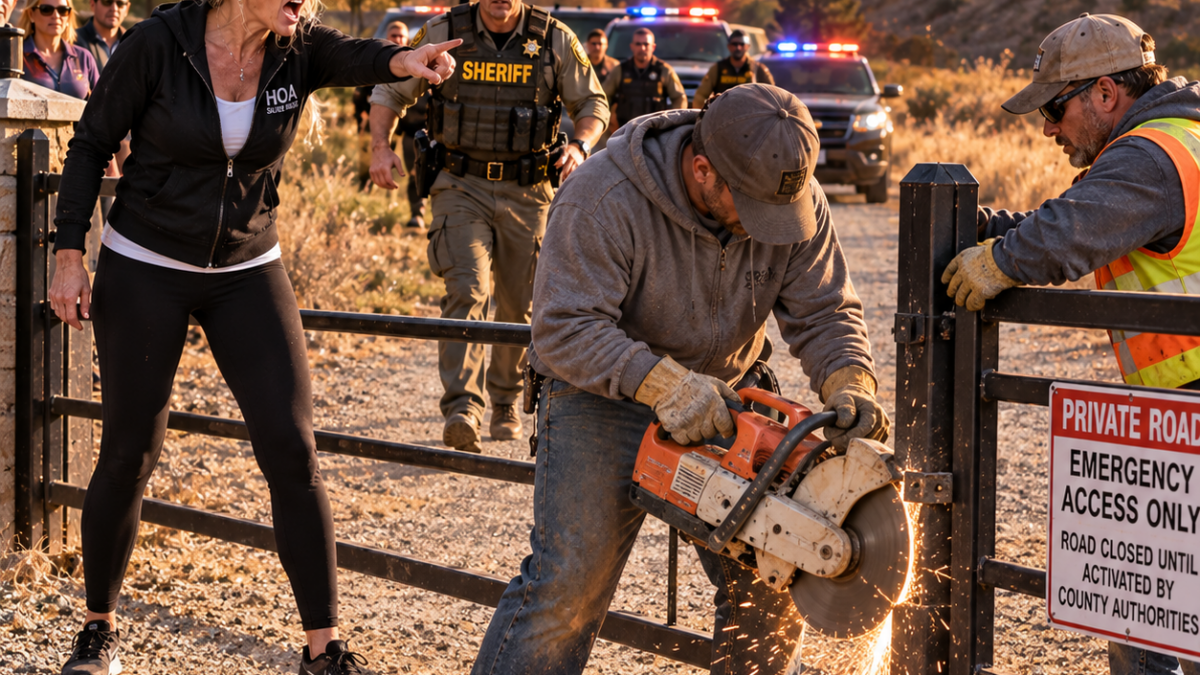
“Tear it down.”
The operator hesitated.
I stepped in front of the gate.
Rebecca’s advice about never physically blocking machinery disappeared from my mind.
“Nobody touches it.”
Vanessa shouted:
“You are endangering hundreds of people!”
“No.”
“You are.”
More residents arrived.
Someone filmed.
Martin Reeves pushed through the crowd.
“What the hell is going on?”
Vanessa pointed.
“He refuses to open.”
Martin looked at me.
“Sheriff activate?”
“No.”
He immediately understood.
“Then nobody moves.”
Vanessa spun.
“You don’t speak for the board.”
“I was a fire captain thirty-two years.”
“That doesn’t give you authority.”
“No.”
He pointed toward the gate.
“Neither does your HOA jacket.”
The skid-steer operator killed his engine.
Good man.
Vanessa stormed toward him.
“I hired you to remove it.”
He said:
“You told us county approval had been obtained.”
“It has.”
“Where?”
“Emergency authority.”
“From county?”
“From the association.”
He shook his head.
“Not touching sheriff equipment.”
Vanessa stared at the lock box.
Then something inside her broke.
She grabbed a heavy pry bar from the contractor truck.
Martin said:
“Vanessa.”
She marched toward the chain.
I stepped between.
“Don’t.”
“This road is opening.”
“Not like this.”
Then a sound came over the ridge.
Sirens.
Multiple.
Fast.
One sheriff SUV came first.
Then another.
Behind them, a fire battalion pickup.
Tom Alvarez’s vehicle slid to a stop on gravel.
He was out before the dust settled.
No greeting.
No explanation.
He took one look at the gathered cars.
The contractor.
The pry bar.
The gate.
Then at Vanessa.
His first question was:
“Who ordered this gate removed?”
Nobody breathed.
Vanessa still held the pry bar.
Tom looked at her.
“Ma’am?”
She lowered it.
“I did.”
“Why?”
“Because you haven’t opened the evacuation route.”
Tom stepped closer.
“We were three minutes from activating it.”
Vanessa opened her mouth.
He didn’t let her.
“Do you understand why this gate stays closed until deputies are positioned?”
“It was blocking people.”
“It was preventing uncontrolled traffic from meeting fire apparatus head-on.”
He pointed down the road.
“I have Engine 12, two water tenders, and a strike team coming inbound from County 88.”
Vanessa went pale.
“If fifty vehicles had entered that road ten minutes ago, where do you think my engines would go?”
Silence.
Tom turned to me.
“Gate functional?”
“Yes.”
“County lock?”
“Functional.”
“Good.”
Then radio.
“Mercer West Access ready. Begin protocol.”
Everything changed immediately.
Deputies positioned.
One at Silver Ridge gate.
One at County 88.
Fire crew placed cones.
Traffic direction established.
Outbound residents queued.
Inbound emergency lane kept clear.
Tom unlocked the chain.
Gate swung open.
Not torn down.
Opened.
Exactly the way it had been designed.
He looked at the waiting neighborhood.
“Single file.”
“No passing.”
“Windows up.”
“Headlights on.”
“Follow deputies.”
“If you stall, stay in vehicle unless instructed.”
Then to me:
“Nolan, can you ride lead to the first blind curve?”
“Yes.”
I knew every pothole.
Every narrow spot.
Every shoulder.
I drove my old pickup ahead of the first deputy.
Traffic followed.
At the first blind curve, I parked off-road.
Directed people wide.
Families passed.
Scared faces.
Dogs.
Kids.
Linda rolled down her window despite instructions.
“Thank you.”
I pointed forward.
“Keep moving.”
Then came the first engine inbound.
Massive red apparatus.
It passed cleanly in the protected lane.
That image destroyed Vanessa’s entire argument.
If residents had flooded the road early, that engine would have been trapped.
The evacuation worked.
One hundred sixty-three vehicles moved through in forty-seven minutes.
No collision.
No panic stop.
No blocked engines.
Fire crews entered continuously.
By 7:10, Silver Ridge was mostly empty.
Wind pushed the Willowbrush Fire north of the subdivision.
Embers crossed two ridgelines.
Crews defended structures.
My western pasture burned about twelve acres.
Fence posts gone.
Grass black.
No house damage.
Silver Ridge lost three detached sheds and one ornamental deck.
No homes.
No injuries.
Could have been worse.
Much worse.
At 10:30 that night, I stood beside Tom near the gate.
Smoke everywhere.
Ash in his hair.
Vanessa’s SUV was gone.
“What happens now?”
I asked.
“To the fire?”
“To her.”
Tom drank from a plastic water bottle.
“Tonight?”
“Nothing dramatic.”
“That seems disappointing.”
“We’re busy.”
“Fair.”
He looked at the damaged lock-box screws from the earlier incident.
“Tomorrow is different.”
The next morning, Silver Ridge residents started asking questions.
Not about me.
About Vanessa.
Why had she told them the route was open before county activation?
Why had she sent a neighborhood emergency message without sheriff authorization?
Why had she hired a contractor during a wildfire?
Why did her husband’s development company care so much about permanent western access?
Gary Moon requested records.
Vanessa refused.
The board removed her emergency communications access.
Then called counsel.
This time actual HOA counsel.
Not Mark Pike.
Emails surfaced quickly.
One from Mark to Vanessa three months earlier:
If permanent west access is established before our preliminary review, the county transportation objection gets a lot weaker.
Another:
Daily community use would help establish practical necessity.
And Vanessa:
Nolan will never volunteer. We need to stop treating his gate like sacred property.
Mark:
Do not damage county hardware.
Vanessa:
Then we remove the rest.
That one became important.
Another email sent the morning of the wildfire:
If Level 2 hits, that’s our cleanest opportunity. Nobody will argue against opening an evacuation route during an active fire.
Mark responded:
Wait for county activation.
Vanessa:
If county activates first, Nolan claims his system works.
There it was.
Not safety.
Narrative.
She wanted the gate gone before county activation so she could later claim that permanent open access had been necessary.
She needed the emergency to prove her position.
Instead, she nearly interfered with the emergency plan to create the proof.
The HOA attorney advised the board to preserve every device, email, and record.
Sheriff investigators interviewed Vanessa.
Then Mark.
Then the contractor.
The contractor produced text messages.
Vanessa had told them:
Sheriff approval expected—proceed under HOA emergency authority if delayed.
Expected.
That word cost her.
No approval existed.
The county fire review followed.
Not criminal at first.
Operational.
They reconstructed timing.
If the gate had been removed when Vanessa first ordered it, uncontrolled vehicles could have entered approximately eleven minutes before the inbound strike team reached the narrowest section.
Fire analysts modeled likely congestion.
Not to dramatize.
To understand.
Their conclusion was simple:
Premature uncontrolled civilian entry onto Mercer Road presented substantial risk of obstructing inbound emergency apparatus during the initial evacuation period.
That sentence did more damage to Vanessa than anything I said.
Because it wasn’t angry.
It wasn’t political.
It wasn’t personal.
It was operational.
The gate had worked.
Her interference had been dangerous.
The HOA called an emergency membership meeting four days after the fire.
I didn’t attend initially.
I wasn’t a member.
Then Gary called.
“We want you there.”
“Why?”
“Because half the neighborhood thinks we owe you an apology.”
“Half?”
“The other half thinks we owe you two.”
So I went.
The clubhouse smelled faintly like smoke because everybody’s clothes still did.
Vanessa sat at the front.
No HOA jacket.
Her attorney beside her.
Mark did not attend.
Gary opened.
He had become acting vice president after two resignations.
First item:
Emergency communication.
Second:
Unauthorized contractor engagement.
Third:
Conflict disclosure.
Fourth:
Presidential removal.
Linda Chen spoke first.
“I want to say something.”
Gary nodded.
Linda turned toward Vanessa.
“You told us Nolan was blocking our way out.”
Vanessa looked down.
“He wasn’t.”
Silence.
“You told us we would be trapped because one man controlled the gate.”
Nothing.
“The sheriff opened that gate in less than a minute once he arrived.”
Martin Reeves added:
“And because it stayed controlled, the engines got in.”
Someone clapped.
Gary stopped them.
“This isn’t a rally.”
Good.
Martin continued.
“I spent thirty-two years fighting structure and wildland fires.”
He looked around.
“People die in evacuations because fear makes traffic stupid.”
“No insult.”
“Just fact.”
“The Mercer route works because somebody controls direction.”
He looked at Vanessa.
“You almost turned a controlled emergency lane into a two-way panic road.”
Vanessa’s attorney whispered.
She finally spoke.
“I acted because I believed there was imminent danger.”
Linda said:
“We all believed there was danger.”
“That’s why we followed the plan.”
Then Gary produced the emails.
The room went completely silent when he read:
If county activates first, Nolan claims his system works.
Gary lowered the page.
“Vanessa.”
“Was protecting residents your goal?”
Her attorney objected.
“This is not a courtroom.”
Gary nodded.
“No.”
“It’s a board meeting.”
“Which is why she can choose not to answer.”
She didn’t.
The vote was forty-seven to six.
Vanessa Pike was removed as HOA president.
Three people abstained.
Mark Pike’s company withdrew its development application two weeks later.
Not voluntarily, exactly.
County planning had started asking how the proposed west connection relied on property they did not control.
The access assumption vanished.
Without it, road-improvement costs increased by nearly $2.4 million.
The project became financially unattractive.
Pike Development sold the thirty-six acres eighteen months later.
No subdivision.
No west entrance.
Just open hillside.
The criminal side was less dramatic than people expected.
Vanessa was cited for attempted criminal mischief related to the gate and later charged with a misdemeanor count tied to interference with emergency-management property.
Her attorney negotiated.
She pleaded to a reduced offense.
Fine.
Probation.
Community service.
No jail.
People online would probably complain.
I didn’t.
I had watched a wildfire come over a ridge.
That rearranges your appetite for spectacle.
Nobody died.
That was enough.
The HOA settled my civil claim separately.
They paid for damage from contractor staging.
Attorney fees.
Replacement of one gate hinge that had been bent during the attempted removal.
More importantly, the settlement contained something I insisted on.
A recorded acknowledgment.
Silver Ridge had no permanent access rights over Mercer Road.
The emergency easement belonged solely to the county under its existing terms.
No HOA officer could activate, alter, widen, remove, or otherwise interfere with the road or gate.
Simple.
Permanent.
Recorded.
Rebecca smiled when the document came back stamped.
“Happy?”
“Yes.”
“Really?”
“No.”
“What do you want?”
“Quiet.”
She laughed.
“Should’ve bought land farther away.”
The county improved the evacuation system the following spring.
Not because Vanessa had been right.
Because every emergency teaches you something.
They added a second lock box.
Reflective lane markers.
Two pull-off bays at wider portions of my road.
Radio repeater.
Better signage inside Silver Ridge.
Most importantly, they ran an actual evacuation drill.
No smoke.
No panic.
Deputies activated the gate.
Residents lined up by zone.
Traffic moved west.
Engines practiced inbound priority.
Total clearance time:
Thirty-nine minutes.
Better than the real fire.
Tom Alvarez stood beside me afterward.
“Not bad.”
“Would’ve been thirty-eight if Linda hadn’t stopped to yell hello.”
Tom smiled.
“She brought cookies.”
“Still.”
The new HOA president was Gary Moon.
He hated the job.
Ideal qualification.
His first newsletter included exactly three sentences about my road:
Mercer Road is private property subject to county-controlled emergency access. Residents are not authorized to enter except during official activation. Please direct evacuation questions to county emergency management.
No drama.
No accusation.
No photograph of my gate.
Beautiful.
Silver Ridge became a better neighbor afterward.
Not immediately.
Embarrassment makes people awkward.
For a few months, drivers avoided eye contact when I passed.
Then one family brought fence posts after the fire.
Another helped reseed my burned pasture.
Teenagers from the neighborhood came out one Saturday to pull melted plastic irrigation line.
Martin brought beer after.
Linda brought enough food to feed a fire crew.
I told her:
“You know this wasn’t your fault.”
She said:
“We let one person speak like she was all of us.”
That answer mattered.
Communities outsource attention.
It’s understandable.
People have jobs.
Children.
Bills.
Sick parents.
Nobody wants to read HOA bylaws after dinner.
So the loudest person says:
Trust me.
Most people do.
Until the loudest person is wrong with machinery behind her.
The residents weren’t responsible for Vanessa’s choices.
But after the fire, they stopped pretending governance was something that happened without them.
Meeting attendance doubled.
Then slowly declined again.
That was healthy.
Good boards are boring enough that people stay home.
My road stayed locked.
Exactly as before.
Occasionally someone asked whether I would consider opening it permanently now that Vanessa was gone.
My answer stayed no.
Not angrily.
No.
The route was narrow.
Wildlife crossed it.
My cattle used adjacent pasture.
Daily traffic would change my property permanently.
People respected that.
Funny how easy boundaries become once nobody’s trying to win.
A year after the wildfire, I replaced the old steel gate.
Not because Vanessa damaged it badly.
Because it was twenty-seven years old.
The new one was heavier.
Galvanized steel.
Powder-coated dark green.
Automatic swing mechanism rated for emergency use.
Battery backup.
County remote activation.
Mechanical override.
Tom joked:
“You building Fort Knox?”
“No.”
“Looks expensive.”
“It was.”
“Silver Ridge pay?”
“No.”
“Why not?”
“It’s my gate.”
He nodded.
That was the point.
The county retained emergency access.
I retained ownership.
Both could coexist.
People act as though cooperation requires surrender.
Usually it requires clarity.
At the dedication—
I hated calling it that, but county emergency management insisted on a small demonstration—
Vanessa did not attend.
She had sold her Silver Ridge house six months earlier.
Moved somewhere near Phoenix, according to Linda.
Mark and Vanessa separated after the failed development deal.
I heard that from people who enjoyed gossip more than I did.
I didn’t ask.
Then one afternoon, almost two years after the fire, I received a letter.
Handwritten.
No return name I recognized.
Inside:
Nolan,
I have rewritten this six times because every version sounds like an excuse.
I was wrong.
Not just about the gate.
About what authority meant.
I convinced myself that because I was responsible for the neighborhood, I was entitled to force solutions on people who had never given me authority over them.
During the fire, I was afraid.
But I was also desperate to prove that opening the road permanently had been right.
Those are not the same thing.
I understand now that I placed people at risk because admitting your system worked felt like losing.
I am sorry.
Vanessa.
I read it twice.
Then put it in a drawer.
For several weeks I did nothing.
Then I wrote back.
One sentence.
Thank you for saying it clearly.
Nothing about forgiveness.
Nothing about friendship.
No need.
Some apologies deserve acknowledgment without reunion.
That was enough.
Life returned to normal.
My favorite kind.
I repaired the burned pasture.
Rebuilt a section of fence.
Replaced two water trough lines.
The scrub oak came back.
Grass came back first.
Fireweed after.
By the second spring, black ground was difficult to find.
Land heals differently than people.
Faster in some places.
Slower in others.
Annie would have loved the wildflowers.
That thought hit me one morning so hard I had to sit on the tractor step.
Grief does that.
Three years.
Five.
Ten.
Doesn’t matter.
You can be thinking about hydraulic fluid and suddenly remember the exact way somebody tucked hair behind one ear.
I started talking to her out loud sometimes.
Not because I believed she answered.
Because silence gets heavy.
One evening I stood at the gate after checking the lock box.
“Annie would’ve hated Vanessa,” I told the empty road.
Then corrected myself.
“No.”
“She would’ve invited her for coffee.”
That was true.
Annie believed most difficult people needed one person willing to ask what they were afraid of.
I was less ambitious.
Still, Vanessa’s letter taught me something.
During the wildfire she had been afraid.
So had I.
Fear didn’t excuse what she did.
But fear had mixed with pride.
That was the dangerous part.
People make bad decisions under pressure.
People make catastrophic decisions when pressure combines with a need to prove they were right.
The gate became famous locally for a while.
News stations used footage.
“PRIVATE GATE AT CENTER OF EVACUATION DISPUTE.”
The sheriff’s question made the clip.
“Who ordered this gate removed?”
People loved it.
Short.
Dramatic.
Easy.
But the question I remembered most came later.
After the evacuation.
After dark.
Tom standing beside me near the open gate.
Smoke behind him.
He asked:
“Why didn’t you just unlock it yourself when Level 2 came?”
That was the real question.
I answered:
“Because it wasn’t time.”
“But people were scared.”
“I know.”
“You could’ve opened it.”
“I know.”
“Why wait?”
“Because the plan said wait.”
Tom nodded.
Exactly.
That sounds boring.
Maybe even rigid.
But emergency plans exist precisely because fear makes improvisation attractive.
At 5:40, opening early felt compassionate.
Let people go.
Why stop them?
Because four fire engines were coming the other direction.
Because narrow roads don’t care about good intentions.
Because ten independent decisions can create one shared disaster.
Discipline often looks cruel until the reason arrives.
Then everyone calls it obvious.
That lesson followed me.
I served on the county wildfire advisory committee for two years.
Against my better judgment.
Meetings.
Maps.
Fuel breaks.
Evacuation zones.
Insurance.
Emergency alerts.
Most of it boring.
Important.
One evening, a newer subdivision representative suggested leaving all evacuation gates permanently open during fire season.
“More access is always safer.”
Martin Reeves, now sitting beside me, whispered:
“Here we go.”
I raised my hand.
“More controlled access is safer.”
The representative disagreed.
I asked:
“Two-way road?”
“Yes.”
“Narrow?”
“Some sections.”
“Emergency ingress?”
“Yes.”
“Then open doesn’t automatically mean safe.”
He looked at me.
“You’re the Mercer gate guy.”
Unfortunately.
People knew the story.
“Yeah.”
He smiled.
“Guess you would say that.”
I answered:
“I say it because I watched a fire engine pass fifty feet from a line of evacuating families on a road that would’ve been blocked if everybody left five minutes earlier.”
He stopped smiling.
Plans improved.
Not because I was brilliant.
Because mistakes became examples.
That’s one decent thing you can do with a bad day.
Use it.
Silver Ridge eventually bought its own emergency generator.
Removed ornamental juniper near the entrance.
Widened the eastern shoulder.
Created zone captains.
Installed better address markers.
All the recommendations Vanessa had ignored while obsessing over my gate.
Irony again.
Real safety came from boring improvements.
Not dramatic control.
Gary called once after a drill.
“You realize if Vanessa had just done the consultant’s list, she’d probably still be president.”
“Maybe.”
“All that over one gate.”
“No.”
“What then?”
“Over being told no.”
He went quiet.
“Yeah.”
That’s what it had always been.
Not transportation.
Not wildfire.
Not even Mark’s development land at first.
A woman asked for something.
A stranger said no.
Instead of treating no as information, she treated it as defiance.
Everything after that grew from one refusal she believed she had the authority to erase.
I kept the original gate section after replacement.
Same way some people keep old barn wood.
Steel frame.
Dented hinge.
Scratches near the chain.
I leaned it against the back of the equipment shed.
My nephew asked why.
“History.”
“That’s junk.”
“History often is.”
Years later, he helped me turn a section of it into a bench.
We cut one horizontal rail.
Welded legs.
Added cedar slats.
Set it near Prairie Overlook where Annie used to watch sunsets.
On the underside of the steel, I left the old warning sticker:
EMERGENCY ACCESS ONLY.
It amused me.
A gate that once existed to stay closed had become a place to sit.
One September evening, Linda Chen came by.
She had moved out of Silver Ridge but still lived nearby.
She sat on the gate bench.
“That’s poetic.”
“No.”
“It absolutely is.”
“It’s scrap metal.”
She smiled.
“Men are terrified of symbolism.”
“Correct.”
We watched sunset.
After a while she said:
“You know what I remember about the fire?”
“What?”
“Not the flames.”
“What then?”
“Sitting in my car behind the gate.”
I looked at her.
“Thinking you hated us.”
“I didn’t.”
“I know that now.”
She continued.
“When Vanessa kept saying you were trapping us, I believed some of it.”
“Then when the sheriff opened the gate, I saw you standing on the first curve directing everyone.”
She shook her head.
“I felt embarrassed.”
“You were evacuating.”
“Still.”
“Linda.”
She looked at me.
“You didn’t owe me an opinion.”
“You owed yourself a safe route.”
She smiled.
“That sounds like Annie.”
I had talked about my wife enough that Linda knew.
“Annie would’ve said it nicer.”
“Probably.”
The road still activates occasionally.
Two fires.
One landslide at the eastern entrance.
Once after a propane truck overturned.
Same process every time.
County calls.
Deputy opens.
Traffic one way.
Emergency equipment protected.
Then gate closes.
People go home.
Nobody argues.
Children who were ten during the Willowbrush Fire became teenagers who barely remembered Vanessa Pike.
Good.
Communities should outlive their worst leaders.
One of those children, a boy named Noah Chen—Linda’s grandson—became a volunteer firefighter.
At nineteen, he drove an engine through my gate during a training exercise.
He stopped afterward.
“Mr. Mercer?”
“Nolan.”
He pointed at the road.
“Grandma told me the whole story.”
“I’m sorry.”
He laughed.
“She says this gate saved everybody.”
“No.”
He looked confused.
“The system did.”
“Difference?”
“Big one.”
I pointed down the road.
“Gate alone is just steel.”
“Deputies.”
“Dispatch.”
“Fire crews.”
“Drivers following instructions.”
“County planners who designed the route.”
“Residents who stayed in line.”
“All of it.”
Noah nodded.
“So nobody’s the hero.”
“Now you’re getting it.”
People like heroes because heroes simplify responsibility.
One good guy.
One bad guy.
Easy.
Reality is networks.
Plans.
Failures.
People correcting failures.
Vanessa made a dangerous choice.
The contractor refused to execute it.
Martin spoke up.
Linda called me.
Gary exposed records.
Sheriff arrived.
Residents followed traffic control.
Any one of those steps could have gone differently.
Safety is often a chain.
No single link gets to brag too much.
When I turned seventy, I transferred most of the acreage into a conservation trust with my niece and nephew as eventual stewards.
The road stayed private.
Emergency easement stayed.
County agreement updated.
Gate replaced again.
Technology changes.
Boundaries remain.
During the legal review, a young county lawyer asked:
“Why not deed the road to the county and simplify everything?”
“Because I don’t want a public road.”
“Emergency access would be easier.”
“For you.”
He smiled.
“Fair.”
“We already have a system.”
“It works.”
“Then don’t fix what isn’t broken.”
He signed the renewal.
I thought of Vanessa.
The temptation to simplify other people’s property is powerful.
Your solution always looks cheap when somebody else pays for it.
That was the core.
Silver Ridge wanted convenience.
Pike Development wanted value.
Vanessa wanted control.
My land absorbed the cost.
Traffic.
Dust.
Liability.
Noise.
Maintenance.
Lost privacy.
Once you frame somebody else’s sacrifice as “community benefit,” it becomes easy to forget they are still sacrificing.
My father taught me a version of that before I understood property.
He used to borrow tools from neighbors.
Always returned them cleaner.
Why?
“Because borrowed convenience belongs to you.”
“What?”
“If someone makes your life easier, don’t make theirs harder.”
Simple.
I wish HOA boards put that on walls.
At seventy-two, I finally sold the cattle.
Kept the land.
Too old for winter calving.
Smart enough to admit it.
The barn became storage.
Fields leased.
I spent more mornings drinking coffee than repairing fences.
Wonderful.
One November morning, a young couple from Silver Ridge walked up to the gate.
They had moved in recently.
Didn’t know the story.
The man pointed.
“Hi.”
“Morning.”
“We saw this road on the emergency map.”
“Yep.”
“Can residents hike on it?”
“No.”
He looked disappointed.
“Why not?”
“Private property.”
His wife elbowed him.
“Sorry.”
“No problem.”
Then he asked:
“Does it really open in emergencies?”
“Yes.”
“How?”
“Sheriff.”
“Oh.”
He nodded.
“That makes sense.”
And they walked away.
That interaction lasted thirty seconds.
No newsletters.
No attorneys.
No contractors.
No wildfire.
Just question.
Answer.
Respect.
I stood there smiling like an idiot.
Apparently civilization can work.
The old signs remain.
PRIVATE ROAD.
EMERGENCY ACCESS ONLY.
ROAD CLOSED UNTIL ACTIVATED BY COUNTY AUTHORITIES.
Every few years I repaint the lettering.
People ask why not install newer signs.
Reflective aluminum.
Cleaner.
I have those too.
But I keep one old wooden sign near the gate.
Weathered.
Cracked.
Because it was there that evening when Vanessa pointed at the steel and screamed:
“Tear it down.”
It was there when smoke came over the ridge.
There when neighbors lined up.
There when Tom Alvarez arrived and asked:
“Who ordered this gate removed?”
There when the road opened.
There when the fire engines came through.
And there when the last family drove safely out.
The gate was never about keeping Silver Ridge trapped.
It was about making sure that when everybody needed the road at once, the road still worked.
Vanessa saw a barrier.
The county saw a control point.
I saw my property.
All three were true.
The disaster almost happened because Vanessa believed only her version mattered.
That is the part worth remembering.
Not every locked gate is cruelty.
Not every open gate is freedom.
Not every person who says no is refusing to help.
Sometimes no means:
Not yet.
Not this way.
Not without a plan.
And sometimes the safest thing in front of two hundred frightened people and a wall of smoke is one stubborn piece of steel staying exactly where it belongs until the sheriff arrives with the key.








