HOA Karen Kicked Over My Trash Can 17 Times—So on Her 18th Visit, Four Cameras Caught the One Thing She Never Expected.
PART3:
Melissa would have approved.
Most of the neighborhood felt like that at first.
People waved.
A couple brought banana bread.
Someone offered me the number for a reliable HVAC technician.
For maybe three weeks, I believed I had made the right choice.
Then I met Patricia Vance.
She drove a white Lexus SUV with a vanity plate that said PRSDNT.
Not PRESIDENT.
PRSDNT.
Apparently vowels were optional when announcing status.
She was fifty-eight, with blonde highlights trying hard to hide dark roots, knockoff Gucci sunglasses, and velour tracksuits in colors that looked selected by casino carpet designers.
Purple.
Emerald.
Ruby red.
She patrolled the neighborhood every morning between 6:30 and 7:30.
Slow.
Window down.
Clipboard in hand.
Sometimes she actually carried a ruler.
I thought Darnell was joking when he told me that.
He was not.
Patricia measured grass.
She measured driveway encroachment.
She measured the distance between decorative objects and sidewalks.
Her husband, Eugene, was almost invisible.
Commercial real estate broker.
Semi-retired.
The few times I saw him, he looked like a man who had been apologizing for something for twenty years.
Patricia was different.
Pine Haven was not simply where she lived.
Pine Haven was her jurisdiction.
Third term as HOA president.
Nobody ran against her.
At first, I assumed people liked her.
Later, I discovered something worse.
People were tired.
My first violation arrived during week three.
An envelope tucked into the front door.
UNAUTHORIZED DECORATIVE ROCK BORDER.
Section 4.7.3B.
Fine: $150.
I stared at the paper.
Then at the yard.
The “unauthorized border” consisted of three-inch river stones placed around an agave plant.
They had been there when I bought the house.
I walked the neighborhood after dinner.
Six houses had nearly identical borders.
Patricia’s house had one too.
I photographed them.
Then emailed the board.
Polite.
Professional.
No anger.
I attached the photographs.
Patricia replied forty-seven minutes later.
Previous violations do not excuse current noncompliance. Fine stands. Remove within ten days or additional $50 daily penalties will accrue.
I read it twice.
Then called Rochelle.
“She fined me for rocks.”
“That sounds important.”
“Patricia has the same rocks.”
“Take pictures.”
“Already did.”
“Of course you did.”
“What do I do?”
“Depends how much you want to spend arguing about rocks.”
That was the calculation Patricia relied on.
One hundred fifty dollars.
Two hundred to re-landscape.
Maybe fifteen hundred to have an attorney write letters.
Most rational people choose the two hundred.
So did I.
I removed the stones.
Paid the fine.
And taught Patricia the worst possible lesson.
That I would comply to avoid conflict.
Three weeks later came the trash can.
Tuesday morning.
I was in the shower when I heard something slam outside.
Loud enough to make me shut off the water.
I walked out in a towel.
My ninety-five-gallon trash bin was on its side.
Garbage everywhere.
Banana peel on the hood of my truck.
Coffee grounds across the concrete.
Eggshells in the gutter.
A grocery bag caught in a cactus.
I stood there wondering how hard the wind had been.
Then I realized there was no wind.
Dead calm.
Not one branch moving.
Darnell came around the corner with his dog.
“Again?”
“What do you mean again?”
He looked at the mess.
“Third house this month.”
“Wind?”
“On three calm Tuesday mornings?”
He bent down and picked up a yogurt container.
“Weird, right?”
I filed it away.
That is what engineers do with weird things.
We do not immediately assign meaning.
We collect data.
The following Tuesday, I set an alarm for 6:30.
I sat near the bedroom window drinking coffee.
At 6:47, Patricia’s white Lexus rolled past.
Slow.
She looked toward my driveway.
Kept moving.
The bin remained upright.
I almost felt embarrassed.
Maybe I was turning into the suspicious old widower everyone warned me not to become.
The next Tuesday, I overslept.
Seven o’clock.
I walked outside.
Garbage explosion.
Again.
This time, coffee grounds covered enough concrete to preserve a partial shoeprint.
Small.
Women’s athletic shoe.
Waffle tread.
Size seven or eight.
I crouched over it.
Then remembered Patricia’s morning patrol.
Her sneakers.
Her tracksuits.
Her timing.
I stood there under the Arizona sun thinking about Melissa.
She had spent two years fighting cancer and rarely complained.
I was spending twenty minutes every Tuesday picking eggshells out of gravel because I was afraid of creating neighborhood drama.
That irritated me.
So I bought a Ring camera.
Ninety-nine dollars.
Home Depot.
Installed it myself.
Most people would have mounted it in twenty minutes.
It took me two hours.
Angle mattered.
Lighting mattered.
Street coverage mattered.
Motion zones mattered.
I ran tests.
Walked the driveway from every direction.
Adjusted again.
Darnell watched from across the street.
“You protecting Fort Knox?”
“Field of view was bad.”
“You’re filming garbage.”
“I’m filming a pattern.”
He laughed.
“You really are an engineer.”
Tuesday.
6:47 a.m.
My phone buzzed.
Motion alert.
I was standing in the kitchen.
I opened the live feed.
Patricia.
Powder-blue velour.
Sunglasses.
She had parked one house away outside the main camera zone.
Smart.
She walked toward my driveway.
Looked left.
Looked right.
Not casually.
Theatrically.
Like somebody in a cheap burglary movie.
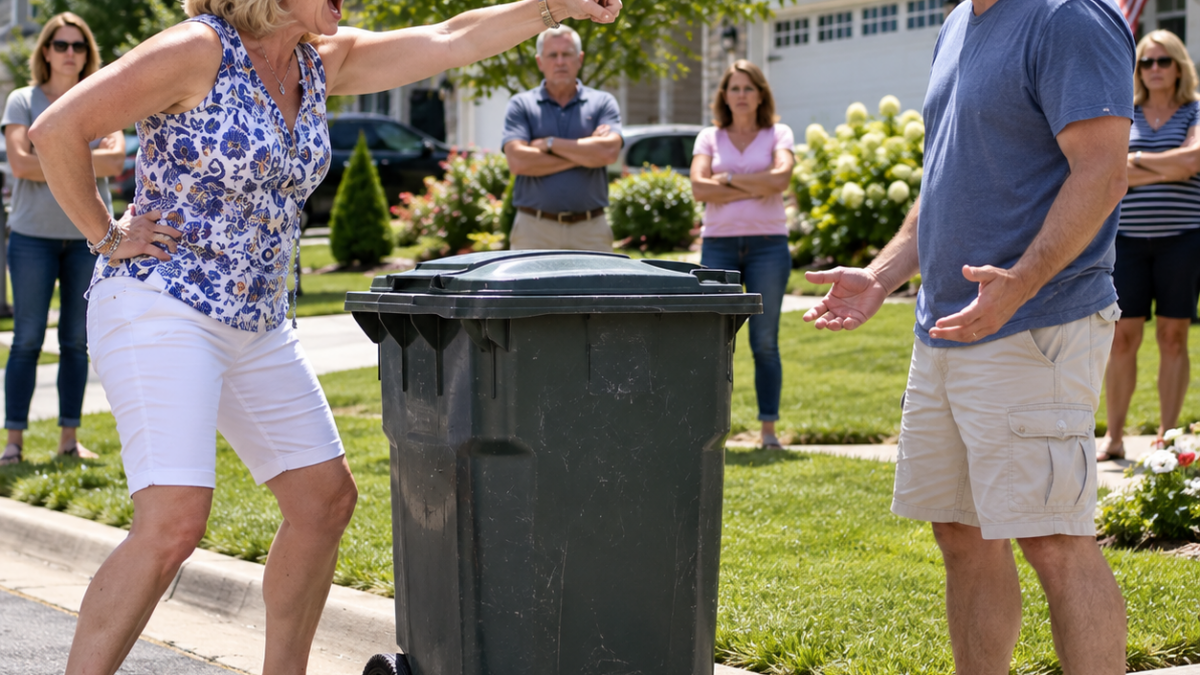
Then she planted one sneaker against the bottom edge of my trash bin and kicked.
The bin rocked.
She kicked again.
Harder.
Nothing.
Third kick.
The bin tipped.
Garbage spilled across my driveway.
Patricia smiled.
Not embarrassed.
Not nervous.
She grinned.
Then she walked back to her Lexus and drove away.
Ninety seconds.
Beginning to end.
I watched the clip three times.
Then backed it up.
Cloud.
External drive.
DVD.
Triple redundancy.
Pipeline safety habit.
If evidence exists in one place, evidence does not exist.
At three that afternoon, I carried my laptop to Patricia’s house.
She answered wearing purple velour and holding a glass of white wine.
Three o’clock.
I turned the screen around.
“I have video of you kicking over my trash can.”
She barely looked.
Took a sip.
“That’s a serious accusation.”
“It’s video.”
“Time stamps can be manipulated.”
“It’s your face.”
She smiled.
“Your bin was three inches over the easement.”
“What?”
“Section 6.2.”
“You kicked it over to correct an easement violation?”
“I corrected improper placement.”
“You spread garbage across my property.”
“Maybe you should position your waste receptacle appropriately.”
I stared at her.
“Are you hearing yourself?”
Her smile disappeared.
“Are you calling me a liar?”
“I’m calling what you did vandalism.”
Her eyes went cold.
“I’ve lived here nine years, Garrett. I know every property line, every rule, and every enforcement procedure.”
“Then you know you don’t get to kick over garbage cans.”
“Maybe spend less time manufacturing fake videos and more time complying with community standards.”
She closed the door.
I stood there for a moment.
Then I heard her voice through the wall.
She was on the phone.
“Another whiner who can’t handle basic rules.”
A laugh.
“New people are exhausting.”
The next morning, three violation notices appeared on my door.
Garage door open past 8:00 a.m.
One hundred dollars.
Irrigation overspray.
One hundred fifty.
Navy-blue bedroom curtains visible from street instead of approved beige.
Two hundred.
Total: four hundred fifty dollars.
I pulled out the seventy-three pages of CC&Rs.
Penalty schedule.
First offense maximum: fifty dollars.
I checked three times.
Then checked amendment records.
No change.
Patricia had tripled or quadrupled fines because she apparently expected nobody to read.
I started a spreadsheet.
Date.
Alleged violation.
Rule cited.
Permitted penalty.
Actual penalty.
Comparable properties.
Photographic evidence.
That same evening, Darnell found me near the side fence. His mesquite grill smoked behind him.
“On the list now?”
“What list?”
“Patricia’s.”
He flipped ribs.
“Last year it was the Kowalskis.”
“What happened?”
“Their son played basketball too late.”
“So?”
“So she fined them.”
“How much?”
“Enough.”
He stopped smiling.
“They sold.”
“That sounds extreme.”
“Seven families in three years.”
I looked at him.
“Seven?”
“People get tired. She schedules meetings at two in the afternoon when working homeowners can’t show. Eugene rubber-stamps everything. Shelly and Carmela vote with her. People pay because fighting costs more.”
He turned the meat.
“Patricia has the only key to the HOA bank records anyone ever sees.”
“That legal?”
“Ask her.”
I did not.
Not yet.
Rochelle came for dinner.
I spread the notices across my table.
She read them.
Then read the CC&Rs.
“These amounts don’t match.”
“I know.”
“First offense caps.”
“I know.”
“She’s betting nobody checks.”
“That’s what I thought.”
Rochelle looked at me.
“You want advice?”
“Always.”
“Stop trying to win individual arguments.”
“What?”
“Build the pattern.”
She tapped the papers.
“Every notice. Every inconsistency. Every person treated differently. Every meeting. Every request. Make the case before she realizes there is one.”
Paper trails win wars.
I liked that.
The next morning, I drove Pine Haven.
Nine homes with dark curtains.
Twelve garages open past eight.
Patricia’s sprinklers sent water across the sidewalk every Tuesday and Friday.
Photograph.
Timestamp.
Location.
Comparison.
Then Tuesday came again.
6:47.
Patricia walked up.
Looked directly into my camera.
Waved.
Then kicked the bin.
Fourth recorded incident.
This time, she opened the lid before tipping it.
Rummaged through the top bag.
A few envelopes slid out.
She picked up one piece of mail.
Dropped it into the gutter.
I saved everything.
Called police.
Officer Luis Gutierrez arrived an hour later.
Thirty-five.
Solid build.
Calm voice.
He watched the clip.
Then watched it again.
“Your HOA president?”
“Yes.”
“She does this every Tuesday?”
“So far.”
He shook his head.
“This is trespassing. Vandalism. Mail issue gets more complicated depending on what exactly she touched and where.”
“So you arrest her?”
He gave me the kind of look professionals use when reality is less satisfying than expectation.
“I can make the report.”
“That’s it?”
“I’m not saying nothing can happen. I’m saying neighborhood disputes often get treated as civil until conduct escalates.”
He handed me a card.
“Keep documenting.”
“That seems to be everyone’s advice.”
“It’s good advice.”
He smiled slightly.
“My mother lives in an HOA in Scottsdale. President makes her life miserable over a bird feeder.”
“Maybe we should start a club.”
“Probably already exists.”
After he left, I opened Facebook and created a private group.
PINE HAVEN ESTATES HOMEOWNERS UNOFFICIAL.
First post:
New here. Having issues with selective violation enforcement. Anyone else?
Two days.
Seventy-three members.
That was twenty-one percent of the neighborhood.
Stories appeared immediately.
Tamara Ochoa.
Eight-hundred-dollar fine for a basic play structure.
Patricia made her remove it.
Brian Whitmore.
Plumber.
Work truck citation for commercial signage.
Eugene Vance parked a company-branded F-150 in his own driveway every night.
The Fenstermachers.
Late seventies.
Twelve-hundred-dollar fine for a dead tree.
Except the tree was not dead.
Dormant.
HOA placed a lien anyway.
Darnell.
Two-inch flag sticker on mailbox.
Violation.
Patricia’s mailbox had custom gold lettering.
VANCE ESTATE.
I expanded the spreadsheet.
Thirty-four households.
Two years.
Forty-seven thousand dollars in documented fines.
Then I did another calculation.
Three hundred forty homes.
Two hundred eighty-five dollars monthly.
Times twelve.
Over one million dollars every year.
Community pool pump had been broken for three months.
Landscaping was dying.
Clubhouse roof leaked.
Where was the money?
Pipeline projects taught me one thing.
When inputs stay high and visible outputs keep shrinking, follow the missing volume.
Money works the same way.
I sent a certified request for financial statements.
Bank records.
Meeting minutes.
Contracts.
Supporting invoices.
The governing rules and state provisions Rochelle identified required access within a set period.
Day ten.
Nothing.
Day fifteen.
Email from Patricia.
Request being processed. $50 administrative processing fee required.
I reread the records language Rochelle had sent me.
No such fee.
I replied with citation.
Patricia responded within five minutes.
Your interpretation is incorrect. Records will not be released until payment.
I called my daughter.
Simone.
Twenty-seven.
Air Force JAG attorney stationed in Germany.
Video call.
She appeared in uniform with coffee.
“What did she do now?”
I explained.
Simone stared at the screen.
“Dad.”
“Yes?”
“She’s violating the access requirement and daring you to challenge her.”
“That’s my understanding.”
“You want me to draft something?”
“Can you?”
“She’s messing with my father.”
I smiled.
“That a legal standard?”
“It is now.”
Three days later, Patricia received a formal demand letter.
Records.
Cease retaliatory fines.
Preserve documents.
Written response within seventy-two hours.
I expected anger.
Maybe compliance.
Instead, she went nuclear.
Emergency board meeting.
Forty-eight-hour notice.
Wednesday.
Two p.m.
Agenda item:
MEMBER GARRETT HOLLINS — CONTINUED VIOLATIONS, HARASSMENT OF BOARD PRESIDENT, POSSIBLE PRIVILEGE SUSPENSION.
Eleven homeowners attended.
I brought Rochelle.
Recorded everything.
Patricia stood in front of the clubhouse.
“Mr. Hollins has engaged in harassment.”
“How?”
“Frivolous legal threats.”
“I requested financial records.”
“Unauthorized communications.”
“What does that mean?”
“Organizing dissent through unofficial social media.”
I looked around.
“You mean homeowners talking to one another?”
She ignored me.
Her proposal was simple.
Suspend my pool and clubhouse privileges.
Double existing fines.
Authorize lien if unpaid after thirty days.
She asked for discussion.
None from Shelly.
None from Carmela.
Then vote.
Three hands.
Patricia.
Shelly.
Carmela.
“Motion carries.”
Rochelle grabbed my arm as we walked outside.
“She just made a huge mistake.”
“She won.”
“No.”
“She doubled the fines.”
“She also retaliated publicly right after a lawful records request, rushed notice, and recorded the entire thing for us.”
She smiled.
“Stop looking at moments. Look at sequence.”
That night, Darnell handed me a business card.
“My buddy Clayton works at county recorder.”
“What am I looking for?”
“Patricia.”
“And Eugene?”
“Especially Eugene.”
Saturday morning, Rochelle and I drove to the recorder’s office.
Gray building.
Bad fluorescent lights.
Old carpet.
Public terminals that looked old enough to vote.
We searched Patricia and Eugene Vance.
Their house.
Purchased in 2009 for three hundred eighty-five thousand.
Estimated current value around five twenty.
Two liens.
Combined approximately eighty-nine thousand.
One from a HELOC.
One from Sunset Credit Solutions.
Then Eugene’s commercial properties.
Three strip malls bought before the market crash.
Heavy debt.
Poor valuations.
Financial strain.
Interesting.
Then HOA foreclosure records.
Eight properties with liens in eighteen months.
Two homes foreclosed.
I stared at those documents.
“HOAs can do that?”
“In some circumstances,” Rochelle said. “The question is whether these circumstances were legitimate.”
We traced buyers.
First foreclosed home sold for one hundred twenty thousand.
Buyer:
VPS Holdings LLC.
Second:
One hundred forty thousand.
Same buyer.
Both resold within six months.
Four hundred eighty thousand.
Five hundred ten thousand.
Rochelle leaned closer.
“Who owns VPS?”
Clayton showed us the registration.
Eugene Vance.
We sat in my truck afterward.
Air conditioning blasting.
Documents across the dashboard.
Rochelle went quiet.
Then said, “This is a scheme.”
“Explain.”
“Patricia buries homeowners in fines.”
“Then?”
“HOA liens.”
“Then foreclosure.”
“Then Eugene’s LLC buys cheaply.”
“Flips.”
“Exactly.”
“How illegal?”
“Depends on the evidence, procedure, disclosures, conflicts, whether fines were legitimate, whether bids were manipulated. But combined with association money going missing?”
She looked at me.
“We need the books.”
I thought about Patricia kicking my trash can.
Her grin.
All of it suddenly seemed small.
Petty cruelty often is small.
What matters is what it reveals.
Before we tackled the finances, though, I had one Tuesday problem left.
The trap.
I want to be clear about something.
I did not build anything designed to hurt Patricia.
No wire.
No collapsing mechanism.
No projectile.
No electrification.
Nothing dangerous.
The point was to make the bin impossible to kick over and capture evidence so clear that she could not call it fake.
Sunday afternoon, Darnell helped.
We dug a three-foot hole beside my driveway.
Arizona caliche fought us like concrete.
Pickaxes.
Shovels.
Sweat.
Dust.
Darnell stopped after twenty minutes.
“I retired so I wouldn’t do this.”
“You brought the shovel.”
“Bad judgment.”
We poured a heavy concrete pier and bolted an identical ninety-five-gallon trash bin to the top.
From the street, normal trash can.
Underneath?
Not moving.
Second camera disguised near a sprinkler head.
Wide-angle.
Infrared.
Audio.
Motion light.
I also installed a harmless air horn.
Then the part Darnell loved.
Food-safe organic Holi powder.
Purple.
Patricia’s favorite color.
A small bag was positioned so that when someone deliberately forced the bin beyond its normal range, the mechanism would release the powder.
No explosive charge.
No dangerous chemical.
A pressure-triggered release.
Messy.
Embarrassing.
Safe.
Darnell stood back.
“You booby-trapped a trash can.”
“I instrumented a test fixture.”
“You’re insane.”
“Engineering terminology matters.”
Tuesday.
6:46.
I sat in the kitchen.
6:47.
Motion alert.
Patricia approached on foot.
Powder-blue velour.
Sunglasses.
She had started parking around the corner.
Smart enough to adapt.
Not smart enough to stop.
She looked left.
Right.
Approached the bin.
Kicked.
Nothing.
Her face changed.
Confusion.
She kicked harder.
Nothing.
She shook her foot.
Apparently hurt.
Then she bent down.
Grabbed the handle.
Pushed.
The spotlight snapped on.
The air horn blasted.
Patricia screamed.
The bag released.
Purple powder erupted across her white shirt, face, and hair.
She stumbled backward into my grass.
Coughed.
Looked down at herself.
Then screamed again.
Not fear.
Rage.
She ran toward her car.
Purple footprints followed.
I sat at the kitchen table laughing harder than I had laughed since Melissa died.
That realization stopped me.
For one second, guilt.
Then another thought.
Melissa would have found this hilarious.
I saved the footage.
Every angle.
Timestamp.
Audio.
That afternoon, I posted a forty-five-second clip to the private homeowners group.
Caption:
When petty tyranny meets basic physics. No bylaws harmed.
The group exploded.
One hundred forty comments.
People shared it beyond the private group.
Phoenix neighborhood pages picked it up.
A local newspaper blog mentioned:
HOA PRESIDENT CAUGHT IN BIZARRE TRASH CAN INCIDENT.
Patricia sent a neighborhood-wide email the next morning.
Subject:
DANGEROUS BOOBY TRAP SAFETY ALERT.
She claimed I had installed a hazardous chemical device.
Potential threat to children.
Demanded five thousand dollars.
Removal.
Urgent care reimbursement.
Foreclosure threat within seven days.
The private group jumped to one hundred twenty-seven members.
At the next board meeting, fifteen people came.
Patricia looked furious.
Residents demanded answers.
Why was she on my property?
Why was she kicking the bin?
Why were financial records being withheld?
Why were violations selective?
Patricia snapped.
“I don’t have to explain myself to people who don’t understand community governance.”
Darnell said, “You’re president. Explaining yourself is the job.”
Patricia pointed at him.
“If you don’t like it, run against me.”
Then she looked around.
“Oh, wait. None of you will because you’re all too lazy.”
Silence.
She realized too late what she had said.
“Meeting adjourned.”
She stormed out.
That night, Tamara called.
“I’m an accountant.”
Brian called.
“I’ll organize a recall.”
Darnell knocked on my door.
“I’ll canvass.”
The Pine Haven Accountability Committee existed by midnight.
Then Patricia filed a police report against me.
Assault with hazardous substance.
Harassment.
Cyberbullying.
Officer Gutierrez returned.
Watched the full video.
Inspected the bin.
Looked at my receipt for food-safe cornstarch color powder.
Then sighed.
“She walked onto your property?”
“Yes.”
“Deliberately tried to move the bin?”
“Yes.”
“After prior reports?”
“Yes.”
He rubbed his forehead.
“Garrett.”
“What?”
“I’m not arresting you for throwing party powder on someone who trespassed to knock over your trash.”
“Good.”
“You could pursue the vandalism complaints.”
“I don’t want this to be about trash cans.”
He looked toward the house.
“Probably bigger than trash cans now.”
He had no idea.
Three days later, Sanderson & Briggs sent a cease-and-desist letter.
Remove video.
Pay five thousand dollars.
Threatened fifty-thousand-dollar lawsuit.
Simone called it intimidation.
Rochelle called it desperation.
I called it another document for the binder.
Then Patricia finally released partial financial records.
Heavily redacted.
Tamara came Sunday morning.
Laptop.
Yellow highlighter.
Coffee.
She worked for almost an hour without speaking.
Then she said, “Garrett.”
“What?”
“Come here.”
I sat beside her.
She turned the spreadsheet.
“Three hundred forty homes times two eighty-five times twenty-four months.”
“About two point three million over two years.”
“Correct.”
She pointed at the partial records.
Association income.
Fines.
Expenses.
Insurance.
Landscaping.
Pool service.
Administrative charges.
Some numbers were redacted.
Others inconsistent.
Tamara reconstructed what she could.
When she finished, she leaned back.
“Approximately three hundred thirty-three thousand dollars isn’t properly accounted for.”
I stared.
“Missing?”
“Unexplained based on what they released.”
She highlighted quarterly payments.
Vance Property Solutions.
Eight thousand five hundred every three months.
“What is that?”
“Management services.”
“Patricia says the HOA self-manages.”
“Exactly.”
Then she found payments to Sunset Credit Solutions.
Twenty-five thousand.
Thirty thousand.
Twenty-two thousand.
Same creditor holding a lien against Patricia and Eugene’s house.
Tamara went quiet.
“This looks bad.”
“How bad?”
“If association money paid their personal creditor, very bad.”
Rochelle arrived with foreclosure documents and laid them beside the financial printouts.
Kowalski.
Patel.
Fine escalation.
Lien.
Foreclosure.
Purchase by VPS Holdings.
Resale.
Profits approaching six hundred thousand combined.
The three of us sat there.
Cold coffee.
Printer toner.
Sunday silence.
Outside, sprinklers hissed.
Rochelle said, “She targets people who won’t fight.”
Tamara nodded.
“New homeowners. Elderly residents. Immigrant families.”
I thought about Mrs. Kapoor.
Her marigolds.
The Fenstermachers.
Darnell.
The Kowalskis.
“You think this is enough for prosecutors?”
“Enough to report,” Rochelle said. “Not enough for us to declare guilt.”
Good answer.
“Then we report.”
Tamara hesitated.
“Immediately?”
I looked at the annual meeting date on my calendar.
Three weeks.
“If we quietly hand this over now, Patricia calls it personal revenge.”
Rochelle understood.
“You want residents to see the documents.”
“I want accountability before she can isolate everybody again.”
The recall petition required eighty-five signatures.
We had sixty-four.
Darnell and Brian went door-to-door.
They never opened with, “Sign this.”
Instead, they asked, “Has the HOA treated you fairly?”
That question opened doors.
Mrs. Kapoor.
Seventy-three.
Fined because Patricia called her xeriscape garden “ethnic.”
Six hundred dollars.
She had chosen medication over paying.
Lien threatened.
Javier and Sofia.
Newborn crying at night.
Noise violation.
Curtis Boyle.
Veteran.
POW/MIA flag citation.
Unapproved flag.
Each story became another signature.
Day fourteen:
Ninety-two.
Enough.
Then Lisa Tran joined us.
Elementary school teacher.
Good with technology.
She saw the purple-powder video and volunteered to build the presentation.
Twenty slides.
Professional.
No insults.
No jokes.
No “HOA Karen.”
Numbers.
Documents.
Timelines.
Slide One:
PINE HAVEN FINANCIAL ACCOUNTABILITY REVIEW.
Slides Two through Five:
Dues collected versus documented services.
Slides Six through Ten:
Unexplained $333,000.
Money transfers.
Sunset Credit Solutions.
Vance Property Solutions.
Slides Eleven through Fourteen:
Foreclosure timelines.
Kowalski.
Patel.
VPS Holdings purchases.
Resales.
Slide Fifteen onward:
Resident experiences.
Selective enforcement.
Record withholding.
Recall process.
Requested remedies.
Immediate resignation.
Independent forensic audit.
Restitution review.
Recall election.
Nothing theatrical.
That made it stronger.
We printed one hundred fifty evidence packets.
Four pages each.
Summary.
Financial charts.
Public-record references.
Recall information.
Contacts for relevant authorities.
The garage became headquarters.
Whiteboards.
Timelines.
Backup laptop.
Projector.
Portable speaker.
Extension cords.
Darnell ate half the pizza.
Tamara denied him a third slice.
Brian tested equipment.
Lisa practiced timing.
Rochelle memorized procedural rules.
We anticipated sabotage.
If Patricia tried ending the meeting, homeowners stayed.
If she changed locks, alternate venue.
If she accused us of defamation, documentation ready.
If police were called, everyone remained calm.
If projectors failed, paper packets.
Triple redundancy.
My kind of operation.
The night before, everybody left around ten.
I sat alone in the garage.
Melissa’s photograph sat on my workbench.
Grand Canyon.
Bald from chemotherapy.
Still smiling.
On the back, her handwriting said:
DON’T LET THE BASTARDS GRIND YOU DOWN.
She wrote that during treatment after I complained about a contractor problem.
I held the photo.
“We won’t, babe.”
Saturday morning, forty-eight hours before the meeting, my phone exploded.
Seventeen messages.
Patricia had posted at three a.m.
Long statement.
Garrett Hollins spreading misinformation.
Unauthorized financial review.
Potential criminal defamation.
Mental instability.
Recent widower.
Grief counseling.
That last one stopped me.
My grief counseling was private.
I had told maybe three people in Pine Haven.
None of them Patricia.
I felt exposed.
Then the post became worse.
She published my address.
Phone number.
Photograph of my house.
This man is harassing your board.
Calls began.
Unknown numbers.
Texts.
Back off.
Move.
Watch yourself.
At four Sunday morning, somebody egged my truck.
Camera captured a shadow.
No face.
Then Darnell called.
His garage door had been spray-painted.
TRAITOR.
His flag stolen.
Burned in the driveway.
He sounded shaken.
“Darnell.”
“I’m good.”
“You don’t sound good.”
“I’m angry.”
“Do you want to stop canvassing?”
“No.”
“Think about it.”
“No.”
His voice hardened.
“This proves why we don’t stop.”
Monday morning, Brian called.
“Clubhouse locks changed.”
“What?”
“Sign says emergency repairs.”
Exactly the move we expected.
Backup plan.
Darnell’s church community center.
One hundred fifty seats.
Audio/video.
Five minutes away.
Rochelle sent formal notice citing closure.
Brian printed neon flyers.
Volunteers distributed them throughout the neighborhood.
Lisa posted online.
I stood at the entrance during evening rush holding a sign with the new location.
Patricia drove through around 7:30 ripping down flyers.
Multiple doorbell cameras captured her.
At Javier and Sofia’s home, she confronted Sofia on the porch.
Sofia held her baby.
Patricia yelled, “You people are destroying this community.”
Sofia answered calmly, “We want to know where our money went.”
Then Patricia said the sentence that ended any chance of controlling the narrative.
“Your money? It’s HOA money. I decide how it’s spent. That’s what president means.”
Video online within an hour.
Shared over a hundred times.
Even some of Patricia’s supporters stopped defending her.
At nine that night, Eugene came to my door.
Suit.
No tie.
Sweating.
“Garrett.”
“Eugene.”
“Can we talk man to man?”
I started my phone recorder in my pocket.
“Talk.”
He tried friendly.
“Patricia gets passionate.”
“That’s one word.”
“She’s done a lot for property values.”
“So have foreclosures.”
His expression changed.
“What?”
“VPS Holdings.”
He stopped breathing for half a second.
I continued.
“Kowalski property.”
Silence.
“Patel property.”
His eyes narrowed.
“That’s legal business.”
“Using manipulated HOA fines to create foreclosure opportunities?”
“No laws were broken.”
“What about association payments to Sunset Credit Solutions?”
Now he understood how much we knew.
“You don’t understand the full picture.”
“Explain it tomorrow.”
“You think this is a game?”
“No.”
“We have real attorneys.”
“I met them.”
“They’ll sue you.”
“Okay.”
“For everything.”
“Then let them.”
He leaned closer.
“How much did Melissa’s cancer cost?”
Everything inside me froze.
He knew her name.
He had researched.
“Excuse me?”
“You want six figures of legal fees after everything you spent?”
My hands wanted to move.
My brain stopped them.
Melissa spent two years showing me what discipline looked like.
I spoke slowly.
“My wife taught me something while cancer was killing her.”
Eugene watched.
“You don’t negotiate with bullies.”
I pointed toward the street.
“Get off my property.”
He left.
Tuesday morning.
Meeting day.
Six a.m.
Dead rat on my doorstep.
Note.
RATS GET EXTERMINATED.
That was no longer petty intimidation.
I called Gutierrez.
He arrived.
Bagged the note.
Photographed the animal.
Arranged additional patrol.
“I’ll be at the meeting,” he said.
“Thank you.”
“Garrett.”
“Yeah?”
“Do not engage if someone tries to start something.”
“I won’t.”
“Good.”
At three, our team entered the church community center.
Projector.
Screen.
Packets.
Chairs.
Microphones.
Tamara’s hands trembled.
I touched her shoulder.
“Numbers don’t lie.”
“People lie about numbers.”
“Then show receipts.”
Darnell led a prayer circle.
I am not particularly religious.
I joined anyway.
At six, I sat alone in my truck.
Texted Simone.
It’s happening.
Her reply came almost instantly.
Dad, Mom would be proud.
Then another.
Give them absolute hell. Legally.
I laughed.
By 6:30, people arrived.
By 6:50, ninety-four homeowners filled the room.
Four times normal turnout.
The atmosphere reminded me of pre-incident command centers.
Quiet nervous energy.
Everyone knew something consequential was coming.
Patricia arrived at 6:55.
Purple velour replaced by business attire.
Shelly and Carmela behind her.
She stepped through the door.
Stopped.
Saw the crowd.
Evidence packets.
Projector.
Rochelle.
Officer Gutierrez at the back.
A reporter from the Arizona Republic in the corner.
Patricia’s face went pale.
“This is a hijacked meeting.”
Rochelle stood.
“Meeting is properly noticed, quorum present, and alternate location required because the board closed the announced facility.”
Patricia glared.
“This location was not authorized.”
“Homeowners complied with governing procedures.”
“By who?”
“The members.”
Patricia sat.
Seven o’clock.
Meeting started.
Minutes.
Agenda.
Routine reports.
Patricia objected to almost everything.
Rochelle responded with bylaws each time.
Cold.
Precise.
Then came the financial report.
Patricia stood.
“Income approximately one-point-one million dollars. Expenses approximately one-point-zero-five million. Reserves fifty thousand. Financial position healthy.”
“Questions?”
Tamara raised her hand.
“Vance Property Solutions.”
Patricia’s jaw tightened.
“What about it?”
“Explain eighty-five thousand dollars in management-related payments.”
“Standard services.”
“What services?”
“Administrative.”
“Which?”
“Vendor coordination.”
“Who performed them?”
“Proprietary information.”
Murmurs moved through the room.
Rochelle stood.
“Association expenditures are subject to member review.”
Patricia snapped.
“Sit down.”
Rochelle did not.
“I move to proceed to the homeowner financial presentation.”
Hands rose.
Eighty-seven.
Motion carried.
Patricia jumped up.
“This is a kangaroo court.”
Rochelle answered, “If you leave, quorum remains. Your departure will be entered into the minutes.”
Patricia looked toward the door.
Then sat.
Trapped by the procedures she had spent years pretending only she understood.
Lights dimmed.
Slide One.
PINE HAVEN FINANCIAL ACCOUNTABILITY REVIEW.
Tamara walked forward.
Her hands had stopped shaking.
She explained dues.
Expected revenue.
Documented expenses.
No accusation yet.
Just arithmetic.
Slides moved.
Then the gap.
Three hundred thirty-three thousand dollars.
People shifted.
A woman whispered, “What?”
Next slide.
HOA payments to Vance Property Solutions.
Next.
Payments to Sunset Credit Solutions.
Tamara spoke.
“Public records identify Sunset Credit Solutions as a creditor holding a lien against Patricia and Eugene Vance’s personal residence.”
Patricia stood.
“Lies.”
Tamara looked at her.
“The source documents are in the packet.”
“You stole private financial records.”
“Public recorder data and records produced by the HOA.”
“I’ll sue you.”
“Page eight includes routing references and payment dates.”
Patricia sat.
Next section.
Foreclosures.
The Kowalskis.
The Patels.
Violation escalation.
Liens.
Foreclosure sale.
Buyer:
VPS Holdings LLC.
Registered agent:
Eugene Vance.
Purchase:
One hundred twenty thousand.
Resale:
Four hundred eighty.
Next property.
Purchase:
One hundred forty.
Resale:
Five hundred ten.
Brian presented.
His voice stayed steady.
“These records indicate families were fined, liens were placed, properties were foreclosed, and a company connected to the HOA president’s husband acquired and resold those homes at substantial profit.”
Eugene appeared in the back.
“DEFAMATION!”
Everyone turned.
“We’ll sue every one of you!”
I stood.
“The documents are public record.”
“This is slander.”
“It’s written documentation.”
He left.
Door slammed.
Then Mrs. Kapoor walked forward.
Seventy-three.
Traditional dress.
Hands trembling.
“She called my garden ethnic.”
Patricia looked down.
Mrs. Kapoor continued.
“My mother grew marigolds.”
Her voice cracked.
“I planted marigolds.”
She held up a violation notice.
“Six hundred dollars.”
Silence.
“I have Social Security.”
She looked toward Patricia.
“I bought medicine instead.”
Someone in the room cried.
“She put lien on my house.”
Patricia finally looked up.
Mrs. Kapoor said, “You almost took my home because flowers reminded me of my mother.”
No spreadsheet could compete with that.
Curtis Boyle spoke next.
Twenty-two years military service.
POW/MIA flag.
Fine.
“What kind of community punishes somebody for honoring missing service members?”
Applause.
Then people stood.
Everyone except Patricia, Shelly, and Carmela.
Rochelle presented procedural concerns and potential statutory violations documented for referral.
She was careful.
Potential.
Appears.
Subject to investigation.
No exaggeration.
Then I stood.
Three months of anger condensed into something calm.
“Patricia.”
She looked at me.
“You kicked my trash can seventeen times.”
A few people laughed.
I did not.
“That sounds ridiculous compared with what we heard tonight. But it matters because that is who you are when you think nobody can stop you.”
Her mouth tightened.
“You trespassed. You vandalized. You retaliated. You fined people differently depending on whether they challenged you. You used fear. You used liens. And now we have financial records that need investigation.”
Patricia shook.
“You have no idea what I’ve done for this community.”
“Then explain it.”
“Property values were three hundred twenty thousand. Now they’re over five hundred.”
Darnell stood.
“And how many families did you force out to get there?”
Patricia shouted, “They violated rules!”
Darnell answered, “Or they had houses your husband could buy cheap.”
The room exploded.
I raised my hand.
“Vote.”
Paper ballots.
Recall.
Witnesses.
Count.
Nobody spoke during the tally.
Final:
Eighty-nine yes.
Three no.
Two abstentions.
Patricia.
Shelly.
Carmela.
Removed.
Patricia sat frozen.
Disbelief.
Then rage.
Then fear.
She stood.
No speech.
Walked out.
Shelly and Carmela followed.
Her Lexus peeled away.
For several seconds, nobody moved.
Then applause.
Not for me.
For themselves.
That mattered.
People who had been frightened of one woman were standing together.
Wednesday morning, Patricia filed for emergency injunction.
Illegal meeting.
Procedural violations.
Defamation.
Conspiracy.
Restraining order.
Fifty thousand dollars damages.
Hearing at two.
Fast.
Judge Rebecca Thornton had a no-nonsense reputation.
The courtroom was packed.
Thirty homeowners had taken off work.
Patricia’s attorney argued first.
Improper location.
Stolen records.
False accusations.
Social media harassment.
Patricia sat beside him in a conservative business suit.
No velour.
Fresh hair.
Tissues.
Victim presentation.
Rochelle presented our side.
Certified notices.
Email confirmations.
Bylaw clauses.
Alternate venue triggered by clubhouse closure.
Quorum records.
Ballots.
Video.
Public recorder documents.
Financial records released by HOA.
Nothing stolen.
Judge Thornton reviewed everything.
Then looked at Patricia.
“Mrs. Vance, these association payments to Sunset Credit Solutions.”
Patricia shifted.
“Yes.”
“That entity holds a lien against your personal residence?”
“It provides services.”
“What services?”
“Management.”
“Your association represents itself as self-managed.”
“We outsource functions.”
“To your creditor?”
Silence.
Patricia’s attorney whispered.
The judge continued.
“What did Sunset Credit Solutions do for Pine Haven?”
Patricia answered, “Various administrative duties.”
“Which?”
“It’s complicated.”
Judge Thornton set down her glasses.
“The supporting records do not identify operational services matching these payments.”
The ruling came shortly afterward.
No procedural basis shown to void the recall.
No injunction.
Defamation theory insufficient at that stage given documented public records and supporting evidence.
Complete unredacted financial production ordered for review.
Then the line nobody expected.
“Mrs. Vance should obtain criminal counsel.”
Patricia collapsed back into her chair.
The judge forwarded concerns to prosecutors.
Outside, cameras waited.
Reporter Marcus Lowry held out a microphone.
“Mr. Hollins, message for other homeowners?”
I hated cameras.
But I answered.
“HOAs serve homeowners.”
I paused.
“If your board refuses to tell you where your money goes, ask why.”
Another pause.
“Fight legally. Fight peacefully. But don’t confuse silence with peace.”
That clip spread farther than the purple-powder video.
The evidence packages went out.
Attorney General.
County Attorney.
Real estate regulators regarding Eugene.
Two hundred pages.
Financial analysis.
Public records.
Meeting transcripts.
Witness statements.
Friday, county investigation opened.
Monday, federal attention followed because some transfers crossed state lines.
That part moved beyond us.
We handed over evidence.
Authorities did their jobs.
Eugene’s real estate license faced emergency action.
His commercial properties were already struggling.
Legal bills arrived.
Patricia’s support collapsed.
Shelly resigned.
Carmela resigned.
Both eventually cooperated.
The interim board election happened quickly.
People nominated me.
I said no.
They nominated me again.
I still said no.
Darnell laughed.
“You started this.”
“No. Patricia started it.”
“You built a trash cannon.”
“Trash stabilization system.”
“President.”
I lost the vote.
Garrett Hollins.
Interim HOA president.
Tamara treasurer.
Darnell vice president.
Three additional homeowners.
Our first meeting lasted four hours because everyone suddenly wanted to speak.
Good.
First action:
Independent forensic audit.
Unanimous.
Second:
Suspend disputed fines pending review.
Unanimous.
Third:
Remove the Fenstermacher lien.
Unanimous.
The old couple attended.
Mrs. Fenstermacher cried.
Mr. Fenstermacher shook my hand with both of his.
“Thank you.”
I looked at the new board.
“Thank them.”
Fourth:
Review every enforcement action from the previous three years.
Thirty-four households received refunds totaling twelve thousand four hundred dollars during the initial review.
Not huge.
But symbolic.
A hundred dollars means something when it was taken through intimidation.
The pool pump got replaced.
That cost less than some of Patricia’s legal letters.
Funny.
Board meetings moved from two p.m. weekdays to 6:30 evenings.
Attendance tripled.
Then doubled again.
People argued.
A lot.
At first, I thought that meant we were failing.
Rochelle corrected me.
“Democracy is noisy.”
Fair.
The forensic audit found enough irregularities to support the investigations already underway.
The missing-money estimate hardened around the same range Tamara identified.
Personal creditors.
Related companies.
Unexplained transfers.
Improper contracting.
Foreclosure conflicts.
Investigators separated what was criminal from what was merely abusive or procedurally wrong.
Months passed.
Eventually, Patricia pleaded guilty to multiple embezzlement and fraud counts.
Eighteen months in minimum-security custody.
Five years probation.
Restitution in the hundreds of thousands.
Additional fines.
She served fourteen months before release.
Eugene pleaded guilty in connection with real estate fraud and conspiracy-related conduct.
Home detention.
License permanently revoked.
Restitution.
His strip malls went into foreclosure.
Their marriage ended.
Their house sold.
They left Pine Haven.
I never saw Patricia again.
The Kowalski and Patel families each received significant restitution.
Not enough to return the years they lost.
Enough for down payments elsewhere.
That bothered me.
Justice can return money.
Not time.
The civil settlement put more money into the HOA reserve.
We changed everything.
Monthly financial reports online.
Every transaction visible.
Vendor receipts attached.
Independent annual audit.
Conflict-of-interest disclosures.
No single person controlled bank access.
Two signatures for major transfers.
Meeting video posted.
Agenda items open.
Working-hour meetings eliminated.
Fines reduced dramatically.
First response became education.
Friendly notice.
Explanation.
Chance to correct.
Lien and foreclosure procedures became last resort, not revenue strategy.
Monthly dues dropped temporarily to two hundred twenty-five because recovered surplus gave us breathing room.
Later, they stabilized around two fifty after owners voted on the budget.
The pool was renovated.
New pump.
Resurfacing.
LED lights.
Kids returned.
Mrs. Kapoor helped redesign common landscaping.
Her “ethnic” garden became the model.
Drought-tolerant.
Beautiful.
Water-efficient.
Marigolds included.
The first time I walked past and saw Patricia’s old landscaping standards replaced by Mrs. Kapoor’s flowers, I stood there longer than necessary.
Melissa loved marigolds too.
That gave me an idea.
We created a memorial scholarship.
Not because HOA funds should become somebody’s personal charity.
We separated it.
Voluntary donations.
Bake sales.
Private contributions.
Two thousand dollars annually for local students pursuing healthcare careers.
I named it after Melissa.
The first recipient wanted to become an oncology nurse.
At the ceremony, I made it halfway through my speech before my voice broke.
“My wife believed healing happens when people help each other.”
I looked at the young woman holding the scholarship certificate.
“She knew she was dying and still worried about whether her nurses had eaten lunch.”
The room went quiet.
“This is her legacy.”
I sat down.
Darnell handed me a tissue.
“Don’t tell anyone.”
“About what?”
“You crying.”
“I’m surrounded by cameras.”
“Good point.”
Healing happened slowly.
At first, I thought exposing Patricia would solve everything.
It did not.
Some residents had spent years distrusting each other.
People had reported neighbors.
Supported unfair fines.
Stayed silent during foreclosures.
Relationships needed repair.
We organized the first block party in five years.
Patricia had banned them over “liability.”
Mesquite grills.
Music.
Basketball.
Potluck tables.
Mrs. Kapoor brought samosas.
Gone in minutes.
Curtis raised the American flag and POW/MIA flag together at the community pole.
No violation notice.
No ruler.
No clipboard.
Darnell walked over carrying ribs.
“You realize all this started with garbage.”
“I know.”
“Seventeen trash cans.”
“Same trash can.”
“Technically.”
We looked down the street.
My bin sat upright.
He smiled.
“You still have the concrete base?”
“Yes.”
“Overkill.”
“Redundancy.”
“Engineer.”
“Postal worker.”
We clinked soda cans.
The media turned the story into something larger.
Trash Can Trap Exposes HOA Corruption.
I hated the phrase trap.
It made it sound like I engineered Patricia’s financial crimes.
I did not.
I engineered a trash can Patricia could not kick over.
Everything else came from records.
Still, people remembered the purple powder.
Local homeowners began contacting me.
Then people from other cities.
Same pattern.
Selective fines.
Records withheld.
Family vendor contracts.
Retaliation.
Sometimes corruption.
Sometimes simply terrible governance.
Rochelle said, “You could help them.”
“I’m retired.”
“You’re HOA president.”
“Temporary.”
“You built a concrete trash can.”
“That is not a qualification.”
“Apparently it is.”
Eventually, I started consulting informally.
How to request records.
How to compare enforcement.
How to organize owners.
How to document.
Never:
Attack your board.
Always:
Read your governing documents.
Use writing.
Stay calm.
Separate suspicion from proof.
Do not accuse people of crimes you cannot document.
That lesson mattered.
When Patricia kicked my trash bin, I knew she kicked my trash bin because I had video.
When money looked wrong, we did not declare embezzlement immediately.
We built financial comparisons.
Found public records.
Requested documents.
Then submitted evidence to authorities.
Anger can identify where to look.
Evidence decides what you can say.
I ended up testifying at a state hearing about HOA transparency.
I brought our binders.
Photographs.
Not the purple powder clip at first.
A legislator asked, “How did this begin?”
I hesitated.
“My trash can.”
They laughed.
I did not.
“Seriously.”
Then I explained.
Petty enforcement created fear.
Fear reduced participation.
Low participation concentrated power.
Concentrated power reduced oversight.
Weak oversight allowed financial abuse.
That sequence got their attention.
Not every bad HOA becomes criminal.
Most do not.
But governance systems that punish questions are vulnerable.
New homeowner protections eventually emerged.
Audits.
Financial transparency.
Limits around fines and foreclosure procedures.
Our case became part of the discussion.
The media called proposed reforms “Garrett’s Law.”
I hated that more than HOA Hero Guy.
Melissa would have loved teasing me about it.
I could hear her.
“Your trash can has legislation now?”
“Apparently.”
“Very dignified.”
“Thank you.”
“You’re welcome, Senator Garbage.”
I laughed alone in the kitchen the first time that imaginary conversation entered my head.
Grief changes.
At first, memories stab.
Later, some make you laugh.
That does not mean you loved the person less.
It means the memory became safe enough to carry.
A year after the annual meeting, I sat on my porch before sunrise.
Same chair.
Same coffee ritual.
Cactus wrens screaming.
Creosote after rare rain.
Darnell walked past with his dog.
“Morning, President.”
“Don’t call me that.”
“President Trash Can.”
“Worse.”
He laughed.
Mrs. Kapoor was already in her yard.
Marigolds bright against desert gravel.
Javier and Sofia pushed their toddler in a stroller.
Kids bounced basketballs across the street.
Nobody measured noise with a stopwatch.
The trash truck came down the road.
Driver Marco honked.
I waved.
The bin remained upright.
I thought about Melissa.
Pulled the Grand Canyon photo from my pocket.
Her head wrapped in a scarf.
Smile huge.
Cancer had taken her hair.
It never took her humor.
On the back:
DON’T LET THE BASTARDS GRIND YOU DOWN.
“Mission accomplished, babe.”
The words sounded corny out loud.
I did not care.
Then I noticed something.
Tuesday.
6:47.
Exactly.
For months, 6:47 had meant waiting for Patricia.
Camera alert.
Garbage.
Rage.
Now?
Nothing.
That was peace.
Not silence caused by fear.
Ordinary nothing.
The neighborhood healed in ordinary ways.
Children played.
Residents argued about budgets.
Somebody complained the pool water was too cold.
Someone else wanted warmer lights at the entrance.
A homeowner fought us over an RV.
We checked the documents.
He was right.
We changed our interpretation.
Nobody died.
That sounds obvious.
Under Patricia, admitting error was impossible because authority depended on pretending the president was never wrong.
Our board tried something different.
When wrong:
Say wrong.
Fix.
Move on.
Tamara made monthly financial presentations.
People complained they were too detailed.
She became offended.
“I made graphs.”
Darnell whispered, “She likes graphs more than you.”
“Everyone likes graphs more than me.”
One meeting, an owner asked why landscaping cost increased six percent.
Tamara spent twelve minutes explaining mulch.
I watched people get bored.
It was beautiful.
Boring transparency is a sign things are working.
The pool reopened after renovation.
Kids crowded it.
Mrs. Fenstermacher sat under an umbrella.
Her husband walked up.
“You know what Patricia would hate most?”
“What?”
“This.”
He gestured toward children splashing.
“Noise?”
“Joy.”
Maybe.
I stopped thinking about Patricia after that.
Mostly.
The criminal sentencing brought everything back.
I attended.
Rochelle came.
Darnell did not.
He said, “I already watched her leave once.”
Fair.
Patricia looked smaller.
No velour.
No sunglasses.
Hair gray at the roots.
The prosecutor summarized the financial conduct.
Improper transfers.
Related-party dealings.
Foreclosure scheme evidence.
Restitution.
Patricia’s lawyer argued she had tried to preserve community values and made poor financial decisions under pressure.
Maybe she believed that.
People create stories where they remain the hero.
When the judge asked whether she wished to speak, Patricia said, “I gave nine years to Pine Haven.”
True.
“I raised property values.”
Also partly true.
“I was treated like a criminal for trying to maintain standards.”
That was where truth disappeared.
Then she looked toward me.
“That man turned everyone against me over a trash can.”
I almost laughed.
Because in her mind, maybe that was the story.
Garrett arrived.
Garrett created group.
Garrett embarrassed her.
Garrett led recall.
Garrett exposed records.
Garrett caused investigation.
What she never understood was that I could not have created thirty-four households’ stories.
I could not fabricate foreclosure records.
I could not invent payments.
I could not make her kick a trash bin.
I simply stopped cleaning up the mess quietly.
The judge sentenced her.
Eighteen months.
Probation.
Restitution.
Financial penalties.
No applause.
Courtrooms are not movie theaters.
I walked outside.
Rochelle asked, “How do you feel?”
“Tired.”
“Not victorious?”
“No.”
“Good.”
“Why good?”
“Means you’re sane.”
I looked at her.
“Debatable.”
She smiled.
“Melissa would be proud.”
That one still hurt.
“She would’ve liked the purple powder,” I said.
“She would’ve bought extra.”
We both laughed.
Eugene’s case resolved separately.
Real estate license gone.
Home detention.
Restitution.
Strip malls lost.
Marriage over.
I heard they eventually moved to Nevada.
Separate addresses.
Never verified.
Didn’t need to.
Pine Haven had enough work of its own.
Our civil recovery returned more money to reserves.
Refunds.
Repairs.
Budget stability.
Nobody became rich.
That was not the point.
The Kowalskis called once.
They had received restitution and put a down payment on another house.
Different city.
No HOA.
Mr. Kowalski said, “We’re never doing that again.”
I laughed.
“Fair.”
Then he became quiet.
“My wife still has nightmares about foreclosure letters.”
That stayed with me.
Legal victory does not erase trauma.
The Patels had similar feelings.
They were grateful for money.
Still angry.
Still hurt.
That was when I stopped using the phrase “we won.”
We fixed something.
Not everything.
Some losses stay losses.
Eventually, the consulting work grew.
Rochelle joined.
Tamara helped with financial analysis.
Darnell refused money but volunteered.
We called the project HOA Advocates.
The point was not to destroy associations.
It was to make them functional.
A lot of calls ended with me telling homeowners, “Your board is probably right.”
People hated that.
But fairness had to apply both ways.
Not every enforcement action is tyranny.
The question is whether rules are clear, lawful, evenly applied, and open to challenge.
That was Melissa’s influence too.
She hated hypocrisy.
During chemo, a nurse once apologized because another patient’s family was loud.
Melissa said, “They’re scared. Let them be loud.”
Then five minutes later, she yelled at me for chewing ice.
Context mattered.
A year after Patricia left, Pine Haven held another block party.
The first one had been emotional.
The second felt normal.
That was better.
Grill smoke.
Music.
Kids.
Nobody talked about Patricia for the first hour.
That was progress.
Then Brian brought out a purple trash-can-shaped cake.
I stared at him.
“No.”
Everyone laughed.
Darnell nearly choked.
“You did not.”
Brian absolutely did.
Purple icing.
Tiny fondant sunglasses.
PRSDNT license plate.
I refused to cut it.
Mrs. Kapoor did.
Straight through the sunglasses.
Sometimes communities heal through mature institutional reform.
Sometimes through inappropriate cake.
Both help.
At sunset, Curtis raised the flags.
American flag.
POW/MIA.
No violation.
People stood quietly.
Then kids went back to basketball.
I sat near the pool.
Rochelle dropped into the chair beside me.
“You staying president?”
“No.”
“You said that last year.”
“I mean it.”
“Who?”
“Tamara.”
“She’ll turn every meeting into Excel.”
“Exactly.”
“Darnell?”
“He’ll become a dictator over barbecue standards.”
“True.”
Eventually Tamara ran.
Won.
I stepped down.
Best decision I made after building that trash can.
Power should rotate.
Even when the person holding it thinks they are the good one.
Especially then.
Before my last meeting, I changed one thing.
The president would no longer have unilateral access to association banking.
Multiple approvals.
Independent review.
It was almost boring enough to make me emotional.
I handed Tamara the binder.
She looked at the thickness.
“Why is there a section labeled Trash?”
“Historical records.”
“That’s Patricia footage.”
“Exactly.”
“You kept the DVD?”
“Triple redundancy.”
She shook her head.
“You need hobbies.”
“I have spreadsheets.”
“Worse.”
The scholarship continued.
Every year.
Two thousand dollars.
Healthcare students.
Melissa’s name.
At the third ceremony, the recipient was a young man whose mother had survived breast cancer.
He thanked me.
I told him to thank the donors.
He asked, “Why did you start this?”
I looked toward Melissa’s photograph on the table.
“Because grief needs somewhere to go.”
That answer surprised me.
But it was true.
When I moved to Pine Haven, I thought healing meant escaping memories.
Quiet house.
New neighborhood.
No ghosts.
Instead, Melissa followed me.
Not literally.
In habits.
Patience.
Stubbornness.
Sense of humor.
Her note.
Her refusal to let cancer turn her into somebody smaller.
Patricia kicked over a trash can.
Melissa taught me how to respond.
Not with violence.
Not surrender.
Persistence.
The most satisfying part of the whole story never went viral.
It happened on an ordinary Tuesday morning about eighteen months after the recall.
I woke at 5:20.
Made coffee.
Sat on the porch.
The air was cool.
Darnell walked by.
Mrs. Kapoor’s sprinklers clicked on.
A delivery truck stopped two houses away.
6:47.
Nothing.
6:50.
Nothing.
7:00.
Trash truck arrived.
Marco emptied my bin.
Placed it upright.
Drove off.
That was all.
No camera alert.
No Lexus.
No Patricia.
No garbage in the street.
I realized I had stopped checking the Ring footage every Tuesday.
Fear had lost its schedule.
I went inside.
Found the old purple-powder clip.
Watched it once.
Patricia approaches.
Looks around.
Kick.
Kick.
Push.
Light.
Horn.
Purple explosion.
For months, I had treated that clip as evidence.
Then as comedy.
Now it looked different.
It looked like the exact moment a woman who believed she controlled an entire neighborhood discovered she could not even control one trash can.
I deleted the copy from my phone.
Not the backups.
I am still an engineer.
But I did not need it in my pocket anymore.
Pine Haven changed.
Not because Patricia went to prison.
Because residents learned participation.
They read budgets.
Attended meetings.
Asked questions.
Ran for board positions.
Argued.
Voted.
Reviewed.
That is less dramatic than purple powder.
More important.
A neighborhood does not become safe because a bad president leaves.
It becomes safe when no future president can accumulate the same unchecked power.
We changed meeting times.
Record access.
Bank controls.
Fine limits.
Appeals.
Vendor conflicts.
Foreclosure procedures.
The mechanisms.
That was the real trap.
Not the concrete pier.
The system Patricia never saw coming was a neighborhood that stopped being isolated.
She could fight Garrett Hollins.
She could fine Darnell.
Threaten Mrs. Kapoor.
Foreclose on the Kowalskis.
Pressure the Patels.
Target Brian.
Ignore Tamara.
She could beat any one of us.
She could not beat ninety-four homeowners comparing notes.
That is what she misunderstood.
She thought power came from the title on her vanity plate.
PRSDNT.
Power came from everybody else believing the title meant they had no voice.
The moment they stopped believing that, her power disappeared.
Years later, when people asked for the lesson, they expected something clever.
Install cameras.
Build a trap.
Use purple powder.
No.
The lesson is simpler.
Document before accusing.
Read before paying.
Ask before assuming.
Talk to your neighbors.
And if somebody with authority becomes furious because you ask where your money went, keep asking.
Patricia kicked over my trash can seventeen times.
She probably thought it was funny.
Maybe she wanted me angry.
Maybe she wanted me gone.
Maybe she simply liked knowing she could do something ridiculous without consequences.
Whatever the reason, that trash in my driveway connected me to Darnell.
Darnell connected me to old stories.
The stories connected homeowners.
Homeowners revealed fines.
Fines revealed liens.
Liens revealed foreclosures.
Foreclosures revealed Eugene’s company.
The records revealed financial transfers.
The financial transfers brought auditors.
The audit brought prosecutors.
It all started with coffee grounds on concrete.
Small clues matter.
Engineers know that.
One pressure fluctuation can reveal a failing valve.
One smell can expose a leak.
One kicked trash can can expose a neighborhood’s entire broken governance system.
My original bin is gone.
The concrete-mounted replacement lasted years.
When I eventually sold the house, the buyer called me.
“Why is the trash can bolted to a concrete foundation?”
I told him.
Long silence.
“You’re the purple powder guy?”
“Unfortunately.”
“My wife showed me that video.”
“Of course she did.”
“Should I keep the bin?”
“Absolutely.”
“Why?”
“Structural integrity.”
He laughed.
I did not tell him the real reason.
Some objects become monuments accidentally.
That trash can had become mine.
Not a monument to revenge.
A monument to finally noticing a pattern.
The last evening before I moved, I sat on the porch.
Pine Haven looked different from when I arrived.
Not physically.
Same ranch houses.
Same desert plants.
Same streets.
But I knew people now.
Darnell came over.
His old dog had died.
A new puppy stood beside him.
Mrs. Kapoor brought marigold seeds.
Tamara brought the newest audit, because apparently she thought financial statements made good farewell gifts.
Rochelle brought wine.
“Melissa would approve,” she said.
“She hated red wine.”
“She’d approve of us drinking it.”
Fair.
We watched sunset turn the desert orange.
Darnell pointed at the driveway.
“You gonna dig up that concrete?”
“No.”
“Leaving it?”
“Buyer wants it.”
“Legend continues.”
“Please never say that.”
He smiled.
“President Trash Can.”
“I can still fine you.”
“You’re not president.”
“Damn.”
Everyone laughed.
For a moment, I could almost feel Melissa beside me.
Not ghostly.
Not supernatural.
Just present in the way people remain when enough of your choices still contain them.
That night, I turned the porch light off.
Walked inside.
Checked the front door.
Old habits.
Looked once at the trash can through the window.
Upright.
Peaceful.
Then I went to bed.
Tuesday morning came.
6:47.
Nothing happened.








