HOA Karen Kept Stealing My Firewood—So I Let Her Burn the Evidence in Front of Everyone
PART3:
She ignored that immediately.
“I’m Karen Whitmore, president of the Maple Ridge Estates Homeowners Association.”
“Nice to meet you.”
“Welcome to the neighborhood.”
She held out a basket wrapped in cellophane.
It had muffins, local honey, a candle shaped like a pinecone, and a folded packet labeled COMMUNITY STANDARDS.
That packet was thicker than the muffins.
“Thank you,” I said.
“We’re thrilled to have you here,” she continued, in the exact tone of someone who was not sure yet whether that was true. “Maple Ridge is a very special place. We all work hard to maintain its appearance, harmony, and value.”
There it was.
The first warning.
People like Karen never begin with threats.
They begin with words like harmony.
“I appreciate that,” I said.
Her eyes drifted past me into the house.
Boxes.
Drop cloths.
Tools near the entry.
A life half-unpacked.
Then her gaze moved to the driveway.
My pickup sat there with a load of split oak stacked neatly in the bed.
Her smile tightened.
“I see you have firewood.”
“Yes.”
“Do you heat with wood?”
“Partly.”
Her eyebrows lifted, as if I had just confessed to churning butter in the garage.
“Most homes in Maple Ridge are equipped with modern HVAC.”
“So is mine.”
“But you use firewood.”
“When it gets cold.”
She made a tiny note on her clipboard.
I looked at the clipboard.
She looked at me looking at it.
“It’s just for neighborhood records.”
“Firewood is part of neighborhood records?”
“Exterior storage is.”
I leaned one shoulder against the doorframe.
“The wood is in my truck.”
“For now.”
That should have been my second warning.
The first was the packet.
The second was the phrase for now.
But I had just moved, and I was tired, and I had spent the last year learning how to be alone in a house that did not echo with my wife’s voice.
So I did not argue.
I thanked her for the muffins, closed the door, and threw the COMMUNITY STANDARDS packet onto a pile of unopened mail.
My wife, Laura, would have read every page.
Not because she cared about door colors or mailbox numbers.
Because Laura believed that if you knew the rules, you could stop people from lying about them.
I was still getting used to living without that kind of wisdom in the room.
Laura had died eighteen months earlier.
Pancreatic cancer.
Fast.
Cruel.
Uninterested in bargains.
We had lived thirty-one years together in a farmhouse outside Bozeman before she got sick. It was the kind of place where firewood was not decorative. Firewood was a winter plan. You stacked it in May because February was not sentimental.
After she died, I tried to stay.
For a while.
But grief has a way of turning familiar places into museums of everything you cannot touch anymore.
Her gardening gloves hung in the mudroom.
Her coffee mug sat beside the sink.
Her wool hat stayed on the hook by the back door.
Every corner of that house knew more about missing her than I could stand.
So I sold the farm and moved closer to my daughter in a town outside Denver.
Maple Ridge Estates was supposed to be easy.
Smaller lot.
Less maintenance.
Nice neighbors.
A wood-burning fireplace in the living room, which I liked because fire is one of the few things that still makes silence feel alive.
I was sixty-two years old, retired from twenty-eight years as a fire investigator, and I wanted peace.
That was all.
I wanted to drink coffee in the morning.
Stack wood in the afternoon.
Read in the evening.
Let my daughter and grandson come over on Sundays.
Maybe join a fishing club.
Maybe learn how to make bread without turning it into construction material.
I did not move to Maple Ridge to go to war with a woman in pearl earrings over a pile of split oak.
But Karen Whitmore had different plans.
The first violation notice appeared a week later.
It was taped to my front door inside a plastic sleeve.
VIOLATION: UNAPPROVED EXTERIOR WOOD STORAGE.
Corrective action required within 48 hours.
Fine schedule begins after grace period.
I stared at it for a long time.
Then I walked around the side of my house to the wood rack.
The rack was behind a six-foot privacy fence, placed on a concrete pad, covered with a brown tarp, and visible only if someone came through my gate or leaned over the fence like a raccoon with legal authority.
I looked up.
Karen was standing on her second-floor balcony two houses over.
She gave me a small wave.
I did not wave back.
Instead, I found the HOA packet, sat at my kitchen table, and read it.
Laura would have been proud.
Section 8.3 stated firewood storage was permitted if screened from street view, kept covered, stacked neatly, and not placed against the home.
Mine met every requirement.
So I walked to Karen’s house.
Her landscaping looked like it had been arranged by a surgeon.
Perfect boxwoods.
White shutters.
Two stone lions flanking the walkway, because apparently nothing said suburban humility like guarding your porch with fake royalty.
She opened the door before I rang.
That told me she had been watching.
“Mr. Mercer,” she said.
“Daniel,” I corrected.
She smiled.
“Of course.”
I held up the notice.
“My wood rack is compliant.”
Her face did not change.
“The board has concerns.”
“Which board?”
“The HOA board.”
“I understand what board means. I’m asking which members have concerns.”
Her smile tightened.
“We don’t disclose internal deliberations casually.”
“Convenient.”
Her eyebrows rose.
“Excuse me?”
I unfolded the packet and pointed to Section 8.3.
“Firewood is permitted if screened, covered, stacked, and not against the structure. Mine is screened, covered, stacked, and not against the structure.”
Karen glanced at the page.
“The spirit of the rule is to preserve neighborhood appearance.”
“The rule is written in words.”
“Mr. Mercer—”
“Daniel.”
“Daniel,” she said, like the name tasted plain. “Maple Ridge functions because residents cooperate.”
“I am cooperating with the written rule.”
“The board can still determine that something creates a nuisance.”
“My firewood does not create a nuisance.”
“It may attract pests.”
“It’s kiln-dried oak on a raised rack.”
“It may encourage others.”
“To heat their homes?”
“To disregard the aesthetic standards that make this neighborhood desirable.”
I looked past her into the house.
A gas fireplace glowed behind her, perfectly arranged ceramic logs sitting in perfect imitation of warmth.
I looked back at her.
“Karen, I spent nearly three decades investigating house fires. I know how to store firewood safely. I know how to maintain a fireplace safely. And I know the difference between a rule and a preference.”
Her eyes cooled.
“Well,” she said, “I suppose we’ll have to agree to disagree.”
“No,” I said. “You can disagree. I’ll follow the rule.”
That was the day Karen stopped pretending we were going to be friends.
The fine arrived three days later.
Fifty dollars.
I appealed.
Karen denied it on behalf of the board.
I asked for a hearing.
The hearing lasted twelve minutes and took place in the clubhouse under a framed sign that said COMMUNITY THROUGH RESPECT.
Karen sat at the center of the folding table like a judge without the inconvenience of law school.
Beside her sat Mrs. Beasley, the treasurer, who looked nervous enough to apologize to the carpet.
On Karen’s other side was Paul Drummond, a retired dentist who had been HOA vice president for four years and had the posture of a man who had disagreed with Karen exactly once and still remembered the lesson.
I brought photographs.
Measurements.
A printed copy of the rule.
A letter from my chimney sweep confirming the wood was properly seasoned and stored.
Karen listened with the polite impatience of someone waiting for a dog to stop barking.
When I finished, she folded her hands.
“The board appreciates your presentation.”
“No, you don’t.”
Mrs. Beasley coughed.
Paul looked at the table.
Karen smiled with no warmth.
“However, we remain concerned that exterior storage of firewood, even screened, may create an undesirable precedent.”
“The rule permits it.”
“The rule allows discretion.”
“Where?”
“HOA governance includes broad authority.”
“Broad authority is not the same as unlimited authority.”
Her smile disappeared.
“Fine upheld.”
That was it.
Twelve minutes.
Fifty dollars.
The start of everything.
I paid the fine.
Not because I agreed.
Because I wanted time.
A man my age learns when a fight is not ready yet.
Karen thought paying meant surrender.
That was her mistake.
For the next month, the notices continued.
Improper tarp color.
Unapproved rack placement.
Potential wildlife attraction.
Seasonal storage impact.
Visual disharmony.
Visual disharmony was my favorite.
Especially because the wood rack was still behind the fence.
I kept a folder.
Laura had taught me that.
Date.
Time.
Photograph.
Document.
Response.
I wrote everything down.
Karen, meanwhile, grew bolder.
She stopped by “casually” while I was splitting kindling in the driveway.
“You know, Daniel,” she said, watching me swing the maul, “there are electric fireplace inserts now. Very realistic.”
“So are wax apples.”
She blinked.
“What?”
“Nothing.”
She ignored that.
“I’m only saying there are alternatives that would avoid conflict.”
“There is no conflict. There is you bothering me about wood.”
Her lips thinned.
“I’m trying to help you integrate into the community.”
“I’m sixty-two, Karen. I’m not a transfer student.”
A neighbor across the street laughed into his rake.
Karen heard it.
Her face tightened.
That neighbor was Mr. Jenkins.
Arthur Jenkins had lived in Maple Ridge since before Maple Ridge had an HOA, which meant Karen treated him the way dictators treat old maps: inconvenient evidence that things existed before them.
He was eighty-one, widowed, sharp as barbed wire, and walked with a carved cane shaped like a trout.
After Karen left, he shuffled across the street.
“You’re poking the bear,” he said.
“She’s not a bear.”
“No. Bears are useful.”
I laughed.
He nodded toward my wood pile.
“She came after mine five years ago.”
“You have firewood?”
“Had. Small rack out back. My son brought it every fall. Karen decided it looked rural.”
“Rural.”
“Spat it like a disease.”
“What happened?”
He shrugged.
“Got tired. Sold the stove. Switched to electric.”
He said it lightly, but I saw the grief beneath it.
Old men do not give up routines because they stop mattering.
They give them up when being hassled becomes heavier than remembering who they were.
That was the first time I felt something sharper than annoyance toward Karen.
My firewood fight was not just about firewood.
It was about a woman who had learned she could make people smaller by exhausting them.
Two weeks later, the wood started disappearing.
At first, I thought I had miscounted.
I had stacked two cords in early November. Red oak and ash, cut sixteen inches, seasoned properly. I knew what I had because I had written it down.
Again, Laura would have been proud.
But one morning, the end stack looked wrong.
Not much.
Maybe six pieces missing.
I frowned, counted, then told myself I was being obsessive.
Three nights later, more was gone.
This time, I knew.
I had left the tarp tucked under the corner block.
Now it was loose.
The top row had shifted.
Someone had taken wood.
I checked the gate.
Closed.
Not locked.
That was on me.
I installed a lock that afternoon.
Two nights later, the side fence gate was still locked.
The wood was still missing.
I inspected the fence line and found a scuff mark on the top rail.
Someone had climbed over.
I stood there in the cold, staring at my wood rack.
Then I looked two houses down at Karen Whitmore’s chimney.
A thin stream of smoke drifted into the morning air.
Interesting, I thought.
Very interesting.
I bought cameras.
Not the obvious kind mounted over the garage door.
Small ones.
Trail cameras, motion activated, weatherproof, no glow.
I had used similar devices years earlier on fire investigations where we suspected arsonists were returning to watch the damage.
People who steal, burn, vandalize, or lie often share the same weakness.
They like feeling smarter than everyone else.
That feeling makes them careless.
I placed one camera under the eave behind the shed.
One inside the wood rack angled toward the gate.
One high in the maple tree near the fence.
Then I waited.
Karen waited too.
Three nights.
Nothing.
Four.
Nothing.
On the fifth night, at 1:17 a.m., my phone buzzed.
Motion alert.
I opened the feed.
There she was.
Karen Whitmore, HOA president, queen of harmony, standing in my backyard wearing black leggings, a puffy white coat, and leather gloves.
She had a flashlight clenched between her teeth.
I watched in silence.
She lifted the tarp.
Selected pieces from the back row.
Loaded them into a collapsible garden wagon.
Then she covered the rack again.
Neatly.
That detail almost impressed me.
She stole like a woman concerned with presentation.
On the second camera angle, she dragged the wagon toward the fence, opened the side gate from inside, and slipped out.
So she had copied or stolen a gate key.
That moved things from annoying to criminal.
I downloaded the footage.
Backed it up.
Saved it to two drives and cloud storage.
The next morning, I called the non-emergency sheriff’s line.
A deputy named Lewis came out just after noon.
He was young, polite, and already looked tired.
I showed him the footage.
He watched Karen load the wagon.
“Is that your neighbor?”
“Yes.”
“HOA president?”
“Yes.”
He sighed in the way people sigh when paperwork has entered the room.
“How much wood was taken?”
“Over time? Maybe a quarter cord.”
“Dollar value?”
“Two hundred, maybe more.”
He looked relieved, which annoyed me.
“This may be more of a civil issue.”
“No, Deputy. A person entered my fenced yard at night using unauthorized access and removed my property.”
“I understand.”
“Do you?”
His face flushed.
“Mr. Mercer, I’m not saying nothing happened. But neighborhood disputes get messy. If she claims HOA enforcement authority—”
“To steal firewood?”
“I’m saying she may claim she believed it was abandoned, noncompliant, confiscated—”
“Can the HOA confiscate property from behind a locked fence at 1:17 in the morning?”
“No.”
“Then we agree.”
He rubbed the back of his neck.
“I can speak to her.”
“That would warn her.”
“That is generally how investigations work.”
I looked at him for a moment.
Deputy Lewis was not corrupt.
He was cautious.
There is a difference.
I had spent decades working with law enforcement. I knew when a deputy wanted a clean case and when a case smelled like future meetings with supervisors.
HOA theft did not sound serious to him yet.
It would.
“Make a report,” I said. “Do not speak to her yet.”
He frowned.
“Sir—”
“I’m asking you to document the complaint. I’ll provide more evidence if it continues.”
“Are you planning to confront her?”
“No.”
That was true.
I was not planning to confront Karen.
I was planning to let Karen confront herself.
The next day, Karen stopped me while I was bringing in groceries.
“Daniel,” she called, crossing the street without waiting for invitation.
She wore a red coat and boots with fur trim.
A winter predator in tasteful outerwear.
“Karen.”
“I wanted to remind you the quarterly HOA meeting is next Thursday.”
“I’ve seen the emails.”
“Wonderful. I hope you’ll attend.”
“I might.”
“We’ll be discussing exterior compliance.”
“I assumed.”
Her eyes flicked toward my side gate.
“Also, I noticed you installed a lock.”
“On my gate?”
“Yes.”
“That is usually where locks go.”
Her smile hardened.
“Some residents feel that excessive security measures create an unfriendly atmosphere.”
“Some residents can stay out of my yard.”
She inhaled sharply.
“I hope that wasn’t directed at me.”
“Why would it be?”
A small silence passed between us.
Then she smiled again.
“I’d hate for you to isolate yourself here, Daniel. Maple Ridge can be very welcoming to people who choose to belong.”
There it was again.
A threat wrapped in a muffin basket.
“I belonged to a woman for thirty-one years,” I said. “I belonged to a firehouse for twenty-eight. I belonged to a town where people used names more often than rules. I’m not looking for a committee to tell me whether I qualify.”
For the first time, Karen looked uncertain.
Only for a second.
Then she recovered.
“Well. I suppose we all grieve differently.”
My body went still.
That was the first time she mentioned Laura.
Not by name.
She would not have dared.
But close enough.
“What did you say?”
Her eyes widened with fake innocence.
“I only meant transitions are difficult.”
“No. You meant my wife.”
“Daniel, I certainly—”
“Don’t.”
My voice was quiet enough that she stopped.
“You can fine me. You can write notices. You can hold your little meetings. But you do not use my dead wife as a tool in a property dispute.”
Her face drained of color.
For once, she had gone too far and knew it.
Old Mr. Jenkins had been watching from his porch.
Mrs. Patel next door had stopped unloading groceries.
Karen noticed them noticing.
That mattered to her.
“I think you misunderstood,” she said.
“No,” I replied. “I finally understood.”
She turned and walked away without another word.
That night, she stole again.
This time she took twelve pieces.
I watched the footage live from my living room.
I could have walked outside.
Could have shouted.
Could have called the sheriff while she was still in the yard.
Instead, I sat still and watched her load my wood into the wagon.
A man who spent years investigating fires learns patience.
The truth is rarely destroyed by waiting.
Often, waiting gives it oxygen.
After she left, I went outside with a flashlight.
The snow showed wagon tracks.
From my gate.
Across the side easement.
Through a gap in Karen’s hedge.
To the rear entrance of her garage.
I photographed everything.
Then I did something I had not done since leaving fire investigation.
I built a case board.
Not literally with string and thumbtacks, though I considered it because Laura would have laughed.
Instead, I made a digital folder.
Karen Firewood Theft.
Subfolders.
Video.
Photos.
Timeline.
HOA Notices.
Financial Loss.
Witnesses.
Police Report.
Then I called my old friend Miguel Alvarez.
Miguel had been a fire marshal for thirty-four years, which meant he had seen everything human beings can do with fire when arrogance, stupidity, and insurance money enter the same room.
He answered on the fourth ring.
“If you’re calling to ask whether retirement gets less boring, the answer is no.”
“I’m calling because my HOA president is stealing my firewood.”
There was a pause.
“I’m sorry. Repeat that slowly.”
I explained.
He laughed for nearly a minute.
Then I told him about the cameras.
He stopped laughing.
“You got footage?”
“Yes.”
“Police report?”
“Yes.”
“You want advice or permission?”
“Advice.”
“Don’t do anything stupid.”
“I’m offended that you think I needed to hear that.”
“You always need to hear that.”
“Fair.”
He asked questions.
Gate access.
Value.
HOA rules.
Video angles.
Storage.
Chain of custody.
Then he said, “If she’s burning your wood and denies taking it, you need a way to prove what ended up in her fireplace came from your stack.”
“I know.”
“Don’t even think about rigging anything.”
“I know that too.”
“I mean it, Dan.”
Miguel’s voice sharpened.
“No pressure devices. No sealed containers. No accelerants. No chemical nonsense that can hurt somebody.”
“I spent my career putting people in prison for that kind of nonsense.”
“Good. Because grief makes smart men creative in bad ways.”
That silenced me.
Miguel knew me too well.
“What can I do legally?” I asked.
“Marking dye. Nonhazardous fireplace-safe tracer. Ceramic identification tabs. UV paint on cut ends. Stuff investigators use for property ID. Nothing that changes burn behavior. Nothing dangerous. You document it, photograph it, and let the evidence sit there.”
“That all?”
“Also have your chimney clean. Then tell everyone loudly you did.”
“Why?”
“If she’s stealing your wood and her chimney has a problem, she’ll blame you. You’ll want documented proof your wood was seasoned, clean, and safe, and your own system was maintained.”
I looked toward Karen’s house.
Her chimney had been smoking darker than it should for weeks.
“You think she’s got creosote buildup?”
“I think people who treat fireplaces like decorations often maintain them like decorations.”
He gave me the name of a certified sweep and a supplier of legal property-marking materials used by tree services and firewood dealers.
“Dan,” Miguel said before hanging up.
“What?”
“Do not become the story.”
“I’m trying to make sure Karen does.”
“That’s what worries me.”
He had a point.
The chimney sweep came the next morning.
His name was Eli, twenty-six, cheerful, and deeply enthusiastic about soot.
He inspected my fireplace, flue, cap, damper, firebox, and wood moisture levels. Then he gave me a written report confirming everything was clean, safe, and properly maintained.
“Beautiful setup,” he said.
“Thank you.”
“Most folks don’t do half this.”
“I used to investigate fires.”
His face lit up.
“No kidding? Then you’ve seen nightmare chimneys.”
“Enough to respect boring maintenance.”
He laughed.
On his way out, he looked toward Karen’s house.
“That white chimney over there?”
“Yes.”
He winced.
“What?”
“I’m not saying it’s unsafe because I haven’t inspected it.”
“But?”
“But I’ve been doing houses on this block all week. Hers is putting out some ugly smoke. Could be damp wood. Could be restricted airflow. Could be buildup.”
“Could be all three?”
He grinned.
“You said it, not me.”
After he left, I prepared the marked logs.
Carefully.
Legally.
Safely.
Three ordinary pieces of oak from my stack.
I drilled small shallow cavities, not sealed, not pressurized, not dangerous, just enough to insert ceramic ID tabs with my initials and date. I used a fireplace-safe tracing stain on the interior split faces, the kind that leaves a distinctive residue and odor without increasing flame or creating explosive pressure.
No accelerants.
No metal shrapnel.
No chemicals that could injure anyone.
Nothing that would make the wood burn hotter or faster than normal.
The point was not to hurt Karen.
The point was to let her theft identify itself.
I photographed each piece next to a ruler.
Logged the markings.
Recorded the date.
Then I placed them deep in the stack where Karen usually stole from, because by then I knew her habit.
She did not take from the front.
She took from the back where she thought the missing pieces would be less obvious.
That was Karen in one detail.
Not impulsive.
Strategic.
Cowardly.
Two nights passed.
Nothing.
On the third night, snow fell lightly across Maple Ridge.
The neighborhood looked peaceful enough to sell postcards.
At 12:48 a.m., the camera triggered.
Karen appeared in a dark coat with the hood pulled up.
This time, she was not alone.
Paul Drummond, HOA vice president, stood near the gate holding the flashlight.
That surprised me.
Not because I thought Paul had courage.
Because I knew he did not.
Karen whispered something to him.
He shook his head.
She whispered again, sharply.
He opened the wagon.
Together, they took eighteen pieces of wood.
Including the three marked logs.
I watched from my bedroom.
“Thank you, Karen,” I said softly.
The next morning, I emailed Deputy Lewis.
Subject line: Additional Evidence for Theft Report.
I attached video clips.
Still images.
The timeline.
The marked-log documentation.
I did not mention what I expected to happen next.
Because I did not know exactly.
Evidence has a way of burning on its own schedule.
The HOA meeting was Thursday.
Karen entered the clubhouse at 6:59 p.m., one minute before start time, wearing a navy dress, pearl necklace, and the expression of a woman prepared to be disappointed in everyone.
I sat in the back row beside Mr. Jenkins.
He leaned toward me.
“You look too calm.”
“I’m retired.”
“That doesn’t explain it.”
“No.”
He smiled.
About thirty residents attended, which was a high turnout for Maple Ridge. The agenda had gone out that morning.
- Holiday Lighting Guidelines.
- Snow Removal Updates.
- Exterior Compliance Concerns.
- Open Comments.
Exterior Compliance Concerns might as well have been titled Daniel Mercer’s Firewood Because Karen Cannot Let Things Go.
Karen called the meeting to order.
She spoke about community.
Harmony.
Standards.
Respect.
The usual holy trinity of petty authority.
Then she clicked to a slide showing a photograph of a firewood rack.
My firewood rack.
Taken from above.
From her balcony.
I raised my hand.
She ignored it.
“Certain homeowners,” she said, “have chosen to disregard repeated guidance regarding exterior storage.”
I kept my hand up.
Mrs. Patel turned to look at me.
So did the Miller twins.
So did Mr. Jenkins, though he already knew exactly whose hand was in the air.
Karen continued.
“While we all understand personal preferences, Maple Ridge must not become a place where individual stubbornness overrides collective standards.”
“Question,” I said.
Karen’s mouth tightened.
“Mr. Mercer, comments may be made during open session.”
“This is a question about your slide.”
“We are not debating specific enforcement actions at this time.”
“Did you take that photograph from your balcony?”
She blinked.
“I beg your pardon?”
“That angle appears to be from your second-floor balcony or a drone. Did you use a drone?”
A murmur moved through the room.
Karen clicked the remote.
The slide vanished.
“This is exactly the kind of hostility that makes enforcement difficult.”
“No,” I said. “I think trespass and surveillance make enforcement difficult.”
Paul Drummond looked pale.
That interested me.
Mrs. Beasley stared at her lap.
Also interesting.
Karen moved on quickly.
Too quickly.
She announced that beginning January first, all exterior firewood storage would require prior board inspection and seasonal approval.
Mr. Jenkins snorted.
Karen glared at him.
He smiled back with the innocence of a man too old to fear committees.
Then Karen said something that sealed her fate.
“Furthermore, any noncompliant exterior materials may be removed by the association at owner expense.”
I raised my hand again.
This time, half the room laughed.
Karen’s face flushed.
“Mr. Mercer, if you interrupt again—”
“I want that in writing.”
“It will be included in the minutes.”
“Good.”
“Because unlike some residents, we follow procedures.”
Paul closed his eyes.
Poor Paul.
He knew.
He had helped steal the wood, but he still knew Karen should not have said that.
The meeting ended with nothing resolved except Karen’s growing confidence that she had publicly framed the coming theft as enforcement.
Afterward, Mr. Jenkins walked out beside me.
“You baited her.”
“No.”
He glanced at me.
“I’m eighty-one, not dead.”
I smiled.
“I let her speak.”
“That’s worse.”
“She had options.”
“She always does. Picks the worst one every time.”
At the curb, Karen called my name.
I turned.
She stood beneath the clubhouse lights with Paul beside her and Mrs. Beasley hovering behind.
“I hope tonight clarified the board’s position,” Karen said.
“It clarified several things.”
“I know you think this is personal.”
“I know it is.”
Her smile sharpened.
“You are new here, Daniel. You don’t understand how much effort goes into keeping this neighborhood from declining.”
“Declining into what? People owning wood?”
“Into disorder.”
“Karen, you are not protecting civilization. You’re stealing kindling.”
Paul made a sound that might have been a cough.
Karen’s eyes flashed.
“You should be careful making accusations.”
“You should be careful giving me evidence.”
She stared at me.
For the first time, I saw uncertainty crack the paint.
Then she laughed.
Cold.
Small.
“You really are an unpleasant man.”
“No,” Mr. Jenkins said from behind me. “He’s just harder to bully than the rest of us.”
Karen looked past me.
Mr. Jenkins stood under the streetlight, cane in one hand, collar turned up against the cold.
For once, half the neighborhood heard him.
Karen said nothing.
She walked to her car.
That should have been the end of it.
But people like Karen cannot stand being laughed at.
The next afternoon, she sent an email to the neighborhood list.
Subject: Immediate Compliance Reminder.
Dear Maple Ridge Residents,
Following last night’s meeting, the Board wishes to remind all homeowners that exterior materials stored in violation of community standards may be subject to removal. Our shared property values depend on responsible stewardship and respect for our governing principles.
Regards,
Karen Whitmore
HOA President
She copied the management company.
The management company replied two hours later.
Dear Board,
Please clarify which section of the CC&Rs authorizes removal of personal property from private lots without written notice, hearing, and owner consent.
Thank you,
Diane Keller
Community Management Associates
I printed that email and placed it in the folder.
Karen did not reply publicly.
But at 11:36 that night, my backyard camera triggered.
Karen and Paul returned.
This time, Paul looked miserable.
Karen looked furious.
They took a full wagon load.
I watched them carry away wood I had already marked, numbered, photographed, and emotionally released like bait into a lake.
The three decoy logs remained in Karen’s possession.
The rest was just proof of habit.
The next day was Saturday.
Cold.
Clear.
Windy.
I spent the morning at my daughter’s house helping my grandson build a birdhouse that looked structurally unsound but emotionally important.
Around four, my daughter, Emily, asked if I was staying for dinner.
I almost said yes.
Then my phone buzzed.
Motion alert from Karen’s side yard camera angle.
Not my property this time.
The maple tree camera caught her garage door opening.
Karen and Paul were stacking wood inside.
My wood.
In Karen’s garage.
I saved the clip.
Emily noticed my expression.
“Dad?”
“Nothing.”
“That is not your nothing face.”
“I have several nothing faces.”
“You have one face and it usually means you’re about to make someone regret something politely.”
My grandson looked up from the birdhouse.
“Grandpa makes people regret politely?”
Emily pointed at me.
“Unfortunately, yes.”
I kissed her forehead and told her I had to go.
“Is this about the HOA woman?” she asked.
“Yes.”
“Do I need to be worried?”
“No.”
“Do I need to tell you not to commit a crime?”
“I already got that speech from Miguel.”
She sighed.
“That does not comfort me.”
“I’m not going to do anything illegal.”
“Dad.”
“I mean it.”
She studied me.
Then softened.
“Mom would have loved watching you fight an HOA.”
I smiled despite myself.
“She would have run the whole thing better.”
“She would have brought binders.”
“She always brought binders.”
Emily hugged me.
“Just don’t let that woman make you bitter.”
That sentence stayed with me on the drive home.
Because bitterness had been waiting nearby since Laura died.
Grief opens the door, and bitterness sits politely on the porch until you invite it in.
Karen was annoying.
She was dishonest.
She was cruel in that smooth suburban way that leaves no fingerprints if no one is paying attention.
But I did not want to become a man who needed her downfall to feel alive.
I wanted the truth.
That was different.
At least, I hoped it was.
The boom came three nights later.
Just after dark.
By then, temperatures had dropped into the twenties. Nearly every chimney in Maple Ridge was smoking, including mine. I had built a small fire after dinner, then let it settle into coals while I read in the living room.
At 7:12 p.m., the neighborhood cracked open.
A sharp boom.
A hollow thud.
A blast of sound that made every dog on the block lose its mind.
I set down my coffee and walked to the window.
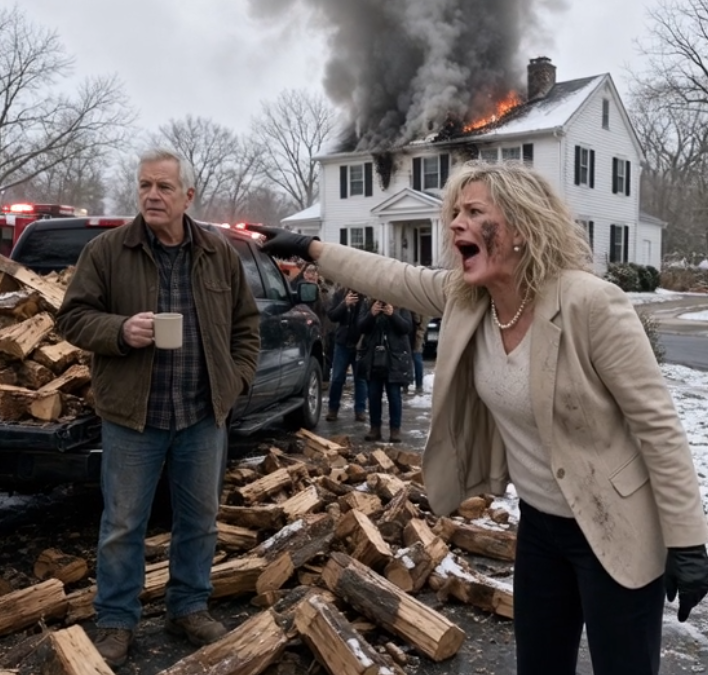
Karen’s chimney was coughing black smoke.
Her living room lights flickered.
A moment later, she burst through her front door screaming.
“It was the wood! The firewood was defective!”
Firefighters arrived fast.
Maple Ridge had a station less than two miles away, and nothing brings firefighters running like a chimney incident in a neighborhood full of expensive homes and decorative ignorance.
Engine 4 pulled to the curb.
Captain Reynolds stepped out first, helmet on, face calm, voice sharp.
“Ma’am, step away from the structure.”
“It exploded!” Karen shrieked. “Something exploded in my fireplace!”
“Is everyone out?”
“Yes, but—”
“Anyone injured?”
“My sleeve—”
“Are you injured?”
“No, but my chimney—”
“Step back.”
Firefighters moved with practiced speed.
One checked the roofline.
One went inside with thermal imaging.
Another pulled tools from the truck.
Neighbors gathered at what they believed was a safe and socially acceptable distance, which in Maple Ridge meant close enough to film but far enough to deny filming.
I stood on my porch.
Mr. Jenkins appeared beside me five minutes later, breathing hard from the walk.
“You knew,” he said.
“I suspected.”
“That was a mighty satisfying sound.”
“Arthur.”
“What? I’m old. Not holy.”
Across the street, Karen spotted me.
Even from two houses away, I saw her expression change.
She pointed.
“That’s him!” she shouted. “That’s his wood!”
Every head turned toward me.
I did not move.
Captain Reynolds looked at me.
Then at Karen.
“Ma’am, please stay back.”
“He did this!”
Now, I walked down my driveway.
Slowly.
No hurry.
No anger.
That annoyed Karen more than yelling would have.
By the time I reached the sidewalk, she was shaking with rage.
“You sabotaged me!”
I stopped beside Mr. Jenkins’s mailbox.
“Sabotaged you how?”
“You know exactly what you did!”
“No, Karen. I know exactly what you did.”
A murmur rippled through the neighbors.
Her face went red beneath the soot.
“You gave me dangerous firewood!”
“I did not give you any firewood.”
She froze.
The words hung there.
Clear.
Cold.
Beautiful.
Mrs. Patel’s hand flew to her mouth.
One of the Miller twins whispered, “Oh my God,” while still recording.
Karen realized the trap one second too late.
“I mean—”
I tilted my head.
“You mean what?”
She swallowed.
“I mean the firewood you stored improperly affected neighboring air quality and somehow—”
“Somehow walked into your fireplace?”
Laughter broke out.
Not loud.
But enough.
Karen’s eyes darted from face to face.
Captain Reynolds stepped closer.
“Sir, are you the owner of the wood she’s referring to?”
“I own firewood stored behind my locked fence.”
“Was any of it given or sold to this homeowner?”
“No.”
Karen snapped, “He’s lying.”
I looked at her.
“Karen, do you want to explain how my firewood ended up in your fireplace?”
“I never said it was in my fireplace.”
“You just said it was defective.”
“I assumed—”
“Based on what?”
She opened her mouth.
Closed it.
Then pointed toward her house again.
“It smelled strange!”
“Yes,” I said. “I imagine it did.”
Captain Reynolds looked at me more carefully.
“What does that mean?”
“It means some of my firewood was marked for identification after repeated thefts.”
Karen’s face drained.
Paul Drummond appeared from the crowd, pale as printer paper.
Captain Reynolds’s expression became very still.
“Marked how?”
“Safely. Nonhazardous. Fireplace-safe tracer and ceramic ID tabs. Documented, photographed, and reported to the sheriff’s office before tonight.”
Karen laughed.
It came out wrong.
High.
Thin.
“That’s insane.”
“No,” Mr. Jenkins said. “Insane is stealing from a retired fire investigator.”
More laughter.
Karen rounded on him.
“You stay out of this.”
Arthur Jenkins leaned on his cane.
“No, Karen. I stayed out of it when you bullied me into getting rid of my stove. I stayed out of it when you fined the Patels for tomato cages. I stayed out of it when you made the Millers repaint a door one shade darker because you said blue had emotional volatility.”
One of the Miller twins yelled, “You did say that!”
Mr. Jenkins continued.
“I think I’m done staying out of it.”
Captain Reynolds raised a hand.
“Everybody calm down.”
A firefighter emerged from Karen’s front door.
“Cap.”
He held a small metal evidence pan.
Inside were charred fragments.
Ash.
Blackened bits of wood.
And three small ceramic tabs discolored by heat but still intact.
Captain Reynolds looked at me.
I said nothing.
He looked at Karen.
She said too much.
“I don’t know how those got there.”
Captain Reynolds sighed.
It was a firefighter sigh.
I knew it well.
It meant someone had chosen the worst possible sentence.
Deputy Lewis arrived nine minutes later.
When he stepped out of the patrol car and saw me, his face changed.
Not annoyance.
Recognition.
He knew.
“You’re Mr. Mercer.”
“Yes.”
He looked at Karen.
Then at the smoke.
Then at the evidence pan.
Then back at me.
“Of course you are.”
I almost smiled.
Karen rushed toward him.
“Officer, he put explosive wood in my fireplace!”
“Deputy,” Lewis corrected automatically.
“He booby-trapped it!”
I said, “No.”
Lewis looked at me.
I handed him a folder.
Of course I had brought a folder.
Laura would have insisted.
Inside were printed stills from the cameras, a copy of the initial police report, documentation of the marked logs, the chimney sweep report, the HOA emails, and a timeline.
Deputy Lewis opened it.
The first photograph showed Karen in my yard at 1:17 a.m.
The second showed her loading wood.
The third showed Paul holding a flashlight.
The fourth showed the marked logs before they vanished.
The fifth showed Karen’s garage with my wood stacked inside.
Lewis looked up slowly.
Karen had gone silent.
Paul looked like a man considering whether fainting might improve his legal position.
Lewis closed the folder.
“Mrs. Whitmore, did you enter Mr. Mercer’s fenced backyard and remove firewood?”
“No.”
One of the Miller twins, still recording, whispered, “Girl.”
Lewis looked at her.
She lowered the phone slightly.
“Sorry.”
Lewis returned to Karen.
“Mrs. Whitmore, I’m going to ask again. Did you enter Mr. Mercer’s property?”
Karen lifted her chin.
“The HOA has authority to remove noncompliant exterior materials.”
“No,” Diane Keller said from behind the crowd.
Everyone turned.
Diane Keller, the management company representative, had arrived in a long gray coat, hair pulled back, tablet in hand.
Karen looked horrified.
“Diane?”
Diane did not smile.
“I received a call from Mrs. Beasley approximately twenty minutes ago.”
Mrs. Beasley made herself very small near a boxwood shrub.
Diane continued.
“The HOA does not have authority to enter a locked private yard at night, remove personal property, or use that property for private benefit.”
Karen’s mouth opened.
Diane held up her tablet.
“In fact, I specifically requested written clarification after your email last Friday. You did not provide any.”
Paul whispered, “Karen.”
She snapped, “Be quiet.”
That did not help him become loyal.
Deputy Lewis turned to Paul.
“Mr. Drummond, did you assist Mrs. Whitmore in removing firewood from Mr. Mercer’s property?”
Paul looked at Karen.
Karen glared at him.
Paul looked at Deputy Lewis.
Then at the evidence pan.
Then at me.
Then at Mrs. Beasley, who was now openly crying.
Finally, Paul said, “I thought it was HOA enforcement.”
Karen gasped.
“You coward.”
Paul flinched.
But he kept talking.
“She told me the board had approved removal. She said Mr. Mercer refused compliance. She said the wood would be stored pending fines.”
“Stored where?” Deputy Lewis asked.
Paul swallowed.
“In her garage.”
Karen spun toward him.
“Paul.”
He shook his head.
“No. I’m not taking the fall for your fireplace.”
That sentence changed the entire neighborhood.
Not legally.
Socially.
And in Maple Ridge, that mattered more to Karen at first.
Her authority did not collapse when I accused her.
It collapsed when Paul stopped pretending.
Captain Reynolds came over.
“Deputy, preliminary appears to be a chimney flare-up, likely due to restricted airflow and creosote ignition. We’ll need a full inspection. I found no evidence of explosive material.”
Karen’s face twisted.
“But the boom—”
“Chimney events can make sharp sounds,” Reynolds said. “Especially if there’s buildup, poor drafting, or improper use.”
“My chimney was fine.”
“When was it last inspected?”
Karen hesitated.
The silence answered.
Reynolds nodded.
“Right.”
I said nothing.
Because sometimes silence is a better cross-examination than questions.
Deputy Lewis asked Karen to step aside.
She refused.
Then he asked again in a different voice.
That time she did.
No one was arrested dramatically that night.
No handcuffs.
No screaming.
No Karen shoved into a patrol car while neighbors applauded.
Real consequences rarely arrive that theatrically.
Instead, Deputy Lewis took statements.
Captain Reynolds documented the chimney incident.
Diane Keller requested emergency access to HOA records.
Mrs. Beasley admitted the board had never voted to remove my wood.
Paul admitted he had helped Karen twice.
Mr. Jenkins gave a statement about prior harassment.
Mrs. Patel gave one too.
Then the Miller twins offered video from six different angles, including a slow-motion clip of Karen yelling, “It was the wood!” which I suspected would become Maple Ridge’s most replayed film since someone’s inflatable Santa broke loose during a windstorm.
Karen stood on the sidewalk wrapped in a firefighter’s thermal blanket, glaring at everyone as if we had betrayed her by noticing what she did.
When Deputy Lewis finally approached me, he looked tired in an entirely new way.
“Mr. Mercer.”
“Deputy.”
“I owe you an apology.”
“No, you don’t.”
“I dismissed this as neighborhood drama.”
“You documented the report. That mattered.”
He nodded toward Karen’s house.
“Do you want to pursue charges?”
I looked at my wood ash in the evidence pan.
Then at Karen.
Then at Mr. Jenkins, Mrs. Patel, Paul, Diane, and all the neighbors who had spent years letting Karen’s nonsense become weather.
“Yes,” I said.
Karen’s head snapped toward me.
“You petty little man.”
I looked at her.
“No, Karen. Petty would have been yelling the first time you stole from me. Patient is what got us here.”
The charges were not dramatic at first.
Trespassing.
Theft.
Criminal mischief related to damage and unauthorized entry.
Possible unauthorized access due to the gate key.
The fire incident remained under review, but Captain Reynolds’s report made one thing clear: the flare-up came from Karen’s neglected chimney conditions and improper burning practices, not from any dangerous modification to my firewood.
That mattered.
It mattered because Karen spent the first week telling anyone who would listen that I had “nearly blown up her house.”
Unfortunately for Karen, everyone had already seen the evidence.
And by everyone, I mean everyone.
The Miller twins posted a heavily censored version of the street scene in the neighborhood group before Diane could delete it.
Someone made a meme of Karen in the thermal blanket with the caption VISUAL DISHARMONY.
Mr. Jenkins printed it and taped it inside his garage.
Mrs. Beasley resigned as treasurer within forty-eight hours.
Paul resigned as vice president and sent me an apology email that contained the phrase “deeply misled,” which was lawyer language for please do not sue me personally.
Diane Keller scheduled an emergency HOA meeting.
This one had seventy-three attendees.
Maple Ridge had never seen civic engagement like it.
People who had not attended a meeting in fifteen years showed up with folding chairs, coffee thermoses, and the hungry expression of citizens discovering local government could include entertainment.
Karen arrived ten minutes late.
That was her second mistake.
Her first was arriving at all.
She wore black.
Not mourning black.
War black.
Her hair was perfect again, though one side still looked slightly shorter where ash or heat had singed it. Her face was carefully made up. Her pearls were back.
She walked to the front of the clubhouse and placed both hands on the podium.
“Before this meeting begins,” she said, “I would like to address the vicious rumors circulating about me.”
Diane Keller stood.
“Mrs. Whitmore, you are not chairing this meeting.”
Karen blinked.
“I beg your pardon?”
“As management representative, I am facilitating tonight due to the pending investigation involving board conduct.”
“This is highly irregular.”
“So is stealing firewood.”
A sound went through the room.
Not quite laughter.
Not quite applause.
Something better.
Collective permission.
Karen looked as if Diane had slapped her.
Diane continued.
“The agenda is as follows: temporary suspension of board enforcement activity, appointment of an interim committee, review of unauthorized fines, review of access to private lots, and discussion of board resignation requests.”
Karen gripped the podium.
“I have not resigned.”
“No,” Diane said. “That is why item five says requests.”
Mr. Jenkins raised his cane slightly.
“I request.”
Half the room raised hands.
Diane sighed but looked pleased.
“Please wait until public comment.”
The meeting lasted three hours.
Three glorious, exhausting hours.
Residents spoke.
Not just about me.
About years of Karen.
The Patels had been fined for vegetable planters behind their fence.
The Millers had been forced to repaint their door because Karen said the blue shade was “emotionally disruptive.”
A retired teacher named Ellen Ruiz had been fined for leaving a mobility ramp visible after knee surgery.
A young couple had been threatened for installing a basketball hoop for their ten-year-old.
Mr. Jenkins spoke last.
He stood slowly, leaning on his cane.
The room quieted.
“I’ve lived here thirty-seven years,” he said. “Longer than the HOA. Longer than most of these houses. My wife and I planted the maple trees this neighborhood is named after.”
Karen looked at the floor.
“She loved this place. Not because it looked perfect. Because people waved. Because neighbors helped shovel snow. Because if someone had smoke coming out of their chimney wrong, you knocked on the door and asked if they needed help. You didn’t fine them for smoke direction.”
A few people laughed softly.
Mr. Jenkins continued.
“Somewhere along the way, we let rules replace neighborliness. And when rules weren’t enough, we let one person use them like a stick. That’s on her. But it’s also on us.”
The room became very still.
His voice softened.
“When Karen came after my firewood, I gave in because I was tired. I told myself it didn’t matter. But it did matter. It was one more piece of my life I let someone take because fighting seemed harder than losing.”
He looked toward me.
“Daniel fought. Quietly. Correctly. Annoyingly thoroughly.”
Laughter broke the tension.
I smiled.
Mr. Jenkins looked back at the room.
“I think we owe him thanks. And I think we owe ourselves a better neighborhood.”
For once, Karen had nothing to say.
The vote was overwhelming.
Karen was removed pending formal proceedings.
The compliance committee was suspended.
All open fines related to subjective exterior appearance issues were frozen.
A review panel was created.
Diane looked like a woman who expected months of paperwork and somehow welcomed it.
I left before the meeting ended.
Mr. Jenkins caught up to me outside.
“Running away from your own victory?”
“No.”
“Then what?”
I looked at the cold stars over Maple Ridge.
“I don’t want victory to become the point.”
He nodded.
“That’s Laura talking?”
“Probably.”
“She sounds smart.”
“She was.”
He stood beside me for a while.
Then he said, “You ever need help stacking wood, my son’s useless but I’m available to supervise.”
I laughed.
“Supervise?”
“I’m eighty-one. You want labor, hire teenagers.”
“Fair.”
The legal process moved slowly.
Karen’s attorney sent me a letter accusing me of entrapment, harassment, emotional distress, and reckless endangerment.
My attorney, a woman named Nora Bell who had the calmest voice I had ever heard, replied with nine pages of citations, evidence references, and one sentence I read three times for pleasure:
Your client’s distress appears to have resulted primarily from being observed committing the conduct she now denies.
I wanted to frame it.
Emily told me not to.
I framed a copy in my garage instead.
Karen eventually entered a plea arrangement for trespass and theft-related charges. Restitution was ordered. Community service too, which seemed almost poetic until I realized Karen serving the community probably counted as punishment for the community.
The HOA insurance carrier refused to cover her personal legal expenses.
Her husband returned from Scottsdale for approximately four days, then went back.
Her house went on the market in March.
By then, Maple Ridge had changed.
Not dramatically.
Not overnight.
But noticeably.
The new interim board rewrote the firewood rule in plain language.
Storage permitted if safe, screened, and not against the structure.
No subjective aesthetic review.
No unauthorized entry onto private property.
No removal of personal property except through legal process.
No enforcement without written board vote and management review.
Mrs. Patel planted tomatoes the following spring in bright red cages visible from the street.
Nobody fined her.
The Millers repainted their door blue.
A louder blue.
Possibly out of spite.
Definitely with community support.
Mr. Jenkins’s son brought him a small wood stove insert in April. I helped install the hearth protection, supervised the chimney inspection, and stacked the first half cord behind his fence while he sat in a lawn chair and criticized my technique.
“You stack like a man who trusts gravity too much,” he said.
“You supervise like a man who wants this wood dumped in his driveway.”
He grinned.
“Laura would’ve liked me.”
“Yes,” I said. “Unfortunately.”
That summer, Maple Ridge held its first actual neighborhood cookout in years.
No committees.
No sign-up portal.
No approved tablecloth colors.
Just folding chairs, grills, kids running around, dogs stealing hot dogs, and Mr. Jenkins telling the Miller twins that their music sounded like appliances arguing.
I brought firewood.
Not to burn.
Just as a joke.
I stacked three pieces near the picnic table with a sign that said:
PLEASE DO NOT STEAL. MAY CONTAIN ACCOUNTABILITY.
The photo went around the neighborhood group.
Even Diane Keller liked it, which felt like official approval.
Karen moved out in late June.
She did not say goodbye.
A moving truck arrived at seven in the morning. By noon, the stone lions were gone. By two, so was she.
I watched from my porch.
Not with joy exactly.
Relief.
There is a difference.
Mr. Jenkins shuffled over.
“Think she’ll terrorize the next place?”
“Probably.”
“Should warn them.”
“Let them have their own character development.”
He chuckled.
After the moving truck left, the neighborhood felt lighter.
Not perfect.
Never that.
A neighborhood is made of people, and people are uneven creatures.
Someone still complained about dog poop.
Someone else still parked badly.
The Millers’ blue door really was a lot.
But the fear had gone out of the sidewalks.
People lingered again.
They borrowed tools.
They asked before assuming.
They argued in meetings without acting like disagreement was treason.
And every winter, smoke rose from chimneys that had actually been cleaned.
Mine most of all.
On the first cold night of the following December, I built a fire in my living room.
Oak.
Dry.
Clean.
Properly stacked.
The kind of fire Laura loved.
I sat in my chair with coffee and watched the flames catch.
For a while, the house was quiet.
Then Emily arrived with my grandson, carrying groceries and a loaf of bread she had made herself.
It was better than mine.
Everyone’s bread was better than mine.
My grandson ran straight to the fireplace.
“Grandpa, is this the famous crime wood?”
“No. This is regular wood.”
“Do you still have crime wood?”
Emily closed her eyes.
“Please don’t call it crime wood.”
I considered lying.
Then said, “I have one piece left.”
My grandson gasped like I had revealed buried treasure.
“Can I see it?”
I took him to the garage.
On a shelf above my workbench sat one split log, marked on the end with black marker.
EVIDENCE, SORT OF.
It was not one of the burned decoys.
Those were long gone into official evidence and then disposal.
This was just a leftover piece from the original stack.
But my grandson did not need details.
To him, it was legend.
“Did Karen really steal wood?” he asked.
“Yes.”
“Why?”
“Because she thought nobody would stop her.”
“But you did.”
I looked at the log.
Then at him.
“No,” I said. “She stopped herself. I just kept records.”
He frowned.
“That’s not as cool.”
“Most real justice isn’t.”
He considered that.
“Can I write on it?”
“What do you want to write?”
He thought hard, then carefully printed on the other side:
DON’T BE KAREN.
Emily laughed so hard she had to sit down.
That log stayed in my garage.
Years later, when people in Maple Ridge told the story, they always made it sound more dramatic than it was.
They said I booby-trapped the wood.
I did not.
They said Karen’s fireplace exploded.
It did not.
They said I planned the whole thing from the beginning.
Not true.
At the beginning, I just wanted a quiet winter and a dry stack of oak.
The truth was simpler.
Karen Whitmore stole from me because she believed authority meant never being questioned.
I marked my property because I believed truth requires documentation.
She burned the wood because she believed stolen things became hers once hidden behind her walls.
And the whole neighborhood watched black smoke pour from her chimney because sometimes lies do not collapse quietly.
Sometimes they burn.
What mattered most was not that Karen got caught.
It was that everyone else saw how catching her happened.
Not through shouting.
Not through threats.
Not through revenge.
Through patience.
Records.
Witnesses.
Rules applied to the person who thought she owned them.
That was the lesson Maple Ridge needed.
It was the lesson I needed too.
Because grief had made me want to disappear.
Karen had mistaken my quiet for weakness.
Maybe I had too.
But standing on my porch that cold night, watching the fire trucks leave and the neighbors slowly turn toward the truth, I felt something I had not felt since Laura died.
Not happiness.
Not yet.
Something steadier.
A sense that I was still here.
Still capable of defending my home.
Still capable of choosing the right kind of fight.
Still capable of building warmth without letting someone steal it.
Later that night, after everyone went back inside and the smoke thinned into the winter sky, I returned to my living room.
My own fire was still glowing.
Small flames moved over the oak.
Clean.
Gold.
Quiet.
I sat down with fresh coffee and looked at the empty chair across from me, the one Laura used to curl into with a book and a blanket.
“You would’ve brought binders,” I said softly.
The house said nothing.
But the fire cracked once.
Gentle.
Ordinary.
A good sound.
Not a boom.
Not a chimney coughing out secrets.
Just wood doing what wood is supposed to do when it belongs where it is.
Burning clean.
Giving warmth.
Leaving nothing behind but ash and proof that it had been there.








