HOA Karen Kept Smashing Through My Ranch Gate—So I Made Her Prove in Court She Never Owned the Road
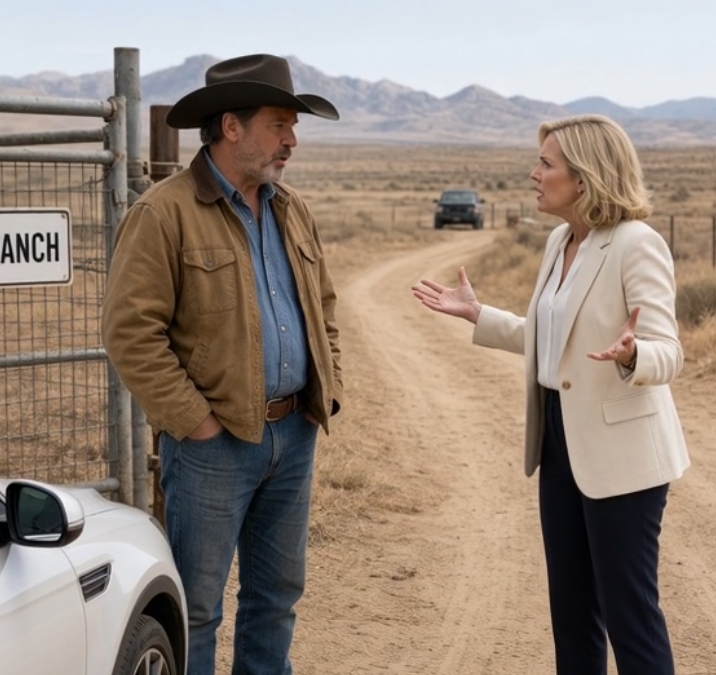
HOA Karen Kept Smashing Through My Ranch Gate—So I Made Her Prove in Court She Never Owned the Road
The sound of splintering cedar is not what a man wants to hear before breakfast.
Especially when it is coming from his own gate.
And especially when the woman behind the wheel has already been told four times that the road she keeps stealing has never belonged to her HOA.
My name is Graham Reed.
I was standing in my kitchen with a mug of black coffee in one hand and a plate of eggs cooling on the counter when the crash rolled across the pasture.
Hard.
Sharp.
Familiar.
The kind of sound a gate makes when it has stopped being a gate and started being another man’s warning being ignored.
My dogs erupted at the back door.
The horses lifted their heads near the far fence.
Dust rose beyond the front pasture, curling into the pale morning light.
I walked onto the porch barefoot, still holding the coffee, and watched Karen Hollis’s white SUV blast through what was left of my ranch gate like she was leading a cavalry charge against common decency.
She did not slow down.
She did not wave.
She did not look sorry.
She drove straight across my private gravel road, past my pasture, past my barn, past the oak tree where my grandfather used to tie horses before the county paved anything within ten miles of us.
Behind her came two more vehicles.
A maroon minivan.
A gray sedan.
Both with Pine Hollow HOA decals in the back windows.
They followed her through the broken gate like ducks behind a mother who had never learned shame.
The white SUV bounced over the ruts, throwing gravel into the grass. Karen’s blonde bob did not move. Her sunglasses reflected the morning. Her hand lifted briefly from the steering wheel, not in apology.
In command.
As if to say, see, I told you this road was ours.
I stood there while they disappeared down the far track toward the county road on the other side.
My coffee had gone cold.
Again.
For a while, I said nothing.
My dogs kept barking. A hinge groaned somewhere near the gate, metal twisting under the weight of snapped cedar. The horses shifted nervously, ears still pricked toward the road.
Then I set the mug on the porch rail and walked down the steps.
I did not run.
I had already done anger.
I had already done yelling.
I had already done repairing.
This was something else now.
I crossed the yard, boots crunching through gravel and splinters, until I reached what had once been my gate.
The left post leaned at a sick angle. One cedar rail had split clean down the middle. The latch I had welded myself hung open and useless, bent like a paperclip.
Tire marks cut deep through the dirt.
Fresh.
Wide.
Arrogant.
I crouched and picked up a broken piece of cedar. Ran my thumb along the snapped grain.
I had built that gate with my own hands.
Not because I needed something pretty.
Because I needed a line
PART2:
After thirty years in construction, after too many years in subdivisions where committees told grown men what color a mailbox should be, I bought this ranch for one reason.
Peace.
Forty-two acres outside Pine Hollow.
Not inside it.
Outside.
My deed said so.
The county map said so.
The survey pins said so.
The tax records said so.
The only person who did not believe it was Karen Hollis, president of the Pine Hollow Estates Homeowners Association and self-appointed queen of every inch of dirt she could see from behind her windshield.
The first time she drove through my gate, I thought she was lost.
The second time, I thought she was testing me.
By the third, I knew she was daring me.
And standing there in the wreckage that morning, looking at the tire tracks carved through my land, I understood the truth.
Karen did not believe I would defend my boundary because nobody in Pine Hollow had ever made her defend hers.
That was about to change.
I stood, brushed cedar dust from my palm, and looked down the road she kept stealing from me.
“Fine,” I said to the empty pasture. “If you want a road fight, Karen, I’ll give you one.”
But I was not going to fight her with shouting.
I was not going to stand in front of her SUV.
I was not going to build some reckless roadside hazard that gave her the victim story she wanted.
I was going to do what builders do when a structure keeps failing.
I was going to tear out the weak parts, pour a real foundation, and make the next thing strong enough to hold.
Not just the gate.
The truth.
PART3;
By 8:00 that morning, I had photographed the damage from every angle.
Wide shots.
Close-ups.
Tire tracks.
Broken latch.
Impact marks.
License plate impressions in the dirt where the vehicles had slowed on the other side of the pasture.
Then I walked the length of the gravel road.
It ran three-quarters of a mile from my front gate to the old county road beyond the ridge. My grandfather had cut that track before Pine Hollow existed, before the subdivision signs, before the HOA newsletters, before anyone decided a pasture view meant they could call themselves “estate owners.”
Back then, it was a ranch lane.
It still was.
The road served my barn, my hay field, my back pasture, and my livestock trailer turn-around. It was not on any Pine Hollow plat. It was not an HOA amenity. It was not a scenic shortcut for people too impatient to use the county road.
But Karen had discovered that cutting across my ranch saved Pine Hollow residents nearly seven minutes when the main entrance backed up during school drop-off and weekend lake traffic.
Seven minutes.
That was all it took for an HOA to decide my land was negotiable.
The first incident happened on a Friday afternoon.
I had been repairing a fence near the east pasture when I saw Karen’s SUV rolling slowly down my private road.
I waved her down.
She stopped beside me, lowered the window two inches, and looked at me as though I were a hired hand blocking a driveway.
“You’re on private property,” I said.
She gave me the smile of a woman who had practiced looking patient with people she considered beneath her.
“This is the old ranch connector road.”
“That’s not a public road.”
“It has been used historically.”
“By my family.”
“And by Pine Hollow,” she said.
“No.”
Her smile thinned.
“Mr. Reed, the association has records indicating this access predates your current ownership.”
“I bought from my uncle. The ranch has been in my family since 1956.”
“Then I’m sure you understand historic use can create rights.”
“I understand you need to turn around.”
She stared at me through the narrow window gap.
Then she said, “We’ll have counsel review it.”
“Do that.”
She backed up that time.
The second time, she came with two cars behind her.
I stopped them at the gate.
Karen stepped out wearing white pants and wedge sandals, which told me she was not expecting mud, animals, or reality.
“We’re conducting an access inspection,” she said.
“On whose authority?”
“The board’s.”
“The board doesn’t own this land.”
“Mr. Reed, you can’t simply block a traditional access corridor.”
“It isn’t traditional. It’s private.”
She lifted a folder.
“We disagree.”
I held out my hand.
She did not give me the folder.
That told me plenty.
“Then send me whatever document you think gives you rights,” I said.
“I don’t respond well to demands.”
“Good. Then respond to the gate.”
I closed it.
She left.
But after that, things escalated.
A Pine Hollow resident drove around the gate through my drainage ditch and got stuck. He claimed his navigation app told him to use my road. His phone had no such route displayed when the deputy arrived.
A landscaper tried to follow Karen’s directions through my pasture and nearly hit one of my horses.
Then came the first broken gate.
Karen claimed the latch had been “improperly secured” and her bumper “nudged” it.
The second broken gate was blamed on wind.
The third on “poor construction.”
The fourth on an “emergency access misunderstanding,” though the emergency was apparently that Karen had a luncheon at the lake clubhouse and did not want to wait behind a propane truck on Pine Hollow Drive.
After the fourth repair, I sent a certified letter to Pine Hollow HOA.
PRIVATE PROPERTY.
NO PUBLIC ACCESS.
NO HOA ACCESS.
NO EASEMENT.
NO RIGHT OF WAY.
Any further entry would be treated as trespass and any damage pursued.
Karen sent back a two-paragraph response on HOA letterhead.
Pine Hollow Estates recognizes the historic use of the ranch connector road and reserves all rights related to community access, emergency access, and resident passage. Your unilateral obstruction of this traditional route may expose you to liability.
She signed it:
Karen Hollis
President, Pine Hollow Estates HOA
That was the letter I pinned to the corkboard in my shop.
Not because it scared me.
Because I suspected I would need it later.
After the fifth gate, later had arrived.
I called Deputy Alvarez first.
Not 911.
The non-emergency line.
When he arrived, he stood beside the broken cedar and whistled low.
“Again?”
“Again.”
He was in his early forties, calm, square-jawed, and blessed with the patient exhaustion of a deputy who had spent too many years dealing with people whose confidence exceeded their paperwork.
“You got video this time?” he asked.
“Trail camera at the oak.”
“Good.”
He crouched beside the tire tracks.
“Same SUV?”
“Karen Hollis. Pine Hollow HOA president. Two vehicles followed her through.”
“Any threats?”
“Not today.”
“Any confrontation?”
“No.”
He looked at me.
“You didn’t block the road with equipment?”
“No.”
“You didn’t chase them?”
“No.”
“You didn’t cut them off?”
“No.”
He nodded.
“Smart.”
“I was barefoot and holding coffee.”
“That stops some men. Not all.”
He photographed the damage and took my statement.
Then he asked the question I knew was coming.
“Do they have any recorded access right?”
“No.”
“Any easement?”
“No.”
“Any shared road maintenance agreement?”
“No.”
“Any old county dedication?”
“No.”
“You have documents?”
“In the house.”
I brought him copies.
Deed.
Survey.
County road map.
Tax parcel overlay.
Old ranch plat.
The private road was marked as an internal ranch lane. It began and ended on Reed land. It crossed no Pine Hollow parcel. It connected to the county road only through my back gate, which had been locked for years except when I hauled livestock or hay.
Alvarez looked through everything.
“I’m not a judge,” he said.
“I know.”
“But if they’re breaking gates to use a private road, this is not just a neighborhood disagreement anymore.”
“I know that too.”
He closed the folder.
“You need a civil injunction.”
“I figured.”
“And you need to stop repairing this gate like it’s a fence problem.”
“It isn’t.”
“No,” he said, glancing down the road. “It’s a permission problem.”
That was the best description I had heard so far.
After he left, I drove to my father’s place.
My father, Elias Reed, was eighty-one and had reached the stage of life where he no longer wasted words pretending he was not annoyed.
He sat in his recliner near the window, oxygen tube under his nose, Western on the television, boots still on because he said slippers were what happened when a man gave up.
I told him Karen had smashed the gate again.
He muted the television.
“White SUV?”
“Yes.”
“Blonde woman?”
“Yes.”
“Looks like she’s allergic to listening?”
“That’s the one.”
He grunted.
“Told you she’d do it again.”
“You did.”
“You bring the deed box?”
“Not yet.”
“Then why are you here?”
“To tell you.”
He pointed toward the door.
“Go get the deed box.”
The Reed deed box was metal, green, dented, and older than me. My grandfather had kept it in his office. My uncle had kept it in a closet. I kept it in my shop under a workbench because fireproof safes were expensive and the box had survived three generations of Reed men swearing they would organize it properly.
Inside were deeds, tax receipts, old surveys, fence line notes, easement releases, handwritten agreements, receipts for gravel, and one black-and-white photograph of my grandfather standing beside the original ranch gate with a cigarette in his mouth and a horse behind him.
Dad sorted through the papers at his kitchen table with hands that trembled slightly but still knew exactly what they were doing.
“She’s calling it historic use?” he asked.
“Yes.”
“Historic by who?”
“Pine Hollow.”
He snorted.
“Pine Hollow was cow pasture until 1998.”
“I know.”
“She know that?”
“She knows what helps her.”
Dad found a folded survey from 1974.
“There.”
He tapped the paper.
Private ranch lane.
No public dedication.
No county maintenance.
No utility access except marked power easement along the west fence.
Then he found another document.
A 2001 letter from Pine Hollow’s original developer.
I had forgotten it existed.
When the subdivision was being built, the developer asked my uncle for temporary construction access across the ranch road while they were finishing Pine Hollow Drive.
Temporary.
Written.
Ninety days.
With a condition that the developer repair any damage and acknowledge no permanent access right was created.
My uncle had agreed because Reeds had always been neighborly until someone mistook courtesy for weakness.
Dad smiled when he read the last line.
Use of Reed ranch road shall not be construed as dedication, easement, license beyond the term, or continuing right of access.
I looked at him.
“That’s it.”
“That’s one of them.”
“One of them?”
Dad reached into the box again and pulled out a yellowed envelope.
“Your granddad fought the county over that road in 1962.”
“What?”
“County wanted to classify it as a public farm-to-market connector. He told them to pound sand.”
I opened the envelope.
Inside was a county commission record from 1962 denying public designation after my grandfather objected and showed the road existed solely for ranch use.
Dad leaned back.
“Karen wants court?”
“She hasn’t said that.”
“She will after you sue her.”
I looked down at the papers.
“She thinks I’m going to keep fixing gates until I get tired.”
Dad’s eyes sharpened.
“Then don’t fix the gate.”
“I need a gate.”
“No. You need a judge.”
He was right.
By noon, I had called Maribel Santos.
Maribel had been my attorney twice before. Once for a contractor who refused to pay me after I built a barn, and once for a boundary dispute involving a neighbor who believed moving a fence at night counted as adverse possession.
Maribel was five-foot-two, wore bright scarves to court, and had a way of making arrogant men regret using complicated words loosely.
She listened without interrupting.
Then she said, “Do not rebuild the gate yet.”
“My father already said that.”
“Smart man.”
“He’s insufferable about it.”
“Most smart men are.”
“What do we file?”
“Trespass, property damage, injunctive relief, declaratory judgment confirming no HOA access rights, and an order preventing Pine Hollow from representing the road as available to residents.”
“That last part matters.”
“Yes,” she said. “Because she isn’t just trespassing. She is manufacturing a claim through repeated use.”
That was the phrase that stuck.
Manufacturing a claim.
Karen was not driving through my gate because she thought she already had rights.
She was driving through because she wanted the pattern.
Use the road.
Call it customary.
Send residents through.
Create confusion.
Then tell a judge the HOA had been using it openly for years.
Only she had made one mistake.
She was doing it to a man who kept paper.
Lots of it.
By the next week, Maribel had filed in county court.
Reed v. Pine Hollow Estates HOA and Karen Hollis.
The complaint was not emotional.
That was why I liked it.
It did not call Karen a bully.
It did not call her entitled.
It did not mention her sunglasses, her condescending smile, or the way her HOA decals seemed to multiply like mold on every vehicle that crossed my broken gate.
It said what mattered.
The road was private.
The HOA had no recorded right.
Karen had repeatedly entered without permission.
Vehicles under HOA direction had damaged my gate.
The HOA had misrepresented private property as a community route.
I requested damages, attorney fees, a permanent injunction, and a declaratory judgment that Pine Hollow had no easement, right-of-way, license, or ownership interest in the ranch road.
Karen’s response came three days later.
Not through counsel at first.
Through Facebook.
The Pine Hollow Residents Forum had a new post by the HOA president.
Some residents have asked about recent confusion concerning the historic connector road adjacent to Reed Ranch. Please know the board is committed to preserving long-standing community access, protecting emergency routes, and preventing unilateral obstruction of shared infrastructure. We will not be intimidated by anti-neighbor behavior.
She did not name me.
She did not need to.
The comments went exactly where she wanted them to go.
He bought land next to a community and now wants to control everyone.
That road has always been there.
My kids’ bus could use that way.
Why is one rancher allowed to block progress?
Someone said I had threatened Karen.
Someone else said I had installed “dangerous barriers” to trap residents.
A third person claimed my grandfather had “donated” the road to the community decades before Pine Hollow existed.
I saved every screenshot.
Then I closed the computer.
A man can lose a whole day answering lies from people who never asked for the truth.
I had better things to do.
Maribel filed a motion attaching Karen’s post.
The judge issued a temporary restraining order faster than I expected.
No Pine Hollow resident, board member, agent, contractor, or guest was to enter Reed Ranch Road pending hearing.
No further representation that the road was HOA-controlled or available for community use.
No contact with me except through counsel.
The next morning, Karen arrived anyway.
Not through the gate.
This time she parked outside it.
The broken gate still hung crooked. I had placed orange cones on my side and a temporary chain behind the damaged section, fully on my property, photographed from three angles after installation.
Karen stepped out of her SUV wearing a navy blazer and that tight public-meeting smile.
I was repairing a water trough near the barn when my phone buzzed.
Trail camera alert.
I watched the clip.
Karen standing at my gate, holding papers, speaking toward the camera as though it were a person.
I drove down in the ranch truck and stopped thirty feet inside my property.
I did not get out.
The window rolled down.
“Karen.”
“Graham, this is ridiculous.”
“You need to leave.”
“I’m here to deliver a notice of board position.”
“You have an attorney.”
“This affects community safety.”
“You have an attorney.”
She lifted the papers.
“You can’t just weaponize the court system because you don’t like sharing.”
“You drove through my gate five times.”
“That gate obstructs a historic access route.”
“The judge told you not to come here.”
“I’m outside the gate.”
“You’re still contacting me about the dispute.”
Her lips tightened.
“This is exactly the kind of hostility we’re trying to address.”
“Good. Address it with Maribel.”
I rolled up the window.
She stood there another minute.
Then left.
The next day, Maribel filed the trail camera footage.
Karen’s attorney entered an appearance by noon.
His name was Dennis Vale.
He sent a letter accusing me of “unreasonably escalating a neighborly access misunderstanding.”
Maribel called me after reading it.
“He used the word neighborly.”
“I saw.”
“He’s already losing.”
“Why?”
“Because people with good documents say documents. People without them say neighborly.”
The preliminary hearing was set for the following Thursday.
By then, Pine Hollow had changed its story three times.
First, the road was historic community access.
Then it was emergency access.
Then it was a prescriptive easement.
Then, two days before the hearing, Dennis Vale filed a brief suggesting the HOA had relied on “decades of permissive ambiguity.”
Maribel read that phrase aloud to me over the phone.
“Permissive ambiguity,” she said.
“What does that mean?”
“It means their evidence is wearing a costume.”
The courtroom was packed.
Not because the case was large.
Because Pine Hollow had made it entertainment.
Residents filled the benches behind Karen. Men in polo shirts. Women with HOA badges clipped to their purses. A few retirees who looked thrilled to have somewhere to be. Two board members sat behind her, whispering until the bailiff looked at them.
My father insisted on coming.
He wore his good hat and a bolo tie I had not seen since my mother’s funeral.
“You don’t have to testify today,” I told him.
“I didn’t wear this hat to sit in the truck.”
Maribel sat beside me at counsel table, calm, organized, scarf bright red against her black suit.
Karen sat across the aisle.
She did not look at me.
That was fine.
Judge Mallory entered at 9:00.
She was in her sixties, gray-haired, sharp-eyed, and had the expression of a woman who had heard every possible version of “I thought I was allowed” and no longer found it charming.
Maribel spoke first.
She laid out the issue plainly.
“This case is not about whether Pine Hollow residents would prefer to use Mr. Reed’s private ranch road. It is not about whether the road is convenient. It is not about whether the HOA president believes access would benefit the subdivision. It is about whether Pine Hollow has a legal right to enter, use, damage, and represent control over land it does not own.”
Then she presented the documents.
Deed.
Survey.
1974 private ranch lane notation.
1962 county commission denial of public designation.
2001 temporary construction access agreement with Pine Hollow’s original developer.
Tax parcel overlay.
Repair invoices for five gates.
Photographs of damage.
Trail camera footage.
Karen’s letters.
Karen’s online statements.
When the video played, the courtroom watched Karen’s SUV break through my gate on the fifth morning.
The sound of cedar splitting filled the room.
Hard.
Sharp.
Familiar.
Nobody spoke.
Then the maroon minivan followed.
Then the gray sedan.
Judge Mallory leaned slightly forward.
Maribel paused the video on Karen’s SUV passing the broken latch.
“Your Honor, this was not confusion. This was a practice.”
Dennis Vale stood.
“Your Honor, the association does not concede that the road is as private as plaintiff claims.”
Judge Mallory looked at him.
“Then this is your opportunity to show me what it is.”
Dennis adjusted his glasses.
That was the moment I had been waiting for.
Not because I expected fireworks.
Because I wanted Karen to do the one thing she had avoided for months.
Prove it.
Dennis began with a subdivision map.
It showed Pine Hollow Estates, the county road, the subdivision entrance, the lake, and my ranch next door.
A dotted line crossed my property.
Maribel stood immediately.
“Objection. Foundation.”
Judge Mallory looked at Dennis.
“Who created this map?”
Dennis hesitated.
“It was included in HOA planning materials.”
“That was not my question.”
“I believe it was generated by a former board planning committee.”
“When?”
“I’m not certain.”
“By whom?”
“I don’t have that information.”
Judge Mallory looked at the dotted line.
“Does this map derive from a recorded plat?”
“No, Your Honor.”
“Survey?”
“No.”
“County road map?”
“No.”
“Title document?”
“No.”
“Then it is an internal drawing.”
Dennis’s jaw tightened.
“It reflects longstanding community understanding.”
Judge Mallory leaned back.
“Mr. Vale, understanding is not a legal description.”
The map did not come in.
Next, Dennis tried meeting minutes from 2003.
A Pine Hollow board had discussed “possible future connector access.”
Possible.
Future.
Those words did not help him.
Then he produced resident affidavits.
Several Pine Hollow residents claimed they had used the ranch road “from time to time” over the years.
Maribel asked one question on cross.
“Did you ever pass through a gate?”
“Yes.”
“Was the gate sometimes locked?”
“Yes.”
“Did you ever receive written permission from the Reed family?”
“No.”
“Did anyone from the HOA ever tell you they had recorded easement rights?”
“I assumed.”
There was that word again.
Assumed.
Another resident admitted she had used the road twice after Karen told the community it was “being reclaimed.”
Reclaimed.
Judge Mallory wrote that down.
Then Karen took the stand.
She wore pearls.
Of course she did.
Dennis guided her gently.
She testified that Pine Hollow had grown rapidly, that traffic had become difficult, that emergency access mattered, and that residents had long believed the ranch connector road was part of the community’s historic circulation pattern.
Historic circulation pattern.
Karen delivered the phrase as if she had paid good money for it.
Dennis asked, “Did you believe Pine Hollow had a right to use the road?”
“Yes.”
“Did you intend to damage Mr. Reed’s gate?”
“No.”
“Did you believe the gate unlawfully obstructed community access?”
“Yes.”
“And did you act in what you believed was the best interest of Pine Hollow residents?”
“Absolutely.”
Then Maribel stood.
She carried one folder.
Just one.
That was never a good sign for the person on the stand.
“Mrs. Hollis, are you a surveyor?”
“No.”
“Title attorney?”
“No.”
“County road official?”
“No.”
“Licensed engineer?”
“No.”
“Historian specializing in rural road dedications?”
Karen blinked.
“No.”
“You testified that you believed Pine Hollow had a right to use Mr. Reed’s ranch road. What document gave you that belief?”
“The planning map.”
“The internal HOA map the court excluded?”
Karen looked toward her attorney.
“Yes.”
“What else?”
“Resident use.”
“Any recorded easement?”
“I’m not personally in charge of recording—”
“That was not my question. Do you have a recorded easement?”
Karen’s mouth tightened.
“Not with me.”
“Does Pine Hollow have one?”
“I would have to check.”
Maribel turned slightly.
“You are HOA president, correct?”
“Yes.”
“You directed residents to use the road?”
“I informed them of their rights.”
“What rights?”
“Our historic access rights.”
“Shown where?”
Karen said nothing.
Maribel opened the folder.
“Let’s discuss the 2001 temporary construction agreement.”
Karen’s face changed.
Not much.
Enough.
“You’ve seen this before, haven’t you?”
“I don’t recall.”
Maribel handed her a copy.
“Is this the agreement between Pine Hollow’s original developer and the Reed family allowing temporary construction access for ninety days?”
“I’m not sure.”
“Please read the highlighted sentence.”
Karen stared at it.
Judge Mallory said, “Read it aloud.”
Karen’s voice tightened.
“Use of Reed ranch road shall not be construed as dedication, easement, license beyond the term, or continuing right of access.”
Maribel let the sentence sit.
Then asked, “When did you first see that document?”
Karen looked at Dennis.
He looked down.
“Mrs. Hollis,” Judge Mallory said. “Answer the question.”
Karen swallowed.
“Several months ago.”
The room shifted.
Several months.
Before the fifth gate.
Before the fourth.
Maybe before all of it.
Maribel’s voice stayed even.
“Before you told residents Pine Hollow had historic access rights?”
Karen did not answer.
“Mrs. Hollis?”
“Yes.”
“Before you drove through Mr. Reed’s gate?”
“I did not drive through. The gate was improperly—”
Maribel clicked the remote.
The video froze on Karen’s SUV hitting the gate.
“Before this?”
Karen stared at the screen.
“Yes.”
Maribel stepped closer.
“So when you told residents the HOA had rights, you already had a document from the original developer stating temporary use created no continuing right of access.”
Karen’s face reddened.
“That document is old.”
“Old documents are often the important ones in property law.”
A few people behind me shifted.
Maribel continued.
“Did you disclose that document to the board before encouraging use of Mr. Reed’s road?”
“I summarized the access history.”
“That was not my question.”
“No.”
“Did you disclose it to residents before posting online that Mr. Reed was obstructing shared infrastructure?”
“No.”
“Did you disclose it to your attorney before today?”
Dennis stood.
“Objection.”
Judge Mallory did not look amused.
“Sustained as to attorney-client issues. Move on.”
Maribel did.
“Mrs. Hollis, after this court issued a temporary restraining order, did you go to Mr. Reed’s gate?”
“I went to deliver HOA communication.”
“Despite the order prohibiting contact?”
“I did not step onto his property.”
Maribel played the trail camera video.
Karen’s voice came through the courtroom speakers.
Graham, this is ridiculous.
I’m here to deliver a notice of board position.
Maribel paused it.
“Is that you?”
“Yes.”
“Were you attempting to communicate with Mr. Reed about the dispute?”
Karen exhaled sharply.
“I was attempting to resolve it.”
“Against a court order.”
“I did not understand the order to mean—”
Judge Mallory interrupted.
“Mrs. Hollis, the order said no contact regarding the dispute except through counsel.”
Karen looked down.
“Yes, Your Honor.”
Maribel returned to counsel table.
“No further questions.”
The hearing lasted four hours.
By the end, Pine Hollow had produced no deed, no recorded easement, no dedication, no county road record, no maintenance agreement, no tax record, no written permission, no legal right.
They had produced assumptions.
Internal maps.
Residents who liked shortcuts.
And Karen.
Judge Mallory issued her ruling from the bench.
“The court finds that plaintiff Graham Reed has established a substantial likelihood of success on the merits. The record before this court shows the ranch road is located on Reed property and that Pine Hollow Estates HOA has not produced recorded easement rights, public dedication, or any enforceable access interest.”
Karen sat rigid.
The judge continued.
“The court further finds that defendants, through Ms. Hollis and others, have repeatedly entered plaintiff’s property without permission, damaged plaintiff’s gate, and represented to residents that access rights existed despite documentary evidence to the contrary.”
She looked directly at Karen.
“Convenience does not create ownership. Repetition does not cure trespass. And a private association cannot manufacture an easement by sending vehicles through a gate until the owner becomes exhausted.”
Something in my chest loosened.
Not joy.
Not victory exactly.
Recognition.
The truth had finally been spoken by someone Karen could not interrupt.
Judge Mallory granted the preliminary injunction.
No Pine Hollow access.
No resident use.
No HOA representation that the road was available.
No contact with me except through counsel.
The HOA was ordered to pay for temporary gate replacement pending final resolution.
Karen was ordered personally not to approach the property.
Then the judge said the sentence everyone remembered later.
“If Pine Hollow believes it owns a right to this road, it may proceed to trial and prove it. Until then, it will behave as though it does not.”
Karen did not look at me as she left.
My father did.
He nodded once.
For him, that was a standing ovation.
Outside the courthouse, reporters from the county paper waited on the steps because nothing fed a small-town news cycle like the words HOA and ranch gate.
Karen walked past them quickly.
Dennis Vale said, “No comment.”
Maribel also said, “No comment,” but somehow made it sound more expensive.
My father stopped beside me.
“You hungry?”
“It’s ten-thirty.”
“So?”
We went to the diner.
He ordered chicken fried steak because he believed medical advice was for men who wanted to live forever but not happily.
For three minutes, we ate in silence.
Then he said, “Your grandfather would have liked that judge.”
I smiled.
“He would have hated the whole thing.”
“Yes. But he would have liked the judge.”
The final trial never happened.
Not because Karen surrendered quickly.
People like Karen rarely surrender. They rebrand retreat as strategy.
After the injunction, Pine Hollow’s insurance company got involved.
Then its attorney asked for the documents Karen had seen before encouraging residents to use my road.
Then the board asked why it had not seen the 2001 temporary access agreement.
Then residents asked why the HOA had spent money defending a right nobody could prove existed.
Then the county paper ran a story.
PINE HOLLOW ACCESS CLAIM HALTED BY COURT
The article included the judge’s line about convenience not creating ownership.
That line traveled fast.
By the next board meeting, Pine Hollow residents were no longer united behind Karen.
Some were angry at me.
That was fine.
Some were angry at the judge.
That was less fine but not my problem.
A surprising number were angry at Karen.
That mattered.
One homeowner stood during public comment and asked, “Did the board ever vote to authorize breaking Mr. Reed’s gate?”
Karen said, “No one authorized property damage.”
Another asked, “Did you know about the temporary agreement before telling us the road was ours?”
Karen said, “The document required interpretation.”
A third asked, “Why did you interpret it by driving through a gate?”
That question made the room silent.
Two weeks later, Karen resigned as HOA president.
Her letter said she had become “a distraction from the association’s broader mission.”
That was one way to say it.
Pine Hollow settled with me in early November.
The settlement was not dramatic.
Most real endings are not.
They agreed to pay for a new gate, fence repair, legal fees, and road restoration where repeated use had damaged the gravel and drainage.
They issued a written correction to all residents.
The ranch road crossing Reed property is private property and is not a Pine Hollow road, amenity, emergency route, connector, easement, or resident access point. No resident, guest, contractor, or board member may enter without written permission from the Reed family or lawful authority.
They also agreed to remove every internal map showing the dotted connector line.
That part mattered more than the money.
Maps are dangerous when people believe them.
The new gate took three days to build.
I did not rebuild the old one.
The old gate had been cedar and sentiment.
The new one was steel and memory.
Twelve-foot powder-coated frame.
Cedar facing, because my father insisted a ranch gate should still look like it belonged to the land.
Reinforced posts set deep.
Stone columns on both sides.
Keypad inside.
No public entry.
A small sign, black letters on white enamel:
REED RANCH
PRIVATE ROAD
NO HOA ACCESS
NO TRESPASSING
My father watched the installation from a folding chair beside the driveway.
He had a thermos of coffee and more opinions than the crew deserved.
“That hinge is crooked,” he said.
The installer checked it with a level.
“It’s dead straight.”
Dad grunted.
“Could still be crooked spiritually.”
The installer looked at me.
“He’s joking,” I said.
Dad said, “Not entirely.”
When the gate finally swung closed, it did not creak.
It did not sag.
It did not look temporary.
I stood beside my father and watched the steel latch settle into place.
“Too much?” I asked.
“No,” he said.
“Looks expensive.”
“Boundaries usually cost something.”
That was true.
Karen’s SUV did not return.
For a while, residents slowed near the entrance when they drove by on the county road. Some stared. Some took photos. One man in a golf cart stopped, looked at the new sign, shook his head, and drove away.
Then, slowly, people got used to what had always been true.
The road was not theirs.
The world did not end.
Pine Hollow still had an entrance.
Residents still got to work.
Children still caught the bus.
Emergency services still used the county road.
The seven minutes Karen had treated like a civil right turned out to be seven minutes.
Nothing more.
A month after the settlement, Deputy Alvarez stopped by while I was repairing a fence near the east pasture.
He leaned against his cruiser and looked at the gate.
“Nice.”
“Thanks.”
“Karen been back?”
“No.”
“Good.”
He took off his sunglasses.
“You handled it right.”
“Didn’t feel right at the time.”
“It never does when you’re letting someone else stay wrong long enough to prove it.”
I looked toward the road.
“That was the hardest part.”
“What?”
“Not stopping her myself.”
Alvarez nodded.
“Most people lose because they want the satisfying moment. You waited for the useful one.”
I thought about that after he left.
The satisfying moment would have been standing in the road.
Yelling.
Dragging Karen from her SUV.
Cutting off access with concrete blocks.
Doing something loud enough that everyone remembered my anger more than her trespass.
The useful moment happened in court, when Karen had to read the document she had hidden behind her confidence.
Use of Reed ranch road shall not be construed as dedication, easement, license beyond the term, or continuing right of access.
That was not dramatic.
It did not splinter like cedar.
It did not roar like an engine.
It did not look good on social media.
But it held.
Winter came early that year.
Frost silvered the pasture.
The horses grew shaggy.
The dogs learned to nap in the patch of sun by the back door.
For the first time in months, mornings were quiet again.
No engines down the ranch road.
No dust beyond the gate.
No HOA decals flashing between the trees.
Just coffee.
Cold air.
Cattle moving near the fence.
The oak tree where my grandfather used to tie horses.
My father came for breakfast one Saturday.
I made eggs.
He criticized them.
Then ate all of them.
Afterward, we walked to the gate because old men and builders both like inspecting things that are not broken.
He ran one hand along the cedar facing.
“Your grandfather would have liked this.”
“He would have said it cost too much.”
“He would have liked that too.”
I laughed.
Dad looked down the road.
“Funny thing about private land.”
“What?”
“People respect it right up until they want something on the other side of it.”
The wind moved across the pasture.
Somewhere beyond the ridge, Pine Hollow’s roofs caught the morning sun.
I could not see Karen’s house from there.
That was one of the things I liked about the ranch.
“I didn’t buy this place to fight,” I said.
“I know.”
“I bought it to be left alone.”
Dad nodded.
“Sometimes being left alone requires proof.”
That was the part Karen had never understood.
She thought the gate was the boundary.
It was not.
The deed was.
The survey was.
The old county record was.
The temporary access agreement was.
The years of locked gates were.
The repair invoices.
The photographs.
The court order.
The word no.
The gate was only the part she could hit with an SUV.
The real boundary had been there long before she arrived.
She just finally met it.
People later asked me whether I hated Karen.
I did not.
Hate takes maintenance.
I had fences for that.
I disliked what she did. I disliked the arrogance. I disliked the way she convinced ordinary people that convenience could be dressed up as community need. I disliked that she used the HOA title like a crowbar.
But I did not need to hate her.
The court order worked fine without hatred.
That is something construction teaches you.
A wall does not stand because you are angry at the weather.
It stands because the foundation is right.
Karen kept smashing through my ranch gate because she believed force would become fact if she repeated it often enough.
She was wrong.
Force breaks cedar.
It bends latches.
It leaves tire marks.
It scares horses.
But it does not write an easement.
It does not change a deed.
It does not move survey pins.
And when a judge finally asks, “Show me where,” force has nothing useful to say.
One evening the following spring, I opened the gate for myself and drove the ranch road from end to end.
Slowly.
No trailer.
No purpose.
Just because I could.
The gravel had been restored. The drainage ditch repaired. New grass grew where tire ruts had cut the edge of the pasture. At the far end, I stopped by the back gate and looked toward the county road.
For a moment, I imagined Karen’s SUV coming over the rise again.
White paint.
Sunglasses.
That lifted hand.
Commanding a road that had never answered to her.
But the road stayed empty.
I turned the truck around and headed home.
The sun was low over the pasture. My barn threw a long shadow across the gravel. The horses watched me pass, then went back to grazing because animals understand boundaries better than people sometimes.
When I reached the new gate, I stopped and let it swing open.
Clean.
Smooth.
Strong.
Then I drove through and closed it behind me.
No crash.
No shouting.
No splintering cedar before breakfast.
Just the sound of a latch catching exactly where it belonged.
And for the first time in months, that was enough.








