HOA Karen Had Her Brother Tow My Car and Pocketed a Fake $95 Fee—Then She Learned I Was a Financial Crimes Detective.
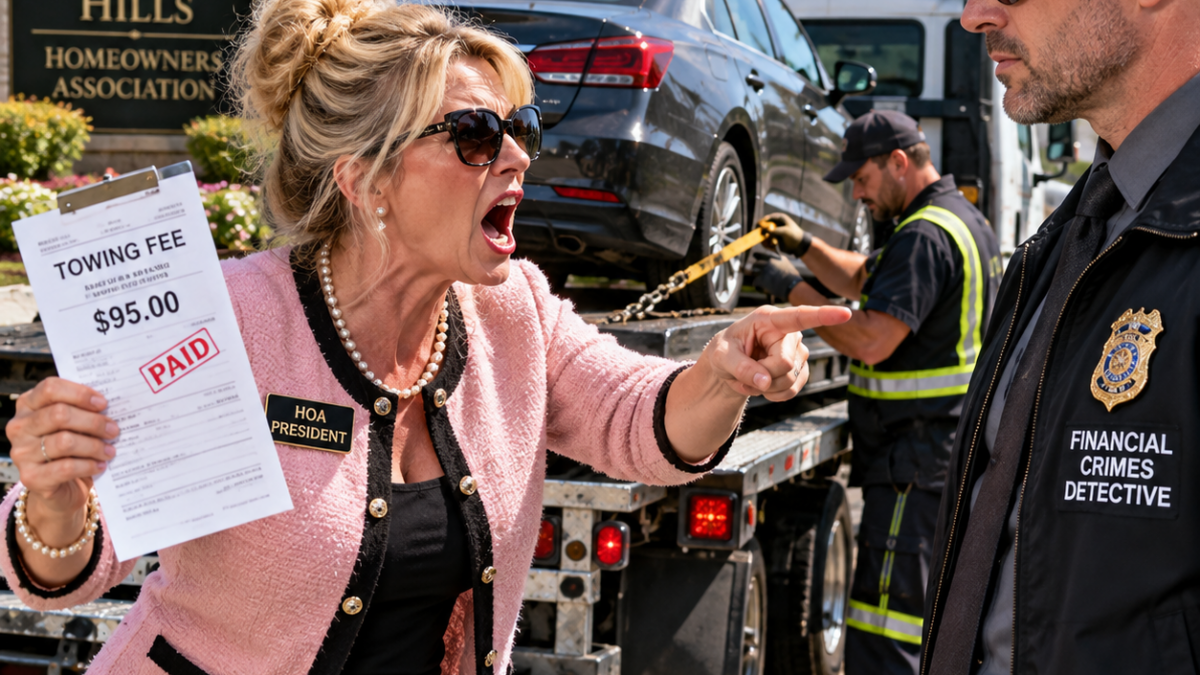
PART2:
He worked commercial HVAC for nearly twenty years.
Then started his own company.
Ran it successfully.
Sold it.
Retired.
He is one of those men who can come to your house, help you move a refrigerator up three flights of stairs, and say maybe six sentences the entire afternoon.
If he thinks your refrigerator is badly designed, that number becomes seven.
I like him enormously.
I have never told him that directly because I suspect it would make both of us uncomfortable.
His wife, Diane, once told me she married him because he was the first man she had ever dated who did not believe every silence needed to be repaired.
Matti’s neighborhood looked like something from a real-estate brochure.
Identical mailboxes.
Trim lawns.
Decorative stone entrances.
Tiny community pond.
A clubhouse nobody seemed to use.
And an HOA.
The kind of HOA that sends letters.
Diane had once received a violation because their trash can was visible from the street on a Tuesday afternoon.
Trash pickup had been Tuesday morning.
She brought the can in at three.
The notice included a photograph timestamped 1:17 p.m.
Matti framed it.
Hung it in his garage.
Underneath he wrote:
EVIDENCE.
The HOA president was Karen Dow.
I had heard her name.
Mostly from Diane.
Never met her.
Didn’t care.
I don’t live there.
That morning we arrived around eleven.
Clare was driving because Matti’s birthday had one tradition involving alcohol and my wife is smarter than both of us.
The neighborhood prohibited street parking.
There was a small guest lot beside the mailboxes two houses from Matti and Diane’s place.
Eight spaces.
I pulled in.
Then, because my job has turned me into a person who reads signs like other people read menus, I stood there for a second and looked.
GUEST PARKING
48 HOUR LIMIT
NO PERMIT OR REGISTRATION REQUIRED
Below it was a separate private towing sign.
Company name.
Phone number.
Recovery location.
Rates.
Accepted payment methods.
Warning that unauthorized vehicles could be towed.
Nothing unusual.
No numbered permits.
No sticker requirement.
No time restriction except forty-eight hours.
I parked in space four.
Clare made Oliver and Sophie stand beside the SUV because they were holding birthday balloons.
Oliver was nine.
Sophie was six.
Oliver believed being forced into family photographs was a violation of international law.
Sophie loved cameras and made a face in every picture.
So Clare took three.
The SUV.
The kids.
The balloons.
And, accidentally, both parking signs in the background.
At the time they were just family pictures.
Later, one became evidence.
Matti opened the door before we knocked.
Gray cardigan.
Brown slacks.
House slippers.
The same cardigan appears in photographs from Christmas, Thanksgiving, our wedding rehearsal dinner, and one family barbecue where it was ninety-four degrees.
“You parked guest lot?”
“Yes.”
“Like sign says?”
“Yes.”
“Good.”
Then he looked past us toward the lot.
“Karen likes sign more than people.”
Diane appeared behind him.
“Matti.”
“It’s true.”
“You cannot insult the HOA president before cake.”
“Why?”
“Tradition.”
Matti considered this.
“Fine.”
Inside, the house smelled like salmon soup and cinnamon.
Diane had learned several Finnish recipes from Matti’s mother during what Clare calls “the Christmas of Fear” in 1995.
Apparently Matti’s mother believed recipe measurements were a moral test.
Lunch lasted two hours.
The kids ran through sprinklers.
Oliver read shark facts aloud to people who had not asked.
Sophie decorated Matti’s cake with something she claimed was a reindeer.
It looked like a spider with antlers.
Then Matti disappeared into the hall closet.
He returned carrying a wooden box.
He handled it carefully.
Clare recognized it.
“No.”
Matti nodded.
“You’re opening that?”
“Sixty.”
Diane sighed.
“That thing has been in my closet for seven years.”
The bottle had come from an old friend in Finland.
A limited edition of Jaloviina from Finland’s centennial year.
Matti had saved it.
I had never tried it.
Matti poured two small glasses.
Clare pointed at me.
“One officially approved drinking day.”
“I am forty-one.”
“One.”
“I am a police detective.”
“One.”
Matti looked at me.
“She is boss.”
“I know.”
I drank.
It tasted surprisingly smooth.
Cognac notes.
Oak.
Warmth.
Then, about four minutes later, it hit me with the friendly efficiency of a professional linebacker.
Matti barely reacted.
I have known that man more than a decade.
I have never seen him drunk.
Slightly more conversational?
Yes.
Drunk?
No.
By the third glass he told a six-minute story about repairing a frozen boiler in Helsinki in 1986.
That was basically Matti dancing on a table.
I was buzzed.
Pleasantly.
Safely.
We were staying overnight.
Clare had the keys.
Nobody was driving.
Around 7:30 p.m., Sophie asked for the stuffed rabbit she had left in the overnight bag.
Clare went outside.
Two minutes later she returned.
No rabbit.
No bag.
Different expression.
“Evan.”
“What?”
“Where’s the car?”
I laughed.
“Guest lot.”
“It’s not there.”
My first alcohol-assisted thought was that Clare had walked to the wrong parking lot.
There was only one.
My second thought was theft.
Possible.
Unlikely.
This neighborhood probably reported unfamiliar squirrels.
We walked outside.
Matti followed.
Space four was empty.
The guest parking sign remained.
GUEST PARKING.
48 HOUR LIMIT.
NO PERMIT OR REGISTRATION REQUIRED.
I stared.
Clare took out her phone.
Called the towing number.
I let her.
When your wife is completely sober and you are currently noticing that the curb has more texture than expected, this is good procedure.
She gave the plate.
Waited.
Then looked at me.
“They have it.”
“Why?”
“HOA authorization.”
Matti’s face went completely still.
“What time?”
Clare asked.
Listened.
“Picked up at 6:52.”
“Can we get it tonight?”
“They’ll release after hours for additional fee.”
“No.”
I shook my head.
“We’re staying.”
Clare agreed.
“We’ll get it tomorrow.”
That was when Karen appeared.
She lived in a corner house overlooking the guest lot.
Early fifties.
White capri pants.
Blue blouse.
Sun visor even though the sun had almost set.
Phone in one hand.
The exact purposeful walk of someone who had been watching through a window and had been waiting for this moment.
“Is that your Toyota?”
I looked at the empty space.
“Was.”
She smiled.
“Well, unfortunately it was in violation.”
Matti folded his arms.
“Guest parking.”
“Yes.”
“Sign says guest parking.”
Karen’s smile tightened.
“I’m Karen Dow.”
She said it like the title should explain the universe.
“HOA president.”
“Evan Mercer.”
She looked at me briefly.
Did not ask anything else.
Good.
I was off duty.
Nothing about me suggested police.
Cargo shorts.
Birthday T-shirt.
Plastic cup of water.
Slightly flushed face from Finnish alcohol.
“Guest vehicles staying after six need to be registered through the resident portal,” Karen said.
Clare pointed at the sign.
“No permit or registration required.”
“That sign is outdated.”
“When did the policy change?”
I asked.
Habit.
Karen turned.
“March.”
“Board vote?”
“Yes.”
“Where is it posted?”
“The community portal and newsletter.”
Matti said:
“I read newsletter.”
Karen ignored him.
“Residents are responsible for informing guests.”
Clare frowned.
“No one told my parents.”
“Then that’s unfortunate.”
I asked:
“Who authorized the tow?”
“I did.”
“What time?”
She looked at me differently.
Not suspicious.
Annoyed.
“Around six-thirty.”
“And the vehicle was removed at 6:52.”
“I don’t manage the towing schedule.”
“What was the violation?”
“Unregistered guest parking after six.”
“Okay.”
Matti said:
“There is no rule.”
Karen turned toward him.
“Matti, this is the third issue this year.”
“What issues?”
“The trash container.”
“It was trash day.”
“It remained visible.”
“Trash truck needs see trash.”
I had to bite the inside of my cheek.
Karen continued.
“And the landscaping notice.”
Matti frowned.
“Which?”
“Garden edging.”
“That was my edging.”
“It extended outside approved color guidelines.”
Matti looked at me.
I could see an entire Finnish sentence happening behind his eyes.
He chose English.
“Brown was too brown.”
Karen ignored him.
Then she looked back at me.
“Pruitt Towing is very reasonable.”
I would later learn she pronounced it “Pruitt,” though the family name was Puit.
“Usually four hundred and change.”
“Four hundred?”
“Depending on fees.”
“And Matti gets fined too?”
“The HOA violation is separate.”
“So they tow me and charge me.”
“Yes.”
“And the HOA fines him.”
“Yes.”
“The rules apply to everyone.”
She looked at my plastic cup.
Then my face.
“You may want to sober up before you go recover your vehicle.”
I smiled.
“That is exactly the plan.”
She seemed surprised I didn’t become angry.
“Well. Good.”
She nodded.
“Most people make a scene.”
Then walked home.
I watched her go.
Clare took photographs.
Empty space.
Signs.
Curb.
Entire lot.
I made notes on my phone.
6:30 call.
6:52 tow.
Karen says policy adopted March.
Guest registration required after 6.
Why?
Not because I was investigating.
Because I was buzzed and knew I might forget.
Back inside, Matti was quiet.
Different from normal quiet.
Heavy quiet.
“I’m sorry.”
“It’s a car.”
“My neighborhood.”
“Still a car.”
“My birthday.”
I sat beside him.
“She doesn’t get your birthday.”
Matti considered this.
Then lifted the Jaloviina bottle.
“One more.”
Diane said:
“That is not how grief works.”
Matti poured anyway.
“For car.”
I laughed.
We drank.
The next morning, I woke with a mild headache and a strong desire never to celebrate Finland again.
Diane drove me to the tow yard.
Clare stayed with the kids.
Puit Towing and Recovery operated from a fenced property behind a tire shop.
Several wrecked cars.
Two tow trucks.
Office trailer.
Small service window.
A man in his late forties sat behind the glass.
Gray at the temples.
Reading glasses pushed onto his head.
His name tag said BOB.
At the time that meant nothing.
I gave him my plate.
He found the record.
“Four twenty-five.”
“Can I get an itemized receipt?”
He slid paper under the window.
TOW AND FEES — $425.
I looked up.
“Itemized.”
“That’s total.”
“I know.”
He sighed.
Typed.
Printer rattled.
New receipt:
Tow: $185.
Storage: $45.
After-hours gate fee: $50.
Special equipment/dolly: $50.
HOA administrative enforcement fee: $95.
Total: $425.
I looked at the line again.
“HOA administrative enforcement fee?”
“Association fee.”
“You collect it for the HOA?”
“Yep.”
“Then remit it?”
He looked mildly irritated.
“That’s between us and them.”
Interesting.
“Why after-hours gate fee?”
“Vehicle came in after six.”
“But I’m retrieving at regular hours.”
“It’s based on intake.”
“That normal?”
“Yes.”
“And dolly?”
“All-wheel-drive SUV.”
“Was a dolly used?”
“Driver marks equipment.”
“Can I see the tow record?”
He stared.
Most people pay.
Take keys.
Leave.
Questions change the temperature.
Still, he opened the file.
Held up authorization.
Signed by Karen Dow.
Violation box checked:
FIRE LANE / NO PARKING ZONE.
Location:
GUEST LOT — SPACE 4.
I looked again.
“This says fire lane.”
“Closest category.”
“My vehicle was in a guest parking space.”
“The forms are old.”
“Time by Karen’s signature says 7:05.”
Bob looked.
“So?”
“Tow sheet says vehicle hooked at 6:52.”
“Driver times may be approximate.”
“So authorization was signed thirteen minutes after removal.”
“It happens.”
“Is that allowed?”
He leaned back.
“Look, you want the vehicle or not?”
“Yes.”
I kept my voice pleasant.
“Can I photograph that?”
He hesitated.
Then shrugged.
“It’s your paperwork.”
I took a clear photo.
Another page had one image taken by the tow driver before removing the SUV.
My Toyota sat perfectly centered in space four.
And directly above the hood:
GUEST PARKING.
NO PERMIT OR REGISTRATION REQUIRED.
Perfect photograph.
“Can I get a copy of that?”
“Written records request.”
“Okay.”
I wrote down:
Date.
Time.
Bob’s name.
Asked where to send request.
Paid by credit card.
$425.
Bob slid the keys under the glass.
“Tell your father-in-law to register guests next time.”
“He says no registration requirement exists.”
“HOA says different.”
“Apparently.”
Driving back, Diane asked:
“You are doing cop face.”
“What face?”
“The face when you don’t believe something.”
“I’m not doing anything.”
“Evan.”
“It’s probably an HOA president on a power trip and a towing company with padded fees.”
“Is that illegal?”
“Depends.”
She waited.
“Bad behavior isn’t automatically criminal.”
That is something my job teaches you quickly.
People use words like scam and fraud loosely.
Legally, details matter.
Intent.
Representation.
Ownership.
Authorization.
Money flow.
Sometimes a ridiculous fee is just a ridiculous fee.
Sometimes a bad tow is just a civil dispute.
I expected maybe a complaint.
Credit-card dispute.
State towing regulator.
Nothing dramatic.
Then Matti said something before we left that afternoon.
“You’re not first.”
I was loading luggage.
“First what?”
“Towed.”
“Obviously.”
“No.”
He shook his head.
“From guest.”
I stopped.
“Who else?”
Matti counted.
“The young couple end street. Babysitter.”
Another finger.
“Tom with boat.”
Another.
“His brother.”
Another.
“Mrs. Alvarez son.”
“What happened to him?”
“Navy.”
“No, I mean parking.”
“He visited mother. Towed.”
“When?”
“November.”
“Same lot?”
“Yes.”
“Same reason?”
Matti shrugged.
“Karen reason.”
Then he said:
“Mrs. Alvarez keeps everything.”
The way he said it caught my attention.
We walked three houses down.
Mrs. Elena Alvarez was seventy-three.
Retired bookkeeper.
Reading glasses on a decorative chain.
She opened her front door.
Matti said:
“Evan car tow.”
She said:
“Come in.”
No question.
Her dining table contained several labeled folders.
Apparently she had been waiting for civilization to catch up with her filing system.
She pulled one.
PARKING / HOA.
Her son’s car had been towed from the guest lot the previous November.
Same towing company.
Same $95 HOA administrative fee.
Three weeks later:
HOA account statement.
Separate $150 violation fine.
Mrs. Alvarez tapped both.
“I asked Karen why I paid the association twice.”
“What did she say?”
“That these are unrelated charges.”
I looked at the tow receipt.
$95 HOA administrative enforcement fee.
“How could those be unrelated?”
Mrs. Alvarez smiled without humor.
“My question.”
“Did the HOA receive the ninety-five?”
“I asked.”
“And?”
“No answer.”
She pulled another folder.
Board minutes.
Three years.
Printed.
Tabbed.
Highlighted.
I looked at Matti.
He shrugged.
“Bookkeeper.”
“March parking policy?”
I asked.
Mrs. Alvarez immediately flipped tabs.
January.
February.
March.
April.
No amended guest parking rule.
“No vote?”
“None in open meeting.”
“What did Karen say?”
“Board approved in executive session.”
“That unusual?”
“Very.”
“Did you request copy?”
“Twice.”
“No response?”
“Correct.”
That was the first moment the situation changed inside my head.
Still not criminal.
But the numbers no longer lined up.
I drove home Sunday.
Kids asleep.
Clare beside me.
About halfway home she said:
“You’re thinking about it.”
“Yes.”
“What?”
“Fee.”
“The ninety-five?”
“Yes.”
“Why?”
“Because if the towing company says it belongs to the HOA, the HOA should account for it.”
“Maybe they do.”
“Maybe.”
“And the policy?”
“Could exist.”
“You don’t sound convinced.”
“I’m not convinced of anything.”
That week, I used only public information.
Important distinction.
I did not access law-enforcement databases.
Didn’t run names.
Didn’t search vehicles.
Didn’t ask coworkers to help.
I searched the state business registry like any citizen could.
Puit Towing and Recovery.
Registered agent:
Robert Puit.
Owner:
Robert Puit.
Nothing inherently suspicious.
Karen’s last name was Dow.
No obvious connection.
Then Mrs. Alvarez called Clare.
By then, apparently, Clare had become neighborhood intelligence headquarters because Mrs. Alvarez trusted her more than me.
During conversation she mentioned Karen’s mother had died the previous year.
Clare searched the obituary.
Then walked into my home office.
“Evan.”
“What?”
She turned her phone.
OBITUARY.
Survived by daughter Karen Dow.
Son Robert Puit.
I stared.
“Bob.”
“The towing guy.”
“Yes.”
“Karen’s brother.”
“Yes.”
“She orders the tow.”
“Yes.”
“Her brother gets paid.”
“Yes.”
“That’s illegal, right?”
“Not necessarily.”
Clare looked disappointed.
“Seriously?”
“Family relationships aren’t crimes.”
“But shouldn’t the HOA know?”
“That is a much better question.”
Matti found the HOA governing documents.
A binder he had apparently used as a doorstop for years.
Conflict-of-interest clause.
Board member must disclose direct financial or family relationships with contractors before participation in vendor selection or votes.
We checked minutes from when Puit Towing received the contract.
No disclosure.
Karen participated in vote.
Again:
Not necessarily criminal.
But ugly.
When I explained that to Matti, something shifted.
For eleven years he had tolerated Karen.
Trash-can notices.
Landscaping.
Holiday decoration restrictions.
Mailbox paint.
He hated conflict.
Then he looked at me and said:
“How many?”
“How many what?”
“Cars.”
Good question.
He and Mrs. Alvarez wrote a letter.
Not dramatic.
Not accusatory.
IF YOU OR A GUEST HAVE HAD A VEHICLE TOWED FROM THE COMMUNITY DURING THE LAST TWO YEARS, PLEASE CONTACT US. WE ARE COLLECTING INFORMATION REGARDING PARKING ENFORCEMENT.
Matti insisted on mailing copies to every homeowner.
Actual stamps.
“No email?”
“People delete email.”
“Postage is expensive.”
“Principle.”
Twenty-six households responded within three weeks.
That was when my dining table became Spreadsheet Central.
Date.
Vehicle.
Parking location.
Stated violation.
Tow amount.
Administrative fee.
Dolly.
Gate.
Storage.
HOA fine.
Photos.
Appeal result.
Patterns appeared.
Almost every tow included the $95 “HOA administrative enforcement fee.”
Many residents also received separate HOA fines later.
Several people had photographs.
Some showed vehicles in legal guest spaces.
One babysitter’s car had been towed at 6:17 p.m.
She had arrived at 5:40.
Sign required no permit.
One resident’s brother had been towed from the resident’s own driveway because his car was “not associated with the address.”
Another truck was removed for blocking a fire lane.
Owner’s Ring-camera footage showed it in a marked guest space.
Not all were invalid.
A man really had parked by a hydrant.
Someone else blocked a curb cut.
But enough were questionable that the pattern mattered.
Then Matti submitted a formal homeowner request for association financial records.
The HOA had to provide them.
Eventually, after delays, they did.
Mrs. Alvarez reviewed everything.
Then called us.
“The ninety-fives aren’t here.”
“What do you mean?”
“No deposits.”
No income matching the towing administrative fees.
Not monthly.
Not annually.
Nothing.
We calculated.
Even using only the twenty-six known tow records, thousands of dollars should have been remitted.
HOA books showed zero.
That was when I stopped viewing it primarily as obnoxious enforcement.
Still, I had a problem.
I was a detective.
And a victim.
That combination can contaminate a legitimate investigation very quickly if handled badly.
So the next morning I went to Lieutenant Sarah Kim.
Closed her office door.
Explained everything.
My car.
My father-in-law’s HOA.
Karen.
Brother.
Fees.
Lieutenant Kim listened.
Then pointed at me.
“You are a complainant.”
“Yes.”
“Nothing else.”
“Agreed.”
“No searches.”
“I know.”
“No databases.”
“I know.”
“No favors from records.”
“I know.”
“No asking analysts to ‘just check something.’”
“I know.”
“I mean it.”
“So do I.”
“If another jurisdiction takes this, you are Evan Mercer, citizen.”
“Understood.”
“If you screw around and defense counsel learns a financial crimes detective used police resources to investigate his own tow…”
“They get Christmas.”
“Exactly.”
I left.
Matti, Mrs. Alvarez, Clare, and I assembled a packet.
Spreadsheet.
Receipts.
Photos.
HOA minutes.
Conflict provision.
Obituary showing family relationship.
Financial statements.
My authorization form.
Guest parking sign photo.
Time discrepancies.
Residents signed individual statements.
Then complaints were filed with the police department covering Matti’s neighborhood.
Separate complaints went to the state agency regulating non-consensual towing.
Two weeks later, Detective Troy Bennett called me.
“You’re Mercer?”
“Yes.”
“Financial crimes?”
“Different county.”
“Good.”
Pause.
“Here, you’re just the guy whose Toyota got towed.”
“That’s exactly what my lieutenant said.”
“I like your lieutenant.”
“So do I.”
He had reviewed the packet.
“Brother towing for sister’s HOA is gross.”
“Agreed.”
“Not automatically illegal.”
“Agreed.”
“The fee is interesting.”
“Agreed.”
“You going to let me investigate?”
“Yes.”
“Meaning?”
“I answer questions.”
“And?”
“Then shut up.”
“Perfect.”
Then nothing happened.
For three months.
That is real investigation.
People think detectives uncover conspiracies in forty-five minutes.
Real financial cases involve subpoenas.
Bank-return waiting periods.
Business records.
Interviews.
Account statements.
Vendor contracts.
Phone calls nobody returns.
Then one random Tuesday, three documents arrive and suddenly the whole case changes.
What I eventually learned came from my witness interviews, court filings, later public records, and proceedings.
Detective Bennett partnered with an investigator from the district attorney’s office.
They subpoenaed Puit Towing’s records.
Fourteen months.
Eighty-three vehicles towed from Matti’s community.
Eighty-three.
Every invoice contained the $95 HOA administrative enforcement fee.
Eighty-three times ninety-five.
$7,885.
The HOA had received none of it.
Where had it gone?
Investigators found monthly payments from Puit Towing to a company called:
KD Parking Compliance Consulting LLC.
Registered address:
Karen Dow’s home.
Total payments:
$7,885.
Exactly.
Not approximately.
Exactly the total of every $95 fee.
That is the kind of number financial crimes detectives enjoy in the way normal people enjoy sunsets.
Clean.
Matching.
Difficult to explain accidentally.
Karen, through counsel, gave an explanation.
She was providing consulting services.
Parking compliance guidance.
Policy interpretation.
Enforcement recommendations.
Her brother’s towing company paid her separately for legitimate work.
Okay.
Possible.
Then investigators looked at the tows.
Drivers were required to photograph vehicles before removal for liability.
Those photographs were devastating.
Dozens showed vehicles parked in guest spaces.
Permitted areas.
Driveways.
The towing company’s own evidence often contradicted the checked violation.
Fire lane box with painted guest-space lines visible.
No-parking box while the guest sign stood in frame.
Expired permit violation where no permit was required.
Then investigators compared authorization times.
Some signatures occurred after vehicles were already hooked.
Others were entered in batches.
Several tow authorizations happened within minutes of Karen photographing vehicles herself.
The more records they obtained, the less the “consulting” explanation worked.
If Karen was simply the HOA official authorizing legitimate enforcement, why was the tow company paying her per tow?
If she was actually consulting for her brother’s business, why had she never disclosed that relationship to the HOA board?
Why exactly $95 per vehicle?
Why label that ninety-five dollars an HOA administrative fee if the HOA never received it?
Why were homeowners then fined separately?
Then came the altered policy.
Remember Karen telling me the parking rule had changed in March?
Investigators requested HOA records.
After that records request, a document appeared in the online resident portal.
AMENDED GUEST PARKING POLICY.
Effective March.
Guest vehicles required registration for stays after 6:00 p.m.
Exactly the rule Karen had cited when my SUV was towed.
Problem:
The portal software kept audit logs.
The document was uploaded in August.
From Karen’s account.
Months after its claimed effective date.
Worse:
The underlying file metadata indicated it had been created that same week.
Not March.
August.
Then Karen emailed an administrative assistant at the HOA management company.
The email was apparently intended to be routine.
Something like:
Please clean up prior parking violation entries to ensure dates align with amended policy effective date.
The assistant read it.
Did not like it.
Forwarded it to her manager.
The manager knew investigators had already requested records.
She forwarded everything to Detective Bennett.
That was the moment the case stopped being merely about questionable fees.
Because adding a retroactive policy after investigators request documents is the sort of decision defense lawyers hate explaining.
About seven months after my Toyota disappeared from space four, Karen was charged.
Not because I was a cop.
Not because she towed the wrong man.
Because investigators found records supporting theft by deception and evidence tampering.
I learned about charges the same way everybody else did.
Matti called.
Only he could deliver news like a weather report.
“Karen arrested.”
“What?”
“Not arrested arrested.”
“What does that mean?”
“Turned herself in.”
“Charged?”
“Yes.”
“What?”
“Money thing.”
“Very precise.”
“Come Saturday.”
We did.
February.
Cold.
Clare and I were at Matti’s for lunch when someone knocked.
Karen stood outside.
No visor.
No HOA polo.
Dark coat.
She held an envelope.
Matti opened the door.
She looked past him at me.
“Evan.”
“Karen.”
“I wanted to make this right.”
She held out the envelope.
I didn’t take it.
“What is it?”
“Your $425.”
Silence.
“And additional money for inconvenience.”
“How much?”
Her expression tightened.
“Five hundred total.”
I almost laughed.
“Why now?”
She looked at me carefully.
“My attorney received discovery.”
There it was.
“And?”
“He told me you’re a detective.”
I said nothing.
“Financial crimes.”
“Yes.”
“You never told me.”
“You never asked.”
Her face tightened.
“You let me stand there talking to you like…”
“Like what?”
She stopped.
I waited.
“I was off duty.”
I said.
“It was Matti’s birthday.”
“You were taking notes.”
“I was drunk enough to forget times.”
Matti corrected me.
“Buzzed.”
“Thank you, Matti.”
Karen looked from him to me.
“This whole thing has gotten out of hand.”
“No.”
She blinked.
“No?”
“It got exactly as far as the records took it.”
She held the envelope out again.
“I want to reimburse you.”
“I’ll take restitution through the case if ordered.”
Her hand lowered.
“I need you to tell them this was a misunderstanding.”
“I can’t.”
“You can.”
“No.”
“You filed the complaint.”
“So did twenty-something other people.”
“But you’re law enforcement.”
“Not in this case.”
“You know how this works.”
“Yes.”
“That’s why I’m not touching it.”
She inhaled.
“If you tell Detective Bennett you don’t want charges—”
“It isn’t my decision.”
“Victims influence these things.”
“Sometimes.”
“Then help.”
I looked at Matti.
He stood completely expressionless.
Karen followed my gaze.
“Matti.”
He said nothing.
“We’ve been neighbors twelve years.”
“Eleven.”
She blinked.
“What?”
“Eleven.”
“This isn’t funny.”
“No.”
Her voice softened.
“You know me.”
Matti considered.
“Yes.”
“Tell him.”
Matti looked at me.
Then back at her.
“Trash can was year four.”
There was a second of silence.
I nearly lost it.
Diane, behind us, covered her mouth.
Karen stared at him.
“You’re really doing this?”
Matti shrugged.
“You did.”
She looked back at me.
“Do you know what my attorney is costing?”
“No.”
“Three hundred fifty dollars an hour.”
“I would listen to him.”
Her cheeks reddened.
“I’m trying to resolve this.”
“If he told you to bring money directly to a witness, I would verify that advice.”
That stopped her.
Her eyes changed.
She looked down at the envelope.
I said:
“I am not accusing you of anything right now. I’m telling you that because you have pending criminal charges, you should speak with your attorney before discussing facts with witnesses.”
Cop voice.
Not threatening.
Protective.
For both of us.
She put the envelope back into her purse.
Nobody said anything.
Then she walked home.
The HOA moved faster than the criminal court.
Once the charges became public, residents demanded a special meeting.
Clubhouse packed.
Standing room.
Karen’s removal from the board was on the agenda.
She did not attend.
Her attorney apparently advised against it.
Matti went.
Mrs. Alvarez sat front row with three binders.
Diane brought cookies.
I did not vote.
Not my HOA.
But I watched.
Residents spoke.
Young couple whose babysitter had been stranded.
Mrs. Alvarez.
The Navy son.
A father whose teenage daughter’s car was towed while she fed a neighbor’s cat.
One resident admitted his vehicle had been legitimately towed and said:
“I paid because I deserved it. That doesn’t mean everybody else did.”
That mattered.
It prevented the meeting from becoming a mob pretending every tow was fraudulent.
Facts.
Not rage.
The vote was overwhelming.
Karen removed.
New interim president.
Puit Towing contract terminated.
All disputed HOA fines connected to questionable guest tows frozen pending review.
Later, improper fines were credited back.
New parking procedure required:
Two board members for non-emergency tow authorization.
Time-stamped photographs.
Written violation reason.
Vendor chosen through competitive bids.
Family and financial conflicts disclosed.
Guest parking sign replaced.
The criminal case moved slower.
Nearly eleven months after my car was towed, Karen reached a negotiated resolution.
Felony theft by deception.
Misdemeanor evidence tampering.
The exact legal structure was more complicated than neighborhood gossip made it sound, but those were the major counts in the plea.
Three-year sentence.
Sixty days in county jail.
Remaining time supervised probation.
Restitution.
Restrictions on financial involvement with HOA-type associations during supervision.
She also still faced civil claims from residents.
Bob took a lesser plea related to inflated towing fees.
Probation.
Restitution.
His company faced regulatory consequences.
The state suspended his authorization to conduct non-consensual towing.
Several clients terminated contracts.
Last I heard, Puit Towing still operated.
Roadside assistance.
Private calls.
Breakdowns.
Vehicles whose owners actually wanted them moved.
Honestly, I was fine with that.
The point wasn’t destroying his livelihood.
It was stopping him from using involuntary towing as a family revenue machine.
One afternoon I received a letter from victim services.
Restitution.
$425.
The entire amount.
Tow.
Storage.
Dolly.
Gate.
Administrative fee.
I showed Clare.
“Your criminal mastermind investment matured.”
“Excellent return.”
“Zero percent.”
“You got the principal back.”
“After eleven months.”
“You also got an HOA president removed.”
“I didn’t.”
“You know what I mean.”
“No.”
I held up the check.
“Records did.”
That became important to me.
People in the neighborhood started telling the story wrong almost immediately.
“Karen towed a cop.”
“Karen picked the wrong guy.”
“She had no idea she messed with financial crimes.”
It makes a better story.
But it misses the point.
My badge did not catch Karen.
I never used it.
Couldn’t.
Shouldn’t.
Mrs. Alvarez’s folders mattered more.
Matti’s HOA records request mattered more.
Residents keeping receipts mattered more.
The tow company’s mandatory photographs mattered more.
The association’s bookkeeping mattered more.
The portal’s audit logs mattered more.
The administrative assistant refusing to rewrite history mattered more.
Detective Bennett doing patient work mattered more.
Karen’s real mistake wasn’t towing a police officer.
It was assuming everyone she charged would simply pay and disappear.
The $95 fee worked because people were busy.
Embarrassed.
Angry.
Confused.
Or too intimidated by the paperwork to challenge it.
One victim feels unlucky.
Twenty-six victims make a spreadsheet.
Eighty-three records make a pattern.
And patterns are dangerous when your business model depends on nobody comparing notes.
The following June, we returned for Matti’s sixty-first birthday.
Same minivan.
Same kids, slightly taller.
Same guest lot.
Different sign.
GUEST PARKING.
48 HOUR LIMIT.
NO PERMIT OR REGISTRATION REQUIRED.
AUTHORIZED TOWING SUBJECT TO HOA WRITTEN POLICY.
Clare parked.
I got out.
Read it.
Matti stood at the end of his driveway.
“Bigger sign.”
“Yes.”
“I asked them add ‘really.’”
“Really?”
“Under no permit.”
“What did they say?”
“No.”
“Probably wise.”
Inside, Diane had salmon soup.
Sophie’s cake looked marginally less dangerous.
Oliver had moved from sharks to tornadoes and explained wind shear during lunch.
Then Matti went to the hall closet.
Wooden box.
Half a bottle remained.
Clare groaned.
“No.”
“Tradition.”
“You nearly cost my husband $425 last year.”
Matti looked at me.
“You got back.”
“Yes.”
“So technically free.”
“That is not how money works.”
He poured two small glasses.
Matti raised his.
“To court.”
I laughed.
“The court should not be included in this toast.”
“Court paid you.”
“Karen paid restitution through the court.”
“Details.”
Clare held out her hand.
“Keys.”
I gave them to her.
“One officially approved day.”
Matti nodded.
“She is boss.”
We drank.
Later, I walked toward the guest lot.
Space four was empty.
Nothing dramatic.
No tow truck.
No Karen.
A younger woman from the board was helping an elderly resident understand the new visitor system.
She spoke patiently.
The resident laughed.
Nobody threatened anybody with fees.
I stood there longer than necessary.
Matti joined me.
Hands in cardigan pockets.
“You happy?”
“With what?”
“She gone.”
I thought.
“Not really.”
He looked at me.
“No?”
“I’m glad it stopped.”
“Different.”
“Yes.”
We stood in silence.
Then he said:
“I should have complained earlier.”
“Maybe.”
“I did not want trouble.”
“That’s how these things keep going.”
He nodded.
“You know what bothered me most?”
“What?”
“Not money.”
“The lying?”
He shook his head.
“She made everybody feel stupid.”
I understood.
“When people complained, she said rules.”
He looked toward the sign.
“They think they wrong.”
That was exactly it.
Karen’s power hadn’t come only from the HOA title.
It came from certainty.
Most people assume official-looking things are legitimate.
Violation letters.
Tow authorizations.
Invoices.
Administrative fees.
If the paper has a logo and a due date, people pay.
Especially when challenging it costs time.
That’s why financial fraud often looks boring.
No ski masks.
No dramatic threats.
Just a line item.
A fee.
An invoice.
A rule nobody remembers approving.
Ninety-five dollars.
Small enough that many people sigh and pay.
Multiply small by eighty-three.
Suddenly it is not small.
A few months later, Detective Bennett called me.
Case already resolved.
He wanted something else.
“You ever use this in training?”
“What?”
“HOA case.”
“No.”
“You should.”
“Why?”
“Because everybody thinks fraud looks clever.”
He paused.
“This wasn’t clever.”
“No.”
“It was repetitive.”
“Yes.”
“That’s the lesson.”
He was right.
Greed rarely starts ambitious.
It tests.
One improper fee.
Nobody challenges.
Do it again.
Then again.
Add a second fee.
Tow faster.
Stretch authorization.
Invent a rule.
Backdate the rule.
Eventually you are not making one bad decision.
You are maintaining an entire system that requires new lies to protect old ones.
That is what happened to Karen.
I don’t think she started with an eighty-three-car scheme written on a whiteboard.
I think it began with proximity.
Her brother owned a tow company.
She controlled HOA parking.
Easy arrangement.
Then money appeared.
Ninety-five dollars here.
Ninety-five there.
People complained.
She had an answer.
People asked for records.
Delay.
Someone caught an inconsistency.
Create a policy.
Investigators asked for documents.
Now the policy needed to look older.
Management company records needed adjusting.
Each step solved yesterday’s problem and created tomorrow’s charge.
That is how bad systems grow.
Not through genius.
Through escalation.
Mrs. Alvarez became something of a legend in the neighborhood.
The new HOA board asked her to serve as treasurer.
She refused.
“I’m retired.”
They asked again.
“No.”
Then offered her audit committee chair.
She accepted.
Of course she did.
Matti called me.
“Elena has office.”
“Volunteer role.”
“Power.”
“Limited.”
“She has binder.”
That was enough.
One Christmas, Mrs. Alvarez mailed me a card.
Inside:
KEEP YOUR RECEIPTS.
Nothing else.
I framed it in my office.
My coworkers think it’s inspirational.
It is.
Two years after everything, I ran into Karen.
Not at the HOA.
Grocery store.
Produce aisle.
I was comparing avocados.
She recognized me first.
“Evan.”
I turned.
She looked older.
Hair shorter.
No makeup.
Normal clothes.
For the first time, she didn’t look like an HOA president.
Just a person.
“Karen.”
We stood there.
Awkward.
I expected anger.
She surprised me.
“I’m working.”
I wasn’t sure how to respond.
“Okay.”
“Office job.”
“That’s good.”
She nodded.
“My brother and I don’t speak much.”
I said nothing.
“My attorney told me not to blame anyone else.”
“That sounds like expensive advice.”
She almost smiled.
“He was very expensive.”
We both remembered the porch.
$350 an hour.
She looked down.
“I thought you set everything up.”
“What?”
“The investigation.”
“No.”
“I know that now.”
She rubbed one thumb against the shopping-cart handle.
“At first I thought you were using your job.”
“I wasn’t.”
“I know.”
Silence.
Then:
“That almost made it worse.”
“Why?”
“Because I couldn’t blame you.”
That was unexpectedly honest.
I waited.
“I blamed Matti.”
“Of course.”
“Mrs. Alvarez.”
“Dangerous woman.”
Karen actually laughed.
Small.
Then her face became serious.
“I blamed my brother.”
“Did he deserve some?”
“Yes.”
She nodded.
“So did I.”
I looked at her.
“You don’t owe me a confession.”
“I know.”
“But?”
She looked toward the automatic doors.
“I think I got addicted to being right.”
That sentence was better than any apology.
She continued.
“People complained. I’d show them the rule.”
“And when the rule didn’t exist?”
She closed her eyes briefly.
“That’s where everything broke.”
“No.”
She opened them.
“It broke before that.”
“How?”
“When you cared more about winning than whether the rule was fair.”
She absorbed that.
I didn’t mean it cruelly.
She nodded.
“Probably.”
Then she said:
“I’m sorry about Matti’s birthday.”
Of all things.
Not the tow generally.
His birthday.
I thought about him standing beside the empty space.
Sixty.
Quiet.
Apologizing to me for something he hadn’t done.
“Tell him.”
“I don’t think he wants to hear from me.”
“Maybe.”
She nodded.
We walked away.
I never told Detective Bennett about that conversation.
No need.
Case closed.
Years later, the thing I remember most isn’t Karen finding out I was a cop.
It’s Sophie’s photograph.
She was six.
Birthday balloons.
Gap-toothed smile.
Oliver looking miserable.
My Toyota behind them.
And two signs in plain view.
GUEST PARKING.
NO PERMIT OR REGISTRATION REQUIRED.
The whole case hiding in the background of a family photo before any of us knew there was a case.
Evidence is like that.
People imagine it arrives dramatically.
A secret recording.
A confession.
A hidden account.
Sometimes.
More often it is ordinary.
A receipt someone forgot to throw away.
A timestamp.
A file creation date.
A photograph taken for an unrelated reason.
A line in meeting minutes that isn’t there.
An administrative fee that should appear in bookkeeping but doesn’t.
An email sent because someone assumes the recipient will cooperate.
Fraud hates boring records.
That is probably why I like them.
They don’t care who is loudest.
Karen had the title.
Bob had the tow trucks.
Residents had receipts.
In the end, receipts won.
Matti still lives in that neighborhood.
So does Mrs. Alvarez.
The HOA still exists.
Because HOAs themselves aren’t magical evil machines.
They are corporations run by people.
Good governance depends on boring things.
Disclosure.
Voting.
Records.
Checks.
Competition.
Transparency.
After Karen, meetings got quieter.
That may be the best outcome.
No more surprise towing crusades.
No president photographing cars from her window.
No mysterious fees.
If somebody actually blocks a hydrant, they get towed.
If a guest parks legally, they don’t.
Revolutionary.
One afternoon Matti called me.
“Need help.”
“With what?”
“Computer.”
“What happened?”
“HOA portal.”
I laughed.
“Thought you hated it.”
“Need register clubhouse.”
“They finally require registration?”
“For clubhouse.”
“Okay.”
“Parking still no permit.”
“I know.”
“You sure?”
“Yes.”
“Sign says.”
I drove out the following weekend.
He had printed the entire policy.
Twenty-seven pages.
On paper.
“You could read it online.”
“No.”
“Why print?”
“Evidence.”
Diane, from kitchen:
“He has become Mrs. Alvarez.”
Matti ignored her.
We booked the clubhouse.
Then he asked if I wanted to see something.
Garage.
On the wall beside his framed trash-can violation was a copy of my restitution check.
Not actual negotiable check.
Photocopy.
Under it Matti had written:
CAR: $425
KAREN: MORE
I stared.
“What does ‘more’ mean?”
He shrugged.
“Lawyer cost.”
“That is mean.”
“True.”
“You’re enjoying this too much.”
“Little.”
I laughed.
Then noticed another frame.
The birthday photo.
Kids.
Balloons.
Toyota.
Parking signs.
Matti tapped it.
“Best evidence.”
“You didn’t take that.”
“No.”
“Sophie did.”
“Clare.”
“Whatever.”
He looked at it.
“She thought just picture.”
“Most evidence is.”
Matti nodded as if we were discussing engineering.
Then he said:
“You know, Karen’s big mistake not towing cop.”
“Correct.”
“People always say that.”
“I know.”
“Big mistake towing everybody.”
Exactly.
That is the version I wish people told.
Karen did not lose because she accidentally picked a detective.
She lost because twenty-six households finally compared experiences.
Because homeowners requested records.
Because one retired bookkeeper kept paper.
Because one management employee refused to backdate history.
Because another detective followed the money.
Because the towing company saved photographs.
Because the bank kept records.
Because Karen and Bob created a system that depended on nobody assembling the whole picture.
My profession helped me recognize some red flags.
Sure.
But if I had been an accountant, teacher, mechanic, plumber, or guy who sold garden hoses, the documents would still have said the same thing.
The money still would have gone where it went.
The upload log still would have shown August.
The receipts still would have contained ninety-five dollars.
The HOA books still would have been missing it.
Truth does not become more true because a cop notices.
That matters.
I tell younger detectives that when I use the case in training now.
Yes.
Eventually I did use it.
Not names.
Not neighborhood.
Just structure.
I put a slide up.
$95 × 83 = $7,885.
Then ask:
“What’s the fraud?”
New detectives usually jump.
Kickbacks.
Embezzlement.
False towing.
Conflict.
I tell them:
“Slow down.”
Then we walk through it.
What was represented?
Who owned the money?
What authorization existed?
Where did funds go?
What records support intent?
What was altered?
What evidence is independent?
Financial crimes are won by patience.
And by not falling in love with your theory before records prove it.
One trainee once asked:
“Didn’t they freak out when they learned you were financial crimes?”
I laughed.
“Eventually.”
“Must’ve been satisfying.”
I thought about Karen at Matti’s door with the envelope.
Honestly?
No.
By then it was sad.
Consequences are satisfying in stories.
In real life they involve families.
Jobs.
Legal fees.
Embarrassment.
Probation.
A brother and sister who stop speaking.
Residents who lose trust.
Nothing about that is fun when you see it up close.
Necessary?
Yes.
Funny in places?
Absolutely.
Matti correcting Karen about eleven years instead of twelve remains objectively funny.
But I never celebrated the jail sentence.
What I celebrated was the system stopping.
People getting money back.
Transparent rules.
No more weaponized guest parking.
That was enough.
Last June, Matti turned sixty-four.
We drove out again.
Sophie is ten now.
Oliver thirteen and far too cool for birthday balloons.
Clare parked in guest space four.
I read the sign.
She caught me.
“You know it by heart.”
“Policies change.”
“You have a problem.”
“Professional habit.”
We walked toward the house.
Matti opened the door.
Same cardigan.
I swear it may be immortal.
“Park okay?”
“Yes.”
“Read sign?”
“Yes.”
“Good.”
Diane yelled from inside:
“Stop interrogating them.”
Lunch.
Cake.
Kids.
Then the wooden box.
Still there.
Bottle almost empty.
Matti poured the last two small glasses.
He studied mine.
“Four years.”
“Since what?”
“Expensive birthday.”
“Technically free after restitution.”
He nodded.
“Good investment.”
“It was not an investment.”
He raised his glass.
“To parking.”
“No.”
“To evidence.”
I considered.
“That I’ll drink to.”
Clare held out her hand.
“Keys.”
I gave them to her.
Matti and I clinked glasses.
That old Finnish liquor still tasted like oak, dried fruit, and poor future decision-making.
After dinner, I walked outside.
Guest lot quiet.
Street quiet.
One unfamiliar sedan parked in space two.
Nobody photographing it.
Nobody calling a tow truck.
Just a car belonging to somebody visiting somebody.
Exactly what a guest space is for.
I stood there for a minute.
Then Matti joined me.
“You checking?”
“No.”
He looked at the sedan.
“Permit?”
“Matti.”
He almost smiled.
“Joke.”
“You’ve changed.”
“No.”
We stood together.
Then I said:
“You know Karen apologized.”
He looked at me.
“When?”
“Grocery store.”
“To you?”
“Yes.”
“What she say?”
“She was sorry about your birthday.”
Matti stared toward the lot.
For a long time.
“Okay.”
“That’s it?”
“What else?”
“You forgive her?”
He shrugged.
“Probably.”
“Probably?”
“Does not mean put her back board.”
“No.”
“Does not mean forget.”
“No.”
“Means I eat dinner.”
That was Matti.
Maybe he had understood consequences better than all of us.
Forgiveness does not restore access.
It does not erase records.
It does not require pretending nothing happened.
Sometimes it simply means the other person no longer gets free space in your head.
Matti had cake to eat.
I wish I were that efficient.
Before we went inside, I looked once more at space four.
The place where my SUV disappeared.
Where Karen stood smiling and told me the rules applied to everyone.
In the end, she was right about one thing.
Rules should apply to everyone.
HOA presidents.
Tow operators.
Police detectives.
Homeowners.
Guests.
Everybody.
The problem was never rules.
It was the person deciding she could invent them after the fact, profit from enforcing them, hide the relationship, and then rewrite the paperwork when someone finally asked questions.
Power does strange things to people.
Especially small power.
A badge can do it.
A board title can do it.
A supervisor position can do it.
A clipboard can do it.
A tow authorization can do it.
The danger begins when somebody stops asking:
Am I allowed to do this?
And starts asking only:
Can anyone stop me?
For a long time, nobody stopped Karen.
So she mistook silence for approval.
Payment for legitimacy.
Authority for ownership.
Then one legally parked Toyota disappeared during a birthday party.
She expected another complaint.
Another angry guest.
Another $425.
Instead, Matti talked.
Mrs. Alvarez opened a binder.
Twenty-six households answered letters.
Eighty-three tow files surfaced.
A spreadsheet formed.
And the number that looked insignificant one car at a time became impossible to ignore when placed in a single column.
$95.
$95.
$95.
Again.
Again.
Again.
That is how greed exposed itself.
Not through a dramatic confession.
Through repetition.
Karen thought she had created a machine that made money every time a tow truck hooked a car.
What she had actually created was a ledger.
And ledgers remember.
That is the part I tell people now.
Not:
Don’t tow a cop.
That lesson is stupid.
The real lesson is:
Don’t build a scheme that depends on everyone staying isolated.
Eventually people compare receipts.
Eventually somebody asks where the money went.
Eventually a database logs the date you uploaded the document.
Eventually the assistant you expect to “clean things up” realizes she does not want to become part of your problem.
Eventually the boring records meet one another.
And when they do, titles stop mattering.
Karen’s mistake was not that she had no idea I was a cop.
Her mistake was believing it would have mattered if I wasn’t.
She thought I was just another birthday guest.
She thought Matti was just another homeowner.
She thought Mrs. Alvarez was just another old woman with folders.
She thought the young couple was just another family too busy to argue.
She thought the Navy son would pay and leave.
One by one, we were easy.
Together, we were evidence.
That is what finally beat her.
Not my badge.
Not my job.
Not revenge.
Just people who stopped accepting a charge because someone in authority told them it was legitimate.
People who kept receipts.
People who asked questions.
People who compared numbers.
And one stubborn Finnish man who had tolerated eleven years of HOA nonsense until somebody ruined his sixtieth birthday.
I sometimes think Karen should have been more afraid of him than me.
Because detectives come and go.
But Matti?
Matti still has the paperwork.
All of it.
In a binder.
Right beside the framed trash-can violation.
And knowing him, he always will.








