HOA Karen Had 18 Vehicles Towed From My Locked Ranch at 2 A.M.—By Sunrise, Deputies Learned She’d Used a Stolen Gate Key and Her Entire Fleet Was Gone Too.
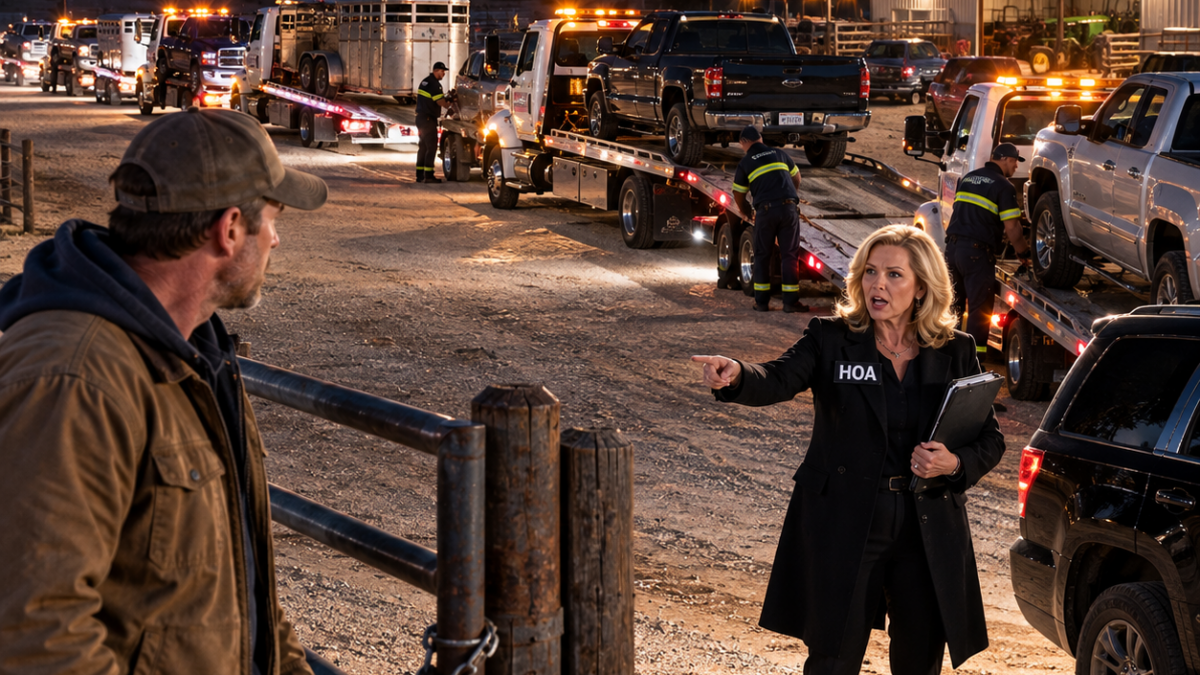
PART2:
And, eventually, what I should do with the twenty-two-foot stock road that ran along the northern edge of my property.
That road was the real issue.
It had always been the issue.
I knew it.
Denise knew it.
Developer Greg Sutton absolutely knew it.
The only reason I did not drive across town that morning was because twenty-six years of managing heavy equipment and county fleet operations finally spoke louder than anger.
Do not react.
Document.
That lesson had saved me money before.
Saved jobs.
Saved equipment.
Prevented arguments from turning into lawsuits.
That morning it may have saved my ranch.
I walked to the north gate.
The chain still hung where I had left it.
Padlock intact.
No cut marks.
No pry damage.
No twisted hinge.
No tire tracks through the ditch.
No broken fence.
I removed the lock and carried it beneath the security light.
The brass around the keyway was clean.
Paint intact.
Nobody had forced entry.
That bothered me more.
A broken gate means somebody broke in.
An untouched gate means somebody believed they were allowed to open it.
I walked back to the house.
Made coffee strong enough to qualify as industrial solvent.
Then opened my security system.
The first unusual movement appeared at 2:07 a.m.
Headlights entered the stock road.
One.
Then another.
Then four more.
Six tow trucks in formation.
DALTON RECOVERY AND TRANSPORT.
I knew the company.
Everybody who dealt with heavy equipment in the county knew Mark Dalton.
Fifty-eight.
Broad shoulders.
Gray beard.
Twenty years towing everything from wrecked sedans to excavators.
He was not an amateur.
He knew paperwork.
Titles.
Lien procedures.
Impound rules.
Private-property authorization.
Which made what I was watching harder to understand.
At 2:10, a black SUV stopped outside my gate.
Driver’s door opened.
Denise Holloway stepped out.
Dark coat.
Leather folder under one arm.
Hair pulled back.
She looked less like somebody committing trespass than somebody arriving early for a board meeting.
Mark met her at the gate.
They spoke.
The camera had no clear audio at that distance.
Then Mark reached into a secure box mounted to one of the gate posts.
Seconds later:
Gate open.
No bolt cutter.
No damaged lock.
He opened it.
His trucks drove onto my ranch.
I grabbed a yellow legal pad.
If anger needed work, it could write timestamps.
2:24.
First pickup removed.
2:31.
Second.
2:39.
Trailer.
2:46.
Service rig.
By 2:52, five vehicles were gone.
The crews moved efficiently.
Photographed plates.
Logged VINs.
Connected chains.
Tilted flatbeds.
Loaded equipment.
No confusion.
No questions.
Nobody appeared surprised to find a locked private equipment yard.
They behaved like the operation had been planned.
At 3:16, they reached Dad’s Ford.
I paused the footage.
For a second I could see him.
Not literally.
Memory.
Dad standing inside our old machine shed when I was fourteen.
Handing me a wrench.
“Listen.”
“To what?”
“The engine.”
“It’s off.”
He shook his head.
“Exactly.”
Dad believed machinery spoke even when it was broken.
Oil.
Wear patterns.
Heat.
Metal shavings.
You just needed patience.
He believed land worked the same way.
“You take care of what carries you.”
He told me that repeatedly.
“Trucks, cattle, people, dirt.”
On screen, a tow operator crawled beneath his Ford.
Attached chains.
Pulled it up the bed.
My hand tightened around the pen.
I wanted to close the laptop.
Instead I wrote:
3:16 — restored Ford removed.
Then kept watching.
At 3:34, one of Dalton’s employees carried a ladder toward the obvious camera mounted above the equipment-yard entrance.
He looked directly into the lens.
Reached behind it.
Screen went black.
I stared.
Then laughed once.
Quietly.
They had found the camera they were supposed to find.
They had not found the three cameras I installed after a diesel theft eighteen months earlier.
One hidden under roof trim.
One inside a weatherproof vent housing.
One disguised inside an old floodlight bracket.
I changed feeds.
The ranch came back.
Same crew.
Same vehicles.
Same operation.
At 3:46, the eighteenth vehicle disappeared through the north gate.
Denise remained.
Mark walked toward her.
This angle had a microphone close enough to catch pieces.
Wind cut through some of it.
I turned the volume up.
Mark looked across the yard.
“All eighteen.”
Static.
“That’s everything.”
Denise stared at the empty equipment spaces.
Then said the sentence that changed the entire problem.
“Get all eighteen out before he wakes up.”
Wind.
Then clear again.
“Sutton needs that road clear before Monday.”
I froze.
Replayed.
Sutton needs that road clear before Monday.
Again.
Sutton.
Greg Sutton.
Developer.
The man who had twice tried buying permanent access across the northern strip of Miller Creek Ranch.
The equipment yard sat beside that road.
The vehicles were not simply parked there.
They occupied the exact corridor Greg wanted.
Until that moment, I thought Denise’s campaign against my trucks had been HOA arrogance.
Now I understood something else.
The vehicles were obstacles.
And Monday was a deadline.
I copied the footage immediately.
Laptop.
External drive.
Second drive.
Cloud account.
Then one more copy to a flash drive I put inside my gun safe.
Not because the footage showed a crime.
That was for investigators to decide.
Because it showed facts.
And facts disappear remarkably fast once people know they are inconvenient.
I called Rachel Morgan.
Rachel had been my attorney for nine years.
Property.
Contracts.
Business.
She answered on the fourth ring.
“Ethan?”
“Yes.”
“It’s four-thirty.”
“I know.”
“Who died?”
“Nobody.”
Pause.
“Then somebody stole something.”
“Eighteen vehicles.”
Silence.
Then:
“What?”
“All eighteen from the north yard.”
Another pause.
“Are you joking?”
“No.”
“Video?”
“Yes.”
“Who?”
“Dalton Recovery.”
“Authorized by?”
“Denise is physically there.”
Her voice changed immediately.
“Do not go to Cedar Valley.”
“I know.”
“Do not call Denise.”
“I know.”
“Do not call Sutton.”
“I know.”
“Preserve originals.”
“Already doing it.”
“Good.”
“Rachel.”
“Yes?”
“She said Sutton needs the road clear before Monday.”
Longer silence.
“Send nothing by text.”
“Why?”
“Because I want the original recording preserved before anyone hears you summarize it.”
Fair.
“Call the sheriff.”
I did.
Sheriff Daniel Brooks reached Miller Creek Ranch before five.
Daniel was fifty-one.
Quiet.
Former state patrol.
The kind of lawman who asked fewer questions than most people but listened harder to the answers.
He arrived with Deputy Allison Grant.
Neither came with conclusions.
Daniel carried a camera.
That made me trust him immediately.
He photographed:
Empty spaces.
Fresh tire tracks.
Gate.
Chain.
Lock.
Emergency-access box.
Private-property signs.
Equipment-yard boundary.
Then we went into my workshop.
I played the recording.
2:07.
Tow trucks.
2:10.
Denise.
2:24.
First vehicle.
Daniel paused twice.
Asked where cameras were positioned.
Asked whether anyone besides me had authorization to remove equipment.
No.
Asked whether I had an active dispute with Dalton Recovery.
No.
Then at 3:34, the first camera went black.
Daniel looked over.
“That the only one?”
“No.”
I switched feeds.
Deputy Grant smiled slightly.
“Good.”
The hidden footage continued.
Then Denise’s voice.
“Sutton needs that road clear before Monday.”
Daniel paused.
“Who is Sutton?”
“Developer.”
“What does he want?”
“My stock road.”
“Owns any interest in it?”
“No.”
“HOA?”
“No.”
“County?”
“No.”
“Recorded easement?”
“No permanent one.”
He caught that.
“What temporary one?”
“I need to verify.”
Rachel arrived twenty minutes later.
She carried a file box.
Inside:
County plat.
My deed.
Survey.
Cedar Valley declaration.
Certified letters.
And the fake county abatement order Denise’s HOA had sent me two weeks earlier.
That document was where the story had actually become dangerous.
At first glance, it looked real.
County seal.
Case number.
Property description.
Legal language.
Emergency nuisance abatement authorization.
It claimed the eighteen vehicles along my northern equipment yard constituted an immediate nuisance and could be removed by a licensed contractor.
When I first received it, I nearly believed it.
Rachel didn’t.
She compared the case number with authentic county files.
Wrong format.
Seal outdated.
No judge.
No code-enforcement hearing.
No inspection.
No docket.
No actual county file.
Fake.
Someone had fabricated government authority.
We sent Denise formal notice.
Certified mail.
Email.
Delivery confirmation.
The notice said clearly:
Miller Creek Ranch was not subject to Cedar Valley HOA jurisdiction.
The abatement order had no verified county basis.
No contractor had permission to enter or remove property absent valid governmental authority.
Denise received it.
Then went ahead anyway.
Daniel read the delivery confirmation.
“So before last night, she was told this document was disputed and that she did not have permission.”
Rachel answered:
“More than disputed. County staff could not verify that the order existed.”
Daniel nodded.
“Doesn’t answer who created it.”
“No.”
“But it answers whether she had notice.”
“Yes.”
The gate still bothered him.
“How did Dalton access the lock?”
That was when I remembered.
Wildfire season.
Seven years earlier.
A series of fast-moving grass fires had threatened the entire northern county.
Emergency management coordinated secondary evacuation access through several rural properties.
Miller Creek Ranch participated.
I allowed a secure emergency box near the north gate.
County emergency services had a controlled key.
Cedar Valley received limited emergency access under the county plan because their western roads could become trapped if fire crossed the highway.
Wildfire.
Evacuation.
Rescue.
That was the purpose.
I had mostly forgotten.
At seven-thirty, county offices opened.
Michael Turner met us there.
Michael was sixty-five, surveyor, and one of the men who had laid out the original Cedar Valley subdivision decades earlier.
He found the emergency agreement.
The language was painfully clear.
Temporary emergency access.
County-directed use.
Wildfire.
Rescue.
Evacuation.
No commercial access.
No general HOA use.
No permanent easement.
No ownership interest.
No transferable right.
Then a sentence in bold legal language:
Nothing herein shall create or convey any permanent easement, right of way, ownership interest, or association access right across Miller Creek Ranch.
Daniel read it twice.
“So the HOA retained a mechanism capable of opening the gate.”
“Yes.”
“But no legal authority to use it for towing.”
“Correct.”
Denise had turned an emergency safety mechanism into a private key.
By eight in the morning, my initial problem had changed.
At 4:11:
Eighteen vehicles missing.
By eight:
Security footage.
A fake county order.
Proof Denise had notice.
Proof she used an emergency-access system outside its purpose.
A recorded statement connecting the removal to Sutton.
One unanswered question:
Where were my vehicles?
Daniel contacted Dalton Recovery.
No answer.
A deputy went to their licensed impound lot.
Empty of my property.
More concerning:
The six tow trucks involved were not there either.
No intake records.
No VIN logs.
No impound notices.
No storage receipts.
No county tow request.
Nothing.
Legitimate towing leaves paperwork.
My eighteen vehicles had effectively disappeared outside the system.
Then traffic cameras picked up the convoy.
One Dalton flatbed at 2:39.
Heading north.
Not toward the company’s storage lot.
Second truck.
Same route.
Third.
Daniel mapped it.
All passed Cedar Valley.
Then disappeared beyond camera coverage.
We were preparing to follow that direction when his radio came alive.
Deputy Grant answered.
Listened.
Then looked at Daniel.
He took the radio.
Spoke briefly.
His expression changed.
I noticed.
“What?”
Daniel lowered the radio.
“Cedar Valley has a missing-vehicle problem.”
My first thought:
Maybe somebody stole two security SUVs.
“How many?”
Daniel looked at me.
“All of them.”
Cedar Valley’s service center had twenty-four empty spaces.
Twelve security and patrol SUVs.
Maintenance pickups.
Landscaping trucks.
Utility vans.
Management vehicles.
Gone.
Employees stood around confused.
Some had arrived for work and discovered there were no work vehicles.
Then Denise came out of the clubhouse.
Black coat.
Same one from my security footage.
Hair slightly disorganized now.
She saw me.
Pointed immediately.
“There he is!”
I stopped.
“You need to arrest him.”
Daniel asked:
“For what?”
“For stealing association property.”
I looked around at twenty-four empty spaces.
The audacity was almost impressive.
Less than six hours earlier, Denise had personally supervised the removal of eighteen vehicles from my private land.
Now her fleet was gone and I was somehow suspect number one.
“He did this in retaliation.”
Rachel stepped forward.
“Retaliation for what?”
“For lawful nuisance enforcement.”
Rachel removed the fake order.
“This?”
“Yes.”
“The county says this case does not exist.”
“That is an administrative discrepancy.”
“No.”
Rachel looked at her.
“That is an authenticity problem.”
Daniel raised his hand.
“Mr. Miller.”
“Yes?”
“Did you arrange the removal of Cedar Valley vehicles?”
“No.”
“Did you enter HOA property overnight?”
“No.”
“Direct anyone to?”
“No.”
“Do you know where they are?”
“No.”
Denise scoffed.
“Obviously he will deny it.”
Daniel nodded.
“Then evidence will tell us.”
My own cameras covered me until I discovered the theft.
Phone records showed I called Rachel.
Daniel’s deputy arrived before five.
From then on, I was surrounded by law enforcement and attorneys.
Unless I possessed the ability to steal twenty-four vehicles while simultaneously reporting eighteen of my own missing, Denise had a problem.
“He has threatened Cedar Valley for months.”
Daniel turned.
“What threat?”
“He resists enforcement.”
“That isn’t a threat.”
“He constantly refuses compliance.”
Rachel said:
“His property is not inside Cedar Valley.”
Denise ignored her.
Then Susan Parker came through the clubhouse doors carrying a laptop and a stack of papers.
Cedar Valley treasurer.
Late forties.
Quiet personality.
I had seen her at county planning meetings.
She looked anything but quiet that morning.
“Denise.”
“Not now.”
Susan stopped.
“Yes.”
“No.”
“Yes.”
She placed documents across the hood of Daniel’s cruiser.
“Our operating balance is wrong.”
Denise’s face changed.
Small.
But unmistakable.
Susan opened the first page.
DALTON RECOVERY AND TRANSPORT.
Payment:
$61,500.
Transferred from Cedar Valley reserves.
Thirty-six hours earlier.
Daniel looked at Denise.
“What was this?”
“Emergency enforcement.”
Susan shook her head.
“The board never approved sixty-one thousand five hundred dollars for emergency enforcement.”
Denise’s jaw tightened.
“This discussion involves confidential association finances.”
Susan pulled out another document.
“So does this.”
Title:
FLEET SECURITY AGREEMENT.
Twenty-four VIN numbers.
Every missing Cedar Valley vehicle.
Susan tapped the signature page.
“These vehicles were not stolen.”
Silence.
Nobody moved.
“They were pledged as collateral.”
Denise stopped talking.
For perhaps the first time since I had known her.
The entire Cedar Valley fleet had secured a short-term financing arrangement.
A lender had issued default notices.
Required payment missed.
That morning, before sunrise, the lender repossessed the vehicles under the agreement Denise had signed.
Her fleet had not vanished because I retaliated.
It vanished because Denise had pledged it and failed to pay.
Daniel pointed at the signature.
“Yours?”
Denise took one second too long.
Susan answered.
“Yes.”
Denise snapped:
“I had authority to manage association assets.”
“Not without the required board vote.”
Susan opened the bylaws.
Major financial obligations:
Board authorization.
Collateralization of association property:
Board authorization.
She had searched the minutes.
No vote.
No approval.
No disclosure.
Rachel asked:
“How much financing?”
Susan gave the number.
Then showed where some of the funds had gone.
One major transfer:
$61,500 to Dalton Recovery.
Description:
EMERGENCY LAND ENFORCEMENT SERVICES.
Daniel looked toward the empty HOA lot.
Then toward me.
Then Denise.
“So while the lender was preparing to repossess Cedar Valley’s fleet, Cedar Valley paid more than sixty thousand dollars to the company that removed Mr. Miller’s vehicles.”
Denise said:
“This is internal.”
Daniel shook his head.
“Your financing may be.”
He held up the fake abatement order.
“A payment to a towing company that removed property from private land under questionable authority is not.”
Balance changed.
Completely.
That morning began with Denise accusing me of stealing her fleet.
Now:
Money tied her directly to the company that took mine.
Her own signature explained what happened to hers.
Susan had more.
$14,800.
TRANSPORTATION CONSULTING.
$9,600.
CORRIDOR SURVEY SUPPORT.
Two smaller amounts:
DEVELOPMENT COORDINATION.
No normal invoices.
Rachel asked:
“Who received these?”
Susan rotated the laptop.
CV ACCESS PARTNERS LLC.
I had never heard of it.
Daniel hadn’t.
Denise had.
I knew because she reached toward the screen.
Susan closed the laptop.
“You are not touching financial records until the board reviews this.”
“You have no authority to—”
“As treasurer, I have an obligation to preserve association records.”
Denise stepped toward her.
Daniel moved between them.
“Nobody deletes anything.”
Conversation ended.
Rachel searched the state business registry from her phone.
CV Access Partners had been formed recently.
Sparse records.
But its management entity connected to:
Sutton Development Group.
Greg Sutton.
Same developer.
Same road.
Same Monday deadline.
My stomach went cold.
Susan looked stunned.
“I have never seen this relationship presented to the board.”
Rachel kept searching.
The management company used a commercial mailbox address.
Susan recognized it.
“That is Denise’s reimbursement mailing address.”
Denise snapped:
“It’s a commercial mailbox.”
Rachel nodded.
“Could be coincidence.”
That calm answer irritated Denise more.
“We will document it.”
Nobody needed to accuse prematurely.
Evidence was already shrinking the available innocent explanations.
Then another camera update came in.
Dalton tow trucks were seen east of Cedar Valley.
Heading toward the agricultural district.
Rachel opened Sutton’s development map.
Michael’s survey beside it.
The proposed west connector ran:
Cedar Valley.
Across Miller Creek Ranch.
Across my twenty-two-foot stock road.
Then east to Cedar Valley Crossing.
And directly through the space where my eighteen vehicles had been parked.
I stared.
“They weren’t clearing a nuisance.”
Rachel nodded.
“They were clearing a corridor.”
Everything made sense.
The citations.
Vehicle storage.
Lighting.
Dust.
Trailers.
Fence.
Every complaint targeted the northern section.
Everything occupying or supporting the road.
When notices failed:
Fake abatement.
When the fake order did not scare me:
Use it anyway.
Susan pulled up Sutton’s development financing timeline.
Monday was important because an upcoming financing and planning review depended heavily on access and transportation assumptions.
A western connection improved:
Traffic flow.
Commercial value.
Neighborhood convenience.
Projected lender confidence.
Suddenly Greg’s $425,000 offer looked smaller.
Much smaller.
Then Rachel found the document that turned the issue personal.
CV Access Partners was positioned to participate financially in acquisition and management of access rights tied to the proposed western corridor.
And a distribution agreement associated with its management entity listed a beneficiary.
Denise Holloway.
Not:
Cedar Valley.
Not:
HOA president.
Denise personally.
Susan sat back.
“She has a financial interest?”
Rachel remained careful.
“These records appear to show a personal interest connected to an entity that could benefit from western-corridor access.”
Denise’s face hardened.
“You’re twisting paperwork.”
Rachel looked at her.
“Then investigators can untwist it.”
For months, Denise had framed the road issue as community service.
Property values.
Emergency access.
Shopping convenience.
Economic progress.
Now there was evidence she might profit if the road went through.
Every conversation changed.
Greg:
$180,000.
No.
Then:
$425,000.
No.
Then Denise:
HOA notices against land she did not control.
Survey confirmed no claim.
Fake order.
Formal notice.
Then:
$61,500 payment.
2:07 a.m. tow convoy.
2:10 Denise enters.
3:46:
“Sutton needs that road clear before Monday.”
Sequence.
Not misunderstanding.
Michael studied the map.
“There’s something else.”
“What?”
“If the road is cleared, then survey stakes appear, signage, temporary markings—something that makes the corridor look active—they can create evidence of apparent use.”
Rachel understood.
“Not legal use.”
“No.”
Michael traced the route.
“But photographs for lenders or planners may show an established field connection.”
“So instead of Sutton asking to buy access…”
Rachel finished:
“They create a dispute over whether access already exists.”
Pressure.
Delay.
Lawyer bills.
Confusion.
Maybe eventually:
Sell because fighting costs too much.
The vehicles were not the objective.
They were in the way.
Then Daniel’s phone rang.
Traffic camera had caught one of the flatbeds entering the old agricultural district.
Dad’s Ford visible on the bed.
They had an address.
We drove there the right way.
Sheriff first.
No confrontation.
No rancher revenge.
No crashing gates.
Deputies entered an old agricultural warehouse compound.
Then Daniel called me forward.
Chain-link fence.
Large metal building.
One roll-up door.
As it lifted, the rear corner of my white service rig appeared.
Then another vehicle.
Then another.
Rows.
All eighteen.
For the first time that morning, I exhaled fully.
Dad’s Ford sat near the center.
Fresh scrape along the passenger fender.
A cattle trailer had a bent jack.
Service truck damage around one wheel.
My first instinct was to walk straight toward the Ford.
Rachel caught my arm.
“Photos.”
I hated her for being correct.
Then loved her for it.
Deputies photographed every vehicle before we touched anything.
VINs.
Plates.
Mileage.
Damage.
Chains.
Tie-down marks.
I read off the numbers.
One.
Two.
Four.
Seven.
Ten.
Fourteen.
Eighteen.
All there.
Then I saw Mark Dalton.
Standing near the wall.
Holding paperwork.
Daniel walked toward him.
“Why are these vehicles here?”
“Lawful abatement.”
He held up the same fake county document.
Rachel placed her copy beside it.
Identical case number.
Same false seal.
Same nonexistent authorization.
“No county case exists.”
Mark looked at Daniel.
“I was given documentation.”
“By whom?”
Pause.
“Denise Holloway.”
“Did you verify the order with the county?”
“No.”
“Why?”
“She said it had already been handled.”
“Did you check whether Cedar Valley had jurisdiction?”
“No.”
“Did you speak with Mr. Miller?”
“No.”
“Why aren’t the vehicles at your licensed yard?”
Silence.
Mark rubbed his jaw.
“The regular yard didn’t have enough space.”
Daniel already knew that was false.
He had sent a deputy there.
Rachel showed Mark the certified notice Denise received.
“No HOA authority.”
“No permission.”
“Order challenged.”
“Did Denise show you this?”
“No.”
“Did you ask whether the owner objected?”
“She said everything was resolved.”
Mark’s explanations were deteriorating.
Then:
“She said it had to happen before Monday.”
Again.
Monday.
Daniel asked:
“Why?”
“I don’t know.”
Nobody believed him.
“Preserve every message with Denise Holloway, Cedar Valley, Greg Sutton, Sutton Development, or anybody connected to this operation.”
Mark hesitated.
Then:
“I have texts.”
He handed over his phone.
The thread was worse.
Vehicle descriptions.
Locations.
Gate instructions.
Emergency box.
Timing.
Finish before owner wakes.
Then Daniel stopped.
“Rachel.”
She read the message aloud:
DO NOT LOG MILLER’S VEHICLES UNTIL THE CORRIDOR WORK IS FINISHED.
Nobody said anything.
Not log them.
Until corridor work finished.
That was not a normal tow.
It explained why no impound record existed.
Why a separate warehouse.
Why speed mattered.
Mark began talking faster.
“Denise said survey people were coming after.”
Rachel stared.
“You were told not to log eighteen vehicles and to store them off-system until survey crews used the corridor.”
“I thought the HOA had legal access.”
“Why hide the vehicles from normal intake?”
“Temporary storage.”
“Why disconnect a camera?”
“One of my guys thought—”
Daniel interrupted.
“Stop.”
He looked at Mark’s phone.
“This conversation is now evidence.”
My phone rang.
Susan.
“You need to return to Cedar Valley.”
“What happened?”
“Denise called an emergency board meeting.”
Rachel closed her eyes.
“Of course.”
Susan continued:
“She told residents you sabotaged the association, caused the fleet repossession, and attacked Cedar Valley because she lawfully enforced rules against your ranch.”
I looked at my eighteen vehicles.
She used the word lawfully.
“What is she asking for?”
“Emergency attorney authority.”
“More security.”
“More spending.”
Of course.
Denise had lost control of the evidence.
So she wanted control of the room.
I looked at Dad’s scratched Ford.
Then toward Rachel.
“If she wants one more audience…”
Rachel picked up her files.
“Bring copies.”
Cedar Valley clubhouse was full.
Every chair.
People along walls.
Residents in hall.
Denise stood beneath the association seal.
Already speaking.
“This is exactly what I warned you about.”
She pointed toward a screen with photographs of the empty fleet lot.
“Ethan Miller has spent months refusing legitimate community requirements.”
I walked in.
She saw me.
“And now he has escalated into financial sabotage.”
I said nothing.
Rachel headed toward the projector.
Denise stepped down.
“This is a closed board meeting.”
Susan spoke from the table.
“No.”
Denise turned.
“The board voted to receive the treasurer’s report before approving any additional expenditure.”
Murmurs.
Denise glared.
Rachel connected her laptop.
First slide:
County plat.
Miller Creek Ranch.
Cedar Valley Estates.
Northern property line.
Stock road.
Rachel asked:
“Is there any annexation placing Miller Creek Ranch inside Cedar Valley?”
Silence.
“Any recorded restrictive covenant?”
Nothing.
“Any permanent easement?”
Denise said:
“This is more complicated than a map.”
Next slide.
Wildfire access agreement.
Emergency only.
Evacuation.
Rescue.
County direction.
No ownership.
No permanent right.
No association access.
One board member looked at Denise.
“You told us Cedar Valley had emergency access.”
“You do.”
Rachel answered:
“For emergencies.”
“Not development.”
Next slide.
Fake abatement order.
Beside authentic county order.
Wrong numbering format.
Old seal.
No hearing.
No file.
No county signature.
No docket.
Denise interrupted.
“You cannot prove Cedar Valley created that document.”
Rachel nodded.
“Correct.”
That surprised people.
“Sheriff Brooks is investigating its origin.”
Daniel stood at the back.
“But the county has confirmed no legal abatement order exists for Miller Creek Ranch.”
Susan took over.
Next slide:
$61,500 payment.
DALTON RECOVERY AND TRANSPORT.
Then:
Fleet financing agreement.
Twenty-four VINs.
Then:
Repossession notice.
The room began talking.
One resident stood.
“You said Miller stole our trucks.”
Denise turned.
“I said retaliation was being investigated.”
“No.”
The man shook his head.
“You told us he did this.”
Another resident:
“So the vehicles were not stolen?”
Susan answered:
“No.”
Silence.
“The lender repossessed the fleet after Cedar Valley defaulted under a financing agreement.”
Everyone looked at Denise.
Susan continued.
“All twenty-four vehicles were pledged as collateral.”
She held up another page.
“I cannot find board authorization.”
Denise slapped one hand against the table.
“The financing was necessary.”
“Why did we not know?”
“Timing required executive action.”
“You pledged every operating vehicle.”
“To protect Cedar Valley.”
Susan stared.
“And then you spent $61,500 removing Ethan’s equipment from land we don’t own?”
“That was legitimate enforcement.”
“Of what?”
Denise’s composure slipped.
“His refusal to cooperate.”
There.
Not:
Violation.
Not:
Safety.
Refusal to cooperate.
Rachel displayed consulting payments.
Survey support.
Development coordination.
CV Access Partners.
Sutton Development Group.
Greg Sutton’s name on screen.
The room quieted.
Then management documents.
Then Denise’s potential personal interest.
One board member leaned forward.
“Denise.”
She ignored him.
“Do you have a personal financial interest connected to this corridor?”
“These documents are being deliberately mischaracterized.”
“Are you entitled to distributions?”
“This is not relevant.”
A resident called:
“Seems pretty relevant.”
Denise tried turning back to me.
“Miller has obstructed community progress for months.”
I stood.
“Then stop interpreting paperwork.”
The room quieted.
“Watch.”
I connected the original ranch footage.
Not highlights.
Not edited.
Raw timestamps.
2:07.
Six tow trucks.
2:10.
Denise.
People watched her walk through my gate.
Mark direct crews.
Vehicles disappear.
One.
Three.
Five.
Ten.
Fifteen.
Eighteen.
Then the visible camera went black.
A few residents murmured.
I switched to the hidden feed.
Mark’s voice:
“All eighteen.”
“That’s everything.”
Then Denise:
“Get all eighteen out before he wakes up.”
Silence.
“Sutton needs that road clear before Monday.”
Nobody moved.
Denise stared at the screen.
Rachel changed slides.
Text from Denise to Dalton:
DO NOT LOG MILLER’S VEHICLES UNTIL THE CORRIDOR WORK IS FINISHED.
Daniel walked forward.
“Mr. Miller’s eighteen vehicles were located today in an agricultural warehouse separate from Dalton Recovery’s licensed storage location.”
He continued.
“Their condition has been documented.”
“Communications associated with removal are being preserved.”
Denise looked around.
“You’re going to believe him?”
Susan raised the financial statements.
“This isn’t about believing Ethan.”
She placed them on the table.
“It’s about believing records.”
Denise’s voice rose.
“I protected this neighborhood for six years.”
Silence.
“I maintained standards.”
Nobody answered.
“I kept property values high.”
A woman stood.
“Did you pledge our fleet?”
Denise looked away.
Another:
“Did you pay the towing company?”
Nothing.
Another:
“Do you personally make money if that road opens?”
Denise snapped:
“You don’t understand what was at stake.”
That gave me the question.
“What was at stake?”
She turned toward me.
“You.”
I almost smiled.
“Me?”
“You refused every reasonable solution.”
“My road?”
“You refused offers.”
“My property?”
“You blocked access that would benefit hundreds of people.”
“So you decided to take it?”
Her face flushed.
“I decided Cedar Valley could not be held hostage by one stubborn rancher.”
That sentence hung in the clubhouse.
Rachel did not need to speak.
Daniel did not.
Susan did not.
Denise had explained the emotional logic.
My ownership stopped mattering because I had said no.
One board member immediately made a motion.
“I move that Denise Holloway be suspended from all presidential authority pending formal investigation.”
Second.
Denise turned.
“You cannot do that.”
Secretary opened bylaws.
“Yes.”
The vote happened in front of her.
No spending authority.
No enforcement authority.
No direction of staff.
No representation involving Miller Creek Ranch.
Effective immediately.
For the first time since I met Denise, she could not issue an order that anyone in Cedar Valley was obligated to consider.
Daniel addressed the room.
“All relevant records are to be preserved.”
“No deletion.”
“No destruction.”
“No alteration.”
“Electronic or physical.”
Denise sat.
Silent.
I expected satisfaction.
Instead I felt tired.
Because I still had a road to protect.
The vehicles were found.
Denise suspended.
Financial trail exposed.
But Greg Sutton still wanted the western connector.
An HOA president could lose office tomorrow.
Land disputes survive people.
Outside, Rachel closed her folder.
“You won today.”
“Not the road.”
“No.”
“What next?”
She smiled slightly.
“We make sure nobody can pretend there is still an argument.”
The following morning, Rachel filed for emergency injunctive relief.
No entry onto Miller Creek Ranch.
No property removal.
No interference with the stock road.
No false representation of access rights.
This time:
Real court.
Real case number.
Real judge.
Real documents.
Deed.
Surveys.
Subdivision plat.
Emergency-access agreement.
HOA notices.
Fake order.
Certified notice.
Security video.
Dalton messages.
Financial records.
Everything said the same thing.
The stock road belonged to Miller Creek Ranch.
It always had.
Within days, Cedar Valley’s new temporary board stopped contesting it.
Their attorney sent formal acknowledgement.
No permanent easement.
No ownership interest.
No HOA regulatory authority.
No right to use Miller Creek’s road except narrow, county-directed emergency permissions still legally valid.
I read the letter twice.
Months of threats reduced to one paragraph.
The road was mine.
Then the part I actually cared about.
My vehicles came home.
Not immediately.
Rachel forced me to be patient.
Inspection first.
Insurance.
Photos.
Damage documentation.
Mileage.
Scrapes.
Tie-down marks.
Bent hardware.
Dad’s Ford needed bodywork.
One trailer needed a jack assembly.
Service rig had rear-wheel damage.
Metal could be repaired.
One afternoon, the first pickup came through my north gate.
Then second.
Fourth.
Seventh.
Eleventh.
Fifteenth.
Finally:
Dad’s Ford.
Eighteen.
Exactly eighteen.
I walked toward it.
Ran my hand over the damaged fender.
For the first time since 4:11 that morning, the anger finally loosened.
Relief.
Mark Dalton’s contract with Cedar Valley ended.
His company entered licensing and legal review.
His saved texts became evidence in the larger investigation.
Denise faced scrutiny connected to:
Unauthorized towing.
Possible fabricated county documentation.
Emergency access misuse.
HOA money.
Undisclosed financial arrangements.
Fleet financing.
Development connections.
No dramatic SWAT arrest happened.
No dozen deputies dragged her across the clubhouse lawn.
I did not need one.
Consequences are often boring.
Subpoenas.
Audits.
Insurance claims.
Licensing hearings.
Board actions.
Lawyers asking questions in rooms without cameras.
Frozen spending authority.
People who stop obeying someone merely because she sounds certain.
Greg Sutton’s problem was simpler.
Once Cedar Valley formally acknowledged it had no western access through Miller Creek Ranch, his development assumptions changed.
The route disappeared.
Traffic plan needed redesign.
Financing changed.
If Cedar Valley Crossing still happened, he had to build around my land.
Exactly what I had told him from the beginning.
Months later, Cedar Valley resolved its fleet financing.
I happened to be near the county road when all twenty-four vehicles returned.
Security SUVs.
Maintenance trucks.
Landscaping rigs.
Vans.
Management vehicles.
I watched.
No celebration.
Those vehicles had never been my enemy.
Neither had most Cedar Valley residents.
They did not know Denise had pledged the fleet.
Did not know reserve money had been used.
Did not know about the towing.
Did not know her private connection to the corridor.
They had been used too.
Important distinction.
Michael returned to reset permanent boundary monuments.
We walked the northern line.
He checked measurements.
“Same line.”
“Always was.”
I looked toward Cedar Valley.
“Denise made it sound complicated.”
Michael smiled.
“Boundary lines get complicated fastest when somebody wants what’s on the other side.”
I replaced the north gate.
Heavy steel.
New access system.
New lock.
Emergency-access protocol rewritten with the county.
No HOA-controlled key.
No ambiguity.
Then I installed a sign.
MILLER CREEK RANCH
PRIVATE ROAD
NO HOA ACCESS
Nothing emotional.
No mention of Denise.
No profanity.
Truth was enough.
One afternoon after Dad’s Ford came back from bodywork, I drove it along the stock road.
Cattle crossed ahead.
I stopped.
Waited.
Dust floated through late sunlight.
Beyond the fence, Cedar Valley rooftops sat against the horizon.
Months earlier, looking at those homes made me angry.
Now I saw families.
Ordinary people.
Most never tried taking anything from me.
One HOA president and one developer tried using them as justification.
Different thing.
Justice was not Miller Creek defeating Cedar Valley.
Justice was everybody returning to their actual boundaries.
Their neighborhood.
Their property.
My ranch.
My road.
I thought about Dad.
One year before he died, we repaired fence along the same boundary.
He was older.
Moving slower.
Still insisted on carrying more tools than I did.
At one point he looked toward Cedar Valley and said:
“Land doesn’t care how important you think you are.”
I laughed.
He didn’t.
“Paper doesn’t either.”
Then:
“A line is a line.”
“Respect yours.”
“Respect the other man’s.”
For months, I had wondered whether turning down $425,000 made me stubborn.
Maybe Greg’s offer was generous.
Maybe selling access would have been easier.
But Denise eventually taught me the difference.
Greg offered a price.
I could say yes.
Or no.
Denise tried manufacturing a right.
A right either exists or it does not.
No HOA notice creates one.
No fake county seal creates one.
No tow truck creates one.
No developer map creates one.
No confident board president creates one.
My deed did not move because Denise wanted better traffic flow.
The survey line did not slide because Greg needed financing.
That evening, I drove back toward the equipment yard.
All eighteen vehicles were home.
No survey stakes on the corridor.
No temporary fencing.
No development markers.
No signs.
Cedar Valley’s claim withdrawn in writing.
The twenty-two-foot gravel stock road remained exactly where it had been before anyone discovered how commercially useful it might be.
I stopped at the new gate.
Got out.
Looked toward Cedar Valley once.
Denise had spent months trying to move a boundary that existed long before her subdivision.
In the end, I never had to move it back.
I only had to prove it had never moved.
I closed the steel gate.
Latch dropped.
Dad’s Ford idled behind me.
Cattle moved somewhere beyond the cottonwoods.
Miller Creek ran farther down the property.
Quiet.
That morning began with eighteen empty spaces in frost.
By the end, every one of my vehicles came home.
Cedar Valley eventually got its twenty-four back too.
Greg lost the road from his development assumptions.
Denise lost authority she had abused.
I never touched one Cedar Valley vehicle.
Never arranged revenge.
Never needed to.
Denise created her own disaster.
She pledged away the HOA fleet.
Spent money without proper approval.
Paid the towing company that removed my property.
Used emergency access for something that was not an emergency.
Relied on government authority that did not exist.
And linked herself personally to the corridor she kept pretending was necessary only for the good of her community.
All I did was save video.
Save letters.
Read deeds.
Call people who actually had authority.
And keep myself from doing the one thing Denise probably hoped I would do.
Lose control.
Because if I had driven into Cedar Valley at 4:11 that morning furious, pounding doors and threatening people, she would have had exactly the story she needed.
Angry rancher.
Hostile neighbor.
Dangerous man resisting lawful enforcement.
Instead, I picked up a legal pad.
2:07.
Tow trucks entered.
2:10.
Denise arrived.
2:24.
First vehicle left.
3:16.
Dad’s Ford.
3:34.
Camera disabled.
3:46.
Last vehicle gone.
Then Denise’s own voice:
“Sutton needs that road clear before Monday.”
By sunrise, the story no longer belonged to whoever could shout louder.
It belonged to timestamps.
Her HOA had paid Dalton $61,500.
Her county order was fake.
Her association had no jurisdiction.
The gate access came from a narrow emergency agreement.
Her own secret financing caused Cedar Valley’s twenty-four-vehicle fleet to disappear.
Her own financial relationships tied her to the road project.
And the vehicles she accused me of stealing?
I had never gone near them.
Her signature told deputies exactly where they went.
That was how Denise Holloway finally lost control of Miller Creek Ranch.
Because the ranch had never been hers to control.
And when eighteen trucks disappeared from my property in the middle of the night, the strongest thing I did was not chase them.
It was stand still long enough for the paperwork to catch up.








