HOA Karen Fined Me for My “Ugly” Generator Until I Finally Removed It—Then a Hurricane Knocked Out Power and Sewage Started Backing Into Their Homes. Suddenly, They Desperately Needed the One Thing She Forced Me to Take Away.
PART2:
But he could listen to a diesel generator turn over twice and tell you which injector was unhappy.
He could trace a wiring problem through a forty-year-old shrimp boat while holding a flashlight in his teeth.
Marina owners trusted him.
Commercial fishermen trusted him.
The Coast Guard guys knew him.
When hurricanes knocked out shore power, Dad was one of the people everybody called.
I grew up around that.
By fifteen, I could rebuild a starter.
By seventeen, I could wire a transfer switch under supervision.
By twenty-one, I knew enough to understand Dad still knew more than I probably ever would.
When he died, the business mostly died with him.
I kept doing smaller jobs.
I was good enough to make money.
I just didn’t want his life.
Dad worked constantly.
Sometimes I think he loved broken machinery because machines told you exactly what they needed if you listened carefully enough.
People were harder.
I kept the house.
The workshop.
Most of the tools.
And two generators.
The first was a stationary diesel unit mounted beside the workshop.
Thirty kilowatts.
Gray enclosure.
Concrete pad.
Automatic transfer switch.
Nothing glamorous.
But when utility power failed, that thing started within seconds and could run the house, workshop, refrigerator, well pump, lights, and most of my basic equipment.
The second generator was different.
Dad called it Old Yeller.
Not because of the dog.
Because the thing was painted an industrial yellow so aggressive it looked like it had been designed by somebody afraid construction equipment might accidentally become attractive.
Fifty-five kilowatts.
Towable.
Four-cylinder diesel.
Heavy trailer.
External fuel connections.
Multiple voltage configurations.
It was the kind of machine you saw at road construction sites, commercial jobs, emergency utility projects, and temporary industrial installations.
Dad bought it used in 1994.
By the time this story happened, the paint was faded.
Some corners had rust.
One access panel had a dent from when a forklift driver at a marina backed into it during Hurricane Floyd cleanup.
The decals were peeling.
The exhaust stack leaned about half an inch.
It was ugly.
No argument.
It was also dependable.
Dad used to say beauty was what started on the first crank when everything else went dark.
Old Yeller always started.
After Dad died, I didn’t really need it anymore.
The stationary generator handled my house.
But you don’t casually sell a working industrial generator when you live on the coast.
At least I don’t.
So Old Yeller sat on its trailer beneath a metal carport beside the workshop, and once every month or so, I’d run it.
Check fluids.
Put it under load occasionally.
Keep the batteries charged.
Make sure the tires held air.
For more than a decade, nobody cared. My family property existed before the neighboring gated development, and I had never signed into its HOA, paid dues, attended meetings, or given the association any legal authority over my land.
Then Karen Whitmore became HOA president.
The development next door was called Marsh Pointe.
The name made it sound like a luxury resort.
It was really about a hundred and twenty houses arranged around two ponds, a clubhouse, tennis courts nobody used, and enough decorative brick to suggest somebody had spent serious money convincing people they were buying a lifestyle.
The houses were nice.
I’m not mocking them.
Mostly retirees.
Some families.
A handful of vacation homes.
People who had worked hard and wanted a clean neighborhood near the water.
I understood that.
For years, I got along with them.
Mr. Harper used to throw tennis balls over the fence for my old Labrador.
A woman named Susan brought me peach cobbler after Dad died.
Earl, the maintenance man, had borrowed tools from me more than once.
I even helped the HOA electrician one afternoon when lightning took out part of their entrance gate.
Nobody treated my workshop like a problem.
Then Karen got elected.
I knew almost nothing about her at first.
White Lexus coupe.
Perfect landscaping.
House near the rear pond.
Mid-fifties.
Always looked dressed for lunch at a country club.
You could spot her because every hair on her head seemed to understand its assigned position.
She was not stupid.
That’s important.
People like turning antagonists into cartoons.
Karen wasn’t an idiot.
She had been a regional banking executive.
She understood paperwork.
Budgets.
Committees.
Procedure.
She also had a talent for turning procedure into a weapon.
After she became president, I started hearing complaints from residents.
Garbage cans visible from the road.
Mailbox numbers wrong font.
Driveways stained.
Holiday decorations left out three days too long.
One man received a violation because his boat trailer was visible for six hours while he was packing for a fishing trip.
Another woman got a letter because her front-door wreath was “seasonally inappropriate.”
I laughed when people told me.
Not my circus.
Not my HOA.
That changed after the flat tire.
I was coming home from replacing a charger system on a thirty-eight-foot sport fishing boat.
Hot afternoon.
Old work van loaded with tools.
Half a mile from my driveway, the right rear tire started wobbling.
I pulled onto the shoulder beside the Marsh Pointe entrance.
There isn’t much shoulder there.
Maybe two feet of grass, then marsh ditch.
I turned on my hazard lights.
Got the jack.
Started loosening lug nuts.
I heard the Lexus before I saw it.
Engine running harder than necessary.
It came around the curve fast.
The driver was holding a phone.
White Lexus.
Karen.
She drifted onto the shoulder.
For half a second, I thought she was going to hit me.
I jumped backward against the van.
The Lexus corrected.
Braked thirty yards farther down.
My heart was pounding.
Karen lowered the window.
I assumed she was going to apologize.
Instead she yelled, “Are you insane?”
I stared.
“You can’t park there!”
I held up the lug wrench.
“Flat tire.”
“You could have caused an accident.”
“You almost did.”
Her face changed.
“What did you say?”
“You’re driving with a phone against your head.”
She looked at the phone as though surprised to find it there.
Then back at me.
“You people think this road is your personal junkyard.”
That phrase stayed with me.
You people.
I glanced at my van.
Dirty.
Work ladder.
Company lettering faded.
Nothing glamorous.
“Pretty sure my tire didn’t schedule this.”
She called me something involving my intelligence and parentage.
Then drove through the gate.
I changed the tire.
Went home.
Forgot about it.
Three weeks later, a letter appeared.
Marsh Pointe Homeowners Association letterhead.
Dear Homeowner,
The HOA had received complaints about recurring mechanical noise from my property.
Specifically, generator testing.
They respectfully requested I perform tests at a less disruptive time.
Fair enough.
My stationary generator exercised Saturday mornings around nine.
Half an hour.
Diesel engines aren’t wind chimes.
So I wrote back.
Explained I wasn’t part of the association but agreed to move testing to Tuesday mornings at eleven.
I even included my phone number in case there was a serious problem.
I thought that would be appreciated.
Two weeks later, another letter arrived.
This one wasn’t polite.
NOTICE OF COMMUNITY STANDARDS VIOLATION.
Visible commercial equipment.
Mechanical noise.
Industrial appearance inconsistent with surrounding residential character.
I read it twice.
Then walked outside and looked at Old Yeller.
“Apparently you’re lowering property values.”
The generator remained unapologetic.
I wrote back.
My property is not part of Marsh Pointe.
Thank you.
Next came a letter about fuel storage.
Then one about “potential environmental hazards.”
Then “visual blight.”
Then a complaint about the metal carport.
Then fines.
Fifty dollars.
One hundred.
One hundred fifty.
Each time, the letters addressed me as though I had agreed to rules I had never seen.
Each time, they quoted sections of HOA covenants.
Each time, Karen signed the bottom.
I called their management company.
A man named Marvin answered.
He sounded exhausted before I finished my first sentence.
“Mr. Dalton, I understand the situation.”
“Do you understand I’m not in Marsh Pointe?”
“Yes.”
“Then why am I getting fines?”
Pause.
“I’ve raised the jurisdictional concern with the board.”
“Jurisdictional concern?”
“Yes.”
“Marvin.”
“Yes, sir?”
“I’m not a member.”
“I understand.”
“Then there’s no concern.”
Another pause.
“I’m aware.”
“Is Karen aware?”
Longer pause.
“You’ll need to discuss enforcement decisions with the board.”
That told me everything.
Poor Marvin wanted his paycheck.
I didn’t blame him.
By August, the total fines were over eighteen hundred dollars.
I kept everything in a blue folder.
Dad had taught me that.
“If somebody sends you stupid paperwork, Murray, don’t throw it away. Stupid paperwork gets smarter when a lawyer reads it.”
I wasn’t worried yet.
Then the county inspector arrived.
White truck.
County seal.
Clipboard.
His name was James Holloway.
Mid-forties.
Sunburned neck.
The tired expression of a man who spends his professional life resolving arguments about fences.
“Mr. Dalton?”
“That’s me.”
“We received a complaint.”
“I can guess.”
He looked mildly amused.
“Hazardous fuel storage, unpermitted commercial electrical equipment, noise, and potential environmental discharge.”
That last one irritated me.
“Environmental discharge?”
“That’s what’s alleged.”
I led him around back.
He inspected everything.
Stationary generator.
Double-wall diesel tank.
Concrete pad.
Electrical connection.
Clearances.
Old Yeller.
Trailer registration.
Carport.
He asked whether I still used the towable unit commercially.
“Not regularly.”
“When’s the last paid job?”
“Three years ago.”
He wrote it down.
“Do you test it?”
“Monthly or every other month.”
“What time?”
“Weekdays now.”
He looked up.
“Now?”
I told him why.
He sighed.
Not dramatically.
Just a small exhale from somebody who had discovered the real nature of the complaint.
I pulled Dad’s permit binder from the workshop.
Original tank permit.
Electrical inspection.
Generator paperwork.
County approvals dating back years.
James studied them.
Walked the property line.
Used a measuring wheel.
Checked the tank placard.
Then closed his clipboard.
“I don’t see a violation.”
“Nothing?”
“Nothing actionable.”
“The fuel?”
“Permitted.”
“Noise?”
“Daytime maintenance testing for thirty minutes isn’t a county nuisance issue under these circumstances.”
“The trailer?”
“Stored private equipment on your property.”
“So we’re done?”
“We’re done.”
I thanked him.
Before leaving, he hesitated.
“Has somebody been sending you HOA letters?”
I smiled.
“Why?”
He nodded toward Marsh Pointe.
“Just guessing.”
I showed him one.
He read it.
Then looked at my house.
“Are you in the association?”
“No.”
He handed it back.
“Then that’s between you and them.”
Professional answer.
Correct answer.
He got in his truck and left.
Any reasonable person would think an actual county inspection clearing the property might end things.
Not Karen.
Two weeks later I received a certified letter.
FINAL NOTICE.
The large yellow generator and trailer had to be removed or completely screened so they were not visible from any point inside Marsh Pointe.
Thirty days.
Failure to comply could result in “additional enforcement remedies.”
Vice President Chester Bell was copied.
That letter annoyed me differently.
The earlier ones were stupid.
This one was arrogant.
I called Chester.
He answered on the third ring.
“Chester Bell.”
“This is Murray Dalton.”
Silence.
Then, “Yes.”
“You know who I am.”
“I do.”
“You’re copied on a letter telling me to remove equipment from property your HOA doesn’t control.”
Another silence.
Chester was a retired insurance executive.
He spoke carefully.
“I did see the letter.”
“Did you approve it?”
“The board discussed complaints.”
“That wasn’t my question.”
“No, I did not personally draft the language.”
“Did you vote?”
“The board authorized continued enforcement.”
“Against somebody outside your HOA?”
He sighed.
“Murray, some residents believe the equipment affects enjoyment and property values.”
“Then some residents should buy my property.”
“Murray—”
“Chester, I’m not trying to be difficult.”
“I know.”
“Do you?”
He didn’t answer.
I looked through the workshop window at Old Yeller.
Something in me just got tired.
Not afraid.
Not defeated.
Tired.
I had Dad’s tools to sort.
Work.
Bills.
A roof repair coming.
I didn’t want my life becoming a crusade against people with meeting agendas.
And honestly, I hadn’t needed Old Yeller in years.
My friend Floyd Briggs owned an equipment storage yard twenty-five miles inland.
Fenced gravel lot.
Excavators.
Chippers.
Skid steers.
Old trailers.
The sort of place where Old Yeller would look elegant.
I called him.
“You still got that dinosaur generator?”
“Yep.”
“Karen win?”
“You know about Karen?”
“Half the county knows about Karen.”
That should have concerned me.
“You got room?”
“For you? Sure.”
Saturday morning, I connected the trailer.
Checked bearings.
Lights.
Safety chains.
Then pulled Old Yeller out from beneath the carport.
Earl from Marsh Pointe happened to be repairing irrigation near the fence.
He watched.
“You selling it?”
“Moving it.”
“Why?”
I held up Karen’s letter.
He read it.
His eyebrows rose.
“She can’t do that.”
“I know.”
“So why move it?”
“Because I’m tired.”
He handed the letter back.
“Murray.”
“Yeah?”
“Don’t throw that away.”
I smiled.
“My dad taught me better.”
Forty minutes later, Old Yeller sat between a wood chipper and an ancient skid steer at Floyd’s yard.
Floyd looked at it.
“You know they’re going to need this the minute you move it.”
“That’s how life works.”
“Probably.”
He slapped the generator enclosure.
“Want me to start charging storage?”
“Absolutely not.”
“Worth asking.”
When I returned home, the carport looked strangely empty.
Within a week, Susan Harper told me Karen had announced at the board meeting that “the industrial equipment issue had been successfully resolved through firm enforcement.”
She said Karen received applause from maybe six people.
I laughed.
Let her have it.
She won.
The ugly generator was gone.
What I didn’t know was that the timing had just become perfect.
September passed.
Then early October.
The National Hurricane Center began tracking a tropical system.
At first it was nothing.
Then a depression.
Then Tropical Storm Helena.
The track shifted.
South.
North.
East.
West.
Every model disagreed.
People started buying water anyway.
By the time Helena reached hurricane strength, the forecast cone included us.
Category One.
Possibly Two.
Slow moving.
Storm surge concern.
Rain concern.
Wind concern.
Around here, Category One doesn’t automatically terrify people.
That’s dangerous.
People hear “only a one” and forget trees can still fall.
Power lines can still snap.
Storm surge doesn’t care about category labels.
Rain doesn’t either.
I prepared.
Filled the stationary generator tank.
Checked oil.
Tested transfer switch.
Bought groceries.
Moved loose equipment inside.
Put plywood over the workshop windows.
Closed hurricane shutters.
Filled the bathtub.
Parked the van on high ground.
Called Floyd.
“You ready?”
“Generator ready.”
“Old Yeller?”
“Starts like your father built it yesterday.”
That made me smile.
Dad didn’t build it.
But I understood.
The wind arrived Tuesday afternoon.
By evening, rain moved sideways.
At eight-seventeen, the utility power failed.
My house went black.
Three seconds later, the stationary diesel turned.
Coughed.
Caught.
Lights returned.
The refrigerator hummed.
Workshop exterior light came on.
I stood in the kitchen listening to wind slap rain against the shutters.
Across the fence, Marsh Pointe disappeared into darkness.
A handful of portable generators started.
You could hear them scattered through the development.
Small gasoline engines.
High-pitched.
The clubhouse emergency generator came on too.
Some lights glowed near the entrance.
That was normal.
Around nine-thirty, somebody knocked on my front door.
I thought it might be Earl.
I opened it.
Karen.
Rain jacket.
Flashlight.
Hair covered.
Water streaming off her sleeves.
For half a second, I wondered if someone was hurt.
“Everything okay?”
“Your generator is extremely loud.”
I thought I had misheard her.
“What?”
“People are trying to sleep.”
I stared past her.
Wind bent the live oak branches.
Rain crossed the yard horizontally.
Half the county had no electricity.
“Karen.”
“We have quiet hours starting at nine.”
I actually turned my head and looked behind me, as if another person might be standing there to confirm this conversation was happening.
Then I looked back.
“The power is out.”
“I’m aware.”
“My generator powers my house.”
“It is creating a nuisance.”
“During a hurricane.”
“The storm doesn’t suspend community rules.”
I started laughing.
I couldn’t help it.
She did not appreciate that.
“This is serious.”
“You know what’s serious?”
I pointed toward the road.
“Live power lines.”
“Flood water.”
“Falling trees.”
She crossed her arms.
“Noise rules exist for a reason.”
“So does electricity.”
“Murray, I am trying to be civil.”
“No.”
I shook my head.
“You’re trying to issue orders.”
Her mouth tightened.
“I expect you to reduce generator use overnight.”
“My refrigerator expects otherwise.”
“People need sleep.”
“I need food that isn’t spoiled.”
“You’re being unreasonable.”
I leaned slightly into the doorway.
“Karen.”
“Yes?”
“I’m still not in your HOA.”
Lightning flashed somewhere beyond the marsh.
For one strange second, her face was completely illuminated.
She turned.
Walked back into the rain.
The next morning, I had an email.
CONTINUED GENERATOR OPERATION DURING QUIET HOURS.
I didn’t know how they’d found my email address.
Probably property records or some contractor list.
I read the first paragraph.
Then deleted nothing.
Printed it.
Put it in the blue folder.
Dad’s rule.
Outside, Helena had moved north.
The storm was mostly gone.
What remained looked bad.
Large pine down across the secondary road.
One power pole snapped near the curve where Karen had nearly hit me.
Branches everywhere.
Standing water.
Roof shingles.
Fence panels.
The utility estimated two to five days for restoration in our area.
My house stayed powered.
Marsh Pointe mostly didn’t.
The clubhouse had emergency electricity.
Entrance gate.
Security booth.
A few outlets.
That’s about it.
What almost nobody outside the HOA board understood was that Marsh Pointe depended on something more important than porch lights.
A sewage lift station.
Low coastal developments can’t always rely entirely on gravity.
Wastewater flows downhill into a collection basin.
Electric pumps push it toward the municipal sewer.
No electricity?
No pumps.
No pumps?
The tank fills.
Eventually everything entering has nowhere to go.
You can probably guess what happens next.
Earl knew.
He had been checking the panel since power failed.
The backup generator at the clubhouse wasn’t connected to the lift station and wasn’t remotely large enough to run everything anyway.
The HOA had an emergency plan.
A service contractor would bring a portable industrial generator and connect it through a transfer point.
Perfectly reasonable.
Except Hurricane Helena had knocked out electricity across multiple counties.
Every large portable generator was suddenly valuable.
Hospitals.
Nursing homes.
Municipal pump stations.
Water systems.
Emergency shelters.
Telecommunications sites.
The HOA’s lift station was not first in line.
Marvin called rental companies.
Nothing.
Chester called contractors.
Nothing.
Earl called people he knew.
Nothing.
One company said maybe seventy-two hours.
Another had a unit but couldn’t reach them because roads were blocked.
By the second night, the lift-station alarm was critical.
Residents had no idea.
Karen apparently insisted the board not “cause panic.”
That became important later.
The first backup happened around six the next morning.
House on Heron Court.
Laundry-room floor drain.
Black water.
Then another home.
Ground-floor shower.
Then a third.
Toilet.
Then Karen’s.
Her house sat on one of Marsh Pointe’s lowest lots.
The downstairs bathroom backed up first.
Then the laundry drain.
Then water spread beneath laminate flooring.
It wasn’t a dramatic wave.
That would almost have been easier.
It was slow.
Dark.
Filthy.
Impossible to ignore.
By the time Karen realized how far it had traveled, it had reached part of the hallway.
She called Earl.
Then Marvin.
Then her insurance company.
Then, apparently, everybody.
Earl and Marvin were standing beside the lift station when Chester joined them.
The alarm was screaming.
The level kept rising.
Earl told me this part later.
“We need fifty kilowatts minimum,” he said.
Marvin said, “I’ve been trying.”
“Something towable.”
“I know.”
“Diesel.”
“Yes, Earl.”
“Something we can configure.”
“I know.”
Earl looked toward my property.
He could see the empty carport through the trees.
Then he stopped.
“Murray had one.”
Marvin looked.
“The yellow generator?”
“Fifty-five kilowatts.”
Chester stared at Earl.
“The one Karen made him remove?”
Earl said nobody spoke for about five seconds.
Then Marvin said, “Call the service technician.”
They gave the technician Old Yeller’s model number and specs.
I had provided those years earlier when helping with an unrelated electrical question.
The technician checked.
“Yeah,” he said.
“That’ll run it.”
An hour later, somebody knocked on my door.
Three men.
Chester.
Marvin.
Earl.
Karen wasn’t with them.
That told me the situation was serious.
I opened the door.
“You boys look cheerful.”
Earl did not smile.
“We’ve got a problem.”
They explained.
Lift station.
No rental generator.
Four homes already affected.
Potentially dozens if the level kept rising.
I listened.
No jokes.
No satisfaction.
Three innocent families had sewage inside their homes.
I didn’t care whether Karen deserved humiliation.
Nobody deserved raw sewage in their house.
Chester finished.
“The service company says your old generator should run the pumps.”
I looked at the empty carport.
“Probably.”
He swallowed.
“Would you be willing to let us use it?”
“Sure.”
All three looked surprised.
Maybe they expected revenge.
“But.”
There it was.
Chester’s shoulders tightened.
I walked into the workshop.
Pulled out the blue folder.
Returned.
Handed him Karen’s final notice.
He read it.
Marvin read over his shoulder.
Earl shook his head.
“I told you.”
Chester looked embarrassed.
“I knew she’d sent notices.”
“Did you know this one told me to remove the generator?”
He didn’t answer.
“That means yes.”
“Murray—”
“I’ll bring it back.”
Relief appeared on all three faces.
“But I’m not moving another inch until we put some things in writing.”
Chester nodded.
“What do you want?”
He expected money.
I could tell.
I didn’t ask for any.
“First, formal acknowledgment that my property is not in Marsh Pointe and your HOA has no authority over it.”
Chester nodded immediately.
“Second, every fine, notice, penalty, administrative charge, enforcement claim, whatever you want to call it, void.”
“Yes.”
“Third, you pay fuel.”
“Of course.”
“Towing expenses.”
“Reasonable.”
“Fourth, your licensed electrician makes the connection.”
“Absolutely.”
“I’m not touching your sewer equipment.”
“Fine.”
“Fifth, liability.”
Marvin looked up.
“What specifically?”
“If your pump burns up, cable fails, station floods, somebody gets hurt, somebody claims my generator caused damage—I don’t own that problem.”
Chester nodded.
“Reasonable.”
“Your association accepts responsibility from the generator output connection onward.”
“Yes.”
“And one more.”
They waited.
“No rental fee.”
Earl frowned.
“What?”
“I’m not charging you.”
Chester seemed surprised.
“Murray, that’s not necessary.”
“I know.”
“Then why—”
“Because this isn’t about squeezing desperate neighbors.”
I pointed toward Marsh Pointe.
“Some of those people never sent me a letter.”
Chester looked down.
“Karen did.”
“Yes.”
“And Karen is not a hundred and twenty houses.”
Silence.
Marvin opened his laptop at my kitchen table.
Chester started calling board members.
Emergency authority required approval from a majority of reachable directors.
Calls happened quickly.
People whose bathrooms were making strange noises were suddenly very responsive.
Within twenty minutes, enough board members approved.
Marvin typed the agreement.
Printed it using my printer.
I read every line.
Made two changes.
Chester initialed them.
Signed as acting representative under emergency board authority.
Marvin signed as witness.
Earl signed.
I signed the equipment-use section.
Then I took a photograph of every page.
Put the original in the blue folder.
“Let’s go get a generator.”
Floyd’s yard was normally forty minutes away.
That day it took almost ninety.
Tree debris.
Standing water.
Traffic lights dead.
One section of highway partially blocked.
Floyd was waiting near Old Yeller.
When I pulled in, he started laughing.
“I told you.”
“Don’t.”
“They need it.”
“Yes.”
“The ugly one.”
“Yes.”
“The one they made you remove.”
“Yes, Floyd.”
He grinned.
“I need to enjoy this.”
“Enjoy while checking the trailer tires.”
We inspected everything.
Fuel.
Oil.
Coolant.
Battery.
Cable lugs.
Tires.
Trailer lights.
The generator started on the first real crank.
Dad would have smiled.
Floyd shut it down.
“So what are you charging them?”
“Fuel.”
“That’s it?”
“And towing.”
He stared.
“Murray.”
“What?”
“You are wasting a beautiful opportunity.”
“People have sewage in their houses.”
“Karen has sewage in her house.”
“Floyd.”
He raised both hands.
“Fine.”
Then smiled.
“Still funny.”
I hated that I agreed.
The sun was dropping when I reached Marsh Pointe.
The entrance gate was closed.
That was odd.
Marvin knew I was coming.
I stopped in front of the guard booth.
Young guy named Caleb—not related to anybody important here.
He came out wearing a rain jacket.
“Mr. Dalton?”
“Yep.”
“Sorry, sir. I can’t allow commercial equipment through.”
I stared at him.
“You’re joking.”
“No, sir.”
He looked miserable.
“Standing board order.”
I held up the signed agreement.
“Emergency authorization.”
He shook his head.
“I was told no commercial trailers or industrial equipment without president approval.”
Of course.
“Who told you?”
He hesitated.
“Mrs. Whitmore.”
I leaned back.
“Call Marvin.”
“I tried.”
“Try again.”
I called him myself.
Five minutes later, headlights appeared inside the development.
Marvin’s sedan.
Chester passenger seat.
Behind them, walking quickly in a rain jacket, came Karen.
I should have known.
Marvin got out first.
“Caleb, open the gate.”
The guard moved.
Karen said, “Wait.”
Everybody stopped.
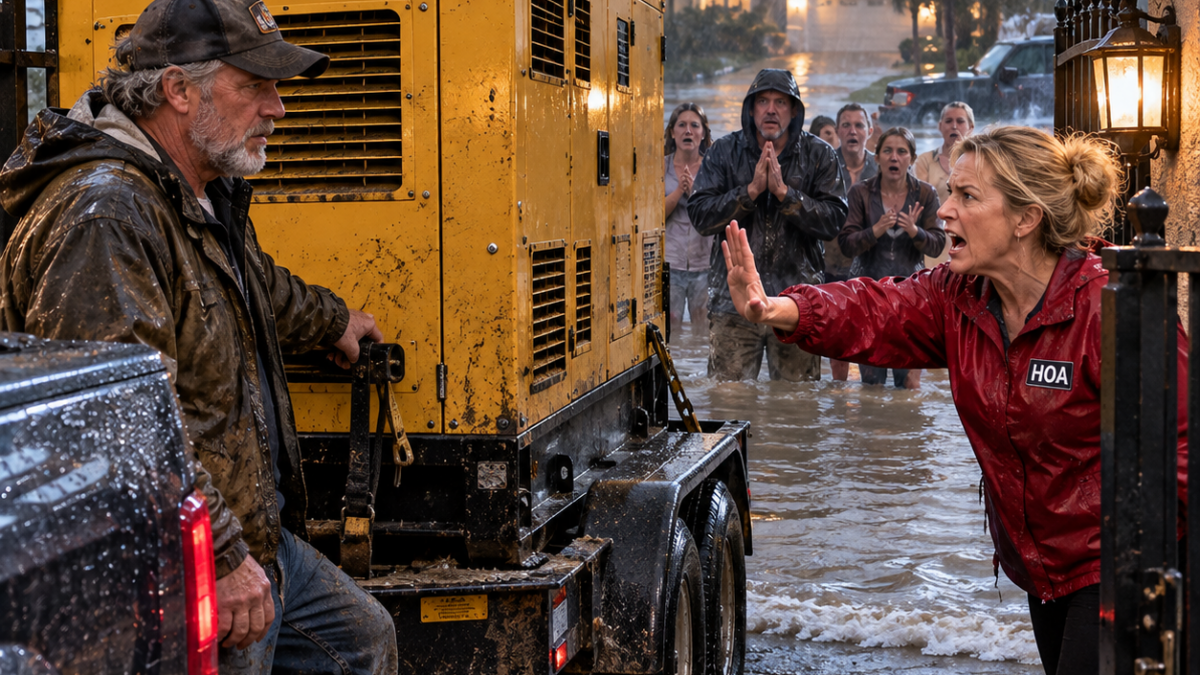
She looked at Old Yeller on the trailer.
Even dirty and faded, it seemed almost proud.
“You can’t bring that into the community without proper review.”
I thought Chester might explode.
“Karen.”
“There are liability issues.”
“We have an agreement.”
“An agreement you executed without a full board meeting.”
“Emergency authority.”
“That provision is for actual emergencies.”
Earl had arrived in a maintenance cart.
He stared at her.
“You’ve got sewage in your house.”
Karen’s jaw tightened.
“I am aware of my own property.”
Chester stepped closer.
“Then what would qualify as an actual emergency?”
“Rules exist for a reason.”
Marvin spoke quietly.
“Karen, this is the same generator you ordered him to remove.”
She refused to look at him.
“We don’t know whether that machine is safe.”
I rolled down the truck window farther.
“No problem.”
Everyone looked at me.
“I can take it back.”
Then I activated my turn signal.
Click.
Click.
Click.
I did not put the truck in gear.
Didn’t smile.
Didn’t threaten.
Just let the blinker tick.
Click.
Click.
Click.
The guard looked at Chester.
Marvin looked at Chester.
Earl’s mouth twitched.
Karen looked furious.
Chester finally turned toward the guard.
“Open the gate.”
“Chester—”
“Open.”
“The.”
“Gate.”
Karen stepped forward.
“You cannot override the president.”
Chester turned.
“Emergency board majority already did.”
“That isn’t—”
“You are standing in front of the equipment that can stop sewage from entering people’s houses because you don’t like how it looks.”
His voice remained calm.
Which made it worse.
“I’m done arguing.”
The gate opened.
I turned off the blinker.
Drove through.
Nobody applauded.
Nobody needed to.
The lift station sat near the rear of the development behind a decorative fence and landscaping.
Earl had already opened access.
The licensed electrician from the service company was there.
So was a wastewater technician.
We backed Old Yeller into place.
I set the parking brake.
Chocked wheels.
Checked fluids.
Then stepped away.
Agreement said they owned the electrical connection.
Good.
The electrician inspected the generator.
Confirmed configuration.
Opened panels.
Checked voltage taps.
Ran cables.
Connected the transfer point.
Tested grounding.
Talked with the wastewater technician.
Twenty minutes.
Thirty.
Rain started again.
Residents gathered at a distance.
Someone asked what was happening.
Another person said the sewer system was failing.
That created exactly the panic Karen claimed she had been preventing.
Finally the electrician looked at me.
“Start it.”
I climbed onto the trailer.
Turned the key.
Preheat.
Crank.
Old Yeller coughed once.
Then caught.
The diesel engine settled into its familiar ugly mechanical roar.
Loud.
Absolutely.
Ugly.
Definitely.
Useful?
Beautiful.
The electrician checked output.
Then energized the lift-station equipment.
Pumps started.
Earl watched the level indicator.
Five minutes.
Ten.
Fifteen.
The line moved.
“It’s dropping.”
Nobody spoke.
He looked again.
“Definitely dropping.”
Marvin exhaled.
“Thank God.”
That was it.
No triumphant speech.
No movie moment.
Just pumps moving sewage in the direction sewage is supposed to go.
Sometimes victory sounds like a diesel engine.
The next morning, I went over to check fuel.
Old Yeller had been running all night.
An older gentleman stood near the road drinking coffee from a stainless mug.
Thin.
White hair.
Probably eighty.
He nodded toward the generator.
“You Murray?”
“Yes, sir.”
“Wilbur Harris.”
We shook hands.
He studied Old Yeller.
“So that’s it.”
“That’s what?”
“The ugly generator.”
I laughed.
“I guess.”
He looked toward Karen’s house.
A remediation truck sat outside.
Two workers in white protective suits were carrying sections of ruined carpet into a disposal trailer.
Wilbur took a slow drink.
Then nodded toward Old Yeller.
“Seems prettier now.”
I laughed harder than I should have.
Word spread quickly.
Faster than the truth usually does.
By noon, neighbors knew.
Not all details.
Enough.
The generator powering the sewer pumps belonged to the man outside the HOA.
The same man Karen had fined.
The same generator she had forced away.
People started stopping by.
One woman brought coffee.
Another brought sandwiches.
A man named Ted offered diesel fuel cans.
I refused most of it.
“HOA’s paying fuel.”
Ted stared.
“They’re paying you rent?”
“No.”
“You’re not charging them?”
“No.”
“Why?”
“Because I’m not a psychopath.”
He laughed.
“I heard Karen tried to stop you at the gate.”
I shrugged.
“Ask Karen.”
That answer became important.
I didn’t campaign against her.
Didn’t post online.
Didn’t attend meetings.
Didn’t call residents.
Didn’t leak documents.
I did something much more damaging.
Nothing.
When people asked questions, I showed them paperwork.
Two days later, utility crews still hadn’t restored power.
Old Yeller kept running.
The lift station stayed under control.
No additional homes experienced sewage backup.
The four already damaged required professional remediation.
Karen’s was worst.
Insurance covered portions.
Not everything.
That wasn’t my victory.
I felt bad for her.
Not enough to lie about enjoying the irony.
But enough that I wouldn’t wish it on her.
On day three, utility power returned.
The pumps switched back.
Electrician disconnected my generator.
HOA paid fuel.
Paid towing.
Exactly as agreed.
I pulled Old Yeller home.
And here’s where I made one small decision.
I didn’t return it to Floyd.
I backed it under my carport.
Exactly where it had been before.
Same ugly yellow box.
Same rust.
Same dent.
Same view from Marsh Pointe.
That evening, I sat on the porch.
Waited.
No letter arrived.
Next day?
Nothing.
One week?
Nothing.
Marvin mailed me the reimbursement check.
Attached was a handwritten note.
Thank you.
—M.
Two weeks after the storm, Marsh Pointe held an emergency community meeting.
Normally, I wouldn’t have known anything about it.
By then I had more friends inside the development than Karen realized.
Chester told me some.
Wilbur told me the entertaining parts.
Marvin confirmed what mattered.
The clubhouse was packed.
People were angry.
Not merely about Karen.
About the emergency plan.
Why did a sewage system serving over a hundred houses depend on rental equipment nobody could guarantee during a regional disaster?
Why wasn’t there a permanent generator?
Why weren’t residents warned when the lift station reached critical level?
Why did four homes experience damage before people knew anything?
Reasonable questions.
Then somebody asked the question that changed the room.
“If Murray had the right generator next door, why didn’t we use it on the first day?”
Silence.
According to Wilbur, Karen answered first.
“The equipment wasn’t available.”
Earl was sitting in the back.
He said, “It used to be.”
People turned.
Karen looked at him.
“What does that mean?”
Earl answered.
“It sat twenty yards outside our fence for fifteen years.”
Someone asked, “Where’d it go?”
Earl didn’t answer.
Marvin did.
“Our enforcement correspondence requested removal.”
Now the room got loud.
“What enforcement?”
“Against Murray?”
“He’s not in the HOA.”
Karen tried controlling the meeting.
“Please.”
“Everyone.”
“This is being mischaracterized.”
A man whose downstairs bathroom had flooded stood.
His name was Peter Collins.
“What exactly is being mischaracterized?”
Karen said, “The generator generated repeated resident complaints.”
“Who complained?”
“Privacy prevents—”
“How many?”
“I don’t have the number in front of me.”
Marvin did.
That turned out badly.
He had brought records.
Because Marvin, unlike Karen, understood what happened when a board needed defensible documentation.
Three complaints.
Over eighteen months.
Two from Karen.
One anonymous complaint submitted from Karen’s HOA email account.
That created silence.
Then laughter.
Not friendly laughter.
Karen’s face reportedly went bright red.
She changed topics.
“Regardless, the equipment violated community appearance standards.”
Peter said, “On property outside the community?”
Karen answered, “Adjacent properties can affect values.”
Chester spoke.
“We had no enforcement authority over his property.”
That was the moment Karen realized Chester wasn’t protecting her.
She stared.
“You approved those actions.”
Chester didn’t flinch.
“I voted to investigate resident complaints.”
“You supported enforcement.”
“I supported sending correspondence.”
“You were copied on notices.”
“Yes.”
“And now you’re pretending this was all me?”
Good question.
This is where the story became less simple.
Chester admitted fault.
“I should have stopped it.”
The room went quiet.
“I knew Murray’s property wasn’t part of the HOA.”
He looked around.
“I assumed the letters were pressure, not enforceable fines.”
Someone shouted, “That’s worse.”
Chester nodded.
“Yes.”
That surprised people.
He continued.
“We sent official-looking penalties to a non-member knowing we lacked authority.”
Karen interrupted.
“They were compliance assessments.”
A woman near the front said, “That’s called a fine.”
People laughed.
Then Marvin produced the county inspection report.
No violations.
Then the final notice.
Remove the generator.
Then my hurricane email.
Continued operation during quiet hours.
Wilbur told me that was the moment somebody in the audience actually said, “You complained about his generator while the power was out?”
Karen said, “Rules don’t cease because of weather.”
That was not the correct answer.
Peter Collins stood again.
“My house had sewage coming out of the shower.”
Karen said, “I understand.”
“No.”
He shook his head.
“You don’t.”
“My wife and I spent three nights in a hotel.”
“Our downstairs walls are cut out.”
“Our insurance adjuster says we may pay thousands out of pocket.”
He pointed toward the documents.
“And the machine that could have prevented more damage was removed because you didn’t like looking at it?”
Karen’s defense became sharper.
“Nobody could have predicted the rental shortage.”
Earl finally spoke.
“That’s why emergency equipment exists.”
That hurt.
Then somebody asked about the gate.
“Is it true you tried stopping the generator when Murray brought it back?”
Karen said, “I raised appropriate procedural concerns.”
Wilbur shouted from the back.
“You told them not to open the gate.”
Laughter.
Karen glared.
He sipped coffee.
Apparently Wilbur brought coffee everywhere.
The board called an executive session.
Residents refused to leave until they knew what was happening.
Then came the part Karen had not anticipated.
Marvin had emails.
Lots of emails.
One showed him warning Karen months earlier:
Murray Dalton’s parcel is outside association boundaries. I recommend discontinuing monetary fines and referring any legitimate nuisance concerns to county enforcement.
Karen replied:
Continue notices. Compliance can often be achieved through consistent pressure regardless of technical jurisdiction.
That sentence ended her presidency.
Pressure regardless of technical jurisdiction.
That was no longer a misunderstanding.
It was deliberate.
Another email from Chester:
Are we certain we have authority here?
Karen:
Authority is less important than creating an expectation of compliance.
Even Chester reportedly closed his eyes when that one was read.
Then the board discovered legal expenses.
Karen had asked the association attorney to draft language for two notices.
Several hundred dollars.
HOA funds.
Used against a property outside the HOA.
Residents went from angry to furious.
Someone called for removal.
Under the bylaws, the board could replace officers by majority vote.
They did.
Karen was removed as president that night.
Not expelled from the board.
Not yet.
Chester became acting president.
Karen remained seated for the rest of the meeting.
Wilbur told me nobody looked at her.
That may have been worse than yelling.
The next morning, I was drinking coffee in the workshop when a white Lexus stopped at the end of my driveway.
Karen got out.
I considered pretending not to see her.
Didn’t.
She walked toward me.
No folder.
No raincoat.
No authority.
Just Karen.
“Murray.”
“Morning.”
She looked at Old Yeller.
Back under the carport.
I waited.
“I suppose you’re enjoying this.”
I set down my coffee.
“What?”
“You got what you wanted.”
“Karen, I never wanted anything from you.”
She laughed bitterly.
“You humiliated me.”
“No.”
“You showed everyone those letters.”
“I showed Chester one letter before helping your neighborhood.”
“He used it against me.”
“That sounds like a Chester problem.”
Her jaw clenched.
“You knew what would happen.”
“When?”
“When you demanded that agreement.”
“I demanded recognition that you don’t own my property.”
“You made the board sign it during an emergency.”
“Because your board had spent months pretending the opposite.”
She stared.
“You could have simply helped.”
“I did.”
“You attached conditions.”
“I didn’t charge rent.”
“That’s not the point.”
I stood.
“Then explain the point.”
Karen looked toward the development.
“You made me look foolish.”
There it was.
Not homes.
Not sewage.
Not legality.
Appearance.
Again.
I crossed my arms.
“Karen, you drove to my house during a hurricane blackout to complain about generator noise.”
She looked away.
“You ordered me to move equipment from land you don’t control.”
Silence.
“You kept sending fines after a county inspector told you there was no violation.”
Silence.
“You tried stopping that same generator at the gate while your own house had sewage in it.”
Her eyes flashed.
“I was protecting the HOA from liability.”
“No.”
I shook my head.
“You were protecting the idea that you could never be wrong.”
That landed.
For the first time since I’d known her, Karen had no immediate answer.
I softened my voice.
“You want to know the strangest part?”
She didn’t respond.
“I would’ve loaned you the generator before any of this.”
She looked at me.
“If you’d knocked on my door a year ago and said, Murray, we’re worried about emergencies, can we coordinate equipment?”
I pointed toward Old Yeller.
“I’d have shown Earl how to run it.”
She stared.
“You didn’t need power over me.”
“You needed a neighbor.”
Something in her face changed.
Only briefly.
Pain, maybe.
Then pride returned.
“You think you’re better than me.”
“No.”
I picked up my coffee.
“I think I’m done arguing with you.”
She stood there another few seconds.
Then walked back to the Lexus.
Drove away.
Slower than the first time I’d seen her.
For about a month, Karen remained an ordinary board member.
She attended two meetings.
At the second, residents questioned whether she should reimburse the HOA for legal expenses related to the unauthorized notices.
She resigned the next morning.
Chester called me.
“She stepped down.”
“Okay.”
“That’s all?”
“What do you want me to do, ring church bells?”
He laughed.
Then became serious.
“Murray.”
“Yeah?”
“I owe you an apology.”
I waited.
“I knew we were pushing beyond our authority.”
“Why didn’t you stop it?”
He exhaled.
“Because Karen was effective.”
“At what?”
“Everything.”
He explained.
Before becoming president, Karen had cleaned up the association’s finances.
Renegotiated landscaping contracts.
Collected overdue dues.
Forced the developer to repair drainage defects.
Got insurance premiums reduced.
“She got results.”
“So everybody stopped questioning how.”
“Pretty much.”
Chester sounded ashamed.
“I told myself the generator thing was harmless.”
“Until it wasn’t.”
“Yes.”
I looked toward Old Yeller.
“People get comfortable with small abuses when they’re benefiting from the person doing them.”
Chester was quiet.
“That sounds about right.”
“You planning to run things differently?”
“Yes.”
“Good.”
“And Murray?”
“What?”
“Would you consider sitting on an emergency preparedness committee?”
I laughed so hard I had to put the phone down.
When I recovered, Chester was still waiting.
“Absolutely not.”
“I expected that.”
“I don’t live there.”
“I know.”
“You finally know.”
He laughed.
“Point taken.”
I did agree to meet once with Earl, the electrician, and a wastewater engineer.
Not as a committee member.
Just a neighbor who knew generators.
We reviewed the lift-station requirements.
Load.
Starting current.
Fuel.
Transfer switch.
Ventilation.
Maintenance.
I made one recommendation.
“Don’t rely on borrowed equipment.”
They didn’t.
The following spring, Marsh Pointe approved a special assessment.
Permanent standby diesel generator.
Sized correctly for the lift station.
Automatic transfer switch.
Weather enclosure.
Dedicated fuel system.
Professional maintenance contract.
The generator was larger than mine.
Quieter.
Newer.
And hidden behind a decorative masonry screen with landscaping.
When installation finished, Earl called me over.
“Want to see Karen’s favorite project?”
I laughed.
The new generator looked expensive.
Very expensive.
“Pretty.”
Earl nodded solemnly.
“Property values preserved.”
He opened the enclosure.
Clean engine.
Fresh wiring.
Automatic controls.
I approved.
“Good installation.”
“Think your dad would like it?”
That surprised me.
I looked at the generator.
Then toward my old workshop.
“Yeah.”
“He’d complain about the price.”
Earl laughed.
“Of course.”
I walked home feeling something I hadn’t expected.
Proud.
Not of revenge.
There really hadn’t been revenge.
I did exactly what Karen demanded.
Removed the machine.
Then when her community needed help, I brought it back.
That’s not revenge.
That’s irony with diesel fuel.
Over the next year, Marsh Pointe changed.
Not dramatically.
HOAs don’t become anarchist communes because one president gets embarrassed.
There were still rules.
Trash cans.
Paint colors.
Parking.
Pool passes.
But Chester created something called jurisdiction review.
Any enforcement action involving property boundaries had to be confirmed by management and counsel.
Fines required board documentation.
Emergency procedures were rewritten.
Residents received outage instructions.
The lift station had automated monitoring.
And, my favorite part, the bylaws were amended so emergency safety decisions could override aesthetic restrictions temporarily without president approval.
Wilbur called it the Old Yeller Amendment.
I doubt that was its official name.
Then something happened I didn’t expect.
Karen changed too.
Not overnight.
And not into some saint.
For months, she barely acknowledged me.
If we passed on the road, nothing.
No wave.
No eye contact.
Then one morning I was repairing a fence section near the property line.
I heard footsteps.
Karen stood on the other side.
No makeup.
Gardening clothes.
Work gloves.
Almost didn’t recognize her.
“Murray.”
“Karen.”
She looked uncomfortable.
“I need to ask you something.”
“Okay.”
“Chester said you know small engines.”
“Some.”
“My pressure washer won’t start.”
I stared.
Of all the possibilities.
“You’re asking me?”
“Yes.”
“Why?”
She almost smiled.
“Because apparently you’re a neighbor.”
I leaned on the fence.
That line was mine.
She remembered.
“Bring it over.”
Twenty minutes later, Karen rolled a pressure washer into my driveway.
Bad carburetor.
Old gasoline.
Simple.
I cleaned the jet.
Changed fuel.
Started it.
She flinched at the engine noise.
I couldn’t resist.
“Quiet hours?”
She looked at me.
For one second I thought I’d gone too far.
Then she laughed.
Actually laughed.
“Don’t push it.”
I shut the machine down.
She stood there awkwardly.
“What do I owe you?”
“Nothing.”
“Murray.”
“Buy fresh gas next time.”
She nodded.
Then looked toward Old Yeller.
“I really did hate that thing.”
“I know.”
“It is objectively ugly.”
“Correct.”
She looked at me.
“I was wrong.”
Three words.
No explanation.
No but.
I didn’t make her repeat them.
“Okay.”
She swallowed.
“I don’t expect you to forgive the fines.”
“There was nothing to forgive financially.”
“You know what I mean.”
“Yes.”
“I got…”
She searched for the word.
“Obsessed.”
I waited.
“When I was president, every complaint felt like a test.”
“Test of what?”
“Whether I was doing the job.”
She looked embarrassed.
“If somebody broke a rule and I ignored it, I felt weak.”
“You weren’t ignoring a rule.”
“I know.”
“Eventually.”
“Yes.”
She looked at Old Yeller again.
“My husband used to say I would rather win an argument than end one.”
I had never heard her mention a husband.
“Where is he?”
“Died six years ago.”
That softened something in me.
“Sorry.”
“Cancer.”
She rubbed her hands together.
“He handled people better than I did.”
I didn’t know what to say.
She continued.
“After he died, the HOA gave me something to do.”
There it was.
Not an excuse.
Context.
Humans always have context.
Even Karens.
“I started believing if everything looked right, everything was right.”
She glanced toward Marsh Pointe.
“Then the storm came.”
“And things didn’t look right.”
She laughed quietly.
“No.”
We stood there beside an ugly generator and a broken pressure washer.
Two people who had spent a year turning each other into symbols.
She wasn’t Tyranny.
I wasn’t Freedom.
She was Karen.
I was Murray.
Both stubborn.
Both imperfect.
Only one of us had sent eighteen hundred dollars in fake fines, though.
Let’s keep perspective.
She rolled the pressure washer away.
Before leaving, she stopped.
“Thank you.”
“For fixing it?”
“For the generator.”
I looked at her.
“That wasn’t for you.”
“I know.”
She nodded toward the development.
“That might be why it mattered.”
Then she left.
I never told anybody about that conversation.
Until now, I guess.
Years have passed.
Old Yeller is still mine.
It sits under the carport.
I repainted one side.
Not because Karen complained.
Because the rust had become real.
Floyd called that surrender.
I called it maintenance.
The generator still starts.
A little slower now.
Parts are harder to find.
One day I’ll probably replace it.
Maybe donate it to a small marina.
Maybe Caleb—the guard, not a kid anymore—will buy it.
He works for an electrical contractor now.
Funny how people drift into things.
Marsh Pointe’s permanent generator exercises every Wednesday at eleven in the morning.
You can hear it from my workshop.
Quiet low diesel hum.
Every time it starts, I smile.
Wilbur still lives there.
Ninety now.
Still carries coffee.
He occasionally walks over when I’m working outside.
Last spring, he stopped beside Old Yeller.
“She running?”
“Yep.”
“Still ugly?”
“Yep.”
He nodded.
“Good.”
Then he asked something.
“You ever regret bringing it back?”
I knew what he meant.
Not back to my property.
Back during the emergency.
“No.”
“Even after Karen?”
“Especially after Karen.”
He raised an eyebrow.
I wiped grease from my hands.
“If I’d refused, she’d have become the victim.”
Wilbur smiled.
“You thought about that?”
“Not then.”
“But now?”
“Yeah.”
I looked toward Marsh Pointe.
“If I’d said, ‘You people treated me badly, so enjoy the sewage,’ nobody would’ve remembered her letters.”
“They’d remember me refusing.”
Wilbur nodded.
“Probably.”
“I didn’t want to become ugly just because the generator was.”
He laughed.
“Murray, that almost sounded wise.”
“Don’t spread it around.”
He raised his coffee.
“Secret’s safe.”
There is a temptation when somebody abuses a little authority to fantasize about revenge.
I understand it.
You want them embarrassed.
You want them exposed.
You want the universe to punish them with perfect timing.
Sometimes it happens.
Karen fought that generator for months.
Then one storm turned it into the most valuable machine in her neighborhood.
That’s funny.
I won’t pretend it isn’t.
But the part I remember isn’t Karen standing at the gate.
It isn’t her removal vote.
It isn’t Wilbur saying the generator looked prettier while contaminated carpet came out of her house.
The moment I remember happened beside the lift station.
Rain dripping off the trailer.
Old Yeller roaring.
Earl watching the level indicator.
We had been standing there almost twenty minutes when he leaned close to the panel.
Then he smiled.
“It’s dropping.”
That was the moment.
Not because Karen lost.
Because everybody else stopped losing.
The sewage level dropped.
Damage stopped spreading.
Families could breathe.
An ugly machine did exactly what it had been built to do.
Dad would’ve understood that.
He never cared whether equipment impressed anybody.
He cared whether it worked when someone needed it.
A few months before he died, we were cleaning tools in the workshop.
He picked up some old corroded marine relay I’d removed from a boat.
“Owner wants stainless hardware everywhere,” I told him.
Dad shrugged.
“Nothing wrong with pretty.”
Then he tapped the relay.
“But pretty isn’t the same as useful.”
At the time, I barely listened.
Dad said things constantly.
Most fathers do.
You don’t realize which sentences matter until years later.
Karen believed ugly equipment lowered property values.
She wasn’t completely crazy.
People do care what neighborhoods look like.
Nobody wants a scrapyard next door.
Appearance matters.
Rules matter too.
Associations need rules.
Communities need standards.
But rules are tools.
The second you care more about the tool than the reason it exists, you’re in trouble.
Karen forgot that.
Eventually, so did half the board.
They stopped asking whether something was harmful.
They asked whether it complied.
They stopped asking whether they had authority.
They asked whether pressure would work.
They stopped asking whether a generator might matter during a hurricane.
They asked whether residents could see it from their patios.
Then the power went out.
Storms are good at exposing priorities.
When the toilets started backing up, nobody cared about landscaping.
Nobody cared that Old Yeller had faded paint.
Nobody cared about decorative screening.
Nobody asked whether the trailer matched the clubhouse architecture.
They wanted the pumps running.
That’s what emergencies do.
They strip away pretending.
You find out which neighbor has a chainsaw.
Which one has a generator.
Which one knows first aid.
Who checks on the elderly woman living alone.
Who has a truck tall enough to cross shallow floodwater.
Who has a freezer full of food and starts feeding people before it spoils.
Nobody asks what color their mailbox is.
After Helena, Marsh Pointe started holding an annual hurricane-preparedness day.
Earl invited me the first year.
I said no.
He asked again.
I said no.
Then Wilbur appeared at my driveway with coffee.
“You’re going.”
“I’m not.”
“They have barbecue.”
“What kind?”
“Pulled pork.”
I went.
They set up tables outside the clubhouse.
Emergency numbers.
Storm-surge maps.
Generator safety.
Fuel storage.
Medical planning.
The fire department came.
Utility representatives came.
And, because Earl has a sense of humor, he asked me to park Old Yeller near the entrance as an example of portable emergency generation.
I refused.
He begged.
I refused again.
Wilbur offered twenty dollars.
I accepted.
So there it was.
The generator Karen had spent months trying to hide.
Parked directly beside the Marsh Pointe clubhouse.
A handwritten sign on it:
EMERGENCY BACKUP POWER — ASK BEFORE YOU NEED IT.
I blamed Earl.
Karen attended that event.
She saw the sign.
Looked at me.
I raised both hands.
“Not mine.”
She looked toward Earl.
He became extremely interested in a fire extinguisher demonstration.
Karen walked past Old Yeller.
Stopped.
Then touched the faded yellow enclosure.
A group of newer residents stood nearby.
One asked, “Is this the generator from the hurricane story?”
Karen closed her eyes briefly.
I prepared for trouble.
Then she said, “Yes.”
The woman smiled.
“The one that saved the sewer pumps?”
Karen looked at me.
Then back at her.
“Yes.”
“Wow.”
The woman examined it.
“It really is ugly.”
Karen laughed.
I laughed.
Even Earl laughed from twenty feet away.
Then Karen said something I never expected.
“Don’t judge it by the paint.”
That was all.
Maybe people change.
Maybe they just get tired of defending old versions of themselves.
Either way, I’ll take it.
I still keep the blue folder.
Every ridiculous letter.
Noise.
Fuel tank.
Industrial appearance.
Unsafe equipment.
Final notice.
Quiet-hours email during the hurricane.
And on top of all of them sits the formal letter Chester’s board sent after Karen resigned.
Dear Mr. Dalton:
This correspondence confirms that your property is not and has never been subject to the Marsh Pointe Homeowners Association Declaration of Covenants, Conditions, and Restrictions.
All prior violation notices, fines, assessments, and enforcement correspondence are hereby withdrawn and declared void.
The Association acknowledges it possesses no architectural or enforcement jurisdiction over your parcel.
I framed a copy.
Dad would have appreciated that.
The original stays in the folder.
Old Yeller sits about fifteen feet away.
Sometimes I think about selling it.
Then hurricane season comes.
I check the oil.
Charge the battery.
Fill the tank.
Start the engine.
The old diesel coughs.
Shakes.
Then settles into that unmistakable rattle.
Loud.
Rough.
Ugly.
Reliable.
On clear days, nobody needs it.
That’s the funny thing about emergency equipment.
Ninety-nine percent of its life, it looks unnecessary.
It takes up space.
Costs money.
Needs maintenance.
Makes noise.
Collects dust.
People complain.
Until the one day the lights go out.
Then suddenly nobody asks whether it’s beautiful.
They ask whether it starts.
And Old Yeller always has.
Karen spent months trying to teach me that appearances preserve property values.
The hurricane taught all of us something different.
Sometimes the ugliest thing in the neighborhood is the only thing standing between your beautiful house and three inches of sewage.
And sometimes revenge doesn’t require plotting, sabotage, anger, or cruelty.
Sometimes all you have to do is respect someone’s demand.
Remove exactly what they told you to remove.
Keep the paperwork.
Wait.
Then, when the storm comes and they finally understand what they pushed away, decide what kind of person you want to be when they’re the ones knocking on your door.
I could have said no.
Nobody could have blamed me.
Instead, I hooked up the truck.
Drove twenty-five miles inland.
Brought that ugly generator home.
And when Karen tried stopping me at the gate, I didn’t yell.
I didn’t threaten.
I didn’t remind her that her downstairs bathroom was already ruined.
I simply turned on my blinker.
Click.
Click.
Click.
And gave her one final opportunity to get exactly what she’d spent months asking for.
That was the moment everybody else finally understood something she hadn’t yet learned.
Sometimes the biggest mistake isn’t owning an ugly generator.
It’s making sure the only neighbor who has one doesn’t owe you a thing.








