HOA Karen Filed 31 Complaints Trying to Take Control of My $4 Million Private Bridge—Then the County Inspector Read the Latest One and Decided He’d Had Enough.
HOA Karen Filed 31 Complaints Trying to Take Control of My $4 Million Private Bridge—Then the County Inspector Read the Latest One and Decided He’d Had Enough.
The thirty-first complaint arrived at the county engineering office at 8:17 on a Monday morning, claiming that my bridge was actively collapsing into the river.
At 8:42, the county inspector stood in the middle of that bridge, stared down at the flawless steel decking beneath his boots, and muttered, “I’m getting real tired of this woman.”
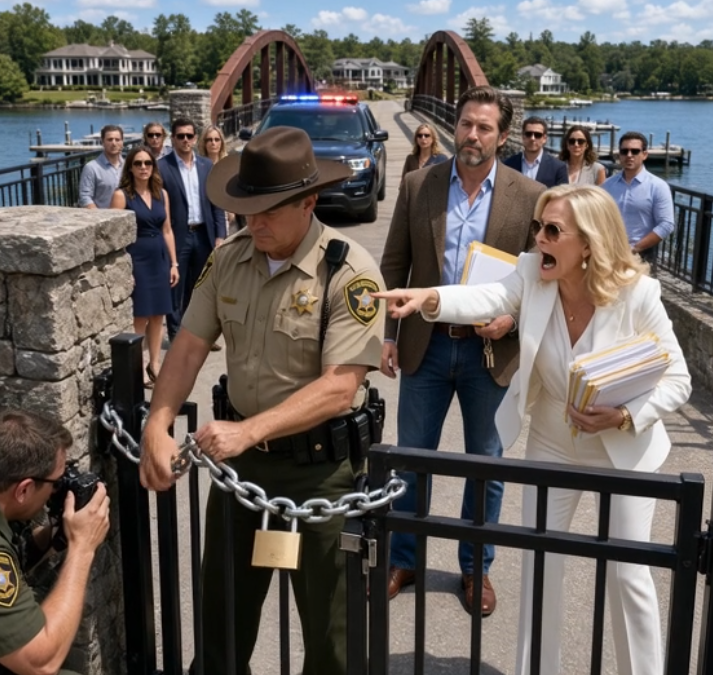
By sunset, the sheriff had chained Victoria Sterling’s entire HOA out of the access road she had spent five months trying to steal.
My name is Ethan Walker, and the bridge crossed land my family had owned in Red Creek, Montana, since my grandfather returned from Korea in 1954.
The Walker Ranch covered six hundred and eighty acres of meadow, timber, riverbank, and mountain foothills at the western edge of the valley. For most of my childhood, reaching the ranch meant driving down a narrow gravel road that followed the river for almost nine miles.
The road was beautiful in summer.
In winter, it was a punishment.
It washed out twice during my teenage years. A rockslide blocked it for eleven days when I was twenty-six. One January evening, my father suffered a heart attack, and the ambulance lost fourteen critical minutes crawling along the icy river bend because the old road was too narrow, too slick, and too exposed to take at speed.
He survived that night.
But I never forgot standing beside him in our kitchen, my hand pressed against his chest, hearing the siren somewhere beyond the trees and knowing the road itself was slowing help from reaching him.
That sound stayed with me.
A siren trapped behind geography.
After my father died eight years later, I began planning the bridge.
The concept was simple. Red Creek curved within half a mile of the county highway, but the river separated the ranch from the nearest paved access. A bridge across the narrowest stable section would shorten the trip from the highway to our house from twenty-two minutes to less than four.
It would also provide emergency access to three neighboring ranches, a Forest Service trailhead, and several hundred acres of wildfire-prone woodland.
The idea was simple.
The engineering was not.
Red Creek was not a polite little stream. It carried mountain runoff with enough force to move boulders the size of pickup trucks. The eastern bank consisted of layered sediment over shallow bedrock. The western approach passed through an old cottonwood stand where nesting eagles had returned every spring for as long as I could remember.
The bridge needed to clear the hundred-year flood elevation.
It needed to withstand ice impact.
It needed to preserve fish movement.
It needed to avoid protected habitat.
And it needed to support fire engines carrying more than thirty tons of water and equipment.
I spent almost two years on environmental studies, hydrological modeling, geotechnical analysis, and permit applications.
I hired North Basin Structural, one of the most respected bridge engineering firms in the Northwest.
We drove steel pilings into bedrock.
We used weathering steel designed to develop a protective oxide layer rather than rust away.
We installed a reinforced concrete deck, heated drainage channels, wildlife-safe lighting, and remotely monitored strain sensors that fed load and movement data directly into a monitoring portal.
The final structure was two hundred and forty-eight feet long, thirty-two feet wide, and rated for loads substantially heavier than anything likely to cross it.
It cost just under four million dollars.
Every dollar came from me.
I had built a successful infrastructure consulting company after leaving county employment, and the bridge was the largest personal expense I had ever undertaken.
Some people bought vacation homes or yachts when their businesses succeeded.
I built the road my father’s ambulance should have had.
The county approved the final inspection in September. The sheriff’s department tested the bridge with one of its armored rescue vehicles. The Red Creek Volunteer Fire Department drove a fully loaded tanker across it. The county emergency manager added it to the regional evacuation plan.
For three peaceful weeks, the bridge did exactly what it had been built to do.
Then Victoria Sterling appeared.
She arrived at my gate in a white luxury SUV with polished wheels and a magnetic sign on the door reading:
SILVER CREEK ESTATES HOMEOWNERS ASSOCIATION
PRESIDENTIAL INSPECTION
There was no such thing as a presidential inspection.
There was barely a legitimate homeowners association.
Silver Creek Estates was a new gated development of forty-six luxury houses built east of the river on land that had once belonged to the Delaney cattle operation. The development’s private road intersected the county highway roughly three hundred yards north of my bridge entrance.
My property was not inside Silver Creek Estates.
My bridge was not inside Silver Creek Estates.
PART2:
The eastern abutment sat on a narrow strip of land I had purchased from the Delaney family before the development existed. The access road connected directly to the county highway under a recorded easement and a state-issued approach permit.
The HOA had no ownership interest.
No maintenance obligation.
No regulatory authority.
No legitimate reason to be at my gate.
Victoria stepped out wearing cream-colored slacks, a fitted white jacket, oversized sunglasses, and an expression suggesting the earth had been waiting for her permission to rotate.
She looked at the bridge.
Then at me.
“You built this without consulting us,” she said.
I was standing near the gate with a thermos of coffee in one hand and survey notes in the other.
“Good morning,” I said.
“This is not a good morning, Mr. Walker.”
“That depends on whether you enjoy bridges.”
Her mouth tightened.
“I’m Victoria Sterling, president of the Silver Creek Estates HOA.”
“I know who you are.”
“Then you know why I’m here.”
“No, ma’am. I truly don’t.”
She removed her sunglasses slowly, as if that should have changed the legal status of the land beneath our feet.
“This bridge affects our community.”
“The bridge is not in your community.”
“It changes traffic conditions around our community.”
“It reduces traffic near your community.”
“That is your opinion.”
“It is measurable geography.”
She inhaled through her nose.
“I’m going to need copies of your permits.”
“No, you’re not.”
Her head tilted.
“Excuse me?”
“You do not need copies of my permits.”
“I am the HOA president.”
“I’m sorry to hear that.”
PART3:
Behind her, a man in a golf shirt shifted uncomfortably near the SUV. He was holding a clipboard. His name, I would later learn, was Brent Collier, chairman of the HOA Safety and Aesthetic Impact Committee, a committee Victoria had invented two weeks before standing at my gate.
Victoria gave me a flat smile.
“Mr. Walker, you may not understand how community governance works.”
“I understand it well enough to know it stops at the property line.”
“Our residents have concerns.”
“Then your residents may contact the county.”
“We already have.”
“I’m sure they’ll enjoy that.”
She took one step closer to the gate.
“You seem to think being difficult will help you.”
“No,” I said. “I think recorded deeds, permits, inspection reports, engineering certifications, hydrology models, and Montana property law will help me. Being difficult is just for personal satisfaction.”
Brent made a sound that might have been a cough.
Victoria’s smile vanished.
“We are not finished here.”
“We never started.”
She put her sunglasses back on.
Then she looked past me at the bridge like it was something alive and disobedient.
“You should have worked with us.”
“I worked with everyone who mattered.”
That was the moment she decided the bridge had to become hers.
Not physically, at first.
Victoria Sterling was not stupid.
She knew she could not simply drive through my gate, plant an HOA flag in the center span, and declare eminent suburban domain.
Instead, she did what people like her always do when they have no authority.
She tried to manufacture some.
The first complaint arrived two days later.
It alleged that construction debris from my bridge had contaminated Red Creek and created a fish kill downstream.
A county environmental officer came out, took water samples, inspected the banks, and found no debris, no contamination, and no dead fish.
The second complaint arrived the following week.
It claimed the bridge lights were blinding drivers on the county road.
The lights were downward-facing, low-temperature, wildlife-safe fixtures that activated only when motion sensors detected a vehicle.
The inspector arrived after dark, stood on the road for twenty minutes, and said, “I’ve seen brighter porch candles.”
The third complaint claimed the bridge created a flood obstruction.
The hydrology model disproved it.
The fourth claimed the bridge was too narrow for emergency vehicles.
The sheriff’s armored rescue vehicle had already crossed it with eighteen inches of clearance on each side.
The fifth complaint claimed it was too wide and therefore encouraged speeding.
That was when I started a spreadsheet.
By the time complaint number eleven arrived, I had columns labeled:
Date.
Agency contacted.
Allegation.
Inspection outcome.
County personnel.
Time wasted.
False statements.
Probable source.
The probable source column was not difficult.
Every complaint used the same language Victoria used in HOA emails.
Community safety.
Visual harmony.
Traffic integrity.
Unapproved regional impact.
The phrase unapproved regional impact appeared in complaint number seven, complaint number nine, and a Silver Creek Estates newsletter Victoria posted online under the headline:
UNREGULATED PRIVATE BRIDGE RAISES QUESTIONS FOR HOMEOWNERS.
I printed that too.
My grandfather used to say the difference between a problem and a pattern is documentation.
He was a cattleman, not a lawyer.
But he understood evidence.
By the time complaint thirteen arrived, the county engineer, Mark Ellison, stopped pretending this was normal.
Mark was fifty-eight, practical, gray-haired, and had the permanent expression of a man who had spent thirty years explaining gravity to people who wanted exceptions.
He called me after inspecting the bridge for the fourth time.
“Ethan.”
“Mark.”
“I’m standing on your bridge.”
“I assumed.”
“This complaint says the western abutment is separating.”
“Is it?”
“No.”
“Good.”
“It also says there are visible cracks in the concrete.”
“Are there?”
“No.”
“Also good.”
“It further states that the bridge vibrates dangerously when crossed by small vehicles.”
I looked out my kitchen window toward the bridge in the distance.
“Mark, the bridge is instrumented. I can send you live strain readings.”
“I know. I’m looking at them on your tablet in my truck because you gave me access.”
“And?”
“And the bridge moves less under load than my office chair.”
“That chair has always concerned me.”
He sighed.
“I’m getting pressure to keep responding because every complaint uses safety language.”
“I know.”
“This is harassment.”
“Yes.”
“Are you involving an attorney?”
“Already have.”
“Good.”
He paused.
Then his voice changed.
“Off the record, this is not about safety.”
“No.”
“She wants leverage.”
“Yes.”
“She wants the bridge connected to their private road system.”
I said nothing.
Mark sighed again.
“Figured.”
Victoria’s first formal demand came two days after complaint fifteen.
She sent it by certified mail, email, and hand delivery, because apparently one form of nonsense was not enough.
The letter was printed on HOA letterhead.
Dear Mr. Walker,
Due to the demonstrated regional impact of the Red Creek Bridge and its proximity to Silver Creek Estates, the HOA Board hereby requests immediate participation in a Bridge Governance and Access Review Committee.
The Committee shall evaluate future traffic management, visual screening, security coordination, shared access opportunities, maintenance contribution structures, and emergency use procedures.
Pending conclusion of this review, the Board requests that you voluntarily suspend private access across the bridge except for essential ranch operations.
I read the letter twice.
Then I laughed so hard my ranch manager, Caleb, came in from the mudroom to ask if I had injured myself.
Caleb Morgan had worked on the ranch since he was nineteen. He was forty-one now, broad-shouldered, sunburned in all seasons, and allergic to bureaucracy.
I handed him the letter.
He read it slowly.
Then he looked at me.
“What the hell is a Bridge Governance and Access Review Committee?”
“A group of people who want my bridge.”
“Can I be on it?”
“No.”
“Can I attend?”
“No.”
“Can I stand outside and laugh?”
“Possibly.”
He looked back at the letter.
“Voluntarily suspend private access? To your own ranch? Across your own bridge? Built on your own land?”
“That is the request.”
“Is she drunk?”
“I don’t think Victoria Sterling drinks. I think she absorbs power through HOA minutes.”
Caleb snorted.
“What are you going to do?”
“Decline.”
“That all?”
“For now.”
I sent one sentence through my attorney.
Mr. Walker declines.
Victoria did not enjoy being declined.
The complaints escalated.
Number sixteen alleged the bridge interfered with elk migration.
An officer from Fish and Wildlife spent two hours reviewing trail camera footage of elk walking calmly beneath the bridge and along the riverbank. One bull stopped under the eastern span and scratched his neck on a boulder.
The report concluded, in wonderfully dry language:
No observed behavioral disruption.
I framed that one in my office.
Complaint seventeen claimed the bridge created a hazard for low-flying aircraft.
The nearest airstrip was twelve miles away.
Complaint eighteen claimed unauthorized radio equipment had been installed beneath the deck.
Those were sensor relays connected to the structural monitoring system.
Complaint nineteen alleged emergency vehicles using the bridge would create noise impacts on Silver Creek residents.
The emergency manager wrote back that he sincerely hoped emergency vehicles would make noise when responding to emergencies.
Complaint twenty claimed the bridge’s weathering steel was rust and therefore evidence of decay.
Mark Ellison copied the manufacturer’s technical sheet into his response and highlighted the phrase protective oxide patina.
Then complaint twenty-one hit differently.
It alleged that my bridge access road crossed HOA land.
That was not a misunderstanding.
That was a lie.
A calculated one.
The eastern access road crossed the Delaney strip I had purchased outright, then connected directly to the county highway through a recorded approach permit.
Silver Creek Estates owned nothing south of their decorative stone entrance.
I had the survey.
The deed.
The recorded plat.
The county’s GIS map.
Victoria had access to all of it.
But complaint twenty-one forced the county to pause an emergency-access update while legal reviewed the land records.
That pause lasted nine days.
During those nine days, a lightning storm hit the west ridge.
A small fire started in the timber above the old trailhead. Red Creek Volunteer Fire contained it quickly, but the first tanker still used the old river road because the county had not finished updating the emergency routing status.
The fire did not become serious.
But it could have.
I stood beside the burned patch of hillside the next morning and felt something cold settle inside me.
Until then, Victoria had been annoying, expensive, and dishonest.
Now she had become dangerous.
Not because she intended to start a wildfire.
People like Victoria rarely intend the final consequences of their actions.
They intend only the pressure.
The embarrassment.
The exhaustion.
The surrender.
But consequences do not care what you intended.
I drove straight from the ridge to the sheriff’s office.
Sheriff Tom Alvarez had known my family for thirty years. He was sixty, heavyset, calm, and had the kind of patience that made guilty people nervous. His office smelled like coffee, leather, and old paper.
He listened while I laid out the timeline.
He looked at the spreadsheet.
Then the photos.
Then the letters.
Then the complaint copies.
When he reached complaint twenty-one, he stopped.
“This one says your access road crosses HOA land.”
“It doesn’t.”
“I know.”
He looked up.
“Why do I know?”
“Because you reviewed the emergency access route personally.”
“Yes.”
He leaned back.
“So why is she saying this?”
“To create enough uncertainty to get the county to pause.”
“Pause what?”
“Emergency designation, maintenance agreements, routing, anything that gives the bridge legitimacy without HOA involvement.”
Alvarez stared out the window for a moment.
“She wants control.”
“Yes.”
“Of a private bridge.”
“Yes.”
“That you paid four million dollars to build.”
“Yes.”
He rubbed his forehead.
“I hate Mondays.”
“It’s Thursday.”
“That’s how much I hate this.”
I almost smiled.
Almost.
Then he looked back at me.
“Has anyone from the HOA tried to access the bridge?”
“Not yet.”
“You have cameras?”
“Everywhere.”
“Gate?”
“Electric. Keypad. Remote lock. Emergency override issued to county dispatch, sheriff, fire, and EMS.”
“HOA?”
“No.”
“Good.”
He closed the folder.
“Ethan, I can’t arrest somebody for filing complaints unless we can prove knowingly false reporting under the applicable statute and intent to harass or interfere. That takes work.”
“I know.”
“But if they trespass, tamper with your gate, block access, or interfere with emergency use, that becomes simple.”
“I know that too.”
He studied me.
“You think she’s going to try.”
“I think she’s running out of paper.”
Alvarez nodded slowly.
“Then let’s make sure we’re ready when she moves from paper to pavement.”
Complaint twenty-two arrived the next morning.
Complaint twenty-three arrived before lunch.
Both came from Silver Creek residents I had never met.
Both used identical language.
That told me Victoria had started delegating.
Complaint twenty-four came from the HOA attorney, claiming the bridge created attractive nuisance exposure for children in the development.
The bridge sat behind a locked gate, fencing, signage, cameras, and half a mile of private ranch road.
Complaint twenty-five alleged that the bridge’s emergency access designation would unfairly increase traffic near Silver Creek Estates.
Complaint twenty-six alleged the opposite: that restricting HOA access to the bridge could endanger Silver Creek residents during evacuation.
Mark Ellison called me after that one.
“She’s arguing both sides now.”
“Yes.”
“Does she know we can read?”
“I have wondered.”
He exhaled sharply.
“I’m flagging the county administrator.”
“Good.”
“Also county counsel.”
“Better.”
“Also, Ethan?”
“Yes?”
“If she files another structural safety complaint without evidence, I’m recommending cost recovery.”
That meant the county would bill the complaining party for wasted inspection resources if the complaint was knowingly false or repetitive.
Victoria would hate that.
Naturally, she filed another structural safety complaint.
Number twenty-seven claimed the bridge deck was separating from the support structure.
Mark drove out with an assistant inspector, two deputies, and visible fury.
I met them at the bridge.
He walked to the center span, knelt, ran one hand over the expansion joint, and stood.
“Perfect.”
His assistant checked the bearings.
“Perfect.”
One deputy looked over the railing at the river.
“Pretty.”
Mark turned to him.
“Not helping.”
The deputy grinned.
Mark pointed to the bridge camera.
“You recording?”
“Yes.”
“Good.”
He looked directly at it.
“For the record, this bridge remains structurally sound, properly maintained, and free of the alleged condition. This is the fifth substantially similar false structural complaint filed by parties associated with Silver Creek Estates.”
He paused.
Then added, “And I am personally sick of it.”
That clip became important later.
Complaint twenty-eight did not go to the county.
It went to the media.
A local online news page posted a story under the headline:
LUXURY HOA RAISES SAFETY CONCERNS OVER PRIVATE MEGA-BRIDGE NEAR RED CREEK.
Mega-bridge.
That annoyed me more than it should have.
The story quoted Victoria extensively.
“Residents feel excluded from decisions that affect their safety.”
“This structure was built without meaningful community input.”
“We are simply asking for transparency.”
I was not quoted.
The reporter claimed I had declined comment.
No one had contacted me.
That afternoon, the story spread through Silver Creek’s community page. Comments piled up.
Who approved this?
Why does one rancher get to control evacuation infrastructure?
This seems unsafe.
HOA needs to take legal action.
Victoria posted a statement thanking residents for “standing together in defense of community safety.”
I called the reporter.
His name was Evan Price, and he sounded twelve.
“Mr. Walker,” he said nervously. “I was planning to reach out.”
“After publishing?”
“I was under deadline.”
“No, you were underprepared.”
Silence.
I emailed him the permit summary, inspection reports, emergency access documentation, the county’s responses to complaints, GIS maps, and Victoria’s demand letter requesting bridge governance authority.
To his credit, Evan went quiet for a long time.
Then he said, “This is more complicated than I was told.”
“That is usually why journalists call more than one person.”
“I’ll update the story.”
“No,” I said. “You’ll write a new one.”
He did.
Two days later, the headline changed.
COUNTY RECORDS SHOW PRIVATE RED CREEK BRIDGE PASSED ALL SAFETY INSPECTIONS DESPITE REPEATED HOA COMPLAINTS.
Victoria did not post that one in the community page.
I did.
Caleb said that was petty.
I said it was transparent.
We were both right.
Complaint twenty-nine came disguised as a legal notice.
The Silver Creek HOA claimed a prescriptive right to “regional access continuity” due to historical use of the old ranch road.
That would have been difficult, considering their development had existed for less than eighteen months and my bridge for less than six.
My attorney, Marissa Vale, sent a response so cold I felt the temperature drop when I opened the PDF.
She wrote:
Your client’s position appears to rely on the theory that repeated trespass demands, if phrased creatively, mature into property rights. They do not.
I liked Marissa.
Complaint thirty came on a Friday afternoon.
It claimed unauthorized construction activity was taking place near the western abutment.
The “construction activity” was Caleb replacing a cattle fence seventy yards away.
When the inspector arrived, Caleb was holding a post driver.
The inspector asked what he was doing.
Caleb said, “Fence.”
The inspector asked whether it was part of bridge construction.
Caleb looked at the wooden posts, wire, and cattle watching from the field, then said, “I hope not.”
Complaint thirty-one arrived the following Monday at 8:17 a.m.
Bridge actively collapsing into the river.
Imminent danger.
Immediate closure required.
Mark Ellison called me at 8:21.
He did not say hello.
“I swear to God, Ethan.”
“I just saw the email.”
“I’m on my way.”
“I’ll meet you there.”
At 8:42, Mark stood in the middle of my bridge, stared down at the flawless steel decking beneath his boots, and muttered, “I’m getting real tired of this woman.”
“I understood that around complaint four.”
He walked the span anyway.
Professional to the end.
He checked joints, bearings, railings, sensor readings, deck surface, and abutments.
Everything was perfect.
Sheriff Alvarez arrived while Mark was photographing the western approach.
The sheriff stepped out of his cruiser, adjusted his hat, and looked at the bridge.
“Still standing.”
Mark said, “Remarkably, yes, despite collapsing actively.”
Alvarez looked at me.
“You ready?”
“For what?”
He nodded toward the county road.
A line of SUVs was turning off near the bridge entrance.
White.
Black.
Silver.
Luxury vehicles.
All with magnetic signs.
Silver Creek Estates HOA.
Emergency Safety Review Team.
Caleb, standing beside me, lowered his sunglasses.
“You have got to be kidding.”
Victoria Sterling’s white SUV led the group.
She stopped at my gate.
The gate was closed.
Locked.
Signed.
PRIVATE PROPERTY
NO TRESPASSING
AUTHORIZED EMERGENCY ACCESS ONLY
SHERIFF/FIRE/EMS ACCESS CONTROLLED BY COUNTY DISPATCH
Victoria stepped out with Brent, two board members, and at least eight residents holding phones.
She wore a red blazer this time.
Apparently cream was for inspections and red was for coups.
She looked through the gate and smiled.
“Sheriff Alvarez,” she called. “Thank goodness you’re here.”
Alvarez walked toward her slowly.
I stayed where I was.
So did Mark.
So did Caleb, though I could feel him vibrating with the desire to say something unhelpful.
Victoria lifted a folder.
“Given the active collapse report, the Silver Creek HOA is prepared to assume temporary traffic control over the bridge until independent safety review can be completed.”
Alvarez stopped on my side of the gate.
“No.”
Her smile faltered.
“No?”
“No.”
Brent stepped forward.
“Sheriff, with respect, this is a public safety emergency.”
“No, Mr. Collier. This is a locked private gate.”
Victoria’s chin lifted.
“The bridge affects regional evacuation.”
“Yes.”
“Then the HOA has a responsibility to act.”
“No, ma’am. The sheriff’s office, county emergency management, fire department, and property owner have responsibilities under the existing emergency access agreement. Your HOA does not.”
One of the residents began recording.
Good.
Victoria noticed and raised her voice.
“Sheriff, are you refusing assistance from concerned homeowners during an active infrastructure failure?”
Mark Ellison shouted from behind me.
“There is no infrastructure failure.”
Victoria ignored him.
Alvarez did not.
He looked over his shoulder.
“Mark?”
Mark walked forward with his clipboard.
“For the thirty-first time, the bridge is structurally sound.”
Victoria snapped, “You cannot possibly have completed a full inspection in twenty minutes.”
Mark’s face went flat.
“Ma’am, I could determine this bridge was not actively collapsing by using my eyes from the parking area.”
A laugh escaped one of the deputies.
Alvarez gave him a look.
The deputy coughed.
Victoria’s voice sharpened.
“We have residents who believe otherwise.”
“Belief does not create jurisdiction,” Alvarez said.
“This access point must be secured.”
“It is secured.”
“By Mr. Walker.”
“Correct.”
“That is unacceptable.”
“No,” Alvarez said. “What’s unacceptable is filing repeated false emergency complaints and then showing up with a convoy to take control of private property.”
The residents behind Victoria began shifting.
This was not the script she had promised them.
Victoria pointed at the bridge.
“If that bridge fails, Silver Creek families could die.”
“If that bridge fails,” Mark said, “I will resign and become a poet.”
Caleb whispered, “I’d read that.”
I elbowed him.
Alvarez removed a folded document from inside his jacket.
“Mrs. Sterling, this is a formal trespass notice issued on behalf of the property owner and acknowledged by the sheriff’s office. Effective immediately, Silver Creek Estates HOA, its board members, agents, committees, contractors, and residents acting under HOA authority are prohibited from entering Mr. Walker’s bridge access road, gate area, service road, western approach, eastern abutment parcel, and associated private infrastructure.”
Victoria stared.
“You can’t do that.”
“I can.”
“This is a public route.”
“No, ma’am.”
“It is in the evacuation plan.”
“For authorized emergency use under county control. Not HOA control.”
“You are endangering residents.”
“You are blocking a private gate with eight vehicles.”
She turned and saw what everyone else could see.
The convoy had stopped across the shoulder and part of the access apron.
A fire engine could still pass on the county road, but the entrance area was congested.
Alvarez nodded to his deputies.
“Clear the vehicles.”
Victoria’s eyes widened.
“What?”
Deputy Lewis, who had arrived in a second cruiser, stepped toward Brent.
“Sir, move your vehicle.”
Brent looked at Victoria.
Victoria looked furious.
Alvarez’s voice hardened.
“Now.”
Something important happened then.
Brent moved.
Not because he respected me.
Not because he understood property law.
Because the sheriff had said now in a voice that did not belong to HOA meetings.
One by one, the SUVs backed away from the gate and pulled onto the shoulder farther down the road.
Victoria remained standing where she was.
Alvarez held out the trespass notice.
She did not take it.
So he placed it against the gate, slid it through the bars, and let it fall at her feet.
“Consider yourself served.”
Her face had gone pale beneath her makeup.
“This is abuse of authority.”
“No,” Alvarez said. “This is the end of your authority where it never began.”
That sentence traveled.
Phones captured it from three angles.
By noon, half the valley had seen it.
But the day was not over.
Victoria made one last mistake.
She reached toward the keypad.
Not to enter a code.
She did not have one.
She reached toward the emergency override housing mounted beside the gate.
A red metal box clearly labeled:
AUTHORIZED EMERGENCY SERVICES ONLY
TAMPERING PROHIBITED
I saw her hand move.
So did Alvarez.
So did the camera.
So did Mark.
So did every deputy.
“Mrs. Sterling,” Alvarez said.
She stopped.
Her fingers hovered inches from the box.
He stepped closer to the gate.
“Do not touch that.”
She withdrew her hand slowly.
“I was only looking.”
“You were only about to commit a crime in front of six witnesses and three cameras.”
She turned toward the residents.
“This is intimidation.”
No one answered.
That was when I knew she had lost them.
Not all of them.
There would always be a few people who preferred Victoria’s confidence to documented reality.
But most people can feel when power shifts.
Hers had just stepped backward from a locked gate.
Alvarez turned to me.
“Ethan.”
I walked to the control panel on my side and entered the county lockout command.
The gate system beeped twice.
A red indicator light flashed.
HOA access credentials had never existed, but the lockout command disabled all non-emergency third-party requests, blocked remote tampering attempts, and activated direct alert to dispatch for any forced access.
Then I added the physical chain.
Heavy.
Galvanized.
Looped through the gate frame and secured with a sheriff’s evidence-tagged lock.
It was symbolic more than necessary.
But symbols matter.
Especially when someone has spent five months pretending your property is a suggestion.
Alvarez attached a laminated notice to the chain.
SHERIFF’S TRESPASS NOTICE IN EFFECT
NO HOA ACCESS
AUTHORIZED EMERGENCY USE ONLY
VIOLATORS SUBJECT TO CITATION OR ARREST
Victoria stared at it like the words had personally insulted her.
Caleb leaned toward me.
“I want that on a T-shirt.”
“Don’t.”
“I’m going to.”
“Caleb.”
“Fine. Mug.”
The formal consequences moved faster after that.
The county administrator suspended acceptance of non-evidentiary complaints regarding the bridge unless submitted with sworn documentation, photographs, engineering evidence, or direct observation by qualified personnel.
Mark filed a cost recovery recommendation for repeated false and unsubstantiated safety complaints.
County counsel sent the HOA a letter warning that further knowingly false emergency reports could expose the association and individual complainants to civil penalties and possible criminal referral.
The sheriff’s office opened an investigation into attempted interference with emergency access.
My attorney filed a civil action for harassment, interference with property rights, and damages related to administrative costs, professional fees, delayed emergency designation work, and reputational harm.
Then Evan Price, the young reporter who had mishandled the first article, published a new piece.
This one was thorough.
Timeline.
Complaint count.
Inspection results.
Victoria’s Bridge Governance demand.
Sheriff’s lockout.
County cost concerns.
Emergency access implications.
He called me before publishing.
“What quote do you want to give?” he asked.
I thought about it.
Then said, “The bridge was built to shorten emergency response time. Anyone who tries to turn it into a power struggle is missing the point.”
He used the quote.
Victoria gave one too.
She called the sheriff’s action “a troubling overreach designed to silence community safety concerns.”
Sheriff Alvarez declined to respond directly.
But Mark Ellison did.
His quote was short.
“The bridge is safe. I have inspected it repeatedly. I would like to stop.”
The article went everywhere.
Silver Creek residents began asking questions.
Not about the bridge.
About Victoria.
How much had the HOA spent on legal letters?
Had board funds been used to pursue control of private infrastructure?
Who authorized the convoy?
Why had residents been told the bridge was collapsing?
Why did the HOA newsletter omit county inspection results?
Why did Victoria describe the bridge as “unpermitted” when permits were public record?
Why had the board created a Bridge Impact Reserve Fund?
That last one interested me.
A Silver Creek resident named Amanda Ruiz sent me the document anonymously at first. Later, she called me directly.
“I live on Stillwater Court,” she said. “I bought here because it was supposed to be quiet. I did not sign up for Victoria’s little kingdom.”
“What is the Bridge Impact Reserve Fund?”
“That’s what I’m trying to figure out.”
She emailed me HOA financial summaries.
Victoria had proposed setting aside funds for “future bridge-related legal, administrative, and access management needs.”
Access management needs.
That phrase appeared nowhere in county records.
It appeared nowhere in my agreements.
It appeared only in Victoria’s plan.
Marissa Vale reviewed the documents and laughed once.
Just once.
That was never a good sign for the opposing party.
“She intended to create a financial framework before she had any legal framework,” Marissa said.
“In English.”
“She was preparing residents to pay for a fight to gain access to your bridge.”
“Could she?”
“No.”
“Then why do it?”
“Because people are easier to convince before they realize they’re funding nonsense.”
Silver Creek called an emergency HOA meeting.
I did not attend.
I did not need to.
Amanda sent me updates.
The meeting lasted four hours.
Victoria tried to control the room.
The room refused.
Residents demanded records.
Brent resigned from the Safety and Aesthetic Impact Committee, which apparently caused the committee to disappear because he had been its only official member other than Victoria.
The treasurer admitted she had not fully understood what the Bridge Impact Reserve was for.
The HOA attorney advised the board to stop speaking publicly.
Victoria called that “cowardice.”
Someone played the video of Sheriff Alvarez saying, “This is the end of your authority where it never began.”
The room applauded.
By the end of the night, Victoria had been removed as HOA president pending a recall vote.
Three days later, someone stole the magnetic PRESIDENTIAL INSPECTION sign off her SUV.
I had nothing to do with that.
Caleb denied involvement too quickly.
The recall vote passed by a margin so wide even Victoria could not call it a misunderstanding.
The new interim board sent me a letter.
Dear Mr. Walker,
On behalf of the residents of Silver Creek Estates, we apologize for the actions taken by former HOA leadership regarding your private bridge and property. We acknowledge that the Silver Creek HOA has no authority over the Red Creek Bridge, the Walker Ranch access road, or any associated infrastructure.
We further acknowledge and appreciate the bridge’s role in regional emergency access and commit to no further interference.
Sincerely,
Interim Board of Silver Creek Estates HOA
It was not warm.
It was not poetic.
It was perfect.
I sent back two words.
Apology acknowledged.
Caleb said I should have sent a bill.
Marissa said she already had.
The civil case settled before trial.
The HOA’s insurance carrier refused coverage for intentional misconduct but contributed to defense under reservation of rights. Victoria personally covered part of the settlement after the interim board threatened to pursue her for unauthorized actions that exposed the association to liability.
I recovered attorney’s fees, inspection-related costs, administrative expenses, and a written non-interference agreement.
More importantly, the emergency access agreement was updated, recorded, and distributed to dispatch, fire, EMS, sheriff, county road department, Forest Service, and neighboring ranches.
The bridge became what it was always meant to be.
Not a trophy.
Not an HOA prize.
A route.
A tool.
A way across.
Winter came hard that year.
In January, a blizzard closed the old river road for thirty-six hours.
At 3:18 in the morning, dispatch called.
A Silver Creek resident, an elderly man on Briar Loop, was having chest pain. The development’s private north gate had frozen partially open, and snowdrifts slowed the ambulance coming from town.
The fastest route for the second medic unit was across my bridge.
Dispatch activated the emergency override.
My phone buzzed with the alert.
I got out of bed, pulled on boots, and drove down to the access road.
The gate opened before the ambulance arrived.
Red lights flashed against snow.
The medic unit crossed the bridge at speed, tires humming over the steel deck, snow blowing sideways through the beams.
Four minutes later, a sheriff’s cruiser followed.
Then a fire rescue truck.
I stood near the gate with Caleb, both of us wrapped in heavy coats.
He looked at the ambulance tracks disappearing toward Silver Creek.
“Think they know this is your bridge?”
“They don’t need to.”
The man survived.
I learned that later from Sheriff Alvarez.
The call had been serious. Early intervention mattered.
Fourteen minutes, sometimes, is the difference between a story continuing and a family planning a funeral.
That was why I built the bridge.
Not for Victoria.
Not against her.
For that.
In spring, I walked the bridge alone.
Red Creek ran high beneath it, brown and cold with mountain runoff. The cottonwoods were beginning to leaf out. Swallows nested under the far beam. Elk tracks marked the mud near the western bank.
The bridge stood steady.
Of course it did.
It had been designed to stand.
Still, I placed one hand on the railing and thought of my father.
The night of his heart attack.
The siren beyond the trees.
The helplessness.
I wondered what he would think of all this.
The complaints.
The hearings.
The sheriff’s chain.
The woman who tried to claim a bridge because she could not stand something existing beyond her permission.
My father had been a quiet man.
But he had a way of summing people up.
I imagined him standing beside me, looking toward Silver Creek, and saying, “Some folks mistake a fence for an invitation.”
I smiled.
A truck rolled onto the bridge from the west side.
Caleb.
He stopped halfway and leaned out the window.
“You admiring your four-million-dollar HOA repellent?”
“Emergency infrastructure.”
“Sure.”
He parked and stepped out, handing me a cup of coffee.
We stood there together, listening to the water.
After a while, he said, “You know people are calling it Sterling’s Folly now.”
“The bridge?”
“The sheriff’s chain.”
I laughed.
He looked toward the eastern gate.
“You think she’ll come back?”
“No.”
“You sure?”
“No.”
“But?”
“But the bridge will still be here.”
That was the thing Victoria never understood.
She thought pressure worked on everything.
People.
Boards.
Agencies.
Neighbors.
Truth.
Steel.
But pressure only reveals what something is made of.
Some things bend.
Some crack.
Some collapse.
And some, if built right, carry the load.
The Red Creek Bridge carried it.
Thirty-one complaints.
Seven inspections.
Three legal threats.
One media smear.
One HOA convoy.
One sheriff’s lockout.
And finally, one ambulance in a blizzard, crossing safely over the river toward someone who needed help.
Years from now, people will probably tell the story wrong.
They will say an HOA tried to steal my bridge.
They will say the sheriff locked them out.
They will laugh about Victoria’s white SUV and her presidential inspection sign.
They will remember the drama because drama travels better than paperwork.
But I will remember the quieter facts.
My grandfather buying this land with hands still scarred from war.
My father surviving one heart attack and losing years later to time instead of bad roads.
The first steel piling driven into bedrock.
The fire tanker crossing during the load test.
Mark Ellison standing on the deck, tired of lies.
Sheriff Alvarez sliding that trespass notice through the gate.
The ambulance crossing in the snow.
Because the real story was never about Victoria Sterling.
People like her always believe they are the center of the fight.
They are not.
The bridge existed before her complaints.
It stood through them.
It served after them.
And that, more than any lawsuit or viral video or HOA recall, was the part that mattered.
Victoria wanted control.
I wanted access.
She wanted authority.
I wanted emergency vehicles to reach my ranch before another family had to count siren echoes in the dark.
She wanted the bridge to belong to her.
But a bridge does not belong to the loudest person standing near it.
It belongs to the purpose it was built for.
Mine was built to get people across safely.
And on the day Sheriff Alvarez locked the HOA out, that purpose finally became impossible for anyone to confuse.








