**HOA Karen Dug a Six-Foot Trench Around My Grandmother’s Farmhouse, Trapping My Truck and Blocking Emergency Access—Then She Smirked at the Retired Army Veteran She Thought Was Helpless. She Had No Idea What I’d Recorded. 🚜😱⚖️**
PART2:
I was living in Phoenix then, in a rental that smelled like hot pavement and resignation.
Taking on an old farmhouse in the Colorado mountains sounded like another obligation I was too tired to carry.
The roof needed work.
The wiring was old.
Pipes groaned.
The driveway was more memory than gravel.
And the property sat beside a neighborhood that had once been a cluster of cabins and family homes but had slowly mutated into something called Pine Brook Estates.
An HOA.
That should have warned me.
But then I drove up to look at the place.
The moment I stepped onto Grandma Ruth’s porch, I smelled pine sap, cold earth, and the faint ghost of cinnamon rolls.
That woman had baked cinnamon rolls every Sunday of my childhood visits, and somehow the house had held onto the memory better than most people hold onto promises.
The porch boards creaked under my boots.
Wind moved through the pines.
Somewhere beyond the back fence, deer stepped lightly through needles.
The mountains stood in the distance, blue and patient, like they had watched every human argument and found most of them ridiculous.
For the first time in years, my chest loosened.
I did not feel fixed.
But I could breathe.
So I stayed.
I told myself I would repair the place, live quietly, maybe do electrical work for neighbors when they needed help.
I wasn’t looking for drama.
I wasn’t looking for a fight.
I wanted coffee on the porch, honest work, and enough silence to remember who I was when nobody needed me to be useful.
For about three weeks, that was what I had.
Then Bethany Cromwell arrived.
She came up my driveway in a white BMW SUV with custom plates that read PB-HOA, which told me almost everything I needed to know before she stepped out.
She wore a fitted cream coat, black gloves, and boots that cost more than the water heater I had just replaced.
Her dark hair was perfect and immovable in the mountain wind.
She carried a leather folder under one arm and smiled like a person delivering bad news she had rehearsed in front of a mirror.
“Mr. Whitfield?”
“That’s me.”
“I’m Bethany Cromwell, president of the Pine Brook Estates Homeowners Association.”
She said president like she expected me to stand at attention.
Old habits nearly made me straighten my back.
Common sense stopped me.
“What can I do for you?”
She opened the folder.
“I wanted to personally welcome you and go over several compliance issues before they become unpleasant.”
I almost smiled.
“Compliance with what?”
Her smile remained.
“Pine Brook architectural standards.”
“My property isn’t in Pine Brook.”
The smile weakened.
“It sits within the community perimeter.”
“No.”
“Your driveway connects to Pine Brook Road.”
“So does county land.”
“You receive snowplow access through our system.”
“No. County plows to the turn. I maintain the last quarter mile.”
She looked at me more carefully.
Most people apparently did not answer this fast.
She reached into the folder.
“Your grandmother had a long-standing understanding with the association.”
“What kind?”
“Cooperative.”
“That isn’t a legal term.”
Her expression changed.
Not much.
Enough.
“Mr. Whitfield, I’m trying to be neighborly.”
“So am I.”
I nodded toward the folder.
“What are the issues?”
She handed me a sheet.
Six items.
My barn was the wrong shade of brown.
My truck was considered an oversized commercial-style vehicle.
My woodpile was visible from a shared road.
My flagpole allegedly exceeded community height standards.
A utility trailer needed screening.
And my porch light was “inconsistent with mountain aesthetic guidelines.”
I read the page twice.
Then handed it back.
“None of these apply.”
Bethany folded her hands.
“That is not our position.”
“It’s not a position.”
I pointed toward the road.
“The subdivision plat excludes this parcel.”
“You’re relying on historical documents.”
“I’m relying on the deed.”
“Boundaries evolve.”
“No.”
That stopped her.
I continued.
“Boundaries don’t evolve because somebody builds houses nearby.”
Her smile vanished.
“Your grandmother complied for years.”
“My grandmother avoided arguments.”
“She acknowledged association authority.”
“Show me a signed agreement.”
Bethany’s jaw tightened.
“We have records.”
“Bring them.”
“I don’t appreciate your tone.”
“I don’t have one yet.”
That was true.
She left ten minutes later.
I thought the matter was finished.
I underestimated how personally Bethany took the word no.
The first letter arrived four days later.
NOTICE OF NONCOMPLIANCE.
PINE BROOK ESTATES HOMEOWNERS ASSOCIATION.
Seven violations now.
They had added “improper driveway surface.”
The second came by certified mail.
Then a third.
Each threatened fines.
I called the management company.
A man named Owen Drake answered.
I gave him the parcel number.
Keyboard clicking.
Silence.
Then:
“That’s strange.”
“What?”
“Your property isn’t showing in our assessment roster.”
“Because I’m not in the HOA.”
“I see that.”
“Then why am I receiving violations?”
Another silence.
“I’ll need to speak with Ms. Cromwell.”
“Good.”
He called back the next day.
His voice had changed.
“Mr. Whitfield, the board takes the position that your parcel is subject to an annexation declaration filed in 2009.”
“Send it.”
He did.
I opened it.
Three pages.
The first page described Pine Brook Phase IV.
The second showed several parcels.
Mine was shaded.
The third carried signatures.
One supposedly belonged to Ruth Whitfield.
My grandmother.
Dated May 14, 2009.
I stared.
I knew her signature.
Every birthday card.
Every Christmas check.
Every note taped to leftovers.
This wasn’t it.
Close.
Not terrible.
But wrong.
Grandma Ruth made her R like a hook.
The one on the declaration was rounded.
More importantly, she had been in Mercy Regional Hospital on May 14, 2009, after hip surgery.
I knew because I had flown home from Afghanistan two weeks later and visited her.
I called Owen.
“That signature is forged.”
Silence.
“Mr. Whitfield—”
“My grandmother didn’t sign that.”
“I can’t determine authenticity.”
“I can.”
“This may require counsel.”
“Good.”
Then I hired one.
Her name was Dana McBride.
Fifty-eight.
Property attorney in Fort Collins.
She had the personality of a tax audit and the patience of a woman who billed by the hour.
Perfect.
Dana reviewed the declaration.
Then the county records.
Then called me.
“Interesting.”
“Good interesting?”
“No.”
“What?”
“The annexation declaration was recorded.”
“I know.”
“But the legal description attached to the recorded version does not include your parcel.”
I sat down.
“What?”
“The copy the HOA sent you isn’t identical.”
That was the first real crack.
The county version shaded eight parcels.
The HOA version shaded nine.
Mine had been added.
Different scan quality.
Different page footer.
Somebody had altered a copy after recording.
Dana said:
“This is either incompetence or fraud.”
“Which do you prefer?”
“Incompetence is cheaper.”
We sent Bethany a formal demand.
Stop enforcement.
Correct records.
No entry onto property.
No fines.
No notices.
Produce any document establishing jurisdiction.
For eleven days, nothing.
Then somebody painted an orange X on my mailbox post.
Utility marking.
Except no utility work was scheduled.
The next morning, two men wearing reflective vests came up my driveway.
I met them outside.
“Can I help you?”
One held a tablet.
“Pine Brook drainage assessment.”
“This property is not Pine Brook.”
“We’ve got authorization.”
“From who?”
“HOA.”
“Leave.”
The older man looked uncomfortable.
The younger said:
“We’ve been told there’s an access easement.”
“Show me.”
He couldn’t.
I pointed toward the road.
“Leave.”
They did.
I installed cameras that afternoon.
Not one.
Eight.
Driveway.
Porch.
Barn.
Back fence.
Tool shed.
Tree line.
Two infrared trail cameras where utility corridors crossed.
I had spent twenty-two years keeping systems alive in environments where redundancy wasn’t paranoia.
It was planning.
Bethany noticed the driveway camera two days later.
She stood on the road looking directly at it.
Then smiled.
That smile stayed with me.
The fines began the following week.
$100.
Then $250.
Then $500.
Late fees.
Administrative fees.
Enforcement costs.
By the end of month two, Pine Brook claimed I owed $4,350.
Dana sent letters.
They replied with more letters.
Then came the lien threat.
That got my attention.
Not because the lien was valid.
Because invalid filings can still create enormous problems.
Credit.
Title.
Sale.
Refinance.
Law does not automatically protect you from the cost of proving something unlawful.
I asked Dana:
“Can they file?”
“They can attempt.”
“Can we stop it?”
“We can seek an injunction if necessary.”
“Do it.”
Before she could, Bethany changed tactics.
She started with the driveway.
Pine Brook maintained the paved road east of my property.
My gravel spur connected through a fifty-foot strip that county maps showed as a public access easement.
One morning, I found two concrete planters placed across the connection.
Huge.
Decorative.
Filled with pine shrubs.
A sign:
PRIVATE HOA ROAD — AUTHORIZED RESIDENTS ONLY.
I called the sheriff.
Deputy Mason Lee arrived.
Looked at the planters.
Looked at my deed map.
“Can you still get out?”
“Through the field with four-wheel drive.”
“Emergency vehicles?”
“Not reliably.”
That changed his expression.
He called county road services.
The public access easement was confirmed.
County removed the planters that afternoon.
Bethany arrived while the forklift was loading the second one.
She was furious.
“You cannot remove association property.”
The county supervisor, a woman named Carol Jensen, looked at her.
“It was placed in a public access easement.”
“Our attorney disagrees.”
“Your attorney can call county counsel.”
“I am president of Pine Brook.”
Carol nodded toward the forklift.
“Congratulations.”
I liked Carol immediately.
Bethany turned toward me.
“This isn’t over.”
I said:
“You keep saying that.”
She walked closer.
“You think because you wore a uniform, people should step aside for you.”
That surprised me.
I had never mentioned the Army to her.
Then I remembered.
Pinedale is small.
People know things.
I said:
“I haven’t asked anyone to step aside.”
“You intimidate people.”
“How?”
“You stand there like that.”
I looked down at myself.
Jeans.
Work jacket.
Coffee cup.
“Like what?”
She had no answer.
Then:
“You don’t belong here.”
That one landed.
Grandma Ruth’s house behind me.
Family land.
Bethany telling me I didn’t belong.
I smiled.
That angered her more.
“Have a good day, Bethany.”
The following month, she tried utilities.
An electrician showed up saying the HOA needed to inspect my exterior service for “grid compatibility.”
I asked for utility credentials.
He had none.
He left.
Then a tree contractor claimed branches along my back line violated fire-mitigation rules.
Actual county fire mitigation office had never issued such a notice.
Then a grading crew tried to widen a drainage swale partly onto my land.
Cameras caught everything.
Dana began building a file.
“She’s giving us gifts.”
“I don’t feel gifted.”
“Litigation gifts.”
“Worse kind.”
We filed suit.
Declaratory judgment that my parcel was not subject to Pine Brook.
Injunction against enforcement.
Damages for interference with access.
Request for records involving the altered annexation document.
Once served, Bethany went public.
Pine Brook had a private residents forum.
Someone leaked screenshots to me.
Bethany wrote:
A non-member property owner has initiated hostile legal action seeking to undermine community infrastructure and shared safety standards.
Hostile legal action.
That was me asking her to stop fining land she did not govern.
Another post:
Certain individuals believe military service exempts them from community responsibility.
There it was.
My Army record as a weapon.
I did not respond.
Dana said:
“Good.”
“I wasn’t going to.”
“You looked like you were.”
“I always look like this.”
“Unfortunately.”
Then neighbors started visiting.
First was a man named Henry Wallace.
Seventy-four.
Retired postal worker.
Lived three houses inside Pine Brook.
He parked at the edge of my driveway and walked up.
“Marcus?”
“Yes.”
He held a folder.
“I think you should see something.”
Board meeting minutes.
Bethany had not been president then.
Her husband, Charles Cromwell, had served as treasurer.
The minutes discussed “future annexation opportunities” involving legacy properties on Pine Brook’s perimeter.
Grandma Ruth’s name appeared.
RUTH WHITFIELD — DECLINED PARTICIPATION.
There it was.
Declined.
Two years after the supposed 2009 annexation document.
Henry pointed.
“If she joined in 2009, why were we still discussing convincing her in 2011?”
Good question.
“Where’d you get this?”
“I was secretary.”
“Why isn’t it in the current archive?”
Henry looked away.
“Bethany reorganized the records after Charles died.”
“When?”
“Five years ago.”
“Anything else?”
He handed me another sheet.
A 2012 letter from Grandma Ruth.
Simple.
One paragraph.
Thank you for again inviting me to join the Pine Brook Estates Association. I decline. My property predates the subdivision and will remain independent.
Grandma Ruth.
Direct as ever.
I almost laughed.
Dana loved it.
“This isn’t a gift.”
“What?”
“This is a bomb.”
I didn’t like that metaphor.
But legally, she was right.
Bethany’s position was collapsing.
Which should have made her retreat.
Instead, it made her dangerous.
People assume rational actors retreat when evidence turns against them.
Some do.
Others escalate because retreat would require admitting the entire campaign was wrong.
Bethany chose escalation.
It began at 4:38 on a Monday morning.
One of my trail cameras sent an alert.
Headlights.
Three dump trucks.
Excavator.
Skid steer.
I was awake instantly.
Another camera showed vehicles entering through the northern tree line.
Not driveway.
They had cut a section of old wire fence.
I called the sheriff.
Then Dana.
Then put on boots.
By the time I stepped outside, diesel engines were moving behind the house.
A man in a hard hat approached.
“Morning.”
“No.”
He stopped.
“What?”
“This is private property. Stop work.”
He looked at a clipboard.
“We have an emergency drainage order.”
“From who?”
“Pine Brook HOA.”
“Not government.”
“County engineer signed off.”
“Name?”
He hesitated.
“It’s in the packet.”
“Show me.”
Before he could, Bethany’s BMW came through the cut fence.
4:52 a.m.
She stepped out wearing dark jeans, a quilted jacket, and those same expensive boots.
No makeup this time.
Hair pulled back.
She looked almost military herself.
“Marcus.”
“Stop this.”
“We are correcting an illegal drainage obstruction.”
“No.”
“Your property blocks Pine Brook’s stormwater corridor.”
“No.”
“We have engineering documentation.”
“Then show it.”
She held up a paper.
I stayed where I was.
“Put it on the hood.”
She did.
I walked over.
County logo.
Signature.
Emergency mitigation authorization.
It looked real.
Almost.
Then I saw the electrical stamp in the bottom corner.
Not electrical as in power.
Digital approval stamp.
County Public Works.
I knew the name.
Samuel Ortiz.
County engineer.
We had met once at a veterans breakfast.
I called him.
4:58 a.m.
He answered half asleep.
“Marcus?”
“Did you authorize emergency excavation at 1487 Pine Hollow Road?”
Silence.
“What?”
“Pine Brook has equipment on my property. Your signature is on the order.”
Another silence.
Then his voice sharpened.
“Send me a photo.”
I did.
Thirty seconds.
Then:
“That is not mine.”
I looked at Bethany.
She watched my face.
Knew.
Sam continued:
“Marcus, get away from the equipment.”
“Sheriff’s coming.”
“I’m calling them too.”
“What is this?”
“That document is forged.”
Bethany heard.
Her expression barely changed.
She said:
“Samuel is confused.”
I stared.
“You forged a county emergency order?”
“I did no such thing.”
The excavator started moving.
I shouted:
“Stop!”
Operator hesitated.
Bethany yelled:
“Continue.”
I stepped back.
Important.
Heavy equipment and anger are a bad combination.
The excavator bucket bit into earth fifty feet east of the house.
I thought they were cutting a drainage channel.
I was wrong.
They were cutting a perimeter trench.
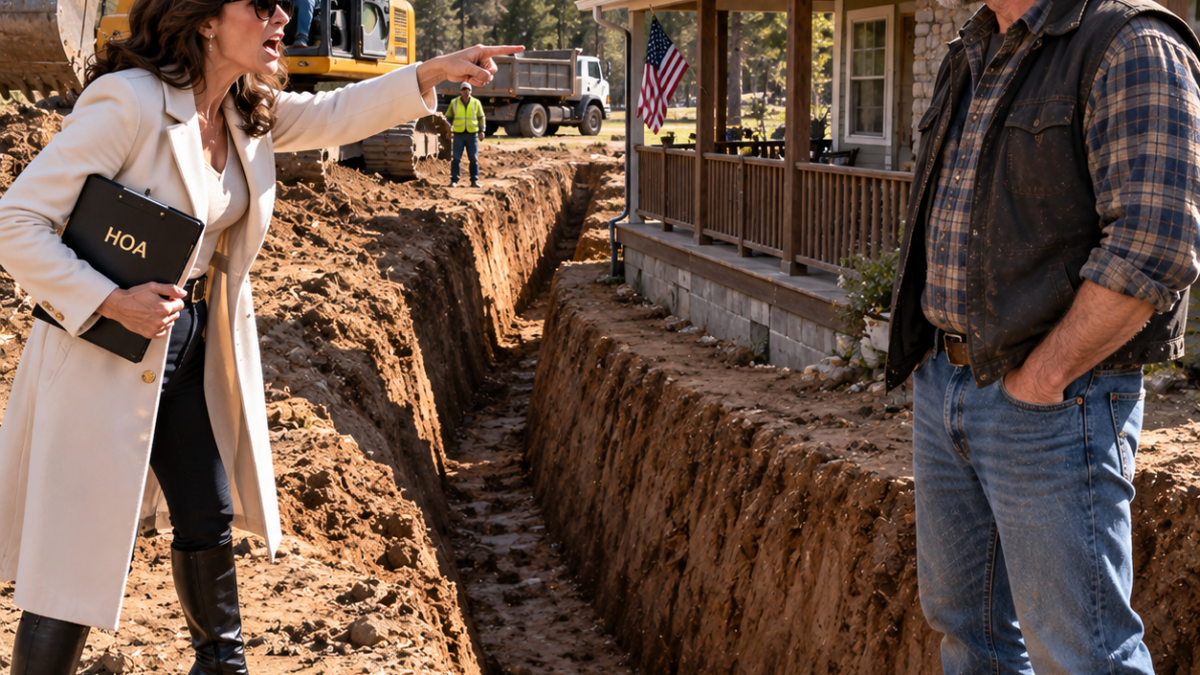
The plan, I later learned, was to excavate a six-foot-deep, four-foot-wide temporary “stormwater interception trench” along three sides of my house and driveway.
Temporary.
Except it would isolate the structure from vehicle access.
Trap my truck.
Cut utility approaches.
Destroy landscaping.
And create exactly the kind of dangerous condition any legitimate engineer would have rejected.
They started fast.
Two excavators by then.
The first trench crossed my driveway at 5:11.
I watched my truck become trapped between house and excavation.
One operator lowered a steel plate temporarily for equipment.
Then removed it.
I understood.
They weren’t merely digging.
They were controlling access.
I called 911 again.
Dispatcher said deputies were en route.
Then my power went out.
5:19.
House dark.
Backup lights came on automatically.
Army habits.
Battery system.
Then internet dropped.
Cell still worked.
Camera network switched to local recording.
Bethany had no idea.
She saw exterior cameras go dark when utility power failed.
She smiled.
That smile again.
I walked toward her.
“You hit my power.”
“We’re not responsible for undocumented private lines.”
“My service is marked.”
“Then your contractor marked it incorrectly.”
“You know I did the work myself.”
She shrugged.
“That may be part of the problem.”
I had installed the new buried service with permit.
Inspected.
Located.
Marked.
They had crossed the markings anyway.
Then a worker yelled.
Everyone turned.
The excavator had exposed a conduit.
Not my house service.
Larger.
Older.
Green warning tape above.
The operator stopped.
Smart man.
Bethany waved.
“Keep going.”
The foreman shouted:
“Ma’am, utility.”
“That’s abandoned.”
“How do you know?”
“It isn’t on our plan.”
That sentence may have saved lives.
The foreman climbed down.
“No.”
Bethany marched toward him.
“You are under contract.”
“Not to hit unknown utilities.”
“It’s abandoned.”
“Then get utility clearance.”
She pointed toward me.
“He’s using delay tactics.”
I laughed.
Couldn’t help it.
“He didn’t put the conduit there, Bethany.”
She looked at me.
“You know what it is?”
“Yes.”
“What?”
“Something you don’t touch.”
The conduit carried an old medium-voltage feeder that crossed Grandma Ruth’s property under a utility easement to serve a municipal emergency well and communications equipment higher on the ridge.
I had traced it while replacing my own service.
Still energized.
Not huge transmission voltage.
Plenty enough to kill someone.
I told the operator:
“If you put steel through that, you may not get a second mistake.”
He backed the excavator away.
Bethany screamed:
“Continue excavation around it.”
He refused.
She threatened the contract.
He shut the machine down.
Good man.
The second excavator operator kept working elsewhere.
By 5:37, the trench wrapped from the east side of my driveway, behind the tool shed, around the south lawn, and toward the western access.
Six feet in places.
Spoil piles stacked along the edges.
My property looked shelled.
Then they cut the emergency access lane.
Grandma Ruth had maintained a narrow gravel lane along the west fence for decades.
Fire department knew it.
County parcel file identified it.
Bethany’s excavator cut straight through.
That crossed a different line.
Not emotionally.
Legally.
At 5:43, I heard sirens.
Bethany heard too.
She didn’t stop work.
Instead she walked toward me.
“Once this drainage correction is established, your lawsuit becomes irrelevant.”
I stared.
There it was.
“Say that again.”
She smiled.
“You heard me.”
I had.
So had the camera hidden inside the porch light.
Battery powered.
Local audio.
Every word.
She continued.
“Your grandmother spent years freeloading off Pine Brook infrastructure while refusing to contribute.”
My hands tightened.
I forced them open.
“Don’t talk about my grandmother.”
“She used our roads.”
“County easement.”
“Our snow removal.”
“No.”
“Our drainage system.”
“No.”
“Our property values.”
I almost asked how one ninety-one-year-old woman had apparently sustained an entire luxury subdivision by existing near it.
Instead I said:
“Stop digging.”
Bethany stepped closer.
“No.”
Headlights appeared.
Two sheriff cruisers.
Then a county public works truck.
Then another.
Sam Ortiz got out of the first county vehicle before it fully stopped.
Hard hat.
Work jacket over pajamas.
He looked at the trench.
Then at the forged order Bethany still held.
His face changed.
Not shock.
Engineer anger.
Different species.
Quiet.
Precise.
Dangerous to bureaucracies.
“What the hell did you do?”
Bethany walked toward him.
“Samuel, thank God. Marcus has turned this into—”
He held up a hand.
“No.”
She stopped.
Sam pointed toward the trench.
“You excavated without a county permit.”
“We have emergency authority.”
“No.”
“You signed—”
“No.”
He stepped closer.
“That document uses my signature.”
Bethany said nothing.
“I did not sign it.”
Sheriff’s deputy came up behind him.
“Ms. Cromwell, I need you to step away from the equipment.”
“This is a civil matter.”
“No.”
Sam pointed toward the west lane.
“You cut designated fire access.”
Then the exposed conduit.
“You excavated inside an active utility easement.”
Then my severed service.
“You damaged permitted electrical infrastructure.”
Then the trench.
“And you created an open excavation without shoring, barriers, or a safety plan within forty feet of an occupied residence.”
Bethany tried to speak.
Sam wasn’t done.
“Who is your engineer of record?”
Silence.
“Who stamped the excavation plan?”
Silence.
“Where is your 811 locate ticket?”
The foreman looked at Bethany.
That one mattered.
Utility locate.
She had none.
Sam turned to the foreman.
“Did you call?”
He shook his head.
“We were told emergency exemption.”
“There is no emergency exemption from not killing people.”
The foreman swore quietly.
Bethany said:
“Marcus created the hazard by refusing drainage corrections.”
Sam looked at her.
“What drainage hazard?”
She pointed toward the north slope.
“Runoff from his parcel flows toward Pine Brook.”
Sam stared.
“Water flows downhill.”
Nobody spoke.
“That isn’t a violation.”
Bethany’s face reddened.
“Our retention system has experienced overload.”
“Then you fix your retention system.”
“His parcel contributes flow.”
“So does the sky.”
One deputy coughed to hide a laugh.
Bethany snapped:
“This is why residents lose faith in government.”
Sam pointed at the forged document.
“No.”
His voice was flat.
“This is why.”
Deputies ordered all equipment stopped.
Workers complied.
One contractor, the first operator who refused to hit the conduit, immediately started photographing everything.
Protecting himself.
Smart.
Then the fire chief arrived.
He had been called because emergency access was blocked.
Chief Nora Bell walked the perimeter.
She looked at the six-foot trench.
Then my house.
Then the only remaining pedestrian path.
“If somebody has a heart attack in there, how do we get a stretcher out?”
Bethany said:
“There is temporary access.”
“Where?”
Bethany pointed toward a narrow plank workers had laid over one section.
Nora stared.
“You want my medics carrying a patient across that?”
Silence.
She turned to the deputy.
“This property is not safe for occupancy with access like this.”
That hit me differently.
“Chief.”
She looked at me.
“I’m sorry.”
I understood.
She wasn’t evicting me.
She was saying Bethany had made my home temporarily unsafe.
Exactly what Bethany wanted.
Trap me.
Force me out.
Create facts.
My stomach turned.
Then Bethany smiled.
Tiny.
Almost invisible.
I saw it.
So did Deputy Lee.
He looked at her.
Then at the trench.
Something shifted.
He asked:
“Ms. Cromwell, did you know this excavation would prevent Mr. Whitfield from safely accessing his residence?”
“I am not answering speculative questions.”
Good legal instinct.
Too late.
My cameras had already answered.
I spent that night at Henry Wallace’s house.
That hurt more than I expected.
Walking away from Grandma Ruth’s porch because somebody else had cut the ground around it.
My truck stayed trapped.
Power off.
Water still on, thankfully.
Fire access destroyed.
I stood at Henry’s guest-room window around two in the morning and stared toward the mountains.
Henry appeared behind me.
“You sleep?”
“No.”
“Me either.”
He handed me coffee.
“At two?”
“We’re old.”
Fair.
He said:
“You going to be okay?”
I looked at him.
“No.”
He nodded.
Good answer accepted.
Then:
“You going to quit?”
“No.”
He smiled.
“Better answer.”
By morning, the story had spread.
Not nationally.
Locally.
HOA DIGS TRENCH AROUND NON-MEMBER HOME USING ALLEGEDLY FORGED COUNTY ORDER.
That headline made Pine Brook famous for all the wrong reasons.
Bethany issued a statement.
Of course.
It said:
Pine Brook Estates undertook emergency drainage mitigation in good faith based on professional guidance after repeated efforts to obtain voluntary cooperation from an adjacent property owner.
Good faith.
The most abused two words in American disputes.
The statement continued:
Any access disruption was temporary and unintended.
My camera had Bethany saying:
“Once this drainage correction is established, your lawsuit becomes irrelevant.”
Unintended.
Dana released nothing immediately.
She told me:
“Don’t fight press with evidence we’re using in court.”
“So she lies publicly.”
“Yes.”
“And we wait.”
“Yes.”
“I hate law.”
“Everyone does until they need it.”
The county issued emergency orders.
Contractor required to stabilize trench.
Steel plates installed over driveway.
Temporary fire access restored.
Power utility repaired my service.
The bill went to the excavator’s insurer.
Then inspections began.
And the trench exposed more than Bethany intended.
Along the south edge, excavation had cut through an old clay drainage pipe.
Twelve inches.
Dating back decades.
The pipe originated inside Pine Brook.
It crossed Grandma Ruth’s land and discharged downhill.
No recorded drainage easement.
I stared.
Sam Ortiz looked at the pipe.
Then at me.
“You know about this?”
“No.”
“Looks old.”
“Very.”
Henry knew.
Of course.
He came out with old board records.
Before Pine Brook Estates officially existed in current form.
The original developer had installed temporary drainage across Ruth’s property during construction.
Grandma Ruth allowed it under a handwritten letter.
Temporary permission.
Terminable upon request.
No permanent easement.
The pipe had remained thirty-seven years.
Pine Brook had been routing stormwater across her land for decades.
Without maintaining the agreement.
Bethany had accused Grandma Ruth of freeloading off Pine Brook drainage.
In reality, Pine Brook had been using Ruth’s property.
The irony was almost too perfect.
Dana looked at me.
“Do not smile.”
“I’m not.”
“You are.”
“I have facial problems.”
The engineering report got worse.
Pine Brook had expanded over the years.
More roofs.
More pavement.
More runoff.
Retention ponds modified.
But the association never upgraded the old outfall appropriately.
During heavy storms, water backed up.
Bethany blamed my property because runoff surfaced near my northern meadow.
But much of that water originated inside Pine Brook and was being discharged through the old pipe.
Sam called me.
“You understand what this means?”
“Yes.”
“They may have been using your parcel as unrecorded stormwater infrastructure.”
“Yes.”
“Potentially for decades.”
“Yes.”
“You sound happy.”
“I am trying not to.”
“Try harder.”
Then came the county records investigation.
The forged emergency order had been created using a genuine county template.
How?
Someone had access.
IT logs traced the document base to an email attachment sent two years earlier to Pine Brook’s engineering consultant during unrelated drainage discussions.
Bethany had the old template.
Sam’s scanned signature block appeared on another legitimate approval.
Someone combined them.
Metadata pointed to a laptop registered to Pine Brook HOA.
Specifically Bethany’s board-issued laptop.
That moved the matter out of civil territory.
Sheriff’s investigators obtained a warrant.
Bethany retained criminal counsel.
She stopped posting.
For about four days.
Then Pine Brook residents received an email from an anonymous address accusing me of exploiting “bureaucratic technicalities” to bankrupt their community.
The message claimed I planned to “cut off storm drainage” and cause flooding.
I did not.
Dana traced nothing.
Didn’t need to.
Residents reacted badly anyway.
Not toward me.
Toward Bethany.
By then too many had questions.
One was Sarah Kim.
Thirty-nine.
Architect.
Lived inside Pine Brook.
She knocked on Henry’s door while I was staying there.
“I need to talk to Marcus.”
Henry looked at me.
I nodded.
Sarah carried meeting packets.
She said:
“Bethany told the board the trench was approved.”
“When?”
“Two nights before.”
“Was there a vote?”
“No.”
“She said emergency executive authority.”
Dana had already explained Pine Brook’s bylaws.
President could authorize limited emergency expenditures for immediate threats.
Not invade someone else’s property.
Not fabricate county orders.
Sarah continued:
“She told us county inspectors had declared your land a flooding hazard.”
“Did she show anything?”
“She displayed a letter on screen.”
“What letter?”
Sarah handed me a photograph.
County Public Works letterhead.
Sam Ortiz’s name.
Again.
Different fake.
This one claimed my parcel was “materially contributing to downstream drainage instability.”
Sam reviewed it.
Not his.
Second forgery.
Then a third document surfaced.
An alleged legal opinion stating Pine Brook possessed “implied emergency entry rights” over my parcel.
The lawyer whose name appeared at bottom had retired eighteen months before the date on the opinion.
Dana called him.
He was seventy-six.
Living in Arizona.
He said:
“I wrote no such thing.”
Three false documents.
All used internally to convince board members Bethany had authority.
That was important.
Bethany had not merely lied to me.
She had lied to her own HOA.
Sarah helped organize a recall petition.
Pine Brook residents needed sixty signatures.
They got ninety-four in two days.
Bethany tried to invalidate them.
Too late.
Emergency membership meeting scheduled.
She attended with two attorneys.
I didn’t plan to go.
Sarah asked me.
“No.”
“Why?”
“It’s their HOA.”
“You’re the reason this is happening.”
“No.”
I looked toward my trench-surrounded home.
“Bethany is.”
Sarah considered that.
“Then come as evidence.”
Dana groaned when I told her.
“Do not improvise.”
“I never improvise.”
“You spent twenty-two years in the Army.”
“Exactly.”
“You people call improvising adapting.”
Fair.
The clubhouse was packed.
Bethany sat at the front.
No cream coat.
Dark suit.
Expression composed.
She began with a statement.
“I understand emotions are high.”
People muttered.
She continued.
“My decisions have always been guided by one purpose: protecting Pine Brook.”
Sarah stood.
“From Marcus?”
Bethany looked at her.
“From unmanaged external risks.”
Another resident:
“He isn’t in the HOA.”
Bethany:
“That does not mean his property cannot affect us.”
True in general.
Dangerous when used as a blank check.
Sarah asked:
“Did the county approve the trench?”
Bethany’s attorney leaned toward her.
She said:
“That matter is under review.”
Someone shouted:
“That’s a no.”
Another:
“Did you forge the document?”
Attorney stood.
“Ms. Cromwell will not address allegations subject to an active investigation.”
The room erupted.
Then Henry walked to the microphone.
Slowly.
Cane.
Folder.
Bethany’s expression changed when she saw him.
Henry had been there longer than almost anyone.
“I served on this board before some of you moved here.”
Quiet.
“I remember Ruth Whitfield.”
He looked toward me.
“She hated meetings.”
People laughed softly.
“She refused to join this association three times.”
He held up the 2012 letter.
“I know because I received one of the refusals.”
Bethany said:
“Historical circumstances are more complicated.”
Henry nodded.
“Yes.”
He held up the supposed annexation document.
“Which is why I looked.”
Then projected both versions.
County recorded copy.
HOA copy.
Mine added only to the HOA copy.
Murmurs.
Henry said:
“Someone altered this.”
Bethany said:
“That document predates my presidency.”
“Your husband was treasurer.”
Silence.
That wasn’t proof Bethany altered it.
But it showed history.
Then Sarah took over.
Fake county letter.
Fake emergency order.
Retired attorney’s fake opinion.
Board members stared.
Some had never seen all three together.
Sarah said:
“We were governed through documents we assumed were real.”
That sentence broke something.
Residents began asking not whether Bethany had exceeded authority.
But whether they could trust anything she had given them.
The recall vote:
113 for removal.
18 against.
7 abstentions.
Bethany remained seated while the result was read.
Face still.
Hands clasped.
Then she looked directly at me.
“You think you’ve won.”
I was standing against the back wall.
I said:
“No.”
The room went quiet.
“My house still has a trench around it.”
That ended the drama.
Reality.
Nobody had won.
Repair remained.
The HOA’s insurer eventually accepted partial responsibility for the excavation after reviewing the contractor agreement and unauthorized board actions.
Contractor insurer covered the rest of physical restoration.
Pine Brook paid substantial legal costs.
Residents were furious about assessments.
Understandably.
Some blamed Bethany.
Some blamed the board.
A few blamed me.
One man confronted me outside a grocery store.
“You could drop the lawsuit.”
“I could.”
“People here are paying for this.”
“So am I.”
“You’re going to bankrupt families over dirt.”
I looked at him.
“My home was made unsafe.”
He looked away.
I continued.
“The board had six months to stop.”
Nothing.
“I didn’t dig anything.”
He nodded eventually.
“Still sucks.”
“Yes.”
That I agreed with.
Accountability often sends costs to people who did not personally commit the wrongdoing.
That’s why oversight before damage matters.
The trench took eleven weeks to fully repair.
Not fill.
Repair.
Engineers assessed soil compaction.
Utilities relocated correctly.
Drainage redesigned.
Fire access restored.
Driveway rebuilt.
Pines replanted.
The old unauthorized stormwater pipe removed from my parcel after Pine Brook constructed a legal outfall elsewhere.
That cost them money.
A lot.
But it fixed a thirty-seven-year problem.
The farmhouse foundation had not shifted.
Good.
Tool shed lost one corner due soil collapse.
Rebuilt.
My truck needed towing out across temporary plates.
No damage.
Grandma Ruth’s old lilac bushes were gone.
That hurt more than the shed.
They had grown beside the porch since I was a kid.
The excavator spoil pile crushed them.
I found one surviving root crown.
Replanted it.
Didn’t know if it would live.
It did.
Barely.
First spring after restoration, one branch flowered.
Purple.
Three clusters.
I sat on the porch longer than necessary looking at them.
Dana called that afternoon.
“Sentencing date.”
Bethany had been charged months earlier.
Forgery-related counts.
Criminal mischief.
Trespass.
Reckless endangerment tied to utility excavation.
Using false instruments.
Several counts changed through plea negotiations.
Her attorneys fought hard.
The prosecution did not charge every bad act people on social media wanted.
Real law is not a comment section.
Bethany eventually pleaded guilty to multiple offenses.
One serious felony involving the forged county document.
Several lower counts.
The contractor foreman was not charged.
He had relied on documents, stopped when danger appeared, and cooperated.
The operator who refused to hit the live conduit testified.
His name was Jesse Morano.
Thirty-six.
Father of three.
At sentencing, the prosecutor asked him what he remembered.
Jesse said:
“She kept telling me to dig.”
“What concerned you?”
“The conduit.”
“Anything else?”
“The homeowner.”
He looked at me.
“He wasn’t acting crazy.”
I almost laughed.
“What do you mean?”
“Ms. Cromwell told us he’d be aggressive.”
Silence.
“She said he might come out armed.”
My stomach dropped.
I had never known that.
Jesse continued.
“She told the crew Marcus Whitfield was unstable, heavily armed, combat-trained, and likely to interfere.”
The courtroom changed.
There it was.
My military service again.
Turned into threat.
The prosecutor asked:
“Did you see a weapon?”
“No.”
“Did he threaten anyone?”
“No.”
“What did he do?”
“Told us to stop. Asked for the paperwork. Called the county.”
Jesse paused.
“Honestly, he was calmer than she was.”
I stared at Bethany.
She didn’t look at me.
That revelation hurt more than I expected.
She had primed workers to see me as dangerous.
If I had run outside angry.
If I’d carried a tool.
If I’d touched an excavator.
If somebody had panicked.
How bad could that morning have become?
Silence does not mean surrender.
But calm may have saved me.
Maybe someone else too.
Sam Ortiz testified about the forged orders.
Fire Chief Nora Bell testified about blocked emergency access.
Dana testified to the civil history only where relevant.
I gave a victim statement.
I kept it short.
“I spent twenty-two years working around systems where mistakes kill people.”
I looked at the judge.
“We used procedures because confidence is not safety.”
Then toward Bethany.
“Ms. Cromwell treated procedure as something that applied only when it agreed with her.”
I paused.
“My grandmother said no.”
“Records said no.”
“The county said no.”
“I said no.”
“She kept converting no into another obstacle to overcome.”
I looked back at the judge.
“That is what brought an excavator within inches of an energized line before sunrise.”
I sat.
Bethany spoke.
Her voice was quieter than I had ever heard.
“I believed Marcus’s property was harming Pine Brook.”
Pause.
“I believed I had exhausted normal options.”
Another pause.
“I believed action was necessary.”
The judge asked:
“Did you believe the documents were genuine?”
Bethany looked down.
“No.”
There it was.
The courtroom became perfectly still.
She continued.
“I told myself the underlying problem was real.”
The judge said:
“So the false documents were acceptable because you believed the outcome was justified.”
Bethany’s face tightened.
“Yes.”
That answer may have mattered more than any apology.
Because it revealed the mechanism.
Ends justify means.
She received prison time.
Not twenty years.
Not life.
Enough to be real.
Followed by probation.
Restitution.
Prohibition from serving in fiduciary association roles during supervision.
The civil case continued.
Eventually settled.
Pine Brook formally acknowledged my property was independent.
Recorded declaration.
Permanent.
The altered annexation copy was removed from all association systems.
No more fines.
No more “community perimeter.”
No more arguments.
The settlement also created a legal drainage easement elsewhere with county approval.
Proper engineering.
Proper recording.
Proper maintenance responsibilities.
Boring.
Safe.
Exactly what should have happened years earlier.
Sarah Kim became HOA president.
She called me after her election.
“I want to promise we’re never bothering you again.”
“Don’t.”
She laughed.
“Why?”
“Promises make people lazy.”
“What do I say then?”
“Follow the documents.”
“That’s deeply unromantic.”
“Good governance is.”
Pine Brook changed.
Slowly.
They required independent legal review before claiming jurisdiction over external parcels.
Emergency authority had to be documented and reviewed after use.
No president could authorize property entry alone.
County permits had to be verified directly.
Not via screenshots.
Not forwarded PDFs.
Directly.
Board members learned to ask:
Who signed this?
Where is it recorded?
Can we call them?
Questions Bethany treated as disloyalty became routine.
Henry loved that.
He attended every meeting with his cane and old folders.
People joked he was the institutional memory.
He said:
“That’s a polite way of saying nobody could get rid of me.”
I repaired Grandma Ruth’s farmhouse.
Again.
The porch needed two new piers after soil movement.
I replaced boards.
Rewired the damaged exterior circuits.
Built a better backup power cabinet.
Installed a proper transfer switch.
My Army career had taught me if somebody finds one failure point, remove it.
I planted new lilacs.
Not to replace Ruth’s.
Nothing does.
But because empty ground looked like surrender.
The divorce remained final.
Helen and I spoke occasionally.
When she heard what happened, she called.
“Marcus.”
“Hey.”
“I saw the article.”
“Which one?”
“The trench.”
“Good title.”
“Are you okay?”
I almost gave the standard answer.
Fine.
Instead:
“Not really.”
She was silent.
Then:
“I’m glad you said that.”
That surprised me.
We talked for forty minutes.
Not reconciliation.
Not that kind of story.
Two people who once loved each other honestly, finally speaking without trying to repair what was already over.
Helen said:
“You always go quiet when people hurt you.”
“I know.”
“I used to think it meant you didn’t care.”
“I know.”
Pause.
“Now?”
“Now I think it meant you were deciding how much of yourself was safe to show.”
That stayed with me.
Bethany had made the opposite mistake.
She thought quiet meant weak.
Helen once thought quiet meant absence.
I had used silence for both survival and avoidance.
Maybe the truth was somewhere between.
The house helped.
Neighbors too.
Not Pine Brook as an institution.
People.
Henry.
Sarah.
Sam.
Chief Bell.
Jesse the excavator operator, surprisingly.
He came back months after the settlement.
Parked at the road.
Walked up.
“I brought something.”
A small lilac plant.
I stared.
“My wife said what happened to your grandma’s bushes was messed up.”
I laughed.
“She sounds smart.”
“Smarter than me.”
We planted it near the rebuilt driveway.
Jesse said:
“I’ve been operating equipment fourteen years.”
“Good job stopping.”
He looked toward where the conduit had been exposed.
“I almost didn’t.”
“What changed your mind?”
“You.”
“Me?”
“You weren’t trying to win the argument.”
He shrugged.
“You said, ‘If you put steel through that, you may not get a second mistake.’”
I remembered.
“My old sergeant used to say something similar.”
Jesse nodded.
“I’ve got kids.”
We stood.
Then he said:
“Bethany told us you were dangerous.”
“I heard.”
“Sorry.”
“You didn’t say it.”
“I believed her enough to be nervous.”
Honest.
I appreciated it.
“Why?”
He thought.
“Because she had paperwork.”
There it was again.
Authority theater.
Logo.
Signature.
Folder.
Person speaking confidently.
Humans trust symbols because civilization requires it.
People cannot independently verify every traffic sign, license, permit, badge, deed, medical credential, bank transfer.
Systems work because most documents are real.
That is why false ones are so dangerous.
They weaponize trust.
Jesse looked at the house.
“Looks good.”
“Getting there.”
“Need excavation?”
I stared.
He smiled.
“Too soon?”
“Very.”
Years passed.
The story turned into neighborhood legend.
People exaggerated.
Some claimed Bethany dug a twenty-foot moat.
Six.
Some said I used Army explosives to collapse her HOA office.
I did not own explosives.
Some said I trapped her excavators using hidden electrical lines.
Absurd.
The line predated both of us.
Some said federal agents came.
No.
County sheriff.
Public works.
Fire department.
Reality was dramatic enough.
But people like simple legends.
Veteran versus Karen.
Moat.
Fake order.
Justice.
The real story was less satisfying and more useful.
Bethany did not become dangerous because she was an HOA president.
She became dangerous because nobody stopped her while small violations grew.
First letters.
Then fines.
Then access restrictions.
Then contractors.
Then false documents.
Then excavation.
Escalation rarely announces itself.
It normalizes itself.
Every previous step makes the next one feel only slightly larger.
By the time you’re standing beside a six-foot trench, everyone asks:
How did it get this far?
Answer:
One foot at a time.
Sarah once asked me to speak at a Pine Brook annual meeting about “lessons learned.”
I said no.
She asked again.
I said no.
Henry said:
“Coward.”
I went.
About eighty residents.
I stood at a podium.
Hated every second.
I said:
“I am not here to tell you HOAs are evil.”
Someone laughed.
“Some of you look disappointed.”
More laughter.
“Associations are tools.”
I looked around.
“So are excavators.”
Quiet.
“A tool does not know whether what you’re doing is lawful, moral, smart, or stupid.”
“It does what somebody directs.”
I pointed toward the board.
“Authority is a tool too.”
“That means the people using it need limits.”
I paused.
“And the people watching them need to ask questions before the trench is six feet deep.”
Henry applauded first.
Then everyone.
I hated that too.
Afterward a woman approached.
“You’re very brave.”
“No.”
She looked surprised.
“I was angry.”
“Same thing sometimes.”
“No.”
I shook my head.
“Bravery is doing something while afraid.”
“I wasn’t afraid until later.”
That was true.
At 4:38 that morning, training ran the machine.
Observe.
Assess.
Document.
Call.
Don’t touch equipment.
Don’t escalate.
Fear arrived at two a.m. in Henry’s guest room.
When I realized what might have happened if the excavator hit the feeder.
If a worker died.
If fire crews couldn’t reach me.
If I’d gone outside armed because I believed strangers were attacking my home.
If somebody else had been armed.
If.
If.
If.
That was fear.
Courage, maybe, was getting up the next morning and continuing through process instead of turning the whole thing into revenge.
I never visited Bethany in prison.
Never wrote.
Never needed her apology.
Then, six years after the trench, I received a letter.
Forwarded through Dana.
Bethany.
Dana called first.
“You don’t have to open it.”
“I know.”
“Want me to?”
“No.”
I opened it on Grandma Ruth’s porch.
Three pages.
Bethany wrote that prison had given her “too much time to understand the difference between responsibility and control.”
I almost stopped reading.
Then:
I believed Pine Brook’s problems gave me moral permission to take shortcuts.
Once I accepted that, every shortcut became easier.
The first false document felt temporary.
The second felt necessary.
By the time the excavation began, I had stopped asking whether I had authority and only asked whether I could make other people act as if I did.
That was painfully accurate.
Then:
I hated you because you would not perform the role I had assigned you.
I expected you to be angry, unstable, and unreasonable.
When you weren’t, I had to escalate to keep my story intact.
I read that sentence twice.
Confirmation bias.
Again.
She ended:
I am sorry for what I did to Ruth’s home and to you. I do not expect forgiveness.
I folded the letter.
Put it in the kitchen drawer.
Not safe.
Not framed.
Not destroyed.
Just paper.
A month later, lilacs bloomed.
The ones Jesse and I planted had spread.
The original surviving root from Grandma Ruth’s bush was stronger too.
I sat on the porch with coffee.
My truck in the driveway.
No trench.
Fire lane open.
Power humming.
Nothing dramatic.
That’s the ending people rarely want.
Normal.
But after chaos, normal becomes luxury.
A pickup came up the drive.
Sarah.
She parked.
Got out holding a folder.
I groaned.
“No.”
She laughed.
“What?”
“No HOA folders.”
“Not HOA.”
“Worse?”
“County.”
I stared.
She handed it over.
Pine Brook had completed a major stormwater upgrade.
New retention basin.
New legal outfall.
No flow through my parcel.
Final inspection complete.
I read it.
Signed.
Stamped.
Verified.
I called Sam anyway.
Sarah laughed.
“You still don’t trust paper.”
“I trust paper after a phone call.”
Sam answered.
Confirmed.
Legitimate.
Sarah said:
“You know this is pathological.”
“Adaptive.”
She smiled.
“Army word?”
“Exactly.”
We sat.
She looked toward the driveway.
“You ever think of moving?”
“Yes.”
“Will you?”
“No.”
“Why?”
I looked at the porch.
The pines.
Lilacs.
Tool shed.
Grandma Ruth’s old chicken coop now leaning badly enough that I pretended not to see it.
“Because I finally know what staying means.”
Sarah didn’t ask.
Good.
Some answers deserve quiet.
My name is Marcus Whitfield.
I served twenty-two years in the Army.
I repaired electrical systems under conditions where one wrong connection could burn equipment, injure people, or shut down something somebody needed to survive.
You learn respect for boundaries doing that work.
Hot side.
Neutral.
Ground.
Load.
Source.
Isolation.
Lockout.
Tagout.
Simple concepts.
Ignore them and electricity doesn’t care about your title.
Neither does law.
Neither does land.
Bethany Cromwell spent years believing boundaries were negotiable if she was confident enough.
My grandmother’s deed.
My driveway.
County authority.
Utility markings.
Emergency access.
Board procedures.
Eventually even truth itself.
She treated every limit like something waiting for a stronger personality.
Then one morning she surrounded my house with a trench.
People still ask what I thought when I saw it.
Was I furious?
Yes.
Did I want revenge?
For a while.
Did military training make me dangerous?
No.
It made me careful.
That’s the part stories usually get backward.
The most useful thing the Army taught me was not how to fight.
It was when not to.
Don’t touch unknown wires.
Don’t step into unstable ground.
Don’t act without knowing what system you’re connected to.
Don’t let someone else’s panic choose your response.
And never mistake silence for absence.
That morning, Bethany looked at me across six feet of fresh dirt and believed she had finally isolated me.
No truck.
No road.
No power.
No safe emergency access.
She saw a man trapped inside his grandmother’s property.
What she didn’t see were eight cameras.
County records.
Old board minutes.
Utility easements.
A fire-access map.
A lawyer already awake.
A county engineer whose signature she had stolen.
A contractor smart enough to stop when steel met warning tape.
Neighbors who were finally asking questions.
And ninety-one years of Grandma Ruth’s stubbornness sitting inside one handwritten sentence:
I decline.
That was what Bethany never understood.
No does not become yes because somebody richer, louder, better dressed, or more official-looking keeps pushing.
A forged paper does not become authority because it has a county logo.
A board title does not become ownership because nobody challenged it yesterday.
And a quiet man standing barefoot on a porch does not become defeated because someone dug a trench around his house.
The trench is gone now.
Grass covers most of where it ran.
If you did not know, you might never see the scar.
I do.
Every spring the soil settles slightly differently along the old cut.
One line of grass turns greener after rain.
A faint curve around the south lawn.
The land remembers.
So do I.
Not because I want to.
Because scars are records too.
And whenever I see that greener line, I remember the morning Bethany Cromwell tried to turn my grandmother’s home into an island.
She believed the trench was the final move.
Instead, it exposed everything underneath.
The fake authority.
The old drainage pipe.
The utility easement.
The forged documents.
The board lies.
Her own fear of losing control.
Sometimes people dig holes to trap somebody else.
Sometimes they dig until they uncover the truth.
Bethany did both.
And the moment that county engineer stepped out of his truck, looked at the document carrying his stolen signature, and asked what the hell she had done, the battle she thought she was winning ended exactly where it had begun.
At the boundary she should never have crossed.








