HOA Karen Drained Our Only 50,000-Gallon Fire Cistern to Build a Luxury Fountain—Then a Wildfire Raced Toward 140 Homes. When the Fire Marshal Discovered the Empty Tank, Everything Turned Into a Nightmare.
PART2:
Young trees stood beside newer homes.
The entrance consisted of a heavy timber sign, drought-resistant landscaping, and one squat iron standpipe most people assumed belonged to irrigation.
It didn’t.
That standpipe was the most important object in Oak Creek.
Below it, under a patch of sunbaked earth near the gate, sat a fifty-thousand-gallon reinforced concrete cistern.
Oak Creek stood outside the municipal water district.
Our houses relied on private wells.
Those wells worked fine for kitchens.
Showers.
Gardens.
Normal domestic use.
They were useless against a fast-moving structure fire.
A residential well might deliver ten or fifteen gallons a minute.
A serious structure fire could demand hundreds.
So when the subdivision was approved, the county required an emergency static water supply.
Fifty thousand gallons.
Dedicated exclusively to fire protection.
Nothing else.
An engine could pull up to the entrance.
Connect hard suction hose to the standpipe.
Draft directly from the cistern.
PART3:
Feed attack lines.
Refill tenders.
Support structure defense.
Simple.
Ugly.
Reliable.
That tank was not an amenity.
It was one reason the county allowed 140 homes to exist on that hill in the first place.
For most of the next twenty years, hardly anybody talked about it.
That was fine with me.
Infrastructure does not need appreciation.
It needs maintenance.
Every spring, the HOA president at the time, Arthur Mitchell, met me at the standpipe.
Arthur was a retired Marine.
He believed maintenance schedules were a form of religion.
We would unlock the access cover.
Lift the cast-iron lid.
Drop a weighted measuring line into the darkness.
Check level.
Inspect the float.
Test the replenishment pump.
Exercise the valve.
Verify signage.
The cistern had a small well feeding it.
That well was never designed to refill the tank quickly.
Maybe nine gallons a minute under good conditions.
Its purpose was to replace minor losses.
Keep the reserve topped off.
Nothing more.
Arthur understood that.
I understood that.
The fire department understood that.
Then Arthur had a stroke.
His daughter moved him to assisted living in Arizona.
Oak Creek needed a new HOA president.
Nobody wanted the job.
That was how Bula Cartwright took over.
Bula was a real-estate agent.
She was always smiling.
Not a relaxed smile.
Not warmth.
A fixed professional smile.
The kind used in listing photographs and charity-gala brochures.
Perfect teeth.
Hair that never moved.
Pastel jackets.
White pants.
Oversized sunglasses.
Shoes with no business being worn on a mountain road.
She had sold at least eleven houses in Oak Creek over the years.
She understood buyers.
Or thought she did.
Her favorite phrase was:
“Perception creates value.”
Mine was:
“Pressure creates flow.”
We were never going to be close.
The first conflict came three months after she became president.
Oak Creek’s entrance sign needed repair.
The original timber posts had started rotting near grade.
Arthur would have replaced them with pressure-treated wood and called it done.
Bula formed a Beautification and Marketability Committee.
That should have terrified us more than it did.
They hired a landscape designer.
A branding consultant.
A residential marketing photographer.
Then unveiled a proposal at the clubhouse.
Stone monument.
Backlit letters.
Native grasses.
Flagstone path.
And a twelve-foot decorative waterfall cascading into a reflecting basin.
The rendering looked like a hotel entrance.
People applauded.
I raised my hand.
Bula noticed.
Her smile changed.
“Dave.”
“Where’s the water coming from?”
The landscape designer answered.
“We’re proposing a recirculating system.”
“Initial fill?”
“Existing water source.”
“What source?”
He looked at Bula.
Bula said:
“The old emergency tank.”
The room went quiet.
Not because everyone understood.
Because I did.
And my face probably showed it.
“No.”
Bula blinked.
“Excuse me?”
“No.”
I stood.
“That cistern is dedicated fire reserve.”
“We know what it was historically used for.”
“Not historically.”
I pointed toward the entrance.
“Currently.”
She smiled.
“We’ve been advised it is oversized for present requirements.”
“By who?”
“Our design team.”
The landscape designer suddenly found his notes fascinating.
I asked him:
“Are you a fire-protection engineer?”
“No.”
“Civil?”
“Landscape architecture.”
“Water-resources engineer?”
“No.”
I looked at Bula.
“Then who evaluated fire storage?”
She folded her hands.
“Dave, we’re not draining the tank and throwing the water into the street.”
“No. You’re taking dedicated suppression storage and making it landscape water.”
“The waterfall recirculates.”
“That isn’t the point.”
“Then what is?”
“The point is that water in a fountain is not reliably available for fire engines.”
She laughed lightly.
“We can put an intake connection in the basin.”
“How many gallons?”
“The basin holds approximately twelve thousand.”
“Then where’s the other thirty-eight thousand?”
“We don’t need all fifty.”
“Yes, we do.”
“You don’t know that.”
I stared at her.
“I helped review the system twenty-six years ago.”
That got some attention.
I continued.
“The county condition of approval requires fifty thousand gallons of dedicated fire storage.”
Bula’s smile tightened.
“Requirements change.”
“Then show me the amended requirement.”
“We are still finalizing approvals.”
“Then don’t touch the cistern.”
A homeowner named Linda Perry asked:
“Is the tank really required?”
“Yes.”
Bula said:
“That is Dave’s interpretation.”
“No.”
I pointed toward the plans projected on the screen.
“It’s written in the original approval.”
Bula crossed her arms.
“Those plans are from 1997.”
“Concrete doesn’t stop existing because a PDF is old.”
A few people laughed.
She didn’t.
The board postponed the vote.
I assumed that meant they would investigate properly.
That was my mistake.
Two weeks later, I received the meeting minutes.
The board had approved the entrance project in executive session.
Six to one.
Only board member Miguel Santos voted against.
I called him.
“What happened?”
Miguel exhaled.
“She told everybody the fire reserve had been superseded.”
“By what?”
“Mutual-aid tanker response.”
I closed my eyes.
“That’s not a replacement.”
“I know.”
“Who told her that?”
“She had a letter.”
“What letter?”
He emailed it.
One page.
Fire Safety Resource Memorandum.
No county letterhead.
No fire district logo.
Prepared by Alpine Community Consulting.
I had never heard of them.
The memo claimed:
Given modern mutual-aid capability, Oak Creek’s existing fifty-thousand-gallon static reserve exceeds current risk-based emergency needs.
No calculations.
No fire-flow analysis.
No travel-time analysis.
No signature from a licensed fire-protection engineer.
I searched the company.
Alpine Community Consulting belonged to Bula’s business partner, Trevor Cartwright.
Her brother-in-law.
I called Bula.
She answered cheerfully.
“Dave.”
“Who is Alpine Community Consulting?”
Pause.
“Why?”
“Who is it?”
“They provide community planning services.”
“Trevor’s company.”
“Yes.”
“Does Trevor have a fire-protection license?”
“No.”
“Engineering license?”
“He doesn’t need one to provide planning analysis.”
“He does if you’re using his opinion to remove an engineered safety system.”
Her voice changed.
“Remove is dramatic.”
“What do you call draining a fire cistern?”
“Repurposing.”
“Don’t.”
“Dave.”
“I mean it.”
“Stop talking to me as if I work for you.”
“Then stop acting like fifty thousand gallons belongs to you.”
Silence.
“It belongs to the association.”
“No.”
I corrected myself.
“The structure belongs to the association.”
Pause.
“The use is restricted by county approval.”
Her voice became colder.
“You’ve been retired four years.”
“Correct.”
“You no longer have authority over public infrastructure.”
“Correct.”
“So perhaps let current leadership manage the community.”
“Current leadership doesn’t get to repeal hydraulics.”
She hung up.
Three days later, construction fencing appeared around the Oak Creek entrance.
I drove down.
A skid steer.
Two laborers.
Concrete saw.
Pump trailer.
And a tanker truck.
I parked.
Bula stood beside the contractor wearing a pale green jacket.
“Dave.”
I got out holding the original plans.
“You’re draining it.”
“We’re beginning site work.”
“The tanker is connected to the cistern.”
“We need to lower the water level to modify the outlet.”
“No.”
The contractor looked between us.
His name was Jason Hale.
Hale Landscape & Waterworks.
I knew the company.
Good reputation.
Mostly residential ponds and decorative systems.
I asked:
“Jason, were you told this is dedicated fire reserve?”
He frowned.
“We were told it’s decommissioned.”
“It isn’t.”
Bula said:
“Yes, it is.”
I held up the county plans.
“Condition seventeen.”
Bula did not look.
Jason did.
He took the pages.
Read.
Then looked at Bula.
“This says maintained continuously for emergency fire protection.”
“1997.”
“Has county released it?”
“Yes.”
“Show me.”
“I don’t carry every document in my vehicle.”
Jason looked uncomfortable.
I said:
“Call Fire Marshal Cole.”
Bula snapped:
“Do not interfere with my contractor.”
“He has a right to know if he’s modifying required life-safety infrastructure.”
She stepped toward me.
“You’re a paranoid retired busybody.”
There it was.
Several workers heard.
Jason lowered the plans.
Bula continued.
“You have spent twenty-five years treating that ugly tank like your personal monument.”
I almost laughed.
“Do you think I like the tank?”
“You certainly act like it.”
“I like houses not burning down.”
She pointed toward the entrance rendering.
“This waterfall will increase curb appeal.”
“Fire doesn’t care about curb appeal.”
“We have never had a major fire inside Oak Creek.”
The sentence hit me like a slap.
Not because it was false.
Because that is exactly how safety systems get dismantled.
We haven’t needed it yet.
I said:
“That’s why you still have 140 houses.”
She rolled her eyes.
“Enough.”
Then to Jason:
“Continue.”
He didn’t.
“Jason.”
He looked at her.
“I need the county release.”
“You have a contract.”
“I also have insurance.”
Smart man.
Bula’s face hardened.
“I’ll get it.”
Work paused.
For forty-eight hours.
Then another contractor arrived.
Mountain Vista Features.
Smaller company.
No Jason Hale.
They started pumping at 7:00 on a Friday morning.
I called the fire district.
Administrative office.
The receptionist said the marshal was in inspections.
I left a message.
Called county planning.
Records clerk couldn’t immediately find the original condition.
I emailed plans.
Called Miguel.
Called three neighbors.
Then drove down.
The water was already being transferred.
Not wasted.
Some went into temporary holding bladders.
Some into the new fountain basin.
Some used for landscape establishment.
All of it removed from dedicated storage.
Bula stood by her BMW.
I walked toward her.
“You got the release?”
“Yes.”
“Show me.”
“My attorney says I am under no obligation to provide you internal HOA records.”
“This isn’t an internal record.”
She smiled.
“Then request it from the county.”
I looked at the pump.
“Stop the work.”
“No.”
“Bula.”
“No.”
She stepped closer.
“You had your career.”
Pause.
“This is not your system anymore.”
That sentence stayed with me.
Not because she was entirely wrong.
It wasn’t mine.
That was the whole point.
Emergency infrastructure doesn’t belong to one personality.
Not me.
Not her.
It belongs to the purpose it was created for.
I pulled out my phone.
Started recording.
“State your name.”
Her smile became incredulous.
“Excuse me?”
“State your name and confirm you are authorizing removal of water from the Oak Creek fire cistern.”
“You need help.”
“Then say no.”
She looked at the pump.
Then at me.
“Bula Cartwright, president of the Oak Creek Homeowners Association.”
Pause.
“I authorized conversion of an obsolete emergency water structure into a modern community amenity.”
There it was.
I kept recording.
“Do you have written county authorization releasing the fifty-thousand-gallon fire-storage requirement?”
She smiled.
“We have all required approvals.”
“May I see one?”
“No.”
I stopped recording.
“Thank you.”
“For what?”
“Clarity.”
She looked suddenly less comfortable.
By sunset, the cistern contained less than twelve thousand gallons.
By Sunday:
Under five.
Then they disconnected the fire standpipe.
Cut the old suction riser.
Reconfigured piping toward the fountain pump house.
That was the moment I knew this had gone beyond bad judgment.
I called Fire Marshal Evan Cole again Monday morning.
Got him.
“Dave?”
“We have a problem.”
I explained.
Silence.
Then:
“Are you sure?”
“Yes.”
“Who authorized abandonment?”
“Bula claims county did.”
“We didn’t.”
My chest tightened.
“You didn’t?”
“No.”
“Did the district issue anything?”
“Absolutely not.”
“Then get up here.”
He came that afternoon.
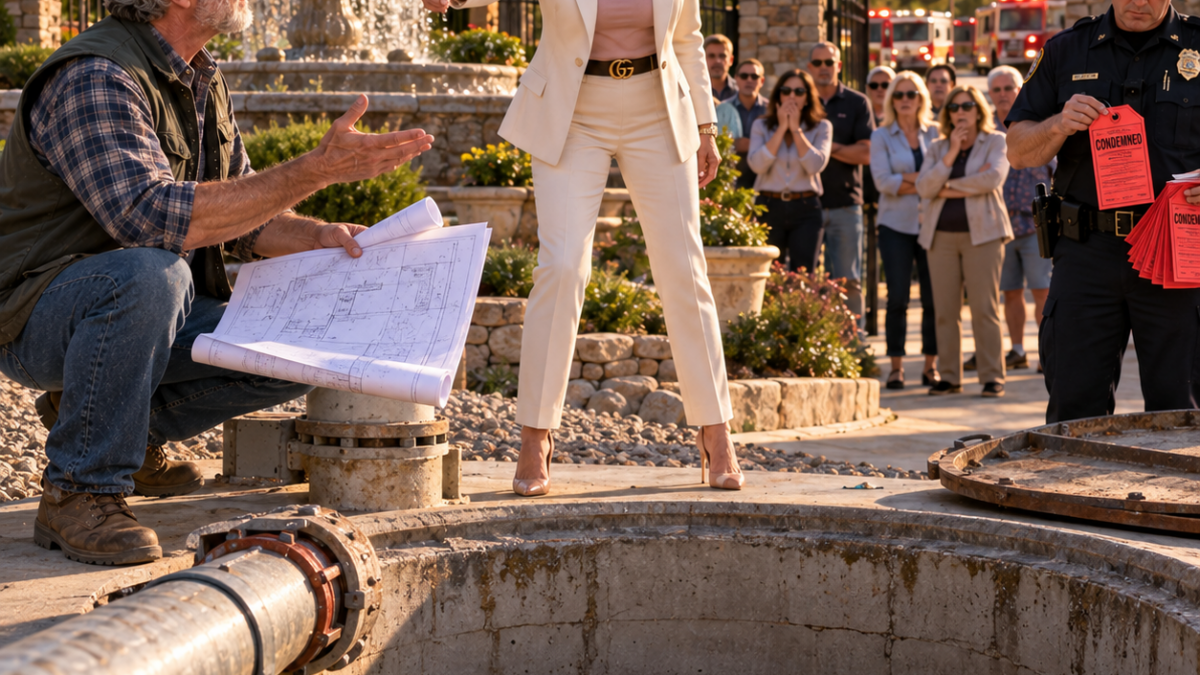
Bula was not home.
Evan opened the cistern hatch with the maintenance key.
Flashlight.
He looked down.
Empty concrete.
Maybe eighteen inches of water in the bottom.
He didn’t speak for several seconds.
Then:
“Jesus.”
I said nothing.
He looked toward the new fountain construction.
“Where’s the drafting connection?”
“Removed.”
“Temporary backup?”
“None.”
“Tankers staged?”
“No.”
“Hydrant?”
“No municipal line.”
“I know.”
He rubbed his forehead.
“Who signed this off?”
“That is the question.”
Evan photographed everything.
Called county planning.
Then called Bula.
Speakerphone.
“Ms. Cartwright, this is Fire Marshal Cole.”
Bula sounded cheerful.
“Hello, Evan.”
“We’re at the cistern.”
Pause.
“Okay.”
“Why is it empty?”
“We’re upgrading the entrance water system.”
“Who authorized decommissioning of the fire reserve?”
“Our consultant determined—”
“Not what I asked.”
Silence.
Evan repeated:
“Who authorized removal of the required fire reserve?”
“The HOA owns the tank.”
“That doesn’t answer the question.”
“Fire protection has evolved since Oak Creek was built.”
“Did I sign anything?”
“No.”
“Did the district approve alternative supply?”
“Not formally.”
Evan looked at me.
There it was.
Not formally.
Meaning no.
He said:
“Stop all fountain work immediately.”
Bula’s tone changed.
“You don’t have authority over HOA landscaping.”
“I have authority over fire-code compliance.”
“This isn’t a fire-code issue.”
“It is now.”
He hung up.
Then turned to me.
“We need fifty thousand gallons restored.”
“How fast?”
“The replenishment well?”
“Nine a minute on a good day.”
He calculated.
So did I.
At nine gallons a minute, continuous:
5,555 minutes.
More than ninety-two hours.
Almost four days.
And that assumed the well held yield.
It wouldn’t.
“Tankers,” I said.
He nodded.
“Temporary fill.”
The HOA would have to pay.
Bula fought.
Of course.
Her attorney sent a letter arguing the fire district had no jurisdiction over “private association water amenities.”
Evan’s response was one paragraph.
The cistern was not a water amenity.
It was a condition of subdivision approval.
Restore it.
Immediately.
Bula requested a hearing.
That delayed things.
Not technically.
The order remained.
But she delayed hiring tankers.
Argued cost.
Asked whether forty thousand gallons would be enough.
Then thirty.
Proposed using the decorative basin as supplemental storage.
Evan refused without engineered modifications.
Bula told residents I was “working with the fire district to obstruct completion of a long-awaited capital improvement.”
That’s when neighbors started choosing sides.
Not everyone chose mine.
Some loved the fountain rendering.
One woman told me:
“We’ve lived here fourteen years and never had a fire.”
I said:
“That’s not evidence the reserve is unnecessary.”
“It feels like you’re catastrophizing.”
“That’s my profession.”
She laughed.
I didn’t.
Safety engineering is professional catastrophizing.
You ask:
What fails?
What happens next?
What protects people after the first thing fails?
It isn’t pessimism.
It is planning.
Miguel started circulating the original plans.
Some neighbors became concerned.
Others accused him of stirring panic.
The board voted four to three to appeal the fire marshal’s restoration order.
Bula won.
Temporary tanker fill was postponed pending legal review.
That delay lasted eleven days.
Then came rain.
A small storm.
Enough to lower fire danger temporarily.
Bula treated it like vindication.
She sent a community email:
Recent weather conditions further demonstrate that emergency-risk claims have been overstated.
I printed that one.
Something about it bothered me enough to keep.
The fountain opened three weeks later.
Despite the dispute.
Stone wall.
Three cascades.
LED lighting.
Reflecting basin.
Bronze sculpture of two elk.
Real-estate photographer.
Ribbon cutting.
Bula wore white.
She posted photographs online.
Oak Creek: Elevated Mountain Living.
The basin held about eleven thousand gallons.
Beautiful water.
Useless to an engine because the drafting connection had never been engineered.
I stood across the road.
Didn’t attend.
Miguel came beside me.
“You’re making your funeral face.”
“My what?”
“Face you make when something stupid is happening and you’ve already decided yelling won’t help.”
“I don’t have a face.”
“You absolutely do.”
He looked at the waterfall.
“It does look nice.”
I stared at him.
“What?”
“It does.”
“That is not the issue.”
“I know.”
“Then don’t say it.”
He smiled.
“Engineers hate aesthetics.”
“No. We hate aesthetics winning against minimum fire flow.”
By mid-August, the hills were dry enough to crackle.
Then September arrived hotter than normal.
No meaningful rain for thirty-two days.
Fuel moisture dropped.
Fire restrictions escalated.
No open burning.
Then no charcoal.
Chainsaw restrictions after noon.
Red-flag warnings.
Wind forecasts.
I checked the fountain every time I drove past.
Water cascading.
Lights glowing at night.
Children taking family photos.
Below it:
An emergency cistern that remained nearly empty.
The HOA had put maybe eight thousand gallons back after pressure from the fire district.
Not fifty.
They claimed restoration work was “in progress.”
Then, on September 14, lightning hit the western ridge.
At first, nobody knew.
A dry thunderstorm crossed north of us around two in the afternoon.
Three strikes were logged near national forest land.
One started a small fire in deadfall.
Smoke showed after four.
The Forest Service sent crews.
By sunset:
Seven acres.
Contained on two sides.
No immediate threat to Oak Creek.
Bula posted:
Fire agencies are aware of the small incident west of our community. There is no current evacuation concern.
That was accurate.
At the time.
The next morning:
Twenty-eight acres.
Wind expected from west by afternoon.
At noon:
Seventy-three.
At 2:30:
One hundred forty.
Spotting in heavy timber.
The fire got a name.
Granite Ridge Fire.
Evan Cole drove into Oak Creek around three.
He brought a battalion chief.
They checked access.
Vegetation.
Turnarounds.
Then the cistern.
I met them there.
Bula arrived ten minutes later.
She was wearing sunglasses.
“This is unnecessary.”
Evan ignored her.
Opened the hatch.
Flashlight.
Gauge.
Approximately 7,600 gallons.
His jaw tightened.
He turned to the fountain basin.
Eleven thousand, roughly.
But decorative plumbing.
Shallow geometry.
No certified drafting point.
No reliable suction setup.
No guarantee debris wouldn’t foul pumps.
Total potentially useful fire water:
7,600 gallons.
For 140 houses.
Battalion Chief Rosa Martinez stared into the cistern.
“How many tender fills?”
“Maybe one full,” I said.
She looked at me.
“You’re James?”
“Dave.”
“Sorry.”
“I’m used to people only remembering engineers after something breaks.”
She didn’t laugh.
Neither did I.
Rosa asked:
“Nearest dependable refill?”
Evan answered.
“County hydrant at Route 16.”
“How far?”
“Nine miles downhill.”
Rosa swore quietly.
One tender round trip, under ideal conditions:
Twenty-five to thirty minutes.
During evacuation traffic?
Longer.
Wildland-urban-interface firefighting depends on mobility.
Water.
Structure triage.
Road access.
You cannot defend 140 mountain homes with one partially filled cistern and hope.
Bula said:
“We have mutual aid.”
Rosa looked at her.
“Mutual aid needs water too.”
“The fountain holds additional reserve.”
“No approved draft system.”
“We can put a pump in it.”
“In a wildfire?”
“Yes.”
Rosa’s eyes narrowed.
“Your plan is to have firefighters improvise suction from a decorative pond while embers land around them?”
Bula looked at Evan.
“This is exactly the alarmism I have been dealing with.”
I had heard enough.
I took out the original approval.
“Condition seventeen.”
She turned.
“Dave, nobody needs your antique drawings.”
Evan said:
“I do.”
He read the condition again.
Then looked at Bula.
“This is not optional.”
She folded her arms.
“The county has been aware of the improvement for weeks.”
“Aware is not approved.”
“There is a pending appeal.”
“The appeal does not suspend a life-safety deficiency during an active wildfire.”
That sentence changed everything.
Evan called county emergency management.
Then planning.
Then the sheriff.
Within an hour, officials were meeting at Oak Creek’s entrance.
The fire was now over two hundred acres.
Winds increased.
Smoke became visible from our western decks.
Gray column.
Then darker.
People came outside.
Phones lifted.
The neighborhood finally stopped talking about landscaping.
At 5:20, the county fire marshal posted a RED FIRE PROTECTION DEFICIENCY placard on the cistern control box.
At 5:34, emergency management upgraded our neighborhood status to pre-evacuation.
Bula went pale.
“This is ridiculous.”
Rosa said:
“No. This is late.”
That night, crews fought the fire along two ridges.
The wind dropped.
Everyone relaxed too early.
By sunrise:
Thirty-five percent containment.
Bula sent an email at 6:12 a.m.
Fire conditions improved overnight. We appreciate residents remaining calm and avoiding unnecessary speculation.
At 9:40, the wind changed.
Twenty-six miles an hour sustained.
Gusts above forty.
The fire crossed a hand line.
At 10:15:
Spot fire east of the main ridge.
At 10:42:
Evacuation warning expanded.
At 11:03, a Forest Service operations chief told county emergency management that if the wind held, Oak Creek could become threatened within hours.
Firefighters began pre-positioning engines.
One engine connected to our standpipe to test draw.
The pump pulled.
Water level dropped immediately.
Pressure unstable.
Crew shut down.
Evan looked at Bula.
No anger now.
Something worse.
“Seven thousand gallons.”
She whispered:
“I was told it would be enough temporarily.”
“By who?”
“Our consultant.”
“Trevor?”
She didn’t answer.
Evan turned to the county official beside him.
“We cannot certify subdivision fire protection.”
The official nodded.
Then came the sentence that changed 140 families’ lives.
“We evacuate.”
Bula stared.
“What?”
Fire Marshal Cole looked at her.
“All residents.”
“You cannot evacuate a neighborhood because a water tank isn’t full.”
“No.”
He pointed west.
“We are evacuating because a wildfire is moving toward a neighborhood that no longer has its required defensive water supply.”
“That is not the same thing.”
“It will feel the same when the sheriff knocks on doors.”
At 11:37 a.m., Oak Creek received a mandatory evacuation order.
Four hours to clear.
One hundred forty households.
Pets.
Children.
Elderly residents.
Medication.
Documents.
Trailers.
Horse owners scrambling to find stock transport.
People who had spent years believing evacuation was something that happened on television suddenly standing in bedrooms deciding which pieces of their lives fit in a car.
The entrance fountain kept running.
That detail made people furious.
Water falling beautifully over stone while phones buzzed:
EVACUATE NOW.
Miguel drove to the pump cabinet.
Shut the fountain off.
Bula saw him.
“What are you doing?”
“Saving electricity.”
“This is HOA property.”
“So is the cistern.”
He walked away.
For the first time since I knew him, Miguel didn’t smile.
I went home.
My wife, Carol, had died eight years earlier.
Heart failure.
No children at home.
Just me and an old lab named Moose.
I had always imagined evacuation would be easy.
Grab documents.
Medication.
Laptop.
Dog.
Leave.
It wasn’t.
I stood in my living room.
Forty years of life.
Photographs.
Carol’s pottery.
My father’s watch.
My engineering license framed on the wall.
Boxes of project notebooks nobody but me would ever read.
What do you save from fire?
The answer depends on how much time you have.
Four hours sounds generous until you realize everybody else has four hours too.
I packed:
Carol’s photo albums.
Her wedding ring.
My laptop.
Important documents.
Medicine.
Clothes.
Dog food.
The original Oak Creek engineering plans.
That last one made me laugh.
Of course.
Even evacuating, I brought the plans.
Outside, the sky turned orange-gray.
Ash began falling.
Not heavy.
Enough.
Neighbors moved fast.
A woman across the road cried while loading two cats.
A teenager tried to fit a gaming computer between suitcases.
A man hooked up a horse trailer with shaking hands.
Sheriff deputies moved door to door.
Bula drove around in her BMW telling residents the evacuation was “precautionary.”
At my driveway, I stopped her.
“Go home and pack.”
She rolled down the window.
“I am coordinating.”
“No.”
“Excuse me?”
“You are not emergency management.”
“I am HOA president.”
“Today that’s not a credential.”
Her face tightened.
“We have responsibilities.”
“So does everybody else.”
I pointed toward her house.
“Pack.”
She looked west.
For the first time, I saw fear.
Real fear.
No smile.
No performance.
She whispered:
“Do you think it will reach us?”
I could have been cruel.
I wasn’t.
“I don’t know.”
Her eyes met mine.
“That’s why we leave.”
She nodded.
Then drove home.
At 1:12, the evacuation line leaving Oak Creek stretched half a mile.
Cars.
Pickups.
Trailers.
Smoke above the ridge.
The fountain sat silent.
And beside it:
A useless standpipe.
I watched families crawl past the entrance in traffic.
People looked at that fountain differently now.
Not beautiful.
Evidence.
By 2:50, approximately ninety percent of residents were out.
Fire crews staged along the eastern road.
Tankers from three districts arrived.
Portable water tanks—folding reservoirs—were set up at two intersections.
A private water-hauling company contracted by the county began filling them.
Emergency workaround.
Expensive.
Slow.
But something.
I stayed until 3:05 because I was helping fire crews explain the old cistern piping.
Rosa finally ordered me out.
“Dave.”
“I can still help.”
“No.”
“I know the system.”
“We know enough.”
“I can—”
She looked at me.
“You’re a resident now.”
That was difficult.
For forty years I had been useful during infrastructure problems.
Engineer.
Advisor.
Technical lead.
Now I was an old man with a dog and a car full of photo albums.
“You need to go.”
I nodded.
Then left.
The Granite Ridge Fire reached the western edge of Oak Creek at 6:47 that evening.
Spotting.
Embers crossed the first meadow.
Firefighters defended three homes along Canyon View Drive.
Two decks ignited.
One detached garage burned.
A wood fence caught.
Crews saved all occupied primary residences.
No one died.
That matters more than everything else.
No one died.
But the cistern failure changed the operation.
That came out later.
Water tenders had to shuttle continuously.
Two engines temporarily disengaged because local water wasn’t available.
Crews deployed portable tanks that would not have been needed if the fifty-thousand-gallon reserve had been intact.
The county spent tens of thousands in emergency water logistics during the first operational period.
Would a full cistern have stopped the wildfire?
No.
Important.
Water tanks do not stop wildfires.
Would it have guaranteed every structure survived?
No.
Also important.
But it would have provided a dependable local source for structure defense exactly as designed.
That was the point.
Safety systems aren’t magic.
They buy capacity.
Time.
Options.
Bula had traded options for a waterfall.
The fire burned for six more days before weather helped crews contain it.
Oak Creek residents were allowed home on day four.
My house stood.
Ash covered the deck.
Pine needles everywhere.
Moose sniffed every room as if checking whether we still owned it.
Two houses had minor exterior damage.
One garage gone.
Several fences.
Trees scorched.
Nothing compared with what could have happened.
People felt lucky.
Then anger arrived.
The first HOA meeting after reentry was the largest in Oak Creek history.
Clubhouse could hold eighty.
More than one hundred twenty came.
People stood outside.
Bula sat at the front table.
Pastel jacket.
No fixed smile.
Beside her:
Trevor Cartwright.
HOA counsel.
Four board members.
Miguel sat among residents.
He had resigned the day after evacuation.
Bula opened:
“I want to begin by expressing gratitude to our firefighters—”
Someone shouted:
“Where was the water?”
Applause.
Bula waited.
“We will have a full infrastructure review.”
Another voice:
“You emptied it!”
“We did not empty it irresponsibly.”
The room exploded.
She raised her hands.
“The entrance project was approved by the board.”
Miguel stood.
“Based on false information.”
Bula’s face tightened.
“Sit down.”
“No.”
That one word changed the room.
He walked forward.
“I voted against the project because Dave showed us the original fire-storage requirement.”
Bula said:
“You accepted the board decision.”
“No.”
“I accepted being outvoted.”
Pause.
“I never accepted the engineering memo as real.”
Trevor stood.
“What exactly are you implying?”
Miguel looked at him.
“That you wrote a fire-water opinion with no fire-protection credentials.”
Trevor’s attorney—he had brought one—leaned close.
Bula interrupted:
“Alpine Community Consulting provided planning analysis only.”
I raised my hand.
People turned.
I hated speaking in rooms.
Always had.
Bula looked at me.
“Dave, please.”
“Please what?”
“Do not turn this into a personal attack.”
I stood.
“It isn’t personal.”
I carried the original plans to the front.
Placed them on the table.
“These are the county-approved subdivision plans.”
Then a copy of condition seventeen.
“Fifty thousand gallons of dedicated emergency fire storage.”
Then Bula’s consultant memo.
“This says the reserve is excessive.”
I looked at Trevor.
“Where is the fire-flow analysis?”
He said nothing.
“Where is your water-supply calculation?”
Nothing.
“Apparatus travel analysis?”
Nothing.
“NFPA reference?”
Nothing.
“Alternative source certification?”
Nothing.
“County release?”
Silence.
I looked at Bula.
“You told me you had all required approvals.”
She said:
“We relied on professional advice.”
“From your brother-in-law.”
Murmurs.
Some residents knew.
Many didn’t.
Bula’s face changed.
“He was disclosed.”
Miguel laughed.
“No.”
“His company relationship was publicly available.”
“That isn’t disclosure.”
A woman stood near the back.
Rachel Vaughn.
Insurance broker.
“Did the board know Alpine was related to you?”
Three board members looked down.
One shook his head.
Bula said:
“It was not relevant to the scope.”
People started shouting.
The meeting collapsed.
Eventually HOA counsel took the microphone.
“Everyone stop.”
Surprisingly, they did.
He looked at Bula.
“Were you advised in writing by county staff that the cistern could be decommissioned?”
Bula stared.
Counsel repeated.
“Yes or no?”
“No.”
“Fire district?”
“No.”
“Licensed fire-protection engineer?”
“No.”
Trevor whispered:
“Counsel—”
The attorney ignored him.
He looked sick.
“How did you conclude the original requirement had been superseded?”
Bula said:
“Trevor’s analysis.”
The attorney closed his eyes.
That’s when I knew he hadn’t approved this either.
The board voted that night to suspend Bula as president pending investigation.
Four to one.
She cast the one.
Residents applauded.
I didn’t.
The tank was still empty.
Applause doesn’t refill water.
The county stepped in next.
Not dramatically.
Paperwork first.
Always.
Fire Marshal Cole issued an emergency compliance order.
The fountain system was shut down.
Its basin water was pumped into the cistern.
Temporary tankers delivered the remaining volume.
Within thirty-six hours:
Fifty thousand gallons restored.
The old drafting connection had been cut, so a temporary approved fitting was installed.
Then a permanent system was engineered.
Not by me.
I was too involved.
A licensed fire-protection consultant from Denver handled it.
That mattered.
Independent review.
The new design retained the cistern exactly for its original purpose.
The fountain remained disconnected.
For weeks it sat dry.
Stone.
Elk statue.
No water.
People drove past.
I secretly thought it looked better.
Then the financial audit started.
At first, this was supposed to answer a simple question:
How did the HOA spend $640,000 on an entrance renovation that began as a $280,000 proposal?
Yes.
Six hundred forty thousand.
For a neighborhood entrance.
The answer was ugly.
Not necessarily criminal at first.
Change orders.
Consulting.
Stone upgrades.
Lighting.
Water features.
Pump controls.
Landscaping.
Photography.
Marketing services.
But several vendors were connected to Bula.
Alpine Community Consulting:
Trevor.
Summit Image Residential:
Bula’s real-estate marketing company.
Cartwright Design Partners:
Cousin.
The HOA had paid Bula’s own brokerage $38,000 for “community positioning photography and market-value enhancement services.”
Residents had never been told.
That got the state real-estate commission interested.
Then the county searched its records.
Remember Bula saying she had approvals?
A document existed in the HOA files titled:
COUNTY WATER FEATURE CONVERSION ACKNOWLEDGMENT.
It carried the county planning logo.
It was not an approval.
It was an automated email acknowledging receipt of Bula’s application.
Somebody had cropped the bottom.
Removed:
THIS ACKNOWLEDGMENT DOES NOT CONSTITUTE APPROVAL.
Then saved the altered version into the board packet.
Who did it?
Metadata.
Created on Bula’s laptop.
That changed things.
She claimed her assistant prepared it.
The assistant produced emails.
Bula:
CLEAN UP THE COUNTY RESPONSE FOR BOARD PRESENTATION. REMOVE ADMINISTRATIVE LANGUAGE THAT WILL CONFUSE PEOPLE.
Assistant:
Do you mean the disclaimer?
Bula:
YES. THEY DON’T NEED THE BOILERPLATE.
There it was.
Not necessarily forgery in the dramatic criminal sense.
But deliberate misrepresentation.
Then came the fire marshal’s original warning.
He had sent an email after visiting the drained tank:
NO FURTHER ALTERATION SHOULD OCCUR UNTIL REQUIRED FIRE STORAGE IS RESTORED.
The board packet summarized it as:
Fire district requests coordination during project completion.
I read both.
Then read them again.
Same message.
Different reality.
Miguel said:
“She rewrote everything.”
That became the pattern.
Warnings softened.
Conditions summarized.
Objections reframed as recommendations.
No turned into coordinate.
Stop became review.
Bula’s power had not come from forging signatures.
It came from editing meaning.
Sometimes that’s enough.
County commissioners ordered an independent review of Oak Creek’s original subdivision approval.
They found the cistern requirement remained fully enforceable.
No amendment.
No replacement.
No superseding condition.
For twenty-six years, the rule had never changed.
Only the story had.
The wildfire cost brought consequences.
Emergency water trucking.
Additional mutual-aid apparatus.
Portable tanks.
Overtime.
County legal review.
Some costs were absorbed by emergency budgets.
Some insurers disputed.
The HOA’s general liability carrier opened a claim.
Then sent a reservation-of-rights letter because the board may have knowingly removed required safety infrastructure.
Residents panicked.
Another special assessment seemed possible.
People who had supported the fountain became furious.
One man came to my house.
His name was Paul Denning.
He had argued with me at the first meeting.
Called me a catastrophist.
Now he stood on my porch holding a six-pack.
“I owe you an apology.”
“I don’t drink much.”
“Then I’ll drink it.”
“Come in.”
We sat.
He looked embarrassed.
“I thought you were one of those retired guys who needs everything the way it was in 1998.”
“Sometimes I am.”
He smiled.
“I thought you hated change.”
“I hate uncalculated change.”
“Same thing to normal people.”
Fair.
He looked toward the smoky western ridge.
“My wife packed our wedding albums into one grocery bag.”
I nodded.
“She spent twenty minutes deciding whether to take her mother’s china.”
“That sounds normal.”
“She ended up leaving it.”
“House survived.”
“I know.”
He rubbed his hands.
“But when we drove out past that stupid fountain…”
He stopped.
“I wanted to break it.”
“Don’t.”
“I didn’t.”
“Good.”
“I finally understood.”
I looked at him.
“The tank?”
He nodded.
“No.”
Pause.
“The idea.”
I waited.
“That ugly pipe at the entrance was something I never noticed because somebody else had already worried about it for me.”
There.
Exactly.
Infrastructure is stored worry.
Engineers.
Inspectors.
Fire marshals.
Operators.
People you never meet have already imagined bad days on your behalf.
The concrete tank was forty years of somebody saying:
What if?
What if a house burns?
What if wells fail?
What if tankers are delayed?
What if wind closes the highway?
What if several homes ignite?
Safety is the physical form of remembered fear.
Bula saw only ugly iron.
That was her mistake.
The board recall came two months after the fire.
Bula attended.
So did Trevor.
The clubhouse overflowed again.
This time no pastel jacket.
Dark suit.
Her attorney sat beside her.
She gave a statement.
“I deeply regret the fear residents experienced during the Granite Ridge Fire.”
People murmured.
Not an apology yet.
She continued.
“My decisions regarding the entrance improvement were based on the information available to me at the time.”
Miguel shouted:
“I gave you the plans.”
The attorney asked for order.
Bula continued.
“I was advised that modern mutual aid reduced our reliance on static water storage.”
Fire Marshal Cole sat in the back.
He looked tired.
She said:
“I never intended to compromise safety.”
That part I believed.
Intent matters morally.
Less operationally.
Most infrastructure disasters are not caused by someone intending disaster.
They are caused by somebody intending convenience.
Beauty.
Savings.
Schedule.
Profit.
And treating warnings as obstacles.
Bula looked toward me.
“Dave and I disagreed.”
I stood.
She paused.
I said:
“We didn’t disagree about landscaping.”
No one spoke.
“We disagreed about whether a safety condition still existed.”
I pointed toward the plans.
“One of us checked.”
Bula’s face hardened.
Her attorney whispered something.
Then a homeowner named Sarah Ortega stood.
She had evacuated with her husband, three children, her seventy-eight-year-old father, and two dogs.
“I want to ask Bula one question.”
The moderator nodded.
Sarah looked at her.
“When Dave warned you that emptying the tank could leave us defenseless, did you believe he might be right?”
Bula didn’t answer immediately.
That delay mattered.
“Did you?”
Finally:
“Yes.”
The room became silent.
Sarah’s voice shook.
“Then why did you keep going?”
Bula swallowed.
“Because every project has objections.”
Wrong answer.
Not evil.
Not clever.
Honest.
Every project has objections.
She had categorized a life-safety warning as resistance to change.
Sarah sat down.
Recall vote:
121 in favor.
9 against.
6 abstentions.
Bula Cartwright was removed from the board.
Trevor’s consulting contract was terminated the same night.
The entrance fountain remained off.
Nobody voted on what to do with it for six months.
Nobody wanted to look at it.
Then Fire Marshal Cole suggested something I thought was either brilliant or cruel.
“Keep part of it.”
The new board president, Miguel, asked:
“What?”
“The structure.”
“Why?”
“Modify it.”
“How?”
“Put the fire connection back visibly.”
The final redesign happened the following spring.
The decorative basin remained.
Smaller.
No waterfall.
No constant circulation.
At its center stood the original restored iron fire standpipe.
Painted red.
Not hidden.
Not landscaped around.
Highlighted.
Behind it, a bronze plaque:
OAK CREEK FIRE RESERVE
50,000 GALLONS
DEDICATED EMERGENCY WATER SUPPLY
ESTABLISHED 1997
Underneath:
MAINTAINED FOR THE PROTECTION OF 140 HOMES
I voted against the plaque.
Miguel ignored me.
“You don’t get a vote.”
“Why?”
“You’re not on the board.”
“Finally somebody learned.”
He laughed.
The cistern got upgrades too.
Remote level monitoring.
High- and low-level alarms.
Telemetry to the fire district.
Locked valve controls.
Annual third-party inspection.
No president could drain it alone.
Two authorized signatures required for non-emergency system modifications.
Any alteration affecting fire storage required written county and fire-district approval.
Boring rules.
Excellent rules.
Oak Creek also improved wildfire resilience.
That mattered more than blaming one person.
Defensible-space grants.
Roof replacement incentives.
Vegetation thinning.
Reflective address markers.
Secondary evacuation planning.
Annual drills.
Two portable community tanks preplanned for tanker operations.
The cistern remained primary local supply.
But not the only thought.
Redundancy.
My favorite word.
The criminal question around Bula turned out less dramatic than neighbors wanted.
She was not charged with attempted anything.
Not arson.
Not reckless endangerment in some cinematic sense.
The law was narrower.
The county investigated document alteration and misrepresentation.
The real-estate commission investigated undisclosed conflicts.
The HOA pursued civil recovery for certain payments.
Eventually Bula entered a settlement on several administrative and civil matters.
Her real-estate license was suspended for a period.
She repaid money connected to undisclosed related-party services.
Trevor lost the consulting work and faced professional penalties tied to representations outside his expertise.
No prison.
Some residents were furious.
They wanted handcuffs.
I didn’t.
Prison would not refill the tank.
Procedure had already done that.
Accountability isn’t required to look dramatic to matter.
Bula sold her house the following year.
I saw the listing.
Of course.
Beautifully photographed.
Mountain views.
Updated kitchen.
Five bedrooms.
And, in the neighborhood amenities section:
Dedicated 50,000-gallon community fire reserve.
I laughed so hard I had to sit down.
Miguel called.
“You saw it?”
“Yes.”
“Should we complain?”
“No.”
“Why?”
“It’s accurate.”
“First time for everything.”
Bula moved to Scottsdale.
At least that was what I heard.
For several years, we had no contact.
Then a letter arrived.
Handwritten.
Bula.
I considered throwing it away.
Didn’t.
She wrote:
Dave,
I have replayed the day you stood in my driveway with those plans more times than I care to admit.
At the time, I believed you were trying to stop something new because you were emotionally attached to something old.
I understand now that I was the one making an emotional decision.
I wanted the entrance to look beautiful because I believed beauty would prove I was improving Oak Creek.
Every objection felt like an attack on my competence.
That made me stop asking whether the objection was correct.
I read that twice.
She continued:
When the evacuation order came, I packed two suitcases and stood in my bedroom unable to decide what mattered. I remember hearing the fountain outside while my phone told me to leave because fire protection was inadequate.
That sound has never left me.
Neither has your warning.
I am sorry.
No request for forgiveness.
No explanation after.
Just:
I hope the cistern is full.
I walked down to the entrance.
Unlocked the hatch.
Dropped the measuring tape.
Forty-nine thousand eight hundred sixty gallons.
Temperature and minor measurement variance.
Full enough.
I wrote back one sentence.
It is.
I never heard from her again.
The Granite Ridge Fire became a local case study.
Not because Oak Creek burned.
It mostly didn’t.
Because a near miss reveals systems almost as clearly as catastrophe.
County planning changed its procedures.
Dedicated subdivision fire-water supplies were added to a digital registry.
Any proposed alteration automatically triggered fire-district review.
HOAs could no longer rely on old paper plan sets nobody remembered.
Fire marshals pushed for telemetry on remote cisterns.
Other mountain subdivisions discovered their own tanks.
Some hadn’t been inspected properly in years.
One had a frozen valve.
Another contained sediment deep enough to reduce usable volume.
One had a drafting cap so corroded firefighters might not have opened it under pressure.
Oak Creek’s stupidity prompted useful work elsewhere.
I liked that.
Waste less pain.
That had been one of my engineering beliefs.
If a system fails, learn enough that the same failure pays tuition for somebody else.
I started teaching a small annual session for HOA boards and rural neighborhood associations.
Not because I enjoy HOAs.
I would rather clean pump screens.
Fire Marshal Cole asked.
The session was called:
“Critical Infrastructure Is Not Landscaping.”
My title.
They tried to change it to:
“Community Fire-Water Resilience and Asset Management.”
I refused.
Every year, I begin with a photograph.
Oak Creek entrance.
The fountain running.
Stone elk.
Perfect water cascade.
Then another photograph.
Same week.
Inside the fire cistern.
Empty concrete.
I ask:
“Which one is the water system?”
Someone always points at the fountain.
Wrong.
The fountain moves water.
The cistern protects people.
Function matters.
Then I explain the numbers.
Fifty thousand gallons sounds enormous.
It isn’t.
One large attack line might flow 250 gallons per minute.
Two lines:
At that rate:
100 minutes.
Less than two hours.
Add tender fills.
Multiple structures.
Exposure protection.
Losses.
Suddenly fifty thousand looks small.
Infrastructure has scale people misunderstand.
A full swimming pool looks like endless water.
To fire apparatus, it can be a few operational periods.
That is why engineers calculate.
We do not design from vibes.
I say that now.
Young boards laugh.
Older engineers nod.
Arthur Mitchell died three years after the fire.
His daughter called me.
He had been in Arizona the whole time.
After the evacuation, somebody told him what happened.
She said he was furious.
“Dad wanted to fly back.”
“At eighty-four?”
“With a walker.”
“That sounds like Arthur.”
Before he died, he mailed me his old cistern notebook.
Twenty years of handwritten entries.
Dates.
Measured depth.
Pump tests.
Valve maintenance.
One note from 2004:
LEVEL DOWN 14 IN. REFILLED. FIND LEAK BEFORE FIRE SEASON. DO NOT LET BOARD TURN THIS INTO IRRIGATION STORAGE.
I laughed.
Arthur had predicted the category if not the fountain.
Another:
BORING IS GOOD.
That one I framed.
It hangs over my workbench.
BORING IS GOOD.
Pressure stable?
Boring.
Tank full?
Boring.
Alarm silent?
Boring.
Valve works?
Boring.
Fire engine connects and receives water exactly as expected?
Beautifully boring.
The older I get, the more I distrust systems that need excitement to prove they matter.
My wife Carol understood that better than anybody.
During my career, I would come home complaining about council members wanting cheaper pipe or developers arguing over tank size.
She would listen.
Then ask:
“Did water come out?”
Usually.
“Yes.”
“Then you won.”
Simple.
After she died, I forgot that sometimes.
Oak Creek reminded me.
We didn’t need a dramatic hero.
We needed water to come out.
The year after Arthur died, we held the annual cistern inspection in his honor.
Not officially.
Just Miguel and me.
Fire district technician.
Two board members.
We opened the hatch.
Dropped the line.
Full.
Tested the drafting connection.
Engine arrived.
Connected.
Pulled water.
Perfect.
A little rust-colored spray at first.
Then clear.
Miguel stood beside me.
“Happy?”
“No.”
“Why?”
“Valve takes too many turns.”
He laughed.
“You are impossible.”
“Write it down.”
He did.
Maintenance next week.
That’s what safety looks like.
Not gratitude.
Attention.
Years later, new families moved into Oak Creek who knew nothing about Bula.
They saw the entrance standpipe plaque.
Some asked.
One young father said:
“Why such a huge fire tank if the department brings water?”
I said:
“Because the department is bringing people and equipment. Water is heavy.”
He nodded.
“How heavy?”
“About 8.34 pounds a gallon.”
He looked at the ground.
“Fifty thousand gallons is…”
“Over four hundred thousand pounds.”
He whistled.
“You can’t exactly carry that up the hill quickly.”
“Now you understand.”
People think fire engines are water supply.
Many carry water.
Not enough for prolonged defense.
Tankers help.
Hydrants help.
Cisterns help.
Everything layers.
Redundancy.
There it is again.
A neighborhood survives not because one system is perfect.
Because several imperfect systems support each other.
The same turned out to be true of communities.
Bula failed.
The board failed.
But Miguel objected.
I kept plans.
Jason Hale refused to continue without release documents.
Fire Marshal Cole enforced.
Rosa Martinez improvised.
Tanker crews hauled.
Residents evacuated.
County planners changed procedures.
Nobody alone protected Oak Creek.
That’s another reason I don’t tell the story as:
I warned them and I was right.
Being right during a wildfire is overrated.
I’d rather have been wrong.
I would have loved for the Granite Ridge Fire to stay seven acres.
For rain to come.
For the empty tank never to matter.
For Bula to spend the next decade pointing at her fountain and saying:
“See? Dave worried over nothing.”
That would have been wonderful.
Safety work has a strange curse.
If you succeed, people think you overreacted.
If you fail, everyone asks why you didn’t do more.
The goal is not vindication.
It is uneventful Tuesdays.
I wish Bula had understood that before she opened the valve.
The evacuation changed one more thing in me.
For forty years, I treated infrastructure as technical.
Numbers.
Specifications.
Drawings.
Pressure zones.
Volumes.
After watching 140 families pack their lives, I understood it differently.
That fifty-thousand-gallon cistern was not fifty thousand gallons.
It was Sarah Ortega having another forty minutes to load her father into a car.
It was firefighters holding a line at Canyon View.
It was a tanker crew not having to drive nine miles downhill while houses burned.
It was a mother deciding she could take the photo box instead of another jug of water.
It was options.
Engineering is stored options.
You build capacity today so frightened people have choices tomorrow.
Bula saw stored water as unused water.
That’s a common mistake.
Unused backup capacity looks wasteful right up until primary capacity disappears.
A generator that never runs.
A hospital bed sitting empty.
A redundant fiber line.
A flood basin with no water in it.
A fire cistern nobody notices.
People ask:
Why pay for something we don’t use?
Because you are using it.
You are using its existence.
Every day.
The absence of disaster is part of the service.
My name is Dave James.
I’m older now.
I don’t attend every Oak Creek board meeting anymore.
That is healthy for everybody.
Miguel served three years as president.
Then stepped down.
Said anybody who enjoys being HOA president after three years should be investigated.
I agree.
The current president is a pediatric dentist named Hannah Lee.
Extremely organized.
Deeply uninterested in dramatic landscaping.
Perfect.
The fountain basin still exists.
But it is dry most of the year.
During spring, residents fill a shallow section from a separate landscape line and plant flowers around it.
No connection to fire reserve.
Children throw coins in.
The bronze elk remained because removing them cost more than tolerating them.
I occasionally put a Santa hat on one in December.
Nobody knows it’s me.
The fire cistern sits directly behind them.
Full.
Monitored.
Tagged.
Tested.
If you visit Oak Creek now, you might think the entrance is slightly strange.
Pretty stone.
Two bronze elk.
Then a bright red standpipe right in the middle where no landscape designer would voluntarily put it.
I love that.
Beauty forced to make room for function.
Exactly as it should.
Every August, before peak fire season, I walk down early.
Before sunrise.
Open the access box.
Check the remote reading.
Then verify manually because retirement has not cured me of anything.
I lower the weighted tape.
Wait for the soft sound when it touches water.
Pull it up.
Read.
Full.
That little sound gives me more peace than the waterfall ever could.
Some mornings I stand there afterward and look toward the western ridge.
The Granite Ridge burn scar is still visible.
New growth coming through.
Aspen saplings.
Grass.
Fireweed.
Landscape repairs itself differently than people.
Slow.
Uneven.
No committee.
No branding consultant.
The mountain doesn’t care what Oak Creek looks like in a real-estate magazine.
Fire doesn’t either.
Water definitely doesn’t.
Water follows elevation.
Pressure.
Gravity.
Open valves.
Closed valves.
It has no respect for titles.
Not retired engineer.
Not HOA president.
Not realtor.
Not fire marshal.
That’s one reason I spent my life trusting it.
It doesn’t flatter anyone.
Bula thought the cistern was ugly.
She was right.
It was.
Concrete.
Iron.
Dark hole in the ground.
But ugly systems save beautiful homes every day.
That’s the part people miss.
We like visible value.
Landscaping.
Stone.
Lighting.
Waterfalls.
Things buyers photograph.
Real safety often hides.
Under roads.
Behind panels.
Inside walls.
Beneath dirt.
Waiting.
Two months before the Granite Ridge Fire, I stood in Bula Cartwright’s driveway with plans in my hand and told her exactly what could happen.
She called me paranoid.
Maybe I was.
Engineers often are.
We imagine failures.
That is literally part of the job.
But paranoia without evidence is fear.
Risk analysis with drawings, flow calculations, and forty years of system history is something else.
She didn’t understand the difference.
Then the fire marshal opened that cistern.
Seven thousand gallons where fifty thousand belonged.
Smoke climbing behind him.
One hundred forty families waiting to hear whether they were safe.
And suddenly nobody thought the old tank was ugly anymore.
Nobody asked what the fountain photographs looked like.
Nobody cared about curb appeal.
Nobody cared about the bronze elk.
Everyone wanted one answer.
Is there enough water?
There wasn’t.
So we left.
Four hours.
One hundred forty families.
Cars crawling downhill under an orange sky.
The fountain silent beside the gate.
And the ugliest piece of infrastructure in Oak Creek sitting nearly empty beneath it.
We got lucky.
That deserves to be said plainly.
Firefighters were excellent.
Emergency managers adapted.
Tankers arrived.
Wind shifted before the worst-case run through the subdivision.
Luck helped too.
People dislike admitting luck because it makes survival feel less controlled.
But engineers respect margins partly because we know luck is unreliable.
You do not build a safety plan around hoping wind changes.
You store the water.
That was the lesson.
Not that Bula was evil.
She wasn’t.
Not that HOAs should never improve anything.
They should.
Not that beauty is frivolous.
It isn’t.
The lesson was simpler.
Never let somebody remove a safety margin just because nothing bad has happened yet.
Never confuse unused with unnecessary.
Never let a pretty rendering outrank an ugly engineering drawing.
And when the person who spent forty years worrying about what happens when water isn’t there quietly walks into your driveway holding the original fire-storage plans, maybe don’t call him paranoid before you read them.
Especially if the mountains behind your house are already dry.








