HOA Karen Cut Through a Federal Worksite Gate to “Inspect” My Project—Then Her Fake Inspection Led Investigators Straight to the Missing Water.
PART2:
UNITED STATES GOVERNMENT WORK SITE.
AUTHORIZED PERSONNEL ONLY.
That language was not decorative.
It was not a suggestion.
It was not the kind of sign a homeowners association could reinterpret after brunch.
It meant the site was controlled.
Access was logged.
Visitors were approved.
Equipment was tracked.
Documents were secured.
And if you cut through the gate because you thought your HOA presidency came with field jurisdiction over federal infrastructure, you were about to have a very busy morning.
Less than a mile away sat Stonehaven Preserve.
If Blackstone Basin looked like mud, steel, pumps, and hard hats, Stonehaven looked like every landscaping committee in America had locked itself in a room with unlimited money and no emotional grounding.
Artificial lake.
Manicured hedges.
Curved drives.
Stone pillars.
PART3:
A clubhouse with oversized windows.
Decorative bridges.
Lawn edges sharp enough to intimidate grass in neighboring counties.
The community had been marketed around its lake.
“Permanent managed waterfront.”
That was the phrase.
I would hear it many times before the case ended.
Permanent managed waterfront sounded expensive because it was supposed to sound expensive.
It helped sell premium lots.
It helped justify assessments.
It made people feel like they had purchased not merely a house, but a small domestic resort with mailboxes.
And for almost fifteen years, the lake stayed full.
Even through dry summers.
Even when smaller neighborhood ponds around the county shrank into muddy bowls.
Even when the county imposed voluntary irrigation restrictions.
Stonehaven’s lake somehow remained within inches of its decorative stone overflow lip.
Residents assumed sophisticated management.
The HOA newsletter called it “proactive hydrological stewardship.”
The landscape contractor called it “makeup supply.”
I would eventually call it Exhibit 37.
But that came later.
My first interaction with Denise Calder was a letter.
Cream paper.
Stonehaven logo.
My name misspelled.
Mr. Holloway,
The Stonehaven Preserve Homeowners Association has received repeated complaints regarding nighttime lighting, construction noise, dust migration, and unsightly equipment visible from the western shoreline residences. You are hereby requested to submit your project operations plan for HOA architectural and environmental review.
I read it twice.
Then walked into our field office and handed it to my deputy superintendent, Luis Ortega.
He read.
Looked at me.
“Are we joining HOA?”
“Apparently.”
“Do we get pool access?”
“I’m asking.”
He folded it.
“Should I send our architectural package?”
“Our architecture is three excavators and a dewatering pump.”
“Minimalist.”
We laughed.
Then I wrote a polite response.
Blackstone Basin is a federally controlled infrastructure project and is not subject to Stonehaven Preserve HOA architectural review. Concerns involving noise, dust, or public safety may be directed to the published project contact number. No HOA access to the secured worksite is authorized.
That should have been the end.
Instead, three days later another letter arrived.
This one from Denise personally.
The HOA does not recognize your claimed exemption from adjacent-community standards.
Claimed exemption.
I wasn’t exempt.
The HOA simply had no jurisdiction.
Different concept.
She continued.
Stonehaven residents have enjoyed protected lake views and environmental safeguards for more than a decade. Any project materially affecting the watershed or aesthetic environment is subject to association review and inspection.
No.
I forwarded the letter to the federal project manager, Allison Kerr.
Allison worked for the agency overseeing the basin rehabilitation.
She had the rare ability to make a two-word email feel like a court order.
Her response:
Do not engage further. Route correspondence through project office.
Fine.
I did.
Stonehaven did not.
Denise arrived at Gate 3 the following Monday.
Not inside.
At least then.
She wore a white blazer, dark sunglasses, and heels that sank half an inch into the gravel before she corrected onto the concrete apron.
Beside her stood a man in a navy polo with STONEHAVEN SECURITY embroidered across the chest.
Not police.
Private security.
He looked deeply unhappy to be there.
Denise pressed intercom.
Luis answered.
“Blackstone east gate.”
“This is Denise Calder, president of Stonehaven Preserve.”
“Okay.”
“I am here for the scheduled site inspection.”
“There is no scheduled inspection.”
“There is now.”
Luis looked at me through trailer window.
I shook my head.
He pressed button.
“Ma’am, you are not authorized to enter.”
“Please open the gate.”
“No.”
She leaned toward camera.
“I am documenting your refusal.”
“Please do.”
I loved Luis.
She stood outside for eleven minutes taking pictures.
Then left.
Two days later, she emailed county environmental services claiming we were illegally drawing down groundwater.
False.
Blackstone bypass circulated basin water through temporary pipe while spillway work proceeded.
Our groundwater monitoring wells were permitted and sampled.
County forwarded complaint to federal project office.
Closed.
Then she complained about sediment.
Then migratory birds.
Then diesel storage.
Every issue already regulated.
Every complaint answered.
I started thinking Denise was simply one of those people who believed authority grew through repetition.
Then our flow numbers stopped matching.
It began small.
Temporary bypass line carried a measured volume from upstream side of basin around the active construction zone and discharged below the work area.
We had meters at intake.
Meters at discharge.
Not because we expected theft.
Because engineers distrust unexplained numbers.
The difference should have stayed within ordinary measurement tolerance.
It didn’t.
At first, we were missing roughly eighteen thousand gallons overnight.
That sounds enormous if you think household use.
On a large water-control project, it can still be a rounding problem depending on flow.
We checked meters.
Calibrated.
Checked again.
Difference persisted.
Twenty-one thousand.
Seventeen.
Twenty-eight.
Then one Saturday night:
Sixty-three thousand gallons.
Luis stared at spreadsheet.
“Leak?”
“Would be wet.”
“Ground?”
“We’d see pressure loss.”
“Bad meter?”
“Both recently calibrated.”
We walked line.
The bypass consisted of large temporary pipe sections running partly above grade and partly through buried crossings.
No visible break.
No obvious wet area.
Pressure remained stable.
Then our remote data logger showed something odd.
Flow dropped downstream between 1:11 a.m. and 3:06 a.m. while upstream intake remained constant.
Not a leak.
A diversion.
Somewhere between.
I notified Allison.
She notified agency engineering.
We began overnight pressure testing.
No public discussion.
Then security found a disturbed patch near northeast perimeter.
Outside our main active zone.
The bypass passed underground there.
The soil had been carefully replaced.
Too carefully.
Grass seed.
Straw.
Someone wanted excavation to disappear.
We had not excavated there.
Survey crew located pipe.
Then a lateral.
Six-inch line branching from the temporary bypass.
Not on our drawings.
Not ours.
It ran east.
Toward Stonehaven Preserve.
That’s when laughter stopped.
We did not dig it up immediately.
We documented.
Called agency counsel.
Federal law-enforcement liaison was notified.
Local water authority too, because Stonehaven’s lake system tied into municipal drainage but was not authorized to take project water.
A covert inspection confirmed the branch line crossed under an old utility strip and disappeared beneath landscaping inside Stonehaven’s western buffer.
A control valve was installed inside a fake irrigation box.
The box bore a Stonehaven landscaping inventory number.
Someone had tapped a federally managed temporary line.
Not enough to compromise flood safety.
But enough to steal water.
Night after night.
Weeks, maybe longer.
The line looked newer than the subdivision.
Probably installed after our bypass went live.
That narrowed timing.
We quietly installed another flow sensor downstream of the unauthorized branch.
Then a camera.
Then pressure monitor.
The next night valve opened at 12:43.
Closed at 4:12.
Approximately ninety-one thousand gallons diverted.
Where?
Stonehaven lake.
Environmental dye test confirmed.
A harmless tracer introduced under controlled conditions appeared in Stonehaven’s decorative lake hours later.
Now we had proof.
Not who.
But what.
The investigation tightened.
The agency wanted to know whether this was a landscaping contractor acting independently, an HOA decision, or something tied to project subcontractors.
Access records.
Purchase records.
Excavation permits.
Utility-locate requests.
Nothing obvious.
Someone had installed the branch without county utility-locate record.
Illegal.
Dangerous.
And knowledgeable enough to conceal.
Then Denise sent me another letter.
That was when my suspicion sharpened.
STONEHAVEN PRESERVE FORMAL NOTICE OF WATER IMPACT INSPECTION
She demanded access to Blackstone to “verify that federal construction activities are not reducing lake levels or interfering with established community water-management rights.”
Established rights.
There were none.
Stonehaven lake was fed by stormwater, permitted wells with seasonal limits, and purchased municipal makeup water under a capped agreement.
I checked public records.
Their permitted well had experienced declining yield for two years.
Municipal water purchases had dropped sharply three months after our bypass came online.
Yet the lake stayed full.
That did not prove Denise knew.
But somebody in Stonehaven knew where free water came from.
Allison told me:
“Do not respond beyond standard denial.”
We denied.
Denise escalated.
She claimed emergency authority.
Sent HOA counsel letter.
Their lawyer’s wording was careful.
Very careful.
Our client requests mutually agreeable observational access. We do not assert a right to enter federally controlled property without authorization.
That sentence mattered.
Their own lawyer knew.
Denise either did not care or thought she knew better.
For the next two weeks, federal investigators collected data.
I was not investigator.
Important.
I was engineer and site manager.
I preserved logs.
Answered questions.
Provided plans.
Security personnel coordinated with agency law enforcement.
No cowboy work.
Nobody asked me to interrogate Denise.
No one wanted confrontation.
They wanted evidence.
The secured trailer she later walked toward held duplicate records because we had moved sensitive monitoring files away from ordinary field trailer.
Not classified.
Not secret-government nonsense.
Just controlled evidence and project documentation.
Inside:
Flow-meter downloads.
Pressure graphs.
Photographs of unauthorized tap.
Survey sketches.
Chain-of-custody forms.
Copies of Stonehaven correspondence.
Maps of buried bypass.
Visitor logs.
A laptop imaged specifically for the investigation.
The trailer had tamper seals and its own camera.
Denise did not know.
Then came Tuesday morning.
6:12 a.m.
I was in Trailer One with coffee.
Luis was outside reviewing concrete delivery.
Security radio cracked.
“Grant, Gate Three.”
I picked up.
“What?”
“Stonehaven group at gate.”
“How many?”
“Seven. Maybe eight.”
I looked at camera feed.
Denise.
Three HOA board members.
Their private security guard.
Two people I didn’t know.
One had clipboard.
One wore polo marked Calder Environmental Compliance.
That name got my attention.
Calder.
Relative?
Later yes.
Her brother’s consulting firm.
Denise pressed intercom.
Security officer on our side, Malcolm Reyes, answered.
“This is a restricted federal site. State your business.”
“HOA compliance inspection.”
“You are not authorized.”
“We’ve given notice.”
“You do not have access.”
“I need site superintendent.”
Malcolm looked toward camera.
I walked to gate but stayed inside.
“Morning, Denise.”
She smiled.
“Grant. Good. Open the gate.”
“No.”
“We’re conducting an environmental compliance inspection.”
“No.”
“We have documented evidence your bypass is affecting Stonehaven lake conditions.”
That was interesting.
The lake was benefitting from bypass theft, not suffering.
“What evidence?”
“We’ll discuss inside.”
“No.”
Her board member, Carl Dunning, looked uncomfortable.
He held binder.
“Denise, maybe we should wait for—”
She cut him off.
“We have authority to inspect any adjoining activity that threatens association property.”
“No, you don’t.”
Her security guard, a man named Rodney Hale, stepped closer to her.
“Ma’am, I told you we can’t force entry.”
Denise ignored.
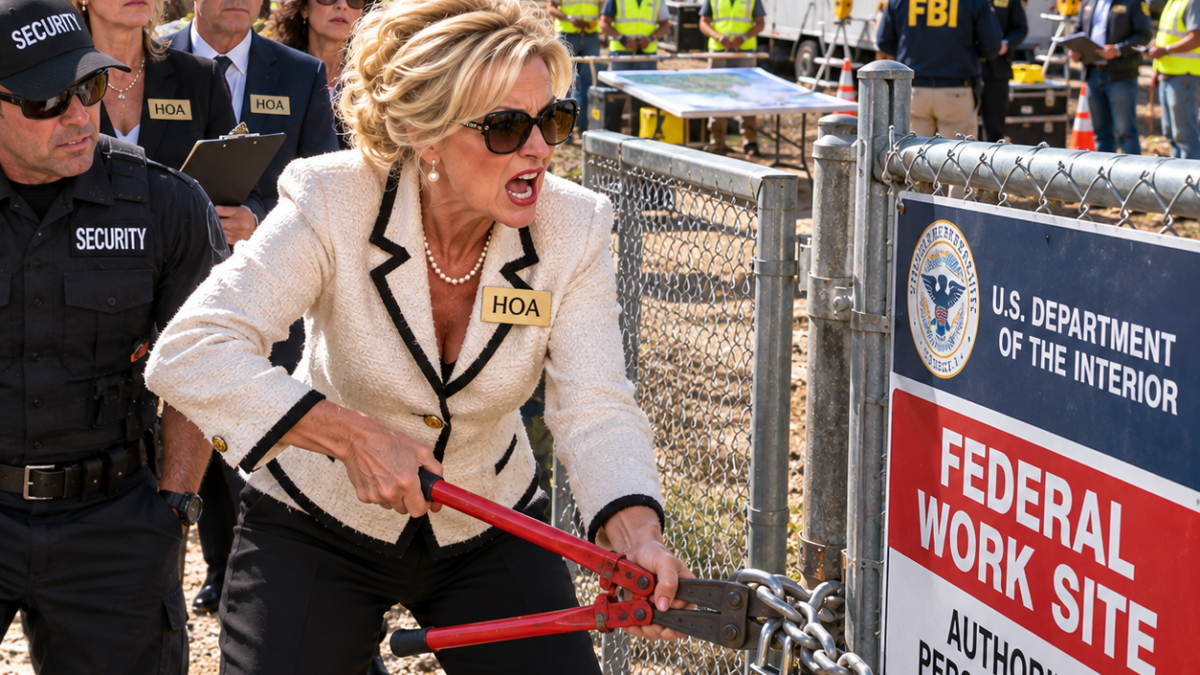
She pointed at warning sign.
“Those signs don’t override easement rights.”
“There is no easement.”
“Our counsel disagrees.”
That was not true.
I knew their counsel’s letter.
I said:
“Have your lawyer call agency counsel.”
“We’re done being delayed.”
Then she looked at chain.
The gate used heavy steel chain and federal padlock.
Rodney had bolt cutters in the back of Stonehaven security SUV.
Probably normal equipment.
Chain removal.
Storm debris.
Fence work.
Denise walked over.
“Give me those.”
Rodney said:
“No.”
“Rodney.”
“I can’t cut a federal lock.”
“You work for me.”
“I work for Stonehaven security.”
“Exactly.”
“This isn’t Stonehaven.”
Correct.
She opened rear compartment herself.
Pulled cutters.
Rodney actually reached toward her.
“Ms. Calder, don’t.”
She smiled.
Not angry.
Confident.
That image is burned in my memory.
She looked at us through gate.
“I’m documenting that you refused lawful inspection.”
Then put bolt cutters around chain.
Malcolm said:
“Do not cut that lock.”
She squeezed.
First attempt slipped.
Second bit.
Third snapped chain link.
The sound was small.
Metal cracking.
That was it.
The moment confidence became evidence.
Every camera caught it.
Gate camera.
Pole camera.
Trailer exterior.
Malcolm’s body-worn camera used for site security incidents.
Two contractor vehicle dashcams.
And, because Denise apparently thought documentation worked only one way, her own board secretary was recording on phone.
She pulled chain loose.
Opened gate.
Rodney did not enter.
He stayed outside.
Smartest man in Stonehaven that morning.
Denise walked in.
Carl followed reluctantly.
Board treasurer Melissa Ward followed.
Two others too.
Her brother’s consultant.
Another security committee member.
I said:
“Stop. You are trespassing on a restricted federal worksite.”
Denise held up binder.
“We are exercising inspection rights.”
“You have none.”
She handed bright orange sticker to Carl.
STONEHAVEN HOA — INSPECTION HOLD
“Tag equipment.”
Carl looked at her.
“What?”
“Equipment adjacent to water system.”
He didn’t move.
Denise grabbed sticker and slapped it onto our temporary pump control cabinet.
Malcolm’s face was extraordinary.
She moved to generator.
Another sticker.
Then excavator.
Another.
She told a foreman:
“Shut this down until inspection concludes.”
Foreman looked at me.
I said:
“Continue safe operations unless security directs otherwise.”
Denise:
“I just issued a hold.”
I looked at her.
“No, you applied a homemade sticker.”
Luis coughed to hide laugh.
Denise pointed.
“Do not mock legal process.”
There are moments when universe writes dialogue too well.
I said:
“This is not legal process.”
She walked deeper into site.
Malcolm radioed federal project security.
I had already alerted Allison.
Procedure was simple:
Do not physically escalate unless immediate safety required.
Keep unauthorized visitors away from active hazards.
Document.
Federal law-enforcement response was already inbound from nearby project office, with county deputies notified for support.
Denise believed our restraint meant uncertainty.
That made her bolder.
She crossed staging lane.
I stayed near enough to keep her away from cranes and open excavation.
“Denise, turn around.”
“You’ve hidden records from adjacent property owners.”
“Which records?”
“Water-flow records.”
There.
She said it.
My pulse changed.
We had never publicly disclosed flow discrepancy.
Not in newsletters.
Not public project updates.
Not county complaint responses.
The detailed flow-meter investigation was restricted to project team and investigators.
“How do you know we have water-flow records under investigation?”
Her face moved.
Not much.
Enough.
“Any competent environmental review would include flow logs.”
Not what I asked.
She turned toward the three trailers.
Trailer One was general field office.
Trailer Two safety and inspection.
Trailer Three—secured evidence trailer.
No large sign saying evidence.
Just numbered trailer with second lock and access keypad.
Denise pointed.
“That one.”
I felt cold.
“Why that one?”
“Because that’s where you’re keeping water records.”
Again.
Too specific.
I stepped between.
“You are not approaching that trailer.”
She smiled.
“Now I know.”
Maybe she thought she had outsmarted me.
What she had done was identify evidence location she should not have known.
She walked around.
Malcolm repositioned.
Not touching her.
Blocking.
“Ma’am, stop.”
She raised phone.
“Are you threatening me?”
“No.”
“Then move.”
“No.”
Her brother’s consultant said:
“Denise, we need leave.”
She snapped:
“Not yet.”
Then to me:
“You have been diverting water away from Stonehaven and falsifying your readings.”
Wrong direction.
“We have experts.”
“Your brother?”
“He is certified.”
“In what?”
“He understands hydrology.”
The consultant looked like he wanted ground to open.
Denise continued:
“The lake lost nearly four inches before we corrected your impact.”
Corrected.
There was the second word.
I said:
“What did you correct?”
She froze.
Only a beat.
Then:
“Your construction changes.”
“No. What did Stonehaven correct?”
“You know exactly what I mean.”
“No. Explain.”
Carl Dunning looked at her.
“Denise.”
She ignored.
“Our community has maintained that water body for fifteen years. We are not going to allow federal contractors to destroy property values because you don’t understand the system.”
“How are you maintaining it?”
“Through lawful methods.”
“Then why are you here trying to reach flow logs?”
She looked at secured trailer again.
I knew then.
Maybe not full proof.
But she knew enough about diversion to be afraid of records.
Sirens approached beyond trees.
Not screaming federal raid.
Two county sheriff units first.
Then two unmarked federal vehicles.
Denise heard.
Her expression changed.
“Did you call police on an HOA inspection?”
“You cut a government lock.”
She looked at broken chain as if remembering.
Federal security investigator Marcus Bell—no relation to board member—entered with credentials visible.
Another agency investigator beside him.
Deputies stayed near gate.
Bell addressed everyone.
“No one move toward equipment or trailers.”
Denise stepped forward.
“I’m Denise Calder, HOA president. We have legal—”
He raised hand.
“Ma’am, do not explain yet.”
He looked at broken lock.
Then stickers.
Then camera.
Then me.
“Any injuries?”
“No.”
“Operational hazard?”
“Contained.”
“Any access to Trailer Three?”
“No.”
He nodded.
Good.
Then looked at Denise.
“Who cut the chain?”
She straightened.
“I did, pursuant to lawful inspection authority.”
Rodney, still outside gate, closed eyes.
Bell asked:
“What authority?”
“Our HOA covenants and environmental easement rights.”
“Show me federal authorization.”
“It isn’t required where adjacent-property rights are implicated.”
Bell:
“Who told you that?”
“Our counsel.”
Carl Dunning spoke.
“That’s not exactly what counsel said.”
Everyone looked.
Denise’s eyes could have cut steel.
Bell:
“What did counsel say?”
Carl swallowed.
“He said we could request access but not enter without permission.”
There it was.
Denise:
“Carl, stop.”
Bell:
“Mr. Dunning, keep speaking only if you’re comfortable. We’ll take formal statement separately.”
Denise turned.
“This is internal board matter.”
Bell:
“Not anymore.”
That line made local news too.
The group was escorted back to gate area.
Nobody handcuffed immediately.
Again, real investigations.
Statements first.
Identity.
Evidence preservation.
Rodney gave deputies the bolt cutters.
Voluntarily.
He said he had warned Denise not to cut lock.
Board secretary had video.
Carl produced binder.
Melissa Ward looked physically ill.
Then federal investigator Bell asked Denise why she had targeted Trailer Three.
She said:
“I didn’t.”
Video showed pointing.
She said she assumed records stored there.
“How?”
“Because it’s the most secured.”
Reasonable answer on surface.
Then they found her printed map.
In binder.
A satellite image of worksite.
Trailer Three circled red.
Handwritten:
FLOW LOGS / BYPASS METER DATA?
Question mark.
But circled.
Where did map come from?
Calder Environmental Compliance.
Her brother’s firm.
They had been hired by Stonehaven two weeks earlier.
Paid $24,000 from lake-maintenance reserve.
Scope:
Independent water-impact review and source-protection investigation.
Source protection.
Investigators seized no binder? With consent? Bell documented and later obtained proper warrant/subpoena where needed. At scene he could take evidence tied to trespass with appropriate authority, but let’s stay careful. The binder was retained temporarily under incident protocol, then chain of custody established under counsel guidance.
Denise was issued federal trespass/removal order and detained briefly for interview.
Whether she was formally arrested that morning became disputed online.
Truth:
She was not dramatically cuffed beside excavator.
She was escorted from restricted site, interviewed, and later charged after warrants and grand-jury process.
Much less cinematic.
Much worse for her.
Because once investigators opened Stonehaven records legally, the water scheme appeared almost immediately.
The unauthorized branch had been installed by BlueArc Landscape & Irrigation.
Stonehaven’s longtime vendor.
Invoice:
Western Lake Stabilization Upgrade — $86,400
Description vague.
Paid from emergency reserve.
Approved by Denise.
No full board vote.
Attached drawing did not show federal bypass.
But BlueArc foreman had text messages.
Denise:
Temporary federal line will be active through next year. We only need supplemental pull overnight.
Foreman:
We need written water agreement.
Denise:
Developer counsel says we have historic basin rights.
False.
Foreman:
I won’t tap federal without paper.
Two days later, BlueArc owner overruled foreman.
Why?
A separate $40,000 “expedited preservation fee.”
Approved by Denise.
Installation occurred at night.
BlueArc dug from Stonehaven side, tunneled beneath buffer, connected to bypass without authorization.
How did they know location?
A former project subcontractor named Eric Mullen.
He had worked three months on bypass installation.
Fired for attendance issues.
Later hired by Calder Environmental.
He had access to old alignment drawings.
Not final secured flow logs, but enough to locate pipe.
He showed BlueArc where.
He also told Denise where our site trailers generally stored meter equipment.
That explained red circle.
But not everything.
Investigators wanted motive.
Stonehaven lake wasn’t merely decorative.
The community’s property values leaned heavily on it.
Premium lots marketed waterfront.
HOA maintained contractual minimum lake elevation for dock usability under its own declarations.
Not government requirement.
Private promise.
During drought, permitted well yield dropped.
Municipal makeup water became expensive.
Stonehaven’s annual water cost rose from $71,000 to $228,000 in two years.
Residents complained about dues.
Denise campaigned for re-election promising:
No special assessment. Stable lake. Stable values.
She won.
Then bypass line appeared less than a mile away.
A temporary river of free water.
At first, according to later testimony, Denise asked whether Stonehaven could purchase project discharge.
Agency said no.
The bypass was operational infrastructure, not municipal supply.
She asked county.
No.
Then BlueArc proposed “temporary supplemental capture” from water supposedly “already crossing Stonehaven watershed.”
That description was nonsense.
But it sounded enough like a technical argument for someone who needed answer.
Denise approved.
The first withdrawal was small.
Ten thousand gallons.
Then twenty.
Lake responded.
Municipal water purchases dropped.
Nobody noticed.
Then drought intensified.
They opened longer.
By the time we discovered branch, investigators estimated Stonehaven had diverted more than 2.8 million gallons over several months.
Not hundreds of millions.
Not enough to drain Blackstone.
But clearly unauthorized.
And because it came through federally managed temporary works, the legal problems multiplied.
Theft of government-controlled resource.
Tampering with federal infrastructure.
False records.
Trespass.
Conspiracy.
Potential environmental permitting violations.
Wire communications.
Vendor invoices.
And then Denise cut a federal lock trying to get to evidence.
That was the part prosecutors understood immediately.
People asked why she would do something so stupid if she already knew investigators might be looking.
Because she did not know how much we knew.
She believed we had detected flow loss but not the Stonehaven tap.
Her plan, according to messages later recovered, was to create an “HOA inspection record” asserting our project caused Stonehaven’s lake-level instability.
Then if diversion discovered, she could frame connection as emergency mitigation undertaken to offset federal construction impact.
In other words:
Build paper after the fact.
Her brother’s consulting firm had drafted a report.
Date blank.
Title:
Emergency Water Stabilization Response to Blackstone Construction Impacts
It claimed Stonehaven took “temporary protective action” after federal bypass operations reduced historic recharge.
The report was false.
Our project had not reduced Stonehaven recharge.
Hydrologists later showed no meaningful direct supply relationship between Blackstone bypass and Stonehaven’s lake before the unauthorized tap.
Denise wanted site photos.
Stickers.
Inspection notices.
A record that she had challenged us.
Then she wanted flow logs to find out exactly what we knew.
Maybe copy.
Maybe photograph.
Maybe only see numbers.
Investigators never proved she intended to destroy records.
Important.
No need exaggerate.
What they did prove was she entered knowing access denied, attempted to interfere with operations, and targeted information relevant to unauthorized diversion.
That was enough.
Stonehaven residents learned about raid? There was no dramatic raid that day. Search warrants came two mornings later.
Federal agents and county deputies executed warrants at:
HOA management office.
BlueArc headquarters.
Calder Environmental.
Denise’s home office.
No tanks.
No doors kicked.
People opened doors.
Computers imaged.
Records boxed.
Lake-maintenance files collected.
HOA board called emergency meeting.
I did not attend.
Not my HOA.
Carl Dunning later told me it lasted four hours.
Residents shouted.
Some cried.
One woman asked:
“Is our lake going to disappear?”
That question hurt, oddly.
Because underneath fraud were homeowners who had bought what they were told.
No one wanted to wake to mud.
But they had not stolen the water.
Most had no idea.
The acting HOA vice president, Melissa Ward, explained permitted water options.
They would have to resume municipal makeup and reduce decorative level temporarily during drought.
Assessments might increase.
A man in back yelled:
“So Denise stole federal water to keep dues down?”
Melissa said:
“That’s what investigators are examining.”
Another:
“And cut their gate?”
“Yes.”
Someone laughed.
Not because funny.
Because reality exceeded anger.
Stonehaven’s attorney stood.
“We need everyone to stop using word steal until charges.”
Good lawyer.
He was right.
At that moment allegations.
Denise sent email to residents that evening.
I acted solely to protect Stonehaven from unaccountable federal construction impacts and to preserve the water rights every homeowner purchased.
There were no such water rights.
Not to bypass.
She continued:
The federal contractor has refused transparency.
We had public project updates.
But not investigation evidence.
Those are different.
She called me:
an unelected site manager with no authority over Stonehaven governance.
True.
I had no authority over Stonehaven.
I never claimed any.
I only had authority over my worksite operations.
The gate.
The one she cut.
I didn’t respond.
Allison forbade.
Good.
Three weeks later federal charges were announced.
Denise.
Her brother Martin Calder.
BlueArc owner Wesley Price.
Former subcontractor Eric Mullen.
Charges varied.
Conspiracy involving unauthorized diversion from federal infrastructure.
Damage/interference with government property.
False statements and records tied to the diversion and attempted cover story.
For Denise specifically, additional count related to unauthorized entry and damage to secured federal worksite.
Not every offense carried Hollywood punishment.
No espionage.
No terrorism.
Just serious property, fraud, and infrastructure crimes.
BlueArc foreman who had objected became key witness.
He had saved text messages because he did not trust owner.
Good instinct.
Mullen cooperated early.
He admitted providing alignment information and helping conceal branch.
Martin Calder claimed he believed legal access existed.
His invoices said otherwise.
One draft memo:
Avoid reference to direct federal connection. Describe source as Western Supplemental Feed.
Hard sentence to explain.
Denise fought.
Her defense was consistent:
Stonehaven had historic watershed rights.
She believed project caused lake decline.
The tap was temporary mitigation.
Her worksite entry was legitimate inspection attempt made under advice from consultant.
She did not know lock cutting violated federal law? Hard to sell with signs and warnings.
But defense has right to argue.
The case took almost a year.
Meanwhile Blackstone project continued.
This surprised reporters.
Federal project did not stop because HOA scandal.
Spillway gates still needed replacing.
Concrete cured.
Pumps installed.
Storm season approached.
Our lives remained schedules.
I liked that.
Criminal cases can swallow identity if you let.
Engineering does not care.
At 5:30 the morning after warrants, Luis handed me coffee.
“Boss.”
“What?”
“Pump Four pressure is off.”
We spent three hours on valve actuator.
Normal.
The unauthorized branch was disconnected under evidence protocols.
Stonehaven lake began dropping.
Not dramatically.
A few inches.
HOA switched back to municipal makeup water.
Then imposed conservation rules:
No decorative fountains afternoons.
Reduced irrigation.
Temporary lake target six inches lower.
Residents survived.
Property values did not collapse.
That mattered.
Denise had built entire justification around catastrophe if lake level fell.
It didn’t.
The lake remained lake.
Docks usable with minor adjustment.
The “permanent managed waterfront” required money.
Not crime.
Stonehaven hired independent hydrologist.
He found long-term solution:
Repair two leaking internal liner sections.
Improve stormwater capture.
Rehabilitate permitted well.
Use municipal makeup during drought.
Total capital cost around $1.4 million.
Expensive.
Legal.
HOA had reserve.
Would require assessment.
Residents voted yes.
That was governance.
Painful.
Transparent.
Better.
Then auditors found another issue.
Denise had been paying Calder Environmental for three years.
Not just recent $24,000.
About $186,000 total.
Services:
Watershed consulting.
Lake preservation strategy.
Environmental compliance.
Martin Calder was her brother.
Disclosure?
Incomplete.
Board minutes referred to vendor as CE Compliance Group.
Some board members knew relationship.
Most residents did not.
Denise had occasionally recused from votes, but emergency approvals often bypassed full vote.
Worse, BlueArc had paid Calder Environmental referral fees tied to lake-maintenance projects.
About $31,000.
Not automatically criminal standing alone.
But undisclosed conflict.
Civil trouble.
Stonehaven sued Denise and vendors after independent audit.
Again, not residents versus me.
I had no financial claim to their mess except minor cost from gate damage, which federal agency handled.
The broken chain cost less than dinner.
The evidence it created cost Denise much more.
One evening, Carl Dunning called my project office.
“Grant?”
“Yes.”
“I owe you apology.”
“You don’t.”
“I walked through gate.”
“You did.”
“I should’ve stopped her.”
“You told her counsel said no.”
“Then I followed anyway.”
Fair.
“What were you thinking?”
He was quiet.
“That if we stayed together, none of us individually were responsible.”
That sentence stayed with me.
Committees can do that.
Responsibility dissolves across group until nobody feels like actor.
“You were still responsible.”
“I know.”
“Why’d you go?”
“She said federal project was hiding water impacts that would cost every homeowner fifty thousand dollars.”
“Did you believe?”
“I believed enough.”
“That’s usually all it takes.”
Carl cooperated.
No charges.
He had not cut lock, touch equipment, or know about diversion.
His phone video became evidence.
He later resigned board.
Melissa Ward became president.
She sent federal project office a formal letter.
Not apology? It was.
Stonehaven Preserve acknowledges it has no inspection authority over Blackstone Basin and will direct all future concerns through authorized channels.
Good.
Then one sentence:
We regret the actions of former leadership and the disruption caused to personnel performing public infrastructure work.
I printed.
Luis wanted to frame beside stickers.
I told no.
He framed one sticker anyway in break trailer.
Below it he wrote:
INSPECTION HOLD — DENIED BY REALITY
I pretended not see.
Denise eventually entered plea rather than take every count to trial.
The strongest evidence was documentary.
Texts.
Invoices.
Unauthorized lateral.
Meter data.
Camera footage.
The lock cutting.
Draft cover report.
Her knowledge of flow logs.
She pleaded to conspiracy involving unauthorized diversion and one count related to damaging/entering federal property, while additional charges were dismissed under agreement.
Sentence included prison.
Not decades.
Substantial restitution shared with co-defendants.
Fine.
Post-release supervision.
Stonehaven civil settlement separate.
Martin Calder received lesser sentence after cooperation.
BlueArc owner got prison too.
Mullen cooperated and received reduced sentence.
The HOA itself was not criminally charged.
Important.
Stonehaven was not a criminal organization.
It was a community whose president and vendors made illegal decisions.
Its homeowners paid enough through legal bills and emergency water costs.
No need pretend they all deserved punishment.
The federal agency calculated diverted water’s direct replacement value at less than internet claimed.
Water itself was not worth millions.
The bigger costs came from:
Investigative response.
Bypass inspection.
Repairing unauthorized tap.
Security remediation.
Engineering review.
Environmental sampling.
Project delays associated with evidence handling.
Legal and contractor claims.
Stonehaven and insurers ultimately paid significant restitution and civil settlement amounts, but nobody wrote a cartoon $20 million check for “stolen water.”
Reality was serious enough.
A reporter once asked:
“Was this the largest water theft you’ve ever seen?”
I said:
“I am an engineer, not prosecutor, and I don’t rank crimes.”
Good answer.
Another asked:
“Did Denise come there to destroy evidence?”
“We don’t know.”
“But she targeted trailer.”
“Evidence showed she wanted access to flow information.”
“Same?”
“No.”
Important.
Don’t make case stronger than proof.
That’s how you lose trust.
What I knew:
She cut lock.
Entered.
Tagged equipment.
Ordered work stop.
Went toward controlled trailer.
Had map marking flow logs.
Knew details not public.
What she intended after opening trailer?
Not proven.
Maybe photograph.
Maybe demand.
Maybe remove files.
We never found out because she never got there.
Facts are enough.
The project finished fourteen months later.
Blackstone Basin’s new spillway gates operated beautifully.
Emergency pumps passed test.
Bypass removed.
The unauthorized branch section was excavated and preserved as evidence, then capped and abandoned.
Stonehaven had no line left to steal from.
At final commissioning, Allison Kerr shook my hand.
“Any HOA inspections scheduled?”
“Only if Luis invites.”
She looked at him.
“Don’t.”
He raised hands.
The federal warning signs eventually came down because worksite closed.
That felt strange.
For years they had been backdrop.
AUTHORIZED PERSONNEL ONLY.
Then fence sections removed.
Trailers hauled.
Mud seeded.
Equipment gone.
The forty-two acres slowly stopped looking like project and started looking like basin again.
People forget temporary industrial landscapes heal.
One afternoon I drove past former Gate 3.
No gate.
Just gravel entrance.
Stonehaven lake visible through trees.
Still there.
Water slightly lower than brochure photos.
Still pretty.
I pulled over briefly.
Not for drama.
Just wanted see.
A Stonehaven resident was walking dog.
She recognized me.
“Grant?”
“Yes.”
“My name is Rachel Simmons.”
I didn’t know.
She pointed toward lake.
“I bought one of waterfront houses.”
“Okay.”
“I was angry at you.”
“Why?”
“Denise said your project was draining lake.”
“I’m aware.”
“I emailed complaints.”
“Also aware.”
She smiled awkwardly.
“Sorry.”
“You didn’t cut lock.”
“No.”
She looked at basin.
“I feel stupid.”
“Don’t.”
“I believed her.”
“You believed elected board president about community issue.”
“I should’ve checked.”
“With what?”
She considered.
Most homeowners do not have access to flow data.
That’s why leadership fiduciary duty matters.
I said:
“You’re allowed to rely on people. They aren’t allowed to abuse it.”
She nodded.
Then:
“Lake costs us a lot more now.”
“I bet.”
“But we know what it costs.”
That was everything.
Transparency hurts less long-term.
I asked how new board.
“Boring.”
“Excellent.”
She laughed.
Stonehaven changed.
Vendor relationships published.
Related-party disclosures mandatory.
Emergency expenditures capped.
No environmental consultant hired without credentials verified.
Any claim against outside property or public agency required counsel review.
Board members received training on what an HOA is.
And perhaps more importantly, what it isn’t.
They manage covenants.
Common property.
Budgets.
Not federal infrastructure.
Not neighboring land.
Not whatever lies beyond confidence.
The homemade inspection stickers became infamous.
One had been placed on federal pump cabinet.
We had photographed before removing.
At later civil deposition Denise was asked:
“What authority did this sticker represent?”
She answered:
“Association’s environmental review authority.”
Attorney:
“Over federal pump equipment?”
She paused.
“We believed there was adjacent-impact jurisdiction.”
“Where is that written?”
No answer.
Sometimes power looks real because it has logo.
That’s not law.
A sticker can carry identity.
Not authority.
Same with title.
President.
Inspector.
Engineer.
Agent.
Contractor.
Every title means only what source permits.
I tell younger engineers that now.
“Never argue with a title. Ask scope.”
What can you actually do?
On whose property?
Under what contract?
Under what statute?
With whose authorization?
Denise’s mistake wasn’t confidence alone.
Confidence is useful.
Her mistake was believing confidence could fill gaps where authority should have been.
The broken gate became symbol online.
People called it:
The $10 lock that exposed a multimillion-dollar water scheme.
Technically lock cost $47.80 under procurement.
Federal purchasing.
Nothing cheap.
But yes.
Small act opened big case.
Still, investigation already existed.
That’s another correction.
She didn’t create case by cutting lock.
We already had flow discrepancies.
Tap.
Tracer.
Camera.
She accelerated and connected herself.
There is a difference.
Internet prefers instant karma.
Reality prefers chain of custody.
I prefer reality.
One day after sentencing, Malcolm Reyes—the security officer who warned her—brought me old chain.
Evidence had been released for disposal? Actually federal property, likely retained/disposed. He couldn’t just give me. Let’s keep plausible: he showed me a photo of tagged chain, not give.
He had photographed it before disposal.
“Want copy?”
“Why?”
“For scrapbook.”
“I don’t scrapbook.”
“You engineers absolutely scrapbook. You call them project archives.”
He had point.
I saved photo.
Not on wall.
Folder.
Gate Incident.
Boring name.
I sometimes open during training.
Not to mock Denise.
To teach.
I show video without sound first.
Woman approaches gate.
Warning signs.
Security guard objects.
Bolt cutters.
Chain breaks.
Then ask:
“At what moment did site staff gain authority to physically stop her?”
Good discussion.
Security isn’t about ego.
Use of force must match threat.
She was trespassing, but not attacking person.
Best course:
Warn.
Document.
Keep her away from hazards and secured evidence.
Call law enforcement.
Don’t turn property offense into injury.
Malcolm did that perfectly.
I nominated him for commendation.
He got it.
He hated ceremony.
Good.
Rodney Hale, Denise’s own security guard, also mattered.
He had refused cutters.
Stayed outside.
Turned over texts.
His messages showed Denise told him:
Federal sign is scare tactic. HOA easement supersedes.
He replied:
I am not forcing entry without law enforcement or court paper.
That saved him.
Professional boundaries.
Rodney later left Stonehaven vendor and started his own small security firm.
He called once asking if he could use incident anonymously in training.
“Yes.”
“Can I say HOA?”
“Yes.”
“Can I say federal gate?”
“Yes.”
“Can I say she took bolt cutters from me?”
“That’s your story.”
He laughed.
“Still embarrassing.”
“Why?”
“I should’ve locked cutters.”
Maybe.
We all learn.
The hardest part for me came months after project.
Not Denise.
Not court.
It was realizing how close unauthorized tap came to causing operational problem during storm.
Our system had redundancy.
Flow loss was within manageable range.
But if diversion had continued and a specific high-demand bypass condition occurred, pressure imbalance could have complicated gate-transition work.
Not catastrophic collapse.
No movie flood.
But enough to create safety risk and project delay.
Stealing water from temporary works isn’t just theft.
It changes assumptions engineers use.
We calculate based on known flows.
Unknown branch is invisible variable.
Invisible variables get people hurt.
That angered me more than lake dues.
Someone had altered a system because they decided their private amenity mattered more than controlled infrastructure.
Again:
Entitlement dressed as necessity.
Denise said Stonehaven had no choice.
They did.
Pay municipal water.
Repair well.
Lower lake.
Raise assessment.
None pleasant.
Still choices.
Illegal tap was cheaper.
Until it wasn’t.
That’s a pattern I had seen in engineering for years.
People rarely say:
“I want to break rule.”
They say:
“We have no practical alternative.”
Then someone checks and discovers practical means expensive.
Expensive is not impossible.
Stonehaven eventually spent money it should’ve spent from beginning.
The lake improved.
Leak reduction meant lower water use than before theft.
Funny how accountability sometimes reveals maintenance deferred for years.
Their “permanent managed waterfront” became truly managed.
Not magically full.
Managed.
Wells.
Stormwater.
Budgets.
Meters.
Reports.
Reality.
I respected new board for publishing monthly lake level and water purchases.
Residents could see.
No mystery.
At one meeting, Melissa Ward said:
“We will never again promise a permanently fixed lake elevation regardless of drought.”
Homeowners grumbled.
She added:
“Because water isn’t decorative paint.”
Good.
Engineering had entered HOA language.
Maybe there was hope.
Years later, I met Denise once.
Not intentionally.
Airport.
She had served time and was out? Let’s keep timeline maybe several years later post-release.
I was waiting for flight.
She was at coffee line.
I recognized.
She recognized.
For a second neither moved.
Then she walked over.
“Grant.”
“Denise.”
She looked different.
Not ruined.
Older.
Less polished maybe because airport.
“I didn’t expect to see you.”
“Same.”
She held cup.
“I owe you apology.”
“You owe a lot of people.”
She nodded.
“I know.”
That was more honest than I expected.
She said:
“I spent years believing if lake dropped, everything we built would collapse.”
“Why?”
“Because that’s what developer told us.”
“Property values?”
“Assessments. Lawsuits. Owners. Board. My reputation.”
There it was.
Reputation.
“I thought keeping water level stable was protecting everyone.”
“At first?”
She looked at me.
“Yes.”
“And later?”
“Later I was protecting what I had already done.”
That is how wrongdoing compounds.
First act needs justification.
Second act protects first.
Third protects story.
Eventually you cut locks to reach records proving first.
She said:
“I never intended to damage project.”
“I believe you didn’t want flood.”
“That sounds cruel.”
“It’s accurate.”
She looked down.
“I told myself your line was temporary.”
“It was still ours.”
“I know.”
“You told yourself lake had rights.”
“Yes.”
“It didn’t.”
“I know.”
Then:
“The gate was stupid.”
“Yes.”
She almost smiled.
“Very.”
“Extremely.”
“I knew when Rodney said no.”
“But you did it.”
“Yes.”
No excuses.
I appreciated.
Announcement called my boarding group.
I picked bag.
She said:
“Do you forgive me?”
I hate that question from people who want clean ending.
“I don’t spend much time thinking about you.”
Her face changed.
Not hurt exactly.
Maybe relief.
“That might be better.”
“It is for me.”
I nodded.
Left.
No hug.
No dramatic closure.
Just airport.
Life.
I retired from federal project work a few years later? Maybe not yet. Keep as experienced trainer.
At engineering conferences, people still ask about Stonehaven water case.
They want technical details.
I give.
Meter discrepancy detection.
Pressure segmentation.
Unauthorized lateral indicators.
Tracer testing.
Remote data logging.
Security integration.
The boring things that actually solved.
Then someone inevitably asks:
“Was it satisfying when she cut lock on camera?”
No.
It was alarming.
Satisfaction came later when numbers reconciled after line disconnected.
Engineers understand.
You stare at system where intake equals discharge within tolerance.
Beautiful.
No missing water.
That was victory.
A clean spreadsheet.
Luis laughed first time.
“After all that, you’re happy because columns match.”
“Yes.”
“Psychopath.”
“Engineer.”
Same.
Blackstone Basin still operates.
Storm season comes.
Gates move.
Pumps test.
Families downstream probably don’t know names of people who rebuilt.
Good.
Infrastructure works best when invisible.
Stonehaven’s lake remains.
Residents still kayak.
Kids still fish.
Houses still expensive.
The promise changed from permanent managed waterfront to something more accurate in resale disclosures:
Private stormwater and recreational lake maintained by association, with levels subject to weather, permitting, and water availability.
Not sexy.
True.
Truth should have been there first.
One of the last things I did before leaving Blackstone assignment was remove outdated federal-worksite sign from storage.
The sign Denise ignored.
Bent corner.
Dust.
I thought about keeping.
Federal property.
Couldn’t.
It went disposition.
Good.
No shrine.
The real lesson was not sign.
Signs only matter if people respect what they represent.
Denise saw words.
United States Government Work Site.
Authorized Personnel Only.
And translated:
Obstacle.
That was her failure.
Not ignorance.
She had been warned.
By me.
By security.
By her own guard.
By her own lawyer.
By gate.
By lock.
Then cut anyway.
There comes a point when misunderstanding ends.
After enough warnings, choice begins.
That morning investigators did not need to guess where that point was.
It was captured in 4K from three angles.
Bolt cutters closing.
Chain snapping.
Gate opening.
Denise stepping through.
Evidence can be complicated.
That wasn’t.
But even that act wasn’t whole case.
The water theft required data.
Invoices.
Pipe.
Texts.
Hydrology.
Money.
The cover story.
The fake inspection.
Cases are built, not revealed.
No single genius clue.
No instant confession.
No magical federal hammer.
Just many facts aligned until alternative explanations stopped surviving.
I think that’s why I kept working engineering instead of becoming investigator.
I like systems that eventually tell truth if measured correctly.
Pressure.
Flow.
Grade.
Load.
People are harder.
But sometimes their systems tell too.
Budgets.
Emails.
Contracts.
Access logs.
Board minutes.
Water bills.
The Stonehaven case was both.
Physical flow and human flow.
Water disappeared from one line and appeared in a lake.
Money disappeared from HOA reserve and appeared in related companies.
Authority disappeared from legal documents and reappeared in Denise’s speeches.
Every discrepancy led somewhere.
You only had to measure.
My favorite line from entire investigation came from Allison Kerr.
Not dramatic.
During review, she looked at charts.
“The water knows where it went.”
That’s it.
Water doesn’t care about HOA language.
If ninety thousand gallons leave pipe, ninety thousand gallons go somewhere.
You can rename it supplemental feed.
Historic recharge.
Emergency stabilization.
The molecules remain unimpressed.
Same with authority.
You can call trespass inspection.
You can call theft preservation.
You can call homemade sticker legal hold.
Names don’t change structure underneath.
At Blackstone, structure won.
The federal gate was repaired that afternoon.
New chain.
New lock.
Operations resumed before lunch.
Denise probably thought she had stopped project.
She delayed one crew thirty-seven minutes.
That’s all.
Her stickers came off with putty knife.
No equipment damaged.
No grand shutdown.
Yet that thirty-seven-minute interruption became the moment her private story collided with public evidence.
Sometimes consequence is wildly disproportionate to the small thing that exposes larger one.
Not because lock important.
Because of what was behind it.
She came to protect a lake.
Instead she led investigators straight toward reason lake never dropped.
She came to create inspection record.
Instead she created trespass record.
She came to accuse us of hiding water data.
Instead she revealed she knew water data existed.
She came to act like owner.
Instead she proved she was willing to cross lines she did not own.
And when people ask what I said as she cut chain, they expect some perfect warning.
Something like:
“You have no idea what you’re walking into.”
I didn’t.
I said:
“Do not cut that lock.”
Simple.
Because good warnings usually are.
She heard.
Rodney heard.
Cameras heard.
Then she cut it anyway.
Everything after that was paperwork.








