HOA Karen Chainsawed Through My Backyard Fence to Save 30 Seconds Walking to the Mailboxes—Then I Pulled the Official Property Records on Her $650K Home. What I Discovered Changed Everything.
PART2:
Neighborhood children learned that if her Escalade slowed beside them, they should suddenly remember homework.
I thought the stories were exaggerated.
Then I built my fence.
I am an electrician by trade, but woodworking had become my divorce therapy.
There is something satisfying about building a thing that does exactly what you planned.
Measurements matter.
Corners matter.
Fasteners matter.
A board does not suddenly announce that it needs emotional space.
Wood is refreshingly direct.
Before installing the fence, I hired a professional surveyor.
My divorce lawyer had taught me one lesson worth every dollar he charged:
Never assume paperwork agrees with memory.
The survey markers placed my boundary clearly.
I installed the six-foot cedar fence two feet inside that line.
Not six inches.
Two feet.
I wanted enough buffer that nobody could ever credibly claim I had accidentally crossed onto neighboring land.
County permit approved.
HOA architectural form submitted.
No prohibition in the recorded covenants.
Everything clean.
The fence enclosed a backyard where Emma and Sophie could play without running toward the street.
I built raised vegetable beds.
Started a small workshop shed.
Promised the girls a treehouse.
Normal divorced-dad ambitions.
The fence did have one unintended consequence.
Before I bought the house, the lot had been vacant enough along one side that Karen had developed a habit of cutting through it on her way from her corner property to the central mailbox cluster.
My fence eliminated that shortcut.
She now had to follow the sidewalk.
The additional walk took roughly thirty seconds.
I know because I timed it later.
Thirty-two seconds at a normal pace.
Twenty-four if you were motivated.
Apparently this was intolerable.
Karen came to my door on the third Saturday after the fence went up.
Emma and Sophie were in the backyard painting birdhouses.
I opened the door with yellow paint on my hands.
Karen stood there in tennis clothes.
Not clothes for playing tennis.
Clothes designed to communicate the existence of tennis.
“Jake.”
She said my name like she was checking whether I knew it.
“Karen.”
“We need to discuss the fence.”
That phrase should be printed on HOA warning labels.
“What about it?”
“You’ve blocked pedestrian circulation.”
I looked past her.
My driveway.
Sidewalk.
Street.
Plenty of circulation.
“Where?”
“The community route to the mail station.”
“There isn’t a community route through my property.”
“There has always been access there.”
“There used to be no fence.”
“Exactly.”
“That isn’t the same thing.”
Karen smiled with extraordinary patience.
“Jake, you’re new here.”
There it was.
The suburban version of sit down.
“I am.”
“So you probably don’t understand how Willowbrook functions.”
“I read the covenants.”
“Covenants don’t always reflect community practice.”
“My deed usually does.”
Her smile disappeared a little.
“We’ve had access across that parcel for years.”
“Who is we?”
“The community.”
“I’ve lived here four months.”
“I have never seen anybody except you walk through my yard.”
“That doesn’t mean others haven’t.”
“Sure.”
I leaned against the doorframe.
“If there’s an easement, send me the recorded document.”
Karen stared.
“You’re an electrician.”
“Yes.”
“Not a property attorney.”
“Also yes.”
“I work in real estate.”
“Great.”
“Then finding the easement should be easy.”
She didn’t like that.
I could tell.
But she shifted strategy.
“The board can require a gate.”
“Where does it say that?”
“Architectural authority.”
“My approved application shows no gate.”
Karen folded her arms.
“The board can modify approvals.”
“Retroactively?”
“When community access is affected.”
“Send that to me in writing.”
For the first time, she looked irritated rather than superior.
“You don’t have to make everything adversarial.”
I nearly laughed.
“You came to my door asking me to cut a hole in a fence you approved.”
“I didn’t approve it personally.”
“The board did.”
“Jake.”
“Karen.”
We stood there.
Then one of my daughters yelled from the backyard.
“Dad! Sophie painted my bird!”
“I did not!”
“You painted its face!”
“It looked boring!”
Karen glanced toward the sound.
Her face shifted slightly.
Not warm.
More like the interruption reminded her the house contained people.
“This neighborhood has standards,” she said.
“So does my backyard.”
I closed the door.
That should have ended it.
Instead, three days later, I received an official HOA violation notice.
OBSTRUCTION OF ESTABLISHED PEDESTRIAN ACCESS.
Fine: $100 per day beginning ten days after notice.
I read it twice.
Then emailed the board.
Please provide the recorded easement, plat notation, covenant provision, or other legal instrument establishing pedestrian access across Lot 31.
Karen replied twelve minutes later.
The route predates your ownership and is recognized as a community-use pathway.
That was not what I asked.
I responded:
Please provide the recorded easement.
No answer.
I sent a certified letter.
Still no easement.
Instead, I received a second notice.
FAILURE TO COOPERATE WITH HOA ACCESS REQUIREMENT.
Fine now threatened at $250.
At that point, I called my original surveyor.
His name was Tom Bell.
Tom was fifty-nine, sunburned year-round, and communicated almost entirely in sentences containing the word “plat.”
“Any pedestrian easement on my side yard?”
“No.”
“Utility?”
“Yes.”
“Where?”
“Rear ten feet.”
“Anything running north-south to mailboxes?”
“No.”
“You sure?”
A surveyor takes that question personally.
“Jake, I signed the survey.”
“Sorry.”
“County final plat shows no such easement.”
“What if people have walked it for years?”
“That can create legal questions depending on jurisdiction, circumstances, permission, duration, all kinds of things.”
“Would Karen walking through my vacant yard for a few years let the HOA chainsaw a gate?”
Tom paused.
“Did somebody chainsaw something?”
“Not yet.”
“Good.”
He sounded relieved.
I wish he’d stayed relieved.
I sent Karen Tom’s written confirmation.
The fines stopped appearing on the portal.
For about three weeks, nothing happened.
I thought she’d backed down.
What actually happened was that Karen changed tactics.
She started walking around the fence.
Every morning.
Thirty-two seconds.
She made those thirty-two seconds look like the Bataan Death March.
If I happened to be outside, she would stare at the fence.
Once she sighed loudly.
Another time she told Mrs. Henderson, at a volume designed to travel across two properties, that “some people move into established communities and immediately destroy the way neighbors interact.”
Mrs. Henderson replied:
“Karen, we’re talking about walking around a fence.”
I liked Mrs. Henderson more every week.
Then Karen called an emergency HOA meeting.
The agenda described:
“Safety access deficiency created by new private fencing.”
I attended.
The meeting was held in the small community clubhouse, which was really one converted sales office with folding chairs.
Nine residents came.
Karen sat behind a table with the vice president, treasurer, and secretary.
Marcus, her attorney husband, sat in the back.
He technically wasn’t on the board.
But everybody acted like he was.
Karen spoke first.
“The issue is whether the fence on Lot 31 interferes with a longstanding access corridor between the southern residences and the centralized mail facility.”
Carlos whispered beside me:
“Southern residences means Karen.”
I coughed to hide a laugh.
Karen continued.
“For decades, residents have crossed that area.”
Mrs. Henderson raised her hand.
“I’ve lived here twenty-two years.”
Karen stopped.
“Yes, Diane?”
“I never crossed there.”
Karen smiled.
“You may not have.”
“Did anyone?”
“Many people.”
“Who?”
Silence.
Mr. Patterson raised his hand.
“I’ve been here since ninety-eight.”
Karen looked increasingly unhappy.
“Arthur?”
“I didn’t know there was a pathway.”
Vice President Lowell Chase, a quiet accountant, examined the packet in front of him.
“Do we have an easement?”
Karen said:
“We have established use.”
I spoke.
“That’s not the same thing.”
Marcus Delacro shifted in his chair.
He had been silent until then.
“Mr. Morrison.”
His voice was smooth.
Courtroom smooth.
“There are circumstances under which established community use can create enforceable access rights even without an express easement on a deed.”
I nodded.
“Absolutely.”
That answer surprised him.
“Then you understand.”
“I understand that if you’re claiming one, you’ll need facts.”
His mouth tightened.
“How many years?”
Silence.
“Continuous?”
No answer.
“Open and notorious?”
Marcus’s expression changed.
I had spent the previous week reading.
Not because I was smarter than him.
Because angry divorced electricians apparently have hobbies.
I continued.
“Adverse or permissive?”
Marcus leaned forward.
“You’ve been Googling.”
“Yes.”
“I recommend against trying to practice law from internet searches.”
“I recommend against cutting through my fence without a recorded right.”
Karen interrupted.
“Nobody is cutting anything.”
Carlos looked at me.
I looked back.
That sentence would age badly.
The board voted three to one to “investigate.”
No fines during investigation.
Fine.
I went home.
Built birdhouses with my daughters.
Went to work.
Lived my life.
Then Tuesday arrived.
7:12 a.m.
I was making coffee.
Emma and Sophie weren’t with me that week.
The house was quiet.
I heard a chainsaw.
At first, I assumed a landscaping crew.
Then it got louder.
Too close.
My kitchen window looked toward the side yard.
I saw orange safety glasses.
White visor.
Blond ponytail.
Karen.
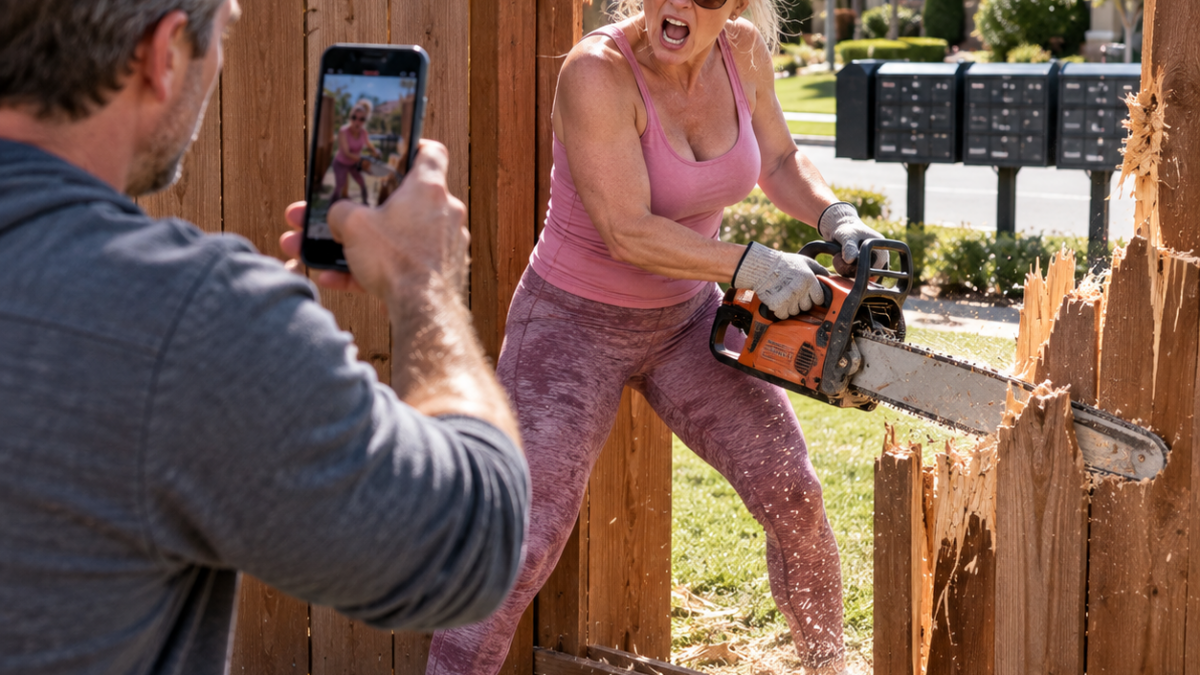
Holding a battery-powered chainsaw against my cedar fence.
For two full seconds, my brain refused the image.
Then the blade entered the first board.
I grabbed my phone.
Started recording before going outside.
“Karen.”
She kept cutting.
“Karen!”
She shut off the saw.
Looked at me.
“Morning.”
“What are you doing?”
“Creating temporary community access.”
I actually looked behind me as though another adult might appear and explain the prank.
“You’re cutting my fence.”
“Yes.”
“With a chainsaw.”
“I don’t see how the tool is relevant.”
That line remains one of my favorites.
I held the phone higher.
“You know I’m recording.”
“Please do.”
She started the saw again.
I stepped farther back.
Not because I feared her.
Because chainsaw.
She cut through another board.
Then another.
Four-foot opening.
Cedar panels dropped inward.
She had already removed two rails before I got outside.
Meaning she had been working before I heard her.
“You’re trespassing.”
“I am acting in my capacity as HOA president.”
“That doesn’t let you destroy private property.”
“The board authorized emergency access.”
“When?”
“Last night.”
“There was no noticed meeting.”
“Executive session.”
“Emergency access for what emergency?”
Karen shut off the chainsaw.
She removed her safety glasses.
“First responders need unobstructed routes.”
I looked at the sidewalk thirty feet away.
“First responders drive trucks.”
“Pedestrian evacuation.”
“Through my backyard?”
“This is exactly why communities need competent governance.”
I laughed.
Couldn’t help it.
That made her angry.
“Bill the HOA for the lumber if you’re emotional about it.”
“If I’m emotional?”
“Jake, don’t perform outrage.”
She gestured toward the opening.
“You’ve known this route needed restoration.”
“Restoration.”
“Yes.”
“You mean the shortcut from your house to the mailbox.”
“This isn’t about me.”
“Then who used it this morning?”
She didn’t answer.
At that moment Mrs. Henderson stepped onto her porch.
Then Carlos.
Then Mr. Patterson.
Chainsaws have a way of creating community engagement.
Karen saw them.
Straightened.
“Good morning.”
Mrs. Henderson stared at the destroyed fence.
“What did you do?”
Karen said:
“The board restored pedestrian access.”
Mrs. Henderson answered:
“No, honey.”
“You cut his fence.”
That sentence shifted the morning.
Not legally.
Socially.
Simple language often does.
Karen looked around.
“I will circulate an explanation.”
Carlos had his phone out too.
“I’d circulate fast.”
Karen picked up the cut boards and leaned them neatly against my shed.
That detail somehow made it more insane.
Then she walked through the opening.
Through my backyard.
Out my rear gate.
Toward the mailboxes.
I timed her.
Twenty-nine seconds.
When she returned by sidewalk, it took fifty-eight.
Her chainsaw shortcut saved twenty-nine seconds.
Twenty-nine.
I called police.
Officer Melanie Price arrived at 7:54.
Karen returned before the officer finished speaking to me.
Of course she did.
She had printed documents.
Karen always arrived with paper when she thought paper would substitute for permission.
Officer Price listened to both sides.
“Did you cut the fence?”
“Yes.”
Karen didn’t hesitate.
“Did Mr. Morrison give you permission?”
“The HOA authorized access.”
“That wasn’t my question.”
“No.”
Officer Price nodded.
“Does the HOA own this land?”
“It has access rights.”
“Recorded?”
“We’re researching.”
Officer Price looked at me.
“Survey?”
I handed her a copy.
She examined the pins shown.
Looked at the physical marker.
Then the fence.
“Fence is inside your boundary?”
“Two feet.”
Karen interrupted.
“Property ownership doesn’t override common rights.”
Price held up a hand.
“Ma’am.”
Karen stopped.
“Right now I’m asking about damaged property.”
She documented everything.
Photographs.
Video.
Statements.
Karen was not arrested.
I didn’t expect her to be.
Property disputes become civil quickly unless circumstances are unusually clear.
But Officer Price gave me an incident number.
Then she told Karen:
“Do not alter anything else until ownership and access are resolved.”
Karen smiled.
“Of course.”
Officer Price looked directly at the chainsaw.
“I mean anything.”
After they left, I called Tom Bell.
“The chainsaw happened.”
Silence.
Then:
“You’re joking.”
“No.”
“Did you film it?”
“Yes.”
“Good.”
“Can you come re-stake?”
“Tomorrow.”
“I also want every historic plat you can pull.”
That made him pause.
“What are you thinking?”
“I don’t know yet.”
“That’s not comforting.”
“No.”
“I want to understand why Karen is this confident.”
Tom came Wednesday.
He re-established the markers.
Fence remained two feet inside my property.
No recorded pedestrian easement.
He photographed the damage.
Then stood near the side line holding an old plat map.
He frowned.
“What?”
“Nothing.”
“That is the surveyor face for something.”
“There isn’t a surveyor face.”
“Yes there is.”
Tom kept studying the sheet.
“What is it?”
“Karen’s place.”
I looked across the neighborhood.
Her giant Mediterranean house sat behind manicured hedges.
“What about it?”
“Her rear improvements look farther east than I remember.”
“Her pool?”
“Pool, outdoor kitchen, addition.”
“So?”
Tom folded the plat.
“Probably nothing.”
I stared at him.
“Tom.”
He sighed.
“There were two subdivision plans.”
“Original preliminary plan from ninety-three.”
“Final recorded plat from ninety-five.”
“Developers move things.”
“Lot lines change.”
“Normal.”
“And?”
“Karen’s lot is one of the corner parcels beside Parcel C.”
“What is Parcel C?”
“Common green.”
I knew the little landscaped area behind her property.
Trees.
Drainage swale.
A walking path farther north.
HOA land.
Tom pointed.
“Final plat shifts her rear line roughly eighteen feet west from the preliminary plan.”
“Why?”
“Drainage redesign.”
I looked toward Karen’s yard.
“Where’s her fence?”
“Appears close to preliminary line.”
“Not final?”
“Appears.”
My heartbeat changed.
“How close?”
Tom looked at me.
“Jake.”
“How close?”
“I need records.”
“Meaning?”
“Don’t get excited.”
“I am unbelievably calm.”
“You’re smiling.”
“I smile under stress.”
He gave me the plat.
“Final boundary could run through some of her improvements.”
“What improvements?”
“Pool deck definitely.”
“Outdoor kitchen maybe.”
“And?”
Tom hesitated.
“Rear addition.”
I stared.
“House?”
“Addition attached to the house.”
I looked again.
Karen had added a two-story rear extension several years earlier.
Master suite upstairs.
Sunroom below.
Stone exterior matching the original structure.
Her real estate listings bragged about 4,800 square feet.
According to Zillow-type estimates, the home was worth around $650,000.
“You’re telling me her house might be on HOA land.”
“I’m telling you I need to verify records.”
“Tom.”
“Yes.”
“She chainsawed my fence because she says my property belongs partly to the community.”
“I see the irony.”
“That’s not irony.”
“What is it?”
“Christmas.”
Tom refused to let me celebrate.
Good surveyors are boring that way.
Over the next week, we pulled records.
County recorder.
Planning department.
Building permits.
HOA archives.
The history became stranger every hour.
Willowbrook’s developer had originally intended Karen’s lot—Lot 1—to extend farther east.
Then engineers discovered stormwater requirements near the corner.
Final plat created Common Parcel C.
Eighteen-foot shift.
Recorded correctly.
Deeds after 1995 referenced the final plat.
No ambiguity.
Karen bought Lot 1 in 2011.
Her deed referenced final plat.
In 2017, she applied for a major renovation.
Pool expansion.
Outdoor kitchen.
Two-story addition.
The permit site plan showed the preliminary 1993 line.
Not the recorded 1995 boundary.
Tom stared at the copy.
“That should not have passed.”
“Could someone make a mistake?”
“Yes.”
“All the time?”
“Not like this.”
The architectural drawing contained a notation:
BOUNDARY PER OWNER-PROVIDED SURVEY.
We requested the survey.
County didn’t have it.
HOA didn’t have it.
Karen’s permit packet listed a survey company.
Company had dissolved in 2019.
Tom knew the principal.
Retired.
We contacted him.
His answer arrived by email:
“Our office prepared a concept sketch based on dimensions supplied by the client. We were not retained to conduct a boundary survey and did not certify the drawing as a survey.”
Tom read it twice.
Then said:
“Oh.”
“What?”
“That is bad.”
“For Karen?”
“For whoever represented this as a survey.”
Who submitted it?
Marcus Delacro.
His name appeared as property owner representative.
Attorney.
Husband.
The same man who had lectured me about practicing property law from the internet.
I sat in my kitchen looking at the scanned application.
I should have felt victorious.
Instead I felt uneasy.
This was no longer an HOA argument.
If Tom was right, the Delacros had built a substantial addition, pool deck, stone wall, and outdoor kitchen over HOA common land using a drawing somebody had presented like a survey.
That could affect title.
Insurance.
Mortgage.
Future sale.
Board authority.
Potential liability.
And one more thing.
Common Parcel C belonged collectively to the HOA.
Which meant Karen, as president, had a fiduciary duty involving it.
She might have used HOA land for private construction while controlling the board responsible for protecting that land.
Tom ordered a certified boundary survey of Lot 1 and Parcel C.
I paid half.
He refused the other half.
“Professional curiosity.”
“That’s expensive curiosity.”
“I haven’t had this much fun since a guy built half a garage in a cemetery easement.”
I didn’t ask.
The survey took four days.
Tom called me at work.
“You sitting?”
“I’m on a ladder.”
“Get off.”
I climbed down.
“What?”
“Final plat controls.”
“Okay.”
“Her rear fence encroaches.”
“How much?”
“Maximum eighteen feet.”
“Pool?”
“About eleven feet onto common parcel.”
“Outdoor kitchen?”
“Entire rear counter and pergola.”
“Addition?”
Pause.
“Fourteen feet of the sunroom.”
I leaned against the wall.
“Upstairs?”
“Structure projects vertically.”
“So yes.”
“Her master-bedroom extension is over common land.”
“My God.”
“And one corner of the attached garage.”
“Anything else?”
“Part of her driveway turnaround.”
I started laughing.
Couldn’t stop.
My coworker stared at me.
Tom waited.
Finally:
“Jake.”
“Yes?”
“Do not post this.”
“I wasn’t going to.”
“Do not confront her.”
“I wasn’t going to.”
“Do not walk over there holding the survey and say Merry Christmas.”
That was exactly what I wanted to do.
“Fine.”
“Call an attorney.”
My divorce lawyer referred me to a property litigator named Rachel Kim.
Rachel was forty-six, compact, calm, and possessed the emotionally reassuring habit of becoming quieter whenever other people got louder.
She reviewed the fence video first.
Karen chainsawing.
Her “emergency community access” explanation.
Then my survey.
Then Karen’s.
Then plat history.
Then permit file.
Then HOA bylaws.
Rachel removed her glasses.
“How much do you dislike this woman?”
“Professionally or spiritually?”
“Jake.”
“A lot.”
“Good.”
“Why good?”
“Because I’m about to tell you something you will enjoy too much, and I need you not to act stupid.”
I sat straighter.
“Okay.”
“The fence issue is simple.”
“Private property damage.”
“Potential trespass.”
“Possibly board-action problems if she falsely represented authorization.”
“Fine.”
“The other issue is not simple.”
“Her house?”
“Her addition.”
She pointed at the recorded plat.
“If accurate, the HOA owns Parcel C.”
“Correct.”
“Karen is HOA president.”
“Yes.”
“Did the board approve transfer of this strip?”
“Nothing recorded.”
“Did membership vote?”
“Nothing.”
“Deed?”
“None.”
“Boundary-line agreement?”
“No.”
“Quitclaim?”
“No.”
“Then she doesn’t own it.”
I smiled.
Rachel pointed at me.
“That face.”
“What?”
“Stop enjoying.”
“Trying.”
“She may have equitable arguments.”
“Adverse possession?”
“Possibly.”
“Boundary by acquiescence.”
“Estoppel.”
“Mistaken improvement.”
“Various statutory remedies.”
“Facts matter.”
“Time matters.”
“HOA structure matters.”
“Her role matters.”
“So she doesn’t automatically lose her house.”
“No.”
I tried to hide disappointment.
Rachel almost smiled.
“However.”
There it was.
“If she knowingly used a false or misleading plan while serving on the board, that’s different.”
“Different how?”
“Fiduciary duty.”
“Fraud theories potentially.”
“Misrepresentation.”
“Self-dealing.”
“Title complications.”
“Insurance issues.”
“And if HOA money maintained those private improvements…”
I interrupted.
“Wait.”
Rachel looked up.
“HOA landscapers maintain her rear garden.”
“How do you know?”
“I’ve seen them.”
“Common garden?”
“No.”
“Inside her fence.”
Rachel became very still.
“How long?”
“Mrs. Henderson would know.”
Mrs. Henderson knew.
Oh, did she know.
Karen had used HOA landscaping crews to maintain the disputed strip for years.
Pruning roses.
Mulching.
Irrigation repairs.
Tree trimming.
Once, according to Carlos, an HOA snow-removal contractor repaired a section of Karen’s private paver driveway.
Karen had called it “common-access maintenance.”
Rachel asked for financial records.
As a homeowner, I had inspection rights under HOA rules and state law.
I submitted a formal request.
Karen denied it.
Reason:
“Harassing fishing expedition unrelated to legitimate homeowner concerns.”
Rachel sent the next request on letterhead.
Three days later, we received six years of incomplete records.
Incomplete became useful.
HOA had paid:
$14,600 in landscaping invoices coded to “Parcel C enhancement.”
$8,900 for irrigation.
$6,200 for “community hardscape repair.”
$4,100 in tree services.
Addresses on work orders matched Karen’s property.
One invoice literally said:
“Mrs. Delacro residence rear patio zone.”
Rachel stared.
“Wow.”
“Good wow?”
“Lawyer wow.”
“What does that mean?”
“It means somebody got lazy.”
The annual HOA meeting was three weeks away.
Rachel advised me not to launch public accusations before we knew more.
Karen made restraint difficult.
She sent me a demand letter.
Not from the HOA.
From Marcus’s law firm.
It accused me of:
Harassment.
Defamation.
Interference with board operations.
“Surreptitious surveillance.”
That last one referred to me filming Karen cutting my fence in broad daylight.
The letter demanded I:
Stop disputing the pedestrian access right.
Install a permanent gate at my expense.
Withdraw my police complaint.
Remove “unauthorized video recordings.”
Pay $1,750 in HOA legal expenses.
I read it in Rachel’s office.
“Can they do that?”
Rachel smiled.
“Send a scary letter?”
“Yes.”
“Make any of it true?”
“Different question.”
“What do we do?”
She slid the paper into a folder.
“Nothing today.”
“That’s unsatisfying.”
“Litigation is mostly delayed satisfaction.”
Then she asked:
“Do you have daughters?”
“Twins.”
“How old?”
“Eight.”
“Fence for them?”
“Yes.”
She nodded.
“Then let Karen keep explaining publicly why she destroyed a safety fence around two children’s backyard.”
That was the first time I understood Rachel’s strategy.
Karen’s biggest weakness wasn’t the boundary.
It was Karen.
She could not tolerate a story she didn’t control.
The annual meeting began at 7:00 p.m. on a Thursday.
Forty-one of forty-seven households attended.
That alone should have terrified the board.
Normal attendance was twelve.
Word had spread about the chainsaw.
Not from me.
Neighborhoods don’t need press offices.
Carlos had seen it.
Mrs. Henderson had seen it.
Officer Price had arrived.
Karen had sent three emails defending herself.
Every email made attendance rise.
The meeting began with Karen seated at the front.
Marcus stood beside the side wall.
Rachel sat next to me.
Karen opened with normal business.
Budget.
Landscaping.
Snow contract.
Pool rules.
People waited.
Finally she reached:
“Lot 31 access dispute.”
Forty heads turned toward me.
Karen adjusted papers.
“Unfortunately, one homeowner has chosen to escalate a routine community-access correction into legal threats and personal attacks.”
Rachel touched my wrist under the table.
Stay seated.
I did.
Karen continued.
“The board has acted responsibly.”
Mr. Patterson raised his hand.
“Did the board authorize the chainsaw?”
Karen paused.
“The board authorized restoration of access.”
“When?”
“Executive session.”
Secretary Susan Blake looked suddenly uncomfortable.
Mr. Patterson asked:
“Was I notified?”
He wasn’t on the board.
Wrong question.
Then Lowell Chase, the vice president, spoke.
“I’d like to clarify something.”
Karen turned.
“Lowell?”
“I don’t remember a vote authorizing physical removal of the fence.”
Room changed.
Karen’s voice sharpened.
“We discussed it.”
“We discussed obtaining legal advice.”
“We discussed restoring access.”
“Not cutting boards.”
Treasurer Mona Ellis raised a hand from the table.
“I didn’t vote on a chainsaw.”
Someone laughed.
Karen’s face reddened.
Marcus stepped forward.
“This isn’t productive.”
Rachel whispered:
“He’s not board counsel.”
Then stood.
“Excuse me.”
Marcus looked over.
Rachel introduced herself.
“Rachel Kim, counsel for Jake Morrison.”
Silence.
Karen stared at me like I had brought artillery.
Rachel continued.
“I have one question for the board.”
“Has any recorded easement been identified over Lot 31?”
Lowell said:
“No.”
Karen interrupted.
“That’s under legal review.”
Rachel nodded.
“So no.”
Marcus said:
“Counsel, this is an HOA membership meeting, not a deposition.”
Rachel smiled.
“Then I won’t bill by the hour.”
Carlos choked on a laugh.
Karen tried returning to agenda.
Rachel sat.
Then Mrs. Henderson raised her hand.
“What about Karen’s backyard?”
Karen froze.
I did too.
We had not planned that.
Mrs. Henderson looked around.
“I’ve lived here longer than almost anyone.”
“When Parcel C was planted, it went farther west than Karen’s fence does now.”
Marcus’s posture changed.
Karen said:
“Diane, that’s unrelated.”
Mrs. Henderson replied:
“Seems related if we’re talking boundaries.”
Rachel looked at me.
I whispered:
“I told nobody.”
Karen banged the gavel.
Yes.
She owned a gavel.
“Out of order.”
Then Tom Bell stood at the back.
I hadn’t invited him either.
Apparently surveys are his entertainment.
“May I speak?”
Karen stared.
“Who are you?”
“Thomas Bell.”
“Licensed professional land surveyor.”
Now Marcus looked genuinely concerned.
Tom held up a certified sheet.
“I conducted the boundary survey for Lot 31.”
“And more recently, at the request of counsel, I verified the recorded boundary between Lot 1 and Common Parcel C.”
Nobody moved.
Karen’s face lost color.
Marcus said:
“This is inappropriate.”
Tom replied:
“Land lines usually are when buildings cross them.”
The room erupted.
Karen shouted:
“Enough!”
Too late.
Carlos said:
“What building?”
Somebody else:
“Whose building?”
Tom looked at Rachel.
Rachel stood.
This had not been her preferred timing.
But once truth is out, lawyers adapt.
She said:
“The certified survey indicates multiple private improvements from the Delacro property encroach substantially onto HOA-owned Common Parcel C.”
Murmurs.
Karen:
“That is false.”
Tom calmly:
“No.”
Marcus:
“We have a contrary survey.”
Tom looked at him.
“Please produce it.”
Marcus’s face tightened.
“We’re not litigating this here.”
Tom said:
“The 2017 document used with your permit is labeled concept sketch by the drafting company that prepared it.”
That landed hard.
Lowell looked toward Karen.
“What improvements?”
Rachel answered carefully.
“Pool deck.”
“Outdoor kitchen.”
“Fence.”
“Portions of the driveway turnaround.”
Pause.
“And part of the two-story rear addition.”
Silence.
Somebody whispered:
“Her house?”
Karen stood.
“This meeting is adjourned.”
Lowell said:
“No.”
Every head turned.
Karen stared at him.
“What?”
Lowell looked scared.
But he stayed seated.
“You can’t adjourn unilaterally while a motion is pending.”
“What motion?”
“I move for immediate independent legal review of Parcel C and suspension of the president’s authority concerning property matters involving Lot 1.”
Mona said:
“Second.”
Karen looked toward Marcus.
For the first time since I’d met her, she did not know what to say.
Membership voted.
Thirty-four in favor.
Four against.
Three abstained.
Karen was not removed as president that night.
But her authority over the dispute was suspended.
An independent HOA attorney was retained.
The financial review began Monday.
That was when the fence became irrelevant.
Almost.
I replaced the boards.
Not with a gate.
Solid cedar.
Same as before.
Emma and Sophie returned that weekend.
They saw the repaired section.
Sophie asked:
“What happened?”
“A neighbor broke it.”
“Why?”
“She thought she could.”
Emma frowned.
“Did she say sorry?”
“No.”
“Did she get in trouble?”
“Adults have different kinds of trouble.”
That answer satisfied neither twin.
We built the treehouse.
I needed something normal.
While I helped Emma hold a level, my phone filled with HOA emails.
Records review.
Attorney notices.
Insurance request.
County inquiries.
Karen had gone from president to subject.
The independent counsel, a woman named Janet Rowe, hired a forensic accountant.
That phrase sounded excessive.
Then the numbers came.
Over six years, approximately $63,000 in HOA expenditures had directly or indirectly benefited improvements within Karen’s fenced rear area.
Not all were necessarily improper.
Some work involved trees and drainage on actual common land.
But enough invoices were specific.
Private irrigation heads.
Paver sealing.
Pool-adjacent landscaping.
Outdoor kitchen electrical trench restoration.
I read that one three times.
As an electrician, it offended me personally.
HOA dues had paid to restore landscaping after trenching for Karen’s outdoor kitchen.
The accountant also found legal invoices.
Delacro & Associates had billed Willowbrook HOA approximately $41,000 over four years.
Marcus’s firm.
No competitive bidding record.
No conflict disclosure in several annual meeting minutes.
Karen had signed some approvals herself.
Marcus’s firm had drafted violation letters against residents.
Including mine.
That changed Marcus’s role from annoying husband to conflicted vendor.
Then the county permit department opened its own review.
The 2017 addition permit relied on the concept sketch.
A planning technician had stamped it.
That employee had retired.
Nobody suggested bribery.
No evidence supported it.
But the permit was defective because the site plan did not match the recorded plat.
Karen’s title insurer received notice.
Then the mortgage lender.
Then her homeowners insurer.
The $650,000 house became less of a castle and more of a folder.
Karen responded the only way she knew.
Aggressively.
She sued.
Not the HOA initially.
Me.
Defamation.
Intentional interference with contractual relations.
Abuse of process.
Emotional distress.
Rachel handed me the complaint.
“Don’t panic.”
“She says I intentionally spread false boundary claims.”
“Did you?”
“No.”
“Good.”
“She says I organized neighbors against her.”
“Did you?”
“No.”
“I barely organize my daughters.”
Rachel nodded.
“She says the survey is malicious.”
“Surveys don’t have emotions.”
“I like that.”
“Can we use it?”
“Probably not.”
The lawsuit made Karen’s situation worse.
Discovery works both ways.
If she claimed the survey false, her title documents became relevant.
If she claimed damages to her real estate business, business records became relevant.
If she claimed emotional distress from public accusations, communications discussing the controversy became relevant.
Marcus should have known that.
I think he did.
But sometimes lawyers cannot control spouses any better than anyone else can.
Karen insisted.
During discovery, Rachel requested HOA-related messages between Karen and Marcus.
They objected broadly.
Court compelled relevant non-privileged communications.
That was how we got the email.
Sent three months before my fence went up.
Karen to Marcus:
“New guy at 31 is putting up a fence. If he closes my cut-through I’ll have to walk all the way around like everyone else.”
Marcus replied:
“Then walk around.”
Karen:
“Not happening.”
Marcus:
“K, don’t turn this into another covenant war.”
Karen:
“I run the board. I’ll make him put in a gate.”
I read it.
Then again.
“Emergency community access.”
Rachel nodded.
“Apparently emergency meant Karen doesn’t want to walk.”
Another email from after I refused:
“Find me something in the old plat language.”
Marcus:
“There is no recorded pedestrian easement that I can see.”
Karen:
“There has to be something.”
Marcus:
“Don’t create facts.”
That was the moment her lawsuit died emotionally, if not procedurally.
Her own husband had told her.
No easement.
Before the chainsaw.
Karen knew.
Then another message:
Karen:
“If he keeps pushing I’ll fine him until he gives up. Everybody gives up eventually.”
I stopped reading.
That sentence bothered me more than the chainsaw.
Everybody gives up eventually.
How many neighbors had?
The answer came slowly.
Mrs. Henderson had paid $600 years earlier over a garden border dispute she probably would have won.
Carlos had removed a basketball hoop after Karen threatened daily fines even though the covenants didn’t prohibit it.
Mr. Patterson had repainted his front door because Karen declared navy blue “insufficiently harmonious.”
Renee Walsh had cut down a mature maple after being told it interfered with “community sightlines.”
Nobody fought because fighting cost time.
Money.
Energy.
Karen did not need to be right.
She only needed to be more exhausting than everyone else.
I understood that because divorce had taught me something similar.
Sometimes people surrender not because the other side is correct.
They surrender because peace becomes more valuable than fairness.
Karen had built six years of power from that calculation.
My fence was the first thing she cut that produced visible debris.
But metaphorically she’d been chainsawing boundaries for years.
The board scheduled a special removal meeting.
Karen attended.
Marcus did not.
This time there were no yoga clothes.
Navy suit.
Pearls.
Folder.
She spoke for forty minutes.
Called the investigation a “mob campaign.”
Said newcomers had destroyed community trust.
Claimed women in leadership were held to impossible standards.
That last point might have deserved discussion in another situation.
Here, Mrs. Henderson leaned toward me and whispered:
“She cut your fence with a chainsaw.”
I nearly lost composure.
Karen insisted Parcel C had been treated as part of her property for years.
That was true.
Because she had fenced it in.
Maintained it partly using HOA money.
Built on it.
And apparently nobody checked.
She claimed the HOA had effectively consented.
Independent counsel disagreed that Karen, while serving as president, could rely comfortably on the board’s silence when she herself controlled much of what the board knew.
Then the membership voted.
Thirty-nine households participated.
Thirty-six supported removal.
Karen was removed as president.
Lowell became interim president.
His first act was abolishing the gavel.
The room applauded.
I went home.
Thought I would feel victorious.
Instead I sat alone in the quiet house and stared at the treehouse through the window.
Winning fights is strange.
The fantasy involves music.
Justice.
Vindication.
In reality, it often feels like exhaustion with paperwork nearby.
My daughters called.
Their mother put them on speaker.
“Did the mean fence lady say sorry?” Sophie asked.
“No.”
Emma said:
“Then you didn’t win yet.”
Children have unreasonable standards.
“What counts as winning?”
“She says sorry.”
I smiled.
“Then maybe I never win.”
Emma thought.
“Did she stop cutting your fence?”
“Yes.”
“Okay.”
“Half win.”
Fair.
Karen’s removal did not resolve the property issue.
Parcel C still held part of her home.
The HOA faced choices.
Force removal.
Sell land.
Lease it.
Negotiate boundary adjustment.
Litigate.
All unpleasant.
The independent attorney recommended mediation.
Karen refused initially.
Then the lender got involved.
A title defect attached to a $650,000 home motivates cooperation in ways neighborly requests do not.
Her refinance application had been pending before the dispute.
Frozen.
Potential sale?
Impossible without disclosure.
Insurance questioned whether the addition complied with permit conditions.
County issued a notice requiring boundary resolution or corrective permitting.
Not demolition.
Yet.
But Karen finally came to mediation.
So did Marcus.
I attended only because my fence claim had become intertwined with her lawsuit and the HOA dispute.
Rachel sat beside me.
Across the table:
Karen.
Marcus.
Their attorney.
HOA counsel.
Mediator.
Stacks of paper.
Karen looked tired.
I almost felt sorry for her.
Almost.
Mediation lasted eight hours.
The ultimate solution was practical rather than cinematic.
The HOA agreed it would consider selling Karen a portion of Parcel C sufficient to legalize most of the existing structural encroachment.
But not for free.
Independent appraisal.
Market value.
Survey costs.
Legal costs.
Replatting.
Drainage easements.
Permit correction.
Member approval.
Karen would also have to remove certain improvements from the remaining common drainage zone.
Specifically:
Part of her rear fence.
One pergola section.
Several landscaping features.
And a stone wall.
The pool itself could remain if she purchased the relevant land and completed engineering review.
Her addition could likely be legalized after lot-line adjustment.
So no bulldozer crashing through a mansion.
Reality is usually less theatrical.
But the cost was substantial.
Land purchase.
Fees.
Engineering.
Legal expenses.
Restitution to HOA for improperly allocated maintenance.
Her personal total ultimately exceeded $110,000.
Her home value remained high.
But she paid dearly to legalize land she had treated as hers.
The HOA recovered money.
More importantly, the agreement contained something Karen despised.
A written acknowledgment.
Not an apology exactly.
Lawyers fear that word.
But close.
It stated that no pedestrian easement had existed across Lot 31, that the HOA had not properly authorized destruction of my fence, and that Karen’s action had been taken without legal authority.
My fence repairs were reimbursed.
My legal expenses were substantially covered.
The HOA rescinded every violation notice.
Karen dismissed her lawsuit with prejudice.
I dismissed my property-damage claim after reimbursement and settlement.
Then Rachel pushed one final term.
Non-retaliation protections for residents who participated in HOA governance.
Karen’s lawyer said:
“Mrs. Delacro is no longer president.”
Rachel answered:
“Exactly.”
The final HOA reforms mattered more than my check.
Open board meetings except narrow legal exceptions.
Recorded votes.
Conflict disclosures.
Competitive bidding above a threshold.
Resident access to financial records.
No fines without citation to a specific covenant provision.
Appeal process.
Independent management company.
No board member’s immediate-family business could receive paid work without disclosed competitive review.
Carlos called it the “Karen Constitution.”
We did not use that name officially.
At the first meeting under the new rules, forty people attended.
Six months later, eleven attended.
That was how I knew things were healing.
Healthy HOA meetings are boring.
Lowell remained president only one year.
Then begged someone else to take it.
Mrs. Henderson became secretary.
Carlos joined the architectural committee.
Mr. Patterson volunteered for landscaping because he had opinions about mulch that apparently required a formal outlet.
I refused every nomination.
Absolutely not.
My contribution to democracy had limits.
Karen and Marcus stayed in Willowbrook.
That surprised everyone.
Maybe selling was complicated.
Maybe pride.
Maybe they actually liked the house.
For months, Karen avoided me.
If we passed on the sidewalk, she looked away.
Her Escalade’s HOAQUEEN plate disappeared.
Normal plate.
That felt symbolic.
She also stopped walking to the mailbox through my yard.
Obviously.
Because fence.
One afternoon almost a year after the chainsaw, I was replacing a loose board near the repaired section.
Emma and Sophie were ten by then.
Technically nine and a half, but apparently that distinction mattered.
They were painting signs for the treehouse.
One said:
NO BOYS.
The other said:
DAD ALLOWED IF SNACKS.
I heard footsteps.
Karen stood on the sidewalk outside the fence.
No designer yoga clothes.
Jeans.
Sweater.
She looked older.
Not dramatically.
Just less armored.
I waited.
She said:
“Jake.”
“Karen.”
Silence.
My daughters noticed.
Everything children aren’t supposed to hear becomes immediately fascinating.
Karen looked toward them.
Then at the fence.
“I owe you an apology.”
I almost dropped the screwdriver.
Emma’s head appeared over the treehouse railing.
Sophie beside her.
This was apparently going to have an audience.
Karen continued.
“I should never have cut your fence.”
I said nothing.
She swallowed.
“I knew there wasn’t a recorded easement.”
That mattered.
More than anything else.
“And I did it because I was angry you wouldn’t give me what I wanted.”
No legal language.
No community access.
No emergency route.
Just truth.
She looked at the cedar boards.
“I had gotten used to people saying yes.”
I leaned against the fence.
“Why now?”
She almost smiled.
“My therapist asked the same thing.”
I did not expect that.
Karen continued.
“Marcus and I separated.”
That I also didn’t expect.
“I’m sorry.”
She shrugged.
“Some things were already broken.”
I understood that sentence.
Too well.
She glanced toward my daughters.
“I spent a lot of years believing being in charge meant never letting anyone tell me no.”
She breathed.
“I was wrong.”
Emma called from the treehouse:
“Are you the chainsaw lady?”
I closed my eyes.
“Emma.”
“What?”
Karen looked up.
For one horrible second, I expected old Karen.
Instead she laughed.
Actually laughed.
“Yes.”
Emma considered.
“That was bad.”
“Yes.”
“Did you pay Dad?”
“Yes.”
“Okay.”
Sophie shouted:
“Did you lose your house?”
“Girls.”
Karen smiled faintly.
“No.”
Sophie looked disappointed.
I wanted to disappear.
Karen said:
“I almost lost part of it.”
That satisfied them.
They returned to painting.
Children dispense justice efficiently.
Karen looked at me again.
“I’m sorry.”
This time no qualifications.
I nodded.
“Thank you.”
We did not become friends.
Important.
Forgiveness does not require brunch.
But after that, we could wave.
She sold the house two years later.
Before listing, every lot-line issue had been resolved.
The official lot was larger after purchase from the HOA.
Disclosures clean.
Permits corrected.
Pool legal.
Addition legal.
New owners paid $702,000.
Karen moved downtown.
Condo.
No yard.
I heard from Mrs. Henderson that the condo association had no elected board because management handled everything.
Probably wise.
Marcus moved elsewhere.
I never learned much.
My life became boring again.
Beautifully boring.
Emma and Sophie grew.
The treehouse survived five years before they stopped using it.
Then it became storage.
I refused to take it down.
Divorced dads become sentimental about lumber.
Their mother and I got better too.
Not back together.
Better.
There is a difference.
We learned birthdays.
School events.
Driving schedules.
We stopped interpreting every inconvenience as an accusation.
By twelve, the twins could joke about having “Mom’s house” and “Dad’s house” without looking guilty.
That mattered more to me than any HOA victory.
One evening, Sophie asked why I still had the cut boards from the fence.
I had saved two.
They leaned behind my workshop.
Chainsaw marks visible.
“Why keep these?”
I thought.
“Reminder.”
“Of Karen?”
“Not exactly.”
“Then what?”
I ran a hand over the rough cedar.
“Boundaries.”
She rolled her eyes.
“You’re making it philosophical.”
“Dad privilege.”
Emma came over.
“Like property boundaries?”
“Those too.”
“What other kind?”
I sat on the workbench.
“When your mom and I divorced, I thought starting over meant getting good at keeping people out.”
The girls became quieter.
“Turns out that’s only half of it.”
Sophie asked:
“What’s the other half?”
“Knowing who gets a gate.”
Emma looked at the solid fence.
“But you didn’t build a gate there.”
“Exactly.”
They both groaned.
I laughed.
But I meant it.
Karen’s mistake wasn’t just crossing a property line.
We all cross boundaries accidentally sometimes.
Social.
Emotional.
Practical.
We misunderstand.
We assume.
We apologize.
Correct.
The dangerous part was deciding that another person’s no did not count.
She didn’t believe my boundary because it inconvenienced her.
So she called it communal.
Emergency.
Historic.
Necessary.
Then she physically cut through it.
People do versions of that everywhere.
At work.
In families.
Relationships.
Neighborhoods.
They rename what they want until taking it feels justified.
Concern.
Tradition.
Access.
Authority.
Love.
Duty.
Community.
Sometimes the word is true.
Sometimes it is a chainsaw wearing a name tag.
The survey mattered because lines drawn before either Karen or I arrived did not care who had the louder voice.
Her title didn’t move the pin.
Her presidency didn’t shift the plat.
Her husband’s law degree couldn’t transform a preliminary concept into a recorded boundary.
Facts can be ignored.
They cannot always be negotiated.
That lesson helped me outside Willowbrook too.
During my divorce, I had spent years second-guessing myself.
Was I too sensitive?
Too distant?
Too demanding?
Was the problem real or was I making it bigger?
My ex-wife probably asked herself the same questions.
We had both become experts at arguing over whose interpretation of the marriage counted.
Property lines were easier.
Brass pin.
Coordinate.
Recorded plat.
There.
Human boundaries need more courage because no surveyor marks them.
You have to say:
This hurts.
This is mine.
Don’t speak to me that way.
I need time.
No.
And sometimes people react like Karen did.
They tell you your boundary is inconvenient.
Selfish.
Unfair.
Not how the community has always operated.
Then you discover whether you actually meant it.
Three years after the chainsaw incident, I attended one HOA meeting.
Just one.
Lowell had moved.
Carlos was president temporarily.
He hated it.
The agenda included replacing several mailboxes.
I laughed when I saw it.
Same mailbox cluster.
The source of suburban warfare.
The HOA planned to relocate them twenty yards south during road resurfacing.
Estimated walking impact:
For my old route, shorter.
For Karen’s former house, roughly thirty seconds longer.
I raised my hand.
Carlos saw me.
“Don’t.”
The room laughed.
I said:
“I have a chainsaw if necessary.”
Mrs. Henderson nearly choked.
That was the last time the incident felt painful.
Once you can joke without needing someone diminished, you know a wound is mostly closed.
The mailbox relocation passed unanimously.
Nobody invaded anything.
Progress.
People sometimes ask whether the boundary discovery was luck.
Yes.
Completely.
If Karen hadn’t cut my fence, I probably never would have investigated old plats.
Tom never would have compared preliminary and final subdivision drawings.
No one would have re-surveyed Parcel C.
Karen might have continued living for years with part of her house over HOA land.
Maybe indefinitely.
She created the investigation that exposed her own problem.
That is the part people enjoy most.
Woman destroys neighbor’s fence.
Boundary records expose her house.
Perfect reversal.
But the satisfying headline hides the less cinematic truth.
The survey didn’t punish her.
Her own habits did.
If she’d asked politely for a gate and accepted no, nothing happened.
If she’d challenged the fence through legitimate process, nothing happened.
If she’d lost and walked thirty extra seconds, nothing happened.
If she’d never used HOA money on private improvements, the later dispute would have been easier.
If she’d disclosed her conflict.
If she’d kept accurate records.
If she’d listened when Marcus wrote, “There is no recorded pedestrian easement.”
Any one of those choices might have prevented disaster.
Instead, confidence stacked on confidence until she believed authority itself changed facts.
It doesn’t.
That was Karen’s real boundary problem.
Not knowing where the lines were.
Believing she could decide.
I kept my original property survey in a fireproof box after that.
Along with divorce papers.
Birth certificates.
Insurance.
The boring documents people never value until somebody says something different happened.
Tom retired two years later.
At his retirement party, I gave him a small cedar plaque.
I had made it from one of the chainsawed boards.
Engraved on it:
THE PLAT DOES NOT CARE ABOUT YOUR FEELINGS.
He laughed for almost a minute.
His wife put it in his home office.
Rachel got one too.
Hers said:
LITIGATION IS MOSTLY DELAYED SATISFACTION.
She claimed she’d never said that.
She absolutely had.
Mrs. Henderson asked for nothing.
So my daughters made her a birdhouse.
One side said:
DIANE’S HOUSE.
The other:
NO HOA APPROVAL REQUIRED.
She displayed it in her garden until she moved to assisted living.
Carlos still sends me a photo occasionally.
He bought her house when her family sold it.
The birdhouse remains.
Small things remain.
That’s what I learned.
Not just surveys.
Not lawsuits.
Not dramatic reversals.
A fence board.
A treehouse.
A birdhouse.
A handwritten apology.
Kids remembering who showed up.
My daughters do not remember the legal details.
They don’t know what adverse possession means.
They couldn’t explain fiduciary duty if their lives depended on it.
What they remember is that somebody broke the fence their dad built.
Their dad fixed it.
The yard stayed safe.
And eventually the woman apologized.
Maybe that’s enough.
One afternoon when Emma was fourteen, she came home furious because a friend kept reading her private messages after being told not to.
“She says if I have nothing to hide, why do I care?”
I put down the drill I was holding.
“Ah.”
“What?”
“Fence problem.”
She stared.
“Dad.”
“Same principle.”
“This is not about a literal fence.”
“Best fences aren’t.”
She rolled her eyes.
But she listened.
“You don’t owe somebody access just because they want it.”
“To your phone.”
“Room.”
“Time.”
“Body.”
“Property.”
“Whatever.”
“If the boundary is reasonable, you don’t need them to agree before it counts.”
Emma became quiet.
Then:
“What if they say I’m being dramatic?”
I thought about Karen standing in cedar chips telling me to bill the HOA if I felt emotional.
“People who benefit from you having no boundary are often the first to call the boundary dramatic.”
Emma looked at me.
“That’s annoyingly good.”
“I’ve been saving it.”
“From the fence lady?”
“Among others.”
She smiled.
Then disappeared upstairs.
That conversation was worth more than the settlement.
Years later, I sold the Willowbrook house.
The girls were nearly grown.
College approaching.
I had met someone.
Not a dramatic romance.
A good one.
The kind where silence did not feel like punishment.
Her name was Beth.
She had one son.
We bought a smaller place together outside town.
Before listing Willowbrook, the real estate agent walked through the backyard.
“Nice fence.”
I laughed.
“What?”
“Nothing.”
“Any issues I should disclose?”
“Property boundary?”
She asked casually.
I handed her the survey.
She looked impressed.
“This is extremely thorough.”
“You have no idea.”
The listing photos showed the cedar fence.
The treehouse.
Raised beds.
Workshop.
Nobody looking at those pictures knew what had happened there.
Good.
A home should eventually outgrow its conflicts.
At closing, the buyers were a couple in their early thirties with a four-year-old boy and another baby coming.
The father asked:
“Did you build the fence?”
“I did.”
“Solid.”
“Overbuilt.”
“That’s good.”
His little boy pressed both hands against the glass door and stared at the treehouse.
“Can that stay?”
I looked at the girls.
Emma smiled.
Sophie nodded.
“Absolutely.”
After closing, I drove past once.
Only once.
The new owners had hung a little plastic swing beneath the treehouse.
A blue bicycle lay near the fence.
The repaired boards were indistinguishable from the rest now.
Weather had blended the cedar.
You could not tell where Karen cut.
That felt right.
For a long time, I thought scars were evidence.
Proof something happened.
Then sometimes healing does the opposite.
It makes the repair look ordinary enough that nobody has to know.
I still had photographs.
The video.
The survey.
The old board in my garage.
I didn’t need the house to keep the story.
And if you want the cleanest version, the one people like to repeat, it goes like this:
An HOA president hated walking thirty extra seconds to the neighborhood mailboxes.
She demanded a gate through her new neighbor’s private backyard.
He refused.
She fined him.
He produced a survey.
She couldn’t produce an easement.
So one Tuesday morning she brought a chainsaw.
She cut four feet out of his cedar fence while he recorded her.
Then she told him she’d created “emergency community access.”
He called police.
His surveyor returned.
While reviewing historical plats, the surveyor noticed something strange about her own property.
The final subdivision plat did not match the old preliminary drawing used when she expanded her home.
A new survey followed.
The woman who had cut through someone else’s fence because she claimed community rights over his private land discovered that her pool deck, outdoor kitchen, fencing, and part of a two-story addition to her $650,000 house were sitting on land belonging to the community.
Then people looked deeper.
HOA money.
Maintenance invoices.
Conflict-of-interest issues.
Missing disclosures.
Her husband’s law firm.
Her emails admitting no recorded easement existed.
The neighborhood that had spent years believing resistance was more trouble than surrender finally stopped surrendering.
She lost the presidency.
Paid to repair the fence.
Dismissed her lawsuit.
Reimbursed money.
Bought the land she had been using.
Corrected the permits.
And eventually apologized.
That’s the viral version.
It’s true.
But here’s the version I prefer.
A forty-two-year-old divorced father bought a small house because his daughters needed somewhere that felt permanent.
He built them a fence.
Somebody decided his boundary was less important than her convenience.
He said no.
She refused to hear it.
So he kept the paperwork.
Kept the video.
Called people who knew more than he did.
Didn’t destroy anything back.
Didn’t cut her fence.
Didn’t threaten her.
Didn’t try to ruin her house.
He simply made the line visible.
Then waited while the truth did what truth sometimes does when enough people finally agree to look at it.
It held.








