HOA Karen Called Three Police Cruisers to Tear Down My Family’s Farm Gate and Demanded My Arrest—Then I Pulled a Gold Badge From My Pocket.
HOA Karen Called Three Police Cruisers to Tear Down My Family’s Farm Gate and Demanded My Arrest—Then I Pulled a Gold Badge From My Pocket.
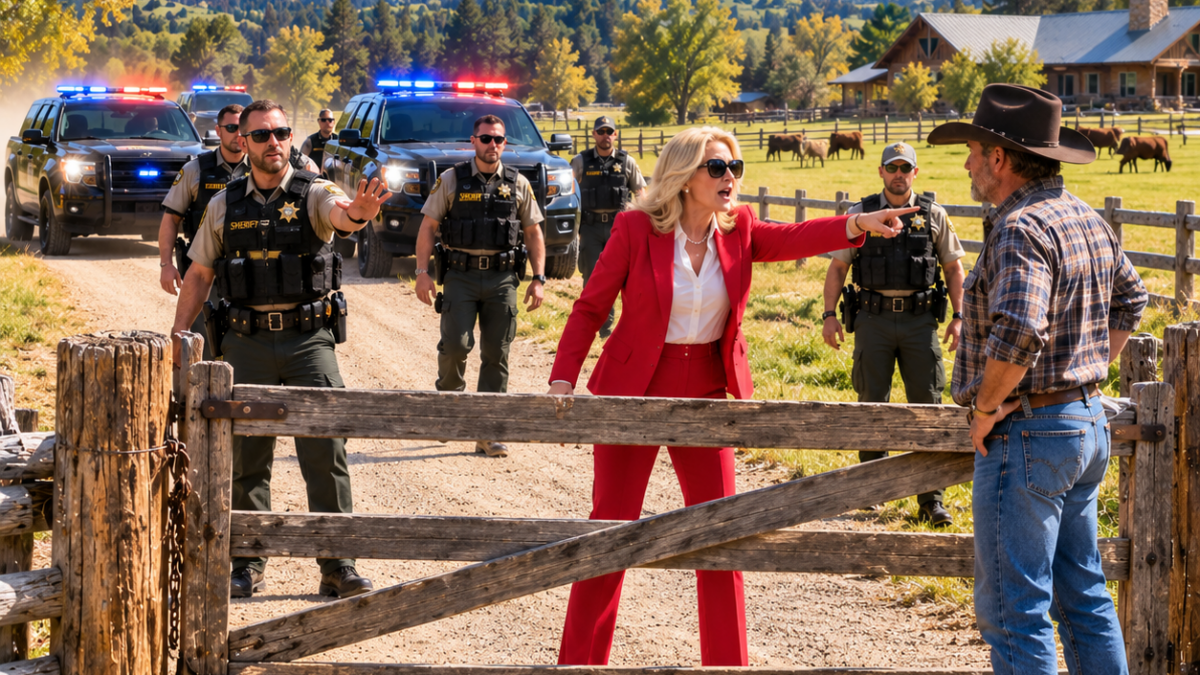
Three police cruisers came roaring down my private dirt road because an HOA president had ordered them to dismantle the wooden farm gate my family had owned for generations.
She stood beside the cruisers pointing at me and demanding my arrest, completely unaware that every deputy stepping out of those cars worked for me.
When I pulled the gold sheriff’s badge from my pocket, the look on her face told me she finally understood she had dragged the law into a fight she never had the authority to start.
My name is John Whitaker.
For more than twenty years, I had lived on the same patch of land my father raised me on, a quiet spread of pasture, cedar, old fencing, and hard red dirt several miles outside town.
The Whitaker place was not fancy.
It was not one of those polished hobby farms people bought after watching too many television shows about country living. It was a real working property, the kind that had mud by the porch when it rained and dust on every truck by the end of August.
The farmhouse had been built by my father in the 1970s.
One section of the barn was older than that.
An oak tree beside the house had stood there longer than anyone in my family could remember.
And at the entrance to the road sat an old wooden gate.
My grandfather had rebuilt that gate twice.
My father rebuilt it once.
I had replaced hinges, boards, bolts, and posts over the years, but the shape had always remained the same.
Two heavy wooden sections.
Iron hinges.
A thick center latch.
Nothing decorative.
Nothing modern.
Just strong.
My grandfather used to stand beside it when I was a boy and say, “As long as that gate swings, this family stands.”
I used to think that was just something old men said to make ordinary things sound important.
By the time Karen Whitmore entered my life, I understood exactly what he meant.
Most mornings on the ranch were predictable.
Coffee before sunrise.
Feed the horses.
Check the barn.
Walk the fence line.
Find whatever had broken overnight.
Then drive into town.
Most of the county knew me as Sheriff Whitaker.
I had worn that badge long enough that I did not need to announce it. People saw the truck, the walk, the hat, the face, and they knew. They waved in grocery store aisles. They stopped me outside church. They caught me at gas pumps to ask about trespassing issues, loose cattle, stolen trailers, bad neighbors, custody exchanges, suspicious cars, and every strange noise that ever happened after midnight.
I did not mind helping.
That was the job.
But on my own land, I preferred being John.
My wife, Sarah, preferred it too.
When I came home and hung my duty belt in the mudroom, I was no longer the man responsible for deputies, warrants, traffic crashes, domestic disputes, missing livestock, and every other problem people expected the sheriff’s office to fix.
I was a husband.
A farmer.
A man who liked silence.
For most of my life, the land around us had been pasture.
Then a development company arrived.
PART2:
The sales brochures called the project Maple Ridge Estates.
The name suggested rolling hills, tall maples, and elegant homes tucked into the countryside.
What appeared instead were rows of nearly identical houses, fresh asphalt, decorative stone entrances, matching mailboxes, perfect lawns, and people who suddenly had very strong opinions about what color other people’s trash cans should be.
With the development came a homeowners association.
At first, I did not care.
Their property was theirs.
Mine was mine.
If a group of homeowners wanted to argue about grass height, mailbox paint, patio furniture, and whether beige counted as “warm neutral” or “visual disruption,” that was their business.
Sarah and I even attended their opening neighborhood barbecue.
That was where I first met Karen Whitmore.
She was in her early fifties, perfectly dressed, with sharp cheekbones, expensive sunglasses, and the posture of someone permanently waiting to speak to a manager. She had blonde hair cut in a smooth bob that did not appear to move in wind. She wore a pale pink blazer and introduced herself as president of the Maple Ridge Estates Homeowners Association.
She said “president” with enough weight that you might have thought she had just taken a federal oath.
I shook her hand.
“John Whitaker.”
“Oh, yes,” she said. “The farm.”
The farm.
Not your farm.
Not Whitaker Ranch.
The farm.
I noticed it but did not think much of it.
She handed me a slice of lemon meringue pie.
I ate it.
It was actually pretty good.
PART3:
For the first month, Maple Ridge barely affected us.
Then stories started drifting over from residents.
One family got fined because their trash cans remained visible too long after collection.
Another homeowner received a warning because his mailbox was supposedly too rustic.
A woman down the street was told the decorative bench on her porch violated community harmony standards.
Sarah heard most of it through neighbors and Facebook threads.
One night, she sat across from me at the kitchen table, scrolling through her phone and laughing.
“Listen to this. Karen wants somebody to repaint a birdhouse.”
“What’s wrong with the birdhouse?”
“It’s red.”
“Criminal.”
“Apparently.”
I shook my head.
“As long as she stays on her side of the fence, we’ll be fine.”
Sarah looked up from her phone.
“You’re going to regret saying that.”
She was right.
A few weeks later, I was repairing the front gate after a storm had split one of the support posts. The morning was warm, and I had already been outside for several hours. I had one hinge loosened when I heard tires on gravel.
A silver SUV stopped near the gate.
The driver’s window slid down.
Karen.
“Good morning, Mr. Whitaker.”
“Morning.”
She did not get out.
Instead, she looked slowly at the gate.
“We’ve received several complaints.”
“About what?”
“This.”
She gestured toward the gate.
I looked at it.
Then at her.
“My gate?”
“Yes.”
I leaned one elbow on the post.
“What did it do?”
She did not appreciate the joke.
“The HOA has concerns regarding its location.”
“Does it?”
“It appears to be positioned on land associated with the Maple Ridge access road.”
I stared at her for a second.
“No.”
She blinked.
“No?”
“No.”
“The HOA maps indicate this road may fall within the community access corridor.”
“It doesn’t.”
“You seem very certain.”
“I own it.”
Karen tightened her lips.
“Our bylaws require access structures to be set back a minimum distance from communal roadways.”
“Then I’d recommend applying that rule to a communal roadway.”
“This road serves Maple Ridge.”
“This road serves my barn.”
Her expression changed slightly.
“Residents use it.”
“Without permission.”
“Which suggests it’s part of the community.”
“No, Karen. It suggests people are driving somewhere they don’t belong.”
She looked at me as if I were being intentionally difficult.
“You’re going to need to move the gate approximately twenty feet.”
I laughed.
I honestly could not help it.
That made things worse.
Her eyes narrowed.
“Something funny?”
“This gate has been here longer than Maple Ridge.”
“That doesn’t exempt it from current safety standards.”
“It doesn’t need an exemption. Your HOA doesn’t have jurisdiction here.”
She reached toward the passenger seat and picked up a thick binder.
“Our governing documents clearly state—”
I held up my hand.
“Karen.”
She stopped.
“You can read that binder until sunset. County land records still beat HOA rules.”
Her jaw tightened.
“If you refuse to cooperate, we’ll escalate.”
“Go ahead.”
She stared at me.
I went back to my hinge.
After a few seconds, she rolled up the window and drove away.
I thought that would be the end of it.
That was my first mistake.
Three days later, an official-looking envelope appeared in my mailbox.
Maple Ridge Estates HOA Compliance Division.
I opened it while standing on the porch.
Notice of Violation.
Gate obstruction.
Two hundred fifty dollar fine.
I showed Sarah.
She read it twice.
“They fined you?”
“Apparently.”
“For a gate on land that isn’t theirs?”
“Apparently.”
“What are you going to do?”
I folded the notice.
“Nothing.”
She gave me a look.
“Nothing?”
“I’m not paying it.”
“That’s not nothing.”
“Close enough.”
A few days later, another notice appeared.
This one had been attached directly to the fence.
I pulled it down, photographed it, and filed it in my office.
Then two men wearing reflective vests showed up near the property line.
They had measuring tape, clipboards, and phones.
I walked toward them.
“Can I help you?”
The older one gave me an uneasy smile.
“We’re conducting an inspection.”
“Who are you?”
“Safety compliance.”
“County?”
He hesitated.
“Community.”
I looked at the logo on his vest.
No county seal.
No department name.
Nothing.
“What are you inspecting?”
“Road access.”
“Whose road?”
“Maple Ridge.”
I pointed to the county marker a short distance behind them.
“That marker is the boundary. Everything on this side is Whitaker property.”
They looked at each other.
“Sir, we were told—”
“Then whoever told you was wrong.”
One of them began putting away his tape measure.
That was when Karen’s silver SUV appeared.
She parked aggressively enough to throw dust.
When she stepped out, she had a clipboard in one hand.
“Gentlemen, continue.”
Neither man moved.
I looked at her.
“Karen, who are these men?”
“Inspectors.”
“County inspectors?”
“They’re authorized.”
“By whom?”
“The HOA.”
I smiled.
“So not county.”
She crossed her arms.
“They’re qualified safety personnel.”
“That wasn’t my question.”
She turned to the men.
“Continue your measurements.”
I looked at them.
“Step onto my property again and you’re trespassing.”
Karen snapped her head toward me.
“You cannot threaten county workers.”
“They aren’t county workers.”
“You don’t know that.”
I almost laughed.
“I’d know.”
She stared at me.
“What does that mean?”
“Exactly what I said.”
One of the men quietly packed his equipment.
The other followed.
Karen’s face turned red.
“This will be handled through law enforcement.”
I folded my arms.
“Good idea.”
For one brief second, I considered telling her.
I could have taken out my badge.
I could have watched her expression collapse right there.
But I did not.
Because the problem had become bigger than one argument.
Karen was not merely confused about a property line.
She had already sent people onto my land.
She had issued a fake fine.
She was building an official-looking paper trail to create authority she did not possess.
I wanted to know how far she was willing to go.
So I let her leave.
That evening, Sarah found me sitting on the porch watching the road.
“You’re enjoying this.”
“No.”
She raised an eyebrow.
“A little.”
“Just tell her you’re sheriff.”
“I could.”
“Why don’t you?”
“Because then she stops because of the badge.”
“Isn’t that the point?”
“No.”
I took a sip of coffee.
“I want her to stop because she learns she doesn’t have authority here.”
Sarah shook her head.
“You’re playing with fire.”
“I’m documenting harassment.”
“That’s a very sheriff answer.”
“Married one.”
“Unfortunately.”
The next week became ridiculous.
HOA members drove past slowly, phones held toward my property.
A neighborhood newsletter referred to an “unauthorized obstruction near a community access point.”
Then Karen posted a picture of the gate on Facebook.
The caption called it a potential danger to emergency response.
Friends from town began calling me.
“John, what are you doing to those poor suburban people?”
“Guarding them from a wooden gate.”
“Sounds serious.”
“Very.”
Sarah told me to stop encouraging them.
I couldn’t.
Then Karen showed up while Sarah was watering the garden.
She brought a young man with another clipboard.
“We’ve reviewed the plats,” Karen announced.
I walked toward the fence.
“And?”
“The gate violates HOA access standards.”
“No.”
She exhaled sharply.
“You cannot simply keep saying no.”
“Sure I can.”
“The community has rights.”
“So do property owners.”
“Take a photograph,” she told her assistant.
He raised his phone.
I stepped closer.
“Karen.”
“What?”
“Touch that gate or enter my property without permission, and you’ll be explaining yourself to the sheriff’s department.”
She laughed.
“Please. Like you know the sheriff personally.”
I smiled.
“Closer than you think.”
She rolled her eyes.
That one still makes me smile.
The letters continued.
Then came a formal hearing notice.
It accused me of obstructing a communal road and endangering emergency vehicles.
The document included photographs of the gate with red circles and arrows.
Sarah spread the pages across our kitchen table.
“They’re making diagrams now.”
“I noticed.”
“They’ve circled the hinge.”
“Critical evidence.”
“This is harassment, John.”
That time, I did not joke.
“Yes.”
“What do we do?”
“We document everything.”
That night, I checked our security system.
One camera covered the driveway.
Another covered the gate.
I adjusted a third to capture the road and adjoining fence line.
Then I called Marcus Hale, one of my senior deputies and the man who handled many of the department’s property-related records.
“Marcus.”
“Sheriff.”
“I need the original plats for Whitaker Ranch and Maple Ridge Estates.”
He laughed immediately.
“Still fighting the HOA?”
“I’m not fighting anybody.”
“That’s not what Facebook says.”
“Facebook thinks my gate is a terrorist.”
“I’ll pull the maps.”
“Certified copies.”
“Planning something?”
“Planning to know exactly where every line is.”
“You know you could just tell Karen you’re sheriff.”
“Everybody keeps saying that.”
“Because it’s the obvious solution.”
“I don’t want the obvious solution.”
“You want the entertaining one.”
“Good night, Marcus.”
He was still laughing when I hung up.
Two mornings later, Karen returned with reinforcements.
Three HOA board members.
A man in a cheap gray suit.
He marched toward my gate holding a clipboard.
“Mr. Whitaker?”
“Yes.”
“I’m here regarding county code enforcement.”
I looked at him.
“County code enforcement?”
“Correct.”
“Identification?”
He paused.
Karen stepped in.
“This is unnecessary.”
“No. It’s actually very necessary.”
I looked back at him.
“Name?”
“Todd.”
“Last name?”
“Reynolds.”
“Department?”
Another pause.
“I’m contracted to perform preliminary compliance assessments.”
“For the county?”
“Through the HOA.”
I smiled.
“So you’re not county code enforcement.”
“I’m a certified consultant.”
“That’s different.”
Karen’s face flushed.
“He is qualified.”
“Qualified to what?”
“Assess the gate.”
“No.”
She stepped toward me.
“You are becoming hostile.”
“I’m standing on my property asking people to identify themselves.”
“This behavior could be reported.”
“To whom?”
“The county.”
I almost told her.
Again.
Almost.
Instead, I looked at Todd.
“Courtesy visit?”
“Yes.”
“Then courtesy visit is over.”
He did not argue.
Neither did the board members.
They retreated.
Karen remained.
“You can’t keep refusing inspections.”
“Watch me.”
“Eventually there will be consequences.”
“For somebody.”
She stared at me for several seconds before turning away.
That evening, I had a complete certified packet on my desk.
The original deed.
The private easement record from 1971.
The renewed filing from 2005.
The county parcel map.
The HOA boundary.
It ended well before my gate.
There was no ambiguity.
I placed everything in a folder.
I did not know then how useful that folder was going to become.
The next letter arrived by certified mail.
This one announced a mandatory removal date.
It specifically stated that police assistance might be requested.
I read that line twice.
Then I started laughing.
Sarah took the letter.
“You’re kidding.”
“No.”
“She’s actually calling police to remove the gate?”
“Looks like it.”
“You cannot let your own deputies drive out here without warning.”
“Why not?”
“Because they’re going to think you’ve lost your mind.”
“They already think that.”
She folded her arms.
“John.”
I smiled.
“I’ll make sure dispatch handles it like any other call.”
“You’re really going to let her do this?”
“Yes.”
She stared at me.
“Why?”
“Because she has been told the truth repeatedly. She’s now trying to turn a fake HOA order into a police action. That’s not misunderstanding anymore.”
Sarah sighed.
“You’re impossible.”
I checked the cameras again that evening.
Then I pressed my uniform shirt and jacket.
Not because I planned to intimidate Karen.
Because I had a feeling I might need them.
The next morning dawned clear and cool.
I was sitting on the porch with coffee when I heard engines.
Sarah came to the doorway.
“That her?”
I stood.
“Yep.”
First came the silver SUV.
Then three patrol cars.
The sight was almost surreal.
Three black-and-white cruisers rolling down the same private dirt road Karen claimed my gate was obstructing.
She parked first.
Before the cruisers had even stopped, she was out of her SUV.
Pink blazer.
Clipboard.
Sunglasses.
Full confidence.
She pointed toward the gate.
“There it is.”
A young deputy stepped out.
He looked at the gate.
Then at Karen.
Then at me.
“Ma’am, this appears to be private property.”
“Not legally,” she said quickly. “The HOA has determined it’s part of the community road.”
The deputy looked uncomfortable.
“We received a call regarding an access obstruction.”
“Correct. The gate needs to be removed.”
She said it as if she were ordering landscaping work.
I walked toward them.
The deputy turned.
“Sir, can we speak with you?”
“Of course.”
Behind him, Karen smiled.
I could hear her telling one of the board members who had followed her, “Finally.”
I stopped a few feet from the deputy.
He studied my face.
Then something changed in his expression.
Recognition.
I reached into my pocket anyway.
Pulled out my badge.
Held it where Karen could see.
The deputy straightened immediately.
“Sheriff Whitaker.”
Karen’s smile disappeared.
I looked at her.
“Morning.”
Her eyes moved from the badge to the deputy.
Then back to me.
“Wait.”
I tucked the badge against my belt.
“Yes?”
“You’re the sheriff?”
“Last time I checked.”
“You’re a farmer.”
“Also true.”
She blinked.
The other deputies had gotten out now.
One of them was Sergeant Miguel Gomez, who had worked with me for years.
I saw him bite the inside of his cheek to keep from smiling.
Karen pointed at me.
“This is a conflict of interest.”
“I haven’t done anything.”
“You’re standing here with officers who work for you.”
“You called them.”
The silence after that was beautiful.
Sarah leaned against the porch railing with her coffee.
Gomez stepped forward.
“Sheriff, dispatch received a report of an illegal obstruction on a community emergency route. Mrs. Whitmore stated she had authorization to remove the gate.”
I looked at Karen.
“County authorization?”
She tightened her grip on the clipboard.
“The HOA filed the appropriate documentation.”
“With the county?”
“With the committee.”
“What committee?”
“The Maple Ridge compliance committee.”
I nodded.
“That’s not county authorization.”
“The road serves the community.”
“Let’s solve this.”
I looked at Gomez.
“Pull the parcel map.”
He opened the county system on his tablet.
Karen watched him.
I watched Karen.
Gomez enlarged the property boundaries.
“Whitaker Ranch, Lot Forty-Two. Private easement recorded 1971. Updated 2005.”
He moved the screen.
“The Maple Ridge boundary ends approximately forty yards before the gate.”
Karen leaned toward the display.
“That can’t be right.”
Gomez looked at her.
“It’s county data.”
“The HOA maps are different.”
“Then the HOA maps are wrong.”
She turned to me.
“You could have told me who you were.”
I actually laughed.
“I told you who owned the land.”
“That’s not the same.”
“It should have been enough.”
Her face reddened.
“You used your position to embarrass me.”
“My position hasn’t entered the discussion until right now.”
“You let me call police.”
“You threatened to call police repeatedly.”
“Because I thought you were violating the law.”
“No. You thought I was violating your HOA rule.”
She opened her mouth.
I continued.
“There’s a difference.”
The younger deputies were suddenly fascinated by their boots.
Karen looked toward the gate.
“Emergency services may still require access.”
“It’s my road.”
“What if there’s a fire?”
“Then firefighters can enter.”
“What if the gate is locked?”
“Emergency responders have legal authority under genuine emergencies. That does not make the road HOA property.”
She looked furious.
“This isn’t over.”
“Karen, stop.”
The word came out quieter than I expected.
She froze.
I stepped closer but kept several feet between us.
“You filed an inaccurate police complaint after being shown property boundaries and being repeatedly told the road is private. Don’t do that again.”
Her voice sharpened.
“Are you threatening me?”
“No.”
I pointed toward the cruisers.
“I’m explaining the law because you’ve now involved my department.”
She tried to recover.
“I was only protecting the community.”
“Then protect the part you’re actually responsible for.”
Gomez cleared the call.
The deputies returned to their vehicles.
As he passed me, he murmured, “Boss, I’m never complaining about paperwork again.”
“Smart.”
Karen remained beside her SUV.
She looked smaller than when she arrived.
But I knew that expression.
I had seen it many times during my career.
Some people become thoughtful when evidence proves them wrong.
Others become more dangerous.
Karen belonged to the second group.
She pointed at me.
“You think this badge lets you do whatever you want.”
“The badge has nothing to do with my property rights.”
“I’ll report you.”
“Feel free.”
“To the state board.”
“I serve on the county law enforcement standards committee.”
Her expression dropped another inch.
I was not trying to humiliate her.
But by then, every answer she wanted seemed to lead into another wall.
She got into the SUV and drove off.
Sarah walked down the driveway.
“That was cruel.”
“What?”
“The committee line.”
“It’s true.”
“I know.”
She laughed despite herself.
“Still cruel.”
I thought the embarrassment might finally end it.
The next morning, I found an orange paper attached to the gate.
FINAL NOTICE.
IMMEDIATE REMOVAL REQUIRED.
I stood there reading it in disbelief.
Sarah came beside me.
“She’s committed.”
“That’s one word.”
I removed the notice and added it to my file.
Then residents began sending me screenshots.
Karen had posted online that “unauthorized individuals” were interfering with the HOA’s emergency safety responsibilities.
One post included a picture of my gate with the words:
Sheriff or not, rules are rules.
That sentence told me everything.
This had stopped being about safety.
It had become personal.
Over the next several nights, security footage captured Karen’s SUV driving past the property repeatedly.
Sometimes she slowed near the gate.
Sometimes she stopped.
One night, she arrived on foot with a flashlight.
She measured the hinges.
Photographed the latch.
Walked the fence line.
I watched the footage with Sarah.
“She’s escalating.”
Sarah nodded.
“Are you going to arrest her?”
“For walking near the road? No.”
“She’s on the property.”
“I want this documented cleanly.”
“You sound like you’re waiting.”
“I am.”
“For what?”
“For her to make the decision I can’t make for her.”
The following morning, I went to the county clerk’s office.
Patty Johnson had worked there long enough to remember me before I became sheriff.
She saw the documents in my hand.
“Karen?”
“How’d you guess?”
“She’s been here three times.”
I stopped.
“Three?”
“Looking at plats.”
“What did she ask?”
“Whether boundaries could be amended administratively.”
I laughed.
“What did you tell her?”
“That property law isn’t a suggestion.”
“Patty, I owe you coffee.”
“You owe me the entertainment.”
I requested certified copies of everything.
Stamped.
Notarized where appropriate.
Complete.
When I returned home, another HOA summons waited in the mailbox.
Sarah held it up.
“War?”
“Apparently.”
The next Saturday, I placed a sign beside the gate.
PRIVATE EASEMENT.
NO HOA JURISDICTION.
Below it, protected beneath clear plastic, I displayed copies of the county map and deed.
People stopped.
At first, just two neighbors.
Then five.
Then more.
Some were curious.
Some embarrassed.
A woman named Rebecca approached me quietly.
“We thought Karen was telling the truth.”
“I don’t blame you.”
“She said the county had confirmed the road.”
“It didn’t.”
Rebecca shook her head.
“She’s done this to other people.”
“Done what?”
“Made up authority.”
That conversation changed the direction of everything.
For the next hour, residents told me stories.
Threatened fines.
Improper inspections.
People sent onto property without permission.
Letters citing rules homeowners could not find.
One retired teacher named Allan said Karen had threatened to place a lien on his property over landscaping charges he disputed.
“Why didn’t anyone challenge her?” I asked.
He laughed bitterly.
“You’ve got a badge and a law degree worth of practical experience. Most of us just want to mow the lawn and be left alone.”
I understood.
Power often survives not because everyone accepts it, but because fighting it costs too much energy.
Karen arrived that evening.
Two board members followed.
She stopped at the property line and stared at the sign.
“Take that down.”
“No.”
“It violates visual harmony standards.”
“I’m not in your HOA.”
“You’re creating confusion.”
“I’m correcting confusion.”
She raised her voice.
“You’re using your law enforcement position to undermine this association.”
“I haven’t mentioned my badge once today.”
She stepped closer.
“You think you’re above the rules.”
“No. I think I know which rules apply.”
People began gathering.
Karen noticed.
That made her louder.
“Your gate creates a dangerous precedent.”
“For what?”
“Noncompliance.”
“It’s private property.”
“The community has rights.”
“Not to my land.”
She looked toward the residents.
“He’s abusing authority.”
That was when I went into the house and brought out the folder.
Not my badge.
Paper.
I opened it.
“Certified deed.”
I held it up.
“Parcel map.”
Another page.
“Private easement filing.”
Another.
“HOA boundary map.”
Another.
“The boundary stops before the gate.”
Karen’s hands tightened around her clipboard.
“I’ve already seen those.”
“Good.”
“That doesn’t resolve the safety issue.”
“It resolves your jurisdiction.”
“Not necessarily.”
“Yes, necessarily.”
I pulled out a second folder.
“These are timestamps from my security cameras.”
Her face changed.
“What?”
“You’ve sent inspectors onto my property. You’ve photographed the gate. You’ve measured it. You’ve issued notices claiming legal authority you don’t have.”
One board member beside her took a small step backward.
I continued.
“I’m formally notifying you now. No HOA agent has permission to enter Whitaker Ranch. No one has permission to touch the gate. Any future unauthorized entry will be documented and treated as trespass.”
Karen stared at me.
“You’re threatening the board.”
“No.”
I handed her the written notice.
“I’m creating a record.”
Frank, one of the board members, read over her shoulder.
“Karen.”
She ignored him.
“You can’t intimidate us.”
Frank said it again.
“Karen.”
She snapped toward him.
“What?”
“Maybe we should stop.”
Her eyes widened.
“Excuse me?”
“The sheriff owns the road.”
“It’s not about ownership.”
“Seems pretty strongly about ownership.”
A few neighbors laughed.
Karen spun toward them.
“This isn’t funny.”
Nobody answered.
That silence hurt her more than laughter would have.
For years, Maple Ridge residents had looked away when Karen spoke.
Now they were looking directly at her.
She had lost something.
Not office.
Not title.
Fear.
And she knew it.
Two days later, flyers appeared claiming I was under investigation for abusing my office.
No investigation existed.
Anonymous calls came into the sheriff’s department demanding to know whether I should be allowed to own property near an HOA boundary.
My dispatcher read one complaint to me.
I rubbed my forehead.
“File it.”
“You want this filed?”
“Every single one.”
“Boss, they’re ridiculous.”
“Ridiculous things become important when people claim they never happened.”
She nodded.
“Fair.”
Then Sarah found a video online.
It showed me locking my own gate.
Karen narrated over it.
“Here we see the county sheriff intentionally blocking what residents understand to be a public access route.”
I watched without speaking.
Sarah looked at me.
“Now?”
“Now what?”
“Now do you do something?”
“I’m saving it.”
“John.”
“She wants an online fight.”
“So?”
“I’m not giving her one.”
“What are you giving her?”
“Evidence.”
That night, I reviewed security footage.
At 1:43 in the morning, headlights stopped near the gate.
Two figures approached.
One wore a jacket.
The other looked unmistakably like Karen.
They stood near the hinges.
There was a metallic sound.
Then they left.
Sarah leaned over my shoulder.
“Are they trying to take it apart?”
“Looks like they’re testing the hardware.”
“That’s insane.”
I saved the clip.
Then I called dispatch.
“If Mrs. Whitmore calls about my property again, let the call proceed normally.”
“Copy.”
“And if we get a trespass alarm from Whitaker Ranch, send patrol.”
There was a pause.
“You expecting company?”
“I think so.”
Karen escalated again before the week ended.
The HOA newsletter arrived in every Maple Ridge mailbox with a front-page warning.
COMMUNITY SAFETY ALERT.
UNAUTHORIZED STRUCTURE UNDER INVESTIGATION.
My name appeared in the article.
The gate appeared in the photograph.
The claim was simple.
Sheriff John Whitaker was knowingly obstructing emergency access and using his position to avoid compliance.
Sarah read it aloud.
Then stopped.
“She put your full name in print.”
“Yep.”
“You’re smiling.”
“She made the allegation public.”
“Meaning?”
“Meaning we’re beyond neighborhood gossip now.”
I added the newsletter to the growing evidence file.
Then bright yellow stakes appeared near the edge of my property.
Each carried an HOA tag.
NEW COMMUNITY ACCESS POINT.
I stared at them.
Sarah came from the barn.
“What’s that?”
“I think Karen is building a road.”
“Where?”
“Through the drainage easement.”
I checked county maps.
Sure enough, the proposed route crossed protected drainage land.
The HOA had no permit.
No authority.
No approval.
I called Marcus.
“I need environmental enforcement.”
“What did she do now?”
“She’s trying to create a road.”
He went silent.
“You’re joking.”
“No.”
“On whose property?”
“County drainage easement.”
Marcus began laughing.
“This woman really hates peace.”
Two days later, county environmental inspectors arrived.
I watched from my porch.
They measured the disturbed area.
Photographed the stakes.
Checked the culvert.
Karen appeared about twenty minutes later.
At first, she looked excited.
I think she believed the inspectors had come to approve the project.
Then one of them pointed to his badge and documentation.
Her expression fell.
I couldn’t hear everything.
I heard enough.
Unauthorized work.
Protected drainage zone.
Cease operations.
Possible penalties.
Karen pointed toward my land repeatedly.
The inspector kept shaking his head.
Before leaving, they posted stop-work notices.
Sarah joined me on the porch.
“How much trouble is she in?”
“Depends what they find.”
“Are you enjoying this?”
“I told you. No.”
“Liar.”
That night at 11:31, my phone vibrated.
Motion alert.
Gate camera.
I opened the live feed.
Two figures.
One was Dennis Harper, the HOA vice president.
The other wore a pink blazer.
I stared at the screen.
Sarah sat up in bed.
“What?”
I showed her.
Karen and Dennis were crouched beside my gate.
Dennis held a flashlight.
Karen held a power drill.
My pulse changed immediately.
Everything before that moment had been paperwork.
Harassment.
Threats.
Bad judgment.
This was different.
They were actively attempting to remove property after receiving written notice that they were trespassing.
The camera microphone captured their voices.
Dennis whispered, “Karen, I don’t think we should.”
She answered, “If we remove it, he’ll have to replace it according to the standards.”
“We shouldn’t be here.”
“Just hold the light.”
I got dressed.
Put on my duty jacket.
Picked up my radio.
“Dispatch.”
“Go ahead, Sheriff.”
“Two trespassers currently on Whitaker Ranch. Attempting to dismantle property. Send two units.”
“Copy. Units en route.”
I looked at Sarah.
“Stay by the house.”
She nodded.
“Be careful.”
I stepped outside.
The air was cool.
The property was almost completely dark except for the flashlight moving beside the gate.
I walked down the driveway quietly.
I could hear the drill.
Metal scraping.
Whispering.
Then headlights appeared in the distance.
Patrol units.
Karen heard them.
She turned.
Her flashlight beam moved across me.
I stopped about twenty feet away.
“Evening, Mrs. Whitmore.”
She froze.
Dennis dropped the flashlight.
It hit the dirt.
“John.”
I looked at the drill in Karen’s hand.
“Working late?”
“This isn’t what it looks like.”
“What does it look like?”
“We were inspecting.”
“With a drill?”
She lowered it.
“The gate is noncompliant.”
“Karen.”
“You can’t keep—”
“Stop.”
My voice was not loud.
It did not need to be.
The patrol cars pulled up.
Red and blue light spread across the road, fence, pasture, and gate.
Two deputies stepped out.
Body cameras active.
One looked at Karen.
Then at the drill.
Then at the partially loosened hardware.
“Ma’am, step away from the gate.”
Karen raised one hand.
“This is HOA business.”
“No, ma’am.”
She pointed at me.
“He’s using you against us.”
I stayed back.
The deputy looked toward me.
“Sheriff?”
“Follow procedure.”
He nodded.
Then addressed Karen.
“Do you have permission to be on this property?”
“We have HOA authority.”
“That’s not what I asked.”
Dennis spoke first.
“No.”
Karen snapped toward him.
“Shut up.”
The deputy turned to Dennis.
“You do not have permission?”
“No.”
“Did Sheriff Whitaker or anyone acting for the property owner tell you previously not to enter?”
Dennis looked toward the ground.
“Yes.”
Karen’s face went white.
The deputy looked at the gate.
“Why are you removing the hinge hardware?”
Karen began speaking quickly.
“We believed the gate was illegally obstructing access, and the HOA has been trying for weeks to resolve—”
“Do you have a court order?”
“No.”
“County removal order?”
“The association—”
“Ma’am. Court order?”
“No.”
“County order?”
“No.”
“Permission from the property owner?”
“No.”
He nodded.
“Turn around.”
Karen stared at him.
“What?”
“Turn around and place your hands behind your back.”
“You cannot arrest me.”
“Ma’am.”
“I’m president of Maple Ridge Estates.”
The deputy looked almost apologetic.
“That isn’t law enforcement authority.”
She looked at me.
“John.”
I said nothing.
“You know this is wrong.”
I stayed exactly where I was.
She stepped toward me.
The deputy intercepted her.
“Don’t move toward him.”
“This is his fault.”
“No, ma’am. You’re being detained because you entered posted private property after notice and attempted to dismantle property.”
Karen’s breathing became fast.
“This is unbelievable.”
The handcuffs clicked.
Dennis surrendered immediately.
He looked more relieved than angry.
As another deputy secured him, he muttered, “I told you.”
Karen turned on him.
“You coward.”
He shook his head.
“No, Karen. This was stupid.”
Neighbors had begun turning on porch lights.
A few people came outside.
Phones appeared.
I hated that part.
Not because I felt sorry for Karen exactly.
Because public humiliation changes people.
Sometimes it makes them reflect.
Sometimes it makes them worse.
But once the patrol car door shut behind her, there was nothing more to do.
Sarah walked down the driveway after the officers cleared the property.
She slipped her arm through mine.
“Gate okay?”
I checked it.
One hinge plate had been scratched.
Several bolts loosened.
Nothing serious.
“Still standing.”
Sarah smiled.
“Your grandfather would approve.”
I looked at the old wood under the flashing lights.
“He’d probably ask why I let it get this far.”
“You wanted her to learn.”
“I think she learned.”
“Are you sure?”
“No.”
The next morning, Maple Ridge exploded.
A neighbor had filmed Karen’s arrest.
The video spread through community groups before breakfast.
HOA PRESIDENT CAUGHT TRYING TO DISMANTLE SHERIFF’S FARM GATE.
My dispatcher looked up when I entered the office.
“Morning, boss.”
“Morning.”
“You’re famous.”
“No.”
“You’re absolutely famous.”
“Please don’t.”
She turned her monitor toward me.
Thousands of views.
Comments.
Shares.
Jokes.
I turned it back.
“I have actual work.”
Inside the holding area, Karen was waiting for release processing.
The pink blazer was gone.
Her hair was disordered.
She wore a county-issued gray sweater.
When she saw me, anger returned immediately.
“You’re enjoying this.”
“No.”
“You embarrassed me in front of the entire neighborhood.”
“You went onto my property at midnight with a drill.”
“You set me up.”
“I installed security cameras after repeated trespassing.”
“You knew I’d come.”
“I suspected you’d make another mistake.”
“That’s the same thing.”
“No, Karen. It isn’t.”
She stood.
“You could have stopped this.”
“I tried.”
“You could have told me you were sheriff from the beginning.”
I stared at her.
“Would that have changed whether the land was mine?”
She did not answer.
“Would my gate suddenly become legal because of my job?”
Silence.
“That’s the problem.”
Her expression shifted.
“For weeks, you ignored deeds, maps, warnings, and county records. You only think my badge matters because you respect power more than facts.”
She looked away.
“This isn’t over.”
I sighed.
“For your sake, Karen, I hope it is.”
The formal charges included trespass, attempted property damage, and matters relating to the false complaints.
I had no interest in exaggerating them.
No special treatment.
No revenge.
Everything went through ordinary procedure.
A day later, her attorney contacted the county.
They wanted to resolve the matter without a drawn-out hearing.
I agreed to attend a meeting as property owner, not as the final decision maker.
Karen sat beside her lawyer.
Beige cardigan.
No clipboard.
No sunglasses.
She looked tired.
Her attorney spoke first.
“My client wishes to acknowledge that the situation escalated unnecessarily.”
I said nothing.
Karen looked at me.
“I went too far.”
“Yes.”
“I believed I was protecting Maple Ridge.”
“You stopped protecting Maple Ridge the moment this became about winning.”
Her jaw tightened slightly.
Then relaxed.
“I understand that now.”
I waited.
She looked at the table.
“The gate is yours.”
“Always was.”
“I know.”
Her attorney proposed community service and restitution for property damage as part of the resolution available to them.
I made one thing clear.
“I want every false HOA violation against my property withdrawn.”
“Agreed.”
“Every fine.”
“Agreed.”
“And residents who received notices based on authority the HOA didn’t have should receive corrected notices.”
Karen looked toward her attorney.
He nodded.
I continued.
“Also, you should resign.”
Her eyes came back to me.
“That isn’t part of the criminal case.”
“No.”
“Then you can’t require it.”
“I’m not.”
I leaned back.
“I’m telling you what your community needs.”
For once, Karen did not argue.
Within a week, the Maple Ridge board held an emergency vote.
Karen was removed from the presidency.
Dennis resigned voluntarily.
The new interim president was Janet Morales, a quiet, practical woman who had spent years avoiding board politics.
Her first actions were simple.
Freeze discretionary enforcement.
Review existing fines.
Publish current rules.
Stop sending unofficial inspectors onto people’s property.
Residents reacted as though someone had opened windows in a room that had been sealed for years.
One Saturday, Janet drove to the ranch.
No convoy.
No clipboard.
Just a folder.
“Sheriff.”
“Janet.”
“The board wanted to deliver this personally.”
She handed me a letter.
It was an official HOA apology.
The association acknowledged that actions taken against me had relied on misinformation, improper enforcement, and claims of authority the HOA did not possess.
At the bottom was Karen’s signature.
I looked at it.
“She signed?”
“She insisted.”
“Interesting.”
Janet smiled.
“We’re trying to fix things.”
“I hope you do.”
“People are scared of the HOA.”
“They shouldn’t be.”
“I know.”
She looked toward the gate.
“I think that’s what Karen never understood.”
“What?”
“An HOA is supposed to make living somewhere easier.”
“That would be a good start.”
After she left, I carried the letter inside.
Sarah read it.
“Frame it?”
“No.”
“Burn it?”
“No.”
“Then what?”
“File it.”
She laughed.
“Of course.”
Part of Karen’s community service required repairing the damage she had caused.
One morning, she appeared with gloves, paint, and supplies.
No pink blazer.
Work clothes.
She stood at the gate for a while before walking toward the house.
I stepped onto the porch.
“Morning.”
“Morning.”
She looked uncomfortable.
“I’m here to repair the finish.”
“Tools are by the barn.”
She nodded.
Then stopped.
“For what it’s worth.”
I waited.
“I was wrong about you.”
I almost told her again that my identity had never been the issue.
Instead I said, “You were wrong about a lot of people.”
She accepted that.
“I know.”
“Maybe remember that next time somebody says no.”
She looked at the gate.
“I will.”
She spent the morning sanding the damaged section and repainting the wood.
Sarah occasionally watched through the kitchen window.
“Think she’s changed?”
“Too early.”
“You’re skeptical.”
“I’m sheriff.”
“That’s another sheriff answer.”
By late afternoon, Karen finished.
She stepped back.
The gate looked better than it had before.
She packed her brushes.
Then she ran one hand lightly along the wooden rail.
“It’s a good gate.”
I nodded.
“Yeah.”
She looked at me.
“I see why you didn’t move it.”
“It was never about the gate.”
“I know that now.”
She drove away quietly.
I thought the story might end there.
It did not.
The new HOA board ordered a review of finances.
Initially, they were looking for the cost of the inspections Karen had hired.
They found something worse.
Payments.
Consulting invoices.
Contracting fees.
A company called Whitmore Property Management had received repeated HOA funds for work residents could not verify.
The company was tied to Karen.
One auditor brought the preliminary report to the county.
I read it slowly.
Sarah stood beside me.
“How bad?”
“Bad.”
“How bad?”
“Thousands in consulting fees. Questionable invoices. Services nobody can confirm.”
She stared at me.
“So she fined people for mailbox paint while billing the HOA through her own company?”
“Looks that way.”
“You cannot make this stuff up.”
The financial matter was turned over to the proper investigators.
I stayed away from it whenever possible.
I was already too close to the earlier dispute.
The last thing I wanted was anybody claiming I had used the sheriff’s office to punish someone who annoyed me.
Independent investigators handled the financial evidence.
What emerged was ugly.
HOA funds had paid for supposed inspections.
Consulting.
Maintenance work.
Some jobs appeared never to have happened.
Residents who had spent years being lectured about compliance discovered their money had been handled with far less care than their lawns.
The board froze old accounts.
The county reviewed the association’s filings.
Maple Ridge residents voted to dissolve the old leadership structure and rebuild it.
The new board was smaller.
Financial reports became accessible.
Enforcement powers were narrowed.
Residents gained clearer appeal procedures.
At the first large community meeting after the reforms, Janet invited me.
“Not as sheriff,” she said.
“Good.”
“As a neighbor.”
“Better.”
When Sarah and I entered the clubhouse, people applauded.
I hated it.
Sarah loved how uncomfortable I looked.
Someone had baked cookies shaped like little gates.
I stared at them.
“This has gone too far.”
Sarah picked one up.
“Gate of justice.”
“Don’t.”
She bit into it.
“Pretty good.”
Janet opened the meeting.
“This neighborhood is not a kingdom.”
The room laughed.
“And the HOA is not law enforcement.”
More laughter.
“We’re here to maintain common property and protect reasonable neighborhood interests. We are not here to control people’s lives.”
That time, the applause was genuine.
I sat in the back.
For the first time since Maple Ridge had been built, I felt like the development next door might actually become a community rather than a collection of people afraid of getting fined.
After the meeting, Allan found me.
“Sheriff.”
“Allan.”
“I wanted to thank you.”
“You don’t need to.”
“Yes, I do.”
He looked around the room.
“For years, most of us knew Karen was overreaching. We just thought fighting her would make things worse.”
“I understand.”
“You didn’t.”
“I had advantages you didn’t.”
“Badge?”
“No.”
I shook my head.
“Experience documenting people who believe confidence is the same as evidence.”
He laughed.
“Still. You stood your ground.”
I looked toward the door.
“So did everybody who voted tonight.”
That mattered more.
One person can expose a problem.
A community has to decide whether to fix it.
Weeks passed.
Maple Ridge became quiet.
No patrol cars.
No fake inspectors.
No violation notices attached to my gate.
The county closed the conflict-of-interest review involving my role.
There was no finding that I had improperly used my office.
That result mattered to me more than the jokes online.
A sheriff cannot demand accountability from others while ignoring his own.
One afternoon, an envelope appeared in my mailbox.
Plain.
My name handwritten.
Inside was a letter from Karen.
Sheriff Whitaker,
I wanted to thank you for not pushing harder when you could have.
I was angry for a long time because I believed you had humiliated me.
I understand now that most of the humiliation came from my refusal to listen.
I convinced myself that being responsible for the HOA meant I was responsible for controlling everything near it.
I stopped hearing people when they disagreed with me.
I treated resistance like disrespect.
The community service has been humbling.
The animal shelter doesn’t care about titles.
The dogs don’t care who was president.
They only care whether somebody opens the kennel, fills the water bowl, and treats them well.
I don’t expect you to forgive me.
I wanted you to know I understand one thing now.
Authority is not the right to control people.
It is the responsibility to use power carefully.
Karen Whitmore
I read the letter twice.
Then placed it on my desk.
Sarah came in.
“Who wrote that?”
“Karen.”
Her eyebrows rose.
“Threat?”
“No.”
“Complaint?”
“No.”
“Demand?”
“No.”
Sarah took the letter.
She read it.
Then handed it back.
“Wow.”
“Yeah.”
“Think she means it?”
“I think she means it today.”
“That’s cynical.”
“That’s realistic.”
She smiled.
“Think she’ll come back?”
“Hopefully with cookies.”
“Gate shaped?”
“Absolutely not.”
A few days later, several children from Maple Ridge rode bicycles past the property.
They stopped near the gate.
One boy waved.
“Hi, Sheriff!”
I waved back.
“You kids staying out of trouble?”
“Yes, sir.”
A girl pointed toward the neighborhood.
“Mrs. Morales says we can paint our mailboxes different colors now.”
I laughed.
“Revolutionary.”
They rode away.
Sarah stood on the porch behind me.
“You’ve spent your entire career dealing with criminals, disasters, drunks, fugitives, and emergencies.”
“Correct.”
“And an HOA tested your patience more than all of them.”
“Criminals are usually more honest about what they’re doing.”
She laughed.
I walked toward the gate.
The repaired wood caught the late afternoon sun.
I put my hand on the top rail.
Same gate.
Same road.
Same land.
But I did not see it the same way anymore.
For most of my life, it had been ordinary.
A boundary.
Something you opened when you wanted someone in and closed when you wanted livestock to stay where they belonged.
Karen turned it into a symbol without intending to.
She believed the gate was offensive because it represented a limit to her authority.
On one side was Maple Ridge.
On the other was land she could not regulate.
She could issue warnings.
She could print newsletters.
She could invent committees.
She could send consultants.
But the gate remained.
It said something she hated hearing.
You stop here.
That is what boundaries do.
Not only property boundaries.
Moral ones.
Legal ones.
Personal ones.
People who respect others understand boundaries without needing to be frightened by consequences.
People who do not often learn only after crossing one too many.
Karen crossed mine repeatedly.
I warned her.
The maps warned her.
The county records warned her.
Even her own board members warned her.
But she was convinced authority meant she could redefine reality if she spoke confidently enough.
When that failed, she called police.
That was the part I still thought about.
She expected law enforcement to function like another HOA tool.
Call.
Complain.
Point at the person who refused you.
Wait for uniforms to make them comply.
Instead, the deputies looked at evidence.
The evidence said she was wrong.
That should have ended everything.
It did not.
Because the real conflict had never been the gate.
It was whether Karen could tolerate being told no.
She could not.
Not until handcuffs forced her to.
Months later, I was repairing another section of fence when Sergeant Gomez drove up in his patrol SUV.
He got out holding two coffees.
“Peace offering.”
“For what?”
“The department still talks about the gate call.”
“I know.”
“They’ve started using it during training.”
I stared at him.
“No.”
“Absolutely.”
“Why?”
“Property disputes. Civil authority. Conflict of interest. Handling calls involving department leadership.”
“I’m retiring.”
“No, you’re not.”
He handed me a coffee.
One of the younger deputies had apparently nicknamed the incident “Operation HOA.”
I told Gomez anyone who used that phrase in an official report would be assigned traffic duty for a month.
He laughed.
“You know what the funny part is?”
“What?”
“Karen kept saying you were hiding behind the badge.”
“I remember.”
“But the whole reason she got in trouble is that you refused to use it.”
That was true.
I had thought about it often.
Had I flashed the badge during our first argument, Karen probably would have disappeared.
Maybe permanently.
But what would that prove?
That John Whitaker deserved property rights because he happened to be sheriff?
No.
A retired teacher deserves them.
A nurse deserves them.
A mechanic deserves them.
A widow living alone deserves them.
A teenager who inherited a small piece of land deserves them.
The law does not become more real because the person invoking it carries a badge.
Karen’s behavior was wrong before she knew what I did for a living.
That was the lesson I wanted Maple Ridge to remember.
Not “don’t bother the sheriff.”
Don’t abuse authority.
There is a difference.
The following spring, Maple Ridge held another neighborhood barbecue.
Janet invited Sarah and me.
This time, I went willingly.
People brought folding chairs.
Kids played near the clubhouse.
Nobody measured anyone’s grass.
No one issued citations.
Frank, the former board member who had once followed Karen to my property, approached me holding a paper plate.
“You know, I owe you an apology.”
“For what?”
“I should’ve stopped her earlier.”
“You tried.”
“Not enough.”
“Why didn’t you?”
He looked down.
“She knew the bylaws better than the rest of us. Or at least we thought she did.”
“Confidence is convincing.”
“That’s the problem.”
He shook his head.
“We let her decide what everything meant because she sounded certain.”
“Common mistake.”
“Not again.”
He nodded toward Janet.
“Now every enforcement action has to cite the exact provision.”
“Good.”
“And homeowners get thirty days to challenge it.”
“Better.”
“And nobody goes onto private property without written consent unless there’s an actual legal reason.”
“Best.”
Frank smiled.
“You should join the board.”
“No.”
“Didn’t even think about it?”
“No.”
He laughed.
Sarah, listening beside me, said, “I’ve been trying to keep him away from committees for years.”
Smart woman.
As the evening went on, I noticed Karen standing near the parking lot.
For a moment, I thought I was imagining her.
She was not wearing pink.
Simple jeans.
Light sweater.
She carried a tray.
Sarah saw her too.
“Cookies.”
I looked closer.
“Don’t.”
“They’re shaped like gates.”
“Absolutely not.”
Karen approached slowly.
A few conversations became quieter.
Old habits.
She stopped in front of us.
“Hi.”
“Karen.”
She lifted the tray.
“The shelter had a fundraiser.”
Sarah took one.
“These are cute.”
Traitor.
Karen looked at me.
“I figured I’d deliver some.”
“Peace offering?”
“Something like that.”
I picked up a cookie.
It was definitely a gate.
I sighed.
“Everybody thinks this is funny.”
Karen almost smiled.
“It is a little funny now.”
“Now?”
“Not when I was being booked.”
“Fair.”
For a few seconds, none of us spoke.
Then she looked toward Maple Ridge.
“Janet’s doing a good job.”
“She is.”
“Better than I did.”
I did not answer.
She nodded.
“You don’t have to say it.”
“Then I won’t.”
She smiled faintly.
That was probably the most civil conversation we had ever had.
She left before dark.
No argument.
No accusations.
No clipboard.
Sarah watched her go.
“Changed?”
“Maybe.”
“That’s almost optimistic.”
“I’m getting soft.”
“Terrifying.”
We drove home after sunset.
The headlights swept across the gate as we approached.
I got out to open it.
Then stopped.
For a moment, I could almost see every version of the property layered together.
My grandfather leaning against the old post.
My father rebuilding the latch.
Me as a boy swinging on the rail until somebody yelled at me.
Karen’s SUV parked on the road.
Deputies under flashing lights.
A power drill in her hand.
Then nothing.
Just wood.
I opened it.
Sarah drove through.
I closed it behind her.
Click.
Simple.
A gate doing what a gate was supposed to do.
It marked where one property ended and another began.
It did not hate the people outside it.
It did not declare war.
It simply created a boundary.
That is what Karen had failed to understand.
Boundaries








