HOA Karen Called the Police to Shut Down My Backyard BBQ With 30 Guests—Then the Mayor Stood Up From My Patio Table. Karen Had No Idea Who She’d Just Tried to Humiliate.
PART2:
The first time she spoke to me, I was carrying boxes from the garage.
She walked over wearing white tennis shoes, khaki pants, a pale blue polo, and sunglasses perched on top of carefully styled hair.
“Ryan?”
I set the box down.
“That’s me.”
“I’m Karen Wilkins.”
She smiled.
“Welcome to Maple Lane.”
“Thank you.”
“I’m on the HOA compliance committee.”
That should have warned me.
Instead, I shook her hand.
“Nice to meet you.”
She looked at my driveway.
“You’ll want to move those boxes inside before evening.”
I glanced at them.
Four cardboard boxes.
All stacked neatly against the garage wall.
“Why?”
PART3:
“Visible storage.”
I thought she was joking.
She wasn’t.
“They’ve been there twenty minutes.”
“I understand. I just didn’t want your first HOA notice to be unpleasant.”
“My first?”
She smiled.
“Everyone gets one eventually.”
Then she walked away.
That was Karen.
Never openly hostile at first.
Always framed as helpful.
She wasn’t reporting you.
She was reminding you.
She wasn’t judging.
She was protecting property values.
She wasn’t watching you.
She was maintaining standards.
Within three weeks, I received my first written notice.
My trash cans had remained visible for approximately forty-five minutes after collection.
I worked from home.
My morning meeting ran long.
I rolled them in at 1:15.
Notice photographed at 12:31.
Violation warning.
No fine.
Still absurd.
I emailed the HOA office.
A woman named Denise answered.
“Mr. Mitchell, no penalty has been assessed. This is only a courtesy reminder.”
I replied:
Does the association routinely inspect same-day trash collection within the hour?
No answer to that.
The next notice came because I installed a small American flag bracket beside my garage.
The flag itself was permitted.
The bracket allegedly required architectural approval because it penetrated exterior brick.
I sent the form.
Approved.
Then my lawn.
One section grew faster after rain.
Karen measured it.
I know because my doorbell camera caught her walking onto my property carrying a ruler.
She bent down.
Measured.
Photographed.
Left.
The notice arrived the next day.
GRASS EXCEEDS 4.5 INCH STANDARD IN FRONT LEFT AREA.
I watched the video twice.
Then sent it to Denise.
I wrote:
Please advise whether compliance volunteers are authorized to enter private yards without notice to measure grass.
Denise called me.
Not emailed.
That told me something.
“Ryan, I saw the video.”
“Good.”
“Karen probably shouldn’t have stepped onto the lawn.”
“Probably?”
“She takes compliance seriously.”
“So do I.”
Pause.
“What do you mean?”
“I mean if your rules matter enough to enforce, boundaries matter enough to follow.”
Denise sighed.
“I’ll speak with her.”
Karen spoke to me two days later.
I was pulling weeds near the mailbox.
“You didn’t need to escalate the grass thing.”
I looked up.
“I emailed the HOA.”
“Exactly.”
“You entered my yard.”
“For thirty seconds.”
“You didn’t ask.”
“I was performing committee duties.”
“Do committee duties include trespassing?”
Her face tightened.
“Don’t be dramatic.”
That phrase became a theme.
Anything Karen did was minor.
Anything anyone else did in response was dramatic.
I said, “Stay off my property unless invited.”
She laughed.
“Ryan, this is a community.”
“Yes.”
“People can’t behave like every square foot is some kind of sovereign territory.”
I looked at her.
“My yard is literally my property.”
“That’s not what I meant.”
“It usually isn’t.”
From that day, Karen stopped pretending we were going to be friends.
The neighborhood itself was different.
Most people were normal.
My closest neighbor, Anthony Delgado, was a high-school history teacher.
His wife, Maribel, ran a small accounting business.
They had two kids.
Across the street lived Linda and Greg Harper, both retired.
At the end of the cul-de-sac, the Chens had twins and a golden retriever named Mochi who believed my porch belonged to him.
Within a few months, I knew almost everyone.
That was what I had hoped for.
We borrowed tools.
Helped with yard work.
Watched each other’s houses.
One Friday, a storm knocked a tree limb across Greg’s driveway.
Six neighbors came out with saws before he finished calling anyone.
That was community.
Karen participated too.
That’s important.
She wasn’t hated by everyone.
She organized the holiday decorating contest.
Ran food drives.
Collected money when a resident’s husband died.
Remembered birthdays.
People are rarely one thing.
The problem was that Karen believed being useful gave her authority.
And every time nobody stopped her, that belief grew.
The HOA president was a man named Harold Grant.
Seventy-two.
Former dentist.
Kind.
Conflict-averse.
He preferred meetings that ended before eight.
Karen was effectively the engine of enforcement because Harold hated enforcement.
The arrangement worked until she started inventing power the governing documents didn’t actually give her.
I discovered that when I built my patio.
The house already had a small concrete slab.
I expanded it with pavers.
No roof.
No permanent structure.
No changes visible from the street.
The rules required architectural approval for “permanent exterior structures,” but specifically exempted landscaping and ground-level patio surfaces.
I checked.
Twice.
Then built it.
Karen appeared the next morning.
“Where’s your approval?”
“Don’t need one.”
“For the patio?”
“Section 8.4 exempts ground-level paving.”
She blinked.
I had learned something.
Karen knew the rules generally.
She did not expect residents to know them specifically.
“That applies to replacement surfaces.”
“No.”
I pulled up the PDF on my phone.
She read.
Her mouth tightened.
“I think the board may interpret that differently.”
“Then the board can write.”
She did not like being sent back to procedure.
No notice came.
That patio became the site of the barbecue.
The barbecue itself was not random.
It started with Anthony.
His oldest daughter, Sofia, had been accepted into the state university.
First in their family.
He mentioned wanting to celebrate but said their backyard was too small for everyone.
I said:
“Use mine.”
Then Maribel said we should invite the neighbors.
Then Greg volunteered brisket.
Then Linda said potato salad.
Then the Chens offered dumplings because apparently every cookout needed dumplings once they were involved.
The whole thing grew.
By the time Saturday arrived, we had thirty-two people confirmed.
Not three hundred.
Thirty-two.
Families.
Neighbors.
A few coworkers.
Three children under ten.
Two teenagers.
No DJ.
No rented speakers.
No alcohol keg.
No fireworks.
One Bluetooth speaker sitting on a patio table playing Motown at a volume low enough that people could talk over it.
I checked the HOA rules.
Private gatherings were allowed.
No permit required below fifty guests.
Quiet hours began at ten p.m.
Street parking was permitted on one side if driveways remained clear and emergency access stayed open.
I even sent Denise a courtesy email three days before.
Backyard graduation barbecue Saturday, approximately 3–8 p.m., around thirty-five guests. Please let me know if there are any specific HOA concerns.
She replied:
Sounds fine. Congratulations to the graduate.
Simple.
Then Karen learned.
Friday evening, she came to my door.
Doorbell camera recorded it.
“You’re having an event tomorrow.”
“A barbecue.”
“How many people?”
“About thirty.”
“Cars?”
“Maybe twelve or fifteen.”
“That will overwhelm street capacity.”
“No.”
“We have elderly residents who may need emergency access.”
“I’ve already told guests to park on one side only.”
“Music?”
“Small speaker.”
“Amplified music requires approval.”
I smiled.
“No, it doesn’t.”
Her expression hardened.
“It does if audible beyond your property.”
“No.”
I pulled up the rule.
Noise prohibited after ten or at levels violating city ordinance.
She did not read it.
“What about food service?”
“Food service?”
“Are you catering?”
“I’m grilling ribs.”
“Are people paying?”
“No.”
“Then technically it may still be a large gathering.”
“Thirty-two people.”
She looked toward my backyard as if expecting to see a festival stage.
“Karen, Denise already confirmed there is no issue.”
Her eyes shifted.
“Denise doesn’t make compliance determinations.”
“She works for the management company.”
“The board has authority.”
“The board hasn’t objected.”
She stepped closer.
“I am trying to prevent problems.”
“So am I.”
“Then cancel.”
I stared.
She stared back.
For a second I thought I misheard.
“What?”
“Move it to a park.”
“No.”
“Ryan.”
“No.”
“You’ve been here six months. You don’t understand how Maple Lane works yet.”
That sentence did something to me.
Not anger exactly.
Clarity.
I said:
“I think I do.”
She folded her arms.
“Do you?”
“Yes.”
I looked toward the other houses.
“People live here.”
Pause.
“The HOA is supposed to serve that. Not replace it.”
Karen smiled without humor.
“We’ll see how your neighbors feel tomorrow.”
Then left.
The next afternoon began perfectly.
Weather warm.
Clouds high.
No wind.
I had two smokers going by noon.
Ribs.
Chicken.
Greg arrived with brisket.
Maribel brought trays.
Anthony showed up wearing a STATE U DAD shirt Sofia had bought him.
By three, the backyard was full.
Kids played cornhole.
Someone brought a folding soccer goal.
Mochi stole a hamburger bun and spent twenty minutes hiding under the patio table.
The music was low.
People laughed.
Exactly what I had imagined neighborhood life might be when I moved.
And my friend Claire Bennett arrived at 3:30 carrying a bowl of potato salad.
Claire and I had known each other for almost nine years.
We met through a downtown redevelopment project when I was still living in the city.
I worked in commercial insurance risk consulting.
She had been a city council member at the time.
We argued for almost forty minutes over whether a proposed pedestrian corridor needed different lighting.
She won.
I never admitted that easily.
We stayed friends.
By the time I moved to Maple Lane, Claire Bennett had been elected mayor.
She was in her second term.
The city was not enormous.
About eighty thousand people.
Large enough that the mayor wasn’t recognized everywhere she went.
Small enough that anyone who attended city meetings knew her face.
Claire didn’t behave like people expected politicians to behave privately.
She drove herself.
Brought food.
Hated ceremonial introductions.
When I invited her, I said:
“No speeches.”
She replied:
“Only if your ribs are bad.”
Her husband, Mark, was out of town visiting his mother, so Claire came alone.
Jeans.
White blouse.
Sunglasses.
Hair pulled back.
No staff.
No badge saying MAYOR.
She sat with Linda and Maribel and spent fifteen minutes debating mayonnaise versus mustard in potato salad.
Karen had no idea she was there.
At 4:05, Anthony came to me.
“Ryan.”
“What?”
He pointed toward the side fence.
Karen.
Standing outside.
Phone in hand.
I sighed.
“What now?”
“She’s filming.”
Of course.
She walked along the sidewalk.
Photographed parked cars.
Photographed my driveway.
Photographed smoke above the fence.
Photographed children playing.
Then she called someone.
Anthony said, “Think she’s calling the HOA?”
“No idea.”
I walked to the fence.
“Karen.”
She turned.
“What?”
“Do you need something?”
“The street is blocked.”
I looked.
It wasn’t.
Cars parked legally along the north curb.
One fire lane width remained clear.
“No.”
“There are fourteen guest vehicles.”
“Legal street parking.”
“You have amplified music.”
I listened.
Marvin Gaye was barely louder than the conversation.
“Karen.”
“The smoke is affecting neighboring properties.”
“It’s barbecue smoke.”
“That doesn’t make it exempt.”
“From what?”
“Air nuisance rules.”
I almost laughed.
“You called somebody, didn’t you?”
She said:
“I called the police.”
Behind me, Anthony whispered something in Spanish that probably wasn’t a prayer.
I stared at her.
“For a barbecue.”
“For multiple violations and public disturbance.”
“No public disturbance.”
“That will be for officers to determine.”
She looked pleased.
Not concerned.
Pleased.
She expected authority to arrive and validate her.
That’s what bothered me most.
“You understand making a false report is serious.”
Her chin lifted.
“I reported what I observed.”
“Thirty people eating ribs.”
“Excessive parking.”
“No.”
“Noise.”
“No.”
“Smoke.”
“Karen.”
“Children running near the street.”
I blinked.
“Children running?”
“One nearly entered the roadway.”
Behind the fence, Claire had walked closer.
She didn’t intervene.
Just listened.
Karen continued.
“And I’m not the only resident concerned.”
“Who else?”
“I don’t disclose complaints.”
“You are the complainant.”
“Others have communicated concerns to me.”
That phrase.
No names.
No evidence.
I said:
“Fine. We’ll wait.”
Karen smiled.
“Good.”
She stepped back toward the sidewalk.
I returned to the patio.
Maribel asked, “Police?”
“Yes.”
Anthony shook his head.
“For what?”
“Apparently ribs.”
Claire was eating potato salad.
She said, “Good potato salad though.”
Linda pointed at her.
“See?”
Claire smiled.
Nobody panicked.
I told everyone:
“Keep eating. Nobody has done anything wrong.”
Still, mood changed.
Parents pulled children closer.
People lowered voices.
The music was turned off even though I hadn’t asked.
That’s what unnecessary police involvement does.
Even innocent people adjust themselves.
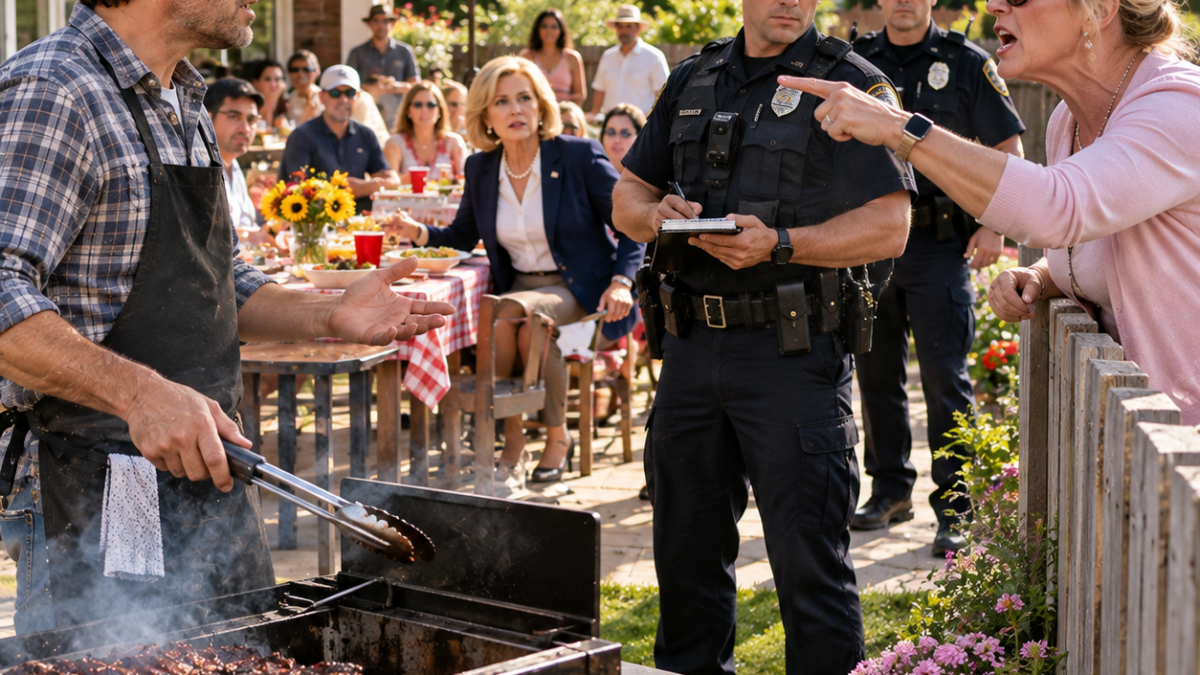
Ten minutes later, two patrol cars entered the cul-de-sac.
Karen stood near my driveway waiting.
I saw her straighten.
One officer was young.
Maybe twenty-eight.
The other, a sergeant in his forties.
They parked without lights.
That mattered.
No emergency.
Sergeant stepped out.
“Afternoon.”
Karen walked toward him immediately.
“I’m Karen Wilkins, HOA compliance committee.”
The sergeant looked at her.
“Okay.”
“I’m the complainant.”
“Understood.”
She began.
Too many vehicles.
Noise violation.
Smoke.
Unapproved event.
Possible alcohol.
Children in street.
Potential fire hazard.
Every sentence became slightly larger than the last.
The younger officer glanced toward my backyard.
People sitting at tables.
Paper plates.
Three toddlers.
One elderly man asleep in a lawn chair.
Not exactly chaos.
The sergeant asked:
“Did you personally observe illegal activity?”
Karen hesitated.
“I’m reporting violations.”
“City ordinance violations?”
“HOA and city.”
“We don’t enforce HOA rules.”
Her face shifted.
“I’m aware.”
She clearly had not expected him to say it first.
“But noise ordinances are city matters.”
“What volume?”
“Amplified.”
“How loud?”
“Clearly audible.”
The sergeant looked toward the backyard.
No music now.
Karen said:
“They turned it off when you arrived.”
I stepped forward.
“Officer.”
He looked at me.
“Ryan Mitchell. Homeowner.”
“Sir.”
“Private graduation barbecue. Started around three. Ends before eight. Thirty-two guests.”
“Any issue so far?”
“No.”
Karen said:
“Yes.”
The sergeant held up one hand.
“Ma’am, I’ll speak with you separately.”
Karen looked offended.
The younger officer walked the street.
Checked parking.
Returned.
“Nothing blocking driveways. One car maybe close to the corner, but legal distance.”
Karen said, “There are too many.”
The officer looked at her.
“Too many isn’t an ordinance.”
Her face reddened.
The sergeant asked me, “Music?”
“Bluetooth speaker. Low volume. Off now.”
“Any neighbor besides Ms. Wilkins complained?”
“Not to me.”
Karen interrupted.
“People don’t feel comfortable confronting him.”
I stared.
Anthony stepped out from behind me.
“I’m his next-door neighbor.”
The sergeant looked at him.
“Any complaint?”
“No.”
Maribel raised a hand from the patio.
“None.”
Greg called:
“Only complaint is he overcooked one rack.”
People laughed.
Tension broke slightly.
Karen looked furious.
The sergeant almost smiled.
Then he smelled the smoker.
“Any open-flame restrictions today?”
“No burn ban,” I said.
He nodded.
“That’s what I thought.”
Karen said:
“The HOA has rules about nuisance smoke.”
Again:
“We don’t enforce HOA rules.”
Her control was slipping.
That’s when she made the mistake.
She pointed at me.
“This man has been hostile toward compliance since he moved in.”
The sergeant’s expression changed.
Not toward me.
Toward the situation.
“Hostile how?”
“He has challenged multiple notices.”
“That’s an HOA issue.”
“He has accused committee members of trespassing.”
The sergeant looked at me.
“Did someone enter your property?”
“Yes.”
Karen said:
“For compliance inspection.”
The younger officer looked at her.
“Without permission?”
Karen’s mouth opened.
“It was the front lawn.”
“That wasn’t my question.”
Claire later told me that was the exact moment she stopped seeing the afternoon as merely ridiculous.
Karen wasn’t just overreacting to a barbecue.
She had become accustomed to crossing boundaries under color of association authority.
And now she was attempting to use police authority to reinforce it.
Karen noticed Claire only when Claire stood.
She placed the potato salad plate on the table.
Wiped her hands on a napkin.
Walked toward us.
Karen glanced at her.
No recognition.
Claire looked at the sergeant.
“Afternoon, Tom.”
The sergeant froze.
Not dramatically.
Just enough.
“Mayor Bennett.”
Karen’s face changed.
The younger officer straightened.
Claire smiled.
“Please don’t do that.”
“Sorry, ma’am.”
Karen stared.
Her eyes moved from Claire to me.
Back.
Then she looked as if someone had changed the floor under her.
Claire said:
“I’m not here in any official capacity.”
That was the first thing she said.
Important.
“This is a friend’s barbecue.”
She looked at Karen.
“I’ve been here since around three-thirty.”
Karen’s mouth opened.
Nothing came.
Claire continued.
“The music was not loud.”
She pointed toward the street.
“I parked over there. I had no difficulty getting through.”
Then toward the smoker.
“And unless city council passed a rib ordinance without telling me, I don’t believe the grill smoke is criminal.”
The younger officer looked down because he was trying not to laugh.
Karen found her voice.
“This isn’t funny.”
Claire’s expression softened.
“No.”
She looked at her.
“It isn’t.”
That removed the humor instantly.
Karen straightened.
“I am trying to protect this neighborhood.”
“From what?”
“Rules matter.”
“They do.”
Claire nodded.
“So do limits.”
Silence.
Karen’s face tightened.
“This is an HOA matter.”
“Then why did you call police?”
That question landed harder than anything else.
Karen looked toward the officers.
“Because city ordinances were being violated.”
The sergeant said:
“We haven’t observed a violation.”
“You arrived after they stopped the music.”
Claire said, “I was here while it was playing.”
Karen snapped:
“With respect, Mayor, you’re his friend.”
“Yes.”
“And therefore not neutral.”
Claire paused.
“Fair.”
That surprised Karen.
Claire continued.
“So don’t take my word for it.”
She pointed toward several houses.
“Ask the neighbors.”
The sergeant did.
Door to door.
Five houses.
Greg and Linda.
The Chens.
Anthony.
A woman named Paige across the cul-de-sac.
An elderly couple near the entrance.
No noise complaint.
No blocked access.
No safety issue.
One person said she could smell barbecue.
The officer asked whether it bothered her.
She said:
“It made me hungry.”
When the sergeant returned, he faced Karen.
“We don’t have an enforcement issue.”
Karen said:
“I want an incident number.”
“You’ll get one.”
“And I want it documented that there was amplified music.”
“Your statement can be documented.”
“And excessive vehicles.”
“Your statement can be documented.”
“Smoke.”
“Your statement.”
She heard the distinction.
What Karen said would be documented.
Not established as fact.
She looked at me.
“This isn’t over.”
Claire said quietly:
“Karen.”
Karen turned.
“If you keep using city services to enforce private disagreements, you may create a problem much bigger than the barbecue.”
Karen laughed bitterly.
“Is that a threat from the mayor?”
Claire’s expression changed.
“No.”
She stepped back.
“It’s advice from somebody who understands how public resources work.”
Karen looked toward the officers.
“Did everyone hear that?”
Sergeant Tom Wallace said:
“Yes.”
Then, calmly:
“And I did not interpret it as a threat.”
Karen had nothing left.
She walked home.
Fast.
No goodbye.
The officers stayed five more minutes.
Not to shut anything down.
To eat ribs.
Technically they were between calls.
Greg insisted.
The younger officer took one plate.
Tom refused twice.
Then Claire said:
“Sergeant, if you make me eat all the potato salad, I’m filing a complaint.”
He accepted.
The barbecue recovered.
Slowly.
Children started running again.
Music returned.
Lower than before, mostly because nobody wanted another excuse.
Sofia opened her graduation gifts.
Anthony made a speech.
Claire kept hers short.
Exactly twelve words:
“Congratulations, Sofia. Ignore every adult who says your future is already decided.”
Then sat.
By seven-thirty, most guests left.
No police.
No chaos.
No citywide emergency.
Just paper plates and leftover ribs.
I thought that would be the end.
I underestimated Karen.
Monday morning, I received an HOA violation notice.
Three violations.
Unauthorized amplified entertainment.
Excessive vehicle congestion.
Nuisance smoke.
Total fine:
$450.
I laughed.
Then called Denise.
She sounded tired before I spoke.
“You got it.”
“Yes.”
“I told the committee not to issue it.”
“Who approved?”
“Karen signed as acting compliance chair.”
“Acting?”
“Our chair is on vacation.”
“Does she have authority to fine?”
“Technically she can recommend.”
“Recommend isn’t issue.”
Silence.
“Denise.”
“I know.”
I forwarded my pre-event email.
Her approval.
Police incident record.
No citations.
Photographs of legal parking.
And, because life had a sense of comedy, a photo of Mayor Claire Bennett eating potato salad under my patio umbrella.
Denise laughed.
“I probably shouldn’t laugh.”
“You should.”
Then her tone changed.
“Ryan, there may be a larger problem.”
“What?”
“I checked your account because of the fine.”
I waited.
“You have eleven compliance entries.”
“I know about four.”
“I know.”
That sentence changed the conversation.
“What’s the other seven?”
“Internal observations.”
“For what?”
“Potential noncompliance.”
“Potential?”
“Notices were apparently held pending pattern review.”
“Who entered them?”
Silence.
“Karen?”
“Yes.”
I drove to the HOA management office that afternoon.
Denise printed everything.
Karen had created an unofficial file.
Notes.
Photos.
Dates.
My visitors.
My work truck.
One note said:
Resident frequently challenges committee authority.
Another:
Pattern of adversarial behavior may require escalation.
Another:
Potential unapproved commercial activity—multiple daytime deliveries.
Those were computer equipment deliveries for my job.
Another:
Possible overnight guest parking.
My sister.
Another:
Resident verbally confrontational.
That referred to me telling Karen not to enter my lawn.
I stared at the pages.
“This isn’t compliance.”
Denise said nothing.
“It’s surveillance.”
She looked uncomfortable.
“I would use the word excessive.”
“Of course you would.”
“Ryan.”
“Sorry.”
She nodded.
“I should have caught it.”
That mattered.
Not defensiveness.
Responsibility.
“Has she done this to anyone else?”
Denise’s expression answered before her words.
“Yes.”
“How many?”
“I don’t know yet.”
That became the real story.
Not my barbecue.
Over the next week, the HOA board reviewed Karen’s compliance records.
Seventeen homeowners had internal monitoring notes.
Nine had received fines after disputes with Karen.
Six involved rules the HOA did not clearly authorize.
One widow, Mrs. Talbot, had paid $1,200 over two years for “excessive garden ornamentation.”
The governing documents contained no such rule.
A family with a disabled child had been fined repeatedly because their medical transport van remained in the driveway overnight.
Karen had classified it as a commercial vehicle.
It wasn’t.
Anthony had three notes because he left basketball equipment near his garage.
The Chens had a file labeled “recurring guest occupancy” because Mrs. Chen’s mother stayed for several weeks after surgery.
None of this meant every complaint was invented.
Some were valid.
But Karen had blurred the line between rules and preferences.
Worse, Harold had signed several fines without reading them closely.
He admitted it.
At the emergency board meeting, he looked ten years older.
“I trusted the committee.”
A resident shouted:
“That’s the problem.”
Harold nodded.
“Yes.”
No defense.
That calmed the room more than argument would have.
Karen sat at the end of the table.
She had hired an attorney.
Of course.
He spoke first.
“My client rejects the characterization that she engaged in harassment.”
Nobody said harassment.
Interesting.
He continued.
“Ms. Wilkins volunteered countless hours for this community.”
True.
“Any documentation maintained was related to legitimate compliance responsibilities.”
Debatable.
“Selective criticism after a highly publicized social event has unfairly targeted her.”
Karen looked toward me.
There it was.
I was the source of her persecution.
The board attorney, a woman named Sheila Ross, asked:
“Was Ms. Wilkins authorized to maintain separate resident behavior files?”
Karen’s attorney said:
“Separate is misleading.”
Sheila held up printed screenshots.
“These were stored in a personal cloud folder labeled PROBLEM HOMES.”
The room erupted.
Karen closed her eyes.
I had not known the folder name.
PROBLEM HOMES.
Sheila continued.
“Seventeen addresses.”
Karen said:
“It was organizational.”
Mrs. Talbot stood.
She was seventy-nine.
Five foot nothing.
Silver hair.
She held one of her decorative ceramic geese under her arm.
Nobody knew why.
She said:
“My house is number six.”
Karen looked at her.
“Margaret—”
“No.”
Mrs. Talbot placed the ceramic goose on the table.
“You fined me for this.”
Somebody laughed.
She pointed.
“You said decorative lawn animals harmed visual consistency.”
Karen said:
“There were multiple ornaments.”
“Three.”
“Margaret—”
“One was a frog.”
The room laughed harder.
Mrs. Talbot didn’t.
“My husband bought that goose in Wisconsin in 1998.”
She looked around.
“He died five years ago.”
Silence.
“I paid your fines because I thought rules were rules.”
She looked at Karen.
“Turns out they were Karen.”
That phrase spread through Maple Lane by morning.
Not rules.
Karen.
The board voted to suspend all outstanding compliance fines pending review.
Then they removed Karen from the committee.
Four to one.
Karen herself cast the one.
She stood.
“This board is surrendering standards because people don’t like accountability.”
Anthony said from the back:
“No. We don’t like making up crimes because you don’t like parties.”
Karen turned.
“That is exactly the mob mentality I’m talking about.”
Then Claire Bennett entered.
Not casually this time.
No potato salad.
Suit.
City folder.
Everyone stared.
Karen looked horrified.
Claire walked to the public seating area.
Harold said:
“Mayor Bennett?”
“I’m here as a resident’s requested witness and to provide public information.”
Karen’s attorney stood.
“This is highly inappropriate.”
Claire nodded.
“Then you’ll appreciate that I cleared it with city counsel before coming.”
He sat.
Claire handed documents to Sheila.
“Maple Grove’s board requested clarification on whether city police may be used for HOA enforcement.”
Sheila nodded.
Claire continued.
“The answer is no.”
Nobody needed that explained, but she did anyway.
“Residents may call police when they believe a city ordinance or criminal law is being violated. Police determine whether there is an enforcement issue. HOA officials have no special standing.”
Karen’s attorney said:
“My client knows that.”
Claire looked at him.
“The 911 and non-emergency logs indicate eight calls from Ms. Wilkins or numbers associated with her household over the past eighteen months involving HOA-related disputes.”
Karen went still.
Eight.
I only knew about mine.
Claire continued.
“Three involved parking.”
“One involved a basketball hoop.”
“One involved a contractor working within permitted hours.”
“One involved children drawing chalk in the street.”
A laugh.
“One involved a resident’s dog temporarily off leash on private property.”
Another laugh.
“And Saturday involved Mr. Mitchell’s barbecue.”
Karen’s face turned red.
Her attorney whispered to her.
Claire continued.
“None resulted in citation.”
Then the serious part.
“City dispatch flagged two previous calls as potential misuse because the caller represented herself as speaking with HOA enforcement authority.”
Karen’s attorney stood.
“My client had every right to contact police.”
“Yes.”
Claire agreed.
“Every resident does.”
That took the fight out of his objection.
“But public safety resources are limited.”
She looked around the room.
“Calling police because you sincerely believe law is being broken is appropriate.”
Then at Karen.
“Calling police to add pressure to a private association dispute is not.”
Karen snapped:
“You’re only here because Ryan is your friend.”
Claire nodded.
“Yes.”
The room quieted.
Karen hadn’t expected admission.
Claire continued.
“That is why I disclosed it.”
Pause.
“And why I brought records instead of opinions.”
That was the difference.
Evidence.
Not status.
Karen sat.
The board meeting lasted three hours.
By the end, they voted to commission an independent audit of all fines issued over the prior three years.
Harold resigned as president.
Not because anyone demanded it.
Because he said:
“I signed things I should have read.”
That sentence earned him more respect than staying would have.
The interim president became Sheila Ross temporarily until elections.
Karen walked out without speaking to me.
The audit took six weeks.
It found $18,700 in fines and fees that either lacked clear governing authority or had procedural defects.
Not all Karen’s fault.
Some were management mistakes.
Some board errors.
But a large portion originated with her compliance recommendations.
The HOA refunded money.
Including Mrs. Talbot’s $1,200.
She celebrated by placing a fourth ceramic animal in her yard.
A duck.
Karen moved it three inches one night.
Doorbell camera caught her.
She returned it the next morning before anyone reported anything.
Growth, perhaps.
Then came the civil threat.
Karen sent me a lawyer’s letter alleging defamation, harassment, and intentional infliction of emotional distress.
The supposed defamatory statements?
I had told Anthony she called police on my barbecue.
True.
I had submitted her compliance notes to the board.
Authentic.
I had allowed the police incident to become known.
Public record.
My attorney, Marcus Bell, responded in three pages.
His final sentence:
Our client declines your request to apologize for accurately describing events your client personally caused.
I framed that one.
Karen did not sue.
What she did do was run for HOA president.
That surprised everyone.
Her campaign flyer appeared in mailboxes three months later.
RESTORE ORDER TO MAPLE GROVE.
Underneath:
PROPERTY VALUES. FAIRNESS. COMMUNITY STANDARDS.
No photograph of her.
Probably wise.
Her speech at the candidate forum was polished.
“I made mistakes.”
Good start.
“I was too aggressive at times.”
Also good.
“But communities cannot abandon standards simply because enforcement is unpopular.”
There it was.
Still not full ownership.
She framed herself as the necessary adult punished for caring too much.
Some people agreed.
Not many.
I wasn’t running.
Neither was Anthony.
The strongest candidate was Maribel Delgado.
She had no interest in power.
Which is often a good sign.
She said:
“I want meetings to be boring.”
Applause.
“I want the rules to mean what they actually say.”
More applause.
“I want residents to know before they are fined.”
More.
“And I don’t want the police called because somebody grills meat.”
The room laughed.
Karen did not.
Maribel won sixty-eight percent of the vote.
Karen received nineteen.
The rest went to a third candidate.
The first thing Maribel did was eliminate the compliance committee.
Not enforcement.
The committee.
All concerns went through the management company.
Documented.
Reviewed.
Notice and appeal process.
No volunteers measuring grass.
No private resident files.
No midnight photography.
Just procedure.
Boring.
Beautiful.
Something else changed after the barbecue.
People started using my patio.
Not constantly.
I still liked privacy.
But more often.
Friday coffees.
Football games.
Birthdays.
A retirement party for Greg.
Mrs. Talbot’s eightieth birthday.
She brought the goose.
Claire came occasionally.
Every time she did, somebody joked about potato salad.
She hated the story because people turned her into the heroic mayor who “shut Karen down.”
That wasn’t what happened.
Claire never ordered anybody.
Never threatened.
Never used office power to settle my dispute.
She simply stood up.
Identified herself.
Told the truth about what she observed.
That mattered to me.
Power used carefully is more impressive than power used loudly.
Karen and I barely spoke for almost a year.
Then something happened I did not expect.
Her husband, David, had a heart attack.
Not massive.
Serious enough.
Ambulance came.
I saw Karen standing in the driveway as paramedics loaded him.
She looked nothing like the woman at my barbecue.
No committee.
No sunglasses.
No authority.
Just terrified.
I walked over.
“Do you need a ride?”
She looked at me.
For several seconds she could not answer.
Then nodded.
I drove her to the hospital.
The whole way, silence.
Halfway there, she said:
“You don’t have to do this.”
“I know.”
“You probably hate me.”
“No.”
She looked out the window.
“You should.”
“That’s not useful.”
She cried quietly after that.
David received a stent.
Recovered.
No lasting damage.
We sat in the waiting room for three hours.
At some point Karen said:
“I called the police on you because I wanted them to embarrass you.”
I looked at her.
No preamble.
No excuse.
She continued.
“I knew the party probably wasn’t illegal.”
Silence.
“I thought if officers came, everybody would see that I was right to be concerned.”
“About what?”
She laughed sadly.
“You.”
“Why?”
“You didn’t respond to me the way other people did.”
I waited.
“You read the rules.”
That almost made me laugh.
She saw it.
“I’m serious.”
“I know.”
“Most people just wanted the notice to go away.”
“You wanted that.”
“Yes.”
She looked down at her hands.
“When you challenged me, I felt like you were challenging whether I mattered.”
There it was.
Not grass.
Trash cans.
Music.
Ribs.
Importance.
Karen had found identity in enforcement.
Maybe after children grew.
Maybe marriage became ordinary.
Maybe career stalled.
I didn’t know.
Didn’t need to diagnose her.
She said:
“I turned being useful into being in charge.”
That was remarkably accurate.
I said:
“Yes.”
She smiled through tears.
“You could pretend to argue.”
“You want honesty.”
“I suppose I earned it.”
David recovered enough to go home two days later.
Karen thanked me.
Nothing magically reset.
We did not become friends.
The old fines did not vanish because she had a vulnerable afternoon.
But after that, she changed.
Not dramatically.
She still liked rules.
Still disliked tall grass.
Still complained when people parked badly.
But she complained as a resident.
Not self-appointed enforcement.
One Saturday, I saw her walking near Mrs. Talbot’s yard.
The ceramic duck had fallen over.
Karen stopped.
Picked it up.
Set it upright.
Then kept walking.
I did not mention it.
Some changes deserve privacy.
Months later, the city invited Maple Grove to participate in a neighborhood listening forum.
Claire asked whether I would speak.
“No.”
“Why?”
“Because I have a grill.”
She laughed.
“Ryan.”
“What?”
“You complain about community all the time.”
“I wanted community. Not municipal speaking opportunities.”
She eventually convinced Anthony instead.
Good choice.
At the forum, Claire spoke about neighborhood governance.
Not Karen.
Not my barbecue.
Systems.
She said something I remembered:
“Rules without restraint become personality.”
That was exactly what Maple Grove had learned.
An HOA is paperwork.
Covenants.
Budgets.
Landscaping.
Road maintenance.
It should be boring.
The moment it becomes somebody’s identity, trouble starts.
Same with any small authority.
School board.
Condo board.
Church committee.
Volunteer association.
Neighborhood watch.
Power does not need to be large to become intoxicating.
Sometimes all a person needs is a clipboard and nobody saying no.
Two years after the barbecue, Sofia graduated from college.
We held another party.
Same backyard.
More people this time.
Forty-three.
I checked the rules.
Still under fifty.
I emailed management.
Old habits.
Maribel replied:
Ryan, stop asking permission for legal barbecues.
I printed that too.
Karen came.
Invited.
I debated inviting her.
Anthony said:
“If you don’t, the story owns you forever.”
Annoyingly wise.
She arrived carrying baked beans.
No potato salad.
Claire came later.
The moment Karen saw her, she laughed.
Actually laughed.
“No police today?”
Claire said:
“Depends on the ribs.”
Karen looked at me.
“Still overcooking?”
Greg shouted:
“Yes!”
I flipped him off with grill tongs.
Children ran.
Cars parked.
Music played.
Nobody measured anything.
At sunset, I looked around.
This was the neighborhood I had wanted.
Not perfect.
Not conflict-free.
That doesn’t exist.
A real neighborhood includes people who annoy you.
People who apologize.
People who don’t.
People who lend ladders.
People who report your trash cans.
People who bring food when someone gets sick.
People who spend a year learning that authority has edges.
Community isn’t the absence of friction.
It’s learning which friction deserves police and which deserves a conversation.
Most deserves the conversation.
Karen eventually sold her house.
Not because of humiliation.
David wanted to move closer to their daughter and new grandson.
Before closing, she came to my patio.
Same one.
No party.
I was drinking coffee.
She sat.
“Do you remember when I told you Maple Lane wasn’t your sovereign territory?”
“Yes.”
She winced.
“I was unbearable.”
“Occasionally.”
“Occasionally?”
“I am practicing kindness.”
She laughed.
Then looked around.
“You were right.”
“About?”
“A neighborhood.”
I waited.
“It isn’t rules.”
“No.”
“It isn’t property values.”
“No.”
“It isn’t even whether everybody likes each other.”
“No.”
She smiled.
“Are you going to contribute?”
“I want to see how long you go.”
She shook her head.
“It’s people knowing where they stop.”
That surprised me.
“That’s pretty good.”
“I’ve had time.”
She looked toward her old house.
“I thought boundaries kept communities apart.”
Pause.
“They’re what let people get close without hurting each other.”
I did not improve the sentence.
Didn’t need to.
When she left, she handed me something.
A folded sheet.
The original barbecue violation notice.
Unauthorized amplified entertainment.
Excessive vehicle congestion.
Nuisance smoke.
Across it, in red marker, she had written:
VOID.
I laughed.
“Keeping this.”
“I assumed.”
“Emotional support paperwork.”
She frowned.
“What?”
“Nothing.”
Wrong story.
Karen moved.
New family arrived.
Young couple.
Toddler.
First week, the husband knocked on my door.
“Hey, I’m Aaron.”
“Ryan.”
“We’re having my son’s birthday next month.”
“Okay.”
“Maybe twenty-five people.”
I waited.
He looked nervous.
“Do we need to notify anybody?”
I laughed.
Longer than necessary.
“No.”
“Really?”
“Really.”
“Music?”
“Keep it reasonable.”
“Cars?”
“Don’t block driveways.”
“Grill?”
I stared at him.
He looked confused.
“Just checking.”
I pointed toward my backyard.
“Grill aggressively.”
He laughed.
That Saturday, I sat on my patio while their birthday party happened two houses down.
Music.
Children.
Smoke.
A balloon floated into my yard.
Nobody called police.
Progress is often that quiet.
Claire eventually left office.
Term limits.
Her last year as mayor, the local newspaper ran a profile.
The reporter asked for memorable moments.
Road projects.
Flood recovery.
Factory expansion.
She mentioned none of those first.
She said:
“Once I watched two police officers investigate a rack of ribs.”
The quote went everywhere.
She called me furious.
“You gave them that story.”
“I did not.”
“You laughed when they asked.”
“I did.”
“Ryan.”
“It was funny.”
She sighed.
Then laughed too.
People still tell the story wrong.
They say:
Karen called cops on BBQ, mayor was guest, Karen got destroyed.
That version is easy.
Satisfying.
Wrong in the important ways.
Karen wasn’t destroyed.
She was corrected.
Then exposed.
Then embarrassed.
Then, eventually, changed.
The mayor did not crush her.
Procedure did.
Records did.
Neighbors did.
Her own files did.
The police simply refused to become an HOA enforcement arm.
That distinction matters.
If Claire had stood up and ordered the officers to “deal with Karen,” the story would just be authority replacing authority.
She didn’t.
She said:
“I was here.”
“This is what I observed.”
“Ask the neighbors.”
Evidence.
That’s why I still respect her.
And Karen’s lesson wasn’t that powerful people might be hiding at your neighbor’s cookout.
It wasn’t:
Be careful who you call police on because maybe the mayor is eating potato salad.
That’s funny.
But shallow.
The deeper lesson was:
Don’t call authority hoping it will turn your personal preferences into law.
Don’t use police because somebody refused to obey you.
Don’t turn public resources into leverage in private arguments.
And don’t confuse being active in a community with owning it.
I moved to Maple Lane because I wanted people.
I got Karen.
I got Anthony.
Maribel.
Greg.
Linda.
The Chens.
Mrs. Talbot and her ridiculous goose.
Sofia.
Claire.
Police officers eating ribs.
Kids running barefoot through grass.
Rainstorms.
Tree limbs.
Arguments.
Apologies.
Exactly what I wanted, though I didn’t know it yet.
A neighborhood.
Real ones are messy.
They are supposed to be.
Years after that first barbecue, I still use the same smoker.
Same patio.
The speaker is newer.
Mochi is gone now.
That one hurts.
Greg’s brisket remains overrated despite what he tells everyone.
Mrs. Talbot’s goose now belongs to her granddaughter.
Maribel still runs HOA meetings so efficiently they rarely last forty-five minutes.
Nobody misses the compliance committee.
And sometimes, when I stand behind the grill with smoke drifting above the fence and music playing and people laughing louder than Karen once considered appropriate, I think about the moment those patrol cars rolled into the cul-de-sac.
Karen stood there certain she had finally brought enough authority to make me comply.
I stood in my driveway wondering how a plate of ribs had become a police matter.
And behind me, Mayor Claire Bennett was eating potato salad from a paper plate, waiting to see whether the officers would do what public servants are supposed to do.
Look.
Ask.
Determine facts.
Then leave people alone when no law has been broken.
They did.
That was the whole thing.
The police did not shut down my barbecue.
The mayor did not shut down Karen.
The HOA did not collapse.
Nobody got arrested.
Nobody went to jail.
No courtroom climax.
Just a neighborhood being forced to decide what kind of community it wanted to be.
One where the loudest volunteer could borrow public authority whenever someone annoyed her.
Or one where rules stayed inside their limits.
Maple Grove chose the second.
Slowly.
Messily.
But it chose.
And Karen?
The last text she ever sent me before moving said:
Aaron’s birthday party is louder than yours was.
I replied:
CALL THE MAYOR.
Three dots appeared.
Then:
Very funny.
A second later:
Also, his burgers smell terrible.
I wrote:
That’s not illegal.
She replied:
I know.
That might have been the most satisfying ending of all.
Not because Karen lost.
Because she finally knew where the line was.








